Tag Archives: Zoo Break

16th May 2023

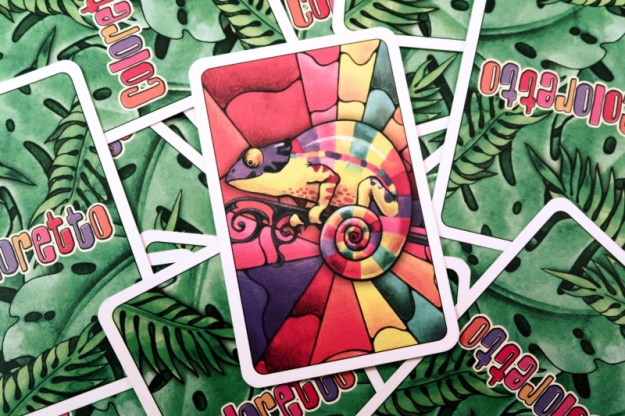
Unusually, Blue and Pink were joined early by Lime for pizza, and Pine who wasn’t eating.  So, while they were waiting for food to arrive the group squeezed in a very quick game of Coloretto. This is a popular game within the group, but somehow Lime had missed out on it.  It is quite simple to play, but one of those games that takes a couple of tries to get the hang of playing well, or as in Blue’s case, lots of tries and still not play it well.  The idea is simple enough though:  players take it in turns to either take a coloured chameleon card from the deck and add it to one of the “trucks”, or take one of the trucks and add the cards on it to their display.

Coloretto
– Image by boardGOATS

Players score points according to the triangular number series where every additional card is worth one more additional point than the previous card.  Thus, the fourth card someone gets is worth ten points, four more points than the third card (which itself is worth three more than the second and so on).  Collecting chameleons was briefly interrupted by the arrival of Hoi-sin duck pizzas, but that didn’t stop Pink winning with a total of thirty-seven points,  well ahead of a tie for second place between Blue and Pine.  By this time, Purple, Black and Teal had arrived and it was time to decide who was going to play what.
Coloretto
– Image by boardGOATS

Pink and Lime were very keen to give Zoo Break another go, having left the town of Bedlam over-run with escaped animals last time the group played.  With it being such a quiet night, there was some debate as to what the other group were going to play, but in the end they opted for the “Feature Game“, the Marina expansion to one of our most popular little games, Draftosaurus.  Pine was keen to play with the cute wooden zoo meeples and after the mayhem last time, Blue was also keen not to miss out, which left Purple, Black and Teal to play with dinosaurs.  The only problem was, none of them knew how to play it, so while Lime, Pink and Pine set up Bedlam Zoo, Blue quickly explained the rules to Draftosaurus.

Draftosaurus
– Image by boardGOATS

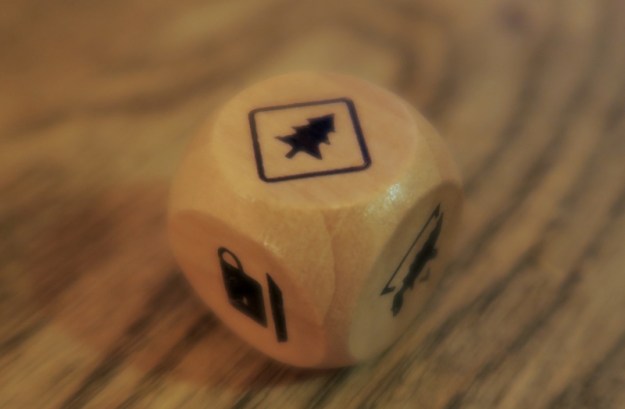
Draftosaurus is a very simple drafting game in the vein of Sushi Go! or 7 Wonders, but instead of drafting cards, players are drafting wooden dino-meeples.  The idea is that players start with a handful of dino-meeples and choose one to keep and pass the rest on to the next player.  The active player rolls a location die which adds restrictions on which pens players can place their chosen dinosaur in in their dino-park.  When everyone has placed their first dino, the die is passed to the next player and everyone chooses their next meeple from the pile passed to them by their neighbour.  The round is complete when each player has placed six meeples, and the game is played over two rounds (passing dino-meeples in opposite directions in each round).
Draftosaurus
– Image by boardGOATS

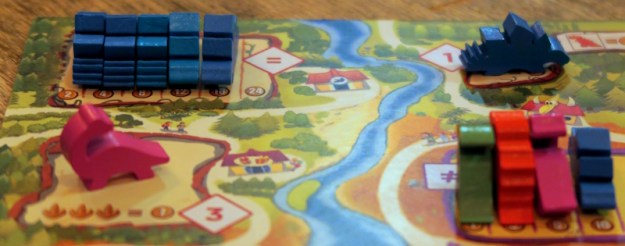
The Marina expansion adds brown Plesiosaurs to the yellow Triceratops, blue Stegosaurus, pink Brachiosaurus, orange Spinosaurus, green Parasaurolophus, and red Tyrannosaurus rex from the base game.  Where dinosaurs from the base game can always be placed in the river that runs through the middle of each player’s park (where they only earn a single point), Plesiosaurs all go into the river, which they travel along into an expansion board.  Each expansion board is slightly different, but when a player places the non-Plesiosaur dinosaur shown on the bridge, if they have a dinosaur immediately up-stream of the bridge, it can pass under it into the next section of the river where it will score more points.

Draftosaurus
– Image by boardGOATS

It was a close game with everyone following different tactics.  Teal concentrated on trying to fill his Meadow of Differences while Black focused on collecting pink Brachiosaurs and Purple stuffed her Forest of Sameness with blue Stegosaurs.  Black took one Plesiosaur, Purple collected two and Teal three, though only one of his made it under the first bridge and out of the main river.  Purple managed to minimise the number of non-scoring dino-meeples in her park, and that just gave her the edge, and she finished a couple of points ahead of Teal who took second place.

Draftosaurus: Marina
– Image by boardGOATS

Although Teal, Purple and Black tried to persuade her to stay (and there was even some suggestion of her playing both games simultaneously), once she had explained the rules, Blue joined the madness in Bedlam, playing Zoo Break.  In this game, players are keepers trying to prevent their charges escaping from the zoo, and to win the game, they have to return all escaped critters to their enclosures and lock the doors.  Losing is much easier—if five cuddly creatures or one dangerous one escape from the zoo, then it is all over.  Last time, only one animal escaped, but it was a cobra, so that was that.

Zoo Break
– Image by boardGOATS

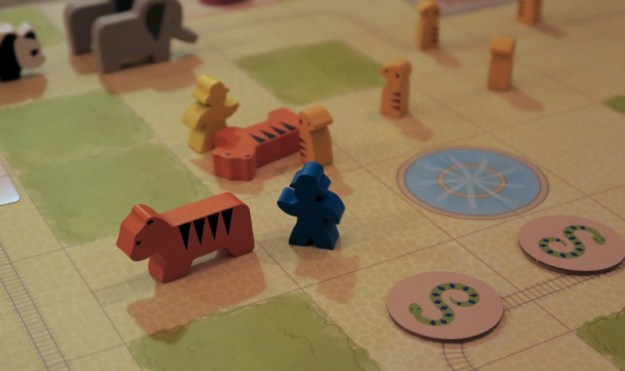
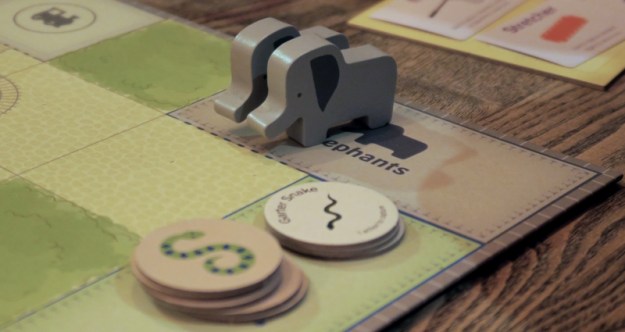
On their turn, players first roll the action die to find out how many Action Points the player has to work with for that round.  Then, after they have carried out their actions, one card from the Escape deck and then one card from the Move deck are revealed.  The Escape card liberates one or more animals, while the Move card often moves animals towards the exit, but occasionally causes other things to happen, like waking up sleeping tigers, breaking barricades and generally cause more chaos.  After last time, the group decided to start by digging through the Supply deck and make sure everyone went really well equipped, then, prioritise capturing (or at least controlling) the Meerkats, as they had been so problematic last time.

Zoo Break
– Image by boardGOATS

On that occasion, the group had played with two “Phew” Cards in the Escape deck, and (following a rules malfunction) all the blank cards in in the Move deck.  In spite of all the blank cards, they still lost spectacularly.  So, this time, the group stuck with the two “Phew” Cards, but removed the blanks from the Move deck and did not add any other rules variants as they really wanted to win, though they stuck with the thematically logical variant where tigers remain tranquilised when returned to their pen. Lime had the Black Belt special power which meant he couldn’t be hurt by animals, so he got the job of dealing with snakes which hide so players have to reveal them, with the risk of being attacked if they are dangerous.

Zoo Break
– Image by boardGOATS

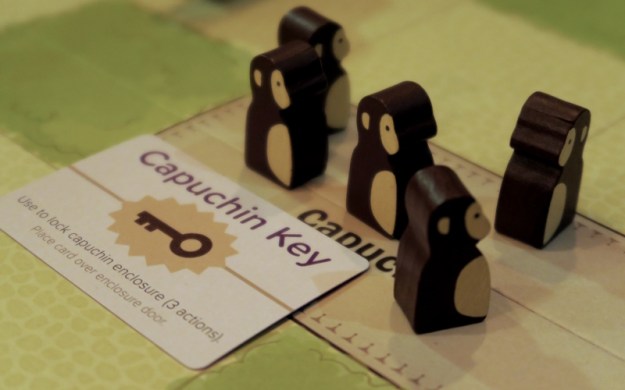
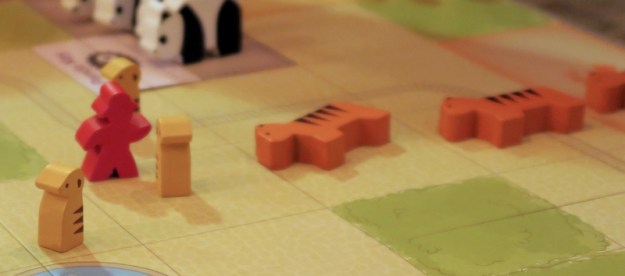
Pink, as usual wanted to work with the pandas, but the Capuchin monkeys were a more immediate threat, and the group made a point of dealing with the troublesome meerkats early this time, so then he went on to deal with them once the monkeys were locked up.  Blue, who had the panda enclosure key, took over trying to control them, but they kept escaping just as Blue was about to lock their cage. Blue was encouraged to capture one panda who was in the rhino’s path, but that meant she was left standing there—”You’ll be fine”, said Pink.  And Blue was immediately flattened by a charging rhino and had to spend a turn with the medic removing the hoof-prints from her forehead.  One meerkat escaped from the zoo, but was left to run free so Keepers could focus elsewhere and then lock their enclosure.
Zoo Break
– Image by boardGOATS

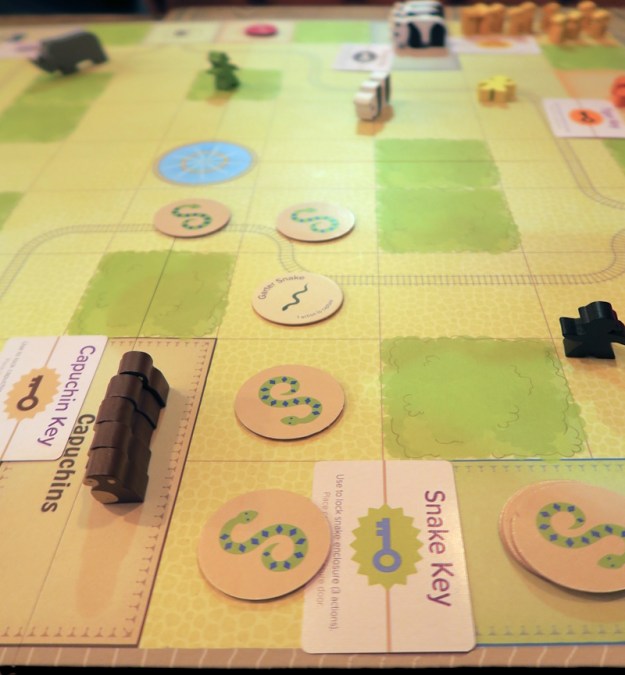
With two enclosures locked early, things became slightly more manageable.  The group wimped out of using the faulty lock variant however, because nobody wanted to risk failing a second time, and certainly, including it would have made things much more difficult.  As it was, one tiger got within sniffing distance of freedom, but was tranked before he could take that one final bound.  Pine made excellent use of his running skills (as Track Star he could move twice as fast as anyone else) and bravely helped Lime with snakes and wielded his dart gun—before long, the zoo was littered with big sleeping cats.  That was all very well, until they woke up at which point Pine had to do the job all over again.
Zoo Break
– Image by boardGOATS

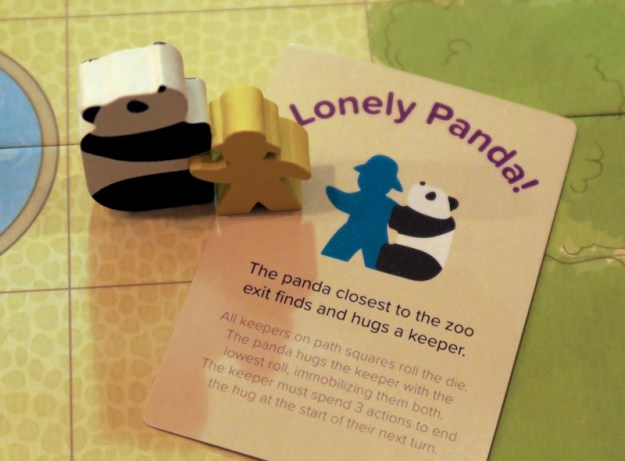
After her run-in with the rhino, Blue tried to end her turn on hedge spaces, but that meant she was unable to swap supplies with other players as she couldn’t share her space.  Once the Pandas were vaguely under control, Blue was able to get a stretcher and another dart gun and help Pine with the tigers, making use of her Gardener ability, hiding in bushes and taking a pop at the big kitties from a place of safety.  While Pine and Blue were working on the tigers, the elephants started rampaging.  As the nearest and armed with a leash, Lime took a break from snakes and tried prevent them from causing too much damage.  This was all very well until (much to Pink’s disgust as he would have loved a black and white cuddle), Lime rolled the lowest number and got hugged by a panda leaving him unable to do anything until it was prised off him.
Zoo Break
– Image by boardGOATS

In the dying rounds, Pink’s, and indeed everyone else’s delight was evident, when another panda popped up for a cuddle and everyone cheered when Pink was the one to roll the lowest number and get a hug.  As the Lucky Duck, on his turn he was able to roll the Action Die multiple times to get more points, but he checked the rules to see if he was obliged to spend his first three points to escape from the furry cuddle or whether he could just stay there for the rest of the game.  In the end, he sent it back to its enclosure, but it probably wouldn’t have mattered.  With one last push, Pine and Lime rounded up the last of the snakes, then the group finally sorted out the charging elephants and mischievous pandas, and finally locked up the rhino, giving the group a much deserved victory.

Zoo Break
– Image by boardGOATS

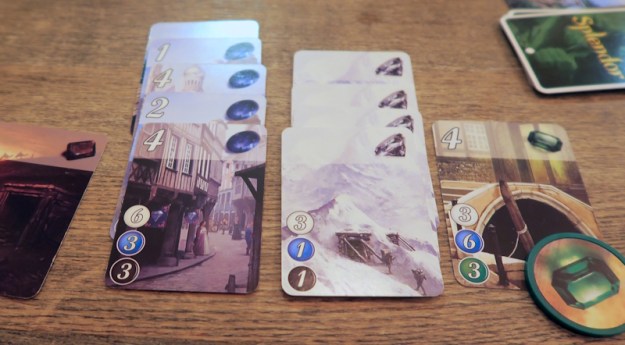
Draftosaurus is a much quicker game than Zoo Break, so while they Keepers were dealing with the tigers, elephants and disobedient pandas, Teal, Black and Purple moved onto play Splendor.  This was one of Burgundy’s favourite games and he was almost unbeatable at it, so we never play it without thinking of him.  It is a very simple engine builder card game, but takes great skill to repeatedly win in the way Burgundy did.  The idea is that on their turn, players either collect gem tokens (three different colours, or two the same as long as there are at least four left), or spend tokens to buy cards from the market.  Cards act as permanent gem tokens (effectively reducing the cost of cards later in the game), but also provide Victory Points—when a player passes fifteen points, that triggers the end of the game.
Splendor
– Image by boardGOATS

In addition to the two basic actions, there is also the relatively rarely used action of reserving cards, where a player gets a wild, gold token and can reserve one card which they can pay for later.  This time, both Teal and Purple reserved cards, while Black prioritised taking high value cards.  Reserving cards can be a very effective tactic, but the game is all about the cards available in the market and surfing through them as quickly and efficiently as possible and amassing points.  As it was, Black romped away with victory, his fifteen points three times that of anyone else.  And with that, both Splendor and Zoo Break finished, leaving the group with a little time to play something else.  Teal and Lime headed off, so after some discussion, Pine, Black, Purple, Pink and Blue decided to give Draftosaurus with the Marina expansion another go as it was the “Feature Game“.
Draftosaurus
– Image by boardGOATS

It was then that the group realised the errors in the original explanation, in particular how the Solitary Isle enclosure worked.  Pine corrected Blue’s errors and the second game began.  Pine and Blue both tried to exploit the Plesiosaurs at every opportunity, and Pink tried to claim extra points for reverse parking his solitary Plesiosaur into the dock.  It turned out he didn’t need them though, as with forty-seven points he took his third win of the night.  Blue and Black tied for second place, while Purple unfortunately had to recount when she realised she had a pink Brachiosaur elsewhere in her park so couldn’t score seven points for her solitary Isle.  That left a bit of time for a chat, but everyone was tired and it wasn’t long before the last of the group headed home.

Draftosaurus: Marina
– Image by boardGOATS

Learning Outcome:  Who needs TV when you’ve got T.Rex?
2nd May 2023

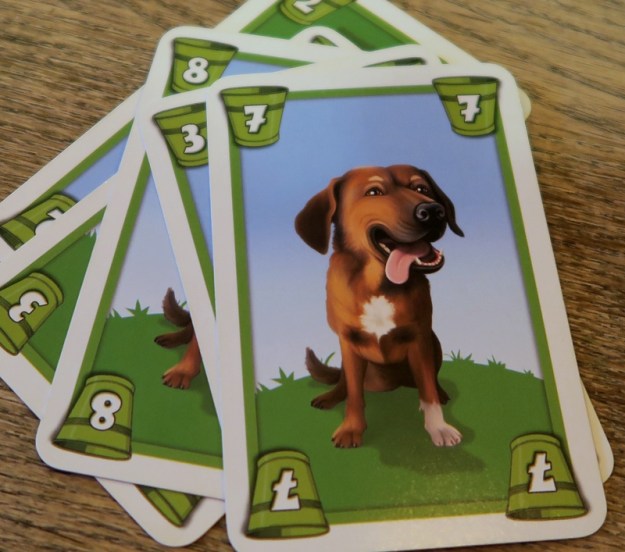
Blue and Pink were the first to arrive and were just finishing their supper when Magenta walked in—sadly not to join in the games as she was there for a Scout meeting.  After a quick chat, she left and as Blue recapped the rules for the “Feature Game“, Zoo Break, Teal arrived and then Purple and Black.  The group had just decided to play Alles im Eimer (aka The Bucket King), when Ivory rocked up to make the full compliment of six.  Purple explained the rules with help from Black.  The idea is very simple:  each player builds a pyramid of ten bucket tokens with two of each of five colours.

Alles im Eimer
– Image by boardGOATS

One player starts, playing a coloured, numbered, animal card and each player has to follow with the same colour and a higher number before picking up a card.  Players can play multiple cards to make the total, but they only ever receive a single replacement card.  If they can’t, or choose not to follow, they lose a bucket of that colour, and any buckets above it.  Worse, if they split their pile of buckets in two, they lose one part as players can only ever have one pile.  On the plus-side, if a player can’t play (or chooses not to), they then lead with a free choice of colour and number.  The last player with buckets still standing is the winner.  With Purple shuffling, Ivory was the first to play.

Alles im Eimer
– Image by boardGOATS

It turns out that there are two things that are really critical in this game.  Firstly, how players stack their buckets—it is not as simple as playing to their hand strengths; the smart player also spreads the colours out a bit so they aren’t forced to take buckets from low down when the unexpected happens.  Secondly, as Ivory pointed out, like 6 Nimmt!, it is all about timing, which is something players may not have control of.  A few rounds in, Black spotted that Pink to his left still had a complete stack where bucket piles had been falling all over the place everywhere else.  So, Black made it his business to make Pink’s life difficult.  From there, it was gloves off and the buckets really started to tumble.  Purple was the first player to kick the last of her buckets over which left Blue to do what she could to damage Ivory’s largely unscathed pile.

Alles im Eimer
– Image by boardGOATS

Black, then Blue, then Teal, all fell, leaving just Pink and Ivory to fight it out.  With Pink’s dwindling pile, it always looked an uphill task, and so it proved, with Ivory taking victory with five buckets still standing.  By this time though, Lime and Green had arrived and with eight, the group split into two tables of four, the first for the “Feature Game“, Zoo Break.  Pink was nearly lured away at the suggestion that the alternate might be Takenoko, but despite being very torn by his love of pandas, he stuck with his original panda driven choice and was joined by Blue, Lime and Black as Keepers at Bedlam Zoo.

Zoo Break
– Image by boardGOATS

Zoo Break is an apparently light cooperative game where players are a team of zoo-keepers trying to prevent a mass break-out.  The mechanism is quite simple:  the active player rolls a die to decide how many Action Points they get, then they carry out actions, before drawing an Escape card and a Move card (to see what animals escape and move).  The game ends when either a dangerous animal (tiger, elephant, or dangerous snake) escapes, or when the fifth cute animal (panda, Capuchin monkey, meerkat or harmless snake) exits the zoo, or when there are no animals roaming about and all the cages are locked up.

Zoo Break
– Image by boardGOATS

Although the mechanism of Zoo Break is very straight-forward and the art-work implies it is a simple kiddies game, nothing could be further from the truth.  The rule book is twenty pages long, and there are a lot of details regarding escaping and recapturing animals.  For example, when an animal escapes, it doesn’t just move to the space immediately outside its Enclosure, it moves to the nearest “open” space.  Also, different animals are recaptured using different tools which have to be acquired from the supply by the Keepers.  For example, a Net can be used to capture meerkats or monkeys, while a Leash is required for pandas and elephants, and tigers need to be Tranquilised and Stretchered home (very carefully, obviously).

Zoo Break
– Image by boardGOATS

Each Keeper has a different skill.  This time, Blue had the ability to reveal snakes and capture animals from adjacent spaces (especially useful for dealing with snakes); Pink could run faster than anyone else, moving two spaces for each action point (instead of the usual one); Black, the Gardener, could move through and hide in bushes, and Lime could re-roll the die twice to try to get additional actions.  From experience with games like Forbidden Island and Forbidden Desert, the key is almost always to make good use of these special powers.  So Blue suggested she made it her business to concentrate on dealing with the snakes since she could do so without being bitten.

Zoo Break
– Image by boardGOATS

Pink with his Panda obsession, was always going to go after them, and everyone else was happy to let him get on with it.  Before any of that could happen though, the Keepers needed Supplies.  Pink started, and went straight to the Supply shed and started revealing tools.  These are drawn from a face down pile, but Keepers only have space to carry four tools in their backpack, so can choose only to take the ones they want.  This was probably the team’s first mistake:  instead of the few players just searching the whole Supply pile and making a discerning choice while taking as much as they could carry, players grabbed a couple of items and headed off.

Zoo Break
– Image by boardGOATS

This became a problem later in the game when the Keepers realised they didn’t have tools and were now on the other side of the board.  Black who had drawn the meerkat enclosure key headed off to the far corner to lock it quickly.  Lime captured the only roaming meerkat (which had been playing in the fountain) and Black was just about to lock the cage when another one escaped.  As he didn’t have a Net, despite being in the same space as it, he was left chasing about trying to grab it unsuccessfully.  And then more meerkats got out.  So Lime, Keeper without portfolio (but with both a Net and a Leash), waged war on the disobedient meerkats, while occasionally taking time out to catch an elephant or a monkey.

Zoo Break
– Image by boardGOATS

Pink, meanwhile, had his panda enclosure Key and a Leash and was trying to do something about them, but was inconvenienced by a pair of elephants, one of which knocked him flying necessitating a visit to the Medic.  Lime captured the last of the Capuchin monkeys and Blue who was close at hand with the enclosure Key managed to slam the door shut before any more got out—just as well, as the snakes were beginning to get out of hand, and as for the meerkats, well, these little blighters were causing mayhem.  Twice the Keepers had them under control before more escaped, and as they formed a long queue, the queue kept getting longer and longer as they marched inexorably towards the exit.

Zoo Break
– Image by boardGOATS

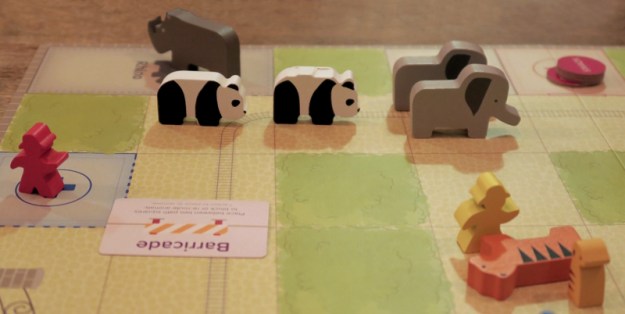
Pink used the Barricade to delay the escape of a couple of pandas and the pair marauding elephants, but it failed to hold when the Broken Barricade Move card appeared.  The rhino’s occasional charges weren’t much of an issue as they were very predictable, but once animals started to get close to the exit the rhino became more of a problem as players stayed out of its path wasting Action Points.  By this time, the tigers were becoming a problem, but Pink and Black put their Tranquiliser darts to good effect and soon the zoo was littered with sleeping tigers.  Lime had a Stretcher, but never actually used it, briefly loaning it to Blue for the only tiger returned to its enclosure (and left to peacefully sleep off the after-effects, as per one of the new variants).

Zoo Break
– Image by boardGOATS

There was a bit of a debate over whether it was more important to work on the rogue pandas or let them and meerkats escape and focus on the dangerous animals (in particular tigers and elephants).  Slowly but surely, however, the animals were taking over as there was a little procession of Keepers at the Medic’s tent, with only Lime avoiding injury.  Black was the only player to make use of the Train, because it didn’t really go where people wanted it to and players dealt with the issues nearest to them.  That was probably a good strategy; like it says in the advice, it is also important to lock stuff up early—the team didn’t.  They dealt with the monkeys, but the only other enclosure they managed to lock was the pandas, just before two meerkats and a cobra made a run for it in a single turn.

Zoo Break
– Image by boardGOATS

Although the mass escape had caused the zoo to be closed down and Pink hadn’t actually been cuddled by a panda, everyone had really enjoyed themselves.  On reflection, working in pairs might have worked better (as with Flash Point and Escape), because then the team can do things much quicker, get on top of things and lock cages making life easier all round.  Black was curious about the variants available.  The group had played on “Standard” difficulty with two “Phew!” Escape cards (where nothing gets out), but thanks to a rules malfunction, had also included the blank cards in the Move deck which provided quite a bit of respite, so everyone had a good laugh at the idea of making the game harder.

Zoo Break
– Image by boardGOATS

Despite the fact the group rarely plays cooperative games, everyone was keen to give Zoo Break another outing soon.  Zoos were popular elsewhere too—the next table had been playing New York Zoo.  This is a tile-laying game that got its first Tuesday outing only a few of weeks ago, but had been enjoyed by all.  In this game, players add pens to their zoo, populating them with animals, and building attractions.  Like Uwe Rosenberg‘s other similar games (including Cottage Garden, Spring Meadow, Indian Summer and Patchwork), it is Tetris-like but what makes this one unique and interesting is the Market.

New York Zoo
– Image by boardGOATS

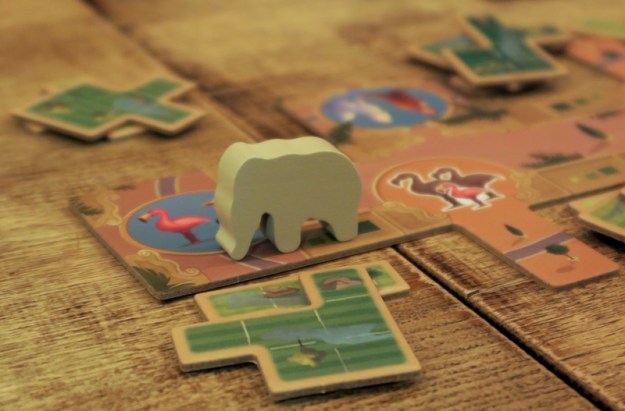
Players move the Marker Elephant one to four spaces round the Market, landing either on an Enclosure tile space (taking the top one and adding it to their zoo) or on an animal space (taking one or both of the animals depicted). Enclosure tiles can be placed anywhere in the player’s Zoo, then one or two identical Animals from elsewhere in their Zoo must be moved to occupy the Enclosure.  Each Enclosure can only hold one type of Animal.  When there are two or more Animals in an Enclosure together they breed when the Elephant passes the Market’s breeding spaces.

New York Zoo
– Image by boardGOATS

When an Enclosure is full, all the animals are removed and the player takes an Attraction tile of their choice and adds it to their Zoo.  Attraction tiles are useful because they fill additional spaces, and at its heart, New York Zoo is a race game—the winner is the first to fill all the spaces in their Zoo.  Purple had played last time, and Green had played elsewhere, however, Ivory and Teal were new to the game and the rules needed explanation.  That didn’t take long though, and the Elephant was soon touring the market and everyone was building their zoo and adding animals.

New York Zoo
– Image by boardGOATS

Purple was quick to get going, as was Green.  New York Zoo is really a tactical game, but there are a couple of broad strategies—fill the zoo with large Enclosures that are harder to fill, but occupy more space, or fill it with smaller Enclosures which are easier to fill with animals giving bonus Attraction tiles.  Purple went for the latter approach, getting some of the large attractions early in the game.  Teal however, opted for the former strategy, which is harder to get to work, but can be extremely effective, as indeed it was this time, making him the first to finish his zoo, and with no Attractions at all.  Purple was the best of the rest with for spaces left to fill, with Green a little way behind.

New York Zoo
– Image by boardGOATS

The Keepers in Bedlam Zoo on the next table were still trying to get the marauding beasts back in their pens (largely unsuccessfully) so the others had to decide what to play.  Green decided to go home, and couldn’t be persuaded to stay by the opportunity to play Nidavellir despite having been very keen to play it previously.  That left Purple, Ivory and Teal, who decided to play it anyhow.  Nidavellir is a card set-collection and bidding game inspired by Norse myths. The game was created by French designer Serge Laget (who sadly passed away in January this year after a lifetime of producing some great games) and the striking black and white artwork by Jean-Marie Minguez which nicely contrasts with the coloured cardboard components.

Nidavellir
– Image by boardGOATS

The story behind the game is that the kingdom of Nidavellir is under threat from the stirrings of the Dragon Fafnir and players are tasked by the King to recruit the best army to defeat it. Appropriately for our venue, the action takes places in three Dwarvish pubs where the players must use their coins to bid for the most skillful Dwarves (in a concealed auction), recruit the most prestigious Heroes, and build the best Battalion they can to defeat the Dragon.  Players hire five different professions of Dwarves into their growing army – Warriors, Hunters, Miners, Blacksmiths and Explorers.  Each player starts with five coins with the values: zero, two, three, four and five. Players place one of their coins against each pub space on their player mat.  The coins are revealed and cards are taken from each pub starting with the highest bidder.

Nidavellir
– Image by boardGOATS

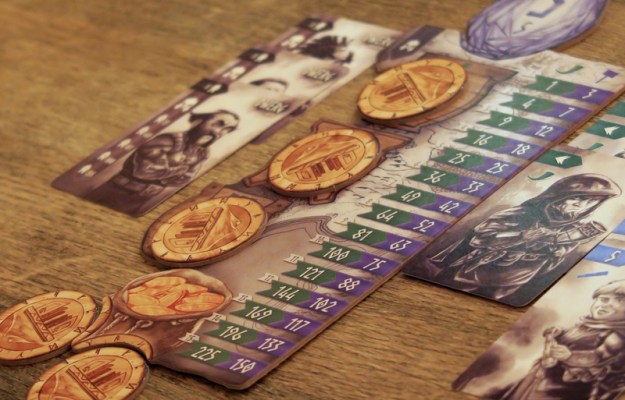
Ties are broken in favour of the player with the the highest jewel token (randomised at the start) and then these players swap jewels so the losing player has an advantage next time there is a draw. Once the three pubs have been resolved, players take back their coins, and place their cards in their tableaux.  At the game end, points are awarded in different ways for each group of Dwarves.  For example, Hunters provide points based on the number of cards squared, Blacksmiths score according to the triangular sequence (as used in Coloretto), while the Navigators are simply a total of the number of points printed on the card, and so on.  Each round of the game, random face-up dwarf cards are lined up by each pub (equal to the number of players) and players bid for their order of selection.

Nidavellir
– Image by boardGOATS

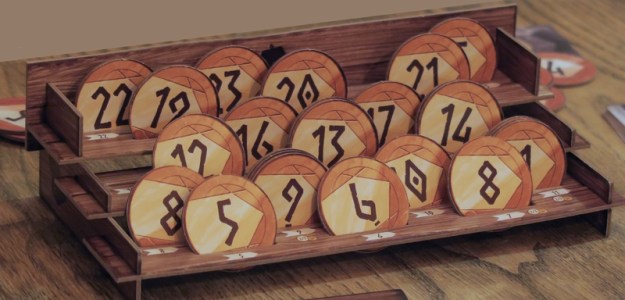
If a player plays their “zero” coin, the values of the two unused coins are added together, the highest of the pair is discarded and a new coin of the same total is added to their stash from the Royal Treasure. Thus, players can gradually increase the value of their coins, which is useful for out-bidding others, but also adds value as the total coin hoard is added to their final score.  Hero cards, which supply additional points bonuses in a variety of ways are awarded when a player manages to have five cards of different type and then each time a new set of five is achieved. Heroes are selected from, a separate deck which allows for further point scoring combinations.  The start was a little slow as Purple and Ivory were both new to the game and had to figure out what to do.

Nidavellir
– Image by boardGOATS

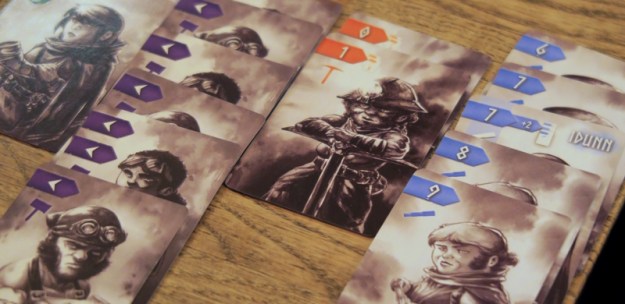
Teal and Ivory both started by upgrading their coins.  Ivory was the first to get a set of five cards and claimed one of the Dwerg Brothers as his Hero giving him the target of collecting the other brothers which greatly crank up the points the more that are collected.  Teal, who had played the game before, chose more complex Heroes.  Half way through the game, Purple took the King’s Hand and the King’s Great Armourer Heroes for having the most Warrior and Blacksmith cards, while Teal took the Hunting Master and Crown Jeweler (for the most Hunters and Miners respectively), leaving Ivory just the Pioneer of the Kingdom (for the most Explorers).

Nidavellir
– Image by boardGOATS

The second age (played with a new deck of cards), was similar to the first, with particular tight battles around getting cards to complete sets.  Ivory had a slight advantage in this, having upgraded his coins more aggressively early in the game, and used this to get more of the Dwerg Brothers.  In contrast, Purple and Teal focused on collecting Dwarves of one kind with Teal using his Heroes to add to their “count” in particular colours when completing a set.  In the end, Purple and Teal scored best for Blacksmiths and Hunters, while Teal also took lots of points for his Miners—something he had focused on from the start.

Nidavellir
– Image by boardGOATS

Ivory however, had more Warriors and having the majority of them meant he could add the value of his most valuable coin to his score.  Despite that and over a hundred points for his Dwergs, Ivory finished just shy of Teal’s winning total of two-hundred and seventy-seven.  The downside of his victory—the winner has to face the Dragon Fafnir!  All agreed it was a good game, not overly complex, but with lots of decisions to make; a game that didn’t out stay its welcome finishing within the forty-five minutes advertised (even with two first-time players).

Nidavellir
– Image by boardGOATS

Learning outcome: Always keep a close eye on your meerkats.