Author Archives: nannyGOAT

17th December 2013

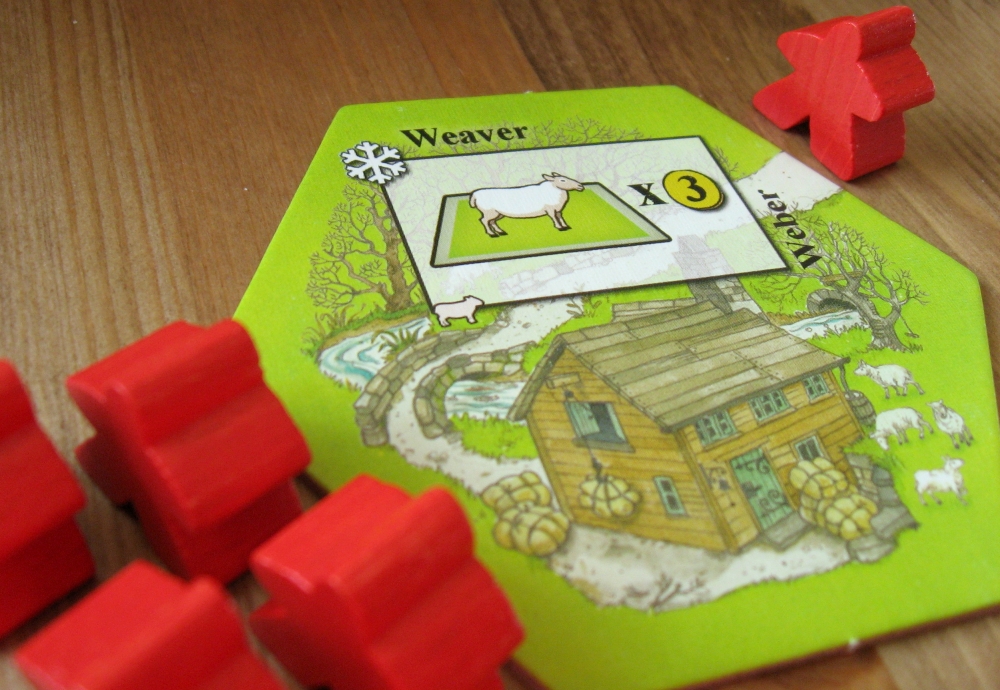
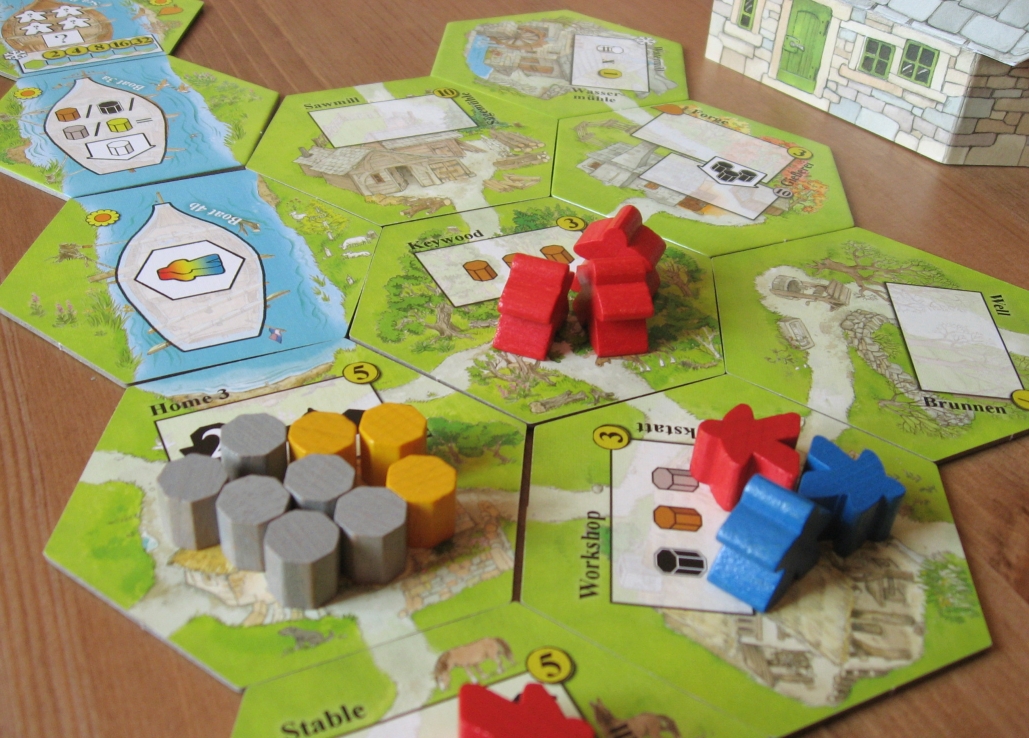
We planned to start early and get in a quick game of the “Feature Game”, Morels, however, we had just finished going through the rules and were just about to start when the late arrivals arrived early.  So, we left the mushrooms for another day and moved on to one of our favourites, Keyflower.  The reason why we were all especially keen to play this, is that the expansion, Keyflower:  The Farmers was released at Essen and we had been waiting since October for a good opportunity to give it an outing.  There are two documented ways to integrate the expansion with the main game:  you can choose tiles randomly from those available in the base game and the expansion, or you can use all the farming tiles and just use random base game tiles to “top up” the numbers.  Since it was the first time any of us had played the expansion, we chose to use this latter, “Farmers Variant”.
Keyflower

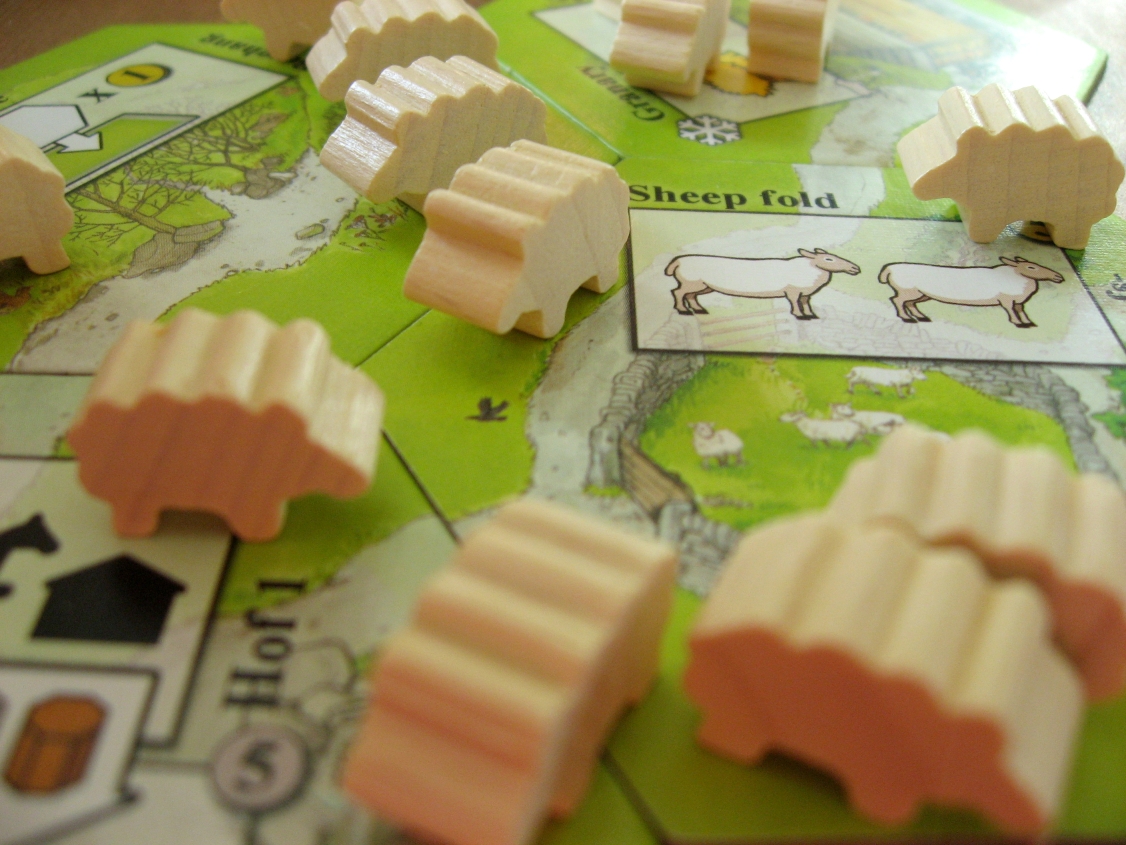
The idea behind the expansion is so simple that it is really very clever, and it is hard to believe that it wasn’t designed at the same time as the base game (though according to the designer, it was not).  In summary, the structure of the game remains the exactly same, but the new tiles give you access to animals which you place in the fields defined by the roads and the edge of the village.  There are a handful of rules associated with the animals (they breed at the end of spring, summer and autumn, but not winter because its too cold; they don’t breed if they are sharing with other animals because they are too shy), and the expansion also introduces wheat (which can be used to entice animals from one field to another or to encourage the horse pulling the cart enabling it to move more resources), but otherwise the game is essentially the same.  Or not…
Keyflower

As usual, we handed out our winter tiles and a handful of meeples (or Keyples as they are called in this game), before the spring tiles were laid out for everyone to look at.  With the farmers expansion, sheep are introduced in spring, pigs in summer, and cows in autumn.  So sheep came out first and Blue and Green got the key sheep producing tiles, and everyone with sheep tried to make sure they had at least two so that they could profit from the end of season breeding.  Unusually, almost no resource production tiles came out as these were of course displaced by the animal tiles, and this was the way it stayed for the rest of the game.  On the other hand, all the “green Keyple” tiles came out making them more abundant than usual.

Keyflower

In summer and autumn, Yellow tried to get into the animal husbandry business breeding pink cows and got into a tussle for it with Blue, who largely lost out and played most of the game with a village of just four tiles.  Meanwhile, the other sheep-farmer, Green, eschewed pigs and cows and concentrated on expanding his flock to nearly epic proportions.  By winter, Blue, with her hamlet and miniscule fields, was stacking pigs and cows in a way that would not have won favour from the RSCPA and Green (the shepherd) was trying to obtain the services of a weaver to increase the value of his flock.  Meanwhile, Yellow was trying to expanded his cattle business and Red, the only player who had managed to get resource production tiles was mining for gold, employing a jeweller to maximise her the outcome from her gold and moving iron from one side of her village to the other.  In the dying moves of the game, the Yellow outbid Blue for the dairy who in turn placed a large bid for the weaver which Green was unable to match.  This cost Green somewhere in the region of twenty points and forced him to take the hillside tile and try to make the best use of it he could.  Despite the inconvenience, Green still romped away with the win some twenty points ahead of Blue and Yellow who came joint second.  Even so, somehow this didn’t seem quite as much of a white-wash as last time

Keyflower

Learning Outcome:  Trying to breed pink cows does not make you a better farmer!

Next Meeting – 17th December 2013

Following the fire at the Jockey, our next meeting on Tuesday 17th December will be held in a private house in Stanford.  Please get in touch if you would like to come along and would like directions.  As usual, we will be playing shorter games from 7.30pm as people arrive, until 8pm when we will start something a little longer.

This week the “Feature Game” will be Morels.  This is a quick little card game based on mushroom picking.  We’ve chosen this because we know some people will probably be late arriving and it’s a cute little game that the early birds can play while they are waiting to hear who will come.

Morels

And talking of mushrooms…

Jeff was out Christmas shopping and while he was waiting at the checkout, he got talking to the man in the queue behind him.  The conversation got around to wives, and he said he had been widowed three times. Jeff was appalled, “Three wives, all dead and buried?” he asked.

“Yes,” replied the man.

“What happened if you don’t mind me asking?” said Jeff.

“Not at all,” the man answered, “The first one ate poison mushrooms.”

“What happened to the second one?” asked Jeff, all agog.

“Poison Mushrooms,” replied the man.

“And the third?” asked Jeff, thinking he might have spotted a pattern.

“Fractured skull,” said the man.

“Oh,” said Jeff, “How did that happen?”

The man paused, then replied, “She wouldn’t eat the poison mushrooms…”

3rd December 2013

Since we knew people were arriving late, we started nice and early to get a quick two-player game in first.  The game we settled on was a cute little game picked up from Essen a couple of months ago, called 1911 Amundsen vs Scott.  This is an asymmetric card game where players are engaged on a polar expedition, and as in 1911, the players take different routes and use different tools (Roald Amundsen famously used dog sleds and beat Robert Falcon Scott’s team who used horses by just a few weeks).  On their turn, players collect cards or play cards.  The cards played can be used to get closer to the pole, or can be special cards to either assist the mission or obstruct the opposition.  Scott had played the game a few times before, whereas Amundsen was new to it.  The Scott’s starting hand included the “equipment loss” card which is quite powerful as it reduces the opponents hand limit from seven to five.  Since Amundsen hadn’t played it before, Scott decided to let Amundsen find his feet before playing it.  This turned out to be a tactical error as the game mirrored 1911 and Amundsen arrived just ahead of Scott who reached the South Pole only to find Amundsen’s Norwegian flag already planted in the frozen ground.

1911 Amundsen vs Scott

Next up was the “Feature Game”, Tzolk’in:  The Mayan Calendar.  This is a complex, but beautiful worker placement game where players represent different tribes during two Mayan “ages”.  On their turn, players must either place workers or pick up workers. When placing workers, players can place as many workers as they like (as long as they can afford it), and must put them onto the gears in the lowest available spaces on any of the five outer gears.  At the end of the round, the central gear rotates, turning each of the outer wheels moving the workers up the next level.  On the next turn, players may chose to place more workers, or might take some or all of the current workers off the gears – the catch is that a “null move” is not allowed, so timing is everything and it is very easy to get things slightly wrong.  This is made worse by the fact that everyone must have three corn at the start of the round and half way through and at the end of each age, there is a “food day”.  The currency of the game is corn and if you don’t have enough to support your workers you Anger the Gods and the penalties for that can be quite dire.

Tzolk'in:  The Mayan Calendar

Since we had one person who had not played it before and it was a while since the rest of us had played it, we spend a fair amount of time going through the rules.  Then we dealt out the starting tiles for players to chose their starting conditions.  Green chose the crystal skull, Blue decided to start with some technology, Yellow began with some corn and Red started with a small farm providing enough to keep one of her people fed for the rest of the game.  Green started out placing his skull on the Chichen Itza wheel (or chicken pizza as we call it) as he felt it would give him a guaranteed thirteen points.  Blue went first and started out by getting an extra worker and then very slowly began to build her corn harvesting ability, angering the Gods when she didn’t have enough corn at the start of a round.  Meanwhile, Red ensured that her people would be fed by building lots of farms, and Yellow quietly collected resources.

Tzolk'in:  The Mayan Calendar

Green confused everyone by placing only the one crystal skull and then going all out to climb the temple steps.  However, it wasn’t until late in the game that everyone else realised this and although Blue capitalised by catching a lot of the remaining spaces, by this time the damage had already been done.  Yellow made a surge as the only player to successfully build a monument, but it was not enough to catch Blue, or indeed Green who made it two wins out of two for the evening.

Tzolk'in:  The Mayan Calendar

Learning Outcome:  Sometimes its necessary to keep a close eye on the beginner to stop them from winning!

Next Meeting – 3rd December 2013

Following the fire at the Jockey, our next meeting on Tuesday 3rd December will be held in a private house in Stanford.  Please get in touch if you would like to come along and would like directions.  As usual, we will be playing shorter games from 7.30pm as people arrive, until 8pm when we will start something a little longer.

This week the “Feature Game” will be Tzolk’in:  The Mayan Calendar, which is complex strategy game where workers are placed on a series of gears that move as the game progresses.

Tzolk'in:  The Mayan Calendar

And talking of Mayans…

Jeff’s best friend was Burmese and as it was approaching Christmas and he wondered what to get him.  He searched high and low, but could not come up with anything suitable so he did what everyone does and tried the internet.  As he was searching about, he I read somewhere that the Mayan calendar ended on the 21st, and decided a new calendar would be a great Christmas gift for his friend from Myanmar…

Gaming in the Seventh Century

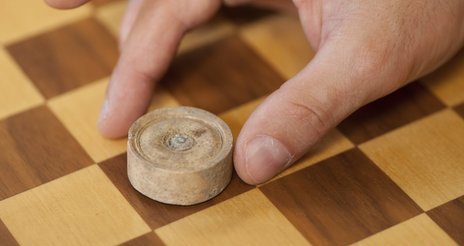
Archaeologists from the University of Reading have found a seventh century board game piece in the remains of an Anglo-Saxon royal hall in Kent.  The hollow bone cylinder with a central bronze rivet found at the Lyminge dig is thought to belong to an early Backgammon or Draughts-type games set.  Board games were really popular in Anglo-Saxon times, especially Latrunculi and Tabula, which had a lot in common with Chess and Draughts with the aim being to capture the opponent’s pieces.

Ancient Game Piece

Finds like this are very rare and the last time a piece like this was found it was in an aristocratic grave excavated in Taplow in Buckinghamshire in the 1880s.  On that occasion, ten pieces were found and these are now in the British Museum.  The game piece recently found in Kent is an isolated discovery and is unique in that it was found where the game was being played, so is presumably a piece that was lost during the game or as it was put away.  Maybe in a thousand years archaeologists will be finding lost trains from Ticket to Ride!

19th November 2013

Since we arrived in “dribs and drabs” and one player had to leave early, we started out playing a couple of quick little games.  First up was Pick Picknic.  This is a cute little game where players simultaneously play coloured chicken cards.  If someone plays the only chicken card of a given colour, they get all the grain at that coloured farm.  If multiple players go for the same coloured farm, then players can either agree to share the corn in any way that is mutually agreeable or roll for all of it.  They must beware the foxes though – foxes don’t eat corn, they only eat chickens; if someone plays a fox card, they will eat any chicken cards of that colour.  The first game was a bit of a white-wash, in contrast, however, the second game was a draw.

Pick Picknic

Next up was a game with a similar box and name, but other wise completely different: Pickomino.  This is a strange little dice rolling game with appealing “worm tiles”.  On a their turn, players roll eight dice.  They must keep all the dice of one “type”, i.e. all those with a one, or all those with a two etc., however, they must not have any of that number or type already.  Then they can, if they choose, re-roll the remaining dice and do the same again.  When they decide to “stick”, they can take any “worm tile” available in the pool with a value equal to or less than the total shown on their dice, and place it on the top of their pile.  When the number rolled exactly matches the topmost tile on someone elses pile, then the player may steal that tile if they choose.  The person with the most worms at the end wins.

Pickomino

Unfortunately, since the rules were in French and the English translation was not entirely clear, we didn’t play this quite right, so we’ll have to give it another go sometime. Since new players had arrived and one had to leave, we moved on to something a little deeper in Montego Bay.  This is an unusual little game about loading barrels into boats.

Montego Bay

To do this, each player has two workers, a large one and a smaller one, and a set of 5 cards for each worker which are used to move them.  Simultaneously, all players secretly choose one of the numbered cards from each of their card sets, then the workers are moved one at a time along the path around the outside of the warehouse, according to a prearranged (otherwise random) order.  Thus, when it is a workers turn to to move, the appropriate card is revealed and the worker moved accordingly.  The clever part is what happens if the space is already occupied, as the original worker is pushed to the opposite side of the warehouse.  In some cases, the position opposite side of the warehouse is also already occupied in which case both spaces are blocked and the active worker simply moves as far as he can.  When all workers have moved, the warehouses are checked if there is a worker next to a chamber. If a worker is next to a chamber with barrels, players receive drums in their colour equal to the number of barrels in the room. These drums are placed in one or more of the ships in the harbour; players may decide freely, but when a ship is full, it sails away immediately and players score points depending on who has the most barrels on the ship.  In contrast, if the chamber has broken barrels in it, drums must be removed from ships.  Thus, players are trying to make sure their workers are optimally placed, but since their pieces can be influenced by other players, everyone is trying to anticipate what each other will do.  Because of all the “double think”, the game is very prone to “analysis paralysis”, however, it wasn’t too bad and only really became noticeable in the last rounds of the game when it was all quite tight and moves were critical to the final score.  Green took the honours in the end, a couple of points clear of Blue, but everyone expressed an interest in playing it again sometime.


Montego Bay

Lastly, was the “Feature Game”, Coup.  This is a very quick little card game of bluffing and back-stabbing.  The idea is that each player starts with two cards representing the people they influence.  On their turn they can take a small amount of money or declare who one of their people is and do a more exciting action associated with that character.  The catch is that since the cards are hidden, players only know who they have influence over themselves – everyone else is secret.  Other players then have a choice, one of them can challenge the active player, or one of them can declare they are a character that can block the action (this declaration can also be challenged), or they can do nothing.  When a player is challenged, they must display one card:  if it demonstrates that they were telling the truth then they draw a replacement card, if it indicates they were lying then they lose a card.  The aim is to be the last player with influence (i.e. a hidden card).  The key to the game is to play as a team against the leader to prevent them from building up enough money to carry out a coup (which there is no real protection from), but to play independently when it is your own turn.  Unfortunately, we didn’t really get the team aspect of the game and, because we didn’t play very many hands, players didn’t really have time to work out that if a player tells the truth, that is a powerful tool to be used against them.  For this reason, it seemed more a game of chance (because if you tell the truth you are safe from challenges), than a game of skill.

Coup

Learning Outcome:  Sometimes short games are best played repeatedly so that they take as long as “big” games which gives time to play the meta-game.

Next Meeting – 19th November 2013

Following the fire at the Jockey, our next meeting on Tuesday 19th November will be held in a private house in Stanford.  Please get in touch if you would like to come along and would like directions.  As usual, we will be playing shorter games from 7.30pm as people arrive, until 8pm when we will start something a little longer.

This week the “Feature Game” will be Coup, which is a very quick little card game of bluffing and back-stabbing, which should give us plenty of time to play lots of other games.

Coup

And talking of bluffing…

Jeff was pulled over by a police officer pulls for speeding.  The conversation went like this:

Officer:  May I see your driver’s license please, sir?

Jeff:  I don’t have one – I was caught for drunk driving and had it taken away.

Officer:  Do you have the vehicle registration certificate, sir?

Jeff:  It’s not my car; I stole it.

Officer:  The car is stolen?

Jeff:  That’s right, but come to think of it, I think I saw the log book in the glove box when I was putting my gun in there.

Officer:  There’s a gun in the glove box?

Jeff: Of course – that’s where I put it after I shot and killed the woman who owns this car and stuffed her in the boot.

Officer: There’s a BODY in the BOOT?!?!?

Jeff:  Well, yes.

Hearing this, the officer immediately called his sergeant and the the car was quickly surrounded by police.  The sergeant approached the driver to handle the tense situation:

Sergeant:  Can I see your license please, sir?

Jeff:  Sure. Here it is.

– It was valid.

Sergeant:  Who’s car is this please, sir?

Jeff:  It’s mine – Here’s the vehicle registration documentation.

– Jeff owned the car.

Sergeant:  Could you please slowly open your glove box so I can see if there’s a gun in it?

Jeff: Yes, sir, but there’s no gun in it…

– There was nothing in the glove box.

Sergeant:  Would you mind opening your boot please, sir? I was told you there’s a body in it.

Jeff:  Of course…

– He opened the boot; no body.

Sergeant:  I don’t understand it. The officer who stopped you said you told him you didn’t have a license, stole the car, had a gun in the glovebox, and that there was a dead body in the boot.

Jeff:  Yeah, and I’ll bet the liar told you I was speeding, too…

5th November 2013

We were relocated once again, so we had six people for the second week running.  Since we are still meeting in private houses, splitting into two games of three was not really an option due to restricted table space, and this limited what we could play somewhat.  For this reason, we started out with one of our old favourites that we’ve played before, Bohnanza.  This is a fairly simple trading game, where players exchange and plant beans to maximise their harvest.  The game was very tight, ending with joint winners on twelve and third and fourth places on eleven and ten respectively.

Bohnanza

Our youngest player left, leaving us with five players for our Feature Game, Hanabi.  “Hanabi” is the Japanese word for “fireworks” (consisting of the ideograms “Flower” and “Fire”) and given the date we felt it was entirely appropriate.  Last time we played, we used the original card version of the game, however, this time we used the new tile version that was released at Essen a couple of weeks ago.   The idea of the game is very simple:  as a group, players must try to lay a total of twenty-five tiles, in number order within their colour suits, thus the red “one”, must be played before the red “two”, and so on.  The snag is that everyone turns their hand back to front so they can see everyone elses tiles, but not their own.  So, on their turn, players can do one of three things:  play a card, give a clue to another player or discard a tile.  If the wrong tile is played, the team lose one of their three lives and there are only eight clues available; although each discarded tile is also worth an extra clue some tiles don’t have any duplicates…

Hanabi

We enjoyed the first game so much that we ended up playing it twice.  The first time a lot of “ones” came out on the first deal, so we had to decide how to guide people to play the correct tiles.  We finished up with three completed fireworks and a total of twenty points.  Any hope that we could improve on our score quickly evaporated when the second game started with no “ones” at all and it took us ages to get started by which time we had run out of clues.  One player was left with the choice of playing or discarding and chose the wrong option and that really set the tone for the rest of the game.  All things considered, it was a bit of a miracle that we finished two fireworks successfully and the game ended with a total of eighteen – not quite as bad as it had looked earlier.

Hanabi

Learning Outcome:  Sometimes “feelings” can be very misleading and you can be doing much better (or worse) than you thought.

Next Meeting – 5th November 2013

Remember, remember, the fifth of November,
Gunpowder Treason and Plot!
I see no reason, why Gunpowder Treason,
Should ever be forgot…

Given the date, the “Feature Game” could really only be Hanabi, which is an unusual cooperative game about fireworks.  It was also awarded the coveted German Game of the Year award, the Spiel des Jares for 2013.  The original incarnation is as a card game, however, one of the toys brought back from Essen was the “Deluxe” version with tiles, so that may get an outing.

Hanabi

As normal, following the fire at the Jockey, our next meeting on Tuesday 5th November will be held in a private house in Stanford.  Please get in touch if you would like to come along and would like directions.  As usual, we will be playing shorter games from 7.30pm as people arrive, until 8pm when we will start something a little longer.

Oh, and talking of fireworks…

After having their eleventh child, Jeff went to the doctor and told him that he and his wife didn’t want to have any more children.

The doctor told him there was a procedure called a vasectomy that would fix the problem, but that it was expensive.  He said, a less costly alternative was to go home, get a firework, light it, put it in a beer can, then hold the can up to his ear and count to ten.

Jeff said to the doctor, “I may not be the smartest guy in the world, but I don’t see how putting a firework in a beer can next to my ear is going to help me.”

“Trust me,” replied the doctor, “It will do the job.”

So Jeff went home, lit a banger and put it in a beer can.  He held the can up to his ear and began to count, “1, 2, 3, 4, 5…” then he paused, thought a moment, and placed the beer can between his legs so he could continue counting on his other hand…

22nd October 2013

We were back to our usual location for our first meeting on the alternate week.  This meant we had an extra person, but in addition, we one of our more distant members coming down on his way to Essen.  He was held up in traffic, so we started out with a quick game of Eight-Minute Empire.  This is a quick little area control game, though in truth, eight minutes is only possible if everyone really knows what they are doing and nobody suffers from “Analysis Paralysis”.

Eight-Minute Empire

Each player has a limited number of coins, three wooden city pieces and a handful of army cubes.  The idea is that players start by picking up a card:  they can choose whether to take the first available card which has no cost, or take another and pay the appropriate number of coins.  Each card is a resource which provide points at the end of the game, the number depending on how many of that resource the player has;  each card also has an action associated with it, which can be place armies on the map, move them about, ship them across the sea, build a city etc.  Players score points for having the majority in a countries and controlling the most countries in each continent, as well as for sets of resources.  The game was a clear victory for Red who finished three points clear of Blue in second place.

Eight-Minute Empire

As we finished, our long distance traveller walked through the door and without missing a beat sat down to join in the Feature GameTsuro.  This is a path laying game that is similar, though strangely opposite to Indigo, which we played a few weeks ago.   Both games are beautiful with a simple mechanism:  players play tiles and any stones that are on paths that are extended by the tile are moved to the end of the path, however, that is where the similarity ends.  In Indigo, you have hexagonal tiles and only draw one at a time, however, in Tsuro, the tiles are square and you have a hand of three for as long as there are enough tiles available.  More importantly though, in Indigo, the object of the game is to navigate stones to your gate and collect them whereas in Tsuro each player has one stone must try to keep it on the board and be the “last man standing”.  We enjoyed the first game so much that we played it again with the winner of the first game coming joint last in the second, and Blue, who came fifth in the first game winning the second, meanwhile one person managed to remain the bridesmaid in both, coming second twice!

Tsuro

The last game was one we have played several times and were mostly very familiar with, Alhambra.  In this game, players can either collect money or buy tiles, however, while they can always overspend, if they pay the exact money, they get an extra turn.  The snag is that there are only so many of each type of tile and the player with the most of each type scores the most points.  The other challenge is placing tiles:  they must form an area unbroken by walls, on the other hand, the longest continuous wall scores lots of points. Playing with so many people really seemed to disrupt some of our plans and the end result was a run-away victory for White who was thirty-six points clear of Blue and Orange who were joint second (with sixty-seven).

Alhambra

Learning Outcome:  Sometimes if you win spectacularly on the first play you can lose the next just as dramatically.