Due to a combination of work, car problems and bereavement, we have decided to cancel the meeting tonight and our next meeting will be Tuesday 1st October. More details will follow nearer the time.

Due to a combination of work, car problems and bereavement, we have decided to cancel the meeting tonight and our next meeting will be Tuesday 1st October. More details will follow nearer the time.
First up this week, while we waited for the others to arrive, was Toc Toc Woodman (aka Clack Clack Lumberjack). This Is a dexterity game that consists of a segmented plastic tree where the am of the game is to knock bits of bark off with an axe, while not removing the core segments. As the game progresses, the tree becomes increasingly unstable with the inevitable consequences… Honours were just about even when we were saved from a tie-breaker by the last of the late arrivals.
:strip_icc()/pic1186412.jpg) |
| – Image by BGG contributor EndersGame |
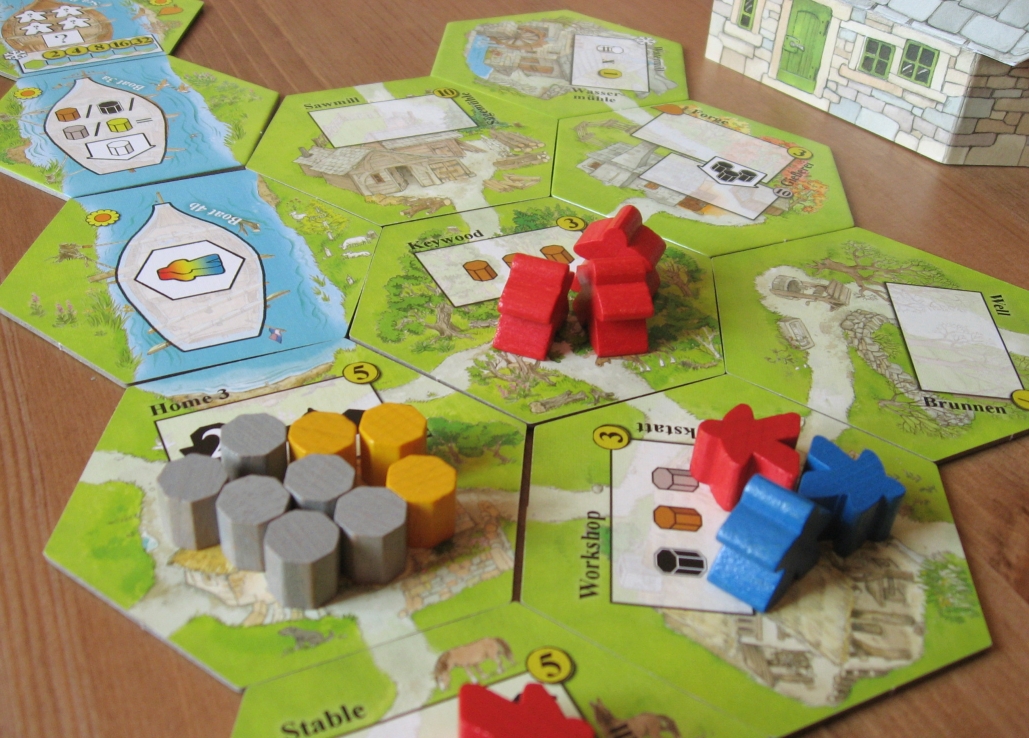
Next we started our “Feature Game”, Keyflower. Although we have played it before and it is a very popular game with most club members, we had one player who was unfamiliar with it, so we chose to play it without any of the additional tiles.
 |
| – Image by boardGOATS |
Keyflower is a worker-placement and auction game that is played over four seasons. Each player begins the game with a home tile and eight worker meeples (or Keyples as they are known in this game). At the beginning of each round there is a new stack of tiles that players can use and bid for. The really unusual part of the game is the interplay between workers and bidding: workers can operate on any tile, in a players own village, in another players village, or one that is still being auctioned. At the end of the round, the workers go to the owner of the tile, thus, if you have a commodity that other players want, it can be a source of Keyples. On the other hand, if you chose to bid for a tile, presumably you wanted to use it, which means that you have competition for the resource, and so it proved.
 |
| – Image by boardGOATS |
One player had been present at the drubbing we had received last time we played and tried the same strategy, i.e. to collect skill tiles. Those of us that were aware of this approach started out with no real strategy except to prevent a second run-away victory by the same means. Meanwhile the new player quietly got on with collecting gold and marshalling her Keyples. Mixed based strategies gradually evolved for otherwise indecisive players with resources, the river and transport all featuring and it wasn’t long before we got to the final round, Winter. Surprisingly, there wasn’t much competition for tiles to begin with as everyone concentrated on getting the resources and skill tiles they wanted to the place they needed them. By this time, Keyples were in short supply, so there was only a token amount of scrapping for final tiles in what ended as a very, very closely fought game with first and second just one point apart, a tie for third and fourth, and everyone separated by only six points.
 |
| – Image by boardGOATS |
The third game of the night was, the race game, Salmon Run. We’ve played this a couple of times before, but still managed to have a couple of new players, so after a quick run through of the rules, off we went with board S1, 5E, 6E, 3M, 2M & F1. White took an early lead, while Red and Black got in each others’ way and battled with bears. Red and White both got sore heads bashing the bank, while Black got a bit stuck with mid-stream and trapped everyone else in the current.White made a dash for the finish, but got caught needing a right and straight to get across the last lot of rapids giving Red and Black a chance to catch up. Red got closest, but White managed to make it across the line first and Red failed to quite make it to the Spawning pool on his last turn. Even if Red and Black had made it home, Red’s nine fatigue cards and Black’s six dwarfed White’s two (thanks to the enforced wait before the last rapids where she had been able to ditch a lot of hers).
:strip_icc()/pic1595599.jpg "Salmon Run") |
| – Image by BGG contributor kilroy_locke |
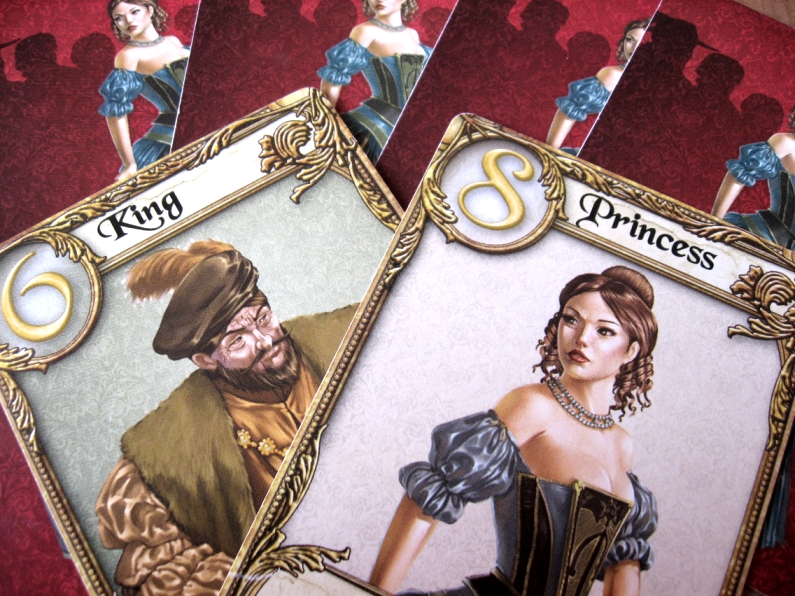
The last game of the night was an old favourite, Love Letter. This is a really simple little duelling game played with just sixteen cards. Each round only takes a couple of minutes and each player takes it in turns to draw a card and then play one of the two cards in their hand. Cards allow players to look at another’s hand, force them to discard, give them the opportunity to try to assassinate other players etc. and the last player in, or (in the unusual case that all sixteen cards are drawn), the player with the highest card, wins the round. Remarkably, one player managed a run of three rounds undefeated, and despite a desperate rear-guard action, this proved an unassailable lead.
 |
| – Image by boardGOATS |
Learning Outcome: A winning strategy doesn’t always work…
Following the fire at the Jockey, our next meeting on Tuesday 3rd September will be held in a private house in Stanford. Please get in touch if you would like to come along and would like directions. As usual, we will be playing shorter games from 7.30pm as people arrive, until 8pm when we will start something a little longer.
This week the “Feature Game” will be Keyflower, which is a worker-placement and auction game played over four seasons and depicts the growth of villages as new pilgrims arrive by boat. It is a truly beautiful game with fantastic original artwork, as well as being the sort of game that that really sucks you in.

And talking of pilgrims…
Two pilgrims went out hunting, but one was carrying two blunderbusses.
Jeff, the second pilgrim asked, “Why do you have two blunderbusses?”
His friend explained, “I usually miss the first time I shoot. By taking two I can take a second shot.”
Jeff thought about this for a while and then asked, “But why not just take the second one, and only shoot once…?”
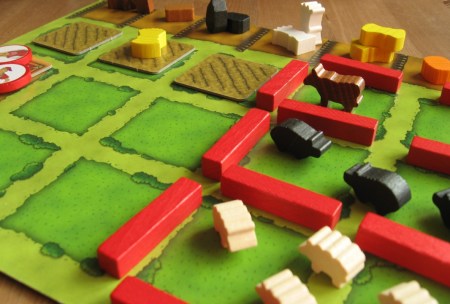
It being the height of the summer holiday, there was a severe shortage of people about, so we started late with our Feature game, Agricola. This game is about farming in the middle ages and is a one we have played several times now. However, one of our regulars has somehow missed out and, as it is a game we know she would enjoy we decided that while it was quiet it was a good opportunity to play the “family game” again.

So we had a gentle run down of the rules before we started collecting wood and clay, fish and grain. Before long, Red had renovated her two room hut to brick and started ploughing fields while her farming couple lived on fish. Meanwhile, Blue was trying (and failing) to expand her wooden hut, plough fields and fence in some pasture so she could keep some sheep, all at the same time. Blue was the first to engage in a little “family growth” and had no qualms about sending her unfortunate offspring out to work the land at an early age. Red didn’t have enough clay to build an additional room, so had to wait until she had the option of sharing rooms. Despite Red picking up vegetables, cattle and pigs, at the end of the day, Blue’s experience (and larger family) meant she had an unassailable lead.
There was just time for a quick second game, so we decided to go with something we were familiar with, Forbidden Desert. This is clever little cooperative game that we’ve played a couple of times before. The idea is that players are members of a team of adventurers on a mission to excavate an ancient desert city and recover a legendary flying machine that’s rumoured to be powered by the sun. Moments before arriving at the destination, the helicopter crash lands, stranding the team in the vast desert,exposed to an unrelenting storm and extreme sun. The only hope for survival is to work together to excavate the city, find the parts of the flying machine and rebuild it to escape.
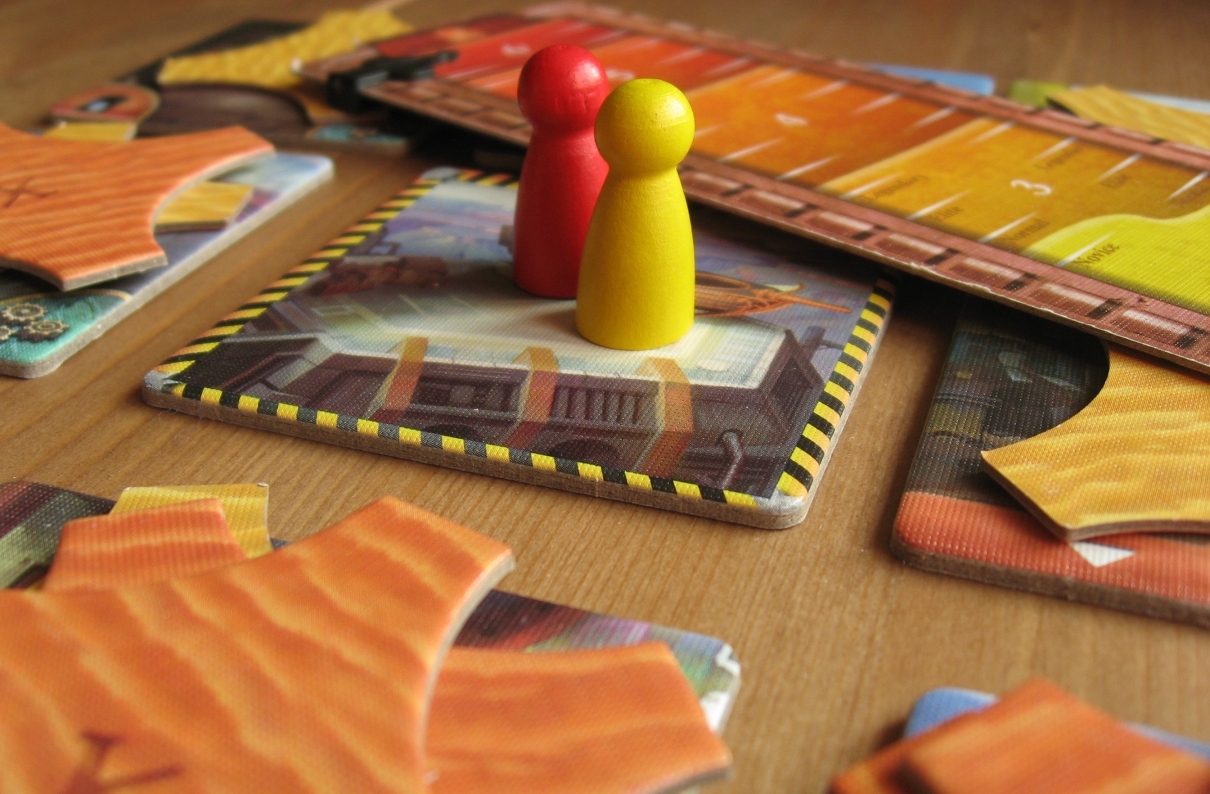
Players have particular areas of expertise: this time we had the “Archaeologist” and the “Meteorologist”, which meant we had one player who could clear sand more efficiently (twice as fast as normal) and another who could check what the storm was going to do next. We started well, making good use of the special abilities and taking advantage of the tunnels to hide from the sun. Without the “Water Carrier” we were really worried about dying of thirst, but we managed eke out our water supply and stayed on top of the problem by hiding as much as possible. We also managed to prevent too much sand build-up with occasional judicious use of the Duneblaster, but what we failed to keep an eye on was the sand-storm level and we were at level six with clues still to find. The storm was on its highest level when we finally managed to pick up the last clue, hop over the dunes with a jet pack, clear the launch pad and escape, but it was a very close-run thing!
Learning Outcome: There is a reason farming families are usually large.
Following the fire at the Jockey, our next meeting on Tuesday 20th August will be held in a private house in Stanford. Please get in touch if you would like to come along and would like directions. As usual, we will be playing shorter games from 7.30 pm as people arrive, until 8 pm when we will start something a little longer.
We decided to have (yet another) go at Agricola, which is about farming in the middle ages. It is a game we have played several times now, but has proved popular and there are players who haven’t tried it yet.

And talking of farming…
Farmer Jeff’s dog Shep went missing and he was inconsolable, so his wife asked him, “Why don’t you put an ad in the paper to get him back?”
Jeff like this idea, but after two weeks Shep was still missing.
Unable to understand why there had been no response, Jeff’s wife asked, “What did you write in the paper?”
“Here boy.”
We decided to save our “Feature Game” (Guillotine) for an occasion when there’s a more appreciative audience and went straight into a much longer, deeper, and very highly regarded game called Puerto Rico. Although we had all played it before, for some of us it was a long time ago, so we had a quick recap of the rules before we started.

In this game players are plantation owners in seventeenth century Puerto Rico growing up to five different kind of crops: corn, indigo, sugar, tobacco, and coffee. Each plantation owner must try to run their business more efficiently than their competitors. First they must grow their crops then they must store them efficiently. Finally, players must sell their crops at the right time or ship their goods back to Europe for maximum benefit. In order to do this most effectively, the plantation owners must make optimal use of the arriving colonists and develop the capital city, San Juan, building useful amenities. In each round, players take it in turns to choose a role, but no role can be selected twice in the same round. Each player gets the opportunity to carry out each action, however, there is a privilege that goes to the player who chose to do it. For example, if one player chooses to build, everyone can build if they want, however, it is cheaper for the person who chose to do it. Ultimately, the player who selects the best roles to advance their position during the game will win. There are two small expansions, but after some discussion, we decided not to use either in the end as we didn’t feel we needed the variety for this game, but maybe next time.

Green decided to start building a couple of quarries and then expanded the indigo plantation that he started the game with, and added sugar (as nobody else seemed to be planting sugarcane). Meanwhile, Blue started out with some corn, built a quarry, then dabbled briefly in tobacco, before going all out for coffee sales. Red, on the other hand, started out with one indigo plantation and added a tobacco plantation. When that didn’t really provide what he wanted, he tried coffee as well for good measure before deciding that what he REALLY wanted was a factory! Red then went into the coffee market which messed with Blue’s plans, so she started shipping corn and coffee which screwed up Green. Towards the end of the game, everyone made a mad dash for big buildings, but the damage had already been done by the efficient factory which gave Red the win with fifty-three points.

We only had time for one other game, and decided on Hanabi. This is a really clever and unusual cooperative game which has just been awarded the Spiel des Jahres. Hanabi is the Japanese word for “fireworks” and the idea is that you are collectively trying make the perfect firework display. To do this, all you have to do is play cards, in order from one to five, in their colour suits. The snag is that you hold your hand of cards back to front so that you can’t see the cards you are going to play, although you can see everyone else’s. Thus, on your turn you can give a hint to someone to tell them something about their cards or you can play or discard a card. Hints are restricted though and you can only point point out all the cards of a specific, common number or colour. You also only have eight hints, although you get extras for every card you discard. You also only have three lives and lose one each time you play a card that has already been played or if you play a card before all the lower numbers of that colour have been played. One of the reasons Hanabi is so unusual is that although players are working towards a common goal, they can’t really help each other. In this game, we made a mistake quite early on when someone discarded the second yellow four and it all went downhill from there, ending with a total of eighteen (out of a possible maximum of twenty-five).

Leaning Outcome: If you teach people too well, sometimes they end up winning!
A couple of weeks ago a brand new games café opened in Oxford, called Thirsty Meeples. Everyone is talking about it and even non-gamers have commented that it looks “really cool”. This week Thirsty Meeples has featured in the Oxford Mail, on BBC Oxford News and BBC Radio Oxford.

The BoardGOATS are planning a visit very soon, however, at the moment it seems so popular we don’t think we’d get a table!
Following the fire at the Jockey, our next meeting on Tuesday 6th August will be held in a private house in Stanford. Please get in touch if you would like to come along and would like directions. As usual, we will be playing shorter games from about 7.30pm as people arrive, until 8pm when we will start something a little longer.
This week the “Feature Game” is Guillotine, which is a light card game where the players are trying to behead the least popular nobles. We’ve chosen this as it is a quick game and then we can play something appropriate to the people who come on the night.

And talking of the Guillotine…
A priest, a thief and an engineer are all slated to be executed by guillotine.
The priest is to be dispatched first and the executioner asks him, “How do you want to face on the guillotine?”
The priest responds, “With my face up, looking toward heaven.”
The executioner accedes and the priest is laid face up on the guillotine. The executioner pulls the cord, the blade drops, and then miraculously stops within mere inches of the priest’s neck. The gathered witnesses gasp in astonishment. Everybody agrees that it is a miracle and sign of divine intervention and the priest’s life is spared.
The thief is next. When the executioner asks how he’d like to be positioned the thief responds, “With my face up, looking toward heaven.”
The executioner complies, and the thief is laid down face up. The cord is pulled. The blade falls, and, as with the priest the blade stops inches from the thief’s neck. Again the witnesses gasp. They can understand a miracle occurring with the priest but with a thief! Nonetheless, they take it as a sign from god, and release the thief.
Finally, it’s the engineer’s turn. Like the other two he wishes to be executed face up, looking toward heaven.
The executioner lays him down, but before he can pull the cord the engineer yells out, “Stop! Stop!”
The executioner pauses, and the engineer, looking up at the guillotine says, “I think I can see the problem…”
This week we started with our “Feature Game”, Vasco da Gama. Some of us played this few months ago so we decided to give it another go. As discussed previously, it is a worker placement game, with an element of risk management. Players recruit workers, start projects, build ships and sail new commercial routes to eastern Africa and India, to earn money and glory.

The game comes in three phases: worker placement, then worker actions, and finally ships sailing. Players take it in turns to choose one of four areas for their workers: buying ships; captaining and manning ships with sailors; “schmoozing” some influential characters to win valued favours; and finally, launching boats. The clever part of the game is that when players place their workers, they also choose a counter to go with it. The counters are numbered from one to twenty and the actions are carried out starting with the lowest working up to the highest – a bit like the deli counter at the supermarket. However, here, the low numbers cost cost money while the higher ones are free. The snag is, you don’t know exactly where the free ones start, only the range of possible values, and the further you are below the cut off, the more it is going to cost you to carry out the action.
So, people take it in turns to choose a counter and place one of their four workers in the four areas. Then, once all the workers have been placed, in number order, players choose whether or to carry out the action (paying if appropraiate) or whether to pass and take money in lieu of an action (just to make things more interesting, the lower numbers get less money). Once a ship has been bought and has a full crew, the ship can be launched, and this is where it gets tricky. You get an immediate reward for launching a ship, but you also get rewards for each ship still sailing at the end of the round, and these rewards are increased if the row the ship is in is also full. The snag is that before the next round starts, each complete row of ships moves on to the next row, however, if there is no space in the next row the ship is lost and with it any future possibility of rewards. Thus, the position of ships is really critical and can make or break your chances of doing well.

Black chose to fight for the attentions of one of the characters, Bartolomeu Dias. This character is particularly generous as he gives players two victory points when they offer to host him as well as two more victory points at the end of the round AND means you go first at the start of the next round. Meanwhile, Yellow and Red decided to buy ships and Blue tried to sail the line between bankruptcy and profit. It is very clear that it is an advantage to have seen the way the ships move as it is a complex process and appears quite chaotic at times with the best laid plans falling apart because someone places a ship unexpectedly or they simply can’t count! Before long, ships were sinking all over the place and Black had a massive lead, however, before long, Yellow and Blue started making in-roads too. Yellow ran out the eventual victor, but only a couple of points ahead of Black.
We only had time for one other game and as time was tight, we chose an old favourite that we’d all played lots of times before, Bohnanza. This is a fun, trading card game, where players are collecting beans to become the most successful bean farmer. Players have to play cards in the order they are in their hand and are not allowed to rearrange them, so the game is all about controlling the order of the cards trading. Everyone was feeling very generous and deals were rarely hard bargains. In contrast to the first game, it was very close and the game was tied with the winners on thirty-three and everyone within four points of each other.

Learning Outcome: Bartolomeu Dias is a very powerful guy.
Following the fire at the Jockey, our next meeting on Tuesday 23rd July will be held in a private house in Stanford. Please get in touch if you would like to come along and would like directions. As usual, we will be playing shorter games from about 7.30pm as people arrive, until 8pm when we will start something a little longer.
This week the “Feature Game” is Vasco da Gama, which we played a few months ago and is a resource management game, with an element of risk management. Players recruit workers, start projects, build ships and sail new commercial routes to eastern Africa and India, to earn money and glory.

And talking of sailors…
A young sailor called Jeff was on his first assignment, guard duty, when he was approached by the Captain, taking his dog for a walk.
Jeff nervously snapped to attention, made a perfect salute, ” Good Evening, Sir!”
The Captain, who was out for some relaxation, returned the salute and said “Good evening, beautiful night, isn’t it?”
Well it was horrid weather, but Jeff knew enough not to disagree with his Captain, so the he saluted again and replied, “Yes, Sir!”
The Captain continued, “You know there’s something about a stormy night that I find soothing, really relaxing. Don’t you agree?”
Jeff didn’t agree, but then he was just an ordinary seaman, so he responded, “Yes, Sir!”
Then the Captain, pointing to his dog said, “This is a Golden Retriever, the best type of dog to train.”
Jeff glanced at the dog, saluted yet again and said “Yes, Sir!”
The Captain continued, “I got this dog for my wife.”
Jeff simply said, “Good trade, Sir…”
 boardGOATS