Author Archives: nannyGOAT

Next Meeting – 18th September 2018

Our next meeting will be on Tuesday, 18th September, at the Horse and Jockey pub in Stanford-in-the-Vale.  As usual, we will be playing shorter games from 7.30pm as people arrive, until 8pm when we will start something a little longer.

This week the “Feature Game” will be Endeavor: Age of Sail, the new, deluxe edition of  one of our favourite games, Endeavor.  Each player represents a growing empire engaged in a glorious endeavor to expand their influence and status at home and across the great oceans of the world.  Players earn glory by increasing their scores in Industry, Culture, Finance, and Politics, as well as by occupying cities, controlling connections between cities, and by holding certain Asset Cards and Building Tiles.  Although it is quite “thinky”, it usually doesn’t take all that long to play so there should be time for a few other games too.

Endeavor: Age of Sail
– Image by boardGOATS

And speaking of Captain Cook…

Jeff was at chic gathering and struggling to make polite conversation.  The person he was talking to was a psychiatrist, so, after a minute or two, Jeff asked him, “Would you mind telling me, how you detect a mental deficiency in somebody who appears completely normal?”

“Nothing is easier,” the doctor replied. “I ask him a simple question, which everyone should answer with no trouble at all. If he hesitates, that tells me just what I need to know.”

“What sort of question?” Jeff asked.

“Well,” replied the psychiatrist, “I might ask a question like ‘Captain Cook made three trips around the world and died during one of them. Which one?'”

Jeff paused a minute and thought for a moment before he replied, “You wouldn’t happen to have another example, would you? I must confess I don’t know much about history.”

4th September 2018

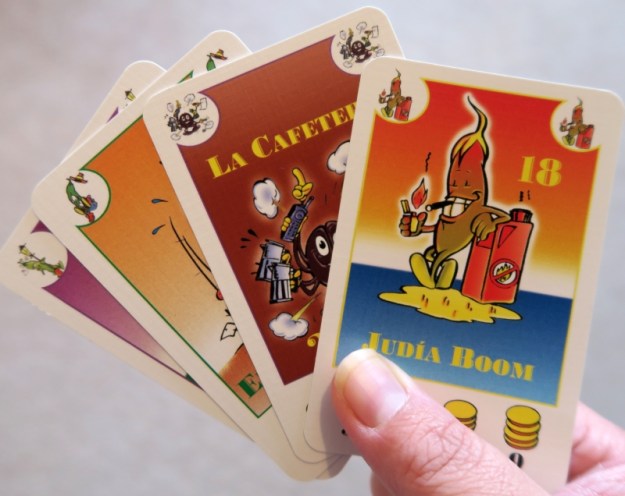
Blue, Red, Burgundy and newcomer, Mulberry, were finishing their food when Pink arrived after a long drive from the north-east.  While he was waiting for his food he opened a very special present Red had brought back from Spain for him.  Pink and Blue have quite a few games and for various reasons there are one or two that they have multiple copies of.  However, there is one game that they have many, many copies of.  Ironically it is a game Pink doesn’t even like playing very much, and yet, it has become a bit of “a thing” that every time Pink goes to Essen he comes back with yet another copy (ideally in a different language, but often just another German copy).  Red has strong opinions about this particular game though, and believes that by far the best language to play it in is Spanish, so kindly brought Pink a copy back from Spain to add to his burgeoning collection.  As he began to unwrap it, Pink took a few moments to realise what it was, but was really touched by this very special gift of Bohnanza.

Bohnanza
– Image by boardGOATS

There wasn’t time to play it before food arrived, then everyone else was turning up and the “who’s going to play what” debate began.  The “Feature Game”, Keyflower with the Farmers expansion had been Pink’s request and Keyflower is one of Blue’s favourite games, so they were a bit of a foregone conclusion.  They were quickly joined by Burgundy who is also very fond of the game, and Ivory who was keen to see if the expansion changed the balance and the strategies available.  Since that was likely to be the long game, they got on with it while everyone else sorted themselves out.  Keyflower itself is not a complicated game mechanistically, though it has an awful lot of depth.  Over four seasons, players are simply taking it in turns to bid for tiles to add to their village or use tiles available in the villages or the central display.  The clever part is that bidding and using tiles are both done with meeples as currency and players must “follow suite”, that is to say, use the same colour if the tile has already been activated.

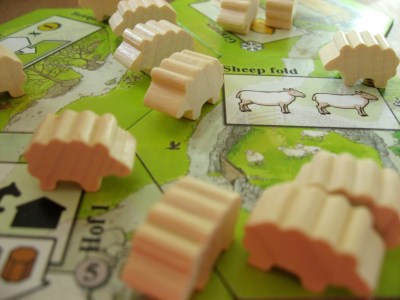
Keyflower: The Farmers
– Image by boardGOATS

In Keyflower, the depth is generated by the actions available on from the tiles and their interaction, added to the fact that except when playing with a full compliment of six, only a subset are used, and these are drawn at random.  This means that one of the most important aspects of game play is to keep as many options open as possible since everything is likely to change in the final round.  This is not only because some tiles don’t appear, but also the fact that there is always someone who will make it their business obstruct even the best laid plans.  Thus it is vital to have at least two ways ways out.  Adding The Farmers expansion exacerbates this as it introduces lots more tiles so each one is less likely to be revealed.  This is a potential problem when trying to “play with the expansion” as it is perfectly possible that none of the Farmer tiles are introduced into the game.  To prevent this, some tiles were drawn explicitly from the Farmers set.

Keyflower
– Image by boardGOATS

The Farmers expansion doesn’t change game play much, it just adds depth by the addition of farm animals as another means to score points.  The idea is that animals are kept in the fields that are formed by the roads in a village.  Each field that is occupied scores points depending on the type of animal or animals in it.  Thus each field with sheep in it scores one point, each field with pigs scores two and each with with cows scores three points.  These scores are increased for villages with special tiles, like the Weaver, which increases the sheep score to three per field.  Animals in a field another of the same type breed at the end of each season and can be moved in a similar way to resources.  The expansion also introduces Corn to the game, which allows players to enhance their movement actions.  Otherwise, the game with the expansion plays in much the same way as the basic Keyflower game, takes a similar amount of time and requires a similar blend of tactical decision making and strategic planning.

Finca
– Image used with permission of BGG contributor garyjames

Meanwhile, everyone else had divided themselves into two groups of three and had begun to play.  Pine joined Red and Mulberry in a game of Finca.  Pine had played it before, but a long time ago so Blue took time out from setting up Keyflower to explain how to it worked.  It’s a very simple game of set collection with beautiful wooden fruit that’s now nearly ten years old.  At its heart is an interesting rondel mechanism.  On their turn, players choose one of three possible actions:  move around the rondel and collect fruit; use a donkey cart to deliver fruit; or carry out an action with one of the special, single use tokens that each player starts the game with.  There are some lovely features about the game.  For example, players move as many spaces round the rondel as there are workers on the space they started on and the number of fruit they get depends on the number of workers on the space they finish on.  As players have four workers each, there are lots of factors to consider when choosing which worker to move.

Finca
– Image by BGG contributor kneumann

Investing wisely is the key to the game, and Pine went for variety while Mulberry specialised more, particularly in figs and oranges.  It was the figs and oranges that won the day with Mulberry finishing with fifty-one points, just four ahead of Red who’d had lots of fruity fun with Finca.  With that finished, Red spotted Yardmaster in a bag, one of her favourite games, and decided to introduce Mulberry to it.  It is quite a simple game and was described by Mulberry as “UNO with trains”.  Players are building a locomotive by drawing cargo cards and using them to buy railcar cards from the four face up cards in the middle.  The game was very close, but it was Red’s experience that was key, giving her a two-point winning margin over Mulberry in second place.  With that done, they moved onto another old favourite, 6 Nimmt!.

Yardmaster
– Image used with permission of BGG contributor moonblogger

6 Nimmt! gets played a lot, but it’s unusual that we play it with so few players.  The idea is that everyone chooses a card and then players add them to one of the rows, in ascending order adding them to the row ending in the highest card that is below the card they are playing.  The catch is that when a sixth card is added to a row, that player picks up the first five cards.  The game really is at its best with more players where the simultaneous card selection adds mayhem.  They just played the one round; perhaps Mulberry misunderstood and thought the idea was to collect “nimmts”, but either way, she top scored with twenty-one – quite an achievement with only three players and only one round!  Red did rather better and finished the winner with just two “nimmts”.

6 Nimmt!
– Image by boardGOATS

On the neighbouring table, Green had joined Black and Purple and they started out with this year’s Spiel des Jahres winner, Azul.  This is a really an abstract game with only a loose theme of tiling a palace, but unusually, nobody seems to mind and we’ve played the game a lot with multiple copies in the group.  The game is really just a set collection game, similar to Finca and Yardmaster, but with an added spacial factor as tiles have to be placed to score points.  Tiles are chosen from “factories” with those that aren’t taken going into a central pool.  Since players can only take one colour at a time and must always take all the tiles of that colour in that location, they can easily end up with not quite enough, or even too many scoring negative points. Although it is not really an aggressive game, it is remarkable how much damage players can do to each other.  Landing too many tiles is bad, but it is arguably worse to get “not quite enough” as it inhibits options in the next round too and therefore can affect the whole game.  As we’ve played it a lot, we all have a good understanding of how to play, so unless someone gets things very wrong, games are often close, making them quite tense affairs.  This was no exception, with Purple just taking the honours with sixty-three points.

Azul
– Image used with permission of boardgamephotos

To alleviate the stress of Azul, the trio moved on to play Om Nom Nom, a light “dice-chucker”  This needs a similar sort of double think to 6 Nimmt!.  The idea is that the board is seeded with dice populating the lower levels of three separate food chains.  Then players simultaneously select an animal card to play, populating the higher levels of the food chains.  The idea is that cards played at the top of a food chain will eat those immediately beneath it.  So if there is a juicy bunch of carrots rolled, is it best to play the rabbit and risk getting eaten by a fox, or is it better to play a fox and gamble on everyone else being tempted to play rabbit cards?  Often the wisest move is not to get involved, but if everyone adopts that approach, the carrots get left and everyone is now playing in the more confined space of two food chains.  Sometimes the game is very tight, but this was not one of those times.  Black took five cheeses in one round and finished some twenty points ahead of everyone else.

Om Nom Nom
– Image used with permission of BGG contributor msaari

The other games were still going and nobody fancied anything particularly taxing, so after a brief hiatus, Splendor got the nod.  Yet another set collecting game, it is also very simple and surprisingly popular in our group.  There is a remarkable amount of thought necessary for the apparently simple choose three different tokens or buy a card.  Many people seem to think it is a trivial game, but for us, it has the right balance of strategy and tactical thinking to make it the perfect game when people are tired but still want something that provides a little bit of interest.  We’ve played it a lot, and almost inevitably, Burgundy wins.  One of the factors in choosing the game was the guarantee that he wouldn’t win this time as he was engaged elsewhere.  In the event, it was another close game, with Green and Black very close to finishing, but Purple just getting to fifteen points first and ending the game before they could catch her – her second win of the night.

Splendor
– Image used with permission of boardgamephotos

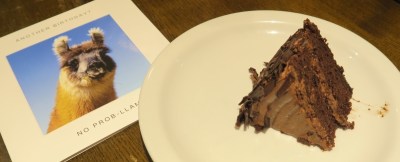
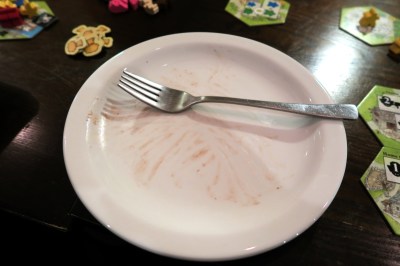
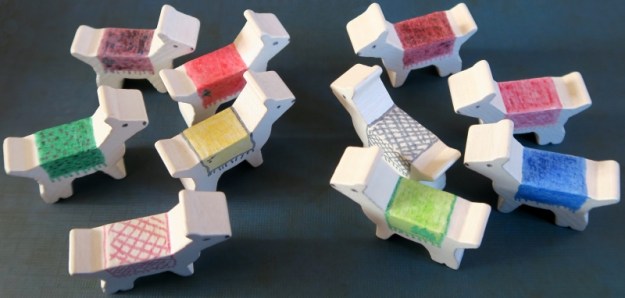
We were about an hour into our respective games and Blue was concentrating deeply on her next turn in Keyflower, when her village was suddenly and unexpectedly improved by the addition of a very fine chocolate cake complete with candles.  Much to her embarrassment, it was also accompanied by singing.  There was a brief interlude while Blue blew out her candles and cut up the cake, admired her quite a-llama-ing card, everyone consumed the really rather delicious cake (Waitrose finest no less), and Burgundy made sure there wasn’t even a pattern left on his plate.  And with all that done, the games continued.

Cake!
– Image by boardGOATS

Keyflower continued after cake and the strategies were beginning to become clear.  Ivory, Blue and Pink were going for animals, while Burgundy’s plans had been undermined by both Blue and Ivory and was trying to make something from his very, very small village.  With the arrival of Winter, players had to put in their choice of the tiles they’d been given at the start.  Much to Ivory’s disgust, someone had put in the Dairy which increases the score for fields with cows in them.  Since neither the Cow Shed tile nor the Ranch tile had been drawn in Autumn, nobody had any cows so the Dairy was a waste of a Winter tile.  This meant there was even more competition for the other tiles, and there weren’t many of those as players can put only one tile into the mix.  Burgundy got his Key Market which nobody else had any real interest in, Blue took the Hillside, but lost out on the lucrative Truffle Orchard to Pink.

Keyflower
– Image by boardGOATS

Ivory took the Mercer’s Guild and the Scribes after a brief tussle with Blue.  It was quite tight with everyone getting points from different places and it was clear the tiles everyone picked up in the final round made all the difference.  Ivory, Blue and Burgundy had spread their points about, while Pink put all his eggs (or rather pigs) in one basket, but it paid off, giving him a massive forty points and seventy-three points overall, four more than Blue in second place.  Everyone had enjoyed playing with the expansion, particularly Ivory who felt it had added more depth.  Although Ivory had to go, there was just time for a quick game of 6 Nimmt!, so Pine took his place and the foursome played a couple of hands.  In the first round Burgundy and Pine competed for the highest score with twenty-five and twenty-seven points respectively.  In the second round, Pine picked up what might be a record score of forty-five.  At the other extreme, Blue managed to keep her score down to eleven, and added to the three in the first round that gave her a clear victory—just in time for her birthday at the end of the week.

An Empty Plate!
– Image by boardGOATS

Learning Outcome:  Sometimes a pig strategy brings home the bacon!

Next Meeting – 4th September 2018

Our next meeting will be on Tuesday, 4th September, at the Horse and Jockey pub in Stanford-in-the-Vale.  As usual, we will be playing shorter games from 7.30pm as people arrive, until 8pm when we will start something a little longer.

This week the “Feature Game” will be the Farmers expansion to one of our favourite games, Keyflower.  The expansion introduces sheep, cows and pigs which players keep in the space between the roads in their village, as well as wheat to feed them with.

Keyflower: The Farmers
– Image by boardGOATS

And talking of farmers…

A Jeff was driving down a country road, when he spotted a farmer standing in the middle of a huge pasture.  He pulled over to the side of the road and watched:  the farmer was just standing there, doing nothing, looking at nothing.  A little concerned that he there might be something wrong, Jeff got out of the car, walked all the way out to the farmer and asked him, “Are you OK?”

The farmer replied, “Of course, I’m fine.”

Jeff could see that although the farmer was behaving oddly, there was clearly nothing wrong.  His concern had just given way to curiosity though.  He hesitated, but he couldn’t just leave it and walk away.  “So, if you don’t mind, what are you doing?”

“I’m trying to win a Nobel Prize,” answered the farmer.

Jeff was non-the-wiser, so continued, “But how?”

The Farmer grinned, “Well, I heard they give the Nobel Prize to people who are out standing in their field…”

21st August 2018

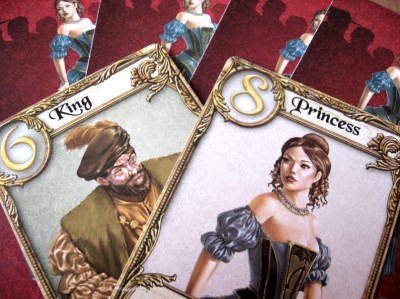
Amid fears of a shortage of people, Burgundy dined alone until he was joined by Green who (unusually) also ordered some food.  While discussing likely numbers Pine appeared, shortly followed by Green’s food and then Ivory.  Once Burgundy had finished his meal he joined Pine and Ivory in a short game of Love Letter.  This is the archetypal micro game where players draw a card to give them a hand of two and then choose which one to play, with the aim of knocking everyone else out and/or being the last player remaining or the one with the highest card.  With only sixteen cards in the deck and each round taking only a couple of minutes, it provides an excellent little filler that can be stopped at almost any time.

Love Letter
– Image by boardGOATS

In the first round Pine was knocked out early, but Ivory caught Burgundy holding the Princess. In the second round, Burgundy was knocked out early leaving Pine and Ivory to try to outwit each other.  It all went to pot for Ivory though when he got confused as to which cards were played and thought he had to reveal his hand showing everyone that that he had been caught with the Princess.  He didn’t have to discard his hand, but what’s been seen, can’t be unseen, so when Pine drew a Guard, it was inevitable that he would “guess” correctly that Ivory had the Princess. There was just time for one last round (which Pine won) before Green disposed of his empty platter and Black and Purple arrived. So Love Letter ended with Pine the winner.

Love Letter
– Image used with permission of boardgamephotos

With six players and the “Feature Game”, Lancaster, playing a maximum of five, the group split into two, with Ivory and Burgundy joining Green for a little medieval fun.  Although Burgundy and Green had played it quite a lot over the last two and a half years, Ivory was new to the game so rules run-down was needed.  The idea is that players take it in turns to place their knights in one of three places:  in the shires; in their castle, or in the wars in France.  Once the knights have been placed, players then vote on and evaluate “the Laws” which give players a benefit just before they get their their rewards for knight placement.  After five rounds, the player with the most points wins.

Lancaster
– Image used with permission of boardgamephotos

Once the game was set up and rules explanation was over, we started – the first time we have played it with three, and it did play slightly differently.  With only two Nobles per County it was going to be a real scrap to get them.  Ivory went for a castle improvement strategy, Green tried to bag those few Nobles and Burgundy went for conflicts in France.  Overall there was not a huge amount of conflict in the counties with so few players.  In round one Green ended up with two upgrades and took his level two Knight straight to level four which gave him access to higher level counties that were out of the reach of the other two.  This helped him gain the nobles he wanted, but in the next round he sent the valuable level four Knight off to the wars in France, to help in a level seven & eight conflict that needed the firepower.

Lancaster
– Image used with permission of BGG contributor kilroy_locke

There still wasn’t much conflict in the Shires, except for one where Burgundy knocked Ivory’s level one Knight out with another level one Knight and a squire. Ivory just accepted it and went elsewhere.  There was a little more conflict during rounds three and four, but not much.  Again it was Burgundy picking on Ivory, although Ivory put up more of a fight this time. Green did not make effective use of his voting influence and Burgundy was becoming a threat.  By regularly taking the ‘free’ Noble bonus when entering conflict in France, he had started to catch Green in the total number of Nobles.

Lancaster
– Image used with permission of BGG contributor aleacarv

Finally, in round there more conflict, though still not as much as we usually get in four and five player games.  Every one had managed to increase the number and value of their Knights. Ivory had also managed to gain three castle improvements and no longer needed to place any Knights there.  Burgundy and Ivory entered into a savage battle over a level four County which would give the victor the chance to gain two nobles, and lost several squires in the process. It didn’t stop there either as they fought over a couple of other counties that seemed a good benefit in this final round.  Just when it all seemed settled with Ivory coming out on top, Green placed his last Knight with a whole bunch of squires in the level four county.  Neither Burgundy nor Ivory had the “squire-power” remaining to dislodge him, so instead they entered into a new round of conflict in other Counties.

Lancaster
– Image used with permission of
BGG contributor punkin312

In the end we realised that all the current Laws would benefit everyone all equally, and the new ones were not much help either, but we voted anyway.  When it came to dishing out the rewards, both Burgundy and Green realised they had made a mistake, forgetting that they wouldn’t get the Knight upgrades they needed for the reward until after reward had been evaluated.  Not that it made a huge difference as the scores were all quite well spaced already.  During the reward taking in the counties Ivory realised he had taken both Nobles from one county, which was against the rules (all nobles must be from different counties). There wasn’t a lot that could be done, but he insisted on putting it back and so the others suggested he take back his three coins as well. Burgundy did point out that he and Green may have done something different as they had both wanted this one too.  These things happen sometimes though, and it is “only a game” after all.

Lancaster
– Image used with permission of BGG contributor punkin312

In final scoring Ivory won the points for the most improved castle, Green won the points for the most powerful Knights, and Burgundy and Green both had one more Noble than Ivory (who had grabbed a load in that final round).  Packing up, we discovered that three of the laws had been left in the bags (one of each of two, three & four class). We had commented how we had seem to get to the last round quickly, and now a check of the rules showed that we should not have taken any laws out and it should have gone on for another round.  The scores were pretty comprehensive though with Green nearly ten points clear of Ivory in second place.  But Ivory had enjoyed it though, so it will no doubt we’ll play it again in the not too distant future.

Lancaster
– Image used with permission of BGG contributor punkin312

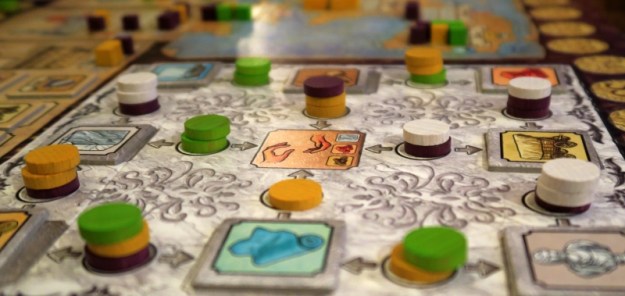
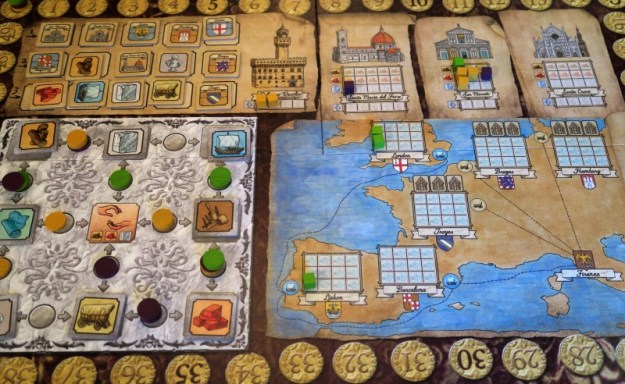
Meanwhile, on the next table, Pine, Black and Purple were playing Calimala.  This got an outing only a few weeks back, but Black and Purple have played it quite a bit since Yellow introduced it to them a six months ago at Didcot Games Club.  Calimala is an area-influence driven, worker-placement game set in the Republic of Florence during the Late Middle Ages.  The action is all centred round the unusual action board, where  place one of their workers on one of the twelve worker spaces.  Each one of these is adjacent to two of the nine action spaces and the active player gets to carry out both actions.  If there is already a worker disk present on the space when a disk is added, the owner of the other disk gets another turn.  This continues until a player places the fourth disk on a stack which triggers scoring.  In addition to worker disks of their own colour, each player also gets a small number of white disks:  coloured disks give players a maximum of two actions on three occasions (i.e. a total of six), while white disks give four actions when played, but none later in the game.

Calimala
– Image by boardGOATS

The fifteen scoring phases are built on the actions, rewarding players for the amount of cloth they have shipped to a given city or combination of cities for example, or for their contribution to a specific building, or their contribution to the building effort of a given resource.  In each case, the player with the most scores three points, the player in second place scores two and the player in third gets just one point.  In case of a tie there is a complicated series of tie-breakers.  The game ends when either all fifteen tiles have been scored, or everyone has placed all their workers (in which case any remain tiles are scored).

Calimala
– Image by boardGOATS

This time Pine led the way in points, pretty much from the start.  He managed to give the impression that he had no idea what was going on though, as he kept asking questions.  It was really close at the end, however.  Black had the Barcelona scoring card, Purple had Troyes and Pine got close to the Lord, with the Cathedral of Santa Maria del Fiore.  It was all largely academic in the end though; as is often the case in this game, there were lots and lots of tie breaks when scoring the districts.  Gradually, as Black kept winning the tie-breaks, he began to catch up with Pine.  The question was, would he make it?  He did, just, beating Pine into second place by a measly three points.

Calimala
– Image by boardGOATS

Learning Outcome:  Nobody is indispensable.

Boardgames in the News: How to attract a Goat

It has been shown previously that dogs and horses have the ability to discriminate human emotional facial expressions.  This is thought to be a by-product of their close working relationships with humans during domestication.  Because dogs and horses are required to work together an understanding of human emotional facial expressions is actively an advantage making the attribute self-selecting.  In contrast, goats have been exclusively domesticated as production animals and as such are less likely to have been selected for reading subtle communicative cues from humans.  A study carried out at the Buttercups Sanctuary for Goats, suggests otherwise however.

A Goat
– Image from pexels.com

A total of twenty goats were tested (eight females and twelve males), receiving a total of four test trials each.  Each trial consisted of a pairs of greyscale still human faces of the same individual showing positive (happy) and negative (angry) facial expressions and over all the trials, the goats’ first interactions were more often with the positive image.  They also tended to spend more time with the positive image compared to the negative one, indicating that goats can distinguish between human faces conveying different emotions.  These results suggest that goats are attracted to “happy faces”, and have been reported by McElligott and co-workers in the Royal Society journal Open Science.1

A Flock of boardGOATS
– Image by boardGOATS

1 Nawroth, C., Albuquerque, N., Savalli, C., Single, M-S., McElligott, A. G., R. Soc. Open. Sci. (2018), 5, 180491; doi:10.1098/rsos.180491.

Next Meeting – 21st August 2018

Our next meeting will be on Tuesday, 21st August, at the Horse and Jockey pub in Stanford-in-the-Vale.  As usual, we will be playing shorter games from 7.30pm as people arrive, until 8pm when we will start something a little longer.

This week the “Feature Game” will be Lancaster, a worker placement game set in the time of Henry V.  Players develop their knighthood, deploy individual knights in the counties of England, work on their own castle, and send them off to the wars in France.  We’ve played Lancaster a few times, but it’s a good game and it’s been a little while since it last got an outing.

Lancaster
– Image used with permission of BGG contributor kilroy_locke

And talking of Plantagenets…

Jeff was visiting a friend in Leicester when he came across the Richard III Visitor Centre.  He had never been much good at History at school, so before paying the entry fee, he wanted to know what it was all about.  The volunteer on the gate was very keen to explain, “Richard III was the last of the Plantagenet Kings who died at the Battle of Bosworth Field in 1485, but nobody knew where he was buried.”

Jeff was puzzled, “So how did you know he’d died then?” he asked.

“Oh,” replied the guide, “We’ve found him now, we found him a few years ago, in a carpark, and he’s been reburied in Leicester Cathedral.”

“Oh right,” answered Jeff, “I’d have thought he’d have been flushed down the toilet like all the other Richard III’s…”

7th August 2018

Largely due to holidays and work, for the first time in months, we only had enough players for one game.  Blue and Pink were first to arrive and, while they were waiting for their pizzas, they played a quick game of Honshū.  This is a game that Blue had played with Black and Purple about a year ago when Black and Blue agreed it was a very, very clever game.  Somehow though, it hadn’t got another outing until last week at the Didcot Games Club, when Blue introduced Pink to it.  He really enjoyed it and was keen to give it another go.  It is a trick taking game, so it plays a bit differently with two.  The idea is that players start with a hand of six cards; two cards are drawn at random from the deck to make one pool, and the players play a card each to make the second pool.  Each card features six districts and a number – the player who wins the trick by playing the highest number chooses one pool and then chooses a card from that pool.  The other player does the same with the second pool.

Honshū
– Image used with permission of
BGG contributor  HedgeWizzard

The players then add the cards to their city. Each card is divided into six districts, each of which scores in a different way at the end of the game. For example, every district in their largest city, players score a point. Similarly, all forest districts score two points. More interestingly, a single water district is worth nothing, but water districts connected to it after that are worth three points each. Perhaps the most interesting are the factories which only score if they are supplied with the appropriate resources, wooden cubes that are placed on resource producing districts.  These resources can also be used increase the value of cards when they are played, in the two-player game this is only by the losing player who can guarantee a win by paying a resource.  One of the biggest challenges is choosing the cards though. When the cards are placed, players must take care to make sure that they either partially cover (or are covered by) at least one other card. This, together with the fact that players are trying to expand their largest city and any lakes makes choosing and placing a card really difficult as there are many options to explore.

Honshū
– Image used with permission of BGG contributor msaari

Despite playing it a couple of times, neither Blue nor Pink have really understood how the game plays which is probably what makes it interesting.  After the first three rounds, in the two-player game, players swap their remaining three cards and are supposed to add another three (repeating this after the sixth and ninth rounds).  Unfortunately, Blue misunderstood the rules for some reason, so instead, they swapped hands after three tricks, refreshed their hands to six cards at half-way and swapped hands again after nine.  This simplifies the game a lot, as the obvious strategy is to play high cards early and then hand all the dross over to the other player who is forced to play them.  It also introduces a lot of luck, and while we like luck in the right place, the game would definitely be more interesting with the rules as written.  Blue won, but it is definitely one to play again, and correctly this time.

Honshū
– Image used with permission of BGG contributor bkunes

With Burgundy’s arrival and then Green’s, and food out of the way, we moved onto the “Feature Game”, Altiplano.  This is a bag building game that re-implements some of the mechanisms found in one of our more popular games, Orléans.  Like Orléans, Altiplano has two phases: planning and carrying out.  The idea is that players start off with a handful of resource tokens and, on their turn can draw a number of these out of their bag, placing them on their personal worker board.  Simultaneously, players then place them on the action spaces on their board.  This usually takes a little time as everyone is trying to maximise their return.  And this is where it differs significantly from Orléans where everyone can more or less do whatever they want, whenever they want.  In Altiplano, there is a central circle of locations, and actions can only be carried out when player’s meeple is in the appropriate area.  There are seven locations and players get one movement of a maximum of three spaces for free on each turn.  This means it is possible to get to any location, but only one of them, unless they pay a food token which will allow them another move, but only a single space.  Thus getting the planning right is essential.

Altiplano
– Image used with permission of boardgamephotos

In the action phase, players must take an action, or pass.  Once they’ve passed, they cannot have another turn.  Before or after they take an action, players may move if they are able to.  This effectively means that players can carry out actions in two locations per turn, unless they pay for more.  Once a token has been spent, it it goes into a little cardboard crate where it stays until the player’s bag is empty.  This means that unlike Orléans, every token must come out of the bag and be placed; there is no element of chance except in the timing.  Thus, instead of playing with probability, the game is now all about controlling what’s in the bag and knowing what can come out and when.  Anyone who’s played Orléans and felt that their Monks have entered a closed order in the corner of their bag will really appreciate this.  However, it also means rubbish can be even more costly as it WILL come out and must be used.  Worse, any rubbish will will eventually go back in the bag and have to be dealt with again, and again and again…

Altiplano
– Image used with permission of boardgamephotos

It is possible to get rid of resources:  they can be placed into the player’s personal warehouse. Once they are in the warehouse though, they can’t be taken out again and as all resources are limited, it may not be possible to obtain a replacement.  Placing resources in the warehouse is done by visiting the Village and is a useful thing to do as it is one of the ways to score points.  Most resources are worth points at the end of the game, but in addition to this, full shelves in the warehouse score bonus points.  Each shelf can only hold one type of resource, and the higher shelves score more points.  Getting resources is therefore important, but they have to be the right resources as the warehouse isn’t the only strategy available.  At the Village location, players can also buy Hut cards which depict one resource and give players extra points for that resource at the end of the game (as well as a little bonus).  In the Market, it is possible to “sell” goods (they still go back into circulation though), and buy Contract cards which give points when completed.  Players can only work on one Contract at a time, but once they are finished, they can be worth a lot of points.

Altiplano
– Image used with permission of boardgamephotos

The Market will probably be one of the most visited locations as players can also buy “Extensions” to their player board.  These are really key to playing the game well, as without them there are lots of resources that are difficult to get.  In addition to the Village and Market, there are five other locations to visit:  the Farm, the Forest, the Mines, the Harbour and the Road.  The first four of these are mostly about using one sort of resource to get another (e.g. using an alpaca and some food to get wool, or using two fish to get stone).  All resources acquired in this way go into the recycling crate to be used on a later turn.  The Road is slightly different as it features a track similar to the Knights track in Orléans, and players’ position on the road dictates how many resource tokens they are allowed to place in the planning phase.  Like Orléans, players don’t have to place their full quota of tokens on action spaces, but these will block spaces for their next turn if they don’t (which can be doubly damaging as it prevents more useful things coming out of the bag).  The Road has to be built though, and it costs a wood and a stone to travel along the path.  Some steps give Corn instead, and this has to be placed in the warehouse, but it can be very useful as it is “wild”, so can help fill those difficult rows where resources are scarce.

Altiplano
– Image used with permission of BGG contributor JackyTheRipper

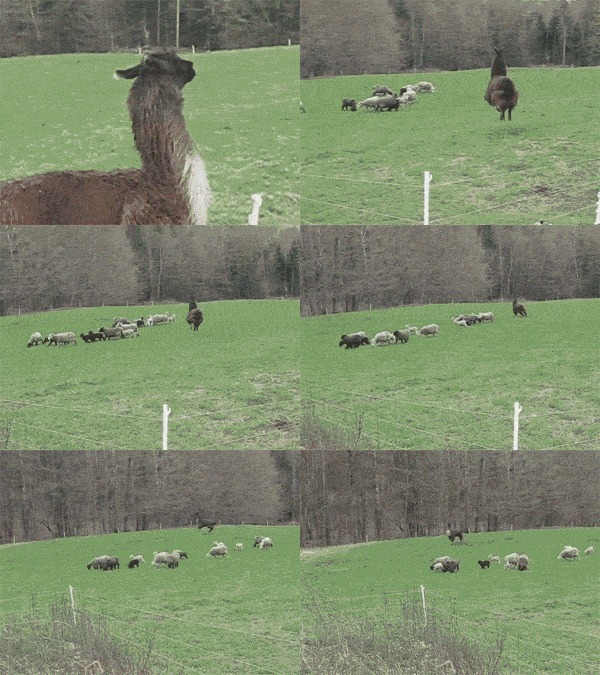
The game is not terribly complicated in itself, but there is a surprising amount of thinking to be done and, like all great games, players always want to do many more things than they are able.  Blue had played Altiplano with Pink a couple of times, and Burgundy had read the rules and watched a video, so the rules explanation was really for the benefit of Green.  Unfortunately, he was too interested in playing with his phone to pay attention, which might explain why he made such a mess of things later on.  To be fair, everyone was interested in the difference between an alpaca and a llama (apparently llamas have long banana-shaped ears and are roughly twice the size of an alpaca, but alpacas have softer fleece and are a bit more skittish).  We all had a good laugh at the jumping alpaca footage too, but even after all that and everyone else focussed on the game, it was clear Green’s attention was elsewhere.

Altiplano
– Image used with permission of BGG contributor Mouseketeer

At the start of the game, everyone gets a character card which dictates their starting resources and gives them a special action.  Green was the Woodcutter, Blue was the Shepherd, Pink was the Miner and Burgundy was the Farmer, giving them access to Wood, Wool, Ore and Alpacas respectively.  Blue and Green started with only three resources (and an extra coin), which didn’t seem to bother Green much.  Blue felt it was a big disadvantage though, especially as it wasn’t clear to her what strategy the Shepherd encouraged.  In the absence of anything better, she started off going to the Market and buying an Extension, and using her Alpaca to make some Wool in the hope that things would become clearer in time.  Green on the other hand, began with the obvious tactic and used his Woodcutter to get some wood.  For Burgundy, the priority was to increase the number of resources he was able to place in each round, so he began by trying to get the stone he needed to start building his road.

Altiplano
– Image used with permission of boardgamephotos

Pink had a two-pronged strategy, planning to go for the three point resources  (especially Silver as he had the Miner which meant he could get plenty of Ore).  This was because they were less difficult to get than Glass, but were still worth a lot, especially if augmented with a Hut bonus.  So that was the second part of his plan: get lots of Hut cards from the Village as they give a small bonus anyhow, and by taking them he was depriving everyone else.  As Burgundy started to build his road, Blue and then Pink decided to join him.  Eventually Green followed suit, but it wasn’t until he was several steps along the road that it became clear that he hadn’t actually been visiting the road to build it.  He explained that he didn’t think it was necessary as the road was different and it had been positioned very slightly out of the line of the circle due to the slightly cramped space.  Everyone else had been visiting properly though, so if he’d been concentrating on the game and watching what others were doing (instead of playing with his phone), it probably wouldn’t have happened.

Altiplano
– Image used with permission of boardgamephotos

Meanwhile, Pink was continuing to collect Huts and Silver, and Blue had another Extension, was buying lots of Cocao and using it to get Glass (or occasionally Food or Cloth).  It was around this time that Green began to join Pink collecting Huts.  Burgundy was just beginning to get his game off the ground when he got into a bit of a tangle.  He had positioned himself to move onto his third step along the Road, but that gives Corn and he really didn’t want to take it yet as it would have to go into his Warehouse.  Since he didn’t have any resources in his Warehouse yet, it would mean he would have to start a shelf with Corn.  The problem with this is that any corn he got later would have to go on that shelf too, rather than padding out any other, scarce resource.  Eventually, Burgundy managed to sort out his problem, but it took a couple of turns and set him back just long enough for Blue to buy the Extension he had his eye on (again).

Altiplano
– Image used with permission of BGG contributor JackyTheRipper

The game was entering its final stages and Blue began filling her Warehouse, trying to keep the size of her bag down.  She was helped by the Extension she’d grabbed from under Burgundy’s nose which allowed her to place an extra item in the Warehouse on each visit.  Everyone else followed, and began worrying about what they needed to maximise their bonus points.  Everyone that is except Green, who was still fiddling with his phone despite the fact that his friend had apparently gone to bed.  The game end is triggered when either there aren’t enough Extensions left to fill the Extension Strip, or one of the locations is completely exhausted.  When Green took the last Glass token, everyone had just one more round to maximise their bonus points.  Blue and Burgundy fought to try to get the last Extension that allows players to draw an extra ten tokens out of their bag and put them straight in the Warehouse at the end of the game.  This time Burgundy won, as Blue discovered that she didn’t need it anyhow because she could use Corn to do the job, and as she didn’t have the right resources in her bag it wouldn’t have helped her in any case.

Altiplano
– Image used with permission of boardgamephotos

Eventually, the game petered out as there was nothing more people could do and players began adding up their scores.  Burgundy had struggled throughout and Pink’s experience and Hut strategy had worked well.  It was very, very close at the front though with just three points in it, and much to everyone’s surprise given how much attention he wasn’t paying, Green finished just ahead of Blue with a hundred and six to her hundred and three.  He was obviously pleased and professed to have liked the game despite not really focusing on it.  It was when Burgundy commented on all the Wood and the Glass that he had, that someone asked where Green had got all the Glass from.  As Green explained that he’d got one from a Hut, it all came out.  Every time he’d taken a Hut card, he’d taken a resource (perhaps confusing them with Boat cards).  He said it wouldn’t really have made much difference, although he wouldn’t have won as he’d have had fewer resources and therefore maybe ten points less, leaving him in second place.  Burgundy pointed out that the advantage he got from all those resources during the game was incalculable, added to which, taking the last Glass ended the game early preventing others from scoring more.  Normally nobody would have minded as everyone makes mistakes from time to time, but as Green had been playing with his phone all evening and not concentrating, we decided there was no cause for a llama, and just disqualified him.

Altiplano
– Image used with permission of boardgamephotos

Learning Outcome:  Playing with your mobile phone means you make mistakes which upset the balance of the game.
Next Meeting – 7th August 2018

Our next meeting will be on Tuesday, 7th August, at the Horse and Jockey pub in Stanford-in-the-Vale.  As usual, we will be playing shorter games from 7.30pm as people arrive, until 8pm when we will start something a little longer.

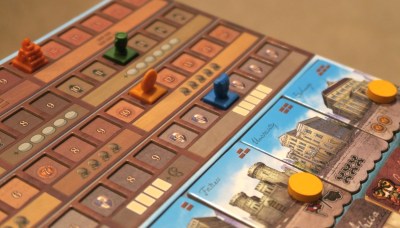
This week the “Feature Game” will be Altiplano, a bag building game that re-implements some of the mechanisms found in Orléans.  Players must build an effective production engine as well as deliver the right goods at the right time and store goods cleverly enough to fill the most valuable areas of their warehouse, all the while being scrutinised by a large cardboard alpaca…

Altiplano
– Image used with permission of boardgamephotos

And talking of alpacas…

Jeff was visiting his South American cousin, José, who farmed alpacas up on the high planes in the Andes.  Alpacas are quite substantial beasts and very nosy, so were very interested in this newcomer from Europe.  Jeff, on the other hand, was a more than a little intimidated by the large shaggy creatures.  José was very understanding though, and explained that they were really very friendly adding, “There’s really no cause for a llama…”

24th July 2018

It was a quiet night, and the atmosphere was slightly subdued as our thoughts were with Green who had had a very rough day and therefore wasn’t with us.  Burgundy and Blue were still eating, so Pine, Red and Ivory began punching out Pine’s brand-spanking, new copy of the “Feature Game”, AzulThis week, Azul won the Spiel des Jahres Award, but despite the fact that it only came out at Essen last year, and has been difficult to get hold of for much of the time, we’ve still managed to play it a lot.  Even so, Red seemed to have managed to miss out, so an explanation of the rules was in order.  It is quite simple to play, if a little abstract.  The idea is that players are tile laying artists decorating a wall in the Palace of Evora with “azulejos”.  On their turn, the active player can either take all the tiles of one colour from one of the factory displays (putting the rest in the central market) or take all the tiles of one colour from the market in the centre of the table.  They then place the tiles in one of the five rows on their player board.

Azul
– Image used with permission of BGG contributor JackyTheRipper

Each row can only contain one colour, but players may have more than one row with any given colour.  The catch is that each player only has five rows, each with a set number of spaces, one to five.  Players can add tiles to a row later in the round, but once a row is full, any left-overs go into the negative scoring row.  Once all the tiles have been picked up, players evaluate their board, and, starting with the shortest row, one of the tiles from each full row is added to the player’s mosaic and scored. Players score one point for a tile that is not placed adjacent to any other tile, whereas tiles added to rows or columns score the same number of points as there are tiles in the completed row (or column).  The game continues with players choosing tiles from the factory displays and then adding them to rows, the catch is that as the mosaic fills up, it is harder to fill the rows as each row can only take each colour once.

Azul
– Image used with permission of boardgamephotos

End game bonuses, keep everyone guessing right up to the end which adds interest and occasionally it can be really nasty when someone ends up with a pile of tiles they can’t use.  Red, Ivory and Pine got going quickly, and once Burgundy and Blue had finished with their supper, they moved to a table near the door to make the most of the draught and started a second game with Black and Purple.  Having played the game quite a bit, nobody pulled their punches:  It was only the second round when Blue had to pick up ten yellow tiles netting her fourteen negative points.  She was fortunate that she didn’t have fourteen to lose, but when Black picked up seven yellow tiles a couple of rounds later he was less lucky.  On the next table Ivory was being nasty to Pine, leaving him with Hobson’s Choice and minus ten points either way.  Playing “dirty” clearly worked for Ivory as he won the first game, though there was some confusion of the scoring, which Pine blamed on his over-hot head.

Azul
– Image by BGG contributor JackyTheRipper

In the other game, there had been a lot negative points and a lot of bonuses, it was all surprisingly close.  In the last round, Purple took the tiles she needed for a full set of reds and Blue had scotched a ten point bonus for Burgundy.  Despite that, Burgundy still picked up a massive twenty-seven points in end-game bonuses, but much to everyone’s surprise he didn’t quite manage to catch Black who finished with a eighty-five.  It had been quite a stressful game, but as usual, we’d all enjoyed it, and discussion moved on to the new release coming in October: Azul: Stained Glass of Sintra, which we are all looking forward to, as long as it doesn’t “do a Queendomino“.*

Azul
– Image used with permission of BGG contributor Toynan

Red, Pine and Ivory had started their game first, and with only three players compared with four on the other table, it was no surprise that that also finished first.   As they were looking round for something to play, Red spied Yardmaster, one of her favourite games, in Blue’s bag.  Neither Pine nor Ivory had played it before, but it wasn’t difficult for Red to persuade them to give it a go.  Unlike most other train games, in Yardmaster, players are building a locomotive rather than routes.  On their turn players can do two from the three possible actions:  draw a cargo card (either blind or from the face up discard pile); buy a railcar card from the four face up cards in the middle, or swap their “Exchange Token” with any other one around the table.  To buy a railcar, players pay using sets of cargo cards, so a yellow number three railcar will cost three yellow “oil” cards.  The exchange tokens allow players to use other cargo cards at a rate of two-to-one, however, if a player only had two yellow oil cards but also had two blue “coal” cards and the blue exchange token, they would still be able to buy the yellow number three railcar.

Yardmaster
– Image used with permission of BGG contributor joeincolorado

When buying a railcar, if the number or colour match the previous car, then it must be added to the end of their locomotive.  If not, then players can park it in their personal sorting yard and add it later, when another railcar is being bought and added to the locomotive.  This is the clever part of the game as it allows players to “stack” points in their personal train yard enabling them both to take some risks and strategically remove railcars from the grasping hands of their opponents.  Players score is the total of the numbers of the on the railcars making up their locomotive at the end of the game.  Ivory started out with a really clever move, using a discarded “extra move” cargo card to take another “extra move” card and Pine and Red thought it was all over before it had begun.  It wasn’t though, and despite it being a very short game, Ivory quickly got bogged down trying to buy a high value, “Purple Four”, which gave both Red and Pine the chance to get past him.  Although he was new to the game, it was clearly one that made sense to Pine who finished four points ahead of Red.

Yardmaster
– Image used with permission of BGG contributor moonblogger

As both games finished Blue, Burgundy, Black and Purple moved back to the group’s usual table and the options were discussed.  With seven players and Red present, Bohnanza was always a possibility, but with the heat sapping everyone’s strength, nobody fancied playing anything too strenuous and the deal was sealed.  Everyone is very familiar with this, even Ivory who has played it the least, so as Burgundy shuffled the deck and removed the cocoa and garden beans, everyone else reminded each other of the rules:  must plant the first card in hand, may plant the second as well; turn over two cards from the deck which must be planted before any other deals can be finalised; trading can only be with the active player; draw four cards at the end of a turn; two coins for a third bean field; fields with only one card can’t be ploughed in unless they all have only one card, and don’t forget – you can’t rearrange your hand!

Bohnanza
– Image used with permission of BGG contributor spearjr

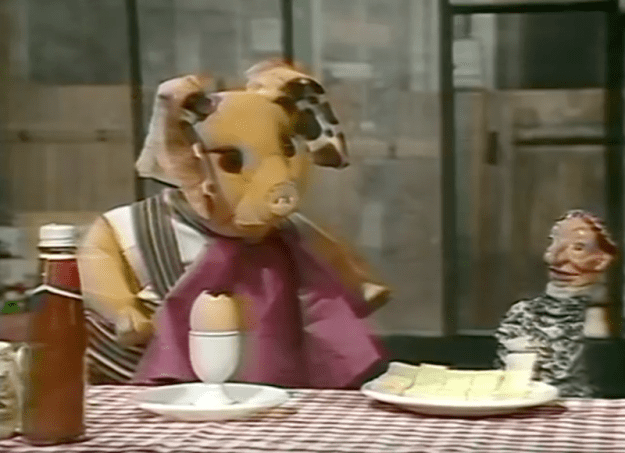
As usual with a large number of players, it was a tight game and everyone spent most of it telling people not to trade with everyone else as they were winning.  Three times through the deck doesn’t take long and people don’t get many turns, but it was Blue, Black and Purple who stood on the podium at the end with everyone else within a point of each other.  It was Blue who made up for her dire showing in Azul though, beating Black into second place by a massive two points.  There was still time to play something else, but the heat had clearly got to everyone as the conversation degenerated into a discussion about everyone’s favourite childhood cartoons and how many had inspired boardgames.  The late, great Peter Firmin‘s Ivor the Engine and Noggin the Nog both got a mention, but then age and nationality created a bit of a divide, and the evening ended with Pine crowing, “My name’s Pig and I like cream cakes!”  His head was definitely over-hot.

Pipkins
– Image taken from youtube.com

Learning Outcome:  Children’s TV programs were very weird in the 1970s.

* Queendomino is the follow-on to the 2017 Spiel des Jahres winner, KingdominoWhen the group played it, we found the new game replaced the smooth elegance of the original with a more clunky, complex, long-winded game that was no where near as good as the games it was trying to compete with (much like Tsuro of the Seas a couple of years before).

Boardgames in the News: Who are PAI Partners and what do they want with Asmodee?

A couple of months ago, Reuters reported that according to un-named sources, investment bankers had been hired to run the sale of Asmodee.  The claim was that the sale “could value the company at over €1.5 billion”, but there was no credible information as to who the potential buyers were.  This mystery has now been solved with the announcement that PAI Partners have entered into exclusive discussions to acquire Asmodee, a company with an enterprise value of €1.2 billion.  So, who are PAI Partners and what do they want with Asmodee?  Well, PAI is a European private equity company, that grew out of the merger between the French banks, BNP and Paribas in 1993, with a management buyout completed in 2001.  They have invested in a wide range of companies covering everything from yoghurt (Yoplait) to tyres (Kwik Fit) to cargo handling (Swissport).  Obviously PAI are interested in making money from Asmodee, but at this time there is no evidence to suggest that would by by asset stripping.  Price increases would be almost inevitable however, as the Studios would be under pressure to provide a good return on the investment.

PAI Partners
– Image from paipartners.com