Author Archives: nannyGOAT

Boardgames in the News: The Guardian

A lot of people familiar with the world of “Designer Boardgames” will tell you how it’s becoming more mainstream.  The opening of more and more and more boardgame cafés and features on the BBC are often cited as example of modern boardgames making it into the public conciousness.  The latest example is the “Board Games” section in the “Life & Style” magazine of The Guardian.

Wil Wheaton

So far they have published articles discussing Ticket to Ride and its effect on boardgaming; commenting on boardgames in society; debating the relationship between computer games and the growth of boardgames, and most recently, an interview with Wil Wheaton, actor, producer and presenter of TableTop, the online boardgame show, now in its third series.  Its not so much the content of the articles (though it is clear that these have been written by someone with an interest or who has done their research), it is the fact that that playing games is no longer something to be shy about:  being “a bit geeky” is no longer something to be ashamed of.

And that has to be a good thing.

2nd December 2014

We were very late starting, but after a short discussion we decided to go with the “Feature Game” which was Grog Island.  This is an “Essen Special” that we’ve not played at the group before, but it has turned out to have been a bit of a hit elsewhere due largely to its innovative bidding mechanism.  The game revolves around retiring pirates who aer trying to work out how to spend their ill-gotten gains. This game is played on a board that represents the five peninsulas of “Grog Island”, which is where pirates that have survived to retirement can go to invest their spoils by buying pirate-like properties.

Grog Island

The idea is that each player receives a hand of end-game victory point condition cards, a number of pirate meeples and markers, eight gold coins, a treasure card (containing an undisclosed amount of gold) and a parrot card.   On their turn, the active player rolls five coloured dice, and then places their first bid.  Bids are placed by selecting any number of the dice with the value of the bid equal to the sum of the number of pips on the upper-most face of the dice.  The bid must be less than the players total amount of gold (including hidden treasure cards).

Grog Island

The clever part of the bidding is that the dice that form the bid are placed in descending order, with each dice placed in one of the five available spaces, starting on the left with the highest value dice. If they can afford it, the next player may increase the bid, by increasing the total number of pips visible on the dice.  To do this they can add dice, replace dice, even completely rearrange the order of the dice, so long they do not change the number on any die and the dice remain arranged in descending order starting from the left.

Grog Island

The position and colour of the dice have a number of consequences, both for the eventual winning bidder, and for players who withdraw from the round early.  The player who eventually wins the bid gets to carry out the actions associated with the dice according to their final position.  These include placing pirates on the island and blocking spaces on the island, but the peninsula is restricted to the colour of the die placed in the location associated with that action.  Pirates positions on the island are important, because these are the primary way players can get points during the game, but since those points depend on the victory cards handed out at the start, everyone has a different combination of goals.

Grog Island

Players who drop out of the bidding either because they can’t or choose not to increase its value, get resources corresponding to the colours of the dice in the current bid.  Thus, if the current bid is comprised of the yellow, blue and green dice, the player receives lemons (yellow), fish (blue), and coconuts (green).  These resources can then be used to carry out one of the options on the shipping track.  For each resource, there are two options available:  the top option costs a single resource and varies as the game progresses, while the bottom option is always the same and allows players to place a single pirate on the peninsula of that colour.

Grog Island

We eventually got going, and after some rules confusion (despite extensive discussion before we began), Blue won the first round so had almost no money and very little to show for it.  Purple and Green both managed to win a couple of rounds while Black, struggled to win anything.  Victory points are awarded at the end of the game depending on the conditions on the victory point card, so every turn that Black didn’t win an auction, he ominously took a card.  Now in this game, the dice cannot be freely placed:  they must be placed in descending order (and are locked so the value cannot be changed).  This, coupled with the fact that the bid must always increase (but players don’t want to spend more than they have to) means there are restrictions on where the dice can go.  Black tried everything, he even used Parrot cards to change the number on dice, but unfortunately, somehow, when he eventually did win an auction, he couldn’t do much with it.  Meanwhile, Blue (who hadn’t been feeling at all well), just collected resources and Purple and Green carried on winning auctions and accruing a lot of money.

Grog Island

Blue had spent most of the game checking things with the rules as she seemed completely incapable of remembering what was going on, but despite this, she eventually managed to win a second auction and then suddenly realised that she had collected enough resources to start to place pirates without winning having to win auctions, which meant she didn’t need any money. Purple and Green both also had pirates left to place when three rounds later, Blue brought the game to an end by placing her final pirate.

Grog Island

Black went first with the scoring, and woefully shook his head saying, “I’m screwed,” as he revealed his goal cards and the fact he’d succeeded in almost none of them.  As we moved on to score Green, Black added, “You need to be somewhere round here,” gesturing at the thirty-five point mark; we all muttered disbelievingly.  Green also thought he’d done badly, but in actual fact had nearly double the number of points Black had achieved and was within one point of Purple.  Much to everyone’s surprise, possibly Blue’s most of all, she ran out the clear winner with thirty-five points.

Grog Island

Because of the late start and the inordinate amount of time it had taken to explain and then play Grog Island, we only had time to play one other quick game.  Purple nipped out for a moment and, in her absence, the rest of us elected to play Indigo.  This is a pretty game that we’ve played before on a Tuesday, and was described by Black as, “Like Tsuro in reverse.”  The idea of Tsuro is that players start with a stone on the edge of the board, and they take it in turns to play tiles that extend the path their stone is sitting on and the winner is the one who keeps their stone on the board the longest.

Indigo

In Indigo, the stones start on the board and players have to build paths to guide the stones into their gate.  The really clever part of Indigo is that each gate is shared by two players, making it a sort of semi-cooperative game.  In the four player game, each player shares one gate with every other player, so three out of the four players have two gates next to each other and one on the opposite side of the board.  The final player, in this case Green, has a gap between each of his three gates, spreading them evenly around the board.

Indigo

The game started quickly with Purple and Blue teaming up to bring a yellow stone home, giving them one point each.  Then it was Green’s turn, but from then on, Blue and Black teamed up to build a highly lucrative gate pulling in a handful of green stones and the three-point blue stone.  There was only a single point between first and second and, unsurprisingly, it was Black and Blue who were in the running, with Blue edging it by a nose giving her a clean sweep for the evening.  Path laying games are definitely Blue and Black’s sort of games, and equally certainly, not Purple’s favourites although she doesn’t mind Tsuro.  Green commented that he felt it was much harder with the gates spread out, though Blue was less sure, as she felt it should be easier as stones were never very far away.  Well, we’ll just have to play it again sometime to find out, though as Purple is not so keen it may be a little while…

Indigo

Learning Outcome:  You don’t have to feel 100% to win.

Next Meeting – 2nd December 2014

Our next meeting will be on Tuesday 2nd December, at the Horse and Jockey pub in Stanford-in-the-Vale.  As usual, we will be playing shorter games from 7.30pm as people arrive, until 8pm when we will start something a little longer.

This week the “Feature Game” will be Grog Island, which is a game we brought back from Essen.  The idea is that even the mightiest pirates must give up their lives of invading and plunder eventually, but then, what do they do for their retirement?  Well, on the five peninsulas of Grog Island, they can invest their loot in rock-solid businesses, such as peg-leg shops, carpentries for figureheads, workshops for voodoo dolls, or the infamous “Grog Hole” pub.  The core of Grog Island is its unique auction mechanism, which uses five coloured dice.  The players use these dice and the pips on them to create and raise bids.

Grog Island


And talking of the pirates…

A pirate went into a pub, but as he entered, the Landlord couldn’t help noticing that he was walking funny.  As the pirate staggered over, the Landlord became transfixed as he realised that the pirate had a ships steering-wheel down his trousers.

“Gissa pint o’ rum,” replied the pirate to the Landlord’s query.  The drink was duly poured and the pirate supped greedily, before asking for another.

By this time, the Landlord had gathered together his courage, and asked, “Excuse me sir, but did you know that you, well, you’ve got a ships steering-wheel down your trousers?”

The pirate looked cross and replied, “Arrrr, it’s driving me nuts!”

18th Movember 2014

Unusually, both Blue and Green were there early, so decided to get a in quick game.  After a bit of discussion, they decided on Blueprints, a cute little dice rolling and building game.  They had set up and Blue had just finished explaining the rules when Black and Purple walked in, so it quickly became a four player game.  The idea is quite simple:  each player has the blueprint of a building and on their turn, they take one die from the central pool, add it to their construction and then replenish the used die from a bag.  Dice must be placed within the two-by-six footprint and any stacked dice must have the same number or higher than the one below.

Blueprints

Each building is scored depending on the dice used and their position.  Thus, orange dice (wood) scores highly if surrounded by other dice, whereas black dice (stone) score for being higher in a stack.  In contrast, green (recycled material) scores well the more it is used, and clear colourless dice (glass) score the face value.  At the end of the round, each building is scored and points awarded for Bronze, Silver and Gold, scoring one, two and three victory points respectively. Prizes (worth two victory points) are given out for buildings that comprise all six numbers, buildings that have four or more of the same number, buildings that are five or more dice high, and buildings that have five or more dice of one colour (they are more aesthetically pleasing, obviously).  All ties are broken by two dice that are drawn out of the bag at the start of the round.

Blueprints

Blue was the only player familiar with the game, so unsurprisingly got off to a flying start, winning Gold for the highest scoring building and a prize for a building with four dice of the same number.  Purple picked up Silver and Black took the Bronze.  As is normal with this game, after the first round there was a pleasing “Ah! Moment” as everyone suddenly simultaneously realised how it all fitted together, what the point was, and how clever the game is.  Consequently, the second round was much more keenly fought and positions were completely reversed with Blue coming out with nothing and Green, Black and Purple winning the Gold, Silver and Bronze awards respectively.

Blueprints

So it was into the final round with all to play for, and this time it was very tight indeed.  Green and Black jointly top-scored, but Black took it on a tie-breaker.  Green lost out on a second tie-breaker with Blue for the award for four dice of the same number.  With an extra prize for using five “glass” dice, Blue finished in joint first place with Black, which necessitated a quick rules check find the tie-breaker in favour of the player with the most prizes, in this case, Blue.

Blueprints

Next, we decided to play our  “Feature Game”, which was Caverna: The Cave Farmers.  Caverna is by the same designer and is closely related to Agricola, which is a game we’ve all played quite a bit.  In fact, Caverna is often described as “Agricola 2.0”, so we’ve all been quite keen to give it a go and see how the two games compare.  In Agricola, players start with two people and a hut and have to build their small-holding with points awarded at the end of the game for the most balanced farm.  Caverna has a new skin, but is a similar game:  players start with two dwarves and are trying to develop their cavern in the hillside while chopping down the forest for use for farming.  There are a lot changes to the game play, some small and some larger.  One of the biggest differences is the absence of cards.  In the advanced version of Agricola, you can start with a hand of cards, which contain “improvements” that you can choose to build to enhance your small-holding.  These add variation to the game and force players to come up with different combinations of buildings and adapt their strategies to match.  In Caverna, these cards are replaced with tiles that are available to everyone to buy; as it was our first game, we chose to use the smaller set.

Caverna: The Cave Farmers

Another one of the key differences between the games is that dwarves can go on expeditions in Caverna.  These can be highly lucrative, but also introduce challenges of their own.  The idea is that players use ore at the Blacksmith’s to forge weapons for one (or more) of their dwarves.  Some of the actions also have an expedition associated with them, so when a dwarf with weapons carries out an action with an expedition, he can also go looting.  The loot he comes back with depends on two things, the level of the expedition and the level of the dwarf’s armoury.  The dwarf’s level dictates what he comes back with and the expedition level dictates how many items.  Thus, a well armed dwarf sent on the right mission can bring back a lot of loot, but more importantly, players can mix and match the loot to suit their purpose which makes them very versatile.  Added to that, every time a dwarf goes on an expedition, he gains experience, so on his return, his level increases by one.  The disadvantage of arming dwarves is that the better armed a dwarf is, the later it goes in the turn order.  This means that players have to choose whether to play a lower level dwarf on expeditions, or whether to take a chance and hope no-one else uses that action and wait until they can play a more experienced dwarf.

Caverna: The Cave Farmers

There are a lot of smaller differences too, for example, the game has two currencies, gold and rubies.  At the end of the game, everything is converted into gold and the player with the most wins.  However, during the game, rubies are more useful as they can be used to buy other resources at any time.  They can also be used for playing dwarves out of turn, but as they are worth one gold in their own right, they are quite valuable.  Rubies and ore can be obtained with certain actions, but players can also build mines in their caverns which not only enhance their supply, but are also worth gold at the end of the game.  There are also new and different animal, principally dogs and donkeys and with them, new animal husbandry rules which we never completely got our heads round (e.g. sheep can now be kept in an unfenced meadow looked after by dogs at a rate of one more sheep than there are dogs; donkeys can be kept in mines; only pigs can be kept in a shed in the forest, but any animal can be kept in sheds in pasture or meadow-land etc.).

Caverna: The Cave Farmers

Purple, who was still suffering with her post Essen lurgy, went first and began by collecting ore, while Green went into agriculture.  Blue meanwhile, started off with wood while Black, who was the only one with a very firm plan, began collecting rubies.  Blue and Black then began to build up a stock of ore and it was only a matter of time before Blue made her first visit to the Blacksmith and Green followed in the next round.  By this time, there were harvests at the end of most rounds and Purple was beginning to struggle to feed her people (good job she picked up the Writing Chamber!).  Green had built an agricultural empire and a Cooking Cave, and Blue was feeding her people on prime Aberdeen Angus, but without a reliable, continuous food supply, Purple had to use her grain to prevent starvation, which meant she didn’t have any to plan to provide a continuous food supply…

And all the while, Black just kept collecting rubies.

As the game drew to a close, Blue had managed to develop and fill her pastures, arm all three of her dwarves, and had managed to furnish her cave with a room for Weapons Storage when Green wasn’t looking (he went to build it in the final round only to be sorely disappointed).  Green had four dwarves, plenty of spare grain and had filled all available space and include mines and other improvements.  Purple had managed to complete her cavern and develop her woodland, but was missing a lot of animals.  Black was also missing some animals and had a lot of unused spaces, but he had managed to pick up both a Ruby Supplier and, in the last round, a Weaver to make the most of his sheep.  We had been really pushed for time, so people counted points individually as others packed up.  Despite initial appearances (namely Black’s HUGE pile of rubies that double scored), it turned out to be a really close game with only a handful of points separating the first three players.  In fact, after several recounts, the game finished in another draw between Blue and Black, and, after another hasty check of the rules, we declared both to be winners.

Caverna: The Cave Farmers

As we left, we had a quick discussion about what we thought of the game and how it measured up to Agricola.  We concluded that it felt longer, possibly because of the fiddling with the expeditions, though that could also be due to our lack of familiarity with the game.  Despite that, we felt that Caverna was probably less complex, though it felt like there were more options which meant there were more ways to do what you wanted.  This meant the game was less pressured than Agricola, which might not be a good thing, though it probably makes it more forgiving for new players.  On the other hand, the extra options also makes it very confusing for the first play.  The lack of cards and the fact the same tiles are available every time meant we felt it also didn’t have the variety that Agricola offered and therefore was less deep and, probably ultimately has less replay-ability.  However, we will have to try it again a few times before coming to any real conclusions.

Caverna: The Cave Farmers

Learning Outcome:  Tie-breakers can have a large impact on both the feel and the outcome of a game.

Next Meeting – 18th Movember 2014

Our next meeting will be on Tuesday 18th Movember, at the Horse and Jockey pub in Stanford-in-the-Vale.  As usual, we will be playing shorter games from 7.30pm as people arrive, until 8pm when we will start something a little longer.

This week the “Feature Game” will be Caverna:  The Cave Farmers.  This is a longer game that is closely related to a game we’ve played quite a bit called Agricola.  In Agricola, players start with two people and a hut and have to build their small-holding with points awarded at the end of the game for the most balanced farm.  Caverna has a new skin, but similar theme:  players start with two dwarves and are trying to develop their cavern in the hillside while chopping down the forest for use as pasture.  There are a lot of small differences that make the game a bit more streamlined, so it will be interesting to see which game people prefer.

Caverna: The Cave Farmers

And talking of the dwarves…

It was a wet and miserable evening when Jeff reversed into another car at the supermarket.

A dwarf got out of the other vehicle looking cross and said, “I am not happy…!”

Jeff replied, “OK, so which one are you then?!?!”

4th Movember 2014

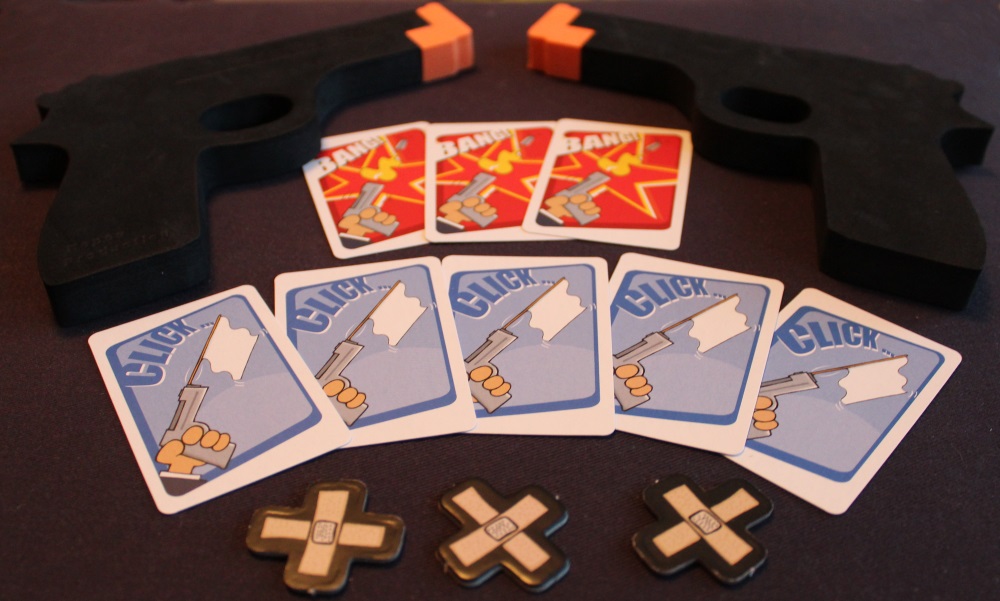
We were a little hesitant about pointing guns at each other in the pub, even foam ones, but that didn’t stop us starting the evening with a game of Ca$h ‘n Guns. This is a fun and silly game that we’ve not played before with the group.  It is based on the premise that the players are gangsters trying to split up the spoils of a robbery and being gangsters, they play a game of chicken to decide who gets the loot.  So, enough loot cards are set out in the middle of the table for one each, and each player starts with a magazine of bullet cards.  Most of the bullets are blanks, but a small number are “live” and everyone secretly loads their “gun” with a single bullet.  One player, “The Boss” begins a countdown that ends with everyone simultaneously pointing their gun at another player.  The Boss (being The Boss) can then order one player to point his gun at someone else, after which, everyone gets a chance to back out (also simultaneously after a countdown).  Backing out means they won’t get shot, but also won’t get any money.   Players who backed out unload their gun in secret, while everyone else reveals their bullet cards.  Players who had a live gun pointed at them get a bit of sticking plaster and are out of the round so don’t get any loot.

Ca$h 'n Guns

We were playing the new, second edition of the game, so those that didn’t chicken out and survived (i.e didn’t get shot) then divide up the loot by taking it turns to choose the choicest pickings from the loot cards on display.  The players continue to take cards until they are all gone, so if a lot of people back out or get shot, the spoils are all the richer for those that remain.  Green started off collecting art-work, while Red and Blue went for jewellery.  Yellow and Cyan concentrated on money, but seemed quite determined to take each other out and both suffered as a consequence.  Aside from when Cyan aimed for Green and  accidentally “shot” the pub landlord, the game went without hitch; Red and Blue finished with the same amount of jewellery so neither got a bonus, which left Green to take the cream of the loot with his vast art collection (on the other hand, selling stolen art is risky, so he’ll certainly get caught by the police first!).

Ca$h 'n Guns

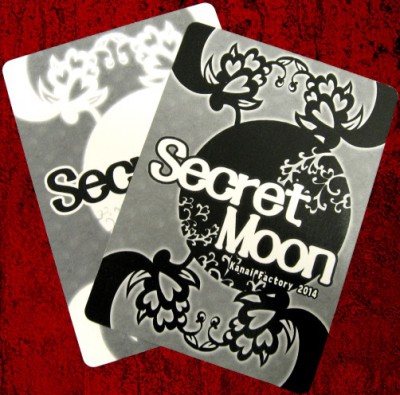
Next, we gave the “Feature Game”,  a try.  This was a new, Japanese game, called Secret Moon.  It is a small quick card game that is the sequel to one of our most played games, Love Letter, and tells the story about what happens when the Princess receives her message and goes out to meet her young man by the light of the Secret Moon.  From the rules:

One day, by chance, a letter reached her. The letter was not filled with vibrant words of love, or poem after poem praising the fair Princess and her beauty… as one might have wished. However, the contents did touch the princess’ heart.  “I have heard of you, and travelled from faraway in search of you. If I may ask, I would like to see you and tell you the tale of my travels here.”

The Princess made her decision, wrote her reply and entrusted it to a kind priestess.  “On the next night of the new moon, I will open the back door to the garden. If you please, could you retell your tale to me there?”

But someone overheard the exchange. The castle Minister. He feared that the Princess he had worked so hard to find the perfect groom for, would have her heart stolen by some wayward, suspicious Wanderer, so he ordered the Guards to watch her closely.  What fate awaits them? Will the Princess be able to hear the Wanderer’s tale, or will the Minister and the Guards get in their way?

Secret Moon

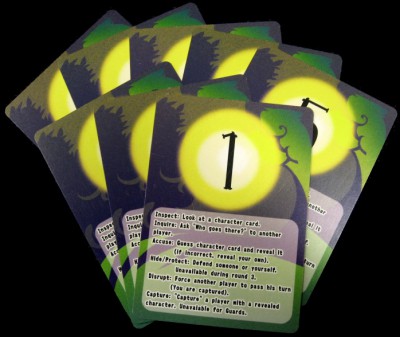
So, this game has a lot in common with Werewolf, in that there are two teams: those on the side of the Princess, and those on the side of the Minister, but while everyone knows which side they are on, only the Wanderer and the Princess know each other.  The idea is that there are three rounds i.e. each player gets three turns.  On their turn, players can inspect anyone’s card.  This means that they know definitively who that person is, but only they know.  Players can also ask, “Who goes there?”  Different characters respond in different ways, thus the Minister replies, “You fool! I’m the Minister!” whereas the Guards respond, “It’s just me!” and the Princess and the Wanderer remain silent.  The Priestess is a curious character: When the Princess asked her for help, she was quick to accept, but officially, she is helping the Minister.  So, in reality, the Priestess is the third member of the Princess’ team, but if asked, she says the same thing as a Guard.  This allows her to buy time for the Princess by masking her whereabouts e.g. by hiding in the first round to draw false suspicion or she can accuse the Guards like the Wonderer might.

Secret Moon

We played a total of three games of this in the end.  The game begins with one player dealing out turn order cards and character cards, so Green got to go first.  The game is supposed to be played with no table-talk, but in the first game, we chatted a bit to try to understand what was going on.  The Princess’ team trapped the Minister (Green), and since he was the start player, there was nothing he could do about it.  One of the features of this game is that, like Love Letter, a card is is put to one side in order to make the game a little more unpredictable.  So, in the second game, imagine her consternation when Cyan, as the Princess found she was all on her own.  Things came to a head when she was asked, “Who goes there?” and, with no-one to hide behind, was quickly captured.  But there was something that was not right.  After some discussion we came to the conclusion that it seemed very deterministic in that it all depended on the round order.  That precipitated a quick re-reading of the rules and there, in black and white it clearly said, “Go back to step 1 with shuffling the turn order cards and play another round.”  So we gave it a third try…

Secret Moon

This time, things started badly when the Red was the first player to be asked, “Who goes there?”, thus identifying herself as either the Princess or the Wanderer.  She managed to hide for a round or so, but the Minister eventually succeeded in capturing the Princess (who was indeed Red).  It was definitely much improved with the change to the turn order every round though, but it was clear that most people were a bit unconvinced.  In truth, it is probably one of those games that needs the right group of players and most of them know what they are doing for it to really sing.  Since it is so small, however, it is a game that will be carried around readily, but it may be difficult to persuade people to play it again.

Secret Moon

Red, Cyan and Yellow had an early start so headed off, leaving the rest to discuss the viability of the group without Azure and Orange who are no longer able to make Tuesdays.  The discussion rambled on for a while getting no-where, until Black suggested we played something.  So, after a number of options were (literally) put on the table, we decided to have another go at Istanbul.  We played this last time, but only Green had been involved in the game as everyone else had been playing Castles of Mad King Ludwig.  Since we didn’t have long, we played the “short routes” like last time.

Istanbul

This time, Black tried Azure’s strategy of making money in the Tea House and buying Diamonds.  Green started the same way, with a visit to the Small Mosque to pick up the tile that allows players to alter their dice rolls.  However,  he then decided to try something different and ended up wandering around the Great Mosque/Post Office area with Purple, who had started out well, collecting enough goods to get a tile from the Great Mosque, but then lost her way a little.  Meanwhile, Blue started out avoiding everyone else with a quick trip to the Post Office then made a visit to the Wainwright to expand her cart to hold three of each goods type.  She then got very lucky in the Black Market picking up three lots of jewellery (blue goods) on each of her two visits.  This left her with a lot of collateral to trade at the Sultan’s Palace and the Large Market as well as being able to pick up both tiles from the Great Mosque quite cheaply and her first gemstone with it.

Istanbul

While all this was going on, Black was picking off the early gems at the Dealer, moving back and forth between the Tea House to collect money and the Wainwright to expand his barrow it looked like the game was his to lose.  For his fourth gem, he needed more money than he could easily get in one round, and Blue was just behind with a decision to make.  She needed sixteen Lire and an assistant, but could she get them before Black, who went before her in turn order?  If she went to the Tea House to get the money, she would have enough, but since Black’s Merchant was already there, she would have to give him two Lire which was sufficient for him to go to the Gem Dealer and end the game.  So, she went to the Post Office and then popped into the Police Station to free her Family Member and send him to the Jewellers in her stead, bringing the game to a close one gem ahead of Black.  Last time everyone enjoyed it, but this time it had a more mixed reception:  while Blue liked it, Purple actively disliked it, and everyone else agreed that it needed to be played with the more challenging layouts to make it more interesting.

Istanbul

Learning Outcome:  Games work better when you play them according to the rules!


Boardgames on The Apprentice

In the next episode of The Apprentice, Lord Sugar will be telling the candidates that they must design a brand new board game, then sell it to shops across London.  According to the press release, one team designs a globetrotting game for the whole family while the others come up with a dating game for adults.  It will be interesting to see if any of the candidates know anything at all about modern, Euro-style games and what their “industry experts” have to say on the subject.

The Apprentice

The episode will be broadcast on Wednesday 12th November on BBC 1 at 9pm.

Next Meeting – 4th Movember 2014

Our next meeting will be on Tuesday 4th Movember, at the Horse and Jockey pub in Stanford-in-the-Vale.  As usual, we will be playing shorter games from 7.30pm as people arrive, until 8pm when we will start something a little longer.

This week the “Feature Game” will be Secret Moon.  This is a small quick card game that is the sequel to one of our most played games, Love Letter, and tells the story about what happens when the Princess receives her message and goes out to meet her young man by the light of the Secret Moon.  This game has a lot in common with Werewolf, in that there are two teams: those on the side of the Princess, and those on the side of the Minister, but while everyone knows which side they are on, they don’t know who else is on the same side.

Secret Moon

And talking of the Moon…

It was a couple of days after Neil Armstrong had landed on the moon and Jeff was chatting about it with his brother, Joe.

“Joe, do you think they’ll put a man on the sun next?” Jeff asked.

“Of course not,” replied Joe, “If you send a man to the Sun, he will burn up with the heat and stuff.”

Jeff sat and thought about it for a moment and then said, “Don’t be silly, they’d send him at night…!”

23rd October 2014: A Post Essen Special

This was a special Thursday night meeting because we’d had to cancel Tuesday (because the pub was holding a Chinese Night) and everyone who went to the Spieltage in Essen couldn’t wait to show off their new toys!  As it was a Thursday, we couldn’t use the pub, so we spent the evening at a private house in the village, something we used to do routinely after the fire, but haven’t done since the pub reopened.

Essen 2014

Typically, almost everyone came which meant we needed a second table!  While people arrived and drinks were found, Essen was discussed and the games played and bought were presented.  New games were the order of the day, so one table opted for Castles of Mad King Ludwig, while the other began with Istanbul, the 2014 Kennerspiel des Jahres.  It was exciting to break new games out of their shrink wrapping, but something that hadn’t been appreciated, was the time it would take to punch the components and learn the rules.

Frames

Although Castles of Mad King Ludwig had a lot of components to remove from their cardboard frame, at least the rules didn’t need to reading as one of the players had played it at Essen and was prepared to teach it.  Time was also saved someone the punching by using poker chips – although the components and box are generally really nice, the small cardboard money tokens are a little fiddly.

Poker Chips

The game itself is quite a simple game in many ways:  the idea is that players buy rooms to add to their castle.  A deck of cards is used to determine which rooms are available, and game ends when this deck has been exhausted.  The active player, or Master Builder then chooses the respective value of each room.  The clever part is the sale, an idea which appears to have been borrowed from Goa, where all monies are paid to the active player except for those spent by the active player, which go to the bank.  Thus, the idea is that the Master Builder wants to arrange the tiles such that rooms desired by the other players are expensive, but generally not too expensive, and similar to Goa, having a lot of money is powerful, but when you spend it, you generally give that advantage to the active player.

Castles of Mag King Ludwig

So, each room has a cost, but also a points value when placed, a size, and some sort of bonus for “completing” it.  A room is considered complete when every door leads to another room and this is where there is a spacial element to the game, since it is necessary to ensure that doors are laid out in such a way that rooms can be completed if appropriate.  The bonuses vary from an extra turn to money to extra victory point cards that are applied at the end of the game.  Some rooms also yield bonuses for “adjacency” which is determined on a room by room basis when the room is placed.

Castles of Mad King Ludwig

Ably assisted by Purple, Black explained the rules to Blue and Pink and then play began.  All was apparently proceeding well, when we discovered that despite the fact she was in the lead, Blue was unsure when the room bonuses applied – on placing, or to rooms added after placing.  This confusion was duly rectified (it is on placing) when we discovered that Pink hadn’t quite got a complete grasp of the rules either.  And then Purple, who was suffering with post-Essen lurgy, took her turn to have a fuzzy-rule moment.  Meanwhile, Black, who was concentrating on keeping everyone else on the straight and narrow found his castle was suffering a little and was starting to fall behind, so he quickly took measures to improve his situation by building a couple of Red rooms which yield a lot of points, though have some significant penalties if you get things wrong.

Castles of Mad King Ludwig

As the game headed towards the conclusion, Black was clearly in front and pulling away, but that was without the final scoring.  At the end of the game there are points available for any bonus cards held by players as well as for winning the King’s Favour.  The King’s Favours are scored separately with points potentially available for the everyone as players are ranked and score points accordingly.  There are four competitions that change with each game, and in the four player game, first place earns eight points, with four, two and one for second, third and fourth place respectively.  In this game, the King favoured castles with the largest footprint of living and utility space, as well as those with a lot of corridors and circular rooms.   Having picked up a lot of orange utility rooms early in the game, Blue had a lot of bonus points to score as well as coming first in two of the Kings Favour competitions, taking her well clear of Black in second place.

Istanbul

Meanwhile, Green, Azure, Red and Orange battled their way through learning the rules to Istanbul.  This is also a fairly simple game where players are trying to lead their Merchant and his four Assistants through the Turkish bazaar.  There are sixteen locations each with an associated action, but to carry out an action, the Merchant needs an Assistant to help out.  The problem is, once an action has been completed, the Merchant must move on, however, the Assistant remains to complete the details of the transaction.  The play-area is made up of tiles representing each stall, so there are four possible layouts:  “Short”, where the distances between places that work well together are small making game-play easier; “Long”, where places that work well together are far apart, which forces players to plan ahead more; “Challenging”, where similar places are grouped together, and “Random”.  As nobody had played it before, we didn’t know quite what to expect, so for this game, we chose “Short”.

Istanbul

Thus, a player’s turn consists of moving their stack of pieces (with the Merchant on top) one or two stalls around the bazaar.  If the stack ends on a space where there is already an Assistant of the same colour, then the stack is placed on top of that Assistant, otherwise, the bottom Assistant in the stack is removed and placed next to the stack.  Then, if the play wants he can perform an action at that stall, for example, buy goods at the fabric, spice or fruit warehouses, sell goods at one of the markets, or buy gemstones from the dealer etc..  If the player does not have an Assistant to collect or leave, then the players turn ends straight away, similarly, if a player meets someone else’s Merchant, they must pay them two Lira each, and forfeit the right to an action.  Meeting one of the other characters in the game also has consequences:  the Governor allows players to buy bonus cards; the Smuggler allows players to buy or trade goods, and a family member can be captured and sent to the Police Station in return for a reward.  The game ends when a player has five rubies.

Istanbul

Each player tried different strategies and tactics and to begin with, everyone was quite close and before long, everyone had with two or three of the five required rubies.  At this point, Green and Red looked at the gem dealer and felt that his gems were very expensive and that it was going to be a while before anyone could get enough to end the game.  However, Orange was buying goods and then selling them in the market and then used his double buy bonus card to jump from two rubies to four. Meanwhile, Azure had gained a special bonus token that allowed her to change a dice roll and then set about visiting the “Tea House” and gambling on dice rolls.  With the ability to change dice rolls, it meant she could call higher and therefore win more money which she took next door to buy her rubies.  By the time Green and Red realised that Azure had enough to buy her remaining rubies, it was too late and Azure had secured the win.

Istanbul

Despite having to learn the game from scratch, Istanbul finished long before Castles of Mad King Ludwig, so they decided they liked the gem-stone theme and went on to play a game that is already quite well known within the group, but has been so popular that a copy was also purchased at Essen – Splendor.  From the group who had finished, only Green was familiar with it, so he took the responsibility of teaching.  Red started out collecting rubies, while Green bought onyx and diamond and Azure and Orange went for  across section.  Orange built up a stack of chips which enabled him to quickly build a good stack of non-scoring gem cards, these, in turn rapidly led to a lot of low level scoring cards. Red continued to concentrate on Rubies, but branched out a little and gaining some of the high scoring cards.  Then suddenly, one player remembered the option to reserve a card and take a gold token and before long everyone was doing it!  Green thought he was about to win and activated his saved five-point diamond card to claim three points for one of the Nobles (four onyx and four diamond) only to realise that he already had enough diamonds and it was onyx that he needed!  Meanwhile, Azure quietly got on with building a mixed set of gems cross-colour starting with low value, moving on to middle and finishing with high values and with it took the game.  No-one secured the patronage of a Noble, though Green came closest as he took second place.

Splendor

Azure and Orange, Green and Pink headed home leaving Blue, Red, Black and Purple with just time for a quick game of the Romeo and Juliet themed card game, Council of Verona.  This is another new game, but it has a lot in common with Love Letter, a quick little game that we’ve all played a lot and are very familiar with.  The idea of Council of Verona is that on their turn, they play a card (a Montague, a Capulet or a Neutral)  either in Exile or in Council.  Broadly speaking, the cards come in two categories:  cards with an action and cards with an agenda.  So once they’ve played a card, players then they choose whether to perform any action associated with that card and, if they wish, they may then play an influence token on any agenda cards in play.  Each player has three influence tokens, a zero, a three and a five.  At the end of the game, the influence tokens are evaluated for any agendas that have been successfully fulfilled and the scores totalled up accordingly.

Councils of Verona

The rules suggest that you play three rounds and draft the cards at the start, but since we were all unfamiliar with the game, all tired and two of us were suffering from post-Essen-lurgy, we decided to play just one quick game and deal the cards out randomly and try to get a feel for it.  Blue and Purple played Romeo and Juliet (who want to be together) into Council and added influence tokens, while Red played Prince Escalus (Neutral who wants council to be balanced) and added a token.  Blue then played Lord Montague (wants more Montagues on Council than Capulets) and Black, Red and Purple retaliated by shuffling things around.  Blue who went last, played Lady Montague allowing her to swap two influence tokens giving her a winning score.

Council of Verona

Learning Outcome:  New games are a lot of fun!

Next Meeting – 23rd October 2014: A Post Essen Special

Our next meeting will be on Thursday 23rd October and will be held in a private house in Stanford.  Please get in touch if you would like to come along and need directions.  As usual, we will be playing shorter games from 7.30pm as people arrive, until 8pm when we will start something a little longer.

This will be a special meeting because we had to cancel Tuesday (because the pub was holding a Chinese Night) and everyone who went to the Spieltage in Essen can’t wait to show off their new toys!  For this reason, the “Feature Game” will be “something brought back from Germany”.

Messe Essen

And talking of Germany…

Jeff was dealing with his late German Grandfather’s effects.  He had been clearing the cupboard and had decided to give all his Grandfather’s old clothes to the local charity shop.  He handed over the bag of clothes to the shop assistant who was rummaging through it when a horrified expression formed on her face.

“How dare you bring this uniform in to my shop!” she exclaimed angrily. “This is a symbol of pain, shame and humiliation.”

Hugely embarrassed at this turn of events, Jeff quickly took back the bag.

“I’m truly sorry,” he stammered, “I had no idea my Grandfather was an Arsenal fan…!”