Author Archives: nannyGOAT

Boardgames in the News: The Hobby Grows and Grows

In the UK in the 1960s and 1970s, boardgames were only available from toy shops, and the range was limited to a relatively small number of “traditional” games, like Chess, Monopoly, Game of Life or Cluedo.  With the appearance of bigger, supermarket-like stores like Toys “R” Us in the 1980s and 1990s, a wider range became available and, occasionally, games like the early Spiel des Jahres winner, Rummikub, made their way onto our shelves.  As children grew up, they might graduate into playing Risk and eventually move onto longer, more complex games like those produced by Avalon Hill.  However, if you liked playing games, but war themes were not for you, it was quite difficult to find good alternative games to play.  They were there though:  games like Acquire and the 18xx railway games had been about for a long time, but these were the exception rather than the rule and were still an acquired taste.

Rummikub
– Image by BGG contributor OldestManOnMySpace

In contrast, in Germany, games like Scotland Yard were starting to become readily available and genuinely very popular.  The success of the Spiel des Jahres, which rewarded good games like Ra, El Grande, Tikal, and the 1995 winner, The Settlers of Catan, meant that boardgames were receiving a lot of publicity in Continental Europe.  The characteristics of these “German Games” (or “Euro Games”) typically include balance, with only a small amount of luck, and lack of player elimination.  As the market developed, beautiful boards and lots of wooden pieces also became an essential component.  Unlike war games, “Euro Games” tend to be less confrontational and much more suitable for family gaming.

The Settlers of Catan
– Image used with permission of BGG contributor kilroy_locke

In the 1990s, UK designers like Alan R. Moon and Richard Breese started publishing small numbers of “designer games”.  These were often largely assembled by hand and generally had a limited print run.  For example, only 1,200 copies of Elfenroads (precursor to the later, Spiel des Jahres winner Elfenland) were ever made and Keywood, the first of the highly acclaimed “Key Series“, was hand-made and had a print-run of just 200.  Given the exclusive nature of these games, it was not surprising then, that many teenagers either gave up on boardgames or moved on to collectable card games, like Magic: The Gathering or Role-Playing Games.

Elfenroads
– Image by BGG contributor dougadamsau

So it was with the growth of the internet that “Euro Games”, or designer boardgames became available to people in the UK.  Firstly, this was because it enabled people to find out about the games that were available, with sites like UseNet and eventually BoardGameGeek in 2000, providing a valuable source of information.  Secondly, internet shopping made “German Games” much more accessible.  The growth of the hobby meant an increase in boardgame publishers, and the appearance of designers like Reiner Knizia who were sufficiently prolific and successful to make a living from designing games.  Over the last fifteen years or so, the hobby has grown and grown and games like Carcassonne and The Settlers of Catan are now available in Waterstones and WHSmith, there are regular comments in The Guardian, there are repeatedly TV appearances, and boardgame cafés are sprouting up all over the place.  The question is, will it continue to grow, or have we reached a high water line?

Ernie
– Image from boardgamegeek.com

13th January 2015

With several new people, we started with two sets of parallel games.  The first group began with Zombie Dice, a very quick dice game where players are zombies and the dice are their victims.  On each turn, players first roll three dice:  a brain symbol is worth one point at the end of the round, while footsteps allow that die to be re-rolled.  On the other hand, shotgun blasts are bad, and collecting three ends the players turn and they forfeit any points they’ve collected. After rolling their first three dice, players can then decide if they want to score their current set of brains or whether they fancy pushing their luck by grabbing a new set of three dice and rolling again.

Zombie Dice
– Image used with permission of BGG contributor zombiegod

With Grey taking his first win, Red convinced the group to play one of her favourite games, Walk the Plank!.  This is a very silly game that we’ve played a lot over the last year and everyone seems to enjoy.  There were the usual hoots of delight as kamikaze pirates committed mass suicide and everyone enjoyed it so much, that after Grey had taken his second win, they played it again.

Walk the Plank!
– Image by boardGOATS

While Cerise was chalking up her first victory, the second group were finishing their game of King of Tokyo, the “Feature Game”.  This was a “Black Friday Special” and is another fun dice rolling game.  The idea is that players are mutant monsters, gigantic robots, and strange aliens – all of whom are destroying Tokyo and attacking each other in order to become the one and only King of Tokyo.  Each player has a stand-up monster, a counter and everyone sits round a board depicting Tokyo.  On their turn, players roll the six oversized dice with four possible outcomes: numbers (potentially leading to points), attack (a paw print), healing (a heart) and energy (lightening bolts).  In order to score victory points, the active player must roll at least three of the same number.  Thus, three “twos” will score two points, but each additional “two” will deliver an extra point (so four “twos” would score three points etc.).

King of Tokyo
– Image used with permission of BGG contributor henk.rolleman

Any attacks rolled are delivered to the monster who is currently in Tokyo unless that is the active player, in which case, everyone else receives the damage.  Each player starts with ten lives and each attack die costs one.  Whenever the player in the middle is attacked, they have to take the damage, but can then chose to leave the middle, to be replaced by the player who attacked them.  Moving into Tokyo has its advantages and disadvantages:  players score a point on going in (with two more if they are still there at the start of their next turn) and they can cause everyone else a lot of damage, however, they cannot using healing dice while in Tokyo which makes it risky to stay.

King of Tokyo
– Image by BGG contributor rothkorperation

Finally players can also collect energy tokens which are a sort of currency and allow players to buy cards which give their monster special powers.  The winner must either destroy Tokyo (by collecting twenty victory points), or be the only surviving monster once all the fighting has ended and all the others have died.  Green started off well, with Burgundy and Indigo in hot pursuit.  Blue seemed unable to get anything she wanted, so took great delight in seeing everyone else reduced to a very small number of lives.  Burgundy was two points ahead of Green, but it was Green’s turn and he ended the game with a gambol rolling five “threes” and finish as the King of Tokyo.

King of Tokyo
– Image used with permission of BGG contributor dekedagger

With the end of both games and the arrival of Purple and Black, we had a quick shuffle of seats and Cerise replaced Green to play another game that has been popular recently, Splendor.  This is a simple set collecting game where players collect gems that they can then use to buy cards which in turn allow them to buy more cards which are worth points and help them to collect “nobles” which give even more points.  The game started slowly with all the basic cards gone and nobody looked close to winning.  However, Blue knew she’d done something right when there was a chorus of disappointment from Cerise and Burgundy when she reserved a high scoring opal card, a trick she repeated the following round.  Buying one of the opal cards enabled her to win two nobles giving her nine points in one turn and putting her over the finishing line, with Indigo finishing just one point behind after a last minute surge.

Splendor
– Image used with permission of BGG contributor henk.rolleman

Meanwhile, the other group were playing Stimmt So!.  Although we’ve not played this for a while, we have played the closely related game, Alhambra which uses the same mechanic.  The idea is that players have a choice of actions:  they can buy commodities, or they can go to the bank for money.  There are four different legal tenders and the cost of each commodity must be paid in the specified currency.  When making purchases (of shares in Stimmt So! or of buildings in Alhambra), players can always over-spend, but if they pay the exact amount they can have an extra turn.  Thie extra turn can be used to either buy another item or to take money from the bank.  If they chose to make a second purchase, they can again pay the exact amount and get another turn.  Play continues in this way until the player no-longer qualifies for another turn or all the available stock has been purchased after which, the stock is refilled for the next player.  Thus, the game is a balance between collecting small denominations of the different currencies (which are more versatile) and collecting larger denominations (that are worth more).  The points are awarded at stages during the game to players with the most of each commodity.
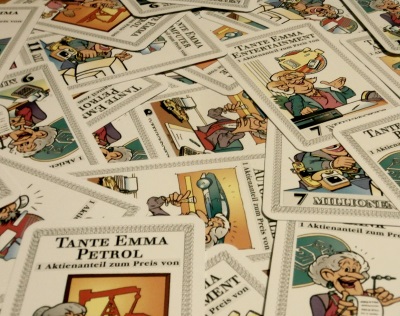
Stimmt So!
– Image by boardGOATS

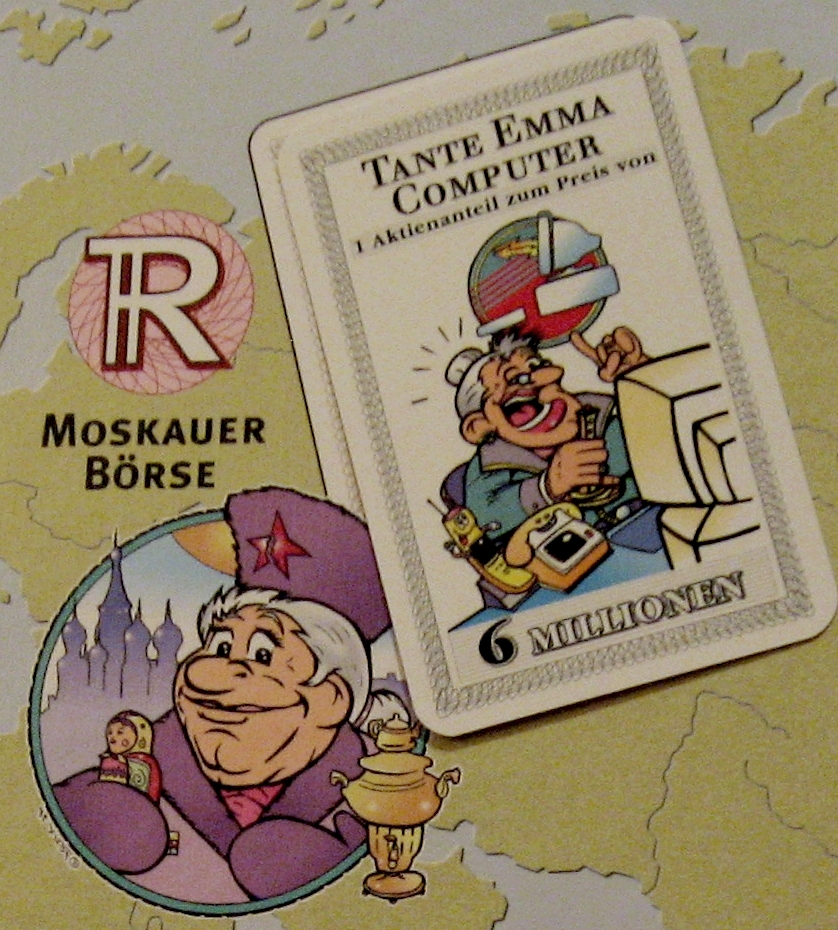
It was a slow start as people built a stock and cash and very few shares were bought. Then, as each person built up a usable amount of money the game took off.  Black quickly took control of the Petrol market with three shares and everyone else built a small portfolio. Grey followed Black’s lead and went for an early lead in Banking.  The first scoring round came along quite quickly and with almost nothing in it and then the game was really afoot.  Purple decided to challenge Black’s dominance in Petrol and Grey added to his Banking stocks.  Airlines, Computing and Entertainment were all hotly contested, but Automobiles remained obstinately absent despite an interim shuffle!  The second scoring came with a range of winners and losers and Black, Grey and Red stretched a small, but significant lead over Yellow and Purple with Green at the back who had been refusing to overpay for anything, plenty of cash, but few shares!  Going into the last round, there were several cards that nobody wanted as they could no longer even share the lead, but eventually people started buying and Automobiles finally made an appearance.  This got the game moving and the final shares came and went in short order.  Black managed to shrug off falling oil prices and finish just ahead of Red, a canny second, demonstrating that not putting all your eggs in one basket can be a good idea.  Grey was not far behind demonstrating that putting all your eggs in one basket is still a not a bad strategy though!
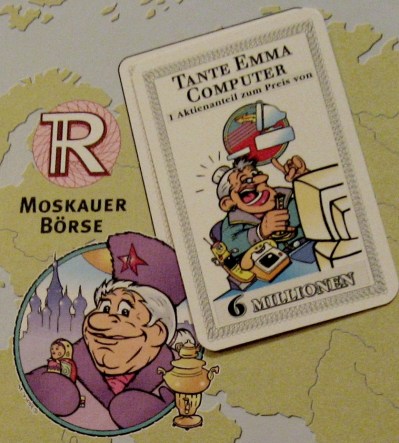
Stimmt So!
– Image by boardGOATS

Splendor finished first, and Indigo was persuaded to play one more game before she had to leave.  As we wanted something fairly quick, we opted for a card game and chose Coloretto.  This is a cute little set-collecting game that inspired, the perhaps better known, Zooloretto.  The aim of the game is to collect sets of cards with the largest three sets scoring positively, and the reset all giving negative scores.  Thus, on their turn, the active player can either draw a coloured chameleon card, or take a “truck” and all the chameleons on it.  If they draw a card, they have to choose which truck to put the chameleon on, trying to make the trucks contain a combination of colours that suit them, but not everyone else.  Alternatively, they can choose take a truck, trying to match the colours on the truck with the sets they already have and  minimise their losses.  This was quite a close game until suddenly, in the final round Indigo drew an orange chameleon which we hadn’t realised had been hitherto missing from the game.  We inevitably blamed the shuffler as all the orange cards turned up together.  Blue managed to avoid picking any up however, and finished just two points ahead of Burgundy.

Coloretto
– Image by BGG contributor SergioMR

In the meantime, Green, Grey, Black and Purple started a game of Click & Crack.  This is one of last year’s “Essen Specials” and has proven to be a fantastic little filler game.  Each player has two penguin counters.  They take in turns to place them on an ice floe made from twenty-five tiles arranged to form a five by five array.  Each player also has two tiles depicting an arrow.  Once the penguins have been placed, players choose a direction for their arrow tiles and reveal them simultaneously. Then, starting with the first player, each player picks a penguin and applies one of their direction tiles.  They can either move the chosen penguin in the specified direction, or the penguin stamps on the ice and causes the floe to crack in the specified direction.  When a crack has been completed so that it divides the floe into two, the player who played the final crack wins the smaller piece of ice and takes the tiles and any penguins caught on it.  Each floe tile is worth one point at the end of the game and each trapped penguin is worth minus one point.

Click & Crack
– Image by BGG contributor thir_teen_

The game ends when one player has at least seven points, or when the main floe is less than seven tiles in size or if there are three penguins left on the floe.  The game went all Purple’s way.  First she broke off a massive piece of ice and trapped a few penguins in the process.  Then before anyone else could do very much, she broke off another large piece capturing a few more penguins and finished the game with eight points and only Black scoring: a paltry two.

Click & Crack
– Image by BGG contributor smn1337

While the penguins were busy finishing up, Cerise (aided by Burgundy), gave Blue a sound thrashing at Dobble (an old favourite that we’ve not played for ages) before the late night brigade started the last game of the evening, Lancaster.  As it was his new game, Green had been absolutely desperate to play it, so despite the lateness of the hour, we gave it a go.  The game is a worker placement game themed around the House of Lancaster, played over five rounds, each consisting of several phases.  First, players take it in turns to place their knights.  Knights can be placed in the counties, or in the a player’s private castle or they can be sent off to fight against the French.  Knights have a rank (one to four).

Lancaster
– Image used with permission of BGG contributor henk.rolleman

When knights are placed in the counties, this rank can be augmented by the addition of squires, but once a knight has been placed, it can be usurped by a higher ranking knights (or a knight with sufficient squires to give it a higher rank).  In this case, the knight is returned to the player, but any squires are returned to the supply.  This means that players might be quite cavalier about knights, but tend to be much more parsimonious when assigning squires.  Winning a county enables players to choose either to recruit a noble, or to perform a one off action associated the county, or, alternatively, on payment of three coins, they can do both.

Lancaster
– Image used with permission of BGG contributor Toynan

If they win a war, the knights sent off to fight the French win points, with the largest contributors (highest combined rank) scoring most heavily.  However, they also receive an immediate benefit which can be monetary or in the form squires or nobles etc..  Knights placed within the castle also give a one off benefit, although it is received later.  The knight’s rank is immaterial for castle placements (as they cannot be usurped) and there is no possibility of victory points.

Lancaster
– Image used with permission of
BGG contributor kopernikus

Once all the knights have been placed, it is time for Parliament to vote on changes to the laws.  The laws basically provide scoring bonuses and other benefits.  At the start of the game there are three laws in place and three new laws that players will vote on.  These three new laws are considered one at a time and the group votes on whether they should be kept (pushing out one of the old ones) or rejected.  Players get one vote each for each law, but can reinforce their vote with votes provided by nobles (and via other means).  After the voting, the other rewards are handed out:  for occupying the counties, for knights placed in castles and for winning wars.

Lancaster
– Image used with permission of BGG contributor punkin312

Although everyone broadly understood what they could do, nobody really fathomed how everything fitted together.  So, different players tried different strategies.  Blue decided that the she couldn’t turn down the thirty-six points awarded at the end of the game for a complete set of nobles, so went for that.  Burgundy was more canny, however, he also went for the nobles, but picked up a lot of them through the one off reward provided by going to war with the French.  This way he also got victory points as he went along.  Green also tried to pick up points in the battles, but focused on trying to build up the strength of his knights and manipulate parliament. Black tried to reinforce his castle to deliver regular rewards with little input, while Purple tried a little bit of everything, just doing as much as she could on each turn.

Lancaster
– Image used with permission of BGG contributor kilroy_locke

Burgundy led the charge with Green, Black and Purple close behind.  Since Blue was focusing on collecting her set of nobles, she hardly shifted from zero for the first four rounds.  Going into the final round however, it was suddenly everything to play for.  Everyone had got the hang of how to use their knights and how the laws worked and knew what they wanted in the final round, but that did not mean they were going to get it!  Knights were placed and then unceremoniously stomped on by more powerful knights with several high ranking knights being placed with four or five squires in reinforcement. Blue and Burgundy both picked up their full compliment of nobles (just) and Green was outvoted when he tried to get his preferred law through.  Black scored for his castle and Purple managed to change the law to convert her mass of coins into points so that she scored heavily.  With her full set of nobles, Blue surged forward into second place, just ahead of Purple, but it was all way too little too late; nothing could match Burgundy’s commanding lead and he finished nearly sixteen points clear of the field.  Although there were a number of rules that we played incorrectly and a number of points that need clarifying, it was Burgundy’s superior strategy, played out to perfection that won the game.

Lancaster
– Image used with permission of BGG contributor kilroy_locke

Learning Outcome:  We really need to learn how to shuffle.

Boardgames in the News: Are Games About to get More Expensive?

There were a number of very good deals available before Christmas as a result of Black Friday and an Amazon Marketplace malfunction, however, the tide now appears to be turning.  At the start of January, the newsletter from one of the UK’s leading specialist online retailers, BoardGameGuru commented:

“The UK’s largest games distributor has changed its discount structure for hobby games that are not best sellers. This is, in effect, a price increase and will result in a lot of older titles increasing in price when I restock them. For new releases there is an initital discount at launch, however prices may increase after launch stock has sold out. I will be doing my absolute best to keep prices down.”

Esdevium
– Image of unknown origin

The distributor in question is Esdevium. Esdevium essentially have a monopoly within the UK and have recently been bought out by Asmodee who have, in turn, have merged with Fantasy Flight Games and Days of Wonder.  Paul Bryant from GamesLore, another leading online seller confirmed that they are “being forced to do exactly the same” and commented that “the rise is considerably higher than our nett margin or we’d be tempted to try and ride it out”. Paul Lister from BoardGameGuru has indicated that most top titles will be unaffected as the discount structure for them remains broadly the same, however, the more niche items (e.g expansions and less popular games) won’t have the same discount structure as in 2014, so their price will increase.  It seems that although there will be an initial discount during the launch period, costs will go up on restocking and this will inevitably be passed on to customers.

Boardgames
– Image from mumwhoruns.com

So, what effect will this have on the UK boardgame market?  It appears that the discounts available from online games stores will decrease, which means the price difference will narrow between them and “bricks and mortar stores” (which generally sell at the Recommended Retail Price or RRP). Does this mean that it is good news for games shops?  Well, probably not.  It is very difficult for sellers to charge over the RRP, so all that will happen is that the margins on a business with already tight margins, will be further squeezed.

What effect will this have on the boardgame market in the UK then?  The good news is that the price of new releases from the main producers (e.g Fantasy Flight, Days of Wonder, Z-Man etc.) probably won’t change much; it will be the older games that will be most affected.  Since older games will become relatively more expensive, it will probably bolster the second-hand market for “good games”.  There will also probably be an increase in the number of language independent games that are imported from Germany by gamers “in the know”.  Sadly, increasingly small margins and more buyers importing games privately may mean the end of the some smaller games stores.  This is a great shame as the hobby is just on the verge of becoming more mainstream.

Rising Prices Ahead
– Image of unknown origin

Next Meeting – 13th January 2014

Our next meeting will be on Tuesday 13th January, at the Horse and Jockey pub in Stanford-in-the-Vale.  As usual, we will be playing shorter games from 7.30pm as people arrive, until 8pm when we will start something a little longer.

This week the “Feature Game” will be King of Tokyo, which is a fun game where players are mutant monsters, gigantic robots, and strange aliens – all of whom are destroying Tokyo and attacking each other in order to become the one and only King of Tokyo.  The winner must either destroy Tokyo, or be the only surviving monster once all the fighting has ended.

King of Tokyo
– Image by BGG contributor christianrehm

And talking about monsters…

Jeff was quite convinced that he’d swallowed a monster, and nothing his doctor said would make him change his mind.

Eventually, after trying several non-invasive therapies, the doctor decided he had to do something about it as his patient was getting quite distressed.  So, made Jeff a special appointment and, when he arrived asked him to change into a hospital gown and lie on the bed.  He then gave Jeff an injection that put him into a deep sleep.

When Jeff woke up, the doctor was standing beside his bed, holding a great big green monster on a lead.

“There’s nothing more to worry about,” the doctor said. “We operated on you and removed the monster.”

“Who are you trying to kid?” said Jeff. “The one I swallowed was blue!”

Boardgames in the News: Last Tango in Halifax

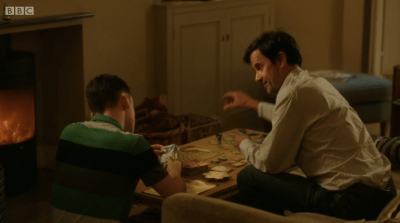
There have been a lot of comments here and elsewhere about how modern, “designer” games are becoming more widely known:  our little hobby is no-longer a secret.  We’ve had the rise of the boardgame café, various reports on the news and in the press, there’s even been an episode of The Apprentice!  One of the signs that games are becoming less niche is their increasing appearance on “normal” television programs, the latest being Last Tango in Halifax, starring Derek Jacobi, Anne Reid, Sarah Lancashire and Nicola Walker.  In this case, the boardgame was entirely incidental to the scene and almost any game would have done.  The programme makers could easily have used something more widely known like Monopoly or Risk, but instead they used Mage Knight.

Last Tango In Halifax
– Image from bbc.co.uk

31st December 2014

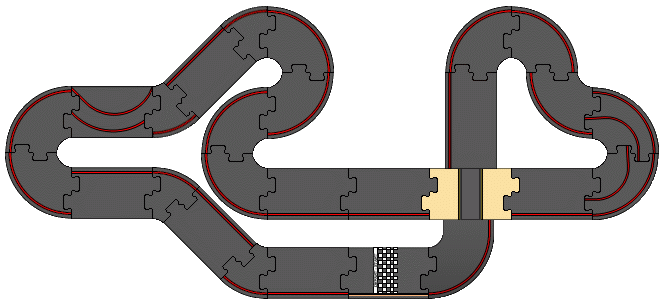
The first challenge of the evening was to set up a track for our “Feature Game”, the gorgeous, dexterity car-racing game, PitchCar.  We started with getting pieces out of the box, then we decided the table needed to be expanded, then we struggled to make the ends of the track meet!  After a bit of pantomime, we eventually resorted to one of the suggested tracks, including chicanes and the bridge/tunnel from the first expansion.

PitchCar Track 31/12/14

Once the track is set up, the game itself is very straight-forward, with players taking it in turns to flick their little wooden “cars”, and the winner the first to complete (in our case) two laps of the track.  The rules are simple: a flick must be a flick (not a push), and cars must end their turn the right way up on the track.  Leaving the track is allowed, but cars must not fly more than two track sections or touch the table.  The leading player always plays first in each round.  Anyone who violates the rules forfeits stroke and distance, but any consequential moves to cars that stay on the track are valid.

PitchCar

Blue missed out on the practice lap as she was preparing food, so started from the back of the grid.  Black got off to a flying start and led round the first couple of corners before the rest of the pack caught up. Blue and Pink had caught up by the bridge, but Black held them off through the chicanes before they finally passed going into the bridge.  It was short-lived however, with Black retaking the lead before Pink passed and took a commanding lead going into the second lap with a disputed two wheels off the track.  Even with an eventually agreed penalty of a missed turn, his position turned out to be unbeatable.  Meanwhile, Blue and Black tussled before Blue got stuck on the bridge on her second pass and Black romped away, finishing second.  That left Blue and Purple to fight it out for the honour of the wooden spoon.  This was a competition they both seemed determined to win, with a series of miss-flicks, and over-flicks, but Blue eventually made it across the line first, with a cloud of smoke.

PitchCar

While tea was cooking, we played a couple of quick games of Belisha. This is a Rummy-based game with cards that depict a trip from London to Oban.  The game was a Christmas present and appears to be an original 1937 edition which probably makes it the oldest game we’ve played.  The cards run one to thirteen in four colour suits, but each card also has a road sign.  Like Rummy, players first draw a card from the face down draw deck or the face up discard pile.  They then play any runs or melds they want, with the difference being that the melds can be in numbers or road signs.  Turns end when the active player discards a card.   The game itself is fairly straight forward, though we still managed to play it wrong!  When laying runs of cards, we were playing any cards in sequence, whereas they are (of course) supposed to be the same colour/suit.  With this game it is usual to play several rounds and the game ends when a player to reaches a pre-agreed total, however, as we were only filling time, we just played a couple of hands with honours going to Black and Pink.

Belisha

After we’d eaten, we decided to play CO2.  This was the Feature Game two weeks ago, but we didn’t get round to playing it.  As only two people had played it before (and that was a long time ago), we spent quite a long time reminding ourselves of the rules, to say nothing of punching out all the pieces!  The game itself is quite an unusual one as it is cooperative, but also competitive.  The idea is that players have to cooperate to save the planet, but the player who is the most successful wins.  Alternatively, if players don’t cooperate, then the greenhouse effect will overpower the planet and everybody loses.

CO2

Each player is the CEO of an energy company responding to government requests for new, environmentally friendly power plants.  There are three stages to building a power plant:  proposing a project; installing the infrastructure for a project, and building the power plant.  Proposing a plant is rewarded by the local government grants (money, technical resource cubes or scientific sponsorship).  On the other hand, installing infrastructure has an environmental cost:  at the start of the game, each region starts with a certain number of Carbon Emissions Permits (CEPs, granted by the United Nations).  These CEPs are spent whenever the region needs to install the energy infrastructure for a project. Building a power plant earns victory points, but also has a cost associated with it which is paid in money and technical resource cubes.  This cost varies depending on the nature of the plant and also changes throughout the game.

CO2

The game is played over five decades and each decade comprises three rounds.  In these three rounds, the players need to try to satisfy the energy demand of the different continents.  At the beginning of each new decade, the energy demand of each region is evaluated and if they don’t have enough power plants, they have to build a fossil fuel plant to supply the deficit.  These are drawn at random from a pile and correspond to gas, coal and oil.  Each of these cost the region one CEP, but more importantly, they contribute to the burden of CO2 in the environment.  When the level of CO2 reaches 350 ppm, the world starts to suffer environmental disasters and at 500 ppm, the game is over and everyone loses.

CO2

At the beginning of each decade, money is awarded to each company based on their scientific expertise.  Each company starts with a scientist, though they can get more if they choose when proposing a new project.  The CEO of the company can assign their scientists to project, which earns them expertise in one of the associated scientific technologies each turn.  When a power plant is built, if there is a scientist working on the project they get the opportunity to do what scientists like to do best: travel to a conference to present their work.  When the conference has its full compliment of scientists, more expertise is awarded and they all return to the company.  Thus, through the scientists, the companies gain wealth which can be used for building power plants, however, they also need a given level of scientific expertise in each technology before they can build power plants of that type.

CO2

The game is quite fiddly and there are a lot of things to consider.  For example, a player may propose a solar power station or install its infrastructure, but they cannot build one unless they have sufficient scientific expertise.  Similarly, the location of solar power plants is also restricted to certain continents, so a solar project can only be proposed in certain regions.  The player who builds the most different power plants in a region gains control of that region and (more importantly) its CEPs.  CEPs are used when building the infrastructure to build a power plant, but are also worth points at the end of the game.  CEPs can be bought and sold on a market, and their price fluctuates throughout the game, with the final value affecting the number of victory points they are worth.  Points are also awarded to players who successfully complete their company’s personal goal (which is depicted on cards handed out at the start), or for achieving goals set out by the UN (which are cards laid out near the board and are available to players throughout the game).

CO2

We were very, very lucky with the set up.  Each region gets one fossil fuel power plant drawn at random and the total CO2 sets the initial CO2 level in the environment.  In our case, we had a lot of gas-fired power stations which are relatively environmentally friendly, so we started off well.  Purple started building in Oceania and Black in North America.  Meanwhile Blue started building up her expertise in solar and Pink just looked puzzled. Although were were unable to satisfy the worlds power demands, for the first couple of decades, we continued to be lucky and avoid the most highly polluting fossil fuel plants, which gave us a chance to start to get a feel for the game.

CO2

After a brief break to admire everyone else’s fireworks and sharing a bottle of dodgy rosé champagne, we continued playing.  Pink was now somehow in the lead, despite having to be woken up for his turn each round.  Blue suddenly realised that she’d proposed a couple of nuclear fusion projects that weren’t allowed in those regions, but everyone just shrugged and carried on with Black commenting that it “was that sort of game”.  Eventually, the CO2 level reached critical and disaster struck North America.  As Blue was the only player without a power plant in the region, she had to pay the price (a valuable technical resource cube).

CO2

It was then that Black claimed a UN goal card, to choruses of, “Oooo!  What did you do there?  What does that do!?!?” as Black surged along the score track taking the lead.  Inevitably, everyone suddenly looked to see what power plants they had built and tried to match them to the cards that had been sat quietly beside the board for the whole game, totally ignored.  Then there was a flurry of people claiming them as the game came to an end.  It was only then that Pink noticed how many CEPs Blue had amassed – with her company goal card giving her extra points for each CEP she had in hand.  Black’s company goal on the other hand, gave him points for achieving UN goal cards, which explained how he knew what they did and had paid so more attention to them than anyone else.  As the people reading the rules, Black and Blue had a better grasp of the game and it was not surprising that they finished fighting it out for the lead, but in the end it was Blue who took the first win of 2015, albeit having mess-up in the middle.

CO2

Learning Outcome:  Late at night is not the best time to learn to play long and complicated games…

Next Meeting – 31st December 2014

Following the success of last year’s New Year party, we have decided that our next meeting will be on Wednesday 31st December.  As it is New Year’s Eve we will be starting early and we will be meeting in a private house in Stanford with food later.  Please get in touch if you would like to come along so we know how much food to make.

The plan is to start off early with the “Feature Game”, which, As has become traditional, will be the gorgeous, dexterity car-racing game, PitchCar.  We will be eating later and maybe set off some fireworks at midnight, depending on how cold it is!

PitchCar

And talking of cars…

A policeman sees an elderly woman driving incredibly slowly on the motorway, so he pulls along side and notices her knitting in the driver’s seat.  She remains focussed on the road and keeps knitting and driving.

He beeps his horn to get her attention, but she is oblivious and carries on.

Getting more frustrated, the policeman turns his siren on and, as she finally notices him, he signals for her to wind the window down.

After a time she finds the button and down goes the window.

Incensed, the cop yells, “PULL OVER!”

“Oh, no sweetie,” she replies.  “It’s a scarf, see?”

16th December 2014

This week we stuck to “old favourites” and started off with the quick fun and very silly game that is Walk the Plank!.  We’ve played this a few times before, and we always play to the “last pirate standing”.  Since Red had chosen the game and White had not played it before, Blue started off by shortening the plank and pushing Red off the end.  This set the tone for the game with Red taking her revenge on Blue and then White joining in the fray.  A few rounds in and with one Blue and a couple of Red pirates down, it was Blue’s turn to start.  All three of White’s pirates were perched precariously on the end of the plank with Red’s one remaining pirate, so the game ended suddenly with a very loud splash when Blue inevitably shortened the plank…

Walk the Plank!

With the arrival of Purple and Black (and their pizza), we decided to play another of Red’s favourite games, Bohnanza. It’s amazing how a game that so many people feel is such good fun, sounds so totally uninteresting when it’s explained.  True, as White pointed out, this applies to quite a few games, but Bohnanza is definitely the “poster child”.  After a quick rundown of the rules, we began. Purple was very generous, offering beans for free at regular intervals, though of course she had an ulterior motive. However, otherwise, as Black commented, “It’s a tough crowd tonight,” as deals were pushed and even turned down.  It was fitting therefore, that such a tight game should end with a draw, with Red and Blue sharing the honours.

Bohnanza

Next, we decided to play something a little deeper and, after some discussion, we opted for one of this years most popular games: Ivor the Engine. Although we’ve played “Ivor” a lot at games night, Red and White were both new to it. It’s a cute little game, though it has a sharp edge if you want to play it that way. With a full compliment of players, it was always going to be a fairly tight game, and although Blue started well with a couple of jobs at Mrs Porty’s House, everyone else struggled as Purple got in their way.  Blue was promptly penalised for her good start though, when the first event card came out and caused the leader to lose sheep.   Since everyone else had now cleared sheep from the locations that corresponded to their cards, Blue was then suddenly left behind.  As everyone galloped on, Red, managed to pick up eleven sheep with one visit to Tewyn!  Black was closing in on the finishing line, when Blue managed to complete a couple of jobs at Dinwiddy’s Goldmine and use the gold to buy a couple of event cards.  That tipped the balance in her favour and she finished just ahead of Black.

Ivor the Engine

We finished the evening with a few rounds of No Thanks!.  This is another game we used to play quite a bit, but hadn’t played for six months.  It is such a simple, push your luck game that experience isn’t necessary, and it really brought out White’s vindictive streak.  After three games, honours finished about even and it was home time.

No Thanks!

Learning Outcome:  Old favourites are still favourites, and for a good reason.

Boardgames in the News: Are Games Getting Cheaper?

There have been a lot of good deals about recently.  First there was Black Friday.  This traditionally American festival of consumerism occurs on the Friday after Thanksgiving, and this year even affected some of the online Boardgame sellers in the UK – anyone for Grog Island at £15?  Then there were the Amazon “Lightening Deals”.  These are deals that are advertised in advance with a specific start time and a limited stock.  This year, we’ve had King of Tokyo and Dominion at £15 each.

The latest one beats all these though.  Thanks to a malfunction in the software used by third-party sellers to ensure their products are the cheapest on the market, prices were reduced to as little as 1p.  Reports suggest that one buyer bought ninety-five board games that should have cost £12.99 each for 99p each!  Ooops.

Amazon Glitch
– Image from theguardian.com

Next Meeting – 16th December 2014

Our next meeting will be on Tuesday 16th December, at the Horse and Jockey pub in Stanford-in-the-Vale.  As usual, we will be playing shorter games from 7.30pm as people arrive, until 8pm when we will start something a little longer.

This week the “Feature Game” will be CO2.  This is an unusual game as it is both co-operative and competitive.  The idea is that players have to work together to save the planet, if they fail, they all fail.  However, if they succeed, then the player with the most successful energy company wins.  This means that players constantly have to balance doing the best thing for the team and the best thing for themselves.

CO2

And talking about the saving the planet…

The leaders of Europe are all sitting around a table at the Copenhagen Climate Change summit.

After the initial pleasantries, Gordon Brown speaks first. “I will end climate change, just like I ended boom and bust! I will be tough on Climate Change and tough on the causes of climate change!  Britain will spend “£200 billion on fighting Climate Change this year!”

Before Brown has even sat back down, Angela Merkel of Germany begins to speak.  “That’s nothing! We will spend €300 billion on fighting climate change!”

Nicolas Sarkozy of France speaks next; “We will end zis climate change. We will spend €1 trillion on fighting climate change!”

Attention now turns to the president of Armenia, he stands and meekly announces, “We have budgeted to spend $1,000 on fighting climate change over the next 10 years.”

People around the table begin to snigger. Embarrassed, the Armenian president slams his fist onto the table and shouts “OK, OK, we will spend $100 trillion on climate change!”.

The sniggering around the table has now become hysterics.  After a couple of minutes, the noise abates and Gordon Brown asks, “How will you afford that?”

“Well” the Armenian president began, “The real figure was bit low, so I just made something up. Isn’t that how it works around here?”