Back in October at BrickSlopes in Utah, Eli Boschetto presented his fantastic Lego Settlers of Catan board.
| – from youtube.com |
Back in October at BrickSlopes in Utah, Eli Boschetto presented his fantastic Lego Settlers of Catan board.
| – from youtube.com |
Board games pop up in all sorts of unusual places—who would have expected them to feature, for example, on BBC Radio 5 Live‘s post Christmas World Football Phone-in? Presenter Dotun Adebayo and editor Adam Rosser played Connect 4 live on Radio and used it to lead into discussion about other games. Unfortunately, the program somewhat perpetuated the stereotype of games being complicated even though Connect 4 is not a exactly a complex game. The other presenters also claimed to have no idea what was happening in the game and one asked if it was anything like the 3D Chess (sic) played on Star Trek. That said, after winning, Dotun commented that the game was addictive and went on to compare it to Subbuteo with later discussion including Crazy Golf and Tiddley Winks (which also needed an explanation).
| – from twitter.com |
There was discussion throughout the program, with the game of Connect 4 starting at 17.30 mins in, with most game related discussion at 1 hr 19 mins (Crazy Golf and Tiddley Winks) and 1 hr 41 mins (extensive chat about Subbuteo). The full episode is available on iPlayer until 25th January 2023.
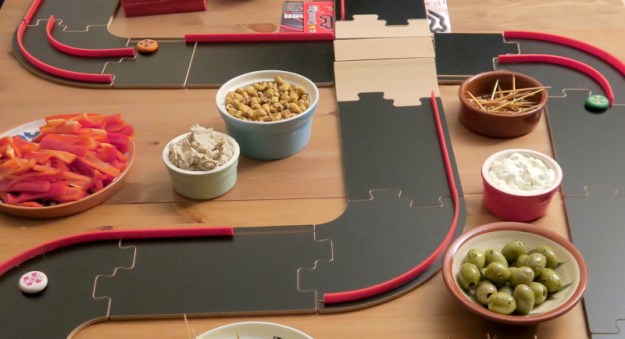
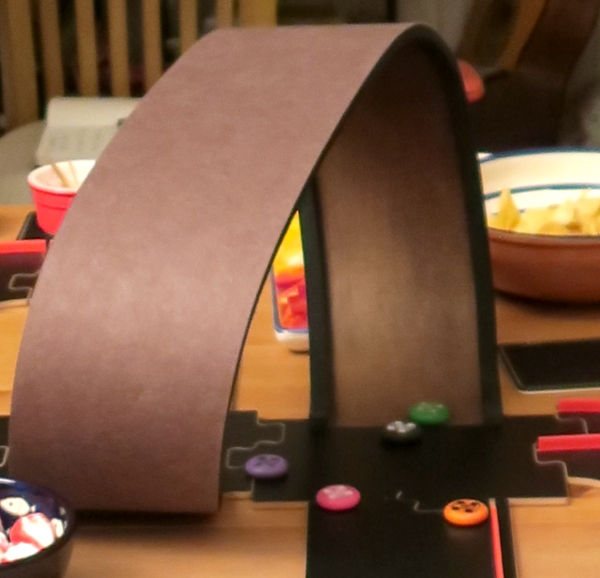
Pine was the first to arrive and, as a result, was landed with the task of setting up the “Feature Game”, the gorgeous, dexterity car-racing game, PitchCar. Black, Purple and Lemon arrived soon after to give him a hand, while Pink got drinks and Blue carried on messing about in the kitchen. Once an annual event, there has been a bit of a hiatus in the New Year PitchCar game over the last couple of years, and it turned out the lack of practice meant everyone had forgotten how to set up the bridge from the first extension. Blue was summoned from the kitchen to explain, and then the track-builders continued their construction work.
 |
| – Image by boardGOATS |
Aside from the bridge and a few chicanes, the track was kept to a simple figure-of-eight, eschewing the multi-level tracks, jumps, potholes, crossroads and loop of the more recent extensions. Before long, the track was complete, and then Lime arrived. Starting order was decided by arrival time, so the first to flick-off was Pine. The game is very simple: starting with the car at the front of the pack, players take it in turns to flick (not push) their puck along the track. Cars can jump as long as they don’t cut corners, land on the track “rubber-side down”, and don’t knock anyone else off the track in the process.
 |
| – Image by boardGOATS |
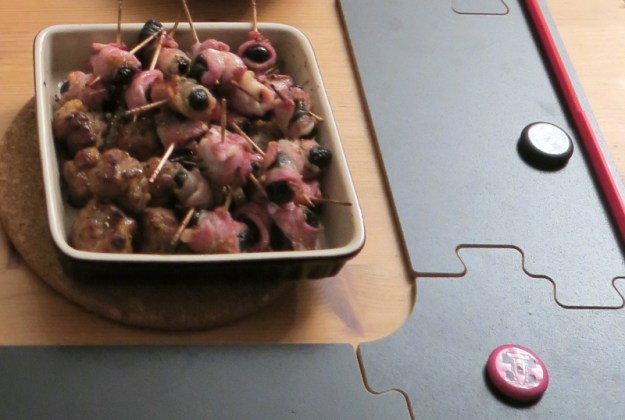
There were the usual ooos, ahhhhs, howls of delight, and cheers, as there were near misses, total misses, bumps and amazing somersaults. First to cross the line was Lime after some amazingly spectacular long distance flicks, followed by Pink and then Lemon taking a podium spot on her debut. Before we started, Pine had commented that he wondered how his skills would have deteriorated over the three years since we’d last played, so he was initially surprised to find that he’d improved. That feeling didn’t last however, as he eventually followed everyone else over the line.
 |
| – Image by boardGOATS |
Supper wasn’t quite ready, so Pink suggested a shortened course running the length of the table, replacing one of the straights with a second finishing line and ignoring the return under the bridge. This time, pole was decided as the reverse order that players crossed the line in the first race, so Pine went first. Unfortunately, he repeatedly rolled his car going over the bridge and it took some dozen or more attempts to cross it. With the shortened course, he didn’t have time to make his way back up the field (indeed the race was over before he crossed the bridge), though he did improve his final position slightly compared to the first race.
 |
| – Image by boardGOATS |
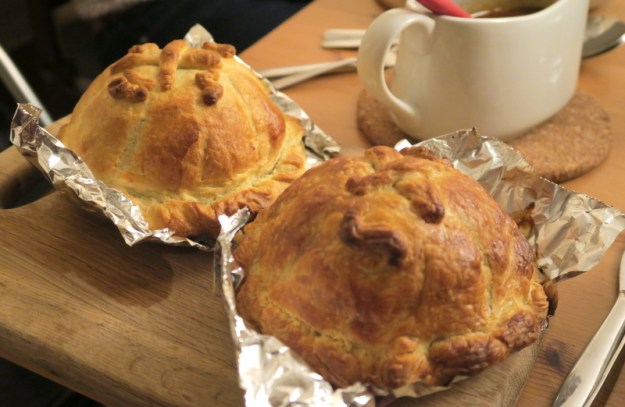
With the short course, it was always likely to come down to who got a good start and made it over the bridge first. Black got a storming start and led the field down the track before running out of gas as he approached the chequered flag. That was OK though, as Lemon rear-ended him at speed and shot him across the line. Lemon followed him onto the podium with Pink taking bronze. With that, supper was pretty much ready, so it was all hands to the deck to dismantle the track in time for the arrival of home-made pie with veg.
 |
| – Image by boardGOATS |
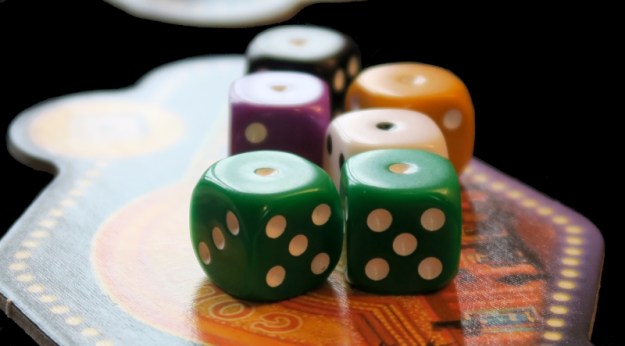
There was much chatter over supper, then, while everyone else pondered what game to play, Lime gave Pink a hand with the washing-up. Eventually, Pine went upstairs and returned with Las Vegas and a panda, and with only snacks remaining on the table, he began setting up while Blue and Black explained the game to Lemon. This is an old favourite that we’ve not played for a long time. It truth, it is a simple enough game, albeit one that is quite clever. The idea is that each player bets in the six numbered casinos using their dice.
 |
| – Image by boardGOATS |
On their turn, each player rolls all their dice and must choose a number and place all the dice with that face value in the casino of that number. The player with the most dice in that casino at the end of the round wins the money. There are a couple of catches, however. Firstly, all the dice of the chosen number must be placed, even if this is not to the player’s advantage. Secondly, and this is why the first catch is so critical, if two players tie, neither gets any money and the winner is the next inline (who is not involved in a tie).
 |
| – Image by boardGOATS |
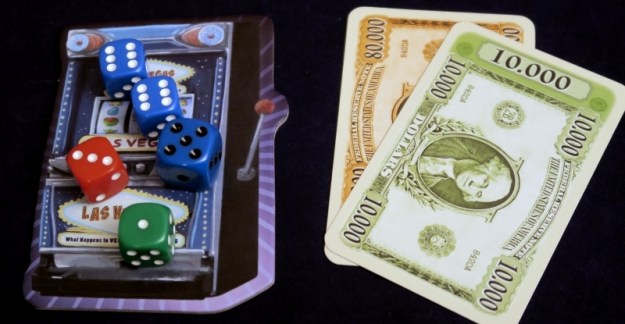
Finally, at the start of each round, money cards are dealt at random to each casino giving them a set value; the winner only takes one of these with the others going to the players in the lower placings. This means that some casinos might have several small denomination cards up for grabs, while others might have only one high value card to fight over. The combination of these features make this a great little game. We also tend to add some components from the Boulevard expansion. There are lots of modules, but we usually only use “The Bigun”, the extra high value money cards, The Slot Machine, and extra dice for additional players.
 |
| – Image by boardGOATS |
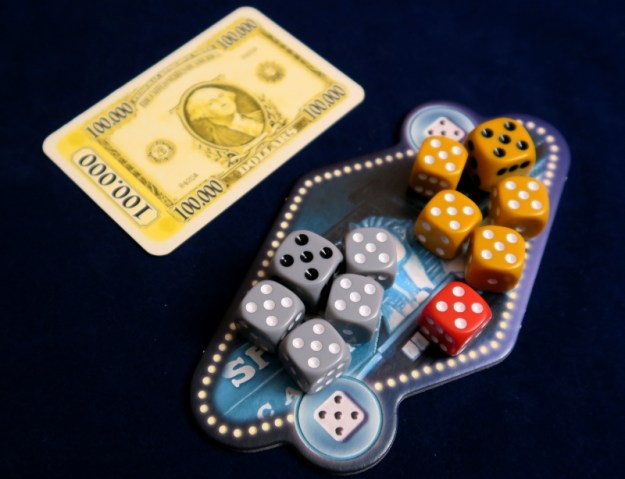
“The Biggun” replaces one die for each player with a bigger one that is worth two smaller dice. The Slot Machine is a bit different though. Like the casinos, players can add dice on several turns, however, unlike the casinos, each number can only be added to the Slot Machine once. Then, although the winner is still the player with the most dice, ties are broken by the number of pips on all the dice placed. The game is played over three rounds and the wealthiest player at the end of the game is the winner.
 |
| – Image by boardGOATS |
Black went first and started the dice rolling fest. Everyone took some money in the first round, but the beginnings of the rivalries began, between Purple and Pine, between Pine and Lime and between Lime and Purple. The second round was filled with high-value cards which entrenched the rivalries and ensured a few new ones were started with Pink, Black and Blue encouraging everyone else’s misbehaviour leaving Lime coming out of the second round without any winnings.
 |
| – Image by boardGOATS |
After a brief sojourn to view the midnight fireworks in the village and to toast absent friends and the New Year, we started the final round. This was very cut-throat: Blue and Pine got into a very silly battle for the Four casino which Blue was winning with seven dice until the final roll by Pine which gave a tie knocking them both out leaving $100,000 to Lime with his lone die. If Pine had won, that would have given him victory, but as it was, it was close between Black and Pink, with Pink taking victory by $10,000 with his total of $340,000.
 |
| – Image by boardGOATS |
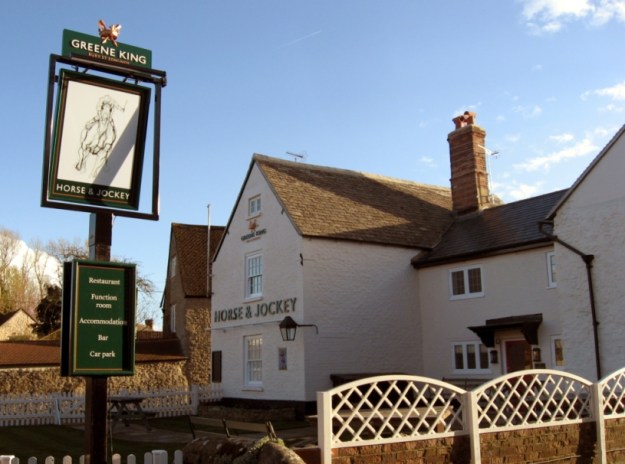
By this time it was 1am, and although everyone was tired, people lingered, first to talk about the robustness of Ikea furniture and then the status of the Jockey. With Monday being the last day for the current Managers/Chefs it is unclear what the situation will be in ten days time when we are next due to meet. We talked over other options, but all that really did was highlight how lucky we have been with The Jockey. And with that, everyone drifted home leaving Blue and Pink to find their beds.
 |
| – Image by boardGOATS |
Learning Outcome: Parties are great fun.
Although there has been a bit of a hiatus, this year, on Sunday 31st December, we will once again be holding a party for New Year’s Eve. As the pub will have their own event, we will be meeting at a private house in Stanford with people arriving from 7.30pm with food served sometime around 8pm. Please get in touch if you would like to come along so we know how much food will be needed.
The plan is to start off with the “Feature Game”, which, as has become traditional at these events, will be the gorgeous, dexterity car-racing game, PitchCar. After that, we will be eating, popping party poppers, playing games and admiring the village’s fireworks at midnight.
 |
| – Image by boardGOATS |
And talking of cars…
A policeman sees an elderly woman driving incredibly slowly on the motorway, so he pulls along side and notices her knitting in the driver’s seat. She remains focused on the road and keeps knitting and driving.
He beeps his horn to get her attention, but she is oblivious and carries on.
Getting more frustrated, the policeman turns his siren on and, as she finally notices him, he signals for her to wind the window down.
After a time she finds the button and down goes the window.
Incensed, the cop yells, “PULL OVER!”
“Oh, no sweetie,” she replies. “It’s a scarf, see?”
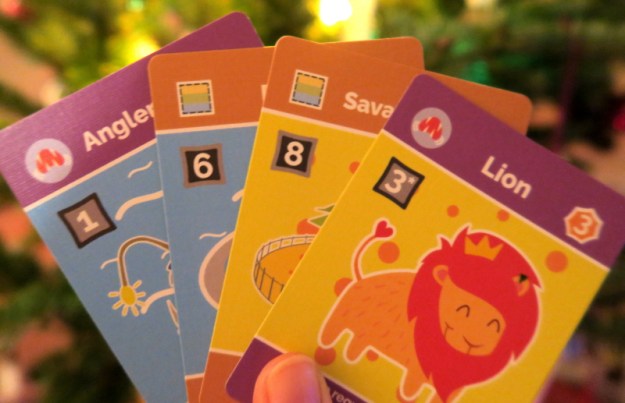
It was a quiet night with everyone still recovering from Christmas. Black and Purple arrived at the advertised 7pm, soon followed by Lime and then Pink, Blue and Pine. After a bit of chatter about Christmas and the “To Let” sign outside the pub, the group eventually settled down to play the “Feature Game“, Zuuli. This is a light, family friendly, card drafting game that is a bit like Sushi Go! or 7 Wonders, but with animals. Similar to Sushi Go! or 7 Wonders, players choose a card from their hand before passing it on to the next player.
 |
| – Image by boardGOATS |
In contrast to Sushi Go!, however, instead of using cards at the end of each turn, players save them until the end of the round and then try to make sure they have all the animals housed. The game is played over three years (“Really?” commented Lime, “I thought you said it was a short game—I had no idea we were going to be here until 2025!”). In the rules as written, there is scoring at the end of each of the three rounds (or years), but it was clear that everyone was struggling with the rules a little at the start, so we “House Ruled” it so for the first game, we only scored at the end of the final year.
 |
| – Image by boardGOATS |
The idea is that each enclosure has a size, habitat type and a satisfaction multiplier while each animal has a space requirement, habitat and satisfaction. To score, for each enclosure, players simply add together the satisfaction value of the animals and multiply the total by the value for the pen. There is a catch, however. As well as ensuring the animals have enough space in the right habitat, players also have to make sure that animals don’t eat each other: animals are either fierce or friendly, friendly animals can share an enclosure, but fierce animals can only live in an enclosure with their own kind.
 |
| – Image by boardGOATS |
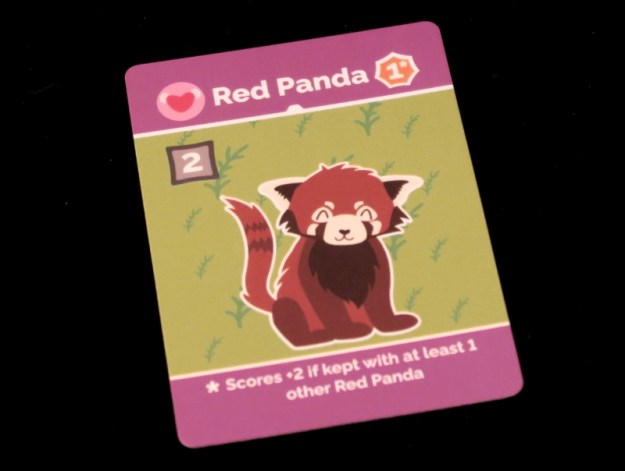
Additionally, some animals and some enclosures have special conditions, for example, tree frogs score double if they are in both water and jungle habitat, and the starting enclosure (the “New Plot”), only scores if it is fully occupied. There were lots of rule clarifications: the first concerned why you would want more land expansions which add no additional space (answer, because they add terrain type). Then some of the animal conditions needed clarifying, and finally whether an expanded New Plot needs to be full (including the expansion). This was not helped by the fact we were including the extra cards from the mini expansion (now included in the second edition, namely hippos and red pandas).
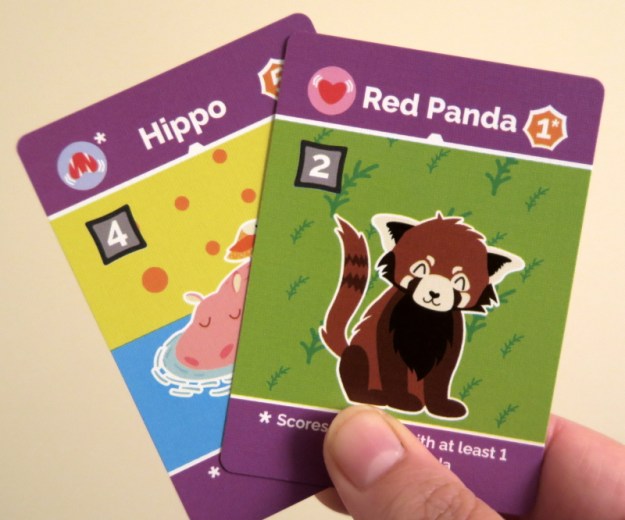 |
| – Image by boardGOATS |
As a result, it was a bit of a messy first game, made worse by the fact that the Christmas spirit meant people were struggling to concentrate. The end result was quite tight though with a single point between first and second as Pink just pipped Blue with Black not far behind. It was no surprise, when Lime suggested giving Zuuli a second try now we all knew what we were doing. As it turned out, this was more a case of, “now Lime knew what he was doing.” This time, we played with the rules as written, including the scoring at the end of each year.
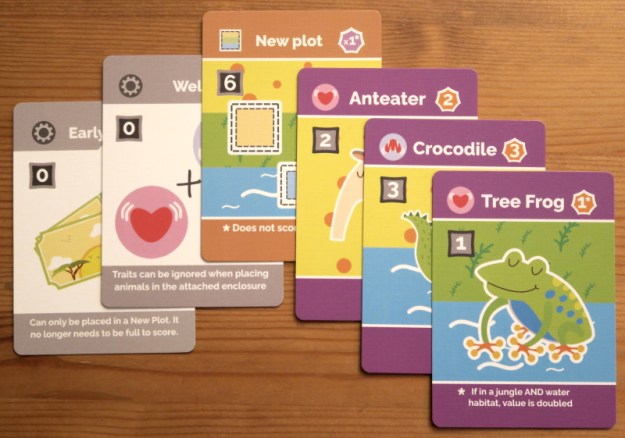 |
| – Image by boardGOATS |
By the end of the second year, it was very clear that Lime was going to be the winner, the only question was by how much. In the end he beat Pink into second by a massive twenty points as he finished with seventy-one, though Pink felt he deserved a bonus points for failing to kill his red pandas with hypothermia (unlike Longleat who managed to kill their two cubs born to much fanfare over the summer). Blue and Pine were not far behind Pink fighting it out for third, but this time it was all about Lime whose scores in the second and final year were well ahead of everyone else’s.
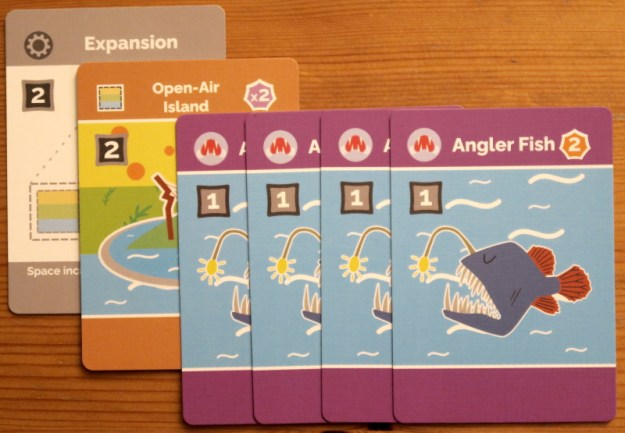 |
| – Image by boardGOATS |
With six, the question was then whether to play as two groups of three, or stick with a larger group of six. As a sociable group, especially at Christmas and other festivals, we tend to go for the latter, and this time was no exception. Whenever there are six players, Keyflower always gets a mention and Pink had put it in the bag, but it was too late to start it really. That left either a couple of much shorter, filler-type games, or Niagara. Mostly people have refused to play Niagara with Pink since, in a “Moment of the Year” he infamously won a game by daring to play by the rules, stealing gems from several others including Burgundy and Blue who never forgave him.
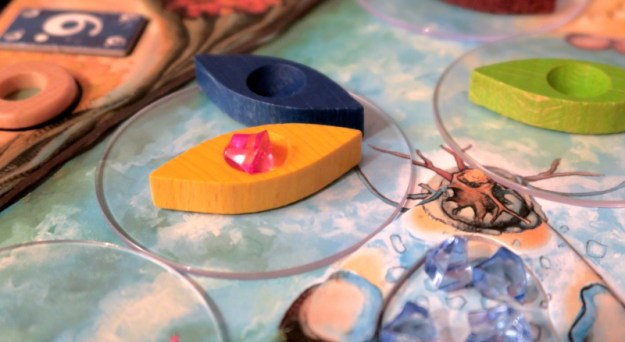 |
| – Image by boardGOATS |
Lime felt that with five against one it was a good opportunity for the group to get their collective revenge and Niagara duly made it to the table. This is an older game which won the Spiel des Jahres Award nearly twenty years ago, but is still a lot of fun. It is a sort of programming game where players simultaneously choose which Paddle tile they are going to play and then take it in turns to activate that action (mostly move their canoe). Players begin with two canoes which they use to collect gems and attempt to return them to the starting jetty; the winner is the first player to get home four identical gems, one of each of the five varieties or any seven gems.
 |
| – Image by boardGOATS |
The game is really made, however, by the really cool moving river, which is essential to the game play. After each round, the river moves, with the movement equal to the movement of the slowest canoe. In addition to moving canoes somewhere between one and six spaces (depending on the Paddle tile played), players can also adjust the speed of the river by playing a Cloud Paddle Tile. This adds a little extra jeopardy, especially as players cannot reuse Paddles until they have used them all and when they play their cloud, their canoes don’t move and therefore risk their craft plummeting over the cataract.
 |
| – Image by boardGOATS |
It costs two movement points to pick up a gem (or drop one off). However, if traveling up stream and the boat finishes its movement on the same space as another loaded boat, the player can steal from other players on the same space, as long as they have space in their boat. Native, Niagara only plays five, however, with the Spirits of Niagara expansion, it plays six, though with a few rules tweaks. These include replacing one single canoe with a double canoe that can hold two gems which makes stealing easier and more likely. There are also new Paddle cards, the introduction of a Whirlpool, the Bathing Beaver and the Hurried Elk.
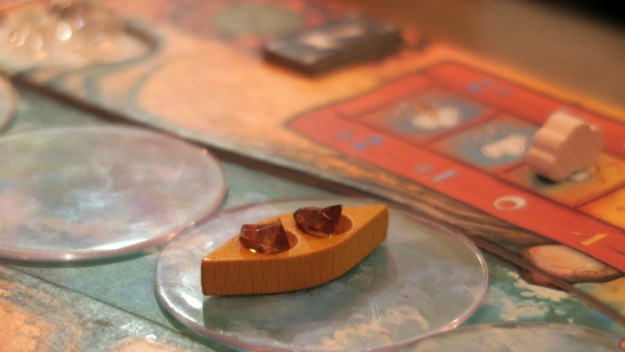 |
| – Image by boardGOATS |
Most of these just make things more complex. So Blue made the executive decision to only include an extra Paddle Tile (value seven) and replace the slowest Paddle Tile (value one) with the 1/2/3 (which allows the player to decided how many they can move, but they can only move one boat). This seemed to maintain the simplicity of the original game while ensuring there wasn’t too much carnage. That said, almost everyone ended up with at least one boat going over the falls, Lime lost several. All that proved was that crime doesn’t pay, however, as he repeatedly nicked gems from poor Pine.
 |
| – Image by boardGOATS |
Following the ill-feeling last time, Pink announced his strategy up front—to win, by whatever means was necessary within the rules, including stealing gems. However, when fate chose him to go first, he garnered opprobrium (and a rules check) when he began by playing his seven and picked up two purple gems on his first turn. Pine also tried stealing gems from others, but as they were immediately pinched by Lime who followed him in turn order, he commented that it felt just like pay day—there one moment and gone the next! Blue was the first to get a gem home, though it was a colourless one, one of the easiest to claim and it wasn’t long before others followed.
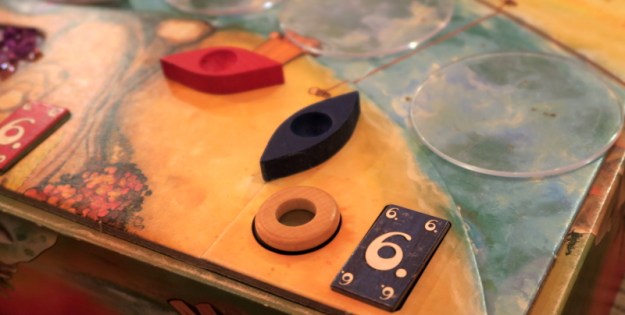 |
| – Image by boardGOATS |
There was a bit of group-think going on, with players generally playing their higher value Paddle Tiles at the start, making the river run fast before it slowed down later when everyone played slower Paddle Tiles. Black and Blue increased the flow of the river to its maximum, but Lime slowed it down again at the first opportunity. We had just got through the Paddle Tiles the first time when Lime commented on his plans. Black responded that he wasn’t going to get another as he was going to end it, and if he didn’t Pink would. In the event, Black, Pink and Blue all achieved the winning condition with four gems of the same kind but Blue and Pink had collected a fifth so rejoiced in their shared victory.
 |
| – Image by boardGOATS |
There was just time for one last game, of an old favourite, 6 Nimmt!. This is one of our most played games and slightly controversially won the Golden GOAT Award in 2020 largely for keeping us sane while playing games online. Online we played a lot of the “Professional Variant”, but this time we chose to keep it simple. Players simultaneously choose a card from their hand and then, in ascending numerical order, the cards are added to one of the four rows. Each card is added to the row ending with the highest number that is lower than the face value of the card played; if it is the sixth in a row, it becomes the first card instead and the player adds the other five cards to their scoring pile. The lowest score is the winner.
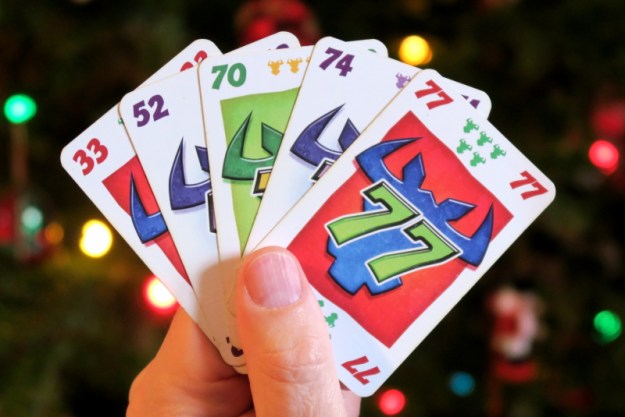 |
| – Image by boardGOATS |
We play a variant that has two rounds and sees all (or almost all, depending on player count) of the hundred and four cards in the deck. This time, the first round was quite attritional as everyone picked up cards. Aside from Pink who picked up twice as many points as anyone else, it was all quite close though. The second round was more variable however. It was Black who top-scored this time, giving him a total of thirty-two, one more than Pink’s final score. Most of the other scores averaged out giving totals in the high teens, however, Purple’s second round clean sheet gave her a winning score of nine.
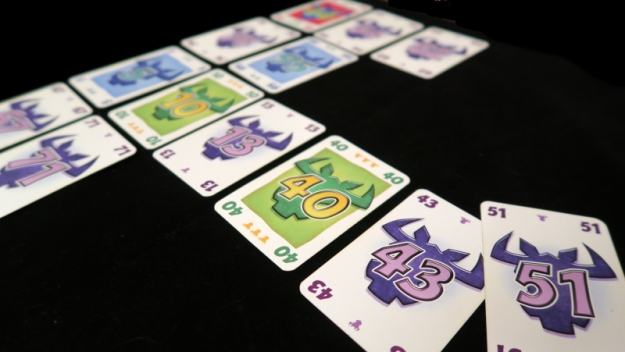 |
| – Image by boardGOATS |
And with last orders called, that was it. There was a little bit of chat about the New Year Party, but otherwise it was a sad farewell. With more uncertainty surrounding the pub, it is a little unclear whether it will still be open for the group’s next scheduled meeting (10th January), so we will see. With that very much in mind, we waived good night to the staff, wished them a Happy New Year and hoped to see them in January.
 |
| – Image by boardGOATS |
Learning Outcome: Don’t leave red panda cubs out in the cold.
Some time ago, The Guardian added a specially dedicated board game section to their online “lifestyle” magazine. Although they include articles covering jigsaws, role-playing and even Wordle in the mix, over the years, they’ve also published popular articles discussing modern board games—their 2020 “Best Game to Play at Christmas” article has garnered over a thousand comments. Their latest contribution is a list of seven of the best new board games to play with family. The most high profile game in the list probably is Cascadia which won the 2022 Spiel des Jahres award (and was a runner up for the Golden GOAT last week), but the list includes a variety of games and is well worth a look.
 |
| – Image by boardGOATS |
Our next meeting will be Tuesday 27th December 2022. As it is a bank holiday, we will start a little earlier playing shorter games from 7pm as people arrive, until 8pm when we will start something a little longer.
This week, the “Feature Game” will be the card drafting animal game, Zuuli (play-through video). This is a light game that is a bit like Sushi Go!, but with animals.
 |
| – Image by boardGOATS |
Speaking of zoos…
Jeff was telling his friend Joe about his trip to the zoo the other day.
Jeff explained, “Some of the animals didn’t bring their wallets, so I ended up paying the lion’s share…”
With this being the annual GOATS UnChristmas Dinner, almost everyone was present for a festival of food and fun, when Blue and Pink arrived with a small car full of party. There were lots of volunteers to help bring everything in and before long, pizza boxes were being handed round along with crackers stuffed full of bling and GOAT Award voting forms. The glittery Wingspan eggs from the crackers were especially popular, partly because so many people have a copy, everyone liked the idea of adding them to their game. As the last of the pizza boxes were being passed around, people started to think about this year’s GOAT awards.
 |
| – Image boardGOATS |
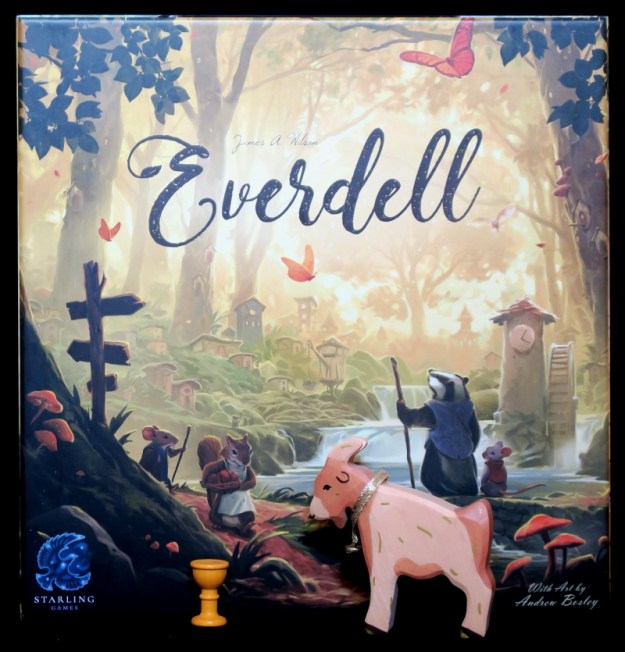
There was lots of umming and ahhhing as people tried to remember which game was which, but eventually the votes were in and people chatted while the returning officers (Pink and Green) did their counting thing. Then Green announced the winners. The GOAT Poo prize for the worst game of the year went to Villainous – The Worst takes it All and the Golden GOAT went to Everdell. Three epic games, one of Viticulture, one of Tapestry and one of Turf Horse Racing were nominated for “Moment of the Year”, but that somewhat poignantly went to the 2021 UnChristmas Dinner which was the last meeting attended by Burgundy, and the last game he played with us, Santa’s Workshop.
 |
| – Image boardGOATS |
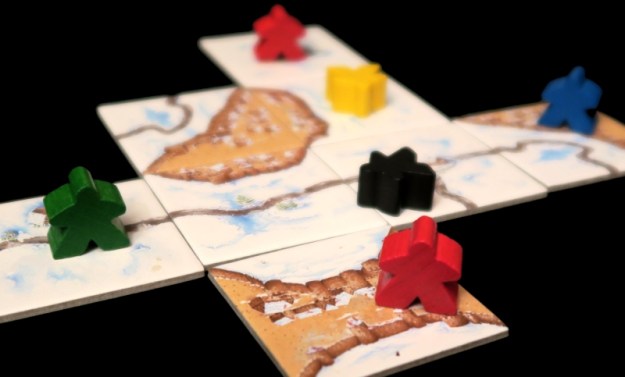
Eventually, we all started thinking about playing games. Ivory and Indigo were keen to play the “Feature Game“, Merry Madness: The Nightmare Before Christmas, while Jade had specially requested a game of Gingerbread House. Eventually, largely due to logistics and lethargy (perhaps caused by too much pizza), everyone stayed pretty much where they were and played something with the people they were sat next to. First underway was Green, Lilac, Pine, Teal and Lime, largely because they were playing a game they were all familiar with, Carcassonne, albeit the Winter Edition.
 |
| – Image boardGOATS |
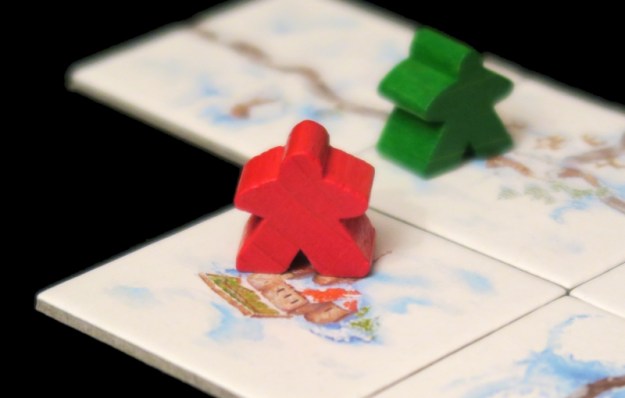
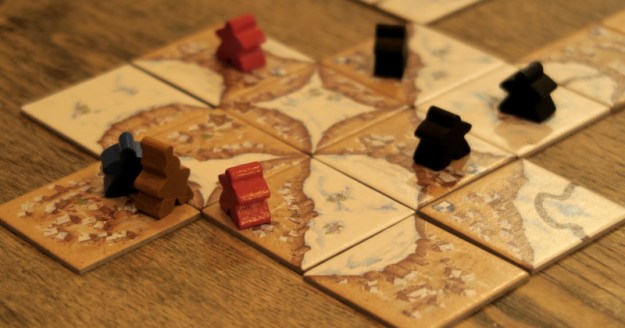
The Winter Edition is essentially the same game as the original “Blue-box” Carcassonne, but with snowy art work. Thus, players take it in turns to draw and place a tile, add a meeple if desired/possible and then remove any meeples that are ready to score. As in the original, the features on the tiles include city segments, roads and cloisters. Players score two points for each tile in a city or road they own if it is completed during the game, or one point at the end if incomplete. Similarly, Cloisters score nine points when completely surrounded or one point for the central tile and each surrounding it at the end of the game.
 |
| – Image boardGOATS |
The clever part of the game is that while players cannot add a meeple to a feature that is already owned by another player, features can be joined together and then shared so that both players score. Green and Lilac had played the same game last year at Christmas, with Der Lebkuchenman (aka Gingerbread Man) mini expansion which consists of additional Gingerbread Man tiles mixed in with the base game; when drawn, the player moves the brown Gingerbread Meeple to an unfinished city of their choice. Before he is moved, however, the current city containing the Gingerbread Man is scored with each player receiving points for the number of meeples they have in the city multiplied by the number of tiles in the city.
 |
| – Image boardGOATS |
Thus, even players that have only one meeple in the city when their opponents have more score a few points. This year, in addition to Der Lebkuchenman, the group also added Die Kornkreise (aka Crop Circles) mini expansion. Although they were happy with the Gingerbread Meeple, they were less sure about the crop circles—they looked more like funny shaped snow “angels”. The expansion consists of six extra tiles which allow each player to place a second follower on a feature that they have already-claimed or return an already-placed follower back to their supply. Of course, the group did not play the rules quite right, however, initially thinking that each person had a free choice of which action to take and whether to take it or not.
 |
| – Image boardGOATS |
It was only just after the second tile was placed that they realised it was the active player that chose the action (add an extra Meeple to the specific terrain type or pick up a Meeple) and everyone else had to do the same (they decided that if the player had no Meeple in an appropriate area then they just skipped the action). As a result of the Kornkreise, Lime ended up with three Farmers on the same tile, which at least it guaranteed him that particular field! The Crop Circle expansion also led to the biggest coup of the game. Lilac had started a city with her first tile and Pine positioned himself to muscle in on it a couple of turns later.
 |
| – Image boardGOATS |
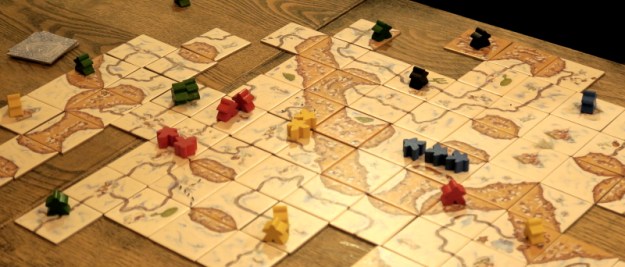
Their cities were joined, but they just could not get the city closed before Teal then joined the fray. This became a very long city and then in the last quarter of the game, Lime also managed to add himself into the action on this game winning city. Then the final Crop Circle tile came out for Teal. He decided he wanted everyone to add a Meeple to a city, which he, Pine and Lime were able to do. Unfortunately Lilac (who had started the city right at the beginning of the game) had no Meeples left, so couldn’t and found herself locked out of the scoring at the end of the game as it was never completed.
 |
| – Image boardGOATS |
It was a game where no-one seemed to be able to get the tiles they wanted. Green regularly selected from the pile nearest to him, but only ever got roads. When he tried from different piles, he still got roads and when others selected from the “Green” pile, they got cities! Pine started to choose tiles from within the middle of the stack, raising cries of “cheat” from Green and Lilac. Pine’s argument was that the tile was still random, which was hard to disagree with and Lime started doing the same later on as well. In the final scoring, Lime surprisingly edged everyone out for the win, with Teal and Pine not too far behind.
 |
| – Image boardGOATS |
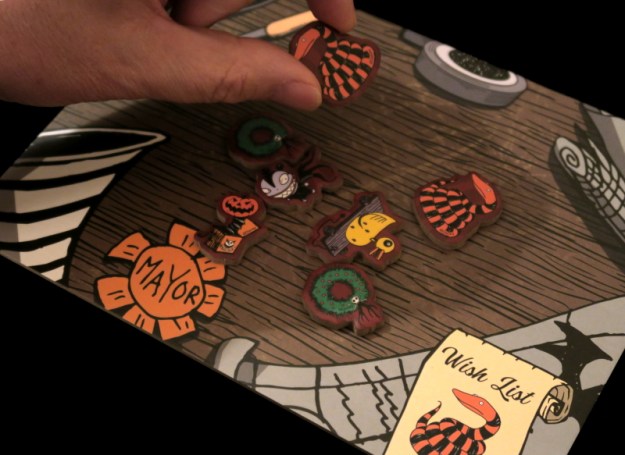
It had been fun though and the Winter edition is certainly the prettiest version of Carcassonne, so Green and Lilac are already looking forward playing it again next Christmas. Meanwhile, on the next table, Blue, Pink, Ivory and Indigo were playing the “Feature Game“, Merry Madness: The Nightmare Before Christmas, a very quick and light dice chucking game where players are trying to gather together all the spooky-themed gifts in Sandy Claws’ Christmas Bag. It really is very, very light and quick: simultaneously players roll their three dice and do what they say (in a similar style to Escape: The Curse of the Temple). The three dice are different: one shows which of the six gift types is moved, another shows how many, one, two or three, and the final die indicates where: to the player on their left, right or of their choice.
 |
| – Image boardGOATS |
The group played with the “Making Christmas Toys” variant. Players started with the same number of each of the different toys. The idea is to get rid of all the toys that don’t match the one depicted on their “Wish List” (shown on their player mat). If they roll the toy on their Wish List, they take that toy from the player indicated, whereas for every other type they roll, they gift one of that type to the recipient indicated. There really wasn’t a lot to it, and basically the game was all about who was most awake (possibly correlated to the person who had eaten the least pizza). Blue won the first round, and Pink took the second. Blue finished the game when she took another two rounds and, although it had been silly fun, it was time for something else and Purple joined the foursome from the next table.
 |
| – Image boardGOATS |
Meanwhile, Purple had been explaining Gingerbread House to Plum and Jade and their partners Byzantium and Sapphire, respectively. In this game players are witches in the Enchanted Forest, building their gingerbread house and attracting hungry fairy tale characters with colorful gingerbread. Each player has a board with a three-by-three grid of building spaces. There is a face down stack of rectangular tiles with the top three turned face up (a little like the train cards in Ticket to Ride). These tiles each feature two squares, similar to Kingdomino tiles. On their turn, players draw one of the face up tiles and place it on their player board, then carry-out the effect of the symbols they covered up. The most likely symbol is one of the four different types of gingerbread, which means they collect a token of that type.
 |
| – Image boardGOATS |
Careful placement of pieces is important because if a player is able to cover the same two symbols in one one turn, the player gets the effect three times instead of twice. Once a tile has been placed, the active player can use some of their gingerbread tokens to capture fairy-tale characters. If placing tiles completes a level, the active player may also take a bonus card. The group found the game simple enough once they got going, but it took a while to get there. The “wilds” caused problems from the first and the group weren’t sure whether covering two at once meant doing three of the same thing. After re-reading that bit of the rules, it was decided the extra actions didn’t have to be the same, and as a result, Plum was able to make more of her final turn.
 |
| – Image boardGOATS |
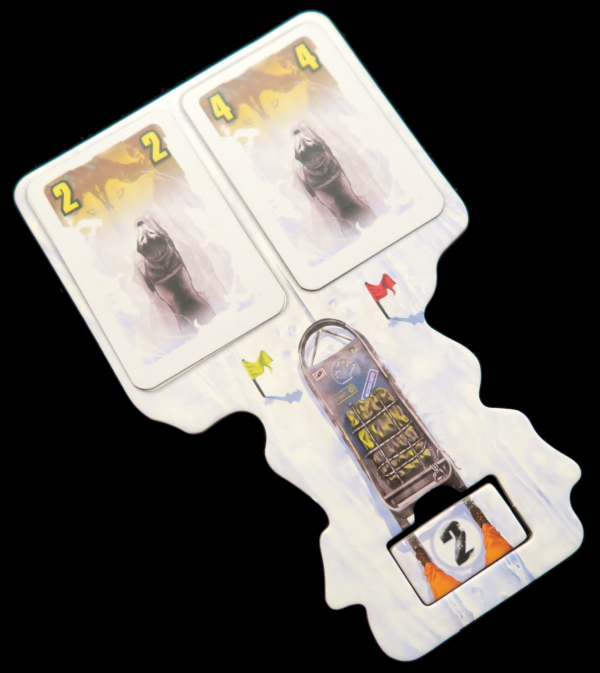
It was close, but despite his super-charged final turn, Byzantium finished two points clear of Plum with Jade coming in third. Everyone had really enjoyed the game, though, so much so that Jade and Sapphire are now on the lookout for a reasonably priced copy! Although it took a little while to get going, once Plum, Jade, Byzantium and Sapphire were playing, Purple was at a bit of a lose end. Nightmare Before Christmas didn’t take long though, so when it was over, Purple joined Blue, Pink, Ivory and Indigo for a game of the husky sled-racing game, Snow Tails.
 |
| – Image boardGOATS |
The idea is that each player has a sled led by two dogs. They start with a hand of five cards drawn from their personal deck. On their turn, they can play up to three cards as long as they all have the same number. There are three places a card can be played, two drive the dogs, and one activates the brake. The idea is that a sled’s speed is the sum of the dogs’ speed minus the current value for the brake. in addition, the difference between the dog values is the sled’s drift, which causes the sled to move left or right. At the end of their turn, players draw back up to five cards.
 |
| – Image boardGOATS |
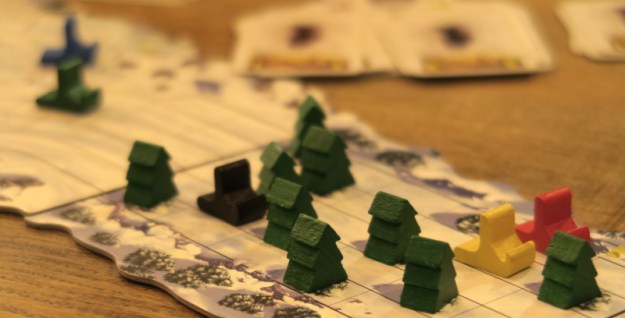
In general, if players hit something, they pick up a dent card which goes into their hand, blocking space and limiting their options. The game is quite simple, but as always, how and when to apply the “drift” caused some confusion; Pink certainly benefited from the rules malfunction, but others probably did as well. The group started out with the “Treemendous” track, but it seemed to take an age to get the game going and everyone was concerned that they might not finish before midnight. So, about half-way through the game, the track was truncated removing the the final bend and finishing with a straight section just before the finish line.
 |
| – Image boardGOATS |
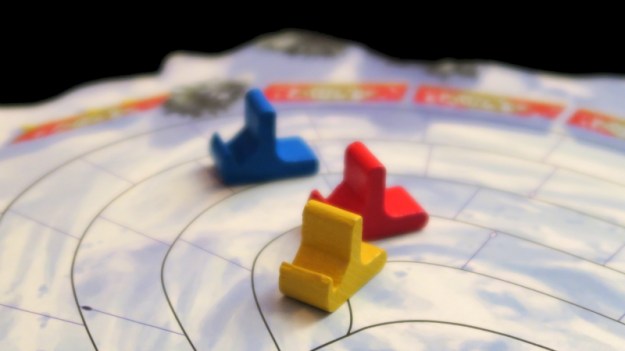
Ivory stole a march in the first couple of turns and looked like he was going to leave everyone miles behind, but when he rammed the first corner it let everyone else catch up. Ivory was still the first out, but Pink was now not far behind going into the first stand of pines and was taking a different line. By this time, the damage to Ivory’s sled was starting to take its toll, and Pink was able to take advantage of his balanced sled (his dogs pulling evenly giving him a bonus equivalent to his position in the field) and moved into the lead.
 |
| – Image boardGOATS |
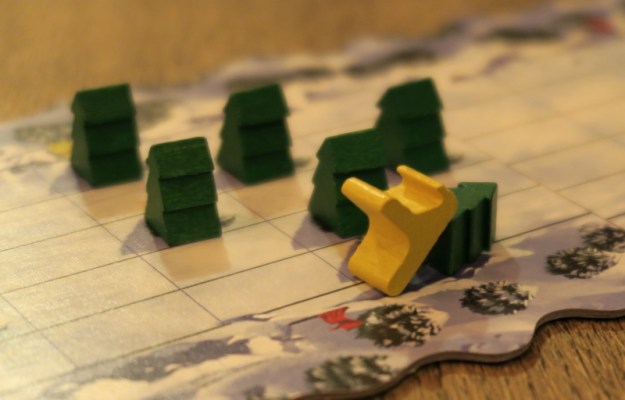
It was then that the act of shortening the track played into Pink’s dogs’ paws. With just the finish line in front, his dogs stretched their legs, he released the brake and shot through the second stand of pines taking out a couple of saplings on his way through. Everyone could see what was going to happen, but nobody could do anything about it, and Pink crossed the line miles ahead of Ivory who would, no doubt, have taken second had the group played on. Everyone else was far behind, still working their way through the first plantation. It had been fun, but it was time for home, so with many “Happy Christmases”, everyone headed off into the cold dark night.
 |
| – Image boardGOATS |
Learning Outcome: Turkey, bacon, sausage, cranberry sauce and stuffing really do make a Pizza taste like Christmas Dinner!
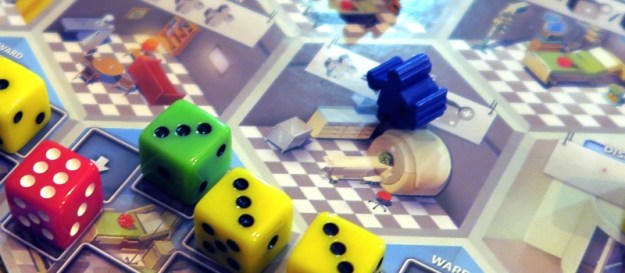
As usual, the boardGOATS met just before Christmas for a party and to decide the winners of the GOAT Awards. After pizza and crackers and the usual mayhem, the group voted for two awards: the Golden GOAT for our favourite game and the “GOAT Poo” award for our least favourite. Everyone had the usual three points to hand out for the Golden GOAT Award (plus a bonus if wearing Festive Attire), though a maximum of two points could be given to any individual game. Everyone could also nominate up to two individual games for the GOAT Poo Prize.
 |
| – Image by boardGOATS |
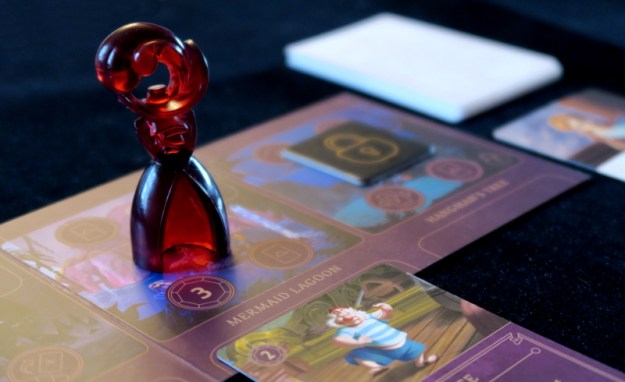
This year, there were a few games that received the unofficial “Marmite Award”, that is to say they received nominations for both the Golden GOAT and the GOAT Poo prizes. These included Dice Hospital, Azul, Modern Art and Viticulture. For the GOAT Poo Prize itself, there were several games that received two or three nominations, but the clear winner was Villainous – The Worst takes it All which received six nominations—quite an achievement since only five people played it and one of those wasn’t present for the vote! Villainous is a beautiful, asymmetric card game, but one that we struggled with for several reasons, not least the fact that players had to work out how to play their own character, and we were playing it with five people which is two or three more than it needs.
 |
| – Image by boardGOATS |
Nominations for Moment of the Year included two epic games, one of Viticulture and the other of Tapestry. The latter nomination included the citation: “I thought I was doing well until Ivory lapped me… twice!” Pine also recalled Lilac nobbling him in Turf Horse Racing. The most poignant moment however, with hindsight, was last year’s UnChristmas Dinner, which was the last meeting attended by Burgundy, who very sadly, suddenly passed away just a few days later. We all still miss him, but the fact we were joined by Jade and Plum and their partners this year is his legacy, and one we think he would have been proud of.
 |
| – Image by Pushpendra Rishi |
And that just left the Golden GOAT Award for the best game of the year. Previous winners including Wingspan, Altiplano and 6 Nimmt! were ruled out, but there were plenty of options remaining. Lots of games received three nominations including Endeavor, Cascadia, Old London Bridge, Splendor, Tapestry and Die Wandelnden Türme But this year, the clear winner was Everdell. This card-driven game was only played for the first time a few weeks ago, but it is planned to play it again soon with one of the expansions being the “Feature Game” early in the new year.
|
| – Image by boardGOATS |
Our next meeting will be Tuesday 13th December 2022 at the Horse and Jockey pub in Stanford-in-the-Vale.
As this is our last meeting before Christmas
we will be meeting early from 7pm for pizzas and Christmas festivities.
This week, the “Feature Game” will be Merry Madness: The Nightmare Before Christmas (review & play through video, rules), followed by a range of Christmas and winter themed games like Santa’s Workshop, Christmas Tree, Snow Tails, Carcassonne: Winter Edition, Giftmas at Dungeon Abbey, Gingerbread House and Ticket to Ride: Nordic Countries. Merry Madness is a real time, dice chucking game where players are trying to gather together all the spooky-themed gifts in Sandy Claws’ Christmas Bag.
 |
| – Image from spelhuis.be |
Speaking of nightmares…
It was shortly before Christmas when Jeff had a nightmare and dreamed that he was stuck inside a snow globe.
When he woke, he was really shaken up…
 boardGOATS