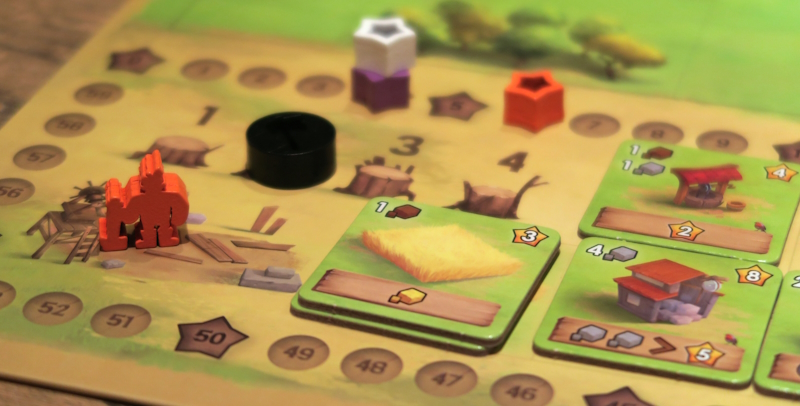
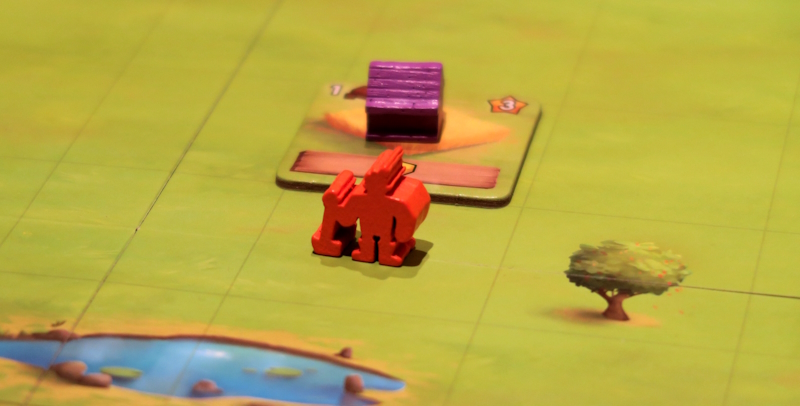
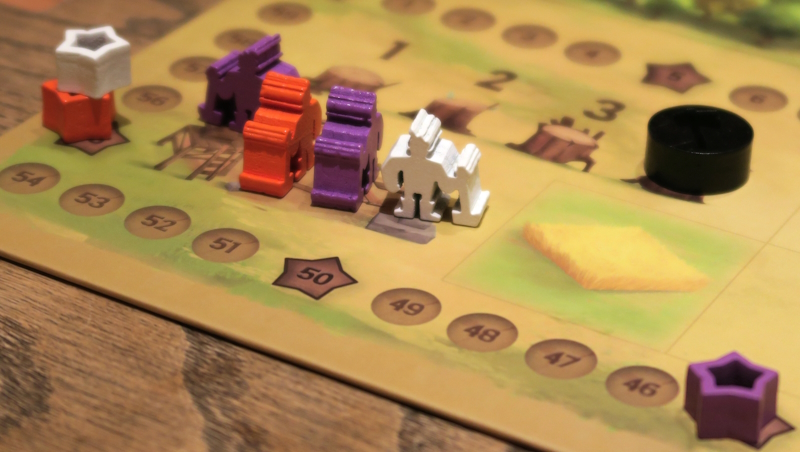
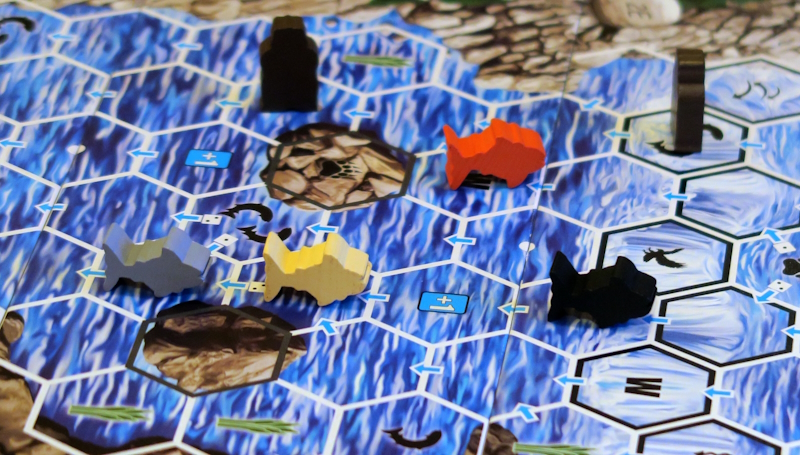
Tag Archives: 6 Nimmt!

8th April 2025

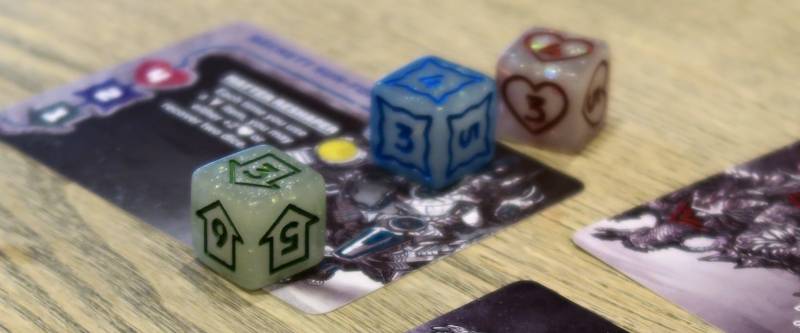
By the time everyone else started to arrive, Cobalt was already most of the way through losing his game of 20 Strong.  This is a solo-player deck-based game where the object is to progress through a shuffled deck of cards, each of which bears a unique challenge. This challenge could be in the form of an enemy, a unique scenario, or some other requirement which are completed by rolling a set of seventeen dice with different odds for a hit.  These dice, along with three adjustable stat dice, make up titular twenty dice.  Cobalt continued rolling his dice while others ordered food, chatted and ate.

20 Strong
– Image by boardGOATS

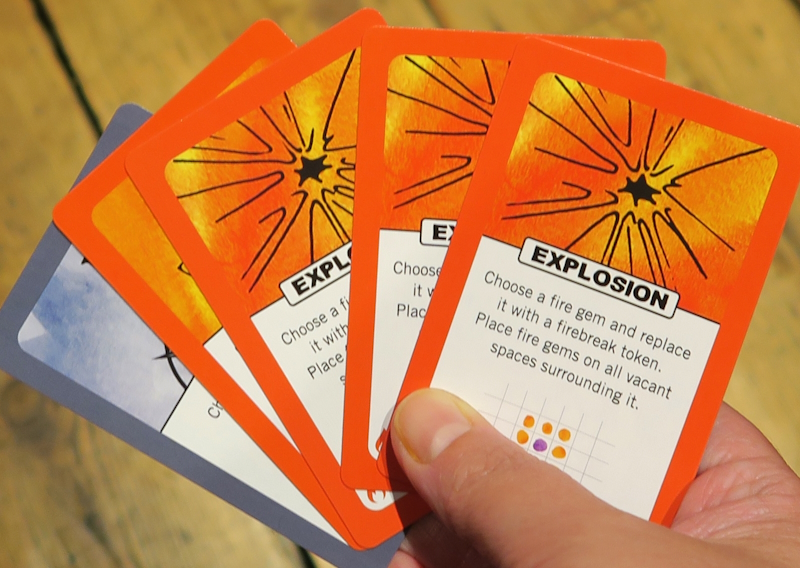
Before long players began splitting into groups, deciding what to play.  The first group was Blue, Pine, Mint and Pink playing the “Feature Game” which was to be Fire Tower.  This is a competitive game where players order air drops of water, and plan the building of firebreaks in order to combat a woodland blaze.  The rules are very simple:  players begin their turn by spreading the fire in the current wind direction then play one card from their hand (or discard all their cards) and replenish their hand.  There are four different types of cards, Wind, Fire, Water, and Firebreak cards.  Wind cards can be used to change the Direction of the Wind which affects which direction the fire spreads in.

Fire Tower
– Image by boardGOATS

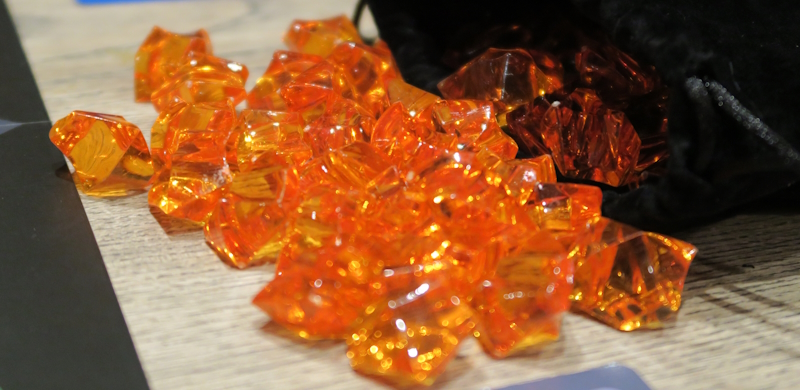
This can either be by playing the card and changing the Wind Direction to that on the card, or by rolling the Wind die and leaving it up to fate.  Alternatively, the player may place a fire gem on one empty space orthogonally adjacent to an existing fire space (or the central Eternal Flame), in the wind direction indicated on the card.  Fire, Water and Firebreak cards give a pattern of spaces that the fire must either spread in, is removed from, or fire break tokens can be placed in.  Firebreaks prevent fire from landing on or jumping over the spaces they occupy and can only be removed using a card that includes the De/Reforest action and cannot be placed in orthogonally adjacent to another Firebreak token.

Fire Tower
– Image by boardGOATS

Each player took the Fire Tower on one corner of the board with Pine sitting opposite Blue and Mint opposite Pink.  Blue went first followed by Mint, then Pine and finally Pink.  The base game is an elimination game, with the winner the being the last player who’s Fire Tower has not be burnt down.  The group decided to play without the events and keep the game as simple as possible to see how things worked.  Pink was the first to get knocked out with Firestorms proving to be disastrous for his Tower.  Pine quickly followed with before there was a long, determined rear-guard action by Blue.

Fire Tower
– Image by boardGOATS

Unfortunately, Mint started in a better position and despite her best efforts, eventually Blue’s Tower was also a moldering ruin.  Since Pink and Pine had spent quite a lot of time as spectators, the group decided to give it a second go, but this time working in pairs.  This time, Blue’s Tower was first to be destroyed with Mint’s next.  Eventually, only Pink’s tower was still standing giving a second victory to Mint, which was shared with Pink.  The game had been quite enjoyable, if very different to the usual fare.  There was still plenty of time left for something else though, so the group had a rummage in the bags and came up with Draftosaurus.

Draftosaurus
– Image by boardGOATS

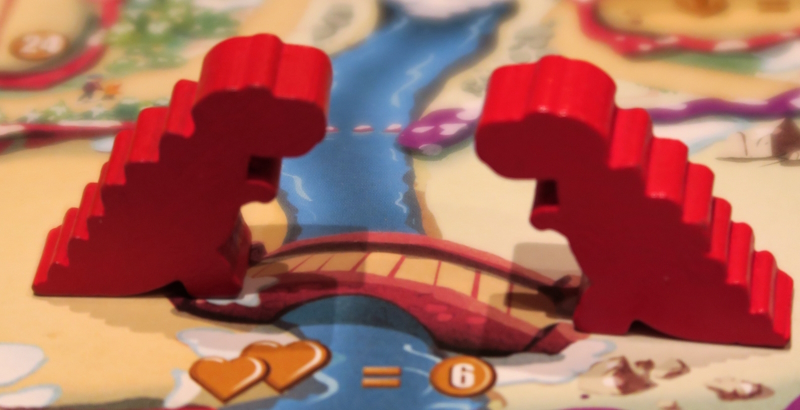
This is a very popular game where players start with a hand of dino-meeples, choose one and pass the rest on before placing them in their dinosaur park.  It frequently gets outings within the group, but on this occasion, for variety, the group decided to play with the winter setting which gives slightly different pens with slightly different placement conditions.  It was very tight, but as is often the case, Pine, who just seems to “get” this game emerged the victor with thirty-six points.  He was only one point ahead of Mint and Pink though, who tied for second place.

Draftosaurus
– Image by boardGOATS

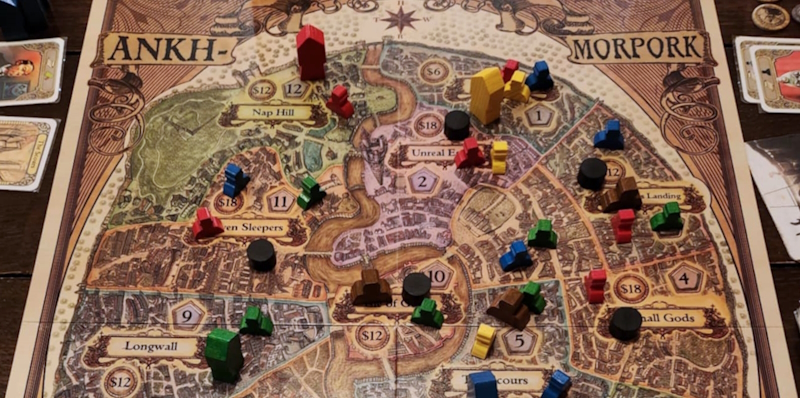
Meanwhile, on the next table, Green putting in a rare, but welcome appearance, was leading Black, Purple and Plum in a game of Discworld: Ankh-Morpork.  In this game, Lord Vetinari has disappeared and players control different factions which are trying to take control of the city.  Game play is quite quick and simple with players playing a card and doing what it says.  Most cards have more than one action on them, and players can choose to do some or all of these actions. Some cards also allow people to play a second card, so they can chain actions together.

Discworld: Ankh-Morpork
– Image by boardGOATS

In this game, Black was the Dragon King of Arms, looking for trouble, Green was Chrysoprase, trying to amass lots of money, Plum was Commander Vimes who was trying to play through the deck and Purple was Lord Rust, with an area control remit.  The game was over quite quickly with Black running out the winner in a game that is much under-rated and sadly very out of print due to IP issues.  This copy was a much cherished one, as it had belonged to Burgundy so it was nice for it to get another outing within the group.  There was time for a second game and this ended up being Faraway, a very clever, much more recent, card-driven game that has had a few outings since its release last year.

Faraway
– Image by boardGOATS

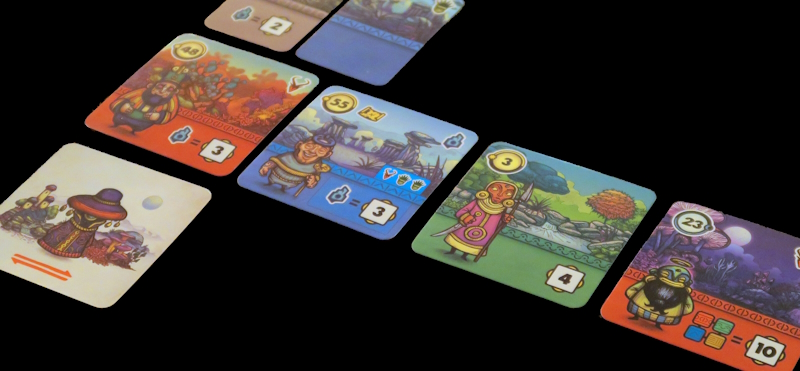
The idea is that players simultaneously chose one of the numbered cards from their hand and starting with the the player that played the lowest card (similar to 6 Nimmt! or Kingdomino), everyone takes it in turns to choose one from the market to add to their hand.  Players then simultaneously choose another card, and again, choose one to add to their hand.  The game ends after everyone has played a total of eight cards, and then everyone scores.  The clever part is that the cards are played left to right, but the scoring is from right to left.

Faraway
– Image by boardGOATS

At first glance, this looks like it makes things easy, because early in the game players find out what they need to get points and can then focus on getting the resources they need as the game progresses, but of course that is not the case.   This time, Purple had a really bad run where she kept getting the highest number cards, which meant she picked last, and then picked up the higher number cards left by others.  Once again, the winner was Black making it two out of two for him, while Plum was second by seven points with Green a little way behind her.

Faraway
– Image by boardGOATS

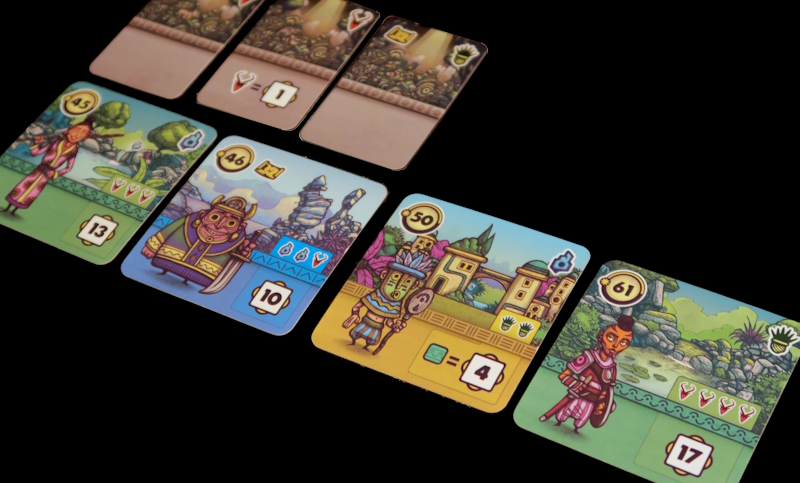
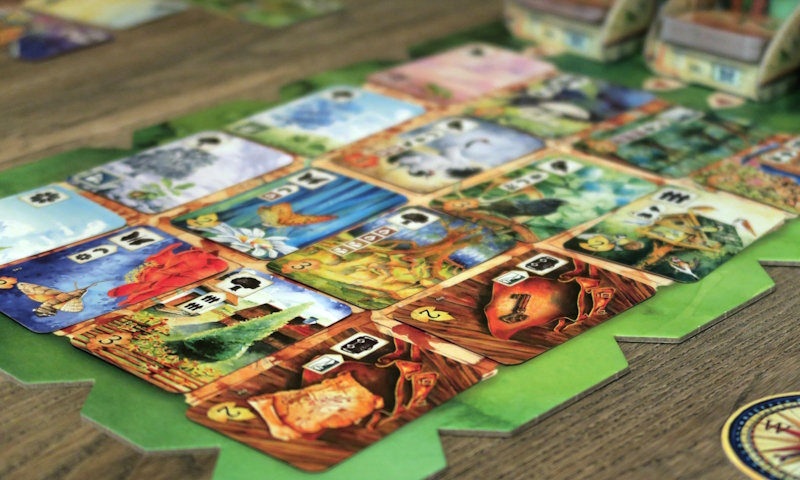
Meanwhile, the third group comprising Jade (fresh from his birthday celebrations), Sapphire, Teal, Byzantium and Cobalt spent the evening playing a five-playergame of Earth.  This is a is a sumptuously illustrated card-driven engine-builder game that is often compared to Wingspan, where players are building themselves an ecosystem.  The game itself is not actually all that complicated. Players are building a four by four grid of Flora and Terrain cards which represents their island and during the game they will plant flora, water it and allow it to grow.  On their turn, players do one of four things: Planting (paying the cost in Soil tokens), Composting (gaining Soil and placing cards from the deck in their discard pile), Watering (place Sprouts and gain Soil) & Growing (draw new cards and place growth tokens).

Earth
– Image by boardGOATS

A bit like Puerto Rico, once the active player has chosen which action they are taking, everyone else gets to do a subsidiary, slightly weaker version of the same action.  Once everyone has completed the action for the turn, everyone activates all the cards in their island that match the colour of the action chosen, starting with the card in the top left and working across each row in turn.  At the end of the game (triggered when one player has completed their island), players score points for each flora card, any Trunks and Canopies they have grown, their Sprouts and their pile of “Composted” or discarded cards.  Players also score points for achieving objectives on the Fauna cards revealed at the start of the game and for completing their island first.

Earth
– Image by boardGOATS

During the game, Cobalt built up the most points; his forty-two were some five ahead of Byzantium.  By far the most points come in the end-game scoring however.  A bit of a point salad there are seven scoring sections:  Teal scored best for Compost; Jade scored most highly for completing his Canopies; Byzantium top-scored for Terrain, and Cobalt out-scored everyone else for his Fauna.  As well as getting the most points for his Sprouts and Ecosystem Objectives, Sapphire also scored well in many of the other categories giving him a clear victory with one hundred and sixty-eight points, thirteen more than Byzantium who pipped Cobalt for second by a single point.

Earth
– Image by boardGOATS

Learning outcome:  Playing with fire may be fun, but you risk getting burnt.

10th December 2024

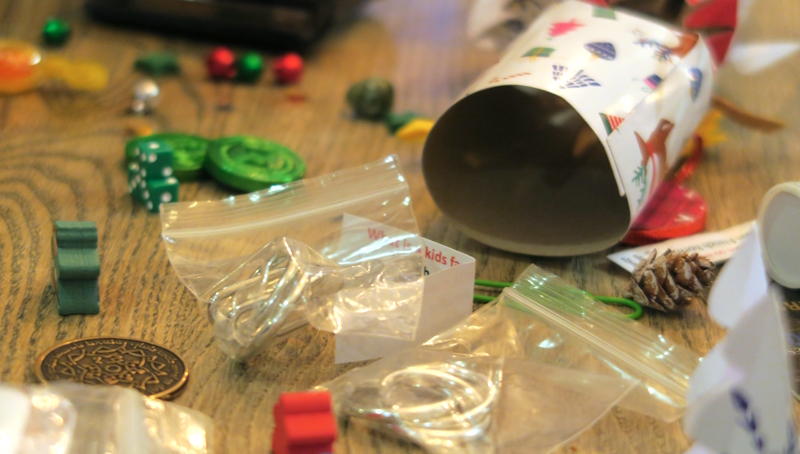
Everyone had already arrived and was waiting in anticipation when Blue and Pink arrived with piles of gamers crackers, Christmas tree decorations, party poppers, paper parcels, mince pies, festive cakes (with carrot meeples on top) and GOAT Award voting forms.  Food quickly followed along with a volley of noise as people tried to pull their crackers and party poppers first so the contents didn’t land in their supper.  As people munched, there was some discussion about the games played and voting forms were filled in.  In the absence of Green, Pine kindly offered to act as returning officer and collate the statistics.
"Un-Christmas Party" 2024
– Image by boardGOATS

While cake and mince meat parcels were shared round, toasts were offered by Lime to the organisers, and in the memory of Burgundy.  He is much missed and will never be forgotten, but we always make a special point of remembering at this time of year, especially as the Un-Christmas Dinner was his last games night with us.  The GOAT Awards were then announced.  Moment of the Year was when Pine got the end game rule wrong for Tonga Bonga, so that Pink thought he’d won, but then didn’t.  The GOAT Poo Prize for the least popular game of the year went to Ca$h ‘n Guns—not a game the group plays often and its only outing over the last year was at the New Year Party.

"Un-Christmas Party" 2024
– Image by boardGOATS

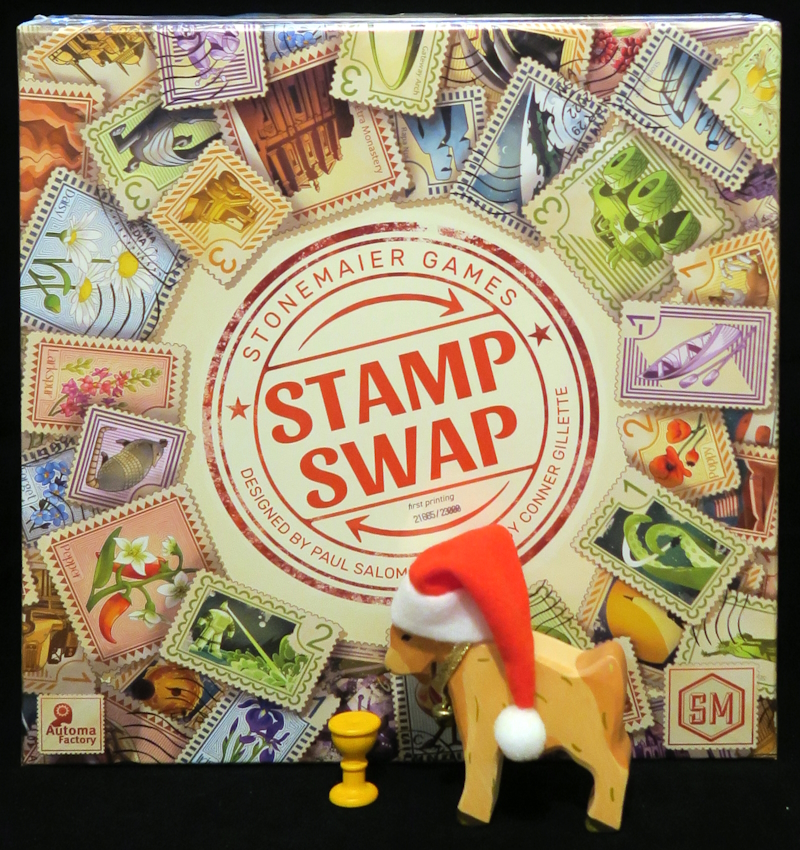
Then it was time for the Golden GOAT.  Previous winners were ruled out, but other contenders included Akropolis, Kavango, Flamme Rouge and Ticket to Ride: Rails & Sails.  The clear winner of the 2024 Golden GOAT Award, however, was Stamp Swap.  There was much discussion about how this was the third winner from Stonemaier Games (after Tapestry last year and Wingspan in 2019) and how we should invite Jamey Stegmaier, to collect the award in person.  Email correspondence over the following few days suggested that while it was unlikely he would be able to come to GOATS, he will be in the UK next year and just might make it as far as Oxford.  In the meantime, he has highlighted the award on his website.
Golden GOAT - 2024
– Image by boardGOATS

With the festive business over, the group broke into three to play some games.  Pink, Blue, Black and Jade began with the “Feature Game“, Courses De Rennes (aka Reindeer Races), a fun little game where players control a team of four reindeer, racing along four different tracks to try to get the highest-scoring tiles.  On their turn, each player can either draw two cards (with a hand limit of seven) or play as many cards of the same type as they can to move one reindeer along one of the tracks.  The cards are numbered and have suit that corresponds to one of the tracks (or are Elfy, and “wild”).  If two and a three of Gifts is played, the player may move one of its reindeer along the Gift track.
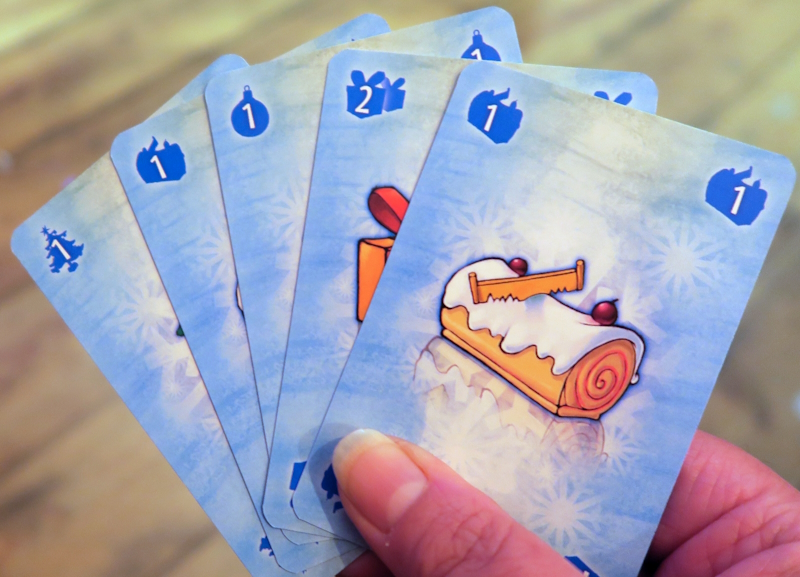
Course des Rennes
– Image by boardGOATS

If a reindeer lands on the same space as another reindeer, it slides forward a space.  If that is occupied too, it continues to slide.  If, however, the owner cries “Thump!” as it lands, the reindeer slithers an extra space forward.  The first reindeer to arrive at the end of a track claims the highest value token.  The game ends when two of the tracks have run out of tokens.  Pink too the first points, and with it a strong early lead.  A few rounds later, Jade took the last token from one of the tracks and with it ended the game.  He got very unimpressed looks from Black and Blue as he gifted victory to Pink, so once this was pointed out, Jade revised his move and play carried on.

Course des Rennes
– Image by boardGOATS

Ultimately, however, it didn’t really change things as Pink still took victory with twenty-two points.  He was long way clear of Jade who won the tight fight for second with fifteen just one point ahead of Black who, in turn, took third by a single point.  Everyone else was still playing, so the group looked for something else to play.  Black had won a copy of Ticket to Ride: Paris in the raffle and, although it wasn’t very festive, it seemed appropriate to give it an outing.  Some of the GOATS had played this mini-city variant of the popular train game earlier in the year when we marked the Olympics with sport and France themed games.  However, none of the current quartet had been part of that group.
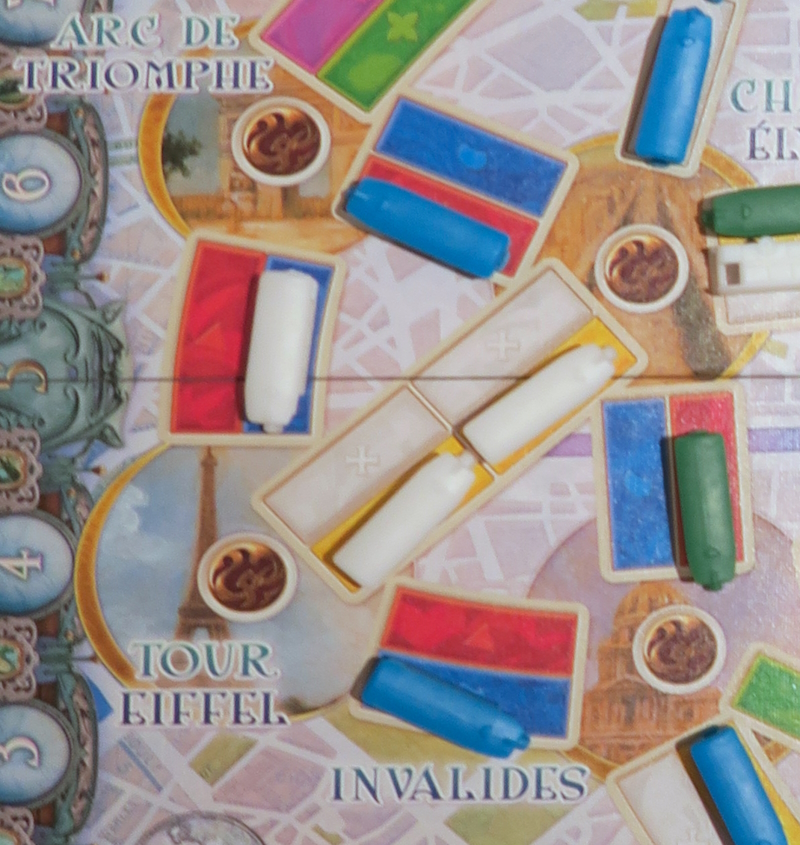
Ticket To Ride: Paris
– Image by boardGOATS

The rules are much the same as all the others (take two cards from the market; play cards to place pieces on the map; collect Ticket cards to score points at the end), but like all the variants, Paris has a special rule.  When players claim a red, white, or blue track, they get a card, when they get all three colours they get four “Tricolore” bonus points.  When the game first came out, there had been comments about how this felt very bolted on, but in practice, it was much more interesting than it sounded.  This time, the in game scoring was quite tight, though Blue, with her trains across the city centre got her nose in front and led by six points.  Tickets can make a huge difference to scores though, as they can give a lot of points, both positive and negative.
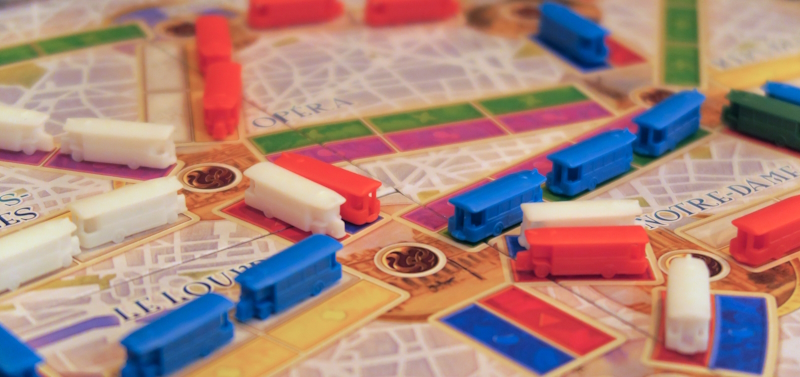
Ticket To Ride: Paris
– Image by boardGOATS

Black, Pink and Jade all picked up similar points for their completed Tickets (ten, eleven and eight respectively), though Jade was unlucky and unable to complete his last one.  Blue, however, made good use of concurrent routes and scored a massive twenty-four points for hers giving her something of a landslide victory with a total of forty-six.  It was much closer for second which went to Pink who finished with twenty-nine, two points ahead of Black.  Meanwhile, on the other side of the room, Purple was leading Ivory, Plum and Byzantium in one of her favourite Christmas themed games, Christmas Tree.
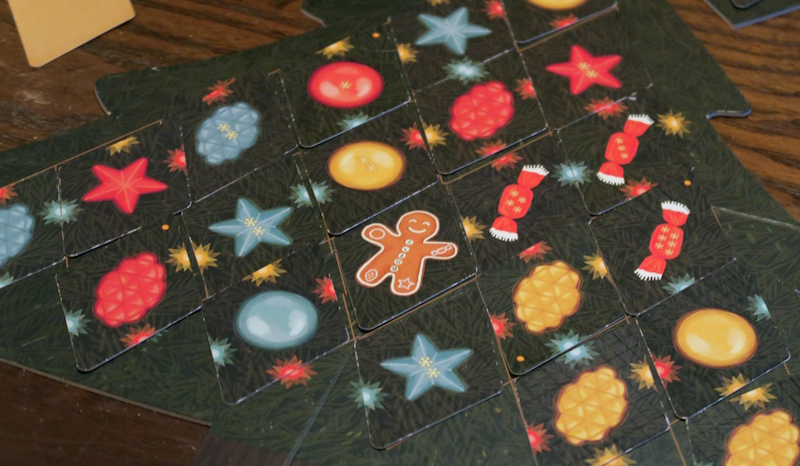
Christmas Tree
– Image by boardGOATS

This is a fairly simple little card-drafting game played over thee rounds, where players are “decorating their Christmas Tree” with diamond-shaped cards, where players score points for the Objective cards everyone contributed to a central pool at the start of the round.  This time, the group played from the advanced set of Objective cards (including all three levels) although the first round, the cards were all levels one and two.  These gave one point for each blue or “nobbly” ornament, four points for each pair of ornaments of the same colour and shape arranged in a vertical pair and six points for three specific shapes in a given arrangement.

Christmas Tree
– Image by boardGOATS

The first round started off slowly with everyone looking to fulfill some of the Objectives—everyone was successful, but Plum and Byzantium got off to a better start.  Plum placed her first Gingerbread man and then concentrated on placing vertical pairs although she only managed that once.  In the second round the Objectives were from the more complicated sets, including six points for three specific colours in a given arrangement, six points for the same three shapes or colours in a set pattern, or eight points for four ornaments with the same point value arranged in two set formations.  This time, Byzantium significantly out scored everyone with multiple objectives scored multiple times and, as a result, built a big lead.

Christmas Tree
– Image by boardGOATS

Plum used one of her Biscuits to move baubles around to make a row of four contain the three colours of glass bauble.and thus scored well, whereas Ivory was focusing on picking up high value Sweets and surrounding his Gingerbread men.  The final set of Objectives included six points for a set arrangement of certain point values, eight points for four ornaments with the same point value arranged in a particular arrangement and five points for each row in which the total points of the glass were above the given amount. Finally, there were two points for each Gingerbread man, with bonuses of six and three points for the player with the most/second most Gingerbread men.
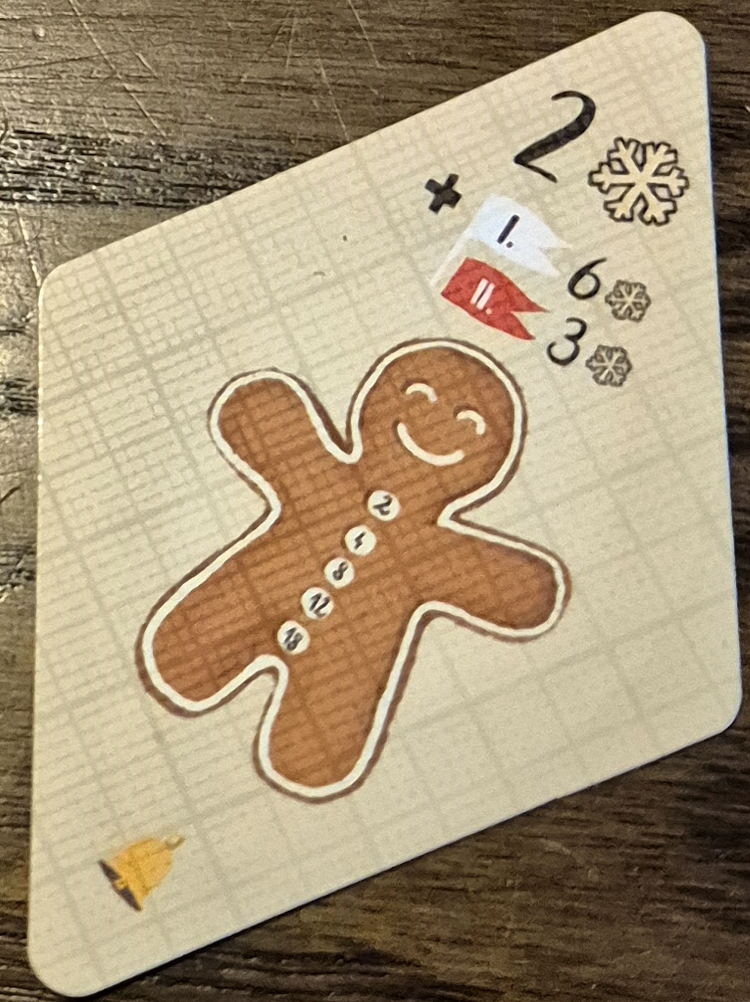
Christmas Tree
– Image by boardGOATS

In the third and final round, Byzantium again out scored everyone, scoring multiple times for the set arrangement of certain point values.  At this point, Ivory was full committed to Sweets and Gingerbread men, especially knowing he was putting in the Gingerbread man Objective, which he scored well for.  Plum and Purple also scored well in the final round, with Plum following a strategy similar to Byzantium, whereas was Purple was collecting sweets like Ivory.  It looked like Byzantium was going to win by a large amount, as he was fifty points ahead of everyone else and was scoring more than anyone else for Lights and Baubles too.

Christmas Tree
– Image by boardGOATS

Ivory’s focus on surrounding his Gingerbread men gave him over fifty points and with more than thirty for his sweets he finished with one hundred and seventy one points, pipping Byzantium to victory by just two, with Plume in third some twenty points adrift.  The puzzly nature of the the game had gone down well and with the Christmas theme everyone had enjoyed playing Christmas Tree.  On the next table, the festive link was much more tenuous, however.  Teal, Pine, Sapphire and Indigo had chosen 6 Nimmt!, because there was a twelve in it, representing the Twelve Days of Christmas (or perhaps they had just wanted to play the game and if you can’t play a daft party game at Christmas, when can you?).

6 Nimmt!
– Image by boardGOATS

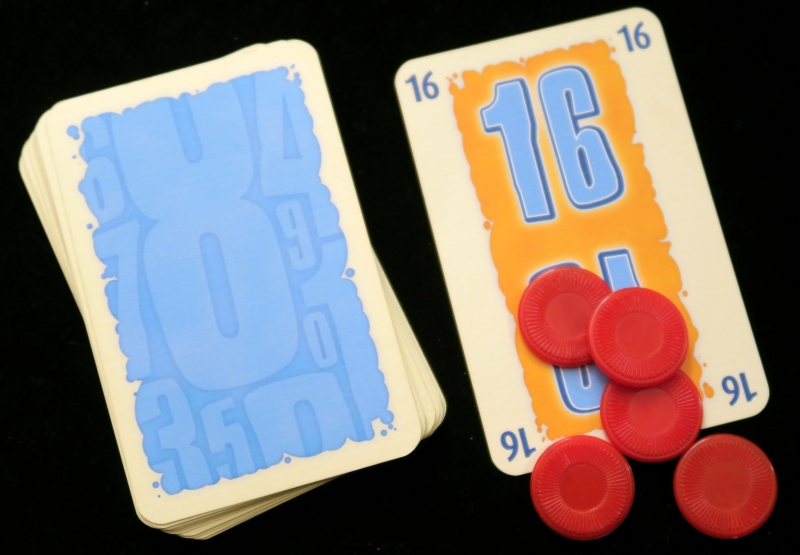
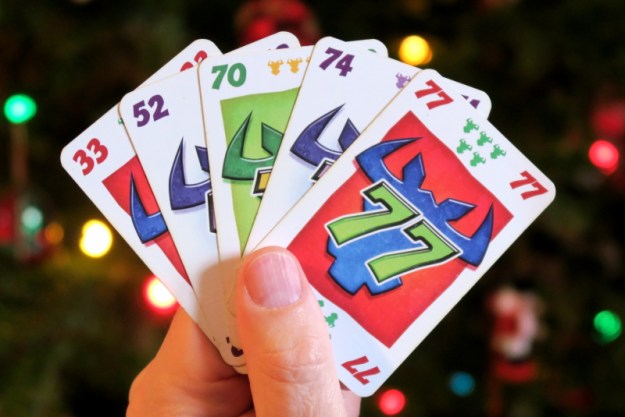
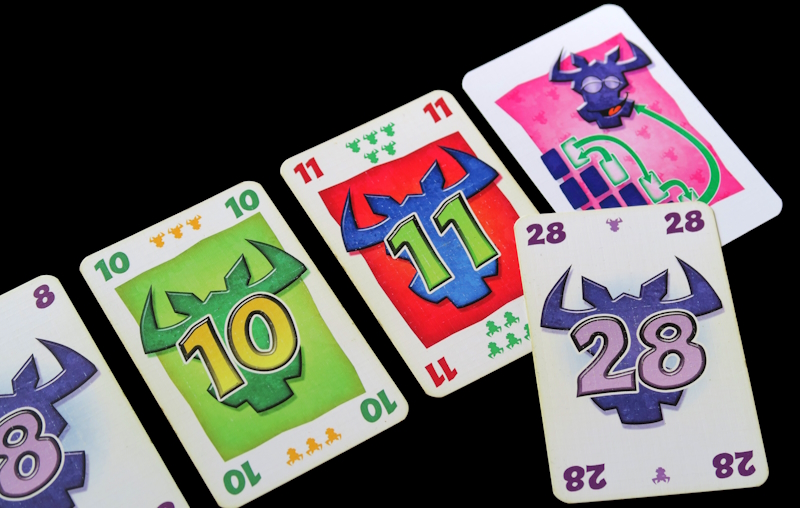
6 Nimmt! is a popular game with the group at any time of year, though it is usually played with more than four people.  Either way, the game is very simple to play, though tough to play well.  Some say this is because there is a lot of chance in the game, but they are usually the people who do badly…  The idea is that players simultaneously choose a card to play and these are then added, in order, to the rows of cards on the table.  The player adding the sixth card, instead, takes the first five cards into their scoring pile.  Usually, we deal out half the cards for the first round and the rest for the second and the winner is the player with the fewest “nimmts” (or points), at the end of the two rounds.

6 Nimmt!
– Image by boardGOATS

This time, however, the group decided to play the multiple-hand variant where each hand has ten cards, and the game ends when someone’s score passes sixty-six.  And that was Sapphire, who finished with an exceptional total of ninety-five.  The winner was Teal with forty-four, however, who was just two points better off than Pine.  The other games were still ongoing, but there was still time for one last game for this group (who were joined by Navy) before everyone went home warmed by the Christmas Gaming Spirit—and their choice of game was Coloretto (apparently this is a  festive game because it includes red, green and gold Chameleons).
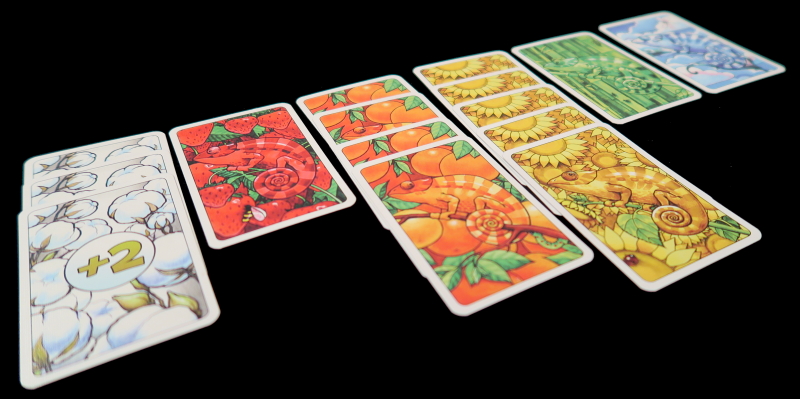
Coloretto
– Image by boardGOATS

This is another simple filler game, where players either take a card and add it to a truck, or take a truck.  Each truck can take a maximum of three Chameleons, with players collecting coloured sets.  The largest three sets score positive points (according to the Triangular Number Series), while all the others score negative points.  In this way, the bigger the series the more additional cards will score, so the aim is to collect three large sets and ensure the others are as small as possible.  This game was really tight, with Sapphire claiming victory with twenty-seven and Teal and Indigo tying for second on twenty-four.  And with that, people began to drift off, many not to be seen until 2025.
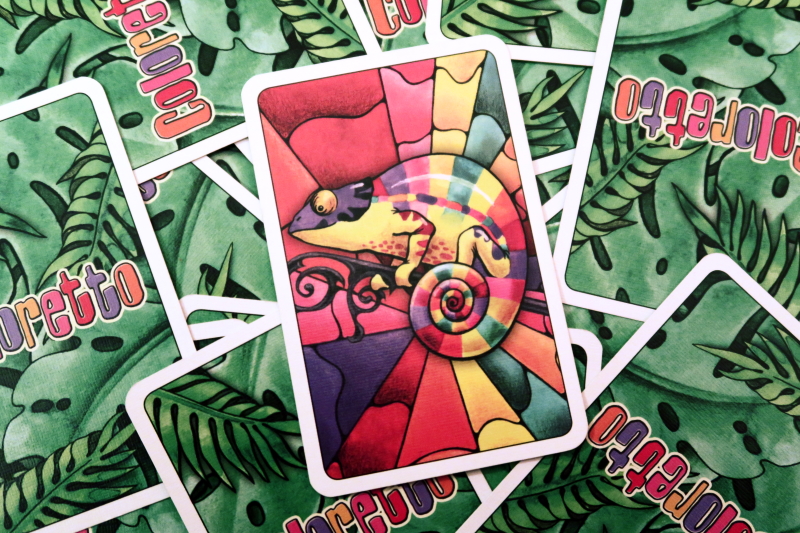
Coloretto
– Image by boardGOATS

Learning outcome:  GOATS love a Cracker!

29th October 2024

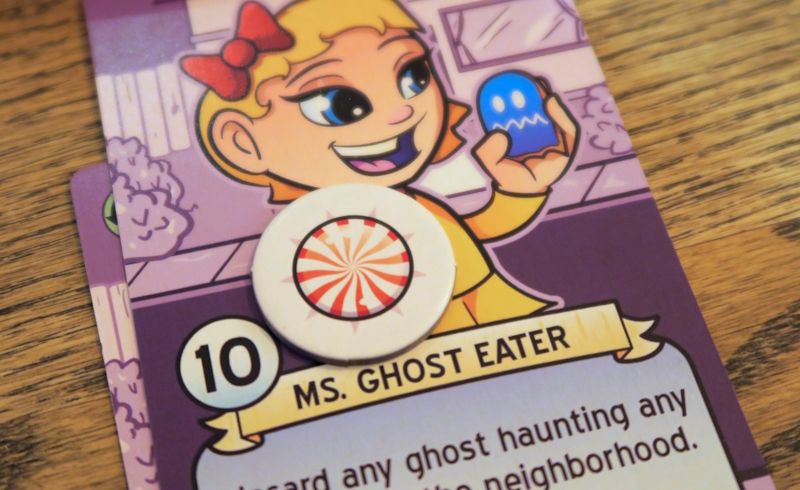
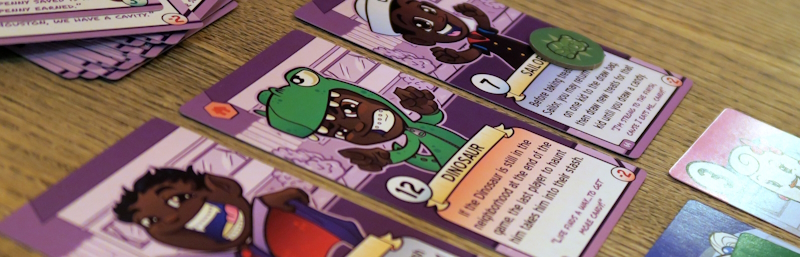
The evening began with everyone admiring Plum’s spooky cardie and wish Black a happy birthday, before people settled down to play spooky games.  To mark Halloween, the “Feature Game” will was Ghosts Love Candy Too (the sequel to Ghosts Love Candy).  This is ostensibly a quick little card game where players haunt kids to steal their sweeties, however, in practice, it took rather longer than expected to get to grips with.  The idea is that players simultaneously choose a card from their hand (of nine) Ghost Cards and then reveal which card people played to decide turn order.  Starting with the player who revealed the highest value card, players then take it in turns to place their card one one of the Kid Cards, to “haunt them”.

Ghost Love Candy Too
– Image by boardGOATS

The player immediately takes any Treat Tokens on the Kid Card and then activates the Kid’s special ability.  Any Kids whose courage has been exceeded are then collected by the active player and the Kid Card is replaced.  Players score points for some of the Kid Cards (some positive, but most are negative), and for Treats they have collected according to their personal, secret, Craving cards which mean that Treats score differently for each person.  Thus, while one player may score five points for, say, Licorice, another another player, Licorice will only be worth one point.  for some reason, there was a bit of sussing out of the rules as, although Blue had done her homework, somehow it didn’t quite fit together in practice.

Ghost Love Candy Too
– Image by boardGOATS

Between them, however, Teal, Pink, Ivory, Cobalt and Blue worked it out in the end. Ivory began, and his favourite was Chocolate, while Cobalt who went second was after peppermints.  From early in the game, it was apparent that Teal was collecting Gummy Bears, and seemed to have little competition, but then, it appeared that Blue was collecting Candy Corn, but that was all she could get her hands on and she really wanted Licorice.  In the end it was a tie between Teal and Pink, who did really well on his Treats, especially his favourites, Lollipops, but picked up ten negative points from his huge pile of terrified Kids.  Victory went to Teal on the tie-break, however, as he had the most of his favourite Treats (that pile of Gummy Bears).

Ghost Love Candy Too
– Image by boardGOATS

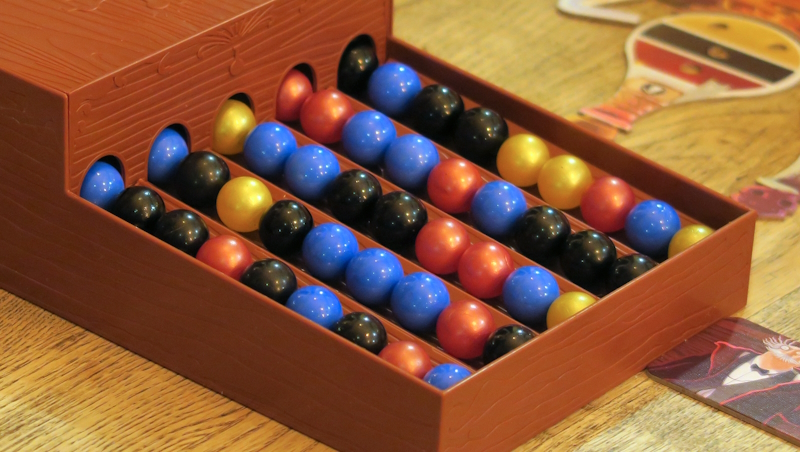
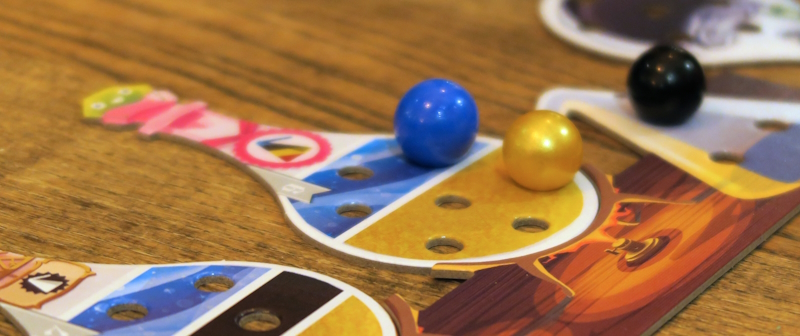
Meanwhile, on the next table, Jade was leading Black, Purple and Green in a game of Potion Explosion, which is sort of “Candy Crush the board game”, played with Marbles.  Players take an Ingredient Marble from the dispenser causing other Marbles to fall.  If that causes Marbles of the same color to connect and form rows or columns, they “explode” and players can take them take as well.  They then use the Ingredients to make  potions and then drink them to give special magical powers.  The winner, however, is the player who brews the most valuable Potions with the least Help and the most Skill.

Potion Explosion
– Image by boardGOATS

This time, Purple took the least assistance and finished with no Help tokens at all, however, a little Help can go a long way if you make the most of it.  Green got a Lot of help which cost him eight points but this was more than offset by the fact he had the most valuable Potions, worth fifty-seven points, and the most Skill giving him another twelve and a total of sixty-one points and substantial victory margin.  Black just pushed Jade into third—although Jade had considerably more valuable Potions, Black had more Skill and had needed a lot less Help, giving him a total of fifty-one points, two more than Jade.

Potion Explosion
– Image by boardGOATS

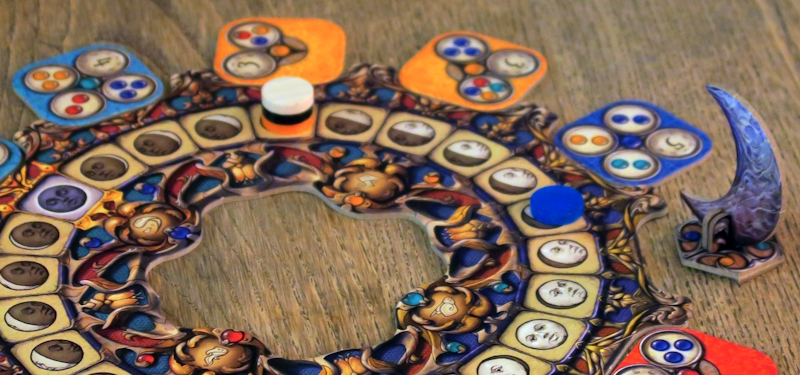
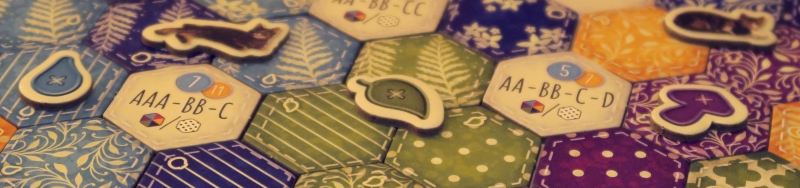
On the third table, Plum had been keen to give the Ghost Train version of Ticket to Ride a go, however, before they got round to that, they played a couple of games of the rather more tenuously Halloween themed Nova Luna.  This is an abstract tile laying game that uses the mechanism from the slightly older, animal-themed game, Habitats.  On their turn, players choose a tile from the Moon wheel to add to their array.  Each new tile brings a new task to fulfill which are completed by placing colors in a specific arrangement which in turn bring more new tasks. Each time a task is completed, the player may places one of their Markers and the first to place all of their Markers is the winner.

Nova Luna
– Image by boardGOATS

Plum was joined in Nova Luna by Sapphire (as it is one of his favourite games), Byzantium and Mint on her first visit.  The group played two games—the first of which was really close.  Plum and Sapphire tied one seventeen and were beaten by a single point by Mint.  The winner was Byzantium, however, with a two point lead and finished with twenty points.  The game was slightly less tight, though Byzantium, the master of consistency, was also the victor with twenty points.  Second place this time went to Plum with sixteen who was one point ahead of Sapphire who, in turn, was one point ahead of Mint.

Nova Luna
– Image by boardGOATS

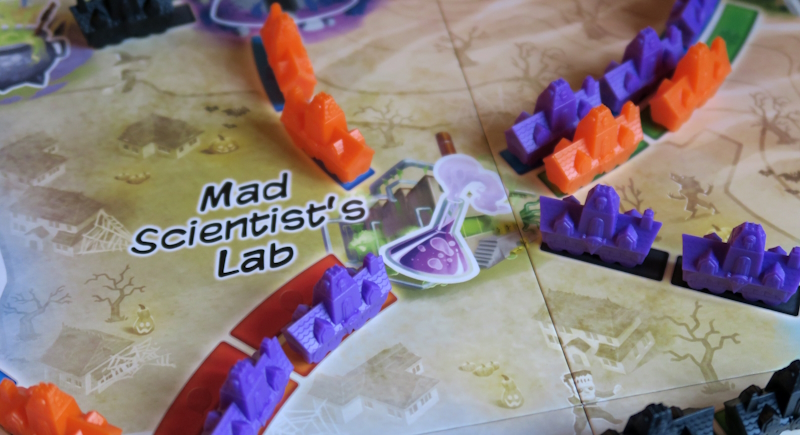
Then the group moved on to play the Ghost Train version of Ticket to Ride.  This is really a re-implementation of the introductory version of the game Ticket to Ride: First Journey, but what makes it special is the gorgeous board and large train pieces.  It still uses the same basic mechanism as all the Ticket to Ride games with players collecting parade Float Cards and using them to claim routes on the main board.  Each player starts with a couple of “Ticket” cards showing locations they have to connect.  In this version, when a player completes a Ticket, they reveal it and draw a new one.  If a player can’t complete a ticket, they can take a turn to discard both their cards and redraw.

Ticket to Ride: Ghost Train
– Image by boardGOATS

There are also bonus Tickets available for connecting a location of the Dark Forest region in the top left corner of the board to a location in the Seashore region in the bottom right and bonus Float Cards for connecting Town Hall to the Crypt.  The winner is the first player to claim their sixth Ticket or the player with the most Tickets when someone places their final Train piece on the map.  The game was a bit of a landslide, with Sapphire stealing a march on the others and quickly taking the lead, rapidly collecting his six tickets before anyone else had got anywhere.  Mint took second with two Tickets and and Byzantium and Plum tied for third.

Ticket to Ride: Ghost Train
– Image by boardGOATS

Pink was somewhat surprised when Mint expressed an interest in his bottle of his favourite Blood Orange cider.  Initially he was reluctant to part with it as it wasn’t empty, but once it was pointed out that they needed it for their next game and Pink could just poor the rest into his glass, everyone was happy and Mint began setting up her birthday present—Cards vs Gravity.  This is a silly, but fun party game where players balance cards on a platform attached to the top of a bottle that has the feel of Jenga, but with cards.  The idea is that players have to add cards to the tree without collapsing it.  Byzantium was obviously on a bit of a roll, and followed up his two victories at Nova Luna with two victories against Gravity (and the others of course).

Cards vs Gravity
– Image by boardGOATS

With everyone pretty much finished, some headed home, but the remaining ten managed a couple of rounds of the old favourite, and totally not Halloween themed, 6 Nimmt!.  In this game, players simultaneously choose a numbered card from their hand and then reveal them at the same time.  These cards are added to four rows of cards in the centre of the table, starting with the lowest card, adding each one to the row that ends with the highest number that is lower than the card.  Where the card would have been the sixth card, instead the player takes the five cards as their scoring pile leaving their card as the first in the new row.  The player with the lowest final total is the winner.  The catch is where players play a card that is lower than all the end cards, and as a result takes the row of their choice.

6 Nimmt!
– Image by boardGOATS

This has the potential to completely upset everyone’s plans.  The plans are not the thing here though, it is the tension and anticipation as people wait to see who is going to pick up that brightly coloured, high-scoring set of cards…  This time, Cobalt top-scored in the first round with twenty-seven, slightly more than Jade.  Pink, Ivory and Purple all finished in single digits, but it Pink was the victor with one solitary point.  In the second round, Green took the biggest pile giving him thirty-three points, but Jade managed to take thirteen points from just three cards.  Ivory was the only one to stay in single digits, and was therefore the winner with a total of eight points.

6 Nimmt!
– Image by boardGOATS

Learning Outcome:  Even apparently silly children’s games can be fun when the occasion is right.

28th May 2024

When Blue, Pink and Cobalt arrived for food, the pub was really busy and they struggled to find a table, ending up in the Bar.  Their food had arrived by the time the others started to turn up, and although there was another free table by this time, it wasn’t conducive to playing games.  Green, who we’d been missing in recent weeks arrived with Lilac for the first time in absolutely ages so there was a lot of catching up to do.  It wasn’t long before more tables began to clear, and the group managed to find several together in the restaurant area, and once the feeders had bolted the remains of their supper they joined the group and everyone began to decide what they’d play.

Little Town
– Image by boardGOATS

First up was the “Feature Game“, Little Town, a resource management, worker placement and tile placement game where players take on the role of architects guiding teams building a small town.  There were two games of this—one with Blue, Pink and Teal, and the other with Black Purple and Lime.  It is quite a simple little game:  players start with a set number of Workers (four in the three-player game) and building Markers (six for three players).  On their turn, they can place a Worker in an empty space on the central player board/map, or spend resources and build a Construction, placing a Marker on it.

Little Town
– Image by boardGOATS

When they place a Worker, the player activates the eight spaces surrounding it.  These can include Woodland, Mountain, or Lake to get Wood, Rock or Fish.  Wood and Rock are useful to build, while Fish is important for players to feed their Workers at the end of the round (one Fish or Wheat per Worker, every round).  Players can also activate Constructions, their own for free, and another player’s by paying them one Coin.  There are twelve Buildings and five Wheat fields available for construction at the start of the game—once they are built, they are not replaced.

Little Town
– Image by boardGOATS

There are twenty-nine buildings in the base game which can be drawn at random, but this time, both groups used the basic set (marked with a robin).  This meant that some of the Objective cards which are Building dependent could not be used, so in the end, only the cards that didn’t require specific Buildings were used.  The Objectives therefore included things like “Gather at least five resources in the same turn” or “Have more Buildings than Workers”—these are scored during the game.  Buildings come in two types:  Those that give Resources when activated, and those that can be used to convert Resources into other Resources, Coins or Points.  The game lasts four rounds, after which players score for each of their Buildings and one point for any three unused Coins.

Little Town
– Image by boardGOATS

Once the rules had been outlined, both groups started playing.  Before they’d got more than a turn in, however, Cobalt commented that he was surprised that Blue hadn’t got metal coins to go with the game, at which point, Blue produced her utility set and both groups swiftly made the substitution.  Unfortunately, these new coins were a little slippery leading to a couple of rounds of “Hunt the Game Piece”.  Little Town is a really good little game though, accessible, but with meaningful decisions and one that doesn’t outstay its welcome.  Despite starting with essentially the same setup, the two games, progressed quite differently.

Little Town
– Image by boardGOATS

Pink and Blue built Points engines converting Coins and Wheat respectively, while Cobalt converted a Coin into Wheat and Fish, then and Wheat into lots of Coins.  On the neighbouring table, however, the Coin to Wheat and Wheat to Coins buildings were owned by different people, Black and Lime respectively while Purple was busy converting Wood into Points.  Both games were quite tight, with Lime’s forty-two beating Black into second place by just two points.  The other game was even tighter though.  Pink rolled back his final move following a suggestion by Blue to pick up an extra point, but she would have done better to keep her mouth shut as that extra point meant he tied for the lead with Blue on fifty-five.

Little Town
– Image by boardGOATS

It was as players were discussing the game and starting to pack away that Pink spotted a way of getting another extra point, but this was deemed too late and the game was deemed a tie.  Packing away, there was some confusion as the manifest indicated there should be twenty-nine Objective cards, whereas Blue’s copy had thirty.  Despite several recounts (and confirmation that there weren’t any in the Goodie Buildings mini expansion), the issue couldn’t be solved, and the group came to the conclusion that one more than expected was better than one less…

Little Town
– Image by boardGOATS

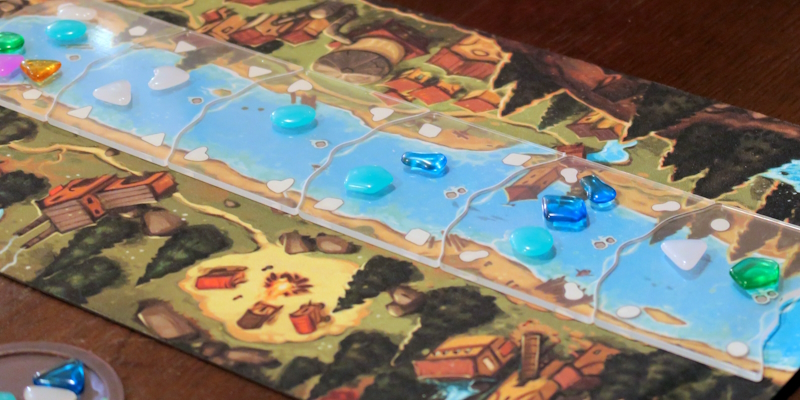
Meanwhile, on the next table Teal was leading a game of Salmon Run with Green, Pine and Lilac.  This is a game that was played quite a few times in the group some years ago when it was first released, but the last time it got an outing was in 2015—nearly ten years ago.  Teal had decided that his copy had been sitting on the shelf unplayed and unloved for too long and it was time for it to move on.  It got a stay of execution though, and as a result, it got a Tuesday night outing.  A fast paced, deck-building, race game, Salmon Run is a sort of cross between Dominion and Flamme Rouge.  Although the game is not particularly complex, the first game was a learning game.

Salmon Run
– Image by boardGOATS

The idea is players are Salmon, racing to be first to get to the Spawning Pool.  The board is modular and therefore the River can be changed to give variety and replayability.  Players start with a deck of cards containing three Swim Forward, three Swim Right, three Swim Left, one Wild and one Bear and draw four of these.  On their turn, players can play up to three cards, however, playing three means they will draw a Fatigue card.  These will ultimately reduce players’ choice and slow their Salmon down, so mostly players stick to playing two, replenishing their hand to four cards at the end of their turn.

Salmon Run
– Image by boardGOATS

Depending on the modules used, the River includes obstacles like Rocks, Currents and Rapids, as well as special spaces which allow players to pick up special cards (that can be used to counter Currents, Rapids and Eagles) to add to their Swim deck.  Teal began by moving a Bear onto the space with Pine’s Salmon, giving him a Fatigue card.  Then, much to Pine’s annoyance, Lilac and then Green did the same before fianally Lilac did it again.  Pine was very unimpressed—for one who loves wildlife, he really wasn’t happy about repeated visits from all those bears!

Salmon Run
– Image by boardGOATS

Green I played a Rapids card and there was some discussion where the card should be discarded to, but in the end there was no catching Teal, who was first to the Spawning Pool, and was some four spaces ahead Lilac, his closest challenger.  As Little Town was still going on both tables, the group decided to play a second time now they knew how to play as they thought they’d be quicker (which they were). The River was a changed a little to make it a bit more challenging and then the Salmon began their second run.  This time, Pine, Teal and Lilac went one way round the rapids, while Green went the other.

Salmon Run
– Image by boardGOATS

This time the bear was moved away from players by Teal so nobody got caught. As the River took a bend to the right, Green ended up with only Swim Left cards so had to just discard and bang his salmonny head against the rocks, falling behind. Teal and Pine had both picked up a lot of Fatigue cards, but they both got to the Spawning Pool.  As Pine had one less though, he was the winner of the second game.  It had been a lot of fun (despite the Bear attacks, and the headaches from banging against the rocky bank), so maybe the stay of execution deserves to be extended a while longer.

Salmon Run
– Image by boardGOATS

With both games finished and the late start, there wasn’t time for something long, so as is often the case in such circumstances, instead of lots of discussion, the group decided to play the old favourite, 6 Nimmt!.  With ten, the group decided to play the game over one round, which meant everyone started with ten cards, a lot more than usual.  This didn’t seem to improve the quality, however, a sentiment that was epitomised by one comment, “These are all bad with a capital F…”  The first few rounds were a little slower than usual as everyone had more cards to choose from than usual.

6 Nimmt!
– Image by boardGOATS

Once everyone had chosen their card, they were simultaneously revealed and added to the end of the appropriate row, with players picking up cards when theirs was the sixth card to be added.  Nobody managed to avoid picking up cards, but unusually, the scores were all quite close—so close that the winners, Green and Blue, tied with nine, while Pink took third place with eleven and Cobalt top-scored with twenty-three.  One game is rarely enough when it comes to 6 Nimmt!, and everyone was keen for another mad ten-player game.  This time the scores were more diverse: Lilac succeeded in avoiding the chaos and won with a clear round, while Teal added thirty-six to his first round twenty two to finish with the most points overall (Cobalt only took seventeen in the second game).

6 Nimmt!
– Image by boardGOATS

Blue took second place in the second game with five (giving her the best combined game total of fourteen), while Pine came in third with ten points.  Green was the most consistent with nine and eleven, but Lilac claimed the nearest to a “Mike Game” with one exceptional round and one awful one, though her bad wasn’t as bad as his usually were.  Everyone was just packing up when the evening came to a smashing end as the wine glass that Lime had carefully put safely to one side bit the dust.  Oh well, less washing up…

6 Nimmt!
– Image by boardGOATS

Learning Outcome:  Little Towns can give quite big games.

14th May 2024

Pine was already sitting outside marking his birthday, when Blue and and Pink rocked up and ordered their tea.  Jade and Sapphire soon joined the group, ferried by newcomer, Tangerine who not only brought gamers, but also his shiny new copy of the “Feature Game“, Faraway, which he had won at Gweeplefest a few days earlier.  This game is has been a bit of a hidden gem whose popularity is rapidly gaining traction as more people play it.  It is quite a simple game, but one which really messes with the head.  Some of the group played it a few weeks back and it was so popular that it seemed a good idea to Feature it so more of the group could try it.

Faraway
– Image by boardGOATS

The story is that players are exploring the mysterious land of Alula in search of its secrets, meeting its inhabitants and listing its wonders in order to gain more fame than everyone else.  In practice, however, it is a fairly simple little card game with a market with a trick-taking type element.  Players simultaneously chose one of the numbered cards from their hand and starting with the the player that played the lowest card (similar to 6 Nimmt! or Kingdomino), everyone takes it in turns to choose one from the market to add to their hand.  Players then simultaneously choose another card, and again, choose one to add to their hand.  The game ends after everyone has played a total of eight cards, and then everyone scores.

Faraway
– Image by boardGOATS

There are a couple of very clever things about the game.  Firstly, if the card someone plays is numbered higher than their previous card, they take a card from the Sanctuary deck.  These cards a really important because of the second clever element, the scoring.  Each card has a number and a colour, while some also have resources and some have also have scoring conditions.  The scoring is clever because the cards are played left to right, but the scoring is from right to left—at first glance, this looks like it makes things easy, because early in the game players find out what they need to get points and can then focus on getting the resources they need as the game progresses.

Faraway
– Image by boardGOATS

However, the scoring is tensioned against the ability to get Sanctuary bonus cards. This is because the scoring cards are generally those that have a higher number and are therefore the ones players want to play first (following them with resource cards which generally have a lower face value).  To get a Sanctuary card though, players have to play a higher value card than the immediately preceding one, and Sanctuary cards are very useful because they are eligible for scoring regardless of when they are played.  Thus, trying to play cards increasing and decreasing in value to score the most points backwards really messes with players’ heads!

Faraway
– Image by boardGOATS

Tangerine, started one game and explained the rules to half the group, comprising Plum, Byzantium, Blue, Pink and Pine, while he ate his supper.  Meanwhile, Jade and Sapphire took their copy to a neighbouring table where they were joined by Teal, Black and Purple, and started a second game.  Although it is a very simple game, the backwards forwards up and down thing got to several of the group at various points, including Blue (who lost the ability to count), Teal (who did all his scoring forwards instead of backwards), Pine (who struggled with the how maps worked) and Purple (who couldn’t get her head round the reverse scoring).  Jade’s game was the first to finish, with Sapphire beating jade into second place by a single point and Black taking third.

Faraway
– Image by boardGOATS

There was a general appreciation of the art and the mechanism though the theme was a bit invisible.  There had been such confusion, however, that the group decided to “do a Lime” and play again.  This time, the finishing order was exactly the same, but the game wasn’t as close with Sapphire’s eighty-two being the highest score of the evening.  On the other table, Plum was the victor with seventy, followed by Tangerine and Byzantium in third.  This game had taken a little longer, and with six, there is a lot of downtime, so although everyone had enjoyed it, the group decided to split into two groups of three.  Blue tempted Plum and Sapphire to a game of Calico with cries of “Kittens!”, while Pink and Pine lured Tangerine into a game of Ticket to Ride: San Francisco.

Ticket to Ride: San Francisco
– Image by boardGOATS

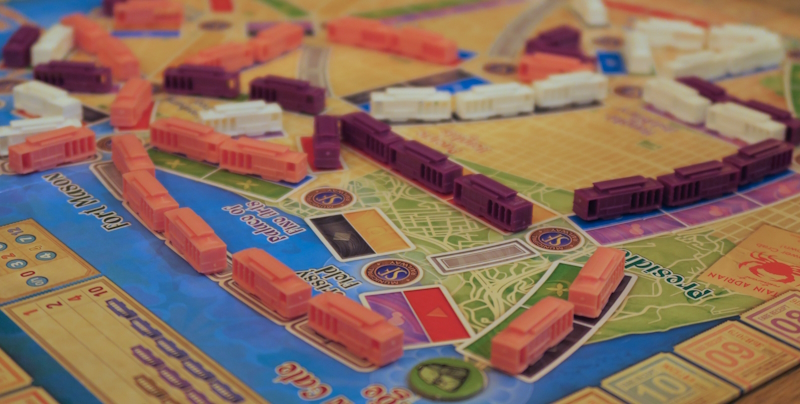
San Francisco is one of the smaller city versions of Ticket to Ride.  The game play is much the same as the original, but the maps are smaller, players have fewer pieces and they only play a maximum of four.  In all the games, players take it in turns to take coloured cards into their hand from the market, or play cards to place pieces on the board connecting locations to satisfy tickets and score points.  Each version of the game has its own specific unique rules, and this one is no exception with players collecting Souvenirs which give points at the end of the game.  Players collect these by building a route (in this case made of trolley cars rather than trains) to the cities where they are available.

Ticket to Ride: San Francisco
– Image by boardGOATS

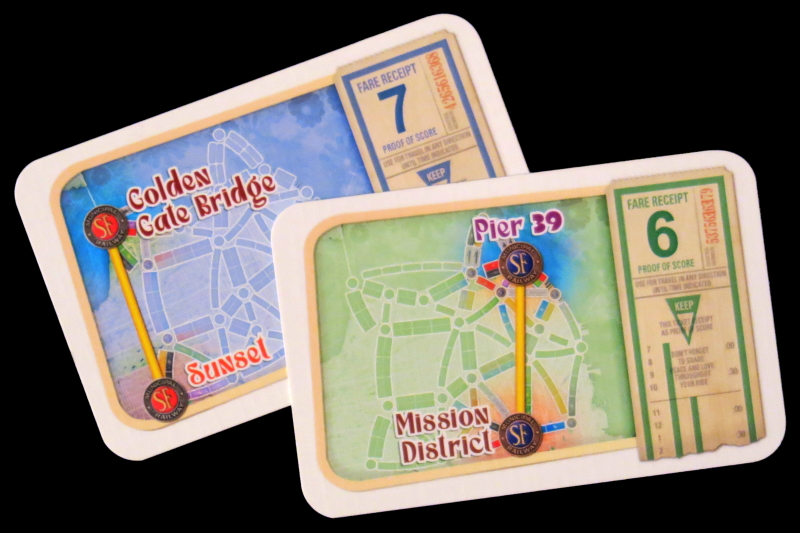
Each player can only collect one of each Souvenir, but a full set of seven gives twelve points, which is a lot.  Tickets are also always key though.  This time, Pink escaped early from Alcatraz to Twin Peaks which gave him a high scoring eight points.  Unlike Pine (who always seems to draw routes he’s already completed), Tangerine was unlucky and and instead picked up some negative points late in the game.  It was very close between Pink and Pine though, but the Souvenirs made the difference and Pink (with five) just edged it, beating Pine (who only had two Souvenirs) by three points.

Ticket to Ride: San Francisco
– Image by boardGOATS

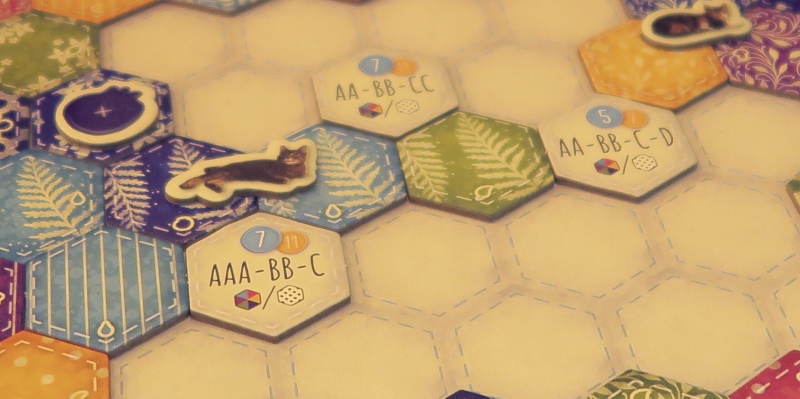
Meanwhile, the kitty-philes were playing the extremely frustrating game Calico, which is all about trying to entice cats to come and sleep on a patchwork quilt by making it with the patterns they like.  In this game, players take it in turns to place a coloured, patterned tile from their hand into their quilt board before taking a replacement from the market.  Everyone had played it before, but it had been a while, so the rules needed a bit of revision.  Each player starts with three tiles in a fixed location with scoring criteria for the neighbouring tiles—satisfying these for either colour or pattern gives points, with more points for for those that satisfy both (which is not easy).

Calico
– Image by boardGOATS

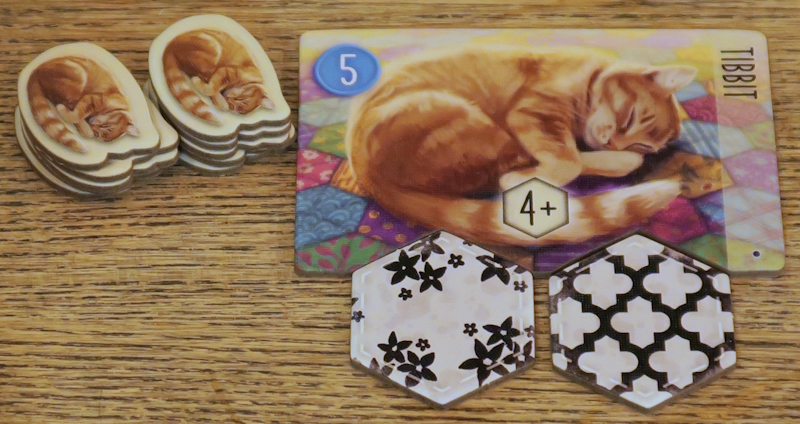
Players then also receive a coloured button for every group of three adjacent tiles of the same colour (with a bonus if they get all six possible colours).  Finally, there are the cats that give Calico its name.  This time the cats in question were Almond, Tibbit and Shop Cat (from the Kickstarter Promo).  Almond was attracted by a group of five tiles of one of the patters in a close packed predefined shape while Tibbit found a set of four tiles of one of the given patterns in any shape most appealing.  Shop Cat was lured to the player with the longest connected chain of tiles in one of the given patterns with the player with the second longest attracting a smaller cat (worth fewer points).

Calico
– Image by boardGOATS

This last one was the subject of some debate as Byzantium ended up with both the longest and second longest chain and it was unclear from the rules whether he would get both.  In the end he allowed the smaller Shop Cat to wander off, but fortunately it didn’t make any difference to the placings.  Almond looked by far the most challenging kitty to attract and initially it looked impossible without failing on the fixed starting challenges.  Plum thought she had made a mess of things, but Byzantium pointed out how Almond could be enticed  using some of the partial tiles around the border of her player board and she was the only one to ultimately have that particular kitty to cuddle.

Calico
– Image by boardGOATS

Blue started badly, and in this game, when that happens things usually only get worse, which they did.  Byzantium and Plum both picked up twenty-seven points for their buttons, but in both starting tiles and kitties, Byzantium had the edge (even without the second Shop Cat).  In the end his final score of sixty-one points gave him a significant margin of victory, by seven points.  Everyone agreed that Calico is a good game, but a very frustrating one when players can’t get the tiles they need.  So Byzantium echoed everyone’s feelings when he commented, “That was fun, but very frustrating—I’ll be ready to play it again in another eighteen months…”

Calico
– Image by boardGOATS

As Faraway and Ticket to Ride had both finished, Tangerine took Jade and Sapphire home and Teal also headed off.  That left Black, Purple, Pine and Pink to play a quick game of the old favourite, Coloretto.  This is a very simple set collecting game, that makes a great filler.  The idea is that players either take the top coloured chameleon card from the deck and place it on a cart, or take a card and add the cards to their collection.  Players score points for their largest three sets (up to six cards, worth twenty-one points), while everything else scores negatively.  The player with the most points is the winner.  Playing with the Jubiläumsausgabe edition, as usual, there was a discussion about what the Golden Joker does and how it differs from the normal Joker.

Coloretto
– Image by boardGOATS

In the end, Pink was the victor and, for the second game in a row, pushed Pine into second place, this time with Black just behind.  The evening looked to be ending there, when a couple of people from the bar came over and asked what we were doing.  That led to a fairly wide-ranging discussion about Monopoly, Cluedo and Mystery of the Abbey amongst other games.  The evening really did come to an end eventually, after Pink and Blue had dragged one of the interested parties into a quick game of No Thanks!.  Unfortunately, there was a misunderstanding and he top-scored with ninety-three, but hopefully he understood that some of the games we play are not that complicated.

No Thanks!
– Image by boardGOATS

Learning Outcome:  Playing forwards and backwards at the same time makes heads hurt.

30th April 2024

Blue and Pink were unusually early and had already finished their pizzas when Pine rolled in.  He was soon followed by Black and Purple and then Lime and Teal giving a total of seven for one of the quietest nights for a long time.  With seven, the question was how to split the group and what would everyone play.   For seven players, the go-to game is generally Bohnanza, which Blue inevitably suggested.  Pink suggested playing it later, but when Teal commented that he’d never actually played it, that was the decision made.  There was no way that state of affairs could continue, so the “Feature Game” (which was to be Canvas) was put on the back burner until later, and the Beans came out.

Bohnanza
– Image by boardGOATS

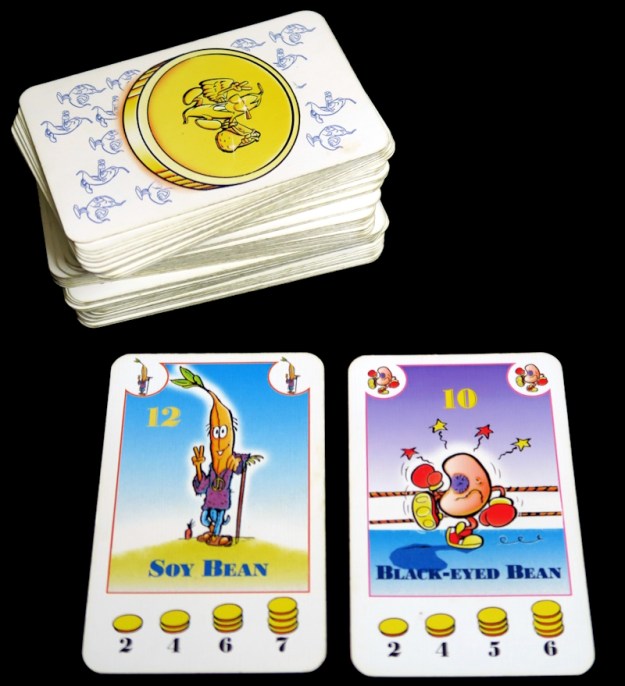
Bohnanza is best part of thirty years old and is, despite him designing a huge number of excellent and popular games since, including Agricola, Caverna, Le Havre, A Feast for Odin and Patchwork, is arguably, still one of Uwe Rosenberg‘s best games.  It is a really simple game of set collecting and trading, that when explained sounds strange, but when played is great fun.  While everyone else chatted, Blue explained the rules and how to play to Teal.  The important thing is players cannot rearrange the cards in their hand (similar to recent Spiel des Jahres nominee, SCOUT).

Bohnanza
– Image by boardGOATS

So, players start with a hand of cards, and, on their turn, must plant the first Bean card in the front of their hand into one of the two “Bean Fields” in front of them.  Then they may, if they wish plant the next Bean into one of their Fields, but each Field can only contain one type of Bean.  Once they have finished planting from their hand, the active player turns over the top two Bean cards, which must be planted, but may be traded and planted in another player’s Field if agreements can be reached.  Once these Beans have been dealt with, the active player can trade any cards from their hand, but all cards involved in any trades must be planted straight away.

Bohnanza
– Image by boardGOATS

Finally, the active player tops up their hand taking Bean cards into their hand (three in the case of the seven player game).  At any point, players can harvest one or both their Bean Fields converting some of the cards into Bean Thaler (according to the “Beanometer”), placing them face-down in their scoring pile, returning the other cards to the discard pile.  However, players cannot harvest a Field with a single single bean in it unless all their Fields have only the one Bean in them (a rule that can sometimes make things unbelievably difficult).  The game ends after three passes through the deck and the player with the most Thaler at the end is the winner.

Bohnanza
– Image by boardGOATS

There are a few, very clever things that really make the game work.  Firstly, there are different numbers of the different types of Beans in the deck—some beans are very common and give a small return, others are quite rare and give a better return.  The number of each card present in the deck at the start of the game is printed on them.  This is key, because it helps players to work out the rarity and therefore the value of different Beans when arranging trades.  However, the value also changes according to the situation in the game and how many players want each Bean type at the time.

Bohnanza
– Image by boardGOATS

Further, because the rare Beans give a larger yield, more of these are removed from the deck, which makes them increasingly rare as the game progresses.  This is because there are disproportionately fewer in the discard pile when it is shuffled to give the new deck.  Players can also buy a third Bean Field, but choosing to do this is a real gamble and only worthwhile if it can be done early in the game.  Choosing when to harvest is also critical, because harvesting a big Field just before the discard pile is shuffled will increase the length of the game.  Finally, players can be generous in their trades in the hope that the generosity will be returned, however, giving away trades too cheaply can cost a player the game.

Bohnanza
– Image by boardGOATS

Once Blue had finished explaining the game, Black started and explained his way through his turn.  Teal quickly caught on and got engaged in trading and planting Beans with everyone else.  There was a lot of debate about players buying their third Bean Fields with about half the players buying one and Teal leaving it to the second round (much against Black’s advice). Several people, including Purple, Teal and Pine got into Black-eyed Beans—quite an achievement given how few of them there are in the pack—and Blue had a couple of goes with the similarly rare Red Beans.  Pink tried for Soy with mixed success and almost everyone planted some combination of Wax, Coffee and Blue Beans at some point during the game.

Bohnanza
– Image by boardGOATS

Teal quickly realised how quick you have to be declaring an interest in a trade in a game where if you snooze, you lose.  And with seven you have to be keep an eye on what’s going on, which can be difficult given how far away some players are.  In the corner, Black quietly got on with his game eschewing the third Bean Field option as he felt there wasn’t time in the seven player game to recoup the cost, and perhaps he was proved right as he ran out the eventual winner with twelve Bean Thaler, closely followed by Pine with eleven and Blue with ten.  It had been a lot of fun, but as usual, had lasted longer than it really should, leaving little time before the first people needed to head home.

Bohnanza
– Image by boardGOATS

So after some discussion (where pink suggested Ticket to Ride: Northern Lights again), everyone settled down to play 6 Nimmt!.  This had recently had an outing with the new Jumping Cow mini-expansion, but this time the group chose to play it without the additional madness.  6 Nimmt! is also a simple game that is a lot of fun:  Players start with a hand of cards and simultaneously choose one to play, then, starting with the lowest value, these are added one at a time to the four rows on the table.  If a player’s card is the sixth in the row, instead, they take the first five into their scoring pile and their card becomes the first in the row.

6 Nimmt!
– Image by boardGOATS

This is another very clever game that does a lot with very little (which is probably why it is still so popular despite the fact it is thirty years old).  Different cards give a different number of points (or Nimmts), and players can also introduce a little bit of their own randomness by playing a card lower than the final card in all the available rows and thus, taking a row of their choice, upsetting everyone else’s plans.  The Jumping Cow mini-expansion adds more of this, but the group felt it didn’t really improve the game, so stuck with the chaos and fun of the original game, also eschewing the mathematical complexity of the Professional Variant.

6 Nimmt!
– Image by boardGOATS

This time, both Pink and Pine managed to avoid picking up any cards in the first round.  However, Blue only picked up two Nimmts and Teal collected seven leaving it all to play for, at least for most people—Black’s twenty Nimmts had already put him out of the game.  In the second half, Lime picked up twenty-four giving him the top score of thirty-eight (some way ahead of Purple with total twenty-nine).  Black managed a clear round, but there was nothing he could do about his pile of Nimmts from the first round.  It was tight between the top three, but Pink just took victory with ten, three fewer than Blue and Pine who tied for second place.  From there, the evening deteriorated into chatter and we decided to leave the “Feature Game“, Canvas, for another day.

6 Nimmt!
– Image by boardGOATS

Learning Outcome:  You can have a lot of fun with nothing but an old deck of cards.

2nd April 2024

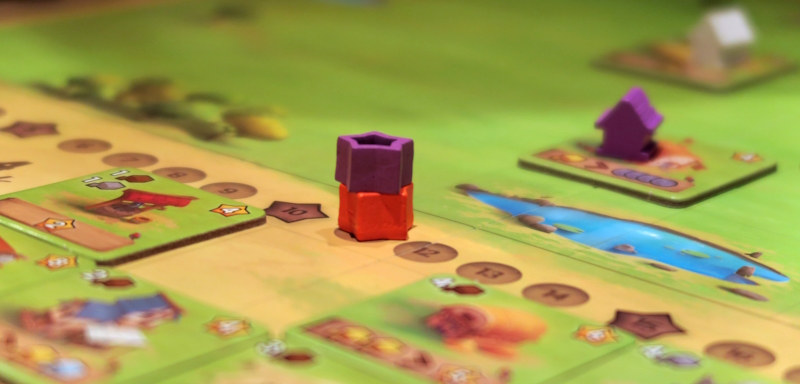
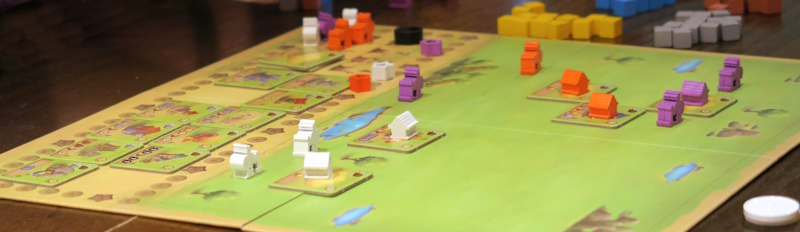
While Blue, Pink and Cobalt were finishing their supper, Plum led a quick game of Draftosaurus with Black, Purple and Cobalt (who had already finished his pizza).   Cobalt was new to the game, so after a quick rules explanation the group were passing dino-meeples left and right and building themselves exciting dino-parks.  The game is really quick and simple:  players start with a handful of wooden dino-meeples, and on each turn, they draft one, that is to say, they choose one and pass the rest on.  The chosen dino-meeples are then placed in the players’ parks, obeying the rules on the Die (the active player who rolled the Die excepted).

Draftosaurus
– Image by boardGOATS

The Die roll forces players to choose from locations in one half of the board, or restricts them to playing in an empty pen or one without a T-rex, making things considerably harder.  Players draft a hand clockwise, and then a second hand anti-clockwise, after which, points are scored for each pen and totalled up to find the winner.  This was Plum’s fiftieth game—it was one of their group’s go-to warm-up and filler games played remotely during the global pandemic on BoardGameArena.  Although her 24% success rate seems really good at first, at four players, one out of four could be seen as about par.

Draftosaurus
– Image by boardGOATS

Plum marked her milestone with a change of strategy, forced by the Dice to go for the most T-rexes, but it worked giving her victory with forty-one points.  Purple took a very respectable second with thirty-five points—one of her best scores in this game.  From there, Cobalt headed off to play Meadow with Blue, Jade and Sapphire, while everyone else joined Plum, Black and Purple to play the “Feature Game“, which to mark the thirtieth anniversary of 6 Nimmt!, was the new Jumping Cow mini-expansion.  6 Nimmt! is one of the group’s favourite games and was arguably responsible for keeping us sane when we were stuck at home in 2020 and as a result, won the Golden GOAT Award.

6 Nimmt!
– Image by boardGOATS

The game is super-simple:  players simultaneously choose a card from their hand and then, starting with the card with the lowest face value, they are added to one of four row.  Each card is added to the row that ends with the highest value card that is lower than the card to be placed.  If that means the row now has six cards, the active player takes the first five cards in the row into their scoring pile, with their card becoming the new first card.  The new Jumping Cow expansion is a single additional card that lurks at the end of the row.  Cards are added as normal, however, when one is added to the Jumping Cow row, the Cow jumps to another row, the one with the lowest face value at the end.

6 Nimmt!: The Jumping Cow
– Image by boardGOATS

The Jumping Cow Card does not have a value itself, but it does add to the number of cards in the row.  So if the card added is the sixth, the player takes the other four cards and then the Cow jumps.  If the row the Cow jumps to has five cards in it, the active player takes four of those too before the Cow jumps again…  Thus, as Plum discovered this time, multiple jumps can lead to collecting a lot of points!  The game was the usual entertaining fun, but although the Jumping Cow expansion adds more madness, 6 Nimmt! is a near perfect game that needs little to no improvement (although we have found the Professional Variant an occasional worthwhile addition).

6 Nimmt!
– Image by boardGOATS

This time, the top scorer (aided by the Jumping Cow) was Plum with sixty-one, closely followed by Ivory with fifty-seven.  Purple did very well to limit her takings to nineteen, but she was beaten into third place by Pink who just kept his to single figures with nine.  The winner was Teal, however, with just four from the first hand and a clear round from the second.  From there, with six, the options were limited, but the group decided to stick together and, after eschewing Bohnanza, opted for another golden oldie: For Sale.  Remarkably, Ivory had somehow not played this before, and was really taken with it, so much so that he immediately looked to see if he could get a copy and everyone was shocked to find it was out of print and the only copy available was for forty pounds on ebay!

For Sale
– Image by boardGOATS

For Sale is really simple:  Players start with a hand of cash and use this to bid for buildings, with a face value from one to thirty.  In the second half of the game, cheques are revealed and players have to choose one of their properties—the player with the highest value building then takes the highest value cheque, thus the idea is not to waste high value buildings when the takings available are low.  Pink, Plum and Teal were all really close and ended in a three-way tie for third place.  Ivory and Purple were some way in front, but separated by a single point with Purple just taking victory, with a final taking of fifty-six thousand dollars.

For Sale
– Image by boardGOATS

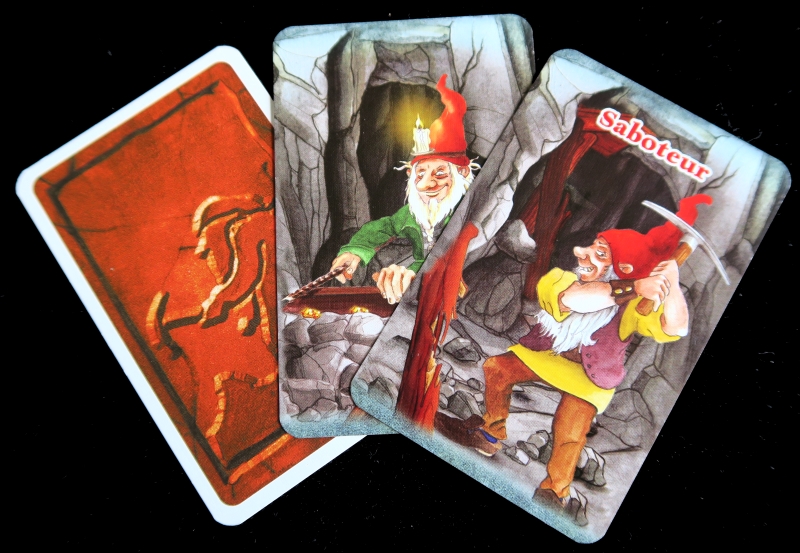
Casting about for another game that plays well with six, Bohnanza was passed over once again, this time in favour of Saboteur.  Saboteur is a hidden traitor game where players are Dwarves tunneling to find gold.  With six players, the rules have either one or two Saboteurs, however, as the game is always difficult for the Saboteurs and impossible alone, the group chose to forgo the ambiguity and go for a guaranteed two Saboteurs.  Once the Saboteurs knew who they were, everyone got a hand of cards: a mixture of tunnel cards and special cards.  On their turn, players play a card and draw a new one.  Tunnel cards extend the network, while special cards allow players to break or mend tools stopping other players from building tunnels (or reinstating that ability).

Saboteur
– Image by boardGOATS

Additionally, there are Treasure Map cards which allow players to look at one of the three potential gold cards to see if it is gold or coal, and Rockfall cards which allow players to collapse the tunnel by removing one card.  Usually, the Saboteurs hide for as long as possible in an effort to acquire some good “Saboteury cards” and play them with a lot of impact.  Choosing the right time for that reveal is really critical though, leaving it too late means there isn’t time to do enough damage.  This time then, Black announced his position very early by playing an obviously obstructing tunnel card and was swiftly followed by Pink who compounded the poor Dwarves’ problems by playing a Rockfall card.

Saboteur
– Image by boardGOATS

The Evil Criminal Masterminds were aided by the fact that when the Dwarves played their Treasure Map cards they struggled to find the gold.  The game turned out to be quite epic, but success just fell to the Saboteurs, giving them a rare victory.  As Teal and Ivory waved farewell, the others looked for something else to play.  Saboteur is a great game, and although it is not as old as 6 Nimmt!, this year is also Saboteur’s anniversary year. It is celebrating twenty years, as is another old favourite, No Thanks!.  In choosing this, those that had played all five games had played over a hundred years of popular games in one evening.

No Thanks!
– Image by boardGOATS

No Thanks! is a super simple, push-your-luck game, where players are trying to finish with the lowest score from the total face value of their cards minus any chips they have.  On their turn, players either take the top card and any chips on it, or pay a chip to pass the problem on to the next player.  There are thirty-three cards in the deck (numbered three to thirty-five), but nine are removed at random, which is what makes the game really tick—when scoring, players only count the lowest card of a run.  This time. Pink top-scored with forty-nine points.  Plum and Purple both took forty-eight points for their cards, but in Plum’s case this was off-set by her enormous pile of chips, leaving her with just twenty.

No Thanks!
– Image by boardGOATS

It wasn’t enough though. Black managed to just scrape through with only a single chip left at the end, giving him a total of thirteen points, and with it, victory.  While everyone else had been sampling a smorgasbord of golden oldie games, Jade, Blue, Cobalt and Sapphire were revisiting the relatively new Meadow, which they’d missed out on playing last time.  This is a fairly simple game, where the complexity is in choosing and placing tokens to get cards that combine well together.  Players take it in turns to play an Action Tokens either in the Market or round the Campfire, and complete the associated Actions. The Market consists of a four by four grid of face up cards.

Meadow
– Image by boardGOATS

Players play an Action token in the market to define a row or column with the number on the token dictating which card they will take from that row or column.  They then place a card in their play area.  This can be the card just collected or one from the player’s hand, but the prerequisites must be satisfied. Playing around the Campfire gives a special action and the option to additionally place a bonus point token on a tree-stump between any pair of symbols currently displayed in the player’s area.  At the end of the game, the total score for the cards played is added up together with any bonuses and the winner has the most points.

Meadow
– Image by boardGOATS

Last time, the general feeling was that the game dragged a little with four, so Blue suggested that instead of playing with the full eight rounds, maybe playing with six (as for the three player game) would make things easier.  Jade interpreted that as the suggestion to play with the three player board, but as quickly became apparent, the campfire circle is smaller with three, leaving fewer bonus spaces available making that element of the game very competitive.  Blue and Sapphire were already committed to their strategy as placing later bonus tokens give more points, so they went for the bonuses doubly hard.

Meadow
– Image by boardGOATS

Jade kept getting Cobalt’s name wrong in a way reminiscent of Blue with Ivory’s name some ten years ago—that lasted the best part of a year, but hopefully Jade will sort it out before then.  It didn’t seem to put Cobalt/Chromium/Cadmium off his game though.  From early on, he focused on building some Landscape cards adding some valuable Observation and Discovery cards.  Sapphire’s starting hand included a Wolf icon for his card from the North deck, and he played that nice and early giving him the opportunity to use it to claim a couple of the bonus spots giving him all three and a total of nine points.  Blue also claimed her third quite early leaving only two for Jade and Cobalt/Chromium/Cadmium to share between them.

Meadow
– Image by boardGOATS

Although she couldn’t see it, going into the final couple of rounds it was tight between Blue and Cobalt/Chromium/Cadmium.  The game is very tight though, with only four turns per round, so it is important to make sure they all count.  In the final round, Blue was fortunate in going first and was able to grab and play a couple of high value cards.  Jade and Sapphire also added a couple more cards to their tableau all of which made it really hard to call.  In the end, Jade (who had the most valuable tableau) pipped Sapphire by a single point (after a couple of recounts) and Cobalt/Chromium/Cadmium was two points clear, finishing with forty points.  The winner, however, perhaps thanks to those final couple of cards, was Blue with a total of forty-three.

Meadow
– Image by boardGOATS

Learning Outcome:  Golden Oldies are golden for a reason.

Boardgames in the News: 20 Years of Some Great Games

This year is the thirtieth anniversary of 6 Nimmt!, but also the twentieth anniversary of two more small-box card games, Saboteur and No Thanks!.  All three are light, family-friendly games that play larger numbers, but they are very different in style.  While 6 Nimmt! is a game of double-think, No Thanks! is a game of push-your-luck and Saboteur is a hidden traitor game.  Looking back, 2004 was a very good year, so these are not the only games celebrating their twentieth anniversary.  In addition to Saboteur and No Thanks!, Ticket to Ride, Power Grid, Goa and San Juan were released in the same year.  Combined, these games have given over a hundred years of great fun.

Saboteur
– Image by boardGOATS

Boardgames in the News: 30 Years of 6 Nimmt!

A little over thirty years ago, Wolfgang Kramer was traveling back across the border from Austria, when he and his wife were delayed because he was picked out by German border security for a luggage search.  Although they didn’t find any contraband, they did find Kramer’s export license, so they asked him to pay for their only purchase, a new pair of ski boots bought in Austria.  Scarred, or perhaps inspired by the experience, Kramer began developing a new game called “Hot Goods”.  In this game, at customs, players realise that someone has planted ten “Hot Goods” on them, so they try to get rid of them by throwing them at their fellow players.

6 Nimmt!
– Image by boardGOATS

Happy with the prototype, Kramer took this to Amigo Spiele who were equally enthusiastic about the game, though less inspired by the theme.  As a result, smuggling across the border was dropped in favour of a purely abstract game, illustrator Franz Vohwinkel added the now iconic bull’s head artwork (which is still in use today), and thus, the game became 6 Nimmt!.  To mark its thirtieth anniversary, Amigo have released a new edition, with standard rules to for ten players, four new cards contributed by the general public, and a new cooperative variant.  Although these are guaranteed to add interesting variety to the old favourite, it seems unlikely that they will improve on the perfection of the original, crazy-fun-filled game.

6 Nimmt!
– Image by boardGOATS

5th March 2024

The evening started with everyone unsure who was coming, so the nine players present split into three groups of three, with Blue, Pine and Lime starting with the “Feature Game“. This was the very short, light, Make the Difference, a game that is basically “spot-the-difference” in board game form.  The idea is that each player gets a pre-printed picture and simultaneously add five extra “features” to their pictures.  Once everyone has added their “extras”, players take it in turns to place their pictures in the centre of the table (covered with a sheet of acetate to make it a little more difficult to spot the difference between printing and drawing), together with an unadulterated copy.

Make the Difference
– Image by boardGOATS

Players have one minute (timed with a slightly grumpy egg-timer), during which a player spotting an addition gets a point, then a second minute, during which both the spotter and the modifier get a point.  After the two minutes, any un-spotted additions are assessed for size, and if they are large enough, the modifier gets two or three points.  The additions have to be a single line, may extend an existing feature, and can’t just increase the width of an existing line.  This time, Pine went first with his picture, and the slightly mardy timer gave Lime and Blue a few extra seconds to spot his additions as Pine encouraged it to behave.  Most of his additions were spotted, partly as a result.

Make the Difference
– Image by boardGOATS

Lime went next, and players were slower to spot his additions giving him extra points.  Blue was the last, but this time Pine and Lime really struggled.  For some reason, Blue seemed to be better hiding hiding her additions, taking six points for lines that weren’t spotted during the two minutes of play.  In contrast, her poor spotting let her down, giving her a total of eight points, and just enough for second place.  The winner was Lime, however, with ten points.  There was a little chatter while they packed away, but as there were no new arrivals, the trio moved on to play something else, and quickly chose to give the recent Northern Lights edition of Ticket to Ride another outing.

Ticket to Ride: Northern Lights
– Image by boardGOATS

Ticket to Ride: Northern Lights has had a couple of outings since it’s group debut last summer, and has been quite popular in the group.  The game is a fairly standard edition of Ticket to Ride (take cards from the market, or play cards to place trains), but the map is set around the Scandinavian countries of Denmark, Norway, Sweden and Finland.  Like all the variant games, this one has a couple of minor rules tweaks, principally, the addition of bonus cards which give points at the end of the game and bonuses for completing some of the longer Ferry routes.  Locomotives are also handled slightly differently as the market is not refreshed when saturated by them, and for Ferry routes only, they can be replaced by any two cards of the same colour.

Ticket to Ride: Northern Lights
– Image by boardGOATS

This time, the bonus cards drawn at random were the Locomotive Collector (A), International Tycoon (G), Polar Express (H) and the Ferry Master (J).  Pine went first and started placing trains much to Lime and Blue’s horror.  A few turns later, Lime headed up the Norwegian cost, while Blue started building an extended route from Bergen in the west through Stockholm to Tallin in the east.  It was then that Pine, with his north-south route got in her way and began costing her points thanks to the fact that with only three players the double routes weren’t in play.

Ticket to Ride: Northern Lights
– Image by boardGOATS

As he had done last time the group played, Lime churned through his trains remarkably quickly catching Pine and Blue on the hop slightly. After the last few turns had been played, the bonus points were allocated with each player winning one (Lime for the most Ferry routes; Pine for the most tickets ending in the Arctic Circle and Blue connecting the most countries while nobody had any Locomotive cards at the end of the game).  Pine claimed a completed Ticket for eighteen points which he had almost completed when he drew it (AGAIN!).  Also like time, Lime finished with a nice round hundred points, and once again was pipped pipped to victory by Pine, albeit by a larger margin (ten points rather than three).

Ticket to Ride: Northern Lights
– Image by boardGOATS

With that over, Lime headed home, leaving Blue and Pine to kill time while waiting for one of the other games to finish.  In this, they played a little “wallet game” called Circle the Wagons.  This is a simple, quick game where players take cards from a market and add them to their player area, building a map, scoring points according to the largest areas of each terrain type and three addition scoring criteria selected at random.  These scoring criteria are printed on the reverse of the cards and are drawn at random at the start of the game.  The first bonus card drawn was “Boom or Bust which gives points for two or fewer Mines/Pickaxes, none for three to six and four or five points for seven or eight (or more).

Circle the Wagons
– Image by boardGOATS

The other bonus cards were Claim Jumpers which gives the player with the most Mines/Pickaxes nine points (though they lose five if their opponent as more Guns), and Bootleggers which give two points for each Beer Bottles next to a Wagon (and minus one for any not next to a Wagon).  Once the bonus cards had been picked, the remaining fifteen cards were shuffled and arranged in a circle.  The first player, in this case Pine, could then choose to either take the first card, or take another, later card, leaving any that had been skipped for his opponent, Blue, who then had the same choice.  Play continues until all the cards had been taken.

Circle the Wagons
– Image by boardGOATS

This time, Pine started prioritising Pickaxes, given the fact that two of the bonus points scored for them.  Blue was slow to get started with these and ultimately scored nothing for Boom and Bust and for Claim Jumpers.  She collected Beer Bottles instead and prioritised scoring for her terrain.  Blue’s thirteen points for Beer Bottles exactly matched Pine’s for his Pickaxes, though he picked up half a dozen points for his Beer as well.  Blue took six points for her Forest and four for her Plains, while Pine got five points for each of his Desert and Water terrain.  It was closer than it seemed during the game, however, with Pine finishing with thirty-five points, just three more than Blue.

Circle the Wagons
– Image by boardGOATS

By this time, Pink, Teal and Ivory were bringing Viticulture to a close.  This is one of the group’s most popular worker-placement games and a particular favourite amongst Pink and Teal who have been promising each other a game for months.  The game is quite simple and doesn’t really do anything fancy, it just does what it does very well.  The idea is that players are making wine, which they do by placing their workers on spaces on the central board.  Each space has a limit to how many workers can occupy it, with each player having a “Grande” worker who can muscle in anywhere.  This time, the group played with the Tuscany expansion, which adds a few little extras.

Tuscany
– Image by boardGOATS

Firstly, whereas the base game has essentially two seasons spring and autumn (with visitors in summer and winter), the Tuscany expansion has actions for all four seasons.  Players can also build special buildings (which give additional powers and special options for those that make the effort to build them), and claim regions to gain influence (and bonuses) which scores points at the end of the game.  The player order works slightly differently to the base game and the end of the game is triggered when someone passes twenty-five points (rather than twenty in the original game).  This time, however, nobody took advantage of the opportunity that Tuscany provides to build buildings, instead focusing on the basics of planting grapes and harvesting them.

Viticulture
– Image by boardGOATS

There is a now a well-known and frequently used tactic of selling a field at the start of the game to provide equity in the early part of the game.  Teal and Ivory both went down this route while Pink decided to try something else, but that didn’t go well for him.  His problems were exacerbated by his inability to get access to fulfilling orders later in the game.  Ivory started acquiring points early taking an early lead.  Teal wasn’t far behind, but never quite managed to overhaul Ivory who triggered the end of the game and finished with thirty-one points, seven more than Teal in second place.

Tuscany
– Image by boardGOATS

When Viticulture finished, Ivory and Teal headed home, leaving Pink to join Blue and and Pine in a couple of quick games of Botswana.  This is a sort of simple stock-holding game where players are collecting animals.  The idea is that there are five suits of animal cards, each numbered from zero to five—these are shuffled and dealt out to the players with a small number left out for ambiguity.  Matching the suits, there are five sets of five plastic animals.  Players take it in turns to play a card (any card) and then take an animal (any animal) until someone plays the sixth card in any suit.

Botswana
– Image by boardGOATS

When the last card is played in any suit, the game ends immediately and players score points for their animals with each animal being worth the face value of the last card played in that suit.  Thus, Zebras might have been worth five points each, right up until the last card was played which could be a zero, rendering them totally, point-less.  Somehow, it is a hard game to understand—far from random, a bit like 6 Nimmt!, it is very hard to control and manipulate the scoring in a particular direction.  This was quite evident in the two rounds played this time.

Botswana
– Image by boardGOATS

In the first round, Blue held a few key Elephant cards and was able to manipulate the game end to ensure they scored well.  With a couple of high scoring Lions added to her menagerie, she ended the game, ensuring she finished with thirty-five points.  It was very tight between Pink and Pine, but Pink just edged second place with twenty-two.  The second round was also close with just two points between Pink and Pine, but this time they were vying for victory.  In the end it was Pink again, this time triggering the end of the game allowing him to ensure his Leopards scored well.

Botswana
– Image by boardGOATS

Botswana is a lot of fun and as they packed up, there was quite a bit of chatter.  Pine pointed out that the backs of the cards said “Wildlife Safari” and wondered why.  Blue commented that there were lots of different versions, but couldn’t remember the differences.  A little bit of research shows that the game was originally released as “Flinke Pinke” and then “Quandary” and eventually “Loco!”, all with simple colour suits.  Then, in 2010, the boring colour suits were changed for animals by Eagle-Gryphon Games, who initially republished the game as “Botswana”, before increasing the size of the box and calling it “Wildlife Safari”.  Presumably this particular copy was released when small boxes were still available, but the company had run out of matching cards…

Botswana
– Image by boardGOATS

Meanwhile, on the next table, Cobalt had persuaded Plum and Byzantium to join him playing the rather epic-looking Nightmare Cathedral. This is a card-driven action-selection area-control game set in the fantasy world of late Polish surrealist painter and sculptor Zdzisław Beksiński. The game is adorned with his artwork and beautifully sculpted miniatures. Players control Units, which act as a resource, whilst an imposing Cathedral is built in the centre of the board. Once the Cathedral is completed, two Nightmares (out of a selection of eight) appear next to the Cathedral and can be controlled by a player on their turn if a certain condition is met. Each Nightmare, represented by a unique sculpt, has varying abilities such as converting or devouring units as they move around the map.

Nightmare Cathedral
– Image by boardGOATS

The game ends when a certain number of Units have been devoured, or, less likely, after completing three rounds. The winner is determined by points, which can be obtained from climbing the Ritual track, building Forts, Devouring the most Units, or completing objectives on Dream cards (the latter being the largest source of points). On a their turn, the active player selects an action with their Dreamer from one of five on the day/night action track, although they cannot select an action adjacent to their dreamer’s current space. After performing the action, other players get to follow, either Conforming or Dissenting depending on whether their dreamer is adjacent to the current action space.

Nightmare Cathedral
– Image by boardGOATS

The active player then moves their Dreamer to the adjacent Night space, a section of the Cathedral is built, the turn marker moves to the subsequent space and the next player takes their turn.  Each player starts with a tableau of five cards, one for each action type, that details how each action can be performed, as well as the Conform/Dissent actions. The players also have a hand of cards, which come in two forms: action Upgrades or one-time Effects; each card also contains combat symbols.  The five basic actions are: Ritual (spending/removing followers to move up the Ritual track); Summon (producing Followers); Fortify (spending Followers to Build/Upgrade Forts); Manoeuvre (moving Units and/or Shaper, performing a conversion and then initial Conflicts); Develop (playing Development cards from hand, either to Upgrade actions or gain one-time benefits).

Nightmare Cathedral
– Image by boardGOATS

A player controls an area if they have a Fort present, or if there is no Fort and they have the most Units in the area. The board is also populated with a “neutral” player, called The Shadows, that can participate in conflicts and be Devoured for benefits. Each area is associated with one of four symbols, with the active symbol being determined by the turn marker (which changes every turn, cycling through each symbol). Certain actions refer to these symbols, for example when moving up the Ritual track, players must spend Units from areas matching the symbol on the next level of the track, or areas marked active by the turn marker produce if that action is selected. When producing Units by marked areas, the unit is produced by the player who controls the area, not by the active player.

Nightmare Cathedral
– Image by boardGOATS

A player may forgo the action on the card to draw two Development cards to hand. Each player may have up to two Dream (objective) cards at any time, and may complete them on their or another player’s turn provided they match the criteria at the appropriate time as specified on the objective card.  However, they may only draw new cards at a specific point in their turn from a display. Once the Cathedral is nearly complete, the Level II Development and Dream cards are mixed in with the initial Level I cards to provide enhanced benefits and more points. When a player initiates Conflicts, they get to choose which of the valid areas the Conflict(s) occur, and they do not need to participate in the conflict themselves.

Nightmare Cathedral
– Image by boardGOATS

To resolve a Conflict, the two players involved reveal a number of Development cards from hand—the number determined by the number of units present in the Conflict area (plus one if they also have a Fort). Each card depicts claws and shields: a Unit is removed for each claw that was not deflected by a shield. The winner of the Conflict is the player who has a Fort remaining, or, failing that, the most Units in the area; the looser must retreat all remaining Units to adjacent areas.  Each player starts with one action upgraded, drawn at random—each player drew an upgraded summons card.

Nightmare Cathedral
– Image by boardGOATS

Cobalt played first, and was able to complete one of his Dream cards immediately. In the first few turns, Byzantium managed to pin Cobalt in one corner of the board, which severely limited his ability to expand and produce Units, whereas Plum was able to grow relatively peacefully on the opposite side of the board. Byzantium, and to some extent Plum, were able to make use of their expansion to move up the Ritual track. Plum was also able to expand her Forts to several areas. Cobalt was able to upgrade his forts in the limited areas he controlled, as well as draw up to the hand limit of eight development cards over the first half of the game.

Nightmare Cathedral
– Image by boardGOATS

During the second half of the game, after the Cathedral was built and the Nightmares came out, Cobalt was able to make use of his Development cards (especially due to a very well timed fortunate draw) to control both Nightmares in a single turn to Convert and then Devour a sufficient number of his own Units to claim a high-scoring Dream card as well as ensure he had the most Devoured units for end-game scoring.  Unfortunately, this time, the group ran out of time so had to end the game early, stopping after everyone had completed an equal number of turns (time which Byzantium used to move up the Ritual track and Plum used to built a few more Forts).

Nightmare Cathedral
– Image by boardGOATS

Long before the game finished, it was clear that Cobalt was miles ahead and nobody was going to catch him.  Plum held on to he Dreams for too long, while Cobalt and Byzantium were better at completing theirs.  She did manage to get a Fort in the fourth corner of the map fairly early on which gave her somewhere to spawn her Units from, though.  Ending the game early meant players didn’t get to make as much of their Upgraded Action Cards as they might have done and there were cards left in hand which could have come into play with another few more rounds. As a taster game, it proved quite different, however, and deserving of another try sometime, as long as there is time to complete it.

Nightmare Cathedral
– Image by boardGOATS

Learning Outcome:  You are never too old to play “Spot-the-Difference”, but that doesn’t make you good at it.