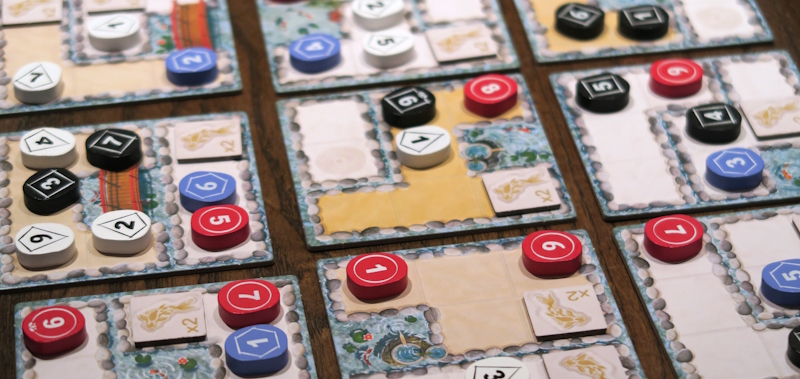
Plum, Jade, Sapphire and Mint were first arrive, and while they were waiting for food, settled down to a game of Hiroba, a sort of board game “Sudoku” where players place their numbered pebbles to take control of the most gardens. As in Sudoku, players must never have two pebbles of identical value in the same garden, row or column. After a couple of false starts the group eventually figured out the rules. This time, Sapphire got in early with the lowest stone number between two Koi carp ponds, ensuring he got both. Plum only got two ponds, so although she got a reasonable number of areas, others overtook her by using the Koi pond multipliers.
 |
| – Image by boardGOATS |
Food arrived during the game, and some were still eating when the final count (and recounts) took place. Despite Sapphire’s great start, Mint’s total of thirty-five gave her victory by a single point pushing Sapphire into second and leaving Plum in third. Meanwhile, since Hiroba was underway when Cobalt arrived, he settled down to a solo game of Explore & Draw, the Roll & Write version of Isle of Cats. The game play is similar with players now drawing polyomino shapes on their ship board, but choosing a set of cards each round instead of drafting them. In the solo game, the player is competing against his “sister” and this time won by forty points to her thirty-six.
 |
| – Image by boardGOATS |
Once everyone had arrived (except Teal who had given up battling the crazy flood-water and gone home) and had finished eating, it was time for the “Feature Game” which was to be Rolling Realms/Rolling Realms Redux. This was advertised as a light roll and write game, but turned out to be rather more involved than everyone expected. It was developed during the global pandemic as a print-and-play game, but has since been released as two professionally produced games. Each game consisting of a number of small games based loosely on other games, with more are available to be purchased separately.
 |
| – Image by boardGOATS |
The idea is that players choose three “mini-games”, or “Realms” for each of three rounds. Then, two dice are rolled and allocated separately to two of the three games. After nine rolls, players add up the number of starts they’ve achieved in the round. The winner is the player with the most points after three rounds. With three copies of the game and several people familiar with it, it should have been a relatively straight-forward game, but with so many different mini-games, players effectively had to learn the rules each round. As the games play six and there were three copies, the group decided to play one large game. and started with the same three mini-games, based on three of our favourite games, Tapestry, Meadow and Flamecraft.
 |
| – Image by boardGOATS |
And this was where the first problem arose. The Tapestry mini-game was quite straight-forward, with players trying to fill their grid using polyomino shapes. However, Meadow and especially Flamecraft, both from the Redux version of the game were more difficult to understand. The Meadow mini-game was based on the card market with players choosing “cards” and using them to score points and collect resources. The Flamecraft mini-game caused a lot of confusion with different “Enchant” and “Gather” actions, which are loosely based on the actual game, but it took a while to work out what they did and how to use them.
 |
| – Image by boardGOATS |
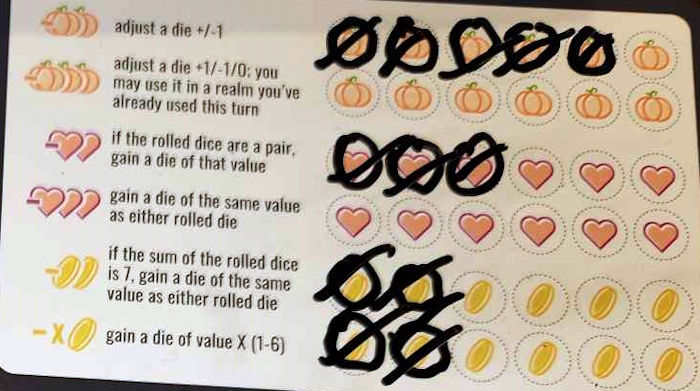
All three games involved players doing things to collect Stars, but the real aim of the game is to collect resources (Pumpkins, Hearts and Coins). These allow players to modify dice, use them both on the same Realm, and most importantly, gain extra dice to give extra actions—these are essential as without them, players don’t get enough turns to get the more challenging Stars. With so many people playing and the difficulties in getting heads round rules, the group ended up splitting into three tables. Plum, Jade, Sapphire and Mint were first to get going and were first to finish the first round. Plum was the victor, and the group went on to play Dinosaur Island, Stamp Swap and Ark Nova for their second round.
 |
| – Image by boardGOATS |
The second group consisting of Blue, Pink, Ivory, Lime and Pine, were a bit slower as they struggled a bit more with the rules, particularly Pine. As a result, they were a bit slower to get to the end of the first round, with Blue and Ivory leading the way. This group decided to reduce the rules overhead by keeping one of the Realms from the first round, the easiest to understand, Tapestry. To this, they added Between Two Castles and My Little Scythe, both from the original Rolling Realms game, as they thought these might be easier to grok, which they generally were. In their second round, Ivory and Blue were still fighting it out, but this time they were joined by Pink, with Pine not far behind.
 |
| – Image by boardGOATS |
The comparative success of the second round and keeping one Realm and choosing two from the original game, meant they repeated the strategy for the last round. This time they kept the Between Two Castles Realm and added Between Two Cities and Scythe. By the final round, everyone seemed to have got the hang of things as the scores were much closer. In terms of totals though, Blue just had the edge over Ivory, with Pink in third. The other table had finished first though, with Tidal Blades, Between Two Cities and Euphoria as the Realms in their final round. Plum had continued her success in the first round winning both the second and third rounds and therefore, taking overall victory.
 |
| – Image by boardGOATS |
Second place was less clear, however, with Sapphire just beating Mint for second place. The third table consisted of Cobalt, Black and Purple. Cobalt had played before, but online while Purple and Black were new to it. They also struggled a bit and took a more leisurely approach to the game, playing just two rounds. Their second round Realms consisted of Scythe, Potion Explosion and A Feast for Odin, the last two both add-on packs, and therefore possibly more challenging than those from the base game. Cobalt won the first round by a bit of a land-slide, but the second round was very close between all three players, with Purple just beating Cobalt (who took overall victory).
 |
| – Image by boardGOATS |
Learning Outcome: Sometimes, one person’s simple game can be another’s nemesis.




 boardGOATS