Tag Archives: …aber bitte mit Sahne

17th September 2024

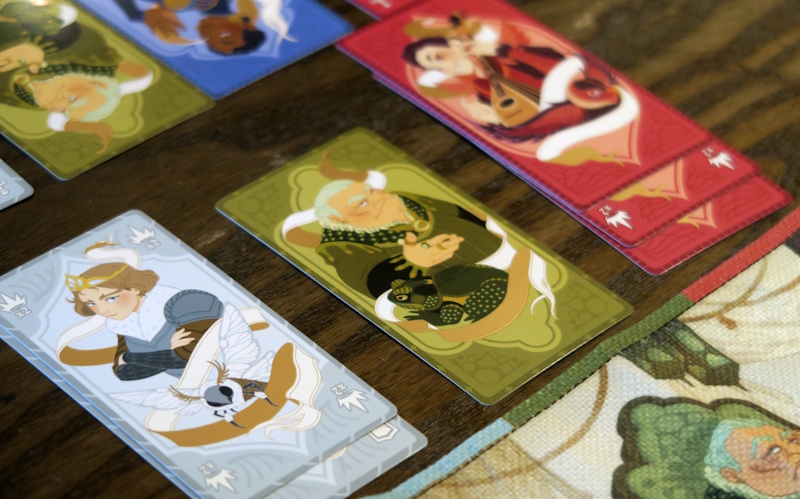
After the usual chatter and some food, the interested parties staked their claim to play the “Feature Game“, Stamp Swap.  This is a game where players take on the role of stamp collectors at a convention collecting, trading and then scoring their stamp album.  All the reviews claim it is a light game, but while it is not hugely complex, there is more to the game than appears at first glance.  At its core is the “I cut, You Choose” mechanism that is used in games like Isle of Skye and …aber bitte mit Sahne, but Stamp Swap is nothing like either of these.

Stamp Swap
– Image by boardGOATS

The game takes place over three rounds each with three phases:  Collect, Swap and Show.  In the collect phase, an Event card is revealed and then players take turns to take an item from the central pool.  Once everyone has six items, everyone puts one item aside to Reserve and then splits the rest into two piles for the Swap phase.  Some “I cut, You Choose” games struggle work across a range of player counts, for example, San Marco, really only plays well with three players where one splits the cards into three sets and the others choose.  While the game might work with two, the decisions would be too trivial (though there are variants with a dummy player).
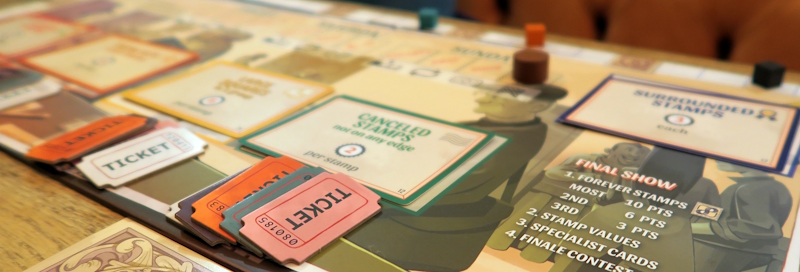
Stamp Swap
– Image by boardGOATS

In contrast, dividing a pile into four would require too many cards and make the decision complex as well as make the game potentially quite “swingy”.  Thus, although the game officially plays three to four players, the mechanism really only works with three.  Stamp Swap avoids this problem with a snake-like mechanism that also negates the need for valuing the hands or the use of money as an intermediate (as in Isle of Skye).  The first player chooses one set and the owner of that set keeps their other set and chooses one from another player.  That player keeps their second set and chooses a set from another player and so on.

Stamp Swap
– Image by boardGOATS

Players then place the stamps in their album and score in the Show Phase.  There are four Goals in each game and each player can score one of these per round, but can only score each only once.  These Goals are different in each game giving a lot of variability, especially as thy combine together in different ways.  At the end of the game, players additionally earn points for the face value of each Stamp, for any Specialist cards they may have, for Stamps that match their personal Theme, and for their achievement in the Finale Contest, while receiving bonus points their place in the Forever Stamp competition.

Stamp Swap
– Image by boardGOATS

The unexpected complexity arises from the stamps themselves.  They come in five different colours, themes and size/shapes.  Some of these stamps are “Cancelled” (and have no face value) and some are “Faded” (and have a negative face value, but may be useful for claiming the Goals).  There is are special gilded Stamps with their own Chocolate theme and a high face value, but cannot be reserved at the end of the Collect phase.  Finally, there are the “Forever” Stamps.  These are Square and are the only Stamps available in the smallest size and have no face value, but are useful for filling tiny holes (should that be required for the Goals) and give bonus points at the end of the game (in much the same way as Pudding do in Sushi Go!).
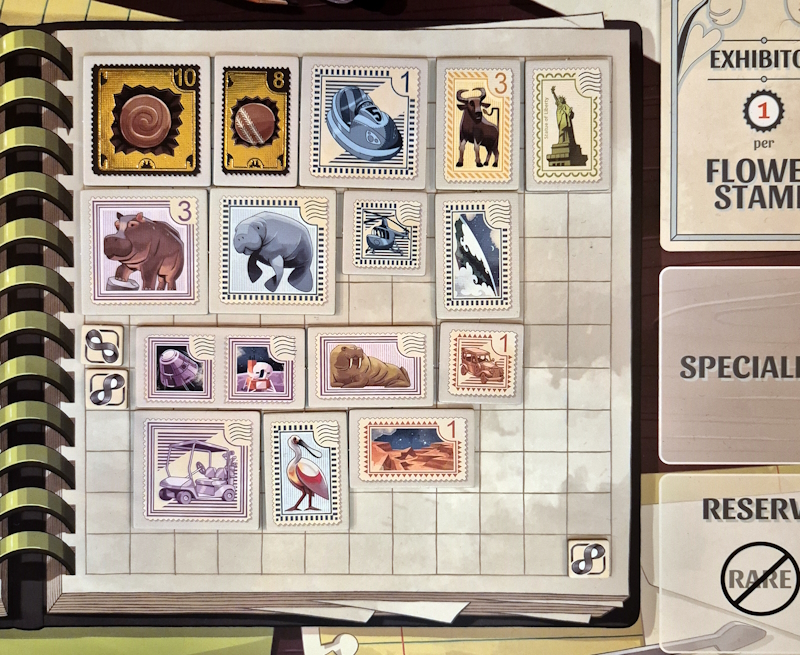
Stamp Swap
– Image by boardGOATS

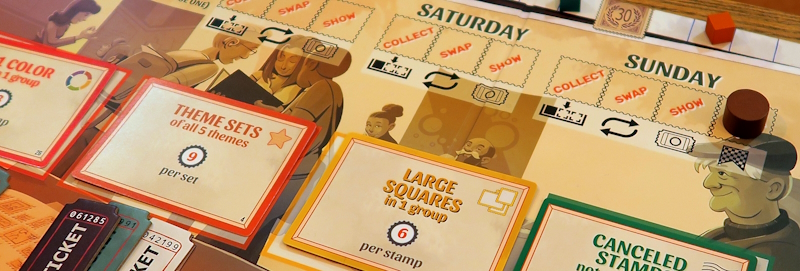
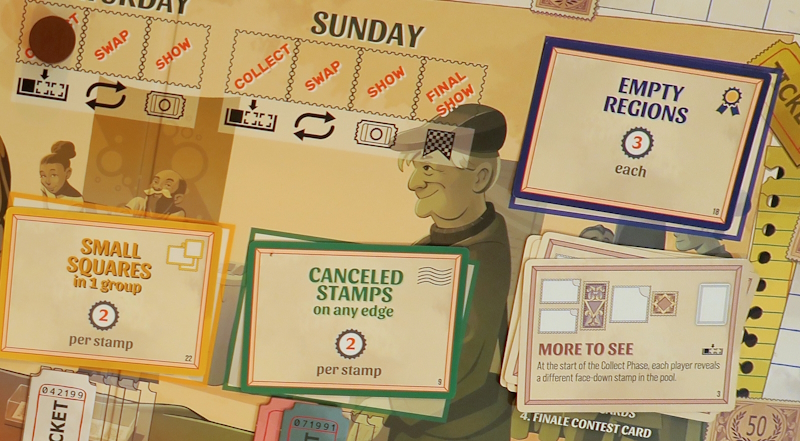
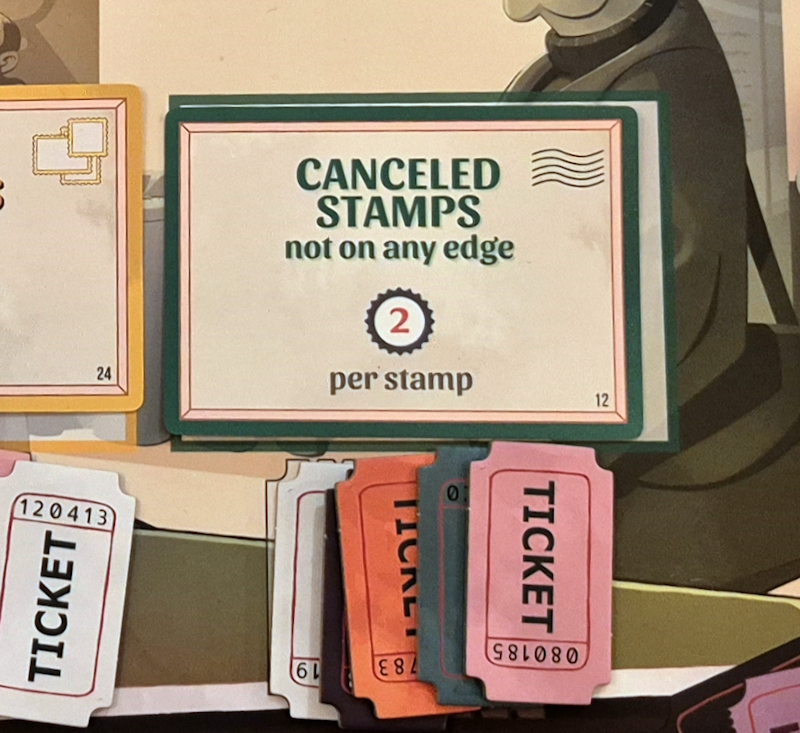
It turns out that the game takes quite a lot longer with more players, which was a bit of a surprise given that much of the game is played simultaneously.  This time Ivory led a group of five with Plum, Sapphire, Jade and Teal, while Blue led a group of four comprising Byzantium, Purple and Black.  Ivory’s group were quick off the mark and first to get going after the rules explanation.  Their Goals gave points for:  Stamps of one Colour in one Group; sets of all five Theme Stamps; Large square Stamps, and Cancelled Stamps not on the edge, while their Finale Contest gave points for the number of Stamps completely surrounded by other Stamps.  Ivory’s personal scoring objective was Space Themed Stamps, Plum’s were Animals, Sapphire’s were Vehicles, Jade’s were Monuments and Teal’s were Flowers.
Stamp Swap
– Image by boardGOATS

Everyone began by feeling their way a bit, especially as the first round added additional Specialists—cards that give extra powers for the rest of the game.  Plum made a “bee line” for these, while Jade and Teal focused on the Large Square Stamps, scoring the related bonus, and giving them an early lead.  Jade also managed to “hide a gold stamp (face down)” and ended up with it in his collect as no one took it.  Plum scored for the Cancelled Stamps first, as she had picked up a lot of them.  As nobody chose his set, Ivory ended up with all his own Stamps, which he thought was great at first, but then had second thoughts as he ended the first round at the back of the pack.
Stamp Swap
– Image by boardGOATS

In the second round, the event was “Rewarding finds” giving two points immediately for taking a face down Stamp, which everyone was keen to do, especially Plum, who quickly caught up with Jade and Teal as a result.  Plum made good use of her “Swap one for three face down Stamps before splitting your collection” to grab extra Stamps.  Teal managed to hang on to the First Player token for most of the game and also took a lead on the Forever Stamps. Sapphire grabbed an exhibitor for Yellow Stamps and proceeded to take Stamps to match wherever possible (both from the pool and from other peoples piles). Ivory made a point of collecting a full set of five different Theme Stamps, scoring nine points, as well as managing to keep a valuable face-down Gold stamp.

Stamp Swap
– Image by boardGOATS

Going into the final round, Ivory was still trailing significantly behind everyone else who were bunched tightly together.  This time the Event gave bonus points for taking Stamps that matched the Theme of their neighbours, which made the game slightly meaner as everyone was taking Stamps others wanted.  Plum was again using the additional Stamps she was getting from her Specialist to shape what she was going to end up with, managing to get three complete sets for twenty-seven points. Jade also managed to score well for this in the final round, as well as for the coloured Stamp cards he collected. Sapphire was similar with his vehicles and Yellow stamps, as well as scoring scoring for Large Square Stamps.
Stamp Swap
– Image by boardGOATS

Teal fell a little behind, taking fewer points for the Cancelled Stamps on the edge and he also failed to collect any of the Flower Stamps he needed as everyone kept taking them during the swap phase (in order to get complete sets). Ivory meanwhile focused on getting as many Large Square Stamps adding to the three he already had, giving him a massive fourty-two points taking him from behind and giving him a significantly lead.  In the final scoring, Teal took the bonus for the most Forever Stamps giving him ten points while and everyone but Plum tied for second with a single Forever Stamp, giving six points.

Stamp Swap
– Image by boardGOATS

Everyone managed to get at least one gold stamp, but Ivory had the most valuable total face value.  Plum scored most for specialists, although most people had at least one, so this made little difference to the scores. Everyone scored well for the Finale Contest, especially Jade, and Plum, but it was not enough to overhaul Ivory’s lead.  He finished with a total of a hundred and forty-eight, ten more than Plum who took second place, who was a handful of points ahead of Sapphire in third.  On the next table, Blue took longer to explain the rules, but once they got going, they soon caught up with the first group and ended up finishing just before.

Stamp Swap
– Image by boardGOATS

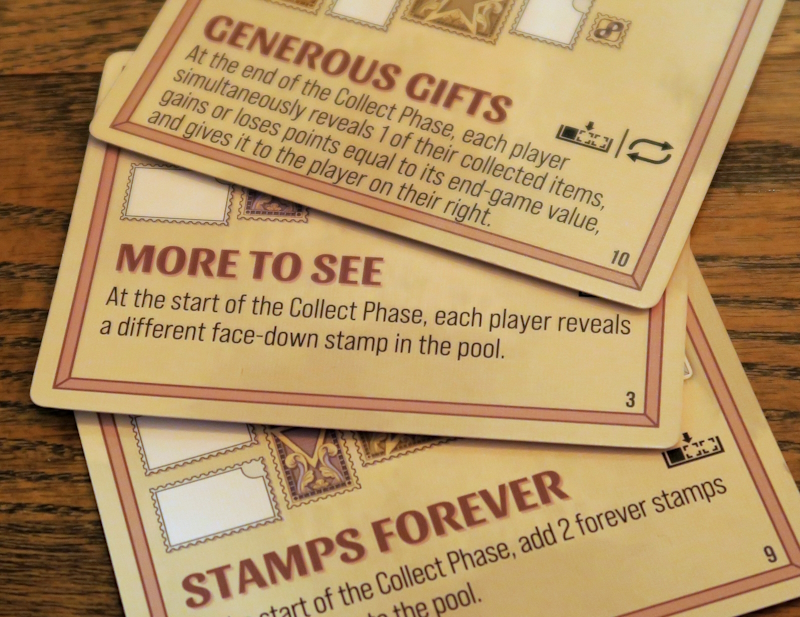
Their first Event card was “Generous Gifts” so after the Collect phase, players choose one collected items to score and then pass on to their neighbour.  Everyone quickly chose their highest scoring Stamp, then realised that meant they would lose it, so had a bit of a re-think.  It was then that the group began to really appreciate the quandary at the centre of the game:  it was all very well taking nice tiles, but they were no use if someone else took them.  This tension was particularly obvious in the final round of the first game where the “Mine not Yours” Event gave points for taking Stamps that matched a neighbour’s theme—while players lost the opportunity to pick up Stamps they wanted in the Collect Phase, they had the chance to take them in the Swap phase.
Stamp Swap
– Image by boardGOATS

The Events in the second and third rounds were “More to See” and “Stamps Forever”.  These had a much smaller impact on the game play, or at least it felt like that, though the Forever Stamps were all collected in the final round.  The Finale Contest was “Empty Regions” which gave three points for each empty region.  Black showed everyone how to to maximise this and from the end of the first round, everyone’s collections began to look like every-expanding checker boards.  Comparing the final album boards between the two games, the layouts were completely different with compact groups for the first game and gappy sprawling displays for the second game.

Stamp Swap
– Image by boardGOATS

Black picked up the bonus for having the most the Forever Stamps, and Byzantium, who by his own admission had been “pants during the game” picked up loads of points in the dying stages.  Purple had done the best with her personal Goal—Flowers, while Blue had a plethora of rare, valuable Stamps.  During the game it had been unclear who was really in the lead as the scores seesawed a bit, but Byzantium’s lunge for the line gave him the lead when it mattered and he finished with a hundred and forty-six points, seven more than the runner up, Blue.  All in all, everyone had enjoyed the game, though the overwhelming feel was that there was much more to the game than the reviews claimed, but that’s a good thing.

Stamp Swap
– Image by boardGOATS

Cobalt was the only person with a strong aversion to playing Stamp Swap, but Pine, Lime and Pink were all keep to play one of their favourite games, Zoo Break, another game that wasn’t really his type.  In he end, Cobalt graciously joined in the keepers of Bedlam Zoo, trying to keep the animals under control.  The game is a cooperative game, where players take it in turns to roll a die to determine how many actions they get, take the actions like acquiring
supplies, capturing animals, locking enclosures etc., before cards are drawn to see what animals escape and then move towards the exit.  The aim is to get all the animals back into their cages and lock them before five animals  or anything dangerous gets out.
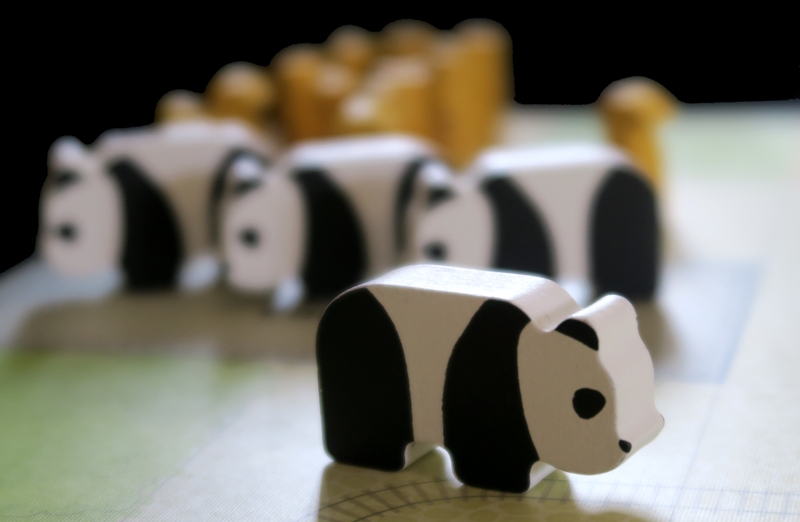
Zoo Break
– Image by boardGOATS

The group chose to use the standard difficulty (two “Phew” cards), but with the “Faulty Lock” variant.  This is where players roll to see if the lock holds when one of the locked up animals tries to escape; it adds a but of interest to the end of the game, however, unfortunately this time, the group didn’t get that far.  They managed to lock up the Elephants, Tigers and the Rhino, but the mischievous Pandas remained rogue until the end of the game.  They weren’t the problem, however, that was the Snakes.  Three harmless Garter Snakes got out, but they were followed by a Viper, and as it left, so did the group’s zoo license…

Zoo Break
– Image by boardGOATS

With Bedlam Zoo sadly closed prematurely, the group moved on to a couple of quick fillers.  The first of these was No Thanks!, a really clever little “cards with numbers” game.  The idea is that players either take the face up card or pay a chip to pass the problem on to the next player with the aim being to be the player with the lowest total at the end.  The clever part is that if a player has a run, only the lowest value card counts, but the deck also has some cards removed at random.  This makes it a proper gambling and “push your luck” game.  This time, Cobalt was the top scorer, but the winner with eighteen was Pink.
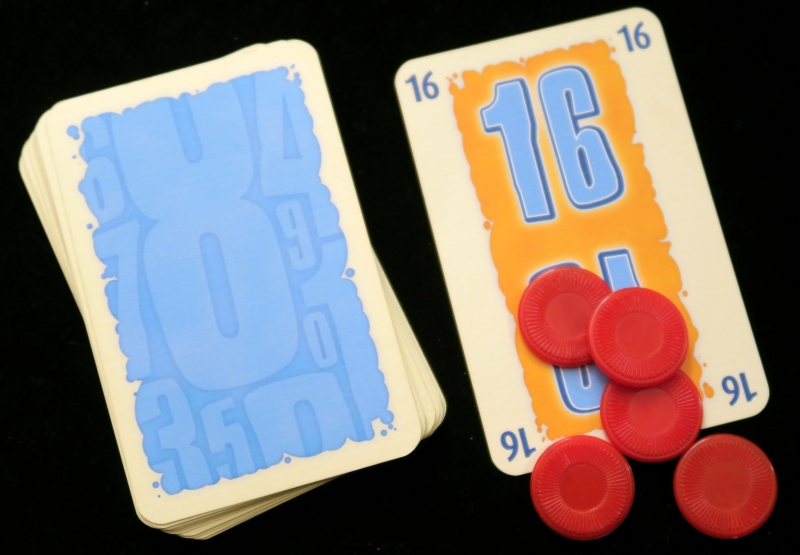
No Thanks!
– Image by boardGOATS

There was just time for one more game, Coloretto.  This is another simple and clever card game, this time the essence of the core mechanism in the bigger game, Zooloretto.  The idea is that players either draw a card and add it to a truck, or take a truck and add its contents to their collection.  At the end of the game players score their three largest sets positively, with negative points for any other sets.  The clever part is the use of the Triangular number sequence which means the first card in a set is worth one point, while the sixth is worth six.  There were the usual questions about Joker cards which resulted in questions being called across the room, but in spite of taking all three Jokers in the deck, Pink was just second by three points behind Lime’s total of forty.
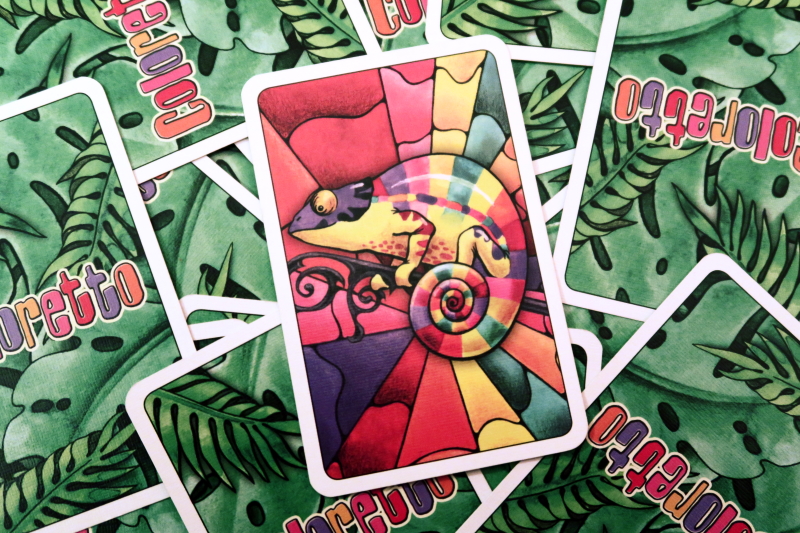
Coloretto
– Image by boardGOATS

Learning Outcome:  A game about Philately can be more than just Stamp Collecting.

11th June 2024

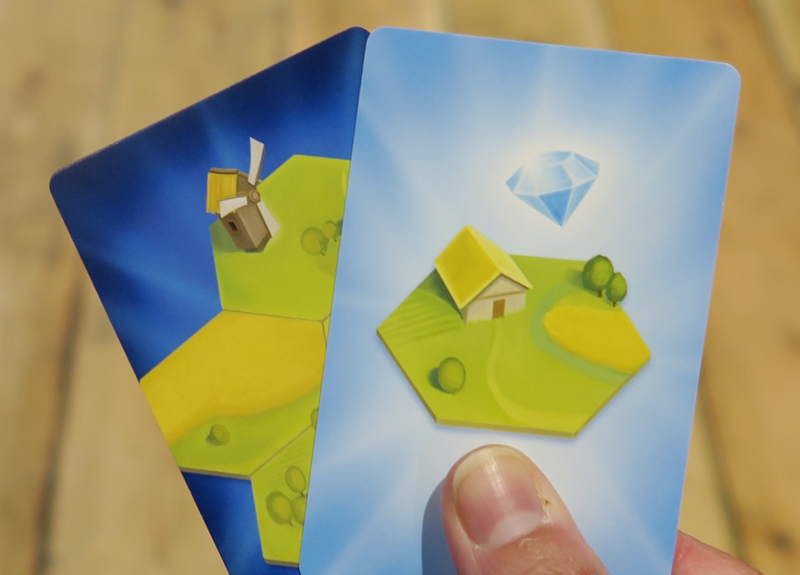
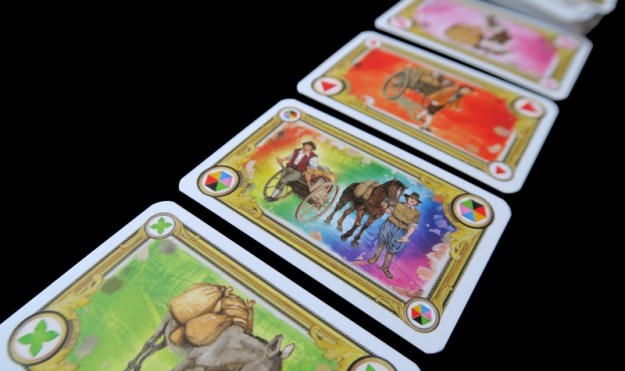
The pub was not as busy as last time, and in any case, Pink, Blue, Black and Purple were there in good time for food.  Once they had finished, they managed to squeeze in a quick game of Rome in a Day while they were waiting for food and eating.  This is a cute little tile-laying game Black and Purple picked up from UK Games Expo as few days back.  It is a bit like Kingdomino with the “I cut, you choose” mechanism to allocate the tiles.  The “I cut, you choose” mechanism is used in a number of other games like, Castles of Mad King Ludwig, Isle of Skye, and Dice Hospital, but it is a more fundamental part of games like San Marco, and particularly …aber bitte mit Sahne and New York Slice.
Dice Hospital
– Image by boardGOATS

In the case of Rome in a Day, Players start by taking five land tiles drawn at random and place two buildings on tiles one and two.  They then divide the five tiles into two groups—a bigger and a smaller one (in any ratio) and add a crystal to the smaller land set before offering them to their neighbour.  During the four rounds the game is played over this neighbour alternates, right, left, right, left.  So, each round, players choose a set from their neighbour and these and the tiles they were left with are added to their domain.  At the end of the game, any building that stands on or adjacent to land of its own colour will score for each tile in the group and then players score for the diamonds they have collected—the player with the most points is the winner.

Rome in a Day
– Image by boardGOATS

Like in Kingdomino where players score better for a medium number of crowns in a medium sized area than for a combination where one is large and the other small, players benefit more if they can surround one large area of coloured tiles with multiple buildings of the same colour.  The most successful at this was Pink who scored well for three coloured areas, the green Olive Groves, the blue-purple Vineyards and the yellow Wheat Fields, while the others didn’t score at all.  As a result of his ruthless scoring strategy, he finished with fifty four points, eight points clear of second place, which went to black by a single point.

Rome in a Day
– Image by boardGOATS

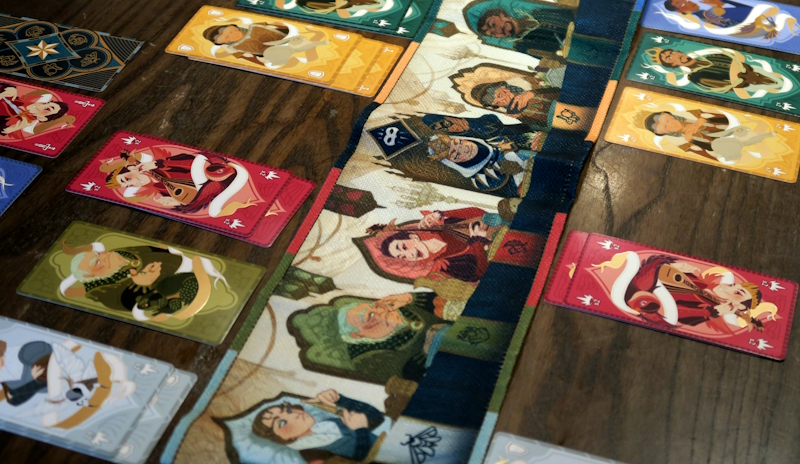
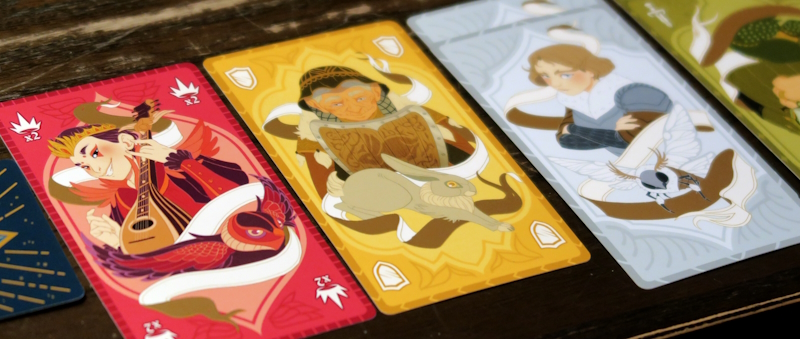
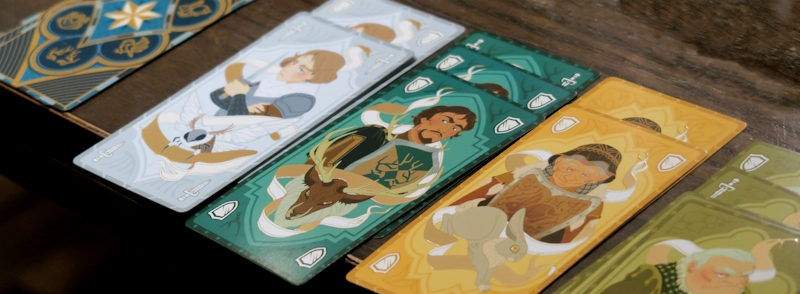
The game was just coming to an end when Jade, Sapphire, Plum and Byzantium arrived, followed by Pine, Ivory and Teal, and then the inevitable debate as to who would play what began.  In the end, Jade led a group of four including Black, Purple and Sapphire in the “Feature Game“, Courtisans (the French for Courtier as it is spelled with an “i” rather than an “e”), which also came from UK Games Expo.  The first game was essentially a learning opportunity where players tried to understand the learning the mechanics of the game.  On their turn, each player receives and plays three coloured Family cards.

Courtisans
– Image by boardGOATS

One card is played at the Queen’s table to sway a family’s influence in a positive or negative way depending on whether it is placed above the table or below—at the end of the game, those with more cards below than above will have “Fallen from Grace”.  The other two cards are then played, one in the player’s own Domain and the other in an opponent’s Domain. At the end of the game, each card a player has from an “Esteemed” Family is worth a point, while each card from an Family that has “Fallen from Grace” loses them a point.  Thus the cards can be worth positive or negative points, depending on the Family’s status at the end of the game.

Courtisans
– Image by boardGOATS

Some of the Courtier cards have a special power, for example, Nobles count as two cards, Spies are played face down and their allegiance is only revealed at the end of the game, Assassins can be used to eliminate other Courtier cards, while Guards are not affected by Assassins.  The game ends when the card deck has been exhausted and nobody has any cards left in hand.  Players then total up their score and add any points earned from successful Secret Missions (each worth three) and the player with the most points is the winner.

Courtisans
– Image by boardGOATS

Black went first chosen by an app and began feeling his way forward.  The group only realised there was a slight issue towards the end as they ran out of cards a bit early.  It was then that it was discovered that at some point Black had acquired a second hand which he had placed on the table beside him.  Despite only a few personal objectives being met mostly players scored scored well; the exception was Purple who was the only one to complete both objectives which added six points to her score at the end.  It wasn’t enough for victory though, that went to Sapphire who had fifteen points, with Jade a point behind in second.

Courtisans
– Image by boardGOATS

Having felt their way through the first game, the group decided to play again.  As the winner, Sapphire went first, and from the off, it was like everyone woke up together and all decided to attack.  This time, everyone completed at least one objective, but this second game was a lot more treacherous and this was evidenced in the scoring.  One of Jade’s objectives was to ensure at least one of the Houses had at least five cards bringing them into disrepute—Jade chose yellow which caused others problems.  It didn’t have as much of an effect as his second objective though,which was to have fewer red cards than the player to his left.  As a result of this, Black was the kind recipient of any red cards he acquired.
Courtisans
– Image by boardGOATS

While he tried to bring the reds into disrepute too, it wasn’t possible to do both.  So, despite his best efforts they still scored positively and probably helped ensure Black’s victory with seven points, four more than Jade himself.  The scores were much more diverse in the second game though with a range of sixteen points with the person at the back finishing with minus nine!  Although savage, it had been a lot of fun; Jade commented that the game felt a bit like a dance with lots of nuance.  Definitely one to play again, especially given the truly beautiful foiled cards which are a delight to play with.

Courtisans
– Image by boardGOATS

Meanwhile, Teal had picked up the Alpine expansion for one of his favourite games of the moment, Forest Shuffle, and was keen to give it its first outing.  He was therefore joined by Plum, Byzantium and Pink who were also keen to see how it changed things.  Forest Shuffle is mechanically a fairly straight-forward game, but playing it well is comparatively difficult as it requires good, robust strategies and an understanding of how to get the best from the cards.  The idea is that players start with a hand of cards and, on their turn draw two more from the market (or “Clearing”) or play one into their tableau.
Forest Shuffle: Alpine Expansion
– Image by boardGOATS

There are two sorts of card, Trees and “Critters”.  Before playing a Critter, players must have played a Tree, which then has spaces on all four sides.  Birds and Butterflies are played to the canopy (i.e. above tree cards), Fungi and Amphibians are played at the bottom of the tree (i.e. below them) and Mammals are played either side.  The clever part is that Critter cards are split so they show two critters (either left and right or top and bottom), so players choose which they would like to play, and where, tucking the other side under the tree, making the unplayed half invisible.

Forest Shuffle
– Image by boardGOATS

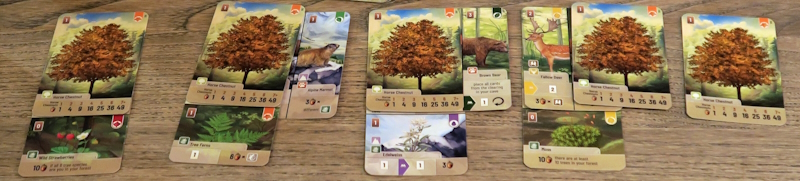
The new Alpine expansion for Forest Shuffle only adds some thirty six cards to the game and, since roughly twenty additional cards are removed during setup, in practice it adds just sixteen to the deck.  Of course, the cards are removed at random so many should be from the base game and the expansion adds new cards like the Mountain Hare, who scores as for the European Hare, but wants to stay alone so can’t share a space with another Hare.  There is an extra Butterfly and more Trees too, which make these easier to score and help to balance the game somewhat.  Additionally, there is the new Alpine Newt provides a new way of scoring, for players who have managed to pick up a lot of cards from the Alpine expansion cards.

Forest Shuffle: Alpine Expansion
– Image by boardGOATS

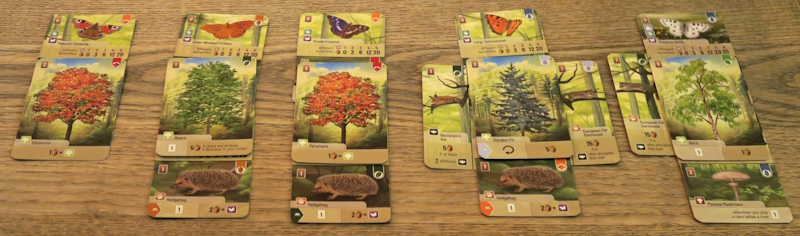
This time, Plum went for Trees in a big way with loads Horse Chestnuts which give more points the more you have on them up to forty-nine for seven or more.  While she didn’t quite make the full seven, she scored a total of forty-eight for her Trees, fifteen more than the nearest player (Byzantium) and more than double what anyone else took.  They, of course, got points elsewhere though.  Pink, for example, went for Butterflies and, with the additional Phoebus Apollo Butterfly, took thirty-five points for them alone.  Byzantium opted for a deer strategy and received a total of sixty-one points for all his Critters.

Forest Shuffle: Alpine Expansion
– Image by boardGOATS

The winner was Teal however, with everyone else totally overcome by “The Lynx-Effect”, where each Lynx he had gave ten points as long as he had a Roe Deer to keep them fed.  Perhaps his victory was to be expected as he has played the game quite a bit with family, but his finishing score of a hundred and fifty was some way ahead of Pink and Plum who tied for second place with a hundred and nineteen.  Overall, the Alpine expansion adds some pretty artwork and made a few of the alternative strategies a lot more viable, reducing the apparent dominance of Wolves and Deer which it has often been claimed are overly powerful.

Forest Shuffle: Alpine Expansion
– Image by boardGOATS

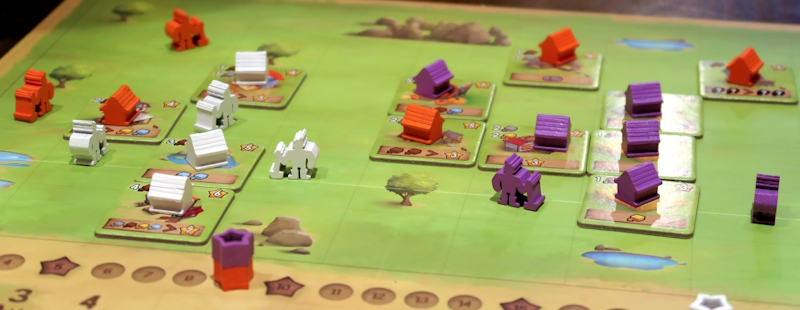
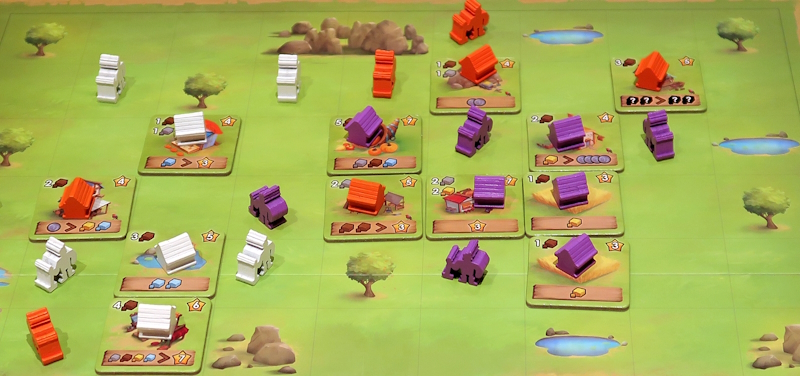
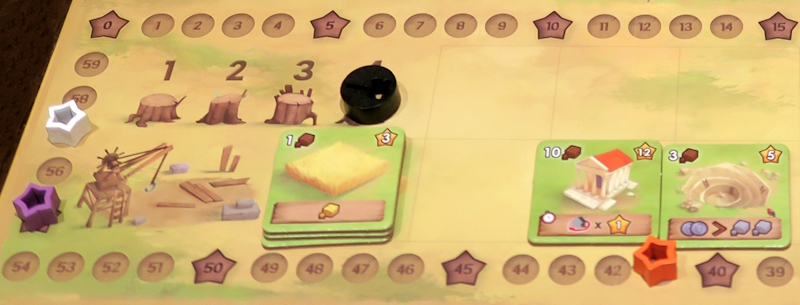
With the Courtisans and Forest Shuffle groups sorted, that left just three players without a game.  Since Ivory and Pine both missed out on playing Little Town last time and neither wanted a particularly late night the decision was made to eschew Key Flow in favour of the lighter, quicker, tile-laying game.  Play is very simple:  players take it in turns to place their Workers in a space on the central board and then activate the eight spaces around them.  These eight spaces could be Buildings, but may also be Trees, Rocks or Lakes pre-printed on the board giving resources (Wood, Rock or fish respectively).  With three players, there are four Workers in each of four rounds and the player with the most points at the end is the winner.

Little Town
– Image by boardGOATS

Little Town has had a few outings, but was the “Feature Gamelast time, with two games played simultaneously, both with the starting tile set up.  This time, a random tile setup was used drawn from the full set that included the Pier, the Marketplace, the Bar, from the variant set as well as the Shop, the Workshop, the Goldmine, the Bakery, the Pawnshop, the Quarry and Wheat Fields from the basic set.  The twelve Buildings were completed by the Temple, the Cornucopia, and the Sushi Bar from the Goodie Buildings mini expansion.  Blue and Pine both complained that their Objectives were considerably more difficult than Ivory’s as he claimed all his quite quickly.

Little Town
– Image by boardGOATS

Eventually though, all three managed to complete all their Objectives.  Pine misunderstood the fact that each Worker needs to be fed at the end of every round, rather than just at the end of the game.  As it was a genuine error, rather than cripple his game at the end of the first round, Blue and Ivory let him pay with other resources leaving his unfortunate workers to gnaw on bits of stone, wood and coins.  Other than that, the game proceeded according to the rules.  Ivory majored on trying to convert Fish into points, while Blue tried to do the same with Wheat and Pine played the merchant, building the Gold mine and the Shop.

Little Town
– Image by boardGOATS

As the game came to a close, Ivory had a substantial lead with forty-two, ahead of Blue in second with thirty and Pine with eighteen.  This was without any of the points from the buildings (which Blue had a lot of) or from leftover money (of which Pine had an enormous pile).  As it turned out, money is not worth much at the end of the game, and although Blue’s buildings were worth considerably more than Ivory’s, she still fell two points short of his final total of fifty-seven.  So although we’ve still not been able to use the “sixty point tokens” we were only a handful of points shy.

Little Town
– Image by boardGOATS

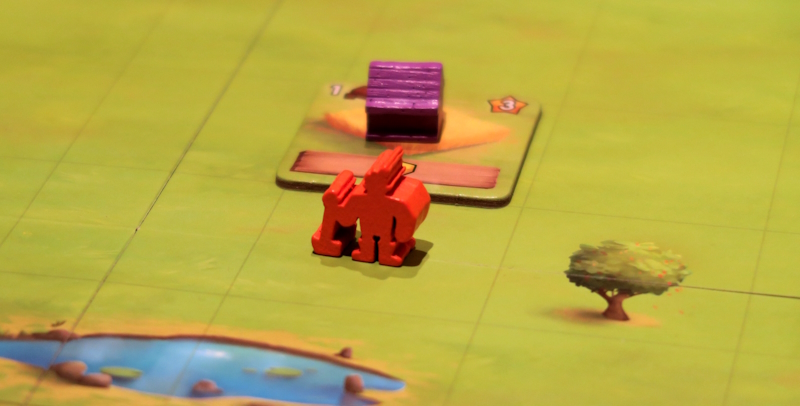
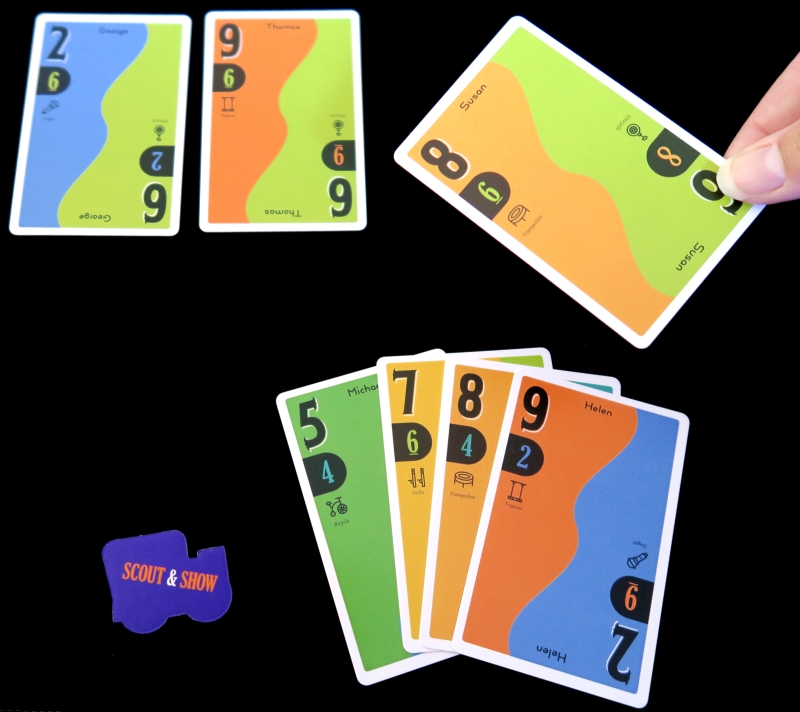
The others were still playing, so after some discussion, Blue, Pine and Ivory decided to give the 2022 Spiel des Jahres nominee, SCOUT, an outing.  This is a clever little card game with two key features: firstly, as in Bohnanza, players can’t rearrange their hands, and secondly, the cards have different values depending which way up they are.  Like Tichu or Haggis, SCOUT is a climbing game, that is to say, on each turn players are aiming to beat the previous score.  In SCOUT, that means players have to play a higher value or larger meld, or a longer run or one of a higher value (and a meld of the same size always beats a run).
SCOUT
– Image by boardGOATS

These cards are played from hand, but have to be consecutive.  In the event that a player can’t or doesn’t want to play cards from their hand (aka “Showing”), they may instead take a card from either end of the current winning set and add it to their hand anywhere, and either way up (aka “Scouting”).  Additionally, once per round, players can “Scout and Show” which is take a card and then also play cards.  The round ends when either nobody in the round has been able to Show or a player plays their last card and has nothing left in hand. At the end of the round, players lose a point for every card they have left, and this is taken from the total from their scoring cards and points earned when others Scout from their display.

SCOUT
– Image by boardGOATS

With three players, there were three rounds, the first of which was finished by Pine, though Ivory nearly managed to check out, leaving Blue with a large handful.  The second round was much closer with Blue playing a nine-card run (though as cards in front of players at the end don’t score, and very quickly nobody could beat it, she didn’t get the advantage she felt she deserved).  The final round was taken by Pine again, but it was also close again.  The total favoured Pine, who finished with a total of twenty-six, a clear victory with Blue just pipping Ivory to second place by a single point.

SCOUT
– Image by boardGOATS

Forest Shuffle and SCOUT were both still going when the Courtisans finished, so they quickly set about playing a light filler that Jade had picked up from the Hachette UK stand that he had worked on at UKGELine-it, is another card game, played with a deck that consists of cards in four colors, numbered one to a hundred and six “Bet” cards (numbered three to five), which are shuffled together and laid out to create a market consisting of slightly more cards than there are players.  Players then take it in turns to take a card and either add it to their hand or add it to the row of cards in front of them (their Line).  There is a hand limit of two and the row must continue either increasing or decreasing.

Line-it
– Image by boardGOATS

If a player can’t add the card to their hand or their Line (because it would break the ascending/descending pattern), they have to score their Line, then play that card to start a new Line.  After drafting a card, players may choose to add one card from their hand to their Line and then score it. When scoring, if there is a Bet card in the Line, if there are more cards added since the Bet card than the value depicted on the Bet card, players get chips equal to the value of the Bet.  If the Bet is lost, the player takes negative points instead. Finally, three cards are discarded from the Line and the others turned over and placed in the player’s scoring pile.

Line-it
– Image by boardGOATS

Once each player has had a turn, all remaining Bet cards are discarded, and the other cards are placed under the Jackpot token that corresponds to their colour—these can be claimed whenever a player adds the third card of the respective color to their Line.  The game ends when the draw deck depleted, and each player plays one last card from their hand, then scores their line and tallies their points, the player with the most points is the winner.  As he had won the second game of Courtisans, Black went first.

Line-it
– Image by boardGOATS

Black and Purple both took (and completed) Bet cards early in the game, whereas Jade didn’t even take because his Lines weren’t right when the Bet cards were available because just didn’t make sense.  Purple won the first jackpot of the game which was a tidy little stack of blue Diamond cards and Sapphire also picked up Jackpot cards later in the game.  The game plays quite quickly and smoothly and this time out, it was close, well, close between Black, Jade and Purple—Sapphire was streets ahead, finishing with twenty-six points, a long way clear of Black in second with fifteen.

Line-it
– Image by boardGOATS

Learning Outcome: UK Games Expo is a good source of new games.

6th September 2022

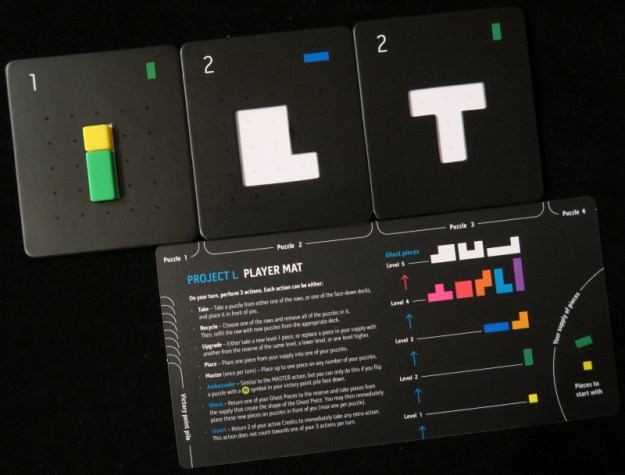
Plum and Pine were the first to arrive, shortly followed by Blue with Orange and Lemon.  With nobody eating, the group were in a position to start thinking about games straight away.  Plum had offered to lead Wingspan, with Lime in mind as he had recently acquired a copy of Wingspan and was keen to give it another go.  Pine commented that although he loves birds, he’d never really got on with the game-play of Wingspan so, sadly he’d prefer to play something else.  The “Feature Game” was to be Project L, a sort of Tetris-like, engine-building game and it sounded much more his thing.

Project L
– Image by boardGOATS

So, Plum took herself off to the other side of the pub to set up Wingspan with the European expansion.  The European expansion adds more cards including end of round cards, but doesn’t add any extra mechanisms (like the Oceania expansion), so it was felt that including it wouldn’t cause too much confusion.  As the others rolled up, there was much surprise as Teal and Ivory said they would rather give Project L a go.  Then Pine changed his mind and joined Wingspan (along with Purple and Lime), allowing Black to play the “Feature Game” as he had played Wingspan recently at Burgundy’s Birthday Event.  That left six to play Project L: Orange, Lemon, Blue, Ivory, Teal and Black.

Project L
– Image by boardGOATS

Project L is a very simple game:  players start with two small plastic pieces and use them to complete Puzzles winning more pieces enabling them to complete more complex Puzzles and thus build an engine.  On their turn the active player can do three actions from a list of five things:  upgrade a piece to a larger one, take a Puzzle from the display, recycle the Puzzle display, place a piece in a Puzzle they own, or place one piece in each of their Puzzles (or in as many different Puzzles as they can).  This last, “Master Action” can only be carried out once per turn, and is clearly very powerful once players can get it going, however, to make it work they need lots of Puzzles and lots of pieces.

Project L
– Image by boardGOATS

With six, to reduce the amount of down time there is the “Line Clear Variant” available.  In the normal game, there are two rows of four Puzzles, one of White backed Puzzles and one of slightly more advanced and therefore more rewarding, Black backed Puzzles.  In addition to winning pieces for completing Puzzles, players can also get  points—the player with the most points at the end of the game is the winner.  The game end is triggered when the draw deck of Black backed Puzzles is exhausted at which point the round is then finished and one more, final, round is played.  In the Ticket to Ride: Switzerland, there are two rows of each colour, each containing three Puzzles.  One pair of Black and White Puzzle rows are marked with a dark stone and the other pair with a colourless stone.

Project L
– Image by boardGOATS

The idea of the Line Clear Variant is that two players play simultaneously with the active players marked by a dark and a colourless stone that are passed round.  When it is their turn, players can only recycle or take Puzzles from the rows that match the colour of their their stone.  Ivory was picked as the start player (he drew the player aid marked with the start player symbol) and he began with the dark stone, so Orange, sitting opposite, started with the light stone.  Everyone began a little tentatively, but before long players were filling their Puzzles with gay abandon.  The game end is slightly less clear with the Line Clear Variant.  Still triggered by exhausting the Black Puzzle Deck, the game continues until the first player has been passed both of the markers again, in any order).

Project L
– Image by boardGOATS

The Black Puzzles ran out quite quickly—Project L really is just a “Filler Game“, but players still had to finish things off.  The start player was Ivory, which meant that Orange was a little caught out.  Once the game has finished, everyone can place any pieces they have left, but at the cost of a point for each one.  Orange was unlucky, and unable to complete any of his remaining Puzzles, neither could could Lemon.  Teal had managed to finish off all his Puzzles in his last turn, but everyone else placed three of their pieces to finish things off.  It was quite close for a first game:  Blue finished with eighteen points, but Ivory and Black tied with fifteen apiece with Ivory sneaking second place on the tie breaker (the player with the most completed Puzzles).

Project L
– Image by boardGOATS

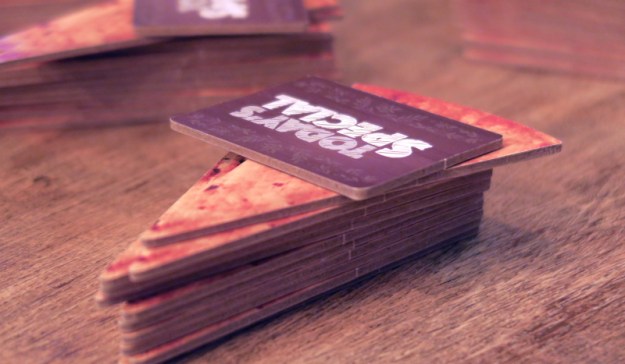
A lot of the comment was about how nicely produced the game is and it had been enjoyable to play too although not very memorable.  It was time to move on to something else though and with six, the obvious and usual choice would be Bohnanza, but Ivory had other ideas and suggested New York Slice.  This is a reimplementation of …aber bitte mit Sahne which we played recently, but with a pizza theme instead of a cake theme.  In both games, the idea is that one player makes the cake (or pizza) and divides it up into segments equal to the number of players, then players take it in turns to choose one of the segments.

New York Slice
– Image by boardGOATS

When a player takes a segment, they can either eat slices or store them for later.  Those they will eat are worth points at the end of the game with the number dependent on the number of blobs of cream (or pepperoni slices) on top.  The pieces players keep are scored depending on who has the most of each type at the end of the game.  Each piece of cake (or pizza) has a number on it which tells players the number of that type in the game and also what the player with the most will score at the end of the game.  There are a few things that are different about New York Slice, however, which make it a little more competitive and slightly more of a “Gamers’ Game”.

New York Slice
– Image by boardGOATS

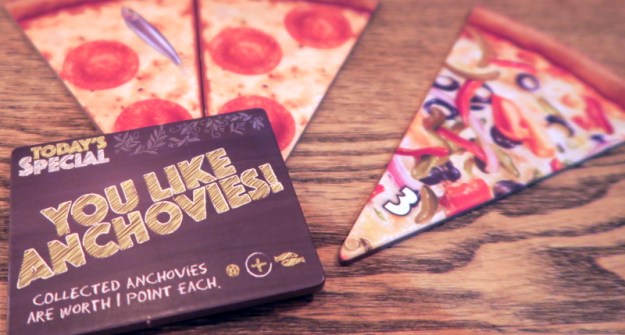
Firstly, in the case of a tie for who has the most pieces of a type of pizza, in …aber bitte mit Sahne all players score points whereas in New York Slice nobody gets anything.  Secondly, some of the pizza slices have anchovies on them and any of these that are visible at the end of the game are worth minus one (because everyone hates anchovies on pizzas right?  Well, everyone except Teal it seems…).  Probably the biggest change though, is that in New York Slice, each pizza is served with a Special—a bonus tile with rule-breaking powers.  In most cases, these are added to one of the segments for players to choose. They can be enticing and helpful, or they can be unhelpful and make players’ lives more difficult.

New York Slice
– Image by boardGOATS

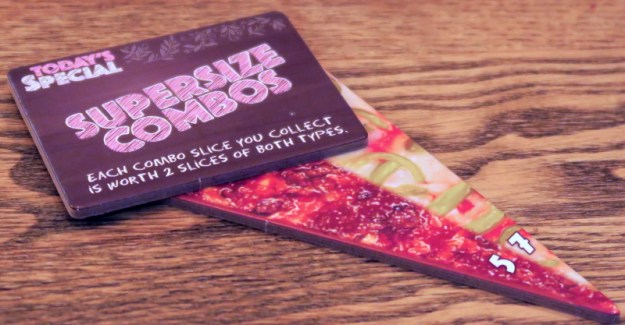
Ivory cut the first pizza, leaving Blue to be the first to choose.  The first Special was “Cut in Line”, which Blue took straight away and then promptly forgot about it until the final round.  Ivory went into battle for mushroom pizza, but lost out to Teal.  The front-runner looked to be Black who stored the most BBQ and veggie pizza slices, largely thanks to his “Supersize Combos” Special which meant his two half slices became two whole slices of each type.  That only gave him joint second however, with Lemon who turned out to be quite the carnivore and finished with the most beef and meat feast pizzas.

New York Slice
– Image by boardGOATS

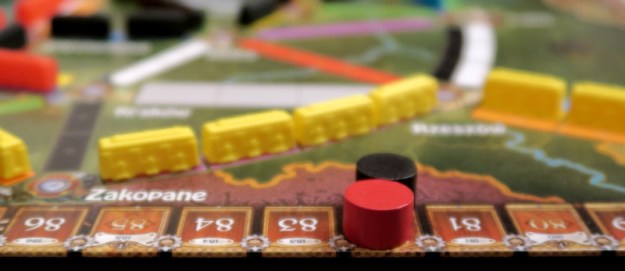
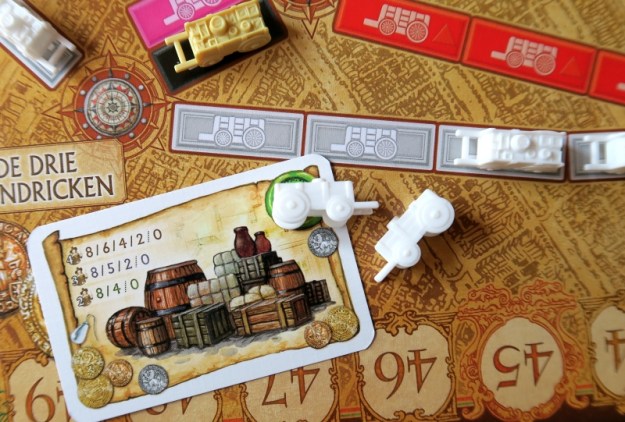
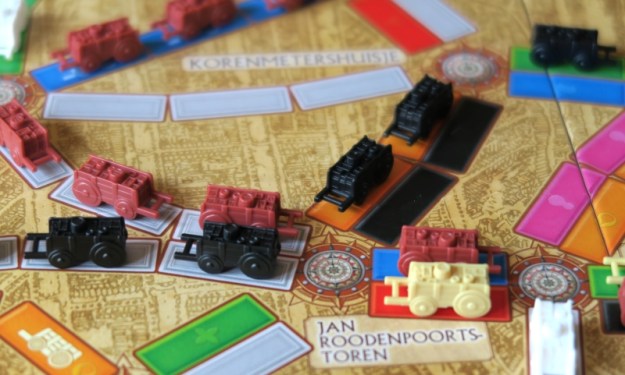
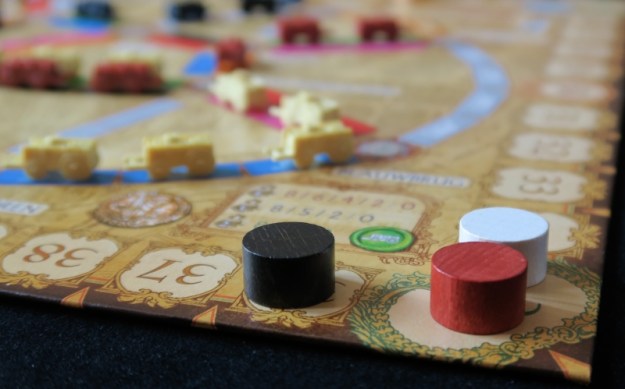
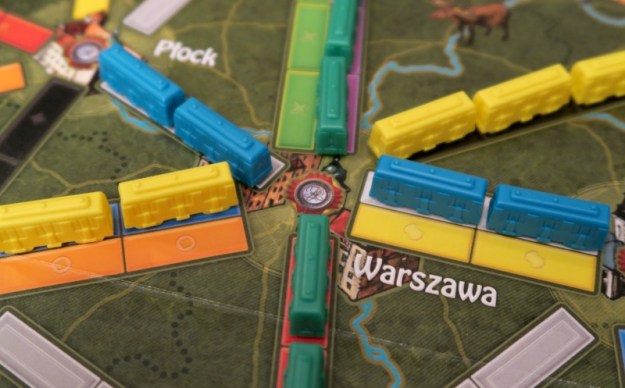
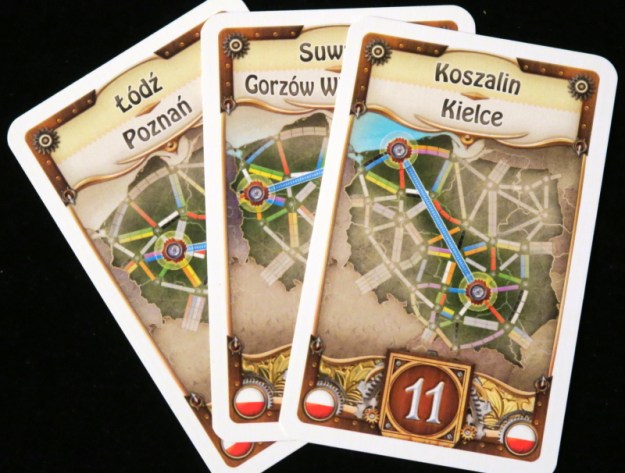
The winner, however, and by a single point, was Blue who picked up a lot of anchovies along with her “You Like Anchovies” Special and coupled that with winning the most lucrative pizza (pepperoni).  Full of pizza, Teal and Ivory decided it was time, leaving Black and Blue with Orange and Lime and a decision to make as to what to play next.  With Wingspan something over half-way through, they were looking for something substantial to play, but not too long.  Blue’s suggestion was Wsiąść do Pociągu: Polska, the Poland map for Ticket to Ride.  This was one that nobody around the table had played before though it had been played in the group two and a half years ago, shortly after it was released at Essen.

Wsiąść do Pociągu: Polska
– Image by boardGOATS

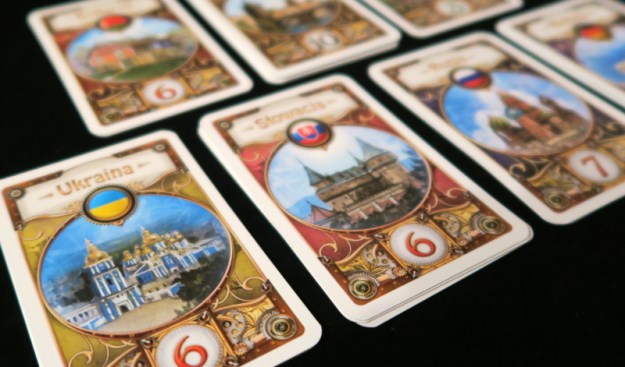
The Poland map works in much the same way as all the Ticket to Ride games; players collect coloured train cards and spend them to place plastic train pieces on the central map scoring points for placing trains, but also completing the route “Ticket” cards that they chose at the start of the game and maybe later too.  In addition to the usual rules, the base game maps all have a little something extra.  As well as the usual city locations, the Poland map also has countries, but unlike the Swiss map, these are not simply locations to connect to.  Instead when a player connects two countries, they collect one Country Card corresponding to each.  These are worth points at the end of the game.

Wsiąść do Pociągu: Polska
– Image by boardGOATS

When a third country is added to the “network”, the player again collects Country Cards, one for each country in the network. When Blue explained the rules, Black commented that that aspect was interesting and he was curious to see how it affected the game.  Blue started and was followed by Orange, Lemon and then Black.  Black started by collecting more Tickets—this was a tactic that was discussed briefly at Burgundy’s Birthday Memorial event.  Black had commented then that this was the way all the best players did it.  The idea is that by collecting Tickets early, players are best placed to make the most efficient use of their trains and know what coloured cards they might need.

Wsiąść do Pociągu: Polska
– Image by boardGOATS

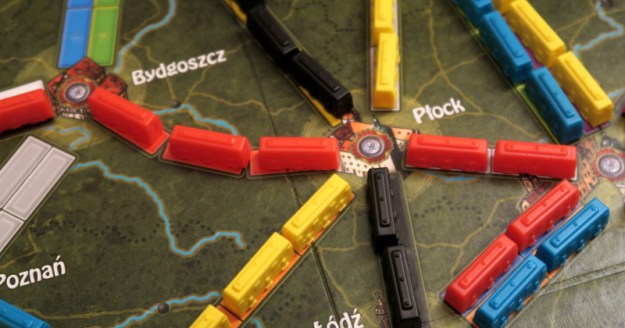
However, it is a bit of a “Go Big or Go Home” strategy because if something critical goes wrong early, the player could get left with an armful of unfulfilled Tickets leaving them with lots of negative points.  And with the Poland map, this was far from impossible as it turned out to be quite a scrap for the centre of the board.  Lemon asked what she should do when someone had just taken a track she wanted, clearly meaning Orange who had just nabbed a critical route from Bydgoszcz to Płock.  “Kill them,” was the instant reply to much hilarity.  Lemon commented that she would get her revenge, though it was unclear whether that was planned for the game or sometime later…

Wsiąść do Pociągu: Polska
– Image by boardGOATS

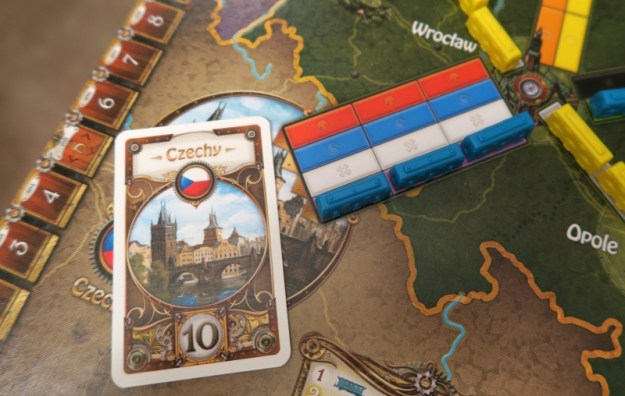
Eventually, Blue claimed the first Country Cards, connecting Belarus to Germany.  When she added Russia and Lithuania, it was clear how these could add significant points to a player’s tally.  Further, the repeated nature of collecting Country Cards each time the network grew provided a good source of points of a similar magnitude to those gained from Tickets, but without the associated jeopardy.  The Country Cards are stacked in descending order of value so that the ones earnt early in the game are worth more, but although the value decreases, as more countries are added to  player’s network more tickets are picked up.  As a result, value of each additional card pick up (and therefore each country when added) remains fairly constant depending on how many players are fighting for Country Cards.

Wsiąść do Pociągu: Polska
– Image by boardGOATS

This time, Blue stole a bit of an early march on the Country Cards in the north, while Black acquired loads of Tickets and Orange got in everyone’s way.  While Blue’s primary route was in the north running east-west, Black and Orange focused on north-south and Lemon had two separate smaller networks which she unfortunately failed to connect together.  As everyone else saw how lucrative Country Cards could be, they joined in, connecting countries to the south.  Lemon pointed out the route they had taken from Ukraine through south Poland to Warsaw where they got a flight to the UK.  It was about then that the pub became an attraction in itself when one of the locals pointed out that the lease was for sale once more.

Wsiąść do Pociągu: Polska
– Image by boardGOATS

The game came to a slightly sudden end when Lemon ran out of trains—the Poland map is played with just thirty-five trains per player instead of the more usual forty-five.  Actual game play time isn’t much shorter than usual because, like the India map, there are fewer longer routes so players have to take more turns placing trains.  At the end of the game though, it was close with Lemon in the lead thanks largely to the fact she had concentrated on the lucrative long routes where possible.  Orange and Black had completed a lot of Tickets though, and when they were added on together with the Country Cards, they tied for second place with eighty-two points.  The winner was Blue, however, thanks to the huge pile of Country Cards.

Wsiąść do Pociągu: Polska
– Image by boardGOATS

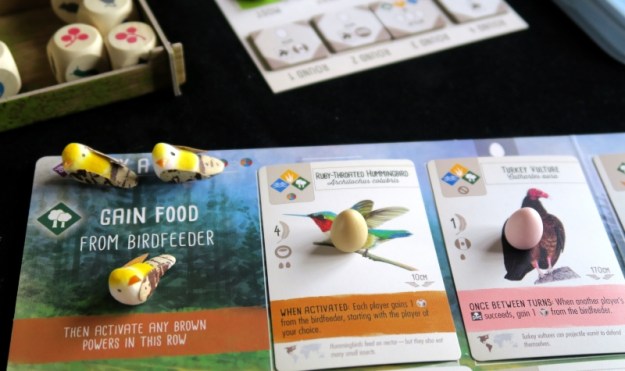
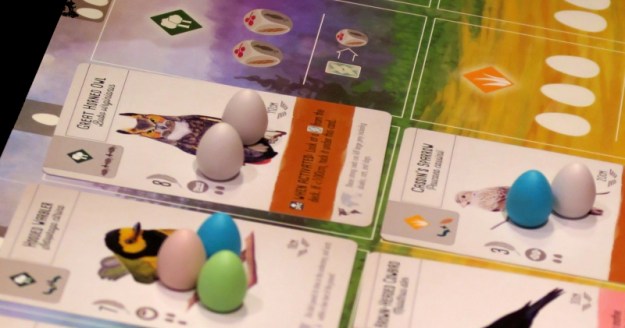
Meanwhile, over the other side of the room, Plum, Pine, Lime and Purple were playing Wingspan with Blue’s pimped out set.  Wingspan is a beautiful bird-themed game where players are collecting birds in three different habitats.  On their turn, they can “plant” a bird card in one of these habitats, or activate one of the three habitats to collect food, lay eggs or collect more cards.  The clever part of the game is that when players activate a habitat, they also activate any birds within that habitat—in this way, the game is card driven. Played over four rounds, there are bonus points at the end of each round (dependent on tiles drawn at the start of the game).  Otherwise, players score for birds, eggs, tucked cards, and personal bonus cards at the end of the game.

Wingspan
– Image by boardGOATS

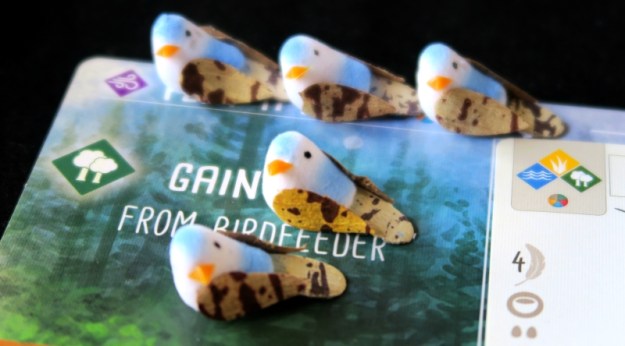
Players start with eight actions in the first round, but that decreases by one each round as the game progresses.  However, because players add birds to their habitats during the game, although they get fewer turns in later rounds, they are actually doing more things in each turn as they are activating more cards.  In Blue’s pimped out copy, she had replaced the wooden action cubes with little fluffy birds which are cute, but led to some initial confusion with the phrase “playing a bird” meaning variously take an action (playing a fluffy little bird) or play a bird card into a habitat.

Wingspan
– Image by boardGOATS

This time, everyone was slow to start—the start is almost always slow in Wingspan as players need cards to play and food so they can pay the cost, but this time it was especially true as players found their feet.  Lime began with a woodland bird that gave an extra food after re-setting the bird-feeder, which really helped him out throughout the game.  He also had a once-between-turns card which was triggered when another player tucked a card.   Since Purple had a bird with a tucking action, that looked like a good call.  Considerable merriment was derived from the tucking action:  who was tucking the most, watching out for people tucking etc..  Unfortunately however, Purple’s action required the tucked card to be taken from Purple’s hand so she often passed up the chance meaning she was not the most prolific tucker…

Wingspan
– Image by boardGOATS

Plum’s first two were wetland birds with one-off powers.  As her bonus card rewarded her for having cards left in hand at the end of the game, the fact these early birds increased her card drawing powers from the very start meant they could help towards that too.  Pine’s bonus card rewarded him for having birds with geographical names which he pretty much had in his starting hand. Lime’s bonus was for birds with tucked cards, but he only realised later that it meant multiple birds with tucked cards not the number of cards tucked.  He was able to pick up another bonus card later in the game, which worked slightly better for him though.

Wingspan
– Image by boardGOATS

Pine’s bird hunting for rodents largely went hungry in the early part of the game, though it did better in the later rounds.  Plum, instead of sharing her latest kitty pictures, mimicked her favourite kitty behaviour, and watched hawk-like for a successful hunt to trigger once-between-turns action.   She had a killer “three birds in one go move” set up ready to go—two birds both with a “play a second bird in the grasslands” action.  Although she was a little disappointed to have been unable to deploy it in time for the worms they ate to count towards the second round goal of most eaten worms.  This increased her egg laying power though and the final third bird allowed her to a sacrifice an egg for two new bird cards ensuring she achieved her bonus in the final round.

Wingspan
– Image by boardGOATS

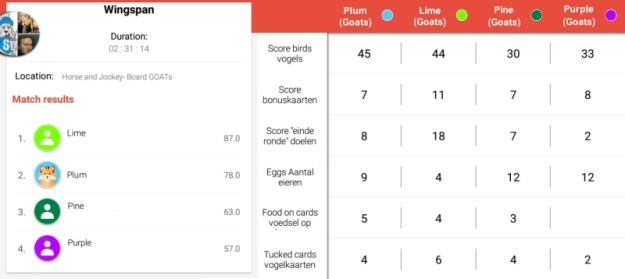
With the game finally coming to an end, all that was left was the scores.  Plum and Lime took the most points for their birds while Purple and Pine had the most eggs.  While everything else was fairly close, Lime had his nose in front in most areas and this showed in the final scores which were moderately spread out.  Lime’s score of eighty-seven points was some ten points ahead of Plum in second, who was similarly ahead of Pine.  As always with Wingspan, it had been fun, though it had sadly confirmed to Pine that while he adores the theme, the game play just isn’t for him.  And on that sad note, with everyone else also finished, it was time for home.

Wingspan
– Image by boardGOATS

Learning Outcome:  Everyone loves Pizza.

12th July 2022

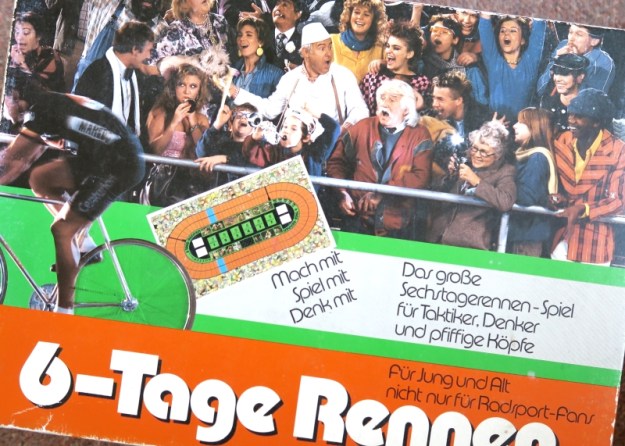
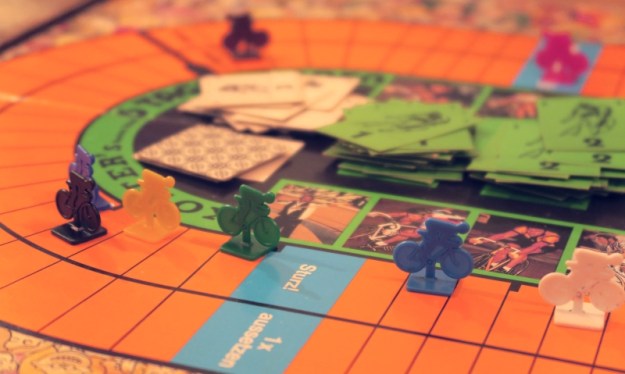
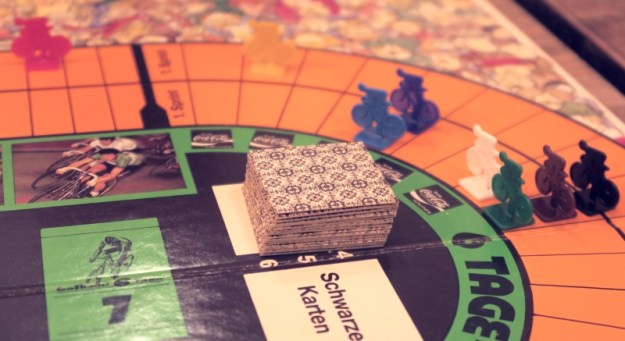
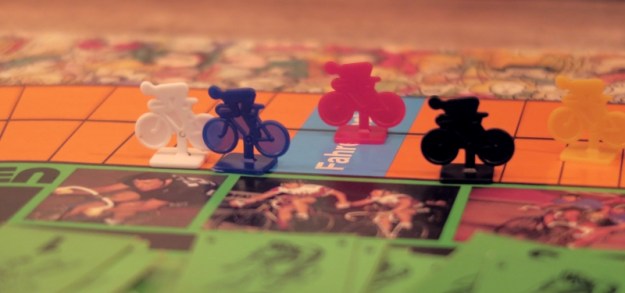
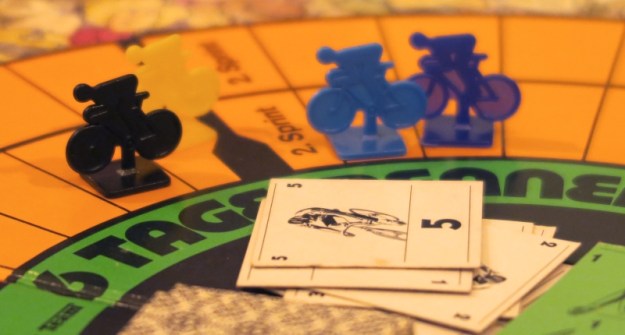
Blue, Pink, Orange, Lemon and Plum all started with food, and Pink’s was accompanied with cocktails (again).  There was a lot of chatter about playing something, but when Pine arrived, that ruled out …aber bitte mit Sahne (which we played last time).  While the discussion about what to play and how to split the group was on-going Purple and Black arrived, so the discussion moved on to who would play what and who else was expected.  In the end, Pink and Plum took themselves off to the other side of the pub to start setting up Altiplano while everyone else admired the 1980s box for the “Feature Game“, the bike racing game, 6-Tage Rennen (aka 6 Day Race).

6-Tage Rennen
– Image by boardGOATS

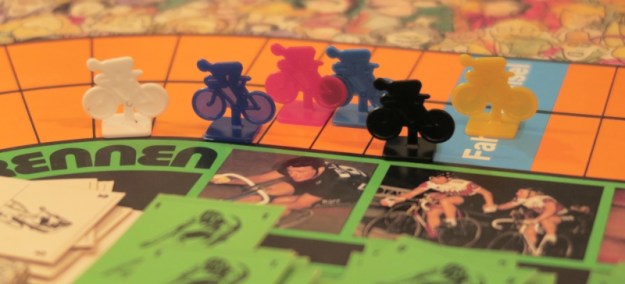
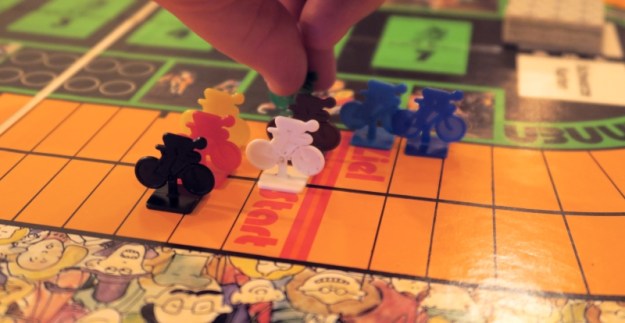
When Lime, Ivory and then Teal rolled up a few minutes later, Ivory joined the Altiplano game, but Teal, after a tough day, eschewed its complexity and decided to go for a gentle cycle ride with the other group instead.  In contrast to Flamme Rouge which we all played last time and emulates road racing, 6-Tage Rennen is set in a velodrome and mimics a six day race meeting.  It is quite simple, much simpler than Flamme Rouge actually, but in spite of this the group still managed a “rules malfunction”.  Similar to Flamme Rouge, the game is card driven, but rather than choosing simultaneously and then playing in race order, in 6-Tage Rennen players choose their card and play in turn order.
6-Tage Rennen
– Image by boardGOATS

There are a couple of other key differences.  Firstly, slip-streaming works differently:  if a player lands on an occupied space, they move again. If that space is occupied by two riders, the active rider moves twice more and if it is occupied by three or more riders, then they can really make a killing.  Also, 6-Tage Rennen is a points race, which means it is the player with the most points at the end who wins, not necessarily the first player to cross the line.  Points are available for the first riders to finish with ten points for first place, but also at the intermediate sprints of which there are two, earning five points for the first riders to cross each line and in both cases there are points for the minor placings.

6-Tage Rennen
– Image by boardGOATS

Teal went first and moved a single space, followed by Blue who used Teal to bounce on an extra space.  Pine, Purple, Black and Orange, further demonstrated how to use the slip-stream mechanism, but it was Lemon, who like last time in Flamme Rouge, took an early lead, though this time without the penalty of Exhaustion cards.  Not only did Lemon take an early lead, but she held it to the first sprint line taking the maximum five points, leaving Teal, Blue and Pine to take the three, two and one respectively.  It was then that the rules malfunction really took effect.

6-Tage Rennen
– Image by boardGOATS

The game is over thirty-five years old and imported from Germany, so the rules were originally in German, but this copy had two English translations. Unfortunately, these were both a bit unclear and, as a result, both Blue and Pine misunderstood how many green cards players started with.  This meant everyone ran out of cards very quickly and Blue, on the fly decided players would refresh their hand from the grey cards.  As Pine pointed out, this was likely to leave a shortage, so the number of cards was reduced slightly.  This meant some players ran out more than once and replaced their cards several times as a result which changed the game massively.

6-Tage Rennen
– Image by boardGOATS

Still, as everyone was playing with the same rules and nobody wanted to just start again, the group played on.  Lemon led the pack over the second sprint line too, and then over the finish line to a landslide victory with the maximum twenty points, twice her nearest rival, Teal.  The game hadn’t taken very long, and Black had long said he thought 6-Tage Rennen was better than Flamme Rouge and he along with some others were keen to play again with correct rules.  So, Pine dealt out the correct number of green cards and Lemon, as the winner of the first race went first in the second.

6-Tage Rennen
– Image by boardGOATS

The first thing noticed was the lack of a six in the starting hand.  As Black pointed out, this was key to the strategy of the game—staying six spaces ahead of other riders helps stop players from “getting a bounce” and moving ahead, and that’s where the grey cards come in.  Half-way round the track, there is a “special space” and players who land on this space discard their cards and replace them with grey ones.  The starting green hand has a seven, two fives, several fours along with some lower value cards and should just last the duration of the race.  Landing on the special space gives cards taken from two piles drawn at random—six slow cards (value one to three) and four fast cards (value four to six).

6-Tage Rennen
– Image by boardGOATS

This time, Orange started fast taking the first sprint and continuing on to the special space where he traded in his cards for new grey ones.  Lemon wasn’t far behind though, followed by Lime and Teal.  Purple demonstrated how to play the game by getting a “double bounce” on her seven, moving twenty-one spaces from the back to near the front on a single turn.  That left Blue and Pine who, reminiscent of last time, were “gapped” and struggled to keep up with the pack.  Before long, Pine was dropped and resignedly, rolled slowly round the track; he would have stopped at the pub if he hadn’t been in a velodrome!

6-Tage Rennen
– Image by boardGOATS

As the game unfolded, Teal commented on how clever it was and added, “It’s almost like it’s been play-tested…”  Meanwhile, Black joined Blue and they worked together briefly until their teamwork broke down just before they were able to catch up with the lead riders.  Lemon stalled on the “miss a turn” special space, allowing Teal to sneak past and pip her to the line.  As everyone else made their final lunge for the finish tape, Lime and Purple positioned themselves for the minor places before Lemon accelerated past and crossed the line to take second.  It being a points race, it was the total, not the finishing positions that count.  It was much closer this time than in the first race, but the placings were still the same with Lemon just beating Teal, and Lime taking the bronze medal.

6-Tage Rennen
– Image by boardGOATS

All this time, on the other side of the room, Pink, Plum and Ivory were playing Altiplano (with the Sunny Days mini-expansion).  Altiplano is a worker-placement bag building game that is a re-implementation of the bag-building mechanic used in Orléans.  The idea is that players draw resources out of their bag and place them on their personal action boards.  Then, players take it in turns to move their “worker” round the rondel to different locations where they can carry out corresponding actions assuming they have the right resources in the right place.  In essence, the game can be boiled down to one of resource improvement, for example, players can use an Alpaca to get Wool which they can later turn into Cloth.

Altiplano
– Image by boardGOATS

Points are scored for the resources at the end of the game, with more valuable resources worth more points.  Picking up Hut cards also increases the value of resources.  When a player no-longer needs a resource, they can move it into their warehouse with completed “shelf-fulls” scoring points at the end of the game.  Players have to be careful with this however, as once a resource is in the warehouse it cannot be used anymore.  Additionally, players can also score points by completing contracts.  It is the player that best interweaves these different aspects of the game that wins.

Altiplano
– Image by boardGOATS

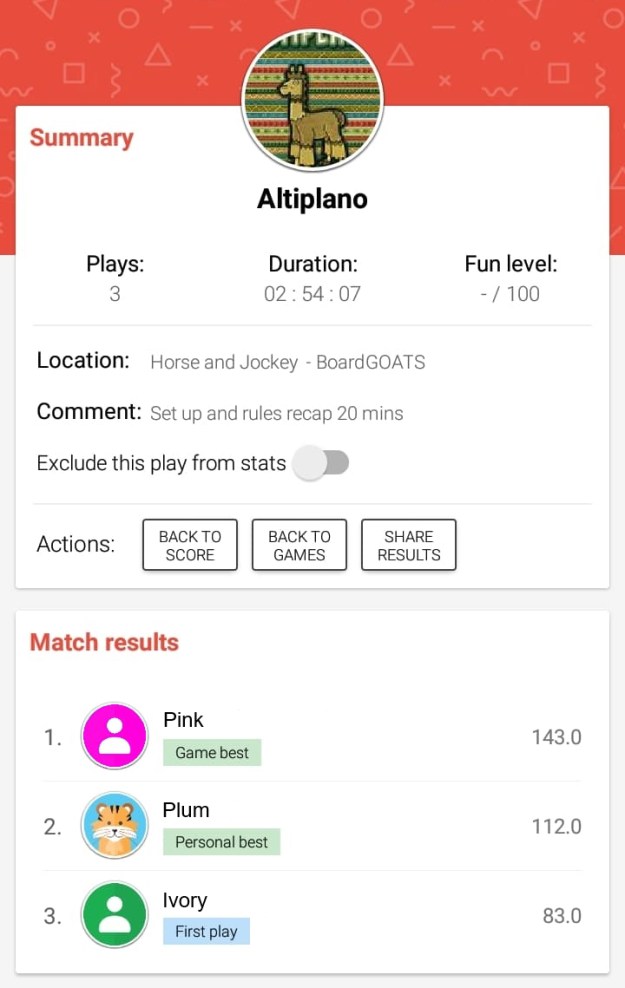
All three players felt they were making a poor fist of things and agreed they were “playing sub-optimally”.  Ivory concentrated on collecting and completing contracts.  In contrast, Pink completely eschewed contracts and instead focused on getting Glass tokens—the most valuable of the resources.  To do this, he had to get cocoa first, which he did by taking the Cocoa Canoe and with it one Cocoa resource.  He then increased the value of his Glass by taking the matching Hut.

Altiplano
– Image by boardGOATS

As a bit of a chocoholic, Plum also wanted Cocoa but as Pink had nabbed the Cocoa Canoe, the only way she could get it was to buy an Extension board.  Unfortunately, the first one was too early for her and she couldn’t afford it.  The next Extension had the “Navigation” anchor icon on it associating it with the Harbour Location, but players are only allowed one Extension board at each Location and, as Plum started with the Fisherman, she was not able to get that one either.  The next Cocoa opportunity didn’t come up until much later in the game, by which time it was too late really.  She did take an Extension eventually, one for the Mountains, which enabled her to exchange Food to give Ore which she was then able to convert into Silver.

Altiplano
– Image by boardGOATS

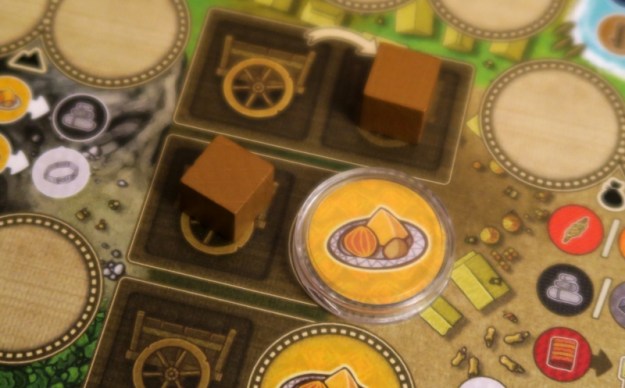
Last time the group played Altiplano, we discovered a “rules malfunction” associated with the purchase and use of carts.  Unfortunately, although many other aspects of the rules were checked, this was overlooked, so instead of always being able to move one space for one food token, or more with a cart, the group played that they could only move if they owned a cart and then only move one space.  That meant movement was much more difficult and made life more challenging.  Once again, everyone was playing by the same rules, so it wasn’t hugely important though it may have shifted the balance of the game a little.
Altiplano
– Image by boardGOATS

There was a nice atmosphere during the game though.  In a Star Wars reference, Pink advised Plum, “Not to go trading with The Huts” and politely waited until the ladies were no-longer present before indulging in comments about his Woodcutter “getting some wood”.  When he started getting wood, however, he couldn’t stop and finished with a particularly large pile.  Ivory started with the Farmer and used his Alpaca to produce wool and wove that into some very high quality scarves.  There was something remarkably “Fishy” about Plum’s strategy but especially when she carefully stashed too many of her fish in her warehouse and then ran out of resources.  She had far more money than anyone else, but ultimately though, there was nothing anyone could do about Pink, who’s Glass factory gave him clear victory.

Altiplano
– Image by boardGOATS

The cycle race finished long before the activities on the high plain.  Lime decided to head off to make sure he got home before the infamous Oxfordshire road closures cut him off, and Teal having enjoyed his evening on the bike also took an early night.  After some more chatter, the remaining six began “a quick game” of Bohnanza.  This is one of our all-time favourite games, and it was time to introduce it to Orange and Lemon.  Although it is not difficult, it is very different to the games we’ve played in the last few weeks, and is considerably more challenging if English is not your first language.

Bohnanza
– Image by boardGOATS

Bean farming might not seem an exciting theme, but the game is great fun and relies on the simple premise that players must not change the order of the cards in their hand.  On their turn, the active player must plant the first card, the card at the front of their hand, and may plant the second card if they choose.  Players have just two Bean Fields to work with, and each one can only hold one type of bean at any one time.  Once the active player has planted their bean or beans from their hand, they turn over the top two cards in the central deck—these must also be planted before the game can progress, though the active player can trade them with another player or even give them away.

Bohnanza
– Image by boardGOATS

Once the two cards on the table have been planted, the active player may trade cards from their hand before drawing replacement cards.  At any point a player may harvest beans, but the more cards they harvest, the more they are worth.  However, if a player has a field with only one bean in it, they must harvest their larger field first.  At the end of the game, the player with the most coins is the winner.  Normally, the game ends after the third turn through the deck, but this time, because time was running short, the group finished after the first pass.  This meant the group missed out on way the balance of the deck changes and the rare cards get rarer and the deck gets progressively shorter.

Bohnanza
– Image by boardGOATS

Purple started, and talked through her turn, followed by Blue.  Pine knew what he was going to do and got on with it as did Black, before it was Orange and then Lemon’s turn.  Purple started collecting Green and Soy Beans, with Pine planting Wax and Black-Eyed Beans.  Orange competed with Blue for Red and Coffee Beans and with Black for Chili Beans.  Lemon started with Blue Beans and later moved onto Green Beans.  There were lots of “generous trades” and gifts too—the group generally play together nicely, but tonight, the heat and the tiredness all round, meant everyone was especially kind to each other.

Bohnanza
– Image by boardGOATS

With time marching on, the group agreed to call a halt when the deck ran out the first time, even though that meant Pine missed out on two turns that he had set up beautifully.  It was a really close game, but it was Blue who just won the chocolates that Pink offered up for first prize.  As she was only one point clear, she shared her winnings with Lemon who generously passed her’s on to Purple.  It was hot and late, and as everyone left, the pub locked up behind them.

Chocolate Prizes
– Image by boardGOATS

Learning Outcome:  Games usually play better with the rules as written.

28th June 2022

When Blue, Pink, Orange and Lemon rolled in (late thanks to the delights of the Oxford traffic and garden watering), Plum was already there.  A gamer with Gweeples in Didcot, Plum was a friend of Burgundy’s that members of the group first met at his funeral about six months ago.  While she finished her tagliatelle, Blue and Pink waited for their supper to arrive, and everyone admired Pink’s Pornstar Martini, the group revisited Tsuro, which Orange and Lemon had enjoyed so much on their first visit, last time.

Tsuro
– Image by boardGOATS

While setting up, Pine arrived and needed a quick reminder of the rules, but that only took a moment:  players have a hand of three tiles and, on their turn place one of them in front of their stone and extend it’s path, moving their stone (and any others) to the end of its path.  Players are eliminated when their stone goes off the board or collides with another stone—the last player on the board is the winner.  First blood went to Blue, who took out Lemon and Pine, but that was collateral damage as she had no choice and went off the board herself at the same time.

Tsuro
– Image by boardGOATS

Pink was next, being trapped and left with no option, and then just Plum and Orange remained to duel it out.  There was very little space left on the board and the writing was already on the wall when Plum went off.  That left Orange a worthy winner, especially as he had a tile to spare too.  Teal arrived and while Blue and Pink fed, he led everyone else in a game of No Thanks!.  This is a game we’ve played a lot in the group and is a very clever design but like all the cleverest games, has very simple rules.  Played with a numbered deck of thirty-two cards, the idea is that on their turn, the active player can take the card in the middle or pay a chip to pass the problem on to the next person.

No Thanks!
– Image by boardGOATS

The next person has the same decision:  they can take the card and the chip, or pay a chip, and so on.  At the end of the game, a player’s total score is the sum of the face value of the cards they took and the player with the lowest number wins.  There are two key points that make the game, however.  Firstly, if a player has consecutively numbered cards, only the lowest card in the run contributes to their total, which means cards have different values to different players.  Secondly, nine cards are removed from the deck, which adds jeopardy on top.  The game can play out in several different ways.

No Thanks!
– Image by boardGOATS

The player or players with the most chips are always in control, until one player is left with so few chips or runs out completely, that they are forced to take cards even when they don’t want them.  This can prevent players, even those with lots of chips, from getting the cards they need to close runs causing the strategy to back-fire, and leaving those with the most chips with the most points as well.  This time, Orange and Teal amassed a huge pile of chips each, but both managed to avoid ending up with multiple high scoring runs.  Then someone dropped a chip on the floor giving Pine the opportunity to recount the tale of how he dropped a chip between the floor boards and how it is still there despite everyone’s best efforts.

No Thanks!
– Image by boardGOATS

This time, the dropped chip was recovered successfully and the game ended without further mishap.  Orange and Teal took first and second respectively, giving Orange two in two games to match Lemon’s achievement at the start of last time.  By this time, the feeders had finished feeding and everyone else had arrived, so it was time for the “Feature Game“.  To mark the start of the Tour de France later in the week, this was to be the Peloton expansion for the cycling game, Flamme Rouge.  Flamme Rouge is a fast-paced, tactical bike-racing game where each player controls a team of two riders: a Rouleur and a Sprinteur.  The aim is to manage the first rider to cross the finish line.

Flamme Rouge
– Image by boardGOATS

Each rider has a deck of cards, and Players move their riders one at a time, by drawing four cards from the rider’s deck, choosing one to play, and recycling the rest.  Once every player has picked cards for both their riders, players simultaneously reveal their cards and, starting with the cyclist at the front, each rider is moved in turn.  After all the riders have moved, slip-streaming takes effect, with groups that have exactly one space between them and the group in front moving forward to remove the gap.  Finally, every rider that still has an empty space in front of them is deemed to be riding into the wind and takes an exhaustion card which goes into their deck—these are bad because they are slow cards and block up plays’ hands.

Flamme Rouge
– Image by boardGOATS

At the start of the race, everyone’s Rouleurs have the same cards, and everyone’s Sprinteurs have the same cards.  The Rouleurs have lots of cards with a similar face value, where the Sprinteurs have some cards that are faster and have a higher value, which are offset by others that are slower and have a lower value.  Players have to balance how they manage their riders and make the most of the slip-streaming opportunities.  The game is modular with the option to add hills to the base game.  The Peloton expansion adds extra riders (so that the game plays up to six players), cobbled sections (aka “Pavé”), Feed Zones, and rules to set up a break-away.

Flamme Rouge
– Image by boardGOATS

Unusually with so many people, rather than splitting in to three groups playing three different games, we split into just two with both playing the same game.  Since the Grand Départ was due to take place in the essentially flat Denmark this year, both groups largely played without hills, but included cobbled sections (à la Stage 5, from Lille to Arenberg, a week later).  Cobbled sections change width frequently and are generally narrower than normal road, but perhaps more importantly, riders can no-longer benefit from slipstreaming but still get exhaustion cards.  The slightly larger group, led by Ivory and Teal also decided to start with a break-away.

Flamme Rouge
– Image by boardGOATS

Their chosen route was Stage 11 of the stage race and took in three sections of Pavé.  The first of these was shortly after the start, the second after the first hairpin and a short slight up-hill ramp, and the third was after a second hairpin and a little chicane.  Teal and Lime made it into the breakaway and they stayed away for most of the game.  Being at the front “pushing air out of the way” all the time is tiring though, and inevitably, they picked up a lot of exhaustion cards.  That meant that as the Peloton was bearing down on them, just as the finish line was in sight, they didn’t have the energy fend them off.

Flamme Rouge
– Image by boardGOATS

As a result, Black and Pink, who had been sheltering in the middle of the group slid across the line just ahead of the gallant breakaway, who were definitely candidates for the day’s combativity award.  Black took first place, having spent most of the race doing as little as possible and saving it all for the final sprint.  While saving energy is a good tactic, Purple took it to a different level picking up no exhaustion cards at all, though she wasn’t able to turn on the burners in time to take advantage of it.

Flamme Rouge
– Image by boardGOATS

The smaller group, led by Blue and Plum rode a simpler route based on the Avenue Corso Paseo ride, with a cobbled section in the middle between the two hairpin bends.  With most people in this group new to the game, they decided to keep things simple and eschewed the complexities of hills completely, sticking to a pan-flat course, and kept to the standard roll-out used in the base game.  First Orange and then Lemon rode off the front while Pine and especially Blue were repeatedly under threat of being spat out of the back of the peloton.  Most rounds seemed to end with Blue breathing a sigh of relief as she managed to hang on and Lemon laughing as she picked up yet another exhaustion card.

Flamme Rouge
– Image by boardGOATS

Once the riders had passed the Pavé the speed picked up and Blue and Pine started to try to move forward in the field.  Lemon who had led most of the way “bonked” and “hit the wall”, and as a result, was unceremoniously dropped.  It was tight, but Pine’s Rouleur was first over the line just holding off Plum’s first rider who took second followed by Pine’s Sprinteur who took third.  It had been a close and quite attritional race, but despite the fact there were fewer riders with a shorter parkour, the race finished at much the same time as the other one.  So races were compared and there was a bit of chatter about other options as people packed away.

Flamme Rouge
– Image by boardGOATS

Ivory took himself off for an early night, as did Teal, but those that were left were keen to play on, albeit not for long in some cases.  Inevitably there was a lot of discussion about what to play, but when Ticket to Ride got a mention, Pine and Lime were keen to give the London version a run out, and were quickly joined by Pink and Purple.  Ticket to Ride is one of our favourite games and we play a lot of different versions, short and long.  They all have the same basic structure, but different layouts on different maps, and often with a little rules change.  In summary, in the original game, players are connecting cities across the USA.

Ticket to Ride (USA)
– Image by boardGOATS

They do this by collecting coloured cards and then spending those cards to place trains.  Players score points for placing trains and also for completing “Tickets” by connecting two cities together by any chosen route—the further apart the cities, the more points they are worth.  The game end is triggered when one player has only two train pieces left and at the end of the game, the player with the most points is the winner.  The original game takes around an hour to play with the full compliment, but more recently, there have been a number of smaller, lighter versions available.  They have the same rules, but players have fewer pieces and the maps are more congested, based on cities like New York, Amsterdam and later this year, San Francisco.

Ticket to Ride: London
– Image by boardGOATS

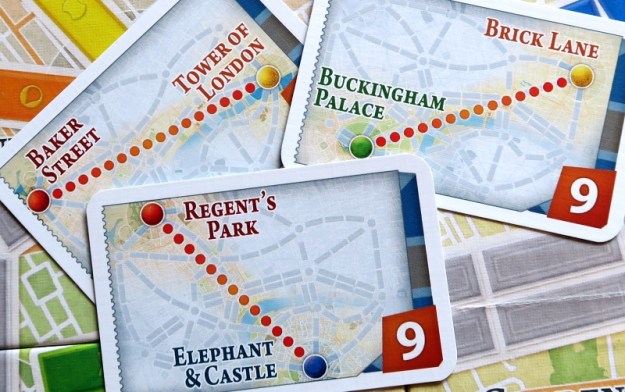
This time, however, the version chosen was London.  In this edition, players are placing buses to mark routes, and in addition to scoring points for claiming routes and Tickets, players also score points for connecting all the places in the same district. Pine won the “name the people on the front of the box” competition and went first.  Lime crossed the city travelling from Baker Street to The Tower of London while both Purple and Pink did the same but from Buckingham Palace to Brick Lane, and via different routes. Pine had a northern route and a south route that looked like they would join up in the middle, but didn’t quite make it.  He did manage to claim a district though, the only player to do so for a district of any significant size.

Ticket to Ride: London
– Image by boardGOATS

It was very close between first and second, though there was a bit more distance to Pink in third.  In the end, Lime just pipped Pine to victory by two points.  Meanwhile, there had been some debate between the other five as to what they would play.  Blue suggested introducing Orange and Lemon to one of our old stalwarts, 6 Nimmt!, but it wasn’t one of Plum’s favourite games.  So instead, Blue and Black introduced everyone else to …Aber Bitte mit Sahne, a clever but simple little “I divide, you choose” game.  The idea is that one player is The Baker who divides the cake into pieces and then everyone else takes it in turns to take a one of them.

…Aber Bitte Mit Sahne
– Image by boardGOATS

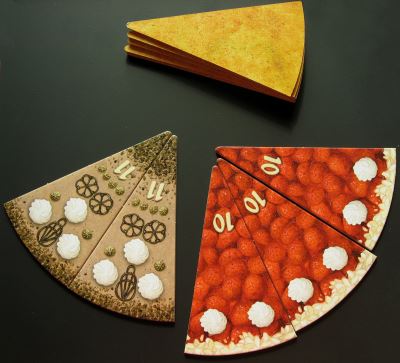
Each slice of cake has a type, a number on it and a some cream.  When a player takes cake, they can choose to eat it or store it.  For all eaten cake, players a point for each blob of cream.  For stored cake, however, the player with the most of each type will score the number of points associated with that type.  The clever part is that the number of points is equivalent to the number of slices of that type in the game, so the more common types which are harder to get a majority in are worth more, but they also have the most cream, tempting players to eat them straight away.

…Aber Bitte Mit Sahne
– Image by boardGOATS

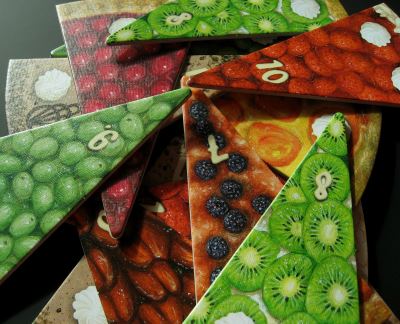
It is always difficult for the first couple of players to take the role of Baker, but this is exacerbated with five players.  Blue went first, then Black.  It was only a couple of rounds in, that the twinkle appeared in Plum’s eye as she realised how clever the game was and expressed her approval.  It was quite tight in the early stages with players staking their claims to different sorts of cake.  There was competition for kiwi and redcurrent, but others went largely un-stored (and therefore eaten).  After everyone had been the Baker it was time to see who had the most of each and add up the scores.  Black got lucky with the chocolate as everyone else was greedy and ate theirs.

…Aber Bitte Mit Sahne
– Image by boardGOATS

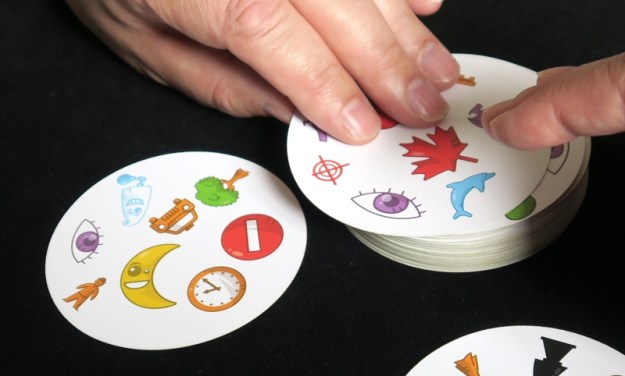
Unfortunately, there was a rules misunderstanding and Orange thought he would get points for every slice he kept if he had the most of that type, so we’ll have to play it again soon so he can try again.  This time though, Black who had been very abstemious and eaten none of his cake, ran out the clear winner with thirty-five points to Blue’s twenty-nine and Plum’s twenty-seven for second and third place respectively.  Ticket to Ride: London was still underway on the next table, so as Orange and Lemon had not played it before, Blue got out Dobble.  We’ve not played this in the group for years, but it is a fantastic little Snap-based filler.

Dobble
– Image by boardGOATS

The idea is that every card has several pictures and each card shares exactly one match with every other card in the deck and using this principle, there are five possible Snap-based games.  Black decided discretion was the better part of valor and opted to spectate while Plum had a significant drive so headed off, leaving just Blue, Orange and Lemon.  They started with a pile of cards each and the winner the first to shed their pile onto the central one.  The game was all very well, but there was a vocabulary check as, although Blue said they could play in Ukrainian, Orange and Lemon were game to give English a go.  Once the items had been identified, the mania started.

Dobble
– Image by boardGOATS

As it was a trial game, the piles weren’t carefully measured, but Orange quickly got the hang of it and in spite of the language differences, managed to shed his pile first for yet another victory.  From there, the group did the reverse and started with one card and grabbed progressively matching cards from the middle.  This can be quite savage, which is why Blue opted for the gentler game first.  Still, everyone was well-behaved and nobody got scratched.  The tension and concentration was palpable though and Ticket to Ride finished and Lime and Pine left with only a a cursory grunt from those playing Dobble, before Blue just edged it to win the final game of the night.

Dobble
– Image by boardGOATS

Learning Outcome:  Tour de France coverage is available on ITV4.

17th Movember 2021 @ The Women’s Institute

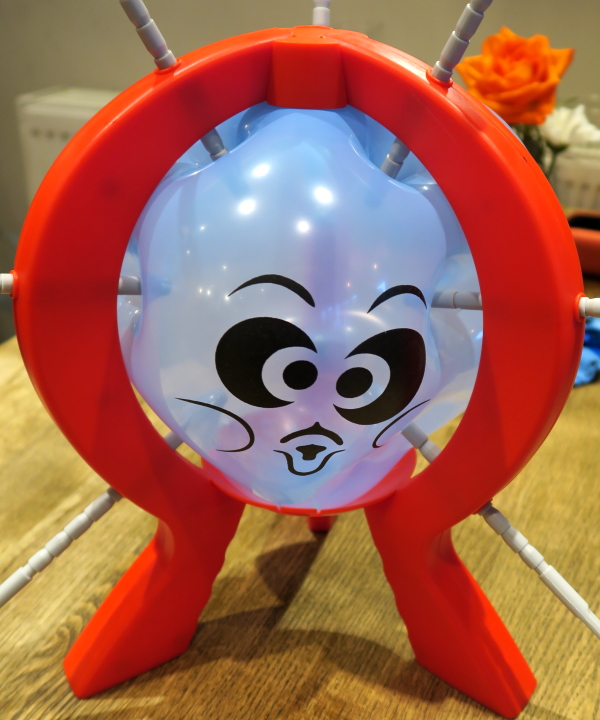
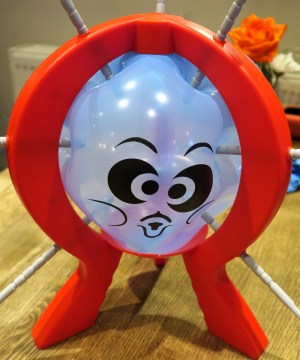
Invited to introduce the Stanford-in-the-Vale Women’s Institute to the concept of modern board games, Blue and Pink took a pile of light games to the Village Hall.  After the obligatory rendition of William Blake’s Jerusalem, in tables of four, people were introduced to No Thanks!, Coloretto, Tsuro, Indigo, Riff Raff, Second Chance, Aber Bitte mit Sahne… and Just One.  Rather inevitably, the biggest success, however, was Boom Boom Balloon—it was quite a sight to see the middle aged ladies of the WI competing to make the biggest bang!

Boom Boom Balloon
– Image by boardGOATS

26th August 2021 (Back at the Jockey!)

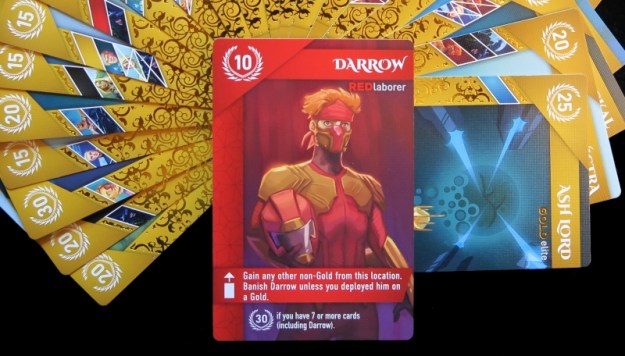
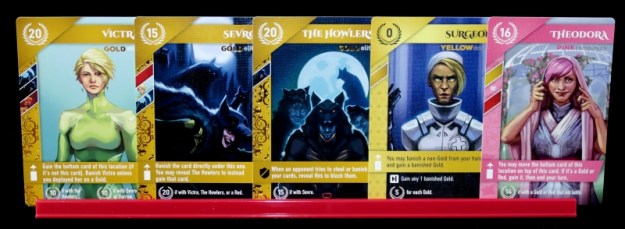
Following the test event at the Horse and Jockey and much discussion, we decided to try meeting in person once again.  As the pub are not currently serving food on a Tuesday, we decided to move to Thursdays, at least in the short term, especially as times are so uncertain.  This week, the “Feature Game” was Red Rising, a new card collecting game inspired by Fantasy Realms and themed round the books by Pierce Brown.  The books are set in a dystopian future on Mars following low-born miner Darrow, a Red, as he infiltrates the ranks of the elite Golds.

Red Rising
– Image by boardGOATS

In the books, society follows a fourteen-colour caste system from Gold at the top to Red at the bottom.  Red Rising the board game takes this colour hierarchy and adds elements of hand-management and card-combo building.  The idea of the game is very simple:  players start with a hand of five cards and on their turn, play one card onto the game board and pick up another.  The aim is to improve the quality of their hand and with it, its value.  Cards are played on one of four locations on the central game board and have an additional deployment action when played, the effect of which can be dependent on the location they are played in or the card they are played on top of.

Red Rising
– Image by boardGOATS

The card picked up must be the top card from another different location except where enabled by the played card.  The location from which the card is collected dictates an additional bonus action:  Move along the Fleet track, Collect helium, Increase one’s presence in the Institute, or Claim the Sovereign token.  There are a couple of other options:  play a card and then take a card blind from the Character deck and roll a die to decide what their bonus action will be.  Alternatively, instead of playing a card, just draw a Character card from the deck and place it, then take the bonus action.  In practice, these two options are relatively rare and only taken if there is nothing to pick up, or the player likes the hand they have.

Red Rising
– Image by boardGOATS

The game ends when either seven is reached in all three of the Fleet track, helium and the Institute, or one player has reached seven in two of them.  At the end of the game, players sum their total score from each card, the scores from combining effects of cards, ten points if they finished with the Sovereign token, three points for each helium, their score for progressing along the Fleet track, and points for each of their tokens in the institute (four per token for the player with the most, two and one for less committed players). Anyone over the seven card hand-limit loses ten points per card over the limit.

Red Rising
– Image by boardGOATS

There is a large deck of cards of which only a relatively small number are seen in each game.  The nature of the game changes dramatically depending on which cards come out.  This time Blue, Pink, Burgundy and Pine made up one table while Ivory, Green, Black and Purple made the other, both playing with the Collector’s Edition.  The first difficulty, was that although beautiful, some of the colours in the Collector’s Edition are difficult to tell apart.  The Influence and Fleet tokens in blue and green, and pink and red, were a particular problem which was made worse in low light.  This was not too much of a problem in practice, however, because influence tokens can be grouped together and we weren’t playing with the maximum number of players so could ditch the worst clashes.

Red Rising
– Image by boardGOATS

A bigger problem was the amount of text on the cards.  Pine and Burgundy both had issues with this, which could be got round by passing cards if people wanted to read them.  Additionally, the cards used in a game tend to circulate with one player playing it and another picking it up before playing it themselves.  So the burden is not as heavy as it seems at first.  Despite it not being complicated, the one table seemed to have a significant issue with rules.  Pine struggled with whether the action was associated with the location a cards was played or the location it was collected from.

Red Rising
– Image by boardGOATS

Pink, meanwhile, developed an inexplicable habit of taking the action at both locations.  Adding insult to injury, Pink also repeatedly distracted Blue by complaining that he couldn’t see a way of increasing the number of cards in his hand and asking advice.  On the next table, however, Green felt he was being got at.  This is actually quite a normal state of affairs because we all love to pick on Green, but in this case that wasn’t what was happening.  Green’s special power that meant he was able to place an Influence token in the institute every time he took the Sovereign token, but he had a card that meant he would lose points if he had the Sovereign token at the end of the game.

Red Rising
– Image by boardGOATS

So, for this reason, Green concentrated on collecting red helium gems instead.  Unfortunately, random draw meant that on this occasion the game had an awful lot of cards that penalised players with the most helium or a player of choice, which Green felt was mostly him.  Worse, the nature of the game is that players play these cards then others pick them up and play them again, which can make it feel like there are more cards like this than there really are.  Black’s influence dominated the Institute, while everyone competed for points on the Fleet track.  It was an extremely close game with four points between first and third.  Purple channelled her inner “Magic: The Gathering” player and with a lot of helium, sneaked ahead of Ivory to take second.

Red Rising
– Image by boardGOATS

Despite struggling to get Gold cards and feeling the game was against him, Green finished just ahead with two hundred and fifty two points.  The other game was nowhere near as close and clearly played out very differently.  Blue, also lost some helium thanks to Burgundy, but it only happened once, there was no real shortage of Gold cards, and the game seemed to take a lot longer.  Part of this was because Pine spent a lot of time checking what he was doing and insisting it wasn’t his sort of game, yet he dominated both the Institute and the Fleet track.

Red Rising
– Image by boardGOATS

There were over a hundred points between first and last in this game, but the scores didn’t feel as disparate while playing.  In spite of his complaints, it was Pine who came out on top with a massive three hundred and nine points.  Overall, both games were a bit of a mixed bag with Burgundy saying it didn’t gel for him, Pine feeling bewildered (not withstanding his success), Green feeling “got at”, and even Pink (who had played it twice before) made a bit of a hash of things. Ivory, Pink and Blue had played it before, and all three had been unconvinced after the first game, but more positive after the second.  So it is definitely a game that benefits from multiple plays, if people are prepared to give it a second chance…

Red Rising
– Image by boardGOATS

Ivory, Green, Black and Purple finished first and, at the time it looked like the other group wouldn’t finish for ages.  So after some discussion, they started another game and chose Ticket to Ride: Amsterdam.  This is one of the “little” spin-off games based on the original Ticket to Ride.  Themed round a city rather than a country or continent, these are smaller and quicker to play than the bigger games, but lots of fun.  This one is based on the Dutch capital, but the game play is essentially the same as the other editions.

Ticket to Ride: Amsterdam
– Image by boardGOATS

On their turn, players either collect coloured cards from the market, or spend them to place plastic carts and score points.  Players start the game with three tickets (of which they must keep at least two), which depict two locations.  Players who can connect these locations score points at the end of the game; failure to do so leads to negative points.  Each variant has a little tweak.  So, in addition to scoring points from placing pieces and successfully completing tickets, in the Amsterdam edition, players can pick up goods cards when they complete a route marked with carts.

Ticket to Ride: Amsterdam
– Image by boardGOATS

The player with the most of these at the end of the game scores an extra eight points with other players scoring fewer with the amount depending on the number of players.  This time, Purple built her routes through the middle of Amsterdam and to the north.  Everyone else went for the potentially lucrative goods routes in the south, east and west.  The problem with this was the competition, with Green the main casualty.  Although Green managed to get three goods cards he failed to complete his second ticket.

Ticket to Ride: Amsterdam
– Image by boardGOATS

Ivory also went for two tickets and completed them, but managed to add five goods cards giving him the most and adding a valuable eight points to his score.  Both Purple and Black largely eschewed goods cards (collecting just one) and concentrated on finishing their three tickets.  In a tight game, which this was, those solitary tickets and the tie-breaker for them was critical.  It was a tie for second between Black and Ivory, but it was Purple, who just edged in front, winning by a single point.

Ticket to Ride: Amsterdam
– Image by boardGOATS

While the others were playing with their trains carts, the second table had finally finished their game of Red Rising, so they picked up where they had left off last time with another game of the filler, Love Letter.  This “micro game” consists of just sixteen cards.  Players start with one, draw a second and play one of them doing the associated action.  The player with the highest value card, or the last player standing is the winner of the round.  The first player to win three rounds is the winner.

Love Letter
– Image by boardGOATS

Last time, it was all about Blue and Burgundy, with Poor Pine being knocked out every single round.  This time it was a bit different, and it was all about Pine and Blue.  Pink and Burgundy failed to take a single round, but it was tight between Pine and Blue.  There was a bit of ebb and flow with one taking a round and then the other, but it was Pine who took his third round first and with it revenge for last time as he left Blue languishing with just two love tokens.

Love Letter
– Image by boardGOATS

Although Ticket to Ride: Amsterdam and Love Letter finished at about the same time, Purple, Black, Green and Ivory all decided it was time to make a move.  The others felt there was still time for one quick game of …Aber Bitter mit Sahne, a fun little game based on the simple “I divide, you choose” mechanism.  On their turn as Master Baker, the active player constructs a “pie” from pieces drawn at random and divides it into portions, each consisting of several pieces.  Starting with the player to the Baker’s left, each person takes a portion of their choice and decides which pieces to keep and which pieces of cake to eat.

…Aber Bitte Mit Sahne
– Image by boardGOATS

When all the cake has been distributed, the player with the most of each type scores the number shown on that type, while each piece that has been eaten scores for the number of blobs of cream, sahne.  The clever part is that the number of cake pieces of each type in the game is the number shown on the pieces, thus the most common types are the most valuable, but also need the most pieces to score.  Thus the aim of the game is to collect sets, but only the largest of each type scores, everything else is worthless unless it has been eaten.

…Aber Bitte Mit Sahne
– Image by boardGOATS

Players tend to wind up collecting different sets.  This time, Pine won nine points for his gooseberry pie, Burgundy won seven for his blackberry flan and Pink took twenty-one points for his strawberry tart and chocolate gateaux.  That was without counting the cream though.  Pink thought he’d done enough, but was just beaten by Burgundy who, as well as a lot of cream, also shared the points for a lot of the lower scoring cakes. His final total of thirty-four was one more than Pink with Pine and Blue tied for third.  And on that sweet note, it was home time.

…Aber Bitte Mit Sahne
– Image by boardGOATS

Learning Outcome:  It will take a little time to get used to playing face-to-face again.

7th January 2020

Almost everyone was late arriving and many wanted to eat, so we decided to play something quick to get people going while we waited for food to come.  In the top of the bag was …Aber Bitte mit Sahne (a.k.a Piece o’ Cake), and as there were a lot of hungry people, it seemed appropriate somehow.  “Sahne” is a very simple little “I divide, you choose” game where players are collecting pieces of cake.  On their turn, the active player, or Baker, begins by turning over one of the five piles of cake slices in the order they appear in.  They then divide the cake into segments, each containing one or more slices. The player to their left then chooses one of the segments, either “eating”, or “saving” each of the slices they take.

…Aber Bitte Mit Sahne
– Image by boardGOATS

At the end of the game, if a player has saved the most of a given type of cake, they score the number of points shown on the slices of that type; they also score one point for each blob of cream they have eaten.  The clever part is balancing the possibility of scoring a lots of points later with banking the blobs of cream now.  The cake types that score the most highly are those that have the most slices available, but they also have the most cream.  The player with the most points after the five rounds wins.  Burgundy started the first round, and, as there were four players, he also started the last round, arguably giving Blue a slight advantage since it meant that she was able to choose first twice. Blue began by collecting chocolate cake, because, well, it’s chocolate cake, (obviously), while Green and Pine began a bit of a tussle for “pea pie” (probably gooseberry tart really).

…Aber Bitte Mit Sahne
– Image by boardGOATS

One of the key parts of this game is that ties are friendly, in other words, if there is a tie, everyone gets the points.  This generally has the effect of making players work to get just enough pieces of cake to join the group of players that will score points rather working that bit harder to than get more pieces than everyone else and be the only one to score.  Thus, many people often score points for the same type of cake.  This was instrumental in making it a tight game this time, as there were several ties. In the end, the fact Green wasted none of his slices, winning points for everything he kept and eating the rest, meant he beat Blue by just one point with Pine not far behind in third place.  Towards the end of “Sahne” Ivory arrived and commented on the differences between it and it’s reimplementation, New York Slice, where cream is replaced with pepperoni and anchovies are added to give negative points – one to play another time perhaps.

…Aber Bitte Mit Sahne
– Image by boardGOATS

Once everyone had finished feasting (both in the game and in real life), we started looking at what people might play.  First up was the “Feature Game”, Suburbia in it’s rather epically large, and very fancy new “Collector’s Edition”. This is a tile-laying game, where each player tries to build their own town providing an economic engine and infrastructure that starts off as self-sufficient and hopefully becomes profitable and encourages growth.  Each player has two tracks:  Income and Reputation, the facilities that a player builds affect these, so as the income of their town increases there is more money to spend on purchasing better and more valuable buildings.  These, in turn, can increase the reputation of the town which will increase the population.  The winner is the town with the largest population.  While one might think this means going for the highest possible reputation would be the way to victory, the scoring track contains several expansion checks that immediately reduce a player’s income and reputation.

Suburbia
– Image by boardGOATS

The frequency of these scoring checks increases as scores increase, which could be disastrous for a player who allows rampant population growth to get out of control.  Although only Ivory had played the game before, the group decided to include one of the expansion sets, Nightlife.  Setup did not take as long as it looked, with the box inserts from the new edition making the job much quicker and easier.  The three communal objectives were: Most houses, Highest Income, and Most Municipal Buildings.  Each player also had their own private objectives with Green going for Nightlife, Ivory for Factories and Burgundy for Offices.  In the first round, even though the developments were as yet tiny villages, both Green and Ivory built Helipads.  With the owners of each helipad receiving $5 for every Helipad currently in the game (including the ones just taken), the power of the game became immediately obvious.

Suburbia
– Image by boardGOATS

In most games, players receives bonuses based on the situation when a card or token is taken.  In Suburbia, any benefits act through past, present and future, so tiles can keep on giving throughout the game.  Burgundy used this effect to gain $1 every time anyone built an Office. Green managed to build up a bonus of $3 for every House built in the game. This type of Income really helped, as Green didn’t need to worry too much about his base Income level and could concentrate on building up the Night tiles and Houses that he needed to fulfill his personal goals.  Ivory and Burgundy both decided to chase the Income bonus and ended up fighting for the Income producing tiles pushing each other up to ever higher values.  Obviously that Income helped them buy tiles, but they were largely in competition with each other and thus allowed Green to build a commanding lead in Accommodation and Nightlife.

Suburbia
– Image by boardGOATS

Another unique aspect of Suburbia, are the expansion checks that prevent a run-away winner. For every few population points gained, the player’s Income and Reputation markers are pushed back by one point each.  Since Burgundy and Ivory were competing for the income bonuses, there was the highly unusual (and amusing for anyone who was not Burgundy or Ivory) situation in the final couple of rounds where they were trying to avoid scoring too many “points” resulting in reducing their income and potentially losing the fifteen points the end-game objective would.  Ivory in particular was racking his brains over the best way to do this and spent so much thought on it that he failed to spot that he was only one Municipal building ahead of Green who’s turn was next (and had a pile of cash even though his Income was minus three!).

Suburbia
– Image by boardGOATS

Thus, for his final turn Green (knowing he had already won the Houses and Nightlife bonuses) bought the one remaining Municipal building on the track, robbing Ivory (no friendly ties in this game, to get a bonus you have to have most).  In the final scoring, Green’s green and pleasant city, with only Houses, Schools, Nightlife and a large Park (aside from his one starting Factory) was much more popular with the residents than Ivory’s Factory filled city or Burgundy’s green Office city.  Overall the group had enjoyed the game, which had perhaps more than the usual amount of interaction for a personal area building game.  Although there weren’t really any new mechanics, it was well implemented and everyone would be very happy to play it again.

Suburbia
– Image by boardGOATS

Meanwhile, Pine, Lime and Blue opted for the slightly lighter game, Istanbul. This is an old favourite that won the Kennerspiel des Jahres in 2014, but thanks to the new fare hasn’t been played in the group for some time. The game is played on a modular board with players making paths between different locations. The aim of the game is to be the first player to get five red Rubies, but there are a number of ways to get these.  For example, they can be bought from the Gemstone Dealer, but this costs money (and every time someone buys a Ruby, the cost increases too).  Money can be obtained by trading goods obtained from the three warehouses at one of the two markets.

Istanbul
– Image by boardGOATS

Each player starts with a small barrow, with space for four different goods and the Rubies. Three of the goods (Spices, Cloth and Fruit) can be gained from the associated warehouse, with a visit allowing players to fill their barrow to its maximum. A small barrow will only hold a maximum of two of each though, so visiting the wheelwright to buy an extension or two makes these visits more efficient, but barrow extensions also cost money… So planning the order of visits to these different places, and this is the clever part of the game.

Istanbul
– Image by boardGOATS

Each player is in charge of a stack of wooden disks representing a Merchant and his Assistants. The idea is that on their turn, the Merchant visits one of the different locations by travelling orthogonal a maximum of two spaces. At each location, he can negotiate a deal and leaves one of his Assistants to complete it. After several turns, the player runs out of Assistants so they can continue to move their Merchant without making deals returning to the Fountain to call their Assistants so they can start again, possibly using a couple of turns to do so.  Alternatively, the Merchant can move up to two spaces and return to one of the locations where they left an Assistant and carry out another deal at that location, taking the Assistant with them.

Istanbul
– Image by boardGOATS

Thus, the game is similar to Yokohama in that it is all about planning an efficient route, in this case, dropping off Assistants at useful locations and then, ideally, travelling the route again reusing them and picking them up.  There are other factors to consider too however. Encountering another Merchant will cost money, for example.  On the other hand, meeting the Smuggler or the Governor provide opportunities to get resources, including the rare Jewels (valuable, but distinct from Rubies), or bonus cards that can be kept and played to give an advantage later in the game.

Istanbul
– Image by boardGOATS

This time, the group used the big numbers on the location tiles to dictate their layout. Then, after a rules run-down, Blue started, moving her Merchant from the Fountain to the Post Office.  Visits here provide a couple resources and some cash, which she planned to sell, using the profits to extend her barrow.  Lime started out visiting the Tea House (via the Caravansary) to get cash, while Pine went to the Black Market to get money and Jewellery.  Blue was first to get a Ruby, but Pine and Lime weren’t far behind, and it was even closer by the time they were claiming their second Rubies. Lime, every inch the accountant was accruing vast amounts of cash, and somehow seemed to be collecting gems too, without the pile seeming to diminish significantly.

Istanbul
– Image by boardGOATS

As the game approached the end, Lime went on a spending spree, at the end of which Pine scuppered Lime’s plans. He took a Ruby from the Gemstone Dealer, increasing the price for Lime in the process, making things worse by the fact that he was squatting putting the cost just out of Lime’s reach. In the end though, Blue made a mistake leaving the door open for Pine to have another visit, and claim his final Ruby, with it the game.  With that, Pine left for an early night, convinced that Suburbia which was “just finishing” would be at least another half an hour. Blue and Lime, waited and set up For Sale, but it turned out Pine was right, and by the time the other group finished there wasn’t time to play.  So, after a bit of chit-chat, everyone went home.

For Sale
– Image by boardGOATS

Learning Outcome: Green and pleasant towns are nicer places to live.

Pink’s sPecial Party

It being a very special day for Pink, he decided he wanted to spend it playing games with friends and family at the Jockey.  The early arrivals set up PitchCar, including the new “Loop” expansion and others played Loopin’ Louis, Patchwork Express, Dobble and the surprise hit, Boom Boom Balloon.  Little-Lime won PitchCar (perhaps flicking talent runs in the family as Lime himself managed to complete the  loop at least three times), and almost everyone managed to lose Boom Boom Balloon at least once.  Late in the afternoon, a game of Scotland Yard was started with Pink as the fugitive, and finished almost before it was begun when he was quickly captured.  It was then restarted with Mrs. Lime as the fugitive and turned into an epic game that went on for a couple of hours with a brief break as people tucked into the buffet supper and amazing sticky-toffee pudding cake-desert provided by the Jockey Kitchen.

Boom Boom Balloon
– Image by boardGOATS

The evening continued with more games including No Thanks!, Finstere Flure (a.k.a. Fearsome Floors), Saboteur, …Aber Bitte mit Sahne (a.k.a. Piece o’ Cake) and Ice Cool.  The team of five eventually managed to corner Mrs. Lime, freeing up Pink to play his special request, Captain Sonar, which his team fittingly won, twice.  This was followed by a game of Ca$h ‘n Guns (it is always fun entertaining the bar staff by waving foam pistols about and threatening to shoot each other), before finishing with 6 Nimmt!, a game to match Pink’s socks.  It was a great day, and we all went home tired, but very happy, with Pink and Blue keen to thank everyone for sharing Pink’s sPecial day.

6 Nimmt!
– Image by boardGOATS

17th September 2019

Blue and Pink arrived nice and early and so after ordering food, started a quick game of Ganz Schön Clever (a.k.a. That’s Pretty Clever).  This is one of the first of the “Roll and Write” games from the last couple of years and, as it received a Kennerspiel des Jahres nomination last year, arguably one of the best.  This type of game has been around for many years, with Yahtzee being one of the first, but the current trend was started by games like Qwixx.  Qwixx came out seven years ago, but has since been followed last year by games like Roll to the Top!, Railroad Inc., Welcome to… and the Roll Through the Ages and Penny Papers Adventures series of games.

Ganz Schön Clever
– Image by boardGOATS

These games all have different themes and different mechanisms, but the basic principle is the the same with players rolling dice (sometimes bespoke dice) and marking the results on a piece of paper, usually from a bespoke pad, or more recently a laminated card.  Ganz Schön Clever is an abstract game using six coloured dice which are used to fill in boxes in five coloured areas of the individual player “boards” (the white die is wild).  The active player, rolls all six and chooses one to keep and use, discarding all dice with lower pip values.  They then roll any remaining dice, again keeping and using one and discarding the rest before rolling the rest one last time keeping and using one final die.  The other players can then use one of the discards, before play passes to the left.

Ganz Schön Clever
– Image by boardGOATS

The clever part is the way the dice are used, and the fact that filling in some of the boxes gives a bonus action, enabling players to fill in other boxes or gain the opportunity to re-roll their dice or even use an extra die.  With just two, the game is played over six rounds, giving them just eighteen dice on their own turn with another six from their opponent’s turn and as many bonuses as they can get.  The player who wins is therefore the player who makes the best use of the dice they roll and usually, the player who manages to build the most combinations to take advantage of the bonuses available.  This time round, Blue was failed to get a good start and Pink took her to the cleaners, finishing with a hundred and ninety-two, a winning margin of twenty-six.

Ganz Schön Clever
– Image by boardGOATS

Blue and Pink had only just started, when the others started rolling in, but unusually, there was no sign of Burgundy.  By the time food had arrived, we were into double figures, but still no  sign of Burgundy.  People were starting to get worried until Blue borrowed a phone and checked her email to discover he wasn’t feeling well.  There were still enough players for three games, and eventually, everyone else took themselves off leaving Blue, Pink and Green to play the “Feature Game”, West of Africa.  This is a game set in the Canary Islands (which really are west of Africa, unlike Krakatoa which is famously not East of Java), and has a slightly nasty edge to it, making it almost like a “Vanuatu Light”.

West of Africa
– Image by boardGOATS

The game is quite simple with some very nice little elements. The basic flow of the game involves planting crops, selling crops, becoming Alcalde (or mayor) of islands and then building settlements.  Each player has their own deck of cards which they use to carry-out their actions, with each card having a value.  Players simultaneously choose up to five of their cards (the first four are free, the fifth comes at a cost), then each hand is evaluated and the lowest value hand is played first.  This means there is a nice tension between choosing a low value hand and going first, or choosing higher value cards, giving other players the chance to carry out actions first, potentially meaning that those actions are no-longer available.

West of Africa
– Image by boardGOATS

There are two types of cards: islands and actions.  Moving workers or boats are simple actions where players just move workers a given number of steps along the shipping lanes, however, some of the action cards need a location to be played.  For example, planting crops needs to be played with an island card which indicates where the crop tokens are to be played.  Similarly, selling crops and settling both need to be played with island cards, but the clever part is that island cards can be used for multiple actions and actions can be carried out at multiple islands an unlimited number of times.  The round ends once all players have completed their actions, then any planted crops are automatically moved into the warehouses where they can be moved and/or sold in later rounds.

West of Africa
– Image by boardGOATS

The islands are split into east, west and central with islands in the different regions having different characteristics.  So the western Canaries only have spaces for production, while the eastern islands only have spaces for settlements.  Selling goods is more lucrative in the east than in the west, however, each lot selling for twelve gold, instead of six.  So shipping goods eastwards can be lucrative, but that requires playing a card and only four (or five) can be played each round.  Selling only provides gold, however, and players need points to win.  The two players with the most gold at the end of the round get a point each, but this is not the main source of points.

West of Africa
– Image by boardGOATS

At the end of the round, the occupation of each island is evaluated and the Alcalde or mayor of each is assigned, with players getting a point for each island they control.  This is not the main source of points either though, that is settling with each settlement giving three points.  Settling is expensive though and gets more so as the cheaper plots get built on.  Another of the clever little features of the game is that the number of settlements available in each round is limited which adds more pressure to the turn order.  As this is so critical, ties have to be resolved, and are always in favour of the player with the most gold which increasing the importance of money, adding balance to the game.

West of Africa
– Image by boardGOATS

Pink had the lowest scoring starting hand so went first.  This can be a substantial advantage as he knew he would be able to do what he wanted.  Green went next and managed to interfere with Blue’s plans, though she had been aware of the risk and had managed to build in some extra options to help mitigate the effects a little.  Pink took control of La Hierro and La Palma, and Green took La Gomera leaving Gran Canaria to Blue who also picked up Fuerteventura, with an eye to later in the game.  Green got the best of the early rounds though setting up a small, but important lead, though more significantly, arguably better positioning.  The game is not a long one, and there isn’t really time to build an engine, so it wasn’t long before Green, in particular, was threatening to trigger the end of the game by getting twenty-five points.

West of Africa
– Image by boardGOATS

It was then that Blue made her monumental mistake: when choosing which of two island cards to play she ended up playing both and not the sale action card to go with them.  This, coupled with Green’s action which he took first, meant she was unable to do anything at all in the penultimate round.  Green followed this by messing up his final round, also failing to play a sale action card which meant he didn’t have enough gold to build the number of houses he wanted to.  He was still able to build one final settlement though, giving him a clear win with forty points.  It was much closer for second with Pink’s thirty-two points just pipping Blue by a single point.  It had been an enjoyable game, but despite the excellent balance and some really nice touches, none of the three players could put their collective finger on what was lacking and what the game needed to take it from “OK, but eminently forgettable” to “great”.

West of Africa
– Image by boardGOATS

Meanwhile, on the neighboring table, despite their reluctance to play it with two chemists, Pine and Lime had joined Red and Mulberry to play Periodic: A Game of the Elements.  This is a recent KickStarter delivery, and seemed entirely appropriate for the International Year of the Periodic Table.  On their turn, the active player either pays energy to activate trends (such as “Decrease Atomic Mass” or “Increase Atomic Radii”) to move their flask around the periodic table board in the direction allowed by the trend.  If they finish a trend movement on an element that appears on the top, visible card of one of the four goal card decks, they can “discover” that element.  Flasks can be moved up to five spaces, but activating the trend multiple times means the player’s flask can be moved further enabling them to “discover” multiple elements.

Periodic: A Game of the Elements
– Image by boardGOATS

The first activation costs one energy point and all additional trends costing two energy points with tokens spent in this way placed on a space associated with the trend used.  Instead of paying to move, the active player can take all the energy accrued on that trend and move their flask according to a trend, but just once.  Thus, the conservation of energy forces players to spend carefully and play efficiently.  When someone discovers all the elements for one goal they take the associated card with a bonus action tile, and all the other players who discovered some of the elements on the card, get consolation points.  Players can also discovering particular types of elements, as shown in by cards laid out around the edge of the board.

Periodic: A Game of the Elements
– Image by boardGOATS

Moving along a step along this “track” gives players academic achievement which is worth an ever increasing amount of points.  The third and final source of points are from the agenda cards which give players personal objectives and are dealt out at the start of the game.  The game ends when someone completes the research track or when a stack of goal cards is depleted and the player with the most points at the end wins.  Unfortunately, due to a “rules malfunction”, the group were halfway through the third stack of goal cards when they realised the game should have ended so decided to carry on till all four piles were depleted in what they referred to as “Periodic: The Director’s Cut”.

Periodic: A Game of the Elements
– Image by boardGOATS

All in all, Pine and Lime needn’t have worried that Mulberry’s and Red’s chemistry backgrounds would give them a significant advantage.  Although there were a lot of nice chemistry references that the scientists appreciated it was not necessary to understand these to play the game effectively.  The strategies employed varied:   Red and Mulberry concentrated on progressing on along the academic track, while Lime on his agenda cards and Pine focused on goal cards.  In the end, it didn’t make a lot of difference and there was a three-way tie for second place with Red, “The Evil Chemist” finishing seven points ahead of the others, with a final total of seventy-one.  Everyone had enjoyed the game though and would be happy to give it another go though they all agreed they would do things differently next time.

Periodic: A Game of the Elements
– Image by boardGOATS

On the other side of the room, Ivory was introducing Black and Purple to this year’s Kennerspiel des Jahres winner, Wingspan.  Wingspan was our “Feature Game”, a few weeks ago and was always going to have another outing – in fact, this time we had a choice of two copies!  Wingspan is a robust, card-based engine builder, with beautiful production and gorgeous artwork.  The idea is that players are collecting birds for their reserves.  On their turn, the active player chooses one of four actions/habitats, and then starting with the card furthest to the right in that habitat, activate each card in turn.

Wingspan
– Image by boardGOATS

The primary action associated with the habitats are spending food to play cards; getting food; laying eggs, and more drawing bird cards.  Players start with eight possible actions per turn, which gradually reduces to five over the course of the four rounds of the game.  All the bird cards in the game give bonuses that fit with their real-life behaviour.  For example, the food needed to play cards closely resemble their diet.  The designer and producer have paid attention to other details too.  For example, the number of eggs each bird has in their nest is not accurate, but are proportionately correct and bonus actions are associated with birds that flock and birds of prey.

Wingspan
– Image by boardGOATS

This time the game was very tight, though different strategies were employed.  Purple tried to maximise her food income, starting with an Eastern Phoebe which provided invertebrates , and later adding a Baltimore Oriole, a Red-Breasted Nuthatch, a Mountain Chickadee and an Indigo Bunting ensuring a lucrative food source giving her a wide variety too.  Then she added a White-Faced Ibis and a Ferruginous Hawk both birds of prey that are triggered by other players actions and give points at the end of the game for each food they bring in.

Wingspan
– Image by boardGOATS

It’s arguable that the cards could have been shuffled better, and as a result birds that ate small mammals or fish and aquatics didn’t come out till later so she wasn’t able to take as much advantage of some of her food supplies as she might.  In contrast, Black and Ivory went for a more egg-based strategy, with Ivory playing a Cassin’s Sparrow and a Brown-Headed Cowbird both of which laid eggs, the sparrow when activated and the Cowbird on other players’ turns.

Wingspan
– Image by boardGOATS

Black played a Yellow-Billed Cuckoo, which also activated on on other players’ turns and coupled it with a House Finch which enabled him to store a lot of eggs.  The end result was really close, with only four points between first and third.  Everyone had a similar number of “tucked” birds, bonus points and end of round points.  Purple took more from her birds and finished with ten food on her cards from her predators.  Although Black and Ivory had no stored food they had twice as many eggs as Purple and, on aggregate, Ivory pipped Purple, by just two points.

Wingspan
– Image by boardGOATS

With time marching on, some of the group decided to head off for an early night leaving Blue, Black, Purple, Pink and Pine to play “something short”.  Pink determinedly eschewed the option of Bohnanza, and suggested “Sahne” instead, which was quickly accepted by the other four.  This cute little game, correctly known as …aber bitte mit Sahne (a.k.a. Piece o’ Cake), is the archetypal “I divide, you choose” game.  Played over five rounds, players take it in turns to be the “Master Baker”.  They divide the eleven slices of the pie into pieces and each player takes it in turns to take a piece (leaving the Master Baker with whatever’s left).

…Aber Bitte Mit Sahne
– Image by boardGOATS

As players take their share, they can choose to keep slices or eat slices:  eating a slice guarantees points (equal to the number of blobs of cream on top), while saving it gives the opportunity for more points if the player has the most of that type stored at the end of the game.  Each slice has a number on it which is the number of points the player with the most uneaten slices of that type gets, but also how many are available (though a couple are always removed to add a little non-determinism).  Thus, the most valuable cakes are also those with the most slices available but also those with the most cream.

…Aber Bitte Mit Sahne
– Image by boardGOATS

Purple started out collecting slices of strawberry tart, while Pine opted for what he insisted was gooseberry flan, but looked like it was made out of peas.  He also went for the pizza (or possibly apricot?) and got into a tussle with Blue for that and cockroach (which Pine insisted on calling pecan, though in truth it could have been date too).  Things kicked off when Pine offered Pink (sat to his left) a particularly favourable selection and when Blue pointed this out, was persuaded by Pink to be “nice”.  However on Pink’s turn, when he had the option to be nice to Blue, he wasn’t.

…Aber Bitte Mit Sahne
– Image by boardGOATS

Learning Outcome: Clever mechanisms, a great game do not necessarily make.