Tag Archives: Adel Verpflichtet

Boardgames in the News: The Passing of the King of Catan

It is arguable that in the last forty years, the game designer, Klaus Teuber had the single biggest influence on the world of modern board games.  Certainly, he was among a small number of designers and industry professionals in the eighties and nineties that brought modern, Euro-style, designer games to a wider audience, ultimately making the hobby as popular as it is today.

Barbarossa
– Image by BGG contributor binraix

The first game he published was Barbarossa, in 1988.  According to the designer, it was inspired by Patricia McKillip‘s Celtic mythology themed Riddle-Master trilogy, in which wizards are devoted to the creation of riddles and riddle solving tournaments.  Players begin the game by making objects out of modelling clay.  They then take turns to move around the board with the spaces landed on determining actions:  players can gain points or clues, or take a guess as to what an object is to win more points.  Barbarossa was innovative and won the Spiel des Jahres Award that year, but although it was a critical success and has had several reimplementations since, it was not as popular nor as long-lived on the public’s gaming tables as some of Klaus Teuber’s later games.

The Settlers of Catan
– Image by boardGOATS

Barbarossa was quickly followed by Adel Verpflichtet (aka Hoity Toity) and Drunter und Drüber (aka Wacky Wacky West), both of which also won the “Red Poppel” Award, and Der Fliegende Holländer and Löwenherz which both won the Deutscher Spiele Preis.  The success of these winners paled into insignificance compared with 1995 Spiel des Jahres and Deutscher Spiele Preis winner, The Settlers of Catan (now simply known as CATAN) which has sold over forty million copies world wide.  The success of this fourth and final Spiel des Jahres winner meant Klaus Teuber could give up his career working for his company Teuber Dental-Labor and in 1998 he took up game design full time.  Although Klaus Teuber released over two hundred games and expansions in his lifetime, “Settlers” was effectively his final game as almost all his more recent releases were variants or expansions set in the world of Catan.

Klaus Teuber in 2017
– Image by Rogi Lensing

This week, it was sadly announced that Klaus Teuber, had passed away on 1st April aged seventy, after a brief, but severe illness.  He will be greatly missed by his friends and family, but has left a very positive mark on the world for the rest of us to appreciate for many years to come.
Boardgames in the News: 20 Years of Alea

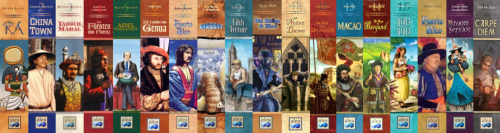
Latin for “dice”, Alea is a brand of Euro games that celebrates their twentieth anniversary this year.  Alea is owned by Ravensburger, a company that has been around for nearly a hundred and fifty years producing everything from instruction manuals to children’s books under their familiar Blue Triangle trademark.  Alea is a more recent development intended to develop a range of strategy games distinct from their more family-friendly range.  Dating from 1999, the Alea range is credited with bringing a lot of “modern classics” to our tables, including Puerto Rico, Ra, Taj Mahal, San Juan, The Castles of Burgundy, Broom Service and one of our groups all time favourites, Las Vegas.  There are four series in the range, the “Big”, “Medium”, “Small” and “very Small” box games, each game in the series is numbered with the artwork on the covers designed to have a “book-shelf” look.

Alea Big Box Games
– Portmanteau image created by boardGOATS

It looked like the end was nigh when Asmodee bought Heidelberger Spieleverlag in 2017, and with it the distribution rights to the Alea brand.  However, Ravensburger reclaimed the rights last year, so to celebrate that and Alea’s twentieth anniversary, they are relaunching the line with new graphics.  They are starting with a new version of The Castles of Burgundy, a boxed set including all the current expansions, and Las Vegas Royale, a big-box version of Las Vegas, including selected elements from the Boulevard Expansion and some new action tiles.  It remains to be seen how many of the old familiar titles will also get a face-lift and make an appearance in the new line and how many new exciting titles will be introduced.

The Complete Original Alea Range
No. Big Box Medium Box Small Box
1 Ra (1999) Louis XIV (2005) Wyatt Earp (2001)
2 Chinatown (1999) Palazzo (2005) Royal Turf (2001)
3 Taj Mahal (2000) Augsburg 1520 (2006) Die Sieben Weisen (2002)
4 The Princes of Florence (2000) Witch’s Brew (2008) Edel, Stein & Reich (2003)
5 Hoity Toity (2000) Alea Iacta Est (2009) San Juan (2004)
6 The Traders of Genoa (2001) Glen More (2010)
7 Puerto Rico (2002) Artus (2011)
8 Mammoth Hunters (2003) Las Vegas (2012) &
Las Vegas Boulevard (2014)
9 Fifth Avenue (2004) Saint Malo (2012)
10 Rum & Pirates (2006) La Isla (2014) V. Small Box
11 Notre Dame (2007) San Juan (2014) The Castles of Burgundy:
The Card Game
(2016)
12 In the Year of the Dragon (2007) Broom Service:
The Card Game
(2016)
13 Macao (2009) Las Vegas:
The Card Game
(2016)
14 The Castles of Burgundy (2011) The Castles of Burgundy:
The Dice Game
(2017)
15 Bora Bora (2013) Puerto Rico:
Das Kartenspiel
(2018)
16 Puerto Rico with Expansions (2014)
17 Broom Service (2015)
18 Carpe Diem (2018)


Boardgames in the News: Spiel des Jahres Awards

This week, Colt Express won the Spiel des Jahres Award.  Although it may seem strange, this German award is highly sought after and is the most coveted award in the world-wide world of boardgames.  The reason for this goes back nearly forty years when the “English” market was dominated by companies like Milton Bradley (who made Scrabble) and Parker Brothers (who made Cluedo and Monopoly).  These concentrated on producing a few top sellers, however, in Germany there was no such dominance.  So, the German market consisted of a large number of small manufacturers producing more varied products.  This, coupled with the traditionally strong German toy industry, encouraged the growth of a culture of families playing games together on a Sunday afternoon.

Spiel des Jahres
– Image from spieldesjahres.de

It was in this environment that the annual German Game of the Year, or Spiel des Jahres Award, began in 1978, with the stated purpose of rewarding excellence in game design, and promoting top-quality games in the German market.  The red pawn of the Spiel des Jahres logo, has since become a mark of quality, and for many German families, buying the game of the year is something they do every Christmas.  Thus, the award has been such a success that it is said a nomination can increase sales from a few hundred to tens of thousands and the winning game can be expected to sell up to half a million copies or more.

El Grande
– Image by BGG contributor Domostie

Over the last fifteen years, years, the Spiel des Jahres has generally gone from highlighting games like El Grande, Tikal and Torres (1996, 1999 & 2000), to rewarding lighter games like Dixit, Qwirkle and Camel Up (2010, 2011 & 2014).  The problem was particularly brought to light in 2002 when Puerto Rico, arguably one of the best games ever made was not rewarded because it was perceived as too complex.  The problem reared its ugly head again in 2008, but this time the jury awarded Agricola a special “Complex Game” award.  These two games are widely considered to be the pinnacle of “Euro-Games”: between them they’ve held the top position on the BoardGameGeek website for the best part of ten years, yet neither were awarded the top prize. The problem was that these games were not mainstream enough for the German family game market:  they were too complex for those families making their annual purchase. On the other hand, for frequent and dedicated boardgamers, these Spiel des Jahres games are too light.  So, for this reason, the Kennerspiel des Jahres or “Connoisseurs’ Game of the Year” was introduced in 2011 and for more serious gamers, this has largely superseded the Spiel des Jahres.  This year it was awarded to Broom Service, a reimplementation of Witch’s Brew which was itself nominated for the Spiel des Jahres in 2008.

Adel Verpflichtet
– Image by BGG contributor Henco

The Kennerspiel des Jahres is not the only prestigious award available to strategy games however.  In 1990, the German magazine “Die Pöppel-Revue”, introduced the Deutscher Spiele Preis or “German Game Prize”.  This is announced in October every year at the Internationale Spieltage in Essen.  In contrast to the Spiel des Jahres, the Deutscher Spiele Preis has gone from rewarding lighter games like Adel Verpflichtet (aka Hoity Toity, in 1990) and our group’s current favourite filler, 6 Nimmt! (winner in 1994) , to highlighting games like Russian Railroads and Terra Mystica (in the last two years).

Deutsche Spiele Preis
– Image from wikimedia.org