Tag Archives: Bärenpark

9th July 2024

When Blue and Pink arrived, Crimson and Cyan were already there on their first visit, finishing their supper and playing a game of Molehill Meadows.  This is a new game by the designer of Zuuli, that they had picked up at the UK Games Expo (meeting the designer Chris Priscott and his delightful family in the process).  In Molehill Meadows, players take on the personality of Mika the Mole, who has an affinity for shiny things, a hunger for juicy worms and an innate desire to dig  A flip-and-write game, players dig tunnels using polyomino shapes to carefully expand their molehill home.

Molehill Meadow
– Image by boardGOATS

Their game was somewhat interrupted as people arrived and were introduced and they were surrounded by the general chatter of arrival and Blue and Pink munching their pizzas.  Crimson and Cyan carried on playing, flipping polyomino cards and then drawing the shapes on their map.  Extending their tunnel to find Worms gave both players four “Worm Powers”, and fining treasure gave them points.  Cyan collected twice as much treasure and picked up more than twice the number of bonus points than Crimson (for collecting all of the two sets of flowers on the Objective Cards) and thus was the eventual victor by something of a landslide (or should it have been a tunnel collapse?).

Molehill Meadow
– Image by boardGOATS

Then, while everyone else generally gossiped and caught up with the events of the last week or so, Jade and Sapphire joined Crimson and Cyan for a quick couple of rounds of the trick-taking, climbing game, SCOUT.  We’ve played this a few times on a Tuesday and everyone has always enjoyed it.  The game is simple in that on their turn, the active player either plays a set of cards to beat and replace the set on the table (a run or a meld), or take one card from either end of the set on the table and add it to their hand.  The round ends if a player plays the last card in their hand, or if it is a player’s turn and they played the current active set of cards on the table.
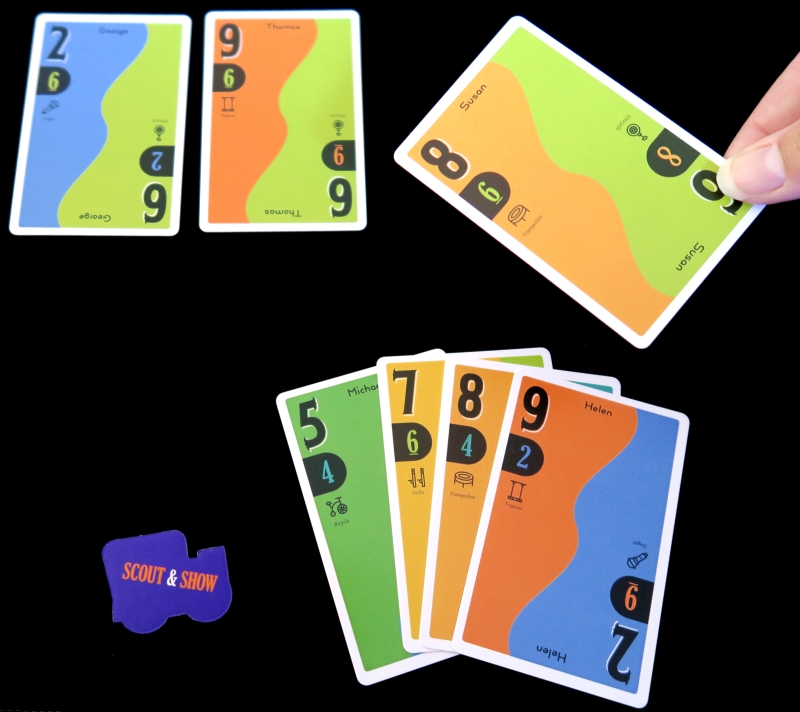
SCOUT
– Image by boardGOATS

At this point, player score for cards in their scoring pile (cards they have beaten during the round), for “chocolate bars” (rewards given when another player takes a card from their active set), and deducts a point for every card left in hand.  The clever part of the game is that, like Bohnanza, cards cannot be rearranged in hand, this with the fact that cards have different values depending which way up they are make this little card game really clever.  In the interests of time, the group only played two rounds, and although the scores can be very disparate, this time it was really tight with only five points between first and last and Sapphire taking the honours one point ahead of Crimson.

SCOUT
– Image by boardGOATS

By this time, Blue and Pink had just about finished eating and everyone else had mostly finished chatting, so with twelve, the group split into three groups of four, starting with Pine, Sapphire and Cyan who joined Jade in the “Feature Game“, Happy Home.  This is another polyomino game, with similarities to games like New York Zoo and Bärenpark, but with a theme of home decorating rather than building an animal park.  Like New York Zoo (or indeed Jokkmokk), the game has a central market, in this case representing a Store, which players move their Meeple round.
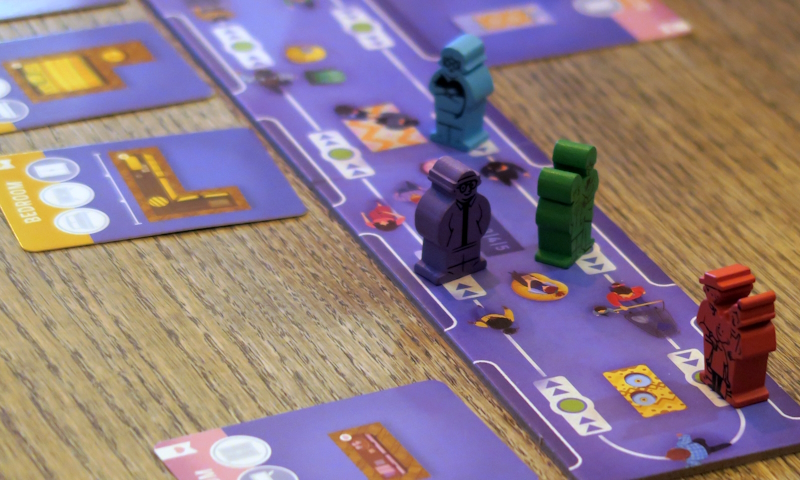
Happy Home
– Image by boardGOATS

On their turn, the active player moves their Meeple (or should that be Muman?) to an available space, takes the card and matching tile and then adds it to their home.  When all the cards are used up, players instead place a “Welcome Mat” on their doorstep to show they are ready to welcome visitors.  When everyone has finished , the game is over and players score their Home for Furniture, Colours, Pot Plants, their Welcome Mat and Design Objectives, losing points for any scratches still visible and not covered up by Furniture.
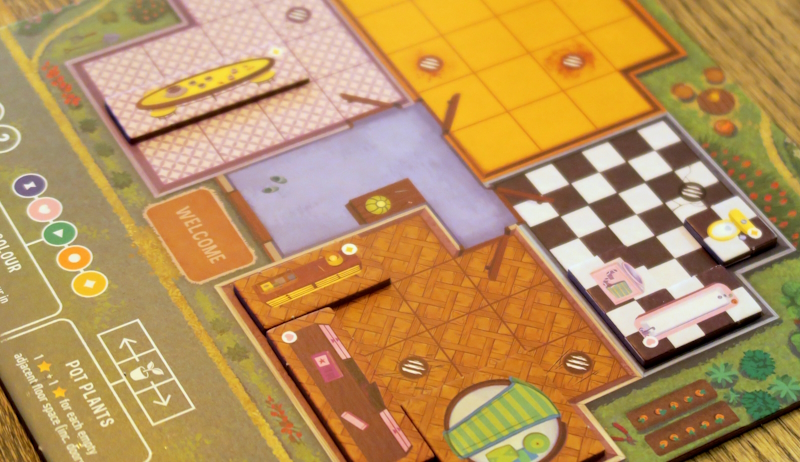
Happy Home
– Image by boardGOATS

There was a wee bit of misunderstanding on how the scoring worked even though Jade had done his best to explain it at the beginning.   Each Room scores one, three or six points if it has one, two or all three different core pieces of Furniture in it, and each Pot Plant is worth a point plus a bonus point for each empty space orthogonal to it.  That wasn’t where the problem was however, that was with the Colour scoring. Essentially players need to have the same Colour across at three different rooms to get two points and across four rooms to get five points, but somehow, this caused more confusion than it should have done.
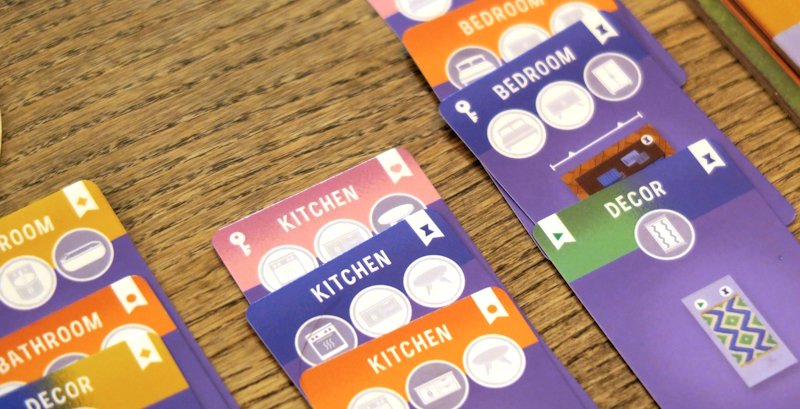
Happy Home
– Image by boardGOATS

The group also made life more difficult for themselves by shuffling the cards and removing twenty-four cards as per the rules for the four-player game, but somehow the bulk of those removed seemed to be Furniture for just one of the rooms, the Bathroom.  It was a good learning game as the value of Rugs, for example, became evident later on—players were a bit confused as they don’t score in their own right, but they add Colour to a Room and thus can score at the end of the game.
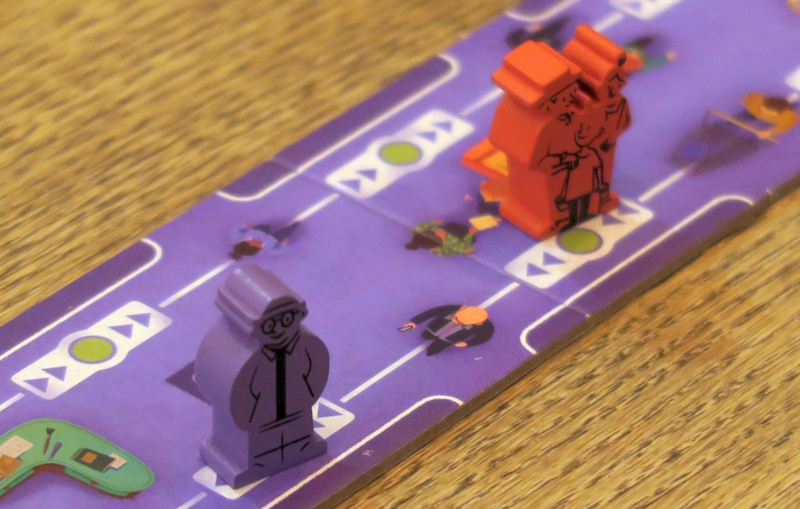
Happy Home
– Image by boardGOATS

This time the Design Objective was “Bigger is Better”, so players lost a point for each empty floor space in their Room with the most empty spaces.  The lack of Bathroom fittings, meant Pine didn’t have a loo in his house and had to resort to “wafflestomping“, but he did have what looked like two pink ironing boards furnishing his Lounge.  Next door, Sapphire filled his Living Room with a pink sofa and an enormous matching pink widescreen TV (that was the same size as the sofa!).  In the end, the victor was a bit of a runaway winner.
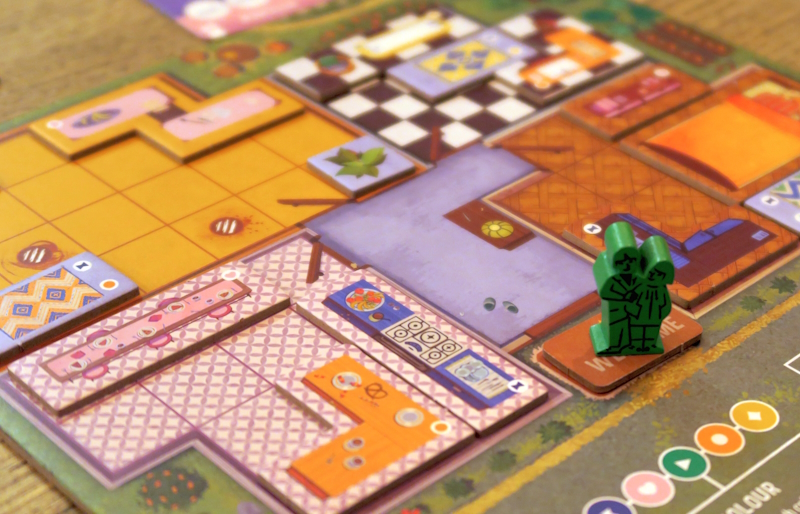
Happy Home
– Image by boardGOATS

In spite of his lack of toilet facilities, Pine finished with twenty-four points, some seven ahead of Sapphire in second, with Jade taking the last place on the podium.  Before the game, Pine had said he wasn’t sure about it from the description, but in the event he really enjoyed it, as indeed did everyone else.  Meanwhile, there were two other games underway.  The first of these was Keyflower—a very popular game with certain members of the group, but one that hasn’t had an outing for a long time, in fact the last time the group played it was online in 2020, and the much-missed Burgundy was involved.
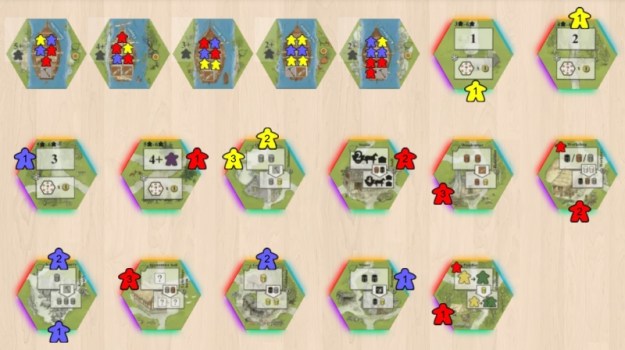
Keyflower on boardgamearena.com
– Image by boardGOATS from boardgamearena.com

This time, the four players were Blue, Pink, Black and Ivory, all of whom had played Keyflower before (albeit a while ago).  The game is fairly simple in terms of concepts, but like many good games, challenging to play well.  Each round, players take it in turns to bid on a tile, or activate a tile.  The clever part of the game is that both bidding and activating is done with red, blue, yellow or occasionally green Keyples (Meeple-shaped workers).  In each of the four rounds (or Seasons), a set number of tiles are put out for players to bid on.  Players take it in turns to bid or activate and when everyone passes in succession, any tiles won are added to the winner’s village, any losing bids and any Keyples used for activating return to their owner.

Keyflower: The Farmers
– Image by boardGOATS

At the end of each round, a boatload of new Keyples arrive in each village (players can bid to get the one of their choice), before the tiles for the next Season are set out.  In general, tiles are drawn at random, and in the first season, Spring, mostly provide Resources with Summer and Autumn tiles providing special powers and Autumn and Winter tiles providing scoring opportunities.  The Winter tiles are different to those for the other Seasons in that instead of being drawn at random at the start of the Season, they are dealt our to each player at the start of the game.  Then, at the start of Winter, players choose from their pile which ones they want to make available—in this way, the Winter tiles act as sort of objective tiles.
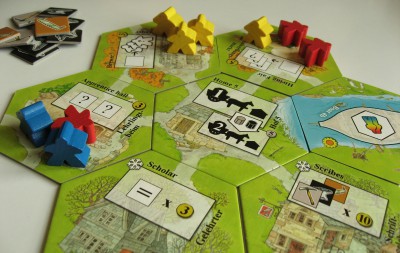
Keyflower
– Image by boardGOATS

The Keyflower box also contained The Farmers expansion and the question arose whether to include it or not.  Blue, Pink and Ivory were on the fence until Black said he’d never played with the Farmers, so of course that was a problem they had to urgently fix.  In the base game, the different tiles are connected by roads which are used for transporting goods to places where they can be used to upgrade tiles or score points.  In The Farmers expansion, these roads now define fields where animals can be left to graze and with each occupied field scoring points at the end of the game.
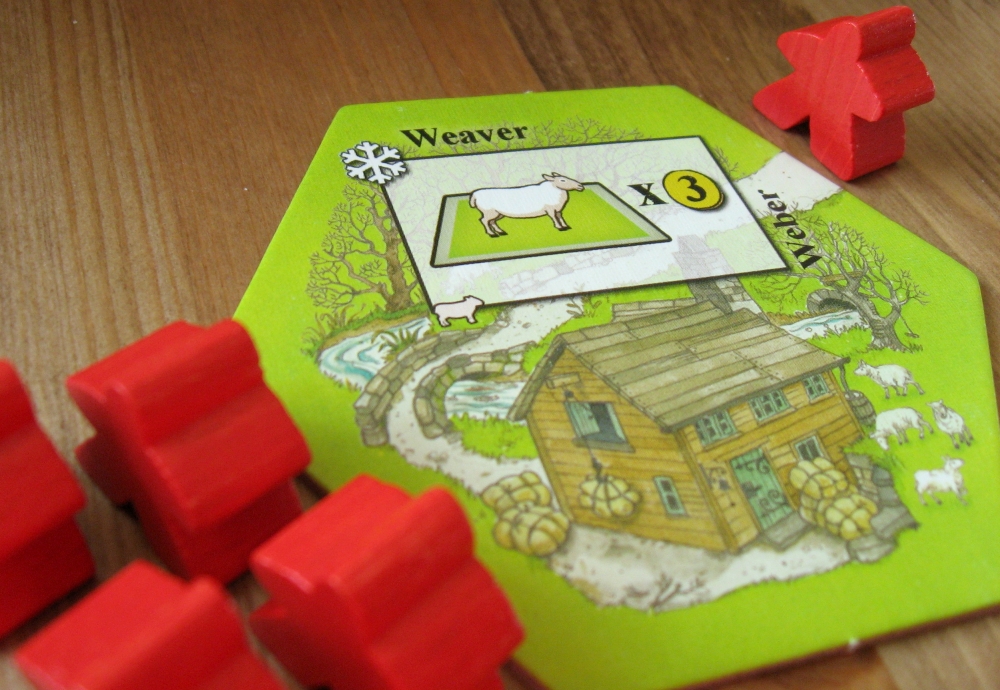
Keyflower: The Farmers
– Image by boardGOATS

Additionally, The Farmers expansion introduces wheat as a new resource, which can be used to add distance/quantity to the movement action, enabling players to move more animals and resources further.  There are several ways to set up the game with The Farmers expansion, but this time the group used The Farmers Variant, where all the tiles from the expansion are used and the number made up with tiles from the base game.  After setting up and explaining the additional rules to Black, Ivory went first, taking the waving purple start-player Keyple, and began the bidding.

Keyflower: The Farmers
– Image by boardGOATS

In Spring, Blue failed to get anything useful at the start of the game (or so she thought) taking just the Key Mine tile which gives Coal and didn’t match any of her Winter tiles.  Pink started off taking the Sheep Fold which gave him a source of sheep and the Paddock which gave him more Movement and upgrade ability together with some Wheat.  Then, he took the Workshop which gave him one resource of his choice from Wood, Coal or Stone, upgradeable to three resources, one of each, which matched his Winter tile, the Mercer’s Guild.  Ivory won the Quarryman, which gave him some very useful gold, and in Summer took the Shepherd’s Hut which gave him Wheat and Sheep and then embarked on a concerted breeding and movement programme.

Keyflower
– Image by boardGOATS

Black picked up a few tiles early in the game, which ultimately led to a lightly sprawling Village by the end of the game.  These included the Wheatfield in Spring and the Tavern, the Smelter and Boat 3a in the Summer.  By this time, Pink had decided that the sheep weren’t doing it for him so moved on to pigs, with the Pigsty.  Blue, having missed out on the Tavern which converts one Keyple into two, instead took the only tile that generated green Keyples, the Store which went well with one of her Winter tiles, the Key Market, but gave the added power of preventing other players from following if she was the first to Bid with Green, as they were highly unlikely to have any.

Keyflower: The Farmers
– Image by boardGOATS

In Autumn, Blue discovered the value of the Key Mine tile she had picked up in the first round, when the Blacksmith tile appeared which gave points for each Coal on the tile at the end of the game.  She added the Ranch to this which gave Cows and Wheat, and then began mining Coal in earnest and hoarding large numbers of sheaves for a super-movement move later in the game to get everything where it was needed as efficiently as possible.  Black got the Goldsmith which went well with his Smelter which gave him the Gold he needed to upgrade it and get ten points, while Ivory and Pink continued their procreation programmes.
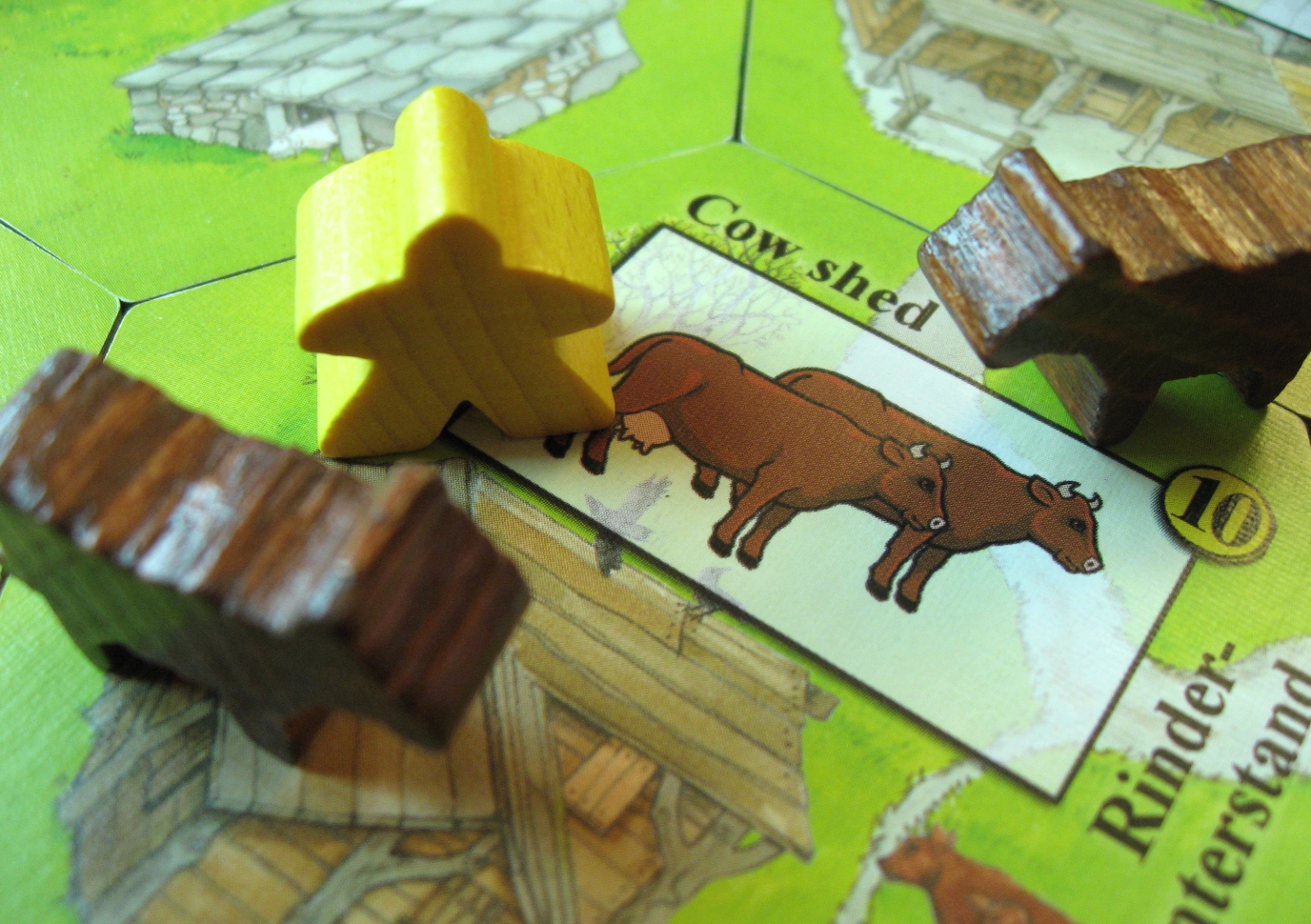
Keyflower: The Farmers
– Image by boardGOATS

As the game progressed there were several visits from the other gamers in the room, many of whom, much to the people who were playing it’s surprise, had not played Keyflower. It is, of course, Blue’s favourite game and was a favourite of Burgundy’s, as well as being generally very popular with almost all of the regulars pre-2020.  So as the game continued into Winter, it was clear it would have to get another outing or two reasonably soon to rectify the situation. There is also The Merchants expansion which has not been played with the group, so that might be the “Feature Game” in the coming months.

Keyflower: The Farmers
– Image by boardGOATS

Only eight out of a possible sixteen Winter tiles were introduced by the players and the Scribes, which Ivory commented usually ensured victory was not there (it turned out nobody had started with it).  Black took the Granary which gave him points for his Wheat and Pink got his Mercer’s Guild that he’d been working towards.  Ivory won the Cathedral giving him a straight twelve points; the Weaver giving two extra points per sheep field, and the Bakery giving four points for each set of a Resource, a Skills tile and a Wheat Sheaf.  Blue had lots of options, so concentrated on building her piles of resources before bidding for her end of game scoring.
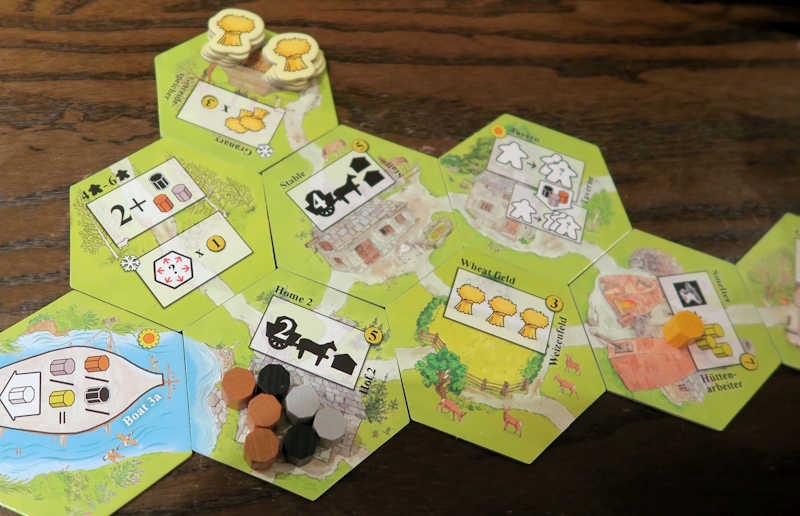
Keyflower: The Farmers
– Image by boardGOATS

This required a lot of nerve as Ivory had there wherewithal to take some of the tiles she obviously wanted.  Ivory hummed and hawed over it and as Black and Pink passed, twice he had the chance to begin a war, but decided not to as “that’s not very nice” and it can also backfire spectacularly.  Instead he generated the odd Gold for a point (“in case it was close”) and waited and watched.  In the end he passed and then Blue passed and that was that bar the counting.  And as it turned out, it was close, very close, but Blue just took victory, by a mere three points, with a total of ninety-five.
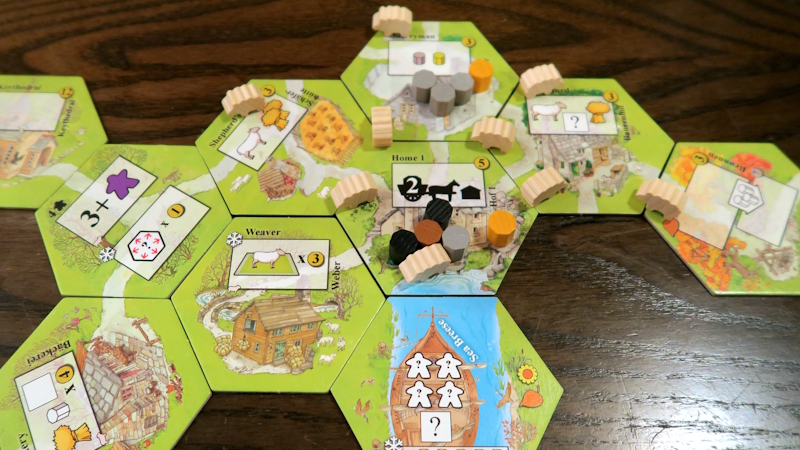
Keyflower: The Farmers
– Image by boardGOATS

The jury is out as to whether it was Ivory’s kindness that cost him the game because Blue did, of course, have contingency plans if someone had tried to take some of the tiles she wanted, and she could have cost him a lot of points.  However, by the end, Blue had no Keyples left and Ivory had a couple that he could have used, so depending on how things had panned out, he might have just nicked it or still lost.  Instead, his kindness and generous good nature won him a lot more respect from his fellow gamers, especially given that everyone knew how fond Blue is of Keyflower successfully destroying her plans might have made her just a little bit sad.
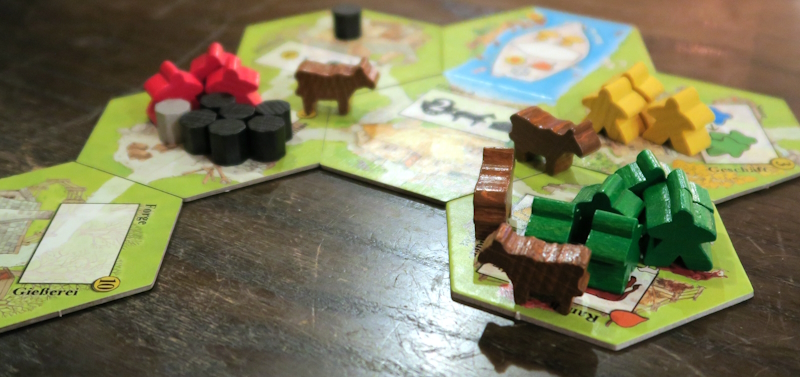
Keyflower: The Farmers
– Image by boardGOATS

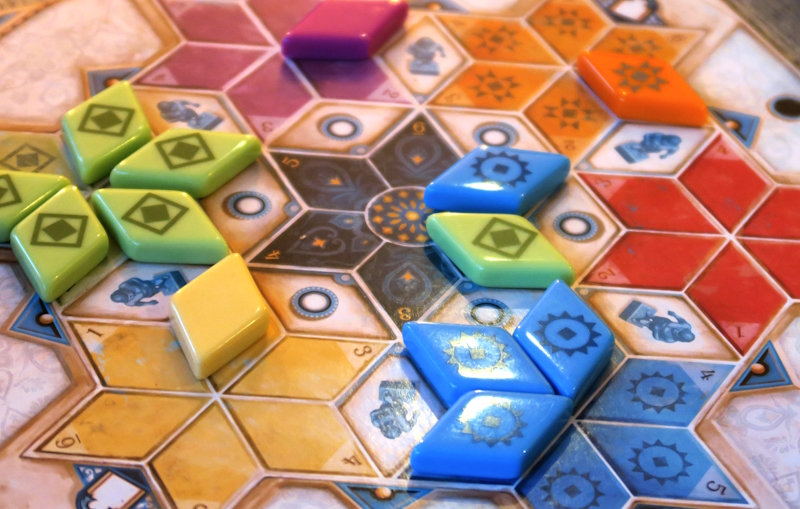
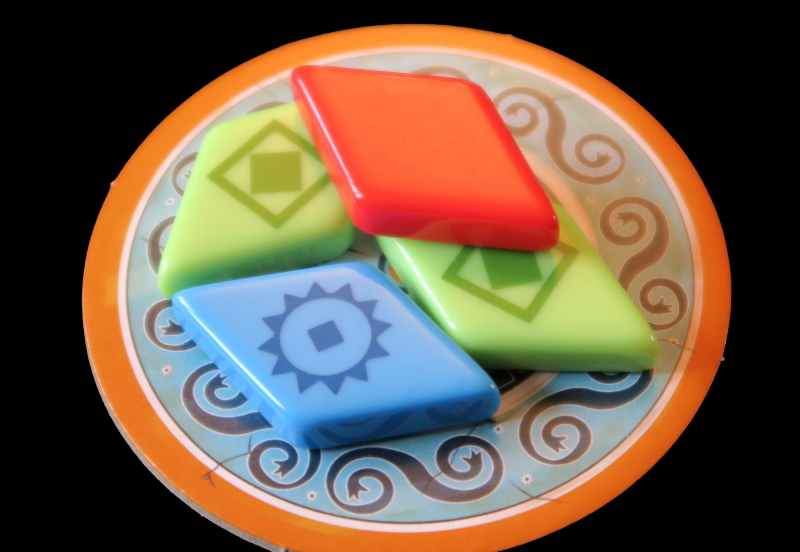
Finally, the third table began their evening with Azul: Summer Pavillion, the third in the series based on the essentially abstract game of tile collecting, Azul.  Crimson kindly obliged in offering to lead the game with Lime, Teal and Purple, none of whom had played this variant before.  This is more similar to the original than the second in the series (Stained Glass of Sintra), but is built on lozenge-shaped pieces that make up hexagons.  Like the original, players take tiles from a central market and add them to their player-boards claiming points as they do so.  In contrast to the original, players store the tiles and add them all to their board at the end of the round (taking it in turns to do so).
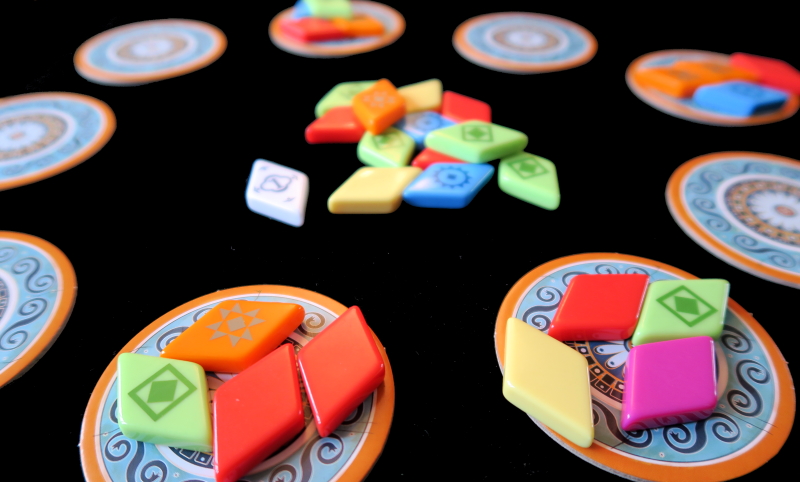
Azul: Summer Pavilion
– Image by boardGOATS

After some initial confusion caused by the additional bag and player boards from the Objective Tiles and Glazed Pavillion expansions, the game got underway.  Unfortunately, there was a bit of a rules malfunction:  initially it was thought that every time a tile was placed it scored one point for itself, two for one next to it and three for a third one in sequence (totalling six).  The group soon realised this wasn’t right though.  So they then thought you scored at the end of the round after playing all the tokens, however, they soon realised there was no way anyone could remember when a new tile that round had been placed.
Azul: Summer Pavilion
– Image by boardGOATS

At this point, they then read the rules and from that decided players score one point for the tile and one for each tile it was adjacent to, thus scoring from one to three points per tile as they were placed and this is how they continued to play.  Cyan immediately identified they had come a cropper when he looked at the low end-game scores. He explained that they should have scored one point for the tile placed and one point for each tile connected to that group, so potentially up to six points could be scored for some tiles!
Azul: Summer Pavilion
– Image by boardGOATS

Although it wasn’t played by “the rules as written”, everyone had the same disadvantage, and the group resolved to give it another go again soon, but with the right rules next time.  As it was, it was a very close game with Crimson, beating Lime by a single point and Teal finishing some half a dozen points behind.  It is a very pretty game, and despite the issues, players had enjoyed making patterns and pushing the tactile bright tiles around, which was very therapeutic after a hard day at work.

Azul: Summer Pavilion
– Image by boardGOATS

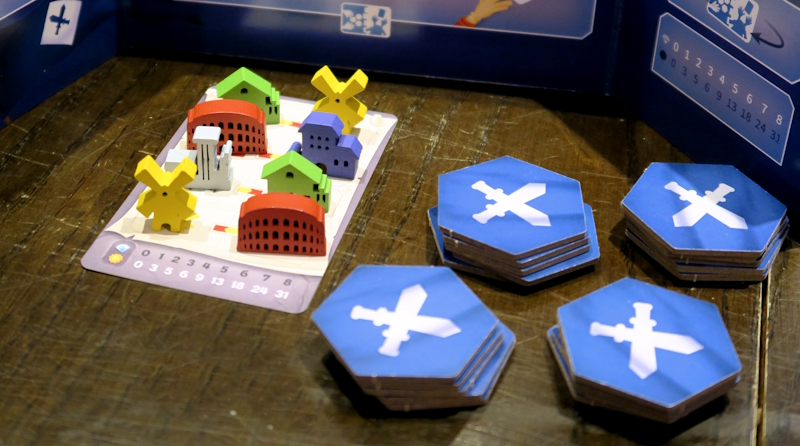
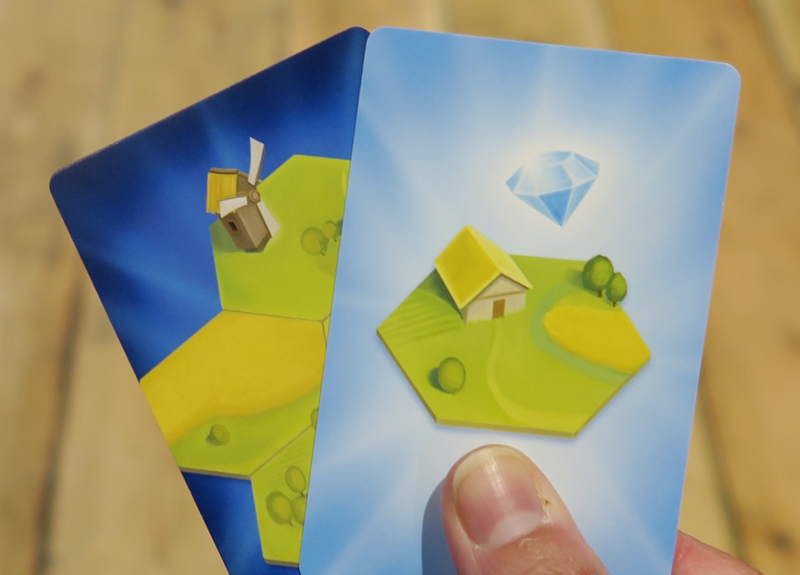
Keyflower was ongoing (and would be for the rest of the evening), but Happy Home had finished so there was a quick game of musical chairs and Purple began by leading Lime, Cyan and Pine in a game of the group’s currently popular filler, Rome in a Day.  This is a little tile laying game built round the “I divide, you choose” mechanism.  The idea is that players draw five land tiles at random and place two buildings on tiles one and two. They then divide the five tiles into two groups—a bigger and a smaller one (in any ratio), and add a Crystal Gem to the smaller land set before offering the choice to their neighbour.
Rome in a Day
– Image by boardGOATS

During the four rounds that the game is played over this neighbour alternates, right, left, right, left. So, each round, players choose a set from their neighbour and these and the tiles they were left with are added to their domain.  At the end of the game, any building that stands on or adjacent to land of its own colour will score for each tile in the group and then players score for the diamonds they have collected—the player with the most points is the winner.  The game has had a couple of outings recently after Black and Purple picked it up at UK Games Expo a few weeks back.  Pine, Lime and Cyan had not been part of those games, so Purple explained the rules.
Rome in a Day
– Image by boardGOATS

The game was a bit of a struggle, probably not helped by the fact that on both the previous occasions the rules have not been strictly adhered to.  This is partly because the rules are not the best written and partly because when the game was explained to Black and Purple at UK Games Expo they were different to those published online.  Although it wasn’t entirely clear to everyone during the game, it was actually very close.  In fact, Lime and Cyan finished tied for first place with forty-four points each despite quite different tactics with Cyan prioritising collecting Gems and Lime making hay in his Wheat fields and wine in his Vineyards.
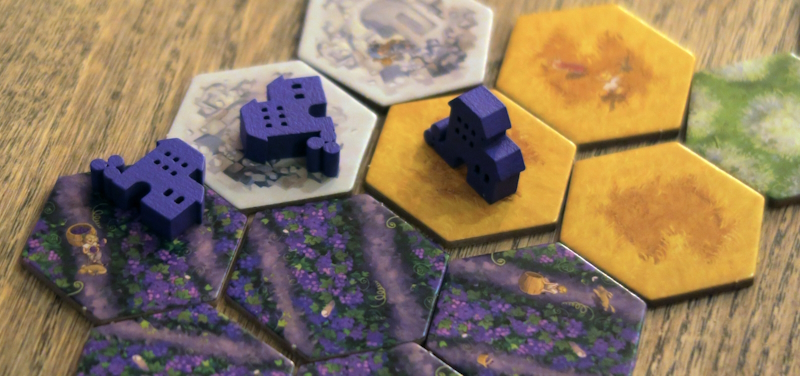
Rome in a Day
– Image by boardGOATS

While the group were fighting their way through Rome in a Day and Keyflower was coming to an end, Jade led Sapphire and Crimson in the 2024 Spiel des Jahres recommended game, Harmonies.  This was described by Jade as a sort of cross between Splendor and Cascadia, with an Azul-type market.  On their turn, the active player takes three wooden Tokens from one of the spaces on the central player board and places them on their player board. These Tokens represent Mountains, Trees, Buildings, Water and Fields.  Some tokens can stack, others cannot: the reasons why are thematic (e.g. tall Mountains and Forests, no tall Rivers etc.), but otherwise Tokens can be placed on any empty space.

Harmonies
– Image by boardGOATS

Players may then take an Animal card from the central display—they can have a maximum of four at any one time and each has a number of Animal cubes on them.  Each time the pattern on an Animal card is fulfilled, one of these Animal cubes is removed and placed on the token indicated on the card.  At the end of the game, players score for the highest achieved Animal on each card and for each Mountain, Tree, Building, Field and River (or Island, depending on  which side of the board players are using).  Mountains are made of stacks of up to three Rock Tokens, while Trees are a green Leaf Token on zero, one or two Wood Tokens.
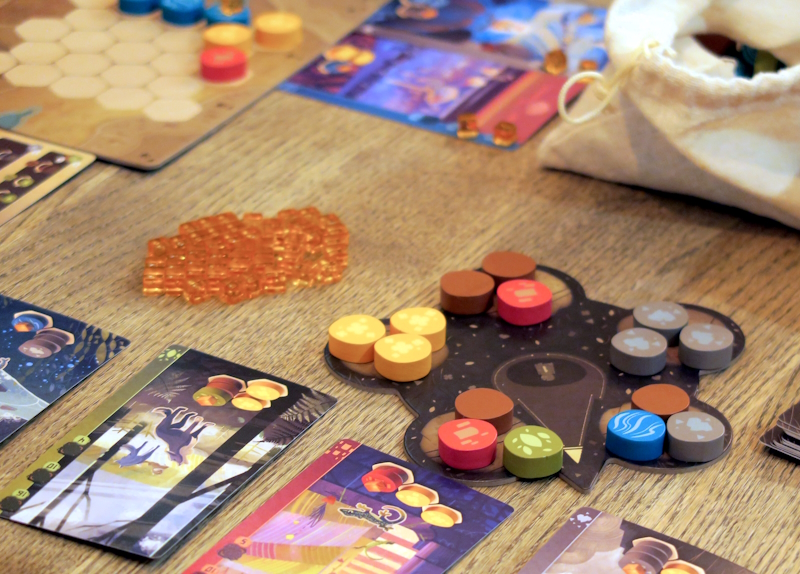
Harmonies
– Image by boardGOATS

Taller Mountains and Trees give more points (one, three or seven points), while Buildings (made of two Tokens, at least one Brick and a Wood, Rock or another Brick), and Fields (two adjacent Wheat Tokens) score five points each.  Finally, depending which side of the board is used, players score points for the length of their River, or five points for each Island they make.  This time, the group played with “Side A” which scores for Rivers.  It was a learning game for Crimson, but was quite close quite between Jade and Sapphire, but Sapphire’s one hundred and eight gave him victory in what is an interesting point-salad tile-placement game that deserves another outing soon.

Harmonies
– Image by boardGOATS

Learning Outcome:  You don’t need a toilet to have a Happy Home.

UK Games Expo 2019 – Not as Hot as Last Year, but that’s a Good Thing…

Last weekend was the thirteenth UK Games Expo (sometimes known as UKGE, or simply Expo), the foremost games event.  Every year it grows bigger, and this was no exception. Historically, Expo is focused on gamers playing games rather than publishers selling new games, however, the exhibition aspect has been growing, and this year there were two halls full of vendors selling games and demoing wares.  Last year, there was an issue with the air conditioning on the Friday which, combined with the thousands of “hot water bottles” walking about looking at games, made it unbelievably hot.  This year, working facilities and a little more space made it much, much more pleasant, although Saturday was busier than ever!

UKGE 2019
– Image by boardGOATS

This year the hot games included Wingspan, copies of which were flying off the slightly wobbly shelves following it’s recent Kennerspiel des Jahres nominationFoothills, a two player Snowdonia game by UK designers Ben Bateson and Tony Boydell (designer of the original Snowdonia, Ivor the Engine and Guilds of London) was another extremely popular game.  Foothills is produced by Lookout Spiele, but there were sixty copies available from the designer’s Surprised Stare stand, which sold out in less than forty minutes (though there were a small number of copies to be had elsewhere for those that kept their eyes peeled).

Foothills
– Image by boardGOATS

Surprised Stare were also demoing Foothills and another Snowdonia-based game, Alubari, which is due for release later in the year (hopefully).  There was a new Ticket to Ride game available (London) as well as another instalment in the Catan series (Rise of the Inkas); the new expansion for Endeavor: Age of Sail was also available to see (coming to KickStarter later in June) and “old” favourites like Echidna Shuffle were there to be played and bought too.  There were some very good deals to be had from some of the third party sellers as well, including some of the Days of Wonder games for just £15.

Horticulture Master
– Image by boardGOATS

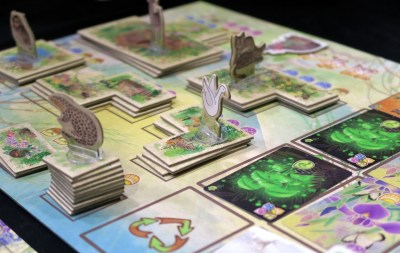
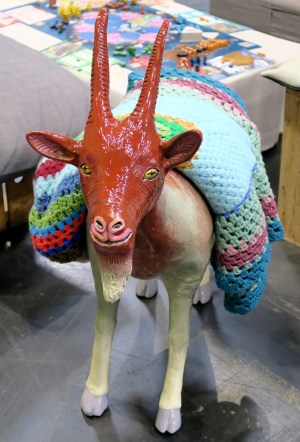
One of the reasons for attending conventions is the opportunity to see and play games that are not available elsewhere.  One example was Horticulture Master, a cute little Taiwanese game with beautiful artwork, which combined card collecting elements from Splendor with Tetris-like tile laying from games like Patchwork and Bärenpark.  Another cute little game was Titans of Quantitas from Gingerbread Games, a clever two player strategy game based round the old fashioned digital rendering of the number eighty-eight.  What really made this game special though was the fact that the stall was guarded by a fiberglass goat!  Not everything was quite as wholesome though, as one Games Master was thrown out and banned for life for including content in a role-playing game that allegedly involved sexual violence and played on the shock factor.  This is definitely the exception rather than the rule, however, and UK Games Expo is a great place for family and friends to spend a weekend.

UKGE 2019
– Image by boardGOATS

17th April 2018

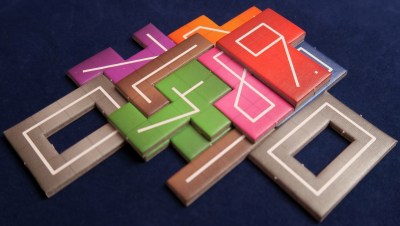
With Burgundy and Blue waiting for food, they decided to entertain Red with a quick game of NMBR 9, making it’s appearance at four consecutive games nights and starting three, something of a record.  Somehow despite this extended run, Red had managed to avoid playing it, so after a very quick run-down of the rules, we started.  The game is really very simple indeed, with players simultaneously drawing tiles and adding them to their tableau. Tiles can be placed on top of other layers as long as they don’t overhang and overlap more than one tile.  Each tile depicts a number and the more tiles it sits on, the more points it scores.  The whole game is typically over in about ten to fifteen minutes, and in this case it was quite tight between Blue and Burgundy, though Blue finished on ahead thanks to a lot of high-scoring tiles on her third level.

NMBR 9
– Image by boardGOATS

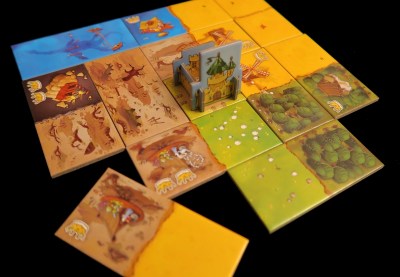
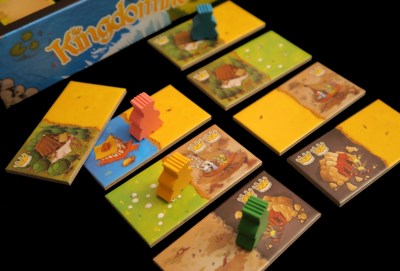
Although it has proved to be a highly popular filler thanks to it’s simplicity and minimal set up time, Red was not so impressed because she felt it had seemed to offer more when she had watched everyone else playing.  She struggled to explain what she meant, but it was clear that she was a little disappointed though that was probably largely due to her expectations.  By this time, food had been dealt with and everyone else was arriving, and as the “Feature Game” was to be be Mini Park, another quick filler, we got on with deciding who would play it.  When Ivory’s comment, “I’ll play that, but it depends on what else is on offer really…” was challenged, he added, “Well, if the alternative is Kingdomino, I’d rather try Mini Park!”  Since Black had chosen that moment to wave Kingdomino around, that pretty much settled them as the two games and uncharacteristically, almost everyone jumped on the Mini Park band-waggon, leaving Black and Purple to play Kingdomino alone.

Kingdomino
– Image by boardGOATS

The group doesn’t usually go for two-player games and as Black and Purple get lots of opportunity to play games like this together, normally someone would join them.  However, in this case, both games were short and Kingdomino can be a bit variable with three due to the tiles that are left out, so we just got on with it.  Kingdomino was the Spiel des Jahres in 2017 and has been very popular within the group as a light filler, so has hit the table quite a bit in the last year.  The game is quite simple in that players take it in turns to choose a “domino” and add it to their “Kingdom”.  The clever part of the game is that the tiles are numbered with players who choose the high numbered (and therefore more valuable) dominoes taking their turns later in the next round.  In the two player game, players get two turns per round, so their first turn can be used to try to set up the second turn.

Kingdomino
– Image by boardGOATS

Unfortunately, Black and Purple forgot about the other key difference when playing a two player game:  instead of 5×5 arrays, each player is building kingdoms consisting of 7×7 arrays of “squares”.  They suddenly noticed they had more tiles left than they had spaces and realised their error, so decided to carry on playing anyhow.  Purple concentrated on getting corn fields and then sea and finally forests, while Black just tried to build areas of everything and make sure he was able to place all his tiles.  It was very, very close, but despite the fact that she had to forfeit some tiles and failed to pick up her bonus for completing her grid, Purple just pinched it by a single point.

Kingdomino
– Image by boardGOATS

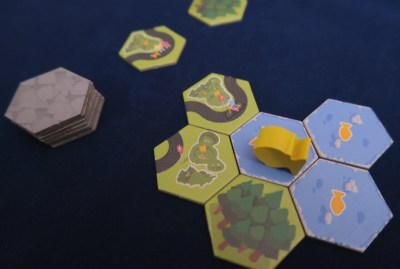
Meanwhile, on the neighbouring table, everyone else was learning the “Feature Game”, Mini Park, another quick-playing, tile-laying game.  On the face of it, this has a lot in common with Carcassonne, played with two face up tiles to choose from.  In contrast, however, the tiles are hexagonal which gives a little more variability and once during the game, players choose one character which dictates the end game scoring.  We played the “advanced” game which has slight changes to the scoring and pairs each scoring character at random with a second character.  In our game, for example, the Black Man in the Smart Hat was paired with the Yellow Fish, so the player who chose the Man (Ivory), got half the points that the player who chose the Fish got for that character (Blue).  It was felt that this would add an interesting dynamic to the game as it would take on some aspects of a semi-cooperative game.

Mini Park
– Image by boardGOATS

Unfortunately, nobody realised at the start just how powerful (or not) each of the characters were and in that game it turned out that some were really very powerful indeed.  For example, at the start of the game everyone was encouraged to place fish next to other fish, as this was the only way to make them pay when they were being placed.  However, this left a large fish pond with lots of fish and when Blue (who was the first to get to the Yellow Fish Marker) and then Ivory added to it, it yielded a massive twenty-four points.  Although this was the most lucrative character, the Green Man on a Bicycle (claimed by Pine) was not far behind with eighteen points.  This was thanks largely to the fact that Pine and Blue (who had the Bicycle as her subsidiary character) kept drawing road tiles and extending the road the Bicycle was on, trying to scupper Ivory’s plans to build roads with benches.

Mini Park
– Image by boardGOATS

Although Burgundy picked up the most points for tile placement, the majority of the points come at the end of the game and, as he was last to pick his character, Burgundy was penalised when he ended up with the relatively low scoring White Bird (ironically partnered with the Orange Cat that also failed to score highly).  Pine scored well for his Green Cyclist, but did not pick up enough subsidiary points from the White Bird.  Ivory’s subsidiary scored highly (Yellow Fish), but much to his chagrin the scoring for his Black Man in a Smart Hat was severely restricted by Pine and Blue’s tactics. Blue, however, did well on both her primary goal (Yellow Fish) and her subsidiary (Green Cyclist), giving her more than enough compensate for a poor score on the tile placement, and she finished some way in front.  If everyone had realised the implications of how the scoring worked, it was quite likely that they would have played differently and it would not have been such a landslide, and chatting afterwards, it was obvious that that aspect coloured people’s opinion of the game.

Mini Park
– Image by boardGOATS

The fact that everyone had only one shot at a character was meant it felt that all a player’s eggs were in one basket.  This was made worse by the fact that with only one shot, the challenge was when to choose a character:  too early and everyone else would be able to obstruct, too late and only the dross is left with not enough time to improve the situation.  That said, it was not a long game and with only three players it would be very different as each player gets two opportunities to take character cards.  Furthermore, it seems the rules are still being developed, for example, the latest version of the online rules state that the subsidiary character cards are placed face down and thus kept secret until the end of the game and the tile placement scoring has been simplified too.  Given that it is such a short game, we should certainly give this one another go sometime, perhaps with the new rules-set.

Mini Park
– Image by boardGOATS

Kingdomino and Mini Park finished at much the same time, which meant i was possible to re-balance the number of players a little, but not before the usual shenanigans regarding who wanted to play what.  Although neither mentioned it by name, Burgundy and Ivory clearly had an eye on giving Yokohama another go.  Time was marching on though and Yokohama isn’t a short game, and even without any rules explanation there is a lot to setup.  The 10th Anniversary Edition of Puerto Rico was also available though, and there was just time to squeeze in a game provided it started straight away.  So as Ivory had somehow managed to avoid playing it thus-far, we felt it was essential that we rectified the situation and Burgundy and Ivory started setting it up.  With Blue joining Burgundy and Ivory, that left four people looking for something interesting to play, so Blue suggested Bärenpark.  This another fairly light tile laying game, this time set in a bear park.

Bärenpark
– Image by boardGOATS

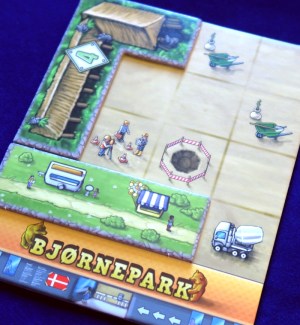
Each player starts with a plot that will become their park, and the idea of the game is that on their turn, players place a tile from their personal supply on this plot.  Each starting plot has a different array of symbols on some of the spaces, indicating different types of tiles.  When these symbols are built over, the player takes more of the appropriate tiles from the general supply to add to their personal holdings.  Some of these are small animal houses, some are larger enclosures and some are very small amenities like toilets and children’s play areas.  Each tile also has a Construction Crew and a Pit providing the foundations for a Bear Statue.  The Construction Crew allows the player to take an expansion board for their park, providing a new plot which they place next to their park.

Bärenpark
– Image by boardGOATS

In contrast to the rest of the spaces, the Pit cannot be built upon in the usual way and is the last space to be covered in each plot; once every other space in a plot is covered, the owner can claim a statue from the display and place it over the Pit.  These statues provide points, with the statues providing a diminishing number as the game progresses.  Other sources of points include the animal houses and enclosures, but the number of these are limited and again, the earlier tiles are worth more.  The small amenity tiles do not score points, but they allow players to fill in those awkward, difficult-to-fill, small gaps, enabling them to finish a plot and build a statue.  Even these are limited, though to a lesser extent, so players need to be on the watch in case they are caught out.  The game ends when one player fills all of their four plots and then everyone adds up their scores.

Bärenpark
– Image by boardGOATS

After a little grumbling about koalas not being bears (the rules explain that “people like koalas, so we will be including them in our park!”), and a brief explanation from Blue, everyone started building.  It was a fairly close game, but Black finishing with eighty-eight, seven points ahead of Pine in second place.  Asked what he thought of it, Black’s comment was that it was a very simple game, but the group had been playing the basic game.  The “Expert Variant” has achievement tiles which provide another source of points and make the game far more interesting for experienced gamers.  Red, on the other hand, enjoyed the game much more, somehow finding in it the tessellation building thing that she had struggled to describe, but she had felt was missing in NMBR 9.

Bärenpark
– Image by boardGOATS

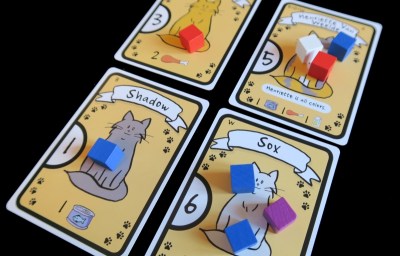
Puerto Rico was still going, so the group moved on to one of Purple’s current favourites, Cat Lady.  This is a light card game that got an outing last month as well.  The game is a very simple a card drafting game, similar in feel to Sushi Go!, though with a very different drafting mechanism.  On their turn, the active player takes all thee cards from one row or column in the three by three grid, marking the row they took with a kitty meeple.  The cards are replaced from the draw deck and the next player then takes a different row or column.  Cat cards go in front of the owner who must feed them before the end of the game or they score negative points.  Any food cards yield cubes which can then be placed on the face-up cat cards to show they are being fed.  Similar to Sushi Go!, there are also cards that score for the player with the most cards (cat “costumes”) and give players with the fewest negative points and sets that players can collect (toys).

Cat Lady
– Image by boardGOATS

Players can also collect catnip cards which score minus two if the player only has one at the end of the game, or one or two points per cat if they have more.  There are also lost cat cards, and discarding a pair allows players take a two victory point token or one of the three stray cat cards which are particularly useful because they have special powers.  The tricky part is making sure that the food a player gets matches the cards, because cats are fussy creatures and some like tuna, while others will only eat chicken…  At the end of the game, players score points for each happy well-fed cat and for their toy collection with extras if they have the most cat costumes.  Unfed cats, having the fewest costumes, and the largest surplus of food will give players negative points.

Cat Lady
– Image by boardGOATS

This time everyone went for different approaches with differing degrees of success.  For example, Purple went for costumes and Pine went for toys; Black and Red both went for lots of cats and catnip, but Black failed get enough catnip to score, and actually ended up with negative points.  It was very close between Pine and Red in the end, but Pine who had fewer cats (but very contented ones thanks to all the toys they had to play with), just beat Red with her larger number of cats that were all high on catnip.  Time was getting on and Puerto Rico was just coming to an end giving them just enough time to watch the last few rounds.

Cat Lady
– Image by boardGOATS

Puerto Rico was the number one rated game on the BoardGameGeek website for over five years and still commands a lot of respect though it has significant flaws.  The problem is that there is very little randomness in the game which is great, but when a game like that is played a lot people become “experts” and there is a perception that there are right and wrong moves.  In Puerto Rico, this point is exacerbated because of the way the game is played.  In each round, beginning with the Governor, players take it in turns to chooses an action.  Every player carries out the action, but the player that chose it gets a “privilege”, i.e. a bonus.  The catch is that players that players need to watch what everyone else is doing in order not to give an advantage to an opponent, or worse, give one opponent an advantage while making life difficult for someone else (also known as “King making”).

Puerto Rico
– Image by boardGOATS

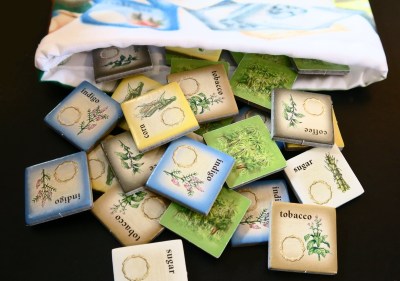
In Puerto Rico, players are plantation owners in seventeenth century Puerto Rico growing up to five different kind of crops: corn, indigo, sugar, tobacco, and coffee. Each plantation owner must try to run their business more efficiently than their competitors. First they must grow their crops then they must store them efficiently. Finally, players must sell their crops at the right time or ship their goods back to Europe for maximum benefit. In order to do this most effectively, the plantation owners must make optimal use of the arriving colonists and develop the capital city, San Juan, building useful amenities.  Thus, the aim of the game is to get victory points which are awarded for buildings and for shipping goods. However, to build, players need money, and before they can ship goods, players need to be able to produce the goods with a plantation, and where necessary process them in the appropriate building.

Puerto Rico
– Image by boardGOATS

As Ivory had not played the game before, Burgundy was Governor for the first round and Blue went second, giving him a little thinking time before he had to choose an action.  This has consequences for the setup, with Blue and Burgundy starting with an indigo plantation and and Ivory starting with a corn field.  At first, Ivory couldn’t see why corn might be useful as selling it doesn’t give any money, however, he quickly realised that it doesn’t need a production building and therefore is quicker and easier to produce, making it ideal for shipping.  Blue joined him and the pair were soon filling boats as often as they could.  Burgundy meanwhile, had gone for the high value coffee.  This took him a little while to get going, but once he had a coffee roaster he was able to sell his first batch of coffee and for a short while looked like he was going to storm ahead as he added sugar to his portfolio.  Unfortunately, for him, once he had spent his coffee profits, Burgundy got a little stuck as Blue and Ivory worked together very efficiently to make life difficult for him.

Puerto Rico
– Image by boardGOATS

To begin with, Burgundy was able to ship his coffee, but as it is a high value produce, he really wanted to sell it and use the profits to build.  That wasn’t possible though as the Trading House already had a coffee crate in it and until there were four different commodities there, no more coffee could be sold.  Burgundy had been able to commandeer a ship for coffee, but once that was full, Burgundy was in an even worse position, because between them, Blue and Ivory were able to make it very difficult for Burgundy to ship two different goods types.  The reason why this caused him problems was because of the Boston Tea Party Rule:  after shipping, players are only able to keep one crate and anything else is lost over the side.  Thus, to begin with, Burgundy was forced to ship when he didn’t want to, and then lost valuable stock when he couldn’t ship.  And all the while, Blue and Ivory were collecting victory points for shipping their corn and a little sugar or indigo.

Puerto Rico
– Image by boardGOATS

Ivory had got off the mark quite quickly buying a Hacienda early on.  It wasn’t till much later in the game when Blue bought a second that we realised we’d been playing it wrong and instead of choosing which extra plantation tile he got, he should have been drawing them blind.  This had two consequences:  firstly it gave Ivory a small, but potentially significant advantage, and secondly, it meant we didn’t run out of plantation tiles quite as quickly as we would otherwise have done.  It couldn’t be fixed though, so we just carried on and as long their strategies were aligned, Blue and Ivory were worked well together.  It wasn’t long before Ivory moved on to the next stage of his development and first built a Factory and then started raking in the cash every time he produced.  Blue then built herself a Warehouse and upped her shipping rate and starting raking in the victory points.

Puerto Rico
– Image by boardGOATS

The game was coming to a close when the Big Question came up:  Burgundy asked whether players were allowed to buy more than one large building.  Both Burgundy and Blue had a vague recollection of the rule, but it couldn’t be found in the booklet.  Ivory graciously switched his strategy and did something else, though checking later proved that was wholly unnecessary.  The game came to a close as we ran out of  on victory point chips and colonists (something that would have happened a lot earlier had we realised there should always be a minimum number arriving on the Colonists Ship), and all that was left was to tally up the scores and it was very tight indeed.  Although he had lots of buildings, Burgundy’s shipping had been effectively stymied by Blue and Ivory and the shortage of colonists had also made things a lot more difficult for him than it should have been, despite all that though, he wasn’t far behind Blue and Ivory.  In the end, Ivory won by a single point.  There was no need to re-count as he would have undoubtedly won by far more if he had built that second large building, though perhaps that off-set some of the advantage he had received early on with his Hacienda.

Puerto Rico
– Image by boardGOATS

Learning Outcome:  Sometimes it is best to play the “basic” game to get a feel for it before trying the advanced rules, but other times, it just feels trivial.

Boardgames in the News: The Consequences of Losing Catan—The Demise of Mayfair

The dramatic growth of Asmodee has been the subject of much comment over the last few years, but more recently it appeared to have slowed a little.  It would seem that perhaps the consequences are now beginning to kick in though.  Nearly two years ago, Asmodee acquired the rights to the English Language edition of the Catan series of games from Mayfair Games.  At the time there was some speculation as to the effect this would have on Mayfair as the Catan range had dominated their catalogue and provided a high proportion of their revenue.  The loss of such a large part of their portfolio inevitably led to major restructuring particularly as the then CEO of Mayfair, Pete Fenlon, left to become the CEO of the new Asmodee owned “Catan Studio” taking a bunch of other people with him.

The Settlers of Catan
– Image by boardGOATS

Thus, Mayfair not only lost the Catan franchise, but also their entire development team and graphics department. Essentially, they were left with Alex Yeager as lead developer, head of acquisitions, and marketing manager and a catalogue of about a hundred games including some of the popular 18xx series, Martin Wallace’s Steam, Caverna: The Cave Farmers, Lords of Vegas and Nuns on the Run.  Mayfair also had a controlling influence in the German company, Lookout Games which they had acquired back in 2013, and this partnership had produced games like Isle of Skye: From Chieftain to King, Costa Rica and Patchwork. The Mayfair strategy was primarily to focus on the partnership with Lookout while continuing to support their existing catalogue, and then, once that was stable, further develop the Mayfair-exclusive products.

Mayfair
– Image from twitter.com

Questions were first asked when Mayfair didn’t exhibit at PAX West or PAX Unplugged, despite featuring in the exhibitor list, though they did present as usual at BGG.CONAt the beginning of November, however, Alex Yeager announced that he had left Mayfair, and this, together with the earlier departure of Julie Yeager and Chuck Rice indicated that the chairs were being shifted on the deck of the Titanic, and there were rumours that Mayfair was in trouble.  Mayfair had not independently produced a new title since the loss of the Catan franchise, but they still had their controlling stake in Lookout Games and producing the English language version of the popular Lookout range of games seemed like the basis for a strong partnership.

Lookout Spiel
– Image from lookout-spiele.de

Lookout Spiele was a highly successful German company responsible for developing games like Agricola, and more recently Bärenpark and Grand Austria Hotel.  At Spiel in October, Mayfair and Lookout shared an extremely popular booth, and it seemed so successful that there were rumours that another merger was on the cards. Sadly however, this was not the case, and on Friday it was announced that Mayfair had sold its three remaining assets (their games inventory, the IP, and their 74% stake in Lookout GmbH) and was closing their doors after thirty-six years.  Simultaneously, Asmodee acquired the remaining 26% of Lookout from the original owner, Hanno Girk and on Friday announced their take-over of Lookout.  With that, one of the most productive and popular of the German board game companies joined the likes of Days of Wonder, Fantasy Flight Games, Space Cowboys, Z-man Games, Pearl Games, Ystari, Plaid Hat Games and of course Catan as yet another “Studio” in the great Asmodee Empire.

Asmodee
– Image from lookout-spiele.de