Tag Archives: Century: Spice Road

27th May 2025 (Report)

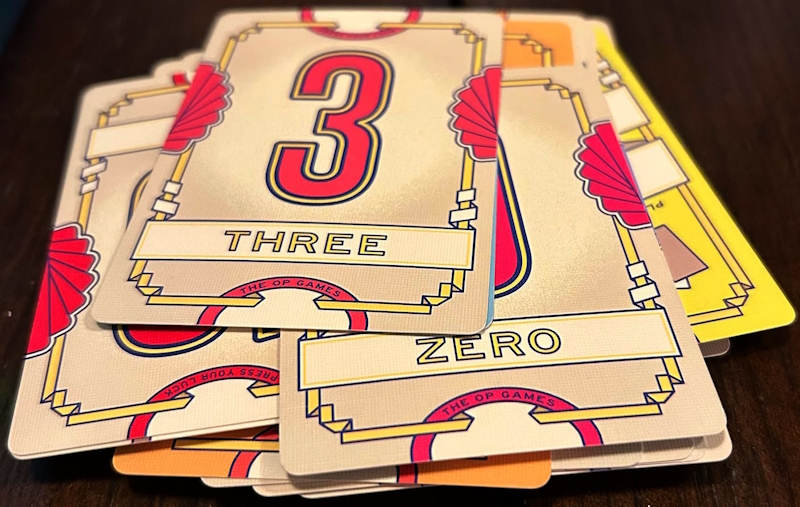
This week, Jade was proactive and quickly got a group together to play the “Feature Game“, which was to be Flip 7.  This is a quick, push-your-luck card game along the lines of Blackjack and recently won a Golden Geek award and received a nomination for the Spiel des Jahres.  The group have already played it a couple of times on a Tuesday, but we wanted to raise its profile and share it more widely amongst our people by making it the Feature Game.  The idea is really simple:  players turn over cards and gamble on not revealing the same number twice.  Unlike Blackjack, the game is played turn-wise, so the the dealer starts by dealing one card to each player.  Then players take it in turns to decide whether they want to “flip” or ” stick”.

Flip 7
– Image by boardGOATS

This mode of play is critical to the game’s popularity because it keeps everyone involved and the turns short. If players stick, they score the total of the face value of their cards.  There are a couple of other things that make the game tick, in particular the fact that each numbered card appears in the deck that number of times (i.e there is one one, two twos and so on).  Thus, the highest scoring cards are also the most risky.  Further driving push to gample, flipping over seven cards in a row gives fifteen bonus points.  There are also some action cards in the deck, “Flip Three”, “Freeze”, “Second Chance” and modifier cards which give extra points, all of which break the rhythm and add interest without adding significantly to the downtime.
Flip 7
– Image by boardGOATS

The game ends when players have reached the pre-agreed total (two hundred, according to the rules, though games can easily be made longer or shorter as desired).  This time, the group played the game as written, to a total of two hundred, which took seven rounds.  Sapphire  and Flint managed to go bust five and six and seven rounds respectively, though Flint did manage to push his luck to get seventy—the most in a single round.   Jade achieved a new low, however, failing to score at all.  The front runner was Teal, but going bust in the sixth round left the door open to Ruby who had been matching him step for step, scoring in every round and triggering the end of the game with her unsurpassed two-hundred and thirteen.

Flip 7
– Image by boardGOATS

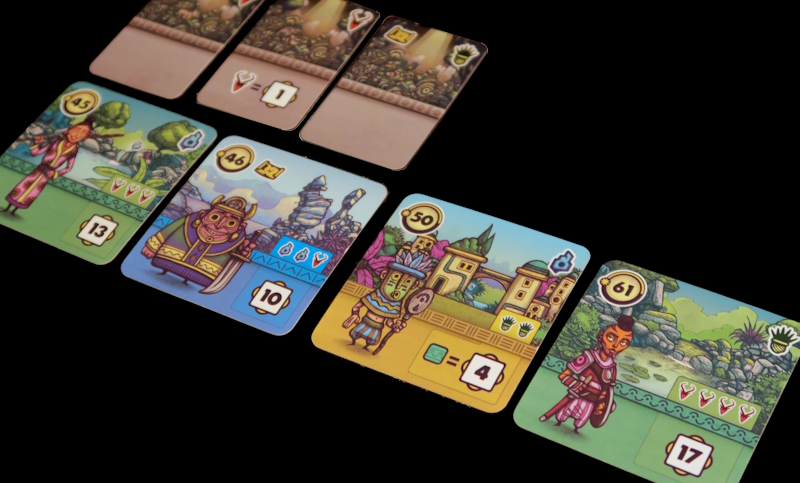
Everyone else was playing a longer game, so with six, that left the choice of another six player game or splitting into two groups of three.  The party feel of Flip 7 had got everyone in the mood for playing in a larger group, leaving a fairly limited choice, though there are a couple of really good options.  Bohnanza is one, but instead, the group chose Faraway—another game that received a Spiel des Jahres nomination this year, that we first played in the group over a year ago and has proved very popular since.  This is another relatively simple game, this time  with a market and a trick-taking type element, but with a really clever twist, and one that really messes with the head.
Faraway
– Image by boardGOATS

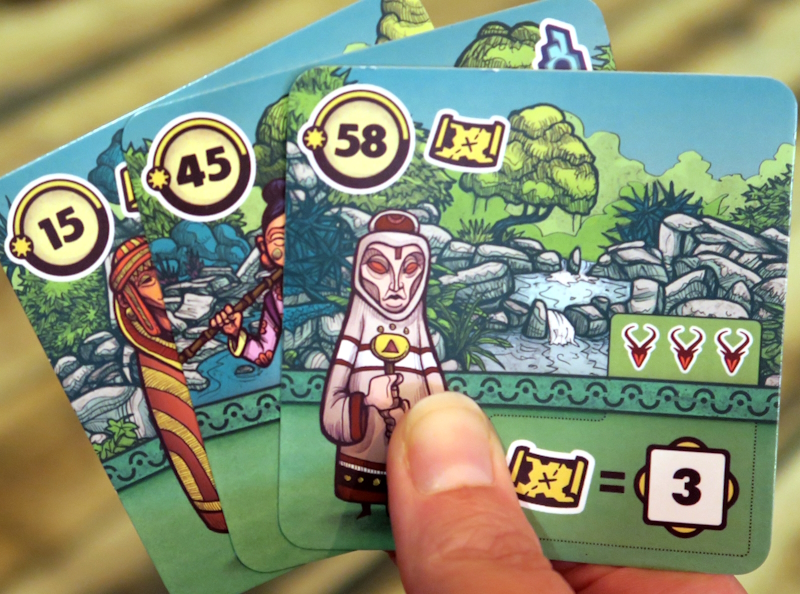
The story is that players are exploring the mysterious land of Alula in search of its secrets, meeting its inhabitants and listing its wonders in order to gain more fame than everyone else.  Players simultaneously chose one of the numbered cards from their hand to add to their tableau then, starting with the the player that played the lowest card (similar to 6 Nimmt! or Kingdomino), everyone takes it in turns to choose one from the market to add to their hand.  Players then simultaneously choose another card to play, and again, choose one to add to their hand.  The game ends after everyone has played a total of eight cards, and then everyone scores.
Faraway
– Image by boardGOATS

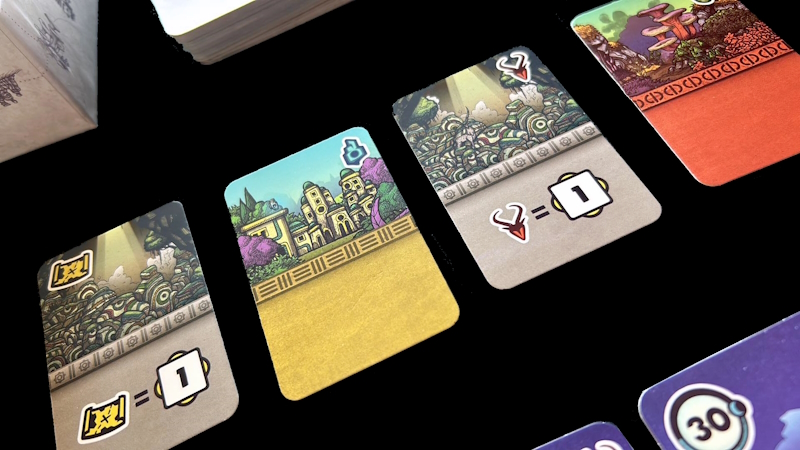
The scoring is the really clever part, because although the cards are played into tableaux from left to right, the scoring is from right to left.  At first glance, this looks like it makes things easy, because early in the game players find out what they need to get points and can then focus on getting the resources they need as the game progresses.  However, the desire to play scoring cards early is tensioned against card choice (the player who placed the lowest numbered card goes first) and the ability to get Sanctuary bonus cards.  Scoring cards are generally higher number and Sanctuary cards are gained when the card played has a higher value than the previous one in their tableau.
Faraway
– Image by boardGOATS

It is always hard to see how players are doing with this game, because if a player has played a high value scoring card early it can be worth a lot, but if the player fails to gain the necessary resources it can be worthless.  In the event, it was quite close with four of the six players scoring over sixty.  The winner, however, was Pink who got lucky early when he played card number fifty-nine first to start a map strategy and finished with five of them.  Sapphire was only two points behind in second though, and Teal two points behind that.

Faraway
– Image by boardGOATS

Meanwhile, on the other side of the room, Black and Purple were introducing Pine to Looot, another game that received a nomination, this time for Kennerspiel des Jahres, the “Expert” or “Connoisseur’s” game.  This is a game where players gather resources and capture buildings to develop their fjord, fill their Long Ships and complete buildings to rack up victory points. The player with the most riches is crowned Jarl of the Vikings.  The game is played over several rounds until each player has played all their Vikings, giving a maximum of thirteen turns.  In each, a player first places their Viking on a Resource tile on the central board adjacent to another Viking of any colour and takes the Resource and place it on their personal board.

Looot
– Image by boardGOATS

If possible, they then capture a Building and place that on their board, take a Long Ship and also place it on their board, use a Shield, complete a Construction Site and finally grab a Trophy.  At the end of the game, scoring is a bit of a point salad with points awarded for Castles, Watchtowers, Houses, Gold, Sheep, Trees, Construction Sites, any Trophies the player may have claimed and a five-point penalty for any unfilled Long Ships.  Purple raked in points for her Houses, Construction Sites and Trophies, while Black did better for his Watchtowers and Gold, and Pine top-scored for Trees.  The winner, however, was Purple whose total of ninety-one was five ahead of Black in second.
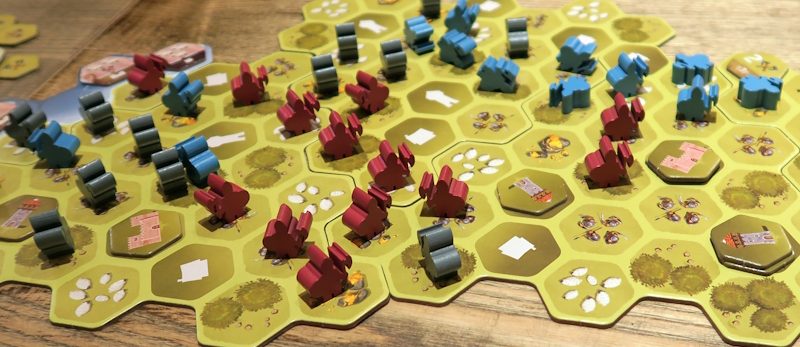
Looot
– Image by boardGOATS

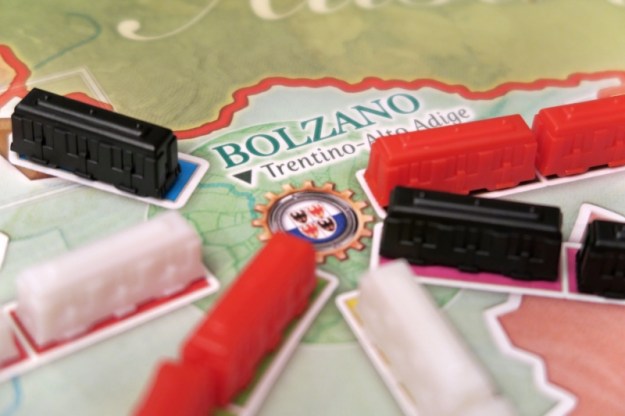
The trio followed this with a shorter game, the Paris version of the 2004 Spiel des Jahres winner, Ticket to Ride (aka Zug um Zug).  Like the original, game-play is very quick and simple:  players take it in turns to take Cards from the market, or spend them to place Trains on the map with the aim of completing Tickets.  Players score points for placing Trains and completing Tickets with penalties for any incomplete Tickets.  Each game variant has its own special rules.  In the case of Paris, when players score bonus points each time they complete a Tricolor: a set of blue, white, and red routes.  This time it was a very close game.  Pine had the most points collected during play (including Tricolors), but Black picked up more for his Tickets and edged it by a single point.
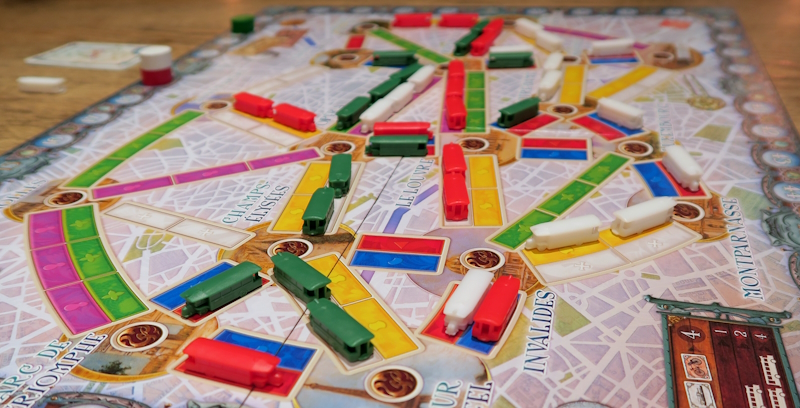
Ticket To Ride: Paris
– Image by boardGOATS

The final game of the night took all evening and was the only one that that has not had a nomination for the Spiel des Jahres, Century: A New World.  This is the final game in the Century Trilogy (preceded by Spice Road, Eastern Wonders), but as they all use some of the same components, Plum and Byzantium had managed to squeeze all three games into one box (with an extra set of cubes so two could be played at once).  In A New World, players are exploring the Americas at the dawn of the 16th century trading with local inhabitants, recording their findings, and hunting and gathering to survive.

Century: A New World
– Image by boardGOATS

The game uses the resource trading mechanisms (Collect, Upgrade and Exchange) found in the rest of the Century series, but instead of using cards as in Spice Road, this is combined with with a worker placement mechanism.  On their turn, players can either Work (place Workers) or Rest (retrieve Workers).  Workers can work at Locations that have neither an Exploration tile nor Workers of their own colour.  If a Location is vacant, they can activate it by placing the number or workers depicted on the space; if it is occupied, the current occupants must be evicted and returned home by placing one extra Worker.
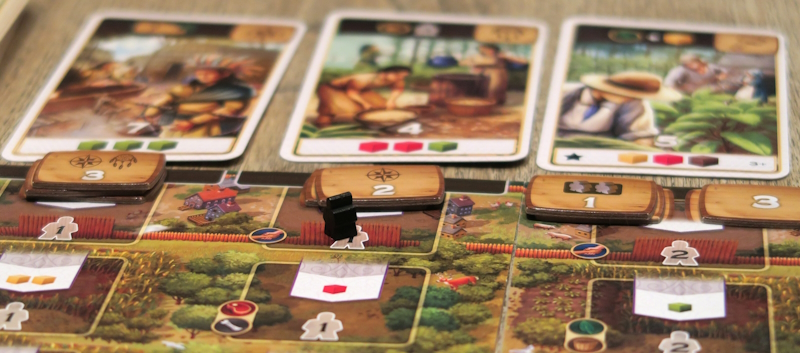
Century: A New World
– Image by boardGOATS

There are four locations types, thee allow players to Collect, Upgrade and Exchange Resource cubes, while the fourth (Forts) allows them to use Resources to claim Points Cards and Bonus Tiles.  Players can only have a limited total number of Bonus Tiles, and can only claim the Points Card associated with the particular Fort.  These Cards are supposed to slide along a conveyor belt so that they move from one Location to another, but thanks to a rules malfunction, this time the didn’t until more than halfway through the game.  The game finishes when one player has their eighth Points Card, so it can end quite suddenly, as players can pick up cards quit quickly due to special powers.

Century: A New World
– Image by boardGOATS

These games are basically race games, and it felt like Byzantium had a good start with points from his Exploration tiles, the only one to have any.  However, as Plum built her engine, she galloped up on the rail, ultimately taking the most points from her Cards. She also took the most points from Bonus Tiles.  In such a tight game, left over resources were critical and they enabled Cobalt to leap-frog Byzantium into second.  Plum was the winner, though by just two points.  It had been fun, though Plum’s comment that she actually preferred the second of the trilogy meant Blue who had not played it would take the opportunity to grab a copy at the UK Games Expo Bring and Buy a couple of days later.

Century: A New World
– Image by boardGOATS

Learning Outcome:  The Spiel des Jahres Jury can spot a good game.
Boardgames in the News: Asmodee’s Plan B

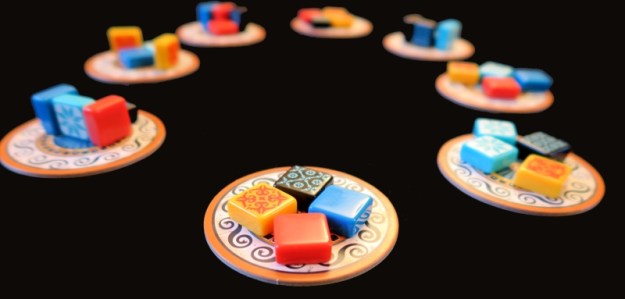
When Asmodee acquired F2Z/Filosofia/Z-Man Games etc. in 2016, the then owner of F2Z, Sophie Gravel, activated her “Plan B” and set up a new company, Plan B Games.  This company was successful almost straight away, winning the Spiel de Jahres Award & Deutscher Spiele Preis just two years later, with Azul.  Since then, Plan B has released the follow-up games Stained Glass of Sintra and Summer Pavilion which, although not as popular as the original, were still very successful in their own right.

Azul
– Image by boardGOATS

Plan B were also responsibly for the three Century Games (Spice Road, Eastern Wonders and A New World) which were all variously successful, and the more recently released games, Beez and Alma Mater.  In 2017, Plan B Games acquired German publisher Eggertspiele, the publisher responsible for many well received heavier, strategy games including Great Western Trail, Mombasa (Deutscher Spiele Preis winner), and Village (Kennerspiel des Jahres & Deutscher Spiele Preis winner), as well as the lighter Spiel des Jahres winner, Camel Up.

Century: Spice Road
– Image by boardGOATS

Given the quality of all these games, almost inevitably, just five years after they acquired F2Z, this week Asmodee announced they have now acquired Plan B and their subsidiary brands (Eggertspiel, Next Move Games and Pretzel Games).  This time Asmodee are absorbing the whole team including Sophie Gavel, perhaps avoiding the necessity of acquiring her Plan C in five years time…

Camel Up
– Image by boardGOATS

21st January 2020

Over the last three years we’ve spent a lot of Tuesday evenings discussing Brexit and following events in the House of Commons as they occured.  Since this was going to be the last games night with the UK in the EU, and as a predominantly pro-EU group, we wanted to mark the occasion and show our support for our European friends and all those who have campaigned against Brexit so valiantly.  For this reason, we decided to make the “Feature Game” “European Ticket to Ride“, in other words, European editions of one of our favourite games, i.e. the Italy, France, Germany, Poland, Netherlands and of course, Europe games/expansions.  Unfortunately, Blue (and therefore most of the maps) was late arriving, and then, nobody could decide what they wanted to play; the only one who expressed any strong opinion was Lime who wanted to play the France map.

Ticket to Ride Map Collection: Volume 6 – France & Old West
– Image by boardGOATS

With nine players, three groups of three looked good, but the debate as to who would play what rivaled the Brexit negotiations, not helped by the number of people who were enticed by the Japan map on the reverse of the Italy map.  In the end, Ivory and Green took themselves off to play the new Poland map, and, after a lot of discussion, Lime, the only one who had a strong opinion ended up forgoing his choice of France and joined the Poles to even up the numbers.  With Black, Purple and Pine starting on France, that just left Blue, Burgundy and Mulberry to decide, and eventually they decided to play the Italy map using the Germany base game components.

Ticket to Ride: Germany
– Image by boardGOATS

Ticket to Ride is a very well-known, well-loved game that has now become something of a “gateway game”, that is, a game that starts people unfamiliar with modern boardgames along the slippery slope.  The game is popular with casual gamers because it is simple to play, with few options and a little bit of luck, but not too much.  The game is played on a map with cities connected by train routes each made up of anything from one to nine spaces (depending on the map).  On their turn, the active player can do one of a small handful of things:  firstly, they can take train cards from the market or use the train cards to place plastic trains on the map and score points.  To place trains on the map, players spend coloured cards to match the route they are claiming.  As well as coloured train cards, there are also multi-coloured locomotive cards which are wild; a face up Locomotive can only be drawn as the first card and ends the turn, making them more expensive as well as useful.

Ticket to Ride: Germany
– Image by boardGOATS

Most cities have only a single route between them, but some are double or even triple, though these can only be used with higher player counts.  Instead of taking train cards or placing trains on the map, players can also draw tickets.  These are a sort of personal objective that give players points for connecting two cities—the further apart, the more points the ticket is worth, but the larger the risk, as failure gives negative points.  Players start the game with a handful of these and can choose which ones to keep.  They can also draw more during the game, keeping some and discarding others, but the specific conditions depend on the map used.

Ticket to Ride Map Collection: Volume 7 – Japan & Italy
– Image by boardGOATS

This is the basics of the original 2004, Spiel des Jahres winning game, with a USA map, Ticket to Ride, but each variant provides a different map and some slight modifications to the rules.  For example, Ticket to Ride: Europe adds Ferry routes which require a certain number of locomotive cards to be played in addition to the coloured train cards. It also adds Stations, which can used to help players complete tickets where a route has been blocked.  For some different maps players get different numbers of trains, Poland is one of the smaller maps, with only thirty-five trains, compared with the forty-five in the Europe and US versions or the three German editions (Germany, Deutschland and Märklin).

Wsiąść do Pociągu: Polska
– Image by boardGOATS

The other thing that makes the Poland expansion map stand out (aside from the fact that it is Map Collection Volume “6½” and goes by the name of “Wsiąść do Pociągu: Polska”) is that routes that connect to the countries bordering Poland give points directly.  Unusually, the routes that cross the border include some triple routes and even a quadruple route, all of which can be used regardless of the number of players.  Each country then also has a small deck of three or four cards, each card giving a different number of points.  The first player to connect to two countries through Poland takes the cards with the highest value, the next takes the next most lucrative and so on.  Adding more countries to a player’s network adds more cards and more points for that player.

Wsiąść do Pociągu: Polska
– Image by boardGOATS

Green was particularly keen to play the Polish expansion because of the “Czech connection”, and Ivory also wanted to try it as it was a new map for him; Lime went along to make up the numbers.  They were quick to get going and started off laying out routes without interfering with each other very much at all.  Ivory was first to link two countries (Czechia and Slovakia), which was annoying to Green as he joined the the same countries on the very next turn.  However, Green got his own back by getting in Ivory’s way and linking Germany into his network first.  Lime was late to join the country network party, but concentrated on the Poland’s eastern borders. Ivory and Lime started taking new tickets about midway through the game, but Green instead continued to concentrate on linking more countries into his network.

Wsiąść do Pociągu: Polska
– Image by boardGOATS

It was only in the last couple of turns that Green finally turned to tickets when it looked difficult to add any more countries to his already substantial, four country network.  While Ivory and Green had been fighting over routes, Lime had quietly travelled the entire width of Poland and also linked several countries into his network, rivalling Green.  In the final scoring it was Lime who had charged ahead, scoring well with tickets and country cards, finishing with ninety-six points—deserved since he gave up his preferred choice of the France map.  It was very close for second though, with Green just three points ahead of Ivory with seventy-nine.  Meanwhile, on the next table, Black, Purple and Pine were setting up the game Lime had missed; a much longer game, that had barely started as the Poles were finishing.

Ticket to Ride Map Collection: Volume 6 – France & Old West
– Image by boardGOATS

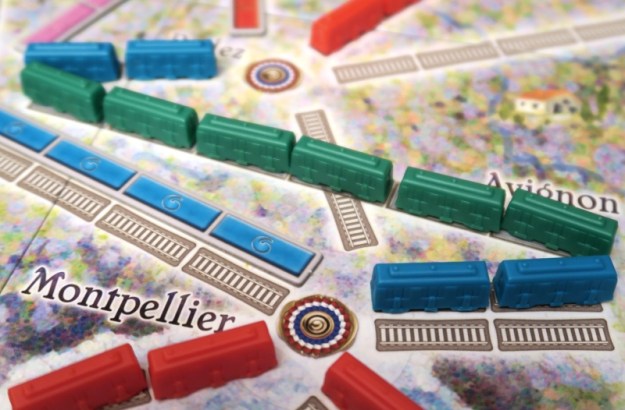
France is one of the more complex expansions as the map mostly only depicts the track-bed, and players choose what colour a line will be.  So, every time a player takes carriage cards, they also take a coloured tile of their choice and place it somewhere on the board.  Thereafter, any player can claim that route by spending the appropriately coloured cards and placing the correct number of train pieces.  Some of these track-beds overlap, but once a tile has placed any track-beds under it are no-longer available.

Ticket to Ride Map Collection: Volume 6 – France & Old West
– Image by boardGOATS

At the start, nobody really knew how to play with the track-bed tiles: placing them somewhere near one’s own route telegraphed probable plans, potentially giving others an opportunity to obstruct.  On the other hand, progress could not be made at all until tiles had been placed.  The map is very, very large so to begin with everyone could get on with their own thing.  Purple monopolised the Loire, Auvergne and Burgundy regions while Pine occupied the north coast and eastern borders.  Pine had competition from Black in the Normandy, Picardy and Champagne regions, but other than that, Black took himself off to the west and south and everyone got on with their own thing.

Ticket to Ride Map Collection: Volume 6 – France & Old West
– Image by boardGOATS

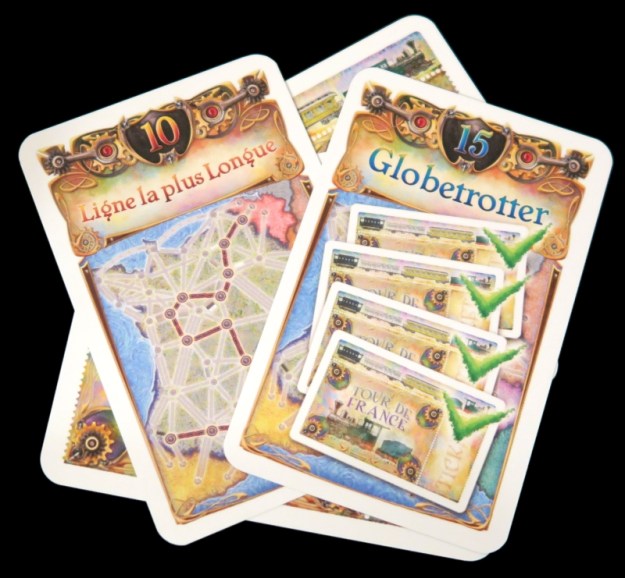
Ultimately, the game was very lopsided.  Pine kept drawing tickets and kept getting lucky; he repeatedly got tickets along similar routes so needed minimal addition to his already substantial network.  As a result, he not only took the longest route bonus, but also the Globetrotter points for the player with the most successful tickets, with eight.  Had Black been successful with all his, things would have been closer, but failing two meant it was a tie for second place with both Black and Purple finishing with eighty, exactly half Pine’s massive victory.

Ticket to Ride Map Collection: Volume 6 – France & Old West
– Image by boardGOATS

Meanwhile, further down the table Burgundy eschewed Netherlands, so the group went instead for Italy, played with the Germany base game, in which the pieces have an unusual colour set.  This gave Blue a slight quandary as to which she should play with, as blue wasn’t available.  Instead Blue opted for purple, only for Purple on the next table to offer to swap pieces as she had chosen blue because purple wasn’t available.  Sadly there was already enough confusion of pieces with Pine, Black and Purple playing with Burgundy’s base game and Blue’s France expansion so swapping pieces just seemed likely to make the chances of all the bits going back into the right boxes that bit smaller.  So in the end, both suffered with the “wrong colour”.

Ticket to Ride Map Collection: Volume 7 – Japan & Italy
– Image by boardGOATS

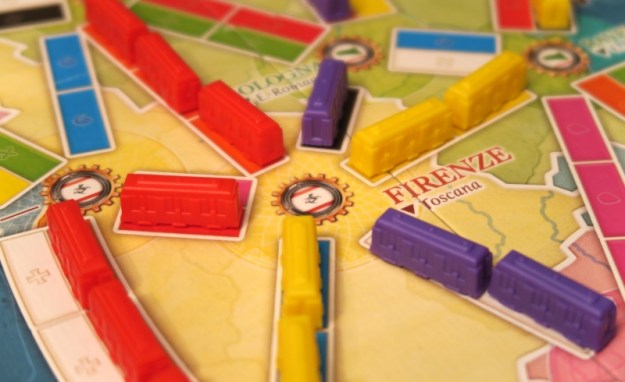
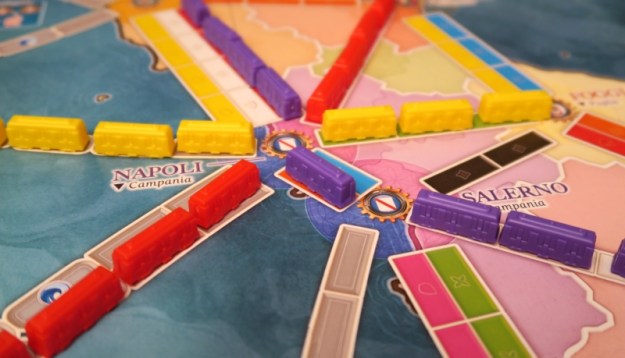
The Italy map is a more conventional expansion than France, with the only significant differences being a tweak to the Ferry rules and a new bonus scoring opportunity.  Instead of needing Locomotive cards, these Ferry routes include some carriages with a round wave-icon on them.  These can be satisfied either using special Ferry cards, or Locomotive cards.  The special Ferry cards are in a separate deck and one of these can be taken instead of drawing train cards, up to a limit of two at any one time.  Each of these special Ferry cards then count as two “wave” cards.  This makes them better value than Locomotive cards drawn face up from the market, but less versatile.

Ticket to Ride Map Collection: Volume 7 – Japan & Italy
– Image by boardGOATS

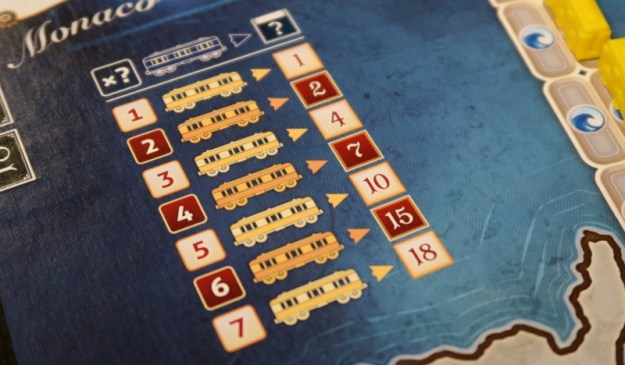
The bonus is potentially extremely lucrative, giving points for having a network that connects different regions of Italy.  This starts with one point for five connected regions and increments according to the “Lazy Caterer’s Sequence” to give a massive fifty-six points for a network connecting fifteen or more regions.  The layout of the map itself has a lot in common with the Nordic map in that it is quite long and thin with what feel like a lot of north/south routes running the length of the country, in the middle of the board and a lot of short, east/west routes available in the north and the south.

Ticket to Ride Map Collection: Volume 7 – Japan & Italy
– Image by boardGOATS

Blue kept all her starting tickets and Burgundy jettisoned just the one, but in contrast, Mulberry kept the minimum she could.  As a result, it wasn’t long before Mulberry was picking up more tickets, and then more and then even more, much to Burgundy’s and Blue’s horror.  When questioned, Mulberry said, “Just Nickels and Dimes, Nickels and Dimes…”  This didn’t calm Burgundy and Blue in the slightest, as they were still struggling to complete their starting tickets.  Eventually though, they also took more tickets, with Burgundy keeping a lot of his, while Blue was less fortunate.  Burgundy supplemented his tickets with a couple of very long Ferry routes netting him eighteen points each.

Ticket to Ride Map Collection: Volume 7 – Japan & Italy
– Image by boardGOATS

As the game came to an end, Blue was still struggling to get the yellow carriage cards she needed to complete her final ticket.  So when Burgundy brutally ended the game it cost Blue some forty points, though in truth she was a couple of turns away from getting them even if she had somehow managed to get that one final yellow card.  It was clear that unless Burgundy had a lot of incomplete tickets, he would probably be able to defend his already substantial lead.  Mulberry’s tickets may have been “Nickels and Dimes”, but she had an awful lot of them; as the phrase goes, “Take care of the pennies and the pounds take care of themselves.”  With just regional bonus to add, Burgundy was out of sight and although Blue and Mulberry made a dent in the gap it wasn’t enough.  It was close for second place though, but in the end a couple of extra regions gave it to Blue.

Ticket to Ride Map Collection: Volume 7 – Japan & Italy
– Image by boardGOATS

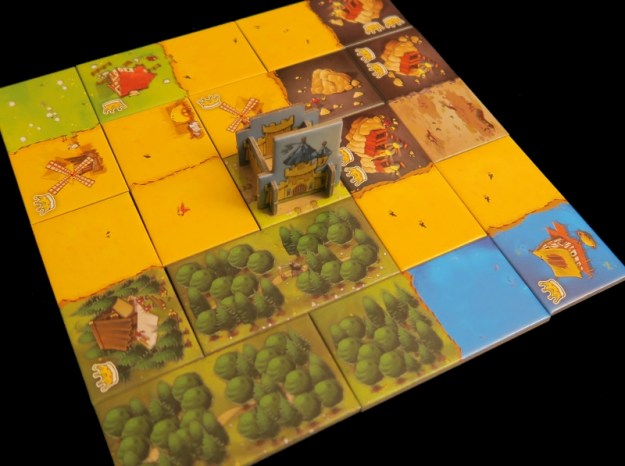
The Poland game was finished first and with France only just started and Italy only halfway through the Poles toyed with the idea of trying another European Ticket to Ride Map, but instead opted for a quick game of the 2017 Spiel des Jares Winner Kingdomino.  This is a light little game with a very clever market mechanic.  The idea is that players take it in turns to take a tile from the market and add it to their kingdom.  Each tile comprises two “squares” (like a domino), each showing a terrain.  At the end of the game, players score points for each area of terrain in their kingdom gaining points equal to the number of “squares” multiplied by the number of crowns in that region.

Kingdomino
– Image by boardGOATS

The clever part of the game is the market which consists of two columns of tiles, each tile having a rank reflecting their value based on scarcity of the terrain(s) it depicts and the number of crowns.  The tiles in each row are placed, and taken, in descending order.  When a player takes their tile from the current column, they choose which tile they want from the next column, thus a player taking a less valuable tile gets a wider choice on the next round.  Unfortunately, as each column has to have the same number of tiles as players, the game can be a bit unbalanced with three, because some of the tiles are removed at random.

Kingdomino
– Image by boardGOATS

As well as scoring for terrain, players also score bonus points for placing all their tiles in a five-by-five array with their castle in the centre.  This time, Ivory managed a full kingdom with his castle in the centre, and a large wheat field with a healthy number of crowns. His score was also assisted by a not inconsiderable lake (although with only a couple of crowns) and a small but valuable mountain.  Lime, fresh from his stunning Polska victory, realised too late that his castle was not central in his kingdom and his last couple of tiles were unplaceable.  Green managed a complete kingdom with his castle in the middle, though his was made up largely of forest.  Pasture, wheat and sand also featured and gave what was a winning score of sixty-three, some ten points ahead of Ivory in second.

Kingdomino
– Image by boardGOATS

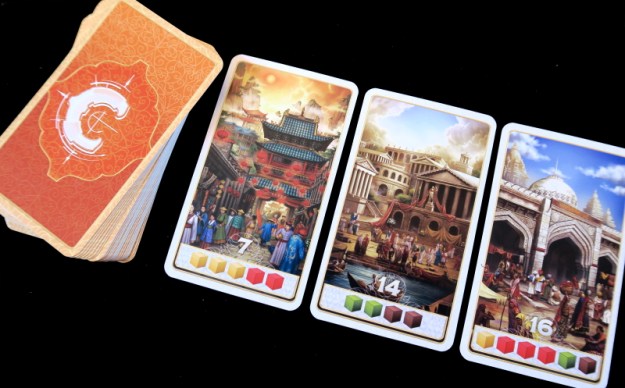
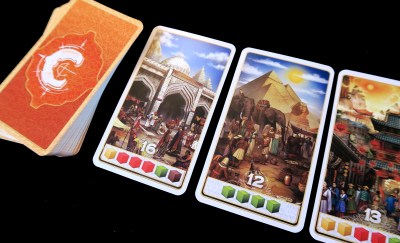
With the Italian map players just finishing, the group decided to join them and see what else was on offer. There were three options: For Sale (best with it’s a maximum of six), Century: Spice Road (plays a maximum of five) and World’s Fair 1893 (maximum of four).  Mulberry decided to get an early night, leaving five players and Century: Spice Road.  This is a resource management game with deck building at it’s core.  Neither Lime nor Green had played it before so there was a quick run down of the rules first.  These are simple enough though.  The central area consists of two markets: one for action cards and one for contracts.

Century: Spice Road
– Image by boardGOATS

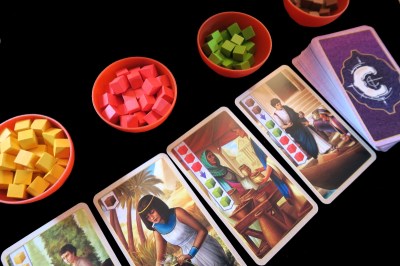
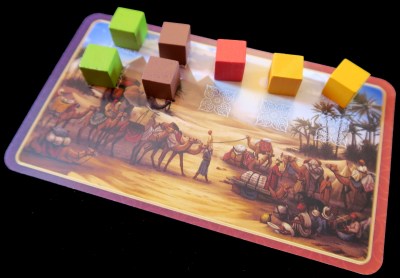
On their turn, the active player can take an action card from the market, if they take the card at the end of the row (the one that has been there longest), it is free, otherwise they have to pay resources dependent on the card’s position.  This card goes into the player’s hand where, on a later turn, they can use it to get spices, upgrade spices or convert spices into other spices.  When used, a card is placed on the player’s personal discard pile, and they can also spend a turn picking up all their discarded cards.  The spices, turmeric, saffron, cardamom and cinnamon are then used to fulfill contracts, giving points.

Century: Spice Road
– Image by boardGOATS

The contract cards that have been around for longest get a bonus, in this case a coin is worth one or three points at the end of the game.  The challenge, or at least part of the challenge is storing the spices: each player has a caravan card which will hold a maximum of ten spice cubes, so converting cubes into other cubes and buying contracts has to be done efficiently otherwise spices are wasted.  The game end is triggered when one player has five contract cards.  There are a couple of minor details, like the number of cards in the markets and the values of the coins, but Burgundy clearly knew these without needing to check the rules.
Century: Spice Road
– Image by boardGOATS

The engine-building nature of this game has a lot in common with Splendor and as Burgundy is invincible at that the writing was on the wall before the group even started.  It was no surprise therefore that when Ivory picked up the first contract, Burgundy was immediately behind him.  Green, new to the game, wasn’t far behind either.  Blue had a complete nightmare, but Lime, after a slow start suddenly seemed to get the hang of it and then made rapid progress.  It wasn’t long before Ivory took his final card though.  Taking the maximum number of cards is always key, and when he said he had sixty-seven points it looked like he might have been successful, however, Burgundy, managed to take one last card in that final round as he was the last to play, and ultimately, he managed to take first place by just three points.

Century: Spice Road
– Image by boardGOATS

Learning Outcome:  Europe has a very extensive (and exciting) rail network.

6th August 2019

With a party just arriving, Blue and Khaki took a gamble on Burgundy being on his way, and ordered his ham, egg, ‘n’ chips for him on the understanding that they’d have a second course if he failed to turn up in time.  Blue, then eschewed her usual pizza in favour of fajitas which she then proceeded to throw down her front.  Pine, meanwhile, arrived fractionally too late to order food at all.  Burgundy arrived just in time to avoid everyone playing musical food and eating his dinner, so Pine ended up eating everyone else’s chips instead.  With the substantial matter of food dealt with and the arrival of Purple and Black, the group moved on to games.  There was some discussion about playing one large game or two smaller, three-player games, but the latter won out, with the “Feature Game”, Century: Spice Road, the first game on the table.

Century: Spice Road
– Image by boardGOATS

This being a similar engine builder type game to Splendor and Burgundy keen to play, Pine could see the writing on the wall and decided to leave Blue and Khaki to it.  The game itself is actually quite different to Splendor.  In Splendor, players take gems and use them to buy cards which then deliver permanent gems enabling them to buy other cards, and eventually get cards that also give points.  In Century: Spice Road, players are spice traders and take cards from a conveyor belt and then use these cards to get spices and then use the spices to buy scoring cards.

Century: Spice Road
– Image by boardGOATS

The clever part is the fact that there are four spices available, turmeric, saffron, cardamom and cinnamon, with cinnamon worth the most, and turmeric the least.  Thus, the activity cards, variously enable players to take spices, upgrade them, or convert them into other spices.  Players place their spices in their caravan, which holds a maximum of ten spices.  Like Splendor, the game is all about building an efficient engine, though in this case, it uses deck building, so a key part is making sure that as many cards as possible are used before the deck is picked up, which costs a turn.  Similarly, any conversions can be carried out as many times as desired when the card is played, so timing is everything.

Century: Spice Road
– Image by boardGOATS

Burgundy went first and it wasn’t long before he took his first points, leading Pine to comment from the next table, comparing Burgundy taking the lead to Bayern Munich taking a five-nil lead ten minutes in.  Burgundy replied that he wasn’t winning… yet.  It wasn’t long before Blue and Khaki scored themselves, though rather than equalising, it was more a case of reducing the deficit.  It was around this point that Blue made a big play, going for a card that allowed her to upgrade three spices (compared to the initial two in the cards everyone started with), but she immediately regretted it as she paid through the nose to take it (the card at the end of the conveyor belt is free, but taking newer arrivals costs one spice per card space nearer to the deck).

Century: Spice Road
– Image by boardGOATS

This mistake was compounded by the fact that Blue didn’t really use the card as she had more efficient ways upgrading her spices.  Meanwhile, Burgundy and Khaki were building up their pile of scoring cards, with Khaki ominously taking a lot of the oldest scoring cards, and with it a large number of the rather pretty bonus metal coins.  The game moved really quickly – it’s not really multi-player solitaire, but everyone had plans, so play moved on very quickly with only sporadic breaks when people had to make decisions, so it wasn’t long before everyone was getting close to taking the critical sixth scoring card which triggers the end of the game.
Century: Spice Road
– Image by boardGOATS

It turned out that all the high scoring cards had come out at the beginning and towards the end, everyone was waiting and hoping someone else would take a low scoring card and leave them with something more exciting.  Blue had the chance to kill the game early and prevent Burgundy and Khaki taking a sixth card, but she thought Burgundy was setting his sights higher than he was.  So in the end it was Burgundy who took his sixth card to trigger the final round and everyone finished with the same number scoring cards, though Burgundy’s were generally of much higher value.

Century: Spice Road
– Image by boardGOATS

It was really close for second place, with Blue taking it by just one point, but Burgundy finished eleven points clear with eighty-six, fulfilling Pine’s prophecy (based on his unbeatable prowess at Splendor) that he would win.  Blue was left ruing the fact she hadn’t ended the game when she had the chance, but in reality Burgundy would probably have won anyhow as he’d only taken a low scoring card end, giving him fewer points than his margin of victory.  However, we’d all enjoyed the game, as it plays quickly and doesn’t out-stay it’s welcome as well as being quite nicely produced.  It does look like it is going to be one of those games that nobody else will want to play with Burgundy though.

Century: Spice Road
– Image by boardGOATS

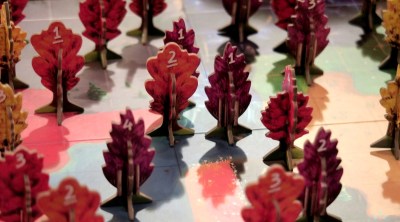
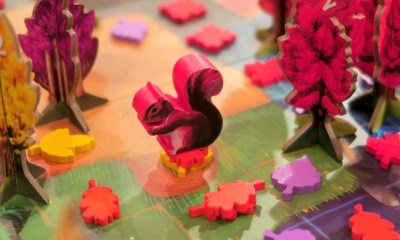
Meanwhile, on the next table, Pine had joined Black and Purple to play the rather beautiful Bosk.  This is a fairly simple little game that has had a couple of outings recently and has proven quite popular.  The game plays over two seasons, spring, where players grow their saplings, and autumn, where the trees then drop their leaves.  Summer and winter are scoring phases.  In summer, players score points for each row or column where they have the largest total and in winter, players score for having the most leaves in each area.

Bosk
– Image by boardGOATS

This time, with players becoming more familiar with how the game works, it was really tight.  Although the scoring in the first half always seems important, it isn’t really, and is usually quite close.  It is a game where small margins are always important though.  So while the wooden squirrels were doing acrobatics in the middle of the table, players’ trees were shedding leaves all all over the forest.  When it came to scoring, it was very “tit-for-tat” with one player scoring best in one area and then another playing scoring best in the next area.  In the end, it was Black who just managed to sneak the win, two points ahead of Pine.

Bosk
– Image by boardGOATS

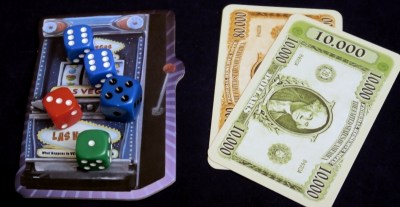
With both games finishing simultaneously, and everyone being keen to play together, we decided to introduce Khaki to one of our favorite games, Las Vegas.  This is a great betting game which is quite unlike anything else.  The idea is that there are six casinos, each with a pot of money in one or more notes.   On their turn, each player rolls a handful of D6 dice and place some on one of the casinos.  The player with the most dice on a casino once all dice have been played takes the highest denomination note in the pot.

Las Vegas
– Image by boardGOATS

As with all the best games, it is the little rules that make the difference.  In this case, there are two “catches”.  Firstly, the player must place all of one number on one of the six casinos, so if they rolled a two and six fives, the must place the two on the “Two” casino, or all six fives on the “Five” casino.  Secondly, when everyone has run out of dice, any dice that tie are eliminated, which means there could be three players with four dice each, and one player with a singleton and the singleton wins.  A new edition of the game has just been announced, Las Vegas Royale, but rather than implement the changes to the rules released with the new edition, we played in our usual, highly enjoyable way.

Las Vegas
– Image by boardGOATS

The game is supposed to be played over four rounds, but we find it can outstay it’s welcome a little for players who are out of the running, so we house-rule it to three rounds instead.  We also add “The Biggun” dice and the Slot Machine from the Boulevard expansion.  The big dice count for two in the final reckoning, which adds a little bit of variety to the game, while the Slot Machine gives players an alternative to placing dice in the casinos.  Each number can only be placed once in the slot machine, but the player must place all their dice of that number (as usual).  In the event of a tie, the total number of pips, and then the highest value dice are the deciding factors.  This a relatively relaxing game to play with friends with short burst of thought interspersed with a lot of table chat and general encouragement and exhortation to make a mess of things for someone else.

Las Vegas: The Slot Machine
– Image by boardGOATS

In the first round, Khaki rolled a handful of fours, so made a play for the “4” casino.  Following it with more fours secured his position, so when he rolled more fours in the second round he was encouraged to go for it again.  By the final third round, everyone was placing subconscious bets on whether he would try again, which of course he did, ultimately winning the “4” casino in all three rounds.  In fact the last round was the deciding factor, ultimately coming down to the last couple of dice, which lost Pine and Burgundy a lot of cash.  It was Blue and Purple, mostly flying under the radar that took the honours with $330,000 each, finishing joint first, and opting to share victory rather than invoking the tie-breaker.

Las Vegas
– Image by boardGOATS

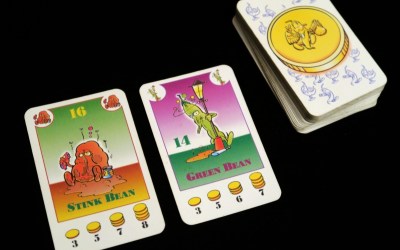
There was still plenty of time, but clearly everyone was in a holiday mood and fancied playing light fare, so we decided to finish with an old favourite, Bohnanza.  Kahki had not played it before, so was given a quick run-down of the rules.  The important thing, is that players must not re-order their hand – this is so automatic in card games that new or not, everyone always reminds everyone else immediately after the cards are dealt.  On their turn, players then play the first card from their hand into one of the two “bean fields” in front of them.  They may optionally play a second, but then the top two cards from the deck are turned over.  These must be “planted” before anything else can happen, but they can be planted in the active player’s field or can be traded for something and planted in a field belonging to another player.

Bohnanza
– Image by boardGOATS

Once the trades have been dealt with, the active player can trade with other players, swapping cards in hand, and then finally tops up their hand by drawing a set number from the deck (dependent on the number of players). There are many clever things about this game, but one of the most important is that when fields are harvested, some of the beans are turned over and become coins which are kept by the player, with the rest moving to the discard pile.  The reason this is important is because some beans are rarer than others and rare beans give a better yield.  This means the balance of the deck changes during the game with rare beans becoming rarer, while there is a glut of common beans.  The winner is the player with the most coins at the end, which is usually the player who best surfed this changing balance.

Bohnanza
– Image by boardGOATS

The game is very sociable and always played in good nature, with players generally offering and accepting reasonable trades, and not being obnoxiously obsessed with winning.  This time was no exception, although Burgundy did refuse Pine’s totally reasonable offer to take a pint for a Red Bean.  Purple made good progress early on, with a large number of Black-eyed Beans while others struggled to make much progress at all.  As a result, when the deck was depleted for the first time round, there were very few cards in the discard pile making the second round extremely short.  The third was even shorter, made worse by the fact that Blue lost the plot and shuffled the last few cards in with the discard pile

Bohnanza
– Image by boardGOATS

When, in the last turn of the game, Purple turned over two Green Beans which Blue wanted, she offered her whole hand, sizeable hand to purple in exchange.  Purple being a kind-hearted, generous sort, graciously accepted, much to Black’s disgust.  The offer was partly to make up for the screw-up with the deck in the hope that Purple would be able to score some points, but of course did Blue no harm either.  In the end it nearly cost Purple the game.  Often the game ends in a multi-way tie, sometimes for first, but more commonly for second place.  The pair of Green Beans that Blue received gave her one extra point, breaking what would have been a three way tie for second with Black and Khaki, putting her one coin behind Purple, the winner with fourteen.
Bohnanza
– Image by boardGOATS

Learning Outcome:  Don’t play Splendor OR Century with Burgundy unless you fancy a pasting.