Tag Archives: Dominion

Boardgames in the News: HandyCon Games Theft

HandyCon is a board game convention that takes place, roughly quarterly, in Milton Keynes.  Unlike other board gaming events like UK Games Expo and SPIEL, HandyCon is not a trade fair, but a convention where hundreds of people meet to play games together.  While many people bring their own games, one of the highlights is the Games Library which included over five hundred games and expansions.  The last event took place two weeks ago, 17th-19th January, but last Monday night while, he was playing football in Luton, the organiser, Paul Frohnsdorff-Harris had his car broken into and £700-800 of games stolen.  As is often the case with theft, the replacement value is one thing, but more important is the sentimental value.

Stolen Games
– Image from facebook.com

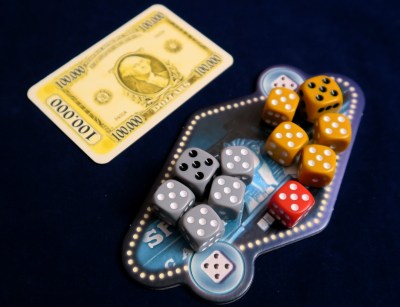
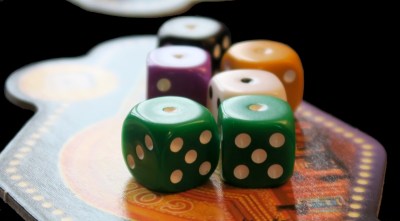
The games were all from Paul’s collection but were used as part of the HandyCon Games Library, and therefore almost all have HandyCon stickers on the lid.  The missing games comprise a wide variety, everything from classics like Dominion, Takenoko and 7 Wonders to new games like SETI, Shackleton Base, and Arcs.  There are also some rarities, like one of the first copies of Misheard Lyrics which was the first published game credited to Paul Frohnsdorff-Harris himself.  This morning the theft featured on BBC Beds Herts & Bucks Radio with an accompanying article on the BBC News website.  Although it is unlikely, it would be great if gamers could find these games and reunite them with their owner (and maybe even catch the thief in the process).

Stolen Games
– Image from facebook.com

28th May 2024

When Blue, Pink and Cobalt arrived for food, the pub was really busy and they struggled to find a table, ending up in the Bar.  Their food had arrived by the time the others started to turn up, and although there was another free table by this time, it wasn’t conducive to playing games.  Green, who we’d been missing in recent weeks arrived with Lilac for the first time in absolutely ages so there was a lot of catching up to do.  It wasn’t long before more tables began to clear, and the group managed to find several together in the restaurant area, and once the feeders had bolted the remains of their supper they joined the group and everyone began to decide what they’d play.

Little Town
– Image by boardGOATS

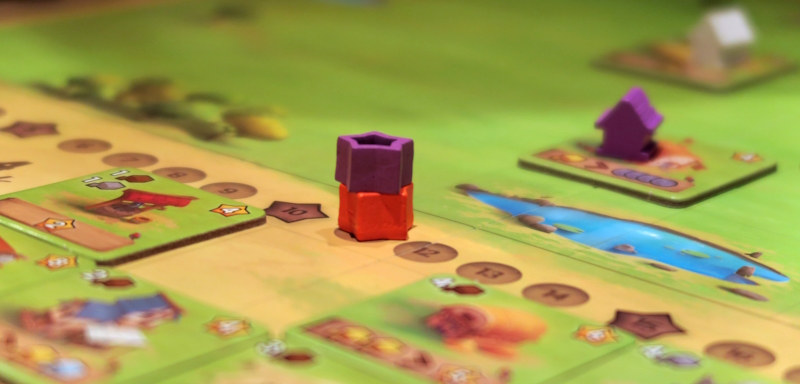
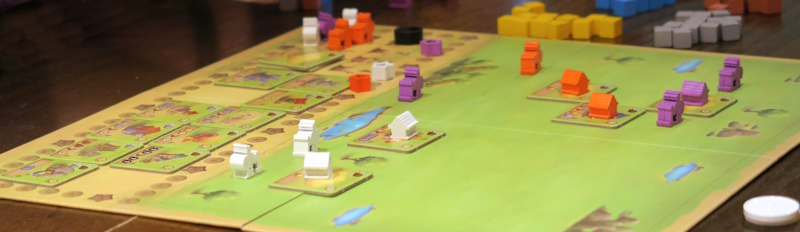
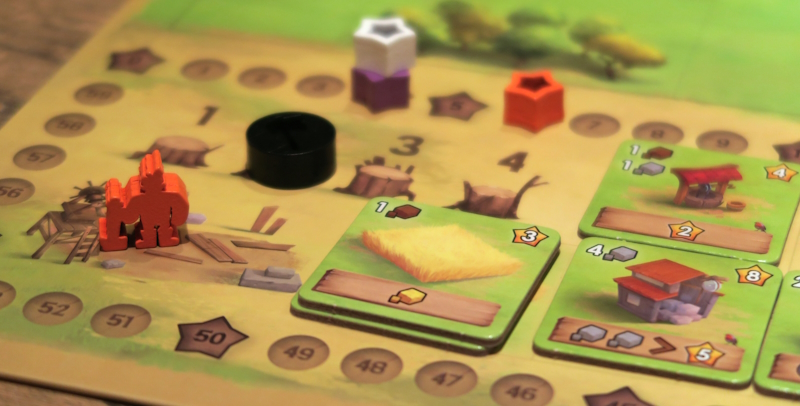
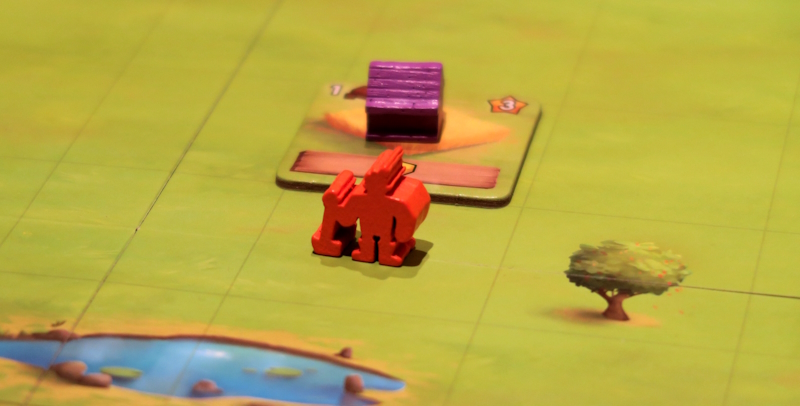
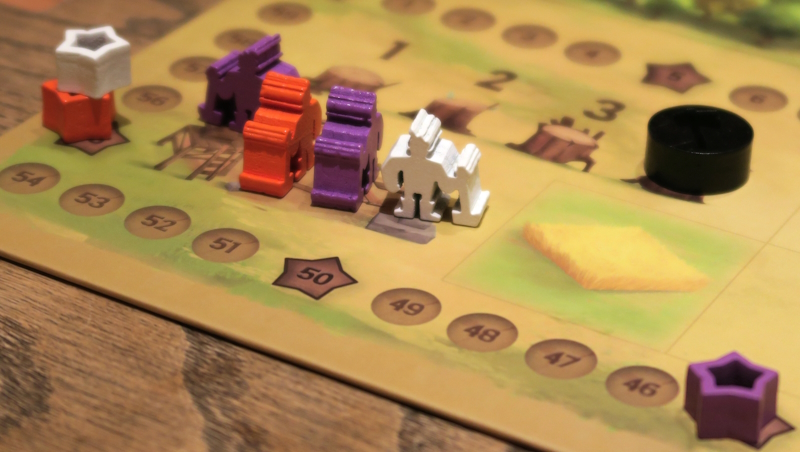
First up was the “Feature Game“, Little Town, a resource management, worker placement and tile placement game where players take on the role of architects guiding teams building a small town.  There were two games of this—one with Blue, Pink and Teal, and the other with Black Purple and Lime.  It is quite a simple little game:  players start with a set number of Workers (four in the three-player game) and building Markers (six for three players).  On their turn, they can place a Worker in an empty space on the central player board/map, or spend resources and build a Construction, placing a Marker on it.

Little Town
– Image by boardGOATS

When they place a Worker, the player activates the eight spaces surrounding it.  These can include Woodland, Mountain, or Lake to get Wood, Rock or Fish.  Wood and Rock are useful to build, while Fish is important for players to feed their Workers at the end of the round (one Fish or Wheat per Worker, every round).  Players can also activate Constructions, their own for free, and another player’s by paying them one Coin.  There are twelve Buildings and five Wheat fields available for construction at the start of the game—once they are built, they are not replaced.

Little Town
– Image by boardGOATS

There are twenty-nine buildings in the base game which can be drawn at random, but this time, both groups used the basic set (marked with a robin).  This meant that some of the Objective cards which are Building dependent could not be used, so in the end, only the cards that didn’t require specific Buildings were used.  The Objectives therefore included things like “Gather at least five resources in the same turn” or “Have more Buildings than Workers”—these are scored during the game.  Buildings come in two types:  Those that give Resources when activated, and those that can be used to convert Resources into other Resources, Coins or Points.  The game lasts four rounds, after which players score for each of their Buildings and one point for any three unused Coins.

Little Town
– Image by boardGOATS

Once the rules had been outlined, both groups started playing.  Before they’d got more than a turn in, however, Cobalt commented that he was surprised that Blue hadn’t got metal coins to go with the game, at which point, Blue produced her utility set and both groups swiftly made the substitution.  Unfortunately, these new coins were a little slippery leading to a couple of rounds of “Hunt the Game Piece”.  Little Town is a really good little game though, accessible, but with meaningful decisions and one that doesn’t outstay its welcome.  Despite starting with essentially the same setup, the two games, progressed quite differently.

Little Town
– Image by boardGOATS

Pink and Blue built Points engines converting Coins and Wheat respectively, while Cobalt converted a Coin into Wheat and Fish, then and Wheat into lots of Coins.  On the neighbouring table, however, the Coin to Wheat and Wheat to Coins buildings were owned by different people, Black and Lime respectively while Purple was busy converting Wood into Points.  Both games were quite tight, with Lime’s forty-two beating Black into second place by just two points.  The other game was even tighter though.  Pink rolled back his final move following a suggestion by Blue to pick up an extra point, but she would have done better to keep her mouth shut as that extra point meant he tied for the lead with Blue on fifty-five.

Little Town
– Image by boardGOATS

It was as players were discussing the game and starting to pack away that Pink spotted a way of getting another extra point, but this was deemed too late and the game was deemed a tie.  Packing away, there was some confusion as the manifest indicated there should be twenty-nine Objective cards, whereas Blue’s copy had thirty.  Despite several recounts (and confirmation that there weren’t any in the Goodie Buildings mini expansion), the issue couldn’t be solved, and the group came to the conclusion that one more than expected was better than one less…

Little Town
– Image by boardGOATS

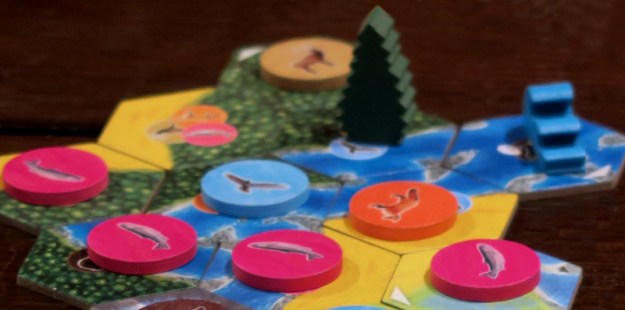
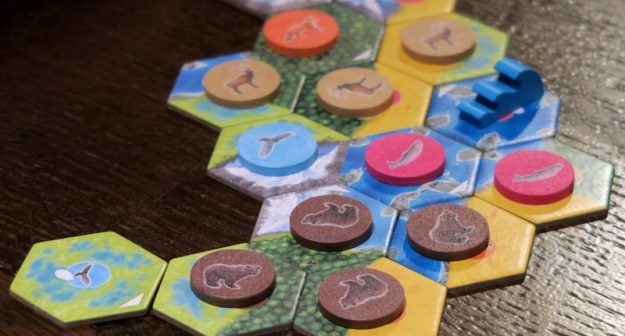
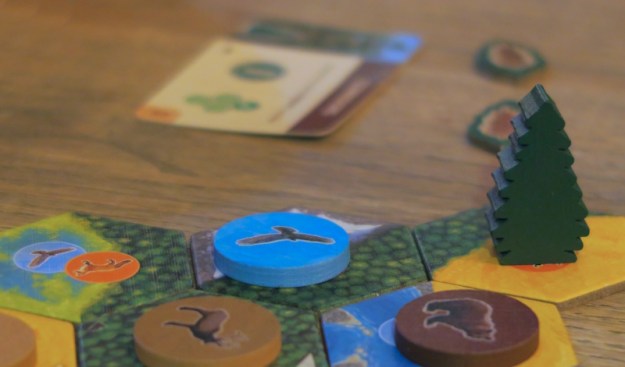
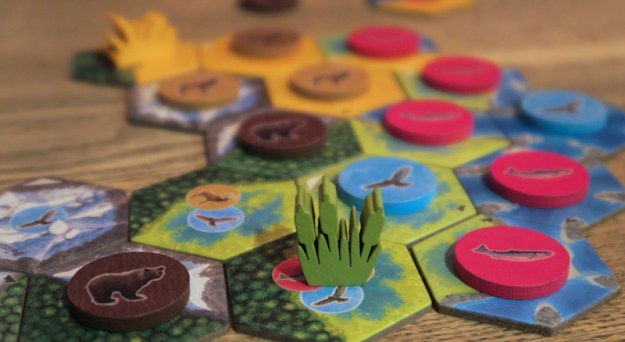
Meanwhile, on the next table Teal was leading a game of Salmon Run with Green, Pine and Lilac.  This is a game that was played quite a few times in the group some years ago when it was first released, but the last time it got an outing was in 2015—nearly ten years ago.  Teal had decided that his copy had been sitting on the shelf unplayed and unloved for too long and it was time for it to move on.  It got a stay of execution though, and as a result, it got a Tuesday night outing.  A fast paced, deck-building, race game, Salmon Run is a sort of cross between Dominion and Flamme Rouge.  Although the game is not particularly complex, the first game was a learning game.

Salmon Run
– Image by boardGOATS

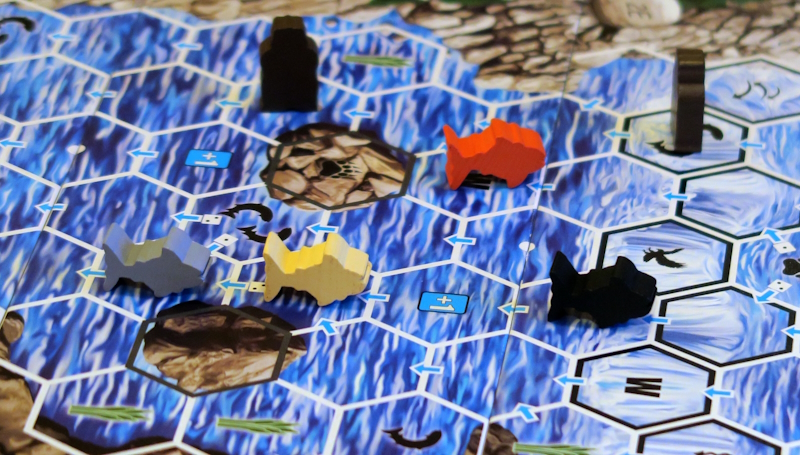
The idea is players are Salmon, racing to be first to get to the Spawning Pool.  The board is modular and therefore the River can be changed to give variety and replayability.  Players start with a deck of cards containing three Swim Forward, three Swim Right, three Swim Left, one Wild and one Bear and draw four of these.  On their turn, players can play up to three cards, however, playing three means they will draw a Fatigue card.  These will ultimately reduce players’ choice and slow their Salmon down, so mostly players stick to playing two, replenishing their hand to four cards at the end of their turn.

Salmon Run
– Image by boardGOATS

Depending on the modules used, the River includes obstacles like Rocks, Currents and Rapids, as well as special spaces which allow players to pick up special cards (that can be used to counter Currents, Rapids and Eagles) to add to their Swim deck.  Teal began by moving a Bear onto the space with Pine’s Salmon, giving him a Fatigue card.  Then, much to Pine’s annoyance, Lilac and then Green did the same before fianally Lilac did it again.  Pine was very unimpressed—for one who loves wildlife, he really wasn’t happy about repeated visits from all those bears!

Salmon Run
– Image by boardGOATS

Green I played a Rapids card and there was some discussion where the card should be discarded to, but in the end there was no catching Teal, who was first to the Spawning Pool, and was some four spaces ahead Lilac, his closest challenger.  As Little Town was still going on both tables, the group decided to play a second time now they knew how to play as they thought they’d be quicker (which they were). The River was a changed a little to make it a bit more challenging and then the Salmon began their second run.  This time, Pine, Teal and Lilac went one way round the rapids, while Green went the other.

Salmon Run
– Image by boardGOATS

This time the bear was moved away from players by Teal so nobody got caught. As the River took a bend to the right, Green ended up with only Swim Left cards so had to just discard and bang his salmonny head against the rocks, falling behind. Teal and Pine had both picked up a lot of Fatigue cards, but they both got to the Spawning Pool.  As Pine had one less though, he was the winner of the second game.  It had been a lot of fun (despite the Bear attacks, and the headaches from banging against the rocky bank), so maybe the stay of execution deserves to be extended a while longer.

Salmon Run
– Image by boardGOATS

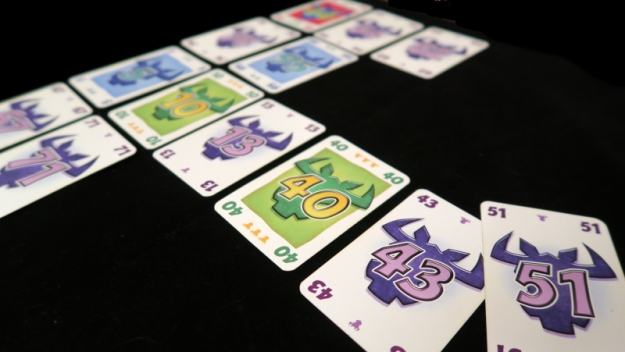
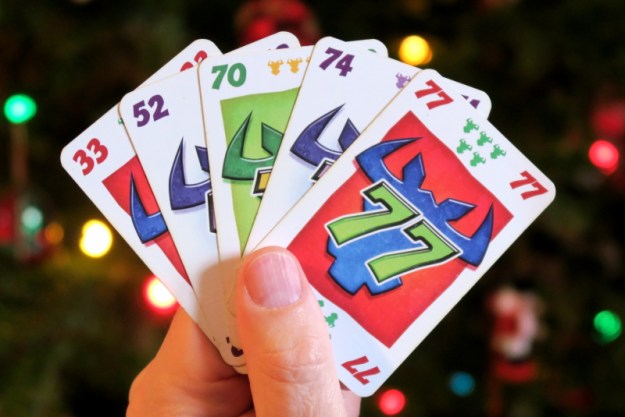
With both games finished and the late start, there wasn’t time for something long, so as is often the case in such circumstances, instead of lots of discussion, the group decided to play the old favourite, 6 Nimmt!.  With ten, the group decided to play the game over one round, which meant everyone started with ten cards, a lot more than usual.  This didn’t seem to improve the quality, however, a sentiment that was epitomised by one comment, “These are all bad with a capital F…”  The first few rounds were a little slower than usual as everyone had more cards to choose from than usual.

6 Nimmt!
– Image by boardGOATS

Once everyone had chosen their card, they were simultaneously revealed and added to the end of the appropriate row, with players picking up cards when theirs was the sixth card to be added.  Nobody managed to avoid picking up cards, but unusually, the scores were all quite close—so close that the winners, Green and Blue, tied with nine, while Pink took third place with eleven and Cobalt top-scored with twenty-three.  One game is rarely enough when it comes to 6 Nimmt!, and everyone was keen for another mad ten-player game.  This time the scores were more diverse: Lilac succeeded in avoiding the chaos and won with a clear round, while Teal added thirty-six to his first round twenty two to finish with the most points overall (Cobalt only took seventeen in the second game).

6 Nimmt!
– Image by boardGOATS

Blue took second place in the second game with five (giving her the best combined game total of fourteen), while Pine came in third with ten points.  Green was the most consistent with nine and eleven, but Lilac claimed the nearest to a “Mike Game” with one exceptional round and one awful one, though her bad wasn’t as bad as his usually were.  Everyone was just packing up when the evening came to a smashing end as the wine glass that Lime had carefully put safely to one side bit the dust.  Oh well, less washing up…

6 Nimmt!
– Image by boardGOATS

Learning Outcome:  Little Towns can give quite big games.

16th April 2024

Everyone seemed more keen on standing around and chatting that playing, but eventually, once everyone had arrived, people started dividing up into groups.  Ivory began by leading Jade, Sapphire and Cobalt to the other side of the room to play the “Feature Game“, which was the new “hotness” Let’s Go! To Japan.  In this game, players are travelers planning, then experiencing their own dream holiday in Japan.  Played over thirteen rounds, players draw activity cards place them in different days in their week-long itinerary. These can’t-miss tourist attractions have players traveling between Tokyo and Kyoto as they try to maximize their experience by optimising their activities while balancing resources.
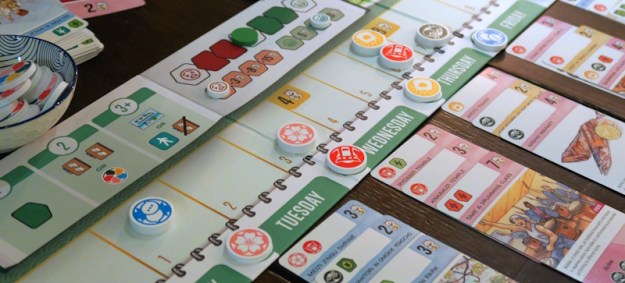
Let's Go! To Japan
– Image by boardGOATS

In each of the thirteen rounds, players draw cards according to the pre-organised sequence.  For example, there are two decks of cards (Tokyo and Kyoto), and for the first four rounds, players take one card from each deck, keep one and add it to their tableau assigning it to one of the days of their dream, then pass the second card to their neighbour.  In the fifth round, players take the four cards they’ve been given and then they place two in their tableau and pass two on, and so on.  Once eighteen cards have been played (three on each of the six days), the game is over and players take their planned trip, activating each of their cards in order, starting on Monday and work their way through to Saturday.

Let's Go! To Japan
– Image by boardGOATS

There is a catch:  where there is a swap between the two decks, players have to move between the cities of Tokyo and Kyoto by playing a Luxury Train Ticket which they can acquire during the game.  Each of these is worth two points.  If players do not have enough tokens to cover each change, they play a Regular Train Ticket from the supply which costs them two points.  Activating cards involves moving the players’ five Experience tokens along a track, increasing or decreasing their Mood, Stress and Happiness, gaining points and then evaluating the requirements for the Highlight of the Day depicted on the final card of the day.  If these requirements have been fulfilled, the player gets bonus points and the player with the most points at the end of the game is the winner.
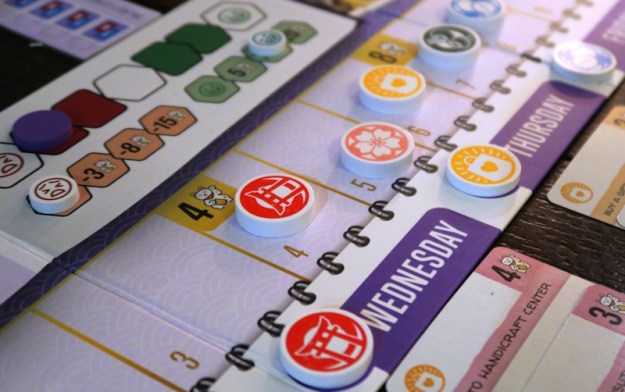
Let's Go! To Japan
– Image by boardGOATS

The game rattled along very quickly with swift turns and the added bonus that setup was quite rapid too.  As a result, it was easily under forty-five minutes before everyone was explaining their plan and scoring it.  That said it was hard to keep track of what everyone was doing.  Ivory was the first to fill a day and managed to get everything aligned to get the top bonus of a Luxury Train ticket. Although this was very nice, it in no way indicated Ivory was going to get a big score.  Jade and Cobalt quickly followed suit, Cobalt also gaining Luxury Train Tickets (which he got quite a few of throughout the game), and Jade got quite a lot of the second best reward, choosing Wild Tokens that would be really useful at the end of game to ensure meeting Highlight of the Day/End of Game objectives.

Let's Go! To Japan
– Image by boardGOATS

Sapphire was spreading his activities out a little bit more, but as the game went on he also managed to build a large store of wild tokens.  At the start of the game, Jade and Sapphire (who were not sitting next to each other) focused more on Kyoto, whereas Ivory and Cobalt were playing a lot more Tokyo cards.  Inevitably, however,  everyone ended up going to both cities and need Train Tickets as a result. Cobalt and Jade were the only people who choose to grab research tokens; Cobalt used one of these mid-game and managed to manipulate his hand so he ensured he passed nothing of use to Jade, much to his annoyance.  Otherwise, everyone worked on their mental health and managed to keep their stress down scoring positive points for the trip.

Let's Go! To Japan
– Image by boardGOATS

At the end of the game, Sapphire, Jade and Ivory had minimized their travel between the two cities though, whereas Cobalt required a lot of trains:  as he had lots of Luxury Train Tickets he actually increased his score significantly with these.  Jade had not picked up enough Luxury Train Tickets, so was stuck on commuter trains causing him to lose a lot of points. Sapphire ended up with a quick return trip between Kyoto and Tokyo on his last day, but that was acceptable because you should always go out your way for Sake!

Let's Go! To Japan
– Image by boardGOATS

Scoring took longer than usual as everyone gave a detailed description of their trip. Both Cobalt and Sapphire scored well on every day of their trip, with Cobalt slightly ahead thanks to his Luxury Train Tickets.  Sapphire managed to complete all his Highlight of the Day objectives though without using his wild tokens, so he cashed these in at the end of the game to push all his tokens into the next scoring zone and subsequently won the game by two points from Cobalt.  It had been a highly enjoyable experience though, enhanced by the beautiful components, especially the extremely pretty, but totally over the top ceramic component bowls!

Let's Go! To Japan
– Image by boardGOATS

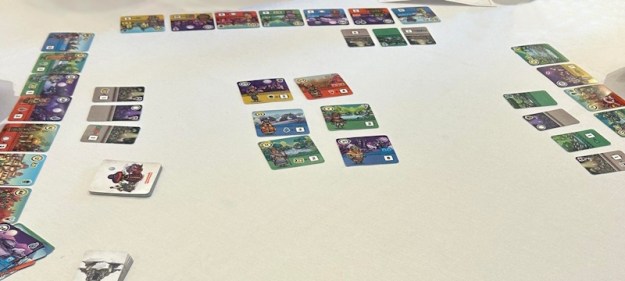
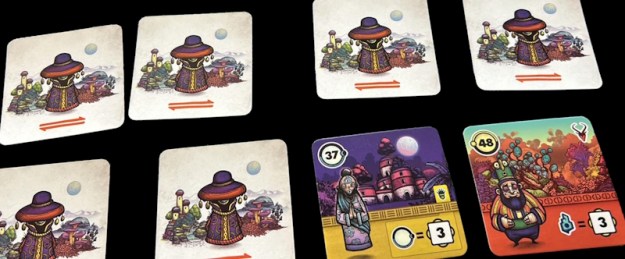
From there, the group then played a game of Faraway, a light game set on the mysterious continent of Alula with its ever-changing geography, shaped after the rhythm of the seasons.  On each turn, players play a card from a hand of three.  As play is simultaneous, players must take into account the priority system in all their choices—being last to pick a card leaves fewer options and often less profitable choices for later turns.  During the game, players will play a row of eight cards in front of them, from left to right. These cards represent the regions they will come across while exploring the lands. Characters on these cards will give victory points if the player later fulfills the conditions they demand.  At the end of the game, players walk back along the same route, scoring cards in the opposite order to that they were played in—and therein lies the heart of the game-play.
Faraway
– Image by boardGOATS

Throughout the game, the cards played serve both to set new objectives, and to meet ones played previously.  This time, Ivory started quickly out of the traps playing the highest card and subsequently getting the last pick in the following round, which was a minor hindrance. As the game went on, the order of picking the cards changed each time and everyone managed to pick first at some point, although it did seem like Sapphire and Ivory had the greatest varieties, mostly either being first or last!  Jade was very quick off the mark getting lots of maps which gave him a significant card advantage throughout the game as he could look at four or five cards and pick the best one. Ivory also didn’t do too badly with maps.
Faraway
– Image by boardGOATS

It eventually became clear that Jade had managed to play his cards in such a way he was always playing a higher card than his last card giving him an additional secondary card, but he was also able to fulfill the requirements to score the objective on that card even though it would need fulfilling earlier in the journey.  Come the end of game scoring and going on their journey, both Cobalt and Ivory had slightly take their eye of the ball and missed fulfilling the requirements of some of their cards and thus missed out on points they though we were going to get. In the end, it was very close for second place Sapphire just taking it, while everyone was thrashed by Jade.

Faraway
– Image by boardGOATS

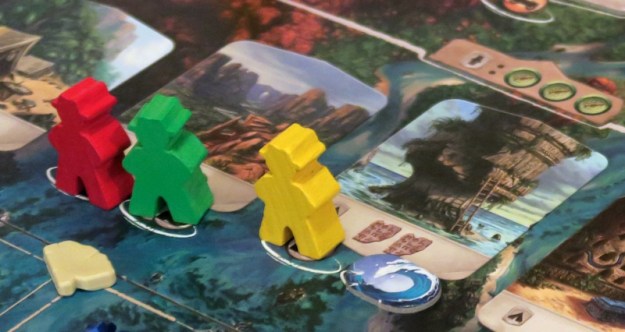
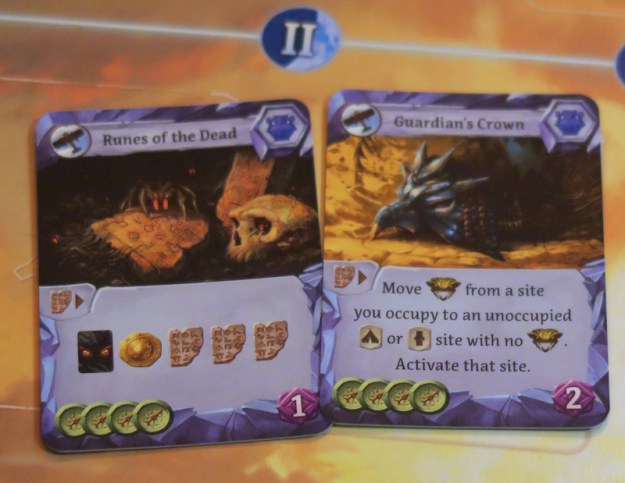
On the next table, Green was keen to play Lost Ruins of Arnak, and was eventually joined by Black and Plum.  This game combines deck-building and worker placement with resource management.  Players start with six cards in their deck, two Money, two Compasses and two Fear cards, and draw five of these to play.  As in the original deck-builder, Dominion, or in the racing games, Flamme Rouge and Snow Tails, Fear cards clog up players’ decks and more are acquired as the game progresses.  But also as in Dominion, there are ways to “exile” cards during the game.  So, players can try to keep a tight deck with minimal cards, or try to buy lots of cards that work well together.
Lost Ruins of Arnak
– Image by boardGOATS

Players then have two meeples each that can be sent to locations on the map, to either discover or use an action Location.  These generally give Resources plus some additions like draw a card, or gain a Fear card etc.. Each new site also has a Creature guarding it, which, if beaten, will give points and a small one-time bonus.  The Research Track is where players spend three of the resources, Tablets, Arrows and Jewels. Each player has two tokens which move up the same track giving different rewards as it ascends. Thematically, you can’t write stuff in the notebook until you find it with your magnifying glass, so the former can never overtake the latter on the track. And of course, the notebook gives cooler rewards.
Lost Ruins of Arnak
– Image by boardGOATS

Players get one action each per turn, until everyone has passed signalling the end of the round, and the game finishes after five rounds.  At the end of the game, Points are awarded for Cards, for progress on the Research Track, for discovering Locations and for beating Creatures; the player with the most points at the end is the winner.  This time, early in the game, Green pointed out to Plum that she could use an Idol gained by defeating a Guardian to give her the resources she needed to go up the Research Track.  That gave Plum an Assistant and she picked one that turned a Boot into an Arrowhead.
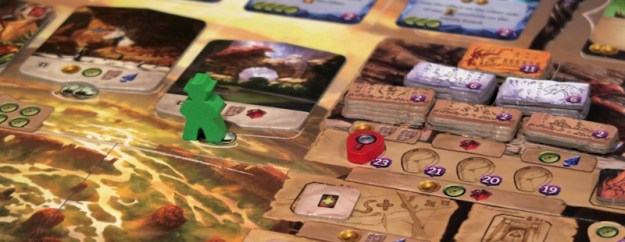
Lost Ruins of Arnak
– Image by boardGOATS

Green bought the card Plum had been eying up, which let players rid themselves of Fear cards (worth minus one point), and therefore seemed like a good use for a Boot/Fear.  It was pointed out later, however, that any card could be used in place of the Boot as all other transport types work for Boot icons.  Plum then got an Assistant that could upgrade a resource, which in practice she used turn Arrowheads into a Rubies as that was all she had by the end of the rounds.  She also managed to get ahead with her Explore magnifying glass token and was the first to a new level on a couple of occasions, which gave her valuable bonuses.

Lost Ruins of Arnak
– Image by boardGOATS

Green picked up a couple of Fear cards from leaving Guardians undefeated; Black got at least one as well, but Plum managed to dodge them.  Both Black and Green got useful Artifact Cards where they could get lots of resources.  It was a little way in that the group noticed the slight Rules Malfunction:  although players were putting their new cards at the bottom of their Draw pile, players were then shuffling the Draw and Discard piles together before drawing new cards.  This gave an extra bit of randomness that this time, worked in Plum’s favour.  For example, she had an item card that gave a Compass per worker when it was played, and it seemed to put in a lot of appearances.  In contrast, all the cards Green had bought didn’t come out until the final round—he got the balance of the bad luck.

Lost Ruins of Arnak
– Image by boardGOATS

Black picked up an Assistant which helped him cycle through his cards which helped mitigate the randomness a little, though there were a couple of occasions when someone took the location he had been working towards. Right at the end of the game, when Plum had managed to reach the top of the Explore/Research Track with her magnifying glass, she was able to use the Icons on her board to get the resources needed to pick up one of the most valuable Temple Tiles—worth eleven points. Green, however, scored almost twice that of the others for his Idols and Black top-scored for his item and artifact cards.

Lost Ruins of Arnak
– Image by boardGOATS

It was the Temple points, together with the extra points Plum got for getting to the top of the Explore/Research Track that ultimately made the difference, giving her a total of sixty-nine points, thirteen more than Green who took second place.  Both Plum and Green had played before, though most of their previous games had been online where the administration of the card shuffling was done for them, hence the Rules Malfunction.  It was Black’s first game, and despite the rules issue and not scoring as well as the other two, he still really enjoyed the game, so there is a good chance it will get another outing in the not too distant future.

Lost Ruins of Arnak
– Image by boardGOATS

Meanwhile, that left six players; Pink was keen to give his favourite panda game another outing, so Pine and Lime joined him in a game of Zoo Break.  This is a cooperative game, where players work together to try to prevent animals escaping from Bedlam Zoo.  On their turn, players roll the die to decide how many Action Points they get, then, after carrying out their turn, flip a Escape Card and a then a Move Card to determine what gets out of its cage and what moves.  Players have to avoid getting trampled on or bitten by the animals, while catching them and then locking them in their cages.

Zoo Break
– Image by boardGOATS

The group started well, or at least it started well from Pink’s perspective when he was cuddled by a Panda (one of his real-life wishes).  However, the game did not go so well.  There are a number of optional variants, and the group had chosen to use the “Faulty Lock” Variant which means that if an escape card is drawn for animals who have already been locked up, the die is rolled to determine whether there are escapees.  This turned out to make things just a bit too difficult and a Coral snake quickly made a bid for freedom, and as it’s a dangerous animal, that was that.  One snake might not seem like much, but there were another five lining up in front of the gate and three tigers too, so it really did not go well.

Zoo Break
– Image by boardGOATS

Reluctant to leave it like that, the trio decided to give it another try, this time without the “Faulty Lock” Variant.  This second try went better, though at one point two elephants got very close to the exit.  The situation was rescued by peanuts which enticed them to the Snack Stall where they were eventually captured.  There was some extensive rules reading to decide whether Pandas were considered “Dangerous” so only one escaping would trigger failure.  The group concluded that Pandas were not Dangerous animals after all though, and four Pandas roaming the streets would not lead to closure of the Zoo (though perhaps the Chinese government would not be appreciative).

Zoo Break
– Image by boardGOATS

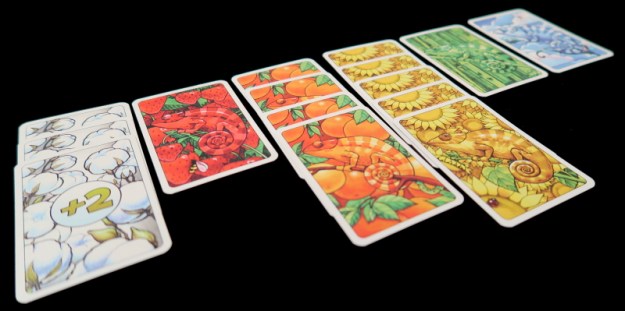
In the end, the distinction wasn’t necessary, none of the Pandas got out, though one Capuchin did manage to escape.  That was all, however, and once the group finally rounded up the last of the mad Meercat escapees, the writing was on the wall and the Zoo was saved.  The other games were still underway, so once the charming wooden animals had been tucked away, the trio opted for a couple of rounds of Coloretto.  This is a charming little card game which is the core of the, arguably better known board game, Zooloretto.

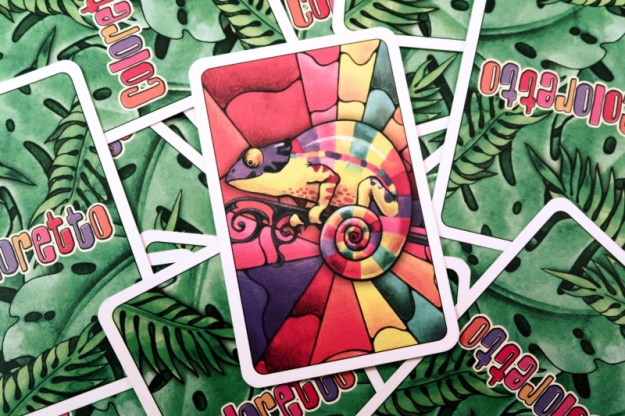
Coloretto
– Image by boardGOATS

The game is very simple:  Players either draw a Chameleon card from the deck and add it to one of the Carts, or take the cards on one of the Carts and add them to their tableau, stepping out until everyone else has taken a Cart.  Each Cart has three spaces and players core points for their three largest sets of cards and negative points for any others.  The player with the most points at the end of the round after the trigger card is revealed is the winner.  The clever part is the scoring for sets, which uses the Triangular Number sequence and means that later cards are worth a lot more than the early ones.

Coloretto
– Image by boardGOATS

When the Golden Chameleon card came out, there was some discussion about the difference between it and the multi-coloured Chameleon.  Blue, on the next table was consulted, and explained that it meant the person who takes it gets an extra card drawn from the top of the deck.  With that sorted, the game continued.  The group played two games and both were close, especially between Pine and Pink with Pink just edging it for the first game by two points and Pine just beating Pink by a single point in the second.  Both games were won by Lime, however, and by a larger margin, taking the first by four points and the second by six.
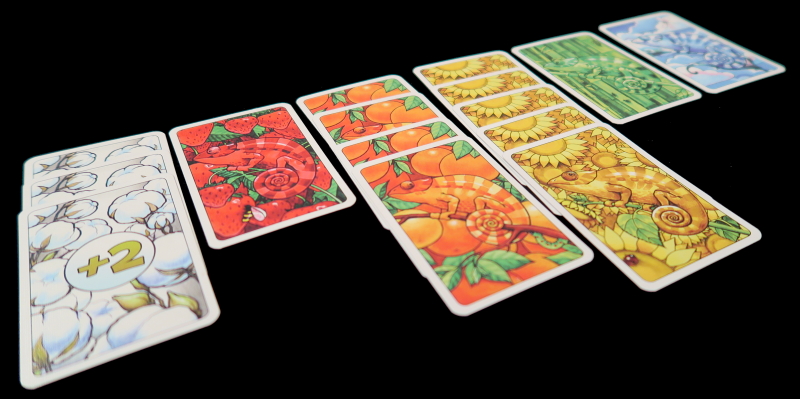
Coloretto
– Image by boardGOATS

The last table included three players, Blue, Purple and Byzantium.  They were the last to start, and were somewhat torn between two of the current hot games in the group, Wyrmspan and Meadow.  After some discussion, the group went for what was probably the easier of the two, and gave Meadow its their outing in three consecutive meetings.  A light to medium card collection game, it was new to both Purple and Byzantium, so Blue explained the rules.  Most of the game is built round a Card Market with players placing an Action Token and taking a card into their hand, before playing a card from their hand.
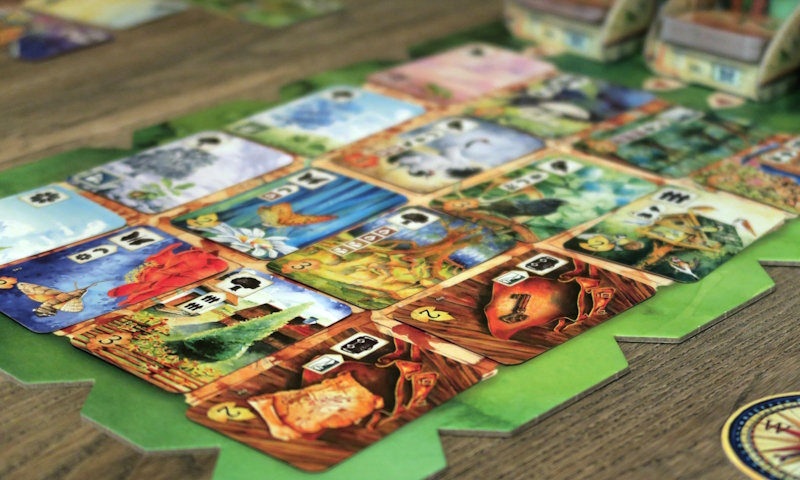
Meadow
– Image by boardGOATS

This aspect of the game has led to some reviewers comparing the game to Splendor, though there is a lot more to the game than that.  In addition to the Market, there is a second Campfire board, which allows players to carry out special actions, and also claim Bonus points. for cards in their tableau.  The first time the game was played, there was a token included erroneously from the Envelope U mini-expansion, and last time the game got an outing, there was a minor rules malfunction where the four players ended up playing on the three-player board.  So although the game has been played three times in fairly quick succession, this time was the first time the game was played by the rules as written, probably.
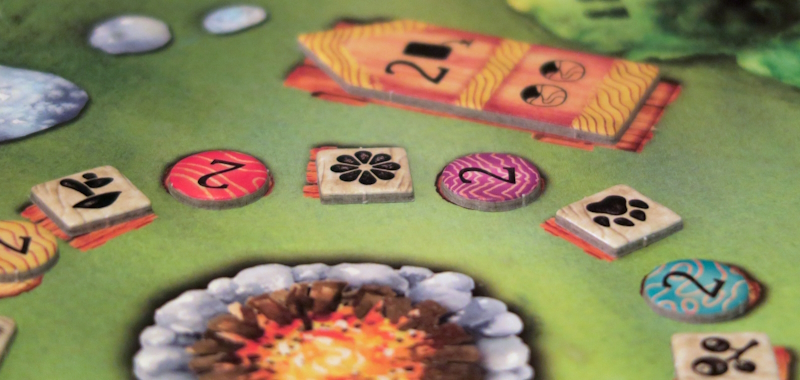
Meadow
– Image by boardGOATS

Players start with a hand of cards, including one from the North deck (which is only introduced halfway through the game)—this last card is typically more worth more but is difficult to play, so is a good way to get a steer in the early stages of the game.  As well as the other cards in their starting hand, another key strategy lead is the Bonus points obtained from the Campfire board.  These are obtained by placing a Bonus point token between two Icons, but in order to do so, the player must have those icons in their tableau.  Since each bonus place can only be claimed once, this element of the game is something of a race between those who want to compete for these points.

Meadow
– Image by boardGOATS

This time, the Icons drawn at random and placed round the Campfire included the relatively scarce Cottage, Fence and Garden Bird as well as the Wolf and Hawk which only come out in the second half of the game, when the North deck is introduced.  This made the Bonus points hard to claim. Although neither Blue nor Byzantium appreciated it at the time, although most Wolf cards are in the North deck, this copy of the game included the Seal promo card, which is a Wolf card that hides in the South Deck.  As it was key to getting bonus points, when it came out, both Blue and Byzantium spotted it, but Blue got to it first, and that turned out to be critical to her Bonus point objectives as Byzantium pinched the other spots early.
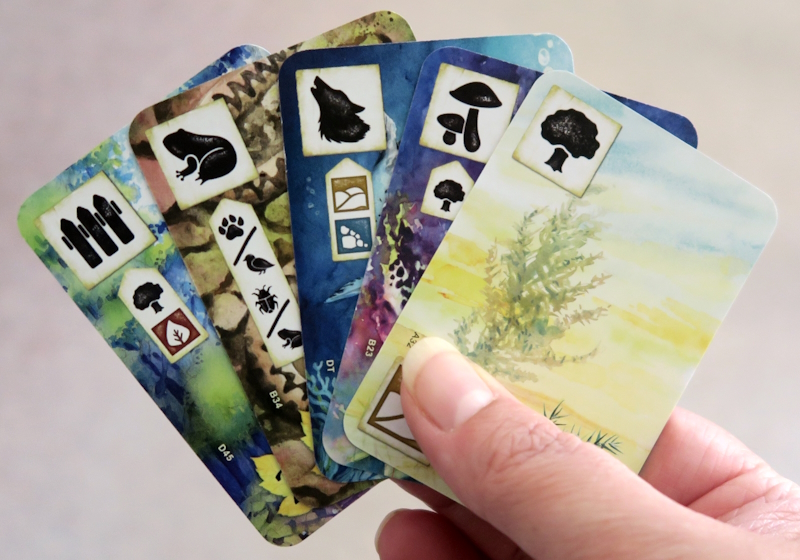
Meadow
– Image by boardGOATS

Meanwhile, Purple was busy collecting frogs and very effectively daisy-chaining cards to give her points.  As the game moved into its final rounds, Byzantium struggled to get a Landscape card that he could play without needing too many difficult prerequisites.  In spite of the frustrations when players can’t get cards, the game has a nice gentle roll to it and with three players doesn’t outstay its welcome in the way it does with four (when there are two extra rounds).  It was quite a tight game—Purple and Byzanium finished with thirty-seven and thirty-six points respectively from their observations, but Byzantium had more points from his Landscape cards.
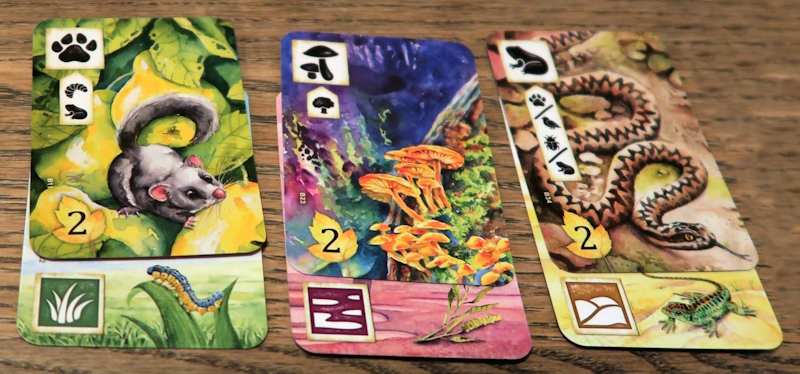
Meadow
– Image by boardGOATS

Blue didn’t do as well as them with her observations, but had the most points from her Landscape cards.  Although Purple hadn’t managed to get any Bonus points, both Blue and Byzantium had picked up the full nine giving them a bit of a lead.  In the end, it was the Observations that were key, and they gave Byzantium victory by four points with a total of sixty.  As the Meadows were tidied up, the last of the other games came to a close too and everyone chatted until it was time to go home.

Meadow
– Image by boardGOATS

Learning Outcome:  Every game should come with ceramic component bowls.
9th January 2024

Blue and Pink were just finishing their supper when Pine arrived, soon followed by Cobalt.  There was a lot of discussion about the road closure to the A420 (due to an accident) and whether this would delay those coming from the west, but Jade, Plum, Sapphire and Byzantium soon arrived with their tales of countryside detours in the dark.  Inevitably, that led to more stories of road closures due to accidents and flooding, and the horror-show that driving anywhere has been over the last week or so.  With almost everyone present, with more proactivity than usual, the group split into three, with two tables playing the “Feature Game“, the Landmarks expansion to the 2022 Spiel de Jahres winner, Cascadia.

Cascadia: Landmarks
– Image by boardGOATS

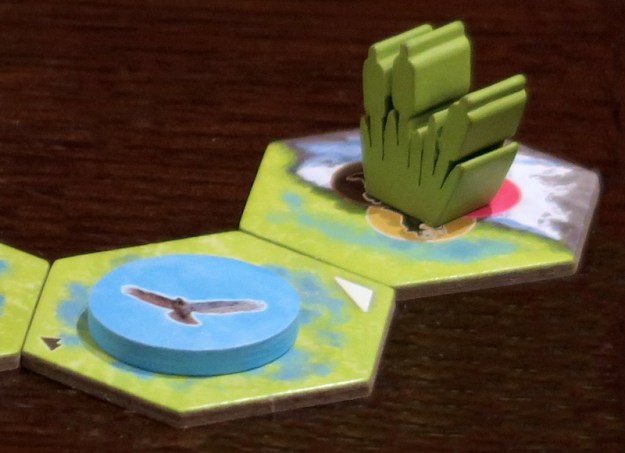
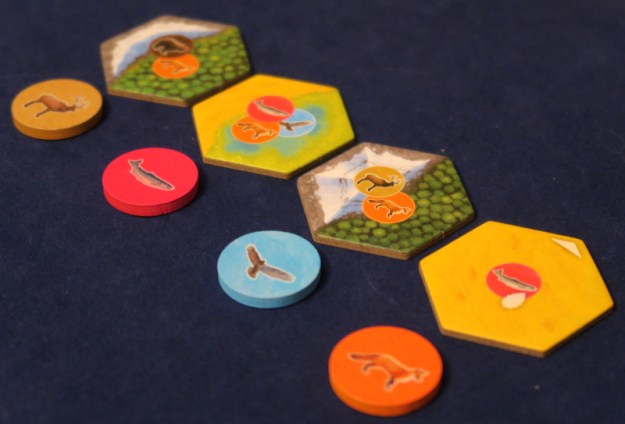
Cascadia is one of the group’s most popular tile laying games.  The mechanisms of the base game are simple enough:  on their turn, players take a Habitat Tile/Animal pair from the market and add them to their territory.  The Habitat Tile can be placed anywhere, but the Animal Token must be placed on a Habitat Tile which depicts that Animal.  The market is then replenished back to four pairs until the Tile pile is depleted and the game ends.  The Tiles and Animals are drawn and paired at random, and players have to take the prearranged pair, they cannot freely mix and match unless they have a Nature Token, which they can spend to either change all the Animals, or to take an Animal from a different pair.

Cascadia
– Image by boardGOATS

Nature tokens are rewards for adding animals to Keystone Habitat Tiles, which, in general, are more difficult to fill because they can only hold one animal type (other tiles can take two or three).  While the mechanism is quite simple, the guts of the game is in the scoring.  Players score for each of the five Animals, Bears, Elk, Foxes, Salmon and Eagles, but the clever part is that the way each of these scores depends on which card is drawn at random from each of the five Animal decks.  Thus, the game plays very differently depending on the combination of Animal scoring cards drawn.

Cascadia
– Image by boardGOATS

In addition to animal scoring, players also score one point for each tile in their largest corridor of each of the five Terrain types, as well as earning bonuses if their largest area is the largest overall.  The Landmarks expansion consists of three new modules, one which increases the the potential player count, one which adds more variety to the scoring (more Animal scoring cards) and finally, the titular Landmarks.  The first of these adds a Personal Market of five Habitat Tile/Animal pairs for each player to give them something to think about (and potentially play) between turns.  This can be played at lower player counts, but is essential in larger numbers as it reduces perceived downtime.

Cascadia: Landmarks
– Image by boardGOATS

The second module is simply some more scoring cards, which adds more variety, but also a little more complexity as some of these are slightly more challenging to work with.  The final module, the Landmarks, changes things a little more.  These can be added to a Habitat Tile when the once the area of Terrain is large enough (spreads over five tiles or more).  These Landmarks also come with a choice of the available cards (drawn at random) which give bonus points at the end of the game, for example, for every Bear in the player’s Forests.  Each player can only build one Landmark on each Terrain type, and because the Landmarks occupy space, players start the game with one additional Keystone Tile.

Cascadia: Landmarks
– Image by boardGOATS

Blue, Pink, Plum, Black and Lime played with all three modules, making a point of choosing scoring cards from the expansion.  In contrast, although the Personal Market can be used for any player count, the four on the other table, Jade, Byzantium, Sapphire and Pine, only added the Landmarks module, choosing scoring cards solely from the base game.  Jade et al. got going first and were four or five rounds in before Blue’s Crew had even started, as the latter had more rules to cover and were a little later to start as they were too busy gossiping.  On the other hand, despite the fact that there were a lot of rules queries, at least they mostly got them right, in contrast, to the little rules malfunction on the other table.

Cascadia: Landmarks
– Image by boardGOATS

The rules for the Landmarks state that players may take a Landmark when they add their fifth or tile to a Terrain, or any subsequent addition, whereas Jade, Byzantium, Sapphire and Pine played that the Landmark had to be taken when the fifth Terrain Tile is added.  It was just a very little thing, but actually had quite a large knock-on effect. The problem was, if a Landmark is added to a Keystone Tile, then players don’t get the Nature token.  Worse, in some cases, players were taking Landmarks when the cards weren’t in-line with their strategy, just because they had to.

Cascadia
– Image by boardGOATS

As the games progressed, both groups realised that taking Landmarks can really restrict a player’s options, especially towards the end of the game when things can get very tight.  And forcing players to take unhelpful Landmarks just exacerbated this effect and meant some Terrains were stuck at four just to avoid some of the issues.  The games both progressed quite merrily, however.  Blue concentrated on a mixture of Animals and Terrain, going for Landmarks early in the proceedings. Plum, misunderstood and didn’t realise that players scored a point for each tile in their largest Terrain, so she concentrated on Animals, but did very well with her Terrain anyhow, by virtue of trying to get bonus points for having the largest areas.

Cascadia: Landmarks
– Image by boardGOATS

Pink asked a lot of questions and got a bit confused between when he could add Landmarks and when he could take tiles from his Personal Market.  So, he ended up concentrating on Foxes instead, “as he was a foxy sort of fellow” (and there aren’t any Pandas in the game).  Black meanwhile collected Elk, but all-round concentrated on animals rather than Terrain.  Lime commented, “Birds are difficult to understand, so I’m not going to bother with them; if I score at the end of the evening, so be it…” though he probably didn’t mean it to come out quite like that!  On the other table, Sapphire was collecting Elk, and Byzantium was focussing on Eagles while Pine concentrated on building his Terrain and Jade capitalised on the Landmarks.

Cascadia: Landmarks
– Image by boardGOATS

With or without the Landmarks expansion, Cascadia is a little bit of a “multi-player solitaire” game, that is to say, players can mostly quietly get on with their own thing without upsetting each others’ plans.  However, with Blue, Black and Plum all having a full set of five salmon, Pink and Lime struggled to get the last few they needed.  In the four-player base game, all the tiles and therefore all the animals are used and Lime hadn’t realised the expansion added more tiles, some of which had been removed and therefore, there was no guarantee that any of the lovely juicy salmon left in the bag were going to come out.  And much to Lime’s chagrin, so it proved, as he was left one short of the full set at the end of the game.

Cascadia: Landmarks
– Image by boardGOATS

The five-player game, despite starting later and having the extra player, finished at much the same time as the four-player game, demonstrating how the new mechanism in the Landmarks expansion really does speed the game up.  Despite the perceived, increased challenge associated with the new Landmark scoring cards, the five-player game was generally more highly scoring, with the Blue and Plum sharing victory, tied on a hundred and seven points (some fifteen more than Black in third) and tied on the tie-breaker too.  The other game was much closer, with a spread of just eleven points and with Pine finishing in first place with ninety-nine, only two points ahead of Byzantium who was the runner up.

Cascadia
– Image by boardGOATS

All in all, both groups liked the base game and enjoyed the game with the Landmarks expansion.  The group playing with all three Landmarks modules felt it was much more of a struggle, though both groups felt the Landmarks didn’t give all that many points unless you knew what you were going for and were able to really make them count.  Certainly, adding lots of Landmarks made things very difficult at the end of the game causing players to reject Animal Tokens, so although the rules say add an extra Terrain Tile, there was some discussion regarding the merits of “house ruling” the addition of a second in future, to encourage people to build Landmarks.

Cascadia: Landmarks
– Image by boardGOATS

Meanwhile, on the next table, Ivory had enticed Cobalt, Purple and Teal to play his new Christmas acquisition, Lost Ruins of Arnak.  It turns out that he wasn’t the only person in the group to receive this game over the holidays—Green had also been given a copy and would no doubt have been keen to play had he been able to come.  The game is set on an uninhabited island  where explorers have found traces of a great civilization. Players lead an expedition to explore the island, find lost artifacts, and face fearsome guardians in a quest to learn the island’s secrets.

Lost Ruins of Arnak
– Image by boardGOATS

The game combines deck-building and worker placement with resource management.  Players start with six cards in their deck, two Money, two Compasses and two Fear cards, and draw five to play.  As in the original deck-builder, Dominion, or in the racing games, Flamme Rouge and Snow Tails, Fear cards clog up players’ decks and more are acquired as the game progresses.  But also as in Dominion, there are ways to “exile” cards during the game.  So, players can try to keep a tight deck with minimal cards, or try to buy lots of cards that work well together.  Players then have two meeples each that can be sent to locations on the map, to either discover or use an action Location.  These generally give Resources plus some additions like draw a card, or gain a Fear card etc.. Each new site also has a Creature guarding it, which, if beaten, will give points and a small one-time bonus.

Lost Ruins of Arnak
– Image by boardGOATS

The Research Track is where players spend three of the resources, Tablets, Arrows and Jewels. Each player has two tokens which move up the same track giving different rewards as it ascends. Thematically, you can’t write stuff in the notebook until you find it with your magnifying glass, so the former can never overtake the latter on the track. And of course, the notebook gives cooler rewards. Players get one action each per turn, until everyone has passed and the game finishes after five rounds.  At the end of the game, Points are awarded for Cards, for progress on the Research Track, for discovering Locations and for beating Creatures; the player with the most points at the end is the winner.

Lost Ruins of Arnak
– Image by boardGOATS

The first round was very slow as there was only limited spaces to go and everyone had weak cards in hand. Purple, Cobalt and Teal all focused on building up resources and buying tool cards for future rounds where Ivory did something a little different and started progressing along the Research Track as well as opening up new Dig sites. The issue with this was that he picked up a Fear card, though fortunately he had already got rid of one of his initial Fear cards through the site he opened so there was no net negative effect.  In the second round, things picked up and strategies started to become apparent.

Lost Ruins of Arnak
– Image by boardGOATS

Cobalt continued to focus on getting Tools, especially ones that allowed him to draw extra cards (and hence allowed additional actions) and he started making headway on the Research Track and was first to unlock an Assistant. He also did a little exploring, but did not overcome the Guardian. Ivory wasn’t far behind on the Research Track and also continued to explore new areas (and this time overcome the Guardian) and make up for lost ground in getting tool cards. Teal went for a very different strategy and started to focus purely on exploring and overcoming Guardians, netting him three points for exploring and gaining the idol and five points for overcoming the Guardian. Purple, on the other hand, continued to focus mainly on building her supply of resources.

Lost Ruins of Arnak
– Image by boardGOATS

The third round continued in much the same vein with everyone continuing to pick up Tools and starting to gain Artifacts. Ivory focused almost exclusively on the Research Track and was able to catch Cobalt and had picked up all the bonuses, while both unlocked their second assistant. Teal was continuing his exploring strategy to great effect, whilst Purple continued to bide her time building up resources, including a significant amount of Rubies (the most valuable resource).  And so it continued into the next round too, except Cobalt began spending his Compasses on Artifacts while Ivory continued to hoard them for the last round.

Lost Ruins of Arnak
– Image by boardGOATS

And it was in the final round that Ivory’s plan became apparent as, in true Ivory style, he used all his Compasses to explore a level two Dig Site. Hitherto, exploration had been limited to level one sites and Ivory was the first to explore a higher level, thinking this would be a fun thing to do. In the end, this ironically might have been the critical move that influenced the outcome of the game. The level two site gave Ivory valuable resources, helping him complete the Research Track just after Cobalt and also overcome the newly uncovered Guardian. With two idols on a level two site, this gave Ivory eleven points.

Lost Ruins of Arnak
– Image by boardGOATS

Teal continued with his strategy and also explored a level two site and began moving along the Research Track too. Purple used all her carefully collected resources and make a late dash to the top of the Research Track, gaining valuable points.  It should be said the whole work placement element of the game felt very tight with limited spaces at the start and then difficulty knowing whether to take the optimal route planning cards first, but potentially missing out on a valuable space to other players, or taking the sub-optimal route and placing your workers first guaranteeing the activity, but at a cost of efficiency.

Lost Ruins of Arnak
– Image by boardGOATS

Everyone got blocked at some point (except perhaps Teal who was opening up new sites), and certainly towards the end of the game everyone wished they had more than two workers!  Teal with his explore/overcome Guardian strategy led to him defeating a very impressive impressive six Guardians and gave him a total of sixty-eight points.  In the end, however, the fact Ivory completed the Research Track and was also able to explore and overcome Guardians gave him the victory by just three points with a winning total of seventy-one.  It was a very good game though, one greatly enjoyed by all involved.

Lost Ruins of Arnak
– Image by boardGOATS

Learning Outcome:  Now we know what Bears do in the Woods!

Boardgames in the News: Twenty-Five Years on the Rio Grande

When Rio Grande Games published their first games twenty-five years ago this month, the gaming world in the USA was a very different place.  At the time, games in the USA were almost all either simple “kids” roll and write games or very long, heavy strategic games for “geeks” not the family games had been around for some time in Europe, especially Germany.  Even in the UK, European games were specially imported from Germany and unofficial translations made and circulated through magazines like SUMO.  As the envious eyes of Jay Tummelson looked across the pond, he he parted company with Mayfair Games and started translating and importing German games for the US family market.  The rest, as they say, is history.

Mississippi Queen
– Image by boardGOATS

The first games imported by the newly created Rio Grande Games (named after the view from Jay’s office window), were Löwenherz and the 1997 Spiel des Jahres winner, Mississippi Queen.  These were both co-published with Goldsieber Spiele, but later games involved other publishers and in due course, Rio Grande Games started producing their own new games.  The best known of these are probably Dominion and Race/Roll for the Galaxy, but their biggest legacy is probably the changes they brought to gaming in the English-speaking world, who now have widespread access to Euro-games.

Rio Grande Games Logo
– Image from riograndegames.com


10th February 2022

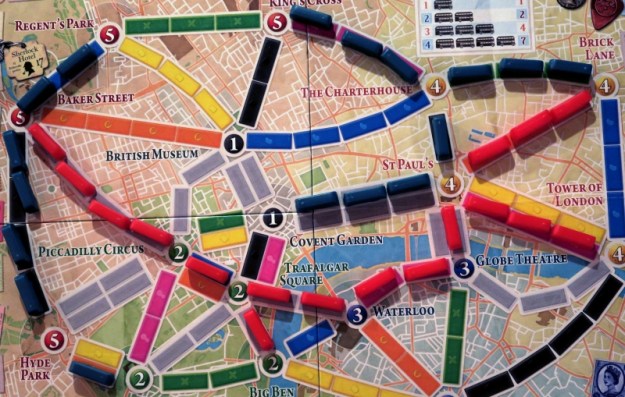
It was just Blue and Pink for food, so while they waited, they killed time with a very quick game of Ticket to Ride: London.  The little, city versions of Ticket to Ride make great appetisers, and this one is no exception.  The game play is essentially the same as in the full-sized versions (collect coloured cards and play them to buy routes), except they have fewer pieces, a much smaller map and take a lot less time to play.  In terms of strategy, there usually isn’t really time to do much, so it’s typically a case of doing one thing and doing it well.

Ticket to Ride: London
– Image by boardGOATS

This time, Blue decided to really challenge herself.  The London game gives bonus points for connect for players that collect certain locations together.  Blue worked out that if she managed to complete her longer ticket (Buckingham Palace to Brick Lane), going via the “ring road”, she could also complete her shorter ticket (Hyde Park to St Paul’s), and pick up lots of bonus points too, with just one bus left over.  Unfortunately for her, Pink managed to end the game just one turn too soon, leaving her with a gap between Regent’s Park and King’s Cross, no bonuses, no tickets and almost no points.  When it came to sparing her blushes, food couldn’t arrive too soon.

Ticket to Ride: London
– Image by boardGOATS

With Green bringing his parents (Saffron & Sapphire), the “Feature Game” was a light, hand-management, double-think fox and chickens game that we’ve played a few times before, called Pick Picknic.  It looked like three games were going to be needed, so Pink suggested Altiplano (in lieu of Orléans which didn’t quite make it last time), and took it to the other side of the room along with Ivory, Sage and Teal.  Pick Picknic plays six, but with eight foxes to fight over the chickens, two games of four seemed the best way to set things up.  Green suggested breaking up his family unit, so Blue instigated a trade and swapped Lilac and Sapphire for Lime and Purple.

Pick Picknic
– Image by boardGOATS

So, after a quick game of Musical Chairs, Green, Saffron, Lime and Purple settled down to play Pick Picknic.  At the start of each round, the six coloured farm yards are seeded with a random corn (worth one, two or three points).  Players then simultaneously choose a card from their hand and play it.  If their card is the only card of that colour and is a chicken, it gets all the corn.  If there is more than one chicken of that colour, they can either come to an agreement to share the corn, or fight for it.  If there is a fox amongst the chickens, the fox has a good feed and the corn remains till the next round.  If someone plays a fox card and there are no chickens, the fox goes hungry.

Pick Picknic
– Image by boardGOATS

The game started in an amicable manner sharing out the corn instead of fighting for it when the need arose, until half way through when Lime decided he no longer wanted to share. He won, but the scene was now set and squabbles broke out over corn more often.  In the meantime, Lime’s foxes were getting fat from eating everyone else’s birds and corn was building up, uneaten.  The others’ foxes were usually not so lucky, and Purple’s foxes were hungriest of all.  Towards the end of the game peace finally broke out once again and sharing was order of the day once more.  In the final tally, Lime proved the wiliest of us finishing first with fifty points and Saffron and Green close behind with forty-four and forty-five respectively.

Pick Picknic
– Image by boardGOATS

On the neighbouring table, Blue, Lilac, Black and Sapphire were a little slower to get going as they had to choose a game, but eventually decided on Coloretto.  While we’ve played it a lot, it was new to both Lilac and Sapphire so there was a recap of the rules first.  Blue explained that on their turn players have a simple decision:  turn over the top card in the deck and choose a “cart” to add it to, or take the cards from one of the carts.  Lilac commented that it was similar to Zooloretto, which of course it is, as Coloretto was it’s predecessor and they share the same basic mechanism.

Coloretto
– Image by boardGOATS

Players are trying to collect sets of the coloured chameleon cards, but there are two clever features.  Firstly, the largest three sets score positively and scores for the others are subtracted from a player’s total.  Secondly, for each set, the first card is worth a single point, but the second is worth two, the third is worth three and so on (up to a maximum of six cards).  Thus, it is better to get six cards of one colour, rather three in each of two suits.  Sapphire, took this to heart, focusing solely on red and green, and often taking nearly empty trucks as a result.

Coloretto
– Image by boardGOATS

Lilac was more adventurous and pushed her luck a bit, ending up with a bit of a rainbow, but with a couple of strong suits and a few bonus point cards.  Blue commented that, although players need to avoid negative points, players who don’t take cards generally don’t do well, and promptly took lots of cards and ended up with lots of negative points as a result.  Black, very experienced at this game, played smart and took an early lead which he held right until the last round when Blue got lucky and drew cards in her longest suit and with it, took victory, pushing Black into second.  Lilac and Sapphire were not far behind and separated by a single point.

Coloretto
– Image by boardGOATS

Pick Picknic and Coloretto finished at much the same time.  Purple then requested a game of Azul, so we preceded it with another quick game of Musical Chairs as Blue swapped places with Green.  Then, after a little discussion, Green, Lilac, Black and Sapphire chose to play Draftosaurus.  This is a fun little drafting game like Sushi Go!, but instead of drafting cards, players are drafting little wooden dinosaurs.  The dinomeeples are placed on the player’s board with different areas on the board scoring points in different ways.  For example, the “Meadow of Differences” can only hold one of each type of dinosaur, but will score twenty-one points if it contains all six (using the same scoring scheme as Coloretto).

Draftosaurus
– Image by boardGOATS

The game is played over two rounds (drafting clockwise and then anti-clocwise), before all the parks are scored.  Players also score an extra point for each Tyrannosaurus rex they have in their park, as well as extra points if they have if they have the most dinosaurs of the type they put in their “King of the Jungle” pen.  Everyone knows there is only one King of Jurassic Park and Black was looking like the winner with his T-rex strategy. He not only got several bonus points for pens with T-rex’s he also got seven points for having the most T-rexes too.  However it was Green’s more general approach to his dinosaur park that pipped Black to the post.

Draftosaurus
– Image by boardGOATS

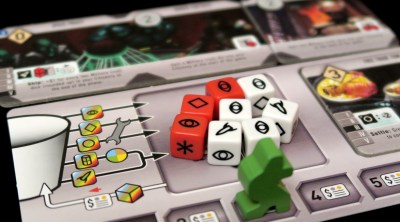
All the scores were close though: Green finished with thirty-seven with Black in second with thirty four, and Lilac and Sapphire were just behind.  As everyone else was still playing, the group carried on together and moved on to the fun little push-your-luck game, Port Royal.  This (like its little cousin “Unterwegs“) is a very simple game: on their turn, the active player chooses to “twist” and turn over the top card of the deck, or “stick” and keep the current card set.  The deck of cards consist of coloured ship cards and character cards.  The first decision is to decide whether to risk a “twist” because if second ship card of a colour is drawn the player goes bust and their turn ends.

Port Royal
– Image by boardGOATS

If a player “sticks” they can take a ship and add its treasure to their stash, or they can use their gold to buy the support of characters.  These give players victory points and special powers, but also can be used to claim contracts and give more points.  The cards are double-sided like those in San Juan or Bohnanza, so in the same way, keeping an eye on the discard pile and the money in players’ hoard is key.  Once the active player has taken a card, players round the table can take a card too, but they must pay the active player for the privilege.  The game ends when one player has twelve points or more, that triggers the end of the game and the winner is the player with the most points.

Port Royal
– Image by boardGOATS

Black, once again, got off to a fighting start, collecting arms to help him ward off the pirates while Lilac had her eye on the contract symbols. Sapphire went for the Admiral, which gave him a bonus for drawing at least five cards and would give others an increased chance to buy and pay him even more.  Green started out with Green Trader bonus, but then got consistently hit by the black pirates before he could barely draw any cards, so his game was hampered from the very start.  With his fighting force at strength, Black was able to haul the cards out and start raking in the points.  Lilac managed to convert high value contracts before anyone else, gaining her more coins to buy more cards.
Port Royal Unterwegs
– Image by boardGOATS

Sapphire built up a “Jack of all Trades” hand, but it only steadily gained him points.  Green managed to finally rid himself of the scourge of the black pirates by stopping draws early, and started collecting symbols, but it was too late as Black reached the twelve points before anyone else. Everyone had one more turn, and Lilac was able to convert her final contract to also reach twelve. Both Lilac and Black managed one more purchase to finish on thirteen points each, but Lilac won took the tie break by virtue of having one more coin left than Black.  Sapphire and Green were also tied on points (on nine-points), but Sapphire completed the podium places with four coins more.

Port Royal
– Image by boardGOATS

Meanwhile, Blue, Saffron, Purple and Lime were playing Azul.  We’ve enjoyed the recent versions of these (Stained Glass of Sintra and Summer Pavillion), but this time the original was the game of choice.  All three use the same market mechanism where players either take tiles of one colour from one of the small markets and put the rest in the central pool, or take all the tiles of one colour from the central pool.  In this original version of Azul, players add these tiles to the channels on the left of player board, and at the end of the round if any of these are full, they move one tile to their mosaic and recycle the rest.

Azul
– Image by boardGOATS

Players score points for placing tiles such that they are part of a row and/or a column in the mosaic and at the end of the game, players score bonus points for completed rows and columns and also for placing all five tiles of any one colour.  There is a catch, however.  When a player takes tiles, all the tiles must go into a single tile channel, and must be of the same colour as any that are already there.  Any left overs score negative points and, as the more left over tiles a player has, the more negative points each one will score.  This has the potential to leave one player picking up lots of tiles and scoring lots of negative points.

Azul
– Image by boardGOATS

This time, that player was Lime.  Having scored a few points during the first round, he was unimpressed when all his negative points at the end of that round pushed him straight back to zero.  This wasn’t the only time that happened though, to the point that it became a bit of a running joke, especially as he made it a point every round to take the first player token (which counts as another negative tile).  One of the key tactics of the game is to try to complete tile channels at the end of the round because these are then emptied leaving the maximum amount of flexibility for the next round.

Azul
– Image by boardGOATS

And this is exactly what Saffron did.  Despite never having played the game before, by focusing on completing her tile channels she was always able to dig herself out of any difficulties.  Although the game was longer than Draftosaurus, it didn’t seem like very long before Purple triggered the end of the game by completing a row, the only one to do so.  It was quite close, but Blue just edged it from Saffron who took an excellent second.  With that, Lime headed off (before the drawbridge was raised) and Blue left Purple and Saffron chatting while she went to watch the last few rounds of Altiplano on the other side of the room.

Azul
– Image by boardGOATS

Altiplano is a much longer game and one that we are very fond of in the group.  Indeed, it was the first winner of the Golden GOAT award (in 2018), though we haven’t really been able to get it to the table since then.  For a while, it had been in the plan to play The Traveler expansion, however, we wanted to play the base game again first and with both Teal and Sage new to the game only the Sunny Days mini expansion was included.  The basic mechanism of the game is quite simple:  on their turn, players carry out the action based in the location their meeple is in, and optionally, moves their meeple either before or after, if they can.

Altiplano
– Image by boardGOATS

The game is a “bag building” game, so a bit like its predecessor, Orléans, or even deck builders like Dominion, players need the correct resources to be available when they carry out the actions.  So, at the start of each round, players draw resource disks out of their bag and place them on their player board to be used in the locations they plan to visit.  Mostly the game trots along quite merrily as this stage of the game is carried out simultaneously and everyone does their planning at the same time so the action phase is quite rapid.  Pink explained what all the different locations did and that there were two main sources of points:  Contracts and Resources.

Altiplano
– Image by boardGOATS

At the end of the game, the resources give points with the amount depending on what it is: primary resources score one point (wood, stone, fish etc.) while advanced processed materials (like cloth and glass) can score up to three or four points.  These will score even more points if they are stored in the Warehouse.  When a resource is used it is places into the players recycling box and goes back into their bag when their bag is empty.  In this way, instead of relying on probability/luck as in Orléans where used resources are returned straight to the bag, all resources are used before they are recycled.

Altiplano
– Image by boardGOATS

Players can leave unwanted resources on their player board, but this can obstruct their plans, so another option is to move them to the Warehouse.  Once in the Warehouse, they cannot be removed, but each full shelf (which can only store one type of resource), gives more points at the end of the game.  Only completely full shelves score in this way, which cost Pink some valuable points when he realised Ivory had pinched the last available fish just before he got there.

Altiplano
– Image by boardGOATS

The other main route to scoring points is through completing Contracts.  Players can only have one on the go at any one time, but when complete, they are worth points and also provide the player with a corn which goes straight in the warehouse and can act as a space-filler too.  As well as getting resources from the Wood, Mines, Seafront etc., players can also buy Contracts, build Carts (to provide them with additional travel options), build Boats or Huts (which provide resources and increase their resource scoring), or buy Board Extensions which give them enhanced abilities.  These Extensions also act as a timer triggering the game end.

Altiplano
– Image by boardGOATS

The game was really tight and despite the fact that all four protagonists employed different strategies, a postage stamp would have covered the final scores.  Pink, despite having carefully explained the importance of Contracts as a means to get points, decided to see how he could do by avoiding them completely—the only one to do so.  He concentrated instead on getting resources, especially high value ones, and storing them in his Warehouse.  Teal’s strategy was driven by the fact he started with the Woodcutter which allowed him to turn food into wood, so he concentrated on building Canoes, lots of Canoes.  This was not a strategy anyone had seen before, but it provided him with a lot of resources.

Altiplano
– Image by boardGOATS

Ivory went for Contracts in a big way, taking a massive fifty-five points for them alone.  Since resources on Contracts don’t score in and of themselves, however, this meant he scored fewer points elsewhere.  Sage went for a more “all round” strategy, picking up a lot of points for his contracts too, but also building a lot of Huts to enhance his resource score.  As the game came to a close there was the inevitable checking what the final Extension tiles and then everyone took their shoes and socks off for the complex final scoring.  The winner, on his first time out was Teal, his unconventional Canoe strategy netting him eighty-six points.  Pink finished second with eighty-three and Ivory was just one point behind that, in what had been a very tight game.

Altiplano
– Image by boardGOATS

Learning outcome: Teach a man to fish, and he’ll swap them for a pile of stones.

27th January 2022 – In Memory of Burgundy

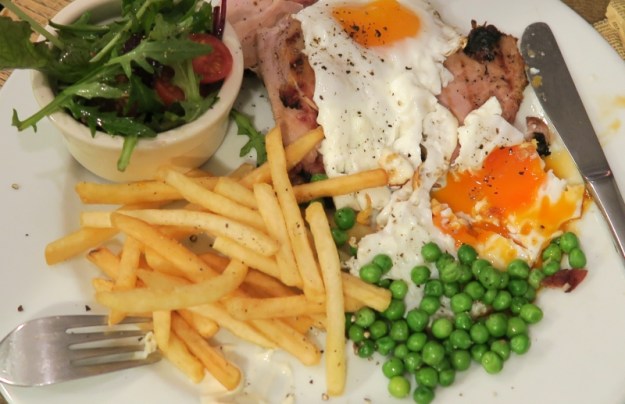
Following the very sad passing of Mike Parker (known on this site as Burgundy), we decided to dedicate this meeting to his memory.  We decided to forgo the usual “Feature Game” and replace it with “Burgundy’s Favourites”, including games as diverse as Concordia, Orléans, Wingspan, Killer Bunnies and the Quest for the Magic Carrot and Dominion. Burgundy had supper at the pub before every games night. Because he always had the same thing, he was known as “Ham, Egg & Chips Man” by the staff at The Jockey.  So we decided to gathering early to reminisce and celebrate his gaming life, and share his favourite supper.

Ham, Egg & Chips
– Image by boardGOATS

Burgundy’s cousins joined us for dinner and we took it in turns to chat and learn things we didn’t know about him. We also had a couple of special guests from elsewhere in the county who fancied joining us to do a bit of gaming in Burgundy’s memory. Chatting to people who knew him in slightly different spheres, one of the first things we found out was that, a creature of habit, Burgundy was known known for having Lasagne when he went to Gweeples, setting up his game while he waited for his molten supper to cool to a point where he could eat it.  There was lots of chatter over dinner and Lime joined us online, but technology difficulties meant he hopped in and out and then, after several rounds of the Hokey-Cokey, eventually gave up.

Mike Parker
– Image by Daniel Monticelli

Black also briefly joined us from Malta—he’d been to a Greek restaurant for dinner, but we all agreed our Ham, Egg & Chips was better.  After a toast to Burgundy, who will never be forgotten, people eventually settled down to play games.  First up was Ivory, Pink, Lilac and Teal who chose Ticket to Ride with the UK map.  Ticket to Ride was one of Burgundy’s favourite games and is popular with the whole group so everyone knows the basics of how to play:  on their turn, the active player can choose two coloured cards from the market to add to their hand, place trains paying with cards, or draw tickets which give extra points at the end of the game if completed.

Ticket to Ride Demo
– Image by boardGOATS

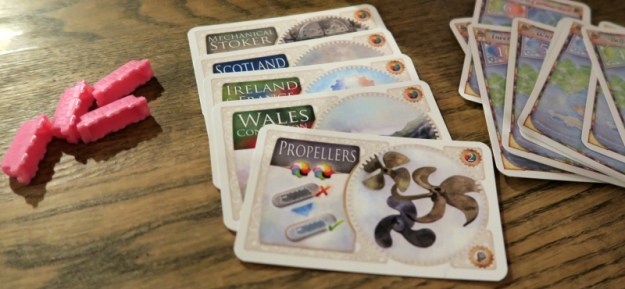
Every expansion set comes with a slight rules twist.  In the case of the UK map, this is the addition of technologies and concessions.  At the start of the game, players can build only one and two train routes and only in England.  By spending wild cards, players can buy technologies which enable them to build routes consisting of three trains or more, build ferries, and build train routes in Scotland, Wales and Ireland. Players can also buy bonus cards that allow them to score extra points for taking certain actions during play.  As usual, the game ends when one player only has two of their plastic trains left and the winner is the player with the most points.

Ticket to Ride Map Collection: Volume 5 – United Kingdom & Pennsylvania
– Image by boardGOATS

Pink (playing with his special pink trains for the first time) started off with a “Home Nations” strategy, eschewing the chance to visit France.  Lilac, on the other hand, explored the Dawlish coast and the area around Dundalk.  Teal took the East Coast Mainline north, and explored Scotland as far north as Wick and Ivory took the West Coast  Mainline and continued up to Stornaway.  The game was really tight, with Lilac, Pink and Ivory all completing nine tickets, and that seemed to be the strategy with Pink the eventual winner thanks to being slightly luckier than the others, finishing just three points ahead of Lilac.

Ticket to Ride Map Collection: Volume 5 – United Kingdom & Pennsylvania
– Image by boardGOATS

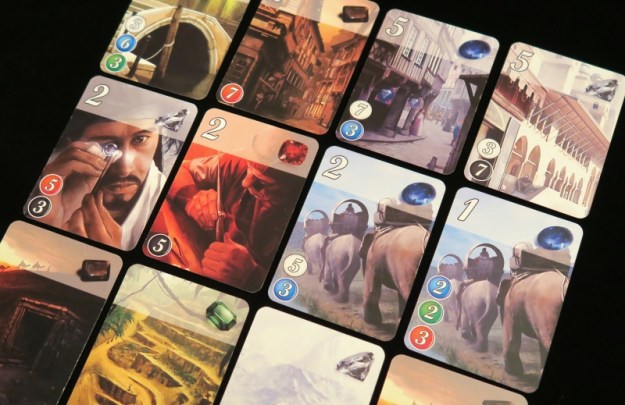
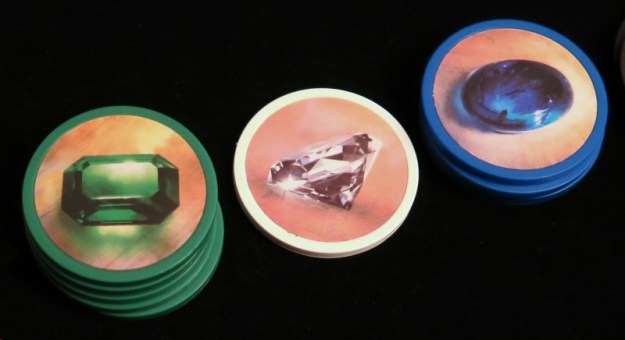
Meanwhile, on the next table, Green, and Magenta were joined by visitors from Oxford and Gweeples, Sage and Jade in a game of Splendor.  Splendor is a simple game, but one at which  Burgundy was a true expert, and at one point went unbeaten for two years.  The idea is that players use poker chips to buy cards which can, in turn be used to buy more cards of a higher value which eventually give points.  When a player reaches fifteen points, that triggers the end of the game and the player with the most points wins.  Game-play is very simple: on their turn players can take three different coloured chips, take two chips of the same colour, buy a card from the display, or reserve a card taking a gold token (which is wild) at the same time.

Splendor
– Image by boardGOATS

As is usual, the game started slowly with Magenta eventually opening the scoring. The others followed with low scoring cards, but Magenta remained one step ahead until everyone else started claiming the higher scoring cards and eventually Nobles.  Green pulled ahead and looked like he might pull off a true Burgundy style victory, but Sage was closing in.  Sage obstructed Green with a tactical reservation, but that just put off the inevitable for another turn. When Green reached fifteen points, the game ended immediately as he was the last player in the round.

Splendor
– Image by boardGOATS

Sage was a close second with the early leader, Magenta, in third. There wasn’t a high score, a resounding win, as there no doubt would have been had Burgundy had been playing, so victory did not feel fully deserved in his absence.  Blue and Purple had been chatting to the family, who were enjoying talking and, after a long day, were reluctant to play anything.  So, when they left to get an early night, Blue and Purple played a quick filler game of NMBR 9 while they waited for something else to finish.  Burgundy played NMBR 9 a lot over the years and, like everything else he was always very good competition, winning more than he lost.

NMBR 9
– Image by boardGOATS

The game has almost zero set up time, and doesn’t take long to play or put away either.  There are twenty cards (zero to nine), which have matching tokens.  Each round, one card is revealed and players take a matching tile and add it to their tableau.  A player’s tableau consists of layers of tiles.  When placing tiles, they must be placed alongside other tiles, or on top.  If placing on top of other tiles, they must overlap more than one, be placed adjacent to others, and next to at least one other on the same layer.  Neither Blue or Purple were focused entirely on the game which Blue edged, as they were too busy gossiping and watching what was happening on the next table.

NMBR 9
– Image by boardGOATS

The game of Splendor and NMBR 9 finished pretty much at the same time, and the group joined up for a game of 6 Nimmt!.  6 Nimmt! is another game that Burgundy really enjoyed playing with the group and indeed, played a lot.  This was especially true online over the last couple of years, where he played forty-three times with us, winning over one in four of the games.  Jade had only played online, so the group introduced him, and indeed Sage as well, to the variant we usually play.  We play the game in two halves, dealing half the deck out for the first round and then the other half for the second round.

6 Nimmt!
– Image by boardGOATS

Everyone was familiar with the basic game play:  simultaneously choose a card which is added in turn, starting with the lowest, to one of the four rows in the play area.  Each card is added to the row that ends with the highest card that is lower than the card played.  If it is the sixth card, the player “wins” all five cards in the row, and their card becomes the new first card.  In contrast to the online version on Board Game Arena, where players start with sixty-six points and count-down to zero, players start at zero and the player who “wins” the most points is the loser.

6 Nimmt!
– Image by boardGOATS

This time, Green “won” the first round, top-scoring with twenty, while Sage managed to keep a clean sheet.  As Burgundy was always the exemplar though, performance in the first round is often no indication of how the second round will go, which is one of the reasons why we love this variant.  So it was all to play for, especially for everyone who’s first score was in single figures.  This time it was not to be, however, and although Sage picked up thirteen “nimmts” in the second round, everyone else’s total was more.  It was close at the other end and with lots of pretty coloured cards, Purple and Jade high-scored with twenty-nine.

6 Nimmt!
– Image by boardGOATS

Ticket to Ride was still going and with six players, and time marching on, there was only really one option, the option Burgundy would have chosen: Bohnanza.  Jade had never played it before, so, after a quick rules summary, as is often customary in this group, he went last so he could see how things work and get a feel for the game.  In this game, although we generally play “friendly”, it is particularly important as it is a trading game and it is important to be able to get a feel for the value of any advice offered.

Bohnanza
– Image by boardGOATS

As Purple pointed out, the most important thing about Bohnanza is not to sort your cards because players play cards from the front of their hand and add cards to the back forming a sort of conveyor-belt.  On their turn, the active player plants the first bean card in their hand into one of their two bean fields, and may plant the second if they choose.  Two cards are then revealed and these can be planted by the active player or traded.  This leads to another key rule: what is on the table must stay on the table so anything traded must be planted.

Bohnanza
– Image by boardGOATS

Fields can be harvested at any point, with some of the cards being turned over and stored as coins.  However, beans can only go in empty fields or share fields with beans of the same type.  Players only have two fields (or three if they buy a third), so if players are unable to trade a card away, they may have to harvest fields before they are ready.  In this sense, we generally play “friendly” and rather than forcing players to plant something they don’t want, we have a culture of giving cards away.  This extends to players taking cards in free trades from someone’s hand to further their game too.  As a result, the game sometimes the player who is best able to make the most of these freebies is the winner.

Bohnanza
– Image by boardGOATS

Unusually, and to the accompaniment of a lot of sucking of teeth from everyone else round the table, Sage ponied up his two coins for a third bean field—the only one to do so, and especially risky in the second round.  He wanted to plant a couple of Red Beans though, so at worst it was probably revenue neutral and certainly worth the risk.  Blue benefited from a lot of Coffee bean donations while Purple, Green, Jade and Magenta all planted the highly lucrative, but quite scarce, Black-eyed Beans.  The first round took an age, but in contrast, the last was really short, so short, Sage sadly commented that although he had the perfect hand, he wasn’t going to be able to play it. 

Bohnanza
– Image by boardGOATS

It was a close game though, and an extra turn or two could have made all the difference.  As it was, Blue was the eventual victor with sixteen “Bohnentaler”, three more than Jade.  Time was pressing and that was the last game for that group, but in the meantime, on the next table, Ticket to Ride had finished and the quartet had moved onto what was arguably the game of the night, Splendor.  This time, the game started with a shortage of blue, sapphires, then green emeralds became hard to get.  It was nice to note that everyone played according to Burgundy’s maxim, “Always take a free one.”

Splendor
– Image by boardGOATS

In the end, Pink ended the game, and although Ivory managed to score in his final turn, he wasn’t able to catch up.  As the games came to an end and everyone chatted, the mood was sombre, perhaps with half a mind to the following day.  In spite of that, it has been a good evening making new friends, and playing games.  All evening Burgundy was never far from our thoughts, but that was particularly true during the two games of Splendor.  And he always will be whenever we play Splendor from now on.

Mike Parker
– Image by Pushpendra Rishi

Learning outcome:  Mike, Burgundy, was THE GOAT, and we all miss him.

Michael Parker (1958-2021)

Michael Jonathan Parker (mostly known as Mike in gaming circles) was the only son of Stan and Pam and was born on 27th August 1958 in Oxford at the Nuffield Maternity Home (part of the old Radcliffe Infirmary).  Brought up in the Botley area, he went to Mathew Arnold School where he was one of just three pupils who took O-Level Astronomy—a first for the school and pretty unusual anywhere at the time.

Mike Parker
– Image by Pushpendra Rishi

In 1976, Mike went on to study electronic engineering at the University of Hull, after which he returned to Oxfordshire to work in the developing world of IT.  Mike spent the rest of his life in the county, living in Botley until 2015 when he moved a short way down the A34, to Didcot.  Mike had many interests, including music and American football where he was a statistician for Oxford Saints.  One of his most enduring past-times though, was playing games.

Mike Parker & The Magic Folk
– Image from Mike Parker (origin unknown)

It was as a young man that this interest first developed, when he played Chess with his father.  They played regularly, both together and with friends.  Then, when the Oxford Magic: The Gathering scene started in the mid-1990s, Mike became hooked on that.  In the early days he played at events and tournaments, but more recently his passion was his Cube, the curated set he used for drafting.

Mike Parker
– Image from Didcot Games Club (origin unknown)

Mike worked hard on balancing his Cube, introducing new cards with each new release and attended every pre-release event in Oxford.  He also bought premium foil versions of cards, making his a very special Cube to play with.  Mike was well-known for favouring green when drafting, so if you were sat next to him at the table, you could usually be fairly certain that colour would be taken before you saw it.  Mike’s Cube Sundays were legendary and he continued to draft weekly until events intervened.

Mike with Mike and Joe setting up a new club
– Image from Mike Parker (origin unknown)

Around the turn of the millennium, every Friday night, Mike was playing Magic in Didcot.  So, when one of the Magic players started Didcot Games Club in 2001, Mike joined them too.  He was there from the first night, and took responsibility for looking after the finances.  His interest in the collectable nature of Magic quickly transferred, and he developed a fondness for Killer Bunnies and the Quest for the Magic Carrot, and later Dominion which Mike collected all the expansions for and also played often.

Mike Parker
– Image from Didcot Games
Club (origin unknown)

As well as playing at Didcot Games Club, he was also an occasional visitor to the Oxford Meeples meetings and always attended the quarterly “Big DoG” events that they run.  Over the years Mike also put in appearances at other conventions including OxCon and UKGE.

Mike Parker
– Image by Pushpendra Rishi

In time, he became a much valued regular at boardGOATS too (where he was “Burgundy” on the website, and known as “Ham, Egg & Chips Man” by the staff at The Horse and Jockey).  When he moved from Botley to Didcot after he retired from working at Sophos, Gweeples became his local group and he soon started playing games there as well.  In fact, if there was a local group playing games, it was highly likely that Mike would be a regular.

Mike Parker and firends at Thirsty Meeples
– Image from Mike Parker (origin unknown)

Mike was an omnivorous gamer: while he loved playing complex strategy games, he also really enjoyed lighter games.  Aside from Magic, Concordia and Orléans were two of his favourites and he was well known for his good-natured grumbling, muttering and moaning just before his strategy paid off and he emerged victorious.

Mike Parker
– Image by Pushpendra Rishi

As well as complicated fare, Mike was equally at home playing family-friendly games like Bohnanza, Wingspan, Ticket to Ride, and 6 Nimmt!.  Indeed he was almost unbeatable at Splendor and at one point held a two year unbroken streak.  The only games he really wasn’t fond of were “social deduction” games, but even then he’d cheerfully join in if that was what someone else wanted to play.

Mike Parker
– Image by Daniel Monticelli

Mike sadly passed away suddenly, but peacefully, in December 2021 (funeral 4pm on Friday 28th January in Garford).  Right up to the end he was engaged in his gaming passion, playing in person and also online via Steam (where he was mike_parker), and researching material on Board Game Arena and Board Game Geek (where he was Bored_Mike).  Below are some of the comments from friends and fellow gamers who will all miss his unique blend of humour, gaming brilliance, and kindness.  Very simply, Mike was a lovely man who has gone too soon.


I’m going to miss Mike Parker, those of you who knew him from Magic he was around from pretty much the beginning of the scene in Oxford.

This guy had a heart of gold.

– Seraphina Namine Lorell, Oxford Magic


Mike was very welcoming when I first started playing with the Oxford Magic group back in 2001. I remember the many occasions we compared our RG builds at pre-releases and drafts! (Before Gruul was invented 😉)

– Mark Walker, Oxford Magic


Mike was always lovely to see and play against at prereleases – kind and friendly with a great sense of humour (especially if his pool or your pool was bad).  He was a lovely man and my dad always loved seeing him at magic events as the “older crowd” too.

– Alice Walker, Oxford Magic


I am really sorry to hear about Mike 😢

Mike to me was a really gentle man even when he was completely destroying you at a game! I am really going to miss his complaints that the game was already going horribly wrong on turn one before proceeding to beat us all! I have many great memories playing against him.  He was friendly and warm and will be sorely missed.

– Tom (Ivory), boardGOATS


Mike was such a lovely person. I’m so sad to hear this.

– Katie Roberts, Oxford Magic


I’m gutted. Mike was such a lovely man. Gentle, kind and welcoming. His Cube Sundays were legendary and I will miss him dearly.

– Jamie Ball, Oxford Magic


Such sad news, Mike was a true gentleman and all round great person. I fondly remember seeing him and interacting with him at pre-release events for every new set, and loved playing against him, as well as his legendary Cube sessions held over the years, I will miss sitting down at the table, seeing all the packs laid out and of course, the box of mini rolls that he always seemed to have readily available. I also saw him quite often when he still lived in Botley as he would often come to my checkout when I was working in the co-operative food store there.

Needless to say, he will be greatly missed and will stay in our hearts for all time. Rest In Peace Mike ❤️

– Aaron Williams, Oxford Magic


Mike was always willing to play any game with anybody whether they were hardened gamers or new to the joys of boardgames. He was definitely one of the good guys, he even put up with me calling him Eric for several of our days of gaming until Joanne (my wife) asked me why I was calling him that when his name was Mike.  Mike, the gentleman that he was, never corrected me and just carried on as if it was normal. Every time we met up we joked about it.

Joanne, said that he was a kind man, and she always enjoyed gaming with him; she knew she was going to have a good time, no matter what the outcome.  She’ll miss the muttering when a card draw went badly, or someone sneaked in and took the space/card/resource he wanted. He played a mean game of Concordia, a favorite game for both of us, I know because he beat me on many many occasions. I was also part of the 2 year Splendor losing streak 🙂 and so were a lot of the other attendees at our events.

I never got to play his favorite game Orléans with him, but I do know that some of my friends bought the game after his teaching of it, which I think says a lot about him.

– Andy Gordon, Oxford Meeples


Really sad to hear a great person has left us 😥
Rest well Mike you will be missed by the MtG community

– Andrew Gardner, Oxford Magic


Mike would often give me advice on what to do in a game if he saw I was struggling. Quite often I would take a resource/place a dobbie/pick a card that he was after, and he would mutter, grumble, and be gracious about it. In all the short years that I have known him, he had always been gracious, and good humoured. He will leave a gigantic hole in the Oxfordshire gaming family.

– Purple, boardGOATS & Didcot Games Club


That’s awful news. Mike was such a lovely bloke, always had a top time going round his place to play his Cube.

– Huw Morris, Oxford Magic


This is such sad news. He was instrumental in inducting myself and many other Gweeples friends to heavier Euros like Concordia and Orléans. He will be sorely missed.

– Daniel Monticelli, Gweeples


His steady presence and gaming skill will be missed. I can’t tell you how many times he beat us at Concordia and Splendor. Happy gaming Mike.

– Pushpendra Rishi, Gweeples


When I first started to play in the local magic tournament scene Mike was my opponent to beat. Our Mike-Mirror-Matches will be amongst the fondest of memories of my early years in Didcot.

The generosity Mike showed to new and young players was characteristic. He often donated many of his drafted cards to those just starting into the hobby. Years later I saw the room he had dedicated to storing the larger portion of his collection, and I can understand that the moving of those excess cards might not have been purely altruistic. 😀

Mike was a good friend. As he moved to Didcot my wife, Nikki, and I lived just around the corner. We had him over for many a games night. The Christmas before my daughter was born we had Mike over for a Christmas meal, all our plans had been messed around due to ill timed hospital visits. So, missing our family we reached out to him. Had we not been in the mix of the pandemic we had hoped to invite him this year too. As it was everyone here went into isolation for the first two weeks of 2022 so we were clapping ourselves on the back for not exposing him. When we found out he’d passed, that felt hollow… on top of the grief.

– Mike Hargreaves, Didcot Magic & Gweeples


Mike was a large part of our gaming community being an active and respected member of every group between Didcot and Oxford (and likely a few more we do not yet know about!). He was a patient teacher and introduced many of our members to games such as Orléans and Concordia… but will likely be remembered for his skill at Splendor, a game I have lost to him many times.

In our community there is a well known phrase that when playing a game the goal is to win, but it is the goal that is important, not the winning. Mike embodied the virtues of this statement and will be missed by many.

– Dave Stephenson, Gweeples


Mike was a structural part of boardGOATS, always present, and always happy to play any game from Love Letter through to Terraforming Mars with great skill and commitment. I can honestly say, if I managed to beat Mike at anything, it would be an occasion to come home feeling that I had really achieved something.

– Anon., boardGOATS & Didcot Games Club


Gutted. Mike was such a nice guy.

– Max Gilbert, Oxford Magic


So sad, but so many fantastic memories. Like standing in the pub car park after games night, freezing to death for well over an hour and getting a crick in the neck spotting Perseids. Or playing games remotely with Mike who didn’t have a camera, and everyone instantly knowing his dice roll hadn’t gone the way he wanted by his immediate response—he could so easily have changed the result and we’d all have been none the wiser, but that would never have occurred to him which made it all the funnier. Or recently, when we did the Quiz, Mike indignantly marching off with his stick to correct the Landlord and Question Master because their answer to a question on NFL wasn’t right (he got the verdict overturned). And so many more great memories.

Mike was such a lovely chap, kind, funny, modest and unassuming. He was competitive and brilliant competition, but always magnanimous in victory or defeat, even if he had been hard done by (though he generally won more than he lost).

We will all miss him so very much.

– Blue, boardGOATS & Didcot Games Club


I first knew Mike from Magic tournaments 20 years ago…

– Jonathan Challis, Oxford Magic & Gweeples


Mike was very welcoming when I joined the group a few years ago. I will miss his good natured grumbling about how badly he was doing, often before he pulled off a masterstroke and won the game.

– Jez (Pine), boardGOATS


He will be missed. He was such a lovely gentleman.

– Kirsten Christensen, boardGOATS


Mike was a very good game player. He was one of those who it was challenge to beat. Whether he won or lost he just seemed to be happy to have played. When he started muttering and huffing about his in game choices anyone who didn’t know him would think he was doing badly and was going to lose, but for those who played him regularly we knew that he was most likely going to win with a big margin. I’ve been playing games with Mike for nearly 10 years now. He was amiable and fun to play against, a joke and a laugh about the game was never far away.

An abiding memory of Mike I will always have was actually when our game group did the pub quiz. When the answer to an American Football question was not what Mike had told us, he went straight up to the quiz master to inform him his information was out of date. It was funny as we had never seen Mike so forceful before! The point was given after all.

We will miss Mike at BoardGOATS, as a gamer and as a friend.

– Chris (Green), boardGOATS & Didcot Games Club


Rest well Mike. You were a lovely person to know and it’s a huge shame I hadn’t seen you in a long time since I moved away. He was a wonderful man.

– George Youens, Oxford Magic


I didn’t get out to gaming events very often, but pretty much every time I did, whether in Stanford, Didcot, or around Oxford, Mike was there. We seemed to have pretty similar tastes in board games, so played together a good many times, and I enjoyed every one of them, with a sense of friendly rivalry and appreciation of a game well played.

As things return to normal and we get back to seeing people to play games again it will seem wrong to not have him there. Mike was a lovely guy and will be very much missed.

– Rob Harper, Didcot Games Club


I’m very sorry to hear about Mike. He had a great sense of humour and was guaranteed to win any game of Splendor he played. However, he would do it with such a cheeky smile that you could not be angry at him for long. His knowledge of and interest in board games was profound, and it was always great to chat about the moving and shaking in the board game world.

He will be greatly missed by everyone at boardGOATS, and I am sending my best wishes to all his family and friends.

– Claire Murray, boardGOATS


He was a very enthusiastic MtG fan and good guy in general. A blow to the community for sure.

– Felix Lloyd Read, Oxford Magic


We will miss you Mike; Ham, Egg and Chips will always have your name on it – as will the end seat at the Jockey – may you spread your wings wide to play Wingspan again – onward and goodbye.

– Stuart (Lime), boardGOATS


We would like to say in a few words:
Mike was a huge and unforgettable part of GOATS;
What’s the best way for Mike to start the games or quiz
Than having his Ham, Egg and Chips?!

Mike would never follow Twitter,
But we always liked the way he wittered;
It was never silent during games,
Once you found out that Mike was in his winning place;
Mike and Splendor?
Brace yourselves as you would always have to surrender.

If you want to play the Wingspan game,
Just think of Mike, as it would be the winning name;
And if you want to play some more,
Be prepared for it, as Mike would always score!

And in case you don’t know this —
But Mike the wizzer was also an excellent quizzer:
Mike would score a lot of points
For our incredible Team, “GOATS”;
And we all know where Mike was also at his best,
It would be his American football interest.

Mike’s American football passion
Scored the points for GOATS in a matter of seconds;
This became clear to us and averted disaster,
When Mike decided to approach the quiz master!
Do you know anything about the Washington Football Team?
Mike could definitely tell you,
As he had American football expertise.

And with a great honour to our friend
We will always play his favourite game in Mike’s name;
Mike was our very precious friend
And without him, GOATS will never be the same.

We all know when playing a quiz or a game,
we will think of Mike as he was the best gamer friend.

Mike was such an amazing and humble gentleman.
He will be greatly missed by all,
And the gap will never be filled.
He might be gone, but never forgotten.
Rest in peace, Mike. 💜

– Jirina (Lilac), boardGOATS


Huge thanks to everyone who contributed, especially those who helped with information and detail without whom this would not have been possible—you know who you are and your help is greatly appreciated.


Boardgames in the News: The Great Escape?

Over the last decade, Asmodee has swallowed most of the big names in modern family board games, including the likes of Ticket to Ride, Settlers of Catan, Star Wars: X-Wing Miniatures, 7 Wonders, Dominion, Agricola, and Pandemic amongst others.  This has been through the relentless acquisition of the companies that produce these titles, in particular, Days of Wonder, Fantasy Flight Games, Z-man Games, Mayfair, Lookout Spiele, and Repos Production.  This monopolising of the market cannot be a good thing for gamers, indeed the effects are already being felt with the introduction of Minimum Advertised Pricing (MAP) and now the loss of customer servicing for all Asmodee products.

HeidelBÄR Games Logo
– Image from twitter.com

There is perhaps a glimmer of hope, however.  Three years ago, the German publisher and distributor Heidelberger Spieleverlag was acquired by Asmodee, with the publishing part splitting off to form the Asmodee Studio, HeidelBÄR Games.  Last year, however, ownership and with it the nucleus of the HeidelBÄR team, was transferred back to the previous manager, Heiko Eller-Bilz.  The resulting enterprise is much smaller than it was, but the most important asset, the people, are in a position to develop new titles.

Plaid Hat Games Logo
– Image from plaidhatgames.com

More recently, Plaid Hat Games have made a similar, slightly slower, journey.  Around five years ago, Plaid Hat Games was bought out by Canadian company F2Z Entertainment, then the parent company of Z-Man Games, Filosofia Éditions and Pretzel Games (now known as Asmodée Canada).  However, earlier this year it was announced that Plaid Hat Games had been reacquired by Colby Dauch, the original founder, albeit without the rights to some of their biggest products, including Dead of Winter, Aftermath, and Mice and Mystics, which remain with the Asmodee Group.  Plaid Hat Games retained the rights to Summoner Wars though, and are currently developing a new product, Forgotten Waters, which will be the first game released by Plaid Hat after their Great Escape.

Forgotten Waters
– Image from plaidhatgames.com

1st October 2019

It was a bitty start with lots of chit-chat and eating, including Blue’s fantastic pizza with mushrooms growing out of it. A little bit of singing to celebrate the fact it was the eve of our seventh birthday was immediately followed by special meeple cakes. Eventually, when everyone had finally finished sucking the icing off their wooden meeples, we finally settled down to the now traditional birthday “Feature Game”, Crappy Birthday.

Pizza
– Image by boardGOATS

Crappy Birthday is a very silly party game that most of the group would normally turn their noses up at, but love to play once a year. The idea is that each person has a hand of cards featuring silly things and chooses one to give to the active player as a birthday present. The Birthday Boy/Girl then chooses the best and worst gifts which score the giver a point. Players take it in turns to receive gifts and after everyone has had one go, the player with the most points is the winner. It is very simple, but the best part is really when the recipient has to sit and sort through all their gifts and justify their choices. It seems a really silly game, and indeed it is, but it encourages people to get to know each other a little better and in a different way too.

Crappy Birthday
– Image by boardGOATS

This year, we discovered that Black would like a trip to the North Pole, Pine fancied two weeks in a swamp and Purple fancied a course on Mime Art.  In contrast, Burgundy was not keen on getting his earlobes stretched, Blue wasn’t keen on a GPS (with or without an annoying voice) and Lime eschewed some “garden manikins”.  Perhaps the most surprising thing we discovered was just how great Ivory would be as a day-time quiz host.  Amongst the fun, the scores were largely incidental, but everyone picked up just one or two points except for Purple who scored three points and Black who just pipped her to the post, with four points.

Crappy Birthday
– Image by boardGOATS

Since Blue and Ivory had both brought Roll for the Galaxy, it was clear that they were keen to give it a go and when Green said he’d play it, the only real question was which copy would get played. Since it can be quite a long game, Blue and Ivory got going quickly and left the others to sort themselves out. Although Ivory was keen to give the new Rivalry expansion a go, as it has been a while since we last played (and Green wasn’t totally familiar with it either), the trio decided to leave that for another day.  Although a lot of the group seem to get in a bit of a mess with Roll for the Galaxy, it is not actually a complicated game. It is a “pool building” game, similar to deck builders like Dominion or bag builders like Orléans or Altiplano, except with dice.

Roll for the Galaxy
– Image by boardGOATS

The idea is that at the start of the round, everyone simultaneously rolls all their dice in their cup and, depending on what faces are shown, secretly allocate the dice to the five possible phases of the game: Explore, Develop, Settle, Produce & Ship. One of the dice can be used to select which phase that player wants to “nominate”, i.e. guarantee will happen. Any die can be used for this, it does not have to match the chosen phase. Once everyone has assigned all their dice and chosen their phase to nominate, all dice are revealed and the active phases are revealed. The clever part is the element of double think that players have to use: a player can only nominate a single phase, so if they want to Produce and Ship they have to rely on someone else to nominate the other one. Guess right and both phases will happen, guess wrong and they will only get one of them, and if that relies on something else happening, they may find they end up doing neither.

Roll for the Galaxy
– Image by boardGOATS

Thus, while there are a lot of other moving parts, fundamentally, a successful player must piggy-back on other players because it will give them more actions.  Dice that are used then go into the players’ Citizenries, and unused dice go back into the players’ cups. Dice are extracted from the Citizenries and returned to the cups on payment of $1 per die, once all the actions have been carried out. Thus, the player with the most appropriate dice can turn the handle on their engine most efficiently. The aim of the game is to finish with the most points, which are obtained from settling and developing worlds and shipping goods to give points.

Roll for the Galaxy
– Image by boardGOATS

So, the first action is Explore, which is taking world tiles from a bag. These are double-sided with a development on one side and a production or settlement world on the other. They go into either the Development or Settlement piles so that dice are placed on top of these during the Develop and Settle phases: when the cost has been matched by the number of dice, the world is added to the player’s tableau and they can use whatever special power it provides. Some of the worlds are production worlds which typically provide more, exciting dice to add to the system.  In addition to extra, coloured dice, Production worlds also house dice played during the Produce phase. These can then be consumed for victory points or traded for cash, enabling more dice to be transferred from the player’s citizenry to their cup.

Roll for the Galaxy
– Image by boardGOATS

The game ends at the end of the round when either, a player Settles/Develops their twelfth world or when the stock of victory point chips run out. The winner is the player with the highest score from their combined victory points and worlds. There are a couple of other minor rules (for example players can pay one die to effectively change the face of one other die), but essentially, that is all there is to it.  Players start with a double tile comprising a complimentary pair of settlement and development worlds and a start world, together with a couple of tiles to add to their Development/Settlement piles.  For the first game it is recommended that players choose the Development and World with the lowest cost to add to their piles, because that is easier to play.  For later games, however, players can choose, which gave Blue a really tough decision.

Roll for the Galaxy
– Image by boardGOATS

In the end she decided to go for it, and chose to start with the “Galactic Federation”, “6+” development world in her building pile.  This would give her an extra one third of her development points at the end of the game, but more importantly two of the dice used for every development would bypass her citizenry, going straight into her cup.  Green started with no fewer than three of the red, “Military” dice, which coupled with his “Space Piracy” starting development, gave him really a good source of finance. He looked very unimpressed with this combination, but Ivory and Blue felt it was a really nice combination of starting tiles. Ivory’s start tiles were also nice, but didn’t have quite the same degree of complimentarity, but he did get a nice  purple, “Consumption” die.  The starting tiles are only the beginning though; the game is all about building an engine made up of dice, Production Worlds, and Developments and then using it efficiently.

Roll for the Galaxy
– Image by boardGOATS

In the case of Blue, her starting tiles led her towards a Development strategy, so she spent a lot of the early part of the game Exploring to try to find nice Development tiles to enhance that approach.  Green and Ivory had a more conventional, “build the finances and the dice pool then Produce and Consume” strategy.  The problem with this was they both frequently wanted the same phases, but ended up with either both of them choosing to, say, Produce, or both choosing Ship, when what they both really wanted was to maximise their dice by Producing and then Shipping.  Blue, on the other hand, could mostly be fairly sure that neither Ivory or Green were going to what she wanted, so was able to focus on her own plan, and just piggy-back the actions of the others.  Although the game has a reputation of being slow (with our group at least), this time, the game got going quite quickly and it wasn’t long before Ivory started his Production engine, Shipping his produce for victory points.

Roll for the Galaxy
– Image by boardGOATS

Green soon followed, while Blue kept building her Developments and occasionally taking advantage of the “Produce/Consume” strategies of the others to provide enough finance to move her dice out of her Citizenry.  Blue felt her game was really boring since all she did was Develop, but in the end, it was probably the fact that Blue was doing something different that was key.  Blue triggered the end of the game placing her twelfth Development/World tile, which gave her the most points from building, slightly more than Green.  Ivory Consumed the most victory points, with Green not far behind, and Blue not really troubling the scorer in that department.  It therefore all came down to bonuses from the “6+” Developments, which is where Blue made up for other deficiencies taking fifteen points giving her a total of fifty-seven points, five more than Green who was just a couple ahead of Ivory.

Roll for the Galaxy
– Image by boardGOATS

It had been a lot of fun, and next time we’ll have to give one of the modules form the Rivalry expansion a try.  On the next table, their game was coming to an end too.  Having been abandoned to sort themselves out, someone mentioned Ticket to Ride, and with everyone having a good idea how to play, that turned out to be most popular. The game is very simple and everyone has played it, in most cases, quite a lot, so we often play with expansion maps.  This time, the Team Asia/Legendary Asia expansion was an option, but as we usually play with the Europe version of the game, the group decided to play with original USA map with the addition of the USA 1910 additional route cards.

Ticket to Ride: Europe
– Image by boardGOATS

The basics of the game is that players start with a handful of train pieces and place them on the board to connect cities, paying with cards.  Thus, on their turn a player can take two coloured train cards from the market (either the face up cards or blind from the deck) or play sets of cards of a single colour that matches both the number and colour of one of the tracks on the board.  Players score points for the number of trains they place, but also for tickets.  Players choose from a handful of these at the start of the game and can take more tickets on their turn instead of placing trains or taking train cards.  These are risky though, because although they are a source of points, any tickets that are not completed at the end of the game give negative points.

Ticket to Ride (USA)
– Image by boardGOATS

The original version of Ticket to Ride (with the USA map) is much less forgiving than the Europe edition that we more usually play.  This is partly thanks to the layout of the tracks, but also due to the absence of Stations which can help alleviate some of the stress associated with failure to complete tickets.  With five, it was always going to be a really hard game and likely to end up with a bit of a train-wreck for someone, and so it turned out.  The eastern states were rough, really, really rough with Burgundy, Lime, Pine and Purple all fighting for routes in the same space.  As a result, Black benefited from mostly staying out of the scrap.

Ticket to Ride (USA)
– Image by boardGOATS

Pine, Lime and Purple managed to complete the most tickets, five each, but remarkable, all three were a long way behind Burgundy and Black who only completed three and four tickets respectively.  This was partly due to negative points, but was mostly caused by the fact that the longer tracks give disproportionately more points and Black for example was able to pick up two of the long tracks around Salt Lake City relatively unopposed as he was mostly alone working in the west.  Similarly, Burgundy did well in the north.  As a result, it all came down to the longest route bonus, ten points, but with Black and Burgundy both in the running it gave a twenty point swing to Burgundy giving him a total of one hundred and thirty-five points, nearly twenty more than Black in second place.

Ticket to Ride
– Image by boardGOATS

Ticket to Ride and Roll for the Galaxy finished simultaneously and only Green decided he needed an early night, leaving everyone else to play one of the group’s favourite game, Las Vegas.  This is a simple game of dice rolling and gambling, where players use their dice to bet in one of the six numbered casinos.  Each casino has one or more money cards and at the end of the round, the player with the most dice in that casino takes the highest value money card.  The player who comes second takes the next highest value card and so on.  When betting, players must place dice in one of the numbered casinos.  The first catch is that they must place all the dice they roll that depict that number in the matching casino.  The second catch is that any dice involved in a tie at the end of the round are removed, and it is this that makes it a great game.

Las Vegas
– Image by boardGOATS

We have the original version of the game rather than the new edition, Las Vegas Royale, though we added elements from the Las Vegas Boulevard expansion, including the double weight “Big” dice and the Slot Machine.  We also house-rule to only play three rounds instead of the four in the rules as written.  This time, Ivory stole a march in the first round, when he was forced to place his last die as a losing singleton in “Casino Five”, only for Purple to roll a five with her final roll and take out both herself and the hitherto winner, Pine.  As a result Ivory took the jackpot of $90,000 to go with his other winnings.

Las Vegas
– Image by boardGOATS

It is not a game to give up on though, as anything can happen.  The second round was relatively uneventful, but the deal for the final round left the last three casinos each with a single card of $100,000.  This is highly unusual, but we decided to play on and see what happened.  In the end, it had a bit of an “all or nothing” feel about it, with players going in early and in big.  It was probably no coincidence that the three big jackpots were taken by the three highest scoring players.  Pine thought he had come off worst, Black, who had done so well in the other two games took the wooden spoon.  It was Ivory’s flying start that was key though, and together with his strong finish, his total takings were a massive $430,000, $40,000 more than Blue in second.

Las Vegas
– Image by boardGOATS

Learning Outcome:  Party games can be great when everyone is in a party mood.