Tag Archives: Draftosaurus: Marina

17th October 2023

Being the first meeting after SPIEL, there was a lot of chatter about Essen and how things had changed since the last time anyone from the group went, some four or five years ago.  Lots of people from the group have been over the years, and others have been to other conventions like UKGE or HandyCon, so have something to compare it to.  Eventually, the group settled down to play games and five very quickly volunteered to play the “Feature Game“, which was Forest Shuffle, a new Essen release.  This is a card game where players are trying to build combinations of animals around trees to score points.
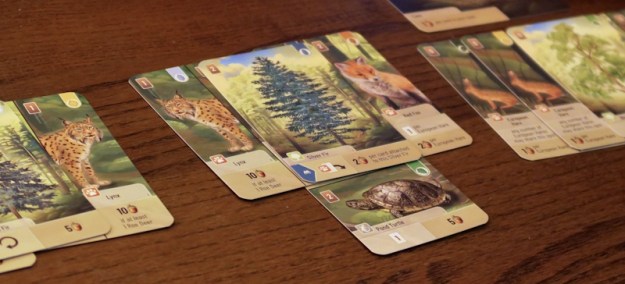
Forest Shuffle
– Image by boardGOATS

Game play is quite simple:  players start with a hand of cards and, on their turn draw two cards from the market (or “Clearing”) or play one to their tableau.  There are two sorts of card, Trees and “Critters”.  Before playing a Critter, players must have played a Tree, which then has spaces on all four sides.  Birds and Butterflies are played to the canopy, Fungi and Amphibians are played at the bottom of the tree and Mammals are played either side.  The clever part is that Critter cards are split so they show two critters (either left and right or top and bottom), so players choose which they would like to play, and therefore where, tucking the other side under the tree, making the unplayed half invisible.
Forest Shuffle
– Image by boardGOATS

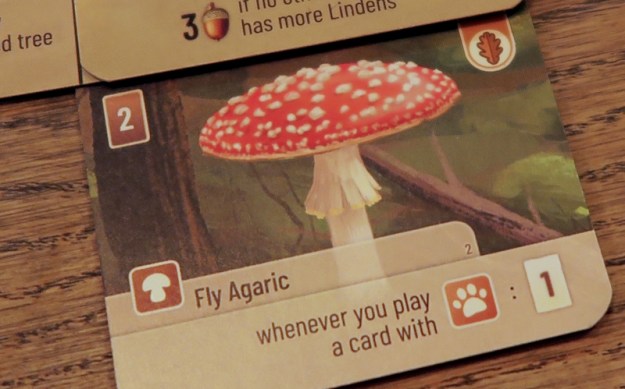
Players have to pay the cost of playing a card into the fact up Clearing, making those cards available to other players (and even sometimes themselves).  Most cards have an effect associated with them, usually this is a one-off special action, but in the case of Fungi, they are special powers that last for the rest of the game.  If the card played matches the colour of the cards used to pay for it, sometimes there is an additional bonus (e.g. take an extra turn, or extra cards, play a card for free etc.).  These can be extremely powerful as they allow players to, for example, pay with cards they can then pick back up, or play a sequence of cards together.
Forest Shuffle
– Image by boardGOATS

The game ends abruptly when the third “Winter is Coming” card is drawn from the deck and the player with the most points is the winner.  Players score points for Trees and for Critters, but it is how players get their cards combining together that really makes the difference.  Thus it is a game of strategy and tactics, but also of timing, which relies on very simple rules.  Blue outlined the rules and explained how some of the cards work together, then ??? started by choosing a card from the market.  There was a little confusion when the Dürer-Fledermaus/Feldhase card came out with the text all in German, but otherwise, everyone got the hang of the basics quite quickly, though playing well can take a little longer.
Forest Shuffle
– Image by boardGOATS

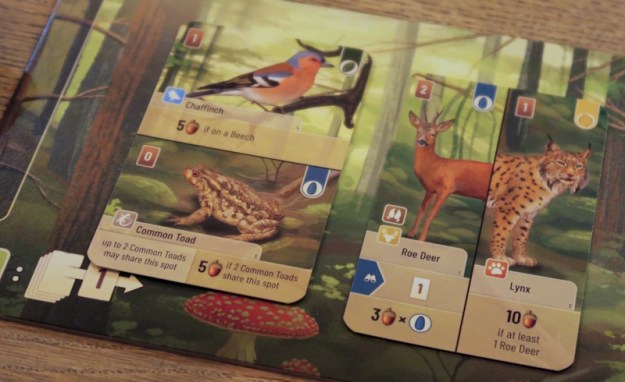
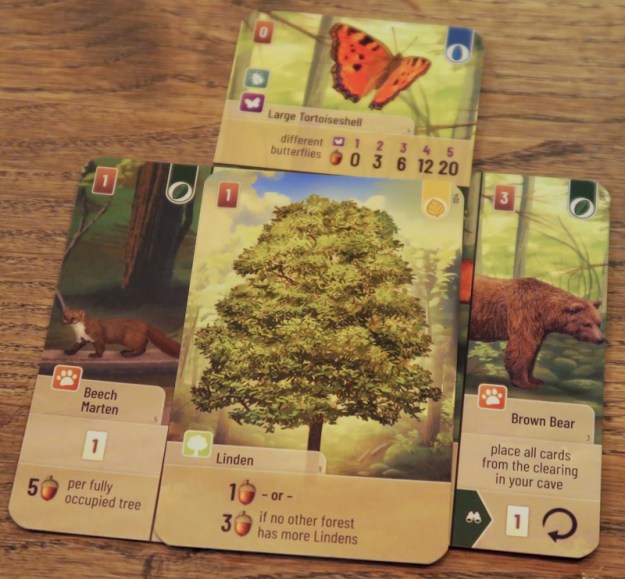
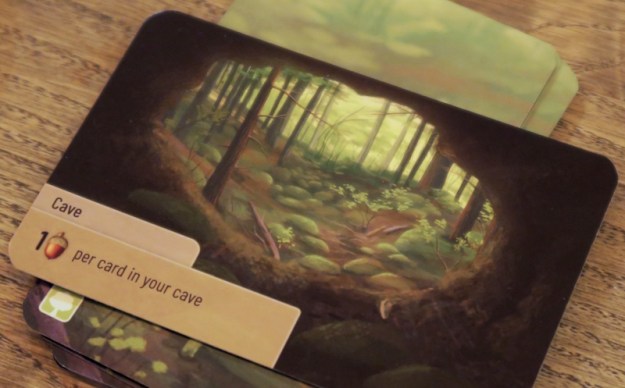
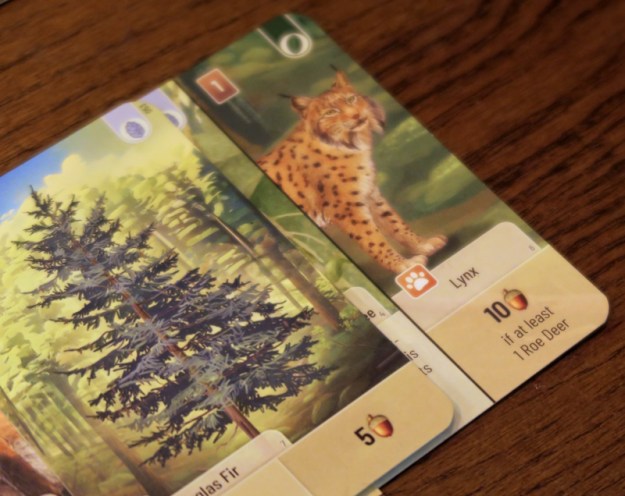
Pine got into a bit of a tussle with Blue and Black for Linden Trees, while Blue spent a long time setting up a “super-move” to play a Brown Bear and place lots of cards from the Clearing into her cave.  Ivory started collecting bats, more bats and even more bats, which coupled with a few gnats gave him lots of points.  His Fungi also gave him a extra cards as he built his forest, making him look like the player to beat.  Meanwhile, Teal was collecting hares (including the Dürer-Feldhase) and before long had down of them.  Then he switched his tactics somewhat after picking up a Roe deer.  This was a critical moment, because from there her started adding lynxes, which give ten points each if there is a Roe deer in the forest.
Forest Shuffle
– Image by boardGOATS

With five, Forest Shuffle drags a little, particularly when everyone is new to the game as they have to read all the cards and try to work out which combinations work well together.  It was an enjoyable game in spite of that, though most people played it in a very multi-player solitaire way, concentrating on their own game rather then keeping an eye on what others want and avoiding gifting people points.  That said, everyone became more aware of what was going on in their neighbour’s forest as the game progressed.  Nobody really had a feel for how well everyone was doing though because of the way the cards combined.  So it was a little bit of a surprise how disparate the scores were.
Forest Shuffle
– Image by boardGOATS

In the end, it was “The Lynx Effect” that made the difference, with Teal taking victory with a hundred and nine points, nearly twenty ahead of Ivory and his bats, with Pine a distant third.  Teal had an early start the next day, so flushed with success, he headed off leaving Ivory to consider leaving as well.  However, when presented with the possibility of playing Draftosaurus, he was tempted into staying—despite it being one of the most popular games in the group, Ivory had only played once before.  He felt he hadn’t really got to grips with it that time, so was keen to give it a quick try now.

Draftosaurus
– Image by boardGOATS

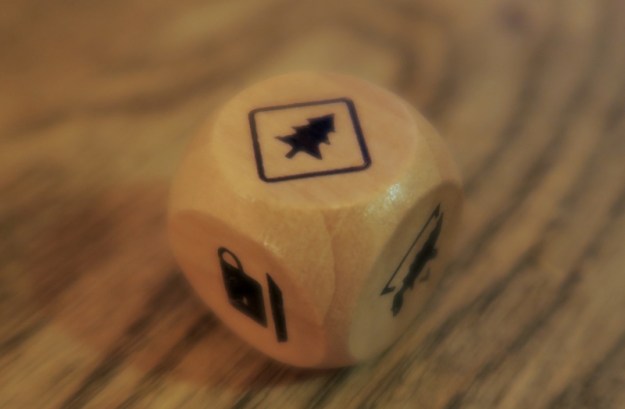
Pine was interested in playing with the Marina Expansion again, but given Ivory had only played it once before, the group decided to save that for anther time.  Without that, Draftosaurus is a simple enough game of drafting wooden dino-meeples with players starting with a hand of six, choosing one and passing the rest on.  Players also take it in turns to roll a die and that dictates where players can place their chosen dino-meeple in their Dinosaur Park.  The parks have pens that score points under certain conditions (e.g. the “Woody Trio” scores seven point if if contains exactly three dino-meeples) and the player with the most points after two rounds of drafting is the winner.
Draftosaurus
– Image by boardGOATS

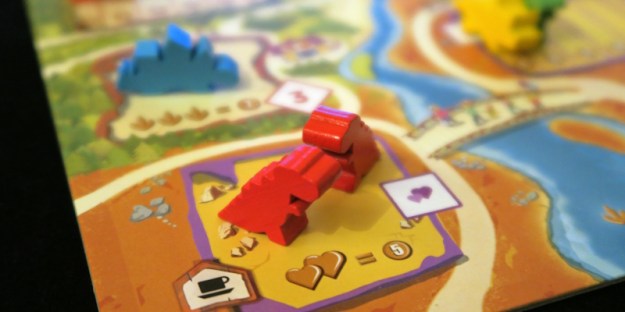
In contrast to Forest Shuffle, Draftosaurus was an extremely close game—everyone picked up seven points for the “King of the Jungle” and fifteen points for their “Meadow of Differences”.  Everywhere else, where one player had an advantage, others picked up points elsewhere.  Purple and Blue picked up points for their “Woody Trio”, Pine for his “Solitary Island” and Ivory had an extra loved up couple.  In the end, Purple and Pine tied for third with thirty-five points, and Blue just pipped them to second place by a single point.  It was Ivory who was the victor, just two points ahead, perhaps thanks to his extra tyrannosaurs giving him an extra point each; it is safe to say, that he’s definitely got to grips with the game now…
Draftosaurus
– Image by boardGOATS

Meanwhile, on the next table, Green’s suggestion of Terraforming Mars (with the Prelude Expansion) was turned down since the group didn’t want to play a complex and potentially longer game. For the same reason, the group eschewed Village although it has been a long time since the group played it (Green commented on how the original artwork is very pretty, but the new version is horrible!).  In the end, since last time Green had agreed to play one of Cobalt’s games, the group ended up playing Barcelona, a game that is both complex and quite long.  With hindsight, perhaps looking for something else entirely might have been sensible as everyone except Cobalt needed to learn it, and even with experienced players it can take a while.

Barcelona
– Image by boardGOATS

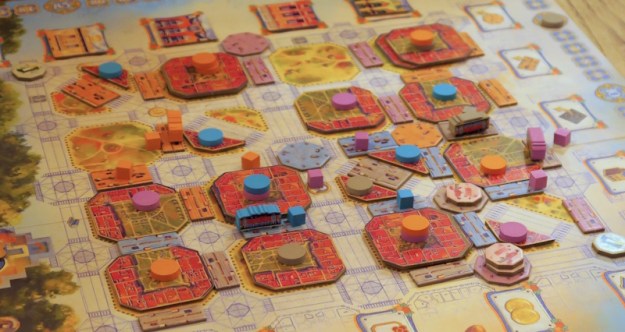
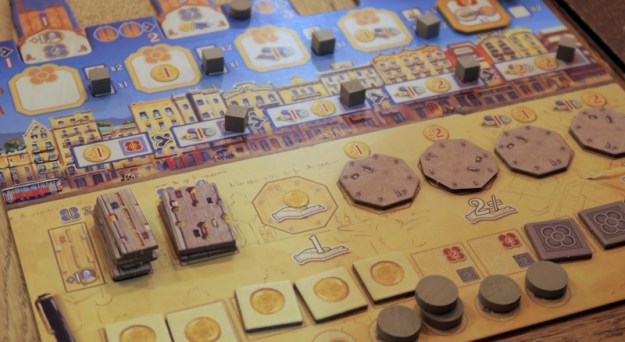
Barcelona is a game where players take on the role of builders in nineteenth century Barcelona who are working on the new expansion to the city following the destruction of old city walls.  Each round, each player takes a single turn consisting of two or more actions, a building phase, and then preparation for their next turn.  Players start with two random Citizen tokens which are placed in a stack onto a chosen unoccupied intersection. Unusually, players can place anywhere they want (no adjacency restrictions as seen in other games).

Barcelona
– Image by boardGOATS

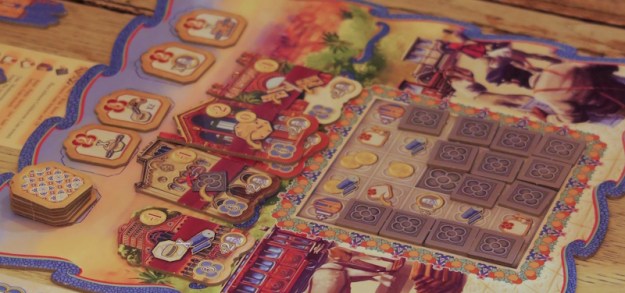
Choosing an intersection is the guts of the game that has significant consequences, initially the type of actions the player can carry out in that round, which are indicated by the streets selected.  At the end of their turn, players must construct a single building if they can which depends on the Citizens adjacent to the building spot selected.  There are four types of buildings: corners and normal shaped Level One buildings require any two adjacent citizens while Level Two building require at least one of them to belong to the middle class and Level Three buildings require three adjacent citizens, one of which must be a member of the upper class.
Barcelona
– Image by boardGOATS

As well as moving players along the Cerdà track, Level Two buildings also allow them to progress on their own Sagrada track giving Sagrada bonus tiles with rewards increasing the more they progress.  Level Three buildings move players two steps on their Sagrada track and give them seven pooints, but will also move players down two steps on the Cerdà track.  All the citizens required for buildings have to come from intersections adjacent to the building spots and are removed from the board and placed on their respective progress tracks according to their colour. Once the first citizen is placed on the end segment of a track, that segment’s Cerdà scoring is triggered and players gain points based on the criteria shown on the tile.

Barcelona
– Image by boardGOATS

This value is then multiplied by players’ positions on the Cerdà track, which represents whether or not players build according to the original intentions of Ildefons Cerdà (now considered the inventor of urbanism).  The game is then played over a variable number of rounds interrupted by three scoring phases before a final scoring phase, after which, the player with the most points wins.  Cobalt started first and went straight in, knowing exactly what the best thing to do was, but being first he couldn’t buy a building with only one stack of citizens. Everyone else was much more uncertain of what to do.

Barcelona
– Image by boardGOATS

At the outset Black chose to follow a policy of not buying buildings if he could get away with it (the rules are you must buy after your turn if you can), while Green had decided to work to getting the best result for each stage scoring, and Lime for a while was really confused and did not really know what he was doing at all.  Lime managed to trigger the first stage scoring, meaning that while he, Cobalt and Black had two turns before scoring, Green had only one turn—so much for his game plan and he soon found himself falling behind the others. Going last seemed to be a significant disadvantage, something Cobalt said has been mentioned before in forums, especially for four player game.
Barcelona
– Image by boardGOATS

And so the game continued. Cobalt knew what he was doing, while Black was trying not to buy buildings, but to get as many points along the way from other means as he could—as he put it, the game was a bit of a “points salad”. Green fared a little better at the second round scoring, but he was still a turn behind the rest (as was Lime for the second stage).  By this time he had decided to get his tram moving as much as possible as well, which was helping him to catch up on the score board.  Lime was still struggling, and gaining a lot of help and advice from Cobalt. It seemed to be working though as he was scoring nearly as well as Cobalt himself.
Barcelona
– Image by boardGOATS

The final stage of the game took a bit longer to complete, but was mostly just more of the same. By the final scoring, Lime took the lead to win the game while Cobalt’s experience had helped him compete and take second place, just three points behind. Green had caught up a bit and took third, while Black’s strategy of not buying really hampered him as he dropped further and further behind. He admitted that it probably wasn’t a good strategy as the later building buys really brought home a lot of points due to the points that also came with each purchase.  It had been an interesting game though, not so much about building a points engine, but looking for a good haul of points on each turn.  Having played once though, next time it might feel more like players are scoring from the game rather than the game scoring for them.

Barcelona
– Image by boardGOATS

Learning Outcome:  Nobody can resist the Lynx Effect.

27th June 2023

Lime was the first to arrive, soon followed by Blue, Pink with Purple, then Pine, Jade, Plum, Ivory, and Teal.  Jade and Teal were armed with some of their toys from UK Games Expo, so the first two games were the “Feature Game“, the Aerial expansion to Draftosaurus and the 2022 Spiel des Jahres nominated SCOUT.  There was the usual chatter at the start while Blue and Plum tried to work out some of the details of the Draftosaurus expansion where the rules were unclear.  Then there was the usual hiatus to sort out who was playing what, but eventually Plum led Purple, Jade, Pine and Pink passing Pterodactyls round the table.

Draftosaurus
– Image by boardGOATS

Draftosaurus is a lot like Sushi Go!, but with wooden dinosaurs.  It’s one of our most popular games that we first played online in 2021 and have since played lots of times in person, drafting real, cute, miniature, wooden dinosaurs.  Instead of sushi cards, players start each round with a handful of wooden dino-meeples, choose one to keep and add to their dino-park, and pass the rest on to the next player.  The active player rolls a location die, which applies a restriction to where dinosaurs can be placed that everyone except the active player has to observe.  There are various pens, each of which score players points in different ways.  For example, the Meadow of Differences can only hold one of each type/colour and scores for each different type.

Draftosaurus: Marina
– Image by boardGOATS

In contrast, the Forest of Sameness can only hold one type/colour of dinosaur, but also scores more the higher the occupancy.  The Prairie of Love needs pairs of dinosaurs of the same type, each of which score five points, while the Woody Trio will score seven points if it contains precisely three dinosaurs at the end of the game (otherwise it scores nothing).  The King of the Jungle and the Solitary Island only hold one dinosaur each, but the King of the Jungle scores if nobody else has more of that type of dinosaur, while the Solitary Island only scores if it contains the only dinosaur of that type in the Park.

Draftosaurus
– Image by boardGOATS

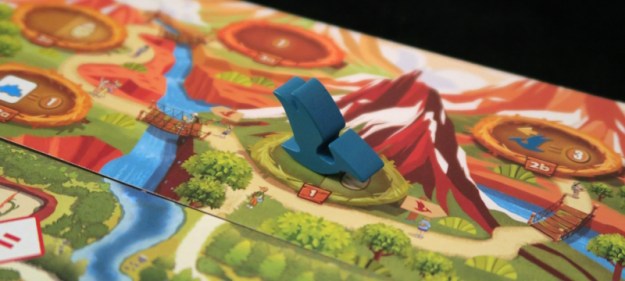
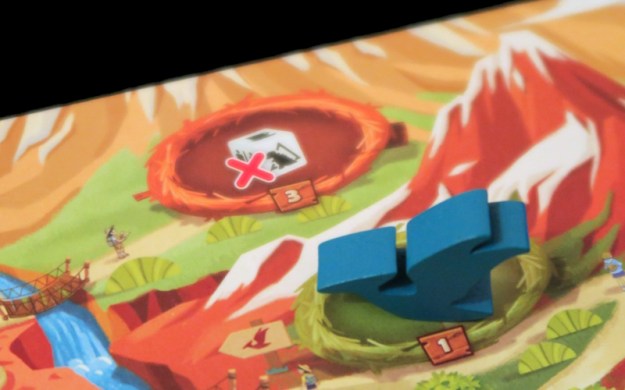
At any time, players can place dinosaurs in the River that runs through the middle of their Park instead of placing them in an enclosure.  There, they will only score a single point, except for any that are the red tyranosaurus Rex which increase the score of any pen they are in by one.  Played over two rounds (passing clockwise and then anti-clockwise, scores are calculated at the end of the game and the player with the most points is the winner.  There is a bit of variety in the base game with double-sided Park boards, though we’ve rarely if ever played the winter side.  There are also two expansions;  a month ago, we played the Marina expansion which adds an extension to the river and plesiosaurs, but this time we wanted to try the Aerial expansion which adds nests on Mountain extension boards and pterodactyls.

Draftosaurus: Aerial Show
– Image by boardGOATS

Pterodactyls can only be placed in the nests on the Mountain expansion board, but when they are placed the player gets some sort of bonus.  The nests are all numbered, one, two or three.  The rules say that before a pterodactyl can be placed in a nest numbered two, one must be placed in nest numbered one.  It was not clear, however, whether players could place dinosaurs in multiple nests numbered one, or whether a second pterodactyl had to be placed into nest numbered two (and by extension, a third should be placed in a nest numbered three).  After much searching online, Plum concluded players had to start with a nest numbered one, before they had the option to use a nest numbered two—an interpretation that was later found to be correct.

Draftosaurus: Aerial Show
– Image by boardGOATS

The Aerial extension boards are double-sided, so things were further complicated by the fact that the board chosen had two nests marked 2a and one marked 2b.  It was suggested that perhaps players had to do both the 2a nests before progressing on to the third nest, but Plum thought that was not the case and that was the choice.  After the event, it was found that the third nest could only be used once one of the 2a nests had been filled (but was not accessible via nest 2b).  Plum did best finishing with a massive thirty-eight, but as everyone was still getting to grips with the new rules and the game is not a long one, the group decided to give it another go with the reverse side of the Mountain board.

Draftosaurus: Aerial Show
– Image by boardGOATS

This time it went better for everyone except Plum and Pink (who had come second in the first game, with thirty-four).  Plum had prioritised placing three pterodactyls so she would be able to ignore the restriction imposed by the placement die, perhaps at the expense of all else.  Lime (who always likes to play games twice in quick succession) and Pine had got the hang of the game and took first and second respectively with thirty-six and thirty-two points.  Although everyone had played Draftosaurus quite a bit during 2020/2021, nobody had been familiar with the expansions.  While they certainly add something new, the Marina expansion is probably the better of the two, though it would be interesting to see how the game would play with both expansions in use too.

Draftosaurus: Marina
– Image by boardGOATS

From there, the group went on to play Mamma Mia!, which is a hand-management card game from Uwe Rosenberg, the designer of the king of all hand-management games, Bohnanza.   Mamma Mia! is quite an old game and we played it quite a bit some years back, but the last time was nearly six years ago and those that knew how to play it had forgotten, and others hadn’t played it then or since.  Purple did her best to explain the rules from memory, but was somewhat hampered by Plum and Lime who kept interjecting, trying to guess how the game might play.  Meanwhile, Pink spent the time trying to read the rules and make sense of them, that said, the game is not all that complex, though really very clever, like all of Uwe Rosenberg’s games.

Mamma Mia!
– Image by boardGOATS

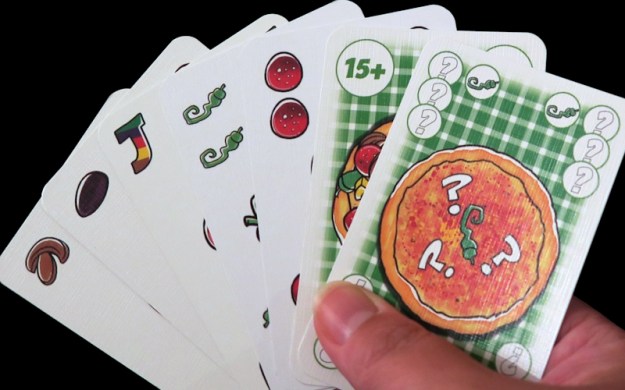
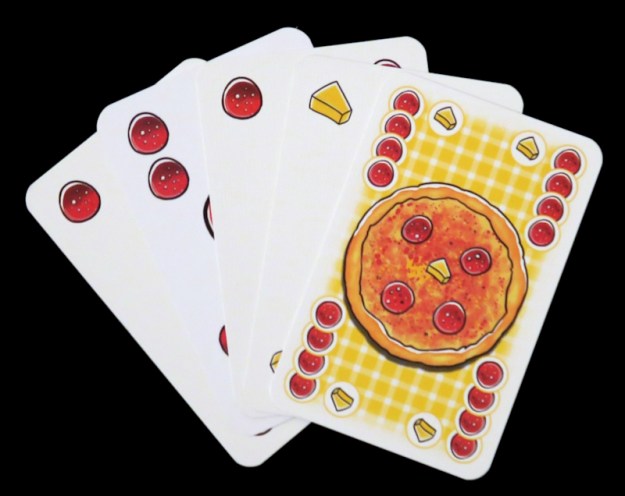
The idea is that each player starts with a hand of pizza topping cards and a deck of order cards.  On their turn, the active player puts pizzas in the oven by placing ingredients cards on top of the central pizza deck and then, optionally, follows it with an order card (which are colour coded for each player) before replenishing their hand from the supply deck.  Unfortunately, in the rushed rules reading, there were a couple of, er, malfunctions:  the group omitted to include the restriction that only one type of ingredient could be played per turn and only one order could be placed, and after placing the toppings cards.  Further, when drawing cards, a player may take them from either the central ingredient deck or from their personal order stack, but not both in the same turn—another rule that, er, malfunctioned.

Mamma Mia!
– Image by boardGOATS

Once the ingredients supply deck is empty, the pizzas are thematically taken out of the oven, by flipping the pile of cards over and placing the cards face up in separate piles for each ingredient i.e. in the order they were played.  When an order is reached the ingredients piles are examined to see if there are sufficient to fill the order.  If so, the cards are removed from the piles, if not, the owner of the order card may add any missing ingredients from their hand to ensure the order is fulfilled.  If they choose not to do so, the incomplete order card is discarded.  After three rounds, the player with the most fulfilled orders is the winner.

Mamma Mia!
– Image by boardGOATS

It was all a bit mad, and with players (incorrectly as it turned out) placing assortments of ingredients cards in the oven, they called out what cards they were adding to the deck.  The cry of “Four chilies and an olive,” was met with the comment from the next table, “That sounds like a mariachi band—who’s the olive?”  It was clear that a lot of fun was had.  Plum succeeded in completing an order of requiring fifteen ingredients that everyone else thought was very risky, but that was pretty much all she managed in the whole game.  Pink, who finished with six clearly thought he should have won, as he commented that Lime was “apparently” the winner with seven and Pine responded, that Pink was “apparently” second, “apparently” followed by Purple in third…

Mamma Mia!
– Image by boardGOATS

Pine commented that before the game started they’d had three different variations and he wasn’t sure which they were going to play, and as it turned out, the one they chose wasn’t quite right!  Despite all the rules issues, however, it had been a lot of fun.  The card-counting memory play worked well, though without a bit of luck in the ingredients department, players could keep playing cards hoping to replenish the hand with better once, without success.  Still, it is clearly fun little card game that we should play again and see if the game is better with the rules played as written.

Mamma Mia!
– Image by boardGOATS

On the next table, Ivory, Teal, Jade and Blue started with SCOUT.  This is a ladder-climbing game with a very nominal theme of circus owners collecting acts for their show.  This theme isn’t really reflected in the art or the game leading Blue to comment that it was the most theme-less game she had ever seen and she wondered why they had bothered.  Not that this made it a bad game, by any means—indeed, when the group played it last year both she and Teal had really enjoyed it.  The game is quite simple, the first player leads with either a run of consecutively numbered cards or a meld of cards of the same number.  The next player can play either a larger set of cards or has cards, or one of the same size but of a higher value (melds always beat runs of the same size).

SCOUT
– Image by boardGOATS

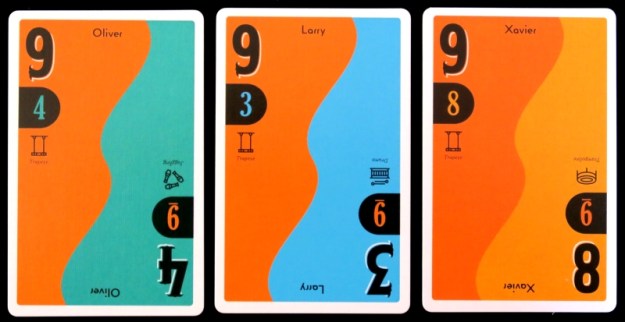
If they beat the cards on the table, the active player takes the beaten cards into their score pile and leads with a new set.  Alternatively, the next player can “Scout” i.e. take a card from either end of the set on the table and add it to their hand.  And this is where the game gets really clever—like Bohnanza, players can only play consecutive cards from their hand, but when they add a card to their hand, they can add it anywhere.  Further, the cards are double-headed, that is to say, they have different values depending on which way up they are.  At the start of the game, players are dealt a hand and, as in Bohnanza must not rearrange their cards, though they can choose which way up the whole hand is, and thus the quality of the hand as a whole.

SCOUT
– Image by boardGOATS

When Scouting, the player can choose which way up it goes into their hand as well as where, and it retains that value in their hand and when played.  Once per round, players can “Scout and Play”, taking a card from the display and immediately playing a set of cards for the cost of a single point.  Playing this at the right time can be critical to winning the game.  The round ends when either a player plays their last card or when play gets back to the player who last played a set and everyone else in between Scouted.  Players score for each card they have taken, but any remaining cards in their hand give negative points, often the decisive factor.

SCOUT
– Image by boardGOATS

This time, the first round was quite close.  Ivory finished the round and also took the most points.  This was the case for much of the rest of the game, and it was soon clear that everyone else was playing for second place.  In that, it was actually quite close.  Blue did particularly badly in the penultimate round, and looked to be cruising for a bruising.  However, she ended the final round very quickly with a very long run leaving both Jade and Teal with negative points (though Ivory still top-scored).  These negative point proved critical, and Blue took second with twenty-seven points, two more than both Teal and Jade.  They were all miles behind Ivory though, who finished with nearly twice that with forty-nine.

SCOUT
– Image by boardGOATS

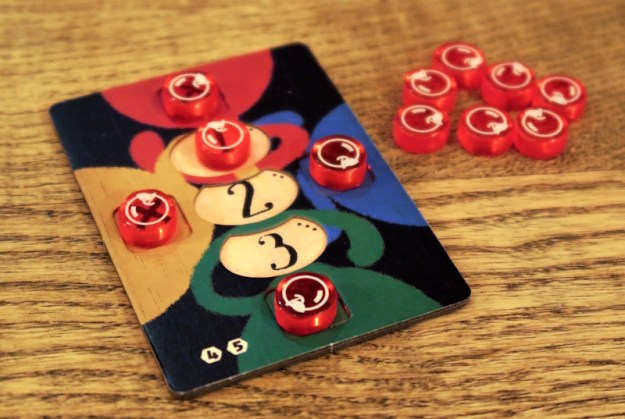
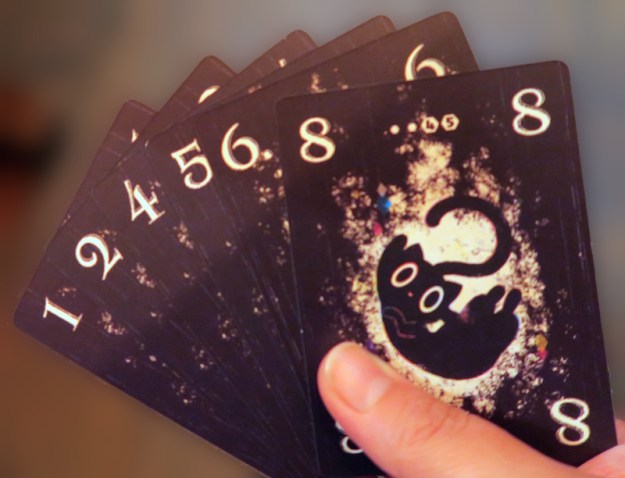
From there, the foursome moved onto an equally theme-less card game that Jade had come back from UK Games Expo, but one that is also very good, Cat in the Box.  The game that was preceded by a quick game of Snap when Ivory pulled the same game out of his bag.  The game is essentially Hearts, but with the twist that the cards exist in all suits until they are played (analogous with Schrodinger’s cat where the it is both alive and dead until the box it is in is opened—hence the name of the game).  The cards are all black and there are five cards of each value.  As in Hearts, the first player leads with a card of there choice declaring its suit.  The players have a pile of tokens and, when they play a card they mark that card on a tally board so nobody else can play the same card.

Cat in the Box
– Image by boardGOATS

At a time of their choosing, players can declare they no-longer have cards of a suit by marking that on their cat card, but although that enables them to play a red trump card, it also limits what cards they are left with in their hand.  The round ends either when a player creates a Paradox because they cannot play any of the remaining cards in their hand, or when the last player plays their final card.  At the end of the game, players score one point for each trick they took during the round.  However, in a sort of solo-Bridge fashion, players make a contract at the start of each round, declaring how many tricks they think they will take.  If they successfully take exactly this number, they get bonus points equal to the largest contiguous group on the tally board, introducing an area control element.

Cat in the Box
– Image by boardGOATS

The catch is that if the round ends with a Paradox (and it usually does), then the player that caused the Paradox does not score any bonus points and additionally scores minus one for each trick they won.  This is particularly savage as a player can go from doing very well to doing very badly in a heartbeat, as Blue discovered in the first round. Not appreciating the risk, she made a contract for three tricks, which she achieved and with the bonus points would have taken seven or eight in the round until she went bust and ended up with minus three!  So, the risk of Paradoxes introduces a lot of tension, but there is also an element of tactics in forcing players to take tricks they don’t want to

Cat in the Box
– Image by boardGOATS

Teal was more circumspect and played very cautiously, so although he caused two paradoxes, they only cost him a total of two points.  Unfortunately for him, he only picked up one point in each of the other two rounds leaving him with a round fat zero.  Jade started cautiously, but then went for bonus points, successfully taking seven points twice, but unfortunately, for him his paradox in the third round was costly, losing him three points, he still finished with ten points, one more than Blue.  Ivory just managed to avoid triggering a Paradox, which is a key part of the game of course.  So with his moderately high, consistent scoring in the second, third and final rounds he finished with fifteen points and his second victory of the night in what was a fun, if quite nasty game.

Cat in the Box
– Image by boardGOATS

Learning Outcome: Little card games can be an awful lot of fun.

16th May 2023

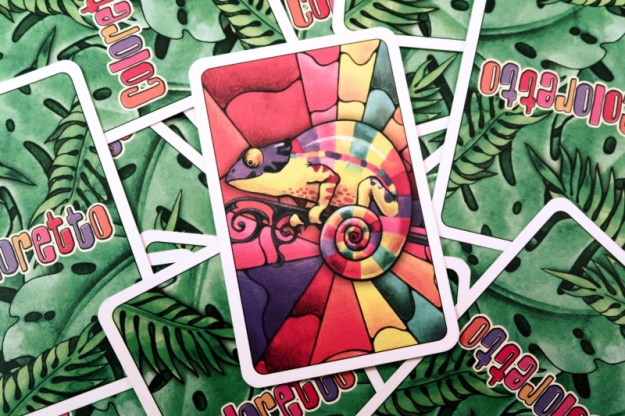
Unusually, Blue and Pink were joined early by Lime for pizza, and Pine who wasn’t eating.  So, while they were waiting for food to arrive the group squeezed in a very quick game of Coloretto. This is a popular game within the group, but somehow Lime had missed out on it.  It is quite simple to play, but one of those games that takes a couple of tries to get the hang of playing well, or as in Blue’s case, lots of tries and still not play it well.  The idea is simple enough though:  players take it in turns to either take a coloured chameleon card from the deck and add it to one of the “trucks”, or take one of the trucks and add the cards on it to their display.

Coloretto
– Image by boardGOATS

Players score points according to the triangular number series where every additional card is worth one more additional point than the previous card.  Thus, the fourth card someone gets is worth ten points, four more points than the third card (which itself is worth three more than the second and so on).  Collecting chameleons was briefly interrupted by the arrival of Hoi-sin duck pizzas, but that didn’t stop Pink winning with a total of thirty-seven points,  well ahead of a tie for second place between Blue and Pine.  By this time, Purple, Black and Teal had arrived and it was time to decide who was going to play what.

Coloretto
– Image by boardGOATS

Pink and Lime were very keen to give Zoo Break another go, having left the town of Bedlam over-run with escaped animals last time the group played.  With it being such a quiet night, there was some debate as to what the other group were going to play, but in the end they opted for the “Feature Game“, the Marina expansion to one of our most popular little games, Draftosaurus.  Pine was keen to play with the cute wooden zoo meeples and after the mayhem last time, Blue was also keen not to miss out, which left Purple, Black and Teal to play with dinosaurs.  The only problem was, none of them knew how to play it, so while Lime, Pink and Pine set up Bedlam Zoo, Blue quickly explained the rules to Draftosaurus.

Draftosaurus
– Image by boardGOATS

Draftosaurus is a very simple drafting game in the vein of Sushi Go! or 7 Wonders, but instead of drafting cards, players are drafting wooden dino-meeples.  The idea is that players start with a handful of dino-meeples and choose one to keep and pass the rest on to the next player.  The active player rolls a location die which adds restrictions on which pens players can place their chosen dinosaur in in their dino-park.  When everyone has placed their first dino, the die is passed to the next player and everyone chooses their next meeple from the pile passed to them by their neighbour.  The round is complete when each player has placed six meeples, and the game is played over two rounds (passing dino-meeples in opposite directions in each round).

Draftosaurus
– Image by boardGOATS

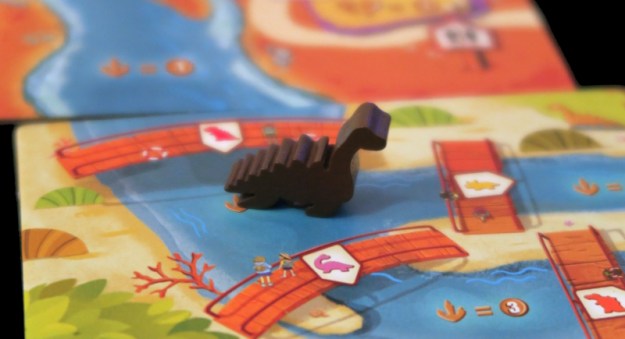
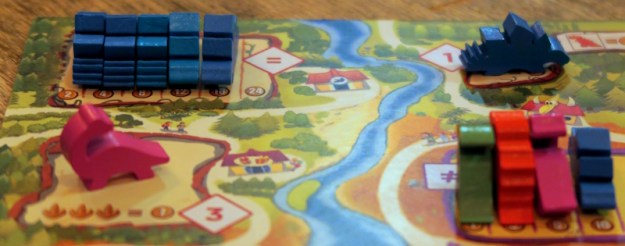
The Marina expansion adds brown Plesiosaurs to the yellow Triceratops, blue Stegosaurus, pink Brachiosaurus, orange Spinosaurus, green Parasaurolophus, and red Tyrannosaurus rex from the base game.  Where dinosaurs from the base game can always be placed in the river that runs through the middle of each player’s park (where they only earn a single point), Plesiosaurs all go into the river, which they travel along into an expansion board.  Each expansion board is slightly different, but when a player places the non-Plesiosaur dinosaur shown on the bridge, if they have a dinosaur immediately up-stream of the bridge, it can pass under it into the next section of the river where it will score more points.

Draftosaurus
– Image by boardGOATS

It was a close game with everyone following different tactics.  Teal concentrated on trying to fill his Meadow of Differences while Black focused on collecting pink Brachiosaurs and Purple stuffed her Forest of Sameness with blue Stegosaurs.  Black took one Plesiosaur, Purple collected two and Teal three, though only one of his made it under the first bridge and out of the main river.  Purple managed to minimise the number of non-scoring dino-meeples in her park, and that just gave her the edge, and she finished a couple of points ahead of Teal who took second place.

Draftosaurus: Marina
– Image by boardGOATS

Although Teal, Purple and Black tried to persuade her to stay (and there was even some suggestion of her playing both games simultaneously), once she had explained the rules, Blue joined the madness in Bedlam, playing Zoo Break.  In this game, players are keepers trying to prevent their charges escaping from the zoo, and to win the game, they have to return all escaped critters to their enclosures and lock the doors.  Losing is much easier—if five cuddly creatures or one dangerous one escape from the zoo, then it is all over.  Last time, only one animal escaped, but it was a cobra, so that was that.

Zoo Break
– Image by boardGOATS

On their turn, players first roll the action die to find out how many Action Points the player has to work with for that round.  Then, after they have carried out their actions, one card from the Escape deck and then one card from the Move deck are revealed.  The Escape card liberates one or more animals, while the Move card often moves animals towards the exit, but occasionally causes other things to happen, like waking up sleeping tigers, breaking barricades and generally cause more chaos.  After last time, the group decided to start by digging through the Supply deck and make sure everyone went really well equipped, then, prioritise capturing (or at least controlling) the Meerkats, as they had been so problematic last time.

Zoo Break
– Image by boardGOATS

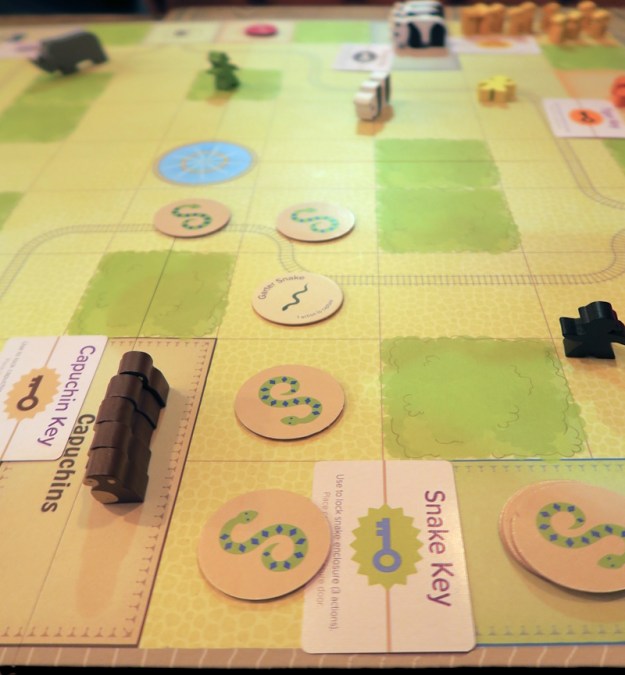
On that occasion, the group had played with two “Phew” Cards in the Escape deck, and (following a rules malfunction) all the blank cards in in the Move deck.  In spite of all the blank cards, they still lost spectacularly.  So, this time, the group stuck with the two “Phew” Cards, but removed the blanks from the Move deck and did not add any other rules variants as they really wanted to win, though they stuck with the thematically logical variant where tigers remain tranquilised when returned to their pen. Lime had the Black Belt special power which meant he couldn’t be hurt by animals, so he got the job of dealing with snakes which hide so players have to reveal them, with the risk of being attacked if they are dangerous.

Zoo Break
– Image by boardGOATS

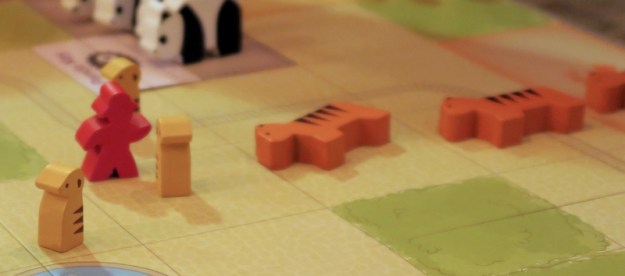
Pink, as usual wanted to work with the pandas, but the Capuchin monkeys were a more immediate threat, and the group made a point of dealing with the troublesome meerkats early this time, so then he went on to deal with them once the monkeys were locked up.  Blue, who had the panda enclosure key, took over trying to control them, but they kept escaping just as Blue was about to lock their cage. Blue was encouraged to capture one panda who was in the rhino’s path, but that meant she was left standing there—”You’ll be fine”, said Pink.  And Blue was immediately flattened by a charging rhino and had to spend a turn with the medic removing the hoof-prints from her forehead.  One meerkat escaped from the zoo, but was left to run free so Keepers could focus elsewhere and then lock their enclosure.

Zoo Break
– Image by boardGOATS

With two enclosures locked early, things became slightly more manageable.  The group wimped out of using the faulty lock variant however, because nobody wanted to risk failing a second time, and certainly, including it would have made things much more difficult.  As it was, one tiger got within sniffing distance of freedom, but was tranked before he could take that one final bound.  Pine made excellent use of his running skills (as Track Star he could move twice as fast as anyone else) and bravely helped Lime with snakes and wielded his dart gun—before long, the zoo was littered with big sleeping cats.  That was all very well, until they woke up at which point Pine had to do the job all over again.

Zoo Break
– Image by boardGOATS

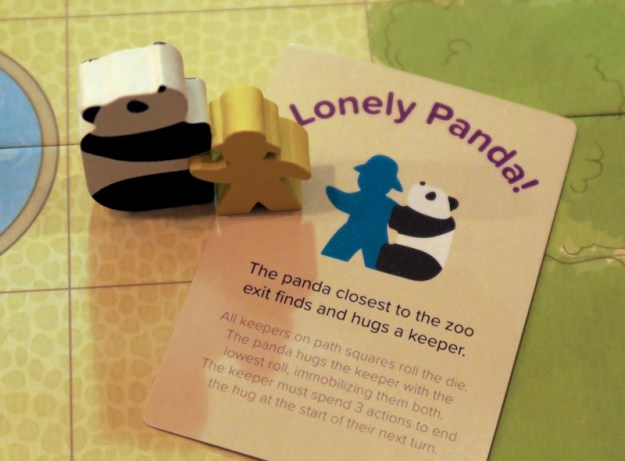
After her run-in with the rhino, Blue tried to end her turn on hedge spaces, but that meant she was unable to swap supplies with other players as she couldn’t share her space.  Once the Pandas were vaguely under control, Blue was able to get a stretcher and another dart gun and help Pine with the tigers, making use of her Gardener ability, hiding in bushes and taking a pop at the big kitties from a place of safety.  While Pine and Blue were working on the tigers, the elephants started rampaging.  As the nearest and armed with a leash, Lime took a break from snakes and tried prevent them from causing too much damage.  This was all very well until (much to Pink’s disgust as he would have loved a black and white cuddle), Lime rolled the lowest number and got hugged by a panda leaving him unable to do anything until it was prised off him.

Zoo Break
– Image by boardGOATS

In the dying rounds, Pink’s, and indeed everyone else’s delight was evident, when another panda popped up for a cuddle and everyone cheered when Pink was the one to roll the lowest number and get a hug.  As the Lucky Duck, on his turn he was able to roll the Action Die multiple times to get more points, but he checked the rules to see if he was obliged to spend his first three points to escape from the furry cuddle or whether he could just stay there for the rest of the game.  In the end, he sent it back to its enclosure, but it probably wouldn’t have mattered.  With one last push, Pine and Lime rounded up the last of the snakes, then the group finally sorted out the charging elephants and mischievous pandas, and finally locked up the rhino, giving the group a much deserved victory.

Zoo Break
– Image by boardGOATS

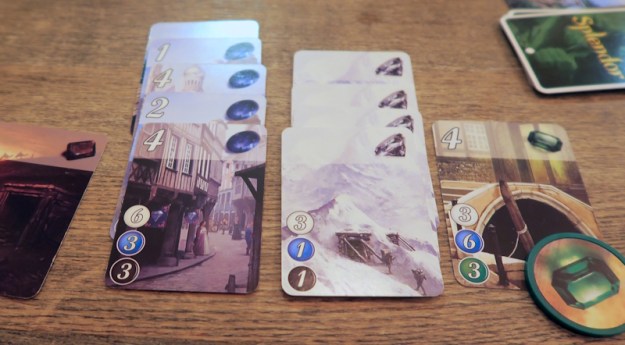
Draftosaurus is a much quicker game than Zoo Break, so while they Keepers were dealing with the tigers, elephants and disobedient pandas, Teal, Black and Purple moved onto play Splendor.  This was one of Burgundy’s favourite games and he was almost unbeatable at it, so we never play it without thinking of him.  It is a very simple engine builder card game, but takes great skill to repeatedly win in the way Burgundy did.  The idea is that on their turn, players either collect gem tokens (three different colours, or two the same as long as there are at least four left), or spend tokens to buy cards from the market.  Cards act as permanent gem tokens (effectively reducing the cost of cards later in the game), but also provide Victory Points—when a player passes fifteen points, that triggers the end of the game.

Splendor
– Image by boardGOATS

In addition to the two basic actions, there is also the relatively rarely used action of reserving cards, where a player gets a wild, gold token and can reserve one card which they can pay for later.  This time, both Teal and Purple reserved cards, while Black prioritised taking high value cards.  Reserving cards can be a very effective tactic, but the game is all about the cards available in the market and surfing through them as quickly and efficiently as possible and amassing points.  As it was, Black romped away with victory, his fifteen points three times that of anyone else.  And with that, both Splendor and Zoo Break finished, leaving the group with a little time to play something else.  Teal and Lime headed off, so after some discussion, Pine, Black, Purple, Pink and Blue decided to give Draftosaurus with the Marina expansion another go as it was the “Feature Game“.

Draftosaurus
– Image by boardGOATS

It was then that the group realised the errors in the original explanation, in particular how the Solitary Isle enclosure worked.  Pine corrected Blue’s errors and the second game began.  Pine and Blue both tried to exploit the Plesiosaurs at every opportunity, and Pink tried to claim extra points for reverse parking his solitary Plesiosaur into the dock.  It turned out he didn’t need them though, as with forty-seven points he took his third win of the night.  Blue and Black tied for second place, while Purple unfortunately had to recount when she realised she had a pink Brachiosaur elsewhere in her park so couldn’t score seven points for her solitary Isle.  That left a bit of time for a chat, but everyone was tired and it wasn’t long before the last of the group headed home.

Draftosaurus: Marina
– Image by boardGOATS

Learning Outcome:  Who needs TV when you’ve got T.Rex?