Tag Archives: Faraway

Essen 2025

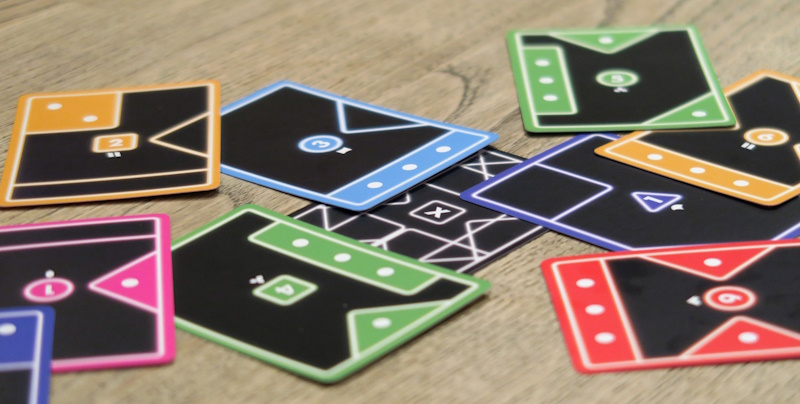
Today is the conclusion of the largest annual gathering of gamers in Europe.  The Internationale Spieltage is known to gamers worldwide simply as “SPIEL” or “Essen” and is a four day fair with lots of new releases scheduled to coincide with the event, just in time for Christmas sales.  This year, there have been lots of exciting new games available to be seen including Galactic Cruise, Brick Like This!, Forest Shuffle: Dartmoor, Waddle, Orloj: The Prague Astronomical Clock (which was sold out before the end of the first day) and Origin Story (which was sold out by Friday).

.Orloj: The Prague Astronomical Clock
– Image by boardGOATS

In addition to new games, the rise of crowd funding has had a large impact, and increasingly there are stands presenting current live projects in the hope of seccuring additional backers.  Examples of this included, Eldertide: A Thousand Lights, the Lodges expansion to Kavango, Cascadia: Alpine Lakes, AstroNavigators, and the re-release of Nippon to name just a few.  There have been a lot of really good deals to be had too, and there will be even more on the final day today.  It was with sadness though that the Snowdonia spin-off, Alubari was found at a discounter for €15, as this was a great game released with much fanfare a few years ago.

Cascadia: Alpine Lakes
– Image by boardGOATS

Old favourites typically often get a new lease of life with the release of expansions.  This year, relatively recent releases like SETI (which was confirmed as the winner of the Deutscher Spiele Preis), Faraway, Castle Combo and Windmill Valley recieved new additions, but older games like Underwater Cities and Wingspan also got some love (with the new Data Era expansion and the fan-designed promo packs).  As well as new games and expansions, there were also a number of re-releases of old favourites including Ra, Bohnanza (with Dahlia artwork) and Botswana, and even Ticket to Ride which has had a bit of a face-lift with new artwork.

Botswana
– Image by boardGOATS

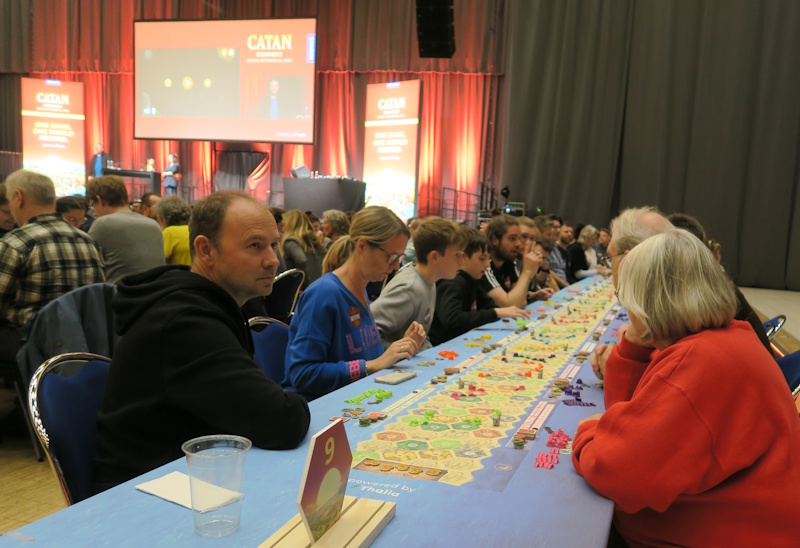
For those that were prepared to stay late on Friday, there was a world record attempt for the most people playing The Settlers of Catan together.  This was achieved with CATAN-Connect, which is a new version of the game designed for large parties that has large groups playing around single islands with elements of simultaneous play and everyone working to one electronic dice roll and a timer.  The record had been set at Essen in 2015 with one thousand and forty, only for Rotterdam to set a new record two years later with one thousand and ninety-six.  At SPIEL, one thousand, one hundred and seventy players joined in the game (watched by a few more who were just curous), successfully bringing the world record back to Germany where it arguably belongs.

CATAN-Connect
– Image by boardGOATS

Deutscher Spiele Preis – 2025

The Deutscher Spiele Preis is awarded anually based on an open vote from German games clubs, gamers in German-speaking countries and people in the gaming industry.  It recognises the “Best Children’s Game” and a top ten list of the “Best Family and Adult Games”.  Although the order of the top three in each category won’t be announced until the Internationale Spieltage in Essen at the end of October, the list of winning games has been released.

Endeavor: Deep Sea
– Image by BGG contributor tobsn,
adapted by boardGOATS

The top three in the general category in alphabetical order are:

The remaining list of games in the top ten are:

  1. Castle Combo
  2. Faraway
  3. Civolution
  4. Blood on the Clocktower
  5. Slay the Spire: Das Brettspiel (aka Slay the Spire: The Board Game)
  6. Astrobienen (aka Apiary)
  7. Dune: Imperium — Uprising

The games named in the Deutscher Spiele Preis lists often intersect with the winners and nominees of the annual Spiel des Jahres Award. This time is no exception, indeed the only game in the top five Deutscher Spiele Preis list not to have recieved a Spiel des Jahres award or a nomination likely missed out because it was considered too complex.  And therein lies much of the difference between the two:  the Spiel des Jahres nominees/winners are chosen by a committee with a list of strict criteria, whereas the Deutscher Spiele Preis is more like a list of the most popular games of the preceding year, with the gaming public having a strong say.  As a result, the Deutscher Spiele Preis often includes heavier games.

Bomb Busters
– Image by BGG contributor spiritraw,
adapted by boardGOATS

The top three children’s games (again in alphabetical order) are, Cascadia Junior, Die kleinen Alchemisten (aka Little Alchemists), and Die Sandburgen von Burgund (aka The Sandcastles of Burgundy).  The order of the top three in both categories will be announced at the press conference on Wednesday 22nd October; congratulations to everyone on the list.

Deutscher Spielepries 2025 Logo
– Image from
spiel-essen.com


22nd July 2025 (Report)

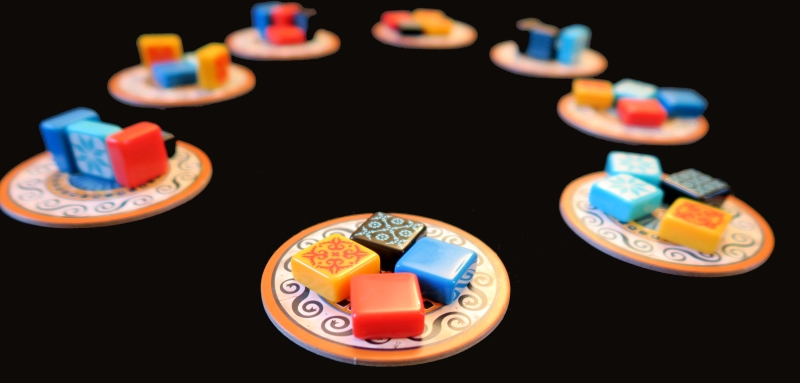
This being the summer, Lime brought LIttle Lime to join in the evening, but as there is a curfew for under-eighteens (due to licencing restrictions), the first game had to get off the mark quickly.  Together with Pink and Plum, they quickly got going with the well known favourite and Spiel des Jahres winning game, Azul.  This is known to everyone, so needed little clarification, though they group decided to use one of the alternate boards from the Crystal Mosaic expansion (the one with the cross pattern).  The game is very simple with players taking tiles of one colour from a factory and putting the remains in the centre, or taking all the tiles of one colour from the central pool.

Azul
– Image by boardGOATS

In either case, players have to add them to their conveyor and if, at the end of the round the conveyor is full, one tile is slid across to be added to the mosaic and the rest disposed of. If the added tile is isolated it scores a single point, but if placed next to other tiles, then more points are scored with larger groups scoring more points.  In this way, tiles grouped together keep scoring points.  Thus, a player who starts well can build a lot of points, which both Little Lime and Plum managed to do.  In the end, Big Lime ended the game, leaving Plum with a single point advantage—The moral of the story:  Don’t end the game too early (as Big Lime commented regretfully).

Azul
– Image by boardGOATS

On something of a roll, the group moved on to one of Pink’s favourite quick fillers, For Sale.  Dating from the end of the last century, this game is now nearly thirty years old, but isn’t really showing its age, despite that.  The game comes in two halves:  Buying Properties at Auction, then Selling Properties by Blind Bid.  This game was really really close with a single point between Plum and Little Lime, but they were a a few points behind Big LIme who, as an accountant might be expected to perform well in a financial game.  The winner, however, was Pink, who, despite it being one of his favourite games had never won, until now.  And with that, it was time for Family Lime to head off.

For Sale
– Image by boardGOATS

Meanwhile, the rest of the group were engaged in the two tables of the “Feature Game“.  To mark the recent announcement of the Spiel des Jahres winners, this was  Looot.  Although Loot was not actually one of the winners, it, along with Faraway, had recieved a nomination for the Kennerspiel des Jahres and, as it had proved popular within the group (also like Faraway) we decided to make it the Feature.  Although its nomination was in the Expert or Connoisseur category, the game is not overly complex.  The game is played over a series of rounds where each player places one of their Viking workers—the game ends when everyone has run out of Vikings.

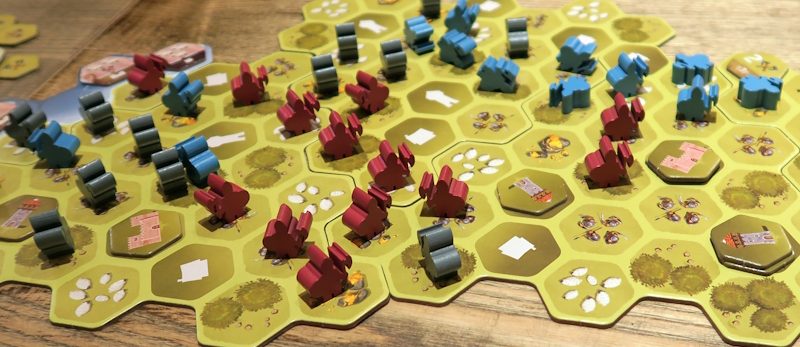
Looot
– Image by boardGOATS

On their turn each player places one of their Vikings on the central playerboard.  This is is made up of hexagons: the Viking must be placed on an empty space next to another Viking (of any colour).  Each hexagon gives a resource which can be used to purchase Longships, and if the Viking fulfills certain conditions, it’s owner can capture a house, Watchtower or Castle.  The player with the most points at the end of the game is the winner.  This time there were two tables playing the same game, with Black leading the first table comprising Purple, Byzantium, and Cobalt.

Looot
– Image by boardGOATS

This game turned into a a bit of a battle for Castles between Byzantium and Cobalt.  Cobalt did rather better in the end though thanks to his Long-ship bonuses.  This was because Byzantium kept revealing them and everyone else eschewed them until it came to Cobalt who snapped them up.  Byzantium’s frustration was increased somewhat because Cobalt was just before him in turn order so it looked like they miight make it round to him until they didn’t…  quite…  In the end, Cobalt’s were worth forty-two while Byzantium’s gave him just twenty-eight, despite the fact he actually had more.

Looot
– Image by boardGOATS

It was still close between them, but fairly inevitably, Cobalt had the edge finishing with one-hundred and twenty-eight, ten more than Byzantium in second place.  This was a much higher scoring game than the second table, although that was much closer.  Jade led this game with Mint, Sapphire, and Blue making up the group.  The strategies were very varied, with Jade going for Castles, Mint for Watchtowers, Sapphire for Gold, and Blue who was new to the game, going for a balanced strategy so she could change her tactics as required.

Looot
– Image by boardGOATS

In the end, Blue’s “points from everything” approach just had the edge giving her victory with eighty-eight points, two more than Mint who had one more than Jade with Sapphire close behind. With the games of Looot coming to an end at the same time as For Sale and with Family Lime heading off, the rest of the group split into two.  The first, larger group, consisted of Jade, Sapphire, Blue, Pink, Mint, Plum and Byzantium who decided to give a simple and supposedly quick little game called Tacta an outing.  This is a sort of “card placing” game where players have a hand of cards and place them on the table to cover up spots on other players’ cards.  At the end of the game, the player with the most spots visibleis the winner.

Tacta
– Image by boardGOATS

Unfortunately, game time is proportional to the number of players, so with the six players (Plum and Byzantium shared a hand and worked together), the game was always going to take twice as long as it would with three.  Worse, this was one of those games where gamers take even longer as they want to make sure the find the best placement option and push the rules boundaries.  It is a very clever little game though and a lot of fun, though perhaps playing with fewer cards or fewer players would avoid it outstaying its welcome.

Tacta
– Image by boardGOATS

It was made worse by the fact that everyone helped everyone else and therefore, the victor was quite obvious from fairly early in the game  Although Blue made a dash to come from zero to finish in a more respectable last place, nobody looked like they were seriously going to challenge the Byzantium-Plum team.  Mint took second one point ahead of Pink who was one point ahead of Jade who was one point ahead of Sapphire.  Definitely one to try again, but with fewer people next time.  The supposed quick card game ended up finishing some time after the supposed longer game, Ticket to Ride: Paris that Black, Purple and Cobalt chose.

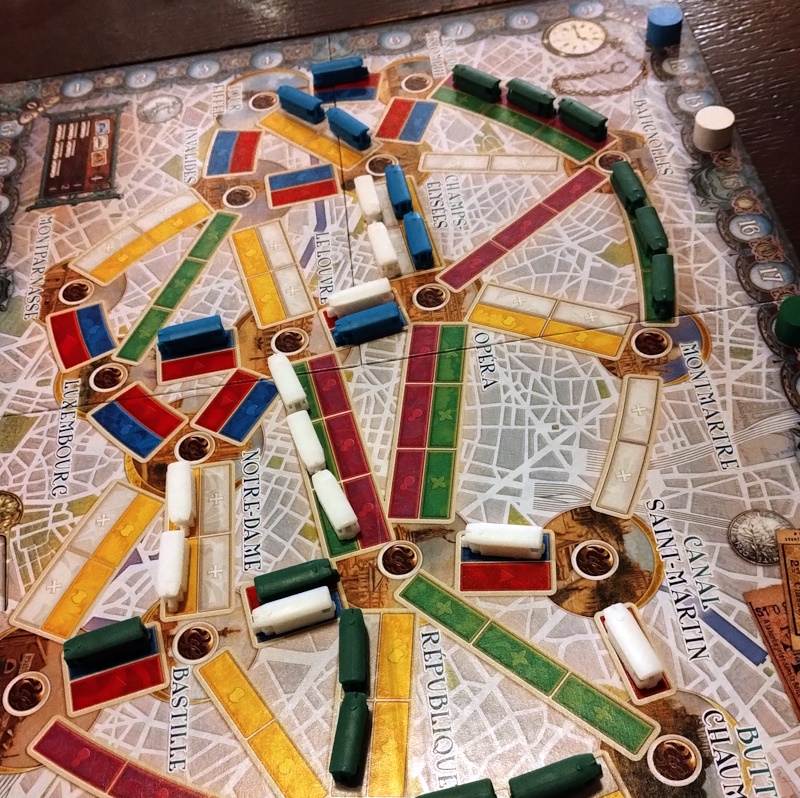
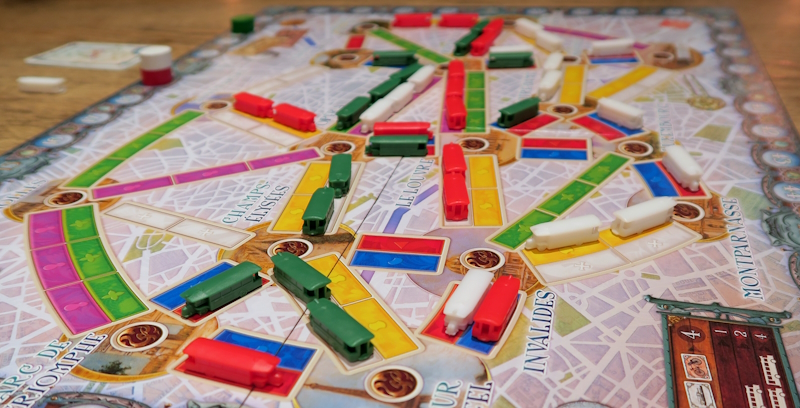
Ticket To Ride: Paris
– Image by boardGOATS

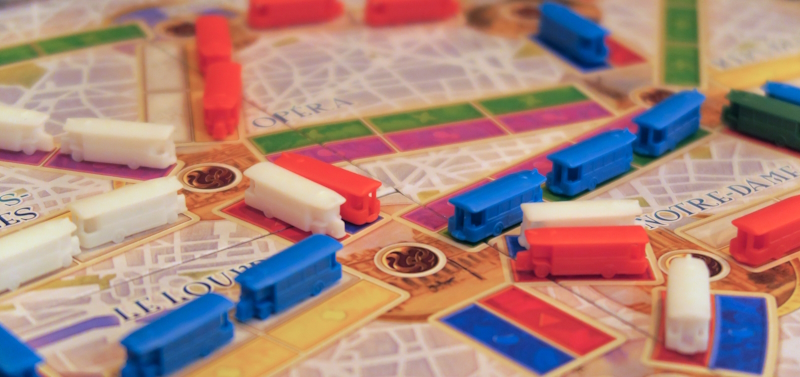
One of the small, “City Editions” of the popular, Spiel des Jahres winning Ticket to Ride games, we’ve played Paris quite a bit since it was released last year.  Following the same pattern as all its brethren, the game involves collecting coloured carriage cards and spending them to place metro carriage pieces on the board to connect regions of the city, while trying to also complete tickets.  Each edition has its own extra little rule, and in the Paris edition, this is centred on the colours of the tricolor.  When players build a red, white or blue route, they keep one of the cards, when they complete a set of three they discard the cards and claim bonus points.

Ticket To Ride: Paris
– Image by boardGOATS

Purple started and game play was rapid.  Before long, players were running out of pieces, with Blake miles ahead of the other two.  But that was without the addition of scores for Tickets. Purple took got nine points for her three completed Tickets thanks to her misplaced bravery in picking up tickets at the end and not being able to complete her last one.  Cobalt took sixteen points for completing all four of his Tickets, though that was with a bit of jiggery pokery (i.e. retaking his last turn) in order to complete one ticket when he realised he had actually failed to complete it. It was therefore perhaps fair that Black who only scored ten points for completing his pair of tickets just managed to keep his nose in front, taking victory by a single point.

Ticket To Ride: Paris
– Image by boardGOATS

Learning Outcome:  There is something for almost everyone in the Spiel des Jahres lists.

27th May 2025 (Report)

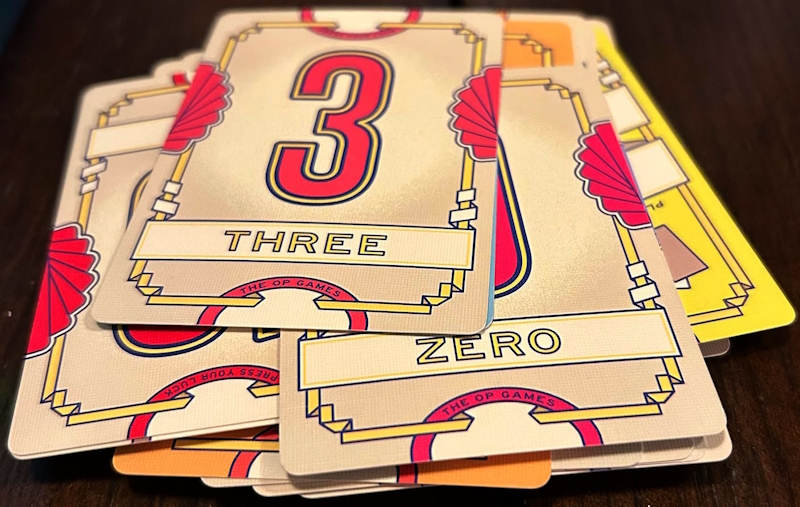
This week, Jade was proactive and quickly got a group together to play the “Feature Game“, which was to be Flip 7.  This is a quick, push-your-luck card game along the lines of Blackjack and recently won a Golden Geek award and received a nomination for the Spiel des Jahres.  The group have already played it a couple of times on a Tuesday, but we wanted to raise its profile and share it more widely amongst our people by making it the Feature Game.  The idea is really simple:  players turn over cards and gamble on not revealing the same number twice.  Unlike Blackjack, the game is played turn-wise, so the the dealer starts by dealing one card to each player.  Then players take it in turns to decide whether they want to “flip” or ” stick”.

Flip 7
– Image by boardGOATS

This mode of play is critical to the game’s popularity because it keeps everyone involved and the turns short. If players stick, they score the total of the face value of their cards.  There are a couple of other things that make the game tick, in particular the fact that each numbered card appears in the deck that number of times (i.e there is one one, two twos and so on).  Thus, the highest scoring cards are also the most risky.  Further driving push to gample, flipping over seven cards in a row gives fifteen bonus points.  There are also some action cards in the deck, “Flip Three”, “Freeze”, “Second Chance” and modifier cards which give extra points, all of which break the rhythm and add interest without adding significantly to the downtime.

Flip 7
– Image by boardGOATS

The game ends when players have reached the pre-agreed total (two hundred, according to the rules, though games can easily be made longer or shorter as desired).  This time, the group played the game as written, to a total of two hundred, which took seven rounds.  Sapphire  and Flint managed to go bust five and six and seven rounds respectively, though Flint did manage to push his luck to get seventy—the most in a single round.   Jade achieved a new low, however, failing to score at all.  The front runner was Teal, but going bust in the sixth round left the door open to Ruby who had been matching him step for step, scoring in every round and triggering the end of the game with her unsurpassed two-hundred and thirteen.

Flip 7
– Image by boardGOATS

Everyone else was playing a longer game, so with six, that left the choice of another six player game or splitting into two groups of three.  The party feel of Flip 7 had got everyone in the mood for playing in a larger group, leaving a fairly limited choice, though there are a couple of really good options.  Bohnanza is one, but instead, the group chose Faraway—another game that received a Spiel des Jahres nomination this year, that we first played in the group over a year ago and has proved very popular since.  This is another relatively simple game, this time  with a market and a trick-taking type element, but with a really clever twist, and one that really messes with the head.

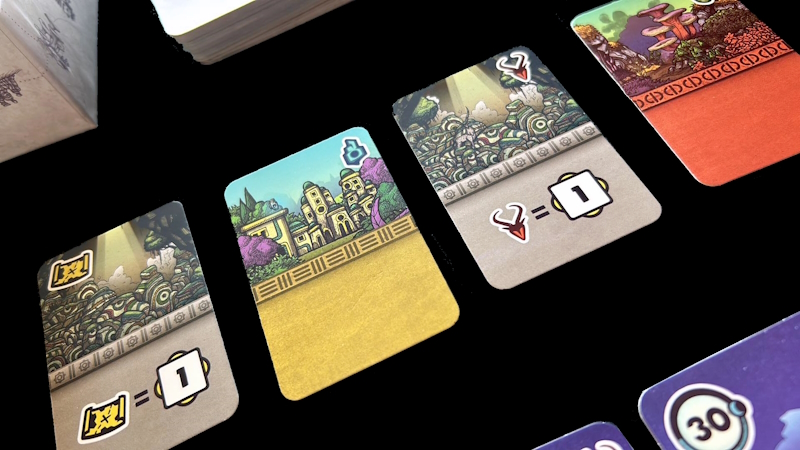
Faraway
– Image by boardGOATS

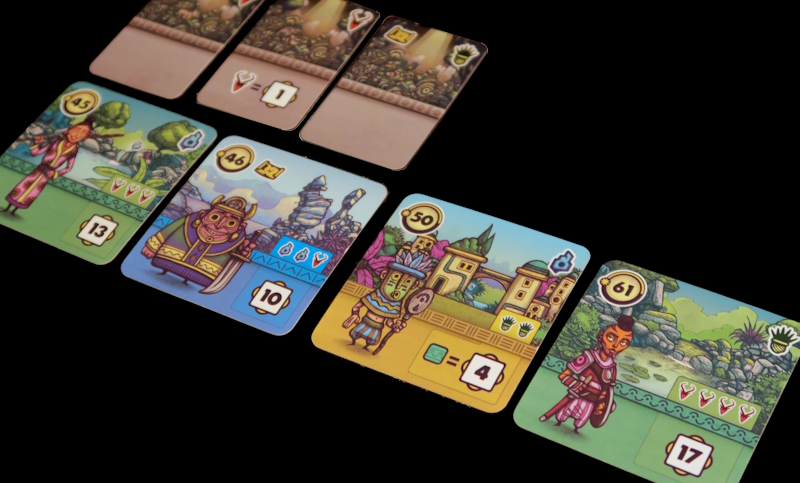
The story is that players are exploring the mysterious land of Alula in search of its secrets, meeting its inhabitants and listing its wonders in order to gain more fame than everyone else.  Players simultaneously chose one of the numbered cards from their hand to add to their tableau then, starting with the the player that played the lowest card (similar to 6 Nimmt! or Kingdomino), everyone takes it in turns to choose one from the market to add to their hand.  Players then simultaneously choose another card to play, and again, choose one to add to their hand.  The game ends after everyone has played a total of eight cards, and then everyone scores.

Faraway
– Image by boardGOATS

The scoring is the really clever part, because although the cards are played into tableaux from left to right, the scoring is from right to left.  At first glance, this looks like it makes things easy, because early in the game players find out what they need to get points and can then focus on getting the resources they need as the game progresses.  However, the desire to play scoring cards early is tensioned against card choice (the player who placed the lowest numbered card goes first) and the ability to get Sanctuary bonus cards.  Scoring cards are generally higher number and Sanctuary cards are gained when the card played has a higher value than the previous one in their tableau.

Faraway
– Image by boardGOATS

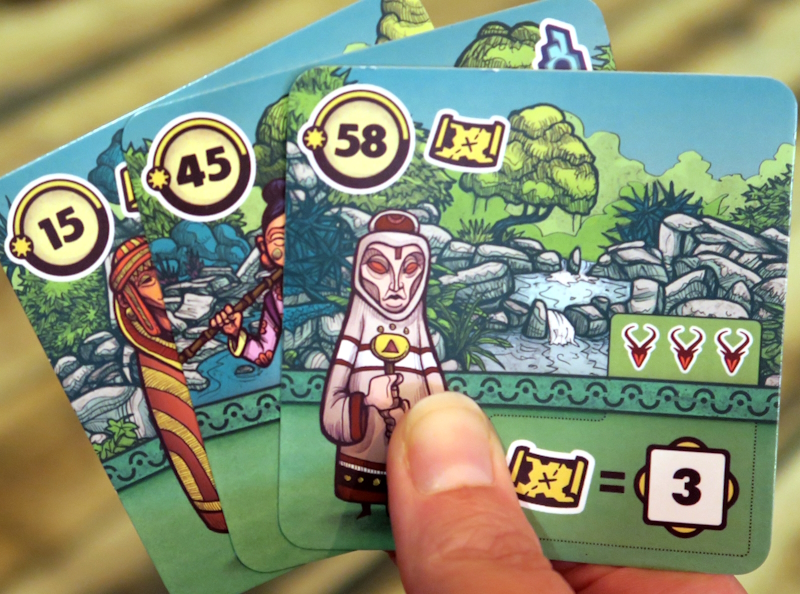
It is always hard to see how players are doing with this game, because if a player has played a high value scoring card early it can be worth a lot, but if the player fails to gain the necessary resources it can be worthless.  In the event, it was quite close with four of the six players scoring over sixty.  The winner, however, was Pink who got lucky early when he played card number fifty-nine first to start a map strategy and finished with five of them.  Sapphire was only two points behind in second though, and Teal two points behind that.

Faraway
– Image by boardGOATS

Meanwhile, on the other side of the room, Black and Purple were introducing Pine to Looot, another game that received a nomination, this time for Kennerspiel des Jahres, the “Expert” or “Connoisseur’s” game.  This is a game where players gather resources and capture buildings to develop their fjord, fill their Long Ships and complete buildings to rack up victory points. The player with the most riches is crowned Jarl of the Vikings.  The game is played over several rounds until each player has played all their Vikings, giving a maximum of thirteen turns.  In each, a player first places their Viking on a Resource tile on the central board adjacent to another Viking of any colour and takes the Resource and place it on their personal board.

Looot
– Image by boardGOATS

If possible, they then capture a Building and place that on their board, take a Long Ship and also place it on their board, use a Shield, complete a Construction Site and finally grab a Trophy.  At the end of the game, scoring is a bit of a point salad with points awarded for Castles, Watchtowers, Houses, Gold, Sheep, Trees, Construction Sites, any Trophies the player may have claimed and a five-point penalty for any unfilled Long Ships.  Purple raked in points for her Houses, Construction Sites and Trophies, while Black did better for his Watchtowers and Gold, and Pine top-scored for Trees.  The winner, however, was Purple whose total of ninety-one was five ahead of Black in second.

Looot
– Image by boardGOATS

The trio followed this with a shorter game, the Paris version of the 2004 Spiel des Jahres winner, Ticket to Ride (aka Zug um Zug).  Like the original, game-play is very quick and simple:  players take it in turns to take Cards from the market, or spend them to place Trains on the map with the aim of completing Tickets.  Players score points for placing Trains and completing Tickets with penalties for any incomplete Tickets.  Each game variant has its own special rules.  In the case of Paris, when players score bonus points each time they complete a Tricolor: a set of blue, white, and red routes.  This time it was a very close game.  Pine had the most points collected during play (including Tricolors), but Black picked up more for his Tickets and edged it by a single point.

Ticket To Ride: Paris
– Image by boardGOATS

The final game of the night took all evening and was the only one that that has not had a nomination for the Spiel des Jahres, Century: A New World.  This is the final game in the Century Trilogy (preceded by Spice Road, Eastern Wonders), but as they all use some of the same components, Plum and Byzantium had managed to squeeze all three games into one box (with an extra set of cubes so two could be played at once).  In A New World, players are exploring the Americas at the dawn of the 16th century trading with local inhabitants, recording their findings, and hunting and gathering to survive.

Century: A New World
– Image by boardGOATS

The game uses the resource trading mechanisms (Collect, Upgrade and Exchange) found in the rest of the Century series, but instead of using cards as in Spice Road, this is combined with with a worker placement mechanism.  On their turn, players can either Work (place Workers) or Rest (retrieve Workers).  Workers can work at Locations that have neither an Exploration tile nor Workers of their own colour.  If a Location is vacant, they can activate it by placing the number or workers depicted on the space; if it is occupied, the current occupants must be evicted and returned home by placing one extra Worker.

Century: A New World
– Image by boardGOATS

There are four locations types, thee allow players to Collect, Upgrade and Exchange Resource cubes, while the fourth (Forts) allows them to use Resources to claim Points Cards and Bonus Tiles.  Players can only have a limited total number of Bonus Tiles, and can only claim the Points Card associated with the particular Fort.  These Cards are supposed to slide along a conveyor belt so that they move from one Location to another, but thanks to a rules malfunction, this time the didn’t until more than halfway through the game.  The game finishes when one player has their eighth Points Card, so it can end quite suddenly, as players can pick up cards quit quickly due to special powers.

Century: A New World
– Image by boardGOATS

These games are basically race games, and it felt like Byzantium had a good start with points from his Exploration tiles, the only one to have any.  However, as Plum built her engine, she galloped up on the rail, ultimately taking the most points from her Cards. She also took the most points from Bonus Tiles.  In such a tight game, left over resources were critical and they enabled Cobalt to leap-frog Byzantium into second.  Plum was the winner, though by just two points.  It had been fun, though Plum’s comment that she actually preferred the second of the trilogy meant Blue who had not played it would take the opportunity to grab a copy at the UK Games Expo Bring and Buy a couple of days later.

Century: A New World
– Image by boardGOATS

Learning Outcome:  The Spiel des Jahres Jury can spot a good game.

Spiel des Jahres Winners – 2025

Last weekend, this year’s Spiel des Jahres (German Game of the Year) winner was announced as Bomb Busters, by Hisashi Hayashi, the designer of Trains, MetroX (aka Voll Verplant), String Railway and Yokohama.  Based on the earlier Bomb Squad by the same designer, this is a cooperative, card driven game, where players work together to try to defuse a bomb before it explodes.  Players begin with a hand of numbered Wire cards (four each, numbered one to twelve) and then take turns pointing at each others’ wires and guessing their values.  Correct guesses lead to wires being cut, incorrect guesses and the detonator advances…

Bomb Busters
– Adapted from image by BGG contributor spiritraw

The winners of the Kinderspiel des Jahres (Children’s Game) and the Kennerspiel des Jahres (“Expert” or “Connoisseur’s” Game) were announced at the same time. The Kinderspiel des Jahres went to Topp die Torte!, which is a tile laying game by Wolfgang Warsch—a previous winner of the Kennerspiel de Jahres in 2018 with Die Quacksalber von Quedlinburg (aka The Quacks of Quedlinburg) and designer of The Mind, Ganz Schön Clever and Quacks & Co., all of which have received recognition from the jury in recent years.  This year, the Kennerspiel des Jahres award went to Endeavor: Deep Sea by New Zealand designers Carl de Visser and Jarratt Gray, a game where players explore the deep sea using the action mechanism from Endeavour: Age of Sail (and its predecessor Endeavor).

Endeavor: Deep Sea
– Image from kickstarter.com

Endeavor: Deep Sea can be played competitively or cooperatively with up to five players (using the Deluxe edition). This means that as last year, both the “senior awards” have gone to cooperative games.  Indeed, the last four Spiel des Jahres awards (Sky Team, Dorfromantic, MicroMacro and Just One) and three of the last five Kennerspiel awards (Paleo and The Crew as well as e-Mission/Daybreak) have gone to cooperative games.  This style of game is clearly very popular with families (where arguments are often best avoided), but can be less so with more traditional gamers who prefer a bit of competition.  As such, cooperative games very much have the “Marmite Factor”, but in such cases, the nominees and recommended lists cater for every taste, with games like Looot, Castle Combo, Faraway and Flip 7.

Bomb Busters
– Image from spiel-des-jahres.de

8th April 2025

By the time everyone else started to arrive, Cobalt was already most of the way through losing his game of 20 Strong.  This is a solo-player deck-based game where the object is to progress through a shuffled deck of cards, each of which bears a unique challenge. This challenge could be in the form of an enemy, a unique scenario, or some other requirement which are completed by rolling a set of seventeen dice with different odds for a hit.  These dice, along with three adjustable stat dice, make up titular twenty dice.  Cobalt continued rolling his dice while others ordered food, chatted and ate.

20 Strong
– Image by boardGOATS

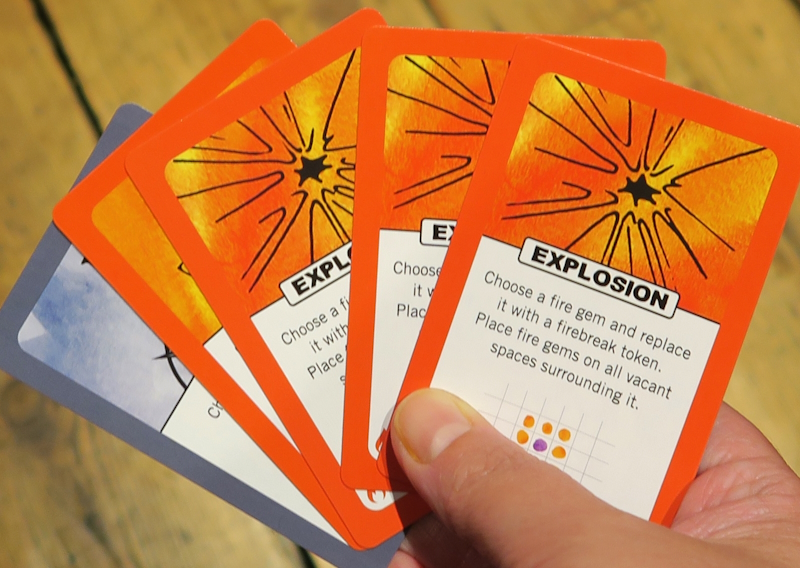
Before long players began splitting into groups, deciding what to play.  The first group was Blue, Pine, Mint and Pink playing the “Feature Game” which was to be Fire Tower.  This is a competitive game where players order air drops of water, and plan the building of firebreaks in order to combat a woodland blaze.  The rules are very simple:  players begin their turn by spreading the fire in the current wind direction then play one card from their hand (or discard all their cards) and replenish their hand.  There are four different types of cards, Wind, Fire, Water, and Firebreak cards.  Wind cards can be used to change the Direction of the Wind which affects which direction the fire spreads in.

Fire Tower
– Image by boardGOATS

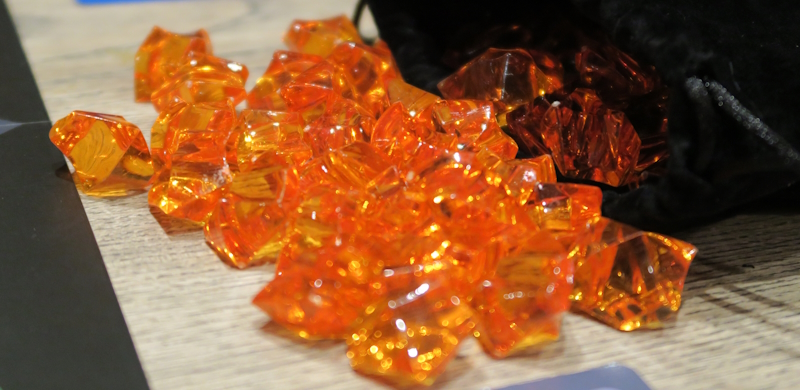
This can either be by playing the card and changing the Wind Direction to that on the card, or by rolling the Wind die and leaving it up to fate.  Alternatively, the player may place a fire gem on one empty space orthogonally adjacent to an existing fire space (or the central Eternal Flame), in the wind direction indicated on the card.  Fire, Water and Firebreak cards give a pattern of spaces that the fire must either spread in, is removed from, or fire break tokens can be placed in.  Firebreaks prevent fire from landing on or jumping over the spaces they occupy and can only be removed using a card that includes the De/Reforest action and cannot be placed in orthogonally adjacent to another Firebreak token.

Fire Tower
– Image by boardGOATS

Each player took the Fire Tower on one corner of the board with Pine sitting opposite Blue and Mint opposite Pink.  Blue went first followed by Mint, then Pine and finally Pink.  The base game is an elimination game, with the winner the being the last player who’s Fire Tower has not be burnt down.  The group decided to play without the events and keep the game as simple as possible to see how things worked.  Pink was the first to get knocked out with Firestorms proving to be disastrous for his Tower.  Pine quickly followed with before there was a long, determined rear-guard action by Blue.

Fire Tower
– Image by boardGOATS

Unfortunately, Mint started in a better position and despite her best efforts, eventually Blue’s Tower was also a moldering ruin.  Since Pink and Pine had spent quite a lot of time as spectators, the group decided to give it a second go, but this time working in pairs.  This time, Blue’s Tower was first to be destroyed with Mint’s next.  Eventually, only Pink’s tower was still standing giving a second victory to Mint, which was shared with Pink.  The game had been quite enjoyable, if very different to the usual fare.  There was still plenty of time left for something else though, so the group had a rummage in the bags and came up with Draftosaurus.

Draftosaurus
– Image by boardGOATS

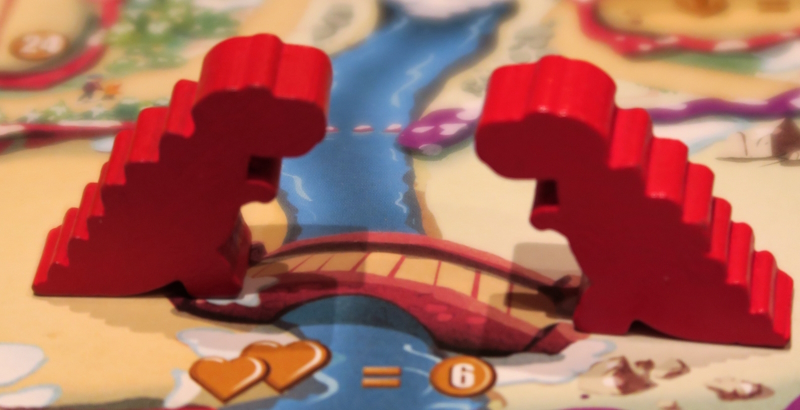
This is a very popular game where players start with a hand of dino-meeples, choose one and pass the rest on before placing them in their dinosaur park.  It frequently gets outings within the group, but on this occasion, for variety, the group decided to play with the winter setting which gives slightly different pens with slightly different placement conditions.  It was very tight, but as is often the case, Pine, who just seems to “get” this game emerged the victor with thirty-six points.  He was only one point ahead of Mint and Pink though, who tied for second place.

Draftosaurus
– Image by boardGOATS

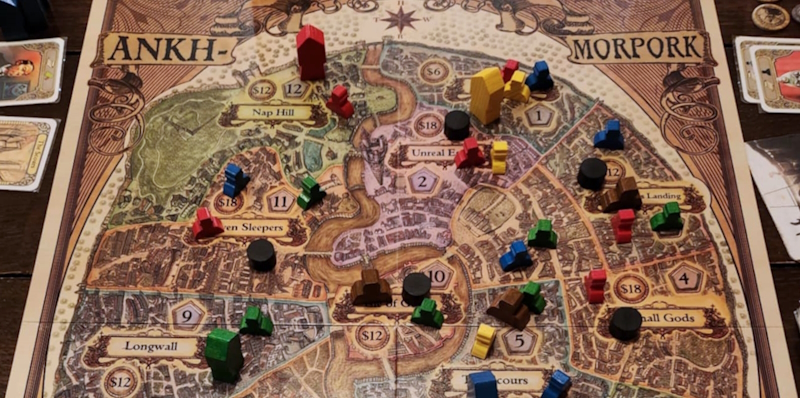
Meanwhile, on the next table, Green putting in a rare, but welcome appearance, was leading Black, Purple and Plum in a game of Discworld: Ankh-Morpork.  In this game, Lord Vetinari has disappeared and players control different factions which are trying to take control of the city.  Game play is quite quick and simple with players playing a card and doing what it says.  Most cards have more than one action on them, and players can choose to do some or all of these actions. Some cards also allow people to play a second card, so they can chain actions together.

Discworld: Ankh-Morpork
– Image by boardGOATS

In this game, Black was the Dragon King of Arms, looking for trouble, Green was Chrysoprase, trying to amass lots of money, Plum was Commander Vimes who was trying to play through the deck and Purple was Lord Rust, with an area control remit.  The game was over quite quickly with Black running out the winner in a game that is much under-rated and sadly very out of print due to IP issues.  This copy was a much cherished one, as it had belonged to Burgundy so it was nice for it to get another outing within the group.  There was time for a second game and this ended up being Faraway, a very clever, much more recent, card-driven game that has had a few outings since its release last year.

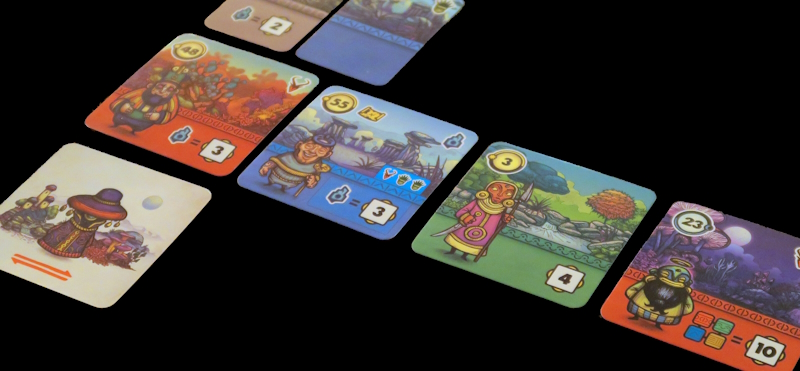
Faraway
– Image by boardGOATS

The idea is that players simultaneously chose one of the numbered cards from their hand and starting with the the player that played the lowest card (similar to 6 Nimmt! or Kingdomino), everyone takes it in turns to choose one from the market to add to their hand.  Players then simultaneously choose another card, and again, choose one to add to their hand.  The game ends after everyone has played a total of eight cards, and then everyone scores.  The clever part is that the cards are played left to right, but the scoring is from right to left.

Faraway
– Image by boardGOATS

At first glance, this looks like it makes things easy, because early in the game players find out what they need to get points and can then focus on getting the resources they need as the game progresses, but of course that is not the case.   This time, Purple had a really bad run where she kept getting the highest number cards, which meant she picked last, and then picked up the higher number cards left by others.  Once again, the winner was Black making it two out of two for him, while Plum was second by seven points with Green a little way behind her.

Faraway
– Image by boardGOATS

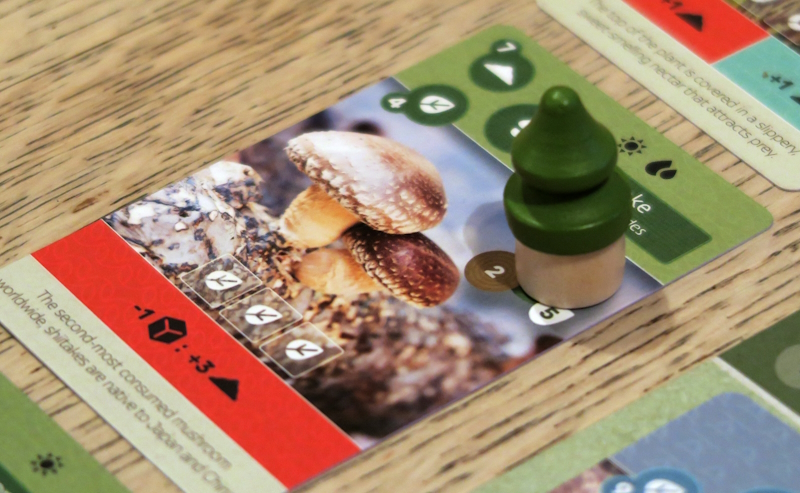
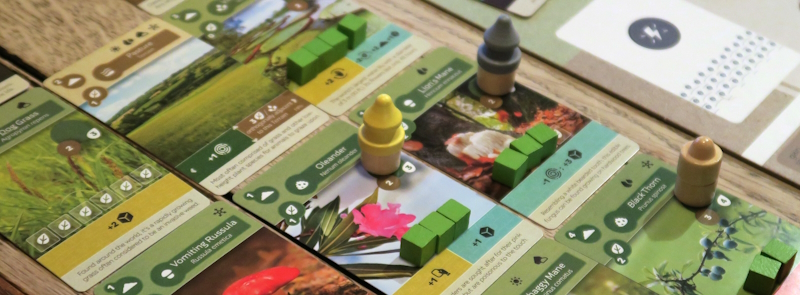
Meanwhile, the third group comprising Jade (fresh from his birthday celebrations), Sapphire, Teal, Byzantium and Cobalt spent the evening playing a five-playergame of Earth.  This is a is a sumptuously illustrated card-driven engine-builder game that is often compared to Wingspan, where players are building themselves an ecosystem.  The game itself is not actually all that complicated. Players are building a four by four grid of Flora and Terrain cards which represents their island and during the game they will plant flora, water it and allow it to grow.  On their turn, players do one of four things: Planting (paying the cost in Soil tokens), Composting (gaining Soil and placing cards from the deck in their discard pile), Watering (place Sprouts and gain Soil) & Growing (draw new cards and place growth tokens).

Earth
– Image by boardGOATS

A bit like Puerto Rico, once the active player has chosen which action they are taking, everyone else gets to do a subsidiary, slightly weaker version of the same action.  Once everyone has completed the action for the turn, everyone activates all the cards in their island that match the colour of the action chosen, starting with the card in the top left and working across each row in turn.  At the end of the game (triggered when one player has completed their island), players score points for each flora card, any Trunks and Canopies they have grown, their Sprouts and their pile of “Composted” or discarded cards.  Players also score points for achieving objectives on the Fauna cards revealed at the start of the game and for completing their island first.

Earth
– Image by boardGOATS

During the game, Cobalt built up the most points; his forty-two were some five ahead of Byzantium.  By far the most points come in the end-game scoring however.  A bit of a point salad there are seven scoring sections:  Teal scored best for Compost; Jade scored most highly for completing his Canopies; Byzantium top-scored for Terrain, and Cobalt out-scored everyone else for his Fauna.  As well as getting the most points for his Sprouts and Ecosystem Objectives, Sapphire also scored well in many of the other categories giving him a clear victory with one hundred and sixty-eight points, thirteen more than Byzantium who pipped Cobalt for second by a single point.

Earth
– Image by boardGOATS

Learning outcome:  Playing with fire may be fun, but you risk getting burnt.

Spiel des Jahres Nominations 2025

The nominations for the 2025 Spiel des Jahres Awards have just been announced.  Although there are now other lots of other awards (including the recently announced Golden Geek Awards), this is still the most prestigious award in board gaming and certainly the one that carries the most weight when it comes to casual gamers.  There are three categories, the Kinderspiel (children’s game) , the Kennerspiel (“expert’s” game) and the most desirable of all, the family award, the Spiel des Jahres or “Red Poppel”.  The nominees for this year’s awards have been announced as:

  • Kennerspiel des Jahres
    Kennerspiel des Jahres 2025 - Nominees
    Endeavor: Die Tiefsee (aka Endeavor: Deep Sea) by Carl de Vissser
    & Laurent Escoffier
    Faraway by Johannes Goupy & Corentin Lebrat
    Neuland (aka Looot) by Charles Chevalier & Laurent Escoffier


In recent years, there has been a shift in both the family and expert awards, away from traditional Euro-style board to lighter, more innovative games.  Gone are the days of El Grande, Tikal and The Settlers of Catan (all winners from the 1990s) with recent winners including MicroMacro: Crime City (from 2021) Pictures (from 2020), Challengers! (from 2023).  It may be that there has been a concerted effort to “freshen” the brand and subvert the conventional idea of what a board game is.  Last year’s winners, were Sky Team and Daybreak which were unusual in that both are cooperative games with Sky Team also being a two-player game (unusual for a “family game”).

– Image by BGG Contributor JuiceNeutron

In addition to the nominees, there are always a number of recommendations, which in this year include Castle Combo and Cities.  The Spiel des Jahres Awards are still the industry’s headline award and therefore are of great significance; it will be interesting to see which direction the awards go in this year when they are announced on Sunday 13th July in Berlin.

The Spiel des Jahres Awards
– Image from spiel-des-jahres.de

8th October 2024

As it was our twelfth birthday party, lots of people arrived early for pizza (or an amazing Mixed Grill in the case of Lime and some lovely veggie curry and fiery chilli for Pine), followed by GOAT cupcakes.  While everyone waited for food, arrivals from Essen were handed out, including Nucleum, Faraway and Flamme Rouge expansions; Let’s Go! To Japan and Cascadia mini expansions, and Die Wandelnden Türme (aka Wandering Towers), Keyflower and Dixit promotional items.   There was a lot of chatter too, about flooding, pot holes, the 34 road closure, full car parks and water leaks, as well as Essen.  Indigo and Navy weren’t eating, so had a play with Villagers while the others entertained themselves.  This is a card game where players “Draft” Villager cards from a market (called the Road) and then add them to their Village.

Villagers
– Image by boardGOATS

Some Villagers have prerequisites before they can be “Built”.  These are cards that must exist in the player’s Village before the Villager can be added on top to make a chain, cards that must be unlocked by paying money to other Villagers in their own Village, someone else’s Village or the Bank.  Some cards allow players to draft extra cards, while others enable players to Build extra Villagers and Special Villagers give powerful special actions.  Twice during the game there “Market” Phases when players get income from their cards, and the player with the most money at the end of the game is the winner. Somewhere along the lines, Indigo and Navy had a bit of a rules malfunction, and as everyone else had already started the now traditional birthday “Feature Game“, Crappy Birthday, they abandoned Villagers.

Crappy Birthday
– Image by boardGOATS

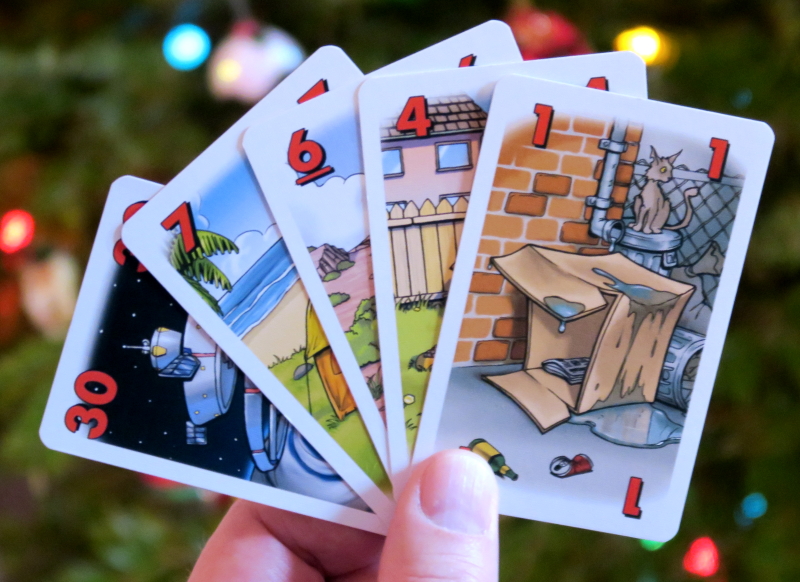
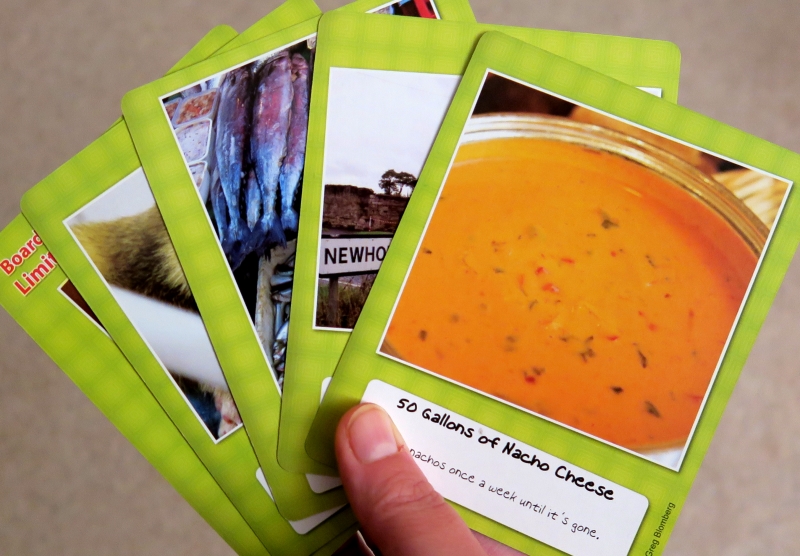
Crappy Birthday is a party game where players give each other comedy birthday presents and the recipient has to decide who gave the best and worst gifts.  We play a slight variant of rules as written, where we play a single year of birthdays with each gamer getting one turn to receive gift cards from everyone else from their hand of five cards.  With lots of players the pile of gifts can get quite substantial and this time everyone was getting thirteen gifts to decide which was the best and which was the worst.  The players who gave these then received a point for knowing the recipient so well and the player with the most points at the end of the year is the winner.

Crappy Birthday
– Image by boardGOATS

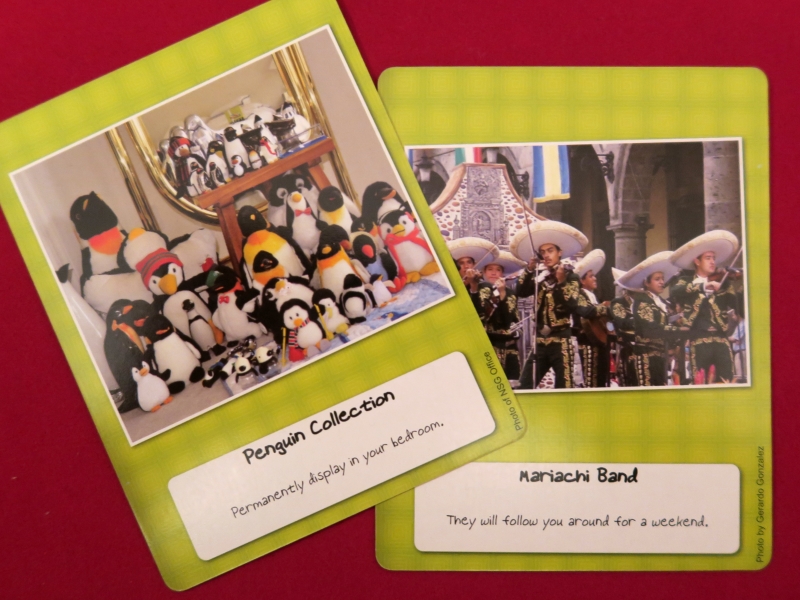
One of the reasons this game is so fun is that we learn a bit about each other.  Pink went first as his real birthday was next.  He liked the idea of an Easter Island Mo’ai for the garden (not that Blue was so impressed with the idea), but disliked the idea of cave scuba diving.  Plum chose a haunted castle as her favourite (because she loves castles), but pulled a face at the idea of earlobe stretching rings.  Purple had the matching neck rings, but these weren’t her least favourite gift, that was a giant swing ride, while she loved the idea of a penguin collection.  Byzantium showed his environmental credentials by picking a Global Warming Study as his favourite, while eschewing Jade’s wing suit dive gift.

Crappy Birthday
– Image by boardGOATS

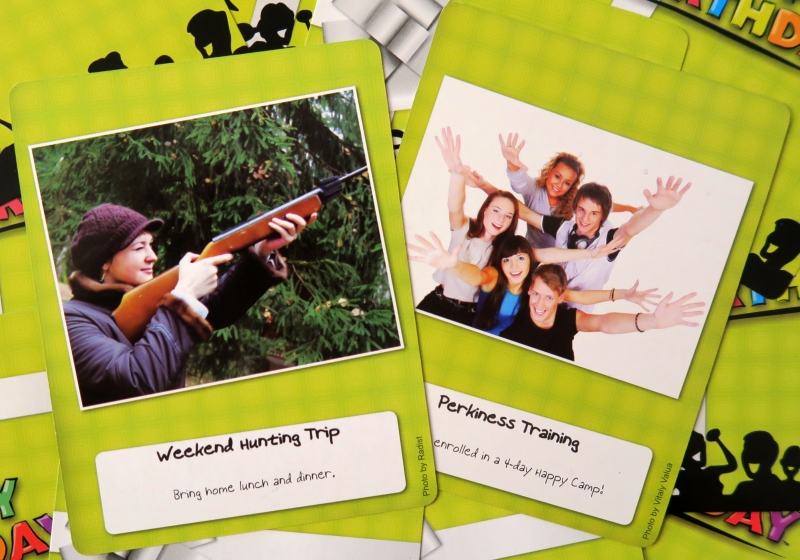
Teal felt that trees were quite beautiful enough without being carved, but really liked the idea of a ride-on bike mower.  Jade wasn’t a fan of Cobalt’s offering of Polka lessons, but loved the idea of trip to Mars from Sapphire, while Sapphire felt “perkiness training” wasn’t something he really needed, but the thrill-seeker loved the reciprocal gift from Jade, a roller-coaster ride.  Lime fancied a three day festival trip, but wasn’t keen on a week eating nothing but Spam.  Blue didn’t fancy the creepy baby sculpture to go with the Mo’ai, but fancied Pink’s gift of a Safari (provided she had time to train for the walking element).  Ivory didn’t feel his life would be improved by a free satellite TV dish, but always one to send his meeples into space in Tapestry, grasped the opportunity to join them with a space walk.

Crappy Birthday
– Image by boardGOATS

It turned out that Navy has a problem with bees, so Teal’s gift of a bee keeping which he personally would have loved, didn’t go down well, but much to Pink’s surprise, his gymnastics camp was received really well.  Indigo was quite abrupt in her negative response to the idea of paparazzi following her about, but liked the idea of exploring a volcano while Cobalt didn’t feel he needed his soul to be searched, but fancied flying lessons.  The final birthday of the year was Pine, who didn’t get his usual pile of horses and meat, instead getting the opportunity to run with the bulls, which having known someone who had done it and been gored, wasn’t something he fancied.  Pine’s favourite was Larry the Lobster (not that he has space in his garden for him), one of the Big Things of Australia, that Pink and Blue happened to see on their visit there last year.

Crappy Birthday
– Image by boardGOATS

Lime was the last to break his duck and was very pleased not to end the game without scoring any points, indeed, nobody finished with the dreaded bagel, which was nice.  The runniest of run-away winners was Teal though, with five successful (or unsuccessful) gifts, with Pink and Cobalt joint runners up with three.  It was interesting though, this time there were quite a lot of gifts that people gave “in error” where as Teal commented, he “Gave pressies he thought people would like, but they all hated them!”  With the birthday formalities dealt with, there was time for something relatively short.  First up was Jade who was very keen to give his new Faraway expansion, Le Peuple du Dessous (aka The People Below).

Faraway
– Image by boardGOATS

Faraway is a fairly simple little game, but one that really messes with your head:  players play cards from their hand of three, adding them to a row of cards, left to right, but at the end of they score the eight cards from right to left.  The Peuple du Dessous expansion adds just seventeen cards, but these include the Guides and the Three-Eyed Ones, two new Peoples with more opportunities to score, as well as giving enough cards to play with seven people.  This time there were only five though, with Sapphire, Byzantium, Indigo and Navy joining Jade.  Navy and Indigo were new to the game and, as usual, it took a little bit of getting used to.  That said, the both did really well with Indigo ending up with seventy-seven points, four more than Sapphire in second with Navy taking third, just one point behind.

Faraway
– Image by boardGOATS

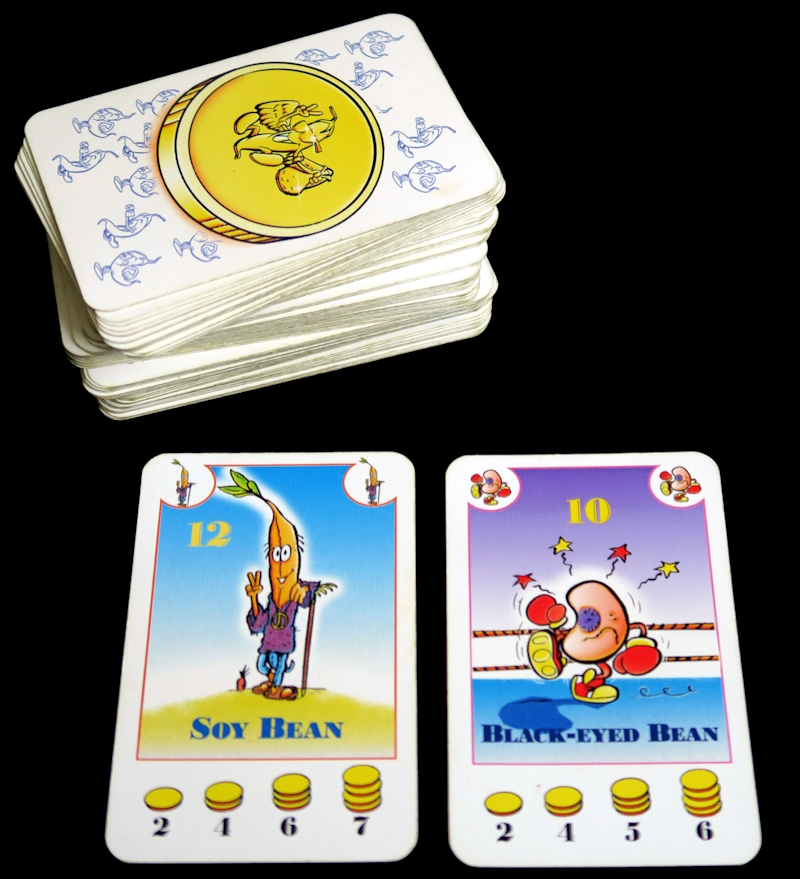
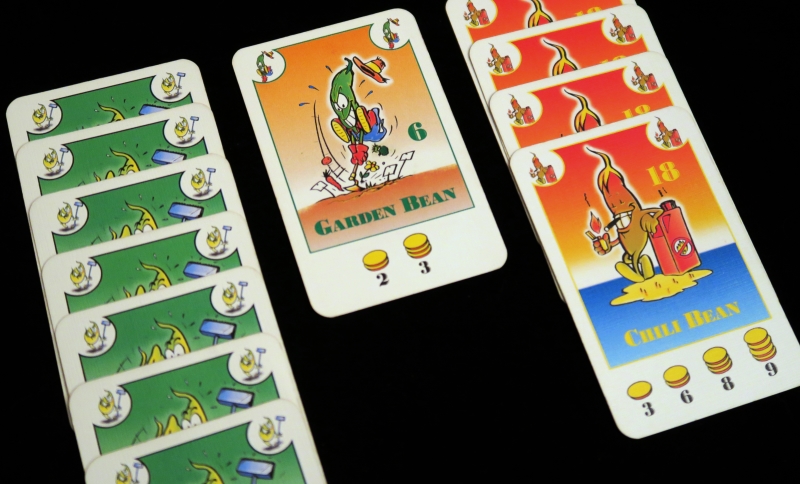
Navy and Indigo headed off and took an early night, but the other three had to wait for Plum who’s game on the other side of the room was ongoing.  Faraway is a fun little game though and the expansion adds a little more, so the trio decided to give it another go.  This time, Byzantium was the victor with seventy-three with Sapphire the runner up again.  Meanwhile, Blue, Pink, Pine and Teal, got out Bohnanza.  This is a game that is generally popular with the group, though Teal had somehow only managed to play it the once almost six months ago.  This is a very simple card game, albeit slightly convoluted and very unpromising when explained, but the key is that players must not rearrange the cards in their hand.

Bohnanza
– Image by boardGOATS

On their turn, players must plant the first card in their hand in one of their two been fields and may plant the second if they choose.  They then turn over two cards from the deck, which must be planted before the player can move on.  Fields can only contain one bean type, but beans can be traded, or even gifted, and it is the trading and negotiation that makes the game such fun.  Once the two cards on the table have been planted, players can trade from their hand, but again all traded cards must be planted.  Players can harvest Fields at any time with some of the bean cards dug up becoming money and larger Fields giving more money and at a better rate.

Bohnanza
– Image by boardGOATS

Blue took some high valued Garden Beans and then sold them off to buy a third Bean Field, causing a lot of confusion for Pink who couldn’t believe it when they kept appearing even though there were only six in the deck.  Teal scored well from his Chilli and Wax and Soy beans, while Pine and Blue ended up in competition for Green Beans.  This time with just four, the scores were a little more varied, but Blue was the clear victor with twenty-five Bohn Thaler, five more than Pine who came second.  The final game of the evening was Villagers, which was getting another outing on the other side of the room with Cobalt leading Ivory, Purple and Plum.

Villagers
– Image by boardGOATS

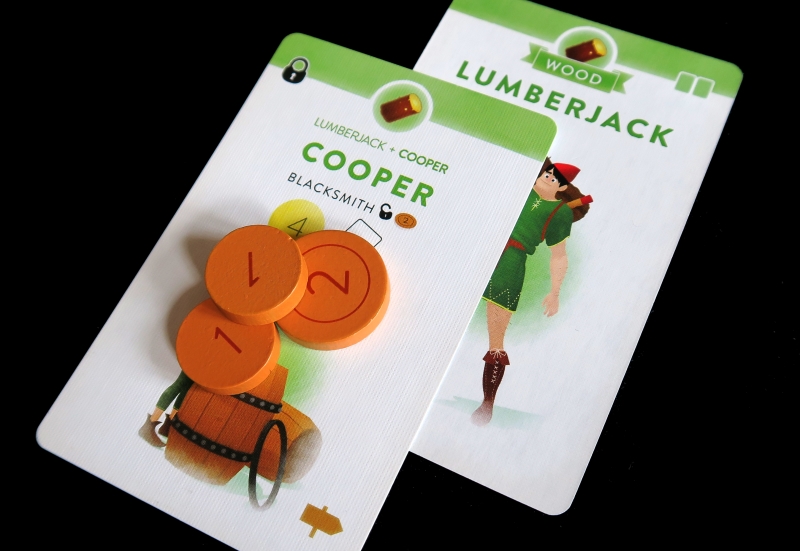
After a reminder of the rules, Purple started and grabbed the Carpenter then Cobalt went next taking the Blacksmith.  Both of these guaranteed their owners an income of coins (and hence points) at the expense of other players paying to use them. However, this did mean that they fell behind on building an engine to Draft and Build more cards (which Plum and Ivory focused on).  From there, the first half of the game went quite quickly with everyone focusing on building their engine. Ivory managed to get a Wine Trader using a Monk as a Graper, as well as playing a Scavenger, enabling him to take slender lead after the first scoring, although the scores were all very close.

Villagers
– Image by boardGOATS

In the second half of the game, Purple and Cobalt were beginning to have to make tough choices, being unable to play as many cards as they would like and not having the building cards they needed, which were also hard to come by. However, they continue gaining coins from all players. Purple had to discard quite a few cards to get starter cards which slowed her down a little, though Plum and Ivory were able to quickly get to the position to Draft and Build the max number of cards allowed; Plum in particular seemed to always have a fist full of cards.  As the game progressed, more people began taking cards that others might want, with Cobalt taking Wool cards that might have been of use to Purple or Ivory.  Ivory, however, was actually more focused on getting a second Vintner, already having a second Wine Trader in hand.

Villagers
– Image by boardGOATS

Towards the end of the game, there was face down Grape card which Ivory debated taking a gamble with, but decided not to take the risk.  Inevitably, when it was flipped over it turned out to be Vintner and Plum grabbed it. Ivory got very lucky during his next draft though, taking a face down Special card that was Monk, which he could then play as Vintner. Elsewhere, Purple played some Wool cards, getting two Weavers, Plum picked up some good end-game scoring cards in the Locksmith and Freemason. Cobalt focused on Solitary cards and Silver end game scoring, doing well from his Priests, Agent and Blacksmith combo. Ivory ended up focusing on the Hay cards, which scored well and that plus the two Wine Traders (and a second Scavenger), gave him a hundred and twenty-six and a two point victory over Cobalt.

2024 Birthday Cupcakes
– Image by boardGOATS

Learning Outcome:  Getting old is not necessarily a bad thing.

14th May 2024

Pine was already sitting outside marking his birthday, when Blue and and Pink rocked up and ordered their tea.  Jade and Sapphire soon joined the group, ferried by newcomer, Tangerine who not only brought gamers, but also his shiny new copy of the “Feature Game“, Faraway, which he had won at Gweeplefest a few days earlier.  This game is has been a bit of a hidden gem whose popularity is rapidly gaining traction as more people play it.  It is quite a simple game, but one which really messes with the head.  Some of the group played it a few weeks back and it was so popular that it seemed a good idea to Feature it so more of the group could try it.

Faraway
– Image by boardGOATS

The story is that players are exploring the mysterious land of Alula in search of its secrets, meeting its inhabitants and listing its wonders in order to gain more fame than everyone else.  In practice, however, it is a fairly simple little card game with a market with a trick-taking type element.  Players simultaneously chose one of the numbered cards from their hand and starting with the the player that played the lowest card (similar to 6 Nimmt! or Kingdomino), everyone takes it in turns to choose one from the market to add to their hand.  Players then simultaneously choose another card, and again, choose one to add to their hand.  The game ends after everyone has played a total of eight cards, and then everyone scores.

Faraway
– Image by boardGOATS

There are a couple of very clever things about the game.  Firstly, if the card someone plays is numbered higher than their previous card, they take a card from the Sanctuary deck.  These cards a really important because of the second clever element, the scoring.  Each card has a number and a colour, while some also have resources and some have also have scoring conditions.  The scoring is clever because the cards are played left to right, but the scoring is from right to left—at first glance, this looks like it makes things easy, because early in the game players find out what they need to get points and can then focus on getting the resources they need as the game progresses.

Faraway
– Image by boardGOATS

However, the scoring is tensioned against the ability to get Sanctuary bonus cards. This is because the scoring cards are generally those that have a higher number and are therefore the ones players want to play first (following them with resource cards which generally have a lower face value).  To get a Sanctuary card though, players have to play a higher value card than the immediately preceding one, and Sanctuary cards are very useful because they are eligible for scoring regardless of when they are played.  Thus, trying to play cards increasing and decreasing in value to score the most points backwards really messes with players’ heads!

Faraway
– Image by boardGOATS

Tangerine, started one game and explained the rules to half the group, comprising Plum, Byzantium, Blue, Pink and Pine, while he ate his supper.  Meanwhile, Jade and Sapphire took their copy to a neighbouring table where they were joined by Teal, Black and Purple, and started a second game.  Although it is a very simple game, the backwards forwards up and down thing got to several of the group at various points, including Blue (who lost the ability to count), Teal (who did all his scoring forwards instead of backwards), Pine (who struggled with the how maps worked) and Purple (who couldn’t get her head round the reverse scoring).  Jade’s game was the first to finish, with Sapphire beating jade into second place by a single point and Black taking third.

Faraway
– Image by boardGOATS

There was a general appreciation of the art and the mechanism though the theme was a bit invisible.  There had been such confusion, however, that the group decided to “do a Lime” and play again.  This time, the finishing order was exactly the same, but the game wasn’t as close with Sapphire’s eighty-two being the highest score of the evening.  On the other table, Plum was the victor with seventy, followed by Tangerine and Byzantium in third.  This game had taken a little longer, and with six, there is a lot of downtime, so although everyone had enjoyed it, the group decided to split into two groups of three.  Blue tempted Plum and Sapphire to a game of Calico with cries of “Kittens!”, while Pink and Pine lured Tangerine into a game of Ticket to Ride: San Francisco.

Ticket to Ride: San Francisco
– Image by boardGOATS

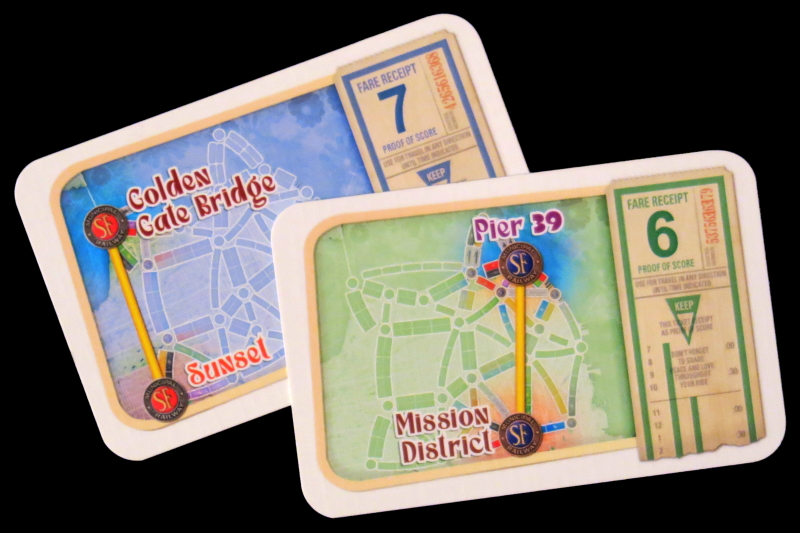
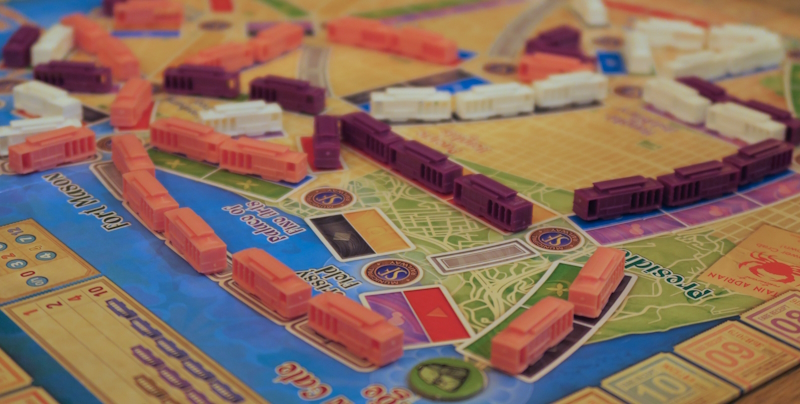
San Francisco is one of the smaller city versions of Ticket to Ride.  The game play is much the same as the original, but the maps are smaller, players have fewer pieces and they only play a maximum of four.  In all the games, players take it in turns to take coloured cards into their hand from the market, or play cards to place pieces on the board connecting locations to satisfy tickets and score points.  Each version of the game has its own specific unique rules, and this one is no exception with players collecting Souvenirs which give points at the end of the game.  Players collect these by building a route (in this case made of trolley cars rather than trains) to the cities where they are available.

Ticket to Ride: San Francisco
– Image by boardGOATS

Each player can only collect one of each Souvenir, but a full set of seven gives twelve points, which is a lot.  Tickets are also always key though.  This time, Pink escaped early from Alcatraz to Twin Peaks which gave him a high scoring eight points.  Unlike Pine (who always seems to draw routes he’s already completed), Tangerine was unlucky and and instead picked up some negative points late in the game.  It was very close between Pink and Pine though, but the Souvenirs made the difference and Pink (with five) just edged it, beating Pine (who only had two Souvenirs) by three points.

Ticket to Ride: San Francisco
– Image by boardGOATS

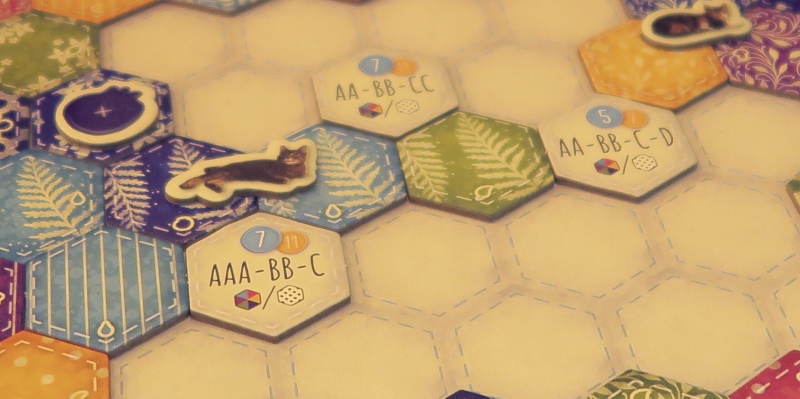
Meanwhile, the kitty-philes were playing the extremely frustrating game Calico, which is all about trying to entice cats to come and sleep on a patchwork quilt by making it with the patterns they like.  In this game, players take it in turns to place a coloured, patterned tile from their hand into their quilt board before taking a replacement from the market.  Everyone had played it before, but it had been a while, so the rules needed a bit of revision.  Each player starts with three tiles in a fixed location with scoring criteria for the neighbouring tiles—satisfying these for either colour or pattern gives points, with more points for for those that satisfy both (which is not easy).

Calico
– Image by boardGOATS

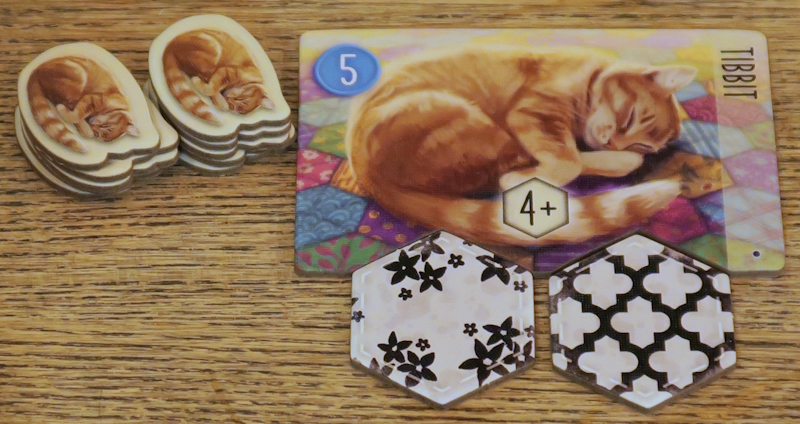
Players then also receive a coloured button for every group of three adjacent tiles of the same colour (with a bonus if they get all six possible colours).  Finally, there are the cats that give Calico its name.  This time the cats in question were Almond, Tibbit and Shop Cat (from the Kickstarter Promo).  Almond was attracted by a group of five tiles of one of the patters in a close packed predefined shape while Tibbit found a set of four tiles of one of the given patterns in any shape most appealing.  Shop Cat was lured to the player with the longest connected chain of tiles in one of the given patterns with the player with the second longest attracting a smaller cat (worth fewer points).

Calico
– Image by boardGOATS

This last one was the subject of some debate as Byzantium ended up with both the longest and second longest chain and it was unclear from the rules whether he would get both.  In the end he allowed the smaller Shop Cat to wander off, but fortunately it didn’t make any difference to the placings.  Almond looked by far the most challenging kitty to attract and initially it looked impossible without failing on the fixed starting challenges.  Plum thought she had made a mess of things, but Byzantium pointed out how Almond could be enticed  using some of the partial tiles around the border of her player board and she was the only one to ultimately have that particular kitty to cuddle.

Calico
– Image by boardGOATS

Blue started badly, and in this game, when that happens things usually only get worse, which they did.  Byzantium and Plum both picked up twenty-seven points for their buttons, but in both starting tiles and kitties, Byzantium had the edge (even without the second Shop Cat).  In the end his final score of sixty-one points gave him a significant margin of victory, by seven points.  Everyone agreed that Calico is a good game, but a very frustrating one when players can’t get the tiles they need.  So Byzantium echoed everyone’s feelings when he commented, “That was fun, but very frustrating—I’ll be ready to play it again in another eighteen months…”

Calico
– Image by boardGOATS

As Faraway and Ticket to Ride had both finished, Tangerine took Jade and Sapphire home and Teal also headed off.  That left Black, Purple, Pine and Pink to play a quick game of the old favourite, Coloretto.  This is a very simple set collecting game, that makes a great filler.  The idea is that players either take the top coloured chameleon card from the deck and place it on a cart, or take a card and add the cards to their collection.  Players score points for their largest three sets (up to six cards, worth twenty-one points), while everything else scores negatively.  The player with the most points is the winner.  Playing with the Jubiläumsausgabe edition, as usual, there was a discussion about what the Golden Joker does and how it differs from the normal Joker.

Coloretto
– Image by boardGOATS

In the end, Pink was the victor and, for the second game in a row, pushed Pine into second place, this time with Black just behind.  The evening looked to be ending there, when a couple of people from the bar came over and asked what we were doing.  That led to a fairly wide-ranging discussion about Monopoly, Cluedo and Mystery of the Abbey amongst other games.  The evening really did come to an end eventually, after Pink and Blue had dragged one of the interested parties into a quick game of No Thanks!.  Unfortunately, there was a misunderstanding and he top-scored with ninety-three, but hopefully he understood that some of the games we play are not that complicated.

No Thanks!
– Image by boardGOATS

Learning Outcome:  Playing forwards and backwards at the same time makes heads hurt.

16th April 2024

Everyone seemed more keen on standing around and chatting that playing, but eventually, once everyone had arrived, people started dividing up into groups.  Ivory began by leading Jade, Sapphire and Cobalt to the other side of the room to play the “Feature Game“, which was the new “hotness” Let’s Go! To Japan.  In this game, players are travelers planning, then experiencing their own dream holiday in Japan.  Played over thirteen rounds, players draw activity cards place them in different days in their week-long itinerary. These can’t-miss tourist attractions have players traveling between Tokyo and Kyoto as they try to maximize their experience by optimising their activities while balancing resources.
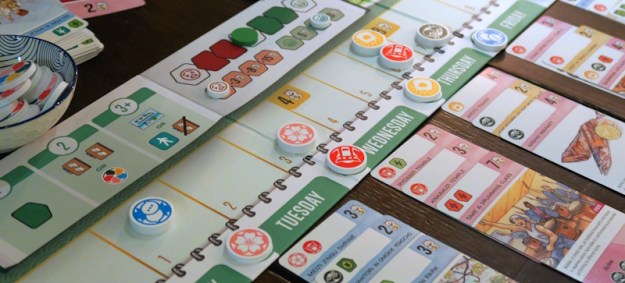
Let's Go! To Japan
– Image by boardGOATS

In each of the thirteen rounds, players draw cards according to the pre-organised sequence.  For example, there are two decks of cards (Tokyo and Kyoto), and for the first four rounds, players take one card from each deck, keep one and add it to their tableau assigning it to one of the days of their dream, then pass the second card to their neighbour.  In the fifth round, players take the four cards they’ve been given and then they place two in their tableau and pass two on, and so on.  Once eighteen cards have been played (three on each of the six days), the game is over and players take their planned trip, activating each of their cards in order, starting on Monday and work their way through to Saturday.

Let's Go! To Japan
– Image by boardGOATS

There is a catch:  where there is a swap between the two decks, players have to move between the cities of Tokyo and Kyoto by playing a Luxury Train Ticket which they can acquire during the game.  Each of these is worth two points.  If players do not have enough tokens to cover each change, they play a Regular Train Ticket from the supply which costs them two points.  Activating cards involves moving the players’ five Experience tokens along a track, increasing or decreasing their Mood, Stress and Happiness, gaining points and then evaluating the requirements for the Highlight of the Day depicted on the final card of the day.  If these requirements have been fulfilled, the player gets bonus points and the player with the most points at the end of the game is the winner.
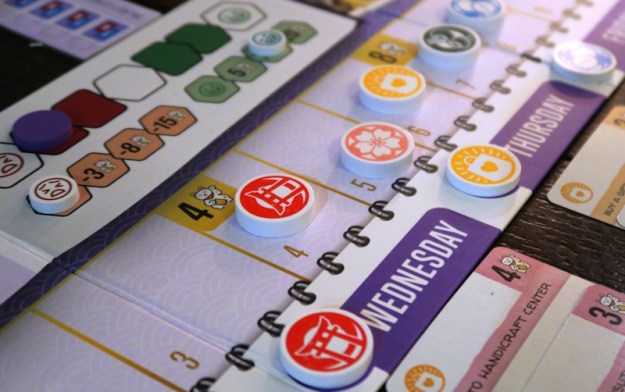
Let's Go! To Japan
– Image by boardGOATS

The game rattled along very quickly with swift turns and the added bonus that setup was quite rapid too.  As a result, it was easily under forty-five minutes before everyone was explaining their plan and scoring it.  That said it was hard to keep track of what everyone was doing.  Ivory was the first to fill a day and managed to get everything aligned to get the top bonus of a Luxury Train ticket. Although this was very nice, it in no way indicated Ivory was going to get a big score.  Jade and Cobalt quickly followed suit, Cobalt also gaining Luxury Train Tickets (which he got quite a few of throughout the game), and Jade got quite a lot of the second best reward, choosing Wild Tokens that would be really useful at the end of game to ensure meeting Highlight of the Day/End of Game objectives.

Let's Go! To Japan
– Image by boardGOATS

Sapphire was spreading his activities out a little bit more, but as the game went on he also managed to build a large store of wild tokens.  At the start of the game, Jade and Sapphire (who were not sitting next to each other) focused more on Kyoto, whereas Ivory and Cobalt were playing a lot more Tokyo cards.  Inevitably, however,  everyone ended up going to both cities and need Train Tickets as a result. Cobalt and Jade were the only people who choose to grab research tokens; Cobalt used one of these mid-game and managed to manipulate his hand so he ensured he passed nothing of use to Jade, much to his annoyance.  Otherwise, everyone worked on their mental health and managed to keep their stress down scoring positive points for the trip.

Let's Go! To Japan
– Image by boardGOATS

At the end of the game, Sapphire, Jade and Ivory had minimized their travel between the two cities though, whereas Cobalt required a lot of trains:  as he had lots of Luxury Train Tickets he actually increased his score significantly with these.  Jade had not picked up enough Luxury Train Tickets, so was stuck on commuter trains causing him to lose a lot of points. Sapphire ended up with a quick return trip between Kyoto and Tokyo on his last day, but that was acceptable because you should always go out your way for Sake!

Let's Go! To Japan
– Image by boardGOATS

Scoring took longer than usual as everyone gave a detailed description of their trip. Both Cobalt and Sapphire scored well on every day of their trip, with Cobalt slightly ahead thanks to his Luxury Train Tickets.  Sapphire managed to complete all his Highlight of the Day objectives though without using his wild tokens, so he cashed these in at the end of the game to push all his tokens into the next scoring zone and subsequently won the game by two points from Cobalt.  It had been a highly enjoyable experience though, enhanced by the beautiful components, especially the extremely pretty, but totally over the top ceramic component bowls!

Let's Go! To Japan
– Image by boardGOATS

From there, the group then played a game of Faraway, a light game set on the mysterious continent of Alula with its ever-changing geography, shaped after the rhythm of the seasons.  On each turn, players play a card from a hand of three.  As play is simultaneous, players must take into account the priority system in all their choices—being last to pick a card leaves fewer options and often less profitable choices for later turns.  During the game, players will play a row of eight cards in front of them, from left to right. These cards represent the regions they will come across while exploring the lands. Characters on these cards will give victory points if the player later fulfills the conditions they demand.  At the end of the game, players walk back along the same route, scoring cards in the opposite order to that they were played in—and therein lies the heart of the game-play.
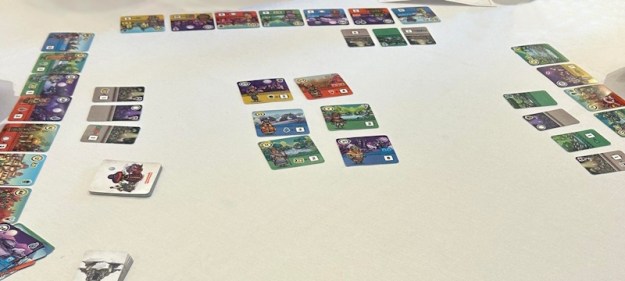
Faraway
– Image by boardGOATS

Throughout the game, the cards played serve both to set new objectives, and to meet ones played previously.  This time, Ivory started quickly out of the traps playing the highest card and subsequently getting the last pick in the following round, which was a minor hindrance. As the game went on, the order of picking the cards changed each time and everyone managed to pick first at some point, although it did seem like Sapphire and Ivory had the greatest varieties, mostly either being first or last!  Jade was very quick off the mark getting lots of maps which gave him a significant card advantage throughout the game as he could look at four or five cards and pick the best one. Ivory also didn’t do too badly with maps.
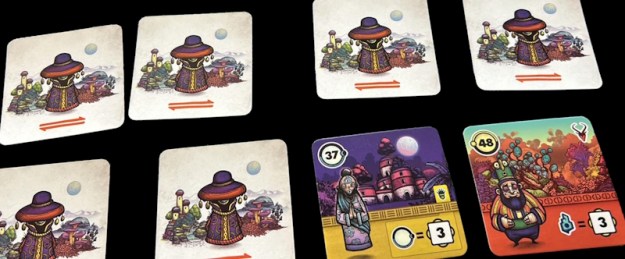
Faraway
– Image by boardGOATS

It eventually became clear that Jade had managed to play his cards in such a way he was always playing a higher card than his last card giving him an additional secondary card, but he was also able to fulfill the requirements to score the objective on that card even though it would need fulfilling earlier in the journey.  Come the end of game scoring and going on their journey, both Cobalt and Ivory had slightly take their eye of the ball and missed fulfilling the requirements of some of their cards and thus missed out on points they though we were going to get. In the end, it was very close for second place Sapphire just taking it, while everyone was thrashed by Jade.

Faraway
– Image by boardGOATS

On the next table, Green was keen to play Lost Ruins of Arnak, and was eventually joined by Black and Plum.  This game combines deck-building and worker placement with resource management.  Players start with six cards in their deck, two Money, two Compasses and two Fear cards, and draw five of these to play.  As in the original deck-builder, Dominion, or in the racing games, Flamme Rouge and Snow Tails, Fear cards clog up players’ decks and more are acquired as the game progresses.  But also as in Dominion, there are ways to “exile” cards during the game.  So, players can try to keep a tight deck with minimal cards, or try to buy lots of cards that work well together.
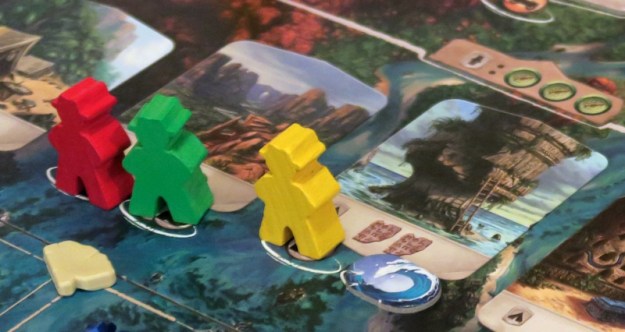
Lost Ruins of Arnak
– Image by boardGOATS

Players then have two meeples each that can be sent to locations on the map, to either discover or use an action Location.  These generally give Resources plus some additions like draw a card, or gain a Fear card etc.. Each new site also has a Creature guarding it, which, if beaten, will give points and a small one-time bonus.  The Research Track is where players spend three of the resources, Tablets, Arrows and Jewels. Each player has two tokens which move up the same track giving different rewards as it ascends. Thematically, you can’t write stuff in the notebook until you find it with your magnifying glass, so the former can never overtake the latter on the track. And of course, the notebook gives cooler rewards.
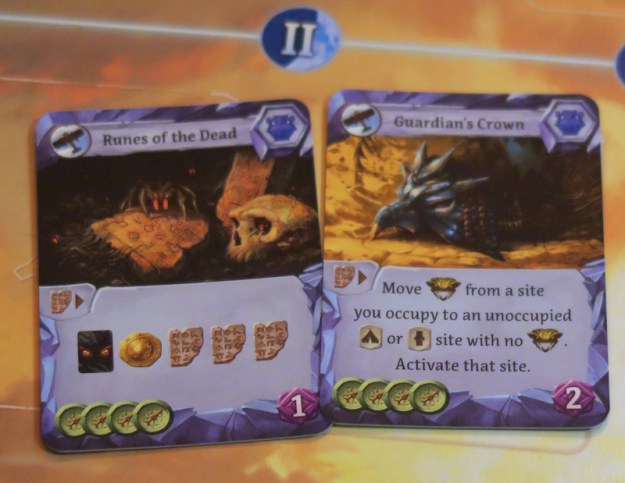
Lost Ruins of Arnak
– Image by boardGOATS

Players get one action each per turn, until everyone has passed signalling the end of the round, and the game finishes after five rounds.  At the end of the game, Points are awarded for Cards, for progress on the Research Track, for discovering Locations and for beating Creatures; the player with the most points at the end is the winner.  This time, early in the game, Green pointed out to Plum that she could use an Idol gained by defeating a Guardian to give her the resources she needed to go up the Research Track.  That gave Plum an Assistant and she picked one that turned a Boot into an Arrowhead.
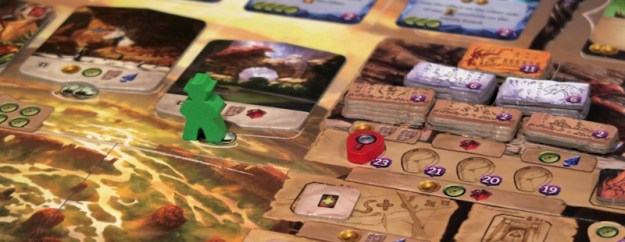
Lost Ruins of Arnak
– Image by boardGOATS

Green bought the card Plum had been eying up, which let players rid themselves of Fear cards (worth minus one point), and therefore seemed like a good use for a Boot/Fear.  It was pointed out later, however, that any card could be used in place of the Boot as all other transport types work for Boot icons.  Plum then got an Assistant that could upgrade a resource, which in practice she used turn Arrowheads into a Rubies as that was all she had by the end of the rounds.  She also managed to get ahead with her Explore magnifying glass token and was the first to a new level on a couple of occasions, which gave her valuable bonuses.

Lost Ruins of Arnak
– Image by boardGOATS

Green picked up a couple of Fear cards from leaving Guardians undefeated; Black got at least one as well, but Plum managed to dodge them.  Both Black and Green got useful Artifact Cards where they could get lots of resources.  It was a little way in that the group noticed the slight Rules Malfunction:  although players were putting their new cards at the bottom of their Draw pile, players were then shuffling the Draw and Discard piles together before drawing new cards.  This gave an extra bit of randomness that this time, worked in Plum’s favour.  For example, she had an item card that gave a Compass per worker when it was played, and it seemed to put in a lot of appearances.  In contrast, all the cards Green had bought didn’t come out until the final round—he got the balance of the bad luck.

Lost Ruins of Arnak
– Image by boardGOATS

Black picked up an Assistant which helped him cycle through his cards which helped mitigate the randomness a little, though there were a couple of occasions when someone took the location he had been working towards. Right at the end of the game, when Plum had managed to reach the top of the Explore/Research Track with her magnifying glass, she was able to use the Icons on her board to get the resources needed to pick up one of the most valuable Temple Tiles—worth eleven points. Green, however, scored almost twice that of the others for his Idols and Black top-scored for his item and artifact cards.

Lost Ruins of Arnak
– Image by boardGOATS

It was the Temple points, together with the extra points Plum got for getting to the top of the Explore/Research Track that ultimately made the difference, giving her a total of sixty-nine points, thirteen more than Green who took second place.  Both Plum and Green had played before, though most of their previous games had been online where the administration of the card shuffling was done for them, hence the Rules Malfunction.  It was Black’s first game, and despite the rules issue and not scoring as well as the other two, he still really enjoyed the game, so there is a good chance it will get another outing in the not too distant future.

Lost Ruins of Arnak
– Image by boardGOATS

Meanwhile, that left six players; Pink was keen to give his favourite panda game another outing, so Pine and Lime joined him in a game of Zoo Break.  This is a cooperative game, where players work together to try to prevent animals escaping from Bedlam Zoo.  On their turn, players roll the die to decide how many Action Points they get, then, after carrying out their turn, flip a Escape Card and a then a Move Card to determine what gets out of its cage and what moves.  Players have to avoid getting trampled on or bitten by the animals, while catching them and then locking them in their cages.

Zoo Break
– Image by boardGOATS

The group started well, or at least it started well from Pink’s perspective when he was cuddled by a Panda (one of his real-life wishes).  However, the game did not go so well.  There are a number of optional variants, and the group had chosen to use the “Faulty Lock” Variant which means that if an escape card is drawn for animals who have already been locked up, the die is rolled to determine whether there are escapees.  This turned out to make things just a bit too difficult and a Coral snake quickly made a bid for freedom, and as it’s a dangerous animal, that was that.  One snake might not seem like much, but there were another five lining up in front of the gate and three tigers too, so it really did not go well.

Zoo Break
– Image by boardGOATS

Reluctant to leave it like that, the trio decided to give it another try, this time without the “Faulty Lock” Variant.  This second try went better, though at one point two elephants got very close to the exit.  The situation was rescued by peanuts which enticed them to the Snack Stall where they were eventually captured.  There was some extensive rules reading to decide whether Pandas were considered “Dangerous” so only one escaping would trigger failure.  The group concluded that Pandas were not Dangerous animals after all though, and four Pandas roaming the streets would not lead to closure of the Zoo (though perhaps the Chinese government would not be appreciative).

Zoo Break
– Image by boardGOATS

In the end, the distinction wasn’t necessary, none of the Pandas got out, though one Capuchin did manage to escape.  That was all, however, and once the group finally rounded up the last of the mad Meercat escapees, the writing was on the wall and the Zoo was saved.  The other games were still underway, so once the charming wooden animals had been tucked away, the trio opted for a couple of rounds of Coloretto.  This is a charming little card game which is the core of the, arguably better known board game, Zooloretto.

Coloretto
– Image by boardGOATS

The game is very simple:  Players either draw a Chameleon card from the deck and add it to one of the Carts, or take the cards on one of the Carts and add them to their tableau, stepping out until everyone else has taken a Cart.  Each Cart has three spaces and players core points for their three largest sets of cards and negative points for any others.  The player with the most points at the end of the round after the trigger card is revealed is the winner.  The clever part is the scoring for sets, which uses the Triangular Number sequence and means that later cards are worth a lot more than the early ones.

Coloretto
– Image by boardGOATS

When the Golden Chameleon card came out, there was some discussion about the difference between it and the multi-coloured Chameleon.  Blue, on the next table was consulted, and explained that it meant the person who takes it gets an extra card drawn from the top of the deck.  With that sorted, the game continued.  The group played two games and both were close, especially between Pine and Pink with Pink just edging it for the first game by two points and Pine just beating Pink by a single point in the second.  Both games were won by Lime, however, and by a larger margin, taking the first by four points and the second by six.
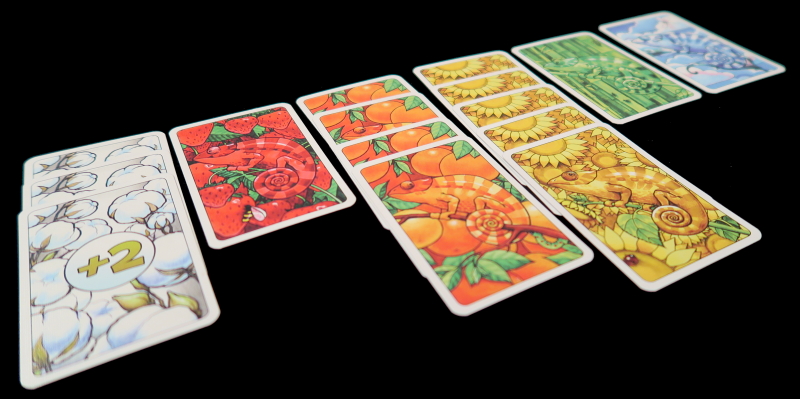
Coloretto
– Image by boardGOATS

The last table included three players, Blue, Purple and Byzantium.  They were the last to start, and were somewhat torn between two of the current hot games in the group, Wyrmspan and Meadow.  After some discussion, the group went for what was probably the easier of the two, and gave Meadow its their outing in three consecutive meetings.  A light to medium card collection game, it was new to both Purple and Byzantium, so Blue explained the rules.  Most of the game is built round a Card Market with players placing an Action Token and taking a card into their hand, before playing a card from their hand.
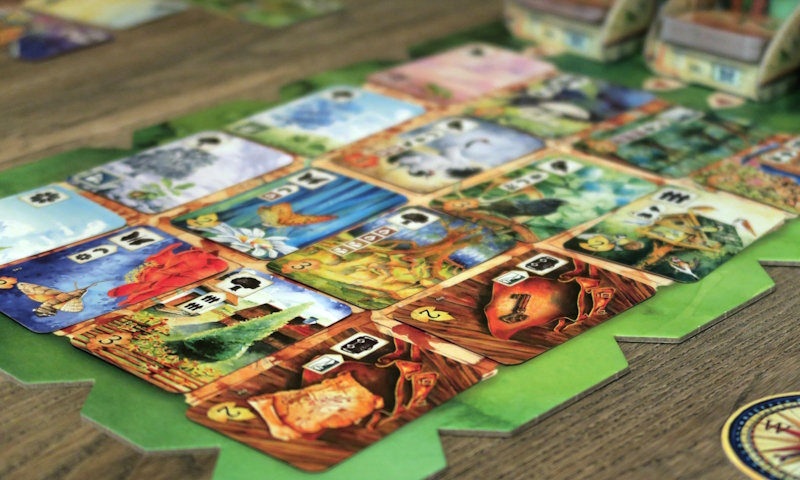
Meadow
– Image by boardGOATS

This aspect of the game has led to some reviewers comparing the game to Splendor, though there is a lot more to the game than that.  In addition to the Market, there is a second Campfire board, which allows players to carry out special actions, and also claim Bonus points. for cards in their tableau.  The first time the game was played, there was a token included erroneously from the Envelope U mini-expansion, and last time the game got an outing, there was a minor rules malfunction where the four players ended up playing on the three-player board.  So although the game has been played three times in fairly quick succession, this time was the first time the game was played by the rules as written, probably.
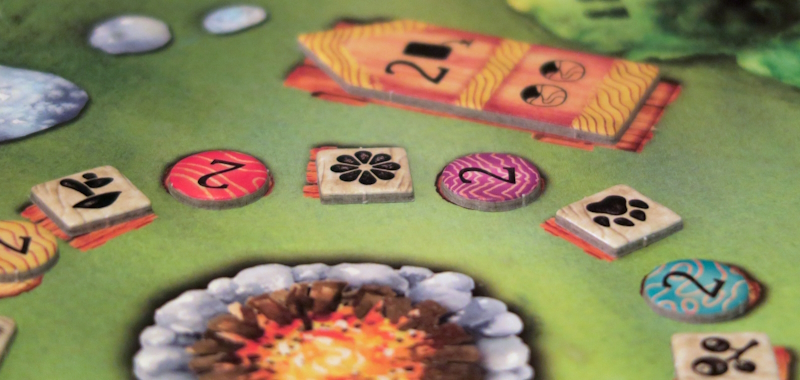
Meadow
– Image by boardGOATS

Players start with a hand of cards, including one from the North deck (which is only introduced halfway through the game)—this last card is typically more worth more but is difficult to play, so is a good way to get a steer in the early stages of the game.  As well as the other cards in their starting hand, another key strategy lead is the Bonus points obtained from the Campfire board.  These are obtained by placing a Bonus point token between two Icons, but in order to do so, the player must have those icons in their tableau.  Since each bonus place can only be claimed once, this element of the game is something of a race between those who want to compete for these points.

Meadow
– Image by boardGOATS

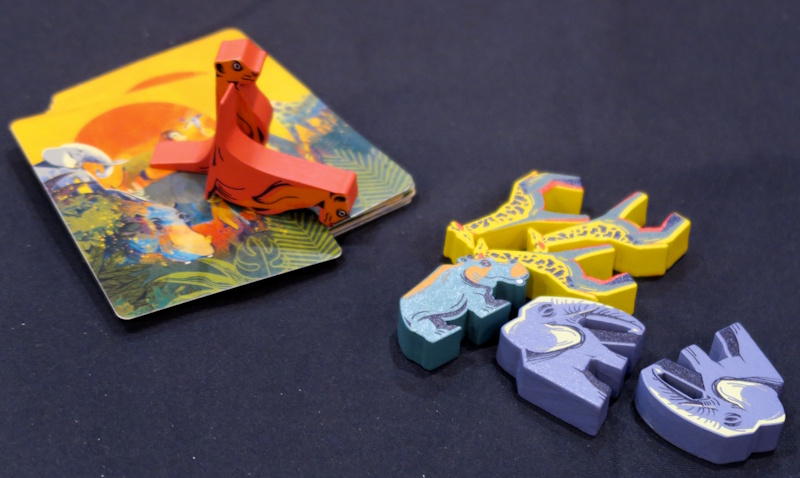
This time, the Icons drawn at random and placed round the Campfire included the relatively scarce Cottage, Fence and Garden Bird as well as the Wolf and Hawk which only come out in the second half of the game, when the North deck is introduced.  This made the Bonus points hard to claim. Although neither Blue nor Byzantium appreciated it at the time, although most Wolf cards are in the North deck, this copy of the game included the Seal promo card, which is a Wolf card that hides in the South Deck.  As it was key to getting bonus points, when it came out, both Blue and Byzantium spotted it, but Blue got to it first, and that turned out to be critical to her Bonus point objectives as Byzantium pinched the other spots early.
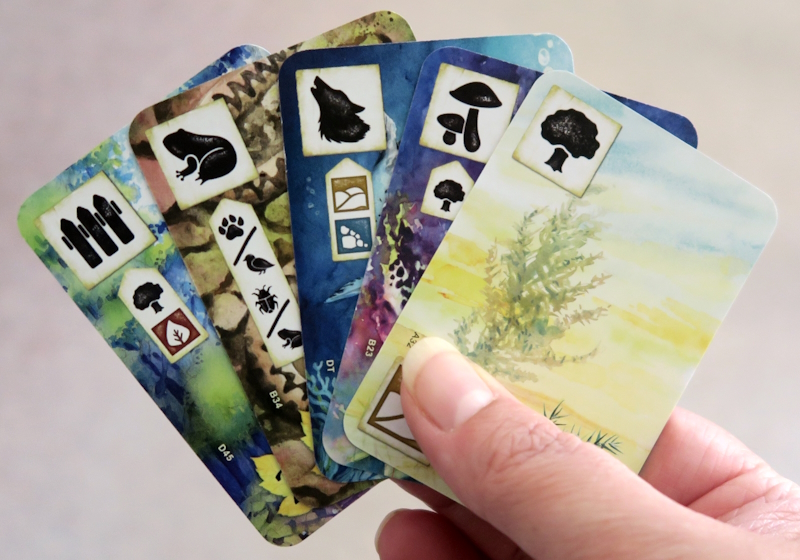
Meadow
– Image by boardGOATS

Meanwhile, Purple was busy collecting frogs and very effectively daisy-chaining cards to give her points.  As the game moved into its final rounds, Byzantium struggled to get a Landscape card that he could play without needing too many difficult prerequisites.  In spite of the frustrations when players can’t get cards, the game has a nice gentle roll to it and with three players doesn’t outstay its welcome in the way it does with four (when there are two extra rounds).  It was quite a tight game—Purple and Byzanium finished with thirty-seven and thirty-six points respectively from their observations, but Byzantium had more points from his Landscape cards.
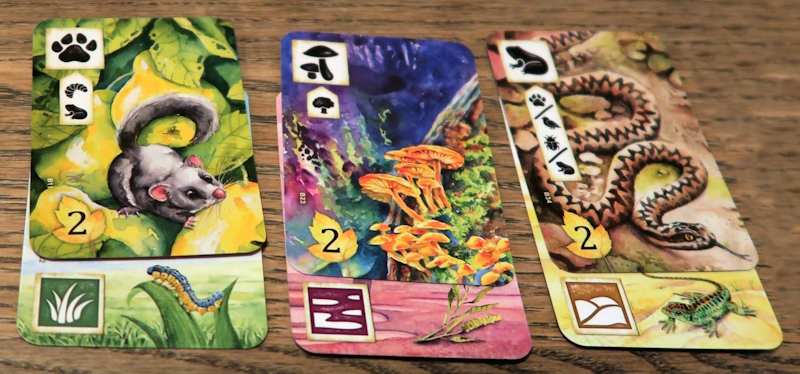
Meadow
– Image by boardGOATS

Blue didn’t do as well as them with her observations, but had the most points from her Landscape cards.  Although Purple hadn’t managed to get any Bonus points, both Blue and Byzantium had picked up the full nine giving them a bit of a lead.  In the end, it was the Observations that were key, and they gave Byzantium victory by four points with a total of sixty.  As the Meadows were tidied up, the last of the other games came to a close too and everyone chatted until it was time to go home.

Meadow
– Image by boardGOATS

Learning Outcome:  Every game should come with ceramic component bowls.