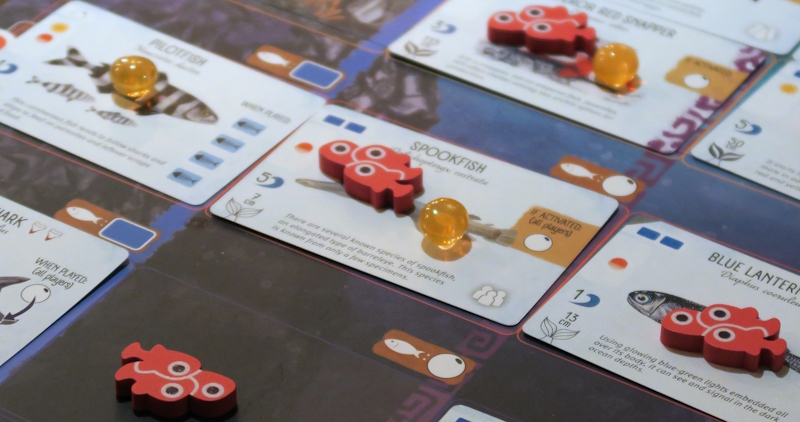
Once people had finished eating, the group settled down to play. There was quite lot interest in the “Feature Game” which was Finspan, a fish-themed version of one of the group’s favourite games, Wingspan. It is advertised as shorter and lighter than the original, but in the event it was only slightly shorter and not much lighter though it was generally agreed to be a bit smoother and therefore perhaps easier to teach. Like Wingspan. Finspan is card-based, though the cards are fish instead of birds, albeit just a beautifully illustrated. As in Wingspan, players have a hand of cards (in this case open) and on their turn can choose to play one from their hand or activate one area or Dive-site of their player board (blue, purple or green), in this case representing the ocean.
 |
| – Image by boardGOATS |
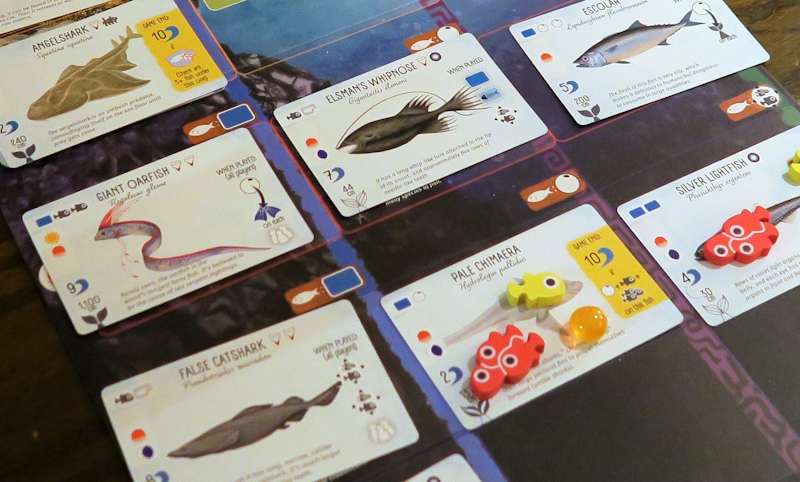
In the case of Finspan, the Dive-sites are arranged vertically (instead of horizontally), but rather than placing cards in order (from left to right in the original), the Fish cards have to be placed at the correct depth for the Fish—some live in the shallows, others in the deep sea, while a small number live in the “twilight” region, between the two. As in the original, there is a cost for playing cards—fish eggs, Young,Schools and/or other cards. Unlike the original, however, cards spent in this way are placed into players’ own personal discard pile and there are mechanisms for getting them back later in the game.
 |
| – Image by boardGOATS |
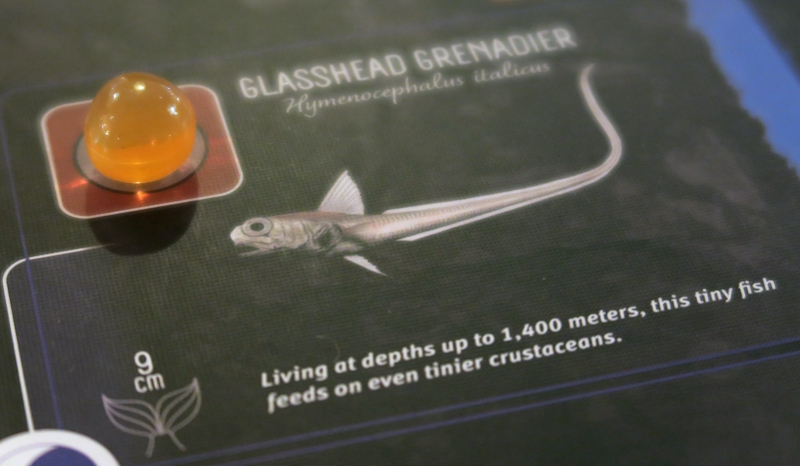
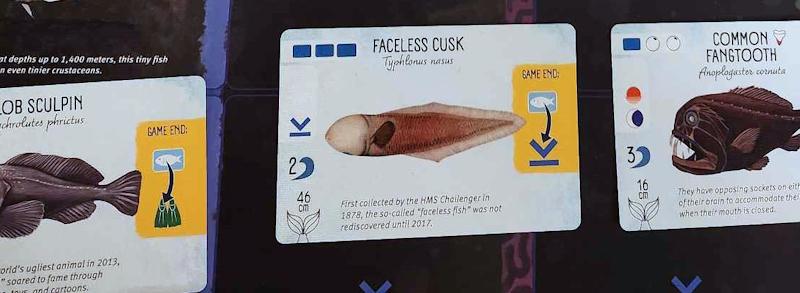
Another way that Finspan is different to the original, is the way the Dive-sites are activated. As in Wingspan, cards are activated in order, in this case, from the shallow “sunlit” zone to the “midnight” deeps. The Fish cards have “when played”, “when activated” and “end of the game” powers, but there are fewer cards that have a power on activation and many of these affect all players too. In addition to the difference in the balance of the cards, when a Dive-site is activated, the three zones each give a benefit as long as they have at least one Fish card in them. These benefits are capped though, as multiple Fish doesn’t increase the income. The first time each player activates a Dive-site in a round, they also get a bonus benefit.
 |
| – Image by boardGOATS |
There are a small number of Fish pre-printed on players’ boards, which mean than some areas give benefits from the very start of the game. The effect of all this is to give the game a more friendly feel than Wingspan, without reducing the challenge of the game. There is another major change which significantly adds to the complexity. In Wingspan, a key part of the game is Egg production with Eggs worth a point each at the end of the game. In Finspan, players also produce Eggs which are worth a point at the end of the game, but each Fish card can only be used to store one single Egg. Eggs can be hatched to give young (also worth a point) and three young on the same fish form a “School”.
 |
| – Image by boardGOATS |
Schools of fish are worth six points at the end of the game. And this is where the game gets a little “head-hurty” as Young and Schools can be moved around, but while Young can share a Fish space, once they have formed a School, they can’t share a space with another School—one School can’t even pass through a space containing another School. The game is played over four rounds (or Weeks) with points for achieving objectives at the end of each one. These are added points gained for each Fish card, Eggs, Young, Schools and any end game actions to give a final total—the player with the most points is the winner.
 |
| – Image by boardGOATS |
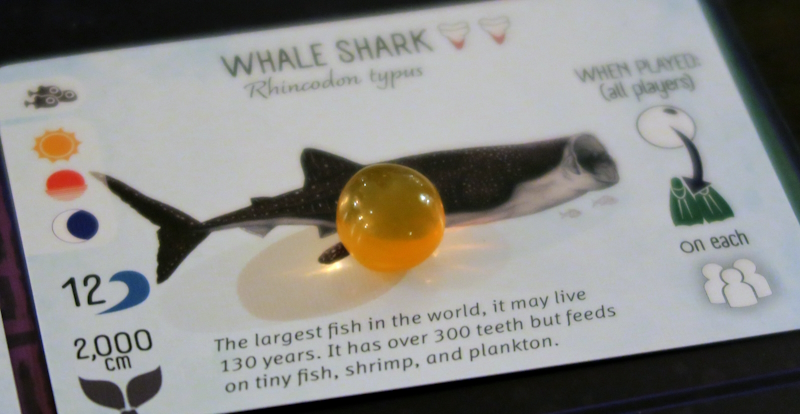
As there was a lot of interest in the game, the group set up two tables. Jade, Sapphire, Plum and Byzantium had played it at a convention over the weekend, so Jade led one game with Blue, Ivory and Sapphire, while Plum led the second with Byzantium, Black and Pine. Jade’s group was the first to complete the rules explanation and got going. Ivory was quite excited by the idea of collecting sharks, and while Blue found Nemo, Sapphire found Dorry. The points from the end of the Week objectives were pretty even for the first three weeks, though only Ivory got much at the end of the final week taking twenty points for his end game bonuses, largely due to having a lot of sharks.
 |
| – Image by boardGOATS |
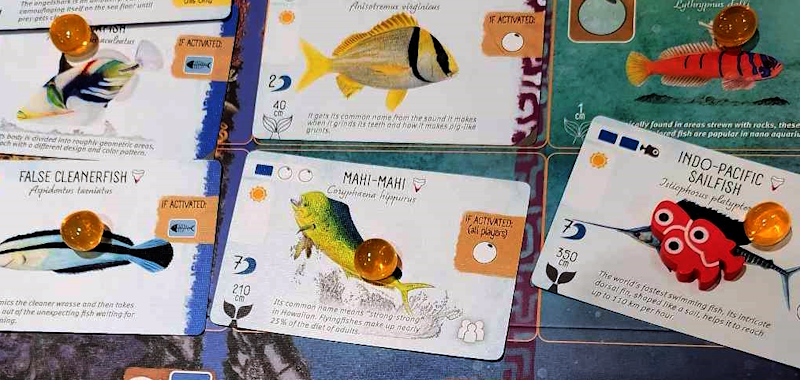
Blue top-scored for her fish while Jade scored the most for his Schools. In the end, Blue’s hundred and fifty-five took victory with Ivory in second eleven points behind, three points ahead of Jade. Over the other side of the room, Plum’s game was slower to start, but finished at much the same time. This game was lower scoring and closer too; almost everyone picked up some end game bonuses, but not as many as Ivory, and there were fewer Schools. The winner was Byzantium, with one hundred and thirty-one, just two points ahead of Plum who was just a nose in front of Black. All in all, everyone had enjoyed the game as a nice variant on the well known original.
 |
| – Image by boardGOATS |
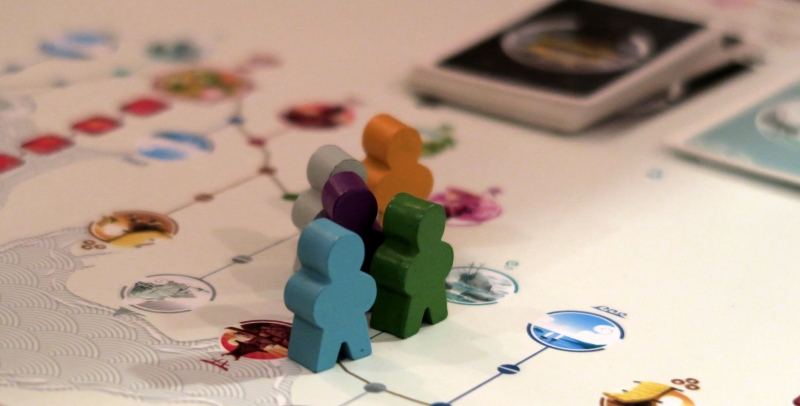
Meanwhile, on the next table, Pink, Cobalt, Lime and Purple had begun by playing Tokaido. This is a sort of time-track game where the player at the back takes their turn moveing forward to an empty space of their choice taking turns until they are no-longer the one at the back at which point the new “Lantern Rouge” takes their turn. Each space allows players to collect panoramas, chance it with a random draw for points, buy souvenirs, donate at a temple or work on a farm to gain cash. At intervals, players have to stop for food which costs money, but the last player to arrive at the restaurant last gets the least choice which can be a catastrophe as these meals are usually more expensive with the risk that they are the same as those eaten on previous stops, which means they can’t eat and therefore don’t score.
 |
| – Image by boardGOATS |
Although it is quite popular within the group, Cobalt was new to the game and commented that it was quite mean when he realised that once a space had been taken it was gone. The group played with the choice of two character cards at the start—Pink felt that his Traveler, Hiroshige, was a poor choice as, although he got a free panorama card at each food stop, it didn’t give him much money at the start. On reflection, he felt Purple had made a better decision in choosing Yoshiyasu, who gave her nine Yen. Lime was the runaway winner with ninety-one, some fifteen more than Purple who just sneaked into second ahead of Pink.
 |
| – Image by boardGOATS |
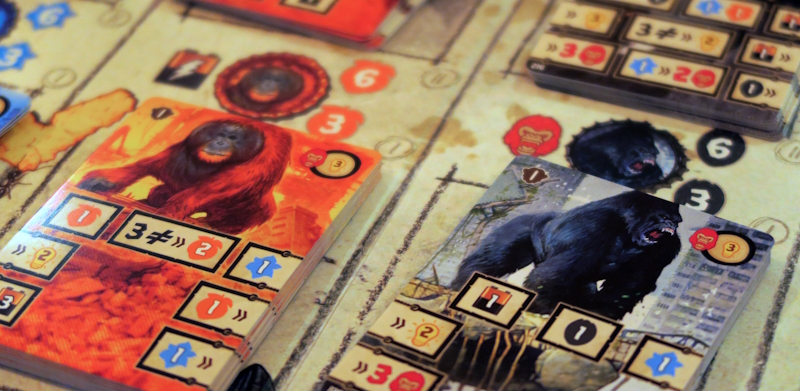
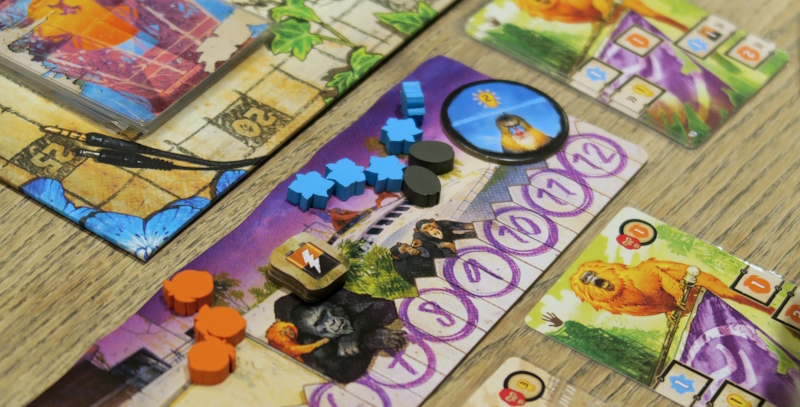
As the games of Finspan were still going, Cobalt introduced the group to After Us, aka “The Monkey Game”. This had an outing within the group about eighteen months ago, but was new to Pink and Lime. It is a deck-building, resource management, engine building game featuring an original card-combo mechanism. The story is that mankind has died out leaving only apes which have kept evolving. As the leader of a tribe, players add new Primate Cards to their starting deck of tamarins. Primate Cards have three rows of “Effects”—the top row will award resources, the middle row will give points (often at the cost of resources) and the the bottom row will have abilities related to the primate type. At the start of a round, players draw four Primate Cards from their deck to be laid out in a row making “Connections”.
 |
| – Image by boardGOATS |
The aim is to get the most out of the Connections by closing the open ended “Frames” along the sides of the cards by butting them up against adjacent cards that also have open ended Frames. Players then resolve the now closed Frames following the order of top left to bottom right, trying to gain as many bonuses as they can. Once everyone has simultaneously collected their Resources they can then use them to buy Primate Cards which are added to the top of the draw deck (and thus they come into use on the very next turn). In this way, they are improving the quality of their deck.
 |
| – Image by boardGOATS |
One of the good things about the game is that if a player gets a bit “hosed” by the card draw, the frames mechanism allows them to make the best of a bad job. The Frames have been resolved, the players simultaneously chose one of their Action Discs denoting which primate type they want to recruit. The game starts slowly with players building their tribe, but it can end in a sudden rush when one player breaks into a gallop and charges past eighty points triggering the end of the round and this game was no exception. Lime was again the victor, with sixty-nine points, with Pink second, some nine-points behind.
 |
| – Image by boardGOATS |
Learning Outcome: Jaws was not the only shark.


 boardGOATS