Tag Archives: Flamme Rouge

21st January 2025

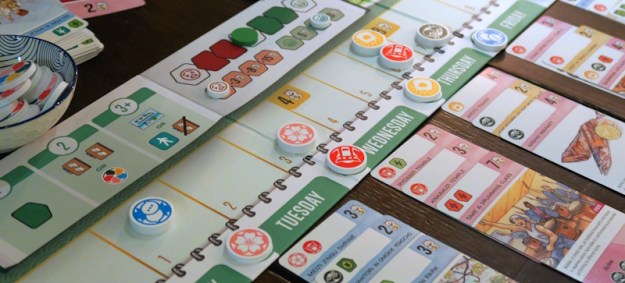
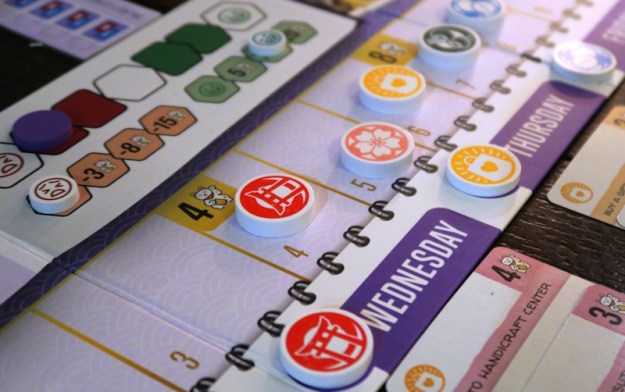
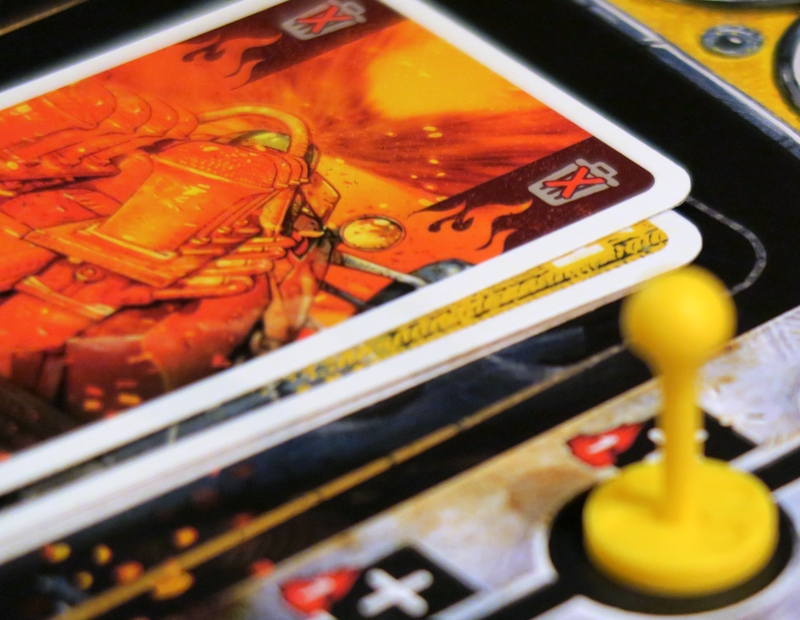
Blue and Pink were still eating as everyone else rolled up.  But as they did, like last time, there was an unusual amount of interest in the “Feature Game“, which, in a change to previous plans, was to be Heat: Pedal to the Metal.  This is a car racing game, in a similar vein to other games popular within the group like Flamme Rouge, Snow Tails, and Downforce.  Like Flamme Rouge and Snow Tails, as well as a racing game, Heat is also a hand management game.  The idea is that players simultaneously choose cards to play and then these are activated from the front of the pack (much like PitchCar).

Heat: Pedal to the Metal
– Image by boardGOATS

Players have a hand of seven cards drawn from their personal deck.  During the game, certain actions that are bad for their engine cause it to heat up meaning they pick up cards that block their hand.  Initially, Heat cards go into players discard pile, simulating the delayed effect engine damage can have, blocking their hand later in the game as the deck is recycled.  There are ways to cool the engine down, but these Heat cards cannot be discarded or played in the normal way.  What makes Heat slightly different to some of the other hand-management-racing games is that there is formally simultaneous play to choose cards and then players take it in turns to activate their cards and take a series of optional mini-actions.
Heat: Pedal to the Metal
– Image by boardGOATS

Players start by simultaneously adjusting their gear, staying put or shifting up or down one without penalty, or shifting two and picking up a Heat card.  The gear dictates how many cards a player must play – second gear means they have to play two cards for example.  Players then take it in turns to reveal their cards and move their car.  There are then five “situational” options: Adrenaline, React, Slipstream, Corner Check, and Discard, before the player replenishes their hand back to seven cards.  Adrenaline is a catch-up mechanism, where the player at the back can move one extra Space while adding one to their Speed value and/or gain one extra “Cool down”.

Heat: Pedal to the Metal
– Image by boardGOATS

“Cool down” is an important aspect of the game because it allows players to remove a Heat card from their hand and return it to their engine deck.  In React, players activate any additional symbols on the cards they have played or from the gear they are currently in or from the Adrenaline.  These include picking up cards because of Stress—players start the game with three Stress cards in the deck which represent lapses of concentration.  When a player plays these, they then have to draw cards from their deck to add an essentially random amount to their speed.  Of course it is not random, and a player who has an idea of what cards are still in their deck will be able to mitigate this.

Heat: Pedal to the Metal
– Image by boardGOATS

Further, Stress cards can also be used to postpone the effects of Heat, as any non-movement cards go straight into the discard pile.  Players can also control their engine heat by spending a period of time in a low gear by “Cooling down” their and removing Heat cards from their hand (three for first gear, two for second).  In contrast, players that have Heat cards available, may add an extra one to their discard pile to boost their speed by drawing an extra card as for Stress cards.  Once all these have been activated, players who end their movement along-side or immediately behind another car can Slipstream, that is move two spaces forward (this does not add to speed, it simply means the car moves further because it is moving more efficiently).

– Image by boardGOATS

If the player has crossed a Speed restriction line typically at a corner, they have to evaluate their Speed by summing the value of their cards and adding one for any Adrenaline bonus if they used it.  If this is more than the limit, players add the difference to their discard pile in Heat Cards.  Players that do not have enough Heat to pay for their excess Speed, pay all the Heat they have and then immediately spin out—move their car back to the last available space before the Speed limit line, take one or two extra Stress cards and change down to first gear.  Once all this is done, players can discard any cards they want that are not Stress or Heat cards before replenishing their hand, shuffling their discard pile if necessary.  The first player to cross the finish line triggers the end of the game and the player that travels the furthest is the winner.
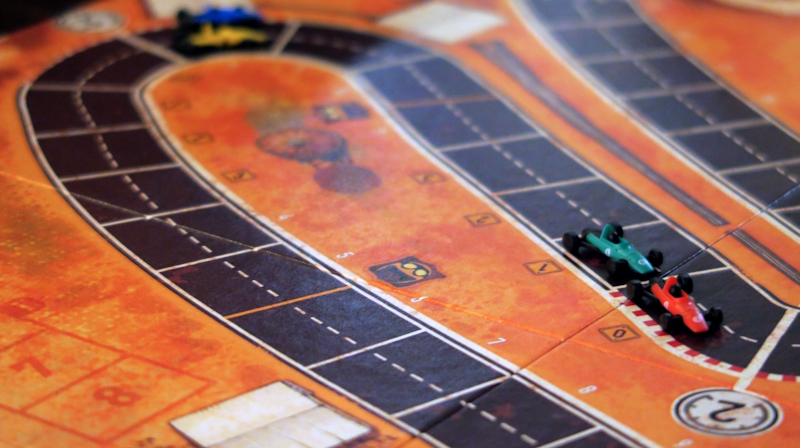
Heat: Pedal to the Metal
– Image by boardGOATS

Although Blue and Ivory were keen to play, numbers meant they missed out and instead, Jade, led Teal, Pink and Lime.  A slight rules malfunction where the group were trying to play all the steps simultaneously meant the safety car did a lap before a restart, then they were off in earnest.  The group were playing on the USA track, which is generally recommended for a first play and is raced over two laps.  One thing that seems to be true for all race games is that once someone has got in front, it is very hard to haul them back, making it critical to get a good fast start.  This time, the good fast start was had by Jade and before long he had built that up and had gone one corner ahead, everyone else felt they were playing for placings and trying to work out how best to approach the corners.

Heat: Pedal to the Metal
– Image by boardGOATS

Instead of playing the end-game as written, the group decided to play it until everyone had crossed the line, so the game continued for some time after Jade had claimed victory.  Lime crossed the line second with Pink in hot pursuit, so much so that although Pink crossed the line in third, he finished his turn ahead of Lime and therefore was awarded runner-up (or first loser) status.  Teal just crossed the line, claiming a sympathy vote ensuring that everyone finished the race.  It had been a bit of a trial and Blue was still keen to give it a go, so Jade, who had been looking to pass it on, sold it to Blue on the spot, which means it will likely get a few more tries over the coming year.
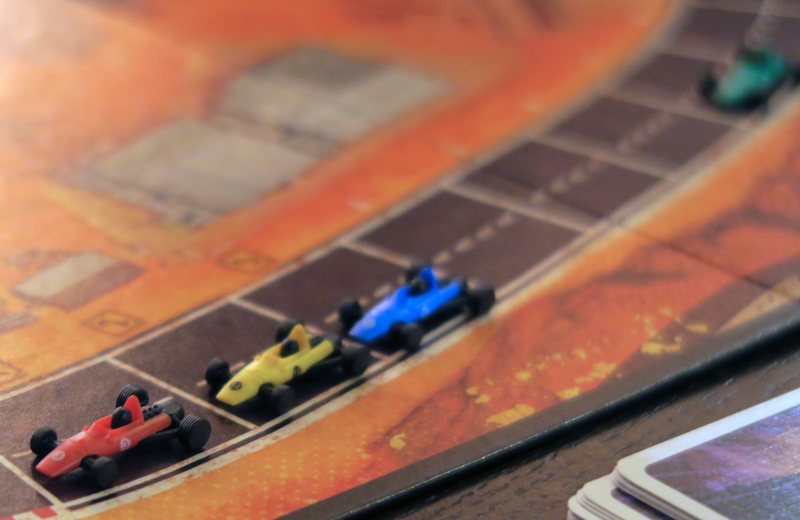
Heat: Pedal to the Metal
– Image by boardGOATS

Blue and Ivory meanwhile, although keen to play Heat, had also been tempted by Roll for the Galaxy.  So, when Byzantium had commented that he hadn’t understood his first and only play, but had enjoyed it, the decision was made.  Roll for the galaxy is a dice game based on the card game Race for the Galaxy, which is itself a sort of space themed, card game version of Puerto Rico.  The thing all these games have in common is “Role (or Action) Selection”—the games have five or six phases or Roles and each player chooses one which will happen in the round.  Thus some things happen, and others do not.  A large part of these games is correctly gambling on others picking certain Roles or Actions and making them happen, so they can be piggy-backed.

Roll for the Galaxy
– Image by boardGOATS

The smaller the number of players, the more critical this can be.  So with just three players in Roll for the Galaxy, at least two will not be happening, possibly more.  The Actions are Explore (acquire world tiles); Develop (progress on building Development worlds); Settle (progress on building Production worlds); Produce (use Production Worlds to produce Goods), and Ship (sell Goods for money, or consume them for victory points).  In this game, the actions are all carried out using dice which are rolled in secret and placed behind the players screen to choose where those dice will get used.  This placement depends on the face shown, though any one die can be used to choose which Action will happen.

Roll for the Galaxy
– Image by boardGOATS

The dice are then moved to the Development or Settlement piles of tiles in their respective phases to progress building those worlds, or placed on Production worlds as goods.  Alternatively, they can be spent to pay for Exploring or Shipping in which case, they (along with any dice from any completed building projects or shipped goods) are placed back in their Citizenry.  Dice can be purchased into the player’s cup at a rate of one dollar each, so it is important for players to ensure their finances are healthy or their game will rapidly stagnate.  The game ends when, either someone has built their twelfth World, or the the pool of victory point chips has been exhausted.
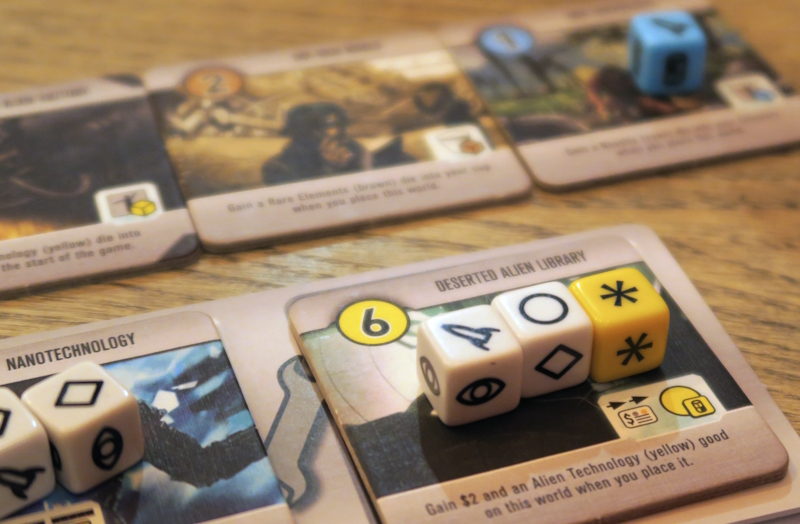
Roll for the Galaxy
– Image by boardGOATS

The game was slow to get going at the start, but then Ivory raced to an early lead getting a nice array of Worlds in his tableau leaving Blue and Byzantium trailing in his wake.  But then, instead of finishing the game by building his final World, he appeared to pull up.  This gave Blue and Byzantium the illusion of a chance, but was of course because he had a plan.  Ivory had the Galactic Reserves Development World which gave an extra victory point for every Goods item on a World at the end of the game while also allowing each Production World to hold an extra Goods item.
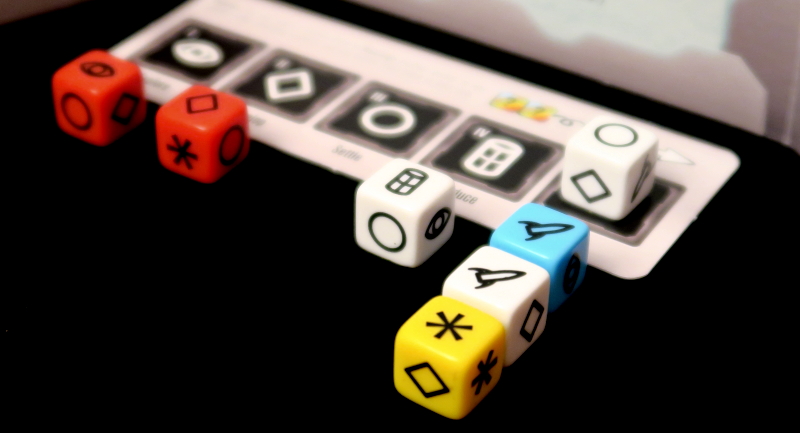
Roll for the Galaxy
– Image by boardGOATS

So, the couple of extra rounds was to enable him to fill his Production Worlds and in the end, the game was brought to a close by Byzantium building his twelfth planet, although the victory point chips were also depleted by the end of that round.  Blue had taken a sizeable twenty-four of those victory points through trading goods, but hadn’t been able to build enough.  As a result, her planets were worth only eighteen points, barely twice those of Ivory’s and Byzantium’s thirty.  Byzantium had five victory point chips and a couple of points from his New Galactic Order, but Ivory was some distance in front, thanks to his thirteen points for his Galactic Reserves and Galactic Bankers Developments together with his eight victory point chips.

Roll for the Galaxy
– Image by boardGOATS

There was time to play something else, but rather than go through rules, as Roll for the Galaxy was already out, the trio decided to give it another go.  This time, with an element of time pressure, it was arguable that some of the decisions made weren’t as sharp and the scores were all lower the second time, though that might have been partly because there were notably fewer rounds.  Blue kept dipping into the bag to try to get Rare Element (brown) Worlds to go with her Mining League, but failed repeatedly and eventually gave up.  Ivory triggered the end game with his twelfth World and this time it was Byzantium who struggled to build enough.
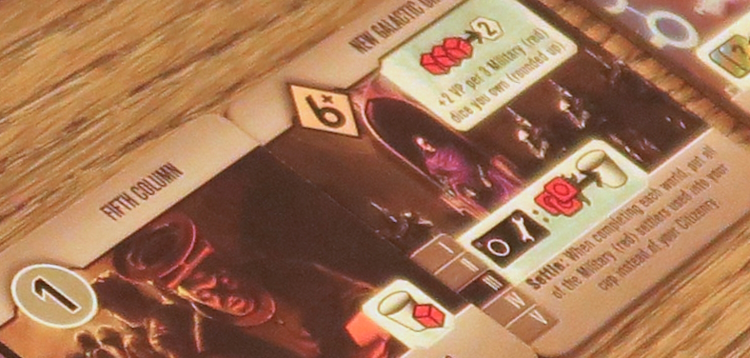
Roll for the Galaxy
– Image by boardGOATS

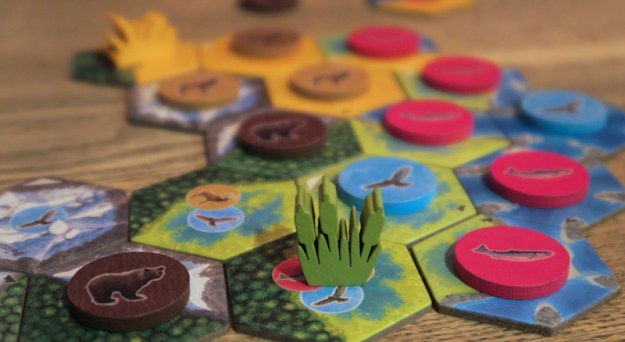
The scores were a bit closer on the second attempt, though the end result was still much the same, with Ivory again taking victory, though with half the winning margin.  By this time, the other games had also finished.  The first of these was Forests of Pangaia, in which Mint was joined by Pine and Plum.  This is a truly beautiful, tactile game, where players are trying to meet objectives to score Life Points; the player with the most Life Points at the end of the game is the winner.  The game has elements of set collection and area control and is played on a central map made of terrain hexagons.  Players take turns to perform three phases: Grow Seeds, take a Spirit Action, and finally add Treetops.  Once Seeds have grown and been turned into Trees, players carry out one of three possible Spirit actions.

Forests of Pangaia
– Image by boardGOATS

These are: Plant (moving their Spirit Pawn to a Lake space and planting seeds in adjacent spaces); Gather (moving their Spirit Pawn back to their player board and receiving a resource), and Prey (moving their Spirit Pawn back to their player board and playing their Ritual Card).  There are fourteen Rituals the Spirits can perform to collect Gaia’s Life Energy.  Once the Ritual card has been scored all the player’s Trees that were involved in the Ritual then partially or fully Decay (depending on the Ritual), either losing a level or rotting back to nothing and leaving a Seed.  The player then discards their Ritual card and draws a new one.  The game ends when the last Ritual card is taken by any player.

Forests of Pangaia
– Image by boardGOATS

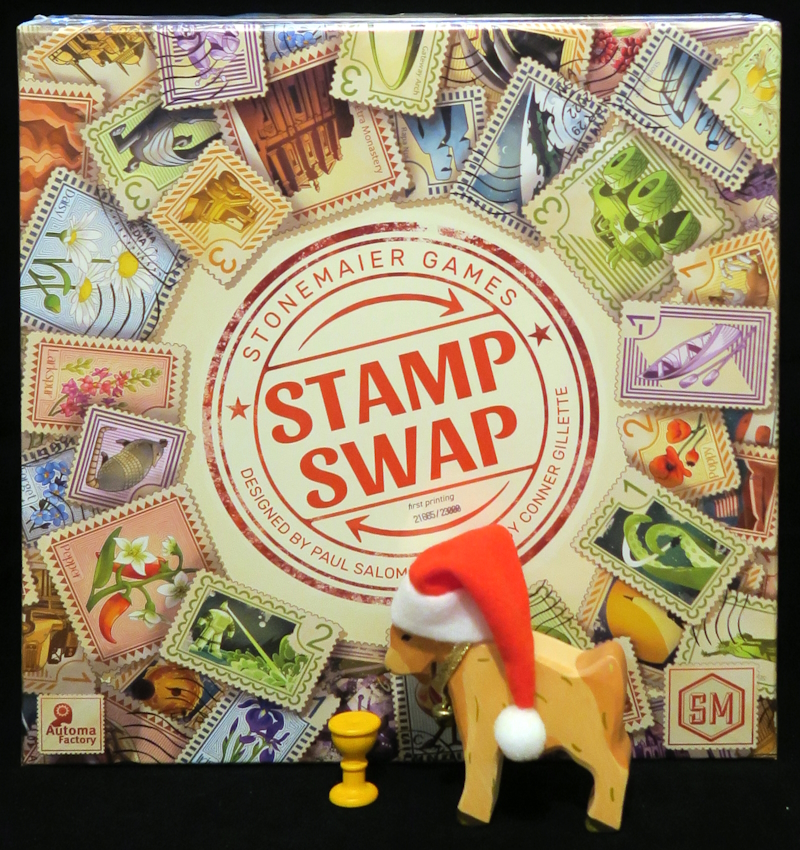
Plum went first and spent most of the game collecting Sun tokens.  In contrast, Pine collected lots of Wind tokens inspiring lots of jokes about using wind to spread his seed.  The winner, however, was Mint with a nine point Trail Ritual due to excessive seed spreading giving her a total of twenty-eight points.  Pine just pipped Plum for second place by a single point.  It had been a really enjoyable game, however, made all the better by the gorgeous pieces. Meanwhile, on the other end of the same, albeit long table, Black, Purple and Sapphire played a game of last year’s winner of the Golden GOAT Award, Stamp Swap.
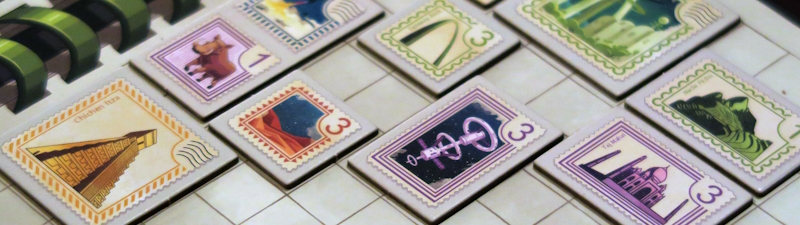
Stamp Swap
– Image by boardGOATS

This is a really smooth tile placement centred around stamp collecting.  There is a lot of simultaneous play, which is nice because it minimises down time.  First, players take it in turns to choose items from the central Pool, then simultaneously divide them into two piles of offerings.  The player with the first player token, chooses and takes one of the piles offered by their opponents.  The opponent keeps their other pile and then chooses a pile from one of their opponents and so on.  Once everyone has two piles, players arrange the Stamps in their Album and then choose which of the four available end of round cards to score this time.

Stamp Swap
– Image by boardGOATS

After three rounds, players score the end of game objective card and the player with the most points is the winner.  One of the clever parts about this game is how much difference the objective cards make to the way players arrange their Stamps.  The end-game scoring gave three points for each enclosed gap two spaces in size (i.e. a one-by-two hole).  More points were available during the game for cancelled stamps not on the edge of the page; for large square stamps; for each stamp in a player’s second most abundant theme, and for groups of a chosen colour.
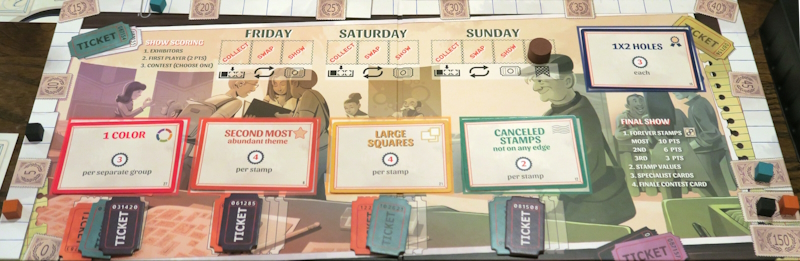
Stamp Swap
– Image by boardGOATS

This time the game was very close.  Purple (specialising in Flowers) struggled to get the stamps she needed and Sapphire (specialising Space stamps) kept getting confused which way the turn went.  It didn’t seem to inconvenience him too much however as he and Black (Monuments) fought it out for first and second place.  Black picked up a lot of his points for Special Stamps—just three accounted for a quarter of his points, which contributed to his total of one hundred and seven points, just four more than Sapphire.
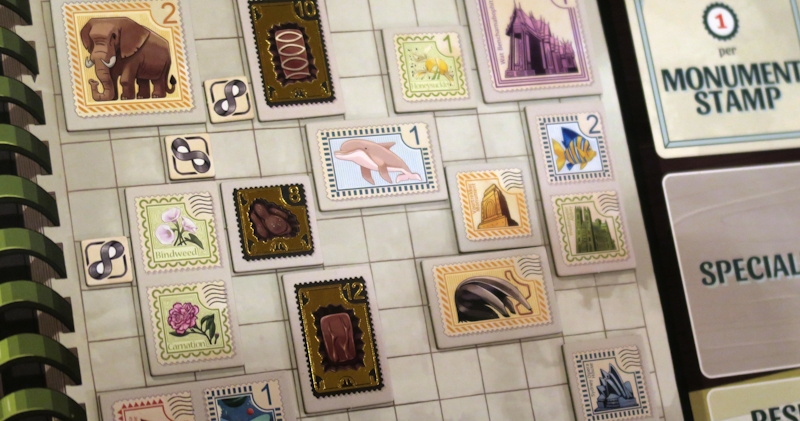
Stamp Swap
– Image by boardGOATS

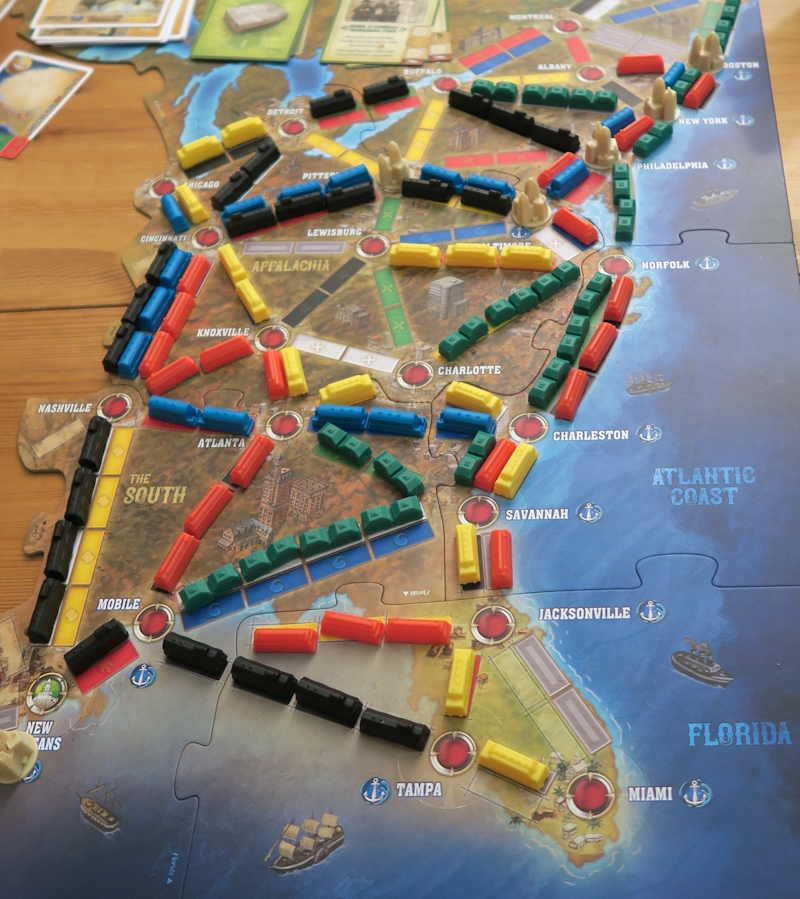
While everyone else was finishing up, there was some discussion about the continuation of the Ticket to Ride Legacy campaign that Blue, Pink, Black, Purple and Pine embarked on at New Year.  The campaign is played over twelve rounds and the group had managed the first two games on the first outing with the next two more recently on Saturday evening.  Spoiler alert—hover HERE to see details. The winner of the third round was Black, very closely chased by Pink with Blue taking third.  After a break for tea (lamb and vegetable tagines with millet), the group began their fourth game. Spoiler alert—hover HERE to see details.

Ticket to Ride Legacy: Legends of the West
– Image by boardGOATS

This was much less close than the third game. The winner was Pine, with Black six dollars behind and Pink a further fourteen points behind him, in third. Spoiler alert—hover HERE to see details. While chatting with the others, out of curiosity, Pine went through The Book and totaled up the scores for the first four rounds, which gave Black a lead of some twenty dollars. Something the rest of the group need to give some thought to next time, before he gets an unassailable advantage although there is a suspicion that as the campaign progresses, the games get longer and more points will be available in each round giving players a chance to catch up.  We shall see.
Ticket to Ride Legacy: Legends of the West
– Image by boardGOATS

Learning Outcome:  However you roll, when you race you need a fast start.
10th December 2024

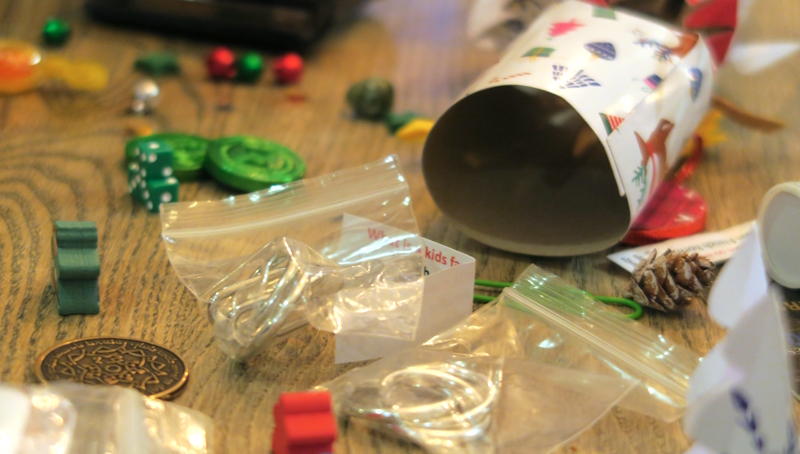
Everyone had already arrived and was waiting in anticipation when Blue and Pink arrived with piles of gamers crackers, Christmas tree decorations, party poppers, paper parcels, mince pies, festive cakes (with carrot meeples on top) and GOAT Award voting forms.  Food quickly followed along with a volley of noise as people tried to pull their crackers and party poppers first so the contents didn’t land in their supper.  As people munched, there was some discussion about the games played and voting forms were filled in.  In the absence of Green, Pine kindly offered to act as returning officer and collate the statistics.

"Un-Christmas Party" 2024
– Image by boardGOATS

While cake and mince meat parcels were shared round, toasts were offered by Lime to the organisers, and in the memory of Burgundy.  He is much missed and will never be forgotten, but we always make a special point of remembering at this time of year, especially as the Un-Christmas Dinner was his last games night with us.  The GOAT Awards were then announced.  Moment of the Year was when Pine got the end game rule wrong for Tonga Bonga, so that Pink thought he’d won, but then didn’t.  The GOAT Poo Prize for the least popular game of the year went to Ca$h ‘n Guns—not a game the group plays often and its only outing over the last year was at the New Year Party.

"Un-Christmas Party" 2024
– Image by boardGOATS

Then it was time for the Golden GOAT.  Previous winners were ruled out, but other contenders included Akropolis, Kavango, Flamme Rouge and Ticket to Ride: Rails & Sails.  The clear winner of the 2024 Golden GOAT Award, however, was Stamp Swap.  There was much discussion about how this was the third winner from Stonemaier Games (after Tapestry last year and Wingspan in 2019) and how we should invite Jamey Stegmaier, to collect the award in person.  Email correspondence over the following few days suggested that while it was unlikely he would be able to come to GOATS, he will be in the UK next year and just might make it as far as Oxford.  In the meantime, he has highlighted the award on his website.

Golden GOAT - 2024
– Image by boardGOATS

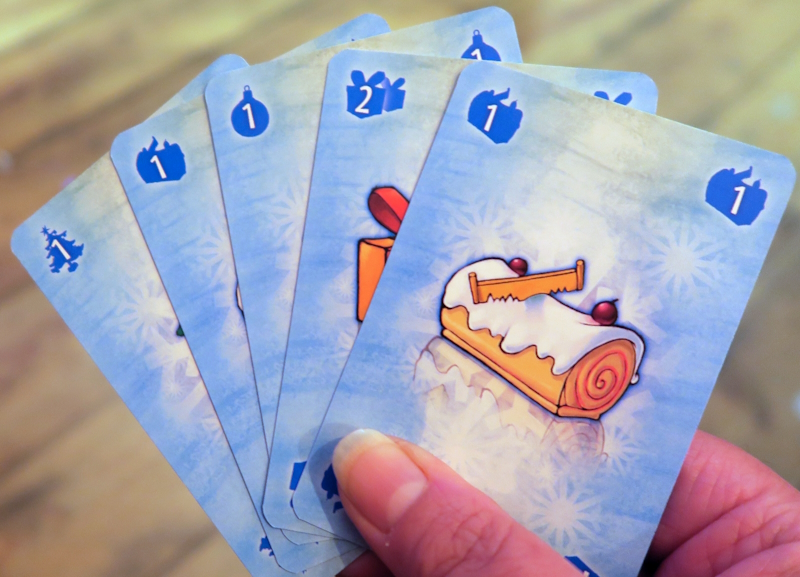
With the festive business over, the group broke into three to play some games.  Pink, Blue, Black and Jade began with the “Feature Game“, Courses De Rennes (aka Reindeer Races), a fun little game where players control a team of four reindeer, racing along four different tracks to try to get the highest-scoring tiles.  On their turn, each player can either draw two cards (with a hand limit of seven) or play as many cards of the same type as they can to move one reindeer along one of the tracks.  The cards are numbered and have suit that corresponds to one of the tracks (or are Elfy, and “wild”).  If two and a three of Gifts is played, the player may move one of its reindeer along the Gift track.

Course des Rennes
– Image by boardGOATS

If a reindeer lands on the same space as another reindeer, it slides forward a space.  If that is occupied too, it continues to slide.  If, however, the owner cries “Thump!” as it lands, the reindeer slithers an extra space forward.  The first reindeer to arrive at the end of a track claims the highest value token.  The game ends when two of the tracks have run out of tokens.  Pink too the first points, and with it a strong early lead.  A few rounds later, Jade took the last token from one of the tracks and with it ended the game.  He got very unimpressed looks from Black and Blue as he gifted victory to Pink, so once this was pointed out, Jade revised his move and play carried on.

Course des Rennes
– Image by boardGOATS

Ultimately, however, it didn’t really change things as Pink still took victory with twenty-two points.  He was long way clear of Jade who won the tight fight for second with fifteen just one point ahead of Black who, in turn, took third by a single point.  Everyone else was still playing, so the group looked for something else to play.  Black had won a copy of Ticket to Ride: Paris in the raffle and, although it wasn’t very festive, it seemed appropriate to give it an outing.  Some of the GOATS had played this mini-city variant of the popular train game earlier in the year when we marked the Olympics with sport and France themed games.  However, none of the current quartet had been part of that group.

Ticket To Ride: Paris
– Image by boardGOATS

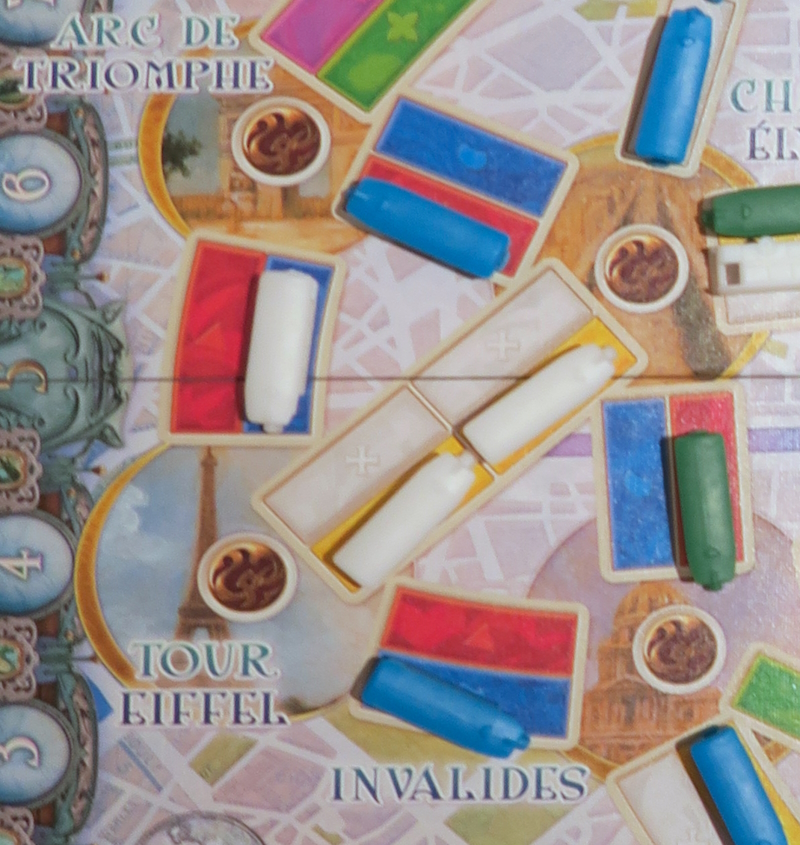
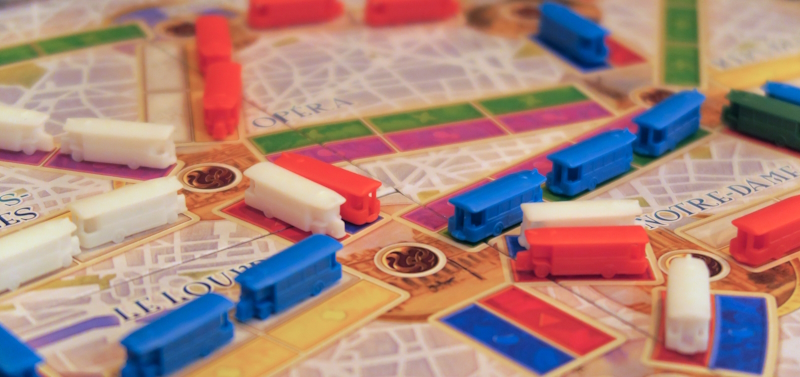
The rules are much the same as all the others (take two cards from the market; play cards to place pieces on the map; collect Ticket cards to score points at the end), but like all the variants, Paris has a special rule.  When players claim a red, white, or blue track, they get a card, when they get all three colours they get four “Tricolore” bonus points.  When the game first came out, there had been comments about how this felt very bolted on, but in practice, it was much more interesting than it sounded.  This time, the in game scoring was quite tight, though Blue, with her trains across the city centre got her nose in front and led by six points.  Tickets can make a huge difference to scores though, as they can give a lot of points, both positive and negative.

Ticket To Ride: Paris
– Image by boardGOATS

Black, Pink and Jade all picked up similar points for their completed Tickets (ten, eleven and eight respectively), though Jade was unlucky and unable to complete his last one.  Blue, however, made good use of concurrent routes and scored a massive twenty-four points for hers giving her something of a landslide victory with a total of forty-six.  It was much closer for second which went to Pink who finished with twenty-nine, two points ahead of Black.  Meanwhile, on the other side of the room, Purple was leading Ivory, Plum and Byzantium in one of her favourite Christmas themed games, Christmas Tree.

Christmas Tree
– Image by boardGOATS

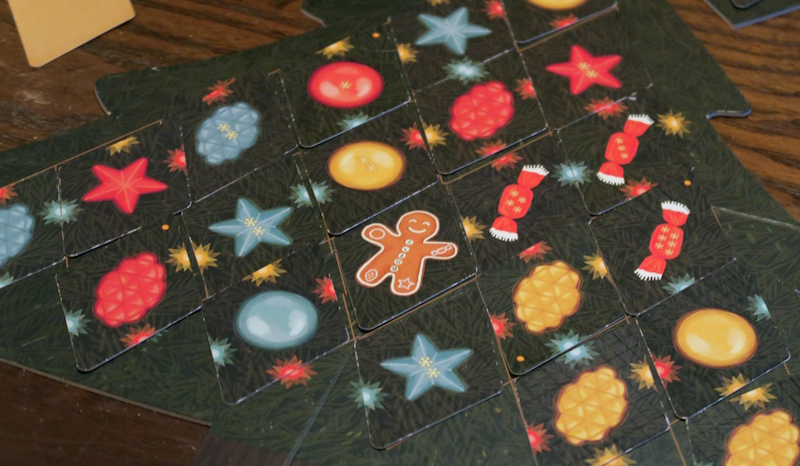
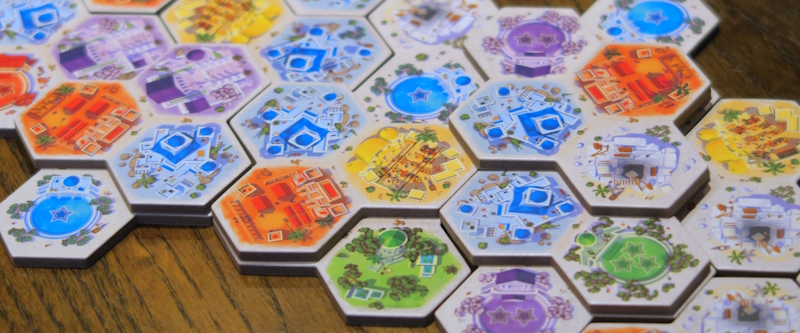
This is a fairly simple little card-drafting game played over thee rounds, where players are “decorating their Christmas Tree” with diamond-shaped cards, where players score points for the Objective cards everyone contributed to a central pool at the start of the round.  This time, the group played from the advanced set of Objective cards (including all three levels) although the first round, the cards were all levels one and two.  These gave one point for each blue or “nobbly” ornament, four points for each pair of ornaments of the same colour and shape arranged in a vertical pair and six points for three specific shapes in a given arrangement.

Christmas Tree
– Image by boardGOATS

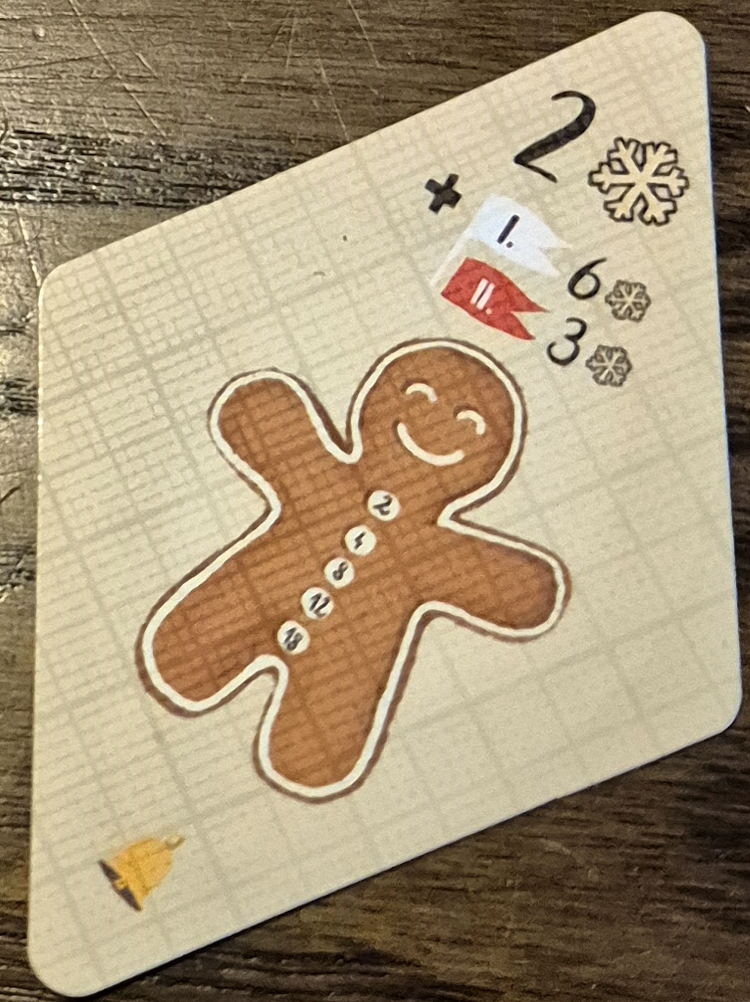
The first round started off slowly with everyone looking to fulfill some of the Objectives—everyone was successful, but Plum and Byzantium got off to a better start.  Plum placed her first Gingerbread man and then concentrated on placing vertical pairs although she only managed that once.  In the second round the Objectives were from the more complicated sets, including six points for three specific colours in a given arrangement, six points for the same three shapes or colours in a set pattern, or eight points for four ornaments with the same point value arranged in two set formations.  This time, Byzantium significantly out scored everyone with multiple objectives scored multiple times and, as a result, built a big lead.
Christmas Tree
– Image by boardGOATS

Plum used one of her Biscuits to move baubles around to make a row of four contain the three colours of glass bauble.and thus scored well, whereas Ivory was focusing on picking up high value Sweets and surrounding his Gingerbread men.  The final set of Objectives included six points for a set arrangement of certain point values, eight points for four ornaments with the same point value arranged in a particular arrangement and five points for each row in which the total points of the glass were above the given amount. Finally, there were two points for each Gingerbread man, with bonuses of six and three points for the player with the most/second most Gingerbread men.

Christmas Tree
– Image by boardGOATS

In the third and final round, Byzantium again out scored everyone, scoring multiple times for the set arrangement of certain point values.  At this point, Ivory was full committed to Sweets and Gingerbread men, especially knowing he was putting in the Gingerbread man Objective, which he scored well for.  Plum and Purple also scored well in the final round, with Plum following a strategy similar to Byzantium, whereas was Purple was collecting sweets like Ivory.  It looked like Byzantium was going to win by a large amount, as he was fifty points ahead of everyone else and was scoring more than anyone else for Lights and Baubles too.

Christmas Tree
– Image by boardGOATS

Ivory’s focus on surrounding his Gingerbread men gave him over fifty points and with more than thirty for his sweets he finished with one hundred and seventy one points, pipping Byzantium to victory by just two, with Plume in third some twenty points adrift.  The puzzly nature of the the game had gone down well and with the Christmas theme everyone had enjoyed playing Christmas Tree.  On the next table, the festive link was much more tenuous, however.  Teal, Pine, Sapphire and Indigo had chosen 6 Nimmt!, because there was a twelve in it, representing the Twelve Days of Christmas (or perhaps they had just wanted to play the game and if you can’t play a daft party game at Christmas, when can you?).

6 Nimmt!
– Image by boardGOATS

6 Nimmt! is a popular game with the group at any time of year, though it is usually played with more than four people.  Either way, the game is very simple to play, though tough to play well.  Some say this is because there is a lot of chance in the game, but they are usually the people who do badly…  The idea is that players simultaneously choose a card to play and these are then added, in order, to the rows of cards on the table.  The player adding the sixth card, instead, takes the first five cards into their scoring pile.  Usually, we deal out half the cards for the first round and the rest for the second and the winner is the player with the fewest “nimmts” (or points), at the end of the two rounds.

6 Nimmt!
– Image by boardGOATS

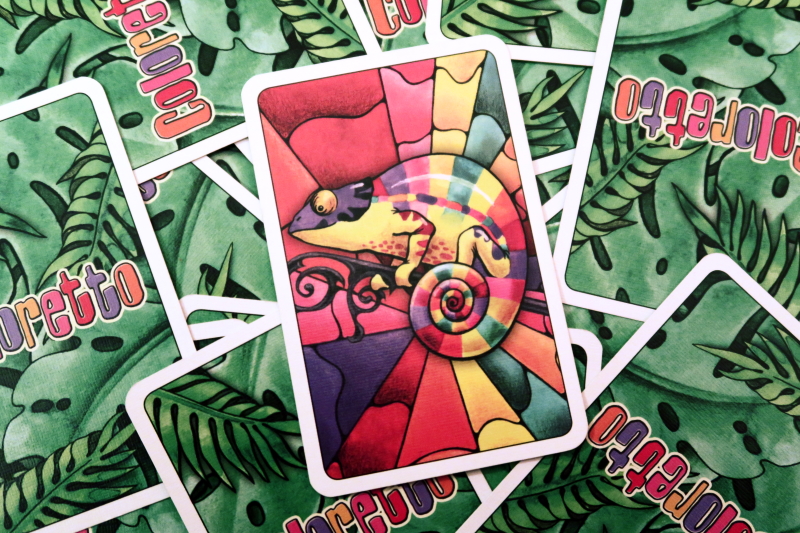
This time, however, the group decided to play the multiple-hand variant where each hand has ten cards, and the game ends when someone’s score passes sixty-six.  And that was Sapphire, who finished with an exceptional total of ninety-five.  The winner was Teal with forty-four, however, who was just two points better off than Pine.  The other games were still ongoing, but there was still time for one last game for this group (who were joined by Navy) before everyone went home warmed by the Christmas Gaming Spirit—and their choice of game was Coloretto (apparently this is a  festive game because it includes red, green and gold Chameleons).

Coloretto
– Image by boardGOATS

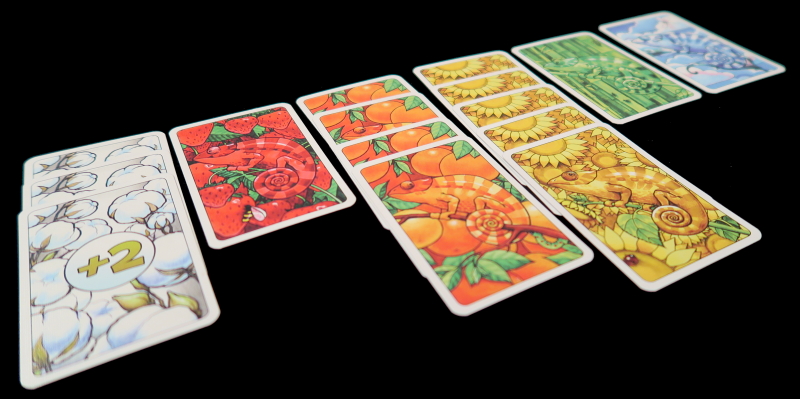
This is another simple filler game, where players either take a card and add it to a truck, or take a truck.  Each truck can take a maximum of three Chameleons, with players collecting coloured sets.  The largest three sets score positive points (according to the Triangular Number Series), while all the others score negative points.  In this way, the bigger the series the more additional cards will score, so the aim is to collect three large sets and ensure the others are as small as possible.  This game was really tight, with Sapphire claiming victory with twenty-seven and Teal and Indigo tying for second on twenty-four.  And with that, people began to drift off, many not to be seen until 2025.

Coloretto
– Image by boardGOATS

Learning outcome:  GOATS love a Cracker!

Golden GOAT Award Winners – 2024

This week was the annual boardGOATS Un-Christmas Dinner including the voting to decide the winners of the GOAT Awards.  There are two main awards:  the Golden GOAT for our favourite game played during the year and the GOAT Poo Prize for our least favourite.  Everyone had the usual three points to hand out for the Golden GOAT Award (plus a bonus if wearing Festive Attire), though a maximum of two points could be given to any individual game.  Everyone could also nominate up to two individual games for the GOAT Poo Prize.

Tonga Bonga
– Image by boardGOATS

This year, the unofficial “Marmite Award” went to Viticulture—something many people seemed to find quite a surprise as it is generally not a divisive game and one that few would usually take offense at.  There had been a lot of fun throughout the year, but one of the more memorable moments was Pine getting the end game rule wrong for Tonga Bonga, so that Pink thought he’d won, but then didn’t.  There were several nominations for the GOAT Poo Prize, including King of Tokyo, Rolling Realms and Ark Nova, but the winner was another surprise: Ca$h ‘n Guns—not a game the group plays often, indeed it doesn’t get played at all at the pub (for obvious reasons), so its only outing over the last year was at the New Year Party.  It can be a lot of fun, but it is also easy to see how some might not like the game.

Ca$h 'n Guns
– Image by boardGOATS

Then finally, there was the Golden GOAT Award for the best game played in the year.  Previous winners were ruled out, but there were plenty of other great games to choose from.  The most popular of these were Akropolis, Kavango, Flamme Rouge and Ticket to Ride: Rails & Sails.  However, the clear winner was Stamp Swap.  This is a new game, only released in September, but was an immediate hit, largely thanks to its silky-smooth game play.  As one person commented, “I wouldn’t have thought a game about stamp collecting would be up my street, and yet…”

Stamp Swap
– Image by boardGOATS

Perhaps more remarkably, this is the third winner from Stonemaier Games after Tapestry last year and Wingspan in 2019—three very different games.  This led to the perhaps slightly tongue-in-cheek suggestion that the group should invite Jamey Stegmaier to visit so we could present him with the actual Golden GOAT in the manner of the Jules Rimet Trophy

Golden GOAT - 2024
– Image by boardGOATS

12th Movember 2024

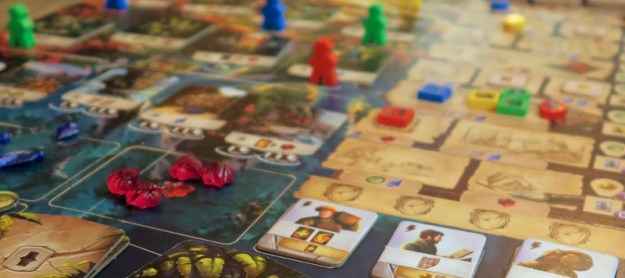
The evening began with Plum explaining the “Feature Game” to Indigo and Navy, despite the fact they had already decided they were unlikely to play it.  Still, there was time to fill as people finished eating and the stragglers, and that was as good a way as any.  The game in question was Underwater Cities, which is a sort of worker-placement and network-building game.  Although the game is quite complex, the underlying mechanism is quite simple:  players start their turn with a hand of three Cards and, on their turn choose an Action space and pay a Card to use it.  The Action spaces and the Cards come in three different colours, green, red and orange.

Underwater Cities
– Image by boardGOATS

If the colour of the Card played matches the colour of the Action space chosen, then the player gets to activate the Card, most of which have an instant effect (though for some, the effect is delayed).  In general, the orange Action spaces are quite powerful and the green Action spaces are weak, whereas the green Cards have powerful effects and the orange cards are weaker, thus the Cards and Actions together are balanced.  Each Action space can only be activated by one person per round and the game takes place over ten rounds (though the group used the Quick Start variant from the New Discoveries expansion which replaces the first round) with each player taking three actions per round and production phases after the fourth, seventh and final rounds.

Underwater Cities
– Image by boardGOATS

The aim of the game is to build a network on players’ personal player board, connecting Cities together with Tunnels and adding and Upgrading Buildings to provide production capabilities.  There are four Resources, Kelp, Steelplast, Science and Biomatter together with money, or Credits; these are produced by Farms (Kelp), Desalination plants (money) and Laboratories (Steelplast and Science).  Biomatter is essential for building symbiotic cities and can also be a universal building material (can be used instead of Kelp or Steelplast), but is a rare Resource that can only be acquired through Cards, Actions and by connecting some Metropolises to a player’s network.

Underwater Cities
– Image by boardGOATS

Players score points during the game and in the production phases after the fourth and seventh rounds, but most of the points are scored at the end of the game after the final production phase.  At this point, players score for the number of different Buildings next to each connected city in their network, for any end-game scoring cards, for their final scoring Metropolis and for any Resources they have left.  Indigo and Navy showed some appreciation as Plum explained, but ultimately decided it wasn’t for them, and were replaced by Cobalt and Ivory, both of whom had an idea of how the game played from watching run-through videos.

Underwater Cities
– Image by boardGOATS

The Quick Start gave everyone an Enhanced Assistant so Plum started with the ability to get Biomatter on production, so she was able to build purple Symbiotic Cities (which score more points) right from the beginning.  Cobalt’s also helped him when building Cities, giving him one Credit or Steelplast discount, although he didn’t really take advantage of this until the final Era. In contrast, Ivory focused on the end-game scoring from his Metropolis which required him to build seven Cities to get the maximum number of points.  By the first production phase, he had already built three and connected them to his network with Tunnels, but all those people needed a lot of feeding which was costly and slowed him down a lot.

Underwater Cities
– Image by boardGOATS

Plum focused on building a robust food engine with two upgraded green Buildings attached to one City (her end-game Metropolis also gave points for sets of upgraded structures) while Cobalt focused on getting his engine online and started on his objective to connect all his Metropolises and Cities with Tunnels in the second and third Eras.  He was aided by an ongoing ability that triggered whenever he used an Assistant (draw a Card and gain a Point), which he used heavily, getting four Assistants early in the game and activating them all in every Era. The extra Card draw ensured he was always able to play a matching coloured card with every Action which also helped.

Underwater Cities
– Image by boardGOATS

Plum pointed out that a friend who she plays with and often wins says, “Don’t always let me get the Special Cards—they are powerful!”  So after the first production phase, there was a focus on the special cards in middle, all of us grabbing some quite powerful abilities.  Ivory got an additional tile that gave him points every production phase and Plum got a heavily discounted City.  Cobalt’s engine was working very effectively by this time giving him lots of Resources and discounted Actions.  Despite her Special Cards, Plum was struggling as the main upgrade slot which she needed for her end-game Metropolis was denied to me when she had the Resources to use it.  Instead she ended up focusing on Symbiotic Cities and ended up with only the one regular City.

Underwater Cities
– Image by boardGOATS

After the second production phase, there was a big focus on how to maximize points. Ivory took a risk, taking the end game scoring card that gave twelve points for the player with the most upgraded Tunnels.  When he took it, he had the most upgraded Tunnels, but it was clear that Cobalt could challenge this.  Cobalt on the other hand had grabbed a couple of Special Cards giving three points per upgraded Tunnel plus one point per Card in his tableau.  For Ivory to score his Card it was critical that he denied Cobalt the ability to upgrade in the last turn and Ivory was able to make sure he took his first in the final round—this was fairly ironic as the majority of the rounds he had been the last player!

Underwater Cities
– Image by boardGOATS

This scuppered Cobalt’s plans and gave a twenty-four point swing in Ivory’s favour, but since he had increased his hand limit to four and was drawing multiple cards, he was able to pivot and build a City sharing two upgraded Farms and us Cards that provided points when played. This also produced quite a few resources in the final production phase.  Plum was struggling towards the end of the game as she couldn’t get the final Resources she needed to build the last two Tunnels to connect her end-game scoring Metropolis.  Despite it failing to score, it had still been a good focus for her game as the upgraded structures had given her extra production during the game and those Metropolis points would only be critical if the game was close.

Underwater Cities
– Image by boardGOATS

And close it was.  Plum had a slight lead going into the end game scoring and and-game scoring cards gave points fairly evenly too.  Cobalt and Ivory had the same number of Cities with three different Buildings, slightly more than Plum, but she more than made up for it with her Cities with her Cities with two different Buildings.  The Metropolis she failed to connect proved critical in her scoring though and although she just edged Ivory by two points, Cobalt ultimately took victory, also by just two points as he finished with ninety-seven.  It had been a very thinky game, and with three players was reasonably tight with people taking Actions others wanted.  It was very enjoyable when players were so evenly matched which was reflected in the scores despite very different strategies.

Underwater Cities
– Image by boardGOATS

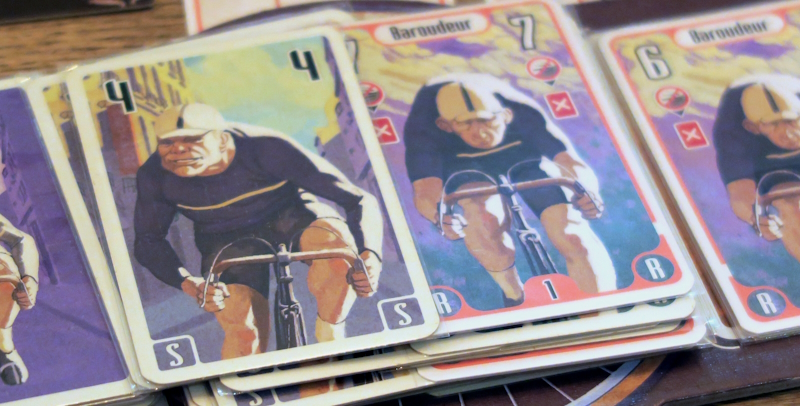
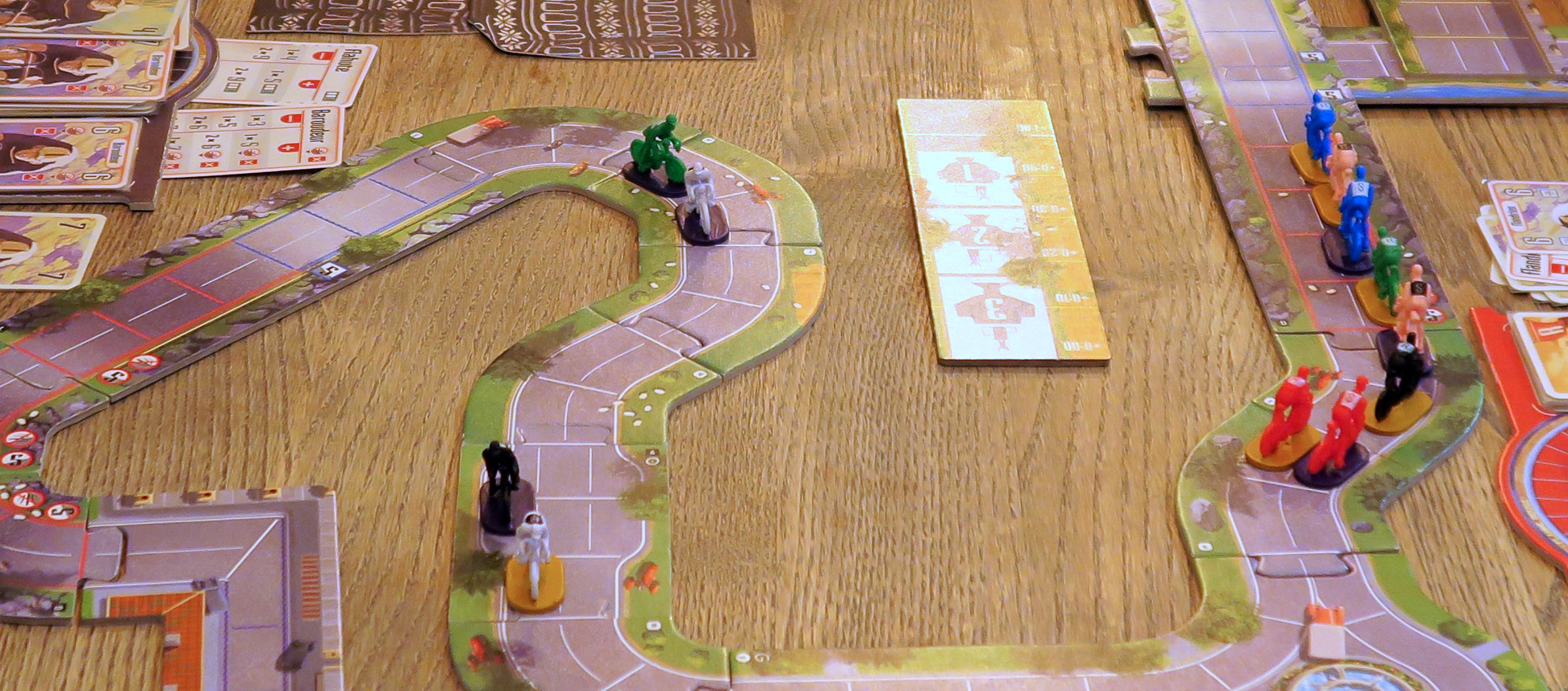
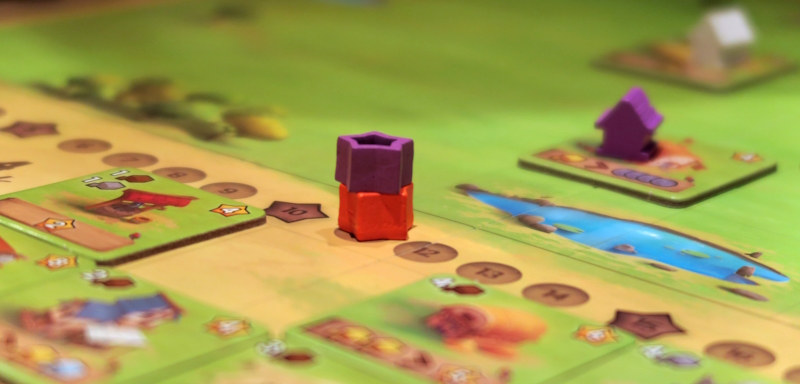
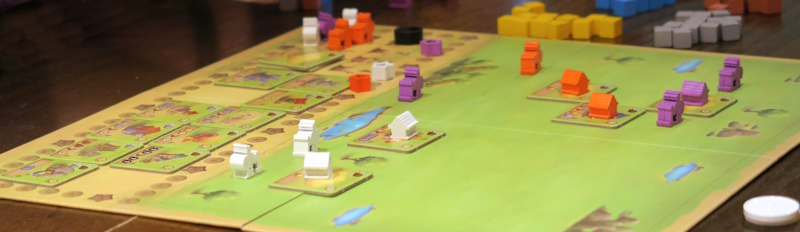
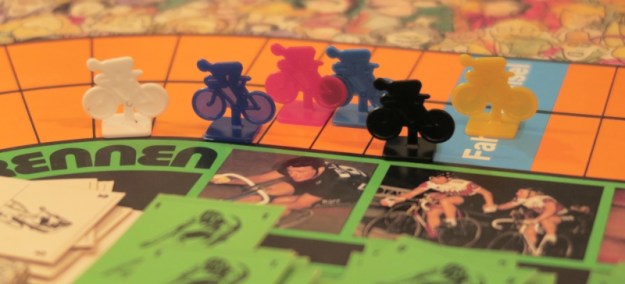
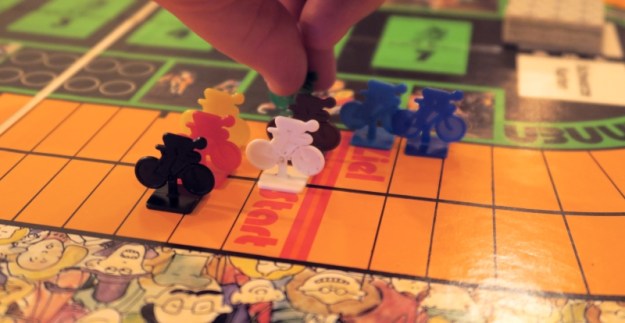
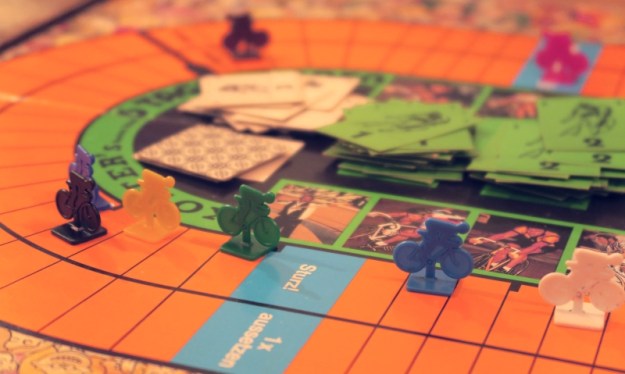
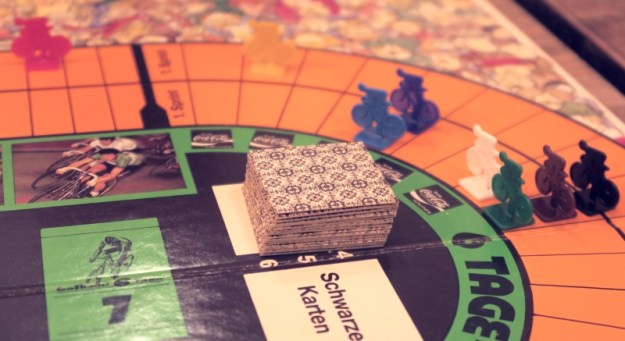
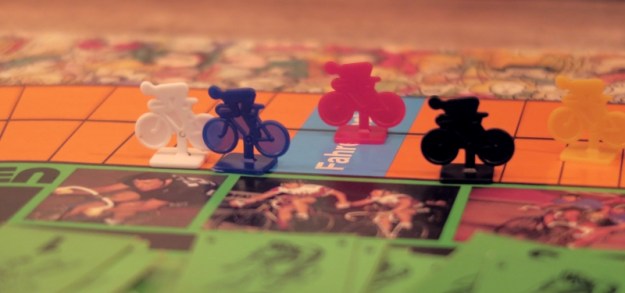
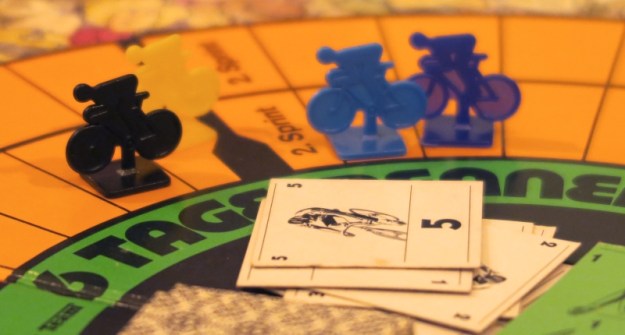
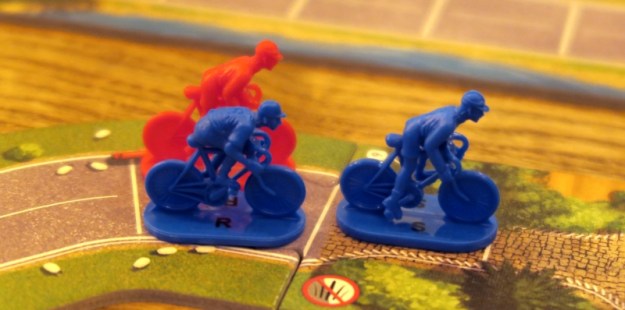
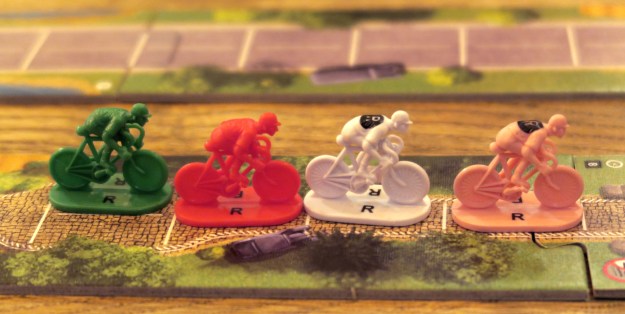
Black and Blue had been interested in joining the game of Underwater Cities, however, as it was, it was the last game to finish by some mile and would have taken a lot longer with a fourth player.  There wasn’t a sixth player interested in making a second game, so in the end, Black joined Pink who was very keen to give Teal’s new acquisition that he’d been toting about since Pink and Blue had brought it back from Essen for him.  This was the Grand Tour expansion to Flamme Rouge. This is a cycle racing game where players move their two riders forward by drawing and playing cards from that riders specific deck, depleting it as they go.

Flamme Rouge: Grand Tour
– Image by boardGOATS

As in real cycle races, players use slipstreaming to avoid exhaustion, in the game, these are cards that block up players’ hands making dealing with obstacles and moving through the peloton more challenging.  A large part of the new expansion is a campaign mode and there was only time for one game, however, there are some additional features, including some new hilly track and a double right-angle hairpin bend.  These added more interesting features to the parcours.  Like all race games, players usually do best if they can start fast and stay at the front of the pack.  In Flamme Rouge, this is mitigated by the fact that once a card is played it is discarded so players have to make their good cards last the duration of the race while avoiding too much exhaustion.

Flamme Rouge: Grand Tour
– Image by boardGOATS

Teal managed to crash both his bikes, while Black and Purple crashed one each.  Indigo and Navy led for most of the game while Pink tried to maintain a position in the front four or five.  Navy faded as the sprinters wound up for a lunge for the line, with Indigo as Marcel Kittel and Pink as Mark Cavendish.  This time, victory went to the German and the Manx Missile with just piped into second with Navy rolling home in third.  The game had been a lot of fun and the general consensus was that the Grand Tour expansion added some nice new features even when multiple games for a campaign weren’t appropriate.  It hadn’t out-stayed its welcome either, and although Teal headed home, there was time for everyone else to play one more quick game.

Flamme Rouge: Grand Tour
– Image by boardGOATS

The game of choice was Coloretto—something of an old favourite.  This is a really quick game to teach and start playing, with players taking it in turns to either draw a card and add it to one of the trucks, or taking a truck and adding the Chameleons on it to their collection.  The clever part is that largest three sets score positive points following the Triangular series, while any other sets score negative points.  Purple drew the Golden Joker which was picked up by Pink, while Black took the other Joker.  The game was really tight, well, amongst the top three anyhow.  Navy managed to only score positive points, but his thirty-four points was one less than Indigo who took second and who, in turn, scored one point less than the victor, Black.

Coloretto
– Image by boardGOATS

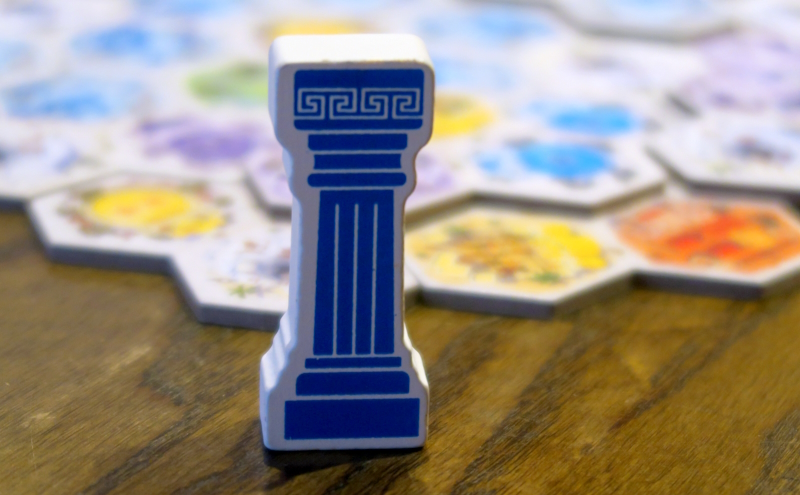
The final table consisted of Pine, Blue, Jade and Sapphire.  After a bit of chit-chat, this group settled on playing Akropolis.  This is a fairly light abstract tile laying game in a similar vein to Taluva or NMBR 9, where tiles placed on higher levels score more points.  In this game, players take a tile from the Market and place it in their City.  The first tile in the market display is always free, the one after costs one stone (the only resource in the game) the next one two stone and so on.  The tiles comprise three conjoined hexes each either a Quarry (which provide Stone when built over), a Plaza, or a District tile.  Tiles can be placed on top of others, but must cover more than one other tile and cannot leave gaps.

Akropolis
– Image by boardGOATS

At the end of the game, tiles that meet the scoring requirements for that colour are multiplied by their height.  As in Kingdomino where the area is multiplied by the number of crowns in it, this District score in Akropolis is multiplied by the number of Plazas in that colour; these totals are added together to give a final total.  This time, Blue scored heavily for her Houses and although Jade almost matched her with his Barracks, he didn’t score much for anything else and Blue had picked up a lot of points for her Markets too.  Together these gave her a bit of a landslide with a total of one hundred and nineteen.  Sapphire and Pine that by the end they had got the hang of things, and fancied giving it another go.

Akropolis
– Image by boardGOATS

The game was punctuated by a discussion about orange juice and lemonade, which is apparently called a “Henry” in these parts though nobody but Jade was aware of it.  Pine commented that where he came from it was more likely to be used to order cocaine.  This time, Blue tried a totally different strategy this time focusing entirely on Houses.  Sapphire’s Markets gave him forty points and Pine’s gave him thirty-four.  These were dwarfed by Jade’s Gardens that gave him sixty points, but they all paled into insignificance compared to Blue’s Houses which gave her one hundred and eight.  Sadly though, with nothing else but a pile of rocks, this left her with exactly the same score as last time—and a tie with Jade, while Sapphire, the most improved player finished in third, just four points behind.

Akropolis
– Image by boardGOATS

Learning Outcome:  The underwater world has a lot of potential.

8th October 2024

As it was our twelfth birthday party, lots of people arrived early for pizza (or an amazing Mixed Grill in the case of Lime and some lovely veggie curry and fiery chilli for Pine), followed by GOAT cupcakes.  While everyone waited for food, arrivals from Essen were handed out, including Nucleum, Faraway and Flamme Rouge expansions; Let’s Go! To Japan and Cascadia mini expansions, and Die Wandelnden Türme (aka Wandering Towers), Keyflower and Dixit promotional items.   There was a lot of chatter too, about flooding, pot holes, the 34 road closure, full car parks and water leaks, as well as Essen.  Indigo and Navy weren’t eating, so had a play with Villagers while the others entertained themselves.  This is a card game where players “Draft” Villager cards from a market (called the Road) and then add them to their Village.

Villagers
– Image by boardGOATS

Some Villagers have prerequisites before they can be “Built”.  These are cards that must exist in the player’s Village before the Villager can be added on top to make a chain, cards that must be unlocked by paying money to other Villagers in their own Village, someone else’s Village or the Bank.  Some cards allow players to draft extra cards, while others enable players to Build extra Villagers and Special Villagers give powerful special actions.  Twice during the game there “Market” Phases when players get income from their cards, and the player with the most money at the end of the game is the winner. Somewhere along the lines, Indigo and Navy had a bit of a rules malfunction, and as everyone else had already started the now traditional birthday “Feature Game“, Crappy Birthday, they abandoned Villagers.

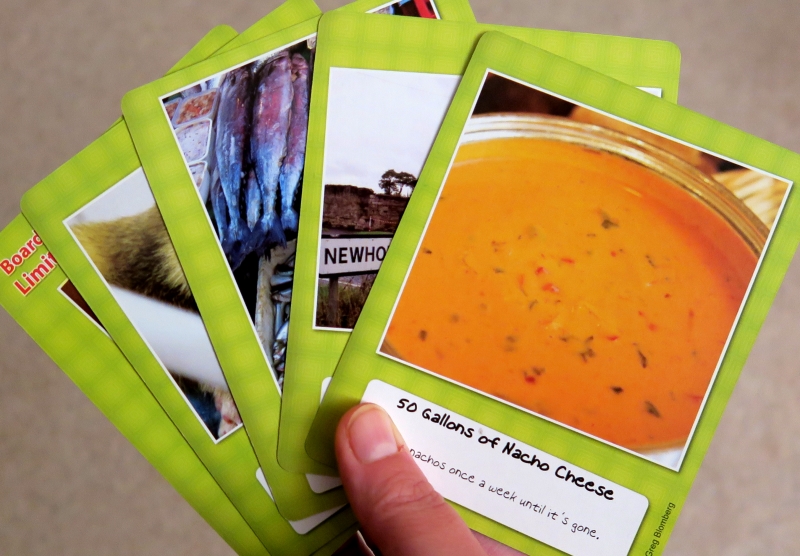
Crappy Birthday
– Image by boardGOATS

Crappy Birthday is a party game where players give each other comedy birthday presents and the recipient has to decide who gave the best and worst gifts.  We play a slight variant of rules as written, where we play a single year of birthdays with each gamer getting one turn to receive gift cards from everyone else from their hand of five cards.  With lots of players the pile of gifts can get quite substantial and this time everyone was getting thirteen gifts to decide which was the best and which was the worst.  The players who gave these then received a point for knowing the recipient so well and the player with the most points at the end of the year is the winner.

Crappy Birthday
– Image by boardGOATS

One of the reasons this game is so fun is that we learn a bit about each other.  Pink went first as his real birthday was next.  He liked the idea of an Easter Island Mo’ai for the garden (not that Blue was so impressed with the idea), but disliked the idea of cave scuba diving.  Plum chose a haunted castle as her favourite (because she loves castles), but pulled a face at the idea of earlobe stretching rings.  Purple had the matching neck rings, but these weren’t her least favourite gift, that was a giant swing ride, while she loved the idea of a penguin collection.  Byzantium showed his environmental credentials by picking a Global Warming Study as his favourite, while eschewing Jade’s wing suit dive gift.

Crappy Birthday
– Image by boardGOATS

Teal felt that trees were quite beautiful enough without being carved, but really liked the idea of a ride-on bike mower.  Jade wasn’t a fan of Cobalt’s offering of Polka lessons, but loved the idea of trip to Mars from Sapphire, while Sapphire felt “perkiness training” wasn’t something he really needed, but the thrill-seeker loved the reciprocal gift from Jade, a roller-coaster ride.  Lime fancied a three day festival trip, but wasn’t keen on a week eating nothing but Spam.  Blue didn’t fancy the creepy baby sculpture to go with the Mo’ai, but fancied Pink’s gift of a Safari (provided she had time to train for the walking element).  Ivory didn’t feel his life would be improved by a free satellite TV dish, but always one to send his meeples into space in Tapestry, grasped the opportunity to join them with a space walk.

Crappy Birthday
– Image by boardGOATS

It turned out that Navy has a problem with bees, so Teal’s gift of a bee keeping which he personally would have loved, didn’t go down well, but much to Pink’s surprise, his gymnastics camp was received really well.  Indigo was quite abrupt in her negative response to the idea of paparazzi following her about, but liked the idea of exploring a volcano while Cobalt didn’t feel he needed his soul to be searched, but fancied flying lessons.  The final birthday of the year was Pine, who didn’t get his usual pile of horses and meat, instead getting the opportunity to run with the bulls, which having known someone who had done it and been gored, wasn’t something he fancied.  Pine’s favourite was Larry the Lobster (not that he has space in his garden for him), one of the Big Things of Australia, that Pink and Blue happened to see on their visit there last year.

Crappy Birthday
– Image by boardGOATS

Lime was the last to break his duck and was very pleased not to end the game without scoring any points, indeed, nobody finished with the dreaded bagel, which was nice.  The runniest of run-away winners was Teal though, with five successful (or unsuccessful) gifts, with Pink and Cobalt joint runners up with three.  It was interesting though, this time there were quite a lot of gifts that people gave “in error” where as Teal commented, he “Gave pressies he thought people would like, but they all hated them!”  With the birthday formalities dealt with, there was time for something relatively short.  First up was Jade who was very keen to give his new Faraway expansion, Le Peuple du Dessous (aka The People Below).

Faraway
– Image by boardGOATS

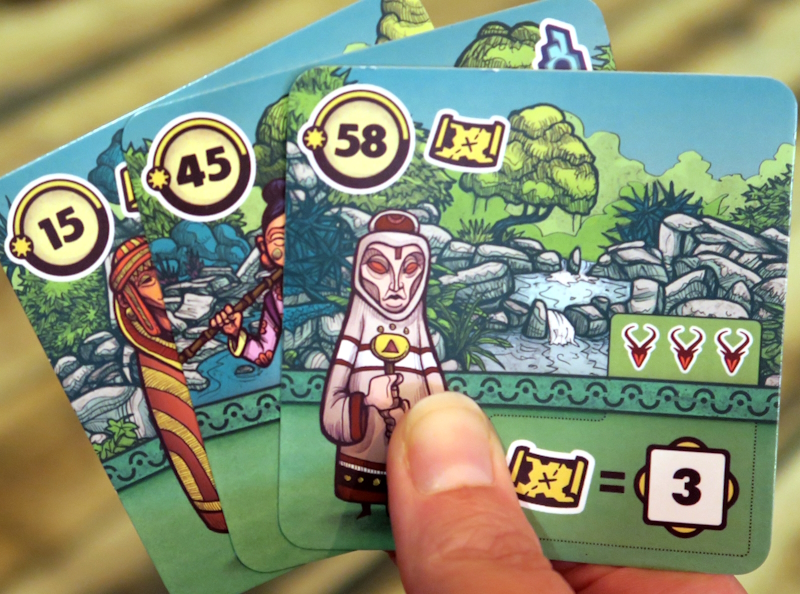
Faraway is a fairly simple little game, but one that really messes with your head:  players play cards from their hand of three, adding them to a row of cards, left to right, but at the end of they score the eight cards from right to left.  The Peuple du Dessous expansion adds just seventeen cards, but these include the Guides and the Three-Eyed Ones, two new Peoples with more opportunities to score, as well as giving enough cards to play with seven people.  This time there were only five though, with Sapphire, Byzantium, Indigo and Navy joining Jade.  Navy and Indigo were new to the game and, as usual, it took a little bit of getting used to.  That said, the both did really well with Indigo ending up with seventy-seven points, four more than Sapphire in second with Navy taking third, just one point behind.

Faraway
– Image by boardGOATS

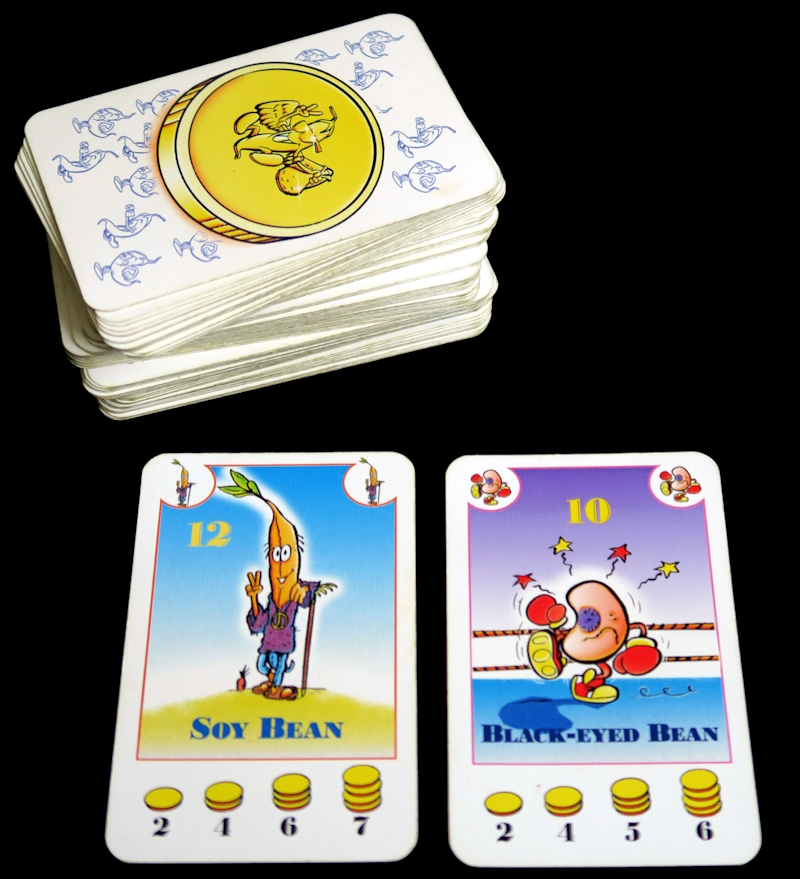
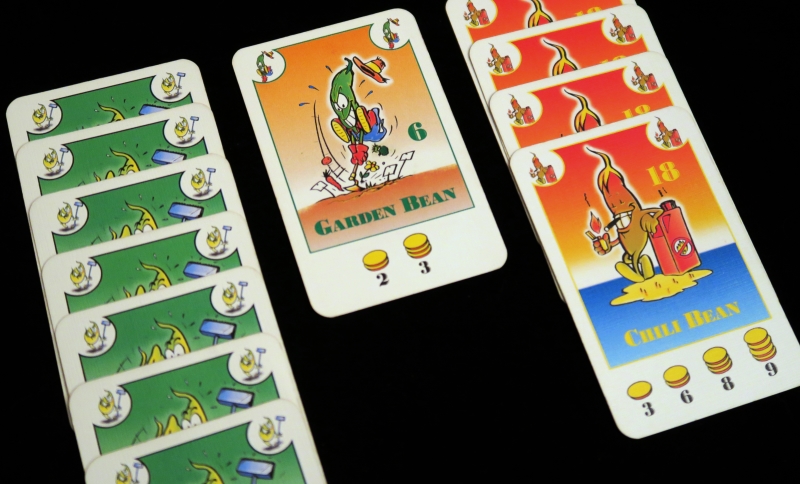
Navy and Indigo headed off and took an early night, but the other three had to wait for Plum who’s game on the other side of the room was ongoing.  Faraway is a fun little game though and the expansion adds a little more, so the trio decided to give it another go.  This time, Byzantium was the victor with seventy-three with Sapphire the runner up again.  Meanwhile, Blue, Pink, Pine and Teal, got out Bohnanza.  This is a game that is generally popular with the group, though Teal had somehow only managed to play it the once almost six months ago.  This is a very simple card game, albeit slightly convoluted and very unpromising when explained, but the key is that players must not rearrange the cards in their hand.

Bohnanza
– Image by boardGOATS

On their turn, players must plant the first card in their hand in one of their two been fields and may plant the second if they choose.  They then turn over two cards from the deck, which must be planted before the player can move on.  Fields can only contain one bean type, but beans can be traded, or even gifted, and it is the trading and negotiation that makes the game such fun.  Once the two cards on the table have been planted, players can trade from their hand, but again all traded cards must be planted.  Players can harvest Fields at any time with some of the bean cards dug up becoming money and larger Fields giving more money and at a better rate.

Bohnanza
– Image by boardGOATS

Blue took some high valued Garden Beans and then sold them off to buy a third Bean Field, causing a lot of confusion for Pink who couldn’t believe it when they kept appearing even though there were only six in the deck.  Teal scored well from his Chilli and Wax and Soy beans, while Pine and Blue ended up in competition for Green Beans.  This time with just four, the scores were a little more varied, but Blue was the clear victor with twenty-five Bohn Thaler, five more than Pine who came second.  The final game of the evening was Villagers, which was getting another outing on the other side of the room with Cobalt leading Ivory, Purple and Plum.

Villagers
– Image by boardGOATS

After a reminder of the rules, Purple started and grabbed the Carpenter then Cobalt went next taking the Blacksmith.  Both of these guaranteed their owners an income of coins (and hence points) at the expense of other players paying to use them. However, this did mean that they fell behind on building an engine to Draft and Build more cards (which Plum and Ivory focused on).  From there, the first half of the game went quite quickly with everyone focusing on building their engine. Ivory managed to get a Wine Trader using a Monk as a Graper, as well as playing a Scavenger, enabling him to take slender lead after the first scoring, although the scores were all very close.

Villagers
– Image by boardGOATS

In the second half of the game, Purple and Cobalt were beginning to have to make tough choices, being unable to play as many cards as they would like and not having the building cards they needed, which were also hard to come by. However, they continue gaining coins from all players. Purple had to discard quite a few cards to get starter cards which slowed her down a little, though Plum and Ivory were able to quickly get to the position to Draft and Build the max number of cards allowed; Plum in particular seemed to always have a fist full of cards.  As the game progressed, more people began taking cards that others might want, with Cobalt taking Wool cards that might have been of use to Purple or Ivory.  Ivory, however, was actually more focused on getting a second Vintner, already having a second Wine Trader in hand.

Villagers
– Image by boardGOATS

Towards the end of the game, there was face down Grape card which Ivory debated taking a gamble with, but decided not to take the risk.  Inevitably, when it was flipped over it turned out to be Vintner and Plum grabbed it. Ivory got very lucky during his next draft though, taking a face down Special card that was Monk, which he could then play as Vintner. Elsewhere, Purple played some Wool cards, getting two Weavers, Plum picked up some good end-game scoring cards in the Locksmith and Freemason. Cobalt focused on Solitary cards and Silver end game scoring, doing well from his Priests, Agent and Blacksmith combo. Ivory ended up focusing on the Hay cards, which scored well and that plus the two Wine Traders (and a second Scavenger), gave him a hundred and twenty-six and a two point victory over Cobalt.

2024 Birthday Cupcakes
– Image by boardGOATS

Learning Outcome:  Getting old is not necessarily a bad thing.

28th May 2024

When Blue, Pink and Cobalt arrived for food, the pub was really busy and they struggled to find a table, ending up in the Bar.  Their food had arrived by the time the others started to turn up, and although there was another free table by this time, it wasn’t conducive to playing games.  Green, who we’d been missing in recent weeks arrived with Lilac for the first time in absolutely ages so there was a lot of catching up to do.  It wasn’t long before more tables began to clear, and the group managed to find several together in the restaurant area, and once the feeders had bolted the remains of their supper they joined the group and everyone began to decide what they’d play.

Little Town
– Image by boardGOATS

First up was the “Feature Game“, Little Town, a resource management, worker placement and tile placement game where players take on the role of architects guiding teams building a small town.  There were two games of this—one with Blue, Pink and Teal, and the other with Black Purple and Lime.  It is quite a simple little game:  players start with a set number of Workers (four in the three-player game) and building Markers (six for three players).  On their turn, they can place a Worker in an empty space on the central player board/map, or spend resources and build a Construction, placing a Marker on it.

Little Town
– Image by boardGOATS

When they place a Worker, the player activates the eight spaces surrounding it.  These can include Woodland, Mountain, or Lake to get Wood, Rock or Fish.  Wood and Rock are useful to build, while Fish is important for players to feed their Workers at the end of the round (one Fish or Wheat per Worker, every round).  Players can also activate Constructions, their own for free, and another player’s by paying them one Coin.  There are twelve Buildings and five Wheat fields available for construction at the start of the game—once they are built, they are not replaced.

Little Town
– Image by boardGOATS

There are twenty-nine buildings in the base game which can be drawn at random, but this time, both groups used the basic set (marked with a robin).  This meant that some of the Objective cards which are Building dependent could not be used, so in the end, only the cards that didn’t require specific Buildings were used.  The Objectives therefore included things like “Gather at least five resources in the same turn” or “Have more Buildings than Workers”—these are scored during the game.  Buildings come in two types:  Those that give Resources when activated, and those that can be used to convert Resources into other Resources, Coins or Points.  The game lasts four rounds, after which players score for each of their Buildings and one point for any three unused Coins.

Little Town
– Image by boardGOATS

Once the rules had been outlined, both groups started playing.  Before they’d got more than a turn in, however, Cobalt commented that he was surprised that Blue hadn’t got metal coins to go with the game, at which point, Blue produced her utility set and both groups swiftly made the substitution.  Unfortunately, these new coins were a little slippery leading to a couple of rounds of “Hunt the Game Piece”.  Little Town is a really good little game though, accessible, but with meaningful decisions and one that doesn’t outstay its welcome.  Despite starting with essentially the same setup, the two games, progressed quite differently.

Little Town
– Image by boardGOATS

Pink and Blue built Points engines converting Coins and Wheat respectively, while Cobalt converted a Coin into Wheat and Fish, then and Wheat into lots of Coins.  On the neighbouring table, however, the Coin to Wheat and Wheat to Coins buildings were owned by different people, Black and Lime respectively while Purple was busy converting Wood into Points.  Both games were quite tight, with Lime’s forty-two beating Black into second place by just two points.  The other game was even tighter though.  Pink rolled back his final move following a suggestion by Blue to pick up an extra point, but she would have done better to keep her mouth shut as that extra point meant he tied for the lead with Blue on fifty-five.

Little Town
– Image by boardGOATS

It was as players were discussing the game and starting to pack away that Pink spotted a way of getting another extra point, but this was deemed too late and the game was deemed a tie.  Packing away, there was some confusion as the manifest indicated there should be twenty-nine Objective cards, whereas Blue’s copy had thirty.  Despite several recounts (and confirmation that there weren’t any in the Goodie Buildings mini expansion), the issue couldn’t be solved, and the group came to the conclusion that one more than expected was better than one less…

Little Town
– Image by boardGOATS

Meanwhile, on the next table Teal was leading a game of Salmon Run with Green, Pine and Lilac.  This is a game that was played quite a few times in the group some years ago when it was first released, but the last time it got an outing was in 2015—nearly ten years ago.  Teal had decided that his copy had been sitting on the shelf unplayed and unloved for too long and it was time for it to move on.  It got a stay of execution though, and as a result, it got a Tuesday night outing.  A fast paced, deck-building, race game, Salmon Run is a sort of cross between Dominion and Flamme Rouge.  Although the game is not particularly complex, the first game was a learning game.

Salmon Run
– Image by boardGOATS

The idea is players are Salmon, racing to be first to get to the Spawning Pool.  The board is modular and therefore the River can be changed to give variety and replayability.  Players start with a deck of cards containing three Swim Forward, three Swim Right, three Swim Left, one Wild and one Bear and draw four of these.  On their turn, players can play up to three cards, however, playing three means they will draw a Fatigue card.  These will ultimately reduce players’ choice and slow their Salmon down, so mostly players stick to playing two, replenishing their hand to four cards at the end of their turn.

Salmon Run
– Image by boardGOATS

Depending on the modules used, the River includes obstacles like Rocks, Currents and Rapids, as well as special spaces which allow players to pick up special cards (that can be used to counter Currents, Rapids and Eagles) to add to their Swim deck.  Teal began by moving a Bear onto the space with Pine’s Salmon, giving him a Fatigue card.  Then, much to Pine’s annoyance, Lilac and then Green did the same before fianally Lilac did it again.  Pine was very unimpressed—for one who loves wildlife, he really wasn’t happy about repeated visits from all those bears!

Salmon Run
– Image by boardGOATS

Green I played a Rapids card and there was some discussion where the card should be discarded to, but in the end there was no catching Teal, who was first to the Spawning Pool, and was some four spaces ahead Lilac, his closest challenger.  As Little Town was still going on both tables, the group decided to play a second time now they knew how to play as they thought they’d be quicker (which they were). The River was a changed a little to make it a bit more challenging and then the Salmon began their second run.  This time, Pine, Teal and Lilac went one way round the rapids, while Green went the other.

Salmon Run
– Image by boardGOATS

This time the bear was moved away from players by Teal so nobody got caught. As the River took a bend to the right, Green ended up with only Swim Left cards so had to just discard and bang his salmonny head against the rocks, falling behind. Teal and Pine had both picked up a lot of Fatigue cards, but they both got to the Spawning Pool.  As Pine had one less though, he was the winner of the second game.  It had been a lot of fun (despite the Bear attacks, and the headaches from banging against the rocky bank), so maybe the stay of execution deserves to be extended a while longer.

Salmon Run
– Image by boardGOATS

With both games finished and the late start, there wasn’t time for something long, so as is often the case in such circumstances, instead of lots of discussion, the group decided to play the old favourite, 6 Nimmt!.  With ten, the group decided to play the game over one round, which meant everyone started with ten cards, a lot more than usual.  This didn’t seem to improve the quality, however, a sentiment that was epitomised by one comment, “These are all bad with a capital F…”  The first few rounds were a little slower than usual as everyone had more cards to choose from than usual.

6 Nimmt!
– Image by boardGOATS

Once everyone had chosen their card, they were simultaneously revealed and added to the end of the appropriate row, with players picking up cards when theirs was the sixth card to be added.  Nobody managed to avoid picking up cards, but unusually, the scores were all quite close—so close that the winners, Green and Blue, tied with nine, while Pink took third place with eleven and Cobalt top-scored with twenty-three.  One game is rarely enough when it comes to 6 Nimmt!, and everyone was keen for another mad ten-player game.  This time the scores were more diverse: Lilac succeeded in avoiding the chaos and won with a clear round, while Teal added thirty-six to his first round twenty two to finish with the most points overall (Cobalt only took seventeen in the second game).

6 Nimmt!
– Image by boardGOATS

Blue took second place in the second game with five (giving her the best combined game total of fourteen), while Pine came in third with ten points.  Green was the most consistent with nine and eleven, but Lilac claimed the nearest to a “Mike Game” with one exceptional round and one awful one, though her bad wasn’t as bad as his usually were.  Everyone was just packing up when the evening came to a smashing end as the wine glass that Lime had carefully put safely to one side bit the dust.  Oh well, less washing up…

6 Nimmt!
– Image by boardGOATS

Learning Outcome:  Little Towns can give quite big games.

16th April 2024

Everyone seemed more keen on standing around and chatting that playing, but eventually, once everyone had arrived, people started dividing up into groups.  Ivory began by leading Jade, Sapphire and Cobalt to the other side of the room to play the “Feature Game“, which was the new “hotness” Let’s Go! To Japan.  In this game, players are travelers planning, then experiencing their own dream holiday in Japan.  Played over thirteen rounds, players draw activity cards place them in different days in their week-long itinerary. These can’t-miss tourist attractions have players traveling between Tokyo and Kyoto as they try to maximize their experience by optimising their activities while balancing resources.

Let's Go! To Japan
– Image by boardGOATS

In each of the thirteen rounds, players draw cards according to the pre-organised sequence.  For example, there are two decks of cards (Tokyo and Kyoto), and for the first four rounds, players take one card from each deck, keep one and add it to their tableau assigning it to one of the days of their dream, then pass the second card to their neighbour.  In the fifth round, players take the four cards they’ve been given and then they place two in their tableau and pass two on, and so on.  Once eighteen cards have been played (three on each of the six days), the game is over and players take their planned trip, activating each of their cards in order, starting on Monday and work their way through to Saturday.

Let's Go! To Japan
– Image by boardGOATS

There is a catch:  where there is a swap between the two decks, players have to move between the cities of Tokyo and Kyoto by playing a Luxury Train Ticket which they can acquire during the game.  Each of these is worth two points.  If players do not have enough tokens to cover each change, they play a Regular Train Ticket from the supply which costs them two points.  Activating cards involves moving the players’ five Experience tokens along a track, increasing or decreasing their Mood, Stress and Happiness, gaining points and then evaluating the requirements for the Highlight of the Day depicted on the final card of the day.  If these requirements have been fulfilled, the player gets bonus points and the player with the most points at the end of the game is the winner.

Let's Go! To Japan
– Image by boardGOATS

The game rattled along very quickly with swift turns and the added bonus that setup was quite rapid too.  As a result, it was easily under forty-five minutes before everyone was explaining their plan and scoring it.  That said it was hard to keep track of what everyone was doing.  Ivory was the first to fill a day and managed to get everything aligned to get the top bonus of a Luxury Train ticket. Although this was very nice, it in no way indicated Ivory was going to get a big score.  Jade and Cobalt quickly followed suit, Cobalt also gaining Luxury Train Tickets (which he got quite a few of throughout the game), and Jade got quite a lot of the second best reward, choosing Wild Tokens that would be really useful at the end of game to ensure meeting Highlight of the Day/End of Game objectives.

Let's Go! To Japan
– Image by boardGOATS

Sapphire was spreading his activities out a little bit more, but as the game went on he also managed to build a large store of wild tokens.  At the start of the game, Jade and Sapphire (who were not sitting next to each other) focused more on Kyoto, whereas Ivory and Cobalt were playing a lot more Tokyo cards.  Inevitably, however,  everyone ended up going to both cities and need Train Tickets as a result. Cobalt and Jade were the only people who choose to grab research tokens; Cobalt used one of these mid-game and managed to manipulate his hand so he ensured he passed nothing of use to Jade, much to his annoyance.  Otherwise, everyone worked on their mental health and managed to keep their stress down scoring positive points for the trip.

Let's Go! To Japan
– Image by boardGOATS

At the end of the game, Sapphire, Jade and Ivory had minimized their travel between the two cities though, whereas Cobalt required a lot of trains:  as he had lots of Luxury Train Tickets he actually increased his score significantly with these.  Jade had not picked up enough Luxury Train Tickets, so was stuck on commuter trains causing him to lose a lot of points. Sapphire ended up with a quick return trip between Kyoto and Tokyo on his last day, but that was acceptable because you should always go out your way for Sake!

Let's Go! To Japan
– Image by boardGOATS

Scoring took longer than usual as everyone gave a detailed description of their trip. Both Cobalt and Sapphire scored well on every day of their trip, with Cobalt slightly ahead thanks to his Luxury Train Tickets.  Sapphire managed to complete all his Highlight of the Day objectives though without using his wild tokens, so he cashed these in at the end of the game to push all his tokens into the next scoring zone and subsequently won the game by two points from Cobalt.  It had been a highly enjoyable experience though, enhanced by the beautiful components, especially the extremely pretty, but totally over the top ceramic component bowls!

Let's Go! To Japan
– Image by boardGOATS

From there, the group then played a game of Faraway, a light game set on the mysterious continent of Alula with its ever-changing geography, shaped after the rhythm of the seasons.  On each turn, players play a card from a hand of three.  As play is simultaneous, players must take into account the priority system in all their choices—being last to pick a card leaves fewer options and often less profitable choices for later turns.  During the game, players will play a row of eight cards in front of them, from left to right. These cards represent the regions they will come across while exploring the lands. Characters on these cards will give victory points if the player later fulfills the conditions they demand.  At the end of the game, players walk back along the same route, scoring cards in the opposite order to that they were played in—and therein lies the heart of the game-play.

Faraway
– Image by boardGOATS

Throughout the game, the cards played serve both to set new objectives, and to meet ones played previously.  This time, Ivory started quickly out of the traps playing the highest card and subsequently getting the last pick in the following round, which was a minor hindrance. As the game went on, the order of picking the cards changed each time and everyone managed to pick first at some point, although it did seem like Sapphire and Ivory had the greatest varieties, mostly either being first or last!  Jade was very quick off the mark getting lots of maps which gave him a significant card advantage throughout the game as he could look at four or five cards and pick the best one. Ivory also didn’t do too badly with maps.

Faraway
– Image by boardGOATS

It eventually became clear that Jade had managed to play his cards in such a way he was always playing a higher card than his last card giving him an additional secondary card, but he was also able to fulfill the requirements to score the objective on that card even though it would need fulfilling earlier in the journey.  Come the end of game scoring and going on their journey, both Cobalt and Ivory had slightly take their eye of the ball and missed fulfilling the requirements of some of their cards and thus missed out on points they though we were going to get. In the end, it was very close for second place Sapphire just taking it, while everyone was thrashed by Jade.

Faraway
– Image by boardGOATS

On the next table, Green was keen to play Lost Ruins of Arnak, and was eventually joined by Black and Plum.  This game combines deck-building and worker placement with resource management.  Players start with six cards in their deck, two Money, two Compasses and two Fear cards, and draw five of these to play.  As in the original deck-builder, Dominion, or in the racing games, Flamme Rouge and Snow Tails, Fear cards clog up players’ decks and more are acquired as the game progresses.  But also as in Dominion, there are ways to “exile” cards during the game.  So, players can try to keep a tight deck with minimal cards, or try to buy lots of cards that work well together.

Lost Ruins of Arnak
– Image by boardGOATS

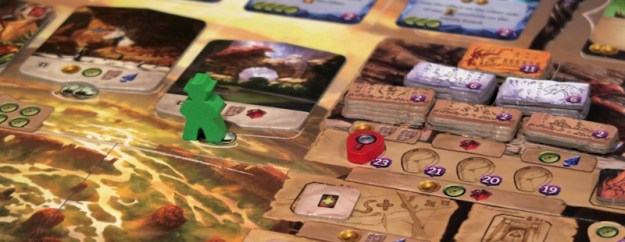
Players then have two meeples each that can be sent to locations on the map, to either discover or use an action Location.  These generally give Resources plus some additions like draw a card, or gain a Fear card etc.. Each new site also has a Creature guarding it, which, if beaten, will give points and a small one-time bonus.  The Research Track is where players spend three of the resources, Tablets, Arrows and Jewels. Each player has two tokens which move up the same track giving different rewards as it ascends. Thematically, you can’t write stuff in the notebook until you find it with your magnifying glass, so the former can never overtake the latter on the track. And of course, the notebook gives cooler rewards.

Lost Ruins of Arnak
– Image by boardGOATS

Players get one action each per turn, until everyone has passed signalling the end of the round, and the game finishes after five rounds.  At the end of the game, Points are awarded for Cards, for progress on the Research Track, for discovering Locations and for beating Creatures; the player with the most points at the end is the winner.  This time, early in the game, Green pointed out to Plum that she could use an Idol gained by defeating a Guardian to give her the resources she needed to go up the Research Track.  That gave Plum an Assistant and she picked one that turned a Boot into an Arrowhead.

Lost Ruins of Arnak
– Image by boardGOATS

Green bought the card Plum had been eying up, which let players rid themselves of Fear cards (worth minus one point), and therefore seemed like a good use for a Boot/Fear.  It was pointed out later, however, that any card could be used in place of the Boot as all other transport types work for Boot icons.  Plum then got an Assistant that could upgrade a resource, which in practice she used turn Arrowheads into a Rubies as that was all she had by the end of the rounds.  She also managed to get ahead with her Explore magnifying glass token and was the first to a new level on a couple of occasions, which gave her valuable bonuses.

Lost Ruins of Arnak
– Image by boardGOATS

Green picked up a couple of Fear cards from leaving Guardians undefeated; Black got at least one as well, but Plum managed to dodge them.  Both Black and Green got useful Artifact Cards where they could get lots of resources.  It was a little way in that the group noticed the slight Rules Malfunction:  although players were putting their new cards at the bottom of their Draw pile, players were then shuffling the Draw and Discard piles together before drawing new cards.  This gave an extra bit of randomness that this time, worked in Plum’s favour.  For example, she had an item card that gave a Compass per worker when it was played, and it seemed to put in a lot of appearances.  In contrast, all the cards Green had bought didn’t come out until the final round—he got the balance of the bad luck.

Lost Ruins of Arnak
– Image by boardGOATS

Black picked up an Assistant which helped him cycle through his cards which helped mitigate the randomness a little, though there were a couple of occasions when someone took the location he had been working towards. Right at the end of the game, when Plum had managed to reach the top of the Explore/Research Track with her magnifying glass, she was able to use the Icons on her board to get the resources needed to pick up one of the most valuable Temple Tiles—worth eleven points. Green, however, scored almost twice that of the others for his Idols and Black top-scored for his item and artifact cards.

Lost Ruins of Arnak
– Image by boardGOATS

It was the Temple points, together with the extra points Plum got for getting to the top of the Explore/Research Track that ultimately made the difference, giving her a total of sixty-nine points, thirteen more than Green who took second place.  Both Plum and Green had played before, though most of their previous games had been online where the administration of the card shuffling was done for them, hence the Rules Malfunction.  It was Black’s first game, and despite the rules issue and not scoring as well as the other two, he still really enjoyed the game, so there is a good chance it will get another outing in the not too distant future.

Lost Ruins of Arnak
– Image by boardGOATS

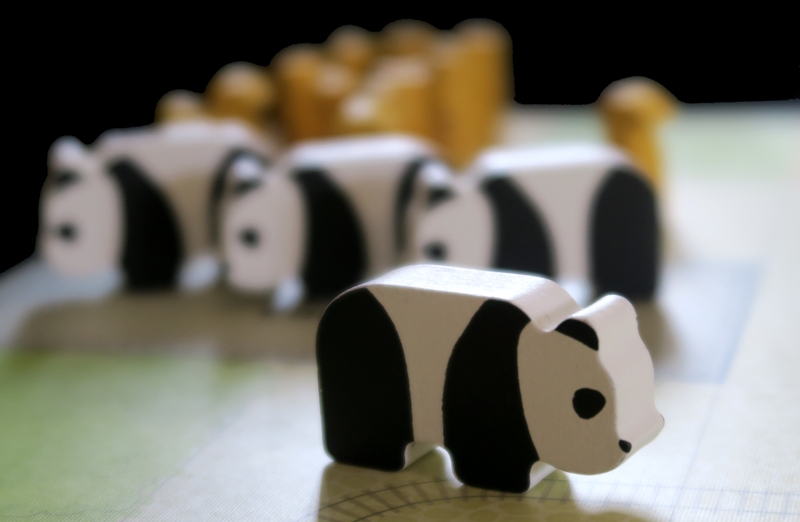
Meanwhile, that left six players; Pink was keen to give his favourite panda game another outing, so Pine and Lime joined him in a game of Zoo Break.  This is a cooperative game, where players work together to try to prevent animals escaping from Bedlam Zoo.  On their turn, players roll the die to decide how many Action Points they get, then, after carrying out their turn, flip a Escape Card and a then a Move Card to determine what gets out of its cage and what moves.  Players have to avoid getting trampled on or bitten by the animals, while catching them and then locking them in their cages.

Zoo Break
– Image by boardGOATS

The group started well, or at least it started well from Pink’s perspective when he was cuddled by a Panda (one of his real-life wishes).  However, the game did not go so well.  There are a number of optional variants, and the group had chosen to use the “Faulty Lock” Variant which means that if an escape card is drawn for animals who have already been locked up, the die is rolled to determine whether there are escapees.  This turned out to make things just a bit too difficult and a Coral snake quickly made a bid for freedom, and as it’s a dangerous animal, that was that.  One snake might not seem like much, but there were another five lining up in front of the gate and three tigers too, so it really did not go well.

Zoo Break
– Image by boardGOATS

Reluctant to leave it like that, the trio decided to give it another try, this time without the “Faulty Lock” Variant.  This second try went better, though at one point two elephants got very close to the exit.  The situation was rescued by peanuts which enticed them to the Snack Stall where they were eventually captured.  There was some extensive rules reading to decide whether Pandas were considered “Dangerous” so only one escaping would trigger failure.  The group concluded that Pandas were not Dangerous animals after all though, and four Pandas roaming the streets would not lead to closure of the Zoo (though perhaps the Chinese government would not be appreciative).

Zoo Break
– Image by boardGOATS

In the end, the distinction wasn’t necessary, none of the Pandas got out, though one Capuchin did manage to escape.  That was all, however, and once the group finally rounded up the last of the mad Meercat escapees, the writing was on the wall and the Zoo was saved.  The other games were still underway, so once the charming wooden animals had been tucked away, the trio opted for a couple of rounds of Coloretto.  This is a charming little card game which is the core of the, arguably better known board game, Zooloretto.

Coloretto
– Image by boardGOATS

The game is very simple:  Players either draw a Chameleon card from the deck and add it to one of the Carts, or take the cards on one of the Carts and add them to their tableau, stepping out until everyone else has taken a Cart.  Each Cart has three spaces and players core points for their three largest sets of cards and negative points for any others.  The player with the most points at the end of the round after the trigger card is revealed is the winner.  The clever part is the scoring for sets, which uses the Triangular Number sequence and means that later cards are worth a lot more than the early ones.
Coloretto
– Image by boardGOATS

When the Golden Chameleon card came out, there was some discussion about the difference between it and the multi-coloured Chameleon.  Blue, on the next table was consulted, and explained that it meant the person who takes it gets an extra card drawn from the top of the deck.  With that sorted, the game continued.  The group played two games and both were close, especially between Pine and Pink with Pink just edging it for the first game by two points and Pine just beating Pink by a single point in the second.  Both games were won by Lime, however, and by a larger margin, taking the first by four points and the second by six.

Coloretto
– Image by boardGOATS

The last table included three players, Blue, Purple and Byzantium.  They were the last to start, and were somewhat torn between two of the current hot games in the group, Wyrmspan and Meadow.  After some discussion, the group went for what was probably the easier of the two, and gave Meadow its their outing in three consecutive meetings.  A light to medium card collection game, it was new to both Purple and Byzantium, so Blue explained the rules.  Most of the game is built round a Card Market with players placing an Action Token and taking a card into their hand, before playing a card from their hand.

Meadow
– Image by boardGOATS

This aspect of the game has led to some reviewers comparing the game to Splendor, though there is a lot more to the game than that.  In addition to the Market, there is a second Campfire board, which allows players to carry out special actions, and also claim Bonus points. for cards in their tableau.  The first time the game was played, there was a token included erroneously from the Envelope U mini-expansion, and last time the game got an outing, there was a minor rules malfunction where the four players ended up playing on the three-player board.  So although the game has been played three times in fairly quick succession, this time was the first time the game was played by the rules as written, probably.
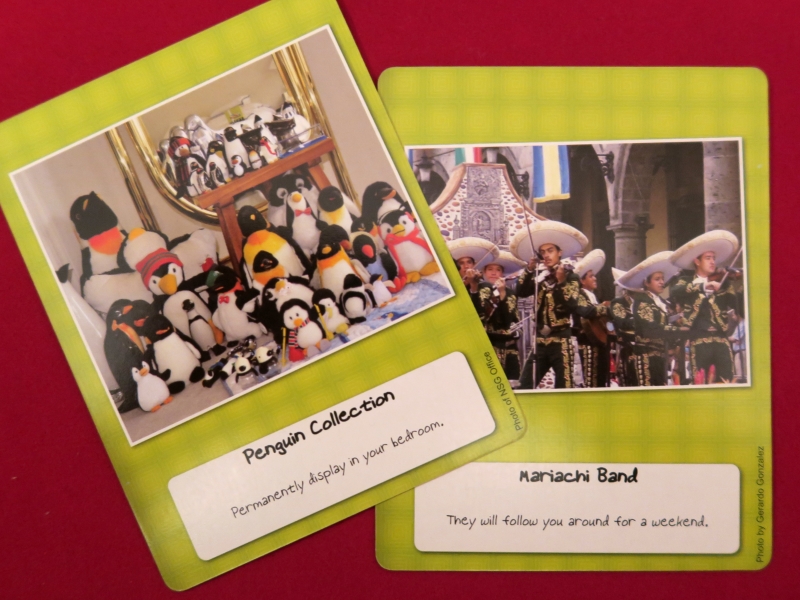
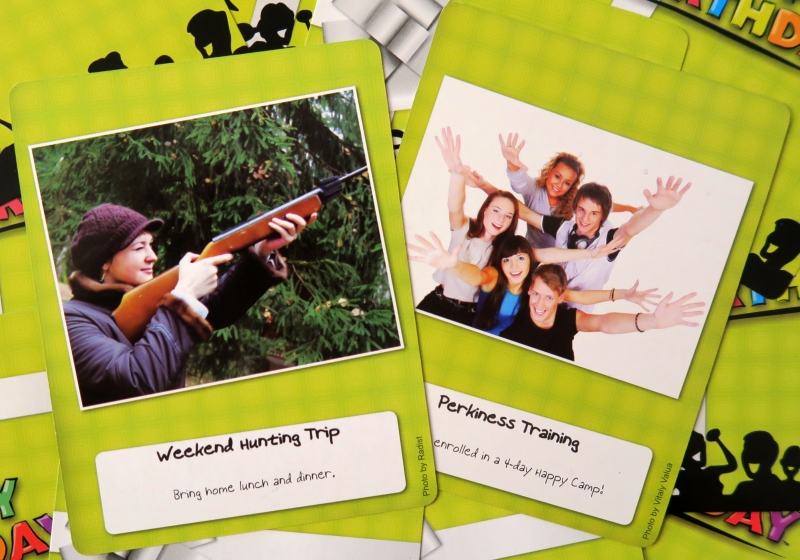
Meadow
– Image by boardGOATS

Players start with a hand of cards, including one from the North deck (which is only introduced halfway through the game)—this last card is typically more worth more but is difficult to play, so is a good way to get a steer in the early stages of the game.  As well as the other cards in their starting hand, another key strategy lead is the Bonus points obtained from the Campfire board.  These are obtained by placing a Bonus point token between two Icons, but in order to do so, the player must have those icons in their tableau.  Since each bonus place can only be claimed once, this element of the game is something of a race between those who want to compete for these points.

Meadow
– Image by boardGOATS

This time, the Icons drawn at random and placed round the Campfire included the relatively scarce Cottage, Fence and Garden Bird as well as the Wolf and Hawk which only come out in the second half of the game, when the North deck is introduced.  This made the Bonus points hard to claim. Although neither Blue nor Byzantium appreciated it at the time, although most Wolf cards are in the North deck, this copy of the game included the Seal promo card, which is a Wolf card that hides in the South Deck.  As it was key to getting bonus points, when it came out, both Blue and Byzantium spotted it, but Blue got to it first, and that turned out to be critical to her Bonus point objectives as Byzantium pinched the other spots early.

Meadow
– Image by boardGOATS

Meanwhile, Purple was busy collecting frogs and very effectively daisy-chaining cards to give her points.  As the game moved into its final rounds, Byzantium struggled to get a Landscape card that he could play without needing too many difficult prerequisites.  In spite of the frustrations when players can’t get cards, the game has a nice gentle roll to it and with three players doesn’t outstay its welcome in the way it does with four (when there are two extra rounds).  It was quite a tight game—Purple and Byzanium finished with thirty-seven and thirty-six points respectively from their observations, but Byzantium had more points from his Landscape cards.

Meadow
– Image by boardGOATS

Blue didn’t do as well as them with her observations, but had the most points from her Landscape cards.  Although Purple hadn’t managed to get any Bonus points, both Blue and Byzantium had picked up the full nine giving them a bit of a lead.  In the end, it was the Observations that were key, and they gave Byzantium victory by four points with a total of sixty.  As the Meadows were tidied up, the last of the other games came to a close too and everyone chatted until it was time to go home.

Meadow
– Image by boardGOATS

Learning Outcome:  Every game should come with ceramic component bowls.

9th January 2024

Blue and Pink were just finishing their supper when Pine arrived, soon followed by Cobalt.  There was a lot of discussion about the road closure to the A420 (due to an accident) and whether this would delay those coming from the west, but Jade, Plum, Sapphire and Byzantium soon arrived with their tales of countryside detours in the dark.  Inevitably, that led to more stories of road closures due to accidents and flooding, and the horror-show that driving anywhere has been over the last week or so.  With almost everyone present, with more proactivity than usual, the group split into three, with two tables playing the “Feature Game“, the Landmarks expansion to the 2022 Spiel de Jahres winner, Cascadia.
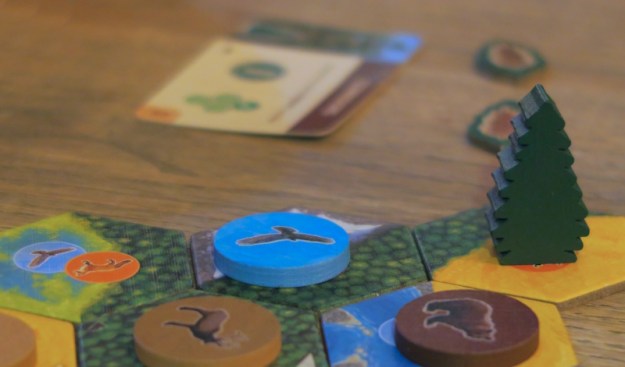
Cascadia: Landmarks
– Image by boardGOATS

Cascadia is one of the group’s most popular tile laying games.  The mechanisms of the base game are simple enough:  on their turn, players take a Habitat Tile/Animal pair from the market and add them to their territory.  The Habitat Tile can be placed anywhere, but the Animal Token must be placed on a Habitat Tile which depicts that Animal.  The market is then replenished back to four pairs until the Tile pile is depleted and the game ends.  The Tiles and Animals are drawn and paired at random, and players have to take the prearranged pair, they cannot freely mix and match unless they have a Nature Token, which they can spend to either change all the Animals, or to take an Animal from a different pair.

Cascadia
– Image by boardGOATS

Nature tokens are rewards for adding animals to Keystone Habitat Tiles, which, in general, are more difficult to fill because they can only hold one animal type (other tiles can take two or three).  While the mechanism is quite simple, the guts of the game is in the scoring.  Players score for each of the five Animals, Bears, Elk, Foxes, Salmon and Eagles, but the clever part is that the way each of these scores depends on which card is drawn at random from each of the five Animal decks.  Thus, the game plays very differently depending on the combination of Animal scoring cards drawn.

Cascadia
– Image by boardGOATS

In addition to animal scoring, players also score one point for each tile in their largest corridor of each of the five Terrain types, as well as earning bonuses if their largest area is the largest overall.  The Landmarks expansion consists of three new modules, one which increases the the potential player count, one which adds more variety to the scoring (more Animal scoring cards) and finally, the titular Landmarks.  The first of these adds a Personal Market of five Habitat Tile/Animal pairs for each player to give them something to think about (and potentially play) between turns.  This can be played at lower player counts, but is essential in larger numbers as it reduces perceived downtime.

Cascadia: Landmarks
– Image by boardGOATS

The second module is simply some more scoring cards, which adds more variety, but also a little more complexity as some of these are slightly more challenging to work with.  The final module, the Landmarks, changes things a little more.  These can be added to a Habitat Tile when the once the area of Terrain is large enough (spreads over five tiles or more).  These Landmarks also come with a choice of the available cards (drawn at random) which give bonus points at the end of the game, for example, for every Bear in the player’s Forests.  Each player can only build one Landmark on each Terrain type, and because the Landmarks occupy space, players start the game with one additional Keystone Tile.

Cascadia: Landmarks
– Image by boardGOATS

Blue, Pink, Plum, Black and Lime played with all three modules, making a point of choosing scoring cards from the expansion.  In contrast, although the Personal Market can be used for any player count, the four on the other table, Jade, Byzantium, Sapphire and Pine, only added the Landmarks module, choosing scoring cards solely from the base game.  Jade et al. got going first and were four or five rounds in before Blue’s Crew had even started, as the latter had more rules to cover and were a little later to start as they were too busy gossiping.  On the other hand, despite the fact that there were a lot of rules queries, at least they mostly got them right, in contrast, to the little rules malfunction on the other table.

Cascadia: Landmarks
– Image by boardGOATS

The rules for the Landmarks state that players may take a Landmark when they add their fifth or tile to a Terrain, or any subsequent addition, whereas Jade, Byzantium, Sapphire and Pine played that the Landmark had to be taken when the fifth Terrain Tile is added.  It was just a very little thing, but actually had quite a large knock-on effect. The problem was, if a Landmark is added to a Keystone Tile, then players don’t get the Nature token.  Worse, in some cases, players were taking Landmarks when the cards weren’t in-line with their strategy, just because they had to.

Cascadia
– Image by boardGOATS

As the games progressed, both groups realised that taking Landmarks can really restrict a player’s options, especially towards the end of the game when things can get very tight.  And forcing players to take unhelpful Landmarks just exacerbated this effect and meant some Terrains were stuck at four just to avoid some of the issues.  The games both progressed quite merrily, however.  Blue concentrated on a mixture of Animals and Terrain, going for Landmarks early in the proceedings. Plum, misunderstood and didn’t realise that players scored a point for each tile in their largest Terrain, so she concentrated on Animals, but did very well with her Terrain anyhow, by virtue of trying to get bonus points for having the largest areas.

Cascadia: Landmarks
– Image by boardGOATS

Pink asked a lot of questions and got a bit confused between when he could add Landmarks and when he could take tiles from his Personal Market.  So, he ended up concentrating on Foxes instead, “as he was a foxy sort of fellow” (and there aren’t any Pandas in the game).  Black meanwhile collected Elk, but all-round concentrated on animals rather than Terrain.  Lime commented, “Birds are difficult to understand, so I’m not going to bother with them; if I score at the end of the evening, so be it…” though he probably didn’t mean it to come out quite like that!  On the other table, Sapphire was collecting Elk, and Byzantium was focussing on Eagles while Pine concentrated on building his Terrain and Jade capitalised on the Landmarks.

Cascadia: Landmarks
– Image by boardGOATS

With or without the Landmarks expansion, Cascadia is a little bit of a “multi-player solitaire” game, that is to say, players can mostly quietly get on with their own thing without upsetting each others’ plans.  However, with Blue, Black and Plum all having a full set of five salmon, Pink and Lime struggled to get the last few they needed.  In the four-player base game, all the tiles and therefore all the animals are used and Lime hadn’t realised the expansion added more tiles, some of which had been removed and therefore, there was no guarantee that any of the lovely juicy salmon left in the bag were going to come out.  And much to Lime’s chagrin, so it proved, as he was left one short of the full set at the end of the game.

Cascadia: Landmarks
– Image by boardGOATS

The five-player game, despite starting later and having the extra player, finished at much the same time as the four-player game, demonstrating how the new mechanism in the Landmarks expansion really does speed the game up.  Despite the perceived, increased challenge associated with the new Landmark scoring cards, the five-player game was generally more highly scoring, with the Blue and Plum sharing victory, tied on a hundred and seven points (some fifteen more than Black in third) and tied on the tie-breaker too.  The other game was much closer, with a spread of just eleven points and with Pine finishing in first place with ninety-nine, only two points ahead of Byzantium who was the runner up.

Cascadia
– Image by boardGOATS

All in all, both groups liked the base game and enjoyed the game with the Landmarks expansion.  The group playing with all three Landmarks modules felt it was much more of a struggle, though both groups felt the Landmarks didn’t give all that many points unless you knew what you were going for and were able to really make them count.  Certainly, adding lots of Landmarks made things very difficult at the end of the game causing players to reject Animal Tokens, so although the rules say add an extra Terrain Tile, there was some discussion regarding the merits of “house ruling” the addition of a second in future, to encourage people to build Landmarks.

Cascadia: Landmarks
– Image by boardGOATS

Meanwhile, on the next table, Ivory had enticed Cobalt, Purple and Teal to play his new Christmas acquisition, Lost Ruins of Arnak.  It turns out that he wasn’t the only person in the group to receive this game over the holidays—Green had also been given a copy and would no doubt have been keen to play had he been able to come.  The game is set on an uninhabited island  where explorers have found traces of a great civilization. Players lead an expedition to explore the island, find lost artifacts, and face fearsome guardians in a quest to learn the island’s secrets.

Lost Ruins of Arnak
– Image by boardGOATS

The game combines deck-building and worker placement with resource management.  Players start with six cards in their deck, two Money, two Compasses and two Fear cards, and draw five to play.  As in the original deck-builder, Dominion, or in the racing games, Flamme Rouge and Snow Tails, Fear cards clog up players’ decks and more are acquired as the game progresses.  But also as in Dominion, there are ways to “exile” cards during the game.  So, players can try to keep a tight deck with minimal cards, or try to buy lots of cards that work well together.  Players then have two meeples each that can be sent to locations on the map, to either discover or use an action Location.  These generally give Resources plus some additions like draw a card, or gain a Fear card etc.. Each new site also has a Creature guarding it, which, if beaten, will give points and a small one-time bonus.

Lost Ruins of Arnak
– Image by boardGOATS

The Research Track is where players spend three of the resources, Tablets, Arrows and Jewels. Each player has two tokens which move up the same track giving different rewards as it ascends. Thematically, you can’t write stuff in the notebook until you find it with your magnifying glass, so the former can never overtake the latter on the track. And of course, the notebook gives cooler rewards. Players get one action each per turn, until everyone has passed and the game finishes after five rounds.  At the end of the game, Points are awarded for Cards, for progress on the Research Track, for discovering Locations and for beating Creatures; the player with the most points at the end is the winner.

Lost Ruins of Arnak
– Image by boardGOATS

The first round was very slow as there was only limited spaces to go and everyone had weak cards in hand. Purple, Cobalt and Teal all focused on building up resources and buying tool cards for future rounds where Ivory did something a little different and started progressing along the Research Track as well as opening up new Dig sites. The issue with this was that he picked up a Fear card, though fortunately he had already got rid of one of his initial Fear cards through the site he opened so there was no net negative effect.  In the second round, things picked up and strategies started to become apparent.

Lost Ruins of Arnak
– Image by boardGOATS

Cobalt continued to focus on getting Tools, especially ones that allowed him to draw extra cards (and hence allowed additional actions) and he started making headway on the Research Track and was first to unlock an Assistant. He also did a little exploring, but did not overcome the Guardian. Ivory wasn’t far behind on the Research Track and also continued to explore new areas (and this time overcome the Guardian) and make up for lost ground in getting tool cards. Teal went for a very different strategy and started to focus purely on exploring and overcoming Guardians, netting him three points for exploring and gaining the idol and five points for overcoming the Guardian. Purple, on the other hand, continued to focus mainly on building her supply of resources.

Lost Ruins of Arnak
– Image by boardGOATS

The third round continued in much the same vein with everyone continuing to pick up Tools and starting to gain Artifacts. Ivory focused almost exclusively on the Research Track and was able to catch Cobalt and had picked up all the bonuses, while both unlocked their second assistant. Teal was continuing his exploring strategy to great effect, whilst Purple continued to bide her time building up resources, including a significant amount of Rubies (the most valuable resource).  And so it continued into the next round too, except Cobalt began spending his Compasses on Artifacts while Ivory continued to hoard them for the last round.

Lost Ruins of Arnak
– Image by boardGOATS

And it was in the final round that Ivory’s plan became apparent as, in true Ivory style, he used all his Compasses to explore a level two Dig Site. Hitherto, exploration had been limited to level one sites and Ivory was the first to explore a higher level, thinking this would be a fun thing to do. In the end, this ironically might have been the critical move that influenced the outcome of the game. The level two site gave Ivory valuable resources, helping him complete the Research Track just after Cobalt and also overcome the newly uncovered Guardian. With two idols on a level two site, this gave Ivory eleven points.

Lost Ruins of Arnak
– Image by boardGOATS

Teal continued with his strategy and also explored a level two site and began moving along the Research Track too. Purple used all her carefully collected resources and make a late dash to the top of the Research Track, gaining valuable points.  It should be said the whole work placement element of the game felt very tight with limited spaces at the start and then difficulty knowing whether to take the optimal route planning cards first, but potentially missing out on a valuable space to other players, or taking the sub-optimal route and placing your workers first guaranteeing the activity, but at a cost of efficiency.

Lost Ruins of Arnak
– Image by boardGOATS

Everyone got blocked at some point (except perhaps Teal who was opening up new sites), and certainly towards the end of the game everyone wished they had more than two workers!  Teal with his explore/overcome Guardian strategy led to him defeating a very impressive impressive six Guardians and gave him a total of sixty-eight points.  In the end, however, the fact Ivory completed the Research Track and was also able to explore and overcome Guardians gave him the victory by just three points with a winning total of seventy-one.  It was a very good game though, one greatly enjoyed by all involved.

Lost Ruins of Arnak
– Image by boardGOATS

Learning Outcome:  Now we know what Bears do in the Woods!

12th July 2022

Blue, Pink, Orange, Lemon and Plum all started with food, and Pink’s was accompanied with cocktails (again).  There was a lot of chatter about playing something, but when Pine arrived, that ruled out …aber bitte mit Sahne (which we played last time).  While the discussion about what to play and how to split the group was on-going Purple and Black arrived, so the discussion moved on to who would play what and who else was expected.  In the end, Pink and Plum took themselves off to the other side of the pub to start setting up Altiplano while everyone else admired the 1980s box for the “Feature Game“, the bike racing game, 6-Tage Rennen (aka 6 Day Race).

6-Tage Rennen
– Image by boardGOATS

When Lime, Ivory and then Teal rolled up a few minutes later, Ivory joined the Altiplano game, but Teal, after a tough day, eschewed its complexity and decided to go for a gentle cycle ride with the other group instead.  In contrast to Flamme Rouge which we all played last time and emulates road racing, 6-Tage Rennen is set in a velodrome and mimics a six day race meeting.  It is quite simple, much simpler than Flamme Rouge actually, but in spite of this the group still managed a “rules malfunction”.  Similar to Flamme Rouge, the game is card driven, but rather than choosing simultaneously and then playing in race order, in 6-Tage Rennen players choose their card and play in turn order.

6-Tage Rennen
– Image by boardGOATS

There are a couple of other key differences.  Firstly, slip-streaming works differently:  if a player lands on an occupied space, they move again. If that space is occupied by two riders, the active rider moves twice more and if it is occupied by three or more riders, then they can really make a killing.  Also, 6-Tage Rennen is a points race, which means it is the player with the most points at the end who wins, not necessarily the first player to cross the line.  Points are available for the first riders to finish with ten points for first place, but also at the intermediate sprints of which there are two, earning five points for the first riders to cross each line and in both cases there are points for the minor placings.

6-Tage Rennen
– Image by boardGOATS

Teal went first and moved a single space, followed by Blue who used Teal to bounce on an extra space.  Pine, Purple, Black and Orange, further demonstrated how to use the slip-stream mechanism, but it was Lemon, who like last time in Flamme Rouge, took an early lead, though this time without the penalty of Exhaustion cards.  Not only did Lemon take an early lead, but she held it to the first sprint line taking the maximum five points, leaving Teal, Blue and Pine to take the three, two and one respectively.  It was then that the rules malfunction really took effect.

6-Tage Rennen
– Image by boardGOATS

The game is over thirty-five years old and imported from Germany, so the rules were originally in German, but this copy had two English translations. Unfortunately, these were both a bit unclear and, as a result, both Blue and Pine misunderstood how many green cards players started with.  This meant everyone ran out of cards very quickly and Blue, on the fly decided players would refresh their hand from the grey cards.  As Pine pointed out, this was likely to leave a shortage, so the number of cards was reduced slightly.  This meant some players ran out more than once and replaced their cards several times as a result which changed the game massively.

6-Tage Rennen
– Image by boardGOATS

Still, as everyone was playing with the same rules and nobody wanted to just start again, the group played on.  Lemon led the pack over the second sprint line too, and then over the finish line to a landslide victory with the maximum twenty points, twice her nearest rival, Teal.  The game hadn’t taken very long, and Black had long said he thought 6-Tage Rennen was better than Flamme Rouge and he along with some others were keen to play again with correct rules.  So, Pine dealt out the correct number of green cards and Lemon, as the winner of the first race went first in the second.

6-Tage Rennen
– Image by boardGOATS

The first thing noticed was the lack of a six in the starting hand.  As Black pointed out, this was key to the strategy of the game—staying six spaces ahead of other riders helps stop players from “getting a bounce” and moving ahead, and that’s where the grey cards come in.  Half-way round the track, there is a “special space” and players who land on this space discard their cards and replace them with grey ones.  The starting green hand has a seven, two fives, several fours along with some lower value cards and should just last the duration of the race.  Landing on the special space gives cards taken from two piles drawn at random—six slow cards (value one to three) and four fast cards (value four to six).

6-Tage Rennen
– Image by boardGOATS

This time, Orange started fast taking the first sprint and continuing on to the special space where he traded in his cards for new grey ones.  Lemon wasn’t far behind though, followed by Lime and Teal.  Purple demonstrated how to play the game by getting a “double bounce” on her seven, moving twenty-one spaces from the back to near the front on a single turn.  That left Blue and Pine who, reminiscent of last time, were “gapped” and struggled to keep up with the pack.  Before long, Pine was dropped and resignedly, rolled slowly round the track; he would have stopped at the pub if he hadn’t been in a velodrome!

6-Tage Rennen
– Image by boardGOATS

As the game unfolded, Teal commented on how clever it was and added, “It’s almost like it’s been play-tested…”  Meanwhile, Black joined Blue and they worked together briefly until their teamwork broke down just before they were able to catch up with the lead riders.  Lemon stalled on the “miss a turn” special space, allowing Teal to sneak past and pip her to the line.  As everyone else made their final lunge for the finish tape, Lime and Purple positioned themselves for the minor places before Lemon accelerated past and crossed the line to take second.  It being a points race, it was the total, not the finishing positions that count.  It was much closer this time than in the first race, but the placings were still the same with Lemon just beating Teal, and Lime taking the bronze medal.

6-Tage Rennen
– Image by boardGOATS

All this time, on the other side of the room, Pink, Plum and Ivory were playing Altiplano (with the Sunny Days mini-expansion).  Altiplano is a worker-placement bag building game that is a re-implementation of the bag-building mechanic used in Orléans.  The idea is that players draw resources out of their bag and place them on their personal action boards.  Then, players take it in turns to move their “worker” round the rondel to different locations where they can carry out corresponding actions assuming they have the right resources in the right place.  In essence, the game can be boiled down to one of resource improvement, for example, players can use an Alpaca to get Wool which they can later turn into Cloth.

Altiplano
– Image by boardGOATS

Points are scored for the resources at the end of the game, with more valuable resources worth more points.  Picking up Hut cards also increases the value of resources.  When a player no-longer needs a resource, they can move it into their warehouse with completed “shelf-fulls” scoring points at the end of the game.  Players have to be careful with this however, as once a resource is in the warehouse it cannot be used anymore.  Additionally, players can also score points by completing contracts.  It is the player that best interweaves these different aspects of the game that wins.

Altiplano
– Image by boardGOATS

All three players felt they were making a poor fist of things and agreed they were “playing sub-optimally”.  Ivory concentrated on collecting and completing contracts.  In contrast, Pink completely eschewed contracts and instead focused on getting Glass tokens—the most valuable of the resources.  To do this, he had to get cocoa first, which he did by taking the Cocoa Canoe and with it one Cocoa resource.  He then increased the value of his Glass by taking the matching Hut.

Altiplano
– Image by boardGOATS

As a bit of a chocoholic, Plum also wanted Cocoa but as Pink had nabbed the Cocoa Canoe, the only way she could get it was to buy an Extension board.  Unfortunately, the first one was too early for her and she couldn’t afford it.  The next Extension had the “Navigation” anchor icon on it associating it with the Harbour Location, but players are only allowed one Extension board at each Location and, as Plum started with the Fisherman, she was not able to get that one either.  The next Cocoa opportunity didn’t come up until much later in the game, by which time it was too late really.  She did take an Extension eventually, one for the Mountains, which enabled her to exchange Food to give Ore which she was then able to convert into Silver.

Altiplano
– Image by boardGOATS

Last time the group played Altiplano, we discovered a “rules malfunction” associated with the purchase and use of carts.  Unfortunately, although many other aspects of the rules were checked, this was overlooked, so instead of always being able to move one space for one food token, or more with a cart, the group played that they could only move if they owned a cart and then only move one space.  That meant movement was much more difficult and made life more challenging.  Once again, everyone was playing by the same rules, so it wasn’t hugely important though it may have shifted the balance of the game a little.

Altiplano
– Image by boardGOATS

There was a nice atmosphere during the game though.  In a Star Wars reference, Pink advised Plum, “Not to go trading with The Huts” and politely waited until the ladies were no-longer present before indulging in comments about his Woodcutter “getting some wood”.  When he started getting wood, however, he couldn’t stop and finished with a particularly large pile.  Ivory started with the Farmer and used his Alpaca to produce wool and wove that into some very high quality scarves.  There was something remarkably “Fishy” about Plum’s strategy but especially when she carefully stashed too many of her fish in her warehouse and then ran out of resources.  She had far more money than anyone else, but ultimately though, there was nothing anyone could do about Pink, who’s Glass factory gave him clear victory.

Altiplano
– Image by boardGOATS

The cycle race finished long before the activities on the high plain.  Lime decided to head off to make sure he got home before the infamous Oxfordshire road closures cut him off, and Teal having enjoyed his evening on the bike also took an early night.  After some more chatter, the remaining six began “a quick game” of Bohnanza.  This is one of our all-time favourite games, and it was time to introduce it to Orange and Lemon.  Although it is not difficult, it is very different to the games we’ve played in the last few weeks, and is considerably more challenging if English is not your first language.

Bohnanza
– Image by boardGOATS

Bean farming might not seem an exciting theme, but the game is great fun and relies on the simple premise that players must not change the order of the cards in their hand.  On their turn, the active player must plant the first card, the card at the front of their hand, and may plant the second card if they choose.  Players have just two Bean Fields to work with, and each one can only hold one type of bean at any one time.  Once the active player has planted their bean or beans from their hand, they turn over the top two cards in the central deck—these must also be planted before the game can progress, though the active player can trade them with another player or even give them away.

Bohnanza
– Image by boardGOATS

Once the two cards on the table have been planted, the active player may trade cards from their hand before drawing replacement cards.  At any point a player may harvest beans, but the more cards they harvest, the more they are worth.  However, if a player has a field with only one bean in it, they must harvest their larger field first.  At the end of the game, the player with the most coins is the winner.  Normally, the game ends after the third turn through the deck, but this time, because time was running short, the group finished after the first pass.  This meant the group missed out on way the balance of the deck changes and the rare cards get rarer and the deck gets progressively shorter.

Bohnanza
– Image by boardGOATS

Purple started, and talked through her turn, followed by Blue.  Pine knew what he was going to do and got on with it as did Black, before it was Orange and then Lemon’s turn.  Purple started collecting Green and Soy Beans, with Pine planting Wax and Black-Eyed Beans.  Orange competed with Blue for Red and Coffee Beans and with Black for Chili Beans.  Lemon started with Blue Beans and later moved onto Green Beans.  There were lots of “generous trades” and gifts too—the group generally play together nicely, but tonight, the heat and the tiredness all round, meant everyone was especially kind to each other.

Bohnanza
– Image by boardGOATS

With time marching on, the group agreed to call a halt when the deck ran out the first time, even though that meant Pine missed out on two turns that he had set up beautifully.  It was a really close game, but it was Blue who just won the chocolates that Pink offered up for first prize.  As she was only one point clear, she shared her winnings with Lemon who generously passed her’s on to Purple.  It was hot and late, and as everyone left, the pub locked up behind them.

Chocolate Prizes
– Image by boardGOATS

Learning Outcome:  Games usually play better with the rules as written.

28th June 2022

When Blue, Pink, Orange and Lemon rolled in (late thanks to the delights of the Oxford traffic and garden watering), Plum was already there.  A gamer with Gweeples in Didcot, Plum was a friend of Burgundy’s that members of the group first met at his funeral about six months ago.  While she finished her tagliatelle, Blue and Pink waited for their supper to arrive, and everyone admired Pink’s Pornstar Martini, the group revisited Tsuro, which Orange and Lemon had enjoyed so much on their first visit, last time.

Tsuro
– Image by boardGOATS

While setting up, Pine arrived and needed a quick reminder of the rules, but that only took a moment:  players have a hand of three tiles and, on their turn place one of them in front of their stone and extend it’s path, moving their stone (and any others) to the end of its path.  Players are eliminated when their stone goes off the board or collides with another stone—the last player on the board is the winner.  First blood went to Blue, who took out Lemon and Pine, but that was collateral damage as she had no choice and went off the board herself at the same time.

Tsuro
– Image by boardGOATS

Pink was next, being trapped and left with no option, and then just Plum and Orange remained to duel it out.  There was very little space left on the board and the writing was already on the wall when Plum went off.  That left Orange a worthy winner, especially as he had a tile to spare too.  Teal arrived and while Blue and Pink fed, he led everyone else in a game of No Thanks!.  This is a game we’ve played a lot in the group and is a very clever design but like all the cleverest games, has very simple rules.  Played with a numbered deck of thirty-two cards, the idea is that on their turn, the active player can take the card in the middle or pay a chip to pass the problem on to the next person.

No Thanks!
– Image by boardGOATS

The next person has the same decision:  they can take the card and the chip, or pay a chip, and so on.  At the end of the game, a player’s total score is the sum of the face value of the cards they took and the player with the lowest number wins.  There are two key points that make the game, however.  Firstly, if a player has consecutively numbered cards, only the lowest card in the run contributes to their total, which means cards have different values to different players.  Secondly, nine cards are removed from the deck, which adds jeopardy on top.  The game can play out in several different ways.

No Thanks!
– Image by boardGOATS

The player or players with the most chips are always in control, until one player is left with so few chips or runs out completely, that they are forced to take cards even when they don’t want them.  This can prevent players, even those with lots of chips, from getting the cards they need to close runs causing the strategy to back-fire, and leaving those with the most chips with the most points as well.  This time, Orange and Teal amassed a huge pile of chips each, but both managed to avoid ending up with multiple high scoring runs.  Then someone dropped a chip on the floor giving Pine the opportunity to recount the tale of how he dropped a chip between the floor boards and how it is still there despite everyone’s best efforts.

No Thanks!
– Image by boardGOATS

This time, the dropped chip was recovered successfully and the game ended without further mishap.  Orange and Teal took first and second respectively, giving Orange two in two games to match Lemon’s achievement at the start of last time.  By this time, the feeders had finished feeding and everyone else had arrived, so it was time for the “Feature Game“.  To mark the start of the Tour de France later in the week, this was to be the Peloton expansion for the cycling game, Flamme Rouge.  Flamme Rouge is a fast-paced, tactical bike-racing game where each player controls a team of two riders: a Rouleur and a Sprinteur.  The aim is to manage the first rider to cross the finish line.

Flamme Rouge
– Image by boardGOATS

Each rider has a deck of cards, and Players move their riders one at a time, by drawing four cards from the rider’s deck, choosing one to play, and recycling the rest.  Once every player has picked cards for both their riders, players simultaneously reveal their cards and, starting with the cyclist at the front, each rider is moved in turn.  After all the riders have moved, slip-streaming takes effect, with groups that have exactly one space between them and the group in front moving forward to remove the gap.  Finally, every rider that still has an empty space in front of them is deemed to be riding into the wind and takes an exhaustion card which goes into their deck—these are bad because they are slow cards and block up plays’ hands.

Flamme Rouge
– Image by boardGOATS

At the start of the race, everyone’s Rouleurs have the same cards, and everyone’s Sprinteurs have the same cards.  The Rouleurs have lots of cards with a similar face value, where the Sprinteurs have some cards that are faster and have a higher value, which are offset by others that are slower and have a lower value.  Players have to balance how they manage their riders and make the most of the slip-streaming opportunities.  The game is modular with the option to add hills to the base game.  The Peloton expansion adds extra riders (so that the game plays up to six players), cobbled sections (aka “Pavé”), Feed Zones, and rules to set up a break-away.

Flamme Rouge
– Image by boardGOATS

Unusually with so many people, rather than splitting in to three groups playing three different games, we split into just two with both playing the same game.  Since the Grand Départ was due to take place in the essentially flat Denmark this year, both groups largely played without hills, but included cobbled sections (à la Stage 5, from Lille to Arenberg, a week later).  Cobbled sections change width frequently and are generally narrower than normal road, but perhaps more importantly, riders can no-longer benefit from slipstreaming but still get exhaustion cards.  The slightly larger group, led by Ivory and Teal also decided to start with a break-away.

Flamme Rouge
– Image by boardGOATS

Their chosen route was Stage 11 of the stage race and took in three sections of Pavé.  The first of these was shortly after the start, the second after the first hairpin and a short slight up-hill ramp, and the third was after a second hairpin and a little chicane.  Teal and Lime made it into the breakaway and they stayed away for most of the game.  Being at the front “pushing air out of the way” all the time is tiring though, and inevitably, they picked up a lot of exhaustion cards.  That meant that as the Peloton was bearing down on them, just as the finish line was in sight, they didn’t have the energy fend them off.

Flamme Rouge
– Image by boardGOATS

As a result, Black and Pink, who had been sheltering in the middle of the group slid across the line just ahead of the gallant breakaway, who were definitely candidates for the day’s combativity award.  Black took first place, having spent most of the race doing as little as possible and saving it all for the final sprint.  While saving energy is a good tactic, Purple took it to a different level picking up no exhaustion cards at all, though she wasn’t able to turn on the burners in time to take advantage of it.

Flamme Rouge
– Image by boardGOATS

The smaller group, led by Blue and Plum rode a simpler route based on the Avenue Corso Paseo ride, with a cobbled section in the middle between the two hairpin bends.  With most people in this group new to the game, they decided to keep things simple and eschewed the complexities of hills completely, sticking to a pan-flat course, and kept to the standard roll-out used in the base game.  First Orange and then Lemon rode off the front while Pine and especially Blue were repeatedly under threat of being spat out of the back of the peloton.  Most rounds seemed to end with Blue breathing a sigh of relief as she managed to hang on and Lemon laughing as she picked up yet another exhaustion card.

Flamme Rouge
– Image by boardGOATS

Once the riders had passed the Pavé the speed picked up and Blue and Pine started to try to move forward in the field.  Lemon who had led most of the way “bonked” and “hit the wall”, and as a result, was unceremoniously dropped.  It was tight, but Pine’s Rouleur was first over the line just holding off Plum’s first rider who took second followed by Pine’s Sprinteur who took third.  It had been a close and quite attritional race, but despite the fact there were fewer riders with a shorter parkour, the race finished at much the same time as the other one.  So races were compared and there was a bit of chatter about other options as people packed away.

Flamme Rouge
– Image by boardGOATS

Ivory took himself off for an early night, as did Teal, but those that were left were keen to play on, albeit not for long in some cases.  Inevitably there was a lot of discussion about what to play, but when Ticket to Ride got a mention, Pine and Lime were keen to give the London version a run out, and were quickly joined by Pink and Purple.  Ticket to Ride is one of our favourite games and we play a lot of different versions, short and long.  They all have the same basic structure, but different layouts on different maps, and often with a little rules change.  In summary, in the original game, players are connecting cities across the USA.

Ticket to Ride (USA)
– Image by boardGOATS

They do this by collecting coloured cards and then spending those cards to place trains.  Players score points for placing trains and also for completing “Tickets” by connecting two cities together by any chosen route—the further apart the cities, the more points they are worth.  The game end is triggered when one player has only two train pieces left and at the end of the game, the player with the most points is the winner.  The original game takes around an hour to play with the full compliment, but more recently, there have been a number of smaller, lighter versions available.  They have the same rules, but players have fewer pieces and the maps are more congested, based on cities like New York, Amsterdam and later this year, San Francisco.

Ticket to Ride: London
– Image by boardGOATS

This time, however, the version chosen was London.  In this edition, players are placing buses to mark routes, and in addition to scoring points for claiming routes and Tickets, players also score points for connecting all the places in the same district. Pine won the “name the people on the front of the box” competition and went first.  Lime crossed the city travelling from Baker Street to The Tower of London while both Purple and Pink did the same but from Buckingham Palace to Brick Lane, and via different routes. Pine had a northern route and a south route that looked like they would join up in the middle, but didn’t quite make it.  He did manage to claim a district though, the only player to do so for a district of any significant size.

Ticket to Ride: London
– Image by boardGOATS

It was very close between first and second, though there was a bit more distance to Pink in third.  In the end, Lime just pipped Pine to victory by two points.  Meanwhile, there had been some debate between the other five as to what they would play.  Blue suggested introducing Orange and Lemon to one of our old stalwarts, 6 Nimmt!, but it wasn’t one of Plum’s favourite games.  So instead, Blue and Black introduced everyone else to …Aber Bitte mit Sahne, a clever but simple little “I divide, you choose” game.  The idea is that one player is The Baker who divides the cake into pieces and then everyone else takes it in turns to take a one of them.

…Aber Bitte Mit Sahne
– Image by boardGOATS

Each slice of cake has a type, a number on it and a some cream.  When a player takes cake, they can choose to eat it or store it.  For all eaten cake, players a point for each blob of cream.  For stored cake, however, the player with the most of each type will score the number of points associated with that type.  The clever part is that the number of points is equivalent to the number of slices of that type in the game, so the more common types which are harder to get a majority in are worth more, but they also have the most cream, tempting players to eat them straight away.

…Aber Bitte Mit Sahne
– Image by boardGOATS

It is always difficult for the first couple of players to take the role of Baker, but this is exacerbated with five players.  Blue went first, then Black.  It was only a couple of rounds in, that the twinkle appeared in Plum’s eye as she realised how clever the game was and expressed her approval.  It was quite tight in the early stages with players staking their claims to different sorts of cake.  There was competition for kiwi and redcurrent, but others went largely un-stored (and therefore eaten).  After everyone had been the Baker it was time to see who had the most of each and add up the scores.  Black got lucky with the chocolate as everyone else was greedy and ate theirs.

…Aber Bitte Mit Sahne
– Image by boardGOATS

Unfortunately, there was a rules misunderstanding and Orange thought he would get points for every slice he kept if he had the most of that type, so we’ll have to play it again soon so he can try again.  This time though, Black who had been very abstemious and eaten none of his cake, ran out the clear winner with thirty-five points to Blue’s twenty-nine and Plum’s twenty-seven for second and third place respectively.  Ticket to Ride: London was still underway on the next table, so as Orange and Lemon had not played it before, Blue got out Dobble.  We’ve not played this in the group for years, but it is a fantastic little Snap-based filler.

Dobble
– Image by boardGOATS

The idea is that every card has several pictures and each card shares exactly one match with every other card in the deck and using this principle, there are five possible Snap-based games.  Black decided discretion was the better part of valor and opted to spectate while Plum had a significant drive so headed off, leaving just Blue, Orange and Lemon.  They started with a pile of cards each and the winner the first to shed their pile onto the central one.  The game was all very well, but there was a vocabulary check as, although Blue said they could play in Ukrainian, Orange and Lemon were game to give English a go.  Once the items had been identified, the mania started.

Dobble
– Image by boardGOATS

As it was a trial game, the piles weren’t carefully measured, but Orange quickly got the hang of it and in spite of the language differences, managed to shed his pile first for yet another victory.  From there, the group did the reverse and started with one card and grabbed progressively matching cards from the middle.  This can be quite savage, which is why Blue opted for the gentler game first.  Still, everyone was well-behaved and nobody got scratched.  The tension and concentration was palpable though and Ticket to Ride finished and Lime and Pine left with only a a cursory grunt from those playing Dobble, before Blue just edged it to win the final game of the night.

Dobble
– Image by boardGOATS

Learning Outcome:  Tour de France coverage is available on ITV4.