Tag Archives: Ganz Schön Clever

Spiel des Jahres Winners – 2025

Last weekend, this year’s Spiel des Jahres (German Game of the Year) winner was announced as Bomb Busters, by Hisashi Hayashi, the designer of Trains, MetroX (aka Voll Verplant), String Railway and Yokohama.  Based on the earlier Bomb Squad by the same designer, this is a cooperative, card driven game, where players work together to try to defuse a bomb before it explodes.  Players begin with a hand of numbered Wire cards (four each, numbered one to twelve) and then take turns pointing at each others’ wires and guessing their values.  Correct guesses lead to wires being cut, incorrect guesses and the detonator advances…

Bomb Busters
– Adapted from image by BGG contributor spiritraw

The winners of the Kinderspiel des Jahres (Children’s Game) and the Kennerspiel des Jahres (“Expert” or “Connoisseur’s” Game) were announced at the same time. The Kinderspiel des Jahres went to Topp die Torte!, which is a tile laying game by Wolfgang Warsch—a previous winner of the Kennerspiel de Jahres in 2018 with Die Quacksalber von Quedlinburg (aka The Quacks of Quedlinburg) and designer of The Mind, Ganz Schön Clever and Quacks & Co., all of which have received recognition from the jury in recent years.  This year, the Kennerspiel des Jahres award went to Endeavor: Deep Sea by New Zealand designers Carl de Visser and Jarratt Gray, a game where players explore the deep sea using the action mechanism from Endeavour: Age of Sail (and its predecessor Endeavor).

Endeavor: Deep Sea
– Image from kickstarter.com

Endeavor: Deep Sea can be played competitively or cooperatively with up to five players (using the Deluxe edition). This means that as last year, both the “senior awards” have gone to cooperative games.  Indeed, the last four Spiel des Jahres awards (Sky Team, Dorfromantic, MicroMacro and Just One) and three of the last five Kennerspiel awards (Paleo and The Crew as well as e-Mission/Daybreak) have gone to cooperative games.  This style of game is clearly very popular with families (where arguments are often best avoided), but can be less so with more traditional gamers who prefer a bit of competition.  As such, cooperative games very much have the “Marmite Factor”, but in such cases, the nominees and recommended lists cater for every taste, with games like Looot, Castle Combo, Faraway and Flip 7.

Bomb Busters
– Image from spiel-des-jahres.de

6th August 2024

Blue and Pink were just finishing their supper when Pine arrived, soon followed by the rest of the posse.  Despite missing Ivory, Teal and Cobalt, we still made it into double figures and everyone was particularly pleased to welcome back Green who has been missing in action for most of the year.  Jade had declared an interest in giving the France map for Ticket to Ride a go.  Ticket to Ride is always popular, so he quickly gathered Sapphire, Pine, Lime and Pink to make an enthusiastic group of five.  He explained the rules differences, to comments of, “Lizen very carefully, I shall say zis only once!”
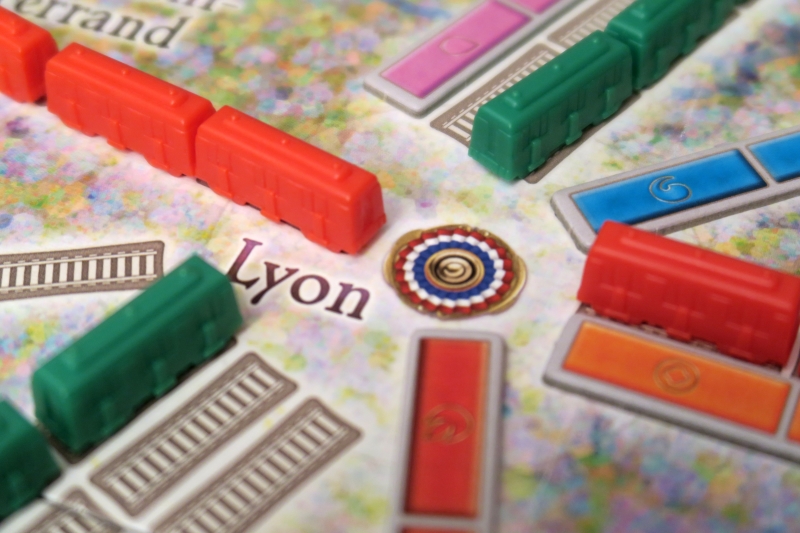
Ticket to Ride Map Collection: Volume 6 – France & Old West
– Image by boardGOATS

Ticket to Ride is well known in the group and the basic rules needed no explanation (take cards from the market, or use them to claim routes while trying to complete Tickets).  All the maps have their own little unique tweak to the rules.  In the case of the France map, most of the tracks on the board start “uncoloured”.   Whenever anyone draws cards, they take a colored tile that’s two to five train cars long, and place it onto an uncoloured track bed.  After that, any player can claim that route in the usual way (by paying the appropriately coloured cards from their hand).

Ticket to Ride Map Collection: Volume 6 – France & Old West
– Image by boardGOATS

Although anyone can claim a route “coloured” by another player, this time, in practice, most people didn’t build on tracks placed by others.  This was partly because messing with someone else’s plans is usually at the expense of your own, but also because of the “mutually assured destruction” effect—that is to say, interfering with someone else is likely to encourage them to do the same in return.  So on the one occasion when Pine DID “steal” a route that Sapphire had set up, everyone (especially Sapphire) was really shocked! Pine and Sapphire both picked up tickets in the very closing stages of the game and both got very lucky with the tickets matching the routes they had already built.
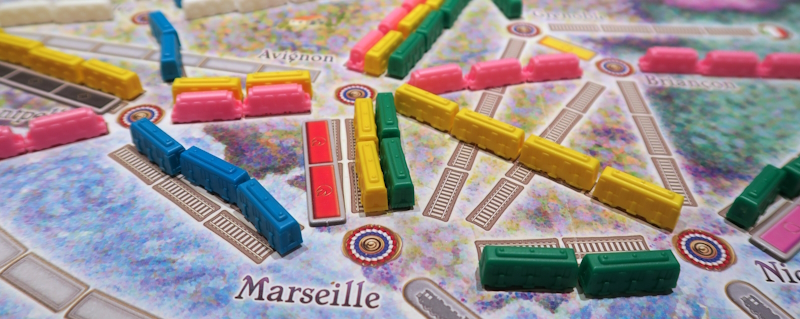
Ticket to Ride Map Collection: Volume 6 – France & Old West
– Image by boardGOATS

The game was quite close and relatively high scoring, with all five finishing in a twenty point range, but that was before bonuses.  With the France map, there are two bonuses:  ten points for the longest continuous route and fifteen points for the player with the most completed tickets.  With seven, Pine had the most tickets and leap-frogged Jade and Pink (who was playing with his pink “Cancer Awareness” train set), into third place.  That left Lime and Sapphire, but with Sapphire taking the longest route bonus, he finished with a hundred and twenty-nine points, extending his lead over Lime to fifteen points to give him a comfortable victory.  It had been a really enjoyable game, however, so much so that Jade and Sapphire added it the France map to their wish list.
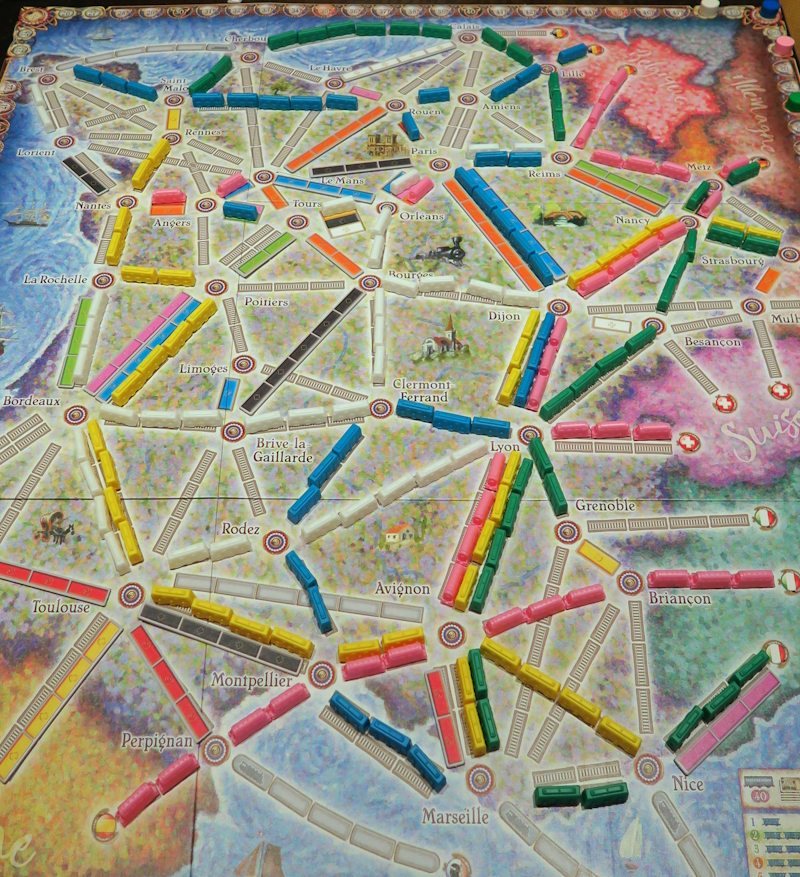
Ticket to Ride Map Collection: Volume 6 – France & Old West
– Image by boardGOATS

At the other end of the table, that left Blue, Plum, Green, Byzantium, Purple and Black.  Nobody seemed keen to play the “Feature Game” (which was to be Montmartre), partly because that would have required splitting into two groups.  Instead, inspired by the Olympics, the group opted for the Heptathlon variant of Reiner Knizia’s Decathlon.  Decathlon is a print-and-play game consisting of a series of ten different, mostly push-your-luck, dice games loosely themed around the ten sports featuring in the Olympic event.  The Heptathlon Variant is slightly shorter and is based on the women’s equivalent.
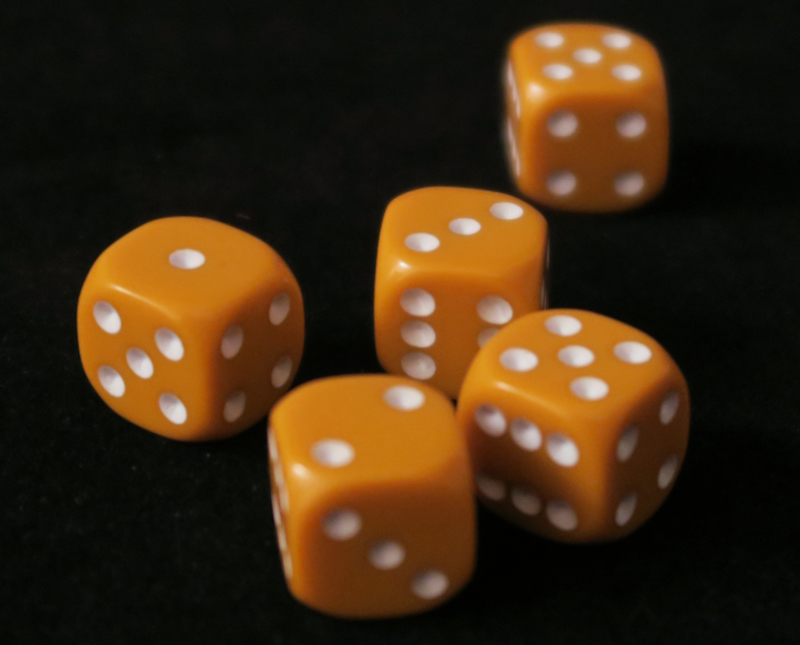
Reiner Knizia's Decathlon (Heptathlon Variant)
– Image by boardGOATS

Normally both variations are played with a maximum of four, but this time, the group played the “Championship Variant” where players play together and the winner of an event scores three points, the runner up gets two points and the person placing third gets one point.  The rules say that tied players get the better rank, but the group used count-back to break ties in the first instance.  Blue had brought an enormous pile of printouts and Las Vegas, from which the group got the dice, and started, slightly tentatively with the 100 m Hurdles.  In this game, players have two sets of three dice and throw one until they are happy then throw the other with a total of seven tries.  The catch is that each “one” that is re-rolled scores minus one.
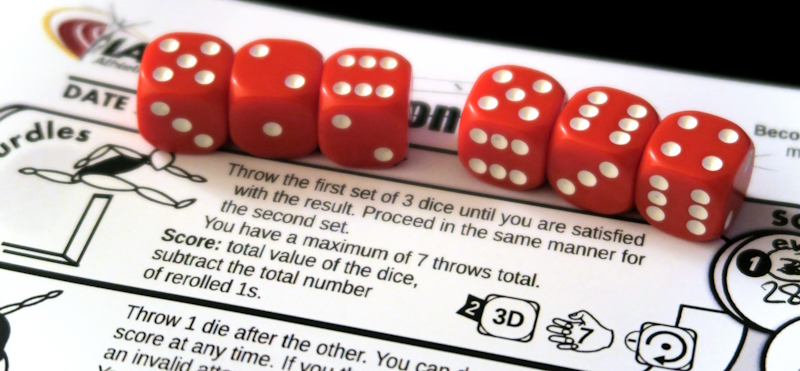
Reiner Knizia's Decathlon (Heptathlon Variant)
– Image by boardGOATS

Green went first and achieved a total of twenty-three.  By the time he had finished though, everyone had got bored watching someone else roll dice and had got on with their own.  It was then that the group realised that, as the 100 m Hurdles was a race, rolling simultaneously was more in keeping with the theme.  Blue crossed the line first (with twenty eight) followed by Byzantium and then Green.  And it was on to the High Jump, a much simpler game where players rolled five dice together to achieve an ever increasing total (with three attempts at each height).  Purple was the first out, failing to achieve eighteen, followed by Blue at the next height.

Reiner Knizia's Decathlon (Heptathlon Variant)
– Image by boardGOATS

The “springiest” was Plum, who sailed over twenty-two, but failed at twenty-four.  She actually tied with Green, but beat him on count-back, with Byzantium taking third.  Next was the Shot Put, where players roll eight dice, one at a time, with a one being a fault.  Players can stick whenever the like, but because of a rules malfunction, the group only played with a maximum of six dice.  The best score after three attempts was again Plum with Black in second and Blue in third.  From here the games got a bit more complex, starting with the 200 m Sprint, which was played with eight dice rolled in a group of four dice, followed by two rolls of two.  Players have a total of eight throws and sixes count negatively.
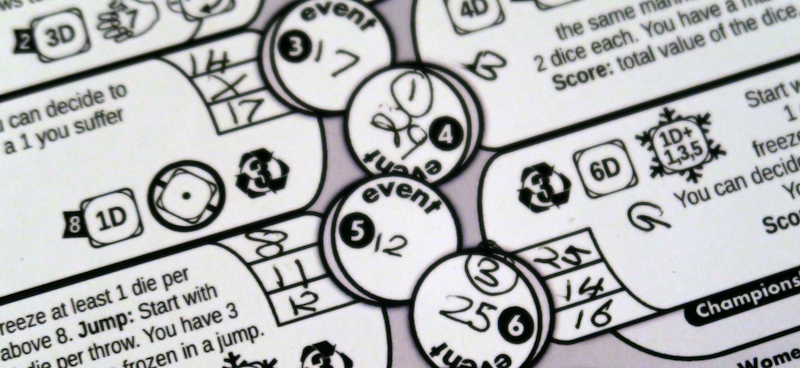
Reiner Knizia's Decathlon (Heptathlon Variant)
– Image by boardGOATS

Plum tripped over her own feet (or maybe Byzantium tied her laces together), but Green demonstrated a remarkable turn of speed to cross the line first, followed by Blue and then Purple.  More than half-way through, it was a three-way tie between Blue, Green and Plum and others not far behind.  So, the second day started with the Long Jump, a five dice game played in two parts.  First there was the run-up, which dictates how many dice the player gets to use for the actual jump.  For the run-up, players roll all five, freeze at least one and roll the rest, but if the total exceeds eight, it is a foot-fault.  Then, for the jump itself, players use the frozen dice and roll all of them, again freezing at least one per throw.

Reiner Knizia's Decathlon (Heptathlon Variant)
– Image by boardGOATS

The best total after three attempted jumps was Byzantium’s twenty-seven.  Green’s turn of speed obviously helped him as he came second while Blue and Plum tied for third, but Plum took the honours thanks to her second longest jump.  Staying in the field, the next and penultimate event was the Javelin.  This six dice game involved players freezing at least one die per turn, but this time only odd dice could be kept.  Green’s first throw threatened to skewer one of the stewards, and things didn’t get much better from there.  Black faulted on his first throw, but was consistent with his second and third taking third with twenty-two.

Reiner Knizia's Decathlon (Heptathlon Variant)
– Image by boardGOATS

First and second went to Purple and Byzantium (respectively), with both failing to improve on an excellent first attempt.  So, going into the final event, the 800 m Race, most people were going for Gold, while everyone was in with a chance of a medal.  This race was an eight dice game with players rolling two dice, then two dice and then the four remaining dice one at a time.  Players have a total of eleven rolls (i.e. just five re-rolls) and the player with the highest total wins, but with the catch that sixes count negatively.  It was a tight race, but Blue crossed the line first which put her in gold medal position, just until Green crossed the line in second and overtook her.  Purple took third, but for her it was too little, too late.
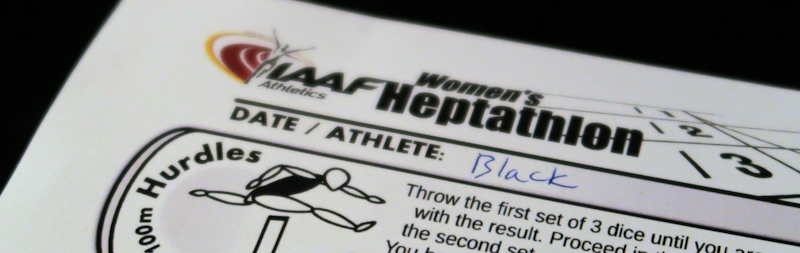
Reiner Knizia's Decathlon (Heptathlon Variant)
– Image by boardGOATS

So, stood on top of the final podium with his gold medal round his neck, Blue with silver and Byzantium who took bronze just ahead of Plum and then Purple, stood either side.  It had been a lot of fun though, and as people often say, it is the journey that counts.  The games have a bit of a feel of Ganz Schön Clever/Doppelt So Clever/Clever Hoch Drei, but sort of stripped back to their raw essence.  The individual events were quite simple and with a sheet each, players could keep their own score and recheck the rules as required.  The questions, “Do I stick or keep going, what have other people done, and do I need to gamble to win?” in a large group add interest, and everyone enjoyed it so much that there was no difficulty getting people to take home the left-over sheets.

Reiner Knizia's Decathlon (Heptathlon Variant)
– Image by boardGOATS

From there, the group of six split into two groups of three and everyone moved from athletics themed games to Paris themed games.  With the best will in the world, there wasn’t time to play Paris, so Blue promised to bring it again another time, and they opted instead to stick with “Roll and Write” type games in the form of Next Station: Paris.  This is the latest variant on Next Station: London, a simple little route planning game with a really clever twist.  The idea is that each station has one of five symbols; a card is turned over depicting one of these symbols and players must extend their route by connecting one end to a station with this symbol without crossing an existing track and following the grid shown on the map.

Next Station: Paris
– Image by boardGOATS

At the end of each round, players score for the number of Districts visited multiplied by the number of Stations in the most visited District.  At the end of the round players get bonus points for Interchange Stations (where two or more lines meet).  However, like the Ticket to Ride maps, each each city comes with a slight variation to the rules as well as a different arrangement of stations.  In London, players score points for crossing the Thames and for the total number of Visitor Attractions visited during the game.  In Paris, these are replaced with scores for visiting Parisian Monuments at the end of each round and using the level crossings marked on the map.

Next Station: Paris
– Image by boardGOATS

The clever part of the game is the fact it is played over four rounds, but each round is played with a different coloured pencil with players swapping pencils between rounds.  This means that while everyone gets the same cards in the same order, they start in different places so are forced to do different things (unlike for example, NMBR 9, where players often play the first few rounds the same).  The Paris version is supposed to be easier than the London variant, but as nobody had played it before, everyone struggled at the start.  The trick though, is, for each line, players need to try to get the same number of Districts as Stations in the most visited District.

Next Station: Paris
– Image by boardGOATS

This is similar to the mechanism in Orléans, where players receive victory points equal to their position on the Development Track multiplied by the number of Trading Stations they have on the map plus the number of Citizen Tiles they have collected.  In both cases, players want these numbers to be as large as possible to give the biggest total.  It is more important that both are significant, however, rather than having one large and one small.  For example, a two times three gives more than one times four, thus it is important to concentrate on both parts equally and not neglect either one of them.

Next Station: Paris
– Image by boardGOATS

Although nobody had played a “Next Station” game before, Blue explained the rules and had got her head round this element of the scoring, where it took the others a little time to get to grips with it. The game suited Plum’s puzzle brain and she liked trying to see where she might get to the level crossings and so on. By the third line, both she and Byzantium were beginning to get the hang of thing (or perhaps the cards just came out better) and then for the final round everyone found their space was more restricted.  It was very close, but Blue’s consistency throughout just gave her the edge and victory by a mere five points.
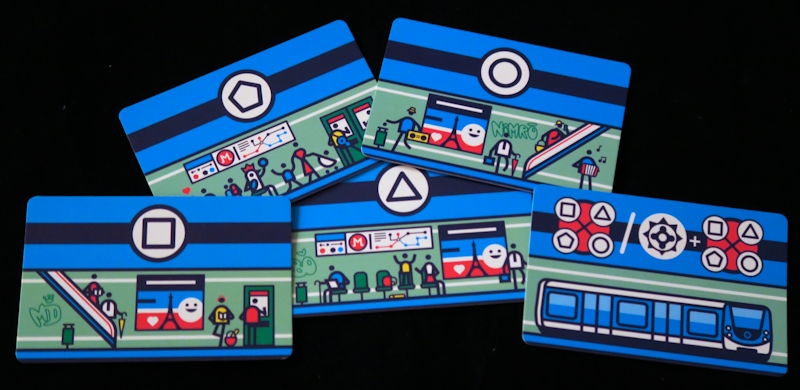
Next Station: Paris
– Image by boardGOATS

Meanwhile, Green, Black and Purple opted for a quick game of the Paris version of Ticket to Ride.  This is the newest of the smaller, city versions of the game, and one that had not been played within the group hitherto.  In general, these play exactly the same way as the bigger ones, but have fewer pieces and shorter tracks (so play a lot quicker) and have a little rules tweak to keep people interested.  There had been a little bit of chat about it as people arrived and Blue, who had only read the rules was quite scathing about the new rule which felt very bolted on, and as there are now several of these little games, there were comments about the sound of barrels being scraped.
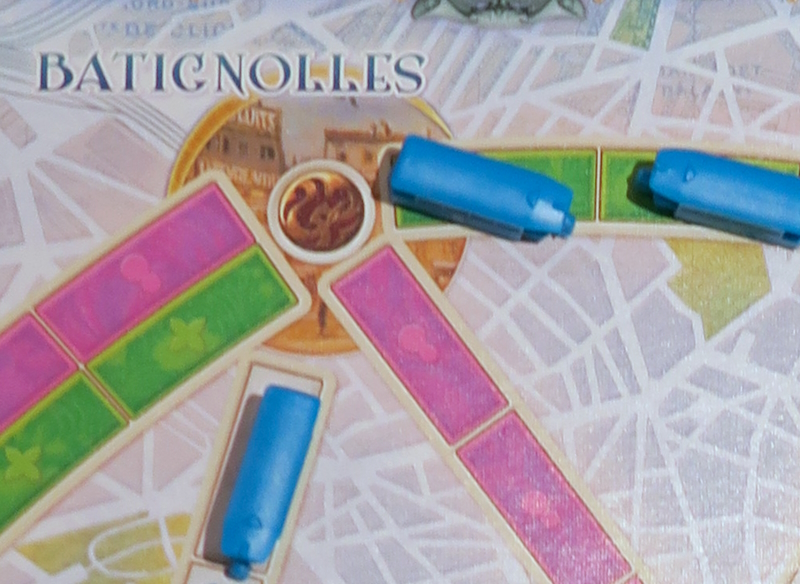
Ticket To Ride: Paris
– Image by boardGOATS

The new rule is that when players claim a red, white, or blue track, they get a card, when they get all three colours they get four “Tricolore” bonus points—this didn’t feel terribly imaginative.  After the game, however, Green commented that it was much better than it sounded.  After he had completed his starting Tickets, he realised they only gave low points, so rather than taking more, he opted to go for Tricolore bonus points instead as the red, white and blue Routes are all short making them easy to get (one, two and one carriage long respectively).  Simpler to achieve than extra Tickets they give an extra four points, though Green only got a total of two Tricolores.
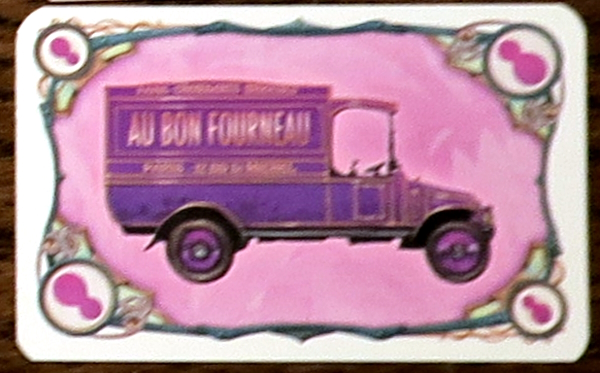
Ticket To Ride: Paris
– Image by boardGOATS

Black and Purple only took one Tricolore each as they were using it as a bonus rather than a target, so missed out on a few opportunities by laying trains on a colour they already had a card for.  In the dying moments of the game, Purple took Tickets—of course she had no way of knowing that Green was about to trigger the final round, but even Black commented that it was a brave move.  And Green ended the game on his very next turn, leaving poor Purple with a couple of uncompleted Tickets.  That extra four point Tricolore bonus Green had taken made all the difference in the final scoring as that was the margin of his victory over Black.

Ticket To Ride: Paris
– Image by boardGOATS

As Green went home (along with Jade, Sapphire, Byzantium and Plum), they passed the copy of Ticket to Ride: Paris along the table to Lime, Pine and Pink who also fancied giving it a go.  They concurred that the Tricolore Bonus was much better in practice than it sounded.  This game was also quite tight with six points between the first and last.  Lime was particularly peeved however, as Pink edged him out by a single point.  With that, and some residual chatter, it was time for home and everyone slowly drifted off.
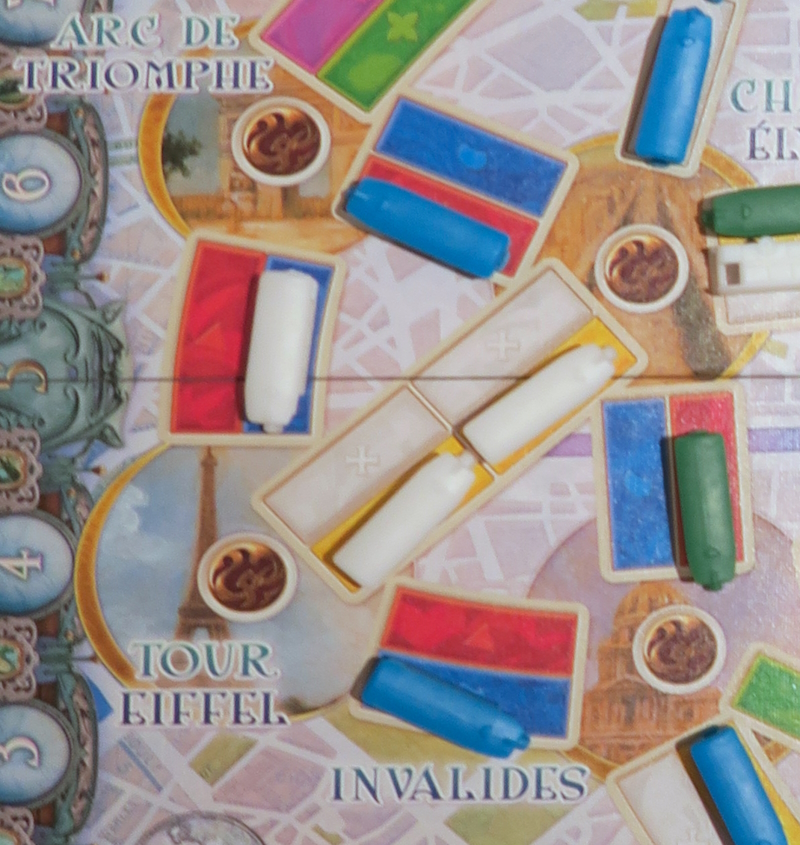
Ticket To Ride: Paris
– Image by boardGOATS

Learning Outcome:  When you take away the sport, you still have France.

Essen 2022

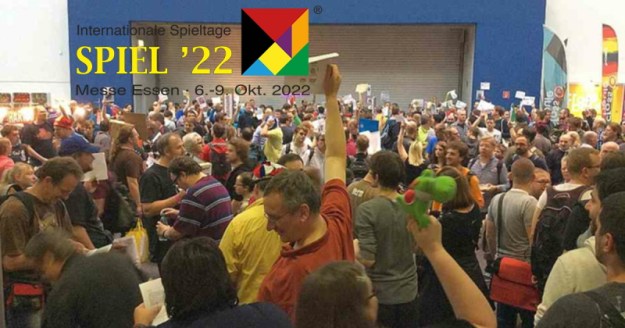
Known to gamers worldwide simply as “SPIEL” or “Essen”, the Internationale Spieltage, the annual German games fair is the largest in Europe and arguably the world.  The fair is of particular significance as many new releases are scheduled to coincide with the event just in time for Christmas sales.  In 2020, like many other events, SPIEL was cancelled.  The online event that replaced it was not as successful, and in 2021 there was a return to the in person fair albeit with restrictions and much smaller than that in 2019.  Today is the first day of this year’s SPIEL which runs from Thursday to Sunday every October.

Essen 2022
– Image from spiel-messe.com

Although many of the Covid restrictions have been lifted, medical grade surgical masks covering mouth and nose are still mandatory for all visitors and exhibitors.  So while SPIEL will likely be larger this year than last, it probably won’t reach pre-pandemic proportions.  The maths trade is back though, a crazy event where hundreds of people agree multiple trades and sales online in advance and then all meet up at 3pm and try to find the people they have made contracts with and make the exchanges.  Remarkably, it works, and very well too, with some people selling hundreds of euros worth of games through this means.

Essen Maths Trade
– Image by Friedhelm Merz Verlag

Despite the number of people involved, the exchanges only take a few minutes and it is usually almost all over in half an hour making it a surprisingly efficient way of making space for the new arrivals.  In addition to the Maths Trade, there will be the usual exhibitors showcasing their wares.  The Spiel des Jahres and Deutscher Spiele Preis winners will also all be available and there will also be lots of games making their SPIEL debut.  These include Uwe Rossenburg’s latest game, Atiwa, and the top of “The Essen Hotness” games:  Tiletum, Revive, Woodcraft, Lacrimosa and Hamlet: The Village Building Game.  Games like Flamecraft, Turing Machine and War of the Ring: The Card Game will be for sale too.

Atiwa
– Image by BGG contributor W Eric Martin

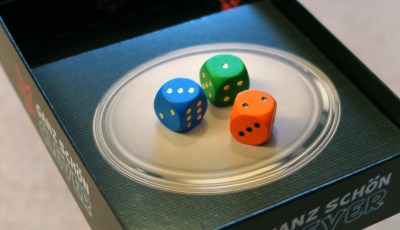
There will be re-implementations, like Richard Breese’s reworking of his 1998 game, Keydom’s Dragons (formerly Keydom), Clever 4Ever (extending Ganz Schön Clever), Skymines (a redevelopment of Mombasa), Amsterdam (formerly Macao) and of course, Ticket to Ride (San Francisco).  Expansions will also be on show for games like The Red Cathedral (Contractors), Galaxy Trucker (Keep on Trucking), Meadow (Downstream), Sagrada (The Great Facades – Glory) and two of our favourites, Viticulture (World) and Wingspan (Asia).  Sadly, no-one from boardGOATS will be there to see them though; maybe next year…
Wingspan: Asia
– Image from stonemaiergames.com

9th June 2020 (Online)

It’s been over three months since we were last officially at the Horse and Jockey, and it is clear everyone is really missing it.  When people joined the meeting from 7.30pm and everyone asked how people were doing, most people had nothing much to say.  Pine is still furloughed, Blue is back at work from time to time, as is Green; Ivory never left, while Pink and Black are still working from home.  Otherwise though, everyone is just getting used to the way things are now.  This week, the “Feature Game” was to be Noch Mal!.  This is a “roll and write” game by Inka and Markus Brand, designers of Village, Rajas of the Ganges and the award-winning EXIT: The Game series.  Although Noch Mal! was first released in 2016, it has only recently been released in English (as Encore!), although the game itself is language independent.

Noch Mal!
– Image by boardGOATS

Noch Mal! is quite similar to the 2018 Kennerspiel des Jahres nominee Ganz Schön Clever (aka That’s Very Clever), where one player rolls the dice and then chooses some to use to cross off boxes on their player card, leaving the left over dice for the other player(s) to use.  The player sheet for Noch Mal! is simpler than the one in Ganz Schön Clever though, and there is less structure to the dice rolling making it more suitable for more players.  Indeed, although it is only supposed to play six, we felt it could easily play more, and this is important to us at the moment because the social aspect is the main reason for these online meetings.

Ganz Schön Clever
– Image by boardGOATS

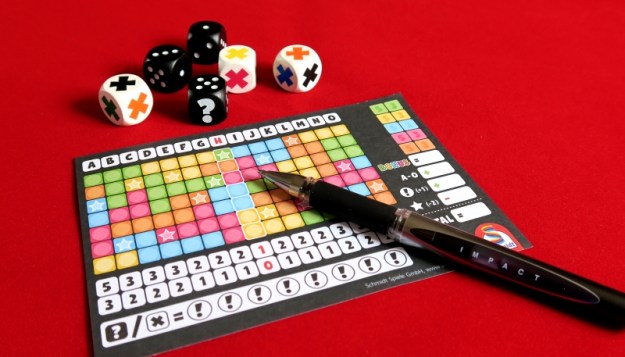
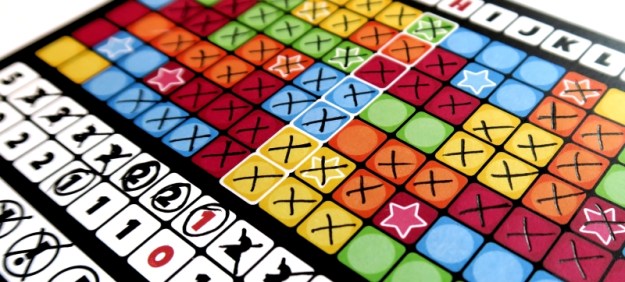
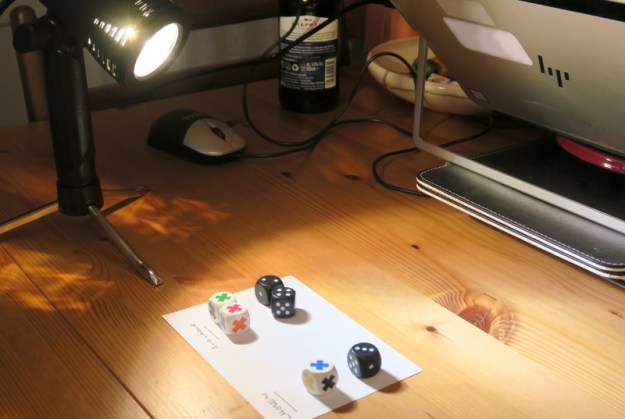
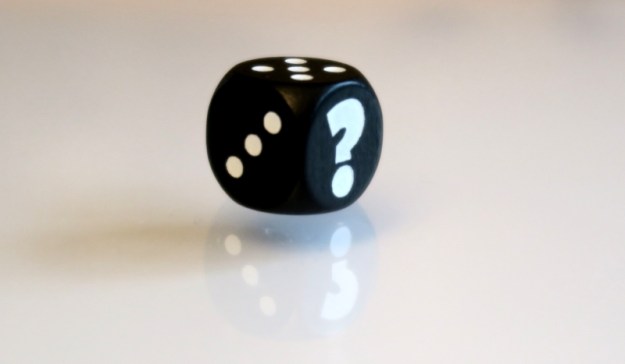
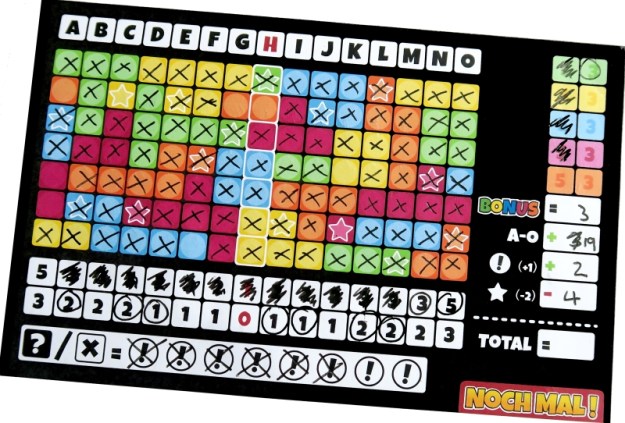
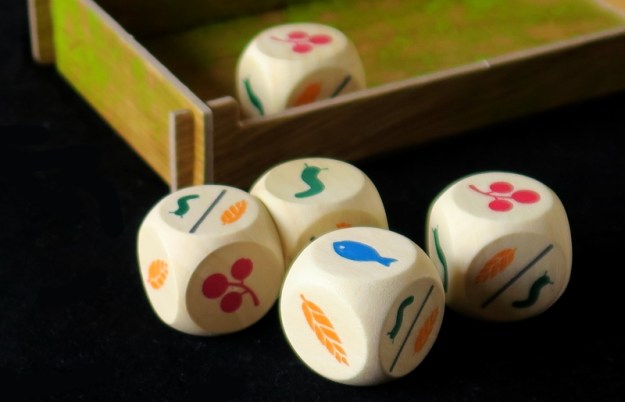
The idea of Noch Mal! is that the active person rolls the dice and then chooses two of the six dice to use.  Three of the dice are relatively normal d6 dice (numbered one to five with a “question mark” replacing the six), while the other three dice are “colour dice” with coloured crosses instead of numbers (red, green, blue, orange, yellow and black).  The player cards depict a rectangular array of square boxes, in groups of different colours.  Players choose two dice, a colour and a number and “spend” them to cross squares off on their sheet.  Thus, if they choose green and five, they must cross off exactly five green squares.  The catch is that these must be in a clump together and must include a square in the starting row (H) or one that is orthogonally adjacent to a square already crossed off.

Noch Mal!
– Image by boardGOATS

Players get points for completing columns, or crossing off all the squares of one colour, with the first player to do so scoring a bonus.  The “question mark” and “black” faces are “wild” and can be used as any number or colour (respectively), but each player can only use a total of eight wilds during the game.  Points are scored for completed columns (those furthest from the central starting column score more), crossing off all of one colour, and any unused wilds.  Some of the squares also feature a star—each one of these that is not crossed off earns a two point penalty.  The game ends when one player crosses off all the squares of two colours and the player with the most points is the winner.

Noch Mal!
– Image by boardGOATS

Everyone had three dice and we began by rolling to see who would go first.  Ivory won, but there were lots of roll-offs to settle tie breaks, so determining the order was in danger of taking longer than the game itself!  To keep people involved and give them a feeling of agency everyone rolled their own number dice, while Blue and Pink rolled the colours and displayed everything on one of their cameras.  For the first three rounds the active players (Ivory, Burgundy and Pink) don’t choose dice and everyone else can choose from the full six, so Pine was the first to play a “proper turn”.

Noch Mal!
– Image by boardGOATS

Pink was quick out of the traps and was first to score a column, and then taking points for a second too.  This meant he was three points up before anyone else had scored.  Worse, nobody else could score anything for the starting column (H), and only one point was available now for column G too.  Ivory had other plans though and had expanded to the right of the table and was soon picking up some of the higher scoring columns further away from the centre.  Others tried the same strategy, some with success, others less so.

Noch Mal!
– Image by boardGOATS

The general feeling was a little bit like Bingo with dice with players calling out when they completed a column.  This feeling was accentuated when lots of people called “House” for a load of columns on the right, all at the same time.  Eventually players started claiming colours; inevitably, Ivory was first, and also the first to discover what a curate’s egg it was as he was then forced to pass.  It wasn’t long before someone completed their second colour and everyone then had to work out their scores.

Noch Mal!
– Image by boardGOATS

It was no real surprise that Ivory top scored with what seemed like an enormous ten points, though Black ran him very close with eight.  Pink, Lime Blue and Green felt they had done well to avoid finishing with negative points and Purple would have done a lot better if she hadn’t lost sixteen points for her eight remaining stars.  It had been interesting though and now everyone felt they had a better understanding of how the game worked, it seemed a good idea to give it another try.

Noch Mal!
– Image by boardGOATS

This time, Lime was the first to score points, claiming column H so fast that it seemed impossible.  Having finished with zero last time though, he was keen to get points on the board straight away.  It was then that the IT gremlins began their attack.  First Lime had problems with the camera freezing, then Ivory as well.  It seemed that the problem was somehow specific to Lime and Ivory and when one left, that seemed to sort out the problem for the other one.  When Green looked at the text chat channel, he commented that it was a very long stream of “Lime has left”, “Lime has joined”, “Ivory has left”, “Ivory has joined”, “Lime has left”…

Noch Mal!
– Image by boardGOATS

Inevitably, we decided it was the French (again) trying to get their revenge for our invasion of their game of 6 Nimmt! a few weeks back—they have very long memories do the French!  Obviously, we weren’t going to let them win, so Lime and Ivory took it in turns to duck out when necessary and Blue and Pink took it in turns to let them back in, and the game carried on.  This time, everyone had a better idea of what strategies were available and players made a better job of completing columns.

Noch Mal!
– Image by boardGOATS

More players completed one colour and almost everyone had a near full grid by the end.  This meant it was down to rolling low numbers and those who hadn’t used up all their “wild” tokens.  This turned out to be really quite important with Burgundy and Pink among others, running out and therefore unable to make use of turns that others could.  It was slow at the end, but eventually Black completed his second colour and everyone tallied up the scores.

Noch Mal!
– Image by boardGOATS

Everyone except Ivory had improved their score, and this time everyone finished in the black.  Purple took the award for the most improved player, improving her score by twenty-three points having made an effort to clear up her stars.  As the scores came in, Pink really thought he had it with eighteen, but he’d failed to look across the table to see Blue had twenty, and with it victory.  Noch Mal! had worked really well which shows how our tastes have changed:  in the pub, we would never had played a game like this with so many, however, as Pine pointed out, playing a real game through a camera felt more like game night than playing an virtual game, so we’ll keep that in mind for future events.

6 Nimmt!
– Image by boardGOATS

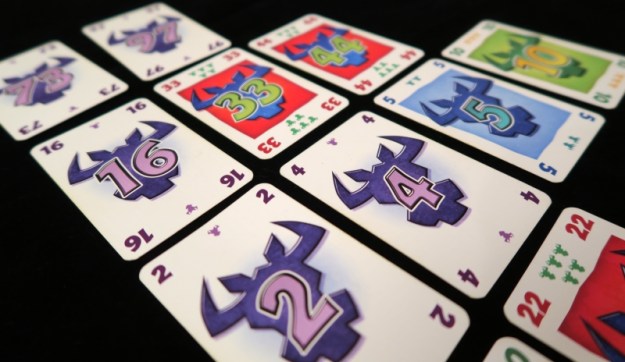
With that, Pine and Lime finally gave in to the French Gremlins and left for an early night, and eventually, Green joined them.  The others were up for something else though, and as Pink was wearing his new 6 Nimmt! socks, that seemed like a good idea.  So everyone logged into Board Game Arena for one of our favourite games.  The game needs little real introduction: players simultaneously choose a card from their hand and everyone reveals them.  Starting with the lowest, the cards are added in turn to one of the four rows—when a sixth card is added the owner instead takes the five cards and starts a new row with their card, scoring the number of bulls’ head points (or “Nimmts”) depicted on the card.

6 Nimmt!
– Image by boardGOATS

On Board Game Arena, the player with the most points when one player’s score falls below zero is the winner.  There was the usual moaning about how bad everyone’s hand was and how badly everyone always did, but Burgundy pretty much nailed it when he said nobody is going to do well, the aim is just to do less badly than anybody else.  In that sense, the game is a bit like escaping a bear, you don’t need to run fast, just faster than everyone else.  This time, Pine started off as the slowest runner being the first to pick up, but was soon followed but Black, Purple and then Burgundy.

6 Nimmt! on Board Game Arena
– Image by boardGOATS from boardgamearena.com

For a long time, it looked like it was going to be a “two bull race” between Blue and Pink, but six is a critical number in 6 Nimmt!, so with six players strange things can happen with players becoming synchronised and picking up lots of points on multiple turns.  It looked like it was going that way for Blue, but she managed to stem the flow and was tied for second with Pine for quite a while before he started picking up cards again.  It looked like Pink’s Lucky 6 Nimmt! Socks were working their magic, but when Black (who had been looking like bear-fodder for the whole game) ended the game, Pink had just picked up, leaving Blue one point ahead.

6 Nimmt! on Board Game Arena
– Image by boardGOATS from boardgamearena.com

There was still time for one more quick game, and with six, the perfect quick game (and one that is available on Board Game Arena), is For Sale.  This is an old game that we dug out about six months ago, before all the current strife, and it got a couple of outings.  Since all games have been online, it is one of the games we can still play, and, as a result, it’s had several outings recently.  It is a game of two halves, first players buy property cards, then they sell them, and the player who makes the most money is the winner.

For Sale
– Image by boardGOATS

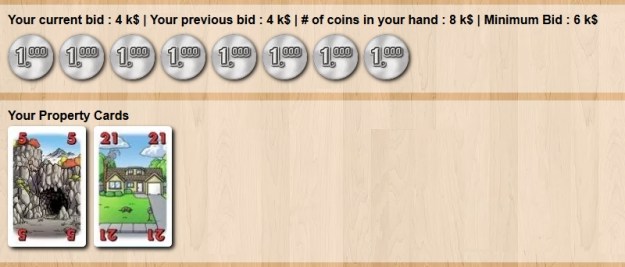
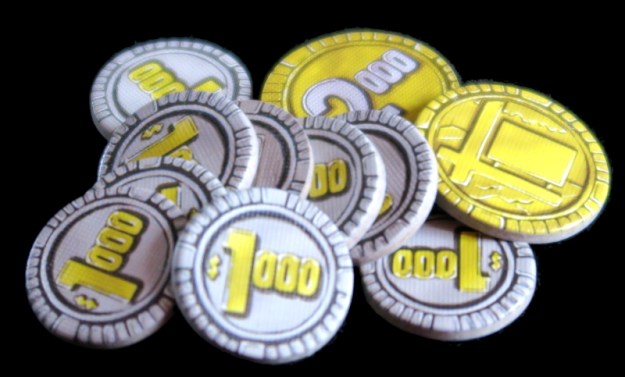
The properties are numbered one to thirty, with the number indicating the relative value.  Buying properties is through auction, with players increasing the bid or passing and taking the lowest value property available and paying half of their bid for the privilege.  The last player then takes the highest value property, but pays their full bid.  In the second part of the game, cheques are revealed and players choose a card to play, with the cheques assigned according to the value of the property played.

For Sale
– Image by boardGOATS

Thus the game consists of two auctions: a variant of an all-pay auction and a sealed bid auction.  In the first auction, a key tactic is predicting what other players will bid so passing can be timed in such a way as to get the best value for money.  Whereas previously, most players increased the bid by the minimum increment, this time it was clear that people were playing a little more tactically, with higher starting bids and increments of $2,000 that pushed other players into paying more.

For Sale on Board Game Arena
– Image by boardGOATS from boardgamearena.com

Black’s and Purple’s strategies were different however:  Black spent a total of just $2,000 on properties, mostly just passing and taking the property offered, and Purple spent only $3,000.  In contrast, Blue spent $13,000 and Pine spent $12,000, i.e. nearly all of their starting $14,000.  There is strategy in the second part of the game too though, and getting the timing right for selling each property is key.  For example, although Blue’s profits of $37,000 were larger than Black’s, his rate of return of $21,000 for just $2,000 outlay was better, matched only by Purple’s return of $32,000 for her $3,000 investment.

For Sale on Board Game Arena
– Image by boardGOATS from boardgamearena.com

That superb return was enough to give Purple third place.  It is not all about rate of return though:  it is the player who makes best use of all their funds that wins.  In this case, this meant we had a tie for first place between Pine and Burgundy, both finishing with a massive $59,000.  The tie break is the player with the most cash at the end, which just gave it to Burgundy who had achieved his $55,000 from properties bought for $10,000.  And with that, it was time for bed.

For Sale
– Image by boardGOATS

Learning Outcome:  A lot of fun can be had with a handful of dice and a few sheets of paper.

4th February 2020

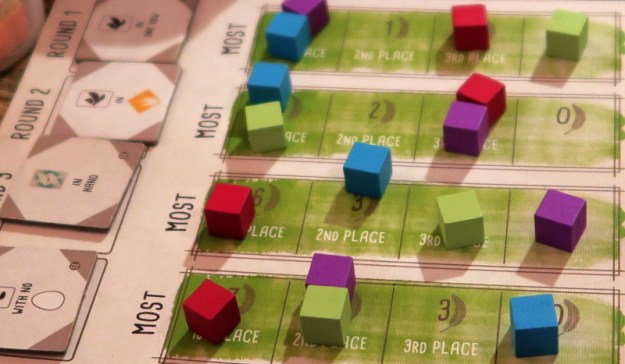
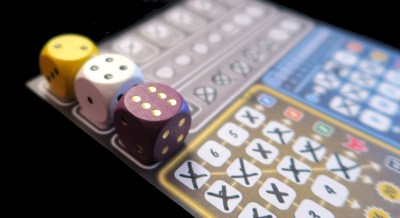
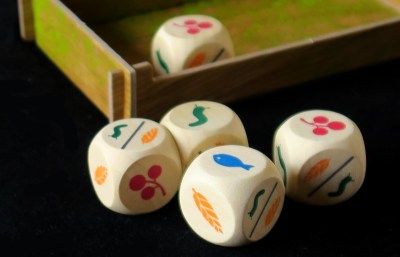
Blue and Pink were first to arrive and, while they waited for others and their pizzas to arrive, they tried to squeeze in a quick game of Ganz Schön Clever (a.k.a. That’s Pretty Clever).  This is a “Roll and Write” game, that is to say, players roll dice and use the values they roll to fill in spaces on their score sheet.  So, it is an abstract game where the active player, rolls all six coloured dice and chooses one to keep and use, discarding all dice with lower pip values.  They then roll any remaining dice, again keeping and using one and discarding the rest before rolling the rest one last time keeping and using one final die.  The other players can then use one of the discards, before play passes to the left.

Ganz Schön Clever
– Image by boardGOATS

Filling in some of the boxes gives a bonus action, enabling players to fill in other boxes or gain the opportunity to re-roll their dice or even use an extra die.  The player who wins is therefore the player who makes the best use of the dice they roll and usually, the player who manages to build the most combinations to take advantage of the bonuses available. This time both Blue and Pink started off slowly, but as they were coming to the last couple of rounds, both food and people arrived and their focus drifted a bit.  Pink managed to keep it together better though and as a result finished with a nice round hundred and fifty, some twenty more than Blue.

Ganz Schön Clever
– Image by boardGOATS

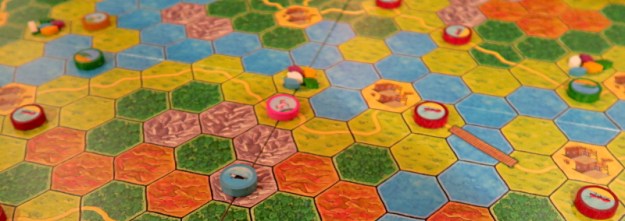
As they finished eating, Green, tried to organise players in an effort get a group together to play Terraforming Mars.  It was quickly clear that it was not going to happen, as Burgundy, Black, Pink, Pine and Mulberry expressed an interest in playing the “Feature Game”, Fast Sloths.   This is a race game where players are sloths travelling around a holiday resort on the backs of other animals.  The rules are quite straight forward:  on their turn the active player takes cards from the face up piles that make the market; optionally play cards, and then discard down to conform to the hand-limit (which varies depending on how players are progressing).  When taking cards, they must all be different animals, and the number they can take depends on their position in the race.

Fast Sloths
– Image by boardGOATS

The game is a pick-up-and-deliver type of game, but unusually the sloths are the cargo being delivered.  Movement on the central board is the heart of the game and each player must try to optimize their movement to win.  When playing cards, they must all be of the same animal – the player then moves the animal corresponding to the cards played towards their sloth, so they can pick it up and drop it somewhere else on the map.  Each animal has their own characteristics, the type of terrain they can cross and how they move etc..  The aim of the game is to collect leaves and the first sloth that can gather eight leaves wins.

Fast Sloths
– Image by boardGOATS

Burgundy got off to a flying start – by both playing first and (even though he was last to pick) securing a good corner tree as his starting location, with a ready-made parade of ants he could bounce over on his way to the next tree.  It was a very tight game, which, after the first few turns while people built up their hand of cards, progressed rapidly with players aiming for a new leaf every turn, or at worst every two turns.

Fast Sloths
– Image by boardGOATS

There was much discussion about the accuracy of the terrains allocated to each transport animal. Donkeys, for example – in Fast Sloths they can’t travel in the mountains or through water, but surely the reasons why donkeys make such good pack animals is that they are great at climbing mountains and wading rivers?  Pink suggested that as this was a “game” perhaps such comparisons weren’t relevant?  However, this suggestion was not received well and went down like a donkey in a river…  Attention then turned to “how true to life” was the representation of unicorn transport.

Fast Sloths
– Image by boardGOATS

The game carried on, with only an occasional call of “Summon the Eagles!” from Mulberry (just imagine Brian Blessed in the film Flash Gordon).  Despite being the first time most people had played the game, all players had clearly got to grips with the mechanism and made speedy progress through the forest – a compliment to the designer it was felt.  In the end, with everyone so closely matched, it came down to marginal differences and Burgundy, after his initial flying start, stayed out in front to win after collecting eight leaves. Hot on his heals were Mulberry, Black and Pine with seven.

Fast Sloths
– Image by boardGOATS

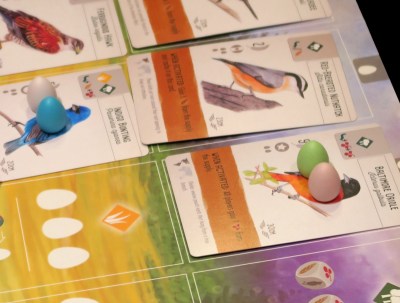
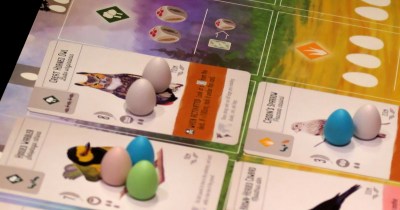
Meanwhile, on the next table, Green and Ivory had settled on Wingspan, and were eventually joined by Purple and Blue.  Since it won the Kennerspiel des Jahres award last year, this has proved a very popular game within the group.  The copy belonged to Burgundy, and he had integrated the European Expansion and Swift-Start Cards, as well as “pimped his bits”; the artwork on the cards is beautiful and the additional pieces just add to the aesthetics.  The game is  functionally very simple, though playing well requires planning and just a little bit of luck.

Wingspan
– Image by boardGOATS

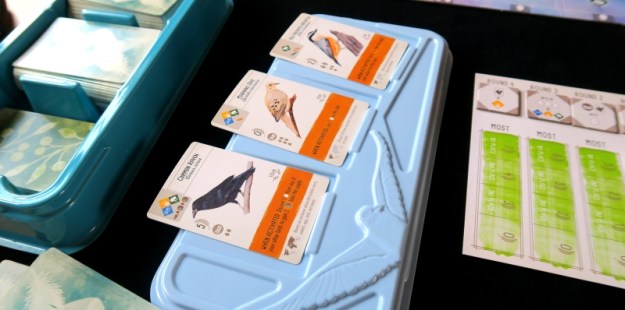
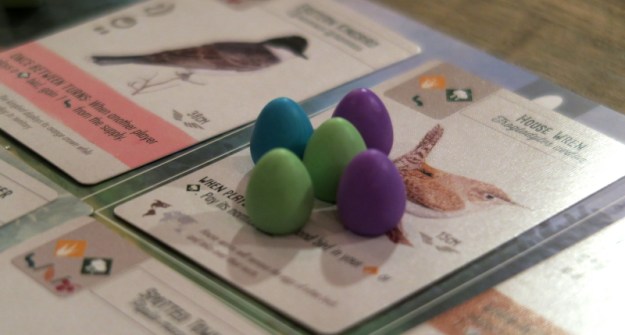
On their turn, the active player can place an action cube to do one of two things:  pay food to play a bird card from their hand, or activate one of their three habitats and all the birds in it.  The three habitats, allow players to collect food, lay eggs or add more bird cards to their hand.  At the end of each round there are bonus points available for players who are most successful with the targets set out; at the end of the game players score points for each bird card they’ve played (value dependent on the bird), food and eggs on their cards, and flocking birds.   The difficult part is to efficiently build combinations of birds with synergistic special powers that will ultimately yield the best score.

Wingspan
– Image by boardGOATS

This time, Blue started by playing a White Wagtail in her Wetland, which gave the opportunity to place a bird card at the end of the round so long as she had activated all three habitats and placed a card during the round.  She still had to pay the food needed, so she concentrated on making sure she had all the bits required to make it work for her every round.  Ivory focused on first playing his Savi’s Warbler and then using it to acquire a lot of cards, many from the face-down draw pile, hoping to draw something good.  Green struggled a bit from the start, partly because he was arguably the player with the least experience, but the fact he was distracted by a bird of a different sort tweeting by phone certainly didn’t help.  Purple on the other hand, quietly concentrated solely on her game, and made excellent use of her Double-Crested Cormorant which allowed her to tuck two cards in exchange for one fish.

Wingspan
– Image by boardGOATS

As the game progressed, Green increasingly needed prompting to take his turn, and explained that he was getting side-tracked because Blue, playing immediately before him, was taking so long on her turn.  While it was true that Blue’s turns were getting longer, this was almost entirely because the number of birds in her reserve was increasing faster than anyone else’s, largely thanks to her White Wagtail which she was busy putting to good use.  The contrast was quite stark Green’s rather meager reserve and Blue’s, although by this time, both Ivory and Purple, also had a good sized reserves.  As the game entered the final round, Fast Sloths was coming to an end and those players wondered over, so the last few turns were played with an audience.

Wingspan
– Image by boardGOATS

At this point, the Wingspan players were putting the finishing touches to reserves.  Green kept commenting how he knew he was coming last and it was clear who had won, but Ivory was not so sure.  In the final accounting every bird in Purple’s reserve had a good point value adding to her points from the tucked birds and Ivory did best in the end of round goals.  Blue had the most birds giving her the same amount of points as Purple (though the individual cards were not as good) and she scored slightly fewer points that Ivory in the end of round goals.  In every other area, however, Blue led the pack giving her the lead overall with ninety-eight points.   Ivory was twenty points behind, and just pipped to second place by Purple.

Wingspan
– Image by boardGOATS

Mulberry, Pine and Ivory Ieft to get an early night, leaving everyone else to play something short;  the game that fitted the bill and was on the top of the pile was For Sale.  This is a very clever property auction game that we played for the first time in years at New Year. The game comes in two parts:  buying properties and then selling them.  So, each player starts the game with $14,000 to spend on property cards.  There are thirty properties, numbered to reflect their relative value and these are auctioned in groups equal in size to the number of players.  The clever part of the auction is that when a player passes and withdraws, they pay half the value of their final bid and take the property with the lowest value; the winner takes the most valuable property, but pays their final bid in full.

For Sale
– Image by boardGOATS

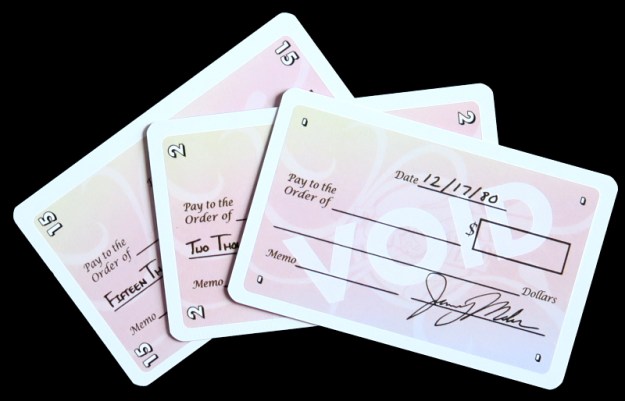
In the second part of the game, cheque cards equal in number to the number of players are laid out, with values from zero to $15,000.  Each player then chooses one property card from their supply and everyone reveals them simultaneously: the highest value property earns the highest value cheque with the second most valuable property earning its owner the second largest cheque and so on.  The winner is the player with the highest total from the sum of their cheques and any left-over cash.  This time, Black took the most valuable property, the space station and with it, on of the $15,000 cheques while Burgundy took the other.

For Sale
– Image by boardGOATS

At the other end of the scale, Pink took both the void cheques, but despite this still managed $33,000 for the rest of his properties.  This was nothing compared to the winner, Green, who finished with $53,000, $2,000 more than Burgundy in second.  The night was still young, however, and there was still time for one of our favourite games, 6 Nimmt!.  Although this is often derided as a game of chance, it is clear that it is not pure luck.  The idea is that everyone has a hand of cards from a deck numbered one to a hundred and four.  Simultaneously, everyone chooses a card from their hand, and, starting with the lowest value card, these are then added to one of the four rows of cards.

6 Nimmt!
– Image by boardGOATS

Each card is added to the row with the highest end card that is lower than the card they have played.  If the card is the sixth card, they take the five cards in the row and their card becomes the first card in the new row.  Each card has a number of bull’s heads on it—this is the number of points they score.  The player with the fewest points at the end of the game wins.  We play with a variant that half the cards are dealt out for the first hand and the rest for the second, which gives us a score at half-time.

6 Nimmt!
– Image by boardGOATS

This time Burgundy and Black were in the lead at the half-time with a single nimmt, with Blue a couple of points behind.  Pink set the competitive high score of thirty-one.  Black picked up a handful of cards in the second half, indeed, only Purple, Blue and Burgundy managed to keep their second half scores to single figures.  In the end, it was Blue who just had the edge, beating Burgundy by three nimmts.  At the other end, however, Pink had no competition finishing with a very respectable high score of forty-five, not a record, but a substantial total nonetheless, and a good end to a fun evening.

6 Nimmt!
– Image by boardGOATS

Learning Outcome:  Donkeys are not as versatile as you might think.

17th September 2019

Blue and Pink arrived nice and early and so after ordering food, started a quick game of Ganz Schön Clever (a.k.a. That’s Pretty Clever).  This is one of the first of the “Roll and Write” games from the last couple of years and, as it received a Kennerspiel des Jahres nomination last year, arguably one of the best.  This type of game has been around for many years, with Yahtzee being one of the first, but the current trend was started by games like Qwixx.  Qwixx came out seven years ago, but has since been followed last year by games like Roll to the Top!, Railroad Inc., Welcome to… and the Roll Through the Ages and Penny Papers Adventures series of games.

Ganz Schön Clever
– Image by boardGOATS

These games all have different themes and different mechanisms, but the basic principle is the the same with players rolling dice (sometimes bespoke dice) and marking the results on a piece of paper, usually from a bespoke pad, or more recently a laminated card.  Ganz Schön Clever is an abstract game using six coloured dice which are used to fill in boxes in five coloured areas of the individual player “boards” (the white die is wild).  The active player, rolls all six and chooses one to keep and use, discarding all dice with lower pip values.  They then roll any remaining dice, again keeping and using one and discarding the rest before rolling the rest one last time keeping and using one final die.  The other players can then use one of the discards, before play passes to the left.

Ganz Schön Clever
– Image by boardGOATS

The clever part is the way the dice are used, and the fact that filling in some of the boxes gives a bonus action, enabling players to fill in other boxes or gain the opportunity to re-roll their dice or even use an extra die.  With just two, the game is played over six rounds, giving them just eighteen dice on their own turn with another six from their opponent’s turn and as many bonuses as they can get.  The player who wins is therefore the player who makes the best use of the dice they roll and usually, the player who manages to build the most combinations to take advantage of the bonuses available.  This time round, Blue was failed to get a good start and Pink took her to the cleaners, finishing with a hundred and ninety-two, a winning margin of twenty-six.

Ganz Schön Clever
– Image by boardGOATS

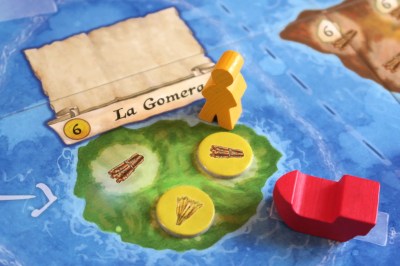
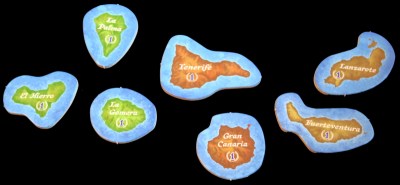
Blue and Pink had only just started, when the others started rolling in, but unusually, there was no sign of Burgundy.  By the time food had arrived, we were into double figures, but still no  sign of Burgundy.  People were starting to get worried until Blue borrowed a phone and checked her email to discover he wasn’t feeling well.  There were still enough players for three games, and eventually, everyone else took themselves off leaving Blue, Pink and Green to play the “Feature Game”, West of Africa.  This is a game set in the Canary Islands (which really are west of Africa, unlike Krakatoa which is famously not East of Java), and has a slightly nasty edge to it, making it almost like a “Vanuatu Light”.

West of Africa
– Image by boardGOATS

The game is quite simple with some very nice little elements. The basic flow of the game involves planting crops, selling crops, becoming Alcalde (or mayor) of islands and then building settlements.  Each player has their own deck of cards which they use to carry-out their actions, with each card having a value.  Players simultaneously choose up to five of their cards (the first four are free, the fifth comes at a cost), then each hand is evaluated and the lowest value hand is played first.  This means there is a nice tension between choosing a low value hand and going first, or choosing higher value cards, giving other players the chance to carry out actions first, potentially meaning that those actions are no-longer available.

West of Africa
– Image by boardGOATS

There are two types of cards: islands and actions.  Moving workers or boats are simple actions where players just move workers a given number of steps along the shipping lanes, however, some of the action cards need a location to be played.  For example, planting crops needs to be played with an island card which indicates where the crop tokens are to be played.  Similarly, selling crops and settling both need to be played with island cards, but the clever part is that island cards can be used for multiple actions and actions can be carried out at multiple islands an unlimited number of times.  The round ends once all players have completed their actions, then any planted crops are automatically moved into the warehouses where they can be moved and/or sold in later rounds.

West of Africa
– Image by boardGOATS

The islands are split into east, west and central with islands in the different regions having different characteristics.  So the western Canaries only have spaces for production, while the eastern islands only have spaces for settlements.  Selling goods is more lucrative in the east than in the west, however, each lot selling for twelve gold, instead of six.  So shipping goods eastwards can be lucrative, but that requires playing a card and only four (or five) can be played each round.  Selling only provides gold, however, and players need points to win.  The two players with the most gold at the end of the round get a point each, but this is not the main source of points.

West of Africa
– Image by boardGOATS

At the end of the round, the occupation of each island is evaluated and the Alcalde or mayor of each is assigned, with players getting a point for each island they control.  This is not the main source of points either though, that is settling with each settlement giving three points.  Settling is expensive though and gets more so as the cheaper plots get built on.  Another of the clever little features of the game is that the number of settlements available in each round is limited which adds more pressure to the turn order.  As this is so critical, ties have to be resolved, and are always in favour of the player with the most gold which increasing the importance of money, adding balance to the game.

West of Africa
– Image by boardGOATS

Pink had the lowest scoring starting hand so went first.  This can be a substantial advantage as he knew he would be able to do what he wanted.  Green went next and managed to interfere with Blue’s plans, though she had been aware of the risk and had managed to build in some extra options to help mitigate the effects a little.  Pink took control of La Hierro and La Palma, and Green took La Gomera leaving Gran Canaria to Blue who also picked up Fuerteventura, with an eye to later in the game.  Green got the best of the early rounds though setting up a small, but important lead, though more significantly, arguably better positioning.  The game is not a long one, and there isn’t really time to build an engine, so it wasn’t long before Green, in particular, was threatening to trigger the end of the game by getting twenty-five points.

West of Africa
– Image by boardGOATS

It was then that Blue made her monumental mistake: when choosing which of two island cards to play she ended up playing both and not the sale action card to go with them.  This, coupled with Green’s action which he took first, meant she was unable to do anything at all in the penultimate round.  Green followed this by messing up his final round, also failing to play a sale action card which meant he didn’t have enough gold to build the number of houses he wanted to.  He was still able to build one final settlement though, giving him a clear win with forty points.  It was much closer for second with Pink’s thirty-two points just pipping Blue by a single point.  It had been an enjoyable game, but despite the excellent balance and some really nice touches, none of the three players could put their collective finger on what was lacking and what the game needed to take it from “OK, but eminently forgettable” to “great”.

West of Africa
– Image by boardGOATS

Meanwhile, on the neighboring table, despite their reluctance to play it with two chemists, Pine and Lime had joined Red and Mulberry to play Periodic: A Game of the Elements.  This is a recent KickStarter delivery, and seemed entirely appropriate for the International Year of the Periodic Table.  On their turn, the active player either pays energy to activate trends (such as “Decrease Atomic Mass” or “Increase Atomic Radii”) to move their flask around the periodic table board in the direction allowed by the trend.  If they finish a trend movement on an element that appears on the top, visible card of one of the four goal card decks, they can “discover” that element.  Flasks can be moved up to five spaces, but activating the trend multiple times means the player’s flask can be moved further enabling them to “discover” multiple elements.

Periodic: A Game of the Elements
– Image by boardGOATS

The first activation costs one energy point and all additional trends costing two energy points with tokens spent in this way placed on a space associated with the trend used.  Instead of paying to move, the active player can take all the energy accrued on that trend and move their flask according to a trend, but just once.  Thus, the conservation of energy forces players to spend carefully and play efficiently.  When someone discovers all the elements for one goal they take the associated card with a bonus action tile, and all the other players who discovered some of the elements on the card, get consolation points.  Players can also discovering particular types of elements, as shown in by cards laid out around the edge of the board.

Periodic: A Game of the Elements
– Image by boardGOATS

Moving along a step along this “track” gives players academic achievement which is worth an ever increasing amount of points.  The third and final source of points are from the agenda cards which give players personal objectives and are dealt out at the start of the game.  The game ends when someone completes the research track or when a stack of goal cards is depleted and the player with the most points at the end wins.  Unfortunately, due to a “rules malfunction”, the group were halfway through the third stack of goal cards when they realised the game should have ended so decided to carry on till all four piles were depleted in what they referred to as “Periodic: The Director’s Cut”.

Periodic: A Game of the Elements
– Image by boardGOATS

All in all, Pine and Lime needn’t have worried that Mulberry’s and Red’s chemistry backgrounds would give them a significant advantage.  Although there were a lot of nice chemistry references that the scientists appreciated it was not necessary to understand these to play the game effectively.  The strategies employed varied:   Red and Mulberry concentrated on progressing on along the academic track, while Lime on his agenda cards and Pine focused on goal cards.  In the end, it didn’t make a lot of difference and there was a three-way tie for second place with Red, “The Evil Chemist” finishing seven points ahead of the others, with a final total of seventy-one.  Everyone had enjoyed the game though and would be happy to give it another go though they all agreed they would do things differently next time.

Periodic: A Game of the Elements
– Image by boardGOATS

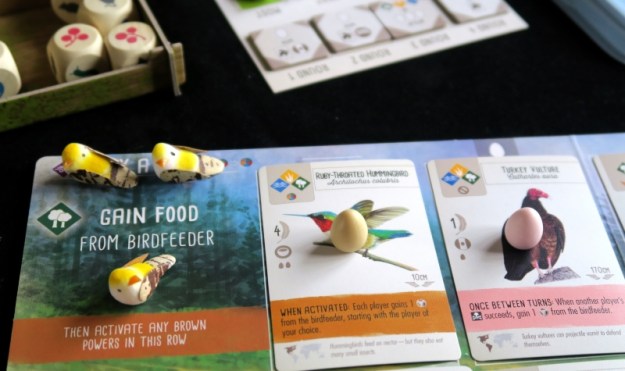
On the other side of the room, Ivory was introducing Black and Purple to this year’s Kennerspiel des Jahres winner, Wingspan.  Wingspan was our “Feature Game”, a few weeks ago and was always going to have another outing – in fact, this time we had a choice of two copies!  Wingspan is a robust, card-based engine builder, with beautiful production and gorgeous artwork.  The idea is that players are collecting birds for their reserves.  On their turn, the active player chooses one of four actions/habitats, and then starting with the card furthest to the right in that habitat, activate each card in turn.

Wingspan
– Image by boardGOATS

The primary action associated with the habitats are spending food to play cards; getting food; laying eggs, and more drawing bird cards.  Players start with eight possible actions per turn, which gradually reduces to five over the course of the four rounds of the game.  All the bird cards in the game give bonuses that fit with their real-life behaviour.  For example, the food needed to play cards closely resemble their diet.  The designer and producer have paid attention to other details too.  For example, the number of eggs each bird has in their nest is not accurate, but are proportionately correct and bonus actions are associated with birds that flock and birds of prey.

Wingspan
– Image by boardGOATS

This time the game was very tight, though different strategies were employed.  Purple tried to maximise her food income, starting with an Eastern Phoebe which provided invertebrates , and later adding a Baltimore Oriole, a Red-Breasted Nuthatch, a Mountain Chickadee and an Indigo Bunting ensuring a lucrative food source giving her a wide variety too.  Then she added a White-Faced Ibis and a Ferruginous Hawk both birds of prey that are triggered by other players actions and give points at the end of the game for each food they bring in.

Wingspan
– Image by boardGOATS

It’s arguable that the cards could have been shuffled better, and as a result birds that ate small mammals or fish and aquatics didn’t come out till later so she wasn’t able to take as much advantage of some of her food supplies as she might.  In contrast, Black and Ivory went for a more egg-based strategy, with Ivory playing a Cassin’s Sparrow and a Brown-Headed Cowbird both of which laid eggs, the sparrow when activated and the Cowbird on other players’ turns.

Wingspan
– Image by boardGOATS

Black played a Yellow-Billed Cuckoo, which also activated on on other players’ turns and coupled it with a House Finch which enabled him to store a lot of eggs.  The end result was really close, with only four points between first and third.  Everyone had a similar number of “tucked” birds, bonus points and end of round points.  Purple took more from her birds and finished with ten food on her cards from her predators.  Although Black and Ivory had no stored food they had twice as many eggs as Purple and, on aggregate, Ivory pipped Purple, by just two points.

Wingspan
– Image by boardGOATS

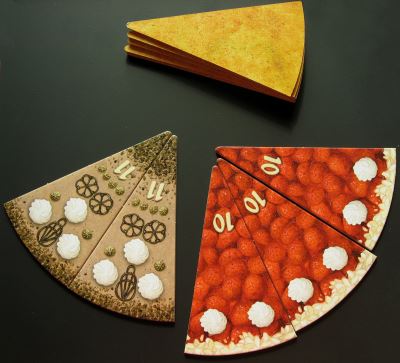
With time marching on, some of the group decided to head off for an early night leaving Blue, Black, Purple, Pink and Pine to play “something short”.  Pink determinedly eschewed the option of Bohnanza, and suggested “Sahne” instead, which was quickly accepted by the other four.  This cute little game, correctly known as …aber bitte mit Sahne (a.k.a. Piece o’ Cake), is the archetypal “I divide, you choose” game.  Played over five rounds, players take it in turns to be the “Master Baker”.  They divide the eleven slices of the pie into pieces and each player takes it in turns to take a piece (leaving the Master Baker with whatever’s left).

…Aber Bitte Mit Sahne
– Image by boardGOATS

As players take their share, they can choose to keep slices or eat slices:  eating a slice guarantees points (equal to the number of blobs of cream on top), while saving it gives the opportunity for more points if the player has the most of that type stored at the end of the game.  Each slice has a number on it which is the number of points the player with the most uneaten slices of that type gets, but also how many are available (though a couple are always removed to add a little non-determinism).  Thus, the most valuable cakes are also those with the most slices available but also those with the most cream.

…Aber Bitte Mit Sahne
– Image by boardGOATS

Purple started out collecting slices of strawberry tart, while Pine opted for what he insisted was gooseberry flan, but looked like it was made out of peas.  He also went for the pizza (or possibly apricot?) and got into a tussle with Blue for that and cockroach (which Pine insisted on calling pecan, though in truth it could have been date too).  Things kicked off when Pine offered Pink (sat to his left) a particularly favourable selection and when Blue pointed this out, was persuaded by Pink to be “nice”.  However on Pink’s turn, when he had the option to be nice to Blue, he wasn’t.

…Aber Bitte Mit Sahne
– Image by boardGOATS

Learning Outcome: Clever mechanisms, a great game do not necessarily make.

Spiel des Jahres Nominations 2018

Almost every time we’ve played Azul, the topic of conversation has moved on to the Spiel des Jahres and how it would be a travesty if it did not receive at least a nomination. It was with this in mind that we read the Spiel des Jahres nominations when they were announced this morning.  There are three nominees in each of the three awards:  a children’s game award (Kinderspiel des Jahres), the “Advanced” or “Expert” Kennerspiel des Jahres, and the main Spiel des Jahres (often interpreted as the “Family Game” award).  In addition, for the first time since 2010, there is also a special award for Pandemic Legacy: Season 2 by Matt Leacock & Rob Daviau, reflecting Pandemic, Forbidden Island and Pandemic Legacy: Season 1 that were all nominated, but failed to win a prize, and have had a significant influence on cooperative and legacy games as a whole.  The other nominees are:

  • Kinderspiel des Jahres
    Kinderspiel des Jahres 2018Emojito! by Urtis Šulinskas
    Funkelschatz (aka Dragon’s Breath) by Lena & Günter Burkhardt
    Panic Mansion (aka Shaky Manor) by Asger Harding Granerud & Daniel Skjold Pedersen
  • Spiel des Jahres
    Spiel des Jahres 2018Azul by Michael Kiesling
    Luxor by Rüdiger Dorn
    The Mind by Wolfgang Warsch

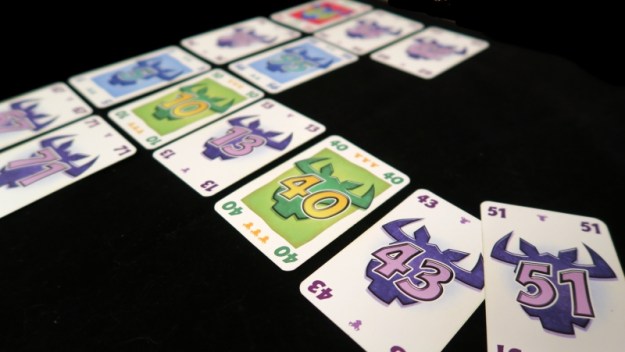
Firstly, more than half of the nominees were designed by either Wolfgang Warsch, or Michael Kiesling, so huge congratulations to them.  In our view, Azul richly deserves it’s nomination and it would be no surprise if it ultimately wins the award.  Of the other two nominations for the “red pöppel”, The Mind has received quite a lot of attention, and is a bit like a cross between Hanabi and The Game (both of which have been acknowledged by the Jury in the past, in 2013 and 2015 respectively).  Luxor has a good pedigree as it is designed by Rüdiger Dorn (also designer of The Traders of Genoa, Goa, Istanbul, and one of our group favourites, Las Vegas), but it is a bit more of an unknown as it has only just come out.  Usually the Kennerspiel Prize winners are a good fit to our group, but this year they are also largely unknown to us, so there is clearly a lot to discover before the winners are announced in Berlin on 23rd July (Kinderspiel des Jahres winners will be announced in Hamburg on 11th June).

Spiel des Jahres
– Image from spieldesjahres.de