Tag Archives: Ivor the Engine

16th December 2014

This week we stuck to “old favourites” and started off with the quick fun and very silly game that is Walk the Plank!.  We’ve played this a few times before, and we always play to the “last pirate standing”.  Since Red had chosen the game and White had not played it before, Blue started off by shortening the plank and pushing Red off the end.  This set the tone for the game with Red taking her revenge on Blue and then White joining in the fray.  A few rounds in and with one Blue and a couple of Red pirates down, it was Blue’s turn to start.  All three of White’s pirates were perched precariously on the end of the plank with Red’s one remaining pirate, so the game ended suddenly with a very loud splash when Blue inevitably shortened the plank…

Walk the Plank!

With the arrival of Purple and Black (and their pizza), we decided to play another of Red’s favourite games, Bohnanza. It’s amazing how a game that so many people feel is such good fun, sounds so totally uninteresting when it’s explained.  True, as White pointed out, this applies to quite a few games, but Bohnanza is definitely the “poster child”.  After a quick rundown of the rules, we began. Purple was very generous, offering beans for free at regular intervals, though of course she had an ulterior motive. However, otherwise, as Black commented, “It’s a tough crowd tonight,” as deals were pushed and even turned down.  It was fitting therefore, that such a tight game should end with a draw, with Red and Blue sharing the honours.

Bohnanza

Next, we decided to play something a little deeper and, after some discussion, we opted for one of this years most popular games: Ivor the Engine. Although we’ve played “Ivor” a lot at games night, Red and White were both new to it. It’s a cute little game, though it has a sharp edge if you want to play it that way. With a full compliment of players, it was always going to be a fairly tight game, and although Blue started well with a couple of jobs at Mrs Porty’s House, everyone else struggled as Purple got in their way.  Blue was promptly penalised for her good start though, when the first event card came out and caused the leader to lose sheep.   Since everyone else had now cleared sheep from the locations that corresponded to their cards, Blue was then suddenly left behind.  As everyone galloped on, Red, managed to pick up eleven sheep with one visit to Tewyn!  Black was closing in on the finishing line, when Blue managed to complete a couple of jobs at Dinwiddy’s Goldmine and use the gold to buy a couple of event cards.  That tipped the balance in her favour and she finished just ahead of Black.

Ivor the Engine

We finished the evening with a few rounds of No Thanks!.  This is another game we used to play quite a bit, but hadn’t played for six months.  It is such a simple, push your luck game that experience isn’t necessary, and it really brought out White’s vindictive streak.  After three games, honours finished about even and it was home time.

No Thanks!

Learning Outcome:  Old favourites are still favourites, and for a good reason.

29th July 2014

After a bite to eat, we started late with our first game, Indigo and immediately in walked a two more gamers.  It is a quick game though, and Yellow in particular was quite fascinated watching.  It is a really beautiful and simple yet clever game, based on tile laying and path building.  The idea is players have to direct glass pebbles and catch them in their “gates”; different coloured stones are worth different numbers of points.  Each player has a single tile and on their turn, they place that tile anywhere on the board in almost any orientation.  If the tile extends the path of one of the stones or connects it to another bit of path, the stone is moved along the path to the new end.  If a stone arrives in a gate, the owners of the gate get to keep the stone; each stone have a value and the player with this highest total at the end wins.

Indigo

In the four player game, players have three gates each, sharing one with each player, so there is a certain degree of team-work.  This was White’s first visit, and it became clear early on that this was not the best game for her as, without her glasses, working out where the blue ribbons go was challenging!  Nevertheless, she did remarkably well, especially in helping us make sure Green didn’t win!   Red and Blue led the charge and, when Red brought home the blue stone (which is worth a valuable three points), the writing was on the wall – a draw!

Indigo

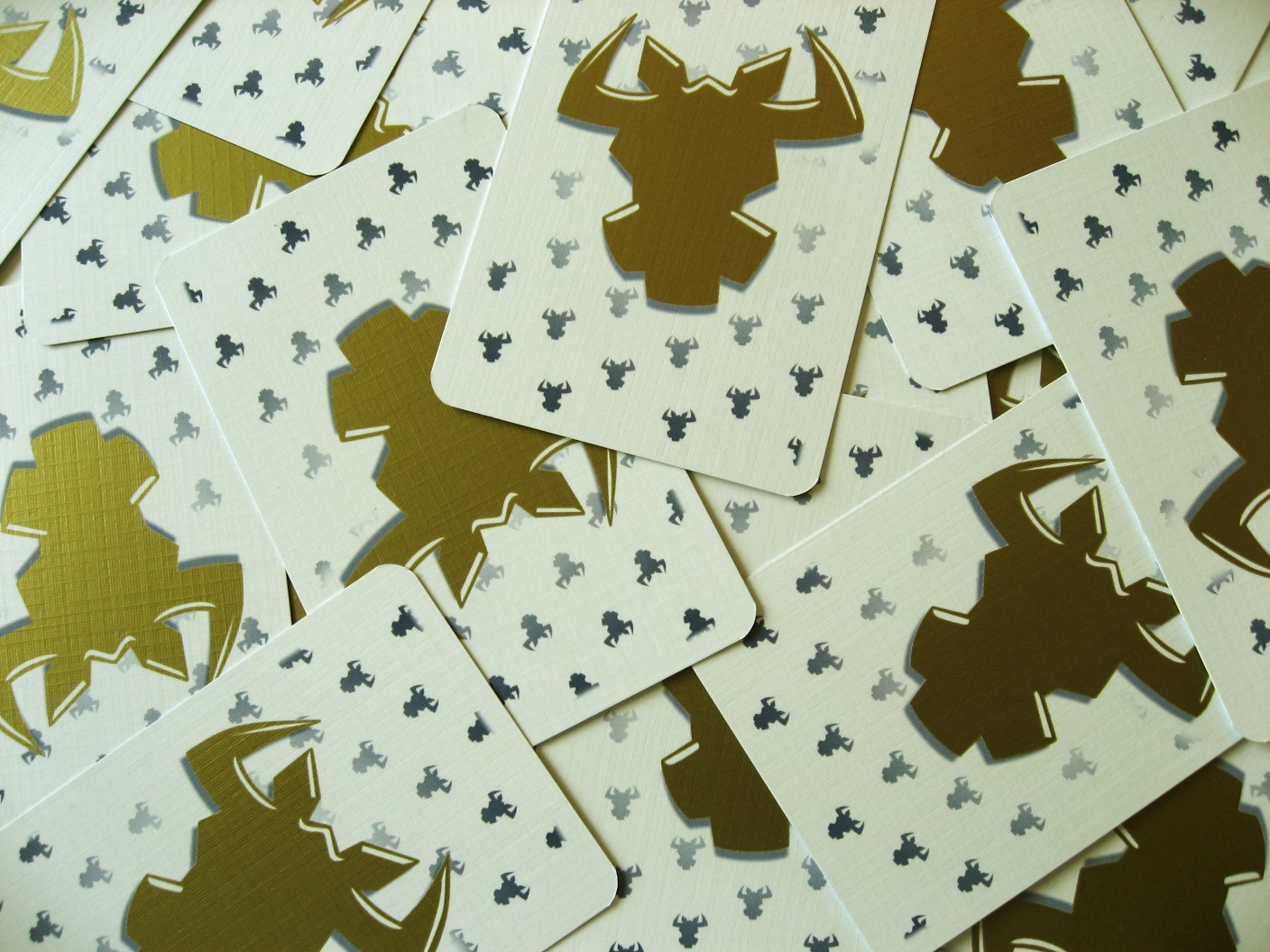
With a few more arrivals, we decided to play our “Feature Game” next, which was 6 Nimmt! (aka Category 5 amongst other things).  This is a much older game (celebrating its 20th anniversary this year), though is also quite simple to play.  There are four cards on the table forming the start of four rows and players start with ten cards in their hands.  Each card has a face value between one and one hundred and four and features a number of “Bulls Heads” (mostly just one, but some have as many as seven).  Basically, players secretly choose a card to play, and then simultaneously show them.  The lowest card is then placed after the highest card on the table that has a face value lower than the card they are playing.  In this way, four rows are formed.  The rows are full when they contain five cards and when the sixth card should be added, the active player instead takes all the cards in the row and places their card down to start a new row.  A player scores the number of Bulls Heads on the cards and winner is the one with the fewest at the end.  Since the number of cards in the rows increase (making it harder to play safely) and the number of cards in hand decrease on each turn (players don’t pick up after each turn), the decisions get increasingly agonising, especially when the number of Bulls Heads in the rows starts to increase.

6 Nimmt

We checked that Red understood that she wasn’t supposed to be collecting cards and she assured us that she understood this aspect of the rules, however, it wasn’t a surprise when she finished with nearly twice as many Bulls Heads as anyone else!  So we decided to play a second round and work our way through the second half of the deck to give her a chance to improve things.  Green decided that it was time to “nobble” Blue as she had finished the first round with one Bulls Head, however, he had no idea how to go about doing it, nevertheless, everyone was delighted when Blue was the first to pick up.  Red seemed to have got the hang of it this time and managed to get through the whole round without picking up a single card which meant she finished in joint second with Green.
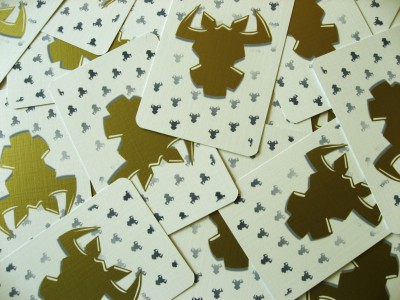
6 Nimmt

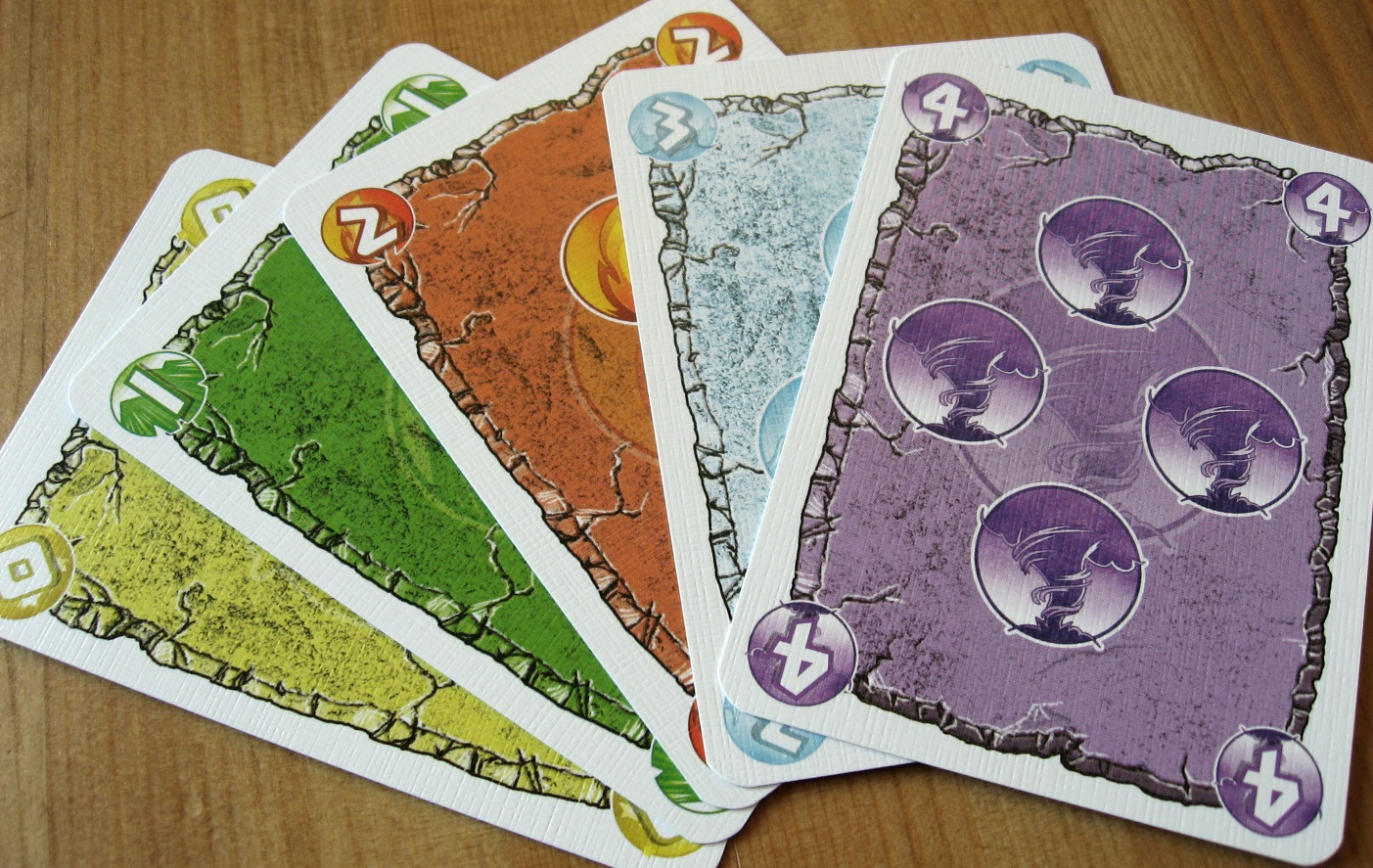
We didn’t have long before people had to leave,  so we played a game of one of our new favourite fillers, Dodekka, which has a lot in common with another game we like, Parade.  This is a simple little push-your-luck card game, with five different suits, Fire, Earth, Air, Water or Ether each with cards numbered 0-4. The game starts with three random cards placed in a line from the draw deck.  On a player’s turn they can either take a card from the deck and add it to the end of the row of cards, or take the card nearest the deck.  If the total of the face values of the cards in the row exceeds twelve, then the player has to take the whole row.  At the end of the game, players choose a scoring suit and add up the face value for that colour, then they subtract the penalty points – one for every card not in their scoring suit.
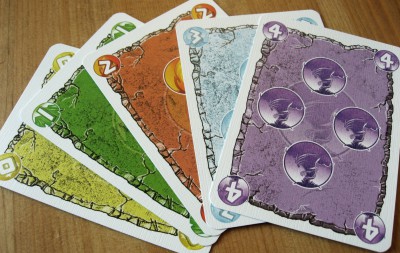
Dodekka

Yellow was the first to pick up a handful of cards, but it quickly became clear that he had a strategy and, as a substantial number of the cards were blue he was hoping to collect enough to offset any penalties.  Red, Green and Blue, meanwhile tried to delay picking up cards and then minimise the number they got so they could leave the decision until they were forced to choose.  Purple was forced to choose quite early on, but ran out the winner with a grand total of five, just one ahead of Green and three ahead of Yellow.  Remarkably, nearly everyone finished with a positive score, which we felt was much better than last time!
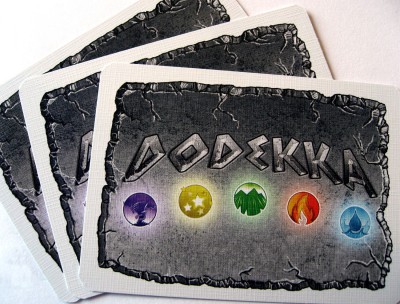
Dodekka

Next up was another recent favourite in Ivor the Engine.  We played this only a few weeks ago, but Yellow has won every game he’s played, so we all felt we couldn’t let this record stand…  Yellow started out well early on, with a lucrative job in Llangubbin, but it stayed close.  Purple carried out a lot of jobs at Mrs. Porty’s House and then picked up the matching event card to add more points.  Green collected a lot of sheep in the Grumbly Town area and then played a handful of cards to do several jobs one after another.  When an event card came up that moved everyone to Tewyn, we all payed a sheep except Yellow who followed the move with an ominous number of jobs in Tewyn Beach.  Meanwhile, Blue had picked up a lot of cards for Dinwiddy’s Gold mine, but without help was unable to clear the sheep efficiently.  So when the matching event card came and went, she changed her strategy and collected a couple of tasty looking jobs in Grumbly Town.  When it looked like Yellow was about to finish the game, Blue gave him a lost sheep card, immediately followed by Purple who forced him to lose a couple more sheep.  Blue turned her Goldmine cards into gold, then into coal enabling her to move and carryout a couple of jobs bringing her sheep flock to twenty-five, and as the last player in the round, brought the game to an abrupt end.  With her extra sheep event card, she finished with thirty, just ahead of Green who pushed Yellow into third, for the first time.

Ivor the Engine

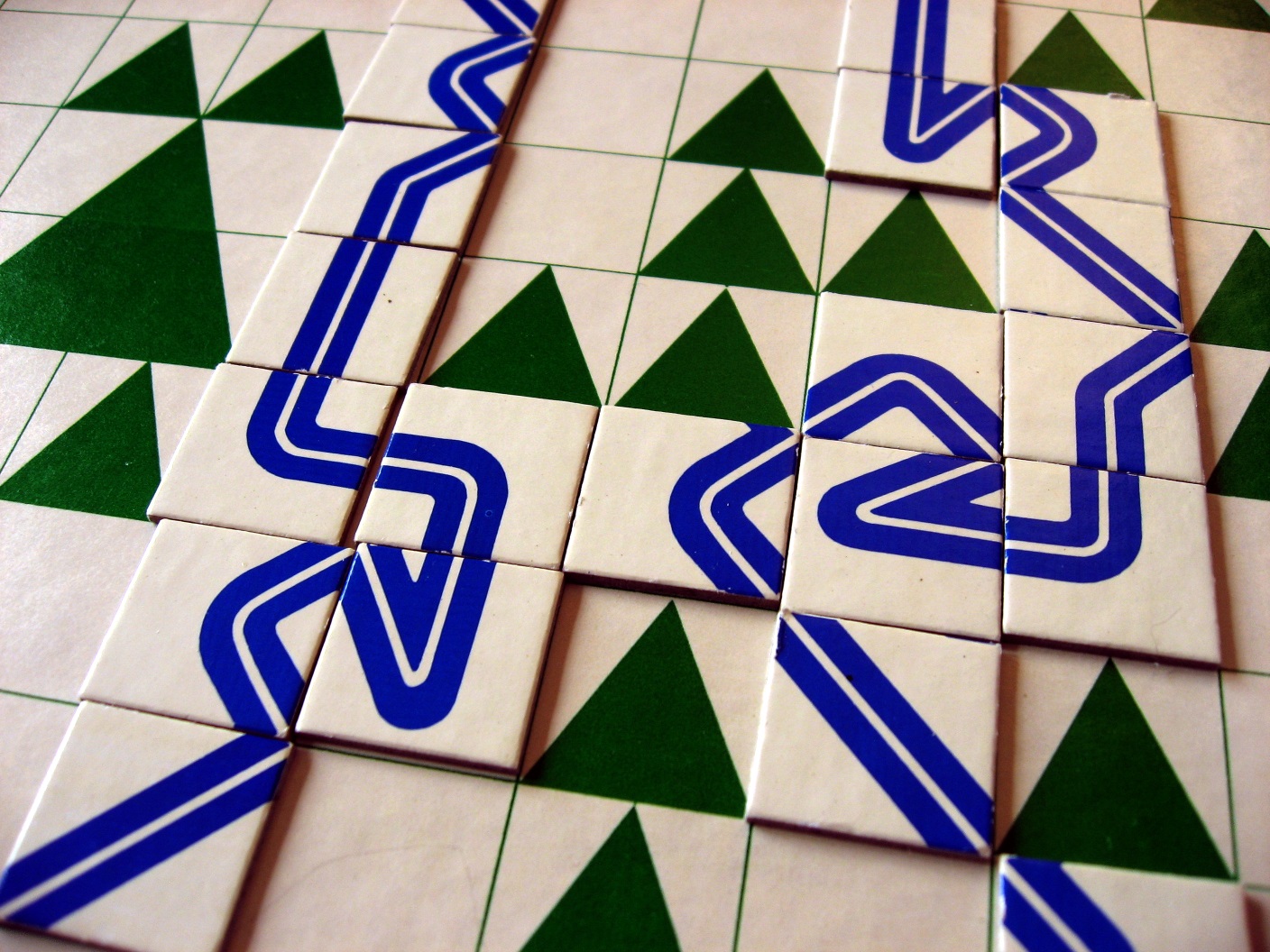
With only half an hour left, we decided to play what looked like a quick game in The Great Downhill Ski Game.  This is is an old game dating back to over forty years, but was ahead of its time.  Basically, players have a hand of ten tiles and on their turn they lay as many of them as they can to create a continuous path avoiding all the trees.  At the end of their turn they draw tiles from a face down pool to bring their hand back up to ten.  The game ends when one player makes it to the bottom of the run and players get points for finishing the course, but also for the tiles they lay, with points for corners and more points for sharper corners or crossing a track.
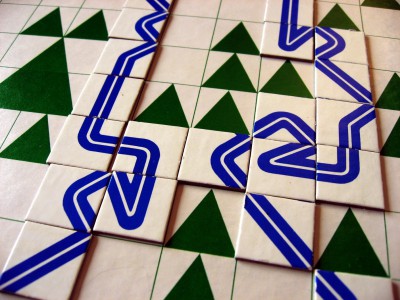
The Great Downhill Ski Game

Yellow started followed by Blue and Purple, so by Green’s turn he was squeezed into a corner and had to wriggle between the edge and Yellow’s track, as well as avoid the trees.  Purple was lucky with the space she had as Blue had left her with a lot, but didn’t get the tiles she needed.  Meanwhile, Blue started well and made a run for the line, but trying to weave in as many of her higher scoring tiles as she could.  It looked like Blue was miles ahead, but Yellow crossed the line first, leaving everyone one turn to finish.  Purple was the only one who couldn’t quite make it, though she managed to use nearly all her tiles.  Blue was hampered by drawing a high scoring, but high penalty tile in the penultimate round that she couldn’t get rid of, and came joint second with Green who did remarkably well considering his difficult start.  The gold medal went to Yellow though, who was not only first down the course, but was also left with the fewest penalties at the end.
The Great Downhill Ski Game

Learning Outcome:  Old games are sometimes still good games.

1st July 2014

Pizza was the order of the day, so while we were waiting for it to arrive, we played a quick game of Walk the Plank!.  This is a very short game of kamikaze pirates that we’ve played a few times before and is great fun so long as everyone plays it in the right spirit.  We started by shortening the plank, so everyone had no choice…  Very quickly, most people had lost a pirate and the plank was only one square long.  Red had all three of her pirates perched precariously on the end of the plank when the inevitable happened and in they all went and out went Red.  Yellow quickly followed, then Green,  leaving Orange and Blue to fight it out with their last remaining pirates (although the rules say the last two players share the victory, we play hard-core and stick it out to the end).  Blue had the advantage of going first, but with both Pirates on the ship one remaining piece of plank between them and certain doom, it needed a bit of thought before she could finally secure victory.

Walk the Plank!

By this time, pizza had arrived and so had more players, so we decided to play our “Feature Game”, Spanish Bohnanza which we could do while munching.  We’ve played this a lot before and always enjoy it, even though it sounds really unpromising when you explain it.  With two players new to the game, we played nicely and before long everyone was happily planting “Judías” and trading “Cafeterías” for “Hippies” and “Bills” for “Booms” – and we had all thought the names were funny in English!  It was a very tight game with Blue finishing only one point ahead of Black and Red who were joint second.  Whenever there are new players in a game, we usually let the experienced players go first as it takes the pressure off a little and means that they get to see how it is done.  Unfortunately, this meant that the last two players, who were also new to the game got one fewer turn which could have made quite a large difference given how close it was and, on reflection, it was an effect that was exaggerated with so many players.  So, if we remember, perhaps we’ll house rule it in future and turn over the draw pile one last time and make sure everyone gets the same number of turns.

Bohnanza

An early start for work the next day meant a few players left early and the rest played Ivor the Engine.  This is a clever little game that features the iconic art-work from the Ivor cartoons as drawn by Peter Firmin.  We’d not played it before in the group, although several players had played it at the UK Games expo where it was first released and we talked about it a few of weeks ago.  The idea is that players are travelling round Wales collecting sheep and the person with the most sheep at the end of the game is the winner.  A single sheep can be collected whenever you start your turn on a town or village with sheep in it, however, more sheep can be collected if you are in a town or village with NO sheep and perform a task to “help Ivor”.  Helping Ivor comes at a price, however, as in order to do this you have to play one of the dual-purpose cards from your hand, which means you cannot use it to help you in other ways.  At the end of your turn you add one card to your hand from the face up displayed cards, however, when the chosen card is replaced from the draw-pile, the game has a sting in the tail:  mixed in with the errand cards are event cards, and these can be nice, or nasty…

Ivor the Engine

Once the game had been set up and sheep sprinkled liberally over the Welsh hillside, players carefully chose the starting points for their waggons.   Within two turns however, the first event card came out and moved everyone to Tewyn.  As almost nobody had any sheep, most of us had no choice, much to the chagrin of Green who had chosen to start in Tewyn and, by the time his turn came round, all the sheep had gone and everyone else’s waggons were in his way.  Nevertheless, Green started well with a couple of very lucrative errands, followed by Black.  Purple meanwhile, was the only player who had been able to avoid the enforced relocation to Tewyn, and was making good progress in the “Grumbly” area of the board.  Blue was feeling more than a little hard-done-by, when she found herself stuck in Ivor’s shed by a nasty, vindictive move from Green, who helped himself to a couple of “lost sheep she’d been eyeing up at the same time.  He couldn’t afford to stick about for long though, and eventually Blue managed to cash in three errands, finally getting going at last.

Ivor the Engine

As the game progressed it became clear that the excellent start made by Green was gradually being eroded by Black who, with extra experience, was clearly the player to beat.  Purple picked up a very lucrative event card giving her lots of extra sheep at the end of the game and Blue carried out a couple of errands and Mrs. Porty’s House, keeping them both in the game.  Green meanwhile got in Black’s way and managed to prevent him from picking up his critical twenty-fifth sheep, thus prolonging the game for an extra round, giving everyone else a chance to play that last card.  That last turn made the game very close, but Green and Blue failed to catch Black and who won on a tiebreak.  Next time…

Ivor the Engine

Learning Outcome:  Spanish judías and German böhns are funnier than English beans.

3rd June 2014

This week, we started late partly due to illness and delayed arrivals and then we got side-tracked by the latest haul from the UK Expo over the weekend.  These included The Little Prince: Make Me a Planet, Tsuro of the Seas (an expanded version of one of our favourites, Tsuro), a little card game called Dodekka and most exciting of all, a new game based on the old childrens’ classic, Ivor the Engine, complete with the original artists drawings.

Ivor the Engine

We decided to start with Dodekka, as it had been played at the show. This is a short card game played with five different suits, Fire, Earth, Air, Water or Ether each numbered 0-4. The game starts with three random cards placed in a line from the draw deck. On their turn, a player may choose to take the card closest to the deck into their hand or take a new card from the deck and add it to the end of the row. Players score the total face value of the highest set, minus one point for each additional card and the highest score wins.   As long as the row totals twelve or less (or the new card is the same number as last one) everything is fine, but if the active player chooses to “twist” and goes “bust”, then they must take all the cards on the table into their hand and this can lead to a lot of negative scores!  The game started fairly evenly, but White was the first to succumb to the bust.  It seemed that every time it came round to White, she had to choose between taking a card she didn’t want or taking a chance that she would not go bust from 11!  So yes, the inevitable happened again and just as we were beginning to wonder if this game was flawed, Red went bust and shifted the cycle.  Green (who had not played it before) somehow managed to hang on till the end of the game without going bust and won with the handsome score of 9.

Dodekka

As the theme of the evening was new games and old favourites, next we played Alhambra, but with a couple of new, unplayed modules:  the Characters and Military Encampments from the City Gates expansion.  We’ve played Alhambra a few times as well as its predecessor, Stimmt So!.  Basically, on your turn, you buy coloured tiles with different coloured money cards and add them to your Alhambra. If you can pay with exactly the correct amount, you can buy another tile, but if you over-pay, you get no change and your turn ends. While this all sounds simple enough, there is the little problem that most of the tiles have walls along one, two or three edges, and when placed, these must match up without partitioning the Alhambra.  These walls are critical as poor play in the early stages means that it is possible to get yourself backed into a corner later in the game.  The Military Encampment tiles are placed alongside and outside the Alhambra walls and score points dependent on the number of tiles within that row.  The Characters can do a variety of  things:  some help end-game scoring, some provide a one off bonus, and others give a bonus of some sort every turn.  These cards are in the money deck and are immediately auctioned off when they appear.

Alhambra

The game progressed steadily through to the first scoring round, with White and Green matching tile for tile and Red just a couple behind. After totting up at the first scoring round, Red was only two points.  As the second round progressed, things began to get interesting as the characters started appearing.  Red picked up the first two, which enabled him to swap exchange a tile on the market board if he wanted, or get extra money if he got low.  Green got the third Character, which was a tie breaker for one tile colour at scoring. White then got in on the action with a card which would increase her wall score, and since her wall was looking good already, seemed like a wise investment.  Meanwhile, Red’s Alhambra was looking good for the high scoring tiles and the wall, although building was going to become more challenging.  White was also getting a little boxed in to the west, but built up a few camps improving her score.  Green did not have the long wall, but was really boxed in due to the hap-hazard nature of his city.  So, when the next character card to appeared gave an additional city re-arrangement action for placing a new building, Green did everything he could to get it, and fortunately for him, the others did not try very hard to stop to him.

Alhambra

In the second scoring round Green’s tie breaker character gave him a boost and White’s wall bonus gave her a few extra points, but it was all to no avail as Red soared into the lead.  Moving into the third round and the game picked up intensity as Ruth left the building (i.e. the game became “Ruth”-less!).  The final character to appear enabled the player to get a money card if he bought a high value tile, although looking at what was already on the table there did not seem to be many (if any) left and only Green thought it was worth money.

Alhambra

So the fight was on, White was trying to make her wall as long as possible and added camps as often as she could.  Green and Red fought to get the most of the highest scoring, purple tiles, while Green frantically set about re-arranging his city, turn by turn, often over-paying simply to buy a tile and unlock the re-arrange action, so that he could to get more tiles in. Red won the battle for purple and green tiles, Green just about got his city re-arranged and nabbed a couple of white buildings at the last to give him the lead in that class.  In the scoring, Green then used his tie breaker to take the lead in brown tiles ahead of White, adding them to the lead in red tiles, meanwhile, Red sneaked ahead in the lowest scoring blue tiles.  Both White and Red scored well for camps and walls, but Green had managed to pull his city together and link up his walls to give a respectable score.  In the end, the game was quite close, but Red won the day with 146 points, just seven points ahead of Green in second.  We all agreed that the character cards really added an interesting twist to the game, and will likely remain a feature of our Alhambra games from now on.

Alhambra

This game had taken a very long time, and, even though it was only supposed to be only an hour, according to the game cube timer it had taken over an hour and a half excluding setting up and auctioning!  There was still time for another crack at Dodekka though and this time Green went bust very early on, while Red remained card-less and White went bust next.  Red did not survive and right at the end, Green took a gamble and went bust to finish the game.  As we’d found earlier this is a generally low scoring game and this was no exception, with Red running out the winner on 1 point!  Even so it was agreed that this was a good game, worth playing again… and again… and again…

Dodekka

Learning Outcome:  To win you don’t always have to score highly!