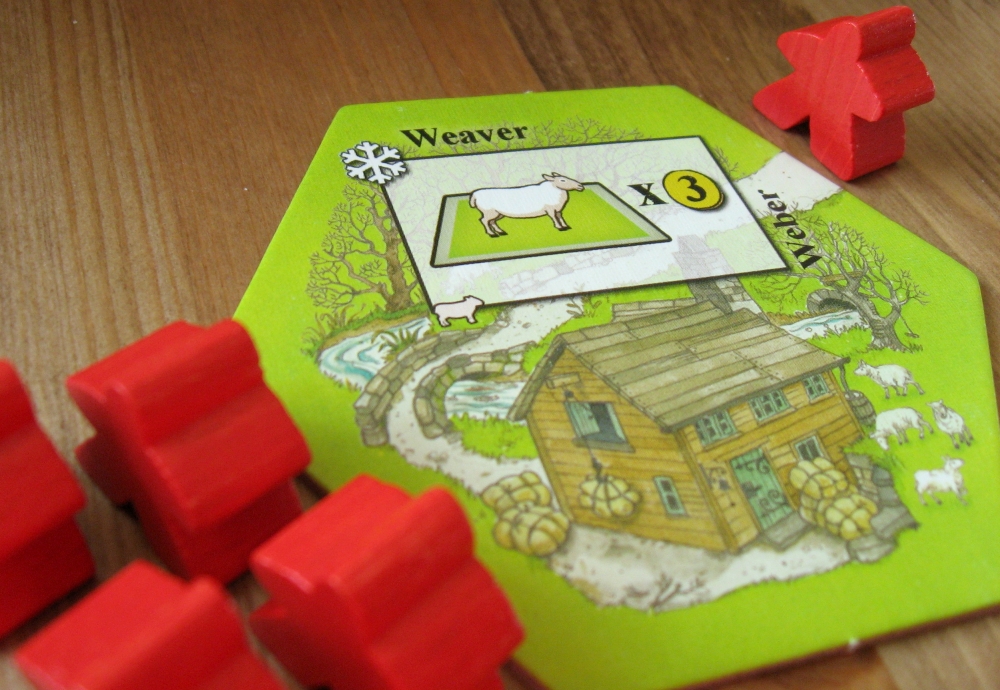
It is that time of year once again, when a boardgamer’s thoughts turn to Germany, specifically, Essen. Essen is a German city in the industrial heartland on the River Ruhr. In German, “Essen” means “food”, but to gamers it means “Spiel” – the largest games fair in Europe and, arguably, the world, The Internationale Spieltage (which is held in Essen of course). The fair runs for four days every year and everyone who is anyone goes. As in most years, a lot of new and exciting games are released at the Fair. This year, amongst other things, there are expansions for some of our favourite games including Keyflower and Snowdonia. There are (of course) lots of exciting new games as well, including Click & Crack, Castles of Mad King Ludwig, Evolution, Five Tribes, Cat Tower, Subdivision etc. There are a few of us going this year and it is certain that they will bring back some exciting new toys to play with.
Tag Archives: Keyflower
7th October 2014
Blue’s dinner had just arrived when two new gamers walked in, closely followed by Black and Purple. While Blue munched her burger and chips, at Purple’s request, the others played a quick couple of rounds of Dobble. This is a game that used to be one of our “go to” fillers, but has been somewhat neglected over the last year or so. Being basically, glorified “Snap”, it is a good game to warm up or finish with and is very easy to teach. Not hampered by the fact that they’d never played it before, the wins were shared between Azure (well, it’s a shade of green) and Orange.
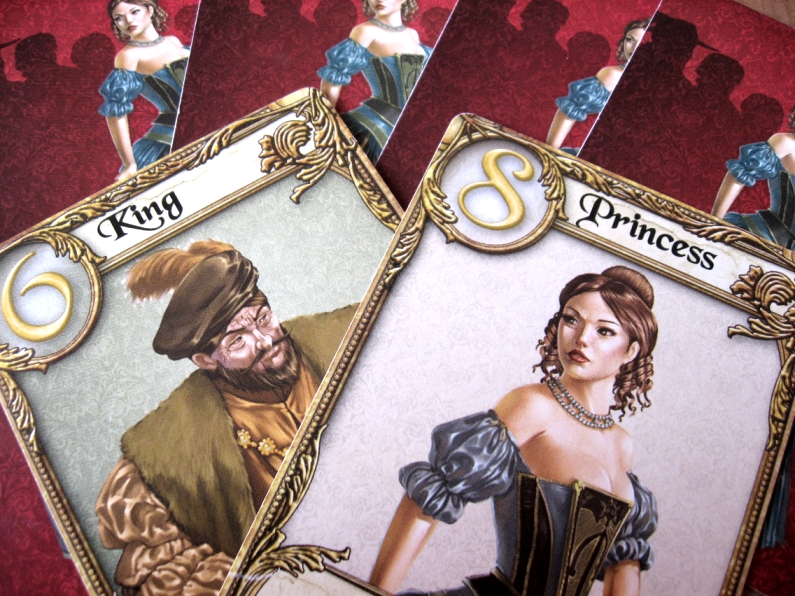
While we waited for Green to arrive we played a quick five player game of the “Feature Game”, Love Letter. This small card game is supposed to play a maximum of four, but we thought we’d try it with five. The basic idea of the game is to be the player with the highest numbered card at the end of the game. So, each player starts with a card in hand and on their turn draws a second and then chooses one to play. Since each card has an effect and there are only sixteen cards in the deck, by playing a card, players are both gaining information about what cards other people have as well as giving away information about their remaining card. Used correctly, this information allows players to attack others and potentially eliminate them from the game. Everyone had won a round and we’d already concluded that although we were enjoying playing it wasn’t really a five-player game. So, the arrival of Green meant we decided to stop when the first player reached two, which happened to be Blue.
Next we had the inevitable debate about what to play and whether to split into two groups. Azure and Orange commented that they liked worker placement games which put Keyflower in the mix, one of our favourite games and one we’ve played quite a lot. It plays six, but several of us thought it might drag, especially with players who had not played it before. Various other options were offered, but Blue is always happy to play Keyflower and others followed, so it quickly became a single six player game.
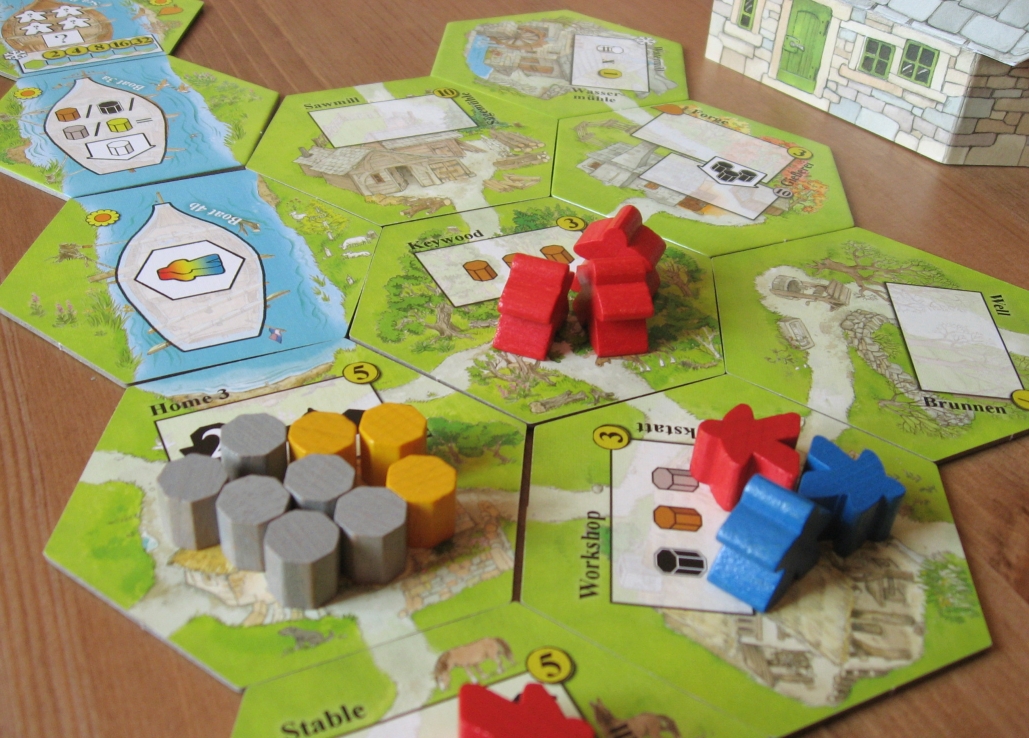
The premise of the game is quite simple: over four rounds (or seasons) tiles are auctioned using meeples (or Keyples) as currency. The clever part is that to increase a bid, players must follow with the same colour. Keyples can also be used to perform the action associated with a tile, any tile, it doesn’t have to be their own, but each tile can only be used three times in each round and, again, players must follow the colour. The aim of the game is to obtain the maximum number of victory points at the end. However, the high scoring tiles aren’t auctioned until the last round (Winter), so players have to keep their options open. On the other hand, the tiles that are auctioned in Winter are chosen by the players from a hand of tiles dealt out at the start, so players can choose to take a steer from that. However, for that to work, you have to win the tile at the end…
With six players, almost all of the tiles are used, which makes it very different to playing with the smaller numbers we are more familiar with. Somehow, with so many players keen to to get involved from the start, the Spring tiles were highly contested and Blue lost out finishing with none. During Summer and Autumn, players strategies started to emerge. Green was collecting green Keyples, while Black was collecting Yellow Keyples. Meanwhile, Azure was collecting resources, and Orange, Purple and Blue were concentrating on trying to upgrade the tiles they had. Purple struggled because everyone else seemed to want her coal and generally managed to get there first while Blue struggled because she needed a pick-axe skill tile and couldn’t get it.
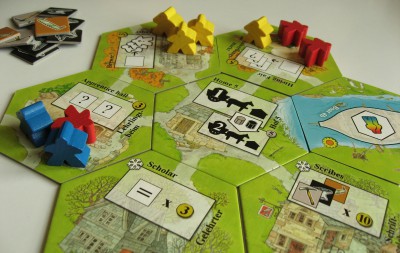
Winter arrived and the Apothecary and Village Hall tiles came out for Black, the Key Market tile came out for Green, the Scribe and Scholar tiles came out for Blue and Orange who had collected quite a pile of skill tiles between them. Blue had secured the start player at the end of Summer and went first with a free choice of tiles and a massive pile of red meeples to fight with. Although she only had one set, she decided to chance it and went for the higher earning potential of the Scribe tile which yields ten points for every set of three. Orange went for the Scholar, Black bid for the Apothecary and Green went for the Key Market with one of his massive pile of green Keyples, leaving Purple and Azure to fight for the rest of the tiles, including the Watermill (which rewards groups of five resources) and the Keythedral (which gives a straight twelve points) amongst others.
Players were beginning to pass, but Green was still increasing his stock of green Keyples, leaving Blue with a decision: keep her now much smaller supply of remaining red Keyples to defend the important Scribe tile, or try to improve her position by trading in one last tile to see if she could get another set or two. After a quick (mis)estimate of Green’s score Blue decided she had to go for the extra points, which increased her number of sets of skill tiles from two to five. While she popped out for a moment, Green under the impression that Blue had more remaining red Keyples, decided to use his two remaining reds to challenge for the Scribe tile in the hope that it would deplete her supply allowing him to win his choice of boats. Unfortunately, although Blue could match his bid, she didn’t have enough to beat it. Although Green did not fully appreciate it at the time, this did far more damage to Blue than to him and it told in the final scores. Green finished with sixty-six points, well clear of the pack, and Blue who (without the Scribe lost fifty points), finished just ahead of Black in second place. Despite our skepticism, Keyflower was very enjoyable with six and it turned out to be one of the best games we’ve played.
Learning Outcome: Don’t over-estimate the position of the other players.
11th February 2014
One of our regulars is moving pastures new, so as this was probably her last week, we played games she said she liked. We started off with Parade, which is a little card game with an Alice in Wonderland theme where you add cards to a row, but the cards that you place dictate what cards you pick up. In general, cards score their face value and the object of the game is to have the lowest score, however, for the person who has the most of a colour, that colour scores only one for each card. So, the game starts with everyone trying to minimise what they pick up and then, once the writing is on the wall, everyone scrabbles to pick up as more cards than everyone else. We first played it a few weeks ago and our leaver came second by just one point, so this had an element of a re-match. The winner from last time was quickly forced out of the running and ended up with twenty-eight points, and the battle was between our leaver and the player who came last in the previous game. Sadly, our leaver once again finished in second place with twenty points after being forced to pick up a couple of tens, but, with fourteen points, the win went to someone who claims he always looses “little games”.
Next we started setting up the “Feature Game” which was Keyflower with the Farmers expansion and then a couple more people arrived. Keyflower is one of our most played games, but there is one player who usually wins, so the rest of us made a point of ensuring that Green didn’t have it all his own way this time. Like the last time we played with the expansion, we used all the farming tiles. Winter tiles were doled out and the rules were passed round as people checked and double checked what they had. Spring tiles were then revealed and Red and Blue went for the sheep tiles. Red and White won them, but Blue had placed a couple of workers on the tiles before the end of the round giving her a breeding pair. By the end of the summer both Red and Blue had a large flock of sheep and it was only then that Blue dissolved into fits of giggles as she realised that sheep weren’t pink and she had been collecting the wrong animal…
Meanwhile, Green had been acquiring resources, Yellow had been trading tiles getting two for one on each occasion, and White had been busy building up a healthy stock of green meeples and pigs. In the last round, the winter tiles were revealed. The Hillside tile came out and it suddenly became apparent why Green had such a strange shaped village, so Yellow took it off him. The only other animal tile that came out was the cow tile which Blue made a play for to try to redeem her earlier spell of colour blindness. Red pointed out a couple of turns in that it was worth a lot and promptly started to bid for it too. In revenge for “stealing” his Hillside, Green took the Scribe which rewards players for collections of skill tiles, so Yellow took the Windmill which rewards players for collecting resources…
Despite Red’s efforts, Blue managed to sneak under the radar and nabbed the Keythedral (which is worth twelve points). The collective efforts of Yellow, White and Red had succeeded in preventing Green from winning. However, despite having a chronic shortage of meeples throughout (due to squandering them on sheep in the first two seasons) and therefore a very small village, and almost no points from anything else, the combination of a heard of cows, the Keythedral and the damage the other players had done to each other, meant Blue finished with seventy-one points, seven ahead of Yellow in second and twelve ahead of Red in her last, quite epic game with us.
Learning Outcome: Beef is very nourishing!
17th December 2013
We planned to start early and get in a quick game of the “Feature Game”, Morels, however, we had just finished going through the rules and were just about to start when the late arrivals arrived early. So, we left the mushrooms for another day and moved on to one of our favourites, Keyflower. The reason why we were all especially keen to play this, is that the expansion, Keyflower: The Farmers was released at Essen and we had been waiting since October for a good opportunity to give it an outing. There are two documented ways to integrate the expansion with the main game: you can choose tiles randomly from those available in the base game and the expansion, or you can use all the farming tiles and just use random base game tiles to “top up” the numbers. Since it was the first time any of us had played the expansion, we chose to use this latter, “Farmers Variant”.
The idea behind the expansion is so simple that it is really very clever, and it is hard to believe that it wasn’t designed at the same time as the base game (though according to the designer, it was not). In summary, the structure of the game remains the exactly same, but the new tiles give you access to animals which you place in the fields defined by the roads and the edge of the village. There are a handful of rules associated with the animals (they breed at the end of spring, summer and autumn, but not winter because its too cold; they don’t breed if they are sharing with other animals because they are too shy), and the expansion also introduces wheat (which can be used to entice animals from one field to another or to encourage the horse pulling the cart enabling it to move more resources), but otherwise the game is essentially the same. Or not…
As usual, we handed out our winter tiles and a handful of meeples (or Keyples as they are called in this game), before the spring tiles were laid out for everyone to look at. With the farmers expansion, sheep are introduced in spring, pigs in summer, and cows in autumn. So sheep came out first and Blue and Green got the key sheep producing tiles, and everyone with sheep tried to make sure they had at least two so that they could profit from the end of season breeding. Unusually, almost no resource production tiles came out as these were of course displaced by the animal tiles, and this was the way it stayed for the rest of the game. On the other hand, all the “green Keyple” tiles came out making them more abundant than usual.
In summer and autumn, Yellow tried to get into the animal husbandry business breeding pink cows and got into a tussle for it with Blue, who largely lost out and played most of the game with a village of just four tiles. Meanwhile, the other sheep-farmer, Green, eschewed pigs and cows and concentrated on expanding his flock to nearly epic proportions. By winter, Blue, with her hamlet and miniscule fields, was stacking pigs and cows in a way that would not have won favour from the RSCPA and Green (the shepherd) was trying to obtain the services of a weaver to increase the value of his flock. Meanwhile, Yellow was trying to expanded his cattle business and Red, the only player who had managed to get resource production tiles was mining for gold, employing a jeweller to maximise her the outcome from her gold and moving iron from one side of her village to the other. In the dying moves of the game, the Yellow outbid Blue for the dairy who in turn placed a large bid for the weaver which Green was unable to match. This cost Green somewhere in the region of twenty points and forced him to take the hillside tile and try to make the best use of it he could. Despite the inconvenience, Green still romped away with the win some twenty points ahead of Blue and Yellow who came joint second. Even so, somehow this didn’t seem quite as much of a white-wash as last time…
Learning Outcome: Trying to breed pink cows does not make you a better farmer!
Essen 2013
Although Essen is a small German city in the industrial heartland on the River Ruhr, it is used by gamers to refer to the largest games fair in Europe and, arguably, the world, The Internationale Spieltage (which is held in Essen of course). The fair runs for four days every year and everyone who is anyone goes. As in most years, a lot of new and exciting games are released at the Fair. This year, amongst other things, this includes an expansion for one of our favourite games, Keyflower. The expansion is called Keyflower: The Farmers and introduces animals to the game. There are also expansions being released for Snowdonia and Tzolk’in: The Mayan Calendar, both of which are excellent games and have been enjoyed by members of the group. In addition to expansions to known games, there are (of course) lots of exciting new games, including Rockwell, Glass Road, Expedition: Northwest Passage, Amerigo and loads of others! Those of us that are lucky enough to be going are sure to bring back some exciting new toys to play with over the next few weeks.
3rd September 2013
First up this week, while we waited for the others to arrive, was Toc Toc Woodman (aka Clack Clack Lumberjack). This Is a dexterity game that consists of a segmented plastic tree where the am of the game is to knock bits of bark off with an axe, while not removing the core segments. As the game progresses, the tree becomes increasingly unstable with the inevitable consequences… Honours were just about even when we were saved from a tie-breaker by the last of the late arrivals.
![]() |
| – Image by BGG contributor EndersGame |
Next we started our “Feature Game”, Keyflower. Although we have played it before and it is a very popular game with most club members, we had one player who was unfamiliar with it, so we chose to play it without any of the additional tiles.
![]() |
| – Image by boardGOATS |
Keyflower is a worker-placement and auction game that is played over four seasons. Each player begins the game with a home tile and eight worker meeples (or Keyples as they are known in this game). At the beginning of each round there is a new stack of tiles that players can use and bid for. The really unusual part of the game is the interplay between workers and bidding: workers can operate on any tile, in a players own village, in another players village, or one that is still being auctioned. At the end of the round, the workers go to the owner of the tile, thus, if you have a commodity that other players want, it can be a source of Keyples. On the other hand, if you chose to bid for a tile, presumably you wanted to use it, which means that you have competition for the resource, and so it proved.
![]() |
| – Image by boardGOATS |
One player had been present at the drubbing we had received last time we played and tried the same strategy, i.e. to collect skill tiles. Those of us that were aware of this approach started out with no real strategy except to prevent a second run-away victory by the same means. Meanwhile the new player quietly got on with collecting gold and marshalling her Keyples. Mixed based strategies gradually evolved for otherwise indecisive players with resources, the river and transport all featuring and it wasn’t long before we got to the final round, Winter. Surprisingly, there wasn’t much competition for tiles to begin with as everyone concentrated on getting the resources and skill tiles they wanted to the place they needed them. By this time, Keyples were in short supply, so there was only a token amount of scrapping for final tiles in what ended as a very, very closely fought game with first and second just one point apart, a tie for third and fourth, and everyone separated by only six points.
![]() |
| – Image by boardGOATS |
The third game of the night was, the race game, Salmon Run. We’ve played this a couple of times before, but still managed to have a couple of new players, so after a quick run through of the rules, off we went with board S1, 5E, 6E, 3M, 2M & F1. White took an early lead, while Red and Black got in each others’ way and battled with bears. Red and White both got sore heads bashing the bank, while Black got a bit stuck with mid-stream and trapped everyone else in the current.White made a dash for the finish, but got caught needing a right and straight to get across the last lot of rapids giving Red and Black a chance to catch up. Red got closest, but White managed to make it across the line first and Red failed to quite make it to the Spawning pool on his last turn. Even if Red and Black had made it home, Red’s nine fatigue cards and Black’s six dwarfed White’s two (thanks to the enforced wait before the last rapids where she had been able to ditch a lot of hers).
![]() |
| – Image by BGG contributor kilroy_locke |
The last game of the night was an old favourite, Love Letter. This is a really simple little duelling game played with just sixteen cards. Each round only takes a couple of minutes and each player takes it in turns to draw a card and then play one of the two cards in their hand. Cards allow players to look at another’s hand, force them to discard, give them the opportunity to try to assassinate other players etc. and the last player in, or (in the unusual case that all sixteen cards are drawn), the player with the highest card, wins the round. Remarkably, one player managed a run of three rounds undefeated, and despite a desperate rear-guard action, this proved an unassailable lead.
![]() |
| – Image by boardGOATS |
Learning Outcome: A winning strategy doesn’t always work…
30th April 2013
Like last time, we again started out with a quick game of Love Letter while we waited for late arrivals. This time we found that players were winning rounds without getting very deep into the deck, which is strange. However, one thing that didn’t change was that beginners luck again carried the day…
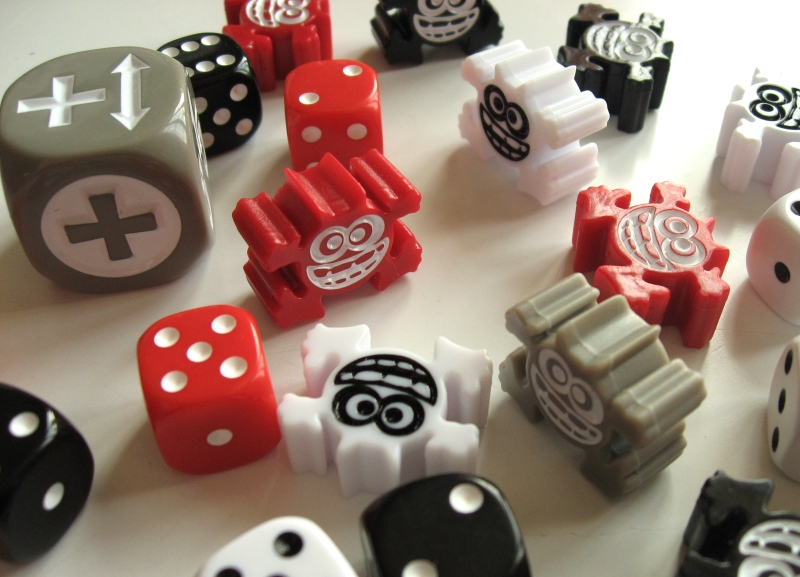
Next we quickly played a new game, Diavolo. This is a dice rolling game where players take it in turns to roll dice and depending on the outcome of the “Order” die, dive for a cute little imp. If they fail to grab one (or get the wrong one), the player loses a gem and the last person to lose all their gems is the winner. We all found this game very stressful so we had one quick round of an old favourite, No Thanks! as the last player arrived and went to the bar.
Once again, our less experienced players were otherwise engaged, so we decided to forego Ticket to Ride and play something we enjoyed a couple of months ago, namely The Speicherstadt. This is a clever little auction game that is relatively quick to play and easy to teach, but has a lot of strategy. In short, cards are turned over and players take it in turns to place one of their “Village People” next to the card they would like to buy: contracts, ships (use to fulfil the contracts), firemen (to protect against inferno) etc.. The first player to bid for a card has first refusal for that card, but the price they must pay is equal to the total number of “Village People” next to the card. If they decline, then the next player has the choice, and the cost has reduced by one. Despite the fact that the different players seemed to employ quite different strategies it ended a very close game. For example, Blue eschewed firemen and ended up taking nearly all the negative points due to fires. Thus, Blue was some twenty points adrift at the back before the final accounting although they had a couple of valuable contracts and the warehouse. In contrast, White invested heavily in firemen, and was way out in front, but had less to add in the final reckoning. White and Blue ended level on points in last place, but only two points behind the winner who had engaged in more trading.
Finally, we just managed to squeeze in a game of Keyflower. This is a really beautiful resource management and bidding game where players use meeples (or “Keyples” as they are known here) both as currency for bidding and as workers to generate resources. Played over four Seasons, with new tiles available at the start of each one, players take it in turns to bid for the different tiles. However, the catch is that once a bid has been made, any subsequent bids for that tile must be both larger and made with the same colour. In addition to the colour management, there are lots of other really elegant aspects to this game. For example, players can place workers on tiles and use the products during that same Season, thus, if a player needs red for bidding, they may be able to use a worker to obtain the necessary Keyples. This means you rarely find you can’t do anything, but you often can’t do exactly what you want. Although it was a new release at the end of last year, we had all played it before, so we just had a quick reminder of the rules as we set up and then launched into it. In contrast to the last game, this was a bit of a white wash with the leader wining by some thirty points. What was particularly interesting, however, was that this was based on a skill tile strategy which netted some sixty points at the end of the game. None of us had ever found them all that useful before, presumably at least partly because the right tiles had never come up.
Learning Outcome: In some games, you can be quite convinced you are losing and be very, very wrong.


:strip_icc()/pic1186412.jpg)


:strip_icc()/pic1595599.jpg)