Tag Archives: Le Havre

30th April 2024

Blue and Pink were unusually early and had already finished their pizzas when Pine rolled in.  He was soon followed by Black and Purple and then Lime and Teal giving a total of seven for one of the quietest nights for a long time.  With seven, the question was how to split the group and what would everyone play.   For seven players, the go-to game is generally Bohnanza, which Blue inevitably suggested.  Pink suggested playing it later, but when Teal commented that he’d never actually played it, that was the decision made.  There was no way that state of affairs could continue, so the “Feature Game” (which was to be Canvas) was put on the back burner until later, and the Beans came out.

Bohnanza
– Image by boardGOATS

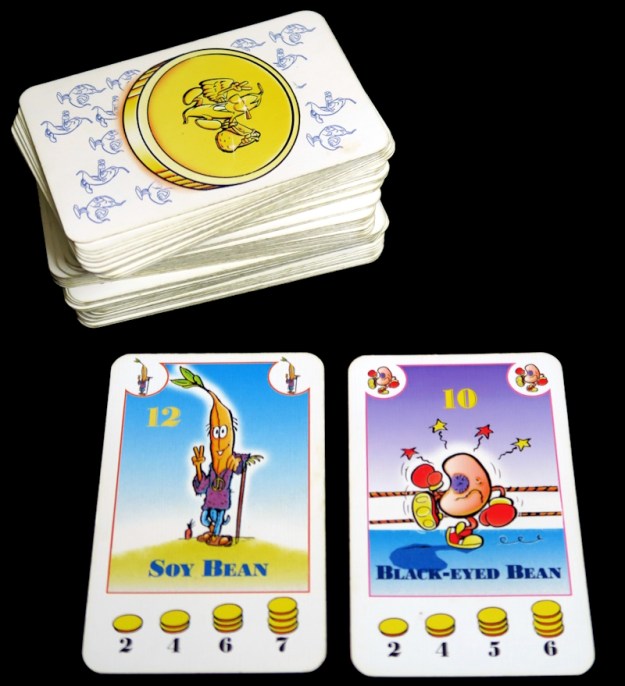
Bohnanza is best part of thirty years old and is, despite him designing a huge number of excellent and popular games since, including Agricola, Caverna, Le Havre, A Feast for Odin and Patchwork, is arguably, still one of Uwe Rosenberg‘s best games.  It is a really simple game of set collecting and trading, that when explained sounds strange, but when played is great fun.  While everyone else chatted, Blue explained the rules and how to play to Teal.  The important thing is players cannot rearrange the cards in their hand (similar to recent Spiel des Jahres nominee, SCOUT).

Bohnanza
– Image by boardGOATS

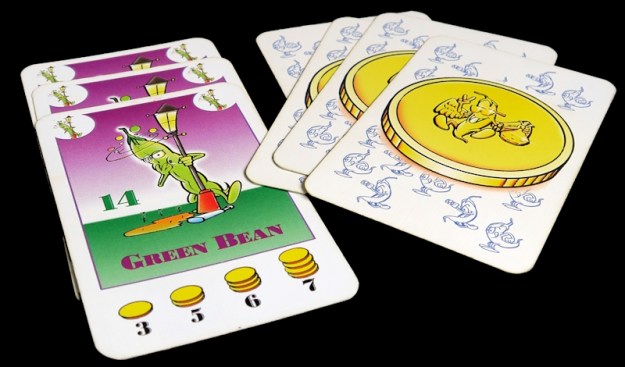
So, players start with a hand of cards, and, on their turn, must plant the first Bean card in the front of their hand into one of the two “Bean Fields” in front of them.  Then they may, if they wish plant the next Bean into one of their Fields, but each Field can only contain one type of Bean.  Once they have finished planting from their hand, the active player turns over the top two Bean cards, which must be planted, but may be traded and planted in another player’s Field if agreements can be reached.  Once these Beans have been dealt with, the active player can trade any cards from their hand, but all cards involved in any trades must be planted straight away.

Bohnanza
– Image by boardGOATS

Finally, the active player tops up their hand taking Bean cards into their hand (three in the case of the seven player game).  At any point, players can harvest one or both their Bean Fields converting some of the cards into Bean Thaler (according to the “Beanometer”), placing them face-down in their scoring pile, returning the other cards to the discard pile.  However, players cannot harvest a Field with a single single bean in it unless all their Fields have only the one Bean in them (a rule that can sometimes make things unbelievably difficult).  The game ends after three passes through the deck and the player with the most Thaler at the end is the winner.

Bohnanza
– Image by boardGOATS

There are a few, very clever things that really make the game work.  Firstly, there are different numbers of the different types of Beans in the deck—some beans are very common and give a small return, others are quite rare and give a better return.  The number of each card present in the deck at the start of the game is printed on them.  This is key, because it helps players to work out the rarity and therefore the value of different Beans when arranging trades.  However, the value also changes according to the situation in the game and how many players want each Bean type at the time.

Bohnanza
– Image by boardGOATS

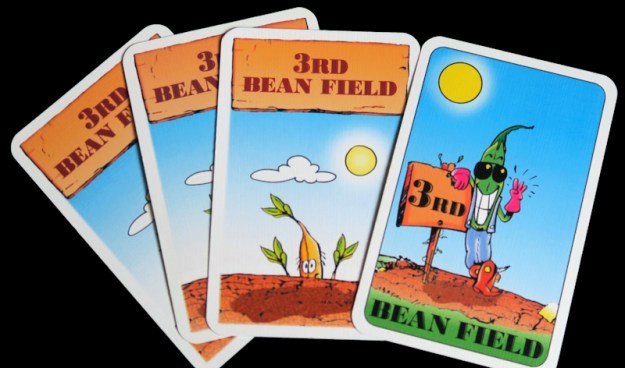
Further, because the rare Beans give a larger yield, more of these are removed from the deck, which makes them increasingly rare as the game progresses.  This is because there are disproportionately fewer in the discard pile when it is shuffled to give the new deck.  Players can also buy a third Bean Field, but choosing to do this is a real gamble and only worthwhile if it can be done early in the game.  Choosing when to harvest is also critical, because harvesting a big Field just before the discard pile is shuffled will increase the length of the game.  Finally, players can be generous in their trades in the hope that the generosity will be returned, however, giving away trades too cheaply can cost a player the game.

Bohnanza
– Image by boardGOATS

Once Blue had finished explaining the game, Black started and explained his way through his turn.  Teal quickly caught on and got engaged in trading and planting Beans with everyone else.  There was a lot of debate about players buying their third Bean Fields with about half the players buying one and Teal leaving it to the second round (much against Black’s advice). Several people, including Purple, Teal and Pine got into Black-eyed Beans—quite an achievement given how few of them there are in the pack—and Blue had a couple of goes with the similarly rare Red Beans.  Pink tried for Soy with mixed success and almost everyone planted some combination of Wax, Coffee and Blue Beans at some point during the game.

Bohnanza
– Image by boardGOATS

Teal quickly realised how quick you have to be declaring an interest in a trade in a game where if you snooze, you lose.  And with seven you have to be keep an eye on what’s going on, which can be difficult given how far away some players are.  In the corner, Black quietly got on with his game eschewing the third Bean Field option as he felt there wasn’t time in the seven player game to recoup the cost, and perhaps he was proved right as he ran out the eventual winner with twelve Bean Thaler, closely followed by Pine with eleven and Blue with ten.  It had been a lot of fun, but as usual, had lasted longer than it really should, leaving little time before the first people needed to head home.

Bohnanza
– Image by boardGOATS

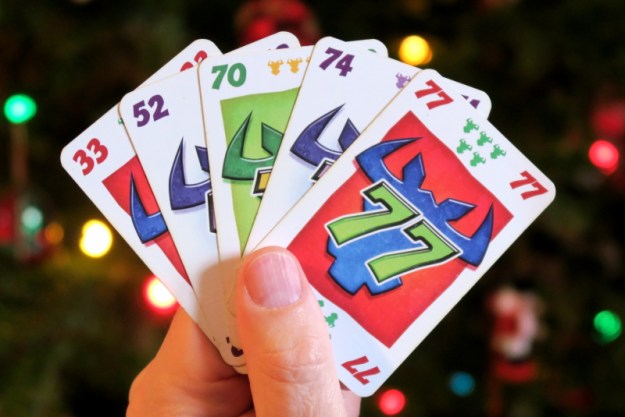
So after some discussion (where pink suggested Ticket to Ride: Northern Lights again), everyone settled down to play 6 Nimmt!.  This had recently had an outing with the new Jumping Cow mini-expansion, but this time the group chose to play it without the additional madness.  6 Nimmt! is also a simple game that is a lot of fun:  Players start with a hand of cards and simultaneously choose one to play, then, starting with the lowest value, these are added one at a time to the four rows on the table.  If a player’s card is the sixth in the row, instead, they take the first five into their scoring pile and their card becomes the first in the row.

6 Nimmt!
– Image by boardGOATS

This is another very clever game that does a lot with very little (which is probably why it is still so popular despite the fact it is thirty years old).  Different cards give a different number of points (or Nimmts), and players can also introduce a little bit of their own randomness by playing a card lower than the final card in all the available rows and thus, taking a row of their choice, upsetting everyone else’s plans.  The Jumping Cow mini-expansion adds more of this, but the group felt it didn’t really improve the game, so stuck with the chaos and fun of the original game, also eschewing the mathematical complexity of the Professional Variant.

6 Nimmt!
– Image by boardGOATS

This time, both Pink and Pine managed to avoid picking up any cards in the first round.  However, Blue only picked up two Nimmts and Teal collected seven leaving it all to play for, at least for most people—Black’s twenty Nimmts had already put him out of the game.  In the second half, Lime picked up twenty-four giving him the top score of thirty-eight (some way ahead of Purple with total twenty-nine).  Black managed a clear round, but there was nothing he could do about his pile of Nimmts from the first round.  It was tight between the top three, but Pink just took victory with ten, three fewer than Blue and Pine who tied for second place.  From there, the evening deteriorated into chatter and we decided to leave the “Feature Game“, Canvas, for another day.

6 Nimmt!
– Image by boardGOATS

Learning Outcome:  You can have a lot of fun with nothing but an old deck of cards.

Boardgames in the News: Withdrawal of Customer Service by Asmodee

One of the characteristics of modern boardgames is the number of pieces in the box:  generally the more complex the game, the more pieces there are, and the more it costs.  For many, part of the fun of acquiring a new game is checking, sorting and otherwise caressing these, often bespoke, pieces.  It is very easy to lose or break a piece and an estimated 1-2% of new purchases arrive damaged or with something missing.  One of the truly special things about the boardgame industry has been the general understanding of the sadness caused by a missing piece, and the support the manufacturers give when a game has become incomplete, even if it is not the manufacturers fault.

No Thanks!
– Image by boardGOATS

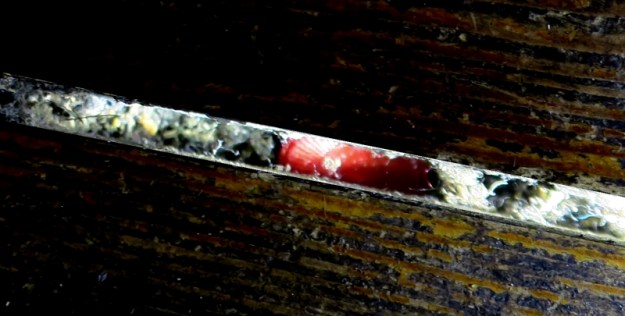
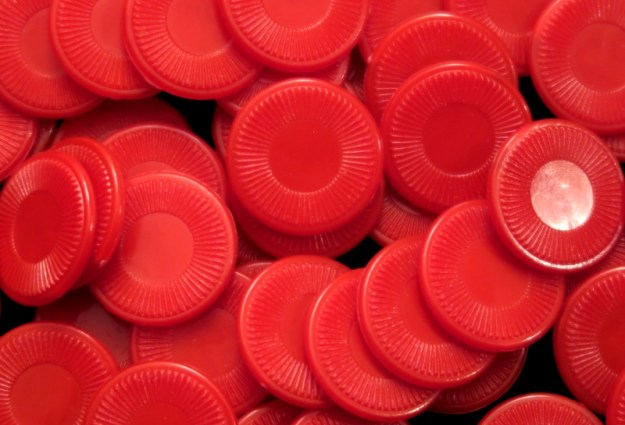
For example, just over a year ago, one of the boardGOATS dropped a counter for No Thanks!.  After an extended session of “Hunt the Game Piece”, we eventually found it nestling in a cushion of dust, just out of reach, exactly where it fell, having cleanly dropped through the gap between the pub floorboards.  The game is inexpensive and readily available, but our copy is much played and much loved, and replacing it for the sake of one token seemed wasteful.  Of course the missing token could be substituted with something else, a penny say, but that would have made us sad every time we played it.  So, a quick email to AMIGO Spiele offering to purchase a couple of spares, and one week later a small handful of red counters arrived in the post—exceptional Customer Service from a superb company.

No Thanks!
– Image by boardGOATS

The remarkable thing is that this is not the only example:  similar service has been received from Zoch Verlag (Auf Teufel komm raus), NSKN Games (Snowdonia: Deluxe Master Set), Queen Games (Kingdom Builder), Ferti Games (PitchCar), Tactic (Nollkoll), Z-man (Le Havre), Rio Grande Games (Torres) & Splotter (The Great Zimbabwe), to name but a few, sometimes their fixing a problem of their making, sometimes just helping out.  This superb service (sometimes with a fee, but often without charge) builds a good relationship with the customer and encourages more sales—so not so much “No Thanks”, as “Yes Please”!

Orléans
– Image by boardGOATS

Last week, however, Asmodee USA closed its Customer Services Department to the public, and announced that all games with missing pieces should be returned to the vendor (as yet there is no comment on who should pay for returns of online purchases, or what happens with gifts that arrive with a piece missing).  Worse, the FAQ adds that when buying a second-hand copy, they “encourage you to make sure that all components of a game are present and intact before purchasing” as they “cannot offer replacements for products that were not purchased directly from our USA retail partners or webstores”.  Their justification for this is:

“With the number of quality titles in Asmodee USA’s growing library, maintaining an independent stock of elements of each game becomes more difficult. We believe offering the customer service through the store they have purchased the game from will be a better experience.”

It was initially thought that this would only affect USA customers, however, it seems that is not the case.  Asmodee UK have passed the buck:  according to their website, for replacement pieces for Asmodee, Fantasy Flight Games, Days of Wonder, Catan, Plaid Hat Games or Z-Man Games, “please visit http://parts.asmodeena.com/”, which in turn simply says:

“As of February 18, 2020, if a game is purchased in the US that has damaged or missing components, please return to where you originally bought the game for assistance.”

This change in policy may or may not make business sense in the short term, but for the gamer it is a very sad loss of what always felt like friendly support, and something that made boardgaming special.

UKGE 2018
– Image by boardGOATS

2nd May 2017

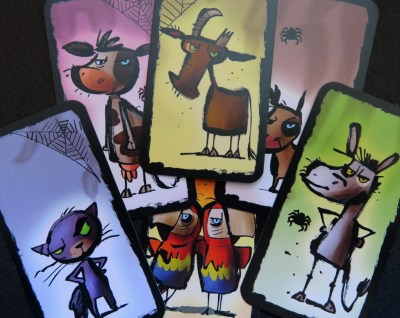
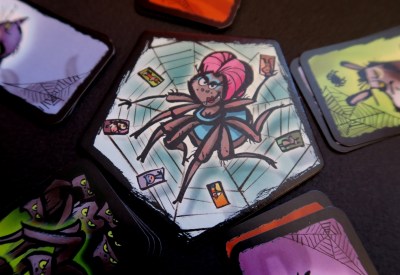
With the inevitable pizzas mostly dealt with, we started the evening with one of Red’s “silly little games from Germany”.  Tarantel Tango (aka Tarantula Tango) is a daft little “get rid of your cards” game with the addition of animal noises.  The idea is that each player starts with a deck of face down cards which will be placed face up in one of five piles located around a central pentagon.  On their turn, the active player first makes a noise in response to the animal and number of spiders on the previous player’s card before placing their own card in a location dictated by the number of animals on the previous player’s card. Thus if a player’s card depicts one donkey and a spider the next player says, “Eee-ore” and places their card on the top of the next pile.  If the card had two donkeys, the card would be placed on the next pile but one, on the other hand, if there were two spiders, the player would have to make a double animal noise, “Eee-ore, Eee-ore!”
Tarantel Tango
– Image by boardGOATS

Simple enough, but things were confused by the fact that the animal art was like something from a Tim Burton Film, so it was easy to confuse them.  Also, according to the rules, a cow says “Moo-moo” (not “Moo”), which means with two spiders the active player must say, “Moo-moo moo-moo” – something that it is easy to forget when a noise must be made and a card played in less than two seconds, under the pressure of everyone else’s gaze.  Worse, some cards have no spiders at all which means the player must remain mute.  The penalty for failing to make the correct noise or put the card in the right place is to pick up all the cards on the table.  A similar penalty awaits when a Tarantula Card is played – everyone must slap their hand on the table and woe-betide the player who is last…
Tarantel Tango
– Image by boardGOATS

Once Red had roped Pine and Ivory into her madness, they were joined by Pink and Blue who read the rules  out.  Black’s comment from the next table was that it would take ages, but neither he nor Purple could be persuaded to join in, so with Burgundy still finishing his pizza everyone else started, what they thought would be a quick bit of fun.  It seemed like ages before the first person had to pick up cards and before long it looked like Pink had it in the bag with just three cards left.  Unfortunately, the stress of being so close meant he inevitably tripped over his words and gathered a large pile of cards as a consequence.  Ivory was next and managed to reduce his hand to just one card before making his mistake.  From here everyone took it in turns to reduce their stack to small handful of cards, but fail to actually get rid of the final few, by which time Purple was in such fits of laughter she was practically soiling the furniture.  It had been a lot of fun, especially at the start, but we were all quite pleased when we could finally move on to something else, so there was relief all round when Pine finally managed to get rid of his last card successfully.

Tarantel Tango
– Image by boardGOATS

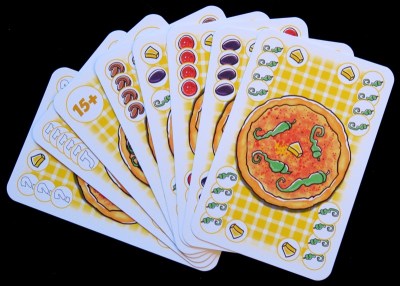
With the gratuitous silliness over, we split into two groups, the first of which consisted entirely of people who hadn’t eaten any pizza and fancied making up for it with the pizza based “Feature GameMamma Mia!.  This is an unusual little card game designed by Uwe Rosenberg of Bohnanza fame (as well as designer of games like Agricola, Le Havre and the more recent Cottage Garden).  Everyone in the group likes Bohnanza, but Red is especially fond of it and was particularly keen to give this one a go.  Uwe Rosenberg has a liking for unusual mechanisms in his card games and Mamma Mia! is no exception.  The idea is that players are trying to fulfill pizza orders by first putting toppings in the oven and then sneaking their order cards in on top before another player does the same and claims the toppings for their order.  So, each player has a deck of personal order cards and a random hand of toppings.  On their turn, each player must place at least one topping card in the oven pile (all the same type) and may follow it with an order card if they choose.
Mamma Mia!
– Image by boardGOATS

All cards are placed face down so players have to try to remember what cards have been played.  Once a player has placed cards in the oven, they draw back up to the hand limit of seven, but the catch is that cards can only be drawn from either the ingredients pile or their own personal order pile.  This is very clever because players have a hand limit of seven and this is something that needs to be handled with care: order cards are needed to give a target to aim for, but too many and there isn’t enough space to hold enough ingredients to build sets.  Just to add to the challenge, we included the Double Ingredients mini expansion which adds a small number of cards which contribute to toppings instead of one.  Black and Purple had played the game before, but it was completely new to Pine and Red and it took a little while for them to get their heads round it.

Mamma Mia!
– Image by boardGOATS

Pine (who’s special ingredient was chili) cleared himself out in the first round taking an order for “Pizza Bombastica” (with at least fifteen toppings) and struggled to get back into the game.  Black (special ingredient pepperoni) on the other hand failed to place orders for any pizza in the first two rounds, instead, as Pine pointed out, “Saved himself to make ‘Quality’ pizza!”  Meanwhile, Red (with mushroom as her special ingredient) was very confused and was struggling to understand what was going on.  This was a feeling that wasn’t helped when Pine requested a “Pineapply-looking-olive” in the final round.  Despite her evident confusion, Red was definitely proving to be the “Queen of Pizza”, a title that also earned her accusations of “card counting” (something she might have tried had she understood what was going on).  In the final accounting, Red finished with seven orders, three more than Purple who had played a quiet, but very effective game making good use of her special ingredient (olives).

Mamma Mia!
– Image by boardGOATS

While the pizzaioli were busy making pizza, the other group (consisting predominantly of pizza eaters) were settling into a game of Last Will.  This is a game we’ve played before, but that was nearly two years ago, so it required a recap of the rules.  Last Will is basically the boardgame equivalent of the 1985 film “Brewster’s Millions”.  The story goes that in his last will, a rich gentleman stated that all of his millions would go to the nephew who could enjoy money the most.  In order to find out who that would be, each player starts with a large amount of money, in this case £70, and whoever spends it first and declares bankruptcy is the rightful heir, and therefore the winner.  The game is played over a maximum of seven rounds each comprising three phases. First, starting with the start player, everyone chooses the characteristics of their turn for the coming round from a fixed list by taking it in turns to place their planner on the planning board. This dictates the number of cards they will get at the start of the round, the number of “Errand Boys” they will be able to place, the number of Actions they will get and where they will go in the turn order.

Last Will
– Image used with permission of BGG contributor PaulGrogan

Inevitably, this is a compromise, so choosing to go first when placing Errand Boys, might guarantee the action of choice, but will only give one card at the start of the round and crucially, only one Action.  On the other hand, choosing to sacrifice position in the turn order could give three or four Actions.  Since all but two cards are discarded at the end of the round and Actions must be used or lost, this decision is critical.  Actions are important, but so are Errand Boys as they allow players to control the cards they are drawing as well as manipulate the housing market and increase the space on their player board.  The heart of the game is the cards, however, which are played in three different ways:  as a one off (white bordered cards); on a player’s board where they can be used multiple times (black bordered cards) or as a modifier (slate bordered cards) which enable players to spend more when black or white bordered cards.  Thus, White bordered “Event Cards” cost a combination of money and Actions to play, but once played, are discarded. In contrast, Black bordered cards cost at least one Action to play, and occupy space on the player’s board, but are kept and can be activated once in each round.

Last Will
– Image used with permission of BGG reviewer EndersGame

Black bordered cards come in three different types: “Expenses” which allow players to spend money; “Helpers” which additionally allow give players some sort of permanent bonus, and “Properties” which are by far the most complex cards in the game.  Properties are an excellent way of spending money as they are bought for a given amount and will either depreciate every round, or will require maintenance which can be expensive. Unfortunately, players cannot declare bankruptcy if they have property and must sell them.  This is where the property market comes in:  one of the possible errands is to adjust the property market, so if a property is bought when the market is high and sold when it is low, this is another possible avenue for losing money.  At the end of the round, everyone reduces their hand to just two cards and loses any left-over actions, which puts players under a lot of pressure as it makes it very hard to plan.  So the game is an unusual mixture of timing, building card combinations, strategy and tactics.

Last Will
– Image used with permission of BGG contributor bswihart

Burgundy went first as he was the last person to pay for something – he paid for his pizza while everyone else had put their purchases on a tab.  The random draw meant everyone started with £120 (in poker chips), making for a slightly  longer game. Only Ivory hadn’t played it before, but it was such a long time since Blue, Pink and Burgundy it was only a vague memory, and none of them felt they had ever really fully understood the game.  Inevitably therefore, there was plenty of moaning and groaning from Burgundy and a lot of puzzled expressions from Pink.  Accusations of “winning moves” were aimed at Blue (accompanied by appropriate denials) when she was the first to take her dog and a chef on a Boat Trip and then bought herself a small mansion.  Property is the key, as it is expensive to buy and either costs to maintain or depreciates, however, it must be sold before a player can go bankrupt.

Last Will
– Image used with permission of BGG contributor Toynan

Maintenance costs or depreciation alone are not sufficient to ensure a player spends enough to win, so players need to find a away to make their properties cost more.  Blue first added a Steward (who enabled her to carryout maintenance on a property without needing an action) and then an Estate Agent to her portfolio.  This latter was particularly useful as it enabled her to over pay for property by £2 when buying and sell for £2 below market value.  Meanwhile, Ivory had bought a couple of valuable farms to which he added animals, then he maximised his outgoings by adding a Training Ground.  Not though want of trying, but Pink was the only one who failed to get a helper who would provide an extra action.  Instead, he had to make do with a two Hectic Days (which gave him extra actions) which he coupled with visits to the Ball.  The first of these was very effective, the second less so.  By this time he was beginning to run out of space on his player board, so Pink then decided to get an extension to his player board, but Ivory had other ideas and kept taking it first, much to Pink’s disgust.

Last Will
– Image used with permission of BGG reviewer EndersGame

While all this was going on, Burgundy was muttering away and shaking his head ominously, quietly buying properties, and making reservations at restaurants with occasional trips to the theatre or trips on the river.  As the game entered its final stages it was becoming clear that it was Ivory who had really got to grips with the game though.  The extra messenger card came up and, as everyone had other things they wanted to do, he took it cheaply which gave him a little extra flexibility in his options.  Blue and Burgundy had began selling properties first, leaving them with a lot of cash to get rid of.  In contrast, although he had no money left, Ivory still had to sell his farms and dispose of the income before he could actually go bankrupt.  Despite Burgundy and Pink’s best efforts to get in his way though, Ivory just made it, finishing £1 in debt.  Nobody else could match that, with the Blue the closest with £16 credit.

Last Will
– Image used with permission of BGG contributor CellarDoor

Mamma Mia! finished long before Last Will, and the group were looking for something else to play.  Blue (from the next table) suggested they might like to try Indigo, which she described as “a bit like Tsuro but backwards”.  Tsuro is a simple “last man standing” game where players take it in turns to place a tile in front of their stone and move it along the path.  Indigo is also a game of moving stones, however, instead of trying to keep one stone on the board, players are trying to move different coloured stones off the board through their own “gates”.  There are other differences too, for example, the tiles are hexagonal rather than square and instead of choosing which tile to lay from a hand of three, tiles are drawn at random.  To make up for the random draw, players can place tiles anywhere they like, which enables players to try to build routes from their gates to stones, rather than the other way round.

Indigo
– Image by boardGOATS

One of the cleverest parts of the game is its semi-cooperative nature – with four, players share their each of the gates with one of the other players.  This introduces an interesting tension between working with other players while simultaneously competing with them.  So, as Purple commented, players that don’t work together get nothing.  Black, on the other hand, was quite taken with the pretty patterns the tiles made on the board.  It was quite a tight game throughout – since stones are stored secretly and have different values, it wasn’t easy to be certain who was in the lead.  In the event, the lead probably swapped several times, and the game finally finished in a tie between Black and Pine, both with ten points, with Red following on in third, three points behind.

Indigo
– Image by boardGOATS

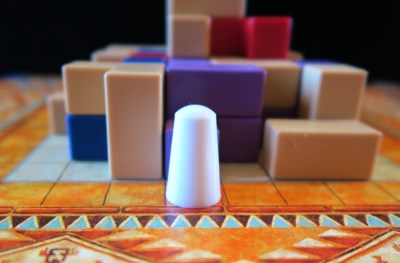
Last Will was still underway, so the hunt resumed for another game, and Blue suggested Pueblo.  Although a slightly older game, this was a recent acquisition and Pink had met pine when he collected it from the village Post Office.  Although he hadn’t known precisely what it was at the time, the rattle had given away the contents as a boardgame.  Pueblo has a very robust rattle as it consists of lots of very solid plastic pieces.  It is one of those games that is quite different to anything else; Blue and Pink had played it quite a bit out in the garden over the weekend and thought the others might like to give it a go, especially as it was simple enough to play from the rules.

Pueblo
– Image by boardGOATS

Each player has a set of coloured pieces and a matching number of neutral pieces.  These are paired up to make a cube consisting of one coloured and one neutral piece.  On their turn, the active player places any unpaired pieces they may have on the grid shown on the board.  If they don’t have any unpaired pieces, then they break up a cube and choose which half to play.  Once they have placed a piece, the active player moves the Chieftain along the track around the edge of the board.  They can choose whether to move him one, two or three spaces, after which, he looks at the building along the grid lines and scores any coloured bricks he can see.  At the end of the game, the Chieftain makes one last trip round the board and the player with the lowest score at the end wins.
Pueblo
– Image by boardGOATS

The game was quite close, and everyone felt that the idea was great but that the game play was not as exciting as it sounded.  Unfortunately, everyone also suffered a bit from “Analysis Paralysis”, and as a result, the game felt like it dragged, a problem that was undoubtedly made worse playing with four than with two.  This is because with two there is just one opponent and the game becomes one of cat and mouse; with more players this tension is diluted.  As the game progressed, it seemed to drag more and more, so the final trip round the track was dispensed with leaving Pine the winner, just two points ahead of Purple.  With that over, and Last Will coming to an end, Pine, Purple and Black headed off for an early night leaving Red to watch over the final moves before it was time to for everyone else to head home too.

Pueblo
– Image by boardGOATS

Learning Outcome:  Games that are a hit for some players are not guaranteed to work for others.

Boardgames in the News: Are Asmodée Taking Over the World?

Asmodée is the French translation for Asmodeus, and according to Binsfeld’s classification of demons, Asmodeus is the demon of lust and is therefore responsible for twisting people’s sexual desires.  In the boardgame world though, Asmodée (originally known as Siroz) are a small French game publishing and distribution company, specialising in the family market. For example, they are well known for Dobble, Dixit, Time’s Up! and Ca$h ‘n Guns, but they also publish some more challenging games including Snow Tails, Mr. Jack, Formula D, Takenoko and 7 Wonders.

Jungle Speed
– Image used with permission of BGG contributor kilroy_locke

Asmodée was started in 1995 by Marc Nunès, a self-trained entrepreneur developing role-playing games, but quickly became France’s foremost games publisher and distributor.  One of the big early successes was Jungle Speed, launched in 1998, which has since gone on to be one of the top-selling titles in France, rivalling Monopoly, Trivial Pursuit and Pay Day.  The real turning point came in 2003, however, when Asmodée obtained the French licence to distribute Pokémon collector cards, which opened up the mass retail sector.  This development led to an 18% investment from Naxicap in 2005.  Naxicap’s stake was bought out two years later by Montefiore who acquired 60% of the company as part of a deal with management worth €40-50 million.  Montefiore invested €120 million to finance Asmodée’s international growth, funding the acquisition of the Belgian game distributor Hodin in 2008, the Spanish games developer Cromola and the German Proludo in 2009, followed by the purchase of a 60% stake in the UK-based distributor, Esdevium Games in 2010.  Asmodée also strengthened it’s portfolio with the acquisition of Abalone and partnership with Libellud (leading to the distribution rights for Dixit) in 2010.

Abalone
– Image used with permission of BGG contributor msaari

In 2012, Asmodée branched out further, setting up a subsidiary in Shanghai, China,  with the intention of expanding “into a new market taking advantage of Asmodee’s extensive line-up of games and the existing relationships with partners, thus promoting the brand in mainland China, Hong Kong and Taiwan”.  This ambition brought Asmodée to the attention of the Eurazeo, a European investment company and a deal was announced in November 2013 that valued Asmodée at €143 million.   In January, 2014, almost exactly a year ago now, Eurazeo bought 83.5% of Asmodée through an equity investment of €98 million while Asmodée’s management team and original founders reinvested €14 million of their own money.

Ticket to Ride
– Image used with permission of BGG contributor garyjames

With the backing Eurazeo provided, Asmodée then went big:  in August last year it was announced that Days of Wonder would be “merging into the Asmodée Group of game companies”.   Days of Wonder are one of the biggest names in modern boardgaming, and are often credited with the growth of the modern boardgame industry, thanks largely to their flagship Ticket to Ride games, which have sold well over two million copies to date.  This is not the only “big game” in their catalogue either, they are also responsible for Memoir ’44 and Small World, both of which are popular games, demonstrated by the number of expansions they support and which take Days of Wonder’s total number of games sold to over five million since their founding in 2002.

Small World
– Image used with permission of BGG contributor crosenkrantz

According to Forbes, Days of Wonder generates between $10 million and $20 million in revenue annually, not bad in such a niche market.  From Eurazeo/Asmodée’s point of view, such an acquisition makes sound financial sense, not just because of the commercial value, but because they already provided a lot of the distribution for Days of Wonder games.  This wasn’t enough for Asmodée however, and three months later, they acquired the U.S. publisher Fantasy Flight Games.

– Image used with permission of BGG contributor adamfeldner

This was a bit of a change of direction for Asmodée:  hitherto, all the acquisitions had been firmly in the family boardgame and distribution markets.  Fantasy Flight games are a very different animal and their headline games, Twilight Imperium and Arkham Horror are much less family friendly.   Even their X-Wing Miniatures Game which is very popular with fathers and sons, is a long way outside the normal scope of Asmodée, since it is essentially a two-player war game with a Star Wars theme.  However, there are considerable benefits for both parties, since the merger will enable Fantasy Flight to improve its distribution in Europe, while simultaneously giving the growing Asmodée Group access to Fantasy Flight’s North American sales and marketing teams.

Black Fleet
– Image used with permission BGG contributor Toynan

Asmodée weren’t stopping there, however, with Ystari Games, Asterion Press and Pearl Games also becoming “part of the Asmodée family” late last year.  The link with Ystari Games almost certainly comes from their mutual interest in Space Cowboys.  Space Cowboys is a game creation studio created in 2013 by Marc Nunès (who started Asmodée way back in 1995, remember?), Philippe Mouret and Croc (both of Asmodée), Cyril Demaegd (Ystari) and Sébastien Pauchon (GameWorks).  Space Cowboys is a very small outfit, but already has one Spiel des Jahres nomination under its belt in Splendor and looks to be trying for a second with Black Fleet, the gorgeous pirate game released at Essen last year.

Asmodee Publishing 2015
– Image from eurazeo.com

So, what are Asmodée up to?  The concern is that gamers generally like the current diversity in the market and fear that this succession of mergers and partnerships will mean a homogenisation of the games available.  The November 2014 Eurazeo “Investor Day” report spelled out the current state of Asmodée in detail and the good news is that this does not seem to be Eurazeo/Asmodée’s intention.  The report states, “Each studio has its own DNA,” and goes on to say, “Repeated success lies in the full independency granted to these studios, to keep innovating.”  So it seems the diversity is valued, however, by acquiring mid-sized publishers like Days of Wonder and Fantasy Flight, Asmodée is positioning itself to compete more effectively with multinational toy giants like Hasbro and Mattel, who publish top board game brands including Monopoly and Scrabble.

Asmodee Organisation 2015
– Image from eurazeo.com

So, is it a good thing that Asmodée are setting themselves up to rival the big boys?  Well, Asmodée is not the only company to engage in mergers:  in 2011 Filosofia purchased the U.S. publisher Z-Man Games, and U.S. publisher FRED Distribution (which releases games under the Eagle Games and Gryphon Games brands), acquired U.S. publisher Face2Face Games.  More recently, in late 2013, Mayfair Games (the U.S. partner for Catan) bought a controlling interest in Lookout Games (the company who first brought Agricola, Caverna, Le Havre and Ora et Labora to the market).

Asmodee Logo
– Image from escapistmagazine.com

Clearly a large stable company provides security for designers, as well as providing support for the individual studios who know that one poor decision is no-longer likely to bring about the end of the company, both of which have to be A Good Thing.  However, companies like Eurazeo invest for only one reason:  financial return.  With an effective monopoly, Asmodée are now in a position to squeeze the market, indeed we may already be seeing the evidence of this in the price rises announced at the start of the year.  With this in mind, it will become clear in due course whether Asmodée is good for boargaming in the UK or whether it is genuinely the demon of lust responsible for twisting our gaming desires…