Tag Archives: No Thanks!

17th September 2024

After the usual chatter and some food, the interested parties staked their claim to play the “Feature Game“, Stamp Swap.  This is a game where players take on the role of stamp collectors at a convention collecting, trading and then scoring their stamp album.  All the reviews claim it is a light game, but while it is not hugely complex, there is more to the game than appears at first glance.  At its core is the “I cut, You Choose” mechanism that is used in games like Isle of Skye and …aber bitte mit Sahne, but Stamp Swap is nothing like either of these.

Stamp Swap
– Image by boardGOATS

The game takes place over three rounds each with three phases:  Collect, Swap and Show.  In the collect phase, an Event card is revealed and then players take turns to take an item from the central pool.  Once everyone has six items, everyone puts one item aside to Reserve and then splits the rest into two piles for the Swap phase.  Some “I cut, You Choose” games struggle work across a range of player counts, for example, San Marco, really only plays well with three players where one splits the cards into three sets and the others choose.  While the game might work with two, the decisions would be too trivial (though there are variants with a dummy player).
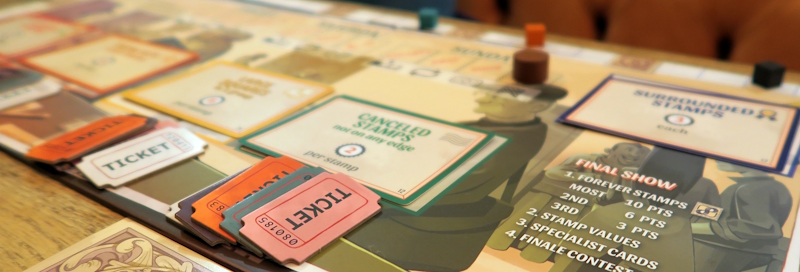
Stamp Swap
– Image by boardGOATS

In contrast, dividing a pile into four would require too many cards and make the decision complex as well as make the game potentially quite “swingy”.  Thus, although the game officially plays three to four players, the mechanism really only works with three.  Stamp Swap avoids this problem with a snake-like mechanism that also negates the need for valuing the hands or the use of money as an intermediate (as in Isle of Skye).  The first player chooses one set and the owner of that set keeps their other set and chooses one from another player.  That player keeps their second set and chooses a set from another player and so on.

Stamp Swap
– Image by boardGOATS

Players then place the stamps in their album and score in the Show Phase.  There are four Goals in each game and each player can score one of these per round, but can only score each only once.  These Goals are different in each game giving a lot of variability, especially as thy combine together in different ways.  At the end of the game, players additionally earn points for the face value of each Stamp, for any Specialist cards they may have, for Stamps that match their personal Theme, and for their achievement in the Finale Contest, while receiving bonus points their place in the Forever Stamp competition.

Stamp Swap
– Image by boardGOATS

The unexpected complexity arises from the stamps themselves.  They come in five different colours, themes and size/shapes.  Some of these stamps are “Cancelled” (and have no face value) and some are “Faded” (and have a negative face value, but may be useful for claiming the Goals).  There is are special gilded Stamps with their own Chocolate theme and a high face value, but cannot be reserved at the end of the Collect phase.  Finally, there are the “Forever” Stamps.  These are Square and are the only Stamps available in the smallest size and have no face value, but are useful for filling tiny holes (should that be required for the Goals) and give bonus points at the end of the game (in much the same way as Pudding do in Sushi Go!).
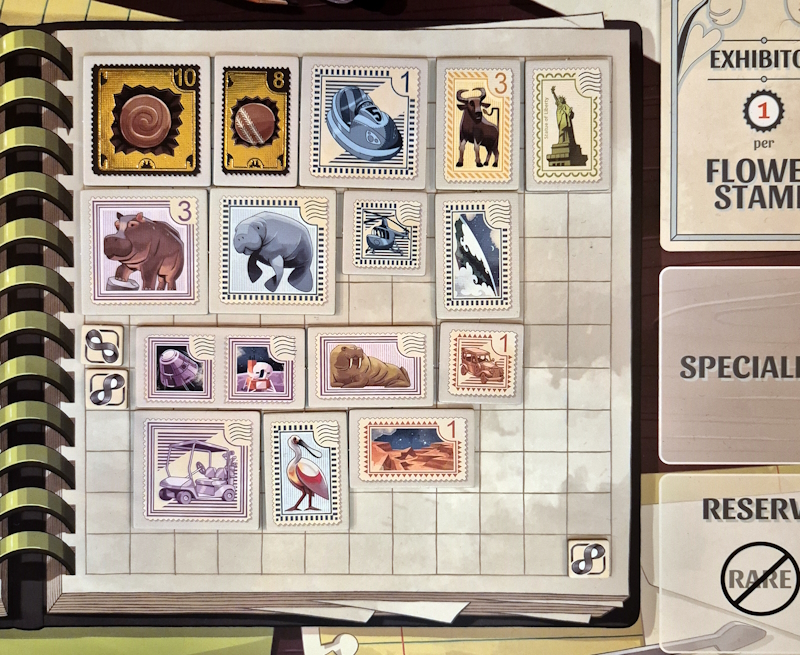
Stamp Swap
– Image by boardGOATS

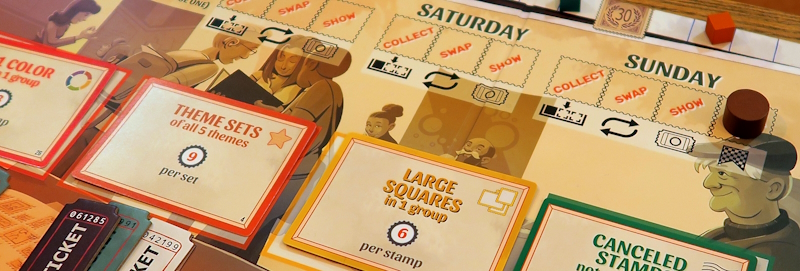
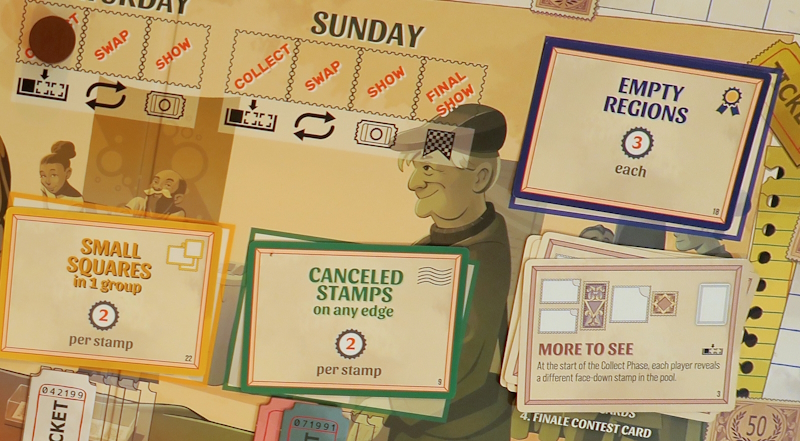
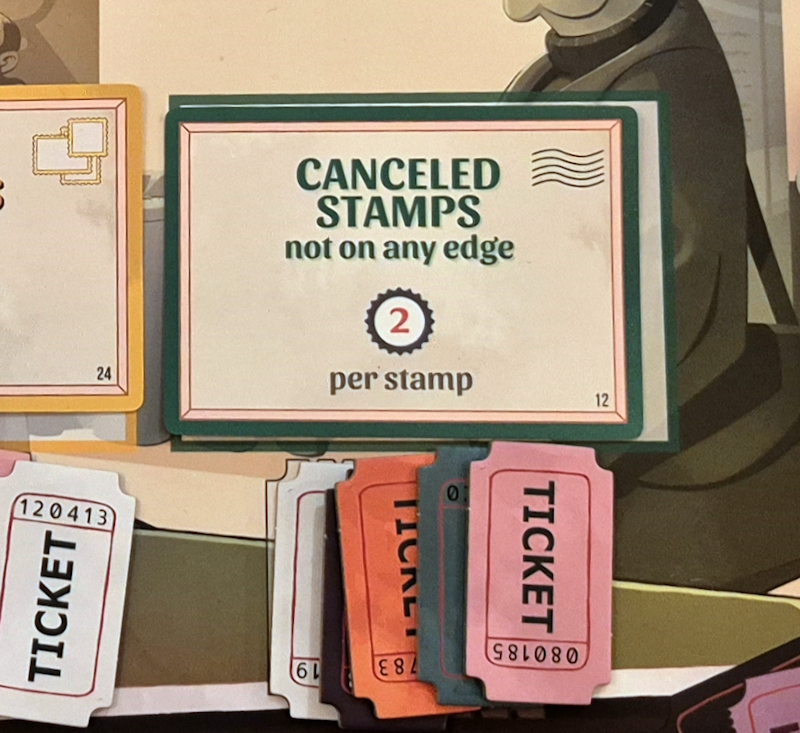
It turns out that the game takes quite a lot longer with more players, which was a bit of a surprise given that much of the game is played simultaneously.  This time Ivory led a group of five with Plum, Sapphire, Jade and Teal, while Blue led a group of four comprising Byzantium, Purple and Black.  Ivory’s group were quick off the mark and first to get going after the rules explanation.  Their Goals gave points for:  Stamps of one Colour in one Group; sets of all five Theme Stamps; Large square Stamps, and Cancelled Stamps not on the edge, while their Finale Contest gave points for the number of Stamps completely surrounded by other Stamps.  Ivory’s personal scoring objective was Space Themed Stamps, Plum’s were Animals, Sapphire’s were Vehicles, Jade’s were Monuments and Teal’s were Flowers.
Stamp Swap
– Image by boardGOATS

Everyone began by feeling their way a bit, especially as the first round added additional Specialists—cards that give extra powers for the rest of the game.  Plum made a “bee line” for these, while Jade and Teal focused on the Large Square Stamps, scoring the related bonus, and giving them an early lead.  Jade also managed to “hide a gold stamp (face down)” and ended up with it in his collect as no one took it.  Plum scored for the Cancelled Stamps first, as she had picked up a lot of them.  As nobody chose his set, Ivory ended up with all his own Stamps, which he thought was great at first, but then had second thoughts as he ended the first round at the back of the pack.
Stamp Swap
– Image by boardGOATS

In the second round, the event was “Rewarding finds” giving two points immediately for taking a face down Stamp, which everyone was keen to do, especially Plum, who quickly caught up with Jade and Teal as a result.  Plum made good use of her “Swap one for three face down Stamps before splitting your collection” to grab extra Stamps.  Teal managed to hang on to the First Player token for most of the game and also took a lead on the Forever Stamps. Sapphire grabbed an exhibitor for Yellow Stamps and proceeded to take Stamps to match wherever possible (both from the pool and from other peoples piles). Ivory made a point of collecting a full set of five different Theme Stamps, scoring nine points, as well as managing to keep a valuable face-down Gold stamp.

Stamp Swap
– Image by boardGOATS

Going into the final round, Ivory was still trailing significantly behind everyone else who were bunched tightly together.  This time the Event gave bonus points for taking Stamps that matched the Theme of their neighbours, which made the game slightly meaner as everyone was taking Stamps others wanted.  Plum was again using the additional Stamps she was getting from her Specialist to shape what she was going to end up with, managing to get three complete sets for twenty-seven points. Jade also managed to score well for this in the final round, as well as for the coloured Stamp cards he collected. Sapphire was similar with his vehicles and Yellow stamps, as well as scoring scoring for Large Square Stamps.
Stamp Swap
– Image by boardGOATS

Teal fell a little behind, taking fewer points for the Cancelled Stamps on the edge and he also failed to collect any of the Flower Stamps he needed as everyone kept taking them during the swap phase (in order to get complete sets). Ivory meanwhile focused on getting as many Large Square Stamps adding to the three he already had, giving him a massive fourty-two points taking him from behind and giving him a significantly lead.  In the final scoring, Teal took the bonus for the most Forever Stamps giving him ten points while and everyone but Plum tied for second with a single Forever Stamp, giving six points.

Stamp Swap
– Image by boardGOATS

Everyone managed to get at least one gold stamp, but Ivory had the most valuable total face value.  Plum scored most for specialists, although most people had at least one, so this made little difference to the scores. Everyone scored well for the Finale Contest, especially Jade, and Plum, but it was not enough to overhaul Ivory’s lead.  He finished with a total of a hundred and forty-eight, ten more than Plum who took second place, who was a handful of points ahead of Sapphire in third.  On the next table, Blue took longer to explain the rules, but once they got going, they soon caught up with the first group and ended up finishing just before.

Stamp Swap
– Image by boardGOATS

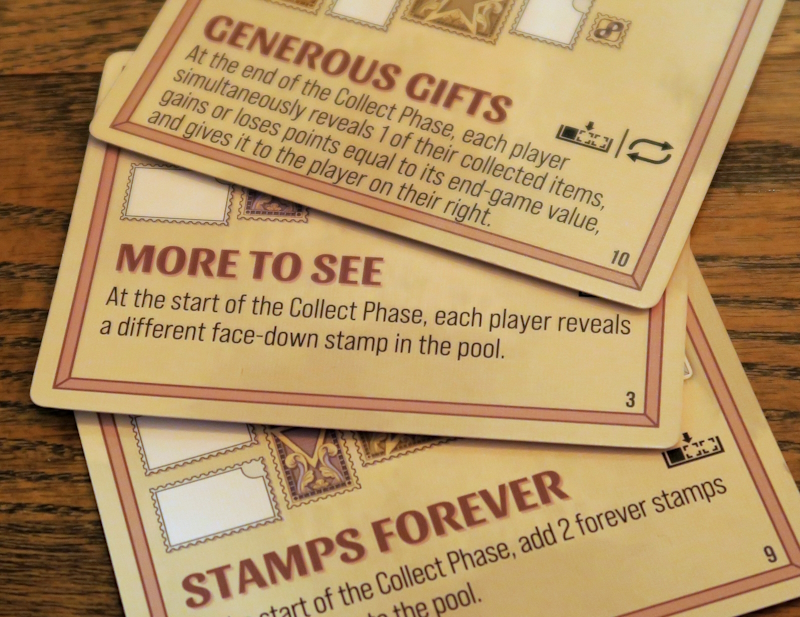
Their first Event card was “Generous Gifts” so after the Collect phase, players choose one collected items to score and then pass on to their neighbour.  Everyone quickly chose their highest scoring Stamp, then realised that meant they would lose it, so had a bit of a re-think.  It was then that the group began to really appreciate the quandary at the centre of the game:  it was all very well taking nice tiles, but they were no use if someone else took them.  This tension was particularly obvious in the final round of the first game where the “Mine not Yours” Event gave points for taking Stamps that matched a neighbour’s theme—while players lost the opportunity to pick up Stamps they wanted in the Collect Phase, they had the chance to take them in the Swap phase.
Stamp Swap
– Image by boardGOATS

The Events in the second and third rounds were “More to See” and “Stamps Forever”.  These had a much smaller impact on the game play, or at least it felt like that, though the Forever Stamps were all collected in the final round.  The Finale Contest was “Empty Regions” which gave three points for each empty region.  Black showed everyone how to to maximise this and from the end of the first round, everyone’s collections began to look like every-expanding checker boards.  Comparing the final album boards between the two games, the layouts were completely different with compact groups for the first game and gappy sprawling displays for the second game.

Stamp Swap
– Image by boardGOATS

Black picked up the bonus for having the most the Forever Stamps, and Byzantium, who by his own admission had been “pants during the game” picked up loads of points in the dying stages.  Purple had done the best with her personal Goal—Flowers, while Blue had a plethora of rare, valuable Stamps.  During the game it had been unclear who was really in the lead as the scores seesawed a bit, but Byzantium’s lunge for the line gave him the lead when it mattered and he finished with a hundred and forty-six points, seven more than the runner up, Blue.  All in all, everyone had enjoyed the game, though the overwhelming feel was that there was much more to the game than the reviews claimed, but that’s a good thing.

Stamp Swap
– Image by boardGOATS

Cobalt was the only person with a strong aversion to playing Stamp Swap, but Pine, Lime and Pink were all keep to play one of their favourite games, Zoo Break, another game that wasn’t really his type.  In he end, Cobalt graciously joined in the keepers of Bedlam Zoo, trying to keep the animals under control.  The game is a cooperative game, where players take it in turns to roll a die to determine how many actions they get, take the actions like acquiring
supplies, capturing animals, locking enclosures etc., before cards are drawn to see what animals escape and then move towards the exit.  The aim is to get all the animals back into their cages and lock them before five animals  or anything dangerous gets out.

Zoo Break
– Image by boardGOATS

The group chose to use the standard difficulty (two “Phew” cards), but with the “Faulty Lock” variant.  This is where players roll to see if the lock holds when one of the locked up animals tries to escape; it adds a but of interest to the end of the game, however, unfortunately this time, the group didn’t get that far.  They managed to lock up the Elephants, Tigers and the Rhino, but the mischievous Pandas remained rogue until the end of the game.  They weren’t the problem, however, that was the Snakes.  Three harmless Garter Snakes got out, but they were followed by a Viper, and as it left, so did the group’s zoo license…

Zoo Break
– Image by boardGOATS

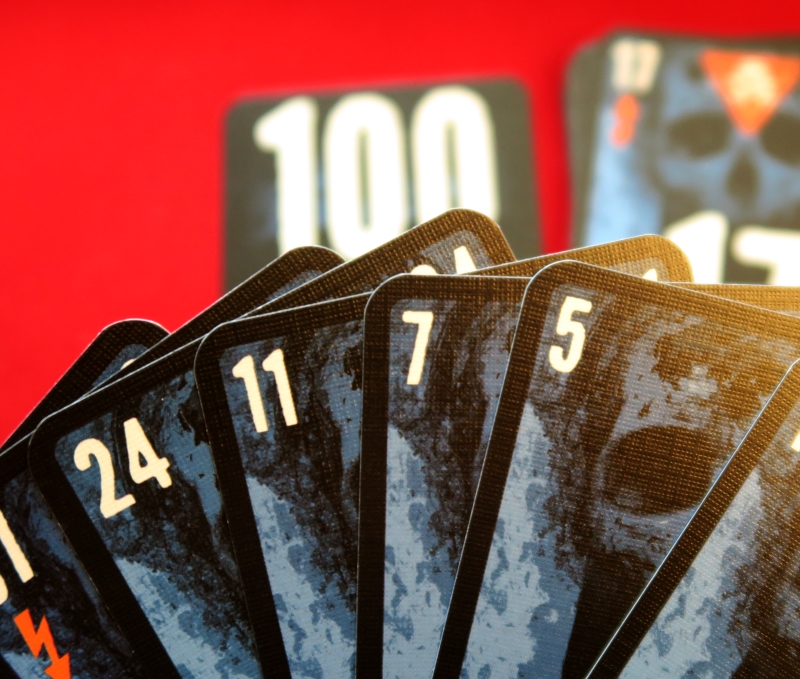
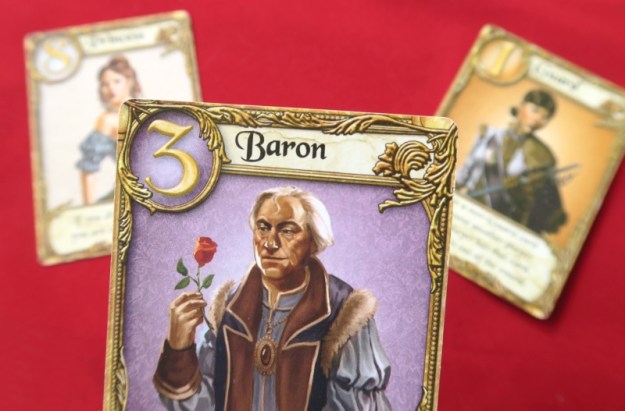
With Bedlam Zoo sadly closed prematurely, the group moved on to a couple of quick fillers.  The first of these was No Thanks!, a really clever little “cards with numbers” game.  The idea is that players either take the face up card or pay a chip to pass the problem on to the next player with the aim being to be the player with the lowest total at the end.  The clever part is that if a player has a run, only the lowest value card counts, but the deck also has some cards removed at random.  This makes it a proper gambling and “push your luck” game.  This time, Cobalt was the top scorer, but the winner with eighteen was Pink.
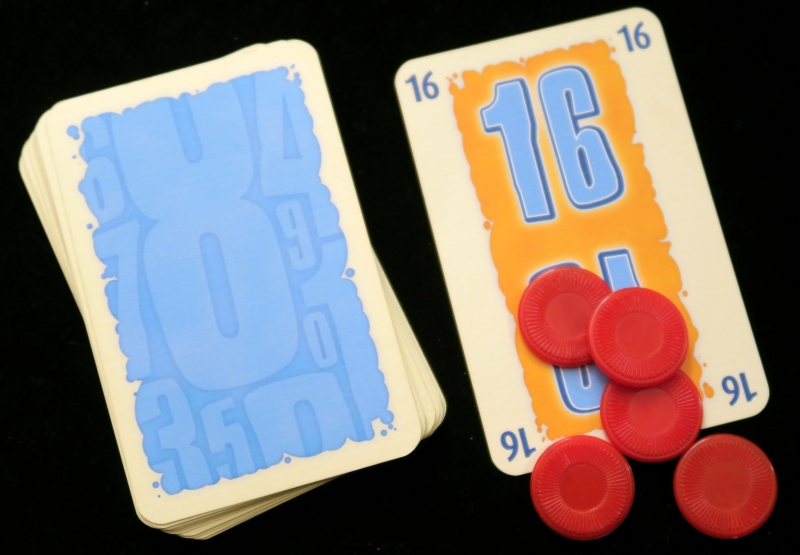
No Thanks!
– Image by boardGOATS

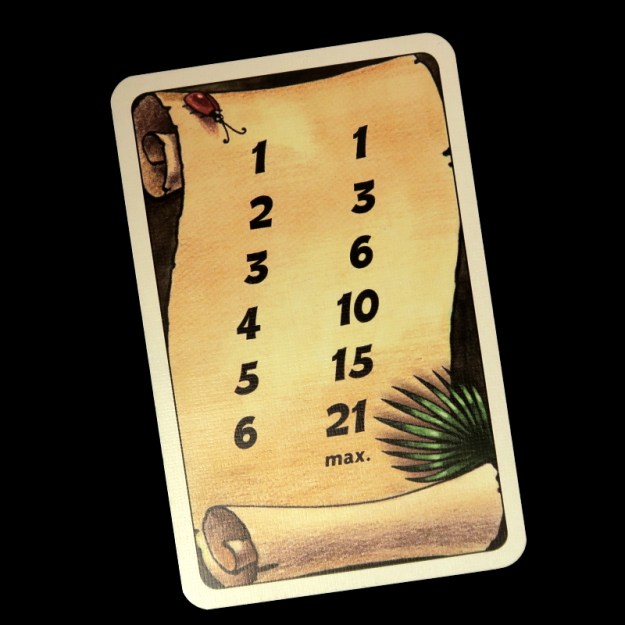
There was just time for one more game, Coloretto.  This is another simple and clever card game, this time the essence of the core mechanism in the bigger game, Zooloretto.  The idea is that players either draw a card and add it to a truck, or take a truck and add its contents to their collection.  At the end of the game players score their three largest sets positively, with negative points for any other sets.  The clever part is the use of the Triangular number sequence which means the first card in a set is worth one point, while the sixth is worth six.  There were the usual questions about Joker cards which resulted in questions being called across the room, but in spite of taking all three Jokers in the deck, Pink was just second by three points behind Lime’s total of forty.
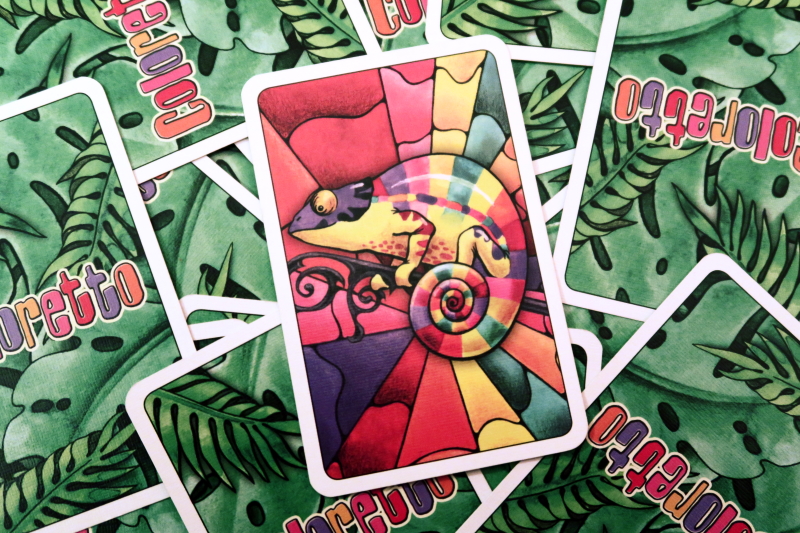
Coloretto
– Image by boardGOATS

Learning Outcome:  A game about Philately can be more than just Stamp Collecting.

25th June 2024

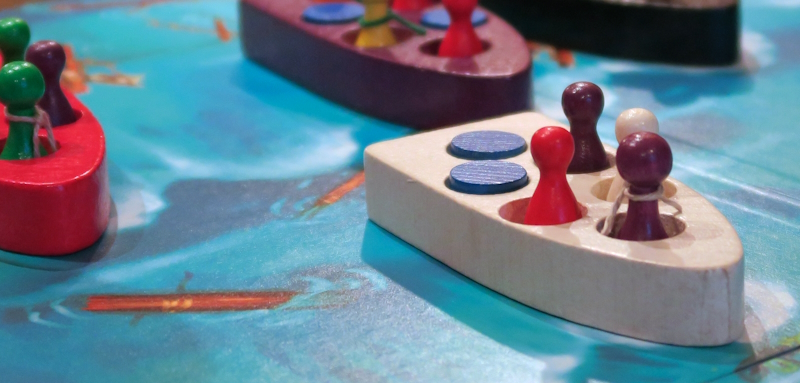
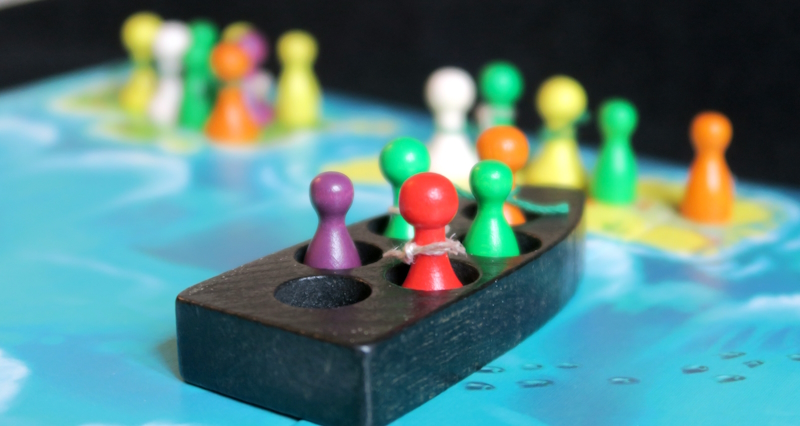
To mark the upcoming General Election, the “Feature Game” was to be Lifeboats, an older game which features lots of voting (as well as boating…).  Blue and Pink were still eating as the others arrived, so those that wanted to join them staked their claim and waited and the others took themselves off to play something else, but it wasn’t long before the voting and boating was underway.  Lifeboats is a fairly simple, if savage game, where players are trying to get their sailors from the sinking wreck of the Santa Timea to shore.  Unfortunately, the lifeboats are old and leaky and as the water comes in and the boats begin to sink, players vote to decide which boats to move and who to throw overboard.

Lifeboats
– Image by boardGOATS

There are three phases to each round in Lifeboats:  firstly one boat develops a leak, then one boat moves forwards, and then finally, one seaman in each boat jumps overboard and then climbs back into a different boat.  In the first phase, players vote to decide which craft develops a leak and a blue wooden disk is placed in an empty spot in that boat—if there isn’t an empty space, the occupants vote to decide who is going over the side.  Once that has been resolved, players vote again, this time to decide which boat is going to move; it’s only three spaces to reach land, but that can seem an awfully long way.

Lifeboats
– Image by boardGOATS

In the final phase of the round, beginning with the start player, players take it in turns to take one of their seamen from a boat into the water and then in reverse order the swimmer climbs into a different boat.  And it must be a different boat—if there isn’t a different boat with space, the unfortunate sailor drowns in the attempt.  All that is quite straight forward, but there are a some little tweaks that add interest to the game.  Firstly, each player has two Officers and a number of Sailors:  deciding who is going to be thrown overboard, players have one vote per Sailor in the boat and two per Officer.  Seamen that make it to land score points, but Officers score more, all this also makes them a target though.

Lifeboats
– Image by boardGOATS

Even though the Santa Timea is headed for Davey Jones’ Locker, the Captain is still in command.  So, during any vote, players may invoke his name to get their way by playing a Captain’s Hat card.  Players only have three of these though, and they are single use so must be used with care.  Worse, if more than one player plays a Captain’s Hat, they cancel out, and a bit like ties in Las Vegas all the tied players lose out, so they also have to be well timed to be effective. The winner is the player to score the most points by getting their seamen back to land before the last boat sinks (and the different islands give different numbers of points for Sailors and Officers).

Lifeboats
– Image by boardGOATS

A key part of the game is the negotiation before votes, so the group played with “The Stick Variant” whereby the Start Player controls how long players have for debate.  The other advantage of being the Start Player is they have the casting vote in the event of a tie.  This time, Ivory went first and began with the Start Token.  As he was playing white, to maintain the election theme, he was representing Independent candidates.  Blue played with orange who were therefore the Liberal Democrats; Lime had purple UKIP pieces; Pine directed the Greens, Black Labour and Pink the SNP.

Lifeboats
– Image by boardGOATS

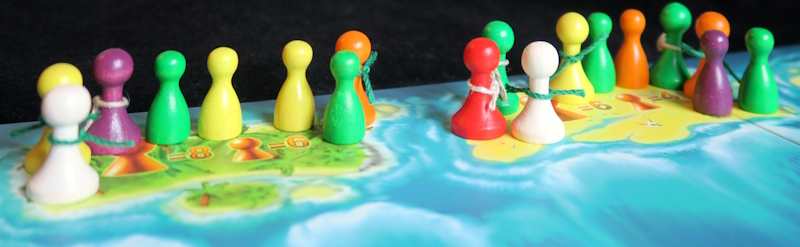
Nobody was quite sure what to do at the start, but Ivory’s Independent boat was the first to spring a leak.  Although players have no control over boats of their colour, they are a tie-break at the end of the game where players finish with equal points.  In the second round, Black opined that there were too many boats and rather than share the leaks around, the group should concentrate on sinking one boat.  Everyone else obligingly agreed and the vote was carried, so before long the Independent boat was heading to the bottom of the deep-blue sea.  In contrast, the Liberal Democrat boat danced over the waves making it to shore first, carrying two Green Sailors, and one Sailor each for UKIP and the Independents, all led by one SNP and one Independent Officer.

Lifeboats
– Image by boardGOATS

From there, things got more savage as the spaces in the boats became more scarce and everyone realised that the SNP (Pink) was on course for a landslide.  Ivory “spoiled his ballot” when he chose to throw his own Sailor overboard, and Lime was sufficiently confused by proceedings that he wound up voting to move a candidate forward when it had already withdrawn (by sinking).  The last boat to go down was Labour, but by that point, it was already clear that the Greens (in the guise of Pine) had the majority with a vote share of thirty-two, six more than the SNP (Pink) in second and twelve more than the third party, the Liberal Democrats (Blue).

Lifeboats
– Image by boardGOATS

It had been a lot of fun, if quite nasty, and as such, is a game with an older feel to it, as befits a game that is thirty years old.  It wasn’t the only thing that was showing it’s age, as the Blackadder quote got several outings too (“Lord Nelson has a vote…”  “He has a BOAT, Baldrick…”).  There had also been an large element of gerrymandering leading to Pine’s victory which, as he said, would not have happened if Lilac had been there as she would have really enjoyed drowning all his seamen.  As it was, he was the only player to get all his men to safety, so deserved his term in Parliament.

Lifeboats
– Image by boardGOATS

The other games were still underway, so the group played a couple of quick rounds of the old favourite, No Thanks!.  This is a super-quick filler, where players choose to take the face-up card, or pay a chip to pass the problem on to the next player.  At the end of the game, players score for the lowest card in each run, minus the number of chips they have left—the player with the lowest total is the winner.  In the first game, Black top-scored with forty-eight and the winner was Lime with nine, pipping Blue by one.  In the second game, Pine finished with the highest total (though it wasn’t a patch on Black’s).  Blue thought she had this one when her total came to just three, but much to her chagrin, Lime finished with two, again beating her by a solitary point.

No Thanks!
– Image by boardGOATS

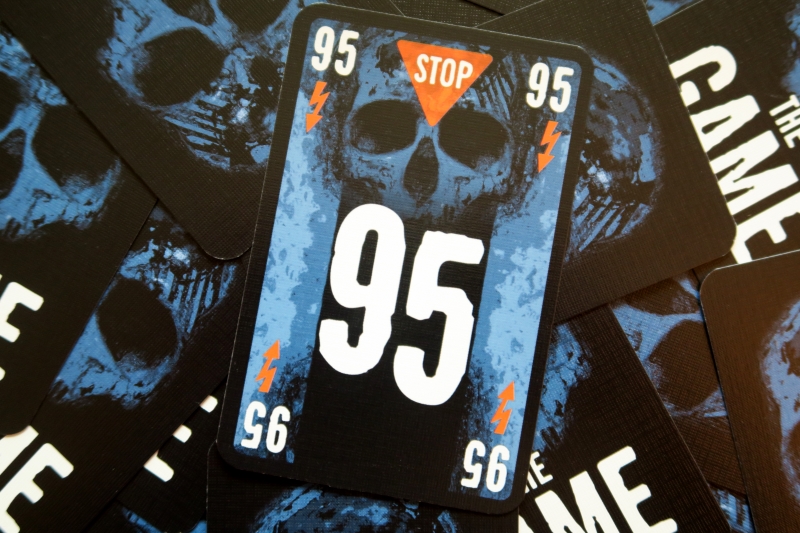
Ivory took his leave, and the remaining five managed one more game, this time of The Game.  This cooperative effort used to be a popular filler in the group, though it is a few years since it last got an outing.  The team have a deck of cards numbered from two to ninety-nine (in our case, from a copy of The Game: Extreme, but ignoring the special symbols), and play each card on one of four piles, two ascending and two descending.  There are just three rules:  the active player can play as many cards as they like, but must play at least two cards before replenishing their hand, and players can say anything they like but must not share “specific number information”.

The Game: Extreme
– Image by boardGOATS

There is the so-called “Backwards Rule” where players can reverse a deck as long as the card they play is exactly ten above or below the previous card played on that pile. The game ends when, either all the cards have been played onto the four piles, or a player cannot play a card. As is often the way, things started to go wrong from the start and pretty much kept going wrong.  The game finally cam to an end when, shortly after depleting the draw deck several people said there wasn’t anything they could play, and after the last possible card had been played the group had seventeen cards left.

The Game: Extreme
– Image by boardGOATS

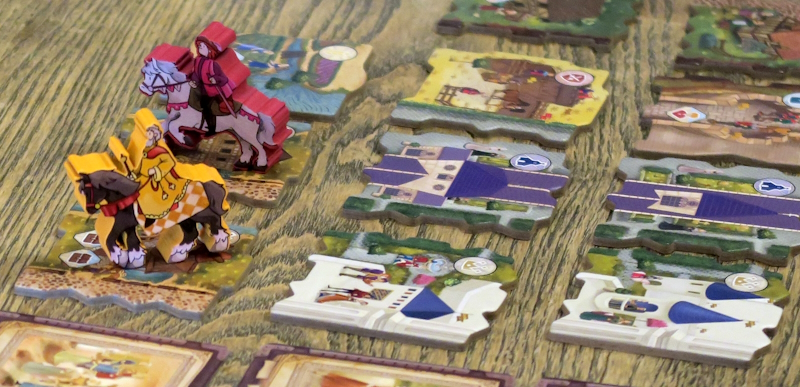
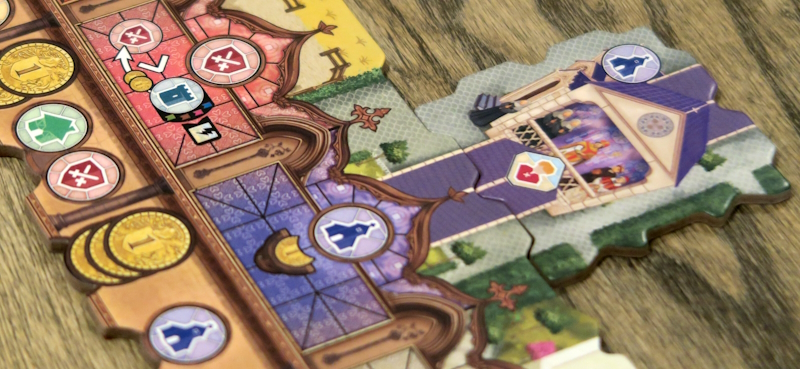
Meanwhile, Jade, Plum and Byzantium had started out playing one of Jade’s acquisitions from the recent UK Games Expo.  Middle Ages (a reimplementation of Majesty: For the Realm) is a quick little game where players are the head of a fiefdom.  The idea is that players use their Lord-eeple (or perhaps that should be lord-muman) to take tiles, placing them on their player board and gain its rewards, which change depending on the type of the piece.  The game is based around a market, similar to that in Kingdomino, where tiles are arranged in ascending order with players taking tiles in that order and placing their Lord-eeple on their chosen tile from the next row.  Thus, the player has to choose between an early choice in the next round and a low value tile, or a high value tile, with less or no choice.

Middle Ages
– Image by boardGOATS

Players then carry out the tile’s special effect and take the associated income.  The payout increases payout the more tiles of the same type a player has.  Every four rounds, there is an event and the game ends after the sixteenth round when players lose ten points for each type of tile they don’t have in their city and the person with the most points is the winner.  This time, Byzantium went all in for Windmills (players with fewer Windmill tiles had to give him two Coins) while Jade built some Barracks.  The Barracks enabled Jade to attack everyone with fewer Rampart tiles than he had Barracks tiles forcing them to give him money.  Plum opted for a more balanced approach that allowed her to improve her income stream significantly due to the Churches and Palace buildings she played.

Middle Ages
– Image by boardGOATS

Plum’s Church gave her a coin bonus which she placed on a Village, which enabled her to repair a broken building. There was some discussion about whether that was voluntary or not, but it didn’t seem to be written like it was a choice. Although not planning for it, Plum did well out of the third Event, “Restoration”, giving her coins for having three broken buildings.  Jade, on the other hand, had interpreted the rule as compulsory and had therefore mended his broken building a turn earlier so wasn’t able to benefit from the Event.  It was close between Jade and Byzantium with Jade just edging it.  Someway ahead, however, was Plum, who finished with one hundred and thirty-one points.
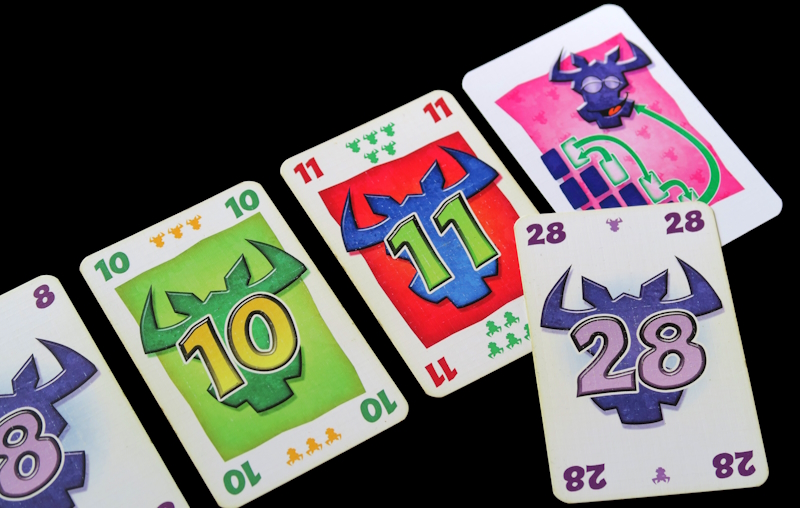
Middle Ages
– Image by boardGOATS

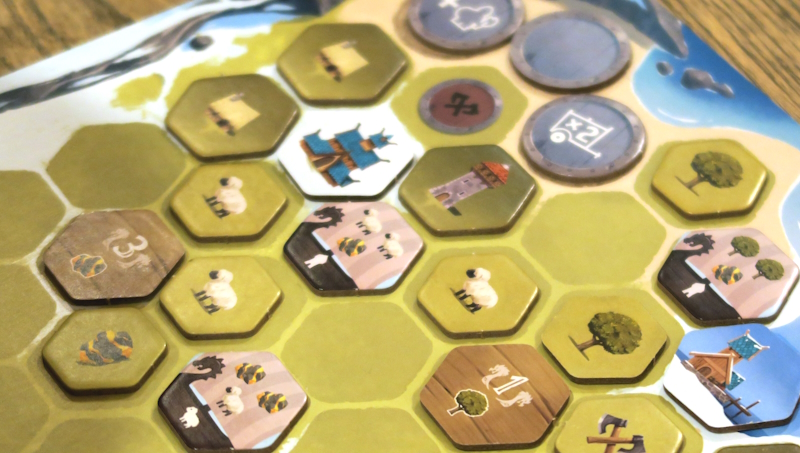
Middle Ages is a quick little game, and the trio then moved on to another UK Games Expo game, the slightly meatier Looot.  This is a game where players gather resources and capture buildings to develop their fjord, fill their longships and complete buildings to rack up victory points. The player with the most riches is crowned Jarl of the Vikings.  Like Middle Ages, this was new to both Plum and Byzantium, so after teaching the group got down to the serious pillaging. The game is played over several rounds until each player has played all their Vikings, giving a maximum of thirteen turns, each with a simple structure.

Looot
– Image by boardGOATS

First, a player places their Viking on a Resource tile on the central board adjacent to another Viking of any colour and take the Resource and place it on their personal board. If possible, they then capture a Building and place that on their board, take a Long Ship and also place it on their board, use a Shield, complete a Construction Site and finally grab a Trophy.  Plum felt she wasn’t going to be able to complete all three of her initial goal hexes, but hedged her bets and left space, just in case.  She used the “occupy the same space as another” option fairly early on to make sure she connected at least two Towers—Towers were the more difficult requirements for the two easier home hexes.

Looot
– Image by boardGOATS

Byzantium’s higher scoring home hex needed two Castles. He failed to complete one of his hexes, but did achieve the most difficult one giving him only slightly fewer points than the other two for this aspect. Jade thought the others were likely to take the spots he was aiming for a few times, but he needn’t have worried as a closer look at the others’ boards would no doubt have told him.  Byzantium got quite a good engine going early game with optimal placements of his first four to five Long Ships, which give bonuses for Resources and Buildings on the player’s map.  In order to complete a Long Ship it needs to be adjacent to three specific resources, however.

Looot
– Image by boardGOATS

Each Long Ship taken and left incomplete leads to a five point penalty, so it is important not to over commit, but equally players don’t want to leave prime location Long Ships for their opponents either.  Byzantium’s Long Ships made great use of the Looot he had pillaged, but for some reason he lost his way a little and ended up with a lot of low scoring Looot at the end of the game.  It felt really close, but Jade thought he would just sneak it as he had increased his Castle scoring to seven points per Castle and had he three of them.  In the end though, Plum ended up winning by quite a significant margin, her hundred and eleven were eight points more than Jades total for second place.

Looot
– Image by boardGOATS

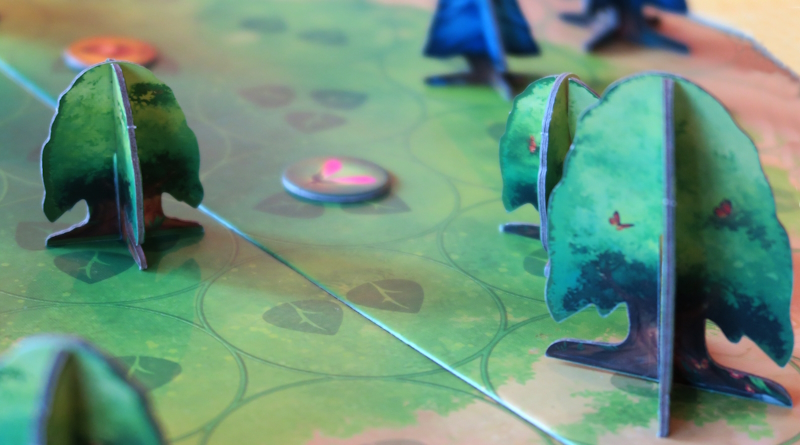
It was an evening for playing games from Expo, as Teal led Purple and Sapphire in a game of Photosynthesis.  This game is a few years old now, but Teal had been really delighted to find a copy for a very good price in the “Bring and Buy”.  In Photosynthesis, players collect light points based on the trees they have on the board and the direction of the sun gaining light points for any of their trees that aren’t in the shadow of another tree.  By collecting light, players can grow and further their species’ dominance over the forest.  Each round, the sun moves creating the direction of light for the round.   Players begin by placing two small trees on the board.

Photosynthesis
– Image by boardGOATS

Small trees collect one light point and cast a shadow over one space. Players can then spend light points to grow a tree, plant a new seed, and eventually harvest a tree once it has reached full size.  As well as a unique spacial puzzle, the game is quite beautiful with mechanics that fit the theme giving simple but meaningful choices.  Like a lot of puzzle-games, Photosynthesis can be quite hard to get one’s head round on the first play.  This time the game was really quite tight between Teal and and Sapphire, but Sapphire just had the edge, beating Teal by one point with final total of fifty-four.

Photosynthesis
– Image by boardGOATS

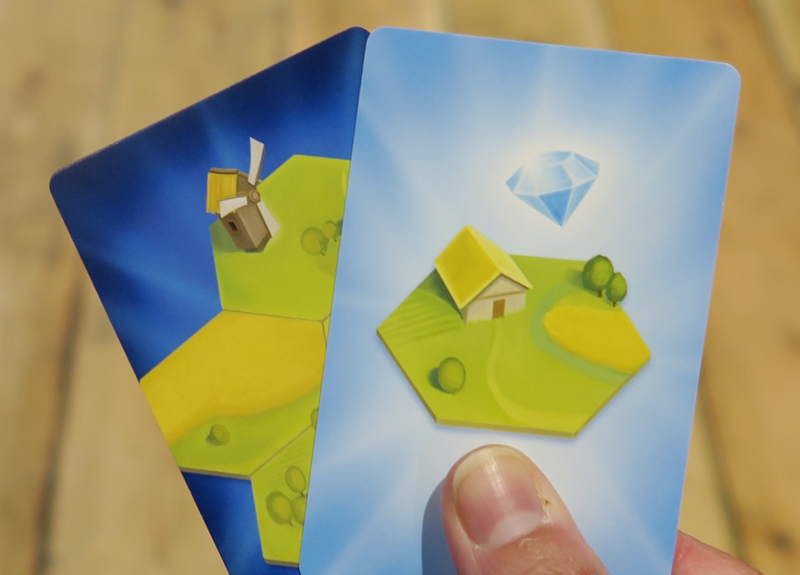
Lifeboats and Looot were still going, so Purple pulled out another Expo special, that first got a run-out last time, a game called Rome in a Day.  This is a cute little “I divide, you choose” game, where players draw five land tiles at random and place two buildings on tiles one and two. They then divide the five tiles into two groups—a bigger and a smaller one (in any ratio) and add a crystal to the smaller land set before offering the choice to their neighbour. During the four rounds the game is played over this neighbour alternates, right, left, right, left.  So, each round, players choose a set from their neighbour and these and the tiles they were left with are added to their domain.

Rome in a Day
– Image by boardGOATS

At the end of the game, any building that stands on or adjacent to land of its own colour will score for each tile in the group and then players score for the diamonds they have collected—the player with the most points is the winner.  It was a really close game, in fact, it was a tie for second place between Purple and Teal who both scored twenty-seven points. Sapphire did rather better, however, finishing with thirty-five points having concentrated on yellow Wheat Fields and green Olive Groves to the complete exclusion of blue-purple Vineyards and red Towns.

Rome in a Day
– Image by boardGOATS

Learning outcome:  Politics can be savage, but it is important everyone votes.

14th May 2024

Pine was already sitting outside marking his birthday, when Blue and and Pink rocked up and ordered their tea.  Jade and Sapphire soon joined the group, ferried by newcomer, Tangerine who not only brought gamers, but also his shiny new copy of the “Feature Game“, Faraway, which he had won at Gweeplefest a few days earlier.  This game is has been a bit of a hidden gem whose popularity is rapidly gaining traction as more people play it.  It is quite a simple game, but one which really messes with the head.  Some of the group played it a few weeks back and it was so popular that it seemed a good idea to Feature it so more of the group could try it.

Faraway
– Image by boardGOATS

The story is that players are exploring the mysterious land of Alula in search of its secrets, meeting its inhabitants and listing its wonders in order to gain more fame than everyone else.  In practice, however, it is a fairly simple little card game with a market with a trick-taking type element.  Players simultaneously chose one of the numbered cards from their hand and starting with the the player that played the lowest card (similar to 6 Nimmt! or Kingdomino), everyone takes it in turns to choose one from the market to add to their hand.  Players then simultaneously choose another card, and again, choose one to add to their hand.  The game ends after everyone has played a total of eight cards, and then everyone scores.

Faraway
– Image by boardGOATS

There are a couple of very clever things about the game.  Firstly, if the card someone plays is numbered higher than their previous card, they take a card from the Sanctuary deck.  These cards a really important because of the second clever element, the scoring.  Each card has a number and a colour, while some also have resources and some have also have scoring conditions.  The scoring is clever because the cards are played left to right, but the scoring is from right to left—at first glance, this looks like it makes things easy, because early in the game players find out what they need to get points and can then focus on getting the resources they need as the game progresses.

Faraway
– Image by boardGOATS

However, the scoring is tensioned against the ability to get Sanctuary bonus cards. This is because the scoring cards are generally those that have a higher number and are therefore the ones players want to play first (following them with resource cards which generally have a lower face value).  To get a Sanctuary card though, players have to play a higher value card than the immediately preceding one, and Sanctuary cards are very useful because they are eligible for scoring regardless of when they are played.  Thus, trying to play cards increasing and decreasing in value to score the most points backwards really messes with players’ heads!

Faraway
– Image by boardGOATS

Tangerine, started one game and explained the rules to half the group, comprising Plum, Byzantium, Blue, Pink and Pine, while he ate his supper.  Meanwhile, Jade and Sapphire took their copy to a neighbouring table where they were joined by Teal, Black and Purple, and started a second game.  Although it is a very simple game, the backwards forwards up and down thing got to several of the group at various points, including Blue (who lost the ability to count), Teal (who did all his scoring forwards instead of backwards), Pine (who struggled with the how maps worked) and Purple (who couldn’t get her head round the reverse scoring).  Jade’s game was the first to finish, with Sapphire beating jade into second place by a single point and Black taking third.

Faraway
– Image by boardGOATS

There was a general appreciation of the art and the mechanism though the theme was a bit invisible.  There had been such confusion, however, that the group decided to “do a Lime” and play again.  This time, the finishing order was exactly the same, but the game wasn’t as close with Sapphire’s eighty-two being the highest score of the evening.  On the other table, Plum was the victor with seventy, followed by Tangerine and Byzantium in third.  This game had taken a little longer, and with six, there is a lot of downtime, so although everyone had enjoyed it, the group decided to split into two groups of three.  Blue tempted Plum and Sapphire to a game of Calico with cries of “Kittens!”, while Pink and Pine lured Tangerine into a game of Ticket to Ride: San Francisco.

Ticket to Ride: San Francisco
– Image by boardGOATS

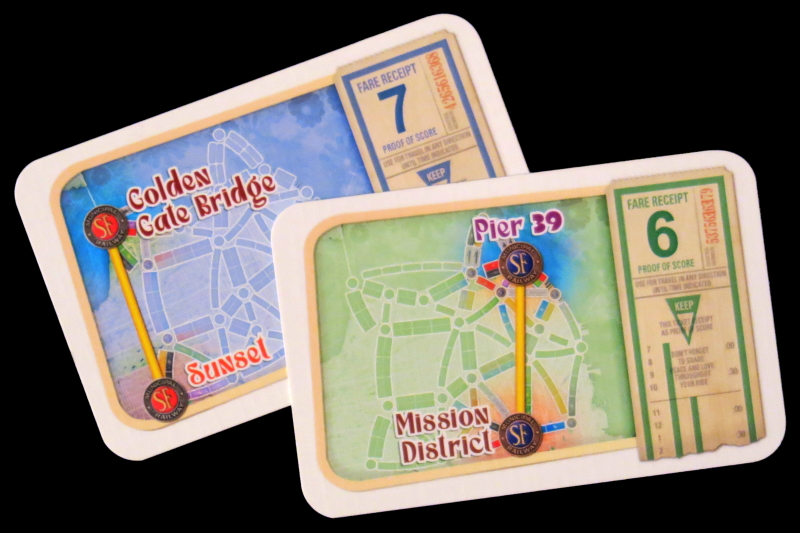
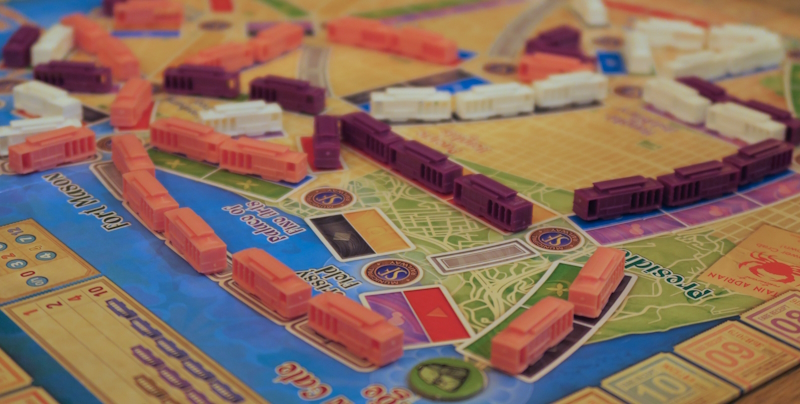
San Francisco is one of the smaller city versions of Ticket to Ride.  The game play is much the same as the original, but the maps are smaller, players have fewer pieces and they only play a maximum of four.  In all the games, players take it in turns to take coloured cards into their hand from the market, or play cards to place pieces on the board connecting locations to satisfy tickets and score points.  Each version of the game has its own specific unique rules, and this one is no exception with players collecting Souvenirs which give points at the end of the game.  Players collect these by building a route (in this case made of trolley cars rather than trains) to the cities where they are available.

Ticket to Ride: San Francisco
– Image by boardGOATS

Each player can only collect one of each Souvenir, but a full set of seven gives twelve points, which is a lot.  Tickets are also always key though.  This time, Pink escaped early from Alcatraz to Twin Peaks which gave him a high scoring eight points.  Unlike Pine (who always seems to draw routes he’s already completed), Tangerine was unlucky and and instead picked up some negative points late in the game.  It was very close between Pink and Pine though, but the Souvenirs made the difference and Pink (with five) just edged it, beating Pine (who only had two Souvenirs) by three points.

Ticket to Ride: San Francisco
– Image by boardGOATS

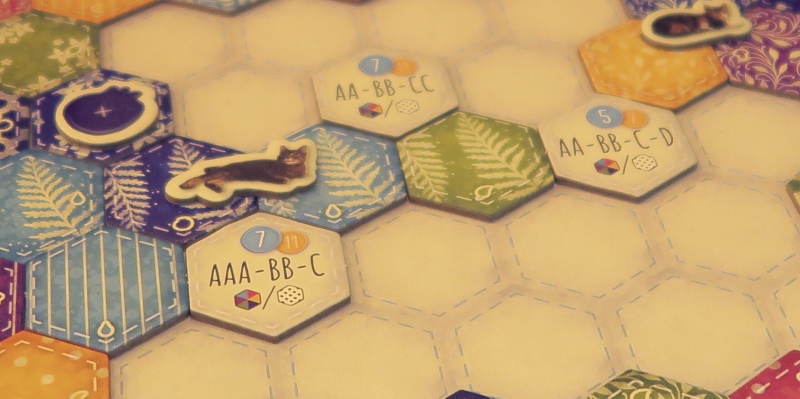
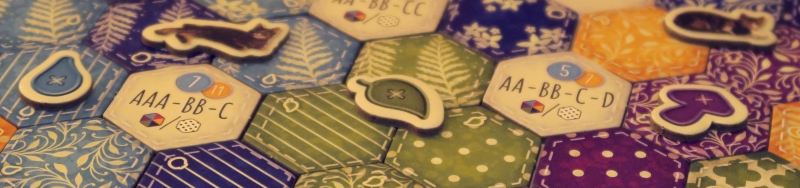
Meanwhile, the kitty-philes were playing the extremely frustrating game Calico, which is all about trying to entice cats to come and sleep on a patchwork quilt by making it with the patterns they like.  In this game, players take it in turns to place a coloured, patterned tile from their hand into their quilt board before taking a replacement from the market.  Everyone had played it before, but it had been a while, so the rules needed a bit of revision.  Each player starts with three tiles in a fixed location with scoring criteria for the neighbouring tiles—satisfying these for either colour or pattern gives points, with more points for for those that satisfy both (which is not easy).

Calico
– Image by boardGOATS

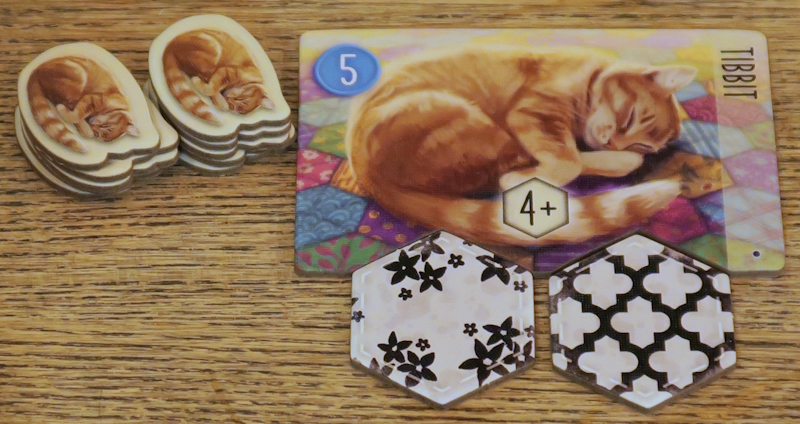
Players then also receive a coloured button for every group of three adjacent tiles of the same colour (with a bonus if they get all six possible colours).  Finally, there are the cats that give Calico its name.  This time the cats in question were Almond, Tibbit and Shop Cat (from the Kickstarter Promo).  Almond was attracted by a group of five tiles of one of the patters in a close packed predefined shape while Tibbit found a set of four tiles of one of the given patterns in any shape most appealing.  Shop Cat was lured to the player with the longest connected chain of tiles in one of the given patterns with the player with the second longest attracting a smaller cat (worth fewer points).

Calico
– Image by boardGOATS

This last one was the subject of some debate as Byzantium ended up with both the longest and second longest chain and it was unclear from the rules whether he would get both.  In the end he allowed the smaller Shop Cat to wander off, but fortunately it didn’t make any difference to the placings.  Almond looked by far the most challenging kitty to attract and initially it looked impossible without failing on the fixed starting challenges.  Plum thought she had made a mess of things, but Byzantium pointed out how Almond could be enticed  using some of the partial tiles around the border of her player board and she was the only one to ultimately have that particular kitty to cuddle.

Calico
– Image by boardGOATS

Blue started badly, and in this game, when that happens things usually only get worse, which they did.  Byzantium and Plum both picked up twenty-seven points for their buttons, but in both starting tiles and kitties, Byzantium had the edge (even without the second Shop Cat).  In the end his final score of sixty-one points gave him a significant margin of victory, by seven points.  Everyone agreed that Calico is a good game, but a very frustrating one when players can’t get the tiles they need.  So Byzantium echoed everyone’s feelings when he commented, “That was fun, but very frustrating—I’ll be ready to play it again in another eighteen months…”

Calico
– Image by boardGOATS

As Faraway and Ticket to Ride had both finished, Tangerine took Jade and Sapphire home and Teal also headed off.  That left Black, Purple, Pine and Pink to play a quick game of the old favourite, Coloretto.  This is a very simple set collecting game, that makes a great filler.  The idea is that players either take the top coloured chameleon card from the deck and place it on a cart, or take a card and add the cards to their collection.  Players score points for their largest three sets (up to six cards, worth twenty-one points), while everything else scores negatively.  The player with the most points is the winner.  Playing with the Jubiläumsausgabe edition, as usual, there was a discussion about what the Golden Joker does and how it differs from the normal Joker.

Coloretto
– Image by boardGOATS

In the end, Pink was the victor and, for the second game in a row, pushed Pine into second place, this time with Black just behind.  The evening looked to be ending there, when a couple of people from the bar came over and asked what we were doing.  That led to a fairly wide-ranging discussion about Monopoly, Cluedo and Mystery of the Abbey amongst other games.  The evening really did come to an end eventually, after Pink and Blue had dragged one of the interested parties into a quick game of No Thanks!.  Unfortunately, there was a misunderstanding and he top-scored with ninety-three, but hopefully he understood that some of the games we play are not that complicated.

No Thanks!
– Image by boardGOATS

Learning Outcome:  Playing forwards and backwards at the same time makes heads hurt.

2nd April 2024

While Blue, Pink and Cobalt were finishing their supper, Plum led a quick game of Draftosaurus with Black, Purple and Cobalt (who had already finished his pizza).   Cobalt was new to the game, so after a quick rules explanation the group were passing dino-meeples left and right and building themselves exciting dino-parks.  The game is really quick and simple:  players start with a handful of wooden dino-meeples, and on each turn, they draft one, that is to say, they choose one and pass the rest on.  The chosen dino-meeples are then placed in the players’ parks, obeying the rules on the Die (the active player who rolled the Die excepted).

Draftosaurus
– Image by boardGOATS

The Die roll forces players to choose from locations in one half of the board, or restricts them to playing in an empty pen or one without a T-rex, making things considerably harder.  Players draft a hand clockwise, and then a second hand anti-clockwise, after which, points are scored for each pen and totalled up to find the winner.  This was Plum’s fiftieth game—it was one of their group’s go-to warm-up and filler games played remotely during the global pandemic on BoardGameArena.  Although her 24% success rate seems really good at first, at four players, one out of four could be seen as about par.

Draftosaurus
– Image by boardGOATS

Plum marked her milestone with a change of strategy, forced by the Dice to go for the most T-rexes, but it worked giving her victory with forty-one points.  Purple took a very respectable second with thirty-five points—one of her best scores in this game.  From there, Cobalt headed off to play Meadow with Blue, Jade and Sapphire, while everyone else joined Plum, Black and Purple to play the “Feature Game“, which to mark the thirtieth anniversary of 6 Nimmt!, was the new Jumping Cow mini-expansion.  6 Nimmt! is one of the group’s favourite games and was arguably responsible for keeping us sane when we were stuck at home in 2020 and as a result, won the Golden GOAT Award.

6 Nimmt!
– Image by boardGOATS

The game is super-simple:  players simultaneously choose a card from their hand and then, starting with the card with the lowest face value, they are added to one of four row.  Each card is added to the row that ends with the highest value card that is lower than the card to be placed.  If that means the row now has six cards, the active player takes the first five cards in the row into their scoring pile, with their card becoming the new first card.  The new Jumping Cow expansion is a single additional card that lurks at the end of the row.  Cards are added as normal, however, when one is added to the Jumping Cow row, the Cow jumps to another row, the one with the lowest face value at the end.

6 Nimmt!: The Jumping Cow
– Image by boardGOATS

The Jumping Cow Card does not have a value itself, but it does add to the number of cards in the row.  So if the card added is the sixth, the player takes the other four cards and then the Cow jumps.  If the row the Cow jumps to has five cards in it, the active player takes four of those too before the Cow jumps again…  Thus, as Plum discovered this time, multiple jumps can lead to collecting a lot of points!  The game was the usual entertaining fun, but although the Jumping Cow expansion adds more madness, 6 Nimmt! is a near perfect game that needs little to no improvement (although we have found the Professional Variant an occasional worthwhile addition).

6 Nimmt!
– Image by boardGOATS

This time, the top scorer (aided by the Jumping Cow) was Plum with sixty-one, closely followed by Ivory with fifty-seven.  Purple did very well to limit her takings to nineteen, but she was beaten into third place by Pink who just kept his to single figures with nine.  The winner was Teal, however, with just four from the first hand and a clear round from the second.  From there, with six, the options were limited, but the group decided to stick together and, after eschewing Bohnanza, opted for another golden oldie: For Sale.  Remarkably, Ivory had somehow not played this before, and was really taken with it, so much so that he immediately looked to see if he could get a copy and everyone was shocked to find it was out of print and the only copy available was for forty pounds on ebay!

For Sale
– Image by boardGOATS

For Sale is really simple:  Players start with a hand of cash and use this to bid for buildings, with a face value from one to thirty.  In the second half of the game, cheques are revealed and players have to choose one of their properties—the player with the highest value building then takes the highest value cheque, thus the idea is not to waste high value buildings when the takings available are low.  Pink, Plum and Teal were all really close and ended in a three-way tie for third place.  Ivory and Purple were some way in front, but separated by a single point with Purple just taking victory, with a final taking of fifty-six thousand dollars.

For Sale
– Image by boardGOATS

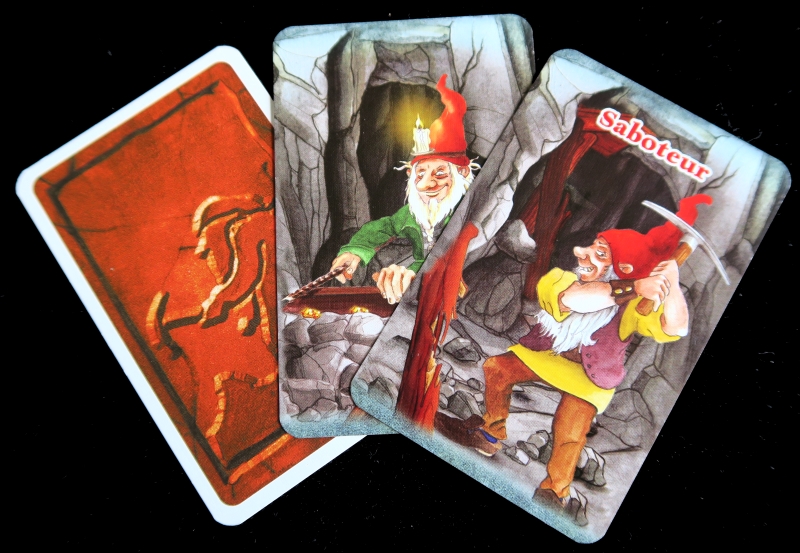
Casting about for another game that plays well with six, Bohnanza was passed over once again, this time in favour of Saboteur.  Saboteur is a hidden traitor game where players are Dwarves tunneling to find gold.  With six players, the rules have either one or two Saboteurs, however, as the game is always difficult for the Saboteurs and impossible alone, the group chose to forgo the ambiguity and go for a guaranteed two Saboteurs.  Once the Saboteurs knew who they were, everyone got a hand of cards: a mixture of tunnel cards and special cards.  On their turn, players play a card and draw a new one.  Tunnel cards extend the network, while special cards allow players to break or mend tools stopping other players from building tunnels (or reinstating that ability).

Saboteur
– Image by boardGOATS

Additionally, there are Treasure Map cards which allow players to look at one of the three potential gold cards to see if it is gold or coal, and Rockfall cards which allow players to collapse the tunnel by removing one card.  Usually, the Saboteurs hide for as long as possible in an effort to acquire some good “Saboteury cards” and play them with a lot of impact.  Choosing the right time for that reveal is really critical though, leaving it too late means there isn’t time to do enough damage.  This time then, Black announced his position very early by playing an obviously obstructing tunnel card and was swiftly followed by Pink who compounded the poor Dwarves’ problems by playing a Rockfall card.

Saboteur
– Image by boardGOATS

The Evil Criminal Masterminds were aided by the fact that when the Dwarves played their Treasure Map cards they struggled to find the gold.  The game turned out to be quite epic, but success just fell to the Saboteurs, giving them a rare victory.  As Teal and Ivory waved farewell, the others looked for something else to play.  Saboteur is a great game, and although it is not as old as 6 Nimmt!, this year is also Saboteur’s anniversary year. It is celebrating twenty years, as is another old favourite, No Thanks!.  In choosing this, those that had played all five games had played over a hundred years of popular games in one evening.

No Thanks!
– Image by boardGOATS

No Thanks! is a super simple, push-your-luck game, where players are trying to finish with the lowest score from the total face value of their cards minus any chips they have.  On their turn, players either take the top card and any chips on it, or pay a chip to pass the problem on to the next player.  There are thirty-three cards in the deck (numbered three to thirty-five), but nine are removed at random, which is what makes the game really tick—when scoring, players only count the lowest card of a run.  This time. Pink top-scored with forty-nine points.  Plum and Purple both took forty-eight points for their cards, but in Plum’s case this was off-set by her enormous pile of chips, leaving her with just twenty.

No Thanks!
– Image by boardGOATS

It wasn’t enough though. Black managed to just scrape through with only a single chip left at the end, giving him a total of thirteen points, and with it, victory.  While everyone else had been sampling a smorgasbord of golden oldie games, Jade, Blue, Cobalt and Sapphire were revisiting the relatively new Meadow, which they’d missed out on playing last time.  This is a fairly simple game, where the complexity is in choosing and placing tokens to get cards that combine well together.  Players take it in turns to play an Action Tokens either in the Market or round the Campfire, and complete the associated Actions. The Market consists of a four by four grid of face up cards.

Meadow
– Image by boardGOATS

Players play an Action token in the market to define a row or column with the number on the token dictating which card they will take from that row or column.  They then place a card in their play area.  This can be the card just collected or one from the player’s hand, but the prerequisites must be satisfied. Playing around the Campfire gives a special action and the option to additionally place a bonus point token on a tree-stump between any pair of symbols currently displayed in the player’s area.  At the end of the game, the total score for the cards played is added up together with any bonuses and the winner has the most points.

Meadow
– Image by boardGOATS

Last time, the general feeling was that the game dragged a little with four, so Blue suggested that instead of playing with the full eight rounds, maybe playing with six (as for the three player game) would make things easier.  Jade interpreted that as the suggestion to play with the three player board, but as quickly became apparent, the campfire circle is smaller with three, leaving fewer bonus spaces available making that element of the game very competitive.  Blue and Sapphire were already committed to their strategy as placing later bonus tokens give more points, so they went for the bonuses doubly hard.

Meadow
– Image by boardGOATS

Jade kept getting Cobalt’s name wrong in a way reminiscent of Blue with Ivory’s name some ten years ago—that lasted the best part of a year, but hopefully Jade will sort it out before then.  It didn’t seem to put Cobalt/Chromium/Cadmium off his game though.  From early on, he focused on building some Landscape cards adding some valuable Observation and Discovery cards.  Sapphire’s starting hand included a Wolf icon for his card from the North deck, and he played that nice and early giving him the opportunity to use it to claim a couple of the bonus spots giving him all three and a total of nine points.  Blue also claimed her third quite early leaving only two for Jade and Cobalt/Chromium/Cadmium to share between them.

Meadow
– Image by boardGOATS

Although she couldn’t see it, going into the final couple of rounds it was tight between Blue and Cobalt/Chromium/Cadmium.  The game is very tight though, with only four turns per round, so it is important to make sure they all count.  In the final round, Blue was fortunate in going first and was able to grab and play a couple of high value cards.  Jade and Sapphire also added a couple more cards to their tableau all of which made it really hard to call.  In the end, Jade (who had the most valuable tableau) pipped Sapphire by a single point (after a couple of recounts) and Cobalt/Chromium/Cadmium was two points clear, finishing with forty points.  The winner, however, perhaps thanks to those final couple of cards, was Blue with a total of forty-three.

Meadow
– Image by boardGOATS

Learning Outcome:  Golden Oldies are golden for a reason.

Boardgames in the News: 20 Years of Some Great Games

This year is the thirtieth anniversary of 6 Nimmt!, but also the twentieth anniversary of two more small-box card games, Saboteur and No Thanks!.  All three are light, family-friendly games that play larger numbers, but they are very different in style.  While 6 Nimmt! is a game of double-think, No Thanks! is a game of push-your-luck and Saboteur is a hidden traitor game.  Looking back, 2004 was a very good year, so these are not the only games celebrating their twentieth anniversary.  In addition to Saboteur and No Thanks!, Ticket to Ride, Power Grid, Goa and San Juan were released in the same year.  Combined, these games have given over a hundred years of great fun.

Saboteur
– Image by boardGOATS

20th February 2024

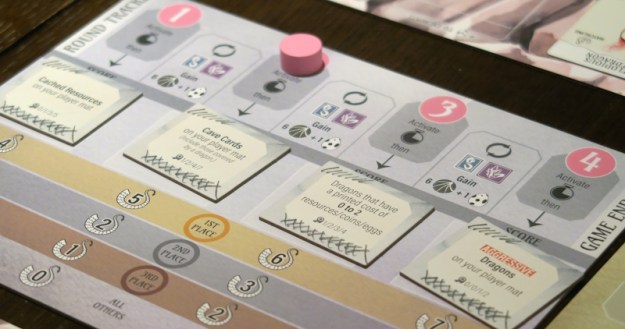
Once everyone had finished eating, we moved on to the usual difficult decision of who was going to play what.  The “Feature Game“, Wyrmspan which is a very new stand-alone game, based on the mechanisms of one of the group’s favourite games, Wingspan, with dragons instead of birds.  It was not as popular as expected, though that was at least partly because it was a relatively quiet night and many of those who would have enjoyed it were away.  In the end, Blue, Black and Pink settled down to play leaving two other groups of three to sort themselves out.

Wyrmspan
– Image by boardGOATS

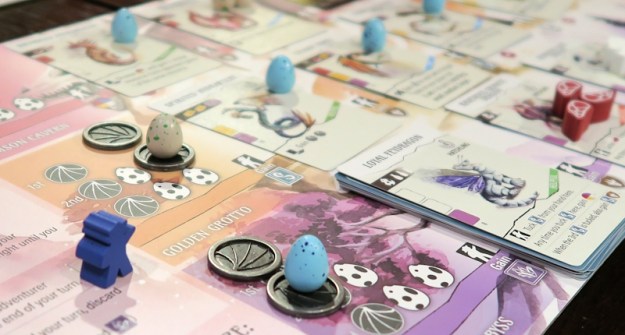
Wyrmspan is very closely related to Wingspan, though it is less forgiving, that is to say, the consequences of mistakes can be much more severe.  Like Wingspan, players are playing cards from their hand onto a player board, and activating the habitats in turn.  In Wingspan, the cards are Bird cards played in three different habitats, Woodland, Grassland and Wetland, whereas, in Wyrmspan, the cards feature Dragons and they are placed in three different cave networks, the Crimson Cavern, the Golden Grotto, and the Amethyst Abyss.  The differences are more than simply cosmetic, however.  Firstly, before a Dragon card can be played, it is necessary to explore the cave which involves playing a card (and claiming a Bonus).

Wyrmspan
– Image by boardGOATS

This is one way of getting Resources, there are others (playing dragon cards for example as well as activating the Crimson Cavern).  One of the key differences is that these typically provide only one Resource at a time.  So, whereas in Wingspan, if a player needs a resource, they activate their Woodland habitat and visit the Birdfeeder, claiming the resource they want and a couple of extras, in Wyrmspan, they don’t have extras so every move as to be made to count.  And this is all the more critical as “Planting Dragons” requires a lot of Resources and can be difficult to do, so it is important that the Dragon planted is then exploited as much as possible.

Wyrmspan
– Image by boardGOATS

Further, one of the Bonuses is movement on a new, separate board, the Dragon Guild.  A step around this Rondel typically gives a Resource as a reward, and when players reach half-way round and all the way round, they get a more valuable bonus which depends on the Guild in play.  The distribution of cards is very different too, in Wingspan, the majority of the cards have an effect when the terrain is activate, but in Wyrmspan, these are in the minority with most card effect happening when played or at the end of the round/game.  That is not to say they are not important—their very presence enables players to do more when the cave network is activated.

Wyrmspan
– Image by boardGOATS

Further, in Wingspan, players have a fixed number of actions per round (with fewer in the later rounds), whereas, in Wyrmspan, players get a set number of coins at the start of each round and an action typically costs one coin.  Some do cost more though, and occasionally players can pickup extra coins, which leads to variable length rounds.  Thus, although Wyrmspan is very definitely Wingspan at its core (players pay Resources to play cards and then activate habitats) there are lots of differences which give the game a very different feel, and make it a tighter, slightly more challenging game to play.  All that said, there has been a lot of discussion online saying it is much more difficult, but that is not how we found.

Wyrmspan
– Image by boardGOATS

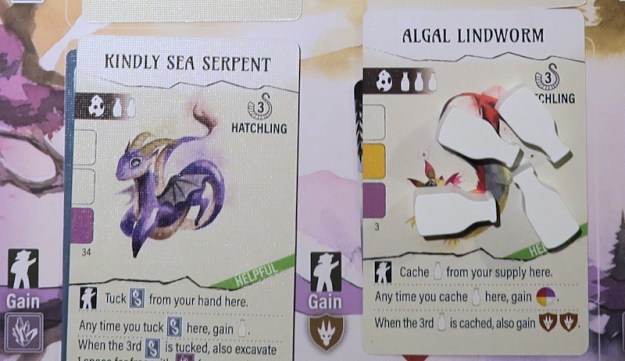
Blue went first and playing a Spirited Hydraptere Dragon in the first round which gave her two extra coins and then she proceed to plan her strategy from there.  Black prioritised progress around the Dragon Guild (Seafarers), which, as that was also high on Blue’s priority list, set them in competition.  Meanwhile, Pink had started with two Hatchlings (Kindly Sea Serpent and Algal Lindworm) which looked like they would synergise well, so he worked towards playing them.  Unfortunately, he came to the conclusion that this was a mistake as it slowed the start of his game and that he would have done better if he had ditched one of them.

Wyrmspan
– Image by boardGOATS

It is interesting to note, that many of the online comments have suggested that Hatchlings come at too heavy a price.  However, discussion after the game suggested that all three players felt they were essential to the “engine” and were worth the effort albeit needing some care to choose the right dragon.  As the game progressed, Black powered round the Dragon Guild with Blue snapping at his heels. Black took the straight six points from under Blue’s nose, so she took a free excavation instead.  Then, towards the end of the game when Blue and Black were heading for their third Dragon Guild bonus Pink grabbed the three point for each completed column and then Black took the straight three point bonus.

Wyrmspan
– Image by boardGOATS

Blue was most unimpressed as between them they had cost her eight points by leaving her with a solitary straight single point, though she picked up a few more from her Tawney Northern Drake (which gave her two points for each marker in the Guild at the end of the game).  Pink did well with his Guild points (despite only placing two tokens), but unfortunately it wasn’t enough.  As well as his points from the Guild, Black had also prioritised the end of round Public Objectives.  In a game with small margins, it looked like this might be enough for victory, however, Blue had a few more eggs, some more valuable Dragons, more tucked Cards and cached Resources.  As a result, she just edged it with eighty-eight points to his eighty.

Wyrmspan
– Image by boardGOATS

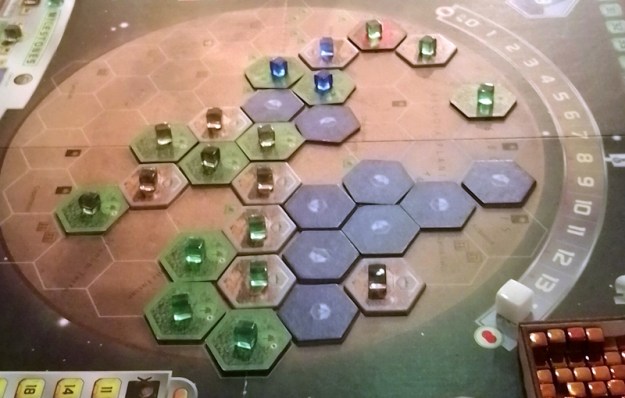
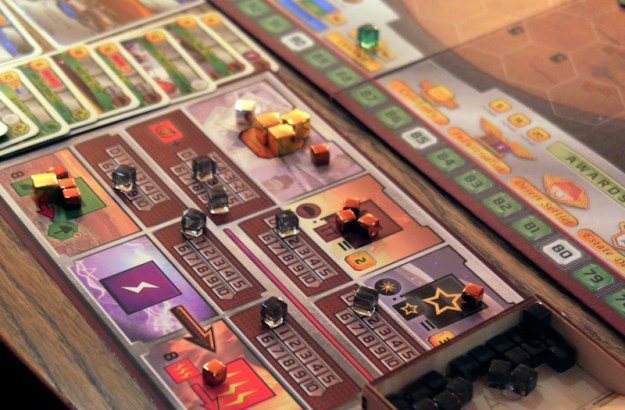
Meanwhile, Green who had considered joining the Wyrmspan game, eventually joined Cobalt and Ivory in a three-player game of Terraforming Mars.  This game is quite popular within the group, though it doesn’t get an outing very often.  The game is set in the 2400s, when mankind begins to Terraform the planet Mars. Players take the role of corporations sponsored by the World Government on Earth to initiate huge projects to raise the Temperature, raise the Oxygen level, and increase the Ocean coverage until the environment is habitable.  Victory points that are awarded for contributions to the terraforming, but also for advancing human infrastructure throughout the solar system, and doing other commendable things.

Terraforming Mars
– Image by boardGOATS

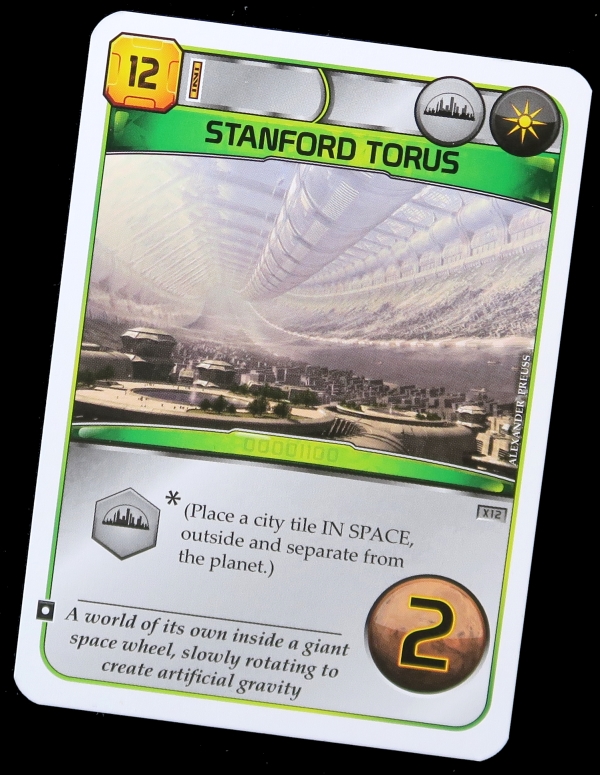
The players purchase Project Cards which can give immediate bonuses, as well as increasing production of different resources. Some of the Cards only become playable when the Temperature, Oxygen, or Ocean coverage increases enough. Buying Cards is costly, so there is a balance between buying Cards and actually playing them. There are six different Resources: MegaCredits (money), Steel, Titanium, Plants, Energy, and Heat and players keep track of these on their personal player board. Players compete for the best places to build Cities, place Ocean tiles, and develop Greenery. They also compete for different Milestones and Awards worth many points.

Terraforming Mars
– Image by boardGOATS

At the start of each round (or Generation) players purchase cards from four drawn privately.  Then players take it in turns to carry out one or two actions:  playing a card, claiming a Milestone, funding an Award, using a Standard Project, converting Plants into Greenery tiles, converting Heat into a Temperature increase, or using the action of a Card already in play.  Once all players have passed, players get Resources according to their Terraform rating and production parameters.  When the three global parameters (Temperature, Oxygen, Ocean) have all reached their goal, Terraforming is complete, and the game ends—the winner is the player with the most points.

Terraforming Mars
– Image by boardGOATS

This time, the group played the Elysium map (from the Hellas & Elysium map pack), with the “quick-start” Prelude expansion (but without the Incorporation Cards) and with Card Drafting (after the initial starting hand).  Ivory had the Valley Trust Corporation giving him increased money production which was further increased by his Research Network Prelude Card, ensuring that finance was not going to be a problem for him.  Green had Tharsis Republic, giving him an injection of cash when any city was planned on Mars.  Cobalt had Cheung Shing which gave him a two MegaCredit discount on Building Cards.

Terraforming Mars: Hellas & Elysium
– Image by boardGOATS

Green and Ivory both placed early Cities; Ivory got built the Research Station giving him a discount on all future Cards.  From there, Cobalt and Green then began focusing on Terraforming.  Green used his initial Titanium (from Prelude Cards) to play several powerful Event Cards early on. Cobalt then played several action cards including Regolith Eaters, Aquifer Pumping, Extreme Cold Fungus and CHG Producing Bacteria which he was able to combine together well to climb the Terraforming Track, although Green’s Event Cards meant he was never far behind.

Terraforming Mars: Prelude
– Image by boardGOATS

While Green and Cobalt were busy Terraforming, Ivory focused on getting his Plant production up and running as well as further increasing his money production (partly through building another city on Olympus Mons, refilling his hand). Although the other two had sped ahead on Terraforming, during income everyone was getting similar income thanks to Ivory’s increased money production. However, the other were generating lots of Energy/Heat and getting a lot of other resources.  As a result, Green took the first Temperature Bonus and Cobalt the second.  Turn order meant Cobalt wasn’t able to grab the Oxygen Bonus, which went to Ivory.  The Oceans were complete very early in the game, so there was no third Temperature Bonus.

Terraforming Mars: Hellas & Elysium
– Image by boardGOATS

Ivory’s focus on money production as well as Plant and Micro-cards, allowed him to grab the Specialist and Ecologist awards in one turn.  This forced Green’s hand to take the final milestone, Legend (for playing at least five events). Green then quickly grabbed the Legend award after.  From there, Cobalt continued to focus on Terraforming (particularly Temperature), placing only one City and a handful of Forests, whereas Green and Ivory started placing Greenery tiles. Ivory managed to get to his plant production up to eight, giving him a Greenery tile each round. Ivory and, to a less of extent, Green also started building more Cities.

Terraforming Mars
– Image by boardGOATS

Although this was going to score Ivory a lot of points at the end of the game, each City built was feeding Green’s engine, increasing his money production, quickly getting well into the teens.  From there, the Awards were the focus.  Ivory jumped first for Desert Settler, Green shortly after for Celebrity.  Noting he had very little end-game scoring, Cobalt had to spend 20 MegaCredits to grab the last award, the Industrialist.  All three players scored the maximum five points for each of the Awards they funded.  It then became apparent that the end of the game was approaching:  Ivory’s Greenery tiles were rapidly pushing the Oxygen to its maximum, the Oceans had been completed early by Green and Cobalt and Cobalt had focused on Temperature.

Terraforming Mars
– Image by boardGOATS

Ivory picked up a number of Animal Cards (Livestock and Fish) and focused on getting animals on them while Green’s huge money production allowed him to play a large number of Cards.   It looked like the game was about to end after Generation Seven, but taking that final Award prevented Cobalt from raising the Temperature the final step, forcing one last Generation.  That allowed Ivory to get more Animals and Greenery tiles and Green more cards with points before Cobalt finally triggered the end of the game.  Both Green and Cobalt were way ahead on Terraforming and everyone scored similarly for Milestones and Awards, but Ivory’s Greenery tiles, Cities and Animals got him victory just ahead of Green.

Terraforming Mars: Hellas & Elysium
– Image by boardGOATS

This demonstrated how important it is to develop a really robust engine, which together with some other scoring Resources will generally allow the funding of awards.  It is also key to keep an eye on the milestones and awards, since they can disappear almost instantly before you get the opportunity.  Cobalt had only really played Terraforming Mars solo before this.  In the solo game it is a race to Terraform the planet alone before the clock runs out (fourteen generations with the Prelude expansion).  This requires a very different strategy to multiplayer Terraforming Mars, however, where it is much better to concentrate on a strong plant engine with some cities to add to the score, as demonstrated by Ivory.

Terraforming Mars
– Image by boardGOATS

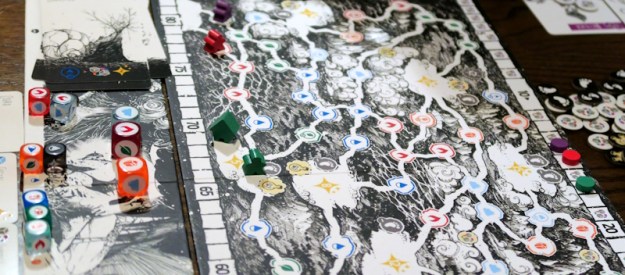
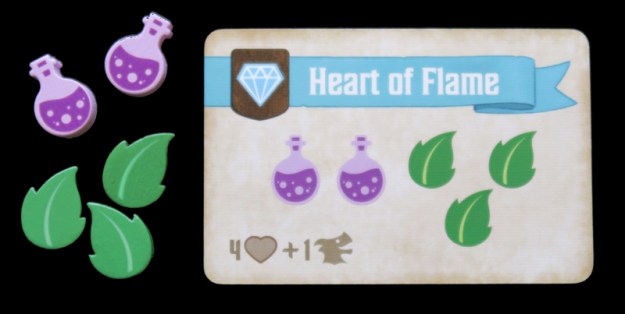
While Mars was being Terraformed and Wyrms were being “Spanned”, Teal, Purple and Pine were playing Glow, a strange little game which visually inhabits the domain of the graphic novel, the roman graphique, much beloved in France. Ben Basso and Vincent Dutrait’s appealing black and white line art is unique and stylised and sets the tone of gentle strangeness, which contrasts well with the brightly coloured dice and other game elements.  In Cedrik Chaboussit’s Glow, players take the role  of animal leaders recruiting a band of up to eight companions to make a journey to bring shards of light back  to a dark world. The game ends after eight days and the winner is the player with the most Light Shards.

– Image by BGG Contributor Propi

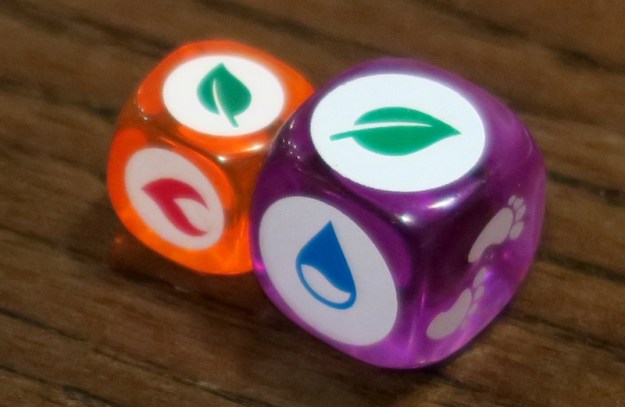
Players start by selecting one Leader Card from a choice of seven and take the accompanying big dice noted on the Card. Dice in the game have elemental symbols on them, Cloud, Water, Leaf, Flame and Gem.  The colour of the die gives an extra face of that coloured symbols, for example, the green die has two Leaf symbols on it.  On day one and every subsequent day players select a Companion Card from the “Meeting Track” (Marketplace) which is refreshed every day with new Cards. Players take the selected Card into their tableau next to their Leader group to form their growing band.  Players also take any small temporary dice that have been placed on the Marketplace card.

– Image by BGG Contributor a2b2c517

Once the recruitment phase is over, players simultaneously roll all their dice. Players can re-roll one or two of their dice if they either play a re-roll token (acquired through in-game actions) or move their scoring track token back to the next re-roll space, effectively losing points for this benefit. The dice results are then used to purchase actions at the base of each character card.  For example two Flame symbols provides three Sparks, or a Gem and a Water symbol provides a re-roll token. Each die can only be used once on each card, but each card can be triggered multiple times if dice are available, and each die can be used on each card if legal.

– Image by BGG Contributor Propi

In addition to scoring point Sparks, players can earn re-roll Tokens, Footprints and Glow-Worms. Unused Feet score one Spark at the end, but have another use in the Journeying phase. If a player has glow-worms equal to or more than their Companions, they receive a ten Spark bonus at the end.  The scoring track surrounds a map of the game world with multiple branching paths. Players start in one corner and in the Journeying phase, attempt to move their band meeple to point-scoring campsites of progressively higher value secured by pitching their tent on scoring spaces. To move along the paths players pay the indicated cost, such as a Leaf symbol, from the revealed symbols in their dice pool. Footprint tokens can be used as jokers to by-pass costs.

Glow
– Image by boardGOATS

At the round end, five new Companion Cards are dealt to the Meeting Track and players give back their temporary small dice by placing them on the matching symbols in the Meeting Track above the Cards. These dice are then taken when the Card is selected in the following round, thus increasing the value of certain Cards.  Although the game phases are played simultaneously after the recruitment phase, this time, Teal, Pine and Purple opted to play sequentially to assist with learning the game.

– Image by BGG Contributor Propi

The complexity of the game comes from selecting Cards from the Meeting Track and weighing up potential Card actions against increasing a player’s dice pool.  Choices include denying opponents Cards, weighing up the cost of re-rolls, planning for action combinations  or focusing more on the Journey board for points.  Pine selected the starting card of Braccio, giving two big green dice, and the action of two leaves providing a Footprint and three Sparks at the game end. During the game Pine got an extra big green dice with a Sketal follower early on to assist with maximising the Braccio special action focussing on Leaf generation for points.

– Image by BGG Contributor rascozion

Purple selected starting card Noctiluca with two big purple dice—the sixth face gives two Footprints and the action of three wild symbols scoring five Sparks. Purple went for a corvid strategy, selecting three crow-like birds.  One of these, Kaar, effectively curses other players dice by locking away from use one symbol per turn if the black die is chosen along with the other dice. Teal selected Tocana, with three big red dice and four Sparks at game end. As the game developed Teal went for a wild symbol strategy and acquired two Torke cards to generate guaranteed points each round, or so he mistakenly thought at the time…

Glow
– Image by boardGOATS

Progress was made on the journey board by all, with Purple and Pine getting to the better quality campsite netting fifteen points each, inspiring reminiscences about woeful tales of camping experiences.  At game end Teal scored a hundred and six, some fifteen ahead of Purple in second place.  Unfortunately, when playing Glow later on BoardGameArena, Teal realised that while the “wild” multi-coloured cost symbols powering actions could represent any symbol, they ALL had to match each other to trigger the benefits.

– Image by BGG Contributor Propi

Because Teal had more of this type of card than other players and acquired them early on, Teal had been unfairly gaining a point advantage by triggering Spark acquisition using mixed symbols.  This explained Teal’s high score and he insisted on being relegated, recording his score as null and void—that left Purple to take the golden crown and Pine the silver medal.  It had been a good game which has lovely presentation with immersive art. There’s lots of risk-reward decision-making, and another game would be great now that the rules are better understood, especially as simultaneous play should reduce playing time to the advertised forty-five minutes.

Glow
– Image by boardGOATS

With both Glow and Wyrmspan finished, there was just time for something quick before home time.  There was some discussion about what to play, but eventually, the player count of six and the short time available fixed the decision as the old favourite, No Thanks!.  This is a very simple “push-your-luck” game where players take it in turns to choose whether to take the face-up Card, or pay a Chip to pass the problem on to the next player.  At the end of the game, players add up the face value of their cards and subtract the number of Chips to give them a total—the player with the smallest total is the winner.

No Thanks!
– Image by boardGOATS

There are two additional rules that make the game work: firstly, if a player has a run of Cards with consecutive numbers, they only count the lowest number.  This is tensioned by the second rule, which is that roughly one third of the Cards are removed from the deck at random before the start.  This means players have to gamble on whether a card in a run is still available and it can make things go very wrong for people.  This time, it went very wrong for Blue who finished with forty-eight and for Black who top scored with a massive one hundred and twelve!  The winner, with a very reasonable twelve, however, was Pink, two ahead of Pine who finished with fourteen.

No Thanks!
– Image by boardGOATS

Learning Outcome:  Wyrms are more challenging to handle than Birds.

19th September 2023

Blue and Pink were the first to arrive, making up for their recent absence on the other side of the world.  They had finished their supper and were just discussing the upcoming Essen, when Purple and Black arrived, quickly followed by Pine, to be regaled of tales of koalas, pandas and roos.  Green, Teal, Cobalt and Lime weren’t that far behind and then the group split into two to play.  The “Feature Game” was Alea Iacta Est, a fairly simple dice chucking game with a Roman theme.  Although it has a lot of similarity to one of our old favourites, Las Vegas, it is more of a “gamers’ game” as it has a bit more planning and slightly more complex scoring.

Alea Iacta Est
– Image by boardGOATS

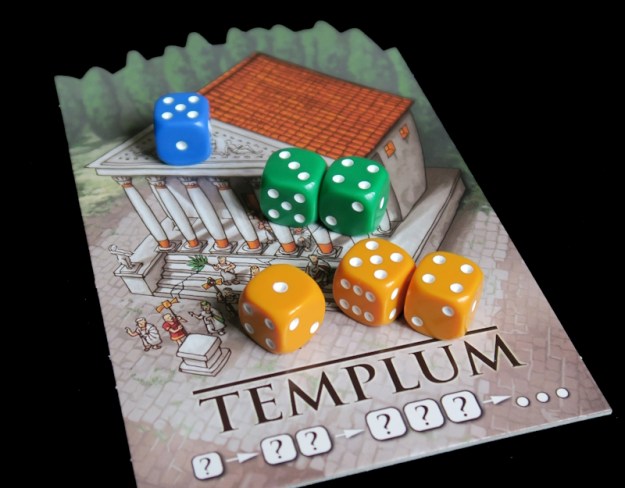
Like Las Vegas, players have a handful of dice, which they roll on their turn and then place a some or all in one of the locations.  In Las Vegas, the locations are different gambling joints and the dice placed are all the same number.  However, in Alea Iacta Est, the dice placed depend on the location, there are five, and the all behave differently.  For example, in the Templum, the first player adds one die and takes a face down Fortunum token.  The next player to place dice in the Templum adds one more die than the first player making sure the total number of pips is larger, and also takes a token.  If a player is returning to the Templum, they can reuse the dice they placed previously, making sure their number of dice is one more than the previous person to play there.

Alea Iacta Est
– Image by boardGOATS

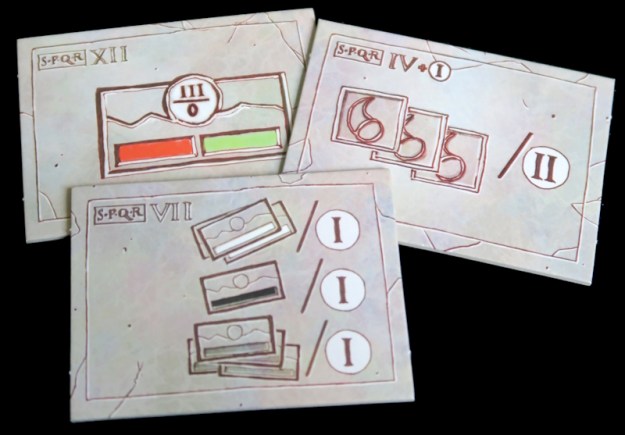
The Fortunum tokens are points, ranging at random from one to three.  At the end of the round (triggered by one player running out of dice), the player with the most Fortunum tokens keeps two of their tokens, while everyone else keeps one of their choice.  In the Senatus, players have to place “runs”, that is sequences of dice with consecutive values.  Players who place dice later must add one more die than the previous player and the run must be different to any that already exist.  Players can only have one run in the Senatus, but as for the Templum, players can ad dice to their previous entry.

Alea Iacta Est
– Image by boardGOATS

At the end of the round, the player with the longest sequence of dice takes three Senate cards, keeps one and passes the rest on to the player with the second longest sequence of dice.  The Senate cards provide players with end game scoring opportunities.  The Castrum is similar to the Slot Machine from the Las Vegas Boulevard expansion, in that players add sets of dice of the same value.  Like the Slot Machine, players can have more than one group, but unlike Las Vegas, there may be any number of groups in the Castrum, but never two groups with the same pips and same number of dice.

Alea Iacta Est
– Image by boardGOATS

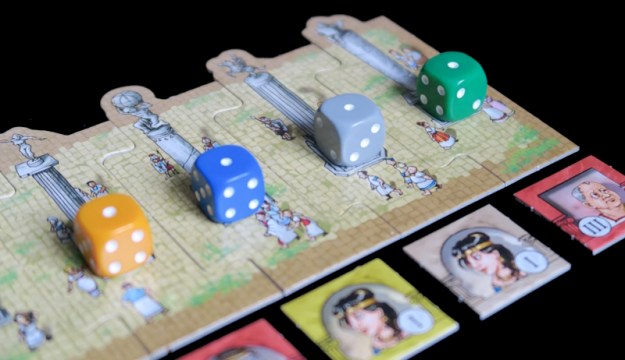
The player with the largest group in the Castrum at the end of the round takes their choice from the face up selection of Province tiles.  These score points at the end of the game, as long as they have at least one assigned Patrician.  Players get Patricians from the Forum Romanum.  The Forum Romanum is perhaps the most complex to control. Player can place either a single die with any number of pips or exactly two dice, which show together the total five pips (i.e. a one and a four, or a two and a three).  The dice are placed at the base of pillars in value order with the lowest value added to the left displacing everything to the right by one space.

Alea Iacta Est
– Image by boardGOATS

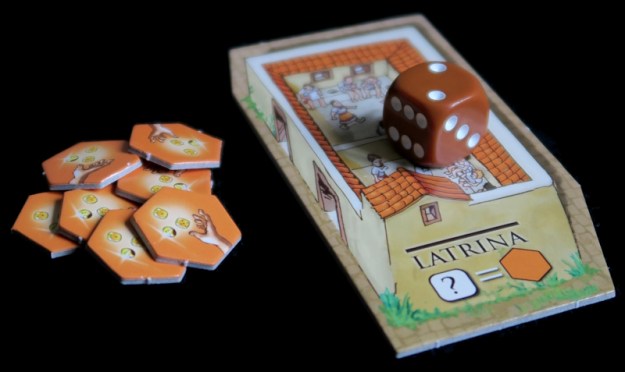
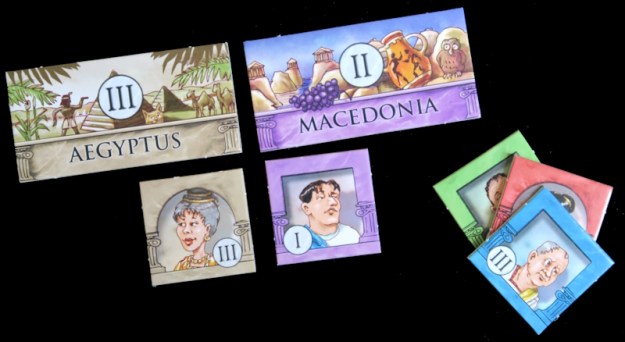
The clever part is the order the dice are placed when there is the inevitable tie:  the most newly added, also goes in the space to the left the group with the same number (again shifting everything to the right by one space).  At the base of each pillar there is also Patrician tile and these go to the owner of the die next to the pillar at the end of the round.  The fifth and final space is the Latrina, which is where players place dice if they can’t place them anywhere else, getting a re-roll token in return.  These can be cashed in during the game, or are worth a point for each pair at the end of the game.  The Patrician tiles and the Provinces are coloured.  Patricians are worth their face value, but only if allocated to a Province with a matching colour.

Alea Iacta Est
– Image by boardGOATS

Each Province can support two Patricians, one male and one female.  Each Province also scores its face value, though there is a point deduction if it has no Patricians.  These are the main source of points, though Senate tiles can provide a lot as well, with additional points from the re-roll chips and Fortuna tiles (taken from the Templum).  The game is played over five rounds with players taking it in turns to allocate dice until one player runs out (play continues until everyone has had the same number of turns).  As expected, it took a couple of rounds for everyone to get the hang of the locations, and in particular how the Forum Romanum worked and the implications for the scoring.

Alea Iacta Est
– Image by boardGOATS

Initially, everyone, but Pine in particular collected some Senate cards, to try to give them a steer on what to aim for.  They were a bit more complicated than people realised, so while they helped to an extent, in some cases, things became more opaque rather than less.  Pink, Pine and Blue made a real effort to get what they wanted from the Forum Romanum, which became increasingly difficult as the game progress—in the final round, the only dice left there had the value of one.  Teal focused on the getting lots of Provinces, realising that they still scored most of the points even when they were unoccupied.

Alea Iacta Est
– Image by boardGOATS

Given how people struggled to get to grips with the scoring, it was a really close game.  Pink just pipped Blue by a single point and Teal was only a couple of points behind in third.  Ultimately, despite the similarities with Las Vegas, it was very definitely a “learning game”.  Indeed, the similarities are quite superficial as the guts of the game are in the way the different locations interact.  This takes the game from being a light betting game to a much more complex game, though one that is still a lot of fun, with special moments when someone shifts someone else’s carefully positioned dice right out of the Forum.

Alea Iacta Est
– Image by boardGOATS

Meanwhile, on the next table, Green led Black, Purple and Cobalt in a game of Endeavor: Age of Sail.  This is a game that is very popular with the group, and although it seems quite complex, really comprises of point-by-point decisions, so although strategy is very important, tactics are critical too. The game is played over eight rounds, each consisting of four basic phases: Build, Populate, Payment and Action.  There are four technology tracks roughly corresponding to each phase, which dictate what a player can do during that phase.  For example, how far along the building track a player is dictates what they can build: the further along they are, the more buildings they have to choose from.

Endeavor: Age of Sail
– Image by boardGOATS

Thus it is one of those games where small decisions made early can have a big impact later in the game.  The first phase consists of passing round the tray of buildings rather like a box of chocolates, but after that, the second and third phases are more or less carried out simultaneously.  The guts of the game, however, is the Action phase.  In this round, players can place population markers on their buildings to activate them and carry out one of the five actions:  Colonise, Ship, Attack, Plunder Assets, and Pay Workers, actions that are generally focused on the central map.

Endeavor: Age of Sail
– Image by boardGOATS

Cobalt had not played Endeavor before so the group opted for the standard buildings and played using the standard, four/five player side of the board.  They did add three exploits from the Age of Expansion, however, the last three that had not yet been played with this copy of the game. They would not come into play until later and by then everyone should have a good idea of how to play.  While Cobalt and Black went with the Occupy action for their first building followed by the Workshop for extra bricks for their second building, Green and Purple both chose Shipping as their first building.  Green then took a Shipyard for a second shipping action and Purple went for a Market (gaining cards), “just to to be different”.

Endeavor: Age of Sail
– Image by boardGOATS

In that first round, Black and Cobalt only took a single occupy action with a plan to get better actions for their third building. Purple could only manage a single shipping, while Green also only managed one ship, but combined it with gaining a Culture to push him into the next category to get more citizens in the second round.  In that next round, Purple and Cobalt continued their similar strategy, gaining slaves for their bricks, while Green was forced into a workshop to stop himself getting hamstrung on buildings later and Purple was struggling to get enough citizens to use all the actions she had available to her.

Endeavor: Age of Sail
– Image by boardGOATS

That was pretty much how the game continued. Black and Cobalt placing people into Europe and building up their cards; Green was shipping around the world (although mostly in the Caribbean and South America) and Purple was taking the shipping routes in Europe, but always without enough citizens.  As the game progressed, regions started to open. Green inevitably gained the first Governor card. Cobalt and Puple fought for who had the most cards in total.

Endeavor: Age of Sail
– Image by boardGOATS

Once three and then four regions became open, only Green and Cobalt had people in both regions of the two opened exploits, so only they were able to make use of them.  They did use the South Sea Company exploit and Green took the extra brick as a ongoing benefit. This was not a normal brick, but a whole extra brick level, which allowed him to gain a level five building in the final round (the only one to do so). Cobald had tried to get a level five building, but then realised he had failed to reduce his brick level after he’d lost a couple of cards, and so was restricted to another level four building.  Although the Letters of Marque was the other opened exploit, no one actually made use of it.

Endeavor: Age of Sail
– Image by boardGOATS

About three rounds in, Green suddenly realised he had forgotten to explain the “Abolition of Slavery” rule to Cobalt. It didn’t look likely to happen as no-one had yet taken any European cards, however, Cobalt made his mind up then that this was what he was going to aim for—even though he had his own slaves, it felt morally right to him to make it happen!  Which he duly did, however, the only players to lose out as a result were himself and Black.  Both of them needed to reduce their card count anyhow, and the slaves were the ones likely to  be for the chop, so it didn’t cause too much damage.  The minus points they both received were only a small price to pay for their freedom.

Endeavor: Age of Sail
– Image by boardGOATS

Balancing everything is critical in this game and unfortunately Purple had always been on the back foot without enough citizens to do the actions she had available.  In the end Green ran out the winner as he had managed to get most of his attribute tracks up and gained a fair presence on the board.  The Letters of Marque, although unused, did provide for extra scoring on the shipping tracks, where Green had rather a lot of due to his early double shipping strategy. He and Cobalt also gained some points for using the South Sea Company Exploit.  This pushed Cobalt into second, marginally ahead of Black (who had managed a fair few points on cards and buildings).

Endeavor: Age of Sail
– Image by boardGOATS

It was still early and Endeavor was on-going, so when Teal left, the group looked for something little and light to play, and quickly settled on No Thanks!.  This is a favourite with the group because it is super-quick to set up and play:  players start with eleven red chips, and on their turn either take the card shown or pay a chip to pass the problem on to the next player.  At the end of the game, when the deck has been depleted, players score for the lowest value card in each continuous “run”, offset by any remaining chips and the winner is the player with the lowest total.  This is made more difficult by the fact that around thirty percent of the cards have been removed.

No Thanks!
– Image by boardGOATS

This time, the group played a total of three games.  In the first one, Pink took all the chips leaving everyone else with nowhere to go but pick up cards, which Blue did in spectacular fashion, finishing with one hundred and forty points.  The other three were very close together, with Pink just edging it by a single point from Lime.  The second game was much better balanced.  Although Pine won, there were clues as to Lime’s strategy for the next game as he picked up lots of cards and would have won by a large margin if two of the cards he wanted hadn’t been removed from the deck, but that’s the point of the game of course.

No Thanks!
– Image by boardGOATS

The third and final game was very unusual.  Lime rode his luck like a bucking bronco and kept taking cards.  Blue picked up a couple, but that was all he let her have, and Pine and Pink who just kept passing, eventually ran out of chips.  As they were playing open handed, Lime saw this and just collected the rest of the cards leaving him with forty chips and fifty-two points from his cards—a very good final score of twelve. Unfortunately for him, as both Pine and Pink had no cards or chips, they both finished with a round, fat zero, and therefore shared victory in one of the strangest No Thanks! games anyone had ever played.

No Thanks!
– Image by boardGOATS

With Endeavor coming to a close, there was just time to squeeze in something quick.  The fancied a change though and, as it had been a while since it’s last outing, Love letter was picked.  Everyone knew the game well , so the rules didn’t really need to be explained: start with a hand of one card, draw a second and choose one to play, effectively dueling to have the highest value card once the deck was exhausted.  Blue and Pine won the first two rounds, and as the others were finishing packing up, rather than play more, the group decided Blue and Pink should have a play-off.  Blue quickly acquired the Princess, which can be risky, but it was soon over when Pine played the Baron and compared hands, do his detriment.  With that, it was time to go home.

Love Letter
– Image by boardGOATS

Learning Outcome:  Although two games may seem similar, they may not suit people equally well.

21st March 2023

Blue and Pink were just setting up Circle the Wagons when Lemon walked in.  As Circle the Wagons is a two player filler game, they quickly packed it away and got out No Thanks! instead.  Lemon hadn’t played it before (or perhaps had forgotten), so Blue gave her a quick rules explanation.  It is a very simple (if clever) game, so it didn’t take long:  the first player reveals the top card of the deck, then makes the choice, either to take it or pay a chip to pass the problem on to the next player.  At the end of the game, the player adds up the face value of all their cards and the player with the lowest total is the winner.

No Thanks!
– Image by boardGOATS

There are two catches, however.  Firstly, if a player has a run of consecutive cards, only the lowest counts to a player’s final score, which encourages players to gamble a little.  However, the second catch is that nine cards are removed from the deck at random before each game, which means the card a player is gambling on getting may not even be present in the deck.  Blue and Pink were half way through their burgers and the trio were halfway through the game when Indigo and then Pine arrived.  Indigo was also new to the game so as they finished the first game Blue explained the rules to her too.

No Thanks!
– Image by boardGOATS

The first game was really close, but Lemon, got lucky and, although everyone scored relatively highly, she had three less than Pink to take victory.  The game plays five well though, so Pine and Indigo joined the other three for a second round.  This time, the top scorer was Indigo who finished just shy of fifty points.  Everyone else was closer, but this time Blue was the winner with seventeen points, some five less then Pine.  By this time, almost everyone else had arrived and the burgers had been dispatched, so it was time to decide who was going to play what.  The “Feature Game” was to be the Visit from the Rhine Valley expansion for one of the group’s most popular games, Viticulture, and the questions were, who wanted to play that, and what would the rest play?

Viticulture
– Image by boardGOATS

Viticulture is one of Pink’s favourite games and Teal was very keen to play it too.  Somewhat surprisingly, Ivory was open to other options, so eventually Indigo and and Green joined them to set that up.  With five people left, Lemon loving Ticket to Ride, and Pine having just acquired Burgundy‘s copy of the Europe edition, it wasn’t really a great surprise when the group decided to give that an outing in his memory.  The game is a very straight forward game of set collecting and network building with players either taking two cards on their turn, or paying sets of cards to place trains on the central map.  Players score points for placing trains on the map (with longer routes giving more points).

Ticket to Ride: Europe
– Image by boardGOATS

At the end of the game, players score extra points for any “completed tickets”, i.e. successfully connected the destinations on ticket cards dealt at the start of the game and perhaps collected during the game.  There is a risk associated with tickets, however, as any that are incomplete, score negatively.  Each version of Ticket to Ride has slightly different rules, so while everyone was very familiar with the basic game, the group had to remind themselves of the specifics of the Europe edition.  The main difference between this version and others is the inclusion of Stations—players can add one of these to a city to enable them to use one line connected to it that someone else has built to help them to complete tickets.

Ticket to Ride: Europe
– Image by boardGOATS

Ivory started and began the game and started on his first move by placing a single train from Bruxelles to Amsterdam.  That caused panic amongst everyone else, and turned out to be completely justified as everyone except Pine got involved in a scrap for the space in central Europe.  Largely as a result of that congestion Purple ended up forced to take tunnel routes.  These are routes where players don’t know the actual cost before they build them, since three cards are turned over from the draw deck and if any match the colour of the track being constructed, these must be matched by the player building the track (or they fail to build it).

Ticket to Ride: Europe
– Image by boardGOATS

This turned out to be costly for Purple who had a couple of attempts knocked back and some that costed considerably more than expected.  Lemon did what she often does and seemly prioritised building tracks she liked the look of, connecting them together later if possible.  Everyone else crossed their fingers and fought for the routes they wanted with most people interfering with somebody else’s plans somewhere along the way.  Ivory claimed the long tunnel route from Stockholm to Petrograd, and much to Purple’s disgust, managed it first time.  Lemon, who was after Pine in turn order kept trying to jump in front of him leading him to wonder whether he was invisible.

Ticket to Ride: Europe
– Image by boardGOATS

Blue seemed to have lots of tickets that didn’t go where her trains were and life got worse and worse as the space became increasingly crowded.  As the number of trains everyone had dwindled, everyone panicked about whether they were going to complete all their tickets.  Then, as everyone else was struggling to complete their tickets, Purple surprised everyone by taking more, and got lucky and finished it the very next turn—just as well, because Ivory had ended the game.  After the obligatory points recount (and a couple of very minor adjustments) the group started evaluating tickets.

Ticket to Ride: Europe
– Image by boardGOATS

Ivory, Pine and Blue had a lot, but Ivory had got lucky with his ticket draws which all fitted together quite nicely.  Blue had been less fortunate and only discovered that she was missing a connection for one of hers when it came to the final count.  Pine and Blue both succeeded in completing eight tickets, but Ivory had the longest continuous connected line, with all but two of his trains conga-ing neatly across the map.  Ivory, who had just been ahead throughout was the victor with a hundred and forty-seven points, twenty ahead of Blue in second and forty ahead of Pine in third.  It had been a good game though, with lots of cut and thrust and everyone (especially Blue) had engaged their inner Burgundy at some point.

Ticket to Ride: Europe
– Image by boardGOATS

Both Ivory and Pine wanted an early night, but there was still time for something else, so long as it wasn’t too long.  Pine rejected Blue’s optimistic suggestion of Bohnanza as always taking too long, so in the end, the group settled on Coloretto.  Lemon was new to this, but it’s a quick game to teach and an easy game to learn as you play too.  Another set collection game, the idea is that players score points for collecting large sets of coloured chameleons.  So, on their turn, players either turn over the top card of the deck and place the card in one of the trucks (each of which can contain a maximum of three cards), or take a truck.

Coloretto
– Image by boardGOATS

The reason this is clever is because while players score positively for the largest three colour groups, the others all give negative points.  The triangular series gives many more points for the later cards, thus, the trick is to have one large set of cards rather than two or three smaller ones.  The game plays well with five and there were lots of difficult tactical decisions with players trying to work out what everyone else would do and then force them to take cards they really didn’t want.  In the end, it was an easy victory for Ivory though, with thirty-four, four points ahead of Blue in second.  It was much tighter with a three way fight for bronze, that Purple just won.

Coloretto
– Image by boardGOATS

Meanwhile, on the next table, Teal, Pink, Ivory and Green were playing the “Feature Game“, the Visit from the Rhine Valley expansion for Viticulture.  Although Viticulture is much more complex than the other games being played in the room, it is a relatively straight forward worker placement game where players are developing their vineyards by building buildings, planting vines, harvesting grapes, making wine and getting help from visitors.  The game is typically a race with the winner being the player with the most points at the end of the round where a player exceeds a set number of points.  The Rhine Valley expansion is very small, just a replacement deck of Visitor cards, but it has a reputation for changing the game quite significantly, making it more about wine making than just getting points.

Viticulture
– Image by boardGOATS

Viticulture is one of Pink’s favourite games and was quite well known to Green and Teal too thanks to them playing regularly on Board Game Arena.  The Tuscany expansion was a new new variation to Green and Teal though and nobody had played with the new Rhine Valley Visitor cards.  Indigo had never Viticulture at all, but Pink and Teal explained the rules, during which Indigo received some well meant general advice on best plays from the others. When Green suggested that five workers was probably optimum, both Teal and Pink were quick to disagree suggesting that more (maximum of six) was always better.  Viticulture is always a slow burner for the first part of the game, and Pine kept looking across from the other table and remarking how the game had been going for ages, but there had only been a single point scored.

Tuscany
– Image by boardGOATS

As Pink, Teal and Indigo inched forward by a point or three, Green remained resolutely on zero for a long time, and then he sacrificed a point to go negative!  As the game progressed the points started to come eventually.  After drawing fulfillment card after fulfillment card, Pink realised he should have planted some higher value grapes rather than just the first ones that came along, which meant it took lots of turns to make them “ready for sale”.  He was the first to complete a wine order though, with Teal just behind.  Green eventually started to move forward and caught Indigo who was struggling a little to get her head around the game a little and with only three workers was really finding it difficult to get much done.

Viticulture: Visit from the Rhine Valley
– Image by boardGOATS

One of the interesting features of Tuscany is the additional buildings that can be constructed.  Green found a Statue which was very expensive, but not only gave him an immediate point, but also an extra point each round.  This, together with his other building, a Storehouse, he had an extra ageing step each round as well—his engine was beginning to build after a slow start.  Green then played a winter Visitor combo, which allowed him to make some wines and fulfill a big six point order with an additional two points.  With the end-game trigger at twenty-five, that was quite a haul in one go, indeed, Green, Teal and Pink were all quite close now.

Viticulture
– Image by boardGOATS

In spite of the sudden flood of points, with time running out, the group soon realised they would not be able to finish in time.  Pink’s more traditional approach of planting, harvesting, making wine and fulfilling orders had kept him at the front of the points track, and would likely have got him over the twenty-five point line in the next round.  However, the group decided that they really needed to finish, just when everyone’s engine was getting into their stride. Nobody will ever know whose would have been be the most successful and by the end of that round it was all very close on the score track.  Pink had his nose in front though, followed by Green and then Teal, but there were still the “Stars” regions to score.

Tuscany
– Image by boardGOATS

This was an area which Teal had really gone for early on in the game. Green had placed a few few early on and then mostly ignored it.  Pink came to the stars late in the game, but as was his usual strategy, made big plays when he did.  In the end Teal narrowly scored most just edging Pink although he still had enough to retain his lead with twenty-one, two ahead of Teal and four ahead of Green.  None of the group quite knew how the end of the evening had snuck up on them so suddenly, they had been so engrossed and it had seemed hardly any time at all—quite a recommendation for a game!

Tuscany
– Image by boardGOATS

Learning Outcome:  If you go into the Wine Business, make sure you know what people want to buy before planting any grapes.

7th February 2023

Blue, Jade, Plum and Byzantium were first to arrive and started by ordering food and then settled down for a chat.  Pine soon joined them, followed by Teal, Green, Black, Purple and Ivory.  With Lime tucked up in bed fending off his lurgy, and Lilac away for work, it was just Pink who was trapped on the motorway system somewhere between The Jockey and the Frozen North.  So, while food was being finished the others wanted a short game for the other end of the table.  Teal had brought along The Lost Expedition and Cottage Garden. Both were apparently at least thirty minutes which probably meant nearly an hour, so we settled on a short one everyone knew, NMBR 9.

NMBR 9
– Image by boardGOATS

This is a super-quick little game, but what really makes it special is that it has almost zero set-up time.  The idea is that one player turns over cards, and these indicate which of ten tiles should be played on that turn.  Players take the tiles straight from the box and add them to their tableau with players making sure edges touch and when placing tiles on higher layers, there must be no overhangs and tiles must cover at least two other tiles.  Players score for the number on each tile multiplied by the “story” or “floor” (thus a nine placed on the third layer (second floor) scores eighteen points).  The player with the largest total is the winner.

NMBR 9
– Image by boardGOATS

Everything started reasonably well with some low numbers to start, including the zero, to help players build a base. The first nine came out in time for most people to have built a base to place it on, but it was after this that  it all started to go wrong.  Everyone seemed to struggle to fit the numbers coming out anywhere higher than the bottom layer, and even then players discovered they had blocked themselves from the best base places.  Players were were struggling to get much on their second layer, let alone the third, so by the time the last two numbers were drawn (six and one), most people had barely managed a third layer.

NMBR 9
– Image by boardGOATS

The one came out and was generally placed on top for a whopping three points for most and then the six could only go on the second layer.  Everyone felt they just hadn’t managed things very that well this time—all except Black that is.  He had been quietly getting on with things in the corner, building his third layer and a final fourth layer for his last number.  The end result was that Black ended up with a score that was one of the group’s highest ever for this game and nearly twice that of second place Teal with Green not too far behind in third.  With that done, it was time to decide who would play what.

NMBR 9
– Image by boardGOATS

Most people seemed to want to give the “Feature Game“, Flamecraft a go.  That was OK, as we had two copies of that available, but the question was what the third game might be.  Green failed to find any takers for Terraforming Mars, so in the end Pine and Teal joined him giving the Pennsylvania map for Ticket to Ride a go.  The Pennsylvania map is part of Map Collection Volume 5 and is the reverse side to the United Kingdom board. All the Ticket to Ride games are built round the same basic idea:  on their turn, players either take carriage cards from the market or use carriage cards to pay to place trains on the map connecting cities together.  Players score points for placing pieces on the map and for completing tickets (connecting two places on the board).

Ticket to Ride Map Collection: Volume 5 – United Kingdom & Pennsylvania
– Image by boardGOATS

Each map has special rules and or mechanisms that are unique to it.  In the case of the Pennsylvania map, this is the ability to acquire Shares.  Each time a player completes a route, they claim a Share token for one of the companies depicted next to that route. At the end of the game, whoever holds the most Shares in each company receives points.  The trio entered into the game without much thought of how it might be best played, so started out doing their best to complete tickets, with the Shares just an added bonus.  Pine was the first to place a train, from Johnstown to Altoona, while Green and Teal continued to collect cards.  Teal was second to place trains, a long route on the eastern side from New York to Philadelphia and Green was a little later in the north west.

Ticket to Ride Map Collection: Volume 5 – United Kingdom & Pennsylvania
– Image by boardGOATS

There wasn’t much else going on except card collecting, and there didn’t seem to be any Locomotive cards in the deck.  When Pine extended his single train westwards to Pittsburg, there was a groan from Green—he had just been unable to get the colours he needed for the same track and now had to go the long way round.  Adding to Green’s woes, Teal then took the three train route in from Towanda to Scranton, that he’d wanted for his two point ticket.  Annoyingly, it didn’t have a specified colour, so he could have placed something there almost any time, but had been concentrating on getting the colours for the routes into Johnstown for his bigger value ticket.

Ticket to Ride Map Collection: Volume 5 – United Kingdom & Pennsylvania
– Image by boardGOATS

When Pine then claimed the final entry into Johnstown to completely block Green out, he was convinced his game was over, with two failed tickets before it was even half way.  With a handful of train cards and no-where else to go, Green was the first to take new tickets, keeping just one.  After placing trains along the northern edge of the state and into Canada, Green had another go at taking tickets, this time keeping two.  With there being a big fifteen point bonus for the most completed tickets and no bonus for longest continuous string of train pieces, this version of Ticket to Ride encouraged everyone to place trains on almost any route.

Ticket to Ride Map Collection: Volume 5 – United Kingdom & Pennsylvania
– Image by boardGOATS

And this was without the Shares—everyone had been been quietly collecting them. Pine seemed to be going for a lot of the highest value, the Pennsylvania Railroad Company, although that was mostly because he kept forgetting he had them.  Teal was collecting a variety, but was the first to take Shares in a lot of the lower value companies (which had fewer Shares available). In fact he was so entranced with the share collecting, he was placing his trains on routes to collect shares and forgetting about his ticket completion, which was to be his downfall.

Ticket to Ride Map Collection: Volume 5 – United Kingdom & Pennsylvania
– Image by boardGOATS

Pine brought the game to a close with just two trains left leaving Green and Teal to place one more two train route each, though Pine was unable to place any more trains for one last Share.  Not terribly surprisingly, Pine eschewed Teal’s suggestion of taking tickets.  He’d taken some earlier and although in this game players get four tickets and only need to keep one, he still felt they looked awfully difficult to do.  Plus with trains all over the board, it seemed very unlikely that a route may have already been completed, much more so than in some of the other versions of the game where it sometimes feels like it is worth a shot.

Ticket to Ride Map Collection: Volume 5 – United Kingdom & Pennsylvania
– Image by boardGOATS

The final scoring was to prove interesting: scores for just placing train pieces on the board were all relatively close.   Everyone had to get their fingers and toes out to score the Shares, but in the end found the scores were all very close on these as well, even though everyone had had different approaches towards them.  It was the tickets that were to be the deciding factor.  As mentioned, Teal had largely forgotten about his routes, and although he had managed two of them, the last was incomplete and counted against him, giving him a ticket score in single digits.  Pine had completed four tickets with most of them being good scorers. Green had also managed to complete four tickets, but this score was off-set by his two failures from the early part of the game.

Ticket to Ride Map Collection: Volume 5 – United Kingdom & Pennsylvania
– Image by boardGOATS

The tie for the most ticket bonus was “friendly” so they both scored it, but those failed tickets cost Green a total of around forty points, roughly Pine’s winning margin.  As the group packed away, they discussed the Pennsylvania map and agreed it was quite good.  Although the Shares score was fairly even, the fact that the bonus was for tickets and not the longest continuous set of trains, meant everyone tended to build all over the board rather than focusing on a connected set.  The feeling was that playing again people might well go for even more of the short routes to gain more Shares, rather than the long high scoring routes—food for thought from a very worthy Ticket to Ride expansion.

Ticket to Ride Map Collection: Volume 5 – United Kingdom & Pennsylvania
– Image by boardGOATS

By this time it was nearly 10pm, but Teal wanted to try out the cooperative game, The Lost Expedition.  The box suggested thirty to fifty minutes, but Teal assured the group that it was unlikely to take that long and everyone would probably die fairly quickly.  He had played it solo a few times and always died, so was keen to try it with a team.  The idea of the game is that they take the role of a team of three in search of the lost legendary explorer, Percy Fawcett.  The game has really nice artwork a little reminiscent of Tin Tin style and large, easy to read cards.  Teal explained the rules, but it wasn’t until play started that Green and Pine really understood how it worked and it wasn’t really that difficult.

The Lost Expedition
– Image by boardGOATS

Each player started with a hand of four cards and took it in turns to lay one forming a route, with the numbered cards increasing in value.  This was creating a path for the explorers to travel, with some loses and some benefits, and several cards which also allowed them to skip or swap other cards on the track.  This meant that if there was a particularly bad card the players could try and place it after one that allowed following cards to be skipped, and therefore not have to deal with it at all.  In the first “Morning” round, the group each played two cards from their hand.  Once that was done, they then started down the path, deciding what to do with each one.

The Lost Expedition
– Image by boardGOATS

There were usually several choices:  some had compulsory things to do, others were optional.  For example, for the Panther card the group had to decide on whether to use one of the three bullets the team start the expedition with (leading Pine to comment on how stupid it was to enter a several day jungle adventure with only three bullets!) in order to gain three food, or to lose a health token to skip over the card.   Once the first path was completed, the group progressed onto the next part, the “evening”, building a path from the remaining cards in the order of placement (the face value on the card was irrelevant now).

The Lost Expedition
– Image by boardGOATS

Fortunately, the group had a couple of skips and swaps (allowing them to switch the position of two cards on the path), and by the end they had taken several steps on the main route through the jungle towards their goal.  The group had taken a few health hits along with the way, but their three characters still seemed to have at least two or three of their initial four health points remaining.  The next day everyone again started with four cards and by the end of the morning phase the team were only two steps from the goal, but their health was beginning to look a little poor.  With the evening placements the group somehow managed to make those final two steps with the first two cards of the path before anything bad happened.

The Lost Expedition
– Image by boardGOATS

The team had beaten the game, however, it was with the easy setting which has only seven spaces on the main route through the jungle—the standard game has nine!  Nevertheless, Teal was pleased to have finally beaten the game and Green and Pine had enjoyed it too.  It is a  clever little co-operative game that really encourages discussion and doesn’t let one player dominate.  With the hand of cards it also provided an element of individual game play and decision making, further preventing the “alpha gamer” problem that often blights cooperative games.  As a result, this game might well appeal to those who do not normally enjoy them and this one could well get another outing.

The Lost Expedition
– Image by boardGOATS

Meanwhile, the other two tables were playing the “Feature Game“, Flamecraft.  This is a game where players take the role of Flamekeepers, gathering items, placing dragons and casting enchantments to enhance the Shops of the town with the aim of finishing the game with the most Reputation points.  A sort of worker-placement game, players take it in turns to firstly move their dragon to one of the Shops and then either Gather resources from it and optionally play a dragon into the Shop, or spend resources to Enchant or upgrade it so it provides more resources.  This sounds very simple and not terribly exciting, but the interplay between the actions on the dragon cards and the large pile of available Shops is what makes the game interesting.

Flamecraft
– Image by boardGOATS

When a player Gathers resources they can also activate or “Flame” one dragon and the special ability for the Shop (if it has one).  In contrast, a player that Enchants a Shop, they can activate all the dragons in the Shop, but cannot activate any special ability associate with the store.  There are six different types of Artisan Dragon and, although every card has a unique name and artwork, the actions are the same for any one type.  For example, all Diamond Dragons allow the active player to take three gems from the supply, and all Bread Dragons allow them to take another Artisan Dragon card from the market or face down deck.

Flamecraft
– Image by boardGOATS

Players get Reputation points for Enchanting Shops:  they pay resources to buy one of the face up cards from the Enchantment market and add it to the Shop they are at which must match the Resource type. There are other ways of getting Reputation though.  For example activating a Plant dragon allows a player to gift another person any resource and in return get two Reputation points.  Some of the Shops also give Reputation points, but perhaps one of the best source is through Fancy Dragons.  These are special dragons which are effectively Goal cards.

Flamecraft
– Image by boardGOATS

Players start the game with two Fancy dragons and choose one to keep and add to their hand.  These come in two types—day and night.  Daytime Fancy dragons (marked with a sun) can be completed at any point during the player’s turn and give points in exchange for Resources or manipulating the game so certain conditions are met.  In contrast, nighttime Fancy dragons are evaluated at the end of the game giving points, for example, for being the player with the most of one Resource or for each Resource of which you have an odd number.

Flamecraft
– Image by boardGOATS

Both groups began with the slightly simpler, purple enchantment deck and without the special helper cards (which are an optional addition to the game that provide a one-time special ability to each player).  Just as Byzantium, Ivory and Blue were about to start, Pink rocked up and joined the game so after the set up had been adjusted and the rules were explained they got going.  Blue started by collecting Resources.  On the first play, Flamecraft has a tendency to feel a little bit aimless, but as soon as the special (non-start) Shops started to come out, things get a little more interesting.  Although there are only six different types of Artisan dragons, the interplay between them and the Shop powers is much more interesting than it seems at first glance.

Flamecraft
– Image by boardGOATS

Ivory was quick to get a feel for things and soon scored some points, as was Byzantium, who was the only one around the first table that had played it before.  Pink and Blue were a little slower to get off the ground, but soon started to improve their Reputation as well.  There was a bit of a rules glitch towards the end when they realised they had forgotten to put out at least one new Shop, but otherwise play proceeded very smoothly to the end of the game.  None of the Shops with the wild icon came out, but there was an awful lot of iron available from early in the game.

Flamecraft
– Image by boardGOATS

There was also a bit of a general shortage of Bread dragons, which is significant as activating them allows players to take another Artisan dragon card, and the few that were played were moved all over the board by people playing Potion dragons. It was a close game though with lots of to-ing and fro-ing, but when Blue had the chance, she triggered the end of the game by taking the last of the Artisan dragons, giving everyone one last turn which they tried to use to their best advantage.  Blue just got her nose in front with Ivory a point behind, but there were still nighttime Fancy dragons to add on and points from dragongeld too.

Flamecraft
– Image by boardGOATS

Unfortunately for Ivory, his extras exactly matched Blue’s so her single point lead remained, with Byzantium taking third.  The second Flamecraft group were slightly slower to get started and were still very much underway with both the Ticket to Ride/Lost Expedition and first Flamecraft groups finished.  Pine, Teal and Ivory headed home, so while the second Flamecraft group finished and Byzantium watched, Pink, Green and Blue played a quick game of the filler, No Thanks!.  This is one of our old favourites and is very simple with players either taking the face up card on their turn or paying a chip to pass the problem on to the next player.

No Thanks!
– Image by boardGOATS

The player with the lowest face up total wins, so eyebrows were raised when Green started collecting cards in the thirties.  If players get a run, only the lowest of the set count to their final score, but since nine of the thirty-four cards have been removed from the deck it is dangerous to bank on building long runs.  Pink picked up the four as almost the first card of the game, and managed to build quite a long run over the course of the game.  All was going well until he ran out of chips and was forced to take cards he didn’t want.  This also screwed up Green’s plans as he wasn’t able to make the most of his high value cards and force Pink and Blue to give him chips.

No Thanks!
– Image by boardGOATS

Worse, Pink took a couple of cards Green really wanted.  Blue, who started collecting cards in the high teens extended her run into the low twenties.  The final card she needed, the seventeen was the final card in the deck and she snaffled it at her first chance to end the game and give her a run from fifteen to twenty-one.  After a couple of recounts, Pink and Green finished in a tie with a massive sixty-nine points, more than twice Blue’s winning score.

No Thanks!
– Image by boardGOATS

The second game of Flamecraft was just coming to an end, but unfortunately, they had a slight rules malfunction and were playing that emptying either the Fancy dragon or Enchantment deck triggered the endgame, when it is the Artisan dragon or Enchantment deck according to the rules as written.  Usually, it is Blue that makes these sort of rules errors, so despite having read the rules at least three times in the last few hours, she panicked and checked them yet again, just in case.  The second group had a shortage of Bread dragons as well, though for a slightly different reason.

Flamecraft
– Image by boardGOATS

The selection of Artisan dragons in the face up market was almost entirely “Toast” for most of the game—Black shuffled so they blamed him.  This meant players spent most of the game taking Artisan dragons blind from the top of the face down draw deck.  As a result, players  didn’t have Bread dragons in hand, so only a couple of Bread dragons were placed in Shops and they just got pulled from pillar to post for the whole game.  The Shop shuffling was slightly better though and there were some that came out that were new Plum and Jade (who had both played before), which was nice.  The game was also close, with Jade taking victory by a single point from Plum with Purple taking third a few points behind.

Flamecraft
– Image by boardGOATS

Learning outcome:  Even dragons like a nice sandwich.

29th November 2022

Although the numbers were severely dented by holidays, work commitments and norovirus, there were still nine of us, and although everyone was late, timings were perfect and the whole group arrived within moments of each other.  There was the usual chatter, as people bought drinks and shared stories of the week, then everyone finally settled down to play some games.  The “Feature Game” was the shiny new Asia expansion to one of our favourite games, the multi-award-winning bird-themed card game, Wingspan.  But first we had to decide who was playing what.

Wingspan
– Image by boardGOATS

Like last time (when there were also nine people), splitting the group into two or three was quite challenging, but eventually, we decided to go with two tables with Blue, Plum, Black and Ivory playing Wingspan with Pink and Pine leading the rest in a game of Downforce. Downforce has three parts:  a car auction, a race, and betting on the race which occurs during the game.  Downforce has had a couple of outings in the last year, and after last time we played, we concluded that the betting skewed the game a little.  Essentially, when the first car crosses the first betting line which triggers players to place their bets, if several people bet on the same car that tends to lead to a runaway leader.

Downforce
– Image by boardGOATS

After a little research, we found an alternative, “Odds Betting” variant that we thought might be worth a try and Pink was keen to give it a go.  This scheme rewards riskier bets because a player’s winnings depends on the position of the car at the point in the race when the bet is made.  Thus, if a player bets on the leading car at the first betting line and it comes in first, they will win three million dollars ($3,000,000 × 1), however, if they bet on the last car and it defies the odds, they will take eighteen million dollars ($3,000,000 × 6).  Even if that last car comes in third, anyone betting on it will take six million dollars ($1,000,000 × 6)—twice that of betting on the leader if it wins.

Downforce
– Image by boardGOATS

The track chosen was Switchback Pass from the Danger Circuit expansion.  The race began and as the cars weaved around the track, players tried to muscle past each other.  Purple made good use of her power, “Tough” (from the Danger Circuit expansion).  This allowed her to move an extra two spaces every time she finished her move on a space adjacent to a “rumble strip” and she used that a lot, an awful lot.  This was in contrast to Pink who didn’t use his “Determined” power at all.  Despite using her power a lot, sadly, Purple wasn’t able to capitalise on it.  “Ambitious” Lemon was the first to cross the line, shortly followed by “Unpredictable” Orange.  However, the winner is the player with the most cash including income from bets, and in this case, that was Orange who had backed himself from the start.

Downforce: Danger Circuit
– Image by boardGOATS

The consensus was that the “Odds Betting” variant was a definite improvement on the rules as written, though they made things significantly more complicated.  As a result, they weren’t considered a perfect fix.  There are other options still to try though:  the “Simple Odds Betting” variant (where players only bet on the winner with the takings based on position at the time of the bet); the “All Bets are Off” variant (where the betting rules are as written but each player must bet on three different cars, none of which are owned by that player), and the “Three Bets” Variant (which just increases the number of cars everyone has an interest in).

Downforce: Danger Circuit
– Image by boardGOATS

While the race was ongoing, the next table were playing Wingspan.  This is one of the most popular games within the group, so we were keen to give the brand new Asia expansion an outing.  The basic game is simple enough:  on their turn, players either play a bird card in one of the three habitats, or activate one of those habitats and all the birds in it.  The three habitats are Woodland, Grassland and Wetland giving food, eggs and bird cards respectively.  Food and eggs are necessary for playing bird cards, as well as eggs being worth points in their own right at the end of the game.  The European and Oceania expansions both added more cards and the latter also added nectar as a food source.

Wingspan
– Image by boardGOATS

Wingspan: Asia is a standalone two-player game that can also be added to the base game as providing new bird and goal cards.  It also adds a new “flock” mode for playing with six or more players, but with only four players this time, the group decided to make the most of the Asia expansion.  So Ivory, Plum and Black started by removing all the other expansion bird cards from the deck and shuffling in the new ones while Blue sorted out all the other bits needed to play.  That all took longer than expected, but with everyone knowing the game well, there was no need to revise the rules before the game, with just a few edge cases that were checked during play.

Wingspan: Asia
– Image by boardGOATS

Ivory started the fastest, with more birds in his reserve than anyone else by the end of the first round.  The goal at the end of that round was the rather cool “most birds facing right”, and although Ivory won it, everyone else was close behind.  That wasn’t the case in the later rounds though, with somebody struggling to get points in each case, but Ivory taking the top bonus in every round.  Some of the new birds offered a bit more, in particular, those that allowed players to cache food, but gave them a wider choice of options.  Some allowed players to choose which food, and there was another that gave the option of caching food or tucking cards.

Wingspan: Asia
– Image by boardGOATS

Although some of the bonus cards were the same as those in the base game and the other expansions, there were also new ones.  There was one that rewarded having different nest types in the trees. Ivory and Plum both got cards that gave points for playing birds in a given habitat that increased or decreased in value.  Although these were a bit different and added variety, they didn’t fundamentally change the game. As Black pointed out, sometimes the bonuses are a bit too difficult and the other ways of accumulating points much easier.  They are good to give a steer at the start of the game though, when the range of options can be overwhelming.

Wingspan
– Image by boardGOATS

With eggs worth one point each, the final turns involved the usual round of egg-laying.  It felt like it was less of a frenzy than it sometimes is, probably because everyone had other things that they felt they needed to do that were more important.  Towards the end of the game, Plum also picked up a couple of extra goal cards, but had to choose between them.  Both gave points for having birds that increased or decreased in value in a Wetland or Woodland—she went for the Wetland as at least the values were increasing, decreasing values was not ideal at that stage of the game.  Black also picked up a couple of extra goal cards during the game, but from Blue’s perspective, Ivory was where he always was, out in front with a formidable lead.

Wingspan: Asia
– Image by boardGOATS

That was not quite how it turned out in practice, however.  Ivory said he thought Black might have it, and ultimately he was proved right.  The differences in the scores were not quite as anybody expected however.  As the scores came in, it became clear that Ivory had a lot of end of round bonus points (twenty-two in fact) and Black had a lot of points from the bonus cards (fourteen) while Blue had the most from her birds (thirty-eight) and Plum had the most cached food (nine).  Of course it is the total that counts, and in the event, Black was some way ahead of the rest with a total of seventy-seven points.

Wingspan: Asia
– Image by boardGOATS

It was much closer for second than anyone expected as Blue had made an extremely slow start, but Ivory’s total of seventy-two pipped her by a single point.  Everyone had enjoyed the game, but then we always do enjoy Wingspan.  The Asia expansion didn’t change things very much, though it did feel a little different, mainly because of the new goal cards (e.g. the cards that reward placing birds in order of points and for playing birds with different types of nests).  These were the biggest difference, though some of the bird card caching options were a little more flexible and players seemed to like that too.  It is unlikely we’ll play Asia in quite this “Asia strong” way again as it will get mixed in with the other expansions, but it was a good way to introduce it to the group.

Wingspan: Asia
– Image by boardGOATS

Downforce never takes very long to play and the other group were still only half-way through Wingspan, but rather than something longer, the racing group decided to play something lighter and eventually settled on No Thanks!.  This is a very simple game, but always a lot of fun.  Players take it in turns to either take the card on display, or pay a chip to pass the problem on to the next player.  At the end of the game, players sum up the total of their cards and subtract the number of chips they have left and the player with the lowest total is the winner.

No Thanks!
– Image by boardGOATS

The catch is that if a player has a run of cards only the lowest counts, but some of the cards have been removed…  This time, that rule was really critical.  Lemon managed to collect cards thirty-two to thirty-five, but unfortunately, that still gave her lots of points.  Orange did a bit better with his run from twenty-four to twenty-seven finishing with just thirteen points.  Sadly however, Pine did slightly better and finished with an excellent eight.  Points in the second game were much higher—Lemon’s twenty-six points gave her second place, but Pink just nicked it with twenty-three.  And as Wingspan had finally finished, that was it for the night.

No Thanks!
– Image by boardGOATS

Learning Outcome:  Playing an expansion without other expansions makes its features more obvious.