Tag Archives: No Thanks!

16th December 2014

This week we stuck to “old favourites” and started off with the quick fun and very silly game that is Walk the Plank!.  We’ve played this a few times before, and we always play to the “last pirate standing”.  Since Red had chosen the game and White had not played it before, Blue started off by shortening the plank and pushing Red off the end.  This set the tone for the game with Red taking her revenge on Blue and then White joining in the fray.  A few rounds in and with one Blue and a couple of Red pirates down, it was Blue’s turn to start.  All three of White’s pirates were perched precariously on the end of the plank with Red’s one remaining pirate, so the game ended suddenly with a very loud splash when Blue inevitably shortened the plank…

Walk the Plank!

With the arrival of Purple and Black (and their pizza), we decided to play another of Red’s favourite games, Bohnanza. It’s amazing how a game that so many people feel is such good fun, sounds so totally uninteresting when it’s explained.  True, as White pointed out, this applies to quite a few games, but Bohnanza is definitely the “poster child”.  After a quick rundown of the rules, we began. Purple was very generous, offering beans for free at regular intervals, though of course she had an ulterior motive. However, otherwise, as Black commented, “It’s a tough crowd tonight,” as deals were pushed and even turned down.  It was fitting therefore, that such a tight game should end with a draw, with Red and Blue sharing the honours.

Bohnanza

Next, we decided to play something a little deeper and, after some discussion, we opted for one of this years most popular games: Ivor the Engine. Although we’ve played “Ivor” a lot at games night, Red and White were both new to it. It’s a cute little game, though it has a sharp edge if you want to play it that way. With a full compliment of players, it was always going to be a fairly tight game, and although Blue started well with a couple of jobs at Mrs Porty’s House, everyone else struggled as Purple got in their way.  Blue was promptly penalised for her good start though, when the first event card came out and caused the leader to lose sheep.   Since everyone else had now cleared sheep from the locations that corresponded to their cards, Blue was then suddenly left behind.  As everyone galloped on, Red, managed to pick up eleven sheep with one visit to Tewyn!  Black was closing in on the finishing line, when Blue managed to complete a couple of jobs at Dinwiddy’s Goldmine and use the gold to buy a couple of event cards.  That tipped the balance in her favour and she finished just ahead of Black.

Ivor the Engine

We finished the evening with a few rounds of No Thanks!.  This is another game we used to play quite a bit, but hadn’t played for six months.  It is such a simple, push your luck game that experience isn’t necessary, and it really brought out White’s vindictive streak.  After three games, honours finished about even and it was home time.

No Thanks!

Learning Outcome:  Old favourites are still favourites, and for a good reason.

25th June 2013

This week, we started off playing a slightly neglected old favourite, No Thanks!.  It seemed like ages since we played it last, but it turned out that it was less than two months ago that it last got an outing.  Since it is a quick card game where rounds take just a few minutes, it was ideal to play until everyone had arrived.  Next we, we played the “Feature Game”, Incan Gold, which is another game we’ve played previously.  In this game players are going down a mine and trying to get out with as many gems as possible before it collapses.  One player made a bit of a killing in the opening round, but she failed to hang onto the lead and was pipped by just two gems at the very end.

– Image by BGG contributor joshie

It was a bit of an evening for games we’ve played previously, as next we played Alhambra (which was a “Feature Game” at the end of last year).  This is a tile laying game where players have to collect sets and score points for having the most in any one set.  Scoring takes place twice during the game and once at the end, and each time the number of points increases.  This time, Blue (who won last time), got a terrible run of the cards and Red who had missed it last time, had an amazing game winning by a very large margin.

– Image by BGG contributor EndersGame

Racing fish may not seem like an obvious choice for a game theme, but it turns out that it actually works really well.  We played Salmon Run just two weeks ago and although we enjoyed it, we were all a bit tired, so we decided to give it another go this week.  For variety, however, we changed almost all the boards, using  S2, 3M, 4E, 5E & F2.  This time, Black got going much quicker than everyone else and headed left followed by Red while White went right.  Black decided not to worry about fatigue cards and just run for it, while Red and White were more cautious.  Black’s tactics seemed to pay off, however, as he made it to the spawning pool first and nobody else could quite make it in time.

– Image by BGG contributor kilroy_locke

Our final game game was Forbidden Desert which we also played last week, however it is a new release this year and it was a very close game last time, so we felt it deserved another outing.  This time we didn’t have a Water Carrier, but we managed to make good use of the tunnels and the Navigator’s ability to move other players three spaces for the cost of only one action.  These with the Archeologist’s ability to clear extra sand meant we ran out comfortable winners.  We’ll have to ramp up the difficulty next time!

– Image by BGG contributor henk.rolleman

Learning Outcome:  Doing well the first time you play a game doesn’t mean you’ll do well the second time…

30th April 2013

Like last time, we again started out with a quick game of Love Letter while we waited for late arrivals.  This time we found that players were winning rounds without getting very deep into the deck, which is strange.  However, one thing that didn’t change was that beginners luck again carried the day…

Love Letter

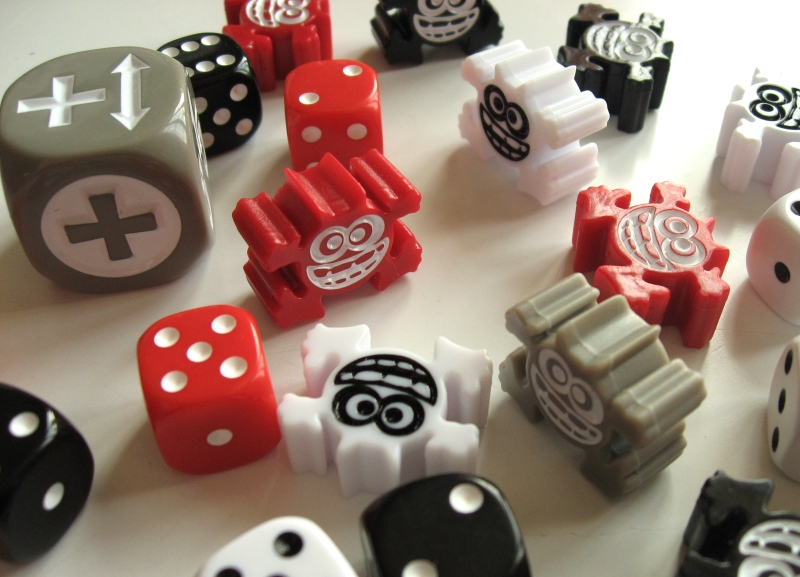
Next we quickly played a new game, Diavolo. This is a dice rolling game where players take it in turns to roll dice and depending on the outcome of the “Order” die, dive for a cute little imp.  If they fail to grab one (or get the wrong one), the player loses a gem and the last person to lose all their gems is the winner.  We all found this game very stressful so we had one quick round of an old favourite, No Thanks! as the last player arrived and went to the bar.

Diavolo

Once again, our less experienced players were otherwise engaged, so we decided to forego Ticket to Ride and play something we enjoyed a couple of months ago, namely The Speicherstadt.  This is a clever little auction game that is relatively quick to play and easy to teach, but has a lot of strategy.  In short, cards are turned over and players take it in turns to place one of their “Village People” next to the card they would like to buy:  contracts, ships (use to fulfil the contracts), firemen (to protect against inferno) etc..  The first player to bid for a card has first refusal for that card, but the price they must pay is equal to the total number of “Village People” next to the card.  If they decline, then the next player has the choice, and the cost has reduced by one.  Despite the fact that the different players seemed to employ quite different strategies it ended a very close game.  For example, Blue eschewed firemen and ended up taking nearly all the negative points due to fires.  Thus, Blue was some twenty points adrift at the back before the final accounting although they had a couple of valuable contracts and the warehouse.  In contrast, White invested heavily in firemen, and was way out in front, but had less to add in the final reckoning.  White and Blue ended level on points in last place, but only two points behind the winner who had engaged in more trading.

The Speicherstadt

Finally, we just managed to squeeze in a game of Keyflower.  This is a really beautiful resource management and bidding game where players use meeples (or “Keyples” as they are known here) both as currency for bidding and as workers to generate resources.  Played over four Seasons, with new tiles available at the start of each one, players take it in turns to bid for the different tiles.  However, the catch is that once a bid has been made, any subsequent bids for that tile must be both larger and made with the same colour.  In addition to the colour management, there are lots of other really elegant aspects to this game.  For example, players can place workers on tiles and use the products during that same Season, thus, if a player needs red for bidding, they may be able to use a worker to obtain the necessary Keyples.  This means you rarely find you can’t do anything, but you often can’t do exactly what you want. Although it was a new release at the end of last year, we had all played it before, so we just had a quick reminder of the rules as we set up and then launched into it.  In contrast to the last game, this was a bit of a white wash with the leader wining by some thirty points.  What was particularly interesting, however, was that this was based on a skill tile strategy which netted some sixty points at the end of the game.  None of us had ever found them all that useful before, presumably at least partly because the right tiles had never come up.

Keyflower

Learning Outcome:  In some games, you can be quite convinced you are losing and be very, very wrong.

8th January 2013

Normally, we are very reliant on support from people coming from outside Stanford – Stanford is a village and we are very grateful to the people who travel from the surrounding villages and towns.  However, this week we had a visitor who set a new record coming over 8,000 miles – although it is possible she might not have come just to play games…!

Since the early arrivals were eating, we didn’t start playing until 8pm by which time we had six people, so the first game was Pick Picknic. This is a fun little game where players play chicken cards to claim corn in one of six coloured fields.  If two or more chickens claim the same field, then they can choose to share or they can roll to see who gets it.  But watch out for the foxes:  They are not interested the large tempting pile of corn, and eat chickens instead.  Initially, it seemed that a handful of fox cards was an advantage (well, wouldn’t you prefer to be a fox?), but the winner was the person with the most corn…

Pick Picknic

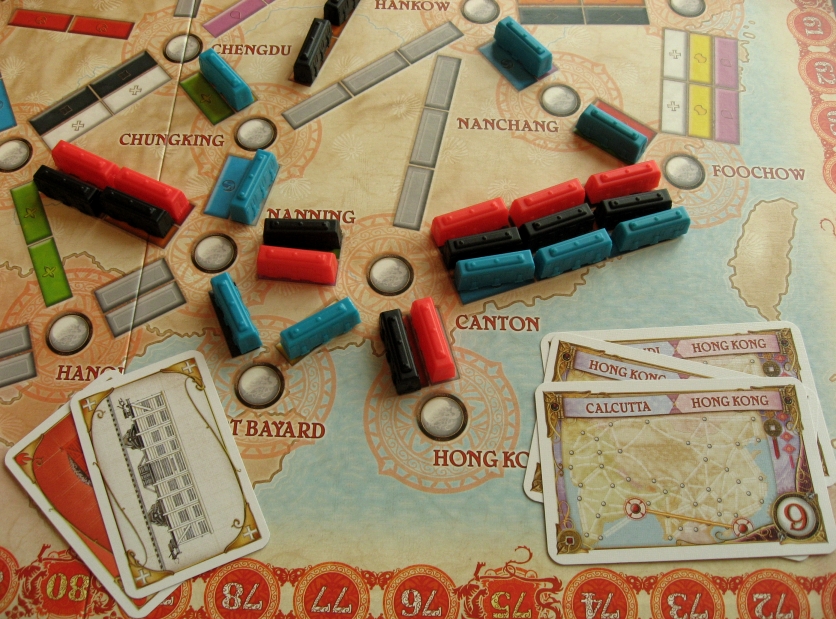
The next game was the “Feature Game” which was Ticket to Ride, a train game where players compete to make routes connecting cities.  Since there were six of us we decided to play the “Team Asia” map which adds the twist that players play in teams of two and have shared information and hidden information.  The first thing we discovered was that it plays a lot better if you include the white, blue and yellow cards, but once we had got that sussed, the game progressed in the usual way with players picking up cards and mispronouncing place names as they laid trains to fulfil their routes.  After a short tussle for Hong Kong, Blue took an early lead with Red and Black squabbling over second place.  However, in the final scoring Black had many more tickets (and higher scoring ones too), and shot ahead running out easy winners.

Ticket to Ride - Team Asia

There had been a lot of discussion and the game took much longer than expected, so we finished up with three rounds of an old favourite, No Thanks!, with the added luxury of real poker chips.  All the winning scores were less than ten, but the final was -1.  We thought that was a good place to end the evening.

Poker Chips

Learning Outcome: Sometimes it is better to be a chicken than a fox!

30th October 2012

This week we had two new people, who arrived early, so we started the evening off with a quick four-player game of No Thanks!  This is a very, very simple push-your-luck game with just a hint of strategy and probably one of the best games going for its size.  The idea is that you turn over the first card in the stack and either take it or pay a chip.  If you take it, you turn over the next card, if you pay, the decision passes to the next player; the person with the lowest number of points when the cards run out wins.  The strategy comes because for runs of two or more cards, only the lowest counts, but unfortunately, someone removed nine cards from the deck at random…  Just as we were finishing the first round, another player arrived, so as it is such a quick game we gave it another go.

No Thanks!

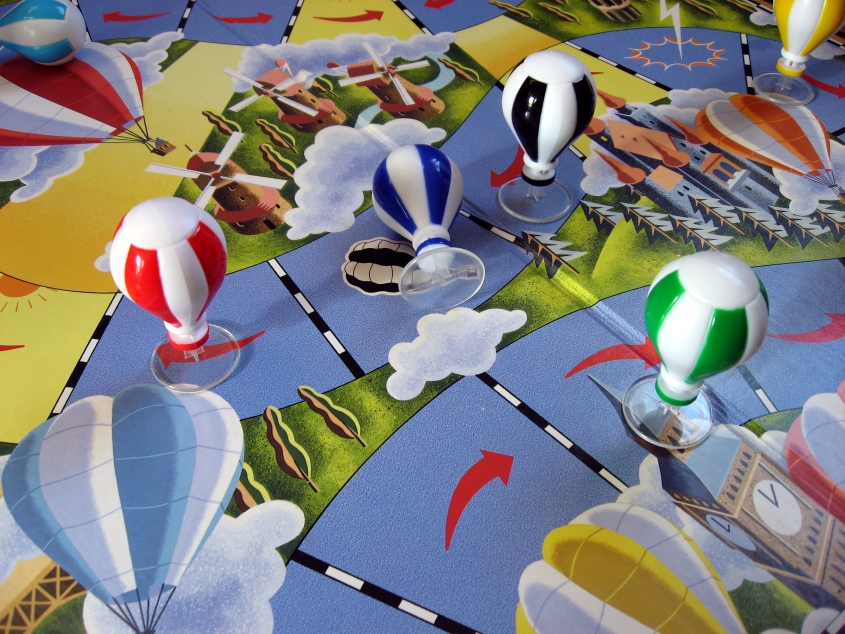
Since it was gone 8pm, we decided to play the  “Feature Game” which was The Great Balloon Race. This is a light hearted, relatively quick race game with quite a lot of luck, and (as it turns out) a lot of vendettas against certain colours with orange and blue being the most victimised.  One of the really nice things about this game was the way that people at the back who felt they had no chance, were able to catch up and indeed win.

The Great Balloon Race

Next, there was some debate about what to play next and in the end we decided to play a fairly light card game, Boomtown.  In this game, players are mining moguls who bid to win the first choice of the cards on offer.  Winning the bidding has two consequences:  you get first pick from the cards available, but you have to pay the other players what you bid.  The game was won by an landslide and it turns out that winning the bid is not always best as it can be expensive as well as favouring the player to your left.  Or was it right?  Actually, it was probably both…

Boomtown

With five games something of a record, we managed to squeeze in a game of Snow Tails.  This is a very pretty game of dog-sled racing, but the choice of game was possibly a mistake given the time, compounded by the fact that we used a more complex track than was wise, and we were playing with the full five players (three of whom were new to it).  Basic numeracy proved to be something of a challenge and the “Big Paws” token changed hands several times as the dents in the sleds increased and the saplings took a beating.  However, most people were in the lead at some point and in the final run for the line, everyone was within one turn or so of finishing the race.

Snow Tails

Learning Outcome: Basic skills such as being able to add up and tell your left from your right can be really useful when mining, flying balloons, and especially driving dog-sleds!