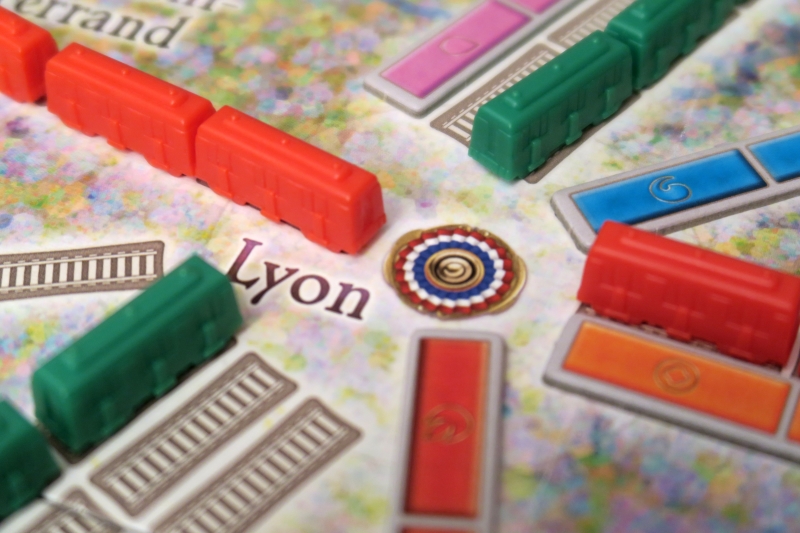
Blue and Pink were just finishing their supper when Pine arrived, soon followed by the rest of the posse. Despite missing Ivory, Teal and Cobalt, we still made it into double figures and everyone was particularly pleased to welcome back Green who has been missing in action for most of the year. Jade had declared an interest in giving the France map for Ticket to Ride a go. Ticket to Ride is always popular, so he quickly gathered Sapphire, Pine, Lime and Pink to make an enthusiastic group of five. He explained the rules differences, to comments of, “Lizen very carefully, I shall say zis only once!”
 |
| – Image by boardGOATS |
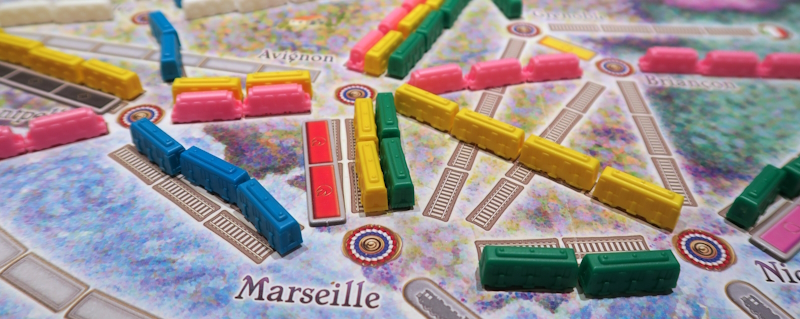
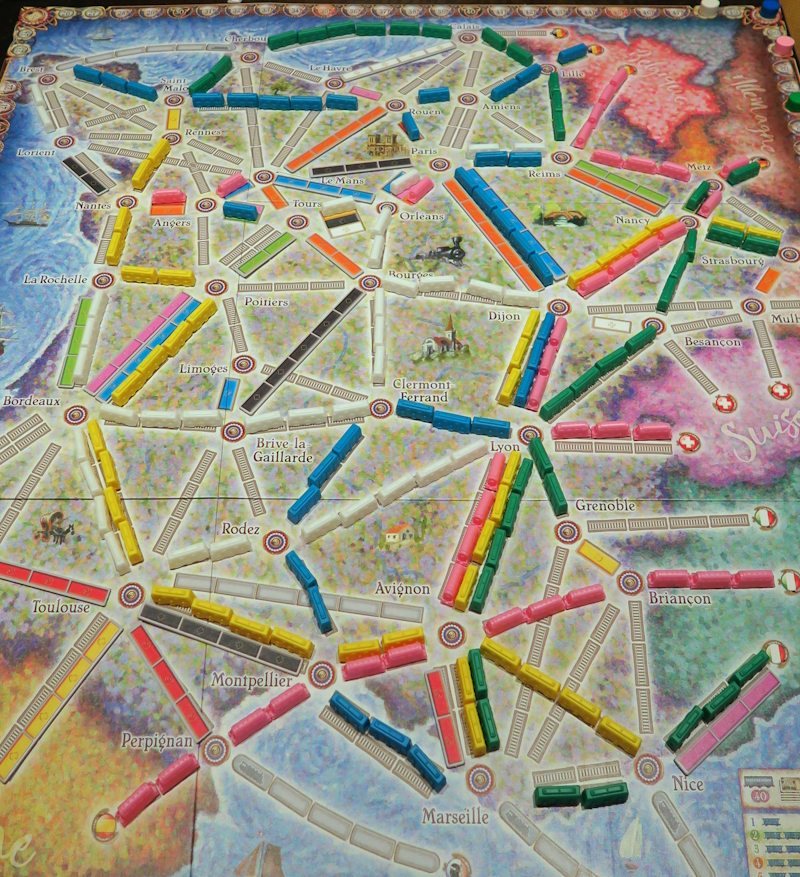
Ticket to Ride is well known in the group and the basic rules needed no explanation (take cards from the market, or use them to claim routes while trying to complete Tickets). All the maps have their own little unique tweak to the rules. In the case of the France map, most of the tracks on the board start “uncoloured”. Whenever anyone draws cards, they take a colored tile that’s two to five train cars long, and place it onto an uncoloured track bed. After that, any player can claim that route in the usual way (by paying the appropriately coloured cards from their hand).
 |
| – Image by boardGOATS |
Although anyone can claim a route “coloured” by another player, this time, in practice, most people didn’t build on tracks placed by others. This was partly because messing with someone else’s plans is usually at the expense of your own, but also because of the “mutually assured destruction” effect—that is to say, interfering with someone else is likely to encourage them to do the same in return. So on the one occasion when Pine DID “steal” a route that Sapphire had set up, everyone (especially Sapphire) was really shocked! Pine and Sapphire both picked up tickets in the very closing stages of the game and both got very lucky with the tickets matching the routes they had already built.
 |
| – Image by boardGOATS |
The game was quite close and relatively high scoring, with all five finishing in a twenty point range, but that was before bonuses. With the France map, there are two bonuses: ten points for the longest continuous route and fifteen points for the player with the most completed tickets. With seven, Pine had the most tickets and leap-frogged Jade and Pink (who was playing with his pink “Cancer Awareness” train set), into third place. That left Lime and Sapphire, but with Sapphire taking the longest route bonus, he finished with a hundred and twenty-nine points, extending his lead over Lime to fifteen points to give him a comfortable victory. It had been a really enjoyable game, however, so much so that Jade and Sapphire added it the France map to their wish list.
 |
| – Image by boardGOATS |
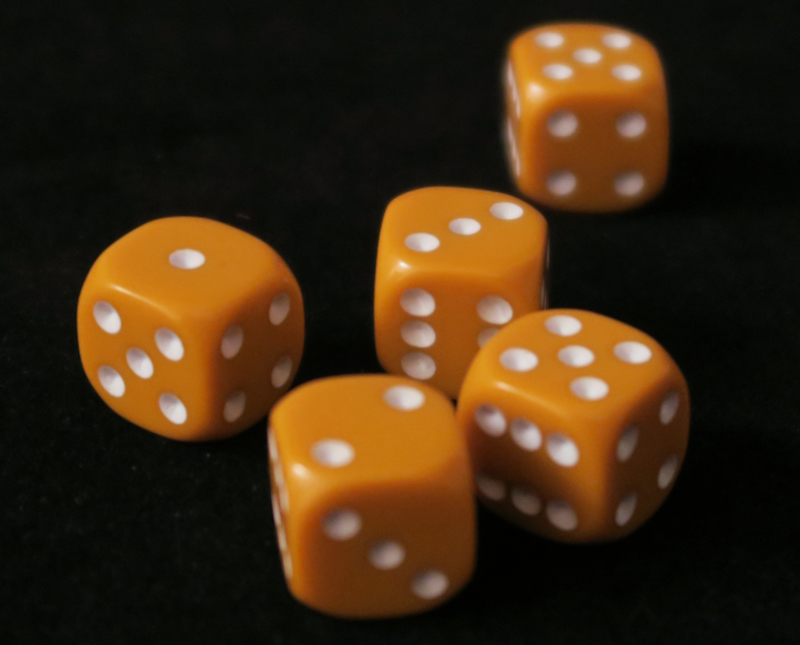
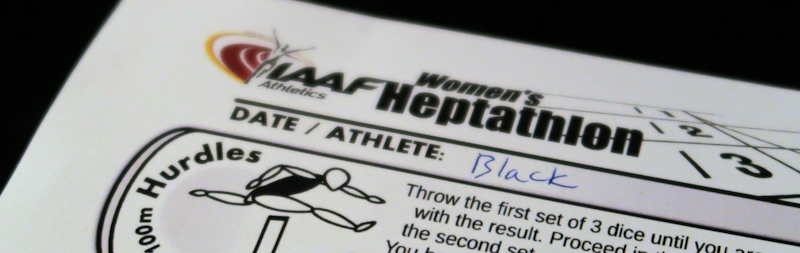
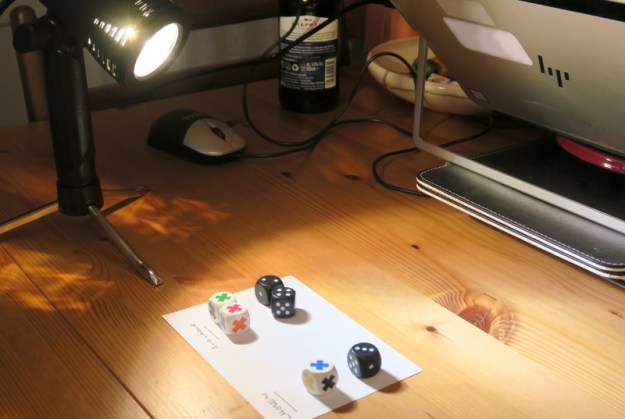
At the other end of the table, that left Blue, Plum, Green, Byzantium, Purple and Black. Nobody seemed keen to play the “Feature Game” (which was to be Montmartre), partly because that would have required splitting into two groups. Instead, inspired by the Olympics, the group opted for the Heptathlon variant of Reiner Knizia’s Decathlon. Decathlon is a print-and-play game consisting of a series of ten different, mostly push-your-luck, dice games loosely themed around the ten sports featuring in the Olympic event. The Heptathlon Variant is slightly shorter and is based on the women’s equivalent.
 |
| – Image by boardGOATS |
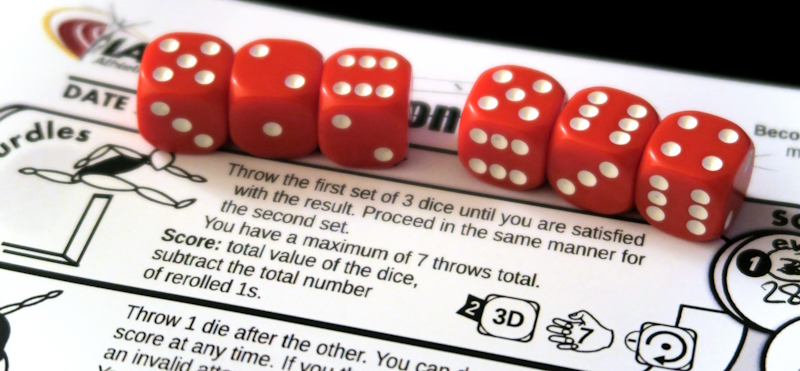
Normally both variations are played with a maximum of four, but this time, the group played the “Championship Variant” where players play together and the winner of an event scores three points, the runner up gets two points and the person placing third gets one point. The rules say that tied players get the better rank, but the group used count-back to break ties in the first instance. Blue had brought an enormous pile of printouts and Las Vegas, from which the group got the dice, and started, slightly tentatively with the 100 m Hurdles. In this game, players have two sets of three dice and throw one until they are happy then throw the other with a total of seven tries. The catch is that each “one” that is re-rolled scores minus one.
 |
| – Image by boardGOATS |
Green went first and achieved a total of twenty-three. By the time he had finished though, everyone had got bored watching someone else roll dice and had got on with their own. It was then that the group realised that, as the 100 m Hurdles was a race, rolling simultaneously was more in keeping with the theme. Blue crossed the line first (with twenty eight) followed by Byzantium and then Green. And it was on to the High Jump, a much simpler game where players rolled five dice together to achieve an ever increasing total (with three attempts at each height). Purple was the first out, failing to achieve eighteen, followed by Blue at the next height.
 |
| – Image by boardGOATS |
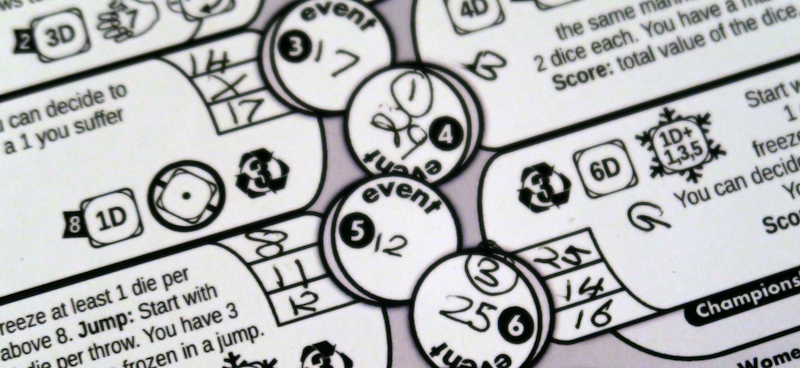
The “springiest” was Plum, who sailed over twenty-two, but failed at twenty-four. She actually tied with Green, but beat him on count-back, with Byzantium taking third. Next was the Shot Put, where players roll eight dice, one at a time, with a one being a fault. Players can stick whenever the like, but because of a rules malfunction, the group only played with a maximum of six dice. The best score after three attempts was again Plum with Black in second and Blue in third. From here the games got a bit more complex, starting with the 200 m Sprint, which was played with eight dice rolled in a group of four dice, followed by two rolls of two. Players have a total of eight throws and sixes count negatively.
 |
| – Image by boardGOATS |
Plum tripped over her own feet (or maybe Byzantium tied her laces together), but Green demonstrated a remarkable turn of speed to cross the line first, followed by Blue and then Purple. More than half-way through, it was a three-way tie between Blue, Green and Plum and others not far behind. So, the second day started with the Long Jump, a five dice game played in two parts. First there was the run-up, which dictates how many dice the player gets to use for the actual jump. For the run-up, players roll all five, freeze at least one and roll the rest, but if the total exceeds eight, it is a foot-fault. Then, for the jump itself, players use the frozen dice and roll all of them, again freezing at least one per throw.
 |
| – Image by boardGOATS |
The best total after three attempted jumps was Byzantium’s twenty-seven. Green’s turn of speed obviously helped him as he came second while Blue and Plum tied for third, but Plum took the honours thanks to her second longest jump. Staying in the field, the next and penultimate event was the Javelin. This six dice game involved players freezing at least one die per turn, but this time only odd dice could be kept. Green’s first throw threatened to skewer one of the stewards, and things didn’t get much better from there. Black faulted on his first throw, but was consistent with his second and third taking third with twenty-two.
 |
| – Image by boardGOATS |
First and second went to Purple and Byzantium (respectively), with both failing to improve on an excellent first attempt. So, going into the final event, the 800 m Race, most people were going for Gold, while everyone was in with a chance of a medal. This race was an eight dice game with players rolling two dice, then two dice and then the four remaining dice one at a time. Players have a total of eleven rolls (i.e. just five re-rolls) and the player with the highest total wins, but with the catch that sixes count negatively. It was a tight race, but Blue crossed the line first which put her in gold medal position, just until Green crossed the line in second and overtook her. Purple took third, but for her it was too little, too late.
 |
| – Image by boardGOATS |
So, stood on top of the final podium with his gold medal round his neck, Blue with silver and Byzantium who took bronze just ahead of Plum and then Purple, stood either side. It had been a lot of fun though, and as people often say, it is the journey that counts. The games have a bit of a feel of Ganz Schön Clever/Doppelt So Clever/Clever Hoch Drei, but sort of stripped back to their raw essence. The individual events were quite simple and with a sheet each, players could keep their own score and recheck the rules as required. The questions, “Do I stick or keep going, what have other people done, and do I need to gamble to win?” in a large group add interest, and everyone enjoyed it so much that there was no difficulty getting people to take home the left-over sheets.
 |
| – Image by boardGOATS |
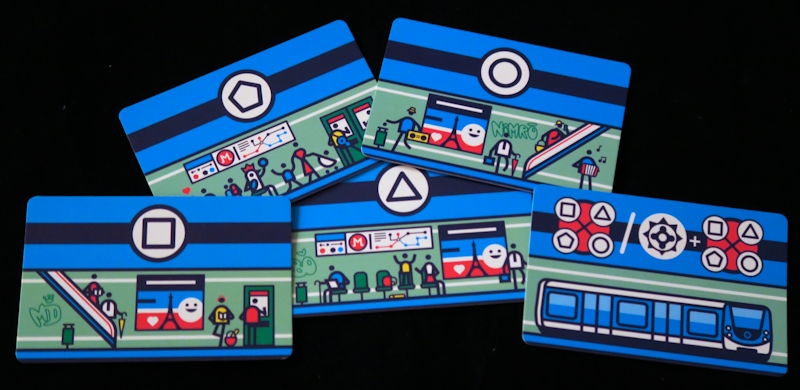
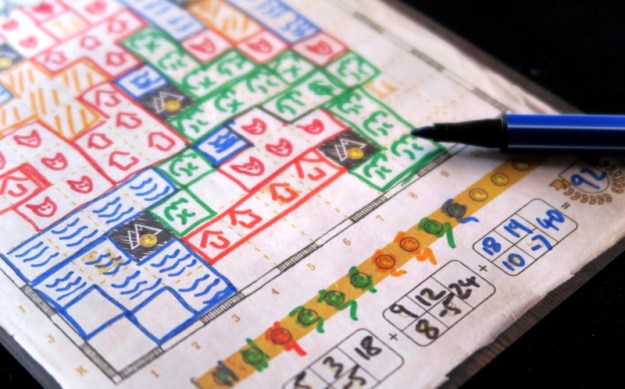
From there, the group of six split into two groups of three and everyone moved from athletics themed games to Paris themed games. With the best will in the world, there wasn’t time to play Paris, so Blue promised to bring it again another time, and they opted instead to stick with “Roll and Write” type games in the form of Next Station: Paris. This is the latest variant on Next Station: London, a simple little route planning game with a really clever twist. The idea is that each station has one of five symbols; a card is turned over depicting one of these symbols and players must extend their route by connecting one end to a station with this symbol without crossing an existing track and following the grid shown on the map.
 |
| – Image by boardGOATS |
At the end of each round, players score for the number of Districts visited multiplied by the number of Stations in the most visited District. At the end of the round players get bonus points for Interchange Stations (where two or more lines meet). However, like the Ticket to Ride maps, each each city comes with a slight variation to the rules as well as a different arrangement of stations. In London, players score points for crossing the Thames and for the total number of Visitor Attractions visited during the game. In Paris, these are replaced with scores for visiting Parisian Monuments at the end of each round and using the level crossings marked on the map.
 |
| – Image by boardGOATS |
The clever part of the game is the fact it is played over four rounds, but each round is played with a different coloured pencil with players swapping pencils between rounds. This means that while everyone gets the same cards in the same order, they start in different places so are forced to do different things (unlike for example, NMBR 9, where players often play the first few rounds the same). The Paris version is supposed to be easier than the London variant, but as nobody had played it before, everyone struggled at the start. The trick though, is, for each line, players need to try to get the same number of Districts as Stations in the most visited District.
 |
| – Image by boardGOATS |
This is similar to the mechanism in Orléans, where players receive victory points equal to their position on the Development Track multiplied by the number of Trading Stations they have on the map plus the number of Citizen Tiles they have collected. In both cases, players want these numbers to be as large as possible to give the biggest total. It is more important that both are significant, however, rather than having one large and one small. For example, a two times three gives more than one times four, thus it is important to concentrate on both parts equally and not neglect either one of them.
 |
| – Image by boardGOATS |
Although nobody had played a “Next Station” game before, Blue explained the rules and had got her head round this element of the scoring, where it took the others a little time to get to grips with it. The game suited Plum’s puzzle brain and she liked trying to see where she might get to the level crossings and so on. By the third line, both she and Byzantium were beginning to get the hang of thing (or perhaps the cards just came out better) and then for the final round everyone found their space was more restricted. It was very close, but Blue’s consistency throughout just gave her the edge and victory by a mere five points.
 |
| – Image by boardGOATS |
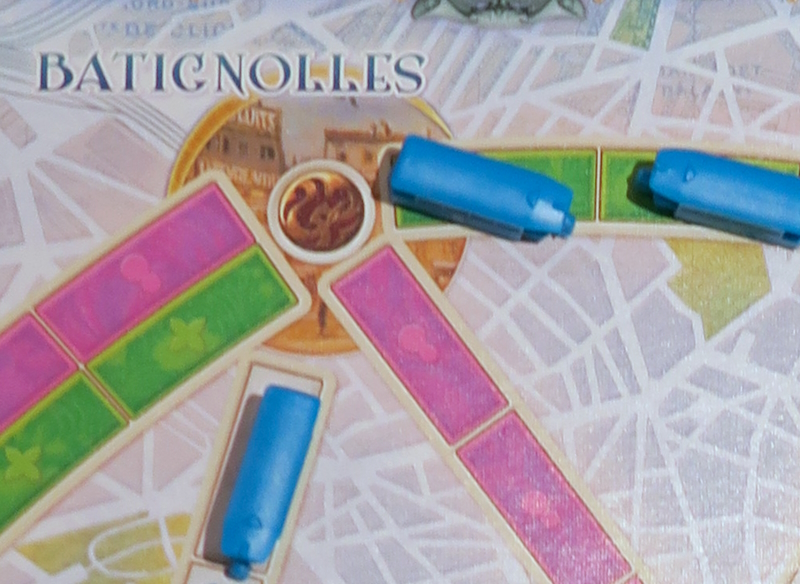
Meanwhile, Green, Black and Purple opted for a quick game of the Paris version of Ticket to Ride. This is the newest of the smaller, city versions of the game, and one that had not been played within the group hitherto. In general, these play exactly the same way as the bigger ones, but have fewer pieces and shorter tracks (so play a lot quicker) and have a little rules tweak to keep people interested. There had been a little bit of chat about it as people arrived and Blue, who had only read the rules was quite scathing about the new rule which felt very bolted on, and as there are now several of these little games, there were comments about the sound of barrels being scraped.
 |
| – Image by boardGOATS |
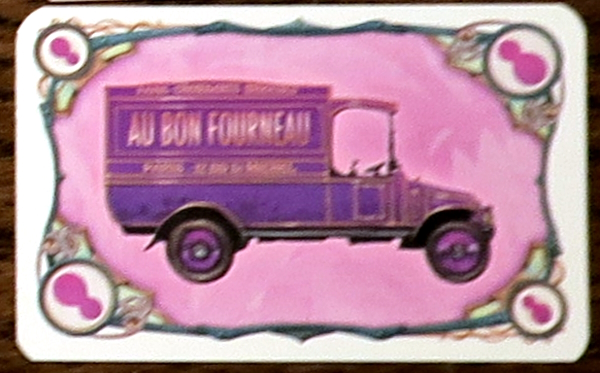
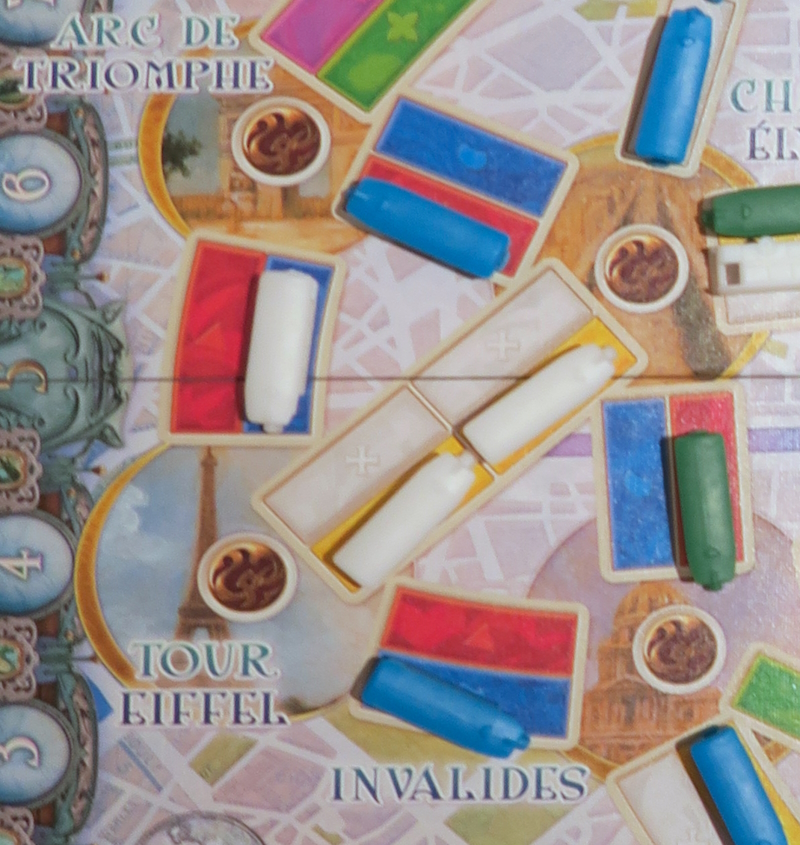
The new rule is that when players claim a red, white, or blue track, they get a card, when they get all three colours they get four “Tricolore” bonus points—this didn’t feel terribly imaginative. After the game, however, Green commented that it was much better than it sounded. After he had completed his starting Tickets, he realised they only gave low points, so rather than taking more, he opted to go for Tricolore bonus points instead as the red, white and blue Routes are all short making them easy to get (one, two and one carriage long respectively). Simpler to achieve than extra Tickets they give an extra four points, though Green only got a total of two Tricolores.
 |
| – Image by boardGOATS |
Black and Purple only took one Tricolore each as they were using it as a bonus rather than a target, so missed out on a few opportunities by laying trains on a colour they already had a card for. In the dying moments of the game, Purple took Tickets—of course she had no way of knowing that Green was about to trigger the final round, but even Black commented that it was a brave move. And Green ended the game on his very next turn, leaving poor Purple with a couple of uncompleted Tickets. That extra four point Tricolore bonus Green had taken made all the difference in the final scoring as that was the margin of his victory over Black.
 |
| – Image by boardGOATS |
As Green went home (along with Jade, Sapphire, Byzantium and Plum), they passed the copy of Ticket to Ride: Paris along the table to Lime, Pine and Pink who also fancied giving it a go. They concurred that the Tricolore Bonus was much better in practice than it sounded. This game was also quite tight with six points between the first and last. Lime was particularly peeved however, as Pink edged him out by a single point. With that, and some residual chatter, it was time for home and everyone slowly drifted off.
 |
| – Image by boardGOATS |
Learning Outcome: When you take away the sport, you still have France.


 boardGOATS