The evening began with the arrival Ruby and Flint, friends of Teal, who had come along despite the fact he wasn’t able to be there to introduce them to everyone himself. They introduced themselves as people finished their supper and prepared to play the “Feature Game” which was to be Cartographers Heroes, the standalone sequel to Cartographers. Cartographers was probably the best of the roll and write games the group played online during the global coronavirus pandemic, so we chose to play it to mark the fifth anniversary of our last meeting in the pub before we moved online. It was a very difficult time for everyone, though as a group we stuck to it and tried to look after each other, continuing to meet fortnightly, online.
 |
| – Image by boardGOATS |
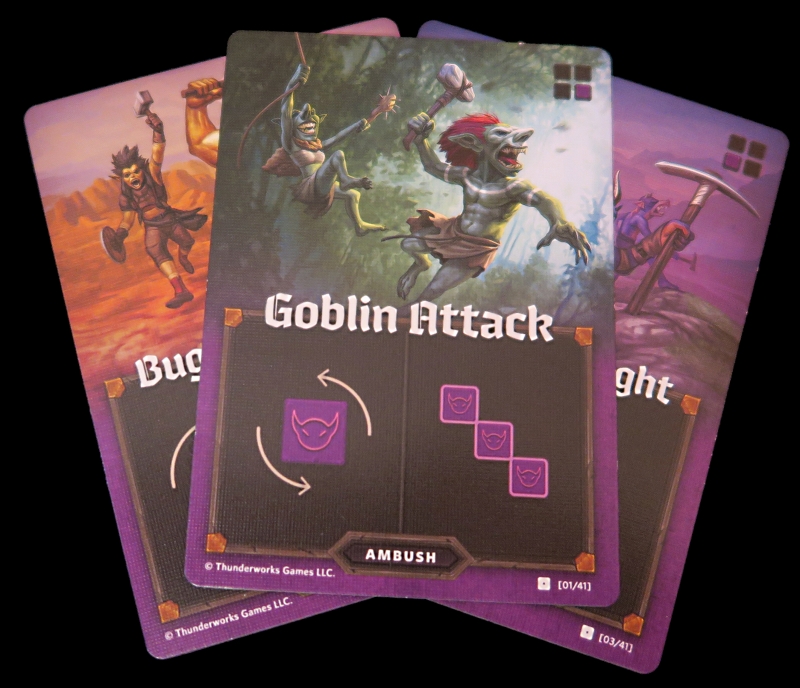
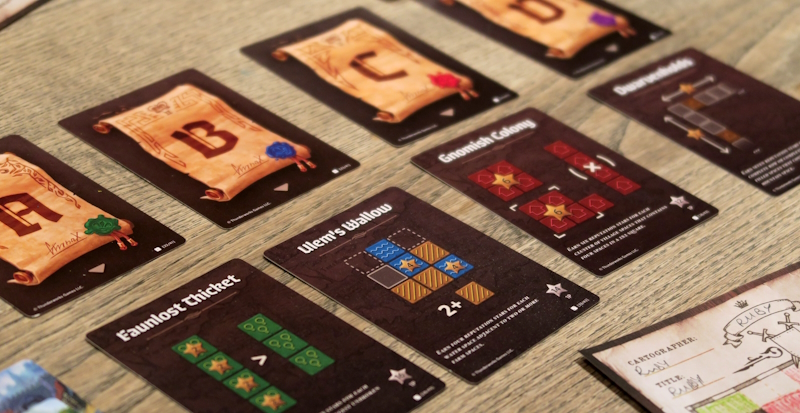
Strictly, Cartographers is a “flip” and write rather than roll and write game as it is card-driven. Played over four seasons, cards are turned over to reveal choice of “Tetris-like” shapes and/or terrains that players draw on their map. The game is played over four rounds, each with a different scoring criteria—a total of four during the game, with two active in each round (similar to Isle of Skye). In addition to the normal terrain cards, there are also Ambush cards, which are nasty as they score negatively with a point lost for each empty space next to an Ambush space at the end of each round. They can be played in two ways depending on the number of players and the circumstances of the game.
 |
| – Image by boardGOATS |
Online, we played these using the Automa rules, where the Ambush “pieces” are placed via a set of rules, whereas in person, players pass their map to a neighbour who places the Ambush piece in as awkward a place as possible. In addition to Ambush cards, the Heroes game adds Hero cards which can be used to off-set the effect of the monsters from the Ambush cards. The distribution of cards is also slightly different and the map layout is slightly different too. This time, although the game can play up to a hundred people simultaneously, because of the difficulty seeing the cards, the group chose to split and play two separate games.
 |
| – Image by boardGOATS |
The first of these included Blue, Pink, Flint, Ruby, Purple and Lime, while the other comprised Jade, Sapphire, Pine, Byzantium and Mint. The first group were using the Collector’s Edition which comes with pencils in colours that match the different terrains. The second group cast envious eyes on the pretty maps as the games started, but despite offers, refused to take a set and stuck to the slightly more elegant monochrome maps relying on symbols to indicate the different terrain types. Although the original Cartographers and the Heroes games can be mixed, both groups used the decks and maps from the Heroes game.
 |
| – Image by boardGOATS |
The first group began with a sequence of woodland terrain, which fitted with their first objective, but the shapes wrapped nicely round the mines. The mines give money—when surrounded by terrain, players can tick off a one of the coins marked at the bottom of the map, which gives a point at the end of each round. Thus collecting them early makes them more valuable each giving up to four points throughout the game. So, most people started by prioritising them as an easy way forward. Consequently everyone’s first rounds gave similar scores, but by the second round Lime and Pink had edged a bit of a lead. Nobody scored particularly well in the third round, so it was all down to the final round to make the real difference.
 |
| – Image by boardGOATS |
Most people scored around twice what they’d picked up in earlier rounds, but it was Pink who top scored with a massive fifty-five, giving him a bit of a landslide with a grand total of a hundred and thirteen (after a couple of recounts). Blue just edged into second, ahead of Lime, but they were some twenty points adrift. The second game followed a similar pattern with massive scores in the final round, though it was a much closer game, with it possible to cover the top three with a postage stamp. The scores were generally higher than for the first game, but the victor was Mint who finished with a hundred and twenty-six, three more than Jade in second who pipped Byzantium by a single point.
 |
| – Image by boardGOATS |
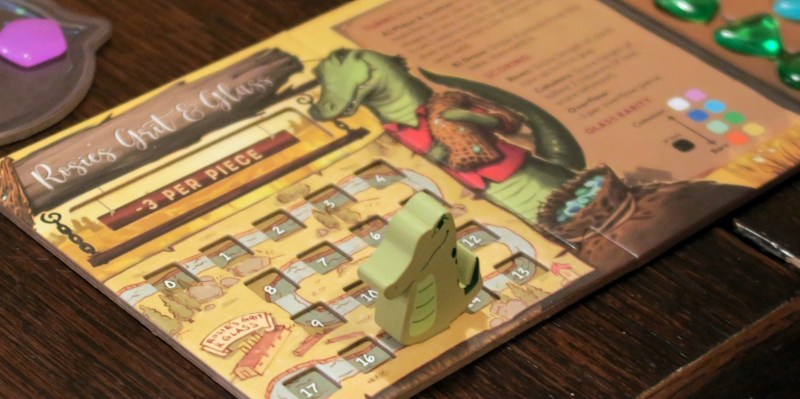
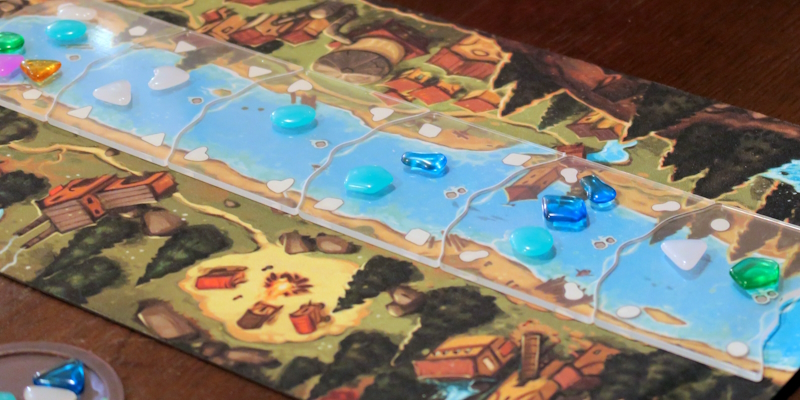
With the second game finishing first, the group moved on to play River Valley Glassworks, a re-implementation of the card game Subastral. In River Valley Glassworks, players take the role of entrepreneurial of woodland creatures drafting glass from the market of river tiles by playing a piece from their inventory into the river. Each river tile can take only a specific shape, and players have to play into a space adjacent to where they want to draft from. After claiming their glass, the river shifts forward (in a way that is vaguely reminiscent of Niagara), revealing new pieces.
 |
| – Image by boardGOATS |
Glass is stored in players’ shops, and the scores depend on where the glass is placed—completed rows and columns gain bonus points, but too many of one type gives negative points. The game is generally cosy, quick and fun, and this time was no exception. Jade explained the rules which are simple enough: either place a piece of glass onto a river tile or draw exactly four pieces from the lake with the aim of collecting a rainbow of glass pieces. Getting the balance right can be a little tricky, so it was no surprise that the most experienced players came out best with Jade taking victory with eighty points nearly ten ahead of the other person who had played it before, Sapphire.
 |
| – Image by boardGOATS |
When the other game of Cartographers finished, the group continued with the roll and write theme, moving on to another game that went down well online, Second Chance. This is a similar “Tetris-like” card driven game, but much simpler. Everyone has a square grid and as cards are turned revealing shapes, they add them to their grid. Players are eliminated when they can no-longer add the latest shape. The game gets its name from the fact that when a player gets stuck, they get one card flipped, just for them, and can carry on if they can add that shape to their grid. The player with the fewest gaps at the end, is the winner. This time, Purple was eliminated first, but it still got quite close to the wire and the tension was palpable. The winner was Flint, however, who very nearly managed to fill his whole grid, leaving just two spaces unfilled.
 |
| – Image by boardGOATS |
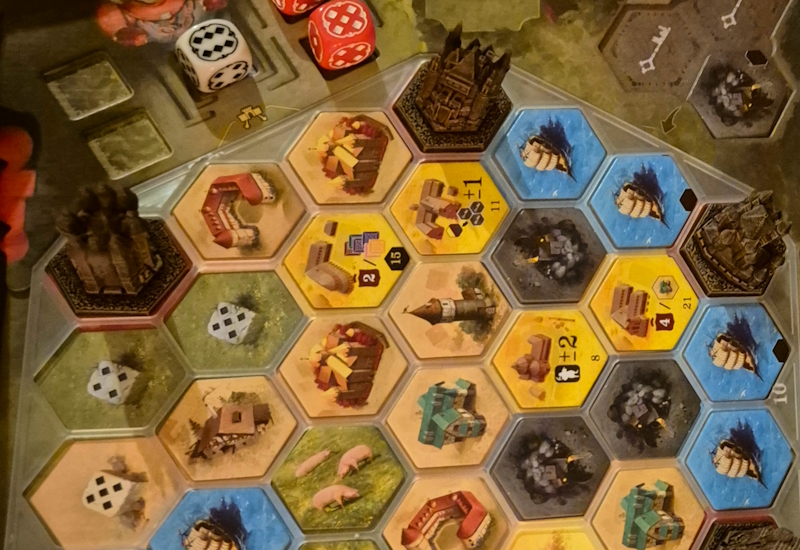
Meanwhile, on the third table, Cobalt was joined by Black, Plum and Ivory in a game of Castles of Burgundy using the new fancy “Special Edition”. In Castles of Burgundy, players take on the role of an aristocrat controlling a small princedom, building settlements and castles, trading along the river, mining silver, and use knowledge of travelers. The game is a tile playing game that is played in five phases, each consisting of five rounds. At the start of each round all players roll their two dice, and first player also rolls a goods placement die. During their turn, players carry out two of the four possible types of action. These include: take a settlement tile from the numbered location corresponding to one of their dice and place it in storage; take a settlement tile from storage and place it on their player board on a space with a number matching one of their dice; deliver goods with a number matching one of their dice, or take worker tokens (which allow players to adjust the roll of their dice).
 |
| – Image by boardGOATS |
Additionally, players may buy a settlement tile from the central depot and place it in their storage area. The Settlements offer benefits, additional actions, money, advancement on the turn order track, more goods tiles, die roll adjustment or victory points with bonus points awarded for filling a region with tiles. Cobalt and Black both started on the east side of the map, with Black building to the south with Ships to move up the turn order. He also got a mine to start generating coins at the end of each of the four rounds. He also managed to completed an area to move up in points (Ships). Cobalt went the other way with yellow and beige buildings and managed to get a second castle (and effectively an extra turn), whilst also completing areas for early points.
 |
| – Image by boardGOATS |
Plum started at the bottom and managed to get a Mine, setting up for the future, as well as Ships to move up the turn order, but started accruing points more slowly. Ivory on the other hand started in the north and went for a different strategy, grabbing animals (specifically goats!) and made a faster start with regards to points, at the expense of turn order. In the second round, Ivory continued to focus on animals, grabbing more animal tiles and end of game tiles giving points for different animals, to go along with his yellow tile from the first round giving him extra points when scoring animals. He also built his second castle and started to fill the eight beige area, needing one of each beige building in that area for a challenging thirty points.
 |
| – Image by boardGOATS |
Plum focused on engine building, getting two more Mines, giving her significant income for the rest of the game, as well as a building which allowed her to build duplicate buildings in an area, making it much easier to achieve thirty points in the eight beige area, as well as a tile allowing her more flexibility in getting tiles (as it allowed her plus/minus one on the die). Black was also engine building and doing a little bit of everything else, while Cobalt, Like Plum and Ivory was focusing on the beige “Eight” area. Cobalt also had tiles that allowed him to spend workers to get a tile (as well as change die results) and also get extra workers when he took that action and gain a coin—a very efficient engine! At the end of the round, Cobalt and Ivory had taken the lead, followed by Black and then Plum.
 |
| – Image by boardGOATS |
In the third round, Ivory managed to fill all his animal spaces and get the bonus for doing so as well as get more points from his animals, but was generally slowed down by the fact he’d stopped developing his engine. In contrast, Plum’s engine had kicked in, giving her lots of points and bumping her up the rankings leaving her snapping at Ivory’s heels by the end of the round. Black was continuing to do a bit of everything, but now had an end game objective for different goods while Cobalt continued to develop his engine. In the penultimate round, Ivory continued to struggle due to his lack of engine development and his ships paucity of ships meant he had taken his turn last for most of the game, although he was “building beige” where possible for the thirty points.
 |
| – Image by boardGOATS |
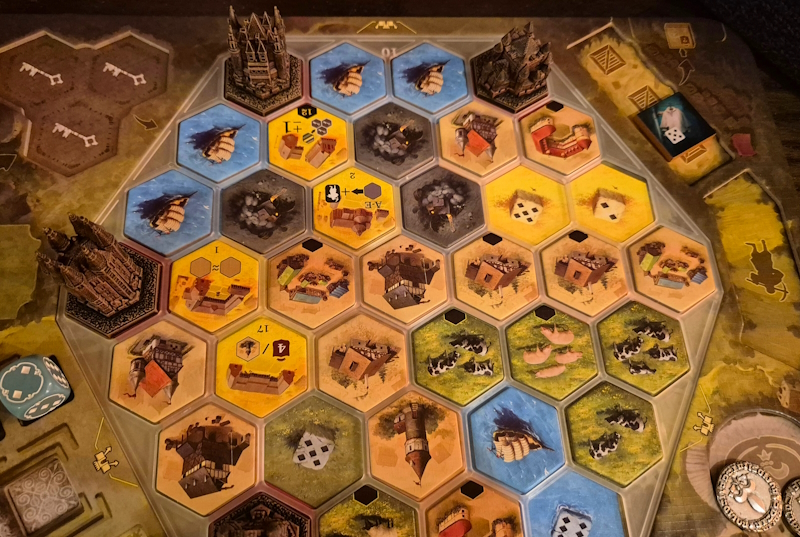
Plum on the other hand, stormed ahead, filling the “Eight” area and taking thirty-four points as she was able to fill it with the same building. With other scoring opportunities as well (like animals), it looked like she was a certainty to win being as she had a lead of over thirty points at the end of the round. Cobalt and Black also pushed past Ivory with Cobalt having focused on mines and Black completing all four of his castles, taking bonus points for doing so. In the final round, Cobalt and Ivory both managed to fill their beige area for thirty-two points and Ivory finally got his first ships, albeit too little too late for anything other than a few points. Plum, having filled in the large beige area, slowed down a little, lacking a focus having done so much in the previous round, but still managed to score significantly.
 |
| – Image by boardGOATS |
Black was still doing a bit of everything, particularly focusing on goods, but failure to score the large beige area cost him dearly. By this time, Cobalt, on the other hand, was using his engine to maximum effect, with his ability to grab tiles using workers to give him more actions than everyone else, filling in almost all of his map. This also allowed him to slowly catch up and eventually overtake Plum, taking lots of bonus points for filling in each colour area, giving him the victory with a grand total of two-hundred and forty-four points, some fifteen more than Plum with Ivory some distance behind her.
 |
| – Image by boardGOATS |
Learning Outcome: Some Roll and Write games are much better than our slightly tarnished memories of them.





 boardGOATS