Tag Archives: Terraforming Mars: Prelude

20th February 2024

Once everyone had finished eating, we moved on to the usual difficult decision of who was going to play what.  The “Feature Game“, Wyrmspan which is a very new stand-alone game, based on the mechanisms of one of the group’s favourite games, Wingspan, with dragons instead of birds.  It was not as popular as expected, though that was at least partly because it was a relatively quiet night and many of those who would have enjoyed it were away.  In the end, Blue, Black and Pink settled down to play leaving two other groups of three to sort themselves out.
Wyrmspan
– Image by boardGOATS

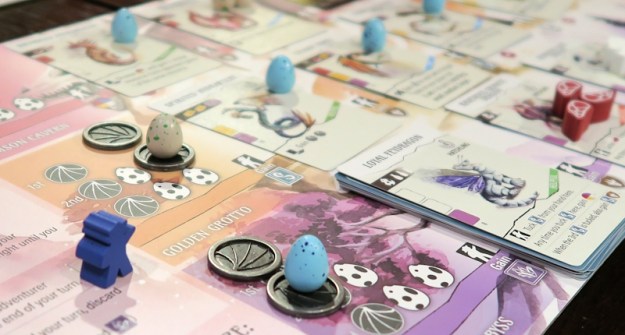
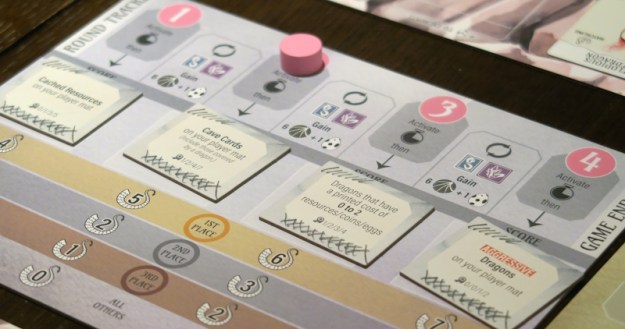
Wyrmspan is very closely related to Wingspan, though it is less forgiving, that is to say, the consequences of mistakes can be much more severe.  Like Wingspan, players are playing cards from their hand onto a player board, and activating the habitats in turn.  In Wingspan, the cards are Bird cards played in three different habitats, Woodland, Grassland and Wetland, whereas, in Wyrmspan, the cards feature Dragons and they are placed in three different cave networks, the Crimson Cavern, the Golden Grotto, and the Amethyst Abyss.  The differences are more than simply cosmetic, however.  Firstly, before a Dragon card can be played, it is necessary to explore the cave which involves playing a card (and claiming a Bonus).
Wyrmspan
– Image by boardGOATS

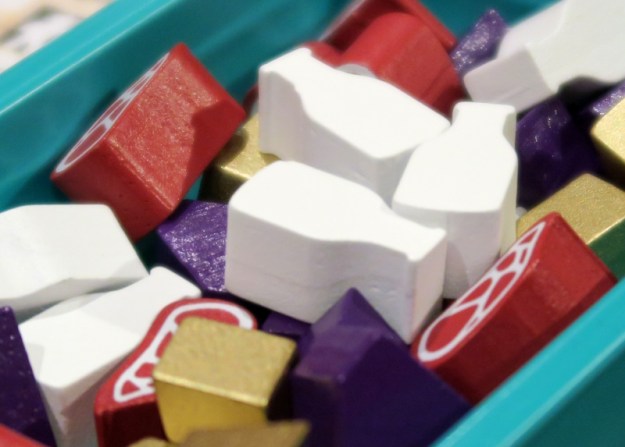
This is one way of getting Resources, there are others (playing dragon cards for example as well as activating the Crimson Cavern).  One of the key differences is that these typically provide only one Resource at a time.  So, whereas in Wingspan, if a player needs a resource, they activate their Woodland habitat and visit the Birdfeeder, claiming the resource they want and a couple of extras, in Wyrmspan, they don’t have extras so every move as to be made to count.  And this is all the more critical as “Planting Dragons” requires a lot of Resources and can be difficult to do, so it is important that the Dragon planted is then exploited as much as possible.

Wyrmspan
– Image by boardGOATS

Further, one of the Bonuses is movement on a new, separate board, the Dragon Guild.  A step around this Rondel typically gives a Resource as a reward, and when players reach half-way round and all the way round, they get a more valuable bonus which depends on the Guild in play.  The distribution of cards is very different too, in Wingspan, the majority of the cards have an effect when the terrain is activate, but in Wyrmspan, these are in the minority with most card effect happening when played or at the end of the round/game.  That is not to say they are not important—their very presence enables players to do more when the cave network is activated.

Wyrmspan
– Image by boardGOATS

Further, in Wingspan, players have a fixed number of actions per round (with fewer in the later rounds), whereas, in Wyrmspan, players get a set number of coins at the start of each round and an action typically costs one coin.  Some do cost more though, and occasionally players can pickup extra coins, which leads to variable length rounds.  Thus, although Wyrmspan is very definitely Wingspan at its core (players pay Resources to play cards and then activate habitats) there are lots of differences which give the game a very different feel, and make it a tighter, slightly more challenging game to play.  All that said, there has been a lot of discussion online saying it is much more difficult, but that is not how we found.

Wyrmspan
– Image by boardGOATS

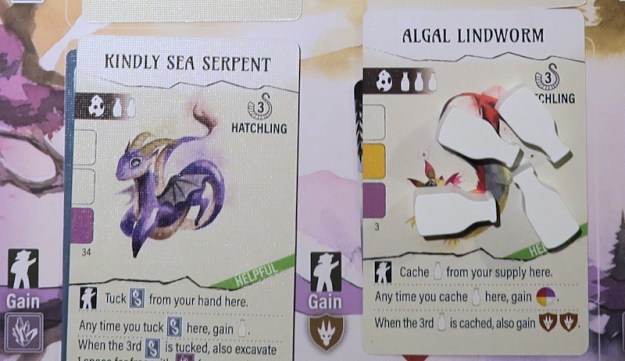
Blue went first and playing a Spirited Hydraptere Dragon in the first round which gave her two extra coins and then she proceed to plan her strategy from there.  Black prioritised progress around the Dragon Guild (Seafarers), which, as that was also high on Blue’s priority list, set them in competition.  Meanwhile, Pink had started with two Hatchlings (Kindly Sea Serpent and Algal Lindworm) which looked like they would synergise well, so he worked towards playing them.  Unfortunately, he came to the conclusion that this was a mistake as it slowed the start of his game and that he would have done better if he had ditched one of them.
Wyrmspan
– Image by boardGOATS

It is interesting to note, that many of the online comments have suggested that Hatchlings come at too heavy a price.  However, discussion after the game suggested that all three players felt they were essential to the “engine” and were worth the effort albeit needing some care to choose the right dragon.  As the game progressed, Black powered round the Dragon Guild with Blue snapping at his heels. Black took the straight six points from under Blue’s nose, so she took a free excavation instead.  Then, towards the end of the game when Blue and Black were heading for their third Dragon Guild bonus Pink grabbed the three point for each completed column and then Black took the straight three point bonus.

Wyrmspan
– Image by boardGOATS

Blue was most unimpressed as between them they had cost her eight points by leaving her with a solitary straight single point, though she picked up a few more from her Tawney Northern Drake (which gave her two points for each marker in the Guild at the end of the game).  Pink did well with his Guild points (despite only placing two tokens), but unfortunately it wasn’t enough.  As well as his points from the Guild, Black had also prioritised the end of round Public Objectives.  In a game with small margins, it looked like this might be enough for victory, however, Blue had a few more eggs, some more valuable Dragons, more tucked Cards and cached Resources.  As a result, she just edged it with eighty-eight points to his eighty.
Wyrmspan
– Image by boardGOATS

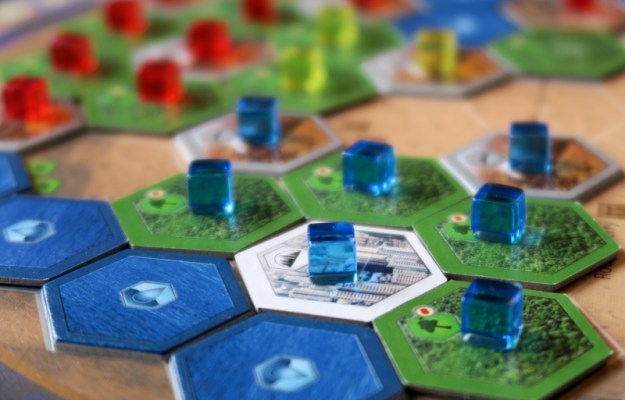
Meanwhile, Green who had considered joining the Wyrmspan game, eventually joined Cobalt and Ivory in a three-player game of Terraforming Mars.  This game is quite popular within the group, though it doesn’t get an outing very often.  The game is set in the 2400s, when mankind begins to Terraform the planet Mars. Players take the role of corporations sponsored by the World Government on Earth to initiate huge projects to raise the Temperature, raise the Oxygen level, and increase the Ocean coverage until the environment is habitable.  Victory points that are awarded for contributions to the terraforming, but also for advancing human infrastructure throughout the solar system, and doing other commendable things.

Terraforming Mars
– Image by boardGOATS

The players purchase Project Cards which can give immediate bonuses, as well as increasing production of different resources. Some of the Cards only become playable when the Temperature, Oxygen, or Ocean coverage increases enough. Buying Cards is costly, so there is a balance between buying Cards and actually playing them. There are six different Resources: MegaCredits (money), Steel, Titanium, Plants, Energy, and Heat and players keep track of these on their personal player board. Players compete for the best places to build Cities, place Ocean tiles, and develop Greenery. They also compete for different Milestones and Awards worth many points.

Terraforming Mars
– Image by boardGOATS

At the start of each round (or Generation) players purchase cards from four drawn privately.  Then players take it in turns to carry out one or two actions:  playing a card, claiming a Milestone, funding an Award, using a Standard Project, converting Plants into Greenery tiles, converting Heat into a Temperature increase, or using the action of a Card already in play.  Once all players have passed, players get Resources according to their Terraform rating and production parameters.  When the three global parameters (Temperature, Oxygen, Ocean) have all reached their goal, Terraforming is complete, and the game ends—the winner is the player with the most points.

Terraforming Mars
– Image by boardGOATS

This time, the group played the Elysium map (from the Hellas & Elysium map pack), with the “quick-start” Prelude expansion (but without the Incorporation Cards) and with Card Drafting (after the initial starting hand).  Ivory had the Valley Trust Corporation giving him increased money production which was further increased by his Research Network Prelude Card, ensuring that finance was not going to be a problem for him.  Green had Tharsis Republic, giving him an injection of cash when any city was planned on Mars.  Cobalt had Cheung Shing which gave him a two MegaCredit discount on Building Cards.

Terraforming Mars: Hellas & Elysium
– Image by boardGOATS

Green and Ivory both placed early Cities; Ivory got built the Research Station giving him a discount on all future Cards.  From there, Cobalt and Green then began focusing on Terraforming.  Green used his initial Titanium (from Prelude Cards) to play several powerful Event Cards early on. Cobalt then played several action cards including Regolith Eaters, Aquifer Pumping, Extreme Cold Fungus and CHG Producing Bacteria which he was able to combine together well to climb the Terraforming Track, although Green’s Event Cards meant he was never far behind.

Terraforming Mars: Prelude
– Image by boardGOATS

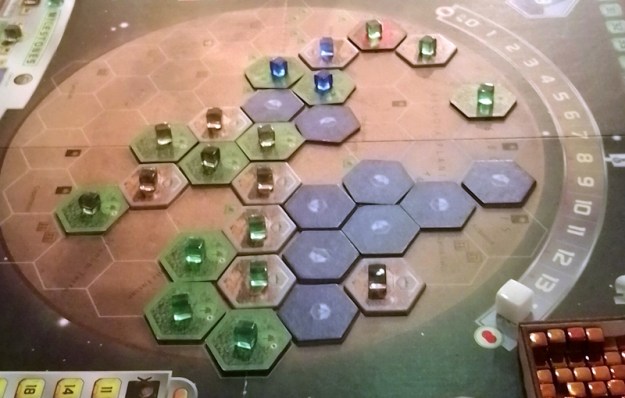
While Green and Cobalt were busy Terraforming, Ivory focused on getting his Plant production up and running as well as further increasing his money production (partly through building another city on Olympus Mons, refilling his hand). Although the other two had sped ahead on Terraforming, during income everyone was getting similar income thanks to Ivory’s increased money production. However, the other were generating lots of Energy/Heat and getting a lot of other resources.  As a result, Green took the first Temperature Bonus and Cobalt the second.  Turn order meant Cobalt wasn’t able to grab the Oxygen Bonus, which went to Ivory.  The Oceans were complete very early in the game, so there was no third Temperature Bonus.
Terraforming Mars: Hellas & Elysium
– Image by boardGOATS

Ivory’s focus on money production as well as Plant and Micro-cards, allowed him to grab the Specialist and Ecologist awards in one turn.  This forced Green’s hand to take the final milestone, Legend (for playing at least five events). Green then quickly grabbed the Legend award after.  From there, Cobalt continued to focus on Terraforming (particularly Temperature), placing only one City and a handful of Forests, whereas Green and Ivory started placing Greenery tiles. Ivory managed to get to his plant production up to eight, giving him a Greenery tile each round. Ivory and, to a less of extent, Green also started building more Cities.
Terraforming Mars
– Image by boardGOATS

Although this was going to score Ivory a lot of points at the end of the game, each City built was feeding Green’s engine, increasing his money production, quickly getting well into the teens.  From there, the Awards were the focus.  Ivory jumped first for Desert Settler, Green shortly after for Celebrity.  Noting he had very little end-game scoring, Cobalt had to spend 20 MegaCredits to grab the last award, the Industrialist.  All three players scored the maximum five points for each of the Awards they funded.  It then became apparent that the end of the game was approaching:  Ivory’s Greenery tiles were rapidly pushing the Oxygen to its maximum, the Oceans had been completed early by Green and Cobalt and Cobalt had focused on Temperature.

Terraforming Mars
– Image by boardGOATS

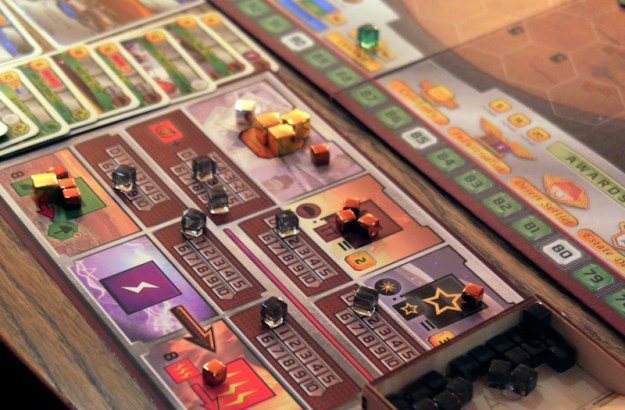
Ivory picked up a number of Animal Cards (Livestock and Fish) and focused on getting animals on them while Green’s huge money production allowed him to play a large number of Cards.   It looked like the game was about to end after Generation Seven, but taking that final Award prevented Cobalt from raising the Temperature the final step, forcing one last Generation.  That allowed Ivory to get more Animals and Greenery tiles and Green more cards with points before Cobalt finally triggered the end of the game.  Both Green and Cobalt were way ahead on Terraforming and everyone scored similarly for Milestones and Awards, but Ivory’s Greenery tiles, Cities and Animals got him victory just ahead of Green.
Terraforming Mars: Hellas & Elysium
– Image by boardGOATS

This demonstrated how important it is to develop a really robust engine, which together with some other scoring Resources will generally allow the funding of awards.  It is also key to keep an eye on the milestones and awards, since they can disappear almost instantly before you get the opportunity.  Cobalt had only really played Terraforming Mars solo before this.  In the solo game it is a race to Terraform the planet alone before the clock runs out (fourteen generations with the Prelude expansion).  This requires a very different strategy to multiplayer Terraforming Mars, however, where it is much better to concentrate on a strong plant engine with some cities to add to the score, as demonstrated by Ivory.

Terraforming Mars
– Image by boardGOATS

While Mars was being Terraformed and Wyrms were being “Spanned”, Teal, Purple and Pine were playing Glow, a strange little game which visually inhabits the domain of the graphic novel, the roman graphique, much beloved in France. Ben Basso and Vincent Dutrait’s appealing black and white line art is unique and stylised and sets the tone of gentle strangeness, which contrasts well with the brightly coloured dice and other game elements.  In Cedrik Chaboussit’s Glow, players take the role  of animal leaders recruiting a band of up to eight companions to make a journey to bring shards of light back  to a dark world. The game ends after eight days and the winner is the player with the most Light Shards.

– Image by BGG Contributor Propi

Players start by selecting one Leader Card from a choice of seven and take the accompanying big dice noted on the Card. Dice in the game have elemental symbols on them, Cloud, Water, Leaf, Flame and Gem.  The colour of the die gives an extra face of that coloured symbols, for example, the green die has two Leaf symbols on it.  On day one and every subsequent day players select a Companion Card from the “Meeting Track” (Marketplace) which is refreshed every day with new Cards. Players take the selected Card into their tableau next to their Leader group to form their growing band.  Players also take any small temporary dice that have been placed on the Marketplace card.

– Image by BGG Contributor a2b2c517

Once the recruitment phase is over, players simultaneously roll all their dice. Players can re-roll one or two of their dice if they either play a re-roll token (acquired through in-game actions) or move their scoring track token back to the next re-roll space, effectively losing points for this benefit. The dice results are then used to purchase actions at the base of each character card.  For example two Flame symbols provides three Sparks, or a Gem and a Water symbol provides a re-roll token. Each die can only be used once on each card, but each card can be triggered multiple times if dice are available, and each die can be used on each card if legal.

– Image by BGG Contributor Propi

In addition to scoring point Sparks, players can earn re-roll Tokens, Footprints and Glow-Worms. Unused Feet score one Spark at the end, but have another use in the Journeying phase. If a player has glow-worms equal to or more than their Companions, they receive a ten Spark bonus at the end.  The scoring track surrounds a map of the game world with multiple branching paths. Players start in one corner and in the Journeying phase, attempt to move their band meeple to point-scoring campsites of progressively higher value secured by pitching their tent on scoring spaces. To move along the paths players pay the indicated cost, such as a Leaf symbol, from the revealed symbols in their dice pool. Footprint tokens can be used as jokers to by-pass costs.

Glow
– Image by boardGOATS

At the round end, five new Companion Cards are dealt to the Meeting Track and players give back their temporary small dice by placing them on the matching symbols in the Meeting Track above the Cards. These dice are then taken when the Card is selected in the following round, thus increasing the value of certain Cards.  Although the game phases are played simultaneously after the recruitment phase, this time, Teal, Pine and Purple opted to play sequentially to assist with learning the game.

– Image by BGG Contributor Propi

The complexity of the game comes from selecting Cards from the Meeting Track and weighing up potential Card actions against increasing a player’s dice pool.  Choices include denying opponents Cards, weighing up the cost of re-rolls, planning for action combinations  or focusing more on the Journey board for points.  Pine selected the starting card of Braccio, giving two big green dice, and the action of two leaves providing a Footprint and three Sparks at the game end. During the game Pine got an extra big green dice with a Sketal follower early on to assist with maximising the Braccio special action focussing on Leaf generation for points.

– Image by BGG Contributor rascozion

Purple selected starting card Noctiluca with two big purple dice—the sixth face gives two Footprints and the action of three wild symbols scoring five Sparks. Purple went for a corvid strategy, selecting three crow-like birds.  One of these, Kaar, effectively curses other players dice by locking away from use one symbol per turn if the black die is chosen along with the other dice. Teal selected Tocana, with three big red dice and four Sparks at game end. As the game developed Teal went for a wild symbol strategy and acquired two Torke cards to generate guaranteed points each round, or so he mistakenly thought at the time…
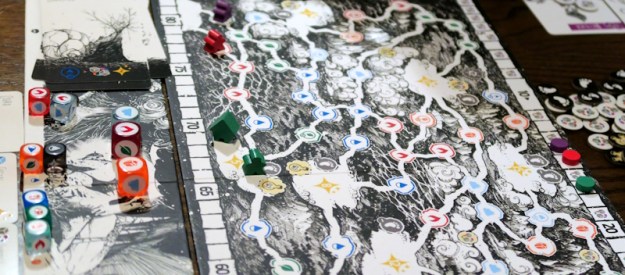
Glow
– Image by boardGOATS

Progress was made on the journey board by all, with Purple and Pine getting to the better quality campsite netting fifteen points each, inspiring reminiscences about woeful tales of camping experiences.  At game end Teal scored a hundred and six, some fifteen ahead of Purple in second place.  Unfortunately, when playing Glow later on BoardGameArena, Teal realised that while the “wild” multi-coloured cost symbols powering actions could represent any symbol, they ALL had to match each other to trigger the benefits.

– Image by BGG Contributor Propi

Because Teal had more of this type of card than other players and acquired them early on, Teal had been unfairly gaining a point advantage by triggering Spark acquisition using mixed symbols.  This explained Teal’s high score and he insisted on being relegated, recording his score as null and void—that left Purple to take the golden crown and Pine the silver medal.  It had been a good game which has lovely presentation with immersive art. There’s lots of risk-reward decision-making, and another game would be great now that the rules are better understood, especially as simultaneous play should reduce playing time to the advertised forty-five minutes.
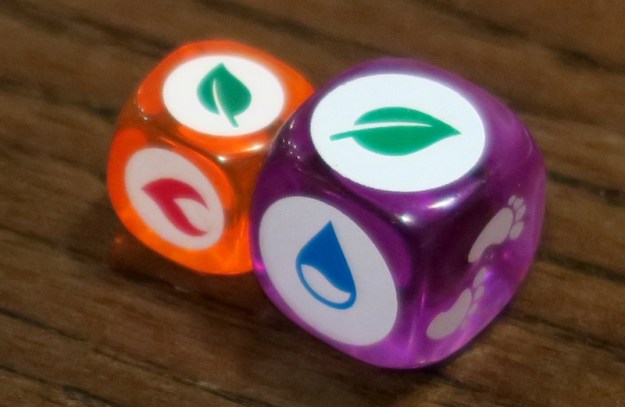
Glow
– Image by boardGOATS

With both Glow and Wyrmspan finished, there was just time for something quick before home time.  There was some discussion about what to play, but eventually, the player count of six and the short time available fixed the decision as the old favourite, No Thanks!.  This is a very simple “push-your-luck” game where players take it in turns to choose whether to take the face-up Card, or pay a Chip to pass the problem on to the next player.  At the end of the game, players add up the face value of their cards and subtract the number of Chips to give them a total—the player with the smallest total is the winner.

No Thanks!
– Image by boardGOATS

There are two additional rules that make the game work: firstly, if a player has a run of Cards with consecutive numbers, they only count the lowest number.  This is tensioned by the second rule, which is that roughly one third of the Cards are removed from the deck at random before the start.  This means players have to gamble on whether a card in a run is still available and it can make things go very wrong for people.  This time, it went very wrong for Blue who finished with forty-eight and for Black who top scored with a massive one hundred and twelve!  The winner, with a very reasonable twelve, however, was Pink, two ahead of Pine who finished with fourteen.

No Thanks!
– Image by boardGOATS

Learning Outcome:  Wyrms are more challenging to handle than Birds.
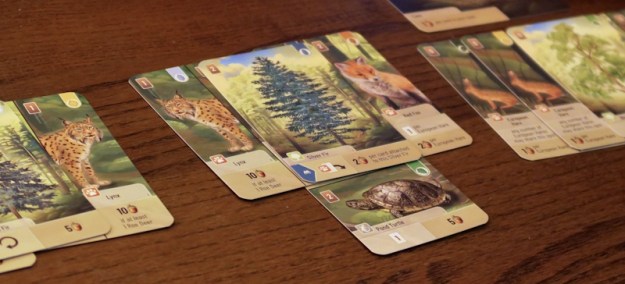
17th October 2023

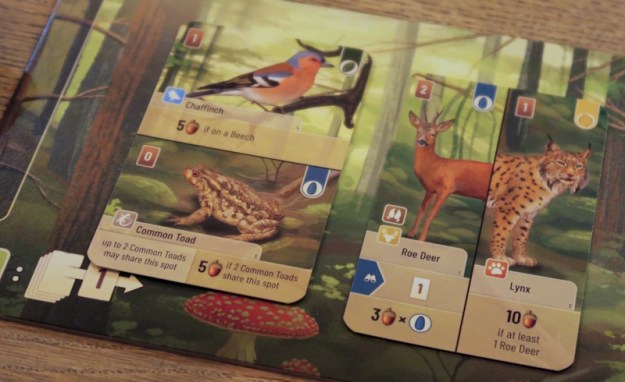
Being the first meeting after SPIEL, there was a lot of chatter about Essen and how things had changed since the last time anyone from the group went, some four or five years ago.  Lots of people from the group have been over the years, and others have been to other conventions like UKGE or HandyCon, so have something to compare it to.  Eventually, the group settled down to play games and five very quickly volunteered to play the “Feature Game“, which was Forest Shuffle, a new Essen release.  This is a card game where players are trying to build combinations of animals around trees to score points.

Forest Shuffle
– Image by boardGOATS

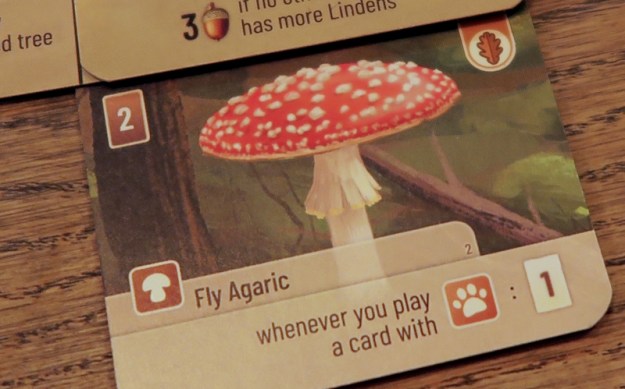
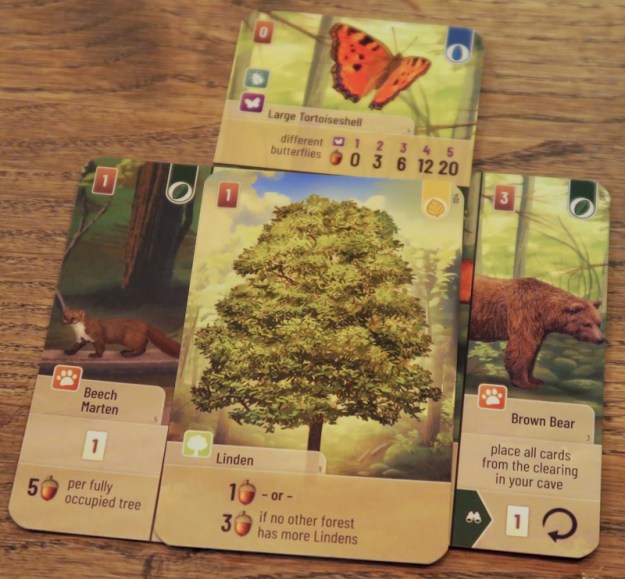
Game play is quite simple:  players start with a hand of cards and, on their turn draw two cards from the market (or “Clearing”) or play one to their tableau.  There are two sorts of card, Trees and “Critters”.  Before playing a Critter, players must have played a Tree, which then has spaces on all four sides.  Birds and Butterflies are played to the canopy, Fungi and Amphibians are played at the bottom of the tree and Mammals are played either side.  The clever part is that Critter cards are split so they show two critters (either left and right or top and bottom), so players choose which they would like to play, and therefore where, tucking the other side under the tree, making the unplayed half invisible.

Forest Shuffle
– Image by boardGOATS

Players have to pay the cost of playing a card into the fact up Clearing, making those cards available to other players (and even sometimes themselves).  Most cards have an effect associated with them, usually this is a one-off special action, but in the case of Fungi, they are special powers that last for the rest of the game.  If the card played matches the colour of the cards used to pay for it, sometimes there is an additional bonus (e.g. take an extra turn, or extra cards, play a card for free etc.).  These can be extremely powerful as they allow players to, for example, pay with cards they can then pick back up, or play a sequence of cards together.

Forest Shuffle
– Image by boardGOATS

The game ends abruptly when the third “Winter is Coming” card is drawn from the deck and the player with the most points is the winner.  Players score points for Trees and for Critters, but it is how players get their cards combining together that really makes the difference.  Thus it is a game of strategy and tactics, but also of timing, which relies on very simple rules.  Blue outlined the rules and explained how some of the cards work together, then ??? started by choosing a card from the market.  There was a little confusion when the Dürer-Fledermaus/Feldhase card came out with the text all in German, but otherwise, everyone got the hang of the basics quite quickly, though playing well can take a little longer.

Forest Shuffle
– Image by boardGOATS

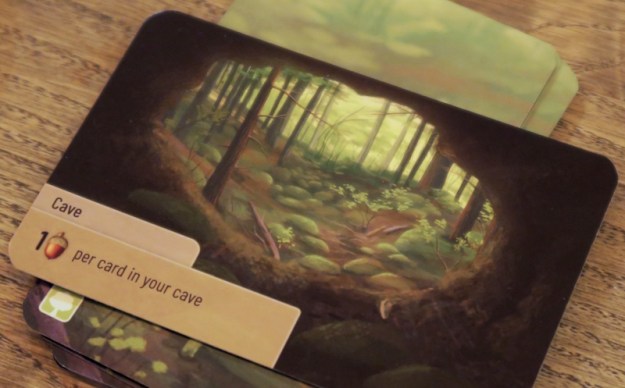
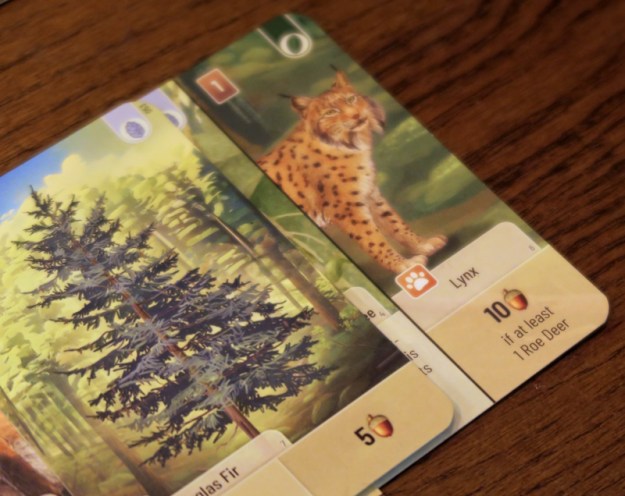
Pine got into a bit of a tussle with Blue and Black for Linden Trees, while Blue spent a long time setting up a “super-move” to play a Brown Bear and place lots of cards from the Clearing into her cave.  Ivory started collecting bats, more bats and even more bats, which coupled with a few gnats gave him lots of points.  His Fungi also gave him a extra cards as he built his forest, making him look like the player to beat.  Meanwhile, Teal was collecting hares (including the Dürer-Feldhase) and before long had down of them.  Then he switched his tactics somewhat after picking up a Roe deer.  This was a critical moment, because from there her started adding lynxes, which give ten points each if there is a Roe deer in the forest.

Forest Shuffle
– Image by boardGOATS

With five, Forest Shuffle drags a little, particularly when everyone is new to the game as they have to read all the cards and try to work out which combinations work well together.  It was an enjoyable game in spite of that, though most people played it in a very multi-player solitaire way, concentrating on their own game rather then keeping an eye on what others want and avoiding gifting people points.  That said, everyone became more aware of what was going on in their neighbour’s forest as the game progressed.  Nobody really had a feel for how well everyone was doing though because of the way the cards combined.  So it was a little bit of a surprise how disparate the scores were.

Forest Shuffle
– Image by boardGOATS

In the end, it was “The Lynx Effect” that made the difference, with Teal taking victory with a hundred and nine points, nearly twenty ahead of Ivory and his bats, with Pine a distant third.  Teal had an early start the next day, so flushed with success, he headed off leaving Ivory to consider leaving as well.  However, when presented with the possibility of playing Draftosaurus, he was tempted into staying—despite it being one of the most popular games in the group, Ivory had only played once before.  He felt he hadn’t really got to grips with it that time, so was keen to give it a quick try now.

Draftosaurus
– Image by boardGOATS

Pine was interested in playing with the Marina Expansion again, but given Ivory had only played it once before, the group decided to save that for anther time.  Without that, Draftosaurus is a simple enough game of drafting wooden dino-meeples with players starting with a hand of six, choosing one and passing the rest on.  Players also take it in turns to roll a die and that dictates where players can place their chosen dino-meeple in their Dinosaur Park.  The parks have pens that score points under certain conditions (e.g. the “Woody Trio” scores seven point if if contains exactly three dino-meeples) and the player with the most points after two rounds of drafting is the winner.

Draftosaurus
– Image by boardGOATS

In contrast to Forest Shuffle, Draftosaurus was an extremely close game—everyone picked up seven points for the “King of the Jungle” and fifteen points for their “Meadow of Differences”.  Everywhere else, where one player had an advantage, others picked up points elsewhere.  Purple and Blue picked up points for their “Woody Trio”, Pine for his “Solitary Island” and Ivory had an extra loved up couple.  In the end, Purple and Pine tied for third with thirty-five points, and Blue just pipped them to second place by a single point.  It was Ivory who was the victor, just two points ahead, perhaps thanks to his extra tyrannosaurs giving him an extra point each; it is safe to say, that he’s definitely got to grips with the game now…

Draftosaurus
– Image by boardGOATS

Meanwhile, on the next table, Green’s suggestion of Terraforming Mars (with the Prelude Expansion) was turned down since the group didn’t want to play a complex and potentially longer game. For the same reason, the group eschewed Village although it has been a long time since the group played it (Green commented on how the original artwork is very pretty, but the new version is horrible!).  In the end, since last time Green had agreed to play one of Cobalt’s games, the group ended up playing Barcelona, a game that is both complex and quite long.  With hindsight, perhaps looking for something else entirely might have been sensible as everyone except Cobalt needed to learn it, and even with experienced players it can take a while.

Barcelona
– Image by boardGOATS

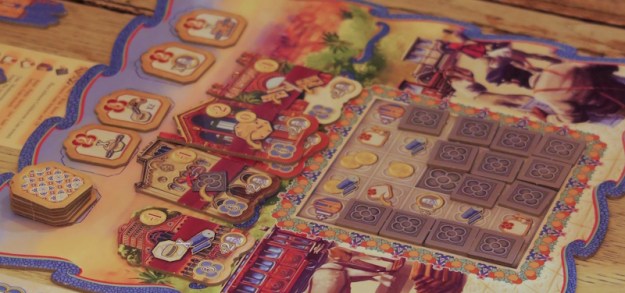
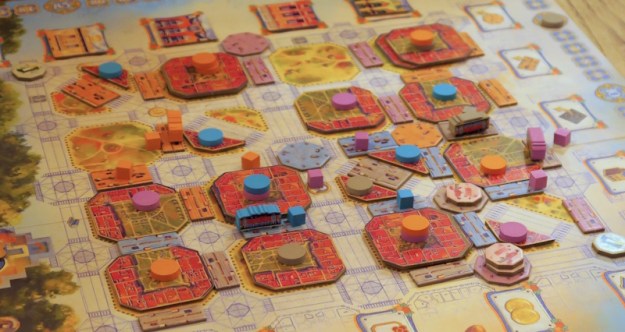
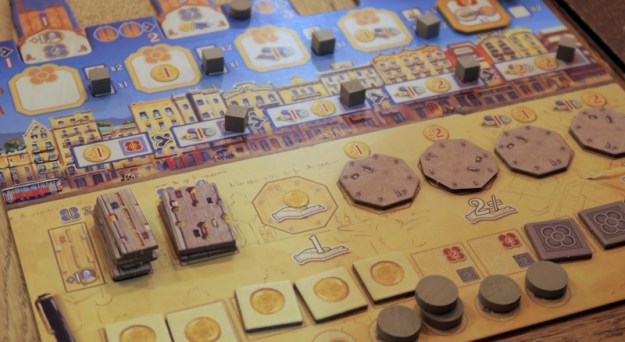
Barcelona is a game where players take on the role of builders in nineteenth century Barcelona who are working on the new expansion to the city following the destruction of old city walls.  Each round, each player takes a single turn consisting of two or more actions, a building phase, and then preparation for their next turn.  Players start with two random Citizen tokens which are placed in a stack onto a chosen unoccupied intersection. Unusually, players can place anywhere they want (no adjacency restrictions as seen in other games).

Barcelona
– Image by boardGOATS

Choosing an intersection is the guts of the game that has significant consequences, initially the type of actions the player can carry out in that round, which are indicated by the streets selected.  At the end of their turn, players must construct a single building if they can which depends on the Citizens adjacent to the building spot selected.  There are four types of buildings: corners and normal shaped Level One buildings require any two adjacent citizens while Level Two building require at least one of them to belong to the middle class and Level Three buildings require three adjacent citizens, one of which must be a member of the upper class.

Barcelona
– Image by boardGOATS

As well as moving players along the Cerdà track, Level Two buildings also allow them to progress on their own Sagrada track giving Sagrada bonus tiles with rewards increasing the more they progress.  Level Three buildings move players two steps on their Sagrada track and give them seven pooints, but will also move players down two steps on the Cerdà track.  All the citizens required for buildings have to come from intersections adjacent to the building spots and are removed from the board and placed on their respective progress tracks according to their colour. Once the first citizen is placed on the end segment of a track, that segment’s Cerdà scoring is triggered and players gain points based on the criteria shown on the tile.

Barcelona
– Image by boardGOATS

This value is then multiplied by players’ positions on the Cerdà track, which represents whether or not players build according to the original intentions of Ildefons Cerdà (now considered the inventor of urbanism).  The game is then played over a variable number of rounds interrupted by three scoring phases before a final scoring phase, after which, the player with the most points wins.  Cobalt started first and went straight in, knowing exactly what the best thing to do was, but being first he couldn’t buy a building with only one stack of citizens. Everyone else was much more uncertain of what to do.

Barcelona
– Image by boardGOATS

At the outset Black chose to follow a policy of not buying buildings if he could get away with it (the rules are you must buy after your turn if you can), while Green had decided to work to getting the best result for each stage scoring, and Lime for a while was really confused and did not really know what he was doing at all.  Lime managed to trigger the first stage scoring, meaning that while he, Cobalt and Black had two turns before scoring, Green had only one turn—so much for his game plan and he soon found himself falling behind the others. Going last seemed to be a significant disadvantage, something Cobalt said has been mentioned before in forums, especially for four player game.

Barcelona
– Image by boardGOATS

And so the game continued. Cobalt knew what he was doing, while Black was trying not to buy buildings, but to get as many points along the way from other means as he could—as he put it, the game was a bit of a “points salad”. Green fared a little better at the second round scoring, but he was still a turn behind the rest (as was Lime for the second stage).  By this time he had decided to get his tram moving as much as possible as well, which was helping him to catch up on the score board.  Lime was still struggling, and gaining a lot of help and advice from Cobalt. It seemed to be working though as he was scoring nearly as well as Cobalt himself.

Barcelona
– Image by boardGOATS

The final stage of the game took a bit longer to complete, but was mostly just more of the same. By the final scoring, Lime took the lead to win the game while Cobalt’s experience had helped him compete and take second place, just three points behind. Green had caught up a bit and took third, while Black’s strategy of not buying really hampered him as he dropped further and further behind. He admitted that it probably wasn’t a good strategy as the later building buys really brought home a lot of points due to the points that also came with each purchase.  It had been an interesting game though, not so much about building a points engine, but looking for a good haul of points on each turn.  Having played once though, next time it might feel more like players are scoring from the game rather than the game scoring for them.

Barcelona
– Image by boardGOATS

Learning Outcome:  Nobody can resist the Lynx Effect.

7th March 2023

Plum and Blue were first to arrive and, by the time they had finished their enormous rack of ribs (or given up and had a doggy bag made up), almost everyone else had arrived.  There were a few people missing, but still enough for two games of four.  The first was the “Feature Game“, but nobody really wanted to commit to that until they knew what the other game was going to be.  As he had done the last couple of times, Green suggested Terraforming Mars.  Unlike previously, this time Ivory, Plum and Teal felt up to it, leaving Blue, Black, Purple and Lime to play their preferred choice of New York Zoo.

New York Zoo
– Image by boardGOATS

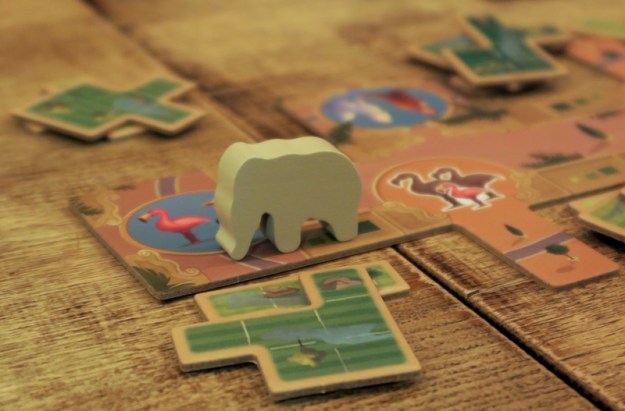
New York Zoo is a tile laying game by Uwe Rosenberg, designer of Agricola, Bohnanza, Patchwork and many other well-known games.  The idea is that players are building pens in their zoo, populating them with animals, and building attractions.  This is one of several polyomino, Tetris-like, tile-laying type games (including Cottage Garden, Spring Meadow, Indian Summer and Patchwork), but what makes this one unique and interesting is the Market.  Players move the Marker Elephant one to four spaces round the Market, landing either on an Enclosure tile space (taking the top one and adding it to their zoo) or on an animal space (taking one or both of the animals depicted).  Enclosure tiles can be placed anywhere in the player’s Zoo, then one or two identical Animals from elsewhere in their Zoo must be moved to occupy the Enclosure.

New York Zoo
– Image by boardGOATS

Each Enclosure can only hold one type of Animal, meercats, snow-foxes, kangaroos, penguins or flamingos, but when moving Animals, no pen can be left empty.  There is an advantage to pens having two or more Animals in them too—the Market also features breeding spaces, and when the Marker Elephant passes these, up to two pens containing two or more matching Animals get an extra one.  When a player moves the Elephant onto an Animal space, they take one of either or both the Animals depicted into Enclosures containing matching Animals (moving another from Storage if they can), or into the Storage space.  Moving animals is important, because when an Enclosure is completed the player removes all the animals putting one into Storage if they have space, and then takes an Attraction tile of their choice and adds it to their Zoo.

New York Zoo
– Image by boardGOATS

Attraction tiles are useful because they fill additional spaces, and at its heart, New York Zoo is a race game—the winner is the first to fill all the spaces in their Zoo.  Black and Purple had played this a few times, and once Black had explained the rules to Lime and Blue, Purple started.  Black and Purple prioritised completing Enclosures to get Attractions.  The Market is stacked so there are large tiles, heptominoes, on the top of each tile space, with hexominoes, then pentominoes and finally tetrominoes at the bottom of each pile.  Black and Purple prioritised getting breeding pairs of animals and as the Market dwindled, getting smaller enclosures because small Enclosures are easier to complete than large ones.

New York Zoo
– Image by boardGOATS

Blue, who had not played the game before, started off getting large Enclosures and fitting them tightly together.  As the game progressed, however, she realised her mistake as everyone else’s Animals were breeding and she didn’t have pairs because she was taking one out every time she added another Enclosure.  This had the additional consequence that she was starting to run out of Animals too, so she prioritised getting breeding pairs for a couple of rounds before continuing to take the biggest Enclosures she could get away with.  It was a tight game—Purple seemed to take an early lead, but it looked like Black and Lime over-took her towards the end and were in a tussle to finish the game first.

New York Zoo
– Image by boardGOATS

With everyone else concentrating on filling pens and taking Attractions, nobody was watching Blue.  So they were taken by surprise when her kangaroos bred filling their pen and she took her first Attraction.  That left one space which she promptly filled taking the only Enclosure that fitted, perfectly, and ended the game.  With everyone else so close to finishing, however, the rest of the group played on to see who would place where.  In the event, Black finished just ahead of Lime.  The group were just dissecting the different strategies when Pine arrived, fresh from his meeting teaching “cubbish-sized scouts” about waste.  Terraforming Mars was still going on, so the hunt was on for a five-player game, and the group settled on Kingdomino.

Kingdomino
– Image by boardGOATS

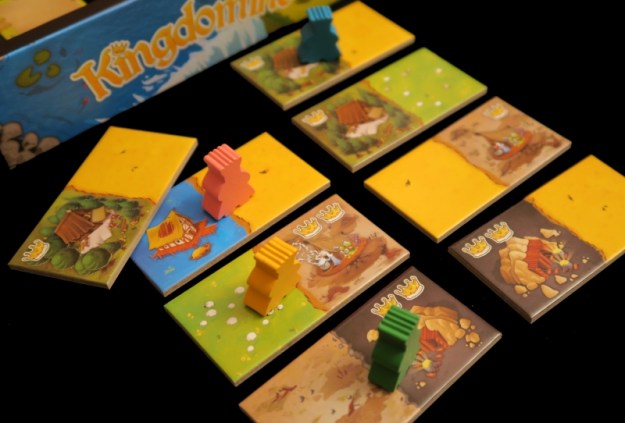
Native, Kingdomino is a four player game, however, with the Age of Giants expansion, it plays five.  The base game is simple enough, but it had been a while since most people last played it, so there was a quick run through of the rules.  On their turn, players add a terrain domino to their Kingdom; each domino comprises two squares of terrain and when placed at least one end must be adjacent to the same terrain type.  Like New York Zoo, the interesting and clever part of the game is the Market.  In Kingdomino, there are two parts, current and future—when a player takes their domino from the current market, they choose their next domino by placing their marker on it.

Kingdomino
– Image by boardGOATS

At the end of the game, players score each terrain region with points equal to the area of each region multiplied by the number of crowns on it.  The clever part is the timing of the Market.  The tiles are drawn at random from a set numbered from one to forty-eight.  The low numbers generally being the less desirable ones, those without crowns or those for terrain types where crowns are more scarce.  Since players take the tiles in numerical order (low to high), taking a low value tile in one round gives a better choice in the next.  Similarly, taking a high value tile means there will be less (or maybe no) choice in the following round.

Kingdomino: Age of Giants
– Image by boardGOATS

The Age of Giants expansion firstly adds twelve extra tiles (enough for a fifth player), six labeled with letters A to F and six numbered forty-nine to fifty-four.  These are ranked below one for the letters and after forty-eight for the high numbers, with the low ranking tiles featuring a Giant, and the high ranking ones featuring Footprints.  Players taking dominoes with a Giant on them, also take a Giant-eeple and place it over a crown in their Kingdom so that it doesn’t score.  Taking a Footprint domino allows the player to move a Giant from their Kingdom to a crown in someone else’s and this increase their score, making these tiles potentially very valuable.

Kingdomino: Age of Giants
– Image by boardGOATS

Unfortunately (especially for Lime and Blue who ended up with all the Giants), the Footprints seemed hard to come by in this game.  The other part of the Age of Giants expansion are the Quests.  The base game comes with two Quests, arrangement targets that give points.  These are “Middle Kingdom” and “Harmony” which respectively give ten points for a castle in the centre of a player’s Kingdom and five points for a complete five-by-five territory with no discarded tiles.  This time, the Quests drawn essentially at random were “Bleak King” and “Four Corners of the Kingdom”.  The first of these gave five points for each five square of terrain with no crowns while the second gave players five points for placing cornfields on all four corners of the five-by-five grid that defines their Kingdom.

Kingdomino: Age of Giants
– Image by boardGOATS

Although the Quests had been included in game play several times before, the Giants have only had an outing once and didn’t go down all that well.  Still, with five players all the extra tiles were needed and their values would have been unbalanced without including Giants, so the group thought they’d give it another try.  This time Blue and Purple had a really hard time getting crowns and things were so bad for Blue that she resorted to picking up twenty points, more than half her total, from the “Bleak King” Quest.  Black built a lot of sea and pasture, while Lime scored heavily for his mountains and Pine picked up lots of points for his large woodland.

Kingdomino: Age of Giants
– Image by boardGOATS

It was very close between the top three and both Lime and Pine scored forty-five points for their highest scoring terrain—Lime for nine crowns spread over five spaces, Pine for five crowns spread over nine spaces.  There were just two points between Lime and Pine in the end, but Pine’s sixty-eight points just edged Lime into second with Black four points behind that.  It had been a good game.  However, the group felt that the Giants took a positive constructive game and added a negative aspect.  Those that had been stuck with them hadn’t found that aspect particularly enjoyable, especially as it was easy to get lumbered largely through no fault of their own, so it is unlikely they’ll get another outing very soon.

Kingdomino: Age of Giants
– Image by boardGOATS

Meanwhile, on the next table, Green, Ivory, Plum and Teal were still playing Terraforming Mars.  To speed up the game they played with the Prelude start cards and also removed the Corporation cards—that turned out to be a good choice as the game only just finished before the pub closed.  In this game, players play corporations sponsored by the World Government working together in the terraforming process, but competing for victory points.  These are awarded not only for their contribution to the terraforming, but also for advancing human infrastructure throughout the solar system, and doing other generally commendable things.

Terraforming Mars
– Image by boardGOATS

The players acquire unique Project cards by buying them into their hand; these can represent anything from introducing plant life or animals, hurling asteroids at the surface, building cities, to mining the moons of Jupiter and establishing greenhouse gas industries to heat up the atmosphere. The Projects can give immediate bonuses, as well as increase production of different resources. Many cards also have requirements and become playable when the temperature, oxygen, or ocean coverage increases enough. Buying cards is costly, so there is a balance between buying cards (three MegaCredits per card) and actually playing them.

Terraforming Mars
– Image by boardGOATS

The game ends after the terraforming is complete when the three global parameters, temperature, oxygen, ocean have all reached their goal.  Players then score for their Terraform Rating with any other points they might have accrued.  This time, Green made his presence felt on the surface of Mars in the early stages with his initial starting forest, which grew a little, and seeded the oceans. He was the only one for a while.  Plum played a blue card which gave her a couple of extra Credits every time someone built a city.  This one really paid for itself in the four-player game as everyone wanted to build more than one city.  Green was first, but had mis-read the card and found himself colonizing Phobos instead.

Terraforming Mars: Prelude
– Image by boardGOATS

So, Teal was the first to actually build a city on the surface of Mars. He opted for the equator but on the other side from Green’s forests.  Later he played a blue city bonus card that gave him a Credit production bonus for each one. Although several cities had already been built by then, several more followed and he was able to enjoy the benefit of extra cash in later rounds.  Ivory meanwhile had made a different start to the game than his normal opening gambit (building a city), and completed the first Milestone: the Ecologist. However his cities did follow later as he extended down towards the south pole. Teal claimed the second milestone: the Specialist, helped on by his city Credit production bonus.

Terraforming Mars
– Image by boardGOATS

Plum was the last to claim a Milestone: the Generalist, as she was able to pay to increase her production one step each round.  She did not claim it straight away, but noticed it after Teal had claimed his, and thought she had better get in there quick.  Green was not able to claim any milestones, but instead was the first to fund an Award. A quick check around the player boards suggested he should fund Celebrity as he had three high value cards to Teal’s two, but neither Plum or Ivory had any cards over the value of twenty Credits. Later on Teal funded the second award and went for Estate Dealer as he clearly had more tiles next to oceans at this point (having planted his forests northwards around the oceans.

Terraforming Mars
– Image by boardGOATS

At the end of the game Green pulled out his wallet once more and funded Benefactor since he was ahead on the Terraform Rating track. Ivory was only one behind, but Green had a couple of options he could play on his last turn for a couple of extra Terraform Rating points. This prevented Ivory from funding the Dessert Settler award for which he had been building.  Green decided to go for outworld domination and also built Deimos city.  During the second half of the game Green realised he had forgotten his company bonus of a two MegaCredits reduction for each brown, Industrial tagged card.  He had built three, so put six Credits aside to be used in the event of a tie, (although had he remembered to claim them at the time, he may have been able to play more and better cards).

Terraforming Mars: Prelude
– Image by boardGOATS

In the final scoring it was very close indeed, although during the game Mars was regularly bombarded with meteors and nuclear bombs, so it was a wonder any one survived at all!  Ivory and Green tied for second with fifty-nine points. Even with his extra six Credits, Green still lost the tie to Ivory, who had more Credits left over from the final production.  At this point, Green realised he again had misread a card thinking he would get one point per ocean tile in the game for his capital city, but that would have given him a guaranteed nine points and would have been way too powerful. In the end, it was Teal who triumphed, but only just, with sixty-one points, in well deserved victory.

Terraforming Mars
– Image by boardGOATS

Learning Outcome:  Mama’s taking us to the zoo tomorrow, zoo tomorrow, zoo tomorrow… We can stay all day!

5th April 2022

Blue and Pink arrived first and, while they were waiting for their dinner, squeezed in a quick game of Abandon all Artichokes (with the Rhubarb Promo).  This is a very quick “deck shredding” game, where players are trying to get to the point where they draw a hand that contains no Artichoke cards.  The game is really simple:  on their turn the active player takes a card from the face up market, adds it to their hand and then plays as many cards as they can before they discard the rest and draw five new cards.  If this new hand contains no Artichoke cards, the player wins.  Despite its simplicity, Pink kept saying he was confused, so given it was such a short game, it was no surprise that Blue won, and just in time too, as their pizzas turned up.
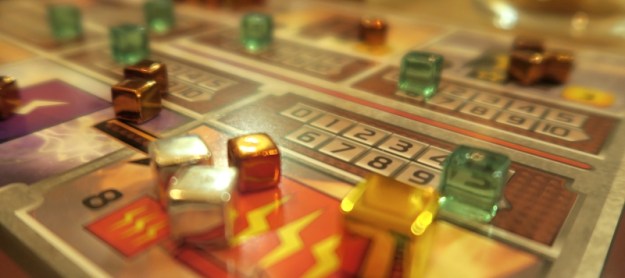
Abandon All Artichokes
– Image by boardGOATS

They were just finishing eating when Purple and Black arrived, then Pine popped in to personally deliver his apologies, before Green, Ivory and Teal joined the party.  The “Feature Game” was the Prelude expansion for Terraforming Mars, which was last played in the group a little over two years ago.  Ivory shared his memories of that game which he felt he had been doing very nicely in thank-you until Burgundy chucked a meteorite in his direction and left him scrabbling for points at end of the game.  That game had been played with the Hellas map from the Hellas & Elysium expansion, this time though, for the first try with the Prelude expansion, the group decided that maybe it would be quicker just to stick with the one new change.

Terraforming Mars: Hellas & Elysium
– Image by boardGOATS

In Terraforming Mars, each person takes the role of a giant corporation initiating projects to make Mars habitable by raising the temperature, increasing the oxygen level, and expanding the ocean coverage.  The game is card driven and at the start of each round, players draw four cards, keeping as many as they like, but paying 3M€ per card. Players then take it in turns to take one or two actions from seven available: play a card; use a Standard Project; use an Action Card; convert eight plants into a greenery tile and raise the Oxygen Level; use eight Heat to raise the Temperature; claim a Milestone, and fund an Award.

Terraforming Mars
– Image by boardGOATS

At the end of the round, players simultaneously produce, turning any energy into heat, taking finance according to the combined total of their Terraforming Rating and their M€ production level, and finally receiving all other resources according to their production levels.  The game ends once all three Global Parameters are met: all of the Ocean Tiles have been placed, the Temperature has reached 8°C, and the Oxygen Level is at 14%. Teal, Ivory and Green all knew the game reasonably well so really only needed to discuss the integration of the Prelude expansion.  This provides Prelude corporation cards that jump start the terraforming process or boost the players’ corporation engines.  During setup, as well as corporation cards and their starting hand, players are dealt four Prelude cards, of which they keep two.

Terraforming Mars
– Image by boardGOATS

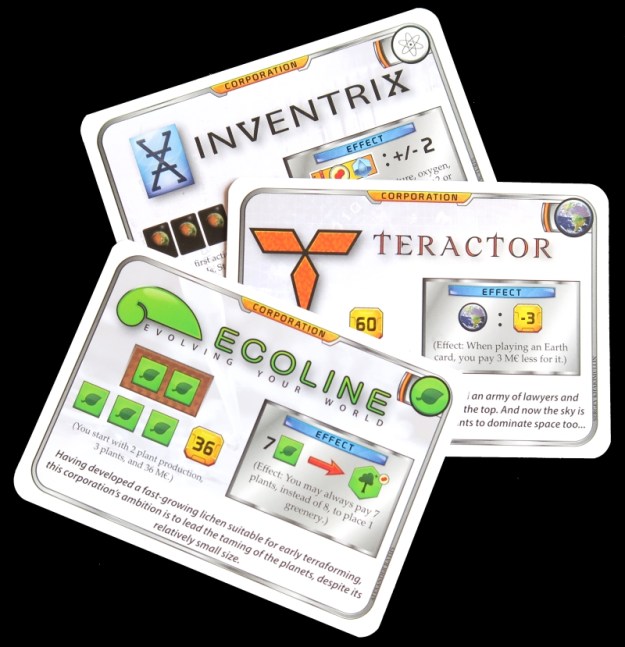
The group decided to not use the advanced cards as they wanted to go home before midnight, so during set up players were dealt one base game corporation card and one corporation card from the new ones that come with the Prelude expansion.  Teal went with the Prelude Cheung Shing, which gave him 3M€ production extra and a 2M€ discount on all building tag cards.  Green wanted to use the Prelude Corporation Card no matter what it was and ended up with Vitor. This would give him 3M€ back for every card that he played with positive points. He also had to fund an award for free as his first turn.  Ivory had chosen Saturn Systems and all his other cards round that.  It was only as they were about to mark out their starting benefits that he realised it was from the Advanced deck.

Terraforming Mars
– Image by boardGOATS

Rather than force Ivory to take his other card, the group gave him another two cards to choose from and this time he selected The Miners Guild, which gave him an extra steel production and five steel at the start of the game. Every time he gained a steel or titanium through building on Mars, his steel production would increase by another one too.  Although it was a good project, it did not fully suit the other cards he had selected, so Ivory started with something of a handicap.  If anyone in the group can cope with a handicap, it is Ivory however, as he regularly wins these more complex games.

Terraforming Mars
– Image by boardGOATS

The trio then went round the table revealing their chosen Prelude Cards that give players that extra kickstart.  Ivory chose Aquifer Turbines (an Ocean tile, two Energy production and -3M€) and Mohole (three Heat resources and three Heat production). Teal went for Umni Contractor (three Terraforming Steps and extra project card) and the Allied Bank (3M€ and 4M€ production).  Green chose Dome Farming (2M€ production and one Plant production) and Society Support (-1M€ production, one Energy, one Greenery and one Heat production).  At the start Teal went straight for city building with a Standard Project, while Green and Ivory were a little more traditional with paying for project cards.

Terraforming Mars: Prelude
– Image by boardGOATS

Generation One was short and Generation Two was equally as short as Teal bought a second city, which prompted Ivory to also build a Standard Project city in Generation Three.  Teal had placed his cities in a convenient triangle to maximise points from greenery tiles when they got laid, but later in the game (before all those forests could be planted), Ivory played the Urbanisation project and built another city right in the middle of Teal’s carefully constructed plan!  Despite this, it was only towards the latter part of the game did it become clearer who’s strategy was working out and who’s wasn’t.

Terraforming Mars: Prelude
– Image by boardGOATS

Ivory had been embracing his “inner Burgundy” and grumbled that he wasn’t getting any Green tag cards, yet Teal seemed to be building nothing but Green tag projects. Green joined the grumble adding that although he’d had some good ones at the beginning with microbe actions, these just weren’t fulfilling their purpose due to the lack of Green tags in his hand.  Black commented from the next table that was why he felt that Terraforming Mars really needs to be played with the drafting variant, where hands are drafted at the start of each turn.

Terraforming Mars
– Image by boardGOATS

The group had chosen not to do this as it strongly favours more experienced players.  As Teal felt he was relatively new to the game having only played the electronic version against AI opponents on Board Game Arena, he did not want to add in extra complexity.  Black certainly had a point though and it is something to consider for next time.  With all the cards laid out, Teal commented how it was quite different from the electronic version. Seeing everyone’s cards grow gave an element of satisfaction and wonder that was missing from the computer version—even the wobbling and waving Mars on the computer didn’t make up for it.

Terraforming Mars: Prelude
– Image by boardGOATS

As for the terraforming of Mars itself, the group completed the Oceans fairly quickly and Oxygen levels also rose at a reasonable rate.  It was just so cold for most of the game though!  So, in the end, it was a race to see who could heat up the planet the most.  Throughout the game everyone all remained close on the Terraforming score track, which meant everyone had all equally contributed to the improvement of Mars and the game would be won or lost in the bonus points.

Terraforming Mars
– Image by boardGOATS

The award for most Award points went to Ivory, as he came top in two of them.  There was a debate regarding the Award Green had funded at the beginning (Scientist). Green had won clearly with four science tags, but both Teal and Ivory had none.  The question was whether they should they score nothing because they hadn’t achieved anything, or whether they should get a second place tie (and as ties are friendly in this game, both would get the points).  Ivory managed to find a thread on Board Game Geek which resolved the issue:  the designer himself stated that second place is second place, even if nothing was done to achieve it.  So Green scored five, while Teal and Ivory both got two, and the free Award from the Prelude Corporation card, Vitor, scored Green a grand total of three points!

Terraforming Mars: Hellas & Elysium
– Image by boardGOATS

Teal managed to get two of Achievements and Ivory got the third with just points for the map left (one point for each forest and for each forest tile adjacent to a players city).  Teal’s early planning came good here, as he scored eighteen points in total, while Green and Ivory took only twelve and ten respectively.  Green had been playing those bonus point projects to good effect, but although he got nine points from them, Ivory and Teal still managed five and four each.  Adding everything up, Teal was the master Terraformer with a massive seventy-four points, eight ahead of Ivory in second—who knows what his score might have been without that starting handicap.

Terraforming Mars: Prelude
– Image by boardGOATS

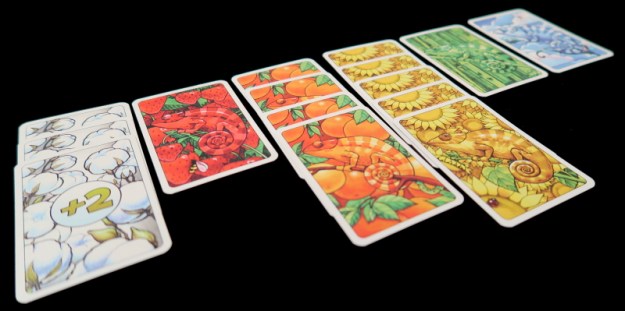
There are several members of the group who aren’t so keen on Terraforming Mars and others who felt it would be too taxing on a night when their brain felt a bit fried.  So those members of the group looked around for something more relaxing to play.  Lime had said he would be there, and although he was unusually late, Black, Purple, Pink and Blue decided to play a quick game of Coloretto in case he had been delayed by traffic or other unforeseen circumstances. Coloretto is a super-simple, but clever little game that we’ve played a lot, so needs little explanation: on their turn players either draw a card from the deck and add it to a truck, or take a truck and add the coloured cards to their collection. The largest three sets of chameleon cards score positively, while the other score negatively.

Coloretto
– Image by boardGOATS

Despite having played Coloretto lots of times, we still needed to check what the Golden Joker did and how it differed from the normal multicoloured Joker. This led to a brief hiatus while Pink tried to read the minuscule text in the English Rules and Blue tried to translate from the original German rules. The conclusion verified later was that it acted as a Joker, but the player who took it also got an extra card drawn from the top of the deck—this could be a good or a bad thing depending on how lucky they were. This time, Pink was ultimately the either the luckiest or perhaps the best player (the line is a fine one), with Blue the best of the rest—just.

Coloretto
– Image by boardGOATS

The foursome were just looking round for something else to play when Lime walked in wearing a suit having come straight from Reading.  His arrival altered the options as the foursome became five.  In the end, Pink persuaded everyone to play Modern Art as he was keen to play something that would make use of the recently rehoused coins he and Blue had brought back from Essen last time they went (now quite a while ago).  Modern Art is a much older game, dating from 1992, but it had been out of print for a while and we only played within the group for the first time a few months ago.  That had been a remarkably enjoyable experience though, and it definitely deserved a second outing.

Modern Art
– Image by boardGOATS

The game is simple enough to play, but difficult to play well.  The idea is that players take it in turns to auction off one of the Art cards from their hand:  if another player wins, the auctioneer gets the money, if the auctioneer wins, they pay the bank.  At the end of the round, the Art is evaluated according to the artist by determining who has the most artwork in players’ collections, with the most being the most sought-after and therefore the most valuable.  Players then sell these to the bank for the determined amount which gives them money to spend in the next round.

Modern Art
– Image by boardGOATS

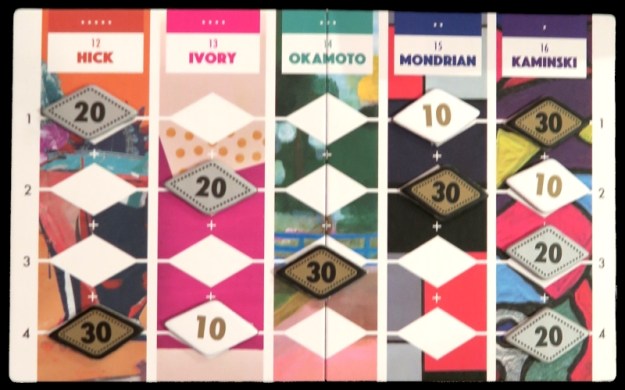
The clever part (which is also the part that messes with people’s heads) is that in any given round, only Art by the three most popular artists is worth any money, however, the value depends on both the popularity in the current round and any previous rounds.  Thus, a painting might be worth £120,000 if it is by the most popular artist in all four rounds, but would be worthless if that artist was the fourth most popular in the final round.  As all the art is available for play, this is a potentially deterministic problem, however, players can try to control the game by avoiding playing some cards.

Modern Art
– Image by boardGOATS

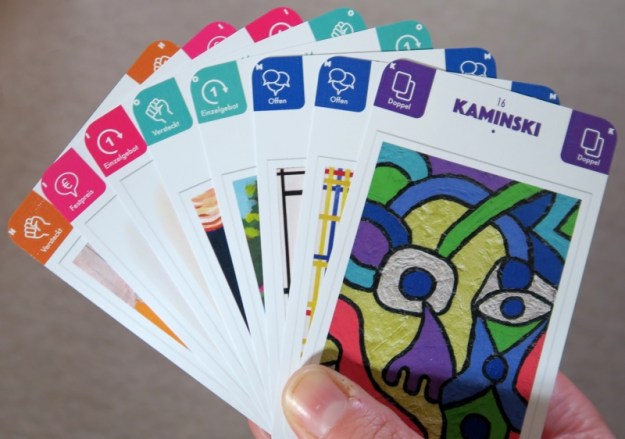
After a strong first round, Blue began the second round well.  She took a couple of early, cheap Kaminskis followed by auctioning a couple of Kaminskis of her own.  This worked well, except that she didn’t have a fifth to trigger the end of the round and ensure they scored.  As Kaminski is the weakest artist in the tie-break and nobody else seemed keen to help her, she did not make the expected profit. Consequently, she went from having “cash to burn” to struggling, a problem exacerbated by a large winning bid on a Mondrian that didn’t come off.  Meanwhile, everyone else was making money from Blue’s mistakes.

Modern Art
– Image by boardGOATS

In addition to the unusual money allocation, different pieces of Art are auctioned in different ways:  some are sealed bids, while others are once round or highest bidder and others use a “double auction” where players sell two pieces at the same time.  The double auctions are curious affairs as, if the active player only has one artwork by the given artist (or chooses not to sell a second), they forfeit their turn as auctioneer and play skips on until another player takes up the mantle, selling one of their own together with the original piece.  This has several consequences: firstly, the new auctioneer takes all the profit, and secondly, any players between the first and second auctioneer miss a turn.

Modern Art
– Image by boardGOATS

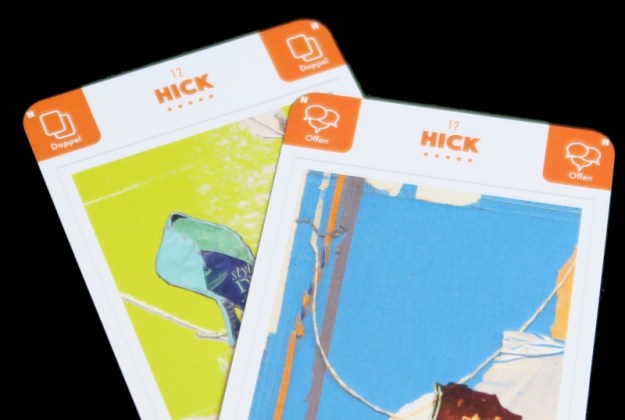
This happened a couple of times as the group played out most rounds to the near maximum, especially as the game wore on—the final round had four Hicks, Ivorys and Okamotos before it came to an end meaning the tie breaker determined which would score.  It is an odd game and, not helped by a bit of “group think”, it was also quite a long game this time, though enjoyable, especially as it wasn’t obvious who was winning.  Black was obviously doing well, but then Lime also made a couple of good sales.  It was Pink, however who navigated the notoriously fickle art market most successfully though, finishing with £428,000, £26,000 more than Purple who took a strong second.

Modern Art
– Image by boardGOATS

Learning Outcome:  Mars has a Marmite Factor.