Tag Archives: The Mind

Spiel des Jahres Winners – 2025

Last weekend, this year’s Spiel des Jahres (German Game of the Year) winner was announced as Bomb Busters, by Hisashi Hayashi, the designer of Trains, MetroX (aka Voll Verplant), String Railway and Yokohama.  Based on the earlier Bomb Squad by the same designer, this is a cooperative, card driven game, where players work together to try to defuse a bomb before it explodes.  Players begin with a hand of numbered Wire cards (four each, numbered one to twelve) and then take turns pointing at each others’ wires and guessing their values.  Correct guesses lead to wires being cut, incorrect guesses and the detonator advances…

Bomb Busters
– Adapted from image by BGG contributor spiritraw

The winners of the Kinderspiel des Jahres (Children’s Game) and the Kennerspiel des Jahres (“Expert” or “Connoisseur’s” Game) were announced at the same time. The Kinderspiel des Jahres went to Topp die Torte!, which is a tile laying game by Wolfgang Warsch—a previous winner of the Kennerspiel de Jahres in 2018 with Die Quacksalber von Quedlinburg (aka The Quacks of Quedlinburg) and designer of The Mind, Ganz Schön Clever and Quacks & Co., all of which have received recognition from the jury in recent years.  This year, the Kennerspiel des Jahres award went to Endeavor: Deep Sea by New Zealand designers Carl de Visser and Jarratt Gray, a game where players explore the deep sea using the action mechanism from Endeavour: Age of Sail (and its predecessor Endeavor).

Endeavor: Deep Sea
– Image from kickstarter.com

Endeavor: Deep Sea can be played competitively or cooperatively with up to five players (using the Deluxe edition). This means that as last year, both the “senior awards” have gone to cooperative games.  Indeed, the last four Spiel des Jahres awards (Sky Team, Dorfromantic, MicroMacro and Just One) and three of the last five Kennerspiel awards (Paleo and The Crew as well as e-Mission/Daybreak) have gone to cooperative games.  This style of game is clearly very popular with families (where arguments are often best avoided), but can be less so with more traditional gamers who prefer a bit of competition.  As such, cooperative games very much have the “Marmite Factor”, but in such cases, the nominees and recommended lists cater for every taste, with games like Looot, Castle Combo, Faraway and Flip 7.
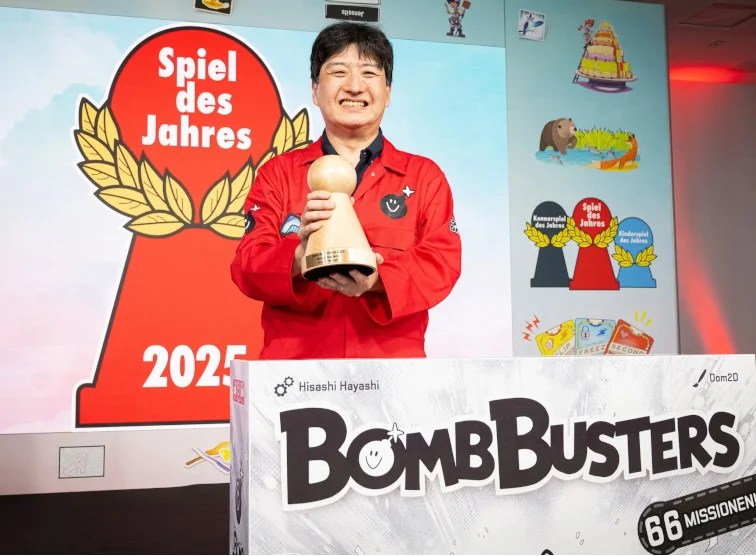
Bomb Busters
– Image from spiel-des-jahres.de

Boardgames in the News: Games on Radio 4

BBC Radio 4 often has short articles on games and from occasionally has longer programs that are dedicated to games or playing.  Recent examples include the “Why we Play” series and an episode of “Start the Week” discussing Videogames.  There has also been an episode of the magazine program “All Consuming“, dedicated to board games.  This is presented by Charlotte Stavrou and Amit Katwala and discusses everything from the Ancient Egyptian game of Senet to more recent classics like Azul, Monopoly and The Settlers of Catan.

Azul
– Image by boardGOATS

During the program, there are interviews with Dan Jolin, co-founder of the magazine, Senet and the World Monopoly Champion, Nicolo Falcone; there is also a visit to the Orc’s Nest in Covent Garden.  Traditional and historical games like Mancala, Chess, The Game of the Goose, Snakes and Ladders and Backgammon are discussed at length together with their history.  Moving on to more modern games, Articulate!, Splendor, Ticket to Ride, and Pandemic all get a mention.  The presenter, Amit Katwala also visits the hugely prolific designer Reiner Knizia in his office in Munich where he keeps a library of all his games including The Quest for El Dorado, Samurai, Lost Cities, Gold Rush, and Lord of the Rings.  There, they discuss how “critical mass” is important for success—reaching enough people is the key Dr. Knizia explains, and is why games like Go and Chess are so popular.

All Consuming
– Image from bbc.co.uk

Last week there was also an episode of the comedic science program, “The Infinite Monkey Cage” with presenters Brian Cox and Robin Ince featuring Marcus de Sautoy from the Maths Department in Oxford, games designer Dave Neale and comedienne Jessica Fostekew. This begins with an introduction about playing Cluedo, moving on to a discussion about the definition of a game—something the philosopher Ludwig Wittgenstein apparently struggled with.  One possible definition discussed is that playing a game is a voluntary attempt to overcome unnecessary obstacles.  From there, conversation progresses to how people often refuse to play with those who are perceived as being good at playing games; Marcus de Sautoy explaining the maths behind his strategy for winning at Monopoly, and why Snakes and Ladders is so popular.

Senet
– Image by boardGOATS

There is also a game of Rock-Paper-Scissors (which makes interesting radio) with discussion about the World Championships, how to win and the fact that it isn’t as random as one might think.  There is a lot of discussion about modern Euro games as well as more traditional games and historical games, with Senet, The Mind, Cheat, Escape from Colditz, Rummikub, Royal Game of Ur, Scrabble and some of those mentioned above amongst those featuring.  The discussion touches on John Nash and Game Theory, the Prisoner’s Dilemma, The Ultimatum Game and the Golden Ratio.  For those who are interested in board games and gaming, this episode of The Infinite Monkey Cage is well worth a listen and both it and the episode of All Consuming are currently available on BBC Sounds.

The Infinite Monkey Cage
– Image from bbc.co.uk

UK Games Expo 2023

It is hard to believe that it is a whole week since the start of the sixteenth UK Games Expo.  With the Friday falling in half-term week for most schools, attendance reached an all-time high with reports of 32,000 unique visitors over the three days of the event—a remarkable bounce back from the 10,671 in 2021 (the first Expo after the cancellation in 2020).  As in previous years there was a viking encampment outside the NEC, and the queues to get in to the main halls were substantial.

UKGE 2023
– Image by Jade

Inside, though busy things were more manageable, gamers from boardGOATS managed to run into each other by accident, which was quite remarkable considering the massive crowds.  Queue conversations were quite a thing this year, especially in the queue for the Bring and Buy which was spacious and well laid out.  The Bring and Buy itself was especially good for Buyers this year as there were constantly new items being put out (though it was perhaps more frustrating for Bringers as their items weren’t put on display until there was space).

Hegemony: Lead Your Class to Victory
– Image by Teal

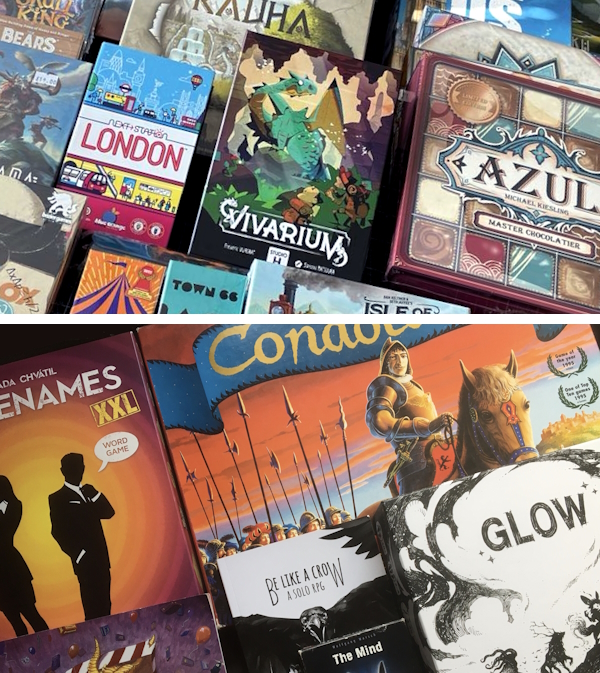
There were some great demonstrations of new games. One highlight was playing as the State in Hegemony: Lead Your Class to Victory, a great, new, heavy-weight, political board game.  There were also demonstrations of Undaunted: Stalingrad as well as for Vivarium and Vaalbara from the marvelous folks on the Hachette Boardgames UK stand (all of which came out last year).  There was a hilarious reading of Ian Livingstone’s City of Thieves and foiling a dastardly aristocrat’s demon-summoning plans in the new, one-shot RPG, Candela Obscura was memorable too.

UKGE 2023
– Image by Jade

As usual, there were also a lot of designers about, including Tony Boydell, Alan Paul, Andy Hopwood, Bez Shahriari, Rob Harper, Gav Thorpe, Florian Sirieix and Morten Billcliff all sharing their games, chatting with gamers and signing boxes.  Copies of Condottiere, Azul: Master Chocolatier, Next Station London, Earth, Tiwanaku and After Us were also acquired amongst other things, and will likely be played over the coming weeks.

UKGE 2023
– Images by Teal and Jade

Deutscher Spiele Preis – 2018

This week the The Deutscher Spiele Preis, or German Game Prize list was announced with first prize going to Azul.  Typically the Deutsche Spiele Preis rewards a slightly heavier game than the the Spiel des Jahres awards, but for the first time since Dominion in 2009, one game took both awards.  This year we haven’t played many of the games on either list, but our first game of Azul was shortly after it’s release at Essen last year and our local groups have played the spots off it since.  So, it is no surprise to us that it has been recognised by both the Spiel des Jahres Jury and the voters from the industry’s stores, magazines, professionals and game clubs, as well as taking the French award at Cannes, the As d’Or and the Origins “Best Family Game of the Year”.

Azul
– Image used with permission of boardgamephotos

Other games that featured on the top ten list included the winner of the Kennerspiel des Jahres award, Die Quacksalber von Quedlinburg (currently only available in German) and one of the runners-up, Heaven & AleThe Mind, which received a nomination for the Spiel des Jahres Award, also featured in the top ten, as did the inevitable Pandemic Legacy: Season 2.  Other than Azul, the only game we’ve played is Altiplano, and that squeaked in at number ten, but Rajas of the Ganges and Clans of Caledonia may feature in the not too far distant future.  The Deutscher Spiele Preis for Best Children’s game went to Memoarrr!.  The prizes will be awarded at the Internationale Spieltage, Essen.

Azul
– Image used with permission of
BGG contributor Vacabck

Spiel des Jahres Nominations 2018

Almost every time we’ve played Azul, the topic of conversation has moved on to the Spiel des Jahres and how it would be a travesty if it did not receive at least a nomination. It was with this in mind that we read the Spiel des Jahres nominations when they were announced this morning.  There are three nominees in each of the three awards:  a children’s game award (Kinderspiel des Jahres), the “Advanced” or “Expert” Kennerspiel des Jahres, and the main Spiel des Jahres (often interpreted as the “Family Game” award).  In addition, for the first time since 2010, there is also a special award for Pandemic Legacy: Season 2 by Matt Leacock & Rob Daviau, reflecting Pandemic, Forbidden Island and Pandemic Legacy: Season 1 that were all nominated, but failed to win a prize, and have had a significant influence on cooperative and legacy games as a whole.  The other nominees are:

  • Kinderspiel des Jahres
    Kinderspiel des Jahres 2018Emojito! by Urtis Šulinskas
    Funkelschatz (aka Dragon’s Breath) by Lena & Günter Burkhardt
    Panic Mansion (aka Shaky Manor) by Asger Harding Granerud & Daniel Skjold Pedersen
  • Spiel des Jahres
    Spiel des Jahres 2018Azul by Michael Kiesling
    Luxor by Rüdiger Dorn
    The Mind by Wolfgang Warsch

Firstly, more than half of the nominees were designed by either Wolfgang Warsch, or Michael Kiesling, so huge congratulations to them.  In our view, Azul richly deserves it’s nomination and it would be no surprise if it ultimately wins the award.  Of the other two nominations for the “red pöppel”, The Mind has received quite a lot of attention, and is a bit like a cross between Hanabi and The Game (both of which have been acknowledged by the Jury in the past, in 2013 and 2015 respectively).  Luxor has a good pedigree as it is designed by Rüdiger Dorn (also designer of The Traders of Genoa, Goa, Istanbul, and one of our group favourites, Las Vegas), but it is a bit more of an unknown as it has only just come out.  Usually the Kennerspiel Prize winners are a good fit to our group, but this year they are also largely unknown to us, so there is clearly a lot to discover before the winners are announced in Berlin on 23rd July (Kinderspiel des Jahres winners will be announced in Hamburg on 11th June).

Spiel des Jahres
– Image from spieldesjahres.de