Tag Archives: Yahtzee

19th March 2024

There were a few absentees again, but the group still made it into double-figures.  So, after the usual chit-chat, the group split into two—the first group playing the “Feature Game“, Meadow, while the other, larger group, played a couple of lighter games.  Meadow is a very smooth, engine building, set-collection card game with charming artwork.  Players take on the roles of explorers competing for the title of the most skilled nature observer.  Reviews refer to it as a “Splendor Killer”, that is to say, these people feel it has a similar feel to Splendor, but is a better game.  It is also considerably more complex, though not especially difficult in its own right.
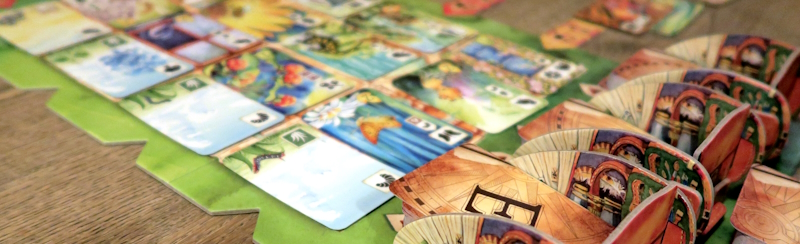
Meadow
– Image by boardGOATS

Players start with four or five Action tokens (depending on player count), a Road token and a double-sided Ground card.  There are four decks of cards, North, South, East and West, and players also begin with a card from each of the North, East and West decks and two from the South deck.  Players then take it in turns to play one of their Action tokens either in the Market or round the Campfire, and complete the associated Actions.  The Market is the simplest: this consists of a four by four grid of face up cards.  Players choose a notch along the edge of the board to play their token in and this defines a row or column and the number on the token dictates which card they will take from that row.
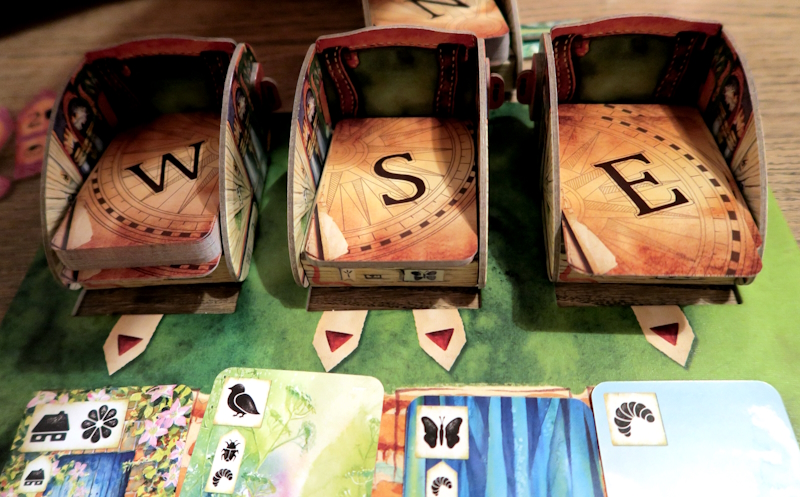
Meadow
– Image by boardGOATS

There are four types of cards: Ground, Observations, Landscapes and Discoveries.  After taking a card from the Market, the active player then plays a card from their hand or the card drawn into the play area in front of them.  In general, each card has a large symbol in the top left corner usually with smaller symbols below—these smaller symbols are prerequisites for playing a card and the player must already have them in their area before they can play the new card. Ground cards are just played in the players’ Meadows and are the lowest cards in the Meadow stacks.
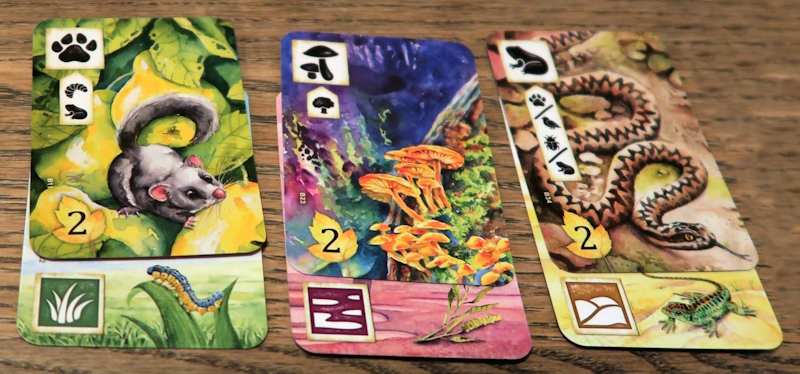
Meadow
– Image by boardGOATS

Landscape cards are similar, but require a Road tile, and are played in the Surroundings area, above the player’s Meadow.  Observation and Discovery cards are played on top of existing cards (in the Meadow and Surroundings respectively), such that the new symbol replaces one of the old ones.  Instead of collecting a card from the Market and playing a card, players can play their Action token in one of the notches around the Campfire.  This activates the special Action shown on the token (take one card from the Market; take two Road tokens; take three cards blind from any deck and keep one; play two cards).
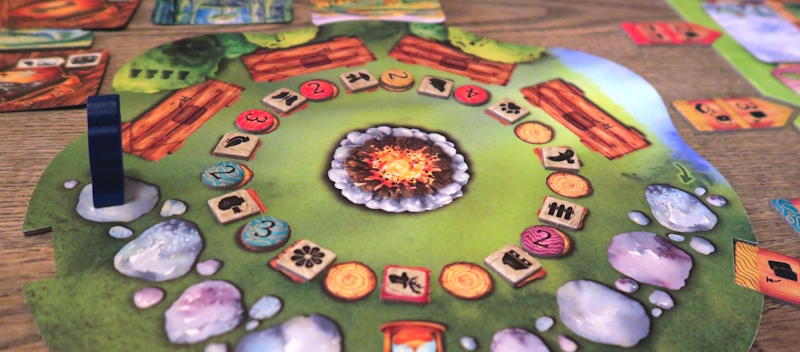
Meadow
– Image by boardGOATS

Players taking the Campfire option can additionally place a bonus point token on a tree-stump between any pair of symbols as long as they are displayed in their play area.  Players have three tokens (valued two, three and four points) giving a total of nine extra points at the end of the game if they manage to place them all.  Finally, in the absence of anything else they can do, players can place their Action token on a bench on the Campfire board and play one card.  This is really very much a last resort as this is a much weaker action, giving half or less than the other options give.
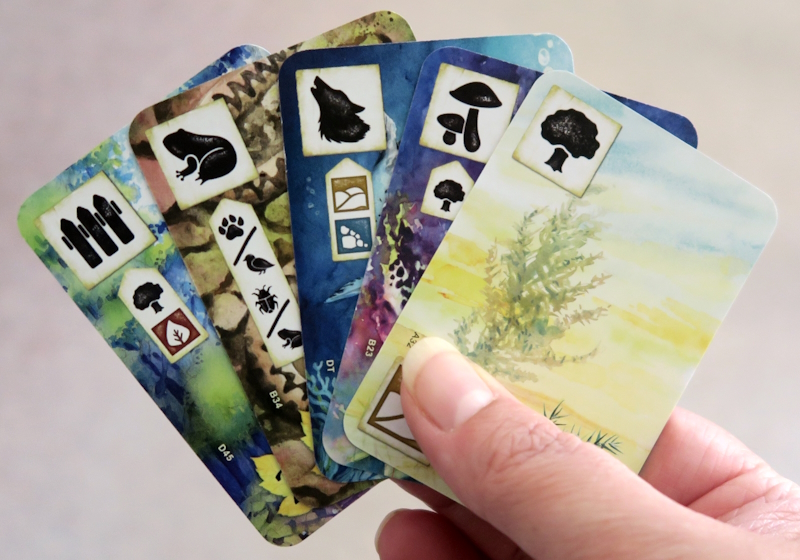
Meadow
– Image by boardGOATS

Pink led explaining the rules to Plum, Lime and Teal, and was roundly chastised by Pine from the next table for not knowing what a Meadow was, and confusing it with “normal grassland”.  The first round was a little slow as the group found their feet, but then it was all go.  Plum started with a Badger card which is quite high value and features a Wolf icon, so she planned her strategy round that.  As the game progressed, everyone was collecting Satchel icons and expected  them to be needed for something in the second half of the game.  However, after the South cards were swapped for the North deck at the half-way stage, there was a slow realisation that they were just the final step on the path (though that could change with the inclusion of expansions of course).
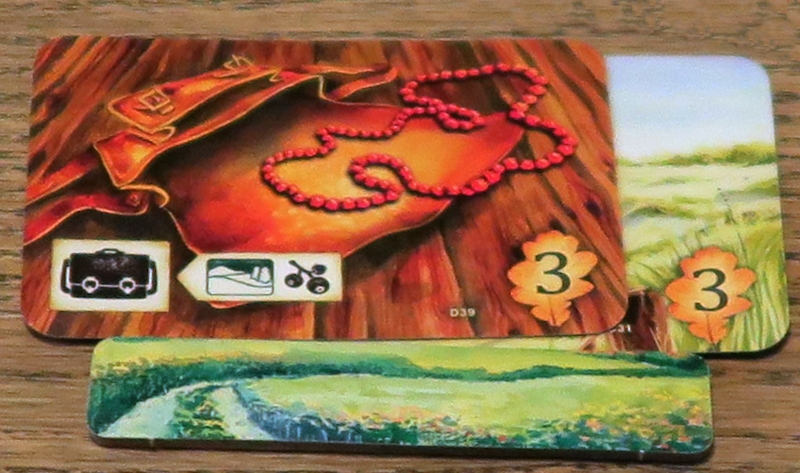
Meadow
– Image by boardGOATS

Plum’s Badger card turned out to be quite difficult to place, so as players can have a hand of ten cards, she filled her hand to give her the most options.  Someone else took the space around the campfire on one side of the wolf before she got to it, but as the the icons on either side weren’t as rare she was able to take the other easily enough and followed it with two more to get the full nine Bonus points, the only one to do so.  There was a problem with an odd token around the fireplace that featured a Stag with a red border, that turned out to be from Envelop U: Big Encounters.  This is a mini-expansion that comes with the base game, and had been confused with the core game as one token had been accidentally left at home.

Meadow
– Image by boardGOATS

The game was enjoyed by all, though with four it perhaps slightly over-stayed its welcome a little.  The eventual winner was Plum with sixty-one points nearly ten points ahead of Pink in second.  Meanwhile, on the next table, the rest of the group were having a light evening, playing as a group of six.  First up was Die Wandelnden Türme (aka Wandering Towers)—a game that has been very popular in the group since it first came out a eighteen months ago.  The idea behind this game is that on their turn, players play two cards from their hand of three cards, one after another, performing all the moves if at all possible.  There are three types of cards, those that move a Wizard, those that move a Tower and those that move either a Wizard or a Tower; in each case, the number of movement spaces is given.
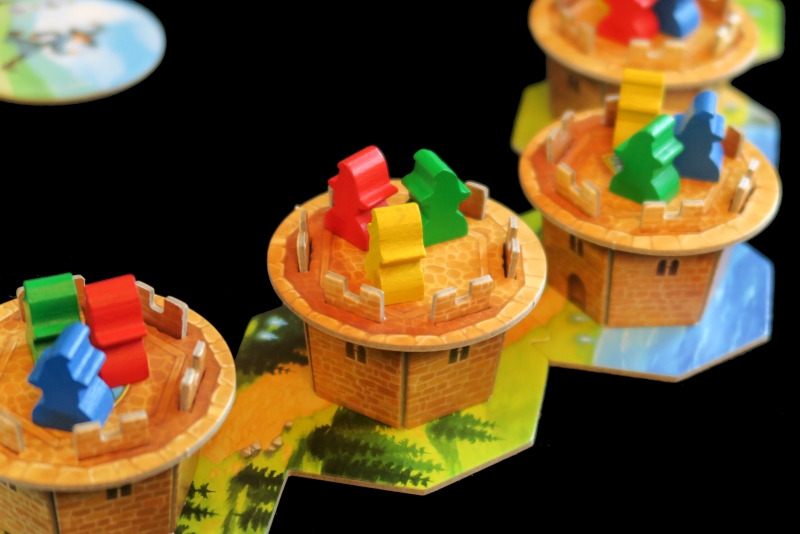
Die Wandelnden Türme
– Image by boardGOATS

Players can only move their own Wizard and each Tower and empty space can hold up to
six wizards (if a move would exceed that limit, it cannot be made).  Whenever a Wizard’s move ends in the space with the Ravenskeep, the player drops the Wizard into the keep—this is one of the key targets during the game as the winner must have all their Wizards trapped in the Ravenskeep.  In contrast to Wizards, players can move any Tower segment along with everything on top of it (Tower segments and Wizards).  Whenever a Tower’s move ends in a space with Tower segments already in it, the new Tower goes on top, imprisoning all the Wizards it covers—all nine towers and the Ravenskeep could end up in the same space!
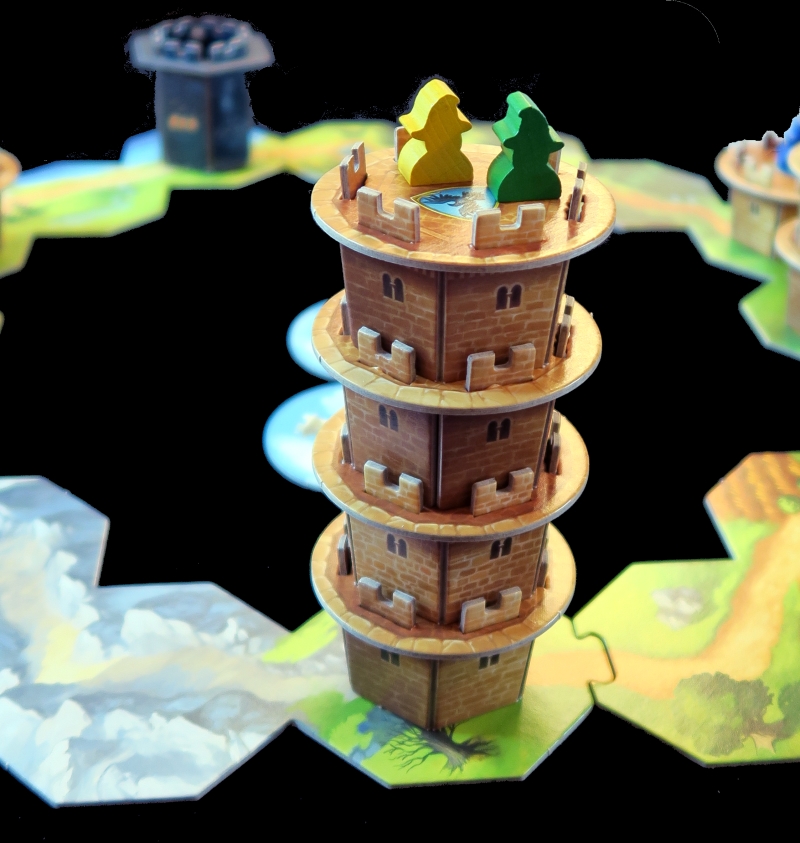
Die Wandelnden Türme
– Image by boardGOATS

Whenever a Tower covers Wizards, imprisoning them players get to fill one of their Potion Vials, turning it over—this is the other key target during the game as the winner must have all filled all their Potion Vials.  The player with both, all their Wizards in the Ravenskeep and all their Vials full of Potion, triggers the end of the game, with play continuing until everyone has had the same number of turns and all players that fulfill the criteria share victory.  Jade led the group, reminding everyone of the rules and explaining them to those who had not played before.
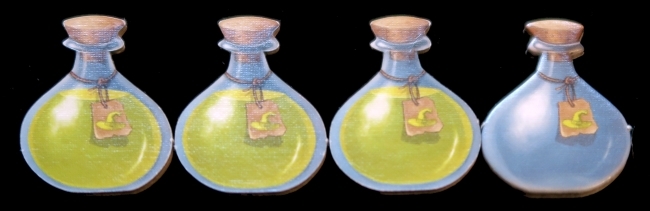
Die Wandelnden Türme
– Image by boardGOATS

Cobalt managed to tease a few extra rules out of the rule book , in particular that no more than six Wizards can sit on any one Tower segment, and a player’s turn finishes immediately if they place a Wizard in the Ravenskeep.  Aside from this, much amusement was had, especially as the stacks of Towers got really tall, they didn’t quite make it to the maximum of nine plus the Ravenskeep, but they did reach a good six or seven segments in one stack.  Black was the first to fulfill both the end-game criteria and Cobalt trapped dropped the last of his Wizards into the keep before the round finished.
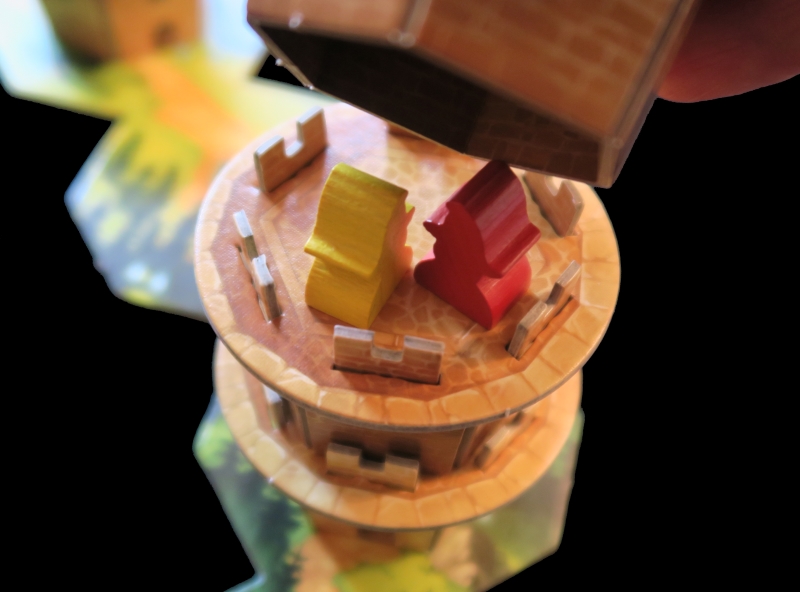
Die Wandelnden Türme
– Image by boardGOATS

As Cobalt still had two empty Vials, he took second place with Sapphire and Jade taking joint third.  Staying together as a group of six, they then went on to play King of Tokyo, a fast dice roller along the lines of Yahtzee where players control a monster try to destroy more of the city than their opponents while also attacking the other monsters to either take them out or keep them down long enough to enable the attacker to take victory.  Players each have a Monster and two dials which are used to track their Monster’s health (starting at ten) and the number of Victory Points they have gained.  The winner is either the first player to earn twenty Victory Points or by being the last Monster standing.
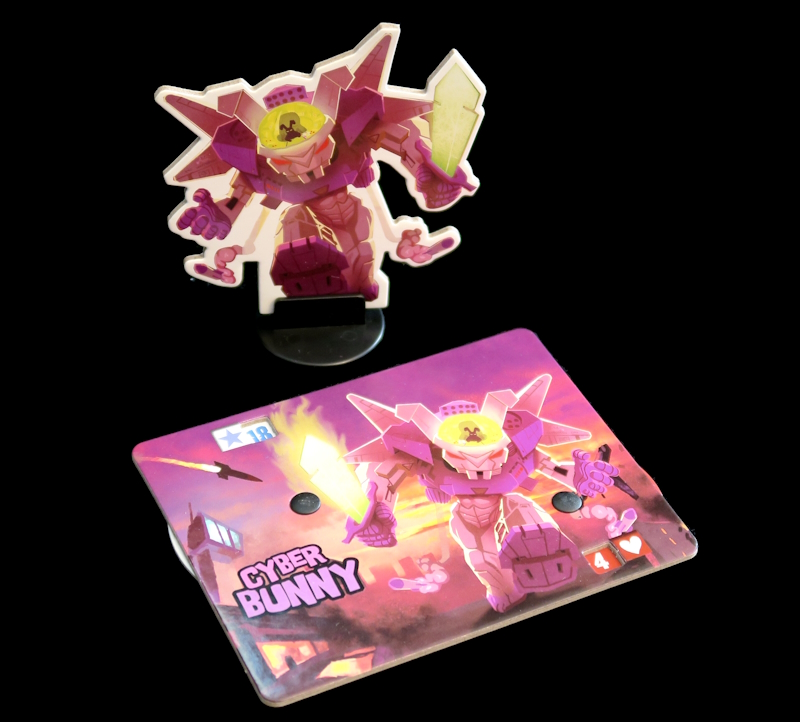
King of Tokyo
– Image by boardGOATS

Players take turns before passing the Dice on, clockwise.  They get a maximum of three rolls, but can stop early and any number of Dice can be put aside after each roll.  The Dice are not locked, so Dice set aside after the first round can be rolled in the third if desired.  The dice feature numbers one, two and three, a Claw, a Lightening Bolt, and a Heart.  The numbers give the player Victory Points and the Claw indicates damage inflicted on a chosen opponent.  The Lightening Bolt gives the player an energy cube which can be spent on Power Cards, and the Heart increases the Monster’s Health (though the Monster must be outside the City to be able to take advantage of this).
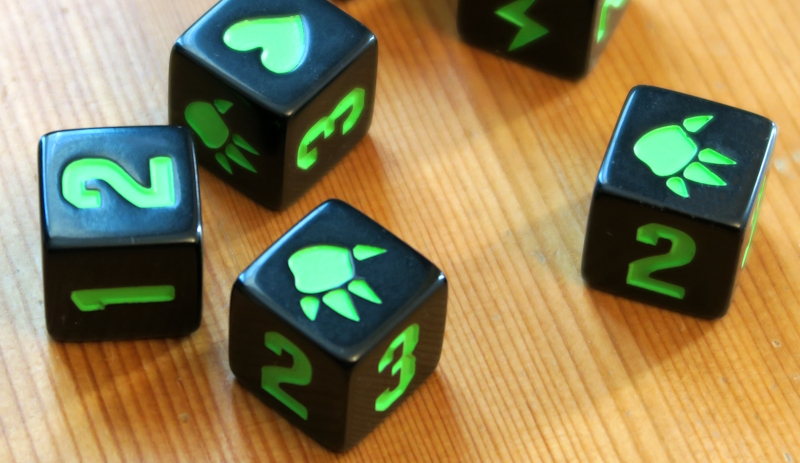
King of Tokyo
– Image by boardGOATS

Once the dice have been rolled and resolved, players can buy Power Cards from the face-up display—these typically cost between two and eight Energy, and can be very useful at helping to control the game.  The other key part of the game is the Monsters’ locations: they can be “In Tokyo” or “Outside Tokyo”.  To enter Tokyo a player must roll one or more Claws; when a monster in Tokyo is attacked they will take damage and the player has to decide whether to stay in Tokyo or not.  If they Yield Tokyo, they allow/force the attacking monster to enter Tokyo in their place.  This is critical because Monsters deal damage based on their location and any Monsters in Tokyo deal damage to all monsters outside Tokyo and vice versa.
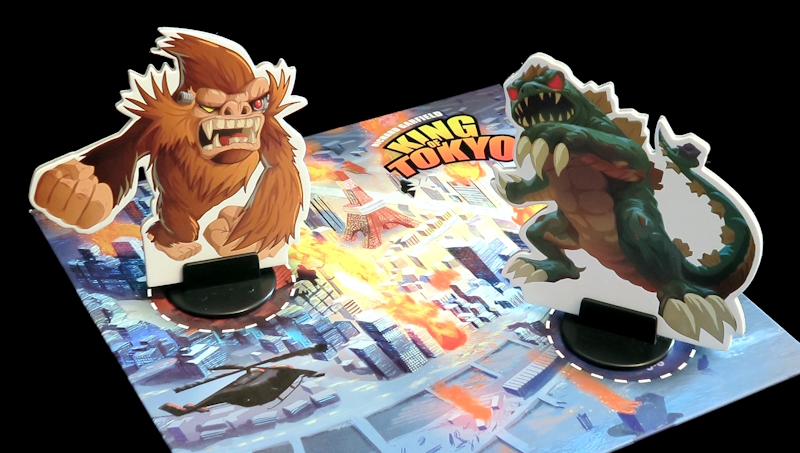
King of Tokyo
– Image by boardGOATS

One of the handicaps of being in Tokyo is the fact that a player cannot heal whilst in Tokyo.  However, when a Monster enters Tokyo it earns a Victory Point for doing so and if it starts its turn in Tokyo, then it earns two Victory Points.  These points help a player inch towards that winning total of twenty.  With six players the Tokyo Bay location on the game board is also used, effectively meaning that two Monsters can be in Tokyo at the same time, improving the balance and preventing five monsters ganging up on one, while also discouraging everyone outside Tokyo to try and displace them rather than just focus on collecting Energy, Healing or Victory Points.
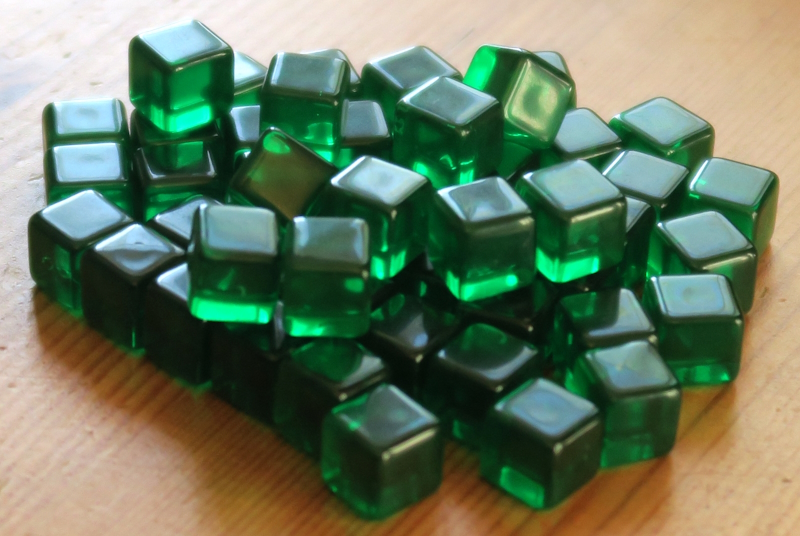
King of Tokyo
– Image by boardGOATS

Unusually for the games the group plays, King of Tokyo has player elimination—when a player’s health falls to zero, they are out, a fate suffered by half the players in the game this time.  Jade was first to be knocked out, but Sapphire and Cobalt weren’t far behind.  With six players, Black’s stay in Tokyo which lasted three full rounds was quite remarkable.  It was perhaps no surprise therefore that he was the eventual victor, collecting the full twenty Victory Points, some way ahead of Pine in second with eight and Purple just behind him in third.
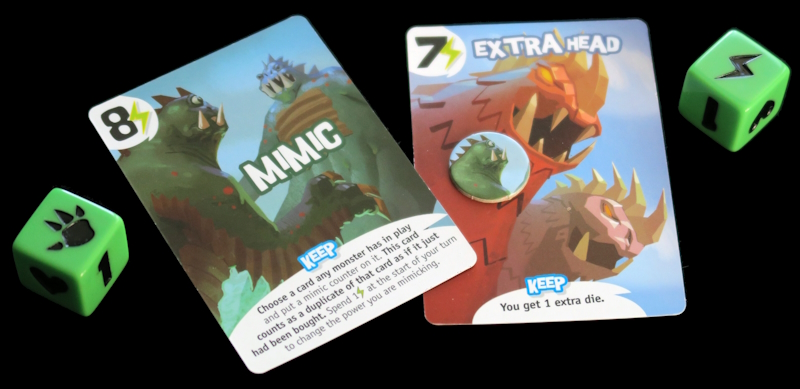
King of Tokyo
– Image by boardGOATS

Learning Outcome:  A meadow is grassland which is not regularly grazed instead being left to grow to produce hay.
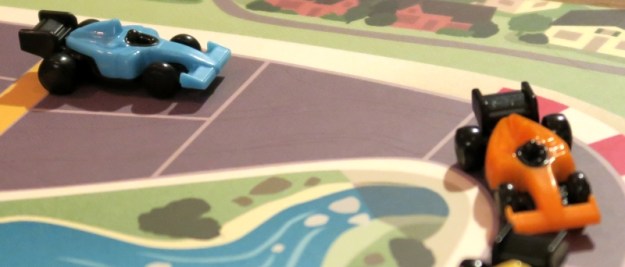
30th May 2023

Pink and Blue were late arriving thanks to a debate as to whether the actor Gary Lewis was in the Roland Emmerich film The Day After Tomorrow.  Eventually Blue and IMDb were proved right when Pink found the guy who WAS in the film (Richard McMillan, who bore no resemblance to Gary Lewis whatsoever), but that meant they were late arriving and Plum and Byzantium were already there.  Unfortunately, due to a mix up, the Jockey wasn’t serving food, so Blue headed off to get chips for everyone from Darren at The Happy Plaice.  As the chips were consumed, everyone else arrived and it was just a question of who would play the “Feature Game“, the Wild Ride expansion to our go-to motor racing game, Downforce, and what everyone else would play.

Downforce
– Image by boardGOATS

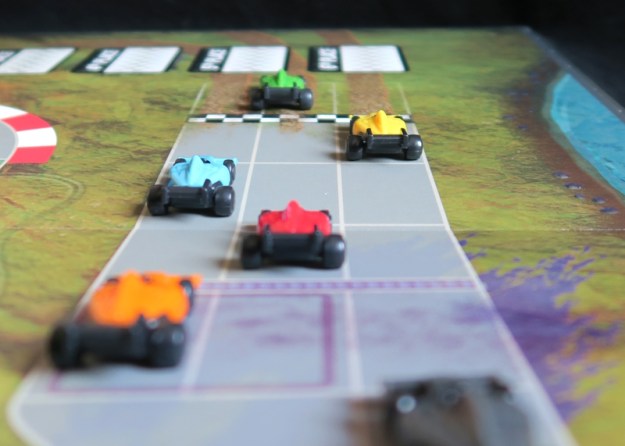
Eventually Pink and Green committed to Downforce, and were joined by Pine (who claimed that after doing well the first time he played, he’d come last ever since), Black and Lime (as long as the other group weren’t playing Wingspan).  Pink and Green reminded people of the rules of the base game, which are simple enough:  after being dealt their hand of cards, players bid for cars, with the player who pays the most deducting the cost from their final score.  Once the bidding is over, the race takes place.  Players take it in turns to play one card from their hand, and then move all the cars depicted on it in turn.

Downforce
– Image by boardGOATS

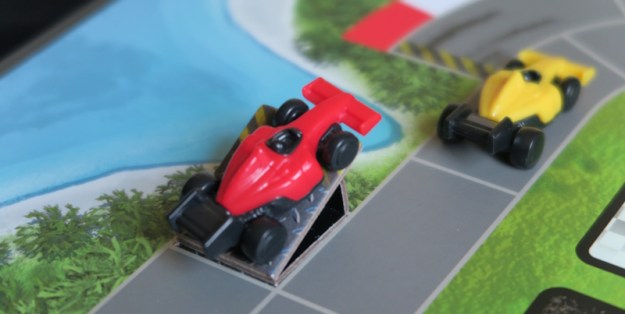
When the first car crosses a betting line, the race is paused while everyone bets on which car will win the race.  There are three betting lines, but the winnings for betting decrease the closer they are to the finish line.  At the end of the game, players total their winnings from the race with those from the betting, deducting the cost of their car and the player with the most cash is the winner.  The Wild Ride expansion adds two new tracks: Aloha Sands and Savanna Stretch. Aloha Sands adds water jumps which cars can use if they are moving fast enough. The jumps allow players to pass other cars and get round the track more efficiently, but timing is everything.

Downforce: Wild Ride
– Image by boardGOATS

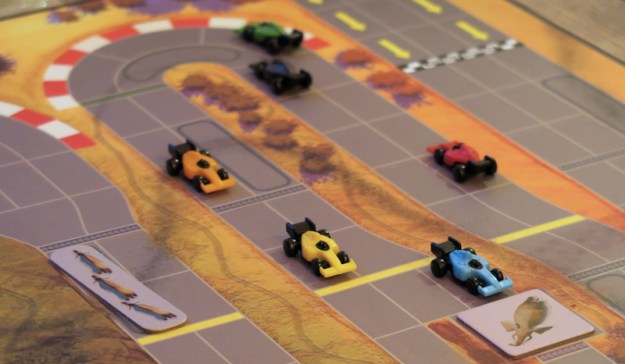
In contrast, Savanna Stretch features wild animals that block the track.  Once the first car has passed an animal, they are moved to another part of the track, as such, they help to prevent the “runaway leader” problem that can sometimes be an issue in the base game.  It was this track that players chose to use this time.  The inclusion of extra animals on the track caused a little confusion initially, but the group soon worked out two of the important features of this track.  Firstly, the animal tile only moves after the first car is fully past it and all other the cars have finished their movements for that card, which means that the animal is really only an impediment for the first few cars.

Downforce: Wild Ride
– Image by boardGOATS

The other the slightly unusual aspect of this track is that the pole position car starts at the rear of the pack.  With five players and six cars, there was always a chance that someone would get two, and that someone was Lime.  While this can be a huge advantage, especially if the cars are cheap, it can also be a risky strategy as it can be difficult to manipulate two cars and they can also become a target for other players.  Unfortunately for Lime, his cars were among the most expensive, leaving him with a deficit of $11M before the racing began, compared with Pink and Green for example, who paid just $2M for theirs.  Once everyone had got to grips with the rules and the cars had been allocated, the race was underway.

Downforce: Wild Ride
– Image by boardGOATS

For a track with so many tight sections it was not surprising that there was a lot of blocking going on—most of it, to be fair, totally deliberate… Pink (in the red car) found his early push to the front to be a mistake, as he was instantly the target for blocking maneuvers from turn two until the final straight.  Green (in orange) used his online experience from Board Game Arena to keep himself in the pack, but not at the front. Luckily for him several other players selected his car to win the race at the first two check points, which helped keep him out of trouble and pushed forwards.

Downforce: Wild Ride
– Image by boardGOATS

However after the halfway mark, Black (driving the blue car) and Pink both surged forward causing Green and Pine to lose their nerve and bet on Black (instead of Green) at the last checkpoint.  However, they should not have worried, as very soon after that, Green’s car surged forward weaving between the cars in front to race for the line and victory.  Pine was close behind, followed by the first of Lime’s cars (the other brought up the rear).  With the race done, there were just the winnings to claim from the bookies.  Because Green had got away with paying little for his car and won the race, he had a significant prize pot even before betting was paid out.

Downforce
– Image by boardGOATS

There wasn’t a huge difference in the results from the betting, but it was enough for Green to extend his lead.  Pine also raked in millions as his betting pattern was the same as Green’s (perhaps someone should investigate them for race fixing).  As a result, Pine come in clear second with Black completing the podium.  Since there was still some time left for a “proper” game, the group hunted around for something that wasn’t too long and could play five.  In the end, they settled on the simple little “push your luck” game, Port Royal, as much because no one could find anything better for five players, than because anyone really wanted it specifically.

Port Royal
– Image by boardGOATS

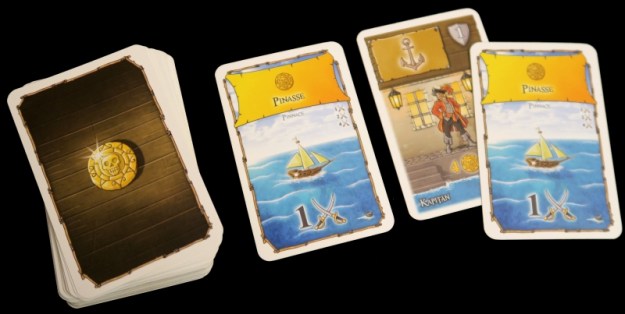
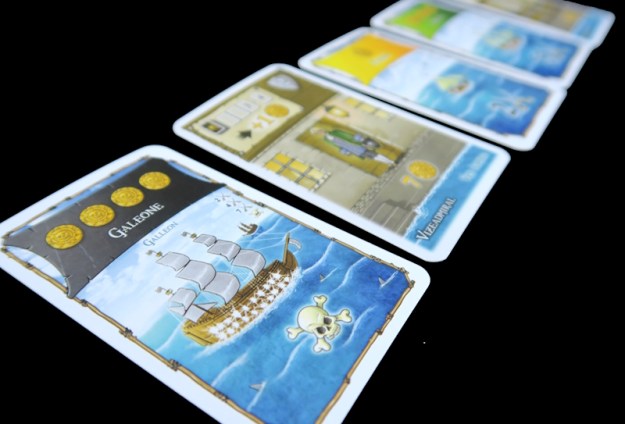
It had been a little while since most of the group had played, though the rules are simple enough.  On their turn, the active player chooses to “twist” and turn over the top card of the deck, or “stick” and keep the current card set.  The deck of cards consist of coloured ship cards and character cards.  The first decision is to decide whether to risk a “twist” because if second ship card of a colour is drawn the player goes bust and their turn ends.  If a player “sticks” they can take a ship and add its treasure to their stash, or they can use their gold to buy the support of characters.  These give players victory points and special powers, but also can be used to claim contracts and give more points.

Port Royal
– Image by boardGOATS

Once the active player has taken a card, players round the table can take a card too.  The cards are double-sided like those in San Juan or Bohnanza, so in the same way, keeping an eye on the discard pile and the money in players’ hoard is also key.  Although Black and Green did their best to quickly explain the rules, Pine and Lime were still both a little unsure, and perhaps with good reason.  Part way through the second round Black and Green realised something was amiss and re-read the rules and spotted a “rules malfunction”:  they had forgotten that when a player takes a card on another player’s turn, they pay the active player one coin, thus encouraging players to push their luck further to give more players more choice.

Port Royal
– Image by boardGOATS

So from the second round on-wards they group started playing correctly.  Pink’s strategy involved ignoring the Sailors and trusting to luck with turning the cards while spending his money on symbols to make up Expedition cards.  That gained him the first Expedition card, but ultimately, this single minded approach wasn’t very successful, at least in this game.  Green went for a strategy of collecting fighting cards, in order to fight off the pirate ships.  This worked initially, but by the time he had five fighters (and seven points), he kept going bust on his turn as he turned up skull bearing Pirate Ships against which there is no defence!

Port Royal
– Image by boardGOATS

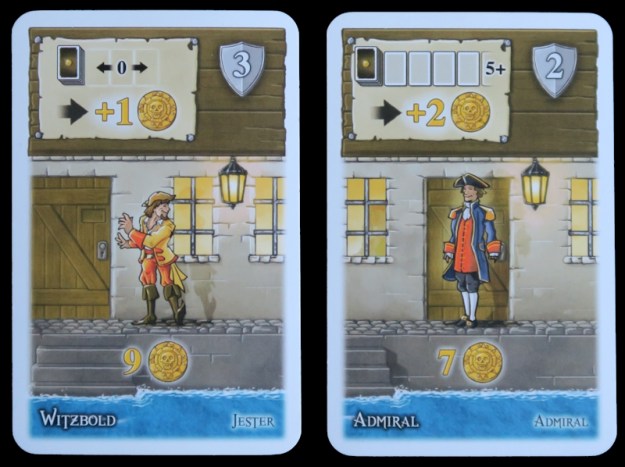
This meant that everyone else was able to gradually build their wealth and cards to catch him up.  Green then collected two more fighters and in preparation for one final attack, but would he get the chance?  Black had managed to accumulate a lot of points, not least because he collected money for both a large array of cards and for when it went bust thanks to the Admiral and the Jester.  If Black could collect another special symbol he could claim an expedition and win the game before Green could make his mega move with a full fighting force.  Unfortunately for Pine, he wasn’t able to collect the symbol he needed to claim a expedition as he went bust.

Port Royal
– Image by boardGOATS

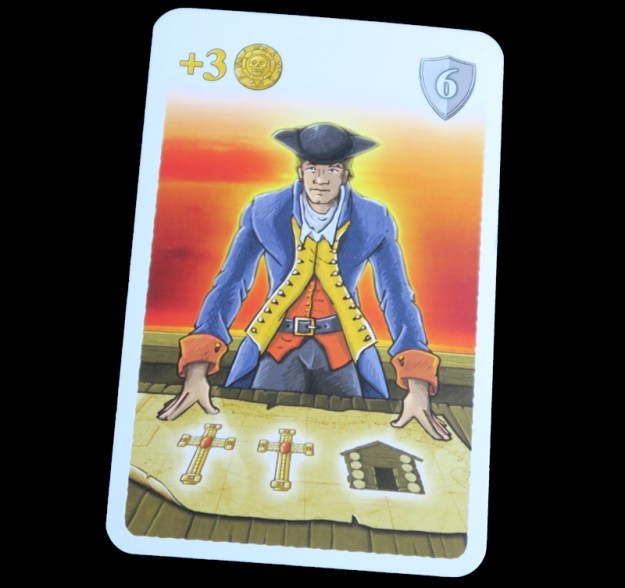
So it was Green’s turn again and he started to pull out cards, with a huge line of cards.  After defeating every lower value Pirate Ship he came across, he managed a full five different coloured ships.  From there he was able to collect another five coins and purchase the two crosses on display, which gave him an expedition card and enough points for victory.  At the conclusion of the game, Pine confirmed his early feelings that he did not really like this game, and Lime felt it was all a bit too confusing, never really sure what he was doing.  This was an older game that we used to play a lot of at the club, but it seems to have lost its lustre now and will probably forever remain an occasional play game.

Port Royal
– Image by boardGOATS

Meanwhile, on the next table there was a lot of debate as to what they’d play.  With five, the options were quite restricted, Burgle Bros. almost made it, until Teal realised it only played four, which left Tiny Towns.  Plum wasn’t so keen, so in the end, the group went for the old favourite Wingspan (having said to Lime that they weren’t going to play it…  Sorry Lime!).  There was some debate as to whether there was time for the game with five players, and options of playing three rounds instead of four were briefly discussed, but since everyone knew what they were doing, the group decided to give it a go and see if they could squeeze in a full-length game.

Wingspan
– Image by boardGOATS

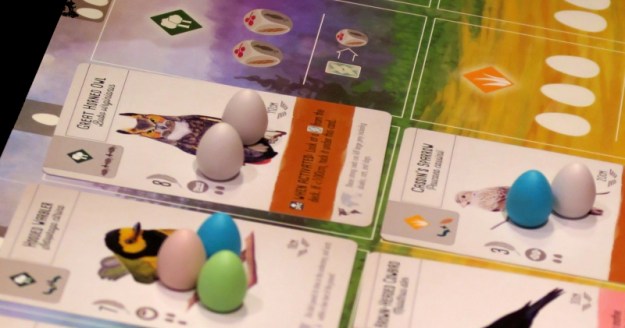
The game is an engine builder that is quite simple in theory, but quite difficult to play well.  Players are collecting birds for their sanctuary, scoring points for exciting birds, eggs, cached food and cards tucked under birds (representing flocks of birds or prey caught), as well as bonus points for achieving particular goals during the game and at the end of the game.  The idea is that, on their turn, players either play a bird card from their hand into their tableau, or carry out the action associated with one of the three habitats (Woodland, Grassland or Wetland) and then activate each bird in that habitat.  While that is all there is to it, it’s all in the cards and getting them to work together.

Wingspan
– Image by boardGOATS

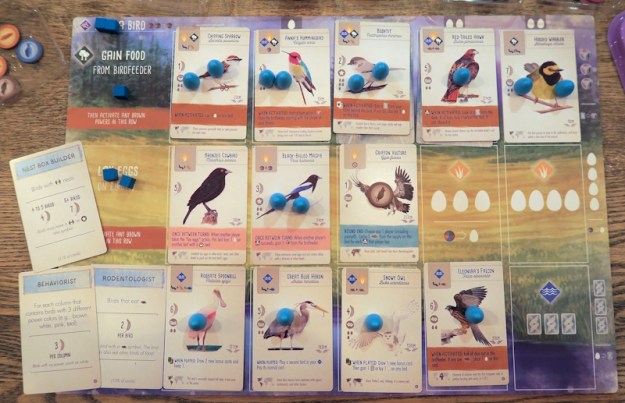
Wingspan can be a little “multi-player solitaire”, that is to say, there can be very little interaction between players in some games.  For some players this is preferred as it means players don’t have their carefully laid plans destroyed by others, while others feel they might just as well be sitting alone and interaction between players is what makes playing games important.  It had been a while since it’s last outing, but the group were quick to get going and were happy to play with the European Expansion which was already mixed in.  Plum in particular, got off to a flying start with her opening hand, four of which were coloured birds and matched her chosen Bonus card (the Photographer).

Wingspan
– Image by boardGOATS

In contrast, Blue had cards that didn’t match at all.  The Rodentologist was her best Bonus card giving her two points for each bird in her sanctuary that ate a rodents, but not one card in her starting hand qualified.  Teal started out with a strategy to maximise his egg production and prioritised birds with brown powers and resource conversion to assist that aim.  The first card Plum played helped him in this, and everyone else too as it happens as it was a very generous Ruby-throated Hummingbird that gave everyone food every time it was activated.  Teal returned the favour as he laid eggs at every opportunity and Plum had a bird that rewarded “once between turns” if anyone laid eggs.

Wingspan
– Image by boardGOATS

As the game progressed, players worked on the end of round bonuses.  Three of the four birds Plum had kept from the start also happened to have bowl nests which contributed towards the fourth round goals, as long she could ensure they had eggs on them.  She didn’t really aim for anything else, but Blue, Byzantium and especially Teal did well in the early rounds.  Plum picked up some more birds with colours in their names, but also managed to play the Yellowhammer end of round card which she was able to use to great effect as it enabled her to play an extra bird card if she had used all four actions during the round.  Byzantium had issues with the dice which repeatedly wouldn’t give him what he wanted.

Wingspan
– Image by boardGOATS

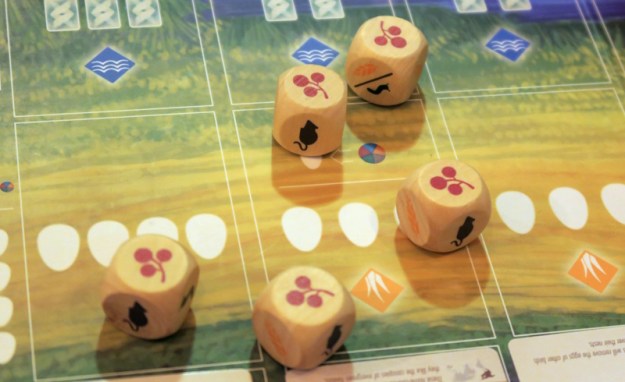
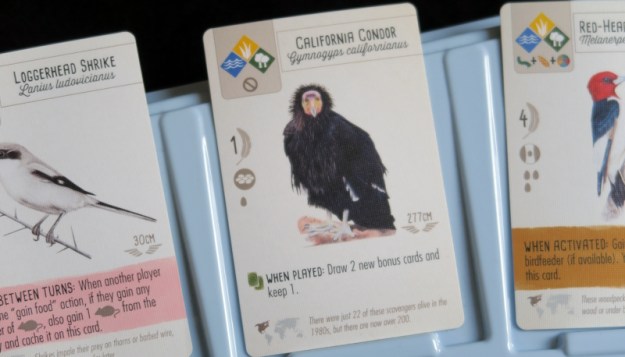
Then to compound Byzantium’s woes, he got himself in a bit of a mess when he played his migrating bird into the wrong habitat meaning he didn’t get the advantage of moving the bird straight away and costing him more eggs into the bargain.  Purple had different dice issues when she rolled five berries and called “Yahtzee!”  Blue had improved her hand and acquired some more helpful cards, including one that gave her an extra Bonus card, the Behaviourist, which gave her three points for each column with three different power colours.  As people sifted through the deck trying to find cards they liked the look of, the California Condor appeared, which everyone agreed looked like a monkey.

Wingspan
– Image by boardGOATS

Towards the end of the game, partly as a result of Plum’s Hummingbird, Byzantium ended up with a surfeit of food and nothing to spend it on.  So, he switched tactics and took the Condor hoping to get a bonus card that would improve his fortunes.  It didn’t.  Blue tried the same and didn’t do any better.  After the final round Plum activated her Yellowhammer again and was left with the choice of playing a bird that gave her a Bonus card or one that gave two extra points.  She also went for the Bonus card, the Fishery Manager, but only one of her birds ate fish.  Time was ticking on, but the game was over well within two and a half hours with just the scoring to go as last orders chimed.

Wingspan
– Image by boardGOATS

Blue had some high scoring birds, but not as many as Plum who took fifty-five points for them alone. Blue had quite a lot of eggs too, but not as many as Teal who had twenty-three.  Everyone else was concentrating on counting, when Purple (aided by Black who had come along to lend a few fingers), gave her score for her bonus cards: thirty-four points, more than twice that of anyone else.  Unfortunately for her though, prioritising her Backyard Birder Bonus which gave her points for birds scoring fewer than four points left her with lots of low scoring birds.  It was a close scoring game, but first place went to Blue who finished a handful of points ahead of Plum with Teal a little way behind in third.

<Wingspan: European Expansion
– Image by boardGOATS

Learning Outcome:  Forget snakes on a train, what about snakes on a race track?!?!

Boardgames in the News: What are “Roll and Write” Games?

In the last few years, “Roll and Write” games have been everywhere, but what defines them and what let to the rise in their popularity?  Well, their roots lie in simple dice games, which are as old as the hills, but arguably the first “Roll and Write” game is Yahtzee, a game that is now a childhood classic.  Although the commercial game dates from the 1950s, the game is based on the older family of traditional games, including Yacht, Generala, Poker Dice etc..

Noch Mal!
– Image by boardGOATS

The idea is that players roll five dice to try to get specific combinations, re-rolling some, all or none up to three times.  These fall into different categories each of which can only be scored once and are crossed off on a scoring sheet.  This roll and re-roll mechanism has been used as the basis of many more modern games like Pickomino (aka Heck Meck), To Court the King and even Roll for the Galaxy, but these are not “Roll and Write” games, they are dice games.  More dice games with a “Writing” element, followed as well though.  These include Reiner Knizia’s Decathalon, the Catan Dice Game, and Roll Through the Ages: The Bronze Age with its subsequent series of games.

Roll for the Galaxy
– Image by boardGOATS

Perhaps the most influential game of this type, however, is Qwixx.  In this game, each player has their own score-sheet with four rows, numbered two to twelve, each in a different colour.  On their turn, the active player rolls six dice: two white and one of each of the four colours. The active player can mark off the sum of one white die and one coloured die in the row of the same colour, while everyone else can mark off the sum of the two white dice on any one of their four rows.  The catch is that the numbers must be crossed out in order: descending for the blue and green rows, ascending for the red and yellow rows.

Qwixx
– Image by boardGOATS

And that is the core that really makes a “Roll and Write” game:  the decision making.  While there is no industry recognised definition, it is widely understood that games that fall into the “Roll and Write” category have the following key characteristics:

  • A randomiser: traditionally dice, but some games use cards etc.;
  • A key element of decision making;
  • Individual work sheets, which are more than just a score pad.

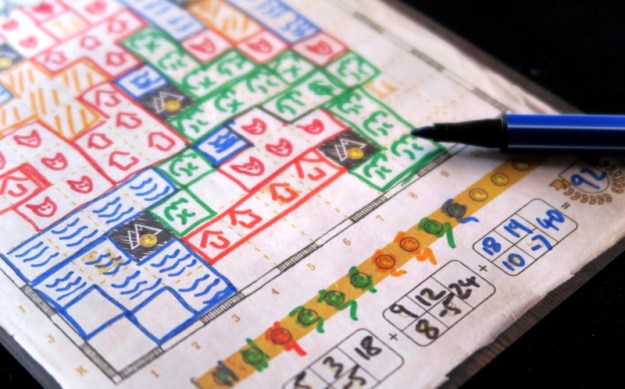
Qwixx was published seven years ago, and was popular in its own right receiving a nomination for the Spiel des Jahres award in 2013.  Its legacy, however, is the way it helped to open the door for other games in the genre.  Noch Mal! (aka Encore!) followed in 2016 and in 2018, “Roll and Write” games really took off.  Yahtzee, Quixx and Roll Through the Ages have now been followed many other very popular and successful games including, Welcome to…, Ganz Schön Clever! (aka That’s Very Clever!), Railroad Ink, and Cartographers: A Roll Player Tale.  Between them, these games have received two Kennerspiel and two Spiel des Jahres nominations.

Ganz Schön Clever
– Image by boardGOATS

There are now, hundreds of “Roll and Write” games available and new games continue to arrive, each with their own twist: some based round rolling dice, some involving a deck of cards, and there are even games now that involve cutting out!  But what is the appeal, and why the sudden growth in this genre?  For the publisher they are obviously cheap and relatively easy to produce, often needing little in the way of complex or bespoke components.  In a squeezed market this is very important.  For designers they are easy to prototype and many of these games are relatively easy to play-test too.  This is because they can often be played solo, and the mathematics of probability are well understood (by mathematicians at least).

Cartographers: A Roll Player Tale
– Image by boardGOATS

For gamers, the low price of these games means financial investment is typically small.  They are usually quick to learn and don’t over-stay their welcome either, which means they are low risk and if they “click” they also can see a lot of table time.  They are easy to play remotely too, because players just need pens and a work-sheet each, and access to a web camera.  And thus, the timing of the rise has been serendipitous: with so many people stuck at home this year, “Roll and Write” games are really coming into their own now.  It remains to be seen whether their popularity will continue into 2021 and beyond.

Noch Mal!
– Image by boardGOATS

5th September 2017

As people arrived slowly, the evening started out with a few rounds of Love Letter.  The archetypal “micro game”, Love Letter is a simple filler game that we’ve played a lot in the past, but less so recently.  The idea is that players have a single card in hand and, on their turn, draw a second and choose which one to play.  There are only sixteen cards in the deck and each has a value and an action.  The action is carried out when the card is played and the player with the highest value card at the end of the game is the winner.  The game is not high on strategy, but is ideally suited to playing while doing other things (like eating pizza), so it is very light hearted and can often generate lots of silly moments with this time being no exception.  When Blue drew the second highest card, the Countess, she got carried away and chose to play the Prince she already held.

Love Letter
– Image by boardGOATS

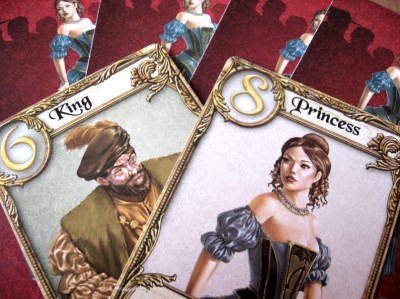
Unfortunately, the special action for the Countess is that if a player has a Prince or the King as well as the Countess she must discard the Countess (thus revealing information).  Without thinking properly, she played used Prince’s action on Green who was forced to discard the Princess, putting him out of the game.  Too late Blue realised her error and she apologised profusely as Green grabbed his card back and she played her Countess instead.  When the next player, Burgundy, then draw a Guard card giving him the chance to assassinate any card he could name, everyone knew that Green’s days were numbered, though they were reckoning without Burgundy’s bad memory!  Completely unable unable to recall the card Green had been forced in error to reveal, he incorrectly named the King and Green lived on.  In the long run, nobody really benefited from the confusion though, with almost everyone taking one round, we played sudden death and it was Pine who ultimately emerged victorious.

Love Letter
– Image used with permission of BGG contributor thatmadgirl

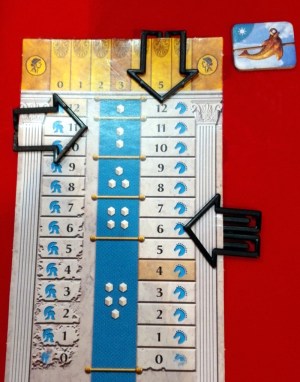
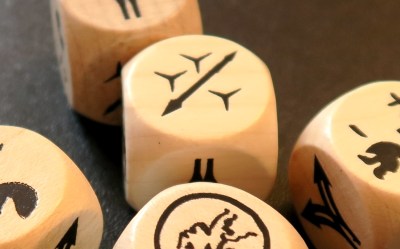
With everyone present it was time for the “Feature Game”, Chariot Race, which is a fairly quick-playing Yahtzee style dice game with a horse racing theme, but actually has more of a feel of King of Tokyo (that we played last time) than anything else.  Players take on the role of charioteers participating in a great race in ancient Rome with the aim being to use dice to complete two laps of the dusty arena and be the first to steer their chariot over the finish line.  On their turn, the active player rolls a number of dice dependent on their speed on the previous turn, with faster chariots rolling fewer dice.  Each face of the six-sided dice allows a different action: Gain new Favors; increase or decrease speed; change lanes, or attack opponents (either directly by hurling javelins or indirectly by dropping caltrops in their path).  If the first roll is not satisfactory, the player can re-roll any or all of the dice.  They can re-roll a second time or turn one die to their chosen face, but to do that they must cash in some of the favour of the goddess Fortuna.  Favours of Fortuna are useful for repairing chariots too, and as there is a large kamikaze element to the game, Favours prove very useful indeed.  Once the dice roll is set, the active player moves their chariot forward according to the final speed they achieved, swerving to avoid rivals, caltrops and potentially devastating piles of rocks and the first player to drag their wreck of a chariot across the line for the second time is the winner.

Chariot Race
– Image modified from original by BGG contributor JackyTheRipper

The game is supposed to be a quick little fun racing game, but it turned out to be everything but quick. This was probably the fault of the players as much as anything else as everyone seemed to get bogged down in analysing all the options.  With seven people present and Chariot Race, playing a maximum of six, Ivory kindly offered to team up with Green who was feeling a little out of sorts, but they were in complete agreement that they should start at the front of the grid.  In contrast, Black decided to start at the back, hoping that others would see him as less of a threat and maybe take each other out leaving him an easy run in.  In practice, it turned out that the back was a particularly bad place to be as Black struggled to avoid everyone in front of him and consequently picked up a lot of damage, soon wrecking his chariot and joining the rows of spectators cheering on their heroes.  Burgundy was quick to follow when the wonky donkey pulling his chariot sped up suddenly and accidentally invented a new Roman form of skittles when he crashed into everyone else in turn.  The problem with that was that although everyone took damage, each collision caused damage to Burgundy’s chariot eventually turning it in to match-wood.

Chariot Race
– Image modified from original by BGG
contributor JackyTheRipper

Starting at the front, the Green/Ivory chariot made a very quick start and took an early lead.  Blue gave chase starting with a recklessly high speed and a “go down in a blaze of glory” attitude.  Pine was a little more circumspect, but made good ground early on.  Purple on the other hand, started towards the back of the grid, made a slow start and was obstructed by the wreckage of Black’s and Burgundy’s chariots at the start of her second lap.  Blue and Green/Ivory tried to impede each other with Blue chucking spears and Green/Ivory dropping caltrops.  As Green/Ivory approached the end of their second lap, Blue was just behind.  So as Green/Ivory crossed the line running on empty they were speared by Blue on the next turn and their wheels fell off their chariot.  Blue crossed the line with a bit to spare and was quickly followed by Pine who couldn’t quite pass Blue so chucked a spear at her to make up for it.

Chariot Race
– Image by boardGOATS

That just left Purple.  With a lot of ground to make up, the odds were always against her and everyone joined helping her to try to cross the line or take out Pine or Blue.  Sadly it was not to be and she decided that if she couldn’t influence the race, she would go out with a bang and smashed her chariot to smithereens on a rock.  So, a game that was listed as taking less than an hour had taken over two and only a third of the chariots playing had made it to the finish line.  It didn’t matter who won though, it had been a lot of fun.

Chariot Race
– Image modified from original by BGG contributor JackyTheRipper

With Chariot Race taking so much time though, we were limited by what else we could play.  Before long there was a debate about the options, including all out old favourites like Saboteur and 6 Nimmt!.  In the end Bohnanza won as a game we could all play without thinking, and Burgundy was reaching for the familiar yellow box from his bag.  The game is one of our old staples, is quick to learn and keeps everyone involved throughout.  Often the simplest of mechanisms are the most effective an that is the case of Bohnanza:  players cannot rearrange the cards in their hand and must play them in the order they arrive.  Thus, on their turn, the active player first plays the first card in their hand with the option of playing the second if they desire.  Once they’ve been planted, two cards are drawn which can be traded, but must be planted by someone.  This can lead to free gifts, but also players being nasty and refusing to take even the apparently most lucrative trades

Bohnanza
– Image used with permission of BGG contributor spearjr

This time, Burgundy started strongly, as did Pine and Ivory.  Black struggled consistently to get the cards he wanted, and with so many people playing, everyone had to be quick or they would miss out.  It was a very tight game with players mostly being nice to each other though everyone was typically reluctant to give Burgundy any easy trades, he got plenty anyhow.  As everyone totaled up the scores, it was clear there wasn’t much in it.  Five of the seven players ended the game with either nine or ten coins, but it was Purple who just sneaked in front finishing with eleven to win by a nose.  And with that, it was time to go home.

– Image by boardGOATS

Learning Outcome: Games sometimes take a lot longer than it says on the box.

22nd August 2017

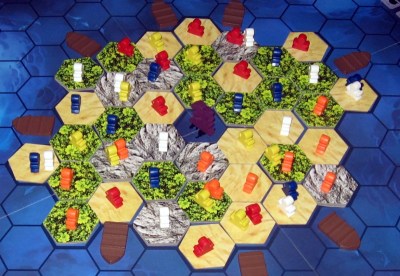
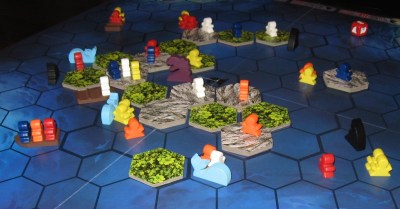
It was a quiet night thanks to work and holidays, and for a long time looked like it might just be a clash of colours between just Magenta and Pink, but gradually others rolled in, just in time for the “Feature Game”, Survive: Escape from Atlantis!.  This is a fairly light game, with a vicious edge that only really works if players engage fully in the “take that” elements.  Basically, each player has set of meeples, each with a number on the base which equates to their value.  With Blue away for work, everyone was keen to take the opportunity to play blue for a change, but Burgundy got in first.  The aim of the game is for players to get their meeples safely to the mainland on the four corners of the board before the volcano erupts and kills them.  To this end, the game begins with players taking it in turns to place their meeples on the hexagonal tiles that make up the central island.   There are actually quite a few things to consider here.  Firstly, the tiles flood in order with the coastal low-lying beach tiles sinking beneath the waves first, then the forest tiles, and finally the grey mountainous tiles.  So, starting on a mountain means there is more time to make arrangements before a vindictive player can sink that hex dumping the unfortunate meeple into the drink.  However, the meeple in question may have to travel some distance across the island to get to the coast, which will take time and actions, both of which are limited.

Survive: Escape from Atlantis!
– Image by boardGOATS

The other major consideration when placing meeples are their value – each player has ten meeples and their values range from one to six.  The winner is the player who gets the highest total value home, so getting a six home is far more important than getting a one to safety.  For this reason, positioning the high value meeples well is critical, on the other hand, placing them first might telegraph that they are the most important meeples, putting them at risk later.  Critically, once they have been placed nobody, not even their owner, can look at the number on the bottom.  So remembering where the high value meeples are also vital to success, as is deciding whether to put the high value meeples together and potentially in the same boat, risking other players attacking it, but ensuring that all efforts can be focussed in one direction.  In general, each hexagon can only hold one meeple, so the available choice steadily decreases during set up.  The base game only plays four, but more can be accommodated with a mini expansion that adds extra pieces in two new colours.  The rules state that everyone should place only eight meeples (returning a one and a three to the box), but we didn’t realise this until people had begun placing so we used the “overpopulated” variant where players place their extra pieces on hexes that are already occupied once the island is at capacity.

Survive: Escape from Atlantis!
– Image by boardGOATS

Once all the meeples had been placed and were jostling for position, the game began in earnest.  On their turn, each player does four things:  play a tile from their hand; move their meeples; remove a tile (carrying out the action if appropriate or adding it face down to their hand), and finally roll the red Creature Die.  Players have three movement points and can use them to move any combination of their meeples and/or boats up to a total of three land or sea spaces.  There are a few rules associated with these, for example,”swimmers” can only move one space per turn because they tire easily, and once they have left the island, they cannot return.  Similarly, it only costs one point to move a “dry meeple” from land to a boat in a neighbouring space, whereas a swimmer must be in the same space as the boat and then it takes a movement point for them to climb over the side.  While anyone can move empty boats, only the player with the largest number of meeples can move an occupied boat.

Survive: Escape from Atlantis!
– Image by boardGOATS

Once the active player has moved his meeples, he then removes one tile from the island, tipping any residents into the sea and then secretly looks at the underside of the tile.  Each tile has different effect with some spontaneously creating whales, sharks or boats out of thin air, while others allow players to hitch a ride on a passing dolphin or cause sharks to magically vanish into the ether.  There are three different types of tile, green bordered to be played immediately; red bordered to be kept for later and played at the start of a later turn; and tiles with a red cross which are also kept but are played on another player’s turn (typically in response to them moving a shark into an attacking position or similar).  Finally, after the tiles have been dealt with, the active player rolls the Creature Die, and then move the creature of that type of their choice.  There are three types of creature.  Whales move fast (up to three spaces) and attack occupied boats, turning them into matchwood, but they leave swimmers alone.  Sharks, on the other hand, move a maximum of two spaces and will happily scoff any swimmers they come across, but can only circle boats looking longingly at their occupants.  Sea monsters are the slowest movers travelling only one hex at a time, but are also the most hazardous, smashing boats and then eating the contents.

Survive: Escape from Atlantis!
– Image used with permission of BGG contributor jsper

For the most part, everyone had distributed their meeples evenly over the island, but Green went for the mountain spaces first so his were a little land-locked in the early part of the game.  Perhaps it was just as well for him though, as everyone started out aggressively and got more so.  There were a lot of whale tiles early on, so boats didn’t last long and no mercy was shown to swimmers at all. Even being nice and trying to make allies didn’t work, so when Pink tried to be nice by moving his boat towards one of Magenta’s swimmers she didn’t repay him in kind.  It’s true that Pink might have had an ulterior motive thinking it was less likely she would attack his boat it if it had one of her own meeples in it, but setting a shark on two of his swimmers was arguably uncalled for.  He got his revenge though when he used a whale to sink one of her boats and parked a shark in the neighbouring hex.  Meanwhile, there was a brief uneasy truce between Green, Burgundy and Ivory as they shared a boat and, with so many people with a vested interest and Pink and Magenta still at war, all three made a rapid crossing.

Survive: Escape from Atlantis!
– Image by boardGOATS

It wasn’t long before all the beach tiles had gone and then all the forest tiles too.  Then everyone was on tenter-hooks waiting for someone to turn over the volcano tile triggering the immediate end of the game.  There are eight mountain hexes, so the probability started out as one in eight, then one in seven, then one in six…  And then Green turned over the fourth mountain tile signalling the end for Pink’s swimmer who had nearly made it to land and Ivory’s boat which disappeared beneath the waves as it filled up with lava.  That just left the scoring.  Burgundy had got three of his meeples home closely followed by Ivory and Magenta who had saved two each.  The number of meeples is largely irrelevant however, as it is the sum of the value of the meeples that is key, and although it looked like a close game, in the end it was much less close than everyone thought.  Almost all of the high value meeples had been eaten or drowned and only Ivory had managed to save any, rescuing both his five and his six point meeples.  That left him with eleven, a clear margin of victory over Burgundy who finished with a creditable seven, taking second place.  It had been fun though, and Pink, who had played it most recently concluded that it was very different with lots of players as it’s a lot easier to end up getting eaten or sunk since it’s a long time between turns delaying the chance to deal with “the impending sea serpent of doom…”.

Survive: Escape from Atlantis!
– Image by boardGOATS

Everyone hadn’t got the aggression out of their systems, so it was out with King of Tokyo for a bit more “take that” style gaming.  This is another “light, but vicious” game where players are mutant monsters, gigantic robots, and strange aliens—all of whom are destroying Tokyo and whacking each other in order to become the one and only, undisputed master of the city.  At the start their turn, the active player rolls six dice, each of which show six symbols each of which has a different effect.  The active player gets three successive throws over which they can choose whether to keep or discard each die.  The dice are used to get points, restore lives, acquire energy and attack other monsters.  Lives and points are tracked using a dial and the aim of the game is to be the first to reach twenty points.

King of Tokyo
– Image used with permission of BGG contributor mikehulsebus

At its core the game uses a three roll, keep or re-roll system similar to that used in Yahtzee, but there is a little more going than that.  In addition to cute standee-monsters and the scoring dials, there is also a small board representing Tokyo.  At the start of the game, Tokyo is empty, but the first player to roll at least one paw (attack) on the dice and choose to use it can move into Tokyo.  Once Tokyo is occupied, it will not be empty again during the game.  Monsters in Tokyo can only damage monsters outside the city and monsters outside Tokyo can only attach monsters inside the city.  This means that a player in Tokyo is a target for all the other monsters.  On the other hand, rolling an attack die while in Tokyo deals damage to everyone else increasing its value.

King of Tokyo
– Image used with permission of BGG contributor msaari

Tokyo is also important because when a Monster enters Tokyo the player earns a point for doing so, furthermore, if a Monster is still in Tokyo at the start of their next turn then the player earns another two points, and will continue to earn points for every round they stay there.  This is perilous, however, as they will be the subject of every attack someone makes from outside Tokyo and monsters in the city are not able to heal themselves.  With five players, there is room for two monsters in Tokyo, which means there is one less outside, but that is only the case until a monster inevitably succumbs to their injuries.  Once a player is in Tokyo, the only way to get them out again is to keep attacking them, until their nerve fails and they decide to leave making way for the attacking monster.  By this time, of course, it may be too late and too much damage has been done for them to be able to heal sufficiently.

King of Tokyo
– Image used with permission of BGG contributor Toynan

In addition to attacking and healing, the dice can also yield energy.  For each lightening bolt rolled and kept, the active player gets a green energy cube, which can be used to buy power cards.  These come in two main types,  “Keepers”, that can be used repeatedly, or “one off” cards that are discarded when used for their benefit.  They are potentially very valuable, especially if bought early in the game and can be used repeatedly.  Finally, it is also possible to score points from the dice by rolling three of the same numbers.  For example, rolling three “twos” will give two points, however, rolling two will score nothing which makes going for these quite a gamble.  The game ends when either one player gets two twenty points or there is only one monster left standing.

King of Tokyo
– Image used with permission of BGG contributor msaari

The game continued the aggressive theme of the evening.  Magenta and Burgundy were first in Tokyo and survived the whole round picking up the bonus points.  Pink then attacked and both Magenta and Burgundy fled with their tails firmly between their monstrous legs.  On his next turn, Burgundy was able to hide and heal, but Magenta was not so lucky being forced to attack and go back into Tokyo.  Sadly, this proved fatal and she was quickly out after accruing just seven points.  At this point Green was looking very strong with a powerful hand, in particular the “Evacuation Orders” which caused everyone else to lose five points.  This meant that when Pink quickly followed Magenta out of the game (finished off by Ivory) he went with no points at all.  Meanwhile, Burgundy was slowly rebuilding his health and was able to keep the other remaining players at a minimum.  Ivory was next, making it a battle to the death between Burgundy and Green, a battle that Burgundy eventually won after much blood was spilt.  Although it was still early, all the savagery had been tiring and everyone opted for an early night.

King of Tokyo
– Image by BGG contributor Schaulustiger

Learning outcome:  Being nasty can be very hard work.

29th December 2015

The pub was very busy, and with one chef down with the lurgy (which had got four of us as well), food was delayed. So, unusually, we started off with a quick game. Expecting more people, we decided to play something short, and opted for Qwixx. This game was designed by Steffen Bendorf who also designed The Game (which has been popular with the group this year) and was nominated for Spiel des Jahres in 2013. So, it has a good pedigree, however, when it was nominated there were a lot of comments about its suitability and eventually, it was beaten by Hanabi, which most people agreed was a better game. We finally got the chance to give it a go in October and generally felt that although the rules made for a promising sounding filler, the resulting game was disappointing. Given how some people continue rave about it though, we’d were keen to give it another try and see if we’d been mistaken.

Qwixx
– Image used with permission of BGG contributor punkin312

Qwixx is a very simple game: each player has a score card displaying the numbers two to twelve in the four different colours, red and yellow ascending and blue and green ascending.  On their turn, the active player rolls six dice, two white, and one of each of the colours, red, blue, green and yellow.  Every player may cross out the number corresponding to the sum of the white dice. The active player may then also cross out a coloured number corresponding to the sum of one white die and one matching coloured die. If the active player cannot or chooses not to cross off a number, then they must tick a penalty box, which costs them five points at the end of the game. The snag is that although numbers can be skipped, they must be crossed off in order, red and yellow ascending, blue and green descending.

Qwixx
– Image by boardGOATS

Points are scored for the number of each colour crossed out and penalties subtracted; the game ends when one player has picked up four penalties, or players have crossed off the last number for two colours locking them for everyone. Scarlet, an experienced local gamer who is usually unavailable on Tuesday evenings, commented that it was a bit like Yahtzee, but with slightly more decisions to make. This didn’t further endear the game to Blue, who has bad memories of playing Yahtzee as a child. Scarlet did manage to demonstrate a modicum of strategy when he chose to cross off a sixth red number rather than his first green number since that would give more points at the end. His discovery clearly gave him a bit of an edge as he took second place, eight behind Burgundy who won with eighty.  We had a bit of discussion about what strategy there was, but it was not really enough to rescue the game in anyone’s eyes and it now faces donation to a worthy cause.

Qwixx
– Image used with permission of BGG contributor punkin312

Meanwhile, Grey and Cerise had arrived and seeing everyone else engaged decided to play a quick game of Hey, That’s My Fish!. This is a cute little abstract with a penguin theme, and, in common with games like Carcassonne, although it plays more, in many ways, it is at its best as a two player game when it is most vicious. The game is played on a grid of hexagonal tiles, with each player starting with four penguin figurines which players take it in turns to move in straight lines across the tiles. When a penguin is moved, the active player gets the tile it was sitting on, leaving a gap that cannot be crossed. Thus, the ice flow progressively melts away trapping the penguins in increasingly smaller spaces.

Hey, That's My Fish!
– Image used with permission of BGG contributor aleacarv

A number of fish is depicted on each tile, and the player with the most fish at the end of the game, i.e. when there are no more valid moves, is the winner. This is just the sort of game that Grey likes, deliciously savage with plenty of opportunity to go for the jugular and for a while he had Cerise under the cosh. Her delight at the end was obvious though when the final reckoning put her four fish clear.  With food imminent for those who hadn’t yet eaten, and Green expected, we decided to split the group and start the “Feature Game”, Broom Service.  This game uses the role selection mechanic from Witch’s Brew (a game we played a few weeks ago), but adds much more with a board and a delivery mechanic.  Witch’s Brew was nominated for the Spiel des Jahres in 2008, but was beaten by Keltis (a boardgame equivalent of the popular two player card game Lost Cities), but its reincarnation, Broom Service, won the Kennerspiel des Jahres this year.

Broom Service
– Image used with permission of BGG contributor punkin312

Like Witch’s Brew, players start with a hand of character cards from which they simultaneously choose a subset in secret. The start player then chooses a card and announces they are that character declaring they are either “brave” or “cowardly”. The other players then must follow suit if they hold that card. If a player is cowardly they take a lesser reward immediately, but if they are brave, they must wait until the end of the round to see if they get a reward. Once everyone has declared their position, the last brave player takes a greater prize and anyone who was brave earlier in the round gets nothing.  The character cards come in three types, Gatherers (who provide ingredients), Witches (who allow players to travel to an adjacent region) and Druids (who deliver potions to the towers). There is also the Weather Fairy who charms away clouds using magic wands.

Broom Service
– Image used with permission of BGG contributor punkin312

The rules are modified by event cards that are revealed at the start of the round, and with less than five players, the game is also made tighter by the inclusion of “bewitched” roles (cue Burgundy and Pink demonstrating how to wiggle-twitch their noses like Tabitha). The game is considerably more complex than the cute theme and artwork imply. Compared with Witch’s Brew, there are also a number of small rules that it is difficult to remember at the start, though they are in keeping with the theme.  The game ends after eight rounds, and, although points are awarded for delivering potions during the game, there are extra points for weather clouds and sets of potions collected.

Broom Service
– Image used with permission of BGG contributor punkin312

Grey quickly got his nose in front delivering potions early, but Scarlet and and Cerise followed suit and kept the points difference down. It didn’t last however, and before long, Grey had moved his witches away from everyone else’s into the south-east corner of the board where he was able to score heavily without competition.  Despite Cerise’s best efforts with the Weather Fairy and Scarlet’s set collecting, Grey had an unassailable lead and finished nearly thirty points clear with ninety-three points. Second place was much closer, however, Scarlet taking it by just two points from Cerise.

Broom Service
– Image used with permission of BGG contributor punkin312

Meanwhile, once the matter of food had been dealt with, Blue, Pink and Burgundy were debating what to play. It had been narrowed down to Snow Tails or Snowdonia (with Pink requesting an expansion to add interest), when Green appeared, newly arrived from visiting relations over Christmas. He was keen to play Snowdonia, so that sealed the deal, with the Jungfraubahn expansion added as a sweetener.

Snowdonia
– Image by BGG contributor duchamp

The base game is not that complex and we’ve played it a few times, however, it is one of those games that somehow everyone struggles to remember how it works. With both Burgundy and Blue suffering with Seasonal Lurgy, adding the expansion was always going to make things more complicated too.  The idea is that players take it in turns to place their workers in the seven possible actions, which are then activated in order. These actions include, visiting the stockyard; converting iron ore into iron bars; digging to remove rubble from the track-bed; laying track; building part of a station; taking contract cards; and surveying the route.

Snowdonia
– Image used with permission of BGG contributor aleacarv

There are two twists: the weather and the game. The stockyard is refilled from a bag, and there are small number of white cubes in the bag which, when drawn cause the game to play itself. This mechanism came about because the designer dislikes players who hoard resources, so in this game, if people don’t keep things moving, the likelihood of white cubes coming out increases and the game moves along on its own. The other interesting mechanism is the weather which increases and decreases the digging and track laying rate making players’ timing key.

Snowdonia
– Image used with permission of BGG contributor winterplum

Green, Pink, Blue and Burgundy were still setting out the game and trying to work out what modifications the Jungfraubahn expansion made, when Broom Service finished, so Grey, Cerise and Scarlet played a quick game of Cosmic Encounter. This is a game they were all familiar with, though we’ve not played it on a Tuesday night before.  The game is reasonably straight forward, with each player leading an alien race trying to establish colonies on other players’ planets with the winner the first player to have five colonies on planets outside their home system.

Cosmic Encounter
– Image by BGG contributor RRunner

On their turn, The active player becomes “The Offense”. The Offense encounters another player on a planet by moving a group of his or her ships through the hyperspace gate to that planet. They draw cards from the destiny deck which contains colors, wilds and specials. The Offense then takes the hyperspace gate and points at one planet in the system indicated by the drawn destiny card. The Offense and The Defense both commit ships to the encounter and both sides are able to invite allies, play an encounter card as well as special cards to try and tip the encounter in their favour.  The game was close with lots of too-ing and fro-ing, but Cerise was the one to finally successfully establish five colonies, with Grey and Scarlet finishing with four and three colonies respectively.

Cosmic Encounter
– Image used with permission of BGG contributor kilroy_locke

By this time, the other group had finally sussed out what they were doing and had got under way with Snowdonia.  The Jungfraubahn expansion changes the game quite considerably replacing fog with snow which adds rubble to the track that must be cleared again before track can be built.  It also introduces dynamite which can be used to remove large amounts of rubble as well as being used to initially clear a route through the mountains before the track-bed is prepared. Added to these, the new contract cards, seemed to introduce even more bad weather than “north-wet” Wales!

Snowdonia
– Image used with permission of BGG contributor winterplum

Blue and Burgundy were both a bit slow off the mark and struggled to really get going. In contrast, Green quickly picked up an engine and Pink got a couple of valuable contract cards. With Grey and Cerise leaving, Scarlet was left as an interested spectator. Eventually, Blue and Burgundy got going, but it was a bit of a rear-guard action.  With the expansion, the game was taking slightly longer than expected, so Green, decided to take the opportunity to play Scarlet as a substitute and went home leaving the rest to finish the game without him. He had set out his plan and Scarlet did an excellent job executing it, however, Pink just had the edge.

Snowdonia
– Image used with permission of BGG contributor ansi

Green/Scarlet took a massive seventy-nine points in bonuses and with twenty-nine points for station building together with the maximum for his surveyor, they finished with one hundred and twenty-two.  The break down for Pink was nearly completely reversed with him taking seventy-eight points for station building and nearly sixty more in bonuses, giving a total of one hundred and thirty-eight, and the game.

Snowdonia
– Image used with permission of BGG contributor winterplum

Learning outcome: Lurgy does not improve gaming ability.