Tag Archives: Zoo Break

22nd April 2025

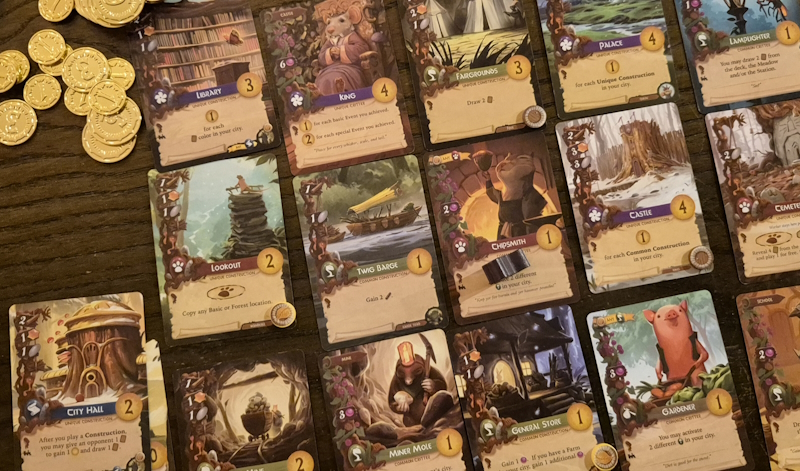
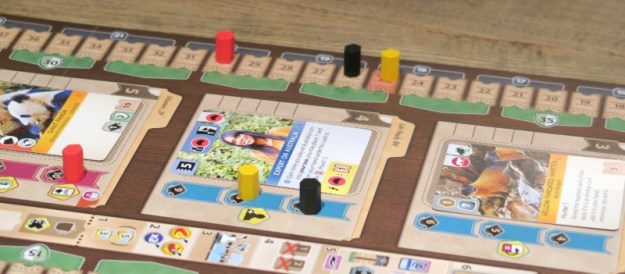
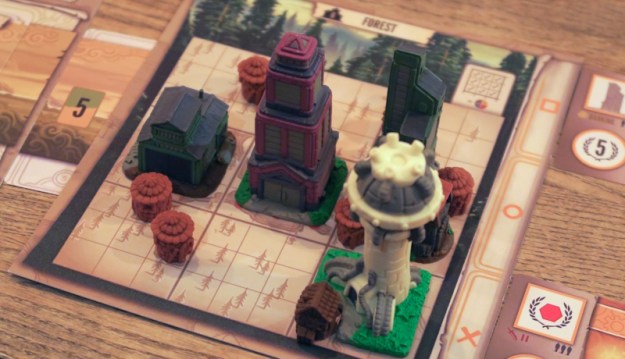
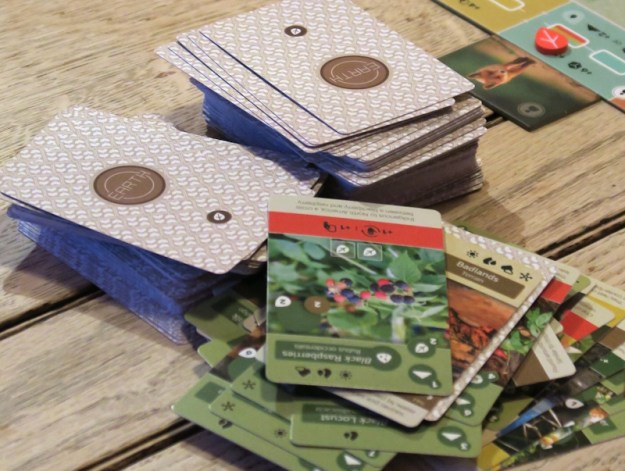
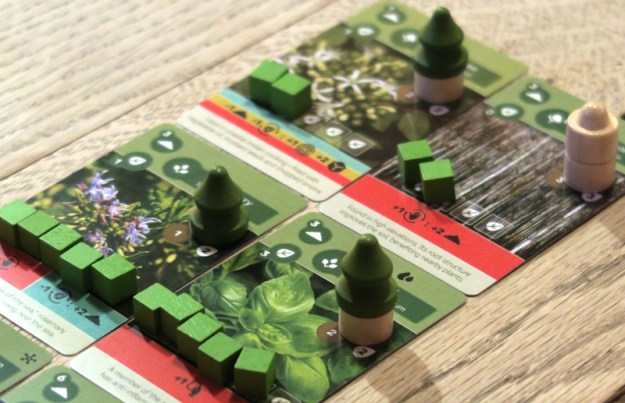
The evening began with the sad news that Kath and Ian and their daughters were leaving for a new pub in Shipton Abbot (or was that  Newton Abbot?).  They have been good to the group and worked hard to give us an environment that conducive to gaming, so it is sad to see them moving on, though Devon is quite a nice place.  Everdell is also reputed to be a nice place, and one that some of the group were to travel to perhaps using its new railway station, as the Newleaf expansion to Everdell was the to be the week’s “Feature Game“.  The game got going after about fifteen minutes of general faffing about and reminding everyone of the rules to the base game and explaining the additional features of the expansion.

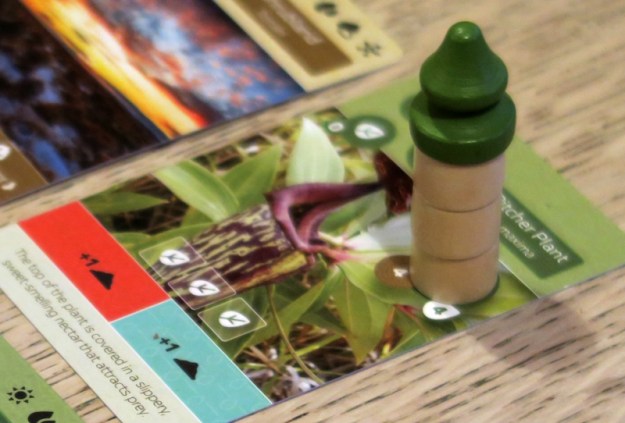
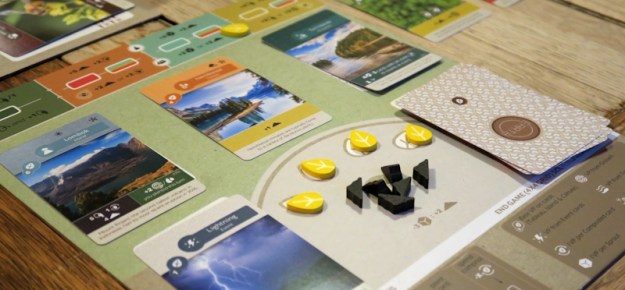
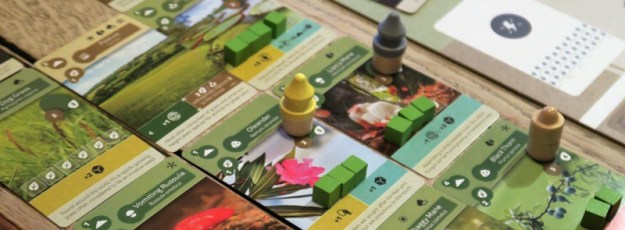
Everdell: Newleaf
– Image by boardGOATS

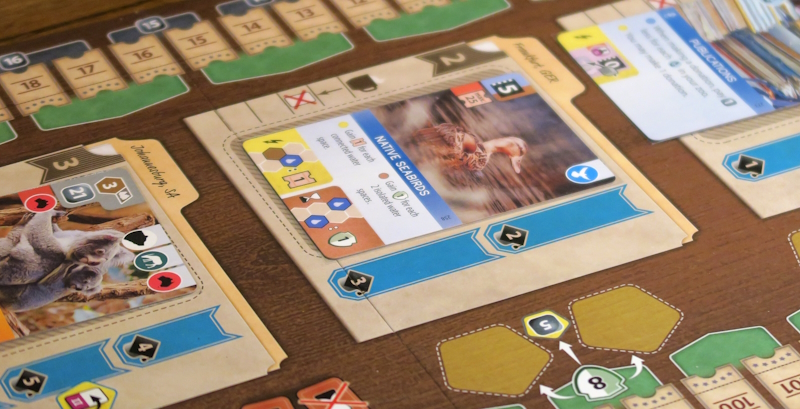
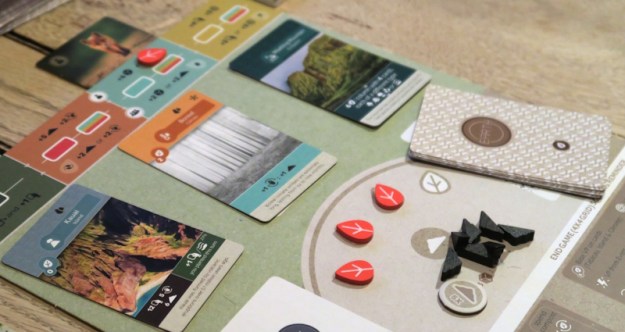
The base game is a fairly simple one of worker placement to collect Resources and spend them to place Cards.  Players keep playing until they run out of workers when they get them all back (vacating the associated Action spaces), and then start again.  The game is played over four rounds (or Seasons), with players with the most points from Construction and Critter Cards as well as Event (end-game scoring) Cards.  The Newleaf expansion adds new Critter, Construction and Event Cards, but more obviously, it a new railway station.  This and associated Visitor Cards, Freight Trucks (which provide an alternative way to get Resources), Travel Tickets, and Reservation Tokens.

Everdell: Newleaf
– Image by boardGOATS

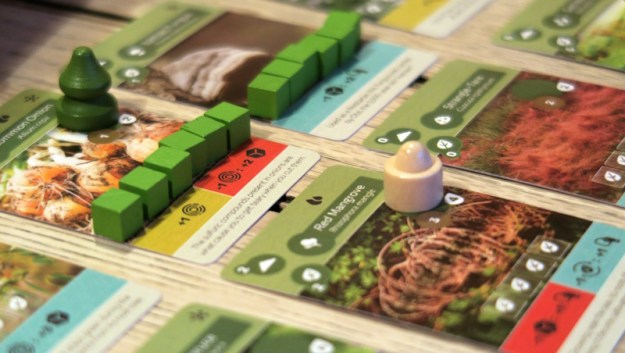
Plum (who obviously chose to play with Cat-eeple Workers) went first, grabbing some Resources, followed by Purple (Butterfly-eeples), Cobalt (Hedgehog-eeples) and then Ivory (Duck-bill Platypus-eeples).  Everyone started setting up their town, particularly focusing on green Constructions and Critters that could give income in spring. Plum built up a large pile of Resources and grabbed a Freight Truck with Resources loaded on it and her choice of discount when producing (paid in part using the Reserve Token to gave her a discount) . Purple didn’t go for green Cards, but red Cards with additional worker spots (in particular the Hotel and Chapel), whereas Cobalt and Ivory both got a Mine and Miner Mole, giving them access to valuable pebbles.

Everdell: Newleaf
– Image by boardGOATS

The length of Seasons in this game is variable, with some players doing more than others before they are forced to reclaim their Workers.  Purple passed on to Spring first, followed by Plum and then, sometime later, Cobalt and Ivory.  Cobalt gained a few blue Cards which had given him Resources (and in particular Cards) when playing Constructions and Critters, whereas Ivory had built quite a collect of green Cards, giving him a significant pile of Resources going into Spring. Spring was very similar to Winter, with everyone focusing on engine building, although Purple was beginning to struggle, due to a shortage of green Cards. Ivory made an early grab for Harvest Festival Event which gives a points bonus for having four green Cards in his city—he was already building quite a big tableau including a Castle.

Everdell: Newleaf
– Image by boardGOATS

Cobalt was taking things slightly more slowly, still focusing on blue Cards, which was enabling him to draw three cards every time he played a Card, so he was always at the hand limit.  Moving into Summer, Cobalt significantly stepped up his building, as did Plum.  She grabbed the Ever Wall Tower card which rewarded her for having nine Constructions. Having already taken Grand Tour event for having three red Constructions, Ivory was eyeing up the Royal Tea special event for having three green and two purple Cards in his town.  However, whilst focusing on collecting resources for buildings to complement his already built Castle and the Palace Card he had in his hand, he failed to notice Cobalt had already played three purple Critters/Constructions.

Everdell: Newleaf
– Image by boardGOATS

As a result, Cobalt beat Ivory to both the Royal Tea and the Scenic Flight awards. Much to Ivory’s disgust, Cobalt was then also able to claim the Sunflower Parade achievement award for having three Events too.  So, Ivory went into damage limitation mode, and began focusing on the passengers at Newleaf station as an alternative way to score points.  Purple was first to move into Autumn and as everyone else followed the focus was firmly on points.  Cobalt was able to collect the Juniper Jig Dance Contest Event card for having nine Critters (in part due to Ivory giving him the Fool!).  Ivory was collecting more passengers using his special ticket to enable him to take a worker back, something everyone had from the from the expansion while Plum was building as many building as possible.

Everdell: Newleaf
– Image by boardGOATS

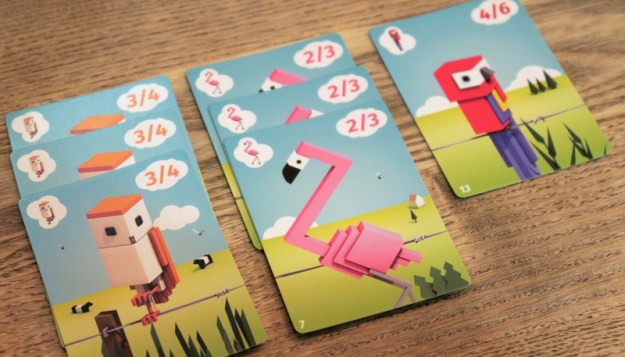
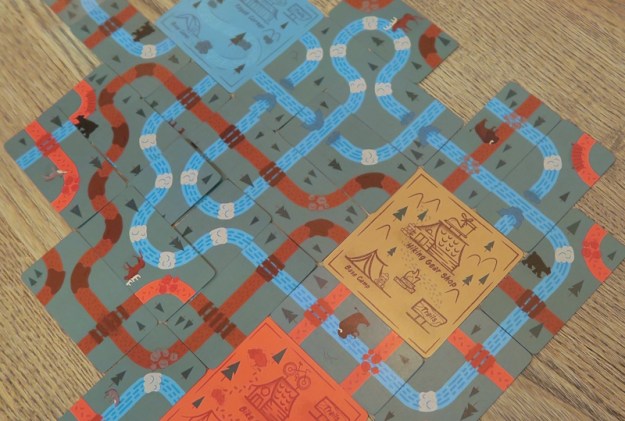
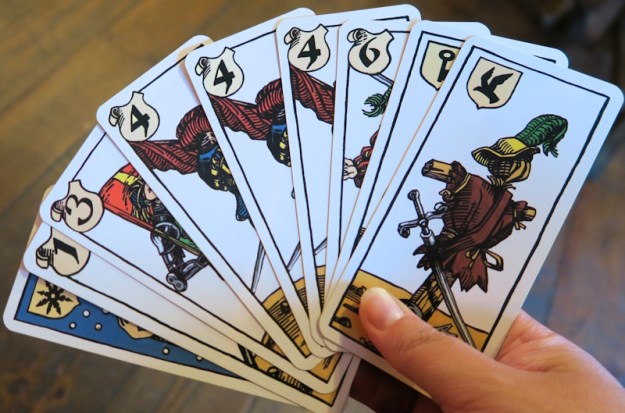
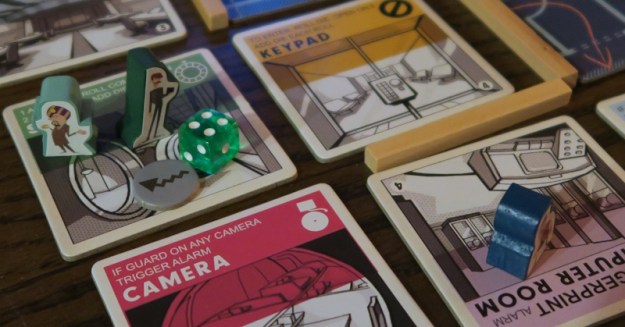
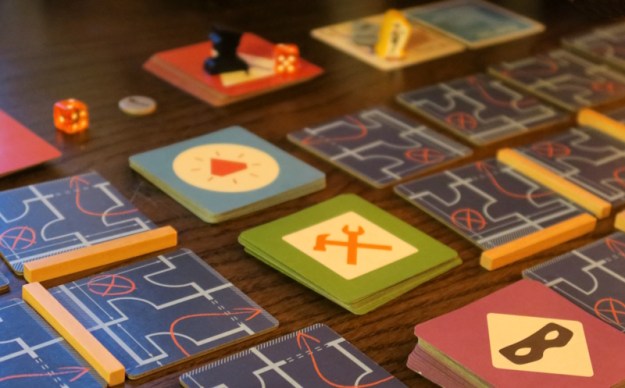
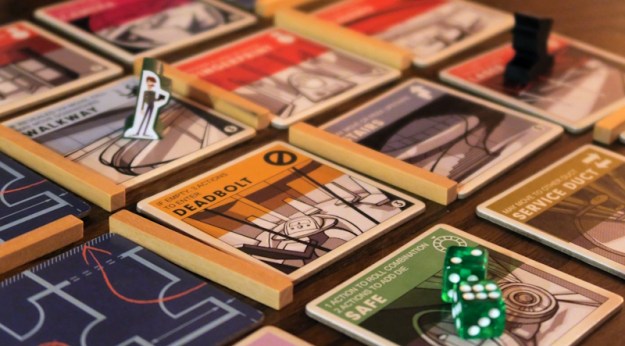
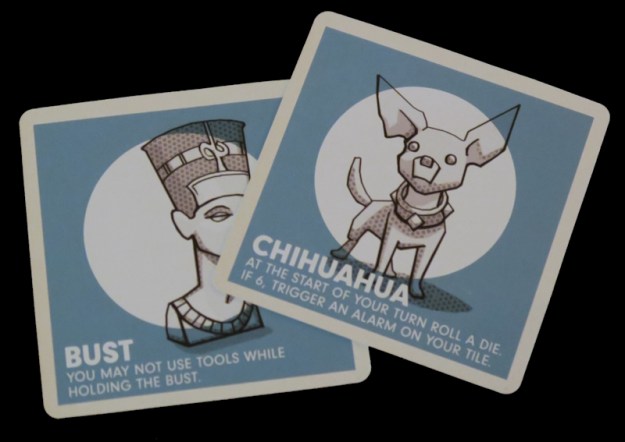
It was all a bit of a rush at the end as it was nearly midnight when the game finally finished.  Largely due to the scores for his huge number of Events, the winner was Cobalt with ninety-three points.  Ivory took second some ten points behind, closely followed by Plum who got over half her points for Critters and Constructions.  The game had taken all evening, but during this time, Pink, Pine and Lime had managed to get through no less than five games.  The first was one of Pink’s favourites, Zoo Break.  In this game, players work cooperatively to try to prevent the escape of animals from their zoo.  It is one of Pink’s favourite games, but this time it was very, very short-lived.

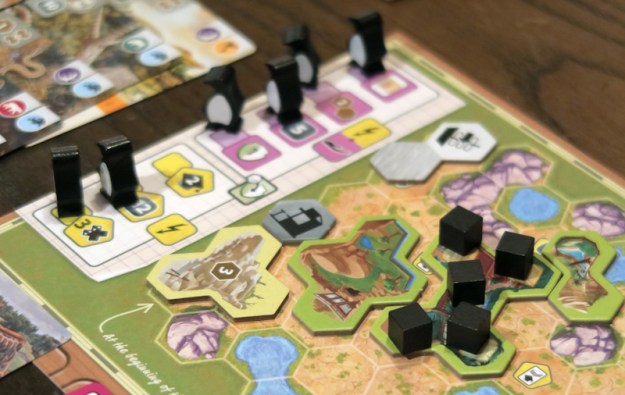
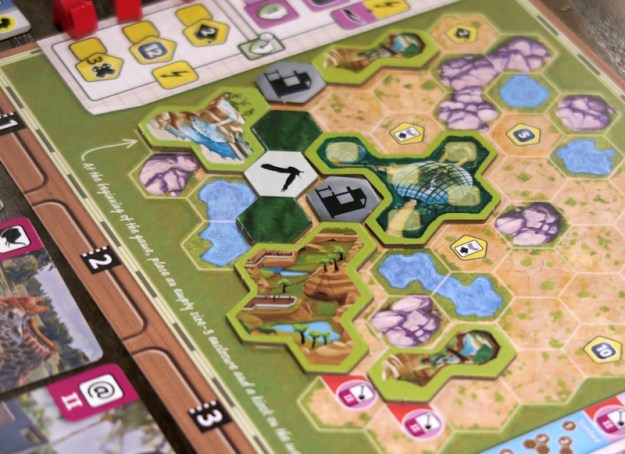
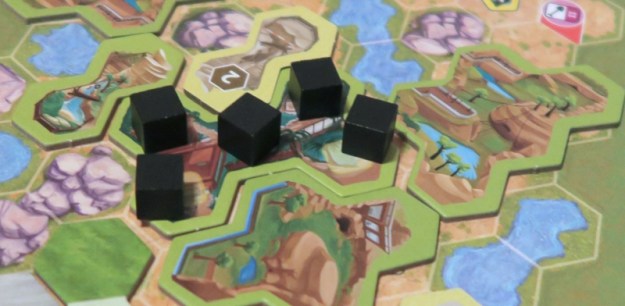
Zoo Break
– Image by boardGOATS

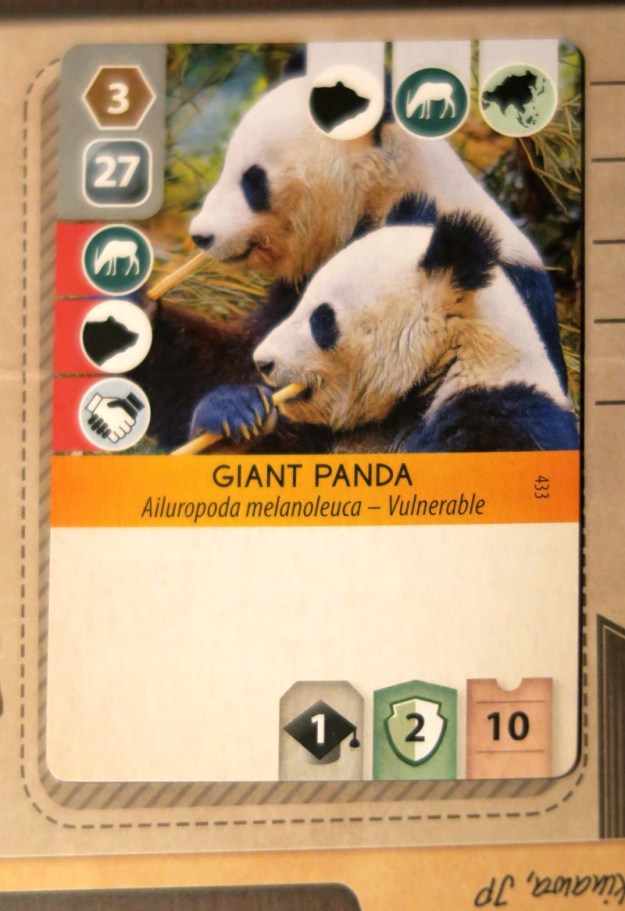
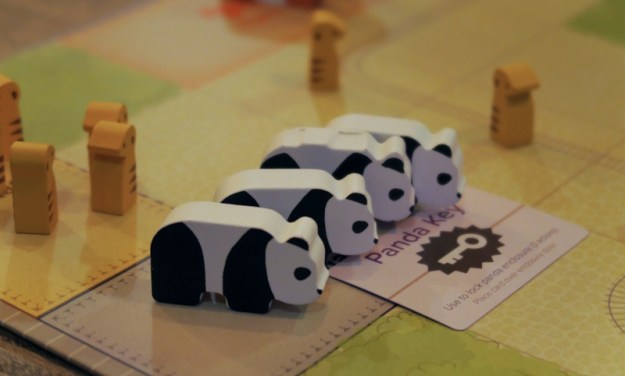
Things started well as the group locked up the Capuchins, Snakes and the Rhino.  But then the Meerkats, who were partying in the fountain, decided to make a bid for freedom.  Three tigers and four elephants were already on the loose and rampaging round the zoo and while Pink put two Pandas back in their cage, five of the Meerkats made it to the exit and headed out.  And thus a handful of mischievous Meerkats led to the sad demise of Bedlam Zoo (which really had been Bedlam this time).  To help get over the disappointment of the epic failure, the group decided to go on a a train ride around France with Les Aventuriers du Rail Express, a light version of one of the group’s favourite games, Ticket to Ride.

Ticket to Ride: Europe
– Image by boardGOATS

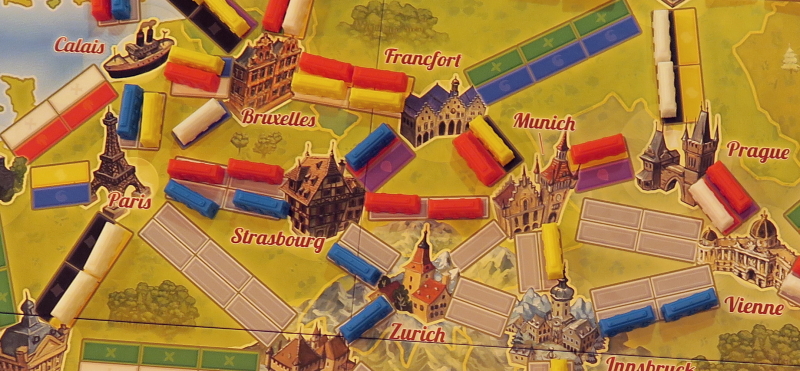
There are lots of versions of Ticket to Ride, from the teeny-tiny city editions through to the rather epic Rails & Sails and Legacy versions.  Les Aventuriers du Rail Express is a French map that is a step up from the city editions and fits between the standard games (Like Europe) and First Journey, making it slightly quicker than the full games, as it is played on a slightly smaller map with slightly fewer trains.  Aside from that, it is essentially very similar in game play to all the others:  on their turn players either take cards from the market, or spend them to place plastic train pieces on the map.

Les Aventuriers du Rail Express
– Image by boardGOATS

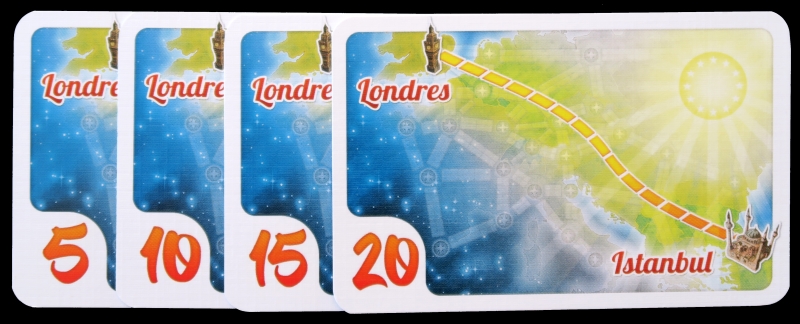
As in the larger version players can also take tickets, but this has to be balanced with the bonus for completing a route from London to Istanbul, the most distant pair of cities.  The first player do so gets twenty points, the second gets fifteen and the third gets ten.  Additionally, the wild Locomotive cards also work slightly differently in this game in that, instead of being mixed in with the market, they are always available from a separate stack, but as usual, players can only take one per turn.  Being a quick game, and with everyone feeling they knew the game and was in with a chance of winning, the group ended up playing it twice.

Les Aventuriers du Rail Express
– Image by boardGOATS

The first time, Lime finished with the most points from placing Trains, but both he and Pine carried negative points from incomplete Tickets.  Incomplete tickets are a real drag as they effectively, carry a swing double their face-value.  As a result, Pine just pipped Lime to second place.  The winner was Pink, however, despite the fact that he had the lowest points for his tickets; he did finish the London to Istanbul connection first though.  In the second game, the roles were somewhat reversed with Pink taking the most points for placing trains, but failing to complete the London to Istanbul route at all.  The winner was Pine who, like Pink in the first game, also claimed the maximum of twenty bonus points, while Lime was the runner up.

Les Aventuriers du Rail Express
– Image by boardGOATS

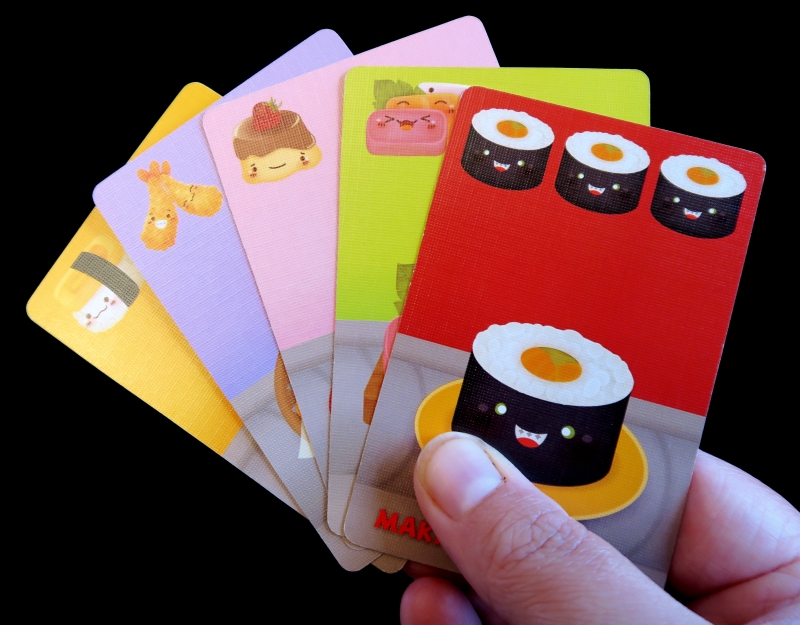
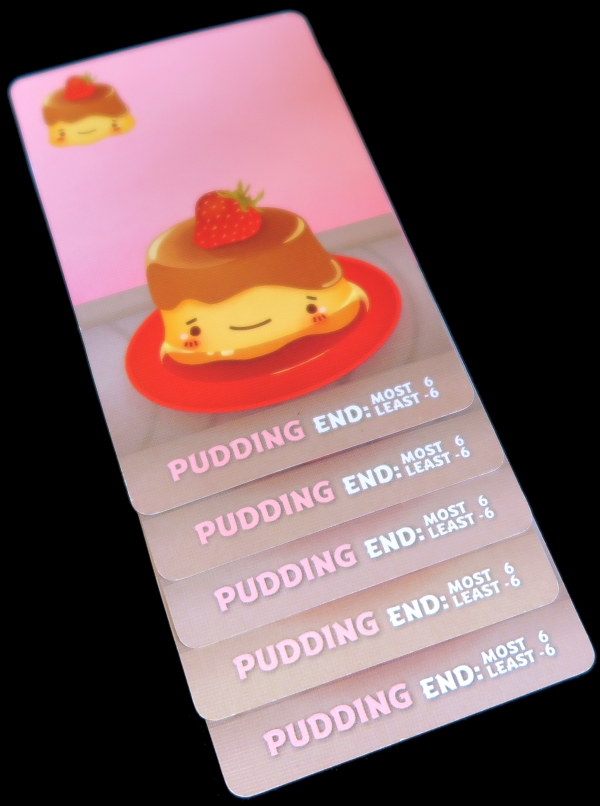
Everyone else was still playing, so the trio managed a quick couple of games of the card-drafting game, Sushi Go!.  This is a very simple game, where players start with a hand of cards and choose one to add to their tableau before passing the rest on.  Played over three rounds, players collect points for collecting Maki Rolls, Sashimi and Nagiri (which is all the better when combined with Wasabi).  At the end of the game, players with the most Pudding cards score an extra six points, while those with the least lose six points.  The player with the highest total is the winner.  The points throughout both games were fairly even with nobody crashing out or having a golden round.

Sushi Go!
– Image by boardGOATS

Despite this, the winner of the first game took it by a bit of a land-slide.  It’s true that Lime top-scored in two of the three rounds, but they were all really close.  The real difference, therefore, was made by the Puddings which he had the most of and left him with a total of forty-five, a dozen more than Pink, the runner-up.  It was fairly inevitable then that in the second game, there was quite a battle for the Pudding cards.  The scores were close again, and again Lime won two out of the three rounds.  The overall winner was arguably Pink, who despite losing all three rounds had the most Puddings and therefore took victory from Lime on a tie-break.

Sushi Go!
– Image by boardGOATS

The final table for the evening, consisted of Jade, Sapphire, Black and Blue playing Meadow with the Adventure Book expansion.  Meadow is a clever little card game where players collect cards to add to their tableau from a central market.  On their turn players place one of their tokens next to the grid with the type of token and the location combining to dictate which card they take.  Players can then add a card from their hand (which may or may not be the one they picked up) to their tableau.  In the base game, there is an additional campfire board, but the Adventure Book replaces this.  Each “page” from the book changes the mechanics to a greater or lesser extent.

Meadow: Adventure Book
– Image by boardGOATS

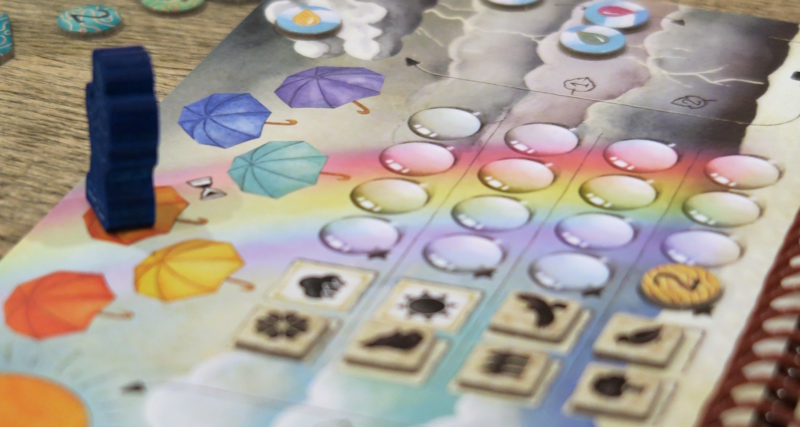
The group played with the first scenario, which introduces Weather.  There are two token that indicate a row and a column in the market, and every time a card is taken from these, players can move along the appropriate Weather track.  Reaching the end of these gives players extra cards.  Additionally, placing a token in a space in the Book allows players to claim rewards if they have fulfilled the criteria and have the two symbols shown visible in their tableau.  These give extra points at the end of the game.  There was a lot of faffing about and getting to grips with the rules changes, especially as initially, the wording in the rules for the expansion was a little unclear.  Added to which, Black hadn’t played the base game at all before.

Meadow: Adventure Book
– Image by boardGOATS

Once the rules had been fathomed out and explained, the group got the game underway.  Different players targeted different card types with some going for the harder to place higher up the food-chain cards, while others tried to diversify.  Blue tried to get as many of the bonus points for collecting pairs of symbols as she could and as a result finished at the back of the pack.  The game is not a high scoring one though and those bonus points made a big difference.  It was not quite enough to give her the victory, however, and she finished one point behind Jade who topped the rankings with forty-six points, with Black in third.  It had been a very enjoyable evening all round though, regardless of the number or type of game played.

Meadow: Adventure Book
– Image by boardGOATS

Learning Outcome:  Cards are a critical part of most modern games.

4th February 2025

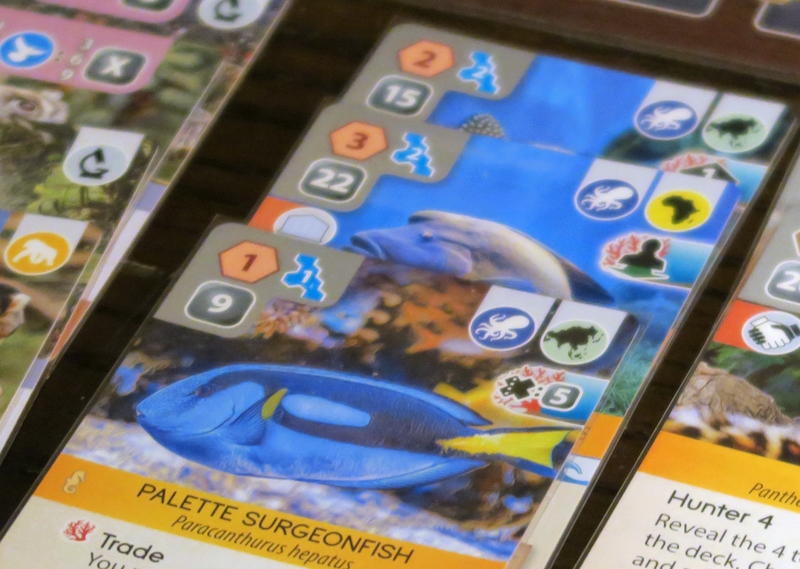
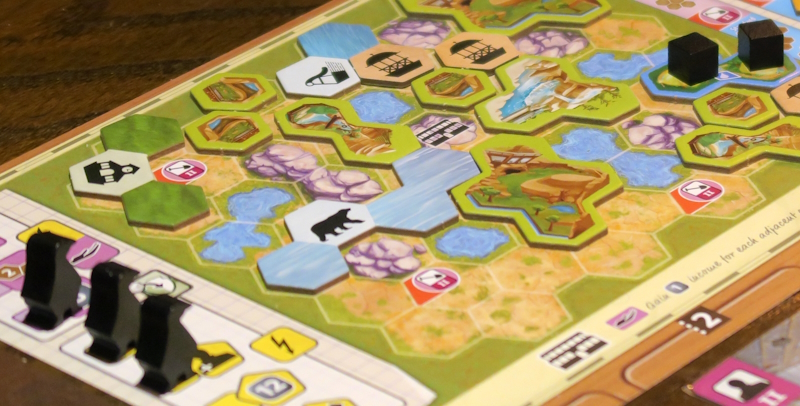
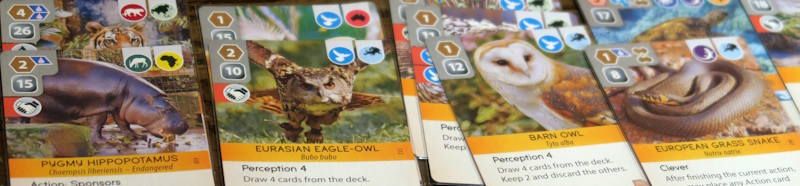
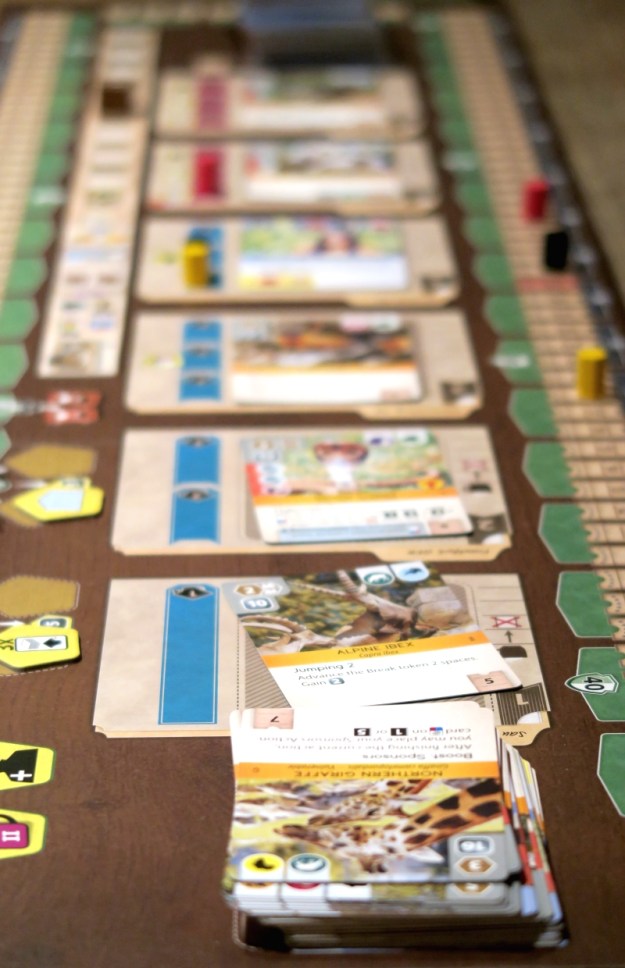
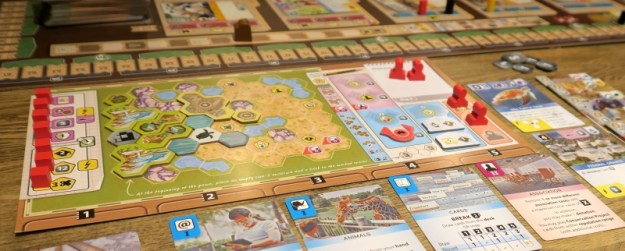
Blue and Pink were just finishing their supper when not one, but three copies of Ark Nova walked in, escorted by Ivory, Cobalt and Green.  This was because the “Feature Game” was to be its Marine Worlds expansion and, as Ark Nova is a substantial game that doesn’t get as many outings as it deserves, everyone was keen to give their copy a bit of an airing.  The game is much longer than those we usually play on a Tuesday so everyone who was keen to play was early and started setting up promptly.  Given the length, we also erred on the lower end of the player count, with just Ivory, Cobalt and Green playing.  The game is all about planning and designing a modern, scientifically managed zoo, but the game-play is more like Terraforming Mars with animals, than Zoo Break or Zooloretto.

Ark Nova
– Image by boardGOATS

Although it is quite a complex game, functionally it is not difficult to play on a turn by turn basis, though there is quite a lot to manage and keep a track of.  On their turn, players take one of six possible actions:  activating one of the five action cards (Cards, Build, Animals, Association and Sponsor) with a strength equal to the number above the card.  When activating a card players perform the action based on its power level which is dictated by its position in the row.  During the game, players can upgrade and turn over the action cards to a more powerful second side using various Bonuses.  The Marine Worlds expansion introduces several new elements to the game.

Ark Nova: Marine Worlds
– Image by boardGOATS

Firstly, there are sea animals that have to be played in new special enclosures that must be built adjacent to water.  Roughly half the sea animals are reef dwellers, and whenever a player adds a reef dweller to their zoo, they trigger the ability of all reef dwellers in that zoo. To deal with the dilution of the deck (caused by adding more cards), all sea cards feature a wave icon, and whenever it is revealed in the display, you discard the first card in the row, then replace it.  For each of the five Action cards there are four alternate versions with a little twist. Players draft these action cards at the start of play, replacing two of their standard action cards with these new ones, increasing the asymmetry in the game.

Ark Nova: Marine Worlds
– Image by boardGOATS

A new fourth University option is also available on the Association board.  If a player takes it, they claim one of six special Universities from the Reserve that feature one Research icon and one of six animal icons.  When a player takes this, they reveal Cards from the top of the deck and keep the first revealed card with an animal icon that matches their chosen University.  There are also new bonus tiles and other little bits and pieces to smooth out the game play.  Although the Marine Worlds expansion comes is modular, the group chose to play with all the components (Marine animals, asymmetric maps and drafted action cards).

Ark Nova: Marine Worlds
– Image by boardGOATS

Ivory took a Sponsor Card that gave him extra money for breaks and an Association Card that gave him the ability to hire workers.  This coupled with the lake map which gave extra money for building around the lake meant Ivory had access to lots of cash as the game developed.  Both Cobalt and Green took a Sponsor and an Animal Card, with Cobalt taking a map that allowed him to discard cards for money while Green had the map with the park restaurant.  While Cobalt was also able to build up a lot of cash, Green spent most of the game playing the poor relation, just scraping by.  The game started slowly, with initial conservation projects devoted to Australian animals, Birds, and African Animals.

Ark Nova: Marine Worlds
– Image by boardGOATS

Both Green and Ivory wound up spending all their early money, trying to get Animals out, whereas Cobalt focused on the Association board and playing Sponsor cards.  After struggling with money for the first couple of rounds, Ivory managed to get two Australian animals, allowing him to put a token on the conservation card, giving an additional Zoo Dollars at each break/income step and from then on, money wasn’t too much of an issue for him. Green however, struggled for money for most of the game, where Cobalt continued to focus on Sponsor Cards and Association Actions, and as a result, he took an early lead on the Research track which gave him a much greater card choice. Cobalt did build an early aquarium, however, and started filling it up with fish.

Ark Nova: Marine Worlds
– Image by boardGOATS

After a quick start, both on the conservation track and appeal track, Ivory’s game slowed down significantly—he was too focused on animals, compared to Green and Cobalt.  They had both spent time taking Association actions, leading them to Upgrade cards and progress up the Reputation track. Cobalt was able to significantly move up the Conservation track in the middle game using his Sponsor Cards, whereas Green focused on one big move by having lots of birds in his zoo.  Much to Pink’s disgust, although the panda was an option at one point in the game, the “wave” added by expansion pushed it on, so nobody got the Panda.  Instead, by the end of the game, Ivory had quite a collection of monkeys, Green had a few some birds and Cobalt had a lot of fish.

Ark Nova: Marine Worlds
– Image by boardGOATS

Going into the end game, Cobalt some way ahead on the Conservation track, followed by Green, while Green and Ivory were fairly similar in Appeal.  Cobalt then started playing lots of animals in his zoo and managed to completely fill it moving rapidly along the Appeal track.  It was clear he was soon going to bring the game to a close, due in part to both his (and Green’s) ability to make donations by upgrading the Association card. Green was also moving forwards on both tracks while Ivory was lagging behind albeit with three conservation cards in hand. Fortunately, Ivory had lots of “x tokens”, allowing him to play all his conservation cards (and gain the additional worker he needed, shooting up the conservation track, though sadly, it was too little too late.  From there, It wasn’t long before Cobalt’s Tokens to crossed, ending the game.

Ark Nova: Marine Worlds
– Image by boardGOATS

Everyone had made some mistakes reading their cards and/or abilities which cost a little bit, but was probably fairly balanced out.  Everyone managed to get the full four Conservation points on their personal scoring cards, but Green picked up quite a few extra points from the Sponsorship cards leaving him level with Cobalt.  Inevitably, this led to a hunt for tie-breakers—the rules state that the tied player who supported the most Conservation Projects wins the game.  As Green and Cobalt had also supported the same number of Conservation projects the rules dictated they should share the victory.  That said, Green magnanimously said he felt Cobalt had the edge by virtue of having way more coin at the end of the game.

Ark Nova: Marine Worlds
– Image by boardGOATS

On the next table, Blue, Pink and Mint had finally got underway playing Kavango.  This is a conservation, card-drafting game.  A bit like games like Sushi Go! and 7 Wonders, players draft cards to build their Reserve.  Like games like Terraforming Mars, however, cards can only be added to a player’s Reserve if they have its requirements.  These might be the food supply, or enough protection (environmental, poaching or climate).  Climate protection is unique because, as in real life, players have to work on that together.  At the end of the game, after three rounds, players add up the value of their animals, and any bonuses together with any points scored during the game for Research, and the player with the most points is the winner.

Kavango
– Image by boardGOATS

Pine joined them briefly and expressed an interest in playing another time, but decided this week he would take himself home to better acquaint himself with his C-vitamins and avoid unnecessarily sharing his bugs.  Mint was the nominal first player, though mostly the game is played simultaneously.  Blue started hard and fast building up lots of income, however, she was forced to invest heavily in Climate protection—honourable, but not necessarily lucrative.  Pink and Mint were a little slower to start, but made good progress.  Both got caught out by a very minor rules malfunction that had a significant impact:  Cards not used at the end of the round are supposed to go into a discard pile, but instead were returned to their decks.

Kavango
– Image by boardGOATS

Towards the end of the game, this suddenly became significant as some types of card are not available in the final rounds.  So, those that needed, for example, termites (like Mint), were unable to get them.  Pink and Mint were most obviously affected, though everyone got caught in some way or another.  The card draw hindered Blue as she struggled to find any migratory animals at all and had to abandon her personal objective as unachievable.  In contrast, Mint and Pink both did really well with theirs (birds and toxic creatures respectively), making the result much closer than it would otherwise have been with Blue the victor with a hundred and seventy-one, a single point more than Mint.

Kavango
– Image by boardGOATS

Meanwhile, Plum and Byzantium had kindly agreed to take Lime to the other side of the room to play the Golden GOAT Award 2024 Winner, Stamp Swap.  Somehow, despite the flurry of outings it received towards the end of last year, Lime had missed out on playing it.  This is also a drafting-type game, but this time with stamps (mostly).  The game takes place over three rounds, each split into two parts:  Firstly players take it in turns to choose from a central pool, then players divide their pile into two and the first player chooses one pile from another player to take, who keeps their other pile and chooses one from another play—and thus the piles of stamps are swapped.

Stamp Swap
– Image by boardGOATS

On previous outings, Byzantium had managed to annoy Blue by just beating her.  It had been his birthday at the weekend, so the question was whether he would get another, albeit slightly belated, birthday gift in the form of another victory.  Sadly for Byzantium, it was not to be though.  Plum took ten more points than him during the game and another ten more in the end game scoring between them, giving poor Lime quite a trampling on his first game.  Stamp Swap wasn’t the only popular new game to get an outing this evening.  On the next table, Jade and Sapphire were introducing Purple and Black to Fromage, a sort of cheesy worker placement game with simultaneous play and a time component, not completely unlike Tzolk’in.

Fromage
– Image by boardGOATS

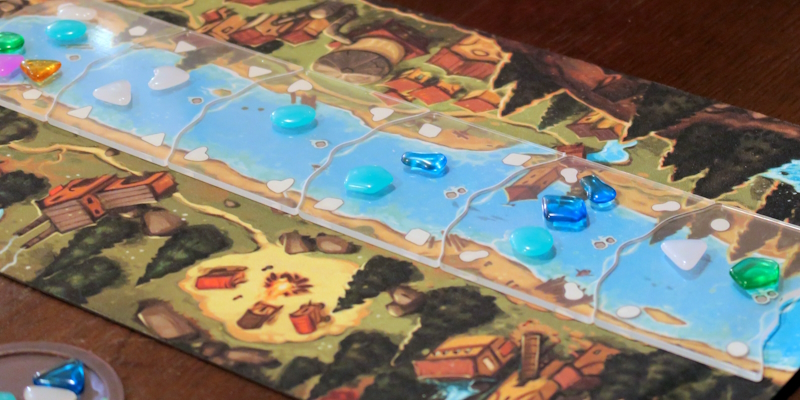
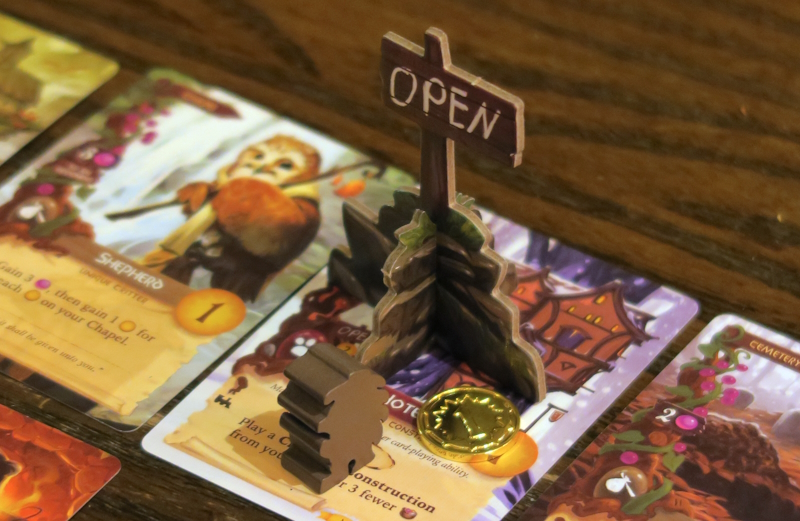
The actions are tied up in four “mini-games” which players take it in turns to participate in.  It has proven quite a popular little game because once everyone knows how to play, there is relatively little down time and despite playing different areas at different times, quite a lot of interaction.  Players simultaneously choose where to place their workers, in their quadrant of the board, and once everyone is done, the board is turned and then players retrieve any workers they can and then place workers on their next quadrant.  Players score points for occupying tables in the Bistro quadrant, holding the majority in regions in the Villes quadrant, filling different tables in the Fromagerie quadrant, occupying contiguous areas in the Festival quadrant, and for fulfilling Orders.

Fromage
– Image by boardGOATS

This time, Purple and Jade made a bit of a killing in the bistro taking nearly thirty points each, while Sapphire took twenty-two points in the Villes.  Black’s strategy was somewhat different, picking up points more evenly across the board and focusing particularly on fruit.  In the end, despite the differences in approaches, the scores were very similar, with only three points covering second to fourth.  The winner was Jade, however, some twenty points clear of Sapphire, who just nicked second, but a single point.  The game had been well received, and the group ended up “Doing a Lime” and playing it a second time.

Fromage
– Image by boardGOATS

The second game was also tight, although everyone was much more even in where they scored their points.  Sapphire just edged it though, again by a single point, again from Black, pushing Jade into third.  There was still time after the second game for something else, something new, something quick—Flip 7.  This is a really simple “Push your Luck” game reminiscent of Port Royal, where players simply turn over cards and gamble on not revealing the same number twice.  The catch is that each numbered card appears in the deck that number of times (i.e there is one one, two twos and so on).  Flipping over seven in a row gives fifteen bonus points.

Flip 7
– Image by boardGOATS

There are also some action cards in the deck, “Flip Three”, “Freeze”, “Second Chance” and modifier cards which give extra points.  Players take it in turns to decide whether they want to “flip” or ” stick”.  The game ends when players have reached the pre-agreed total (two hundred, according to the rules, though games can easily be made longer or shorter as desired).  In the first round, three players scored well, but the rest of the game did not go so well.  In fact, the only player who managed to score in every round was Black with a fairly consistent total around thirty.  It was no surprise that he was the first to pass two hundred and was therefore the winner, ahead of Sapphire and Purple, who were joint second with a hundred and seventy-six.

Flip 7
– Image by boardGOATS

Learning Outcome:  Zoos are even more fun with sea creatures.

17th September 2024

After the usual chatter and some food, the interested parties staked their claim to play the “Feature Game“, Stamp Swap.  This is a game where players take on the role of stamp collectors at a convention collecting, trading and then scoring their stamp album.  All the reviews claim it is a light game, but while it is not hugely complex, there is more to the game than appears at first glance.  At its core is the “I cut, You Choose” mechanism that is used in games like Isle of Skye and …aber bitte mit Sahne, but Stamp Swap is nothing like either of these.

Stamp Swap
– Image by boardGOATS

The game takes place over three rounds each with three phases:  Collect, Swap and Show.  In the collect phase, an Event card is revealed and then players take turns to take an item from the central pool.  Once everyone has six items, everyone puts one item aside to Reserve and then splits the rest into two piles for the Swap phase.  Some “I cut, You Choose” games struggle work across a range of player counts, for example, San Marco, really only plays well with three players where one splits the cards into three sets and the others choose.  While the game might work with two, the decisions would be too trivial (though there are variants with a dummy player).

Stamp Swap
– Image by boardGOATS

In contrast, dividing a pile into four would require too many cards and make the decision complex as well as make the game potentially quite “swingy”.  Thus, although the game officially plays three to four players, the mechanism really only works with three.  Stamp Swap avoids this problem with a snake-like mechanism that also negates the need for valuing the hands or the use of money as an intermediate (as in Isle of Skye).  The first player chooses one set and the owner of that set keeps their other set and chooses one from another player.  That player keeps their second set and chooses a set from another player and so on.

Stamp Swap
– Image by boardGOATS

Players then place the stamps in their album and score in the Show Phase.  There are four Goals in each game and each player can score one of these per round, but can only score each only once.  These Goals are different in each game giving a lot of variability, especially as thy combine together in different ways.  At the end of the game, players additionally earn points for the face value of each Stamp, for any Specialist cards they may have, for Stamps that match their personal Theme, and for their achievement in the Finale Contest, while receiving bonus points their place in the Forever Stamp competition.

Stamp Swap
– Image by boardGOATS

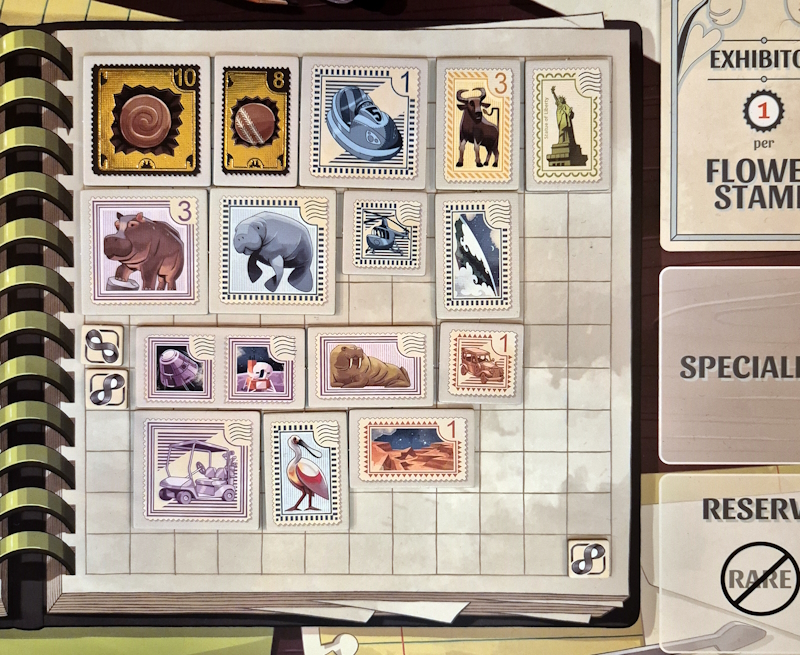
The unexpected complexity arises from the stamps themselves.  They come in five different colours, themes and size/shapes.  Some of these stamps are “Cancelled” (and have no face value) and some are “Faded” (and have a negative face value, but may be useful for claiming the Goals).  There is are special gilded Stamps with their own Chocolate theme and a high face value, but cannot be reserved at the end of the Collect phase.  Finally, there are the “Forever” Stamps.  These are Square and are the only Stamps available in the smallest size and have no face value, but are useful for filling tiny holes (should that be required for the Goals) and give bonus points at the end of the game (in much the same way as Pudding do in Sushi Go!).

Stamp Swap
– Image by boardGOATS

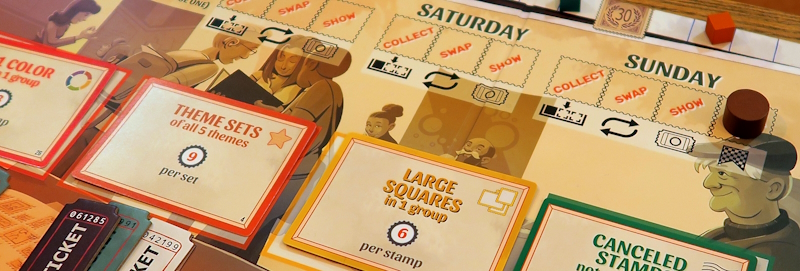
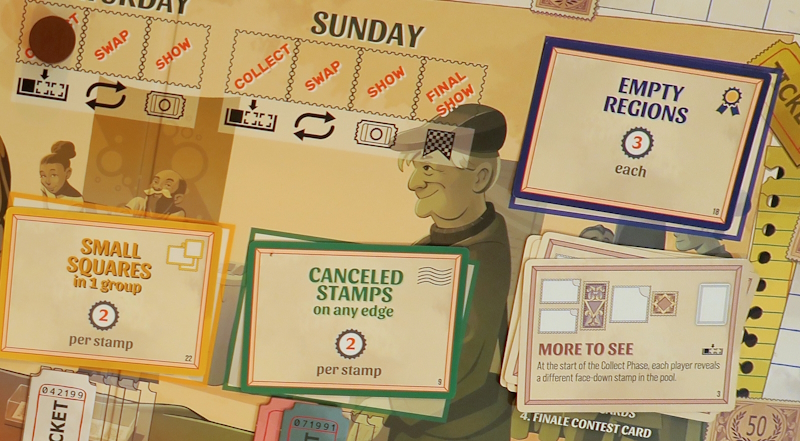
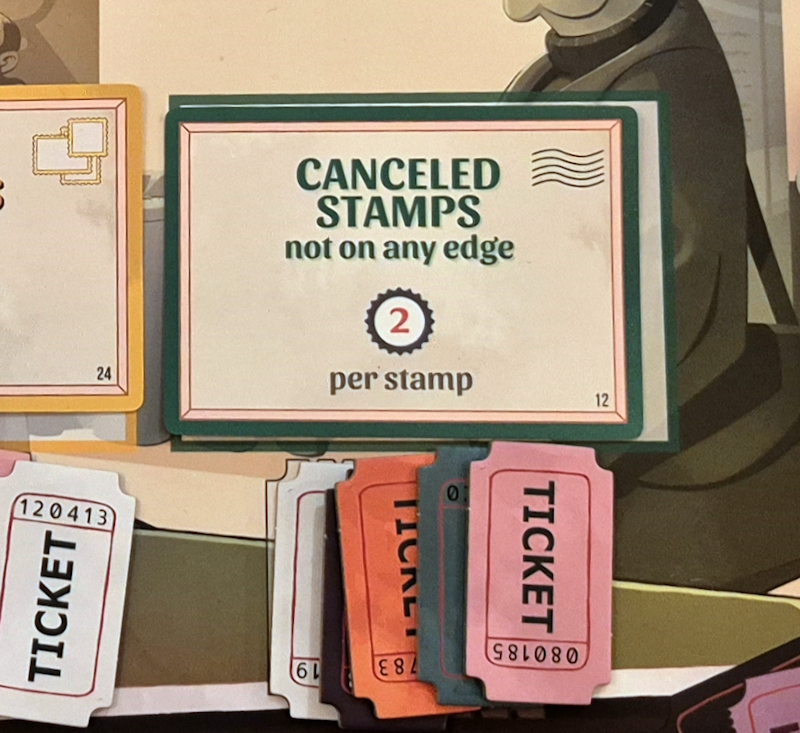
It turns out that the game takes quite a lot longer with more players, which was a bit of a surprise given that much of the game is played simultaneously.  This time Ivory led a group of five with Plum, Sapphire, Jade and Teal, while Blue led a group of four comprising Byzantium, Purple and Black.  Ivory’s group were quick off the mark and first to get going after the rules explanation.  Their Goals gave points for:  Stamps of one Colour in one Group; sets of all five Theme Stamps; Large square Stamps, and Cancelled Stamps not on the edge, while their Finale Contest gave points for the number of Stamps completely surrounded by other Stamps.  Ivory’s personal scoring objective was Space Themed Stamps, Plum’s were Animals, Sapphire’s were Vehicles, Jade’s were Monuments and Teal’s were Flowers.

Stamp Swap
– Image by boardGOATS

Everyone began by feeling their way a bit, especially as the first round added additional Specialists—cards that give extra powers for the rest of the game.  Plum made a “bee line” for these, while Jade and Teal focused on the Large Square Stamps, scoring the related bonus, and giving them an early lead.  Jade also managed to “hide a gold stamp (face down)” and ended up with it in his collect as no one took it.  Plum scored for the Cancelled Stamps first, as she had picked up a lot of them.  As nobody chose his set, Ivory ended up with all his own Stamps, which he thought was great at first, but then had second thoughts as he ended the first round at the back of the pack.

Stamp Swap
– Image by boardGOATS

In the second round, the event was “Rewarding finds” giving two points immediately for taking a face down Stamp, which everyone was keen to do, especially Plum, who quickly caught up with Jade and Teal as a result.  Plum made good use of her “Swap one for three face down Stamps before splitting your collection” to grab extra Stamps.  Teal managed to hang on to the First Player token for most of the game and also took a lead on the Forever Stamps. Sapphire grabbed an exhibitor for Yellow Stamps and proceeded to take Stamps to match wherever possible (both from the pool and from other peoples piles). Ivory made a point of collecting a full set of five different Theme Stamps, scoring nine points, as well as managing to keep a valuable face-down Gold stamp.

Stamp Swap
– Image by boardGOATS

Going into the final round, Ivory was still trailing significantly behind everyone else who were bunched tightly together.  This time the Event gave bonus points for taking Stamps that matched the Theme of their neighbours, which made the game slightly meaner as everyone was taking Stamps others wanted.  Plum was again using the additional Stamps she was getting from her Specialist to shape what she was going to end up with, managing to get three complete sets for twenty-seven points. Jade also managed to score well for this in the final round, as well as for the coloured Stamp cards he collected. Sapphire was similar with his vehicles and Yellow stamps, as well as scoring scoring for Large Square Stamps.

Stamp Swap
– Image by boardGOATS

Teal fell a little behind, taking fewer points for the Cancelled Stamps on the edge and he also failed to collect any of the Flower Stamps he needed as everyone kept taking them during the swap phase (in order to get complete sets). Ivory meanwhile focused on getting as many Large Square Stamps adding to the three he already had, giving him a massive fourty-two points taking him from behind and giving him a significantly lead.  In the final scoring, Teal took the bonus for the most Forever Stamps giving him ten points while and everyone but Plum tied for second with a single Forever Stamp, giving six points.

Stamp Swap
– Image by boardGOATS

Everyone managed to get at least one gold stamp, but Ivory had the most valuable total face value.  Plum scored most for specialists, although most people had at least one, so this made little difference to the scores. Everyone scored well for the Finale Contest, especially Jade, and Plum, but it was not enough to overhaul Ivory’s lead.  He finished with a total of a hundred and forty-eight, ten more than Plum who took second place, who was a handful of points ahead of Sapphire in third.  On the next table, Blue took longer to explain the rules, but once they got going, they soon caught up with the first group and ended up finishing just before.

Stamp Swap
– Image by boardGOATS

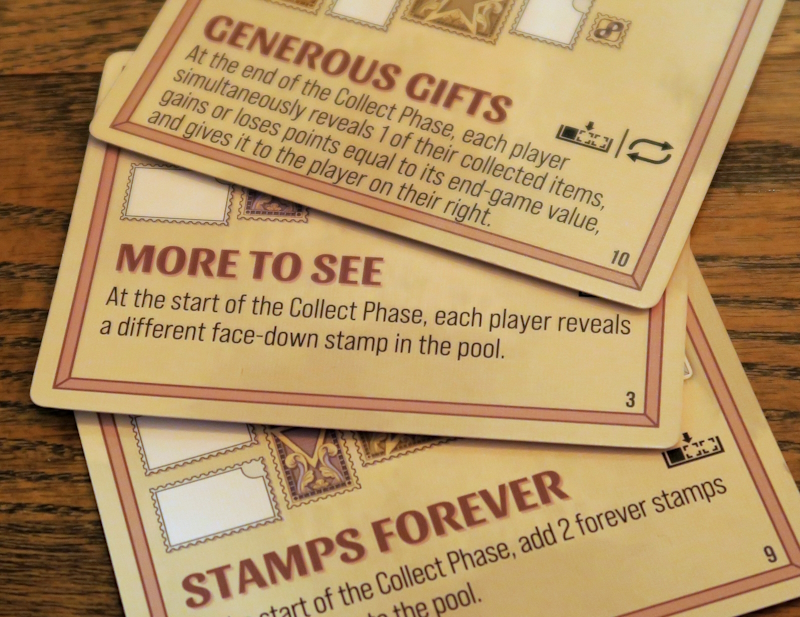
Their first Event card was “Generous Gifts” so after the Collect phase, players choose one collected items to score and then pass on to their neighbour.  Everyone quickly chose their highest scoring Stamp, then realised that meant they would lose it, so had a bit of a re-think.  It was then that the group began to really appreciate the quandary at the centre of the game:  it was all very well taking nice tiles, but they were no use if someone else took them.  This tension was particularly obvious in the final round of the first game where the “Mine not Yours” Event gave points for taking Stamps that matched a neighbour’s theme—while players lost the opportunity to pick up Stamps they wanted in the Collect Phase, they had the chance to take them in the Swap phase.

Stamp Swap
– Image by boardGOATS

The Events in the second and third rounds were “More to See” and “Stamps Forever”.  These had a much smaller impact on the game play, or at least it felt like that, though the Forever Stamps were all collected in the final round.  The Finale Contest was “Empty Regions” which gave three points for each empty region.  Black showed everyone how to to maximise this and from the end of the first round, everyone’s collections began to look like every-expanding checker boards.  Comparing the final album boards between the two games, the layouts were completely different with compact groups for the first game and gappy sprawling displays for the second game.

Stamp Swap
– Image by boardGOATS

Black picked up the bonus for having the most the Forever Stamps, and Byzantium, who by his own admission had been “pants during the game” picked up loads of points in the dying stages.  Purple had done the best with her personal Goal—Flowers, while Blue had a plethora of rare, valuable Stamps.  During the game it had been unclear who was really in the lead as the scores seesawed a bit, but Byzantium’s lunge for the line gave him the lead when it mattered and he finished with a hundred and forty-six points, seven more than the runner up, Blue.  All in all, everyone had enjoyed the game, though the overwhelming feel was that there was much more to the game than the reviews claimed, but that’s a good thing.

Stamp Swap
– Image by boardGOATS

Cobalt was the only person with a strong aversion to playing Stamp Swap, but Pine, Lime and Pink were all keep to play one of their favourite games, Zoo Break, another game that wasn’t really his type.  In he end, Cobalt graciously joined in the keepers of Bedlam Zoo, trying to keep the animals under control.  The game is a cooperative game, where players take it in turns to roll a die to determine how many actions they get, take the actions like acquiring
supplies, capturing animals, locking enclosures etc., before cards are drawn to see what animals escape and then move towards the exit.  The aim is to get all the animals back into their cages and lock them before five animals  or anything dangerous gets out.

Zoo Break
– Image by boardGOATS

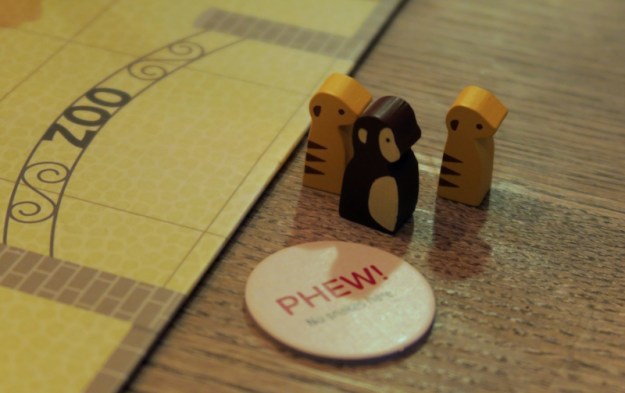
The group chose to use the standard difficulty (two “Phew” cards), but with the “Faulty Lock” variant.  This is where players roll to see if the lock holds when one of the locked up animals tries to escape; it adds a but of interest to the end of the game, however, unfortunately this time, the group didn’t get that far.  They managed to lock up the Elephants, Tigers and the Rhino, but the mischievous Pandas remained rogue until the end of the game.  They weren’t the problem, however, that was the Snakes.  Three harmless Garter Snakes got out, but they were followed by a Viper, and as it left, so did the group’s zoo license…

Zoo Break
– Image by boardGOATS

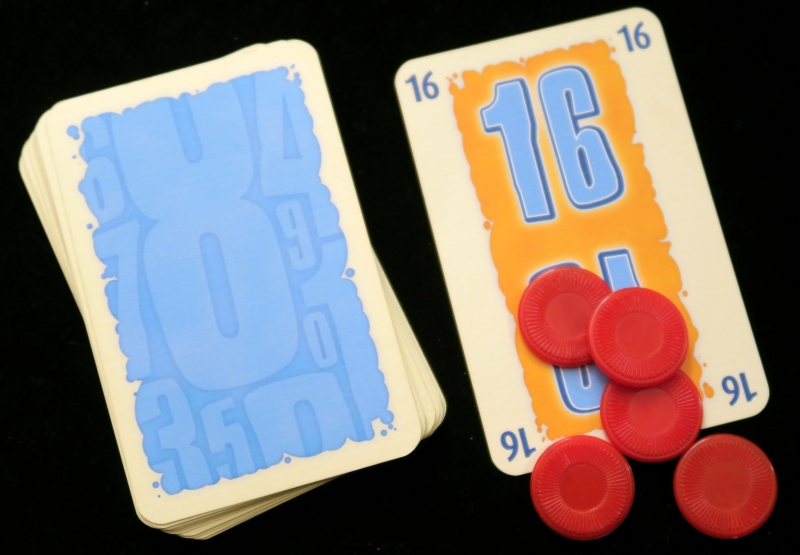
With Bedlam Zoo sadly closed prematurely, the group moved on to a couple of quick fillers.  The first of these was No Thanks!, a really clever little “cards with numbers” game.  The idea is that players either take the face up card or pay a chip to pass the problem on to the next player with the aim being to be the player with the lowest total at the end.  The clever part is that if a player has a run, only the lowest value card counts, but the deck also has some cards removed at random.  This makes it a proper gambling and “push your luck” game.  This time, Cobalt was the top scorer, but the winner with eighteen was Pink.

No Thanks!
– Image by boardGOATS

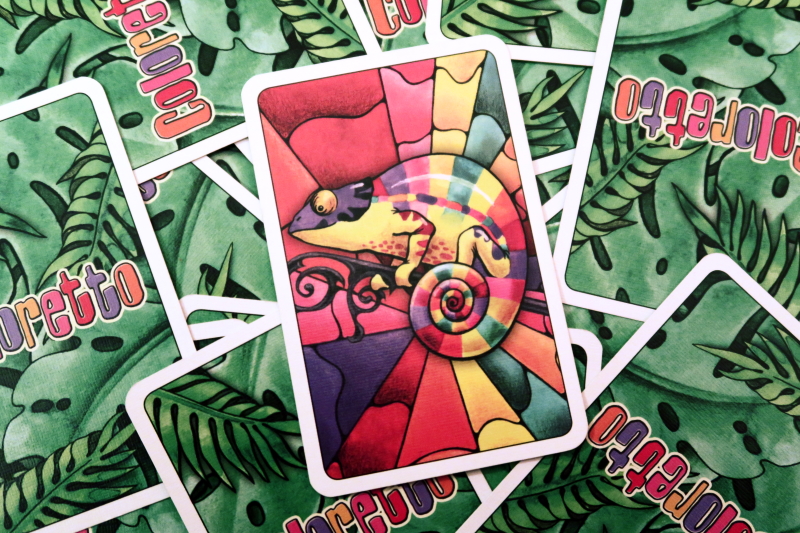
There was just time for one more game, Coloretto.  This is another simple and clever card game, this time the essence of the core mechanism in the bigger game, Zooloretto.  The idea is that players either draw a card and add it to a truck, or take a truck and add its contents to their collection.  At the end of the game players score their three largest sets positively, with negative points for any other sets.  The clever part is the use of the Triangular number sequence which means the first card in a set is worth one point, while the sixth is worth six.  There were the usual questions about Joker cards which resulted in questions being called across the room, but in spite of taking all three Jokers in the deck, Pink was just second by three points behind Lime’s total of forty.

Coloretto
– Image by boardGOATS

Learning Outcome:  A game about Philately can be more than just Stamp Collecting.

16th April 2024

Everyone seemed more keen on standing around and chatting that playing, but eventually, once everyone had arrived, people started dividing up into groups.  Ivory began by leading Jade, Sapphire and Cobalt to the other side of the room to play the “Feature Game“, which was the new “hotness” Let’s Go! To Japan.  In this game, players are travelers planning, then experiencing their own dream holiday in Japan.  Played over thirteen rounds, players draw activity cards place them in different days in their week-long itinerary. These can’t-miss tourist attractions have players traveling between Tokyo and Kyoto as they try to maximize their experience by optimising their activities while balancing resources.
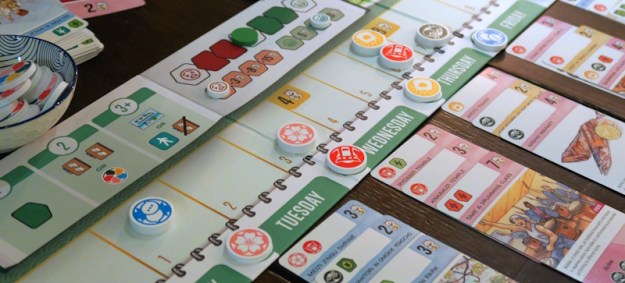
Let's Go! To Japan
– Image by boardGOATS

In each of the thirteen rounds, players draw cards according to the pre-organised sequence.  For example, there are two decks of cards (Tokyo and Kyoto), and for the first four rounds, players take one card from each deck, keep one and add it to their tableau assigning it to one of the days of their dream, then pass the second card to their neighbour.  In the fifth round, players take the four cards they’ve been given and then they place two in their tableau and pass two on, and so on.  Once eighteen cards have been played (three on each of the six days), the game is over and players take their planned trip, activating each of their cards in order, starting on Monday and work their way through to Saturday.

Let's Go! To Japan
– Image by boardGOATS

There is a catch:  where there is a swap between the two decks, players have to move between the cities of Tokyo and Kyoto by playing a Luxury Train Ticket which they can acquire during the game.  Each of these is worth two points.  If players do not have enough tokens to cover each change, they play a Regular Train Ticket from the supply which costs them two points.  Activating cards involves moving the players’ five Experience tokens along a track, increasing or decreasing their Mood, Stress and Happiness, gaining points and then evaluating the requirements for the Highlight of the Day depicted on the final card of the day.  If these requirements have been fulfilled, the player gets bonus points and the player with the most points at the end of the game is the winner.
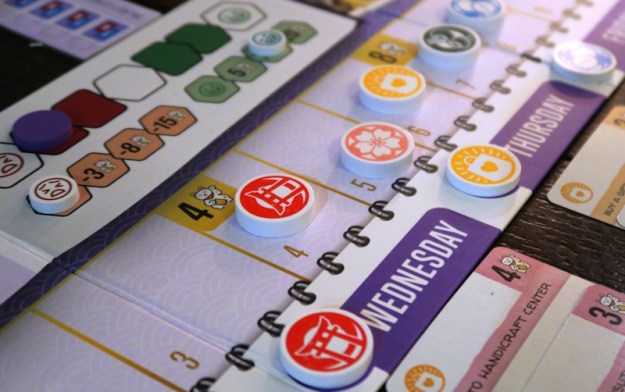
Let's Go! To Japan
– Image by boardGOATS

The game rattled along very quickly with swift turns and the added bonus that setup was quite rapid too.  As a result, it was easily under forty-five minutes before everyone was explaining their plan and scoring it.  That said it was hard to keep track of what everyone was doing.  Ivory was the first to fill a day and managed to get everything aligned to get the top bonus of a Luxury Train ticket. Although this was very nice, it in no way indicated Ivory was going to get a big score.  Jade and Cobalt quickly followed suit, Cobalt also gaining Luxury Train Tickets (which he got quite a few of throughout the game), and Jade got quite a lot of the second best reward, choosing Wild Tokens that would be really useful at the end of game to ensure meeting Highlight of the Day/End of Game objectives.

Let's Go! To Japan
– Image by boardGOATS

Sapphire was spreading his activities out a little bit more, but as the game went on he also managed to build a large store of wild tokens.  At the start of the game, Jade and Sapphire (who were not sitting next to each other) focused more on Kyoto, whereas Ivory and Cobalt were playing a lot more Tokyo cards.  Inevitably, however,  everyone ended up going to both cities and need Train Tickets as a result. Cobalt and Jade were the only people who choose to grab research tokens; Cobalt used one of these mid-game and managed to manipulate his hand so he ensured he passed nothing of use to Jade, much to his annoyance.  Otherwise, everyone worked on their mental health and managed to keep their stress down scoring positive points for the trip.

Let's Go! To Japan
– Image by boardGOATS

At the end of the game, Sapphire, Jade and Ivory had minimized their travel between the two cities though, whereas Cobalt required a lot of trains:  as he had lots of Luxury Train Tickets he actually increased his score significantly with these.  Jade had not picked up enough Luxury Train Tickets, so was stuck on commuter trains causing him to lose a lot of points. Sapphire ended up with a quick return trip between Kyoto and Tokyo on his last day, but that was acceptable because you should always go out your way for Sake!

Let's Go! To Japan
– Image by boardGOATS

Scoring took longer than usual as everyone gave a detailed description of their trip. Both Cobalt and Sapphire scored well on every day of their trip, with Cobalt slightly ahead thanks to his Luxury Train Tickets.  Sapphire managed to complete all his Highlight of the Day objectives though without using his wild tokens, so he cashed these in at the end of the game to push all his tokens into the next scoring zone and subsequently won the game by two points from Cobalt.  It had been a highly enjoyable experience though, enhanced by the beautiful components, especially the extremely pretty, but totally over the top ceramic component bowls!

Let's Go! To Japan
– Image by boardGOATS

From there, the group then played a game of Faraway, a light game set on the mysterious continent of Alula with its ever-changing geography, shaped after the rhythm of the seasons.  On each turn, players play a card from a hand of three.  As play is simultaneous, players must take into account the priority system in all their choices—being last to pick a card leaves fewer options and often less profitable choices for later turns.  During the game, players will play a row of eight cards in front of them, from left to right. These cards represent the regions they will come across while exploring the lands. Characters on these cards will give victory points if the player later fulfills the conditions they demand.  At the end of the game, players walk back along the same route, scoring cards in the opposite order to that they were played in—and therein lies the heart of the game-play.
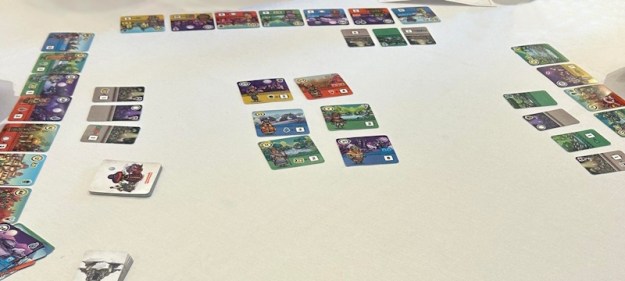
Faraway
– Image by boardGOATS

Throughout the game, the cards played serve both to set new objectives, and to meet ones played previously.  This time, Ivory started quickly out of the traps playing the highest card and subsequently getting the last pick in the following round, which was a minor hindrance. As the game went on, the order of picking the cards changed each time and everyone managed to pick first at some point, although it did seem like Sapphire and Ivory had the greatest varieties, mostly either being first or last!  Jade was very quick off the mark getting lots of maps which gave him a significant card advantage throughout the game as he could look at four or five cards and pick the best one. Ivory also didn’t do too badly with maps.
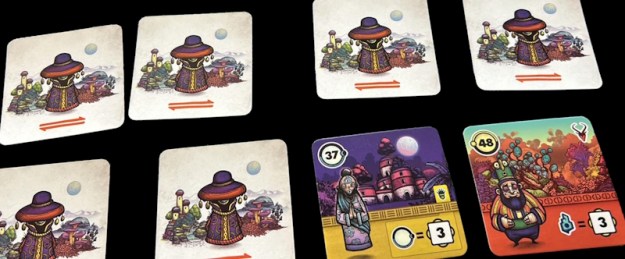
Faraway
– Image by boardGOATS

It eventually became clear that Jade had managed to play his cards in such a way he was always playing a higher card than his last card giving him an additional secondary card, but he was also able to fulfill the requirements to score the objective on that card even though it would need fulfilling earlier in the journey.  Come the end of game scoring and going on their journey, both Cobalt and Ivory had slightly take their eye of the ball and missed fulfilling the requirements of some of their cards and thus missed out on points they though we were going to get. In the end, it was very close for second place Sapphire just taking it, while everyone was thrashed by Jade.

Faraway
– Image by boardGOATS

On the next table, Green was keen to play Lost Ruins of Arnak, and was eventually joined by Black and Plum.  This game combines deck-building and worker placement with resource management.  Players start with six cards in their deck, two Money, two Compasses and two Fear cards, and draw five of these to play.  As in the original deck-builder, Dominion, or in the racing games, Flamme Rouge and Snow Tails, Fear cards clog up players’ decks and more are acquired as the game progresses.  But also as in Dominion, there are ways to “exile” cards during the game.  So, players can try to keep a tight deck with minimal cards, or try to buy lots of cards that work well together.
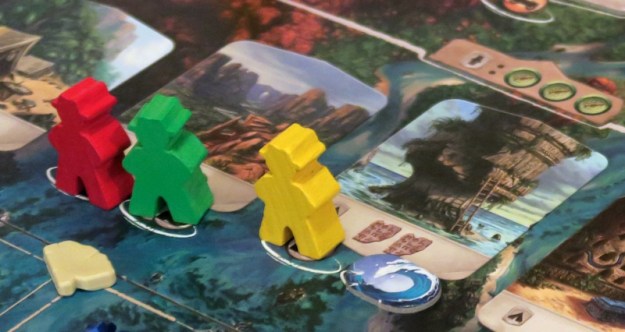
Lost Ruins of Arnak
– Image by boardGOATS

Players then have two meeples each that can be sent to locations on the map, to either discover or use an action Location.  These generally give Resources plus some additions like draw a card, or gain a Fear card etc.. Each new site also has a Creature guarding it, which, if beaten, will give points and a small one-time bonus.  The Research Track is where players spend three of the resources, Tablets, Arrows and Jewels. Each player has two tokens which move up the same track giving different rewards as it ascends. Thematically, you can’t write stuff in the notebook until you find it with your magnifying glass, so the former can never overtake the latter on the track. And of course, the notebook gives cooler rewards.
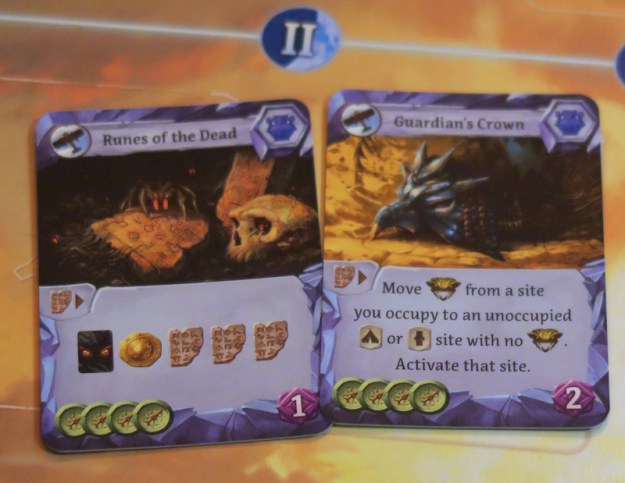
Lost Ruins of Arnak
– Image by boardGOATS

Players get one action each per turn, until everyone has passed signalling the end of the round, and the game finishes after five rounds.  At the end of the game, Points are awarded for Cards, for progress on the Research Track, for discovering Locations and for beating Creatures; the player with the most points at the end is the winner.  This time, early in the game, Green pointed out to Plum that she could use an Idol gained by defeating a Guardian to give her the resources she needed to go up the Research Track.  That gave Plum an Assistant and she picked one that turned a Boot into an Arrowhead.
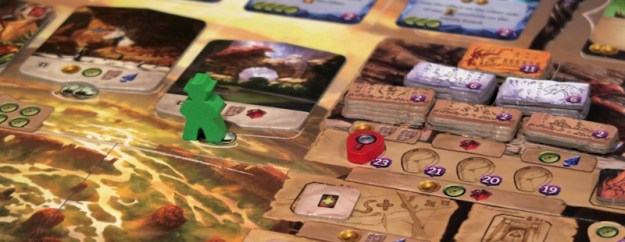
Lost Ruins of Arnak
– Image by boardGOATS

Green bought the card Plum had been eying up, which let players rid themselves of Fear cards (worth minus one point), and therefore seemed like a good use for a Boot/Fear.  It was pointed out later, however, that any card could be used in place of the Boot as all other transport types work for Boot icons.  Plum then got an Assistant that could upgrade a resource, which in practice she used turn Arrowheads into a Rubies as that was all she had by the end of the rounds.  She also managed to get ahead with her Explore magnifying glass token and was the first to a new level on a couple of occasions, which gave her valuable bonuses.

Lost Ruins of Arnak
– Image by boardGOATS

Green picked up a couple of Fear cards from leaving Guardians undefeated; Black got at least one as well, but Plum managed to dodge them.  Both Black and Green got useful Artifact Cards where they could get lots of resources.  It was a little way in that the group noticed the slight Rules Malfunction:  although players were putting their new cards at the bottom of their Draw pile, players were then shuffling the Draw and Discard piles together before drawing new cards.  This gave an extra bit of randomness that this time, worked in Plum’s favour.  For example, she had an item card that gave a Compass per worker when it was played, and it seemed to put in a lot of appearances.  In contrast, all the cards Green had bought didn’t come out until the final round—he got the balance of the bad luck.

Lost Ruins of Arnak
– Image by boardGOATS

Black picked up an Assistant which helped him cycle through his cards which helped mitigate the randomness a little, though there were a couple of occasions when someone took the location he had been working towards. Right at the end of the game, when Plum had managed to reach the top of the Explore/Research Track with her magnifying glass, she was able to use the Icons on her board to get the resources needed to pick up one of the most valuable Temple Tiles—worth eleven points. Green, however, scored almost twice that of the others for his Idols and Black top-scored for his item and artifact cards.

Lost Ruins of Arnak
– Image by boardGOATS

It was the Temple points, together with the extra points Plum got for getting to the top of the Explore/Research Track that ultimately made the difference, giving her a total of sixty-nine points, thirteen more than Green who took second place.  Both Plum and Green had played before, though most of their previous games had been online where the administration of the card shuffling was done for them, hence the Rules Malfunction.  It was Black’s first game, and despite the rules issue and not scoring as well as the other two, he still really enjoyed the game, so there is a good chance it will get another outing in the not too distant future.

Lost Ruins of Arnak
– Image by boardGOATS

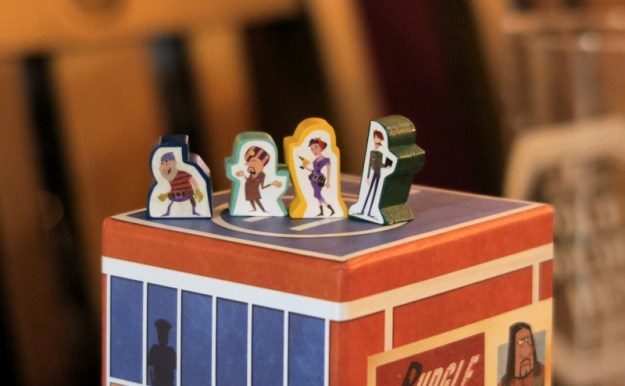
Meanwhile, that left six players; Pink was keen to give his favourite panda game another outing, so Pine and Lime joined him in a game of Zoo Break.  This is a cooperative game, where players work together to try to prevent animals escaping from Bedlam Zoo.  On their turn, players roll the die to decide how many Action Points they get, then, after carrying out their turn, flip a Escape Card and a then a Move Card to determine what gets out of its cage and what moves.  Players have to avoid getting trampled on or bitten by the animals, while catching them and then locking them in their cages.

Zoo Break
– Image by boardGOATS

The group started well, or at least it started well from Pink’s perspective when he was cuddled by a Panda (one of his real-life wishes).  However, the game did not go so well.  There are a number of optional variants, and the group had chosen to use the “Faulty Lock” Variant which means that if an escape card is drawn for animals who have already been locked up, the die is rolled to determine whether there are escapees.  This turned out to make things just a bit too difficult and a Coral snake quickly made a bid for freedom, and as it’s a dangerous animal, that was that.  One snake might not seem like much, but there were another five lining up in front of the gate and three tigers too, so it really did not go well.

Zoo Break
– Image by boardGOATS

Reluctant to leave it like that, the trio decided to give it another try, this time without the “Faulty Lock” Variant.  This second try went better, though at one point two elephants got very close to the exit.  The situation was rescued by peanuts which enticed them to the Snack Stall where they were eventually captured.  There was some extensive rules reading to decide whether Pandas were considered “Dangerous” so only one escaping would trigger failure.  The group concluded that Pandas were not Dangerous animals after all though, and four Pandas roaming the streets would not lead to closure of the Zoo (though perhaps the Chinese government would not be appreciative).
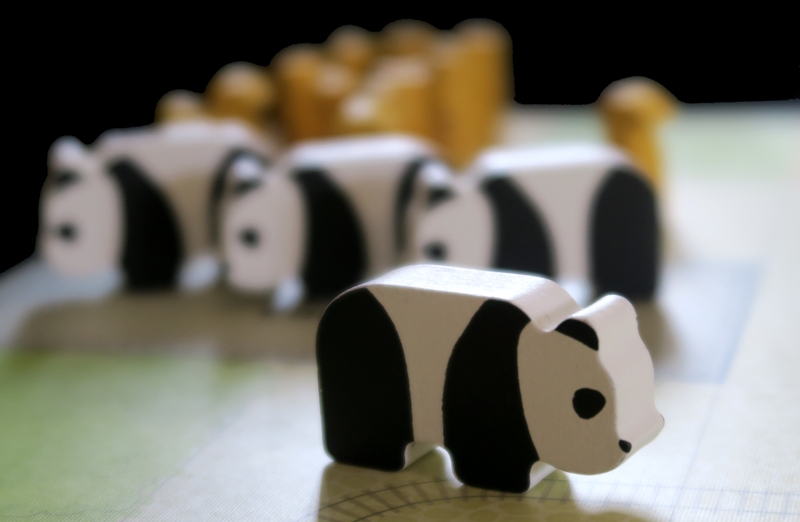
Zoo Break
– Image by boardGOATS

In the end, the distinction wasn’t necessary, none of the Pandas got out, though one Capuchin did manage to escape.  That was all, however, and once the group finally rounded up the last of the mad Meercat escapees, the writing was on the wall and the Zoo was saved.  The other games were still underway, so once the charming wooden animals had been tucked away, the trio opted for a couple of rounds of Coloretto.  This is a charming little card game which is the core of the, arguably better known board game, Zooloretto.

Coloretto
– Image by boardGOATS

The game is very simple:  Players either draw a Chameleon card from the deck and add it to one of the Carts, or take the cards on one of the Carts and add them to their tableau, stepping out until everyone else has taken a Cart.  Each Cart has three spaces and players core points for their three largest sets of cards and negative points for any others.  The player with the most points at the end of the round after the trigger card is revealed is the winner.  The clever part is the scoring for sets, which uses the Triangular Number sequence and means that later cards are worth a lot more than the early ones.

Coloretto
– Image by boardGOATS

When the Golden Chameleon card came out, there was some discussion about the difference between it and the multi-coloured Chameleon.  Blue, on the next table was consulted, and explained that it meant the person who takes it gets an extra card drawn from the top of the deck.  With that sorted, the game continued.  The group played two games and both were close, especially between Pine and Pink with Pink just edging it for the first game by two points and Pine just beating Pink by a single point in the second.  Both games were won by Lime, however, and by a larger margin, taking the first by four points and the second by six.
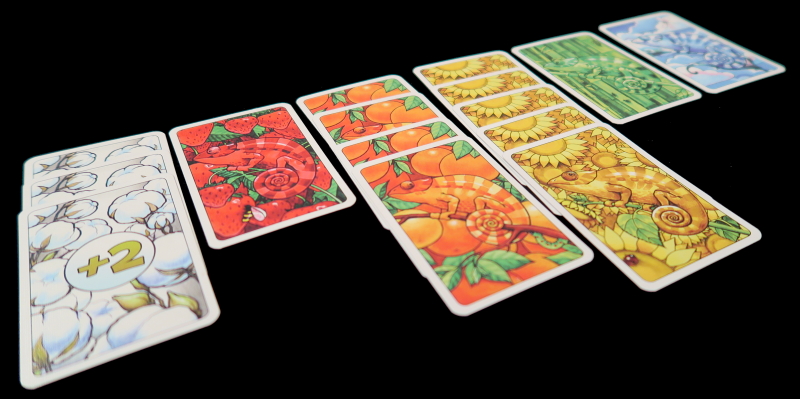
Coloretto
– Image by boardGOATS

The last table included three players, Blue, Purple and Byzantium.  They were the last to start, and were somewhat torn between two of the current hot games in the group, Wyrmspan and Meadow.  After some discussion, the group went for what was probably the easier of the two, and gave Meadow its their outing in three consecutive meetings.  A light to medium card collection game, it was new to both Purple and Byzantium, so Blue explained the rules.  Most of the game is built round a Card Market with players placing an Action Token and taking a card into their hand, before playing a card from their hand.
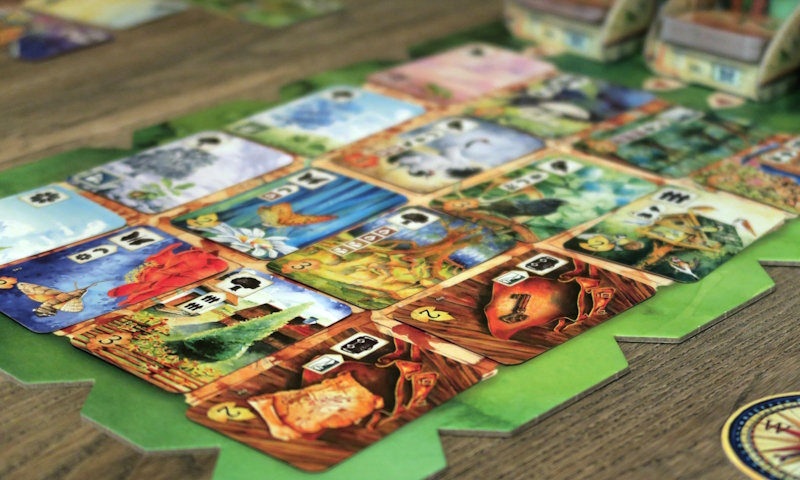
Meadow
– Image by boardGOATS

This aspect of the game has led to some reviewers comparing the game to Splendor, though there is a lot more to the game than that.  In addition to the Market, there is a second Campfire board, which allows players to carry out special actions, and also claim Bonus points. for cards in their tableau.  The first time the game was played, there was a token included erroneously from the Envelope U mini-expansion, and last time the game got an outing, there was a minor rules malfunction where the four players ended up playing on the three-player board.  So although the game has been played three times in fairly quick succession, this time was the first time the game was played by the rules as written, probably.
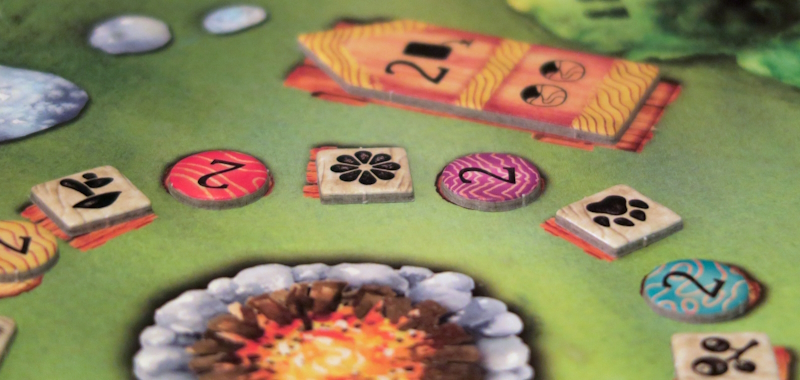
Meadow
– Image by boardGOATS

Players start with a hand of cards, including one from the North deck (which is only introduced halfway through the game)—this last card is typically more worth more but is difficult to play, so is a good way to get a steer in the early stages of the game.  As well as the other cards in their starting hand, another key strategy lead is the Bonus points obtained from the Campfire board.  These are obtained by placing a Bonus point token between two Icons, but in order to do so, the player must have those icons in their tableau.  Since each bonus place can only be claimed once, this element of the game is something of a race between those who want to compete for these points.

Meadow
– Image by boardGOATS

This time, the Icons drawn at random and placed round the Campfire included the relatively scarce Cottage, Fence and Garden Bird as well as the Wolf and Hawk which only come out in the second half of the game, when the North deck is introduced.  This made the Bonus points hard to claim. Although neither Blue nor Byzantium appreciated it at the time, although most Wolf cards are in the North deck, this copy of the game included the Seal promo card, which is a Wolf card that hides in the South Deck.  As it was key to getting bonus points, when it came out, both Blue and Byzantium spotted it, but Blue got to it first, and that turned out to be critical to her Bonus point objectives as Byzantium pinched the other spots early.
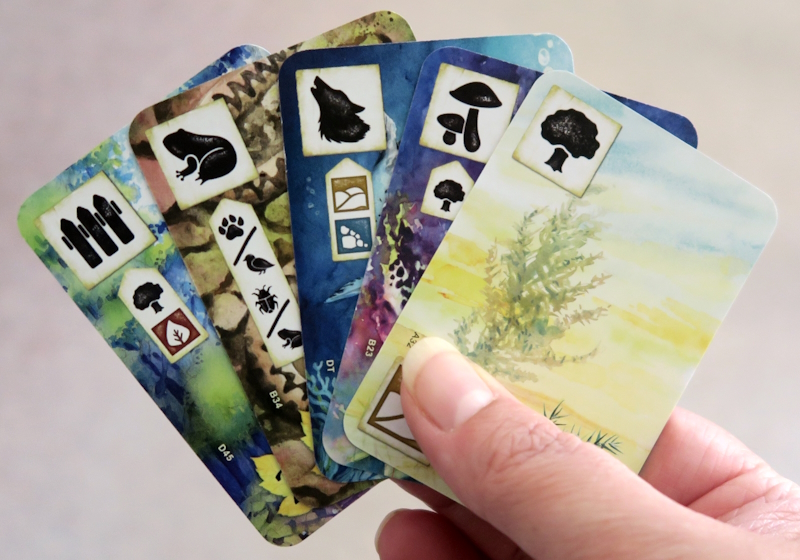
Meadow
– Image by boardGOATS

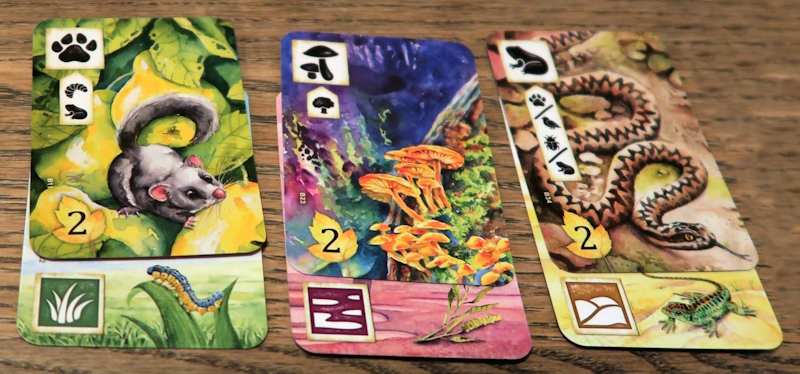
Meanwhile, Purple was busy collecting frogs and very effectively daisy-chaining cards to give her points.  As the game moved into its final rounds, Byzantium struggled to get a Landscape card that he could play without needing too many difficult prerequisites.  In spite of the frustrations when players can’t get cards, the game has a nice gentle roll to it and with three players doesn’t outstay its welcome in the way it does with four (when there are two extra rounds).  It was quite a tight game—Purple and Byzanium finished with thirty-seven and thirty-six points respectively from their observations, but Byzantium had more points from his Landscape cards.
Meadow
– Image by boardGOATS

Blue didn’t do as well as them with her observations, but had the most points from her Landscape cards.  Although Purple hadn’t managed to get any Bonus points, both Blue and Byzantium had picked up the full nine giving them a bit of a lead.  In the end, it was the Observations that were key, and they gave Byzantium victory by four points with a total of sixty.  As the Meadows were tidied up, the last of the other games came to a close too and everyone chatted until it was time to go home.

Meadow
– Image by boardGOATS

Learning Outcome:  Every game should come with ceramic component bowls.

6th February 2024

People were still eating when Ivory rolled up nice and early to start setting up Ark Nova.  Although it was not the “Feature Game“, we are planning to feature the Marine Worlds expansion in the next few weeks and wanted to play the base game before we did.  So, Ivory was soon joined by Cobalt, Plum and Green on the other side of the table, leaving the rest to decide who would play the “Feature Game”, CuBirds, and what everyone else would play while they did.  Before long, Pine, Pink, Lime and Blue were dealing out the bird cards while Purple, Black and Teal moved to the next table and rummaged through the game bags to decide what to get out.

CuBirds
– Image by boardGOATS

CuBirds is a fairly simple set-collecting game built round a central market.  Players start with a hand of seven cards and, on their turn must place cards from their hand.  They have to place all the cards they have of one type, adding them to one of the four rows on the table, at either end.  If there is already a card of this type in that row, then they take all the cards between that card and the newly added cards into their hand.  Optionally, if they have enough cards of a given type in their hand, they can complete a flock of them, that is play the cards, keeping one or two in their display (a bit like harvesting a been field in Bohnanza, where harvesting a field of five beans might leave a player with two Bean Thalers).

CuBirds
– Image by boardGOATS

The game ends immediately when one player’s collection has either three cards of each of two bird types, or seven different bird types (of the eight available) in front of them.  It should play out in about half an hour, though inevitably, the first play through took longer as everyone felt their way through.  When any player places the last card in their hand, everyone has to ditch their whole hand which can be quite brutal with players losing partial sets and having to start collecting again. Pink was the first to upset everyone’s plans, quickly followed by Pine.

CuBirds
– Image by boardGOATS

A lot of fun was had identifying the bird types, and nobody got close to guessing what the tall, thin, “little brown job” was, which turned out to be a reed warbler, but was soon universally known as “WeirdBird”.  When the end of the game was triggered, both Blue and Lime had a magpie apiece with Lime’s paired with four toucans and Blue’s with three robins, while Pink just had two little ducks.  Fittingly, as by far the most dedicated birder in the group, the winner was Pine with three flamingos and three “wols” with a spare parrot.  It had been fun, but rather than play again, as he’d missed out on both the previous plays, Pink had been keen to give the new full-sized, Scandinavian Northern Lights version of Ticket to Ride a go.

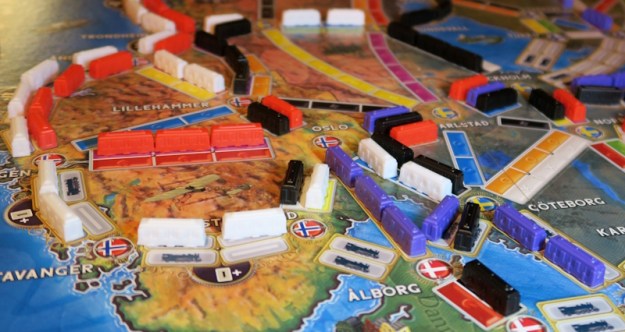
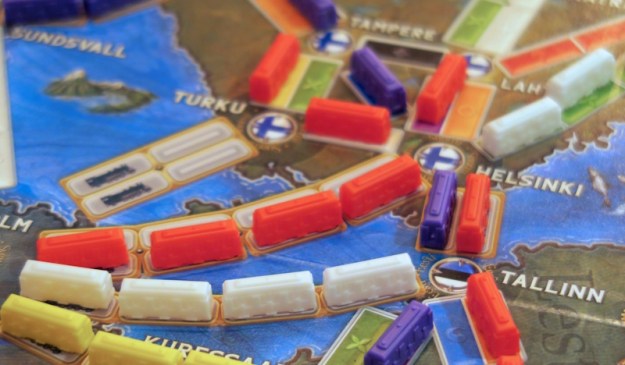
Ticket to Ride: Northern Lights
– Image by boardGOATS

Like the other variants, Ticket to Ride: Northern Lights has slight changes to the rules and a new map, which in this case, similar to the older, festive themed Nordic Countries, though it plays up to five instead of just three.  The base rules are quite simple: on their turn, players either take train cards from the face-up market (or the blind draw deck), or spend cards to place trains on the map for points. Once or twice during the game, players may instead choose to draw Tickets, which give players points at the end of the game if they are completed (i.e. the owner has connected the two locations with their trains) and score negative points if they are not.

Ticket to Ride: Northern Lights
– Image by boardGOATS

Northern Lights additionally has some triple routes (which only take effect with five players) and some routes have a “+X” next to them and when trains are laid on these the player takes X train cards from the face down pile.  In general, Locomotive (wild) cards can replace any other card but for ferry routes they can be replaced with a pair of the same colour (that doesn’t have to be the same as the rest of the cards used).  Unlike most of the other versions, however, if there are three or more face-up Locomotive cards in the market, the market is not refreshed.  The biggest differences are the addition of Bonus cards, however, which extra points at the end.

Ticket to Ride: Northern Lights
– Image by boardGOATS

This time the Bonus cards used were Capital Investment (B), Local Area Network (F), International Tycoon (G) & Ferry Master (J).  These gave Bonus points for completing Tickets to the capital cities (Stockholm, Copenhagen, Oslo and Helsinki); completing the most short Tickets; connecting to the most countries; and completing the most Ferry routes.  The map is very tight with a lot of short routes, spread over a fairly long thin map and a wide variety of Ticket lengths.  Everyone complained that their starting Tickets weren’t compatible, though Blue and Lime both kept all three of theirs, even so Pink surprised everyone when he took his first set of Tickets very early.

Ticket to Ride: Northern Lights
– Image by boardGOATS

Pine soon followed and his sniggering as he kept all the new Tickets was ominous, signalling that he’d already completed all three—a fact confirmed when he drew more on his next turn too.  Blue and Lime covered similar spaces,connecting the north-west to the south-east, while Pine’s network dominated the east and Pinks sprawled over the south.  Everyone was getting on with doing their thing when suddenly, Lime brought the game to a rather abrupt end, catching everyone else out.  As a result, Pink and Pine both had an incomplete ticket that costing them fourteen and twelve points respectively, while Blue had two giving her a combined loss of sixteen points (though part of that was her own fault as she’d overstretched her self and would have run out of trains anyhow).

Ticket to Ride: Northern Lights
– Image by boardGOATS

In spite of that, it was a very, very tight finish with just six points between first and third place, meaning the Bonus cards became much more critical than might have been expected earlier in the game.  Lime set the target with a nice round hundred points, but he did not take any of the Bonus points and was just pipped by Pine who took several of them with Blue making up the podium.  It had been an imperious game from Lime, and he was unlucky to have lost to Pine who was the first to admit that he’d got very lucky with his Tickets, especially the draw where he’d already completed the Tickets, quite remarkable given how spread out the network is on this map.

Ticket to Ride: Northern Lights
– Image by boardGOATS

Meanwhile Purple, Black and Teal had been playing Azul.  This is a favourite game within the group, which is unusual as we tend to eschew abstract games. Players are mosaic building, taking tiles from a shared array of factories, adding them to their Storage on their personal player boards.  At the end of the round, any full rows are scrapped with one tile progressing into the player’s mosaic.  Players score when the tiles added form rows or columns, and the longer they are, the more points players get.  The catch is that each Storage space can only hold one tiles of one colour.  If there is nowhere to put tiles taken from the Factories, left over tiles go into the Scraps bin costing players points which can be very costly as Black found out when he lost fourteen in the final round.

Azul
– Image by boardGOATS

For a little variation, the trio added the Joker tiles and the five double score markers from the Special Factories Promo tiles.  The Joker tiles are a set of ten beautiful promotional tiles that can serve as a proxy for any of the other tiles, though their aesthetic comes at a price as players can’t use them for end of game color Bonuses.  The five double score markers allow players to double the points scored for a row or column, by taking the marker of the matching colour.  Everyone took one of these during what was a hard-faught game where Purple and Black tied for with seventy points.  The clear victor was Teal, however, with eighty-eight points.

Azul
– Image by boardGOATS

Teal and Pine took their leave, so after some chatter, Purple and Black joined Lime, Pink and Blue in another game of CuBirds.  This time, Black collected magpies but twice had enough for sets but kept losing them.  Pueple got three WeirdBirds and was busy collecting parrots when the game came to an end.  Both Lime and Blue tried to collect a set of seven different birds, but while Blue got close with five (and a duplicat “wol”), Pink was imperious.  Before his final turn he had a set of three toucans and two sets of two (flamingos, ducks and robins), pretty-much guaranteeing him victory, regardless what he was left with, though he chose to check-out with another flock of flamingos.

CuBirds
– Image by boardGOATS

While all this was going on, on the other side of the room an epic game of Ark Nova was underway between Ivory, Cobalt, Green and Plum.  This is a much longer game than we usually play with an advertised playing time of upwards of two hours and reputedly considerably more with inexperienced players and setup time included.  It is all about planning and designing a modern, scientifically managed zoo, but the game-play is more like Terraforming Mars with animals, than Zoo Break or Zooloretto.  That said, although it is quite complex, functionally it is not difficult to play on a turn by turn basis, though there is quite a lot to manage and keep a track of.

Ark Nova
– Image by boardGOATS

On their turn, players take one of six possible actions:  activating one of the five action cards (Cards, Build, Animals, Association and Sponsor) with a strength equal to the number above the card, or move a card back to the first space and take a cross token instead.  When activating a card players perform the action based on its power level which is dictated by its position in the row.  Once a card has been played, it is moved the first space in the player’s five card row (i.e.to the lowest power position on the left) moving the other cards to the right to replace the card removed, effectively incrementing their power by one.  During the game, players can upgrade and turn over the action cards to a more powerful second side using various Bonuses.

Ark Nova
– Image by boardGOATS

The Cards action is the simplest action, which lets players draw cards from the deck (the number depending on strength) then advance the marker two spaces along the break track which defines when the round ends.  The Build action allows players to pay to construct one building on their zoo map.  Players can build basic enclosures with a size of one to five, but they can also build a petting zoo for animal storage or pavilions and kiosks (which give players Appeal and money respectively based on adjacent filled enclosures).  With the upgraded build action, players can build multiple different buildings and have access to the large bird aviary and reptile house which allow the storage of multiple animals.

Ark Nova
– Image by boardGOATS

The Animals action allows players to add animals into enclosures in their zoo. Some animals have a special requirement and need a symbol in their tableau and/or the upgraded animal card. Adding an animal to an enclosure has a cost, and then the player turns over the empty enclosure of at least the size needed or places the listed cubes into a special enclosure (an aviary or a reptile house).  The player then adds the animal card to their tableau and resolves the abilities on it and receives ticket sales along with possibly Conservation points and Reputation.

Ark Nova
– Image by boardGOATS

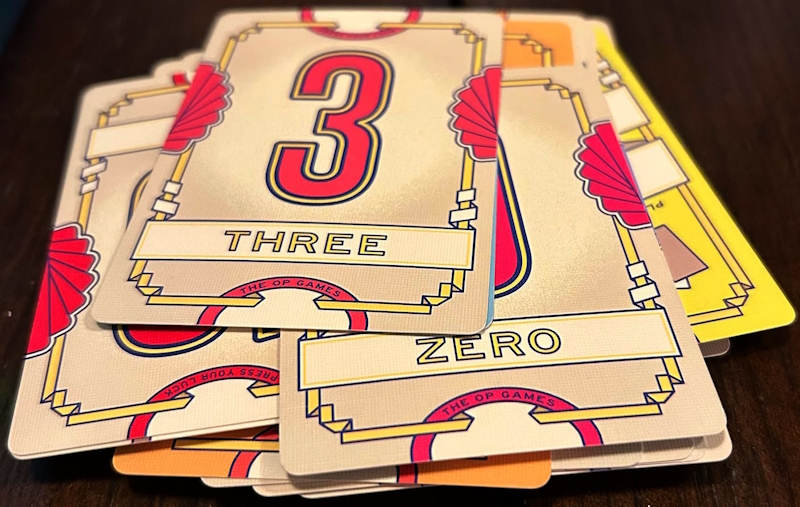
The Association action allows players to take one task on the Association board with different tasks available based on their power level.  This allows people to gain Reputation points, acquire a partner zoo they don’t already own, gain a partner university, or support a Conservation.  Finally the Sponsor action allows players to play exactly one Sponsor from their hand which offer ongoing abilities.  They can allow players to place unique tiles in their zoo and offer end game Conservation point opportunities. Some Sponsor cards have conditions on their play similar to the animal cards.
Ark Nova
– Image by boardGOATS

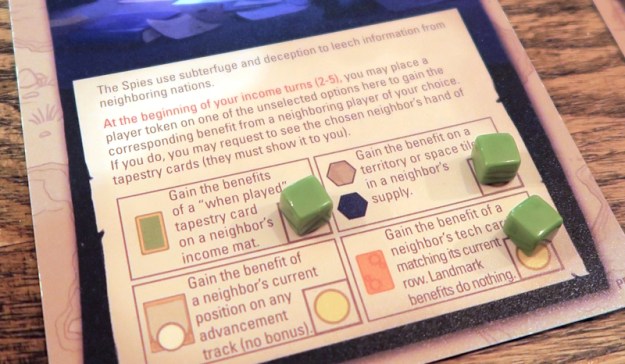
Players take it in turns to take actions, resetting every time a break occurs, until the end game has been triggered.  There are two tracks, Appeal (Tickets) and Conservation that follow the same course, but in opposite directions.  The game end is triggered when one player’s pair of scoring markers cross, after which, everyone gets one more turn and then the end-game cards are scored.  The player with the largest overlap between their Conservation and Appeal values is the winner.  Everyone was familiar with the game and had watched the rules refresher video, so the group could make a fast start, however, Cobalt and Green had played a lot online and Plum had only played once, so there was a difference in experience levels.
Ark Nova
– Image by boardGOATS

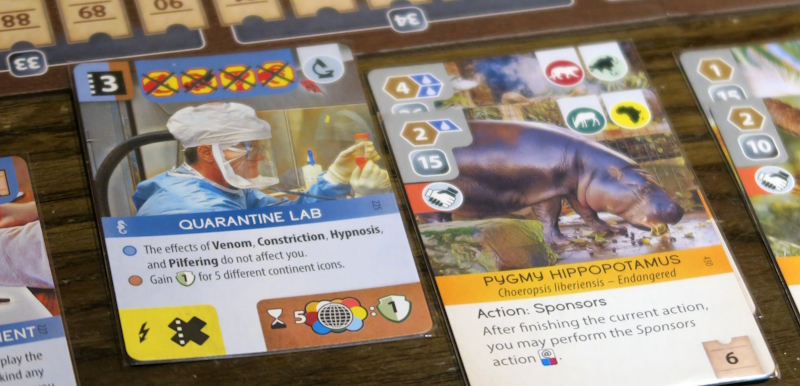
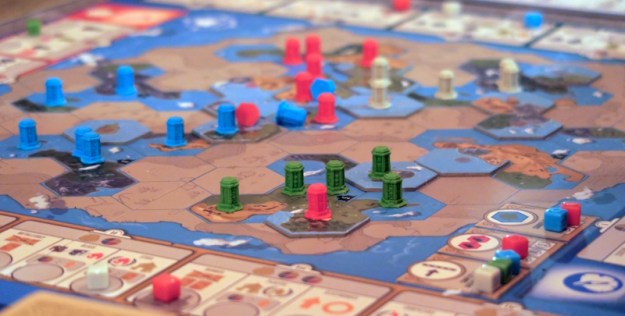
Green and Plum took early Association actions taking the two Reputation universities, scuppering Cobalt’s first turn who couldn’t make use of the double science university.  Cobalt therefore took a partner zoo and snapped a Conservation project from the display in the first few turns. Early game sponsors included: “Veterinarian” by Green (grabbing him an additional university and allowing Conservation projects to be performed at Association level four instead of five, although he didn’t make use of this throughout the game); “Quarantine Lab” by Plum (providing her immunity to venom, constriction, hypnosis and pilfering); “Expert in small animals” by Cobalt (reducing the cost of two-sized animals by three); and “Expert in Herbivores” by Ivory (providing three money each time a herbivore is placed into any zoo).
Ark Nova
– Image by boardGOATS

Plum was very pleased with her “Quarantine Lab” as it meant she didn’t really have to bother with the effects of red tokens that say you have been bitten or poisoned because it meant there was one less thing to get in here way and complicate her game.  Cobalt used his expertise in small animals to good effect, especially when combined with partner zoos, with a petting zoo and several small animals, allowing his money to stockpile. Ivory concentrated on reptiles while Green played several negative effect cards early (e.g. boa constrictor), which hit Ivory and Cobalt (the latter multiple times, and grabbing some of that stockpiled cash). Plum appeared to take an early lead possibly due to her Quarantine Lab which kept her out of all the early pilfering and poisoning.

Ark Nova
– Image by boardGOATS

Cobalt was first to complete a Conservation project, using the snapped card to release a herbivore into the wild and gaining the two-enclosure Bonus, immediately followed by Ivory.  In the middle-game, the African Bush elephant and Serengeti National Park appeared side-by-side in the display, so Cobalt took the risky decision to nab these over two consecutive rounds, but was forced to discard five or six cards from an unexpected break. Having kept the elephant and Conservation project, Cobalt played these to grab an extra scoring card and race up the Conservation track and triggered the scoring card discard. Ivory and Plum took to the Appeal track. Green remained languishing on both tracks, particularly the Conservation track where he barely moved all game.

Ark Nova
– Image by boardGOATS

Cobalt was first to upgrade his cards, leaving only the Association action not upgraded, whereas Green concentrated on Sponsors and Association actions. Plum was working through some difficult choices, ultimately deciding to having to flip the Animals card so that she could play the Elephant she had been nursing. She left the Reputation as the non-upgraded card, which unfortunately removed some of the better options that the Elephant gave.  Plum was just a Europe icon away from being able to take the multi-regional goal, but ultimately forgot that having high Appeal is the negative element to the score and didn’t do the things to convert her Appeal to give her points.

Ark Nova
– Image by boardGOATS

Green was slow to get going, but eventually, managed a master move with his first Conservation project and flew up the scoring to overtake Plum, and began chasing down Ivory and Cobalt.  It was very close between Ivory and Cobalt on who would trigger the end game: Cobalt managed to keep his counters from crossing, causing Ivory to trigger the end game and allowing Cobalt one last turn. Although Ivory scored well on the final turn, Cobalt covered his zoo (giving him seven more Appeal) and scored more than twenty points in the final turn.  In end game scoring, it became apparent that Plum had misunderstood her end game scoring card.  She had thought it gave points for empty enclosures in her zoo (rather than empty spaces) and had set about building lots of them towards the end.  Without this, her game would have ended very differently.

Ark Nova
– Image by boardGOATS

Ivory took the third place on the podium having realised Green was closing and decided to end the game perhaps a turn or two earlier than he really wanted which may have inadvertently caused himself more damage as Green needed some three turns to score anymore.  Green did exceptionally well taking a full four Conservation points from his Bonus card and three extra points from Sponsors, and with it, almost taking victory with a total of eighteen points.  However, Cobalt’s final turn plus two scoring cards (one of which was for small animals) meant he won with a convincing score of thirty.

Ark Nova
– Image by boardGOATS

It had been quite stressful getting the game completed in time, especially with some long turns where actions were chained together, for example Plum played one card which enabled another full turn, but with two new cards it was tough to decide which gave the better option.  All that said, it had been very enjoyable and everyone had got on with their game and helped each-other where necessary.  The group clearly demonstrated that the game can be played in around four hours even with four, so long as everyone knows what they are doing and keeps moving.  It will be a few weeks before the Marine Worlds expansion gets an outing, but it will be exciting when it does.

Ark Nova
– Image by boardGOATS

Learning Outcome:  Reed warblers are weird warblers.

Golden GOAT Award Winners – 2023

The boardGOATS love a good party, so once again, they met just before Christmas for their annual Un-Christmas Dinner and to decide the winners of the GOAT Awards.  After food, crackers and writing GOAT Christmas Cards, the group voted for two awards:  the Golden GOAT for our favourite game played during the year and the “GOAT Poo” award for our least favourite.  Everyone had the usual three points to hand out for the Golden GOAT Award (plus a bonus if wearing Festive Attire), though a maximum of two points could be given to any individual game.  Everyone could also nominate up to two individual games for the GOAT Poo Prize.

7 Wonders
– Image by boardGOATS

This year, there were a handful of games that received the unofficial “Marmite Award”, that is to say they received nominations for both the Golden GOAT and the GOAT Poo prizes.  These included Challengers!, Kites and SCOUT.  For the GOAT Poo Prize itself, this year there were no outstanding candidates, with a tie between 2019 winner 7 Wonders and Dice Hospital, with two votes each.  Nominations for “Moment of the Year included the game of Challengers!, which was likened to “Speed Dating”, and the massacre in Survive: Escape from Atlantis!, but the winner was the three way tie in the epic game of Tapestry with the Fantasies & Futures expansion.

Survive: Escape from Atlantis!
– Image by boardGOATS

And finally, there was the Golden GOAT Award for the best game played in the year.  Previous winners including Wingspan and 6 Nimmt! were ruled out, but there were plenty of options remaining. Earth, Fantastic Factories, SCOUT and Zoo Break all received three votes, but the clear winner was Tapestry.  Over the years, we’ve played this quite a bit, but it is a game that doesn’t suit a significant number of the group.  This year, however, with a slight shift in those eligible to vote, heavier games were in with a better chance and Tapestry was the beneficiary.  We will have to make sure it gets another outing in the new year.

Golden GOAT - 2023
– Image by boardGOATS

28th Movember 2023

What started out threatening to be a quiet night with the absence of Green, Lilac, Purple and Black, turned out to be quite lively in the end.  As Blue and Pink finished their supper, Pine, then Jade, Sapphire, Plum and Byzantium arrived, soon followed by Teal, Ivory and Lime.  Ivory was armed with his new, shiny copy of Apiary, which was to be the “Feature Game“.  This is a worker-placement, hive-building game where players explore planets, gather resources, develop technologies, and create carvings to demonstrate their faction’s strengths before the end of the year when it is time to hibernate.

Apiary
– Image by boardGOATS

At first glance, Apiary seems to be a fairly simple Worker Placement game, where players have the Tzolk’in choice: place a Worker or retrieve Workers.  Unlike in Tzolk’in where Workers carry out their action when they are retrieved, in Apiary, players take the action and gain the associated benefits when placing a Worker, while retrieving Workers enables players to run any engine they have that relies on those recalled workers.   Unlike many other worker placement games, there is no blocking and players can add workers to any space as long as they have the power and required resources.  If a space is already occupied the existing occupant is “bumped” either to the next space (for certain areas) or sent back to the owner (with a choice to increase strength and make available straight away, or hold on to make use of income abilities).

Apiary
– Image by boardGOATS

Players start with asymmetric factions and basic resources (Pollen, Water, and Fiber) according to their faction.  The Action spaces are mostly about getting or trading Resources and Cards, or adding Tiles to improve their base.  There are five available to players at the start of the game: Explore, Advance, Grow, Research and Convert.  Explore allows players to visit planets, gaining bonuses for being the first to visit a planet, and also resources from the planets they discover while Advance allows players access tiles they can build if they have the resources to do so.  Grow enables players to gain their fourth worker (or gain a worker back from the pool once it hibernates) and allows players to build ship frames while Research gives players access to the Seed Card deck, some of which are incredibly powerful.

Apiary
– Image by boardGOATS

Wax and Honey are more advanced resources that can be created during the game using the Convert Action.  Honey, in particular, is required for the final Action, Carve (which also needs a Level Four worker).   When Workers return to the Active Pool (either by being bumped or because they have been recalled), their value increases by one. Level Four Workers trigger special bonuses when played, but instead of returning to the Active Pool when bumped or retrieved, they hibernate. In this way, the player loses that worker, but gains a bonus.   The game ends when all the hibernate spots are taken or when a player uses all seven of their hibernate tokens.

Apiary
– Image by boardGOATS

The game is beautifully produced with great art and lovely wooden resource pieces.  The QueenShip is arguably the best, looking a bit like Starbug from Red Dwarf.  With that and the theme (which had those traveling from Swindon crying, “Bees… In… Space!” à la The Muppets “Pigs in Space!” at intervals), the game was off to a good start.  The not-blocked worker space mechanism is similar to that in Euphoria: Build a Better Dystopia, which Plum, Byzantium and Jade had played at HandyCon.  Everyone starts off with a unique player “Hive Mat” and starting Faction Tile. Ivory began with “The Log” and “The Sini” which gave points for filing the Hive Mat and for each Development Tiles surrounding the Faction Tile (respectively), so he prioritised getting Development Tiles.

Apiary
– Image by boardGOATS

Cobalt’s Faction, “The Cypri”, gave him four points for each Carving adjacent to his Faction Tile, but found that hard to achieve needing a lot of Honey, so concentrated elsewhere instead.  Plum’s focus was on her Hive Mat, “The Warre”, which had spaces that progressed her along the Queen’s Favour track when she covered them, so she decided early to try and focus on that. She had some Farm Tiles that also would have helped her gain more Favour when she triggered the income for taking workers back, but she didn’t use that until later as, although her workers were bumped a lot, she kept choosing to increase their strength and have them available straight away instead.

Apiary
– Image by boardGOATS

Byzantium started with “The Lama” for his faction that gave him a point for each tile he added to his Hive which grew quite rapidly.  He also nabbed a Farm Tile from under Plum’s nose which gave him the Edge on the Queen’s Favour Track.  As the game came to a close, everyone scrabbled to try to finish things off—like filling their Hive Mat (Plum’s last space was filled for free when she covered the adjacent hex).  The lead at the end of the game was held by Plum, but that isn’t really where the points are in Apiary.  In contrast to everyone else, Ivory almost completely eschewed the Queen’s Favour, focusing on Planted Cards and Honey Pots, which gave him over thirty points alone, and as a result he charged from the back of the pack to take victory.

Apiary
– Image by boardGOATS

Meanwhile on the other side of the room, Pink, who had been fondly remembering his visit to the see the pandas “Down Under”, sucked Pine and Blue into a game of Zoo Break.  This is a cooperative game where players are zoo keepers trying to prevent the marauding animals escaping the zoo.  This has had a couple of outings this year the first was a disaster ended when a cobra got out, but the second was a hard-fought victory.  This time, with just three keepers, turns would come round more frequently, so to make things a little more interesting, Pink (Lucky Duck), Pine (Gardener) and Blue (Angler) decided to play with the Faulty Lock Variant, personally recommended by the designer.

Zoo Break
– Image by boardGOATS

The idea of the game is that players take it in turns to roll the Action Die to found out how many actions they get, then after carrying out the actions, players first draw an Escape card and then a Move card, to see what animals escape and move.  In the original game, once animals are locked up, however, they can’t escape, which means the game gets progressively easier.  Further, some players potentially end up lurking about with nothing much to do waiting for someone else to deal with the last couple of mischievous meerkats.  In the Faulty Lock Variant, however, when an Escape card is drawn for an enclosure that has already been locked, a die is rolled to see if the lock is faulty and whether the animal escapes or not.

Zoo Break
– Image by boardGOATS

The problem with the Faulty Lock Variant is that it can extend the game quite a bit.  That said, it didn’t look like that was going to be a problem as Pink chucked first Pine and then Blue under the Charging Rhinoceros.  Then Pink got trampled too, before Pine paid a couple more visits thanks to a mad Elephant and a venomous snake.  Eventually, the team got their act together and locked up the Rhino, and then the Capuchins, Pandas, and Elephants.  Every now and then, a lock failed and an Elephant got out, but gradually, the animals were being locked up, and eventually the last of the Meerkats was evicted from the part in the fountain locked up (aside from the two that escaped).

Zoo Break
– Image by boardGOATS

It had been a lot of fun, even though Pink was sad that he’d not been hugged by a lonely Panda, and jealous of Pine who had.  It had taken all evening though, and on the next table, Jade, Sapphire, Lime and Teal had managed two leisurely games and a bit of chit-chat.  The first game was Isle of Cats: Explore & Draw, a role and write version of the much more substantial card-drafting, polyomino cat-tile-placing game, Isle of Cats.  In Explore & Draw, instead of drafting cards before choosing tiles, players choose a set of cards each turn and then draw their “discoveries” on their boats.

Isle of Cats: Explore & Draw
– Image by boardGOATS

This time it was relatively close for second place, but Sapphire won by something of a landslide, his seventy-nine points was some twenty-five points ahead of Lime who took second with his neatly coloured in boat.  Once the wipe-clean boards had all been cleaned, Teal took an early night before the remaining trio played moved on to the card drafting and path building game, Trailblazers.  In this game, players start with eight Trail cards and draft two cards three times, adding them to their tableau.  The cards must either be placed adjacent to or overlapping other cards as players try to construct long and elaborate trails in three different colours.

Trailblazers
– Image by boardGOATS

Only closed loops in a single colour, that start and end at a matching campsite will score points and players also compete to fulfill “First To” and “End Game” goals.  The game ends after four rounds, when the player with the most points from closed loops and goals achieved is the winner.  This was much closer than the previous game, though the outcome was, ultimately, much the same.  The goal cards in play were “Hikers’ Quartet”, “Trail Hugs”, “Forever Float” and ” Wanderlust”, though the players only scored for the last two (giving points for the longest single blue “Kayak” route and the longest total brown “Hiking” routes.

Trailblazers
– Image by
boardGOATS

Lime and Jade tried to build trails of all three types, Hiking, Kayaking and Biking evenly, making the best of the cards they had.  However, Sapphire focused exclusively on the two that featured in the “Forever Float” and ” Wanderlust” goals, finishing with twenty-eight points for his Kayaking routes alone.  While it was very close when the trail lengths were taken into account, Sapphire took first place for both end game bonuses and Lime came second in both, which also reflected the final placing.  There was some chatter, while “Bees… In… Space!” finished and then it was time for everyone to go home to hibernate until next time.

Trailblazers
– Image by boardGOATS

Learning Outcome: Golden Honey is valuable.

11th July 2023

Blue and Pink were really late arriving, and were much amused by the cheers and applause when they came through the door.  Slightly embarrassed, and after a quick explanation, everyone started splitting into groups.  First was the “Feature Game“, the Fantasies & Futures expansion for one of our more popular, heavier games, Tapestry. On the surface, Tapestry has simple mechanisms, but they combine to make a complex game.  Basically, on their turn, players move one step along one of the four Civilisation tracks around the board: Science, Exploration, Military, Technology and carry out the action (or actions associated with it).  Each space requires payment of resources, and the further along the track, the more expensive the spaces become.

Tapestry: Fantasies & Futures
– Image by boardGOATS

If a player cannot afford to pay (or chooses not to), then they instead take income, which gives them more resources.  They also gain points and play a tapestry card, which usually provides a power for the next round.  So, at its heart, Tapestry is an engine building and resource management game:  players carry out actions and get resources so they can get more resources and ultimately, points.  We have played the first two expansions, Plans and Ploys and Arts & Architecture, but this time the “Feature Game” was the Fantasies & Futures expansion, which is the smallest, adding new Fantasy Civilizations, advanced Capital City mats, new Tapestry and Tech cards.

Tapestry: Fantasies & Futures
– Image by boardGOATS

Ivory was joined by Green, Plum and Byzantium.  Along with the Fantasies & Futures expansion, the group decided to add the “Plans” from the Plans and Ploys expansion as a sort of mini expansion, a private goal, where players get their own, special building they can build.  They also left the Tapestry cards and Civilisations in the mix from the first two expansions and really only left out Arts Advancement track from the Arts & Architecture expansion as they thought it would add too much complexity to the game overall.

Tapestry: Plans and Ploys
– Image by boardGOATS

Tapestry is one of those games that sometimes comes in for criticism for being multiplayer solitaire.  Although that’s not true, there is a strong element of players “getting on with their own thing”.  Although they were each very much playing their own game, there was still quite a bit of interaction which definitely gave the game teeth.  Green’s Civilisation (“Spies”), had him perusing over his neighbours positions and cards each income turn.  Luckily for him Ivory’s Civilisation (“Aliens”) gave him four starting space tiles, and one bonus he could choose was the benefit on an unused tile in a neighbours supply which gave a nice healthy early bonus.

Tapestry: Plans and Ploys
– Image by boardGOATS

Plum’s “Islanders” Civilisation was focused on collecting area tiles and placing them on her Civilisation mat.  So she started out prioritising collecting landscape tiles, looking for ones with water on more edges as these would give her more points in the final income phase.  She got a bit lucky right from the start getting two out of three.  From there she went for an expansionists strategy as did Byzantium (with his “Riverfolk” Civilisation), and from there, throughout the game they found themselves trying to conquer each others territories on the central island.

Tapestry
– Image by boardGOATS

Plum started the game with two Tapestry cards, so chose to use the standard one for her first era.  The second was from one of the expansions and “charmed”, so much to Byzantium’s annoyance when he tried to topple Plum’s Tower in the middle of the map, his attempt was thwarted by Plum’s Trap card which also gave her an extra benefit.  When Plum later attempted to Conquer Byzantium’s tile, he was delighted to be able to repay the earlier battle with his own Trap card. That satisfaction didn’t last, however, as Plum proceeded to play her charmed Anti-trap card which not only stopped the trap dead, but also gave her yet another bonus.

Tapestry
– Image by boardGOATS

That bonus was a random Tapestry card from Byzantium’s hand—he had two, and the one she picked just happened to be the one he had been working towards maximising the effect of (moving up each track once and getting the bonus action for free).  Plum felt pretty bad about picking it, but it was too late by then.   So, all round, it was quite a frustrating game for Byzantium, who started the game with a large forty-eight point bonus from his landscape board (“Forest”), and his first conquering dice rolls, time after time, gave him the choice between a resource or seven points—quite a dilemma in the early part of the game.  Initially he took the seven points (the highest that dice could give him), but found he wasn’t getting as many turns as the others, so later switched to taking the resource.

Tapestry: Fantasies & Futures
– Image by boardGOATS

Ivory, meanwhile, managed to make good use of the charmed Tapestry cards, keeping himself well stocked with resources throughout the game.  The rest of the group barely saw any charmed Tapestry cards (aside from Plum’s Trap and Anti-trap cards), but did find the new Civilisations and Landscape boards quite an interesting addition.  As the endgame approached, Green was last man standing, and for his last few turns he was able to grab an extra Civilisation (“Urban Planner”) which was to reward him handsomely.

Tapestry: Arts & Architecture
– Image by boardGOATS

The game which had been a quite sedate affair, started speeding up a little towards the end.  Pretty much everyone did something that if they had thought just a little a bit more would have gained them another point or so—Green put a cube on another player’s map, Plum put a building somewhere where it could have completed a row if she’d considered a little longer.  As the game came to a close, Ivory and Plum counted their remaining income scores to amazingly find themselves both on two-hundred and thirty-five points.

Tapestry: Fantasies & Futures
– Image by boardGOATS

Then Green counted his final points, giving him the lead by a solitary point. That was until he realised that he’d added thirty-six to one hundred and ninety-nine and discovered he was part of a three-way tie with Ivory and Plum!  Nobody was quite sure how they all managed to have an identical score in such a high scoring game.  If the tie-break had been resources remaining, then Green would have won and if it was Tapestry cards remaining, then Plum would have been the victor.  However, a quick check of the rules suggested the tie-break was in favour of the player with the tallest building (which everyone agreed that was a rubbish tie break), and although Ivory narrowly had a taller building that Green, he graciously agreed that everyone should just share victory.

Tapestry: Plans and Ploys
– Image by boardGOATS

While Tapestry was setting up, on the next table Jade was introducing Black, Purple and Pine (who chose to spectate) to Fantastic Factories.  This is a game where players compete against each other trying to build the most efficient set of factories as quickly as possible.  Players have to carefully manage their blueprints, train their workers, and manufacture as many goods as possible in order to achieve industrial dominance.  Each round consists of two phases:  the market phase and the work phase. In the market phase each player in turn order can either gain a blueprint card from the four available in the market or hire a contractor.

Fantastic Factories
– Image by boardGOATS

To hire a contractor players must pay one card (that matches the tool symbol associated with the contractor’s location on the board) and any additional costs listed.  Contractors have various benefits mostly related to gaining extra resources or extra dice workers for the work phase later in the round.  In the work phase, all players perform actions in their play area simultaneously starting by rolling their four coloured dice (and any additional ones gained from contractors).  Players can use their actions to build cards (which cost various resources matching the building type); while players can build as many cards as they wish in a turn, they may one of each type of building.

Fantastic Factories
– Image by boardGOATS

Dice can be used to take actions on a player’s main Headquarter board or on building cards you have constructed.  A player’s Headquarter board allows them to generate metal and energy.  Players can also activate their buildings once per round. If any player has built ten buildings or produced twelve goods that triggers the end of the game and one final round takes place before end game scoring. Players add up the prestige value of their buildings to their produced goods and the winner is the player with the highest total.  The game was a fairly typical learning game, but was quite close.  Both Purple and Black took thirteen points for their buildings, and while Purple was yet to get her engine going, Black took nine points for his goods.

Fantastic Factories
– Image by boardGOATS

Jade, on the other hand, had fewer points for his buildings (nine), but they were functioning more efficiently.  His total of twenty-three was just one point more than Black who took second.  While they were packing up, the group chatted and Jade showed off Vaalbara, another of his acquisitions from UK Games Expo, which he described this as a nice little set collection, and semi-interactive card game.  Then they chatted while they waited for Tapestry to finish.  And waited some more as the clock ticked and it turned out that Tapestry was no-where as near to finishing as everyone had thought…

Tapestry: Arts & Architecture
– Image by boardGOATS

Meanwhile, Teal was introducing Blue, Pink and Lime to a much older game, Condottiere.  This is a sort of trick taking, battle game.  Set in 13th century Italy, where the wealthy city-states had weak armies.  The Condottiere were veteran English soldiers returned from the Crusades who were contracted to fight for individual city-states by an agreement known as a condotta, the most elite fighters were the mercenary leaders known as the Condottiere.  During each round, control of a State is put up for auction, and players bid the number of troops they are willing to lose in order to win the province.  Players bid with cards that represent Mercenaries, Seasons, Scarecrows, and Political Figures, in an effort to try to take control of four adjacent States.

Condottiere
– Image by boardGOATS

Each player starts with a hand of cards, and one player starts the bidding by choosing a State and a starting bid, playing the card or cards from their hand, face up on the table. Other players follow, playing cards each round.  When a player either cannot play another card (or chooses not to), they “stick”, but unlike many other auctions, in which only the highest bidder loses their bid, at the end, everyone loses all the cards they played, whether they finish with the highest value hand or not.  Mercenary cards have values one to six or ten, while the other cards have special powers that take effect when they are played, but it is how the cards work together that is key.

Condottiere
– Image by boardGOATS

For example, the Drums double’s the value of all that player’s Mercenary cards, but this effect can be offset by another player placing a Winter card reduce every Mercenary card played to a value of one, while a Scarecrow can be used to return a card to its owner’s hand, making it available to play later.  There is also the Heroine, which is untouched by either the Drums or Winter, but also cannot be returned by the Scarecrow.  Perhaps the cleverest cards, however, are the Surrender and Bishop cards;  the Surrender ends the battle immediately (with the current leader winning the battle), and the Bishop ends the battle in peace with no-one winning.

Condottiere
– Image by boardGOATS

While there are some clear uses for some cards (the Bishop is only likely to be played by someone who is losing badly, and the Surrender card is usually played when the active player holds the lead), the meta-game is also important.  Although winning is obviously the aim of the game, as battles become head-to-head, players sometimes end up playing with emotion rather than strategy.  Once a battle has been won, the winner chooses the next city-state to be auctioned and starts the bidding.  Unlike other games, however, play continues with the cards they have left until all players but one have run out of cards, and only then do players get more cards (before they start the next battle).

Condottiere
– Image by boardGOATS

Teal explained the game, and that, although he understood the rules, he had no idea how to win.  Indeed, despite having played Condottiere a lot in the weeks since he acquired it at UK Games Expo, he had never won, a situation that was destined not to change this time.  Teal and Lime won a couple of States, giving them extra cards in the refresh.  Blue and Pink realised they were at a disadvantage, so set out to rectify things.  They took a couple of States and redressed the balance.  Then Pink stole a march when he forced Lime to lead out in a battle he could not win.  With this giving him three adjacent states, the writing was on the wall.  Lime, Teal and Blue tried to work together to prevent Pink from taking the last one, but without success.

Condottiere
– Image by boardGOATS

It had been a very enjoyable game, and given its success, the group went on to play another of Teal’s UK Games Expo acquisitions—Burgle Bros..  This is a cooperative game, a style the group traditionally eschew, though recently have played more often (including Scotland Yard last year, The Lost Expedition about six months ago, Zoo Break twice in quick succession, and Forbidden Dessert a couple of weeks ago).  Burgle Bros. works in a similar way to the other games of this type.  Players are a team of robbers, attempting to enter a building from the ground floor, raiding the safes on each floor before escaping by helicopter from the roof.  In addition to finding and cracking the safes, players also have to avoid the Security Guards that patrol the building.

Burgle Bros.
– Image by boardGOATS

In the game, players each have three Stealth tokens. Whenever they are on the same tile with a Guard, they lose one and if any player is caught without a stealth token, the game is over.  On their turn, players have four actions (move, preparing a safe for cracking by putting some dice on its tile, rolling dice to attempt to crack the code etc.).  Once the player has taken their turn, the Guard takes their turn, moving towards their target room (assigned by the route deck and marked with an orange die).  So to win, players first have to find the safe and then crack the code and all without triggering the motion detectors, heat sensors, fingerprint scanners, laser fields, open walkways, deadbolt rooms, and of course avoiding the guards…

Burgle Bros.
– Image by boardGOATS

The group decided to play on the beginner’s level which meant they only had two floors to explore before they could escape the building.  They got lucky right at the start as they popped up from the ground floor right next to the safe. That meant they only had to reveal all the orthogonal tiles and then roll dice to match the code. They were luckier still as the security guard was on the other side of the building and there were very few walls obstructing their way.  As a general rule, cooperative games of this type give each player unique special powers and using these effectively is usually critical to success.

Burgle Bros.
– Image by boardGOATS

So, Pink (who was “The Hacker” and didn’t trigger alarms) was sent off to reveal tiles while Blue (“The Spotter”) started setting up the safe for Lime, who was “The Peterman” and got to roll an additional die when trying to crack the safe.  Before long, things on the first floor looked pretty much under control with just the last few numbers left to crack the safe, so Teal (“The Juicer”) took himself off to the second floor to start hunting for the safe there.  This was a risky strategy as it triggered the Guard moving on the second floor.  However, with fewer people on both floors, the Guards effectively moved slower and gave players more chance to avoid them.

Burgle Bros.
– Image by boardGOATS

Things were slightly more challenging on the second floor—the Security Guard was a little more proactive, stepping it out more and, of course, the group didn’t find the safe at the top of the stairs this time.  It didn’t take him long to find it though, and with nothing better to do, Pink joined Teal on the second floor, ducking under the risky laser trap at the top of the stairs.  Meanwhile, Lime had finally managed to crack the safe, so Blue headed up the stairs only to find the second floor security guard heading her way, so she escaped to the roof toting their loot (a very annoying large and heavy bust and a particularly yappy dog) .

Burgle Bros.
– Image by boardGOATS

There was a bit of shenanigans as Lime joined Teal and Pink and also dodged the Security Guard (and lost a couple of Stealth tokens), but although there were a couple of near misses, it wasn’t long before all four were on the roof awaiting their lift to safety.  It was another fun game, but with time marching, Lime and Teal headed for home, leaving Blue and Pink to join Jade, Purple and Black who were still waiting for Tapestry to finish.  It was nice to chat though, and eventually Tapestry did finish and everyone who needed one got their lift home (without having to climb on to the roof…).

Burgle Bros.
– Image by boardGOATS

Learning Outcome:  New games are fun, but there are lots of good, slightly older games to be had as well at places like Expo.

13th June 2023

Lime was first to arrive, soon followed by Blue and Pink, and then Pine who were all delighted to see the return of our favourite bar staff.  There was a lot of chat about the recent changes at The Jockey (which is currently managed by the Healy Group who also run the Punch Bowl in Abingdon), and as everyone else arrived, people seemed more interested in gossiping than playing games.  It was a relatively quiet night with quite a few people away.  Black and Purple sent a message to say they were thinking of us, but when Green received a photo from Black and Purple of their current view, it just made everyone else jealous.

Black and Purple in Cornwall
– Image by Black

Jade arrived with his shiny new copy of Earth which he’d picked up from UK Games Expo.  It is a game where players are building themselves an ecosystem and was to be the “Feature Game“.  Earth is a sumptuously illustrated, card-driven engine-builder that is often compared to Wingspan.  We played that Last time after a bit of a break, and remembered how much we liked it, so had decided to give Earth a go this time.  The heat was getting to some people, but Ivory was quite keen to give Earth a go, and they were soon followed to the next table by Green (who had played it online) and then Teal.  Everyone was pretty new to the game:  Ivory and Teal had not played it before and Green and Jade had only played a couple of times.

Earth
– Image by boardGOATS

Although there is a lot to explain before starting, Earth itself is not actually all that complicated. Players are building a four by four grid of Flora and Terrain cards which represents their island and during the game they will plant flora, water it and allow it to grow.  On their turn, players do one of four things: Planting (paying the cost in Soil tokens), Composting (gaining Soil and placing cards from the deck in their discard pile), Watering (place Sprouts and gain Soil) & Growing (draw new cards and place growth tokens).  A bit like Puerto Rico, once the active player has chosen which action they are taking, everyone else gets to do a subsidiary, slightly weaker version of the same action.  For example, when Planting, the active player plants two cards, draws four and keeps one, while the other players plant one and draw one.

Earth
– Image by boardGOATS

Once everyone has completed the action for the turn, everyone activates all the cards in their island that match the colour of the action chosen, starting with the card in the top left and working across each row in turn.  This means, not only is it important which cards are played, but also where they are located in the player’s island.  At the end of the game (triggered when one player has completed their island), players score points for each flora card, any Trunks and Canopies they have grown, their Sprouts and their pile of “Composted” or discarded cards.  Players also score points for achieving objectives on the Fauna cards revealed at the start of the game and for completing their island first.

Earth
– Image by boardGOATS

As in Wingspan, Flora cards have actions that take effect when they are planted and when activated, many of the Terrain cards have ongoing effects and/or end-game scoring opportunities.  When Planting, players must place the cards either orthogonally or diagonally adjacent to an existing card, and although they can never exceed a four by four grid, like in Kingdomino, players can extend on either side of their island until the maximum size is reached.  Each Flora card has a maximum growth and when this is achieved the final wooden Growth token placed on it is a Canopy showing it will score extra points at the end of the game.

Earth
– Image by boardGOATS

The challenge in Earth is really in deciding what actions to do and which cards to play into your tableaux.  Teal found that simply building his tableaux was enough to think about without considering the extra goal cards and end game scoring.  Jade and Green both agreed that was the same for their first game too.  Ivory started and played his first few turns, selecting the green Plant action, so his tableaux filled up quickly. The rest of the group needed to choose other actions in order to get the soil and cards to play, so by the time it came back to ivory he was able to plant again.  He had already had his eye on the bonus cards and was quickly planting as many cards as he could, successfully—he was the first to claim a bonus.

Earth
– Image by boardGOATS

Green started with a high scoring climate card which gave him fewer cards at the start, but better in game bonuses, an approach to the game that nearly paid off. He went for the brown scoring cards, but Ivory just pipped him at the post for that particular shared bonus, which helped up his score as well.  Teal spent the first half of the game, learning and began to fall behind.  It wasn’t until Ivory claimed the first shared bonus that he remembered those cards.  Early on he gained lots of Sprouts which are worth points, however, it is possible to gain a whole lot of Sprouts in the latter stage of the game and use those early actions for other more beneficial things.

Earth
– Image by boardGOATS

Jade was quietly working away to build a tableaux engine that worked for him, but was falling behind Ivory and Green on the shared bonuses.  Jade managed to pick up some of the Fauna bonuses later, but mostly after the others so they weren’t as highly scoring.  Green went for brown scoring cards because he kept picking them up from his nearest pile (there were two draw piles), and eventually reverted to the other pile to find green Flora cards.  Unfortunately, he just couldn’t find the double powers he needed for the shared bonus.  On the opposite side of the table, Teal didn’t come across any brown scoring cards, only realising why at the end of the game—it seams the shuffling had left something to be desired. The Event cards also seemed to be clustered towards the bottom of the draw pile.

Earth
– Image by boardGOATS

Ivory came out on top with a very high score of two hundred and thirty-six with Green just eighteen points behind and Jade in third.  There was much discussion about similarities between Earth and other games. Green felt it was similar to Terraforming Mars, the others thought it was more like Wingspan.  After some thought, Green came round to this idea as it is about playing cards which then provide  more actions and bonuses that can be played on those cards (eggs in Wingspan, Sprouts in Earth; tucked cards & cached food in Wingspan, Growth in Earth).  The others could also see Green’s thoughts about Terraforming Mars though as the game has lots of pretty and individual cards that can be played or rejected, with some providing actions, some bonuses and the all important Events.  Everyone really liked it and definitely wanted to play it again, though better shuffling would be a good idea.

Earth
– Image by boardGOATS

Meanwhile, the rest of the group carried on chatting all agreeing they should play something, but nobody terribly keen to commit to anything.  Eventually, Blue suggested Bohnanza, and as Pine agreed, Pink had to go along with it.  This is an old favourite, though Pink had gone off it a bit as he felt he always did badly—unfortunate really given the number of copies of the game that he owns.  The game is very simple:  keeping their cards in the order they are drawn, players must plant the first bean card from their hand and may plant the second if they have space.  They then turn over the top two cards from the deck and can play these or trade them as they prefer.

Bohnanza
– Image by boardGOATS

Finally, once both of these have been planted, the active player may trade cards from their hand before drawing three replacement cards.  Players can harvest their Bean Fields whenever they like, but the amount of money they get depends on how many Bean cards it has in it and what the beans are—scarce ones give a better return, but are harder to get.  Everyone knows the game quite well, though Lime had recently acquired and been playing a new anniversary edition and it seems some of the rules are slightly different for that.

Bohnanza
– Image by boardGOATS

This time, everyone bought a third Bean Field (which makes it easier to hang on to the rarer beans a little longer).  Indeed, Lime was so determined to use his, he ended up not trading, just so that he had something to plant!  As usual it was quite a close game with fine margins.  So little things like Blue harvesting her Red Beans only to immediately draw another and Pine gifting Pink a Wax Bean or Lime trading with Pine instead of Blue made a difference in the final score, though nobody knew it at the time.  Ultimately, Pink was the victor, beating Blue by just two Bean Thalers with Lime a couple behind her in third.  On the plus-side, Pink can’t complain that he never wins any more.

Bohnanza
– Image by boardGOATS

Earth was still underway, and for once in a way, Bohnanza had played relatively quickly, so there was plenty of time for something else.  Nobody was very focused, and eventually the group settled on the cooperative game, Forbidden Desert.  This is a sort of sequel to Forbidden Island, which itself is a simplified version of the popular gateway game, Pandemic.  All three of these games use the same mechanism as Zoo Break, which we played recently.  Essentially, the active player carries out actions and then they reveal cards from a deck which generally make life difficult: releasing wild animals, causing the island to gradually sink, spreading disease, or in the case of Forbidden Desert, burying the play area with sand.

Forbidden Desert
– Image by boardGOATS

The premise of Forbidden Desert is that the team have crash-landed in the desert and need to find the components of a flying machine and take them to the launch pad to escape.  The game is played on a five by five grid of square Tiles, with a gap in the centre representing the sand storm.  Each player has a character with special powers.  This time, Lime was the Climber, Pink was the Navigator, Pine was the Explorer, and Blue was the Water Carrier.  On their turn, players can take up to four actions:  Move (one action per Desert Tile), Remove Sand from the Desert Tile they are on or an adjacent one, Excavate a Desert Tile (i.e. turn it over), or Pick up one of the four component parts of the flying machine.

Forbidden Desert
– Image by boardGOATS

Lime started.  Once he had cleared some sand and turned over a couple of Desert Tiles, he started turning over Sand Storm Cards.  These indicate which direction Tiles should move to fill the hole, and how many Tiles should be moved, one, two or three.  Each of the Desert Tiles moved then have a Sand Tile placed on them—a single Sand Tile needs to be cleared before the Desert Tile can be Excavated, but two or more additionally obstruct players preventing them from passing (except for Lime who, as the Climber, can cross Sand Dunes of any height).

Forbidden Desert
– Image by boardGOATS

Pine went next and used his special ability—everyone else could clear orthogonally adjacent Tiles, but he could to work diagonally as well.  It wasn’t long before the first “Sun Beats Down” card appeared.  These cause everyone to use water, so as the water carrier (and the only one who could make multiple visits to the Oases and collect water, Blue topped up Lime, who had started with less water than everyone else.  The group gradually started revealing tiles, finding a Duneblaster, a Solar Shield and a Time Throttle, but the Storm picked up and before long the group were turning over more Sand Storm Cards.  Pink located the Propeller for the flying machine and then the engine, the group were making progress, but it was all too slow.

Forbidden Desert
– Image by boardGOATS

Before long it became apparent that the Sand Storm was getting the better of the group and the hiding in the Tunnels wasn’t helping.  Determinedly, the group fought against the rising tide of Sand making good use of their Duneblaster, but it only delayed the inevitable.  Blue, Pine and Lime were discussing a plan to play a Storm Tracker, but when they were briefly side-tracked, Pink played on without it and everyone suffered as a result.  So Pine labelled him as a Saboteur as a consequence.  In such a finely balanced game at such a critical point, it could have made a difference, but in all probability it only hastened the inevitable demise as the group were sadly buried under the ever growing sand dunes and ran out of Sand Tiles (one of the end game conditions).  It was a deflating end to the evening, but given the heat, probably appropriate.

Forbidden Desert
– Image by boardGOATS

Learning outcome:  Shuffling is an important skill.

16th May 2023

Unusually, Blue and Pink were joined early by Lime for pizza, and Pine who wasn’t eating.  So, while they were waiting for food to arrive the group squeezed in a very quick game of Coloretto. This is a popular game within the group, but somehow Lime had missed out on it.  It is quite simple to play, but one of those games that takes a couple of tries to get the hang of playing well, or as in Blue’s case, lots of tries and still not play it well.  The idea is simple enough though:  players take it in turns to either take a coloured chameleon card from the deck and add it to one of the “trucks”, or take one of the trucks and add the cards on it to their display.

Coloretto
– Image by boardGOATS

Players score points according to the triangular number series where every additional card is worth one more additional point than the previous card.  Thus, the fourth card someone gets is worth ten points, four more points than the third card (which itself is worth three more than the second and so on).  Collecting chameleons was briefly interrupted by the arrival of Hoi-sin duck pizzas, but that didn’t stop Pink winning with a total of thirty-seven points,  well ahead of a tie for second place between Blue and Pine.  By this time, Purple, Black and Teal had arrived and it was time to decide who was going to play what.

Coloretto
– Image by boardGOATS

Pink and Lime were very keen to give Zoo Break another go, having left the town of Bedlam over-run with escaped animals last time the group played.  With it being such a quiet night, there was some debate as to what the other group were going to play, but in the end they opted for the “Feature Game“, the Marina expansion to one of our most popular little games, Draftosaurus.  Pine was keen to play with the cute wooden zoo meeples and after the mayhem last time, Blue was also keen not to miss out, which left Purple, Black and Teal to play with dinosaurs.  The only problem was, none of them knew how to play it, so while Lime, Pink and Pine set up Bedlam Zoo, Blue quickly explained the rules to Draftosaurus.

Draftosaurus
– Image by boardGOATS

Draftosaurus is a very simple drafting game in the vein of Sushi Go! or 7 Wonders, but instead of drafting cards, players are drafting wooden dino-meeples.  The idea is that players start with a handful of dino-meeples and choose one to keep and pass the rest on to the next player.  The active player rolls a location die which adds restrictions on which pens players can place their chosen dinosaur in in their dino-park.  When everyone has placed their first dino, the die is passed to the next player and everyone chooses their next meeple from the pile passed to them by their neighbour.  The round is complete when each player has placed six meeples, and the game is played over two rounds (passing dino-meeples in opposite directions in each round).

Draftosaurus
– Image by boardGOATS

The Marina expansion adds brown Plesiosaurs to the yellow Triceratops, blue Stegosaurus, pink Brachiosaurus, orange Spinosaurus, green Parasaurolophus, and red Tyrannosaurus rex from the base game.  Where dinosaurs from the base game can always be placed in the river that runs through the middle of each player’s park (where they only earn a single point), Plesiosaurs all go into the river, which they travel along into an expansion board.  Each expansion board is slightly different, but when a player places the non-Plesiosaur dinosaur shown on the bridge, if they have a dinosaur immediately up-stream of the bridge, it can pass under it into the next section of the river where it will score more points.

Draftosaurus
– Image by boardGOATS

It was a close game with everyone following different tactics.  Teal concentrated on trying to fill his Meadow of Differences while Black focused on collecting pink Brachiosaurs and Purple stuffed her Forest of Sameness with blue Stegosaurs.  Black took one Plesiosaur, Purple collected two and Teal three, though only one of his made it under the first bridge and out of the main river.  Purple managed to minimise the number of non-scoring dino-meeples in her park, and that just gave her the edge, and she finished a couple of points ahead of Teal who took second place.

Draftosaurus: Marina
– Image by boardGOATS

Although Teal, Purple and Black tried to persuade her to stay (and there was even some suggestion of her playing both games simultaneously), once she had explained the rules, Blue joined the madness in Bedlam, playing Zoo Break.  In this game, players are keepers trying to prevent their charges escaping from the zoo, and to win the game, they have to return all escaped critters to their enclosures and lock the doors.  Losing is much easier—if five cuddly creatures or one dangerous one escape from the zoo, then it is all over.  Last time, only one animal escaped, but it was a cobra, so that was that.

Zoo Break
– Image by boardGOATS

On their turn, players first roll the action die to find out how many Action Points the player has to work with for that round.  Then, after they have carried out their actions, one card from the Escape deck and then one card from the Move deck are revealed.  The Escape card liberates one or more animals, while the Move card often moves animals towards the exit, but occasionally causes other things to happen, like waking up sleeping tigers, breaking barricades and generally cause more chaos.  After last time, the group decided to start by digging through the Supply deck and make sure everyone went really well equipped, then, prioritise capturing (or at least controlling) the Meerkats, as they had been so problematic last time.

Zoo Break
– Image by boardGOATS

On that occasion, the group had played with two “Phew” Cards in the Escape deck, and (following a rules malfunction) all the blank cards in in the Move deck.  In spite of all the blank cards, they still lost spectacularly.  So, this time, the group stuck with the two “Phew” Cards, but removed the blanks from the Move deck and did not add any other rules variants as they really wanted to win, though they stuck with the thematically logical variant where tigers remain tranquilised when returned to their pen. Lime had the Black Belt special power which meant he couldn’t be hurt by animals, so he got the job of dealing with snakes which hide so players have to reveal them, with the risk of being attacked if they are dangerous.

Zoo Break
– Image by boardGOATS

Pink, as usual wanted to work with the pandas, but the Capuchin monkeys were a more immediate threat, and the group made a point of dealing with the troublesome meerkats early this time, so then he went on to deal with them once the monkeys were locked up.  Blue, who had the panda enclosure key, took over trying to control them, but they kept escaping just as Blue was about to lock their cage. Blue was encouraged to capture one panda who was in the rhino’s path, but that meant she was left standing there—”You’ll be fine”, said Pink.  And Blue was immediately flattened by a charging rhino and had to spend a turn with the medic removing the hoof-prints from her forehead.  One meerkat escaped from the zoo, but was left to run free so Keepers could focus elsewhere and then lock their enclosure.

Zoo Break
– Image by boardGOATS

With two enclosures locked early, things became slightly more manageable.  The group wimped out of using the faulty lock variant however, because nobody wanted to risk failing a second time, and certainly, including it would have made things much more difficult.  As it was, one tiger got within sniffing distance of freedom, but was tranked before he could take that one final bound.  Pine made excellent use of his running skills (as Track Star he could move twice as fast as anyone else) and bravely helped Lime with snakes and wielded his dart gun—before long, the zoo was littered with big sleeping cats.  That was all very well, until they woke up at which point Pine had to do the job all over again.

Zoo Break
– Image by boardGOATS

After her run-in with the rhino, Blue tried to end her turn on hedge spaces, but that meant she was unable to swap supplies with other players as she couldn’t share her space.  Once the Pandas were vaguely under control, Blue was able to get a stretcher and another dart gun and help Pine with the tigers, making use of her Gardener ability, hiding in bushes and taking a pop at the big kitties from a place of safety.  While Pine and Blue were working on the tigers, the elephants started rampaging.  As the nearest and armed with a leash, Lime took a break from snakes and tried prevent them from causing too much damage.  This was all very well until (much to Pink’s disgust as he would have loved a black and white cuddle), Lime rolled the lowest number and got hugged by a panda leaving him unable to do anything until it was prised off him.

Zoo Break
– Image by boardGOATS

In the dying rounds, Pink’s, and indeed everyone else’s delight was evident, when another panda popped up for a cuddle and everyone cheered when Pink was the one to roll the lowest number and get a hug.  As the Lucky Duck, on his turn he was able to roll the Action Die multiple times to get more points, but he checked the rules to see if he was obliged to spend his first three points to escape from the furry cuddle or whether he could just stay there for the rest of the game.  In the end, he sent it back to its enclosure, but it probably wouldn’t have mattered.  With one last push, Pine and Lime rounded up the last of the snakes, then the group finally sorted out the charging elephants and mischievous pandas, and finally locked up the rhino, giving the group a much deserved victory.

Zoo Break
– Image by boardGOATS

Draftosaurus is a much quicker game than Zoo Break, so while they Keepers were dealing with the tigers, elephants and disobedient pandas, Teal, Black and Purple moved onto play Splendor.  This was one of Burgundy’s favourite games and he was almost unbeatable at it, so we never play it without thinking of him.  It is a very simple engine builder card game, but takes great skill to repeatedly win in the way Burgundy did.  The idea is that on their turn, players either collect gem tokens (three different colours, or two the same as long as there are at least four left), or spend tokens to buy cards from the market.  Cards act as permanent gem tokens (effectively reducing the cost of cards later in the game), but also provide Victory Points—when a player passes fifteen points, that triggers the end of the game.

Splendor
– Image by boardGOATS

In addition to the two basic actions, there is also the relatively rarely used action of reserving cards, where a player gets a wild, gold token and can reserve one card which they can pay for later.  This time, both Teal and Purple reserved cards, while Black prioritised taking high value cards.  Reserving cards can be a very effective tactic, but the game is all about the cards available in the market and surfing through them as quickly and efficiently as possible and amassing points.  As it was, Black romped away with victory, his fifteen points three times that of anyone else.  And with that, both Splendor and Zoo Break finished, leaving the group with a little time to play something else.  Teal and Lime headed off, so after some discussion, Pine, Black, Purple, Pink and Blue decided to give Draftosaurus with the Marina expansion another go as it was the “Feature Game“.

Draftosaurus
– Image by boardGOATS

It was then that the group realised the errors in the original explanation, in particular how the Solitary Isle enclosure worked.  Pine corrected Blue’s errors and the second game began.  Pine and Blue both tried to exploit the Plesiosaurs at every opportunity, and Pink tried to claim extra points for reverse parking his solitary Plesiosaur into the dock.  It turned out he didn’t need them though, as with forty-seven points he took his third win of the night.  Blue and Black tied for second place, while Purple unfortunately had to recount when she realised she had a pink Brachiosaur elsewhere in her park so couldn’t score seven points for her solitary Isle.  That left a bit of time for a chat, but everyone was tired and it wasn’t long before the last of the group headed home.

Draftosaurus: Marina
– Image by boardGOATS

Learning Outcome:  Who needs TV when you’ve got T.Rex?