Author Archives: nannyGOAT

Boardgames in the News: Is Rapid Market Growth a Good Thing?

The way boardgames are published and sold has changed massively over the last few years.  The development of Asmodee is one of the main stories of the last decade:  it has grown from a small company (primarily known for clever little kids games like Dobble), into an industrial conglomerate swallowing up the likes of Days of Wonder, Fantasy Flight Games, Z-man Games, Mayfair, Lookout Spiele and most recently, Repos Production.  There have been other significant shifts too however. Changes in the way “hobby gamers” learn about and acquire games has been hugely influenced by the internet and with it, the rise of crowdfunding, in particular, KickStarter.

KickStarter Logo
– Image from
kickstarter.com

To give an idea of the impact KickStarter has had:  last Easter, they announced that more than one billion US dollars had been pledged by over three million backers, funding nearly seventeen thousand games projects since the platform started a decade earlier.  This growth occurred in tandem with a huge expansion in the hobby which has seen modern boardgaming move from the shadows of a dingy corner of geekdom towards the sunny uplands of the mainstream.  For the last five years, there have been more games released than any year previously.  Despite this growth, the dominance of Asmodee and KickStarter, have increased the squeeze on the smaller players in a relatively niche market.

Alderac Entertainment Group (AEG) Logo
– Image from alderac.com

These smaller players also flourished as the market grew, but maybe a corner is now being turned.  Last year, Alderac Entertainment Group (AEG), producers of games including Smash Up, Love Letter, Cat Lady, Dice City, Thunderstone, and more recently, Ecos: First Continent, announced that after twenty-seven years in the industry, they will be making fewer games.  From their press release:

“There is a reason why there are so many games coming. It is a great time to be making games, maybe the best ever. That does not mean it is easy. In fact, it is also the most challenging time to be making games that I can remember. The bar to get noticed and have any kind of staying power is higher than it has ever been.”

AEG are not the only company affected.  US Publishers, Winsome Games (producers of train games like TransAmerica, Chicago Express, Age of Steam, Railways of the World and the 18xx family of games) have announced they will no longer be presenting new games at Essen.  Part of this is due to owner and developer John Bohrer “aging (dis)gracefully”, but changes in the market have also no doubt taken their toll.

Steve Jackson Games Logo
– Image from sjgames.com

Other companies also seem to be feeling the pinch; last year, Steve Jackson Games (perhaps best known for games like Munchkin, Ogre and Cthulhu Dice) reported that gross income for 2018 was slightly down, the fourth year in a row.  In their 2017 report, they stated that “the current market is more a periodicals business than one that encourages growing and nurturing single games”.  In the 2018 report they observe that “things only got worse … as fewer and fewer copies of new titles were sold into distribution” and as a result, they “were forced to let some talented and hardworking staff go”.  As a company, they have expanded their use of KickStarter, observing that “over the last few years, our core hobby market has changed dramatically”.

Fantasy Flight Games Logo
– Image from
fantasyflightgames.com

Even the massive behemoth that is Asmodee is not unaffected.  About eighteen months ago, Asmodee was bought from Eurazeo by PAI Partners, a European private equity company, and  it seems they are now consolidating and streamlining their assets.  Earlier this month, Timothy Gerritsen, Head of Studio announced the closure of Fantasy Flight Interactive (FFI).  FFI was an independent subsidiary within Asmodee Digital with the remit of adapting tabletop games and creating new digital experiences based on Fantasy Flight Games’s best loved brands.  One of the highest profile of these was the Lord of the Rings: Adventure Card Game, but unfortunately it was not as successful as the Lord of the Rings Living Card Game it was based on.

Asmodee USA Logo
– Image from asmodeena.com

The cuts at Asmodee were wider reaching though, with the initial closure of the Fantasy Flight Customer Service department followed by reports of redundancies elsewhere in the company.  This has been more recently followed by a withdrawal of Customer Services for products all products from Asmodee, Fantasy Flight Games, Days of Wonder, Catan, Plaid Hat Games and Z-Man.  This change in policy is apparently due to “the number of quality titles in Asmodee USA’s growing library” which is making “maintaining an independent stock of elements of each game … more difficult”.  This may, or may not be true, but it is clear that as the market is growing, things are changing for everyone:  gamers and publishers, both big and small.

Next Meeting – 3rd March 2020

Our next meeting will be on Tuesday 3rd March, at the Horse and Jockey pub in Stanford-in-the-Vale. As usual, we will be playing shorter games from 7.30pm as people arrive, until 8pm when we will start something a little longer.

This week, the “Feature Game” will be the Hellas map from the Hellas & Elysium expansion to Terraforming Mars. In Terraforming Mars, each person takes the role of a giant corporation, sponsored by the World Government on Earth to initiate projects to raise the temperature, the oxygen level, and the ocean coverage until the environment on Mars is habitable.  The Hellas map presents a new areas of Mars to explore: the Mars’ south pole and the enormous seven-hex Hellas crater that just begs to become a giant lake. Building around the pole gives placement bonuses in the form of heat and possibly even water.

Terraforming Mars: Hellas & Elysium
– Image used with permission of boardgamephotos

And speaking of Mars…

Jeff got off the space ship to start the first day of his holiday on the red planet.  Looking around he decided he could really do with a drink, so headed for the nearest bar.

Waiting in the queue to be served, he picked up a bar towel and started chewing the corner. The barman looked a bit concerned, so asked, “Are you all right sir?  Maybe I could get you a beer instead…?”

“Oh,” replied Jeff, “That’d be great”.  And he ordered a pint, found a table, and sat down to enjoy his beer.

After a bit he started gnawing on the back of one of the chairs. Eventually, the barman came to the conclusion he had to do something; after all, Jeff was beginning to worry the other customers. He approached Jeff and asks what on earth (or perhaps Mars) he thought he was doing?

Jeff looked bemused.  “I’m really sorry,” he said, “I thought this was a Mars Bar…”

18th February 2020

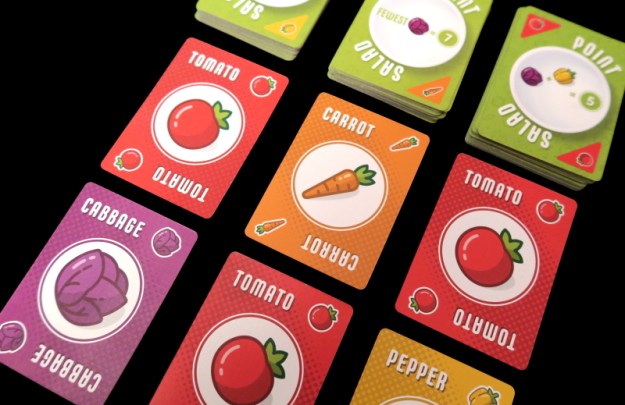
Food was a little delayed, so we decided to start playing something.  Food was clearly on our collective minds though, because we opted for a starter of Point Salad.  This is a very simple set collecting game where players take cards from the market.  The cards are double sided with brightly coloured vegetables on one side and scoring conditions on the other.  The market consists of three piles of cards showing the scoring condition sides, and six cards showing the reverse, the vegetable side.  The number of cards a player can take depends on where they take it from:  one scoring card or two vegetable cards.

Point Salad
– Image by boardGOATS

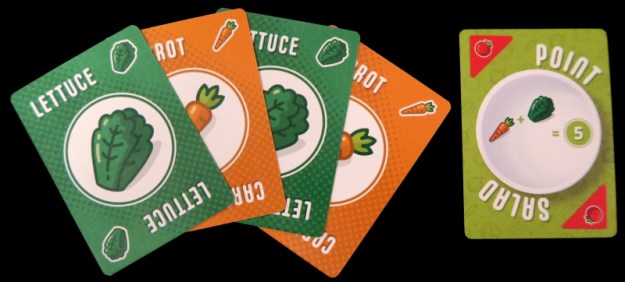
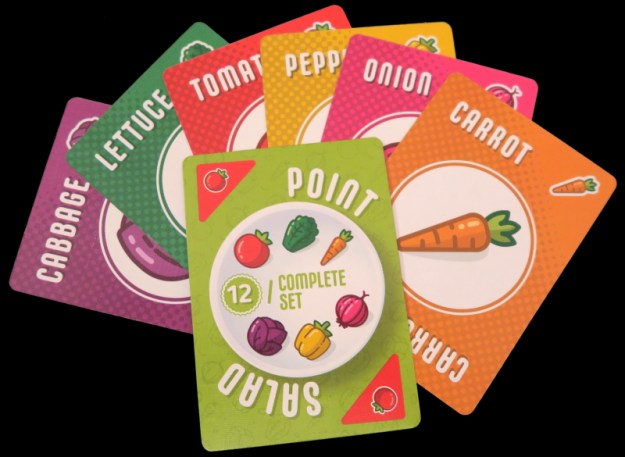
Each pile of cards feeds one pair of vegetables.  So, when a vegetable is taken, a scoring condition card is turned over to reveal its vegetable side, and that scoring condition is no longer available.  Players can also, once per turn, turn over one of their scoring cards so it becomes a vegetable, but they may never turn over a vegetable to make it a scoring card.  The game is over when all the cards have been distributed, and the scores have been totaled.  One of the more unusual things about this game is that both vegetable and scoring cards can be used more than once.  So, a player with a card giving points for sets of onion, cabbage and carrot (i.e. coleslaw), can score it as many times as they have sets.  Furthermore, if they also have a card that scores for pairs of carrots and lettuces (i.e. rabbit food), they can reuse the carrot cards and count them a second time.

Point Salad
– Image by boardGOATS

Pine began collecting lettuces, an obsession with green things that ended up lasting the whole evening.  Burgundy was more obsessed with red things, specifically tomatoes, so Mulberry, Black and Purple took great delight in snaffling them first, even when they didn’t help.  Blue only needed mayonnaise for her coleslaw as she collected onions, cabbages and carrots and generally made a nuisance of herself with Mulberry, sat to her left.  Food arrived before the game finished, and with people getting distracted by pizza and chips (always more appealing than salad) it is possible there were some missed opportunities.  It was tight finish at the front with only six points between the winner and third place.  Sadly, despite everyone else’s best efforts, Burgundy top-scored with fifty-six, ahead of Mulberry and then Blue.

Point Salad
– Image by boardGOATS

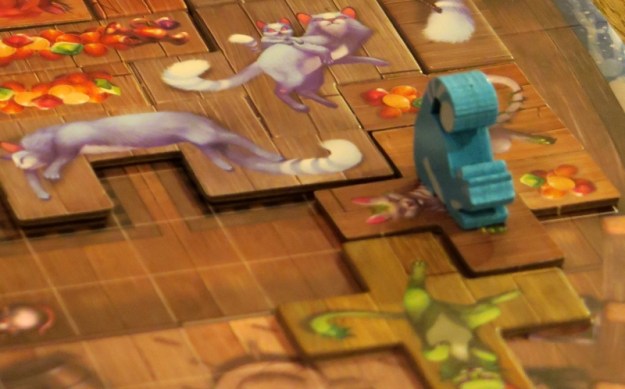
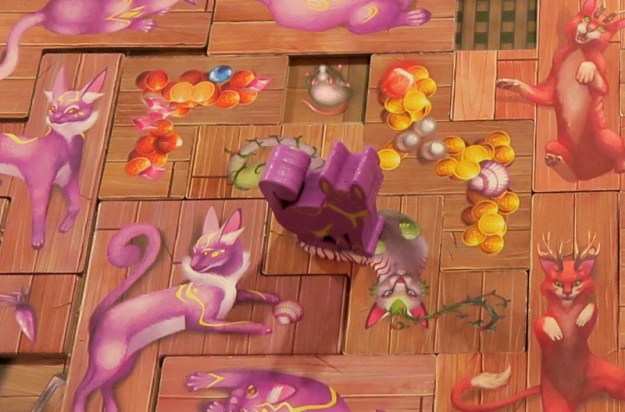
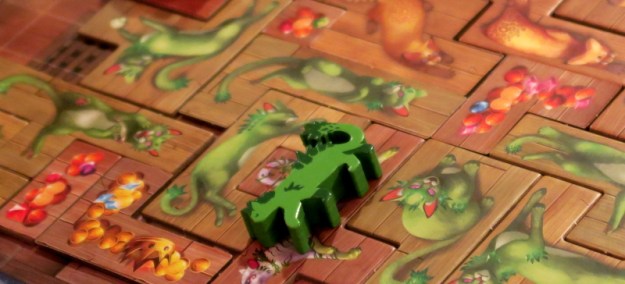
Once everyone had finished eating, it was time to decide who would play what.  The “Feature Game” was The Isle of Cats, a tile-laying game where players are rescuing cats and packing them onto their ship.  There were a lot of takers, none of which were keen to back down (even though Mulberry misunderstood and thought it was called “Pile of Cats” which, on reflection, does sound very exciting).  The game is not terribly complicated though we did make a bit of a meal of it. It is played over five rounds, each of which starts with card drafting.  Players are dealt seven cards and keep two passing the rest to their neighbour; this is repeated until they receive only one single card.

The Isle of Cats
– Image by boardGOATS

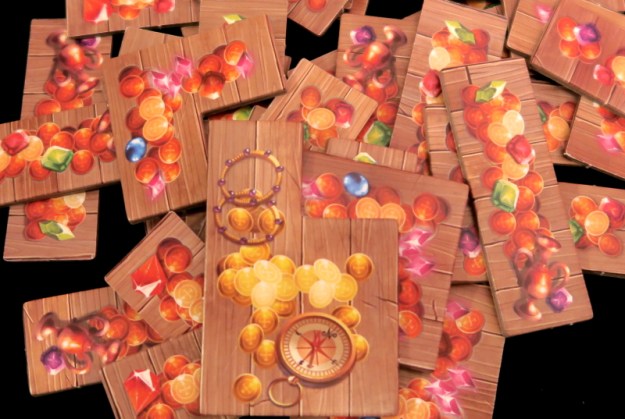
The cards come in five different colours: blue, green, yellow, brown and purple.  Blue cards are Lesson cards which are really just Objective cards, but these come in two types, personal and public.  Yellow cards depict some combination of “Boots”, “Cat Baskets” and “Broken Baskets”.  Boots are useful because they dictate where you come in the turn order, while Baskets are needed to used to “pay” to rescue Cats.  Yellow cards are treasure cards, brown cards are special “Oshax” cat cards and purple cards are instant effect cards that can be played at any time.

The Isle of Cats
– Image by boardGOATS

At the start of every round, each player receives twenty Fish which are used to pay for both cards and Cats.  So, once the cards have been drafted, players choose which ones they want to buy. with prices varying from free to five Fish.  The rest are discarded.  It is imprudent to over-spend, as Fish are also needed later in the round to lure cats off the island and onto the players’ ships; some cats are easier to lure than others, with cats on one side of the island costing three Fish and others costing five Fish.

The Isle of Cats
– Image by boardGOATS

Once everyone has paid for their cards, they must play any blue Lesson cards they kept in the round.  Any Public Lessons are revealed while Private Lessons are kept to one side face down.  Players then play their green cards—this is the guts of the game.  Players do not have to play all their green cards straight away, some can be kept for later rounds.  The number of Boots played are counted up, and the turn order is adjusted according to the number of Boots played so that the player with the most goes first and so on.  Player then take it in turns to spend one of their baskets and the appropriate amount of Fish to take one of their Cats and place it on their ship.

The Isle of Cats
– Image by boardGOATS

Each player starts the game with one “Permanent Basket” which they can use once per round, aside from this, the other Baskets usually come from the cards played or other Permanent Baskets acquired later in the game.  The Cats come in five different colours and are depicted on polyomino tiles which are placed on the players’ Ship-player boards.  At the end of the game players score points for grouping Cats of the same colour together in Families:  the larger the Family the more points.  So, a group of three Cats of the same colour will score eight points, while a Family of ten Cats scores a massive forty points.  In addition, players lose one point for each rat they have failed to cover with a cat, and lose five points for each room they fail to fill.

The Isle of Cats
– Image by boardGOATS

Thus, perfectly tessellating Cats is the aim of the game, but additional points are also available from the Lesson-objective cards.  It would be quite a challenge to perfectly tessellate tiles while keeping cats of the same colour together and conforming to the arbitrary objectives given in the Lessons, however, there are a couple of things to help grease the wheels.  Players who cover Scrolls on their Ships with a Cat of the same colour can add a Treasure tile to their ship for free—these are small tiles that are very useful for filling in holes.  There are only five scrolls though, one of each colour.

The Isle of Cats
– Image by boardGOATS

Additionally, however, once everyone has run out of Baskets, they can also play their Rare Treasure, yellow and brown cards.  The yellow cards enable players to place more Treasure tiles while brown cards allow players to place the very rare Oshax Cats (or “Oh, shucks!” Cats as we mostly called them).  These are very friendly Cats and will join any Cat Family of the player’s choice, though they have to pick the colour when they place it.  The cards are quite rare and very expensive, but a couple of these can be a really good way to boost the size of a Family.

The Isle of Cats
– Image by boardGOATS

In addition to Baskets on cards, each player starts with one Permanent Basket which they can use once per round.  Blue started the game quickly, by playing two lesson cards followed by a special card which enabled her to swap them for a second Permanent Basket.  Everyone looked on agog, envious of the advantage that would give, however, it had cost a  lot of Fish, and she spent the rest of the game trying to recover. Mulberry struggled to get some useful cards, but eventually managed to get a Permanent Basket of her own while Burgundy managed to get a couple of his own and he concentrated on trying to make sure there were no gaps round the edge of his boat to fulfill Lesson 113 to give him twelve points.

The Isle of Cats
– Image by boardGOATS

Pine meanwhile, continued his obsession with green and hogged all the green cats.  Since cards are drafted most of the cards are seen by some of the other players, so when he said he wasn’t sure how one of his Lesson cards worked, Blue and Burgundy knew exactly what his problem was.  The Lesson in question was Card 222 which gave ten points for each row of twelve containing at least twelve cats of the same colour.  Green’s queries concerned whether the row had to be continuous or whether they could be broken up by treasure, and whether Oshax cats counted.  We said they didn’t have to be continuous and Oshax cats counted so long as they were the right colour.  As a result, Pine’s green car family continued to grow, now forming long rows, lots of them.

The Isle of Cats
– Image by boardGOATS

It was in the final round that Mulberry turned nasty playing Public Lesson Card 235 which meant anyone  who didn’t have seven treasures would lose five  points, which inconvenienced Blue quite a bit.  When it came to scoring, it turned out that we weren’t quite right with the rule for Card 222—the rows should have been continuous.  That might have cost Pine ten or even twenty points, though of course had he known that, he would likely have been able to offset that a little.  It wouldn’t have mattered anyhow as finished with ninety points and a huge lead.  Over thirty points behind, it was close for second, but Burgundy, who just managed to ensure there were no gaps at the edge of his boat, pipped Blue, by two points.

The Isle of Cats
– Image by boardGOATS

There are a number of really nice things about The Isle of Cats.  Firstly the production quality is stellar and there are some really, really nice touches.  The cat artwork is fantastic and the fancy screen-printed cat-eeples from the deluxe upgraded version are quite special.  Unquestionably, we made a mistake playing with five the first time round—we were slow, with a lot of people spending a lot of time checking whether tiles would fit and that made the game even slower.  Mulberry commented that she disliked variable turn order as a mechanism:  it is common in lots of games, but tends to encourage a lot of pauses followed by queries about whose turn it is.  The are other little things like the fact the purple and brown cards could have been more distinct.  Overall, it definitely deserves another chance, but it might be hard to get some of the players from the first time to give it a second try.

The Isle of Cats
– Image by boardGOATS

Meanwhile, on the next table, Ivory, Black and Lime, started off with Key Flow.  This was particularly sad for Blue to see, because Key Flow is a sort of card game of Keyflower, one of her favourites.  That said, Key Flow had been played at our sister group, the Didcot Games Club, just a few days previously, so she consoled herself with the memory of that and concentrated on The Isle of Cats.  Although Key Flow has a lot in common with Keyflower, it has a very different feel.  Where Keyflower is really an auction game (using meeples as currency), Key Flow is a card drafting game.  So, in Key Flow, players start with a handful of cards, simultaneously choose one and place it face down, passing the rest on.

Key Flow
– Image by boardGOATS

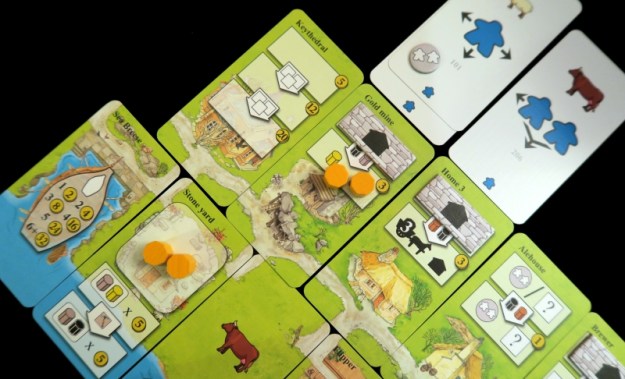
Players then simultaneously reveal their card and add it to their village before picking up the hand they’ve just been given, selecting another card and so on.  Like Keyflower, the game is played over four seasons, and like Keyflower players receive some of the Winter offerings  at the start of the game which they can then use to drive their strategies.  The iconography is very similar too, so a player who is familiar with Keyflower generally feels at home with Key Flow.  The cards come in three flavours:  village buildings, riverside buildings and meeples.  Village cards are placed in a player’s village, in a row extending either side of their starting home card.  Riverside tiles are placed in a row below, slightly off-set.

Key Flow
– Image by boardGOATS

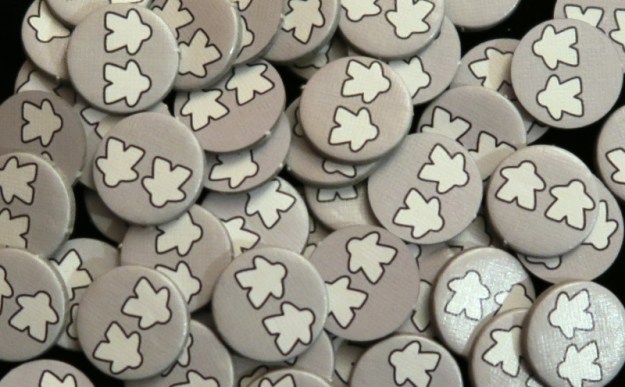
Meeple cards are used to activate Village cards by placing them above the relevant building.  As in Keyflower, buildings provide resources, skill tiles, transport and upgrades.  They also provide meeple tokens which can be used to increase the power of meeple cards or activate a player’s own buildings at the end of the round.  Arguably the clever part is how the meeple cards work.  At the centre of each card there are a number of meeples which dictate the power of the card.  A single meeple card can be played on any empty building; a double meeple card can be played on an empty building or one where one other card has already been played.

Key Flow
– Image by boardGOATS

If two cards have already been played, a triple meeple card is required to activate it a third and final time.  Alternatively, a lower power meeple card can be played with one of the meeple tokens, which upgrade a single meeple card to a triple meeple card.  Double meeple cards can also be upgraded, but each building can only be activated a maximum of three times per round.  The really clever part is that the meeple cards have arrows on them indicating where they can be played:  in the player’s own village, in the neighbouring village to the right, the village to the left, or some combination.

Key Flow
– Image by boardGOATS

Black began the game by adding the Key Mine to his village which provided him with iron (wooden, black octagonal prisms).  In summer he added the Smelter which added more iron producing capacity (converting skill tiles), but he quickly upgraded this to give gold instead as it is more versatile and can be used instead of any other resource and any left overs are worth a point each at the end of the game.  Ivory also had resource providers in the shape of the Workshop which provided him with a wood, an iron and a stone every time it was activated.  He then added an Apprentice Hall which generated skill tiles.

Key Flow
– Image by boardGOATS

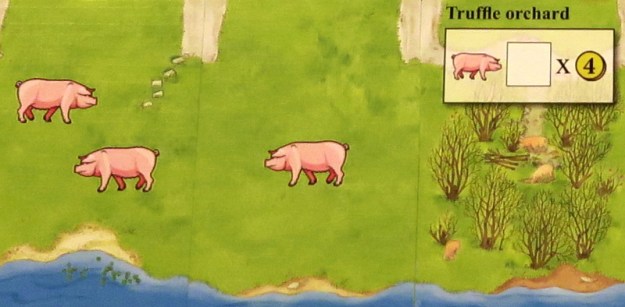
Meanwhile, Lime built a village strong in gold production, with the Gold Mine and Brewer and potentially the Carpenter too if he could upgrade it.  To his village, Black added a flock of sheep on his river bank while Ivory added a heard of pigs; Lime was more of a mixed farmer though with a bit of everything.  As the game progressed into the scoring rounds, Ivory added a Truffle Orchard which gave him four points for each pig and skill tile pair, allowing him to put all his pigs to good use netting twenty-four points.

Key Flow
– Image by boardGOATS

Lime and Black pulled in similar points tallies with their Emporium (four points for each green meeple and gold pair) and Traveller’s Lodge (points for transport and boats) respectively.   With similar points for their upgraded buildings as well, it was close and the smaller contributors became really important.  Ivory’s Trader which scored him fifteen points for stone and axe skill tiles, while both Black and Lime scored ten points for their Autumn stores (Stone and Timber Yards respectively).

Key Flow
– Image by boardGOATS

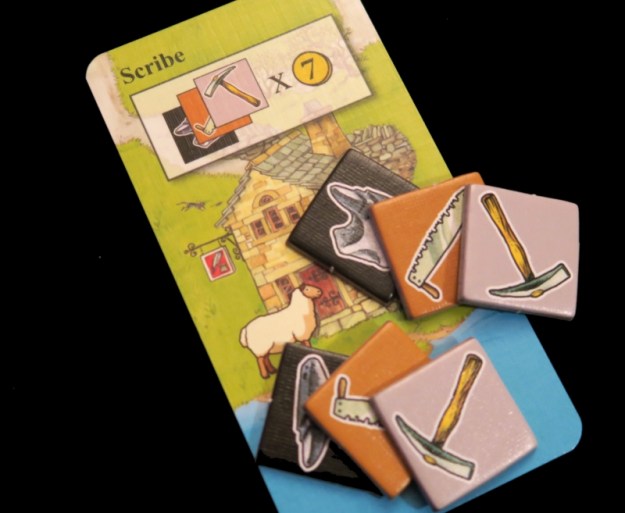
Perhaps it was the points he got from the meeples (Winter Fair and Craftsmen’s Guild), but there was only two points between first and second in the end. Black finished with a total of seventy-one points, just enough for victory—a couple of points more than Ivory, with Lime not far behind.  It had been a hard fought game, and Ivory was impressed how the Scribe, which in Keyflower he felt was always a winner, had little effect.  For him, this made the game more interesting, though he had really enjoyed the last time the group played Keyflower with the Farmers expansion, as that had also mixed things up.

Key Flow
– Image by boardGOATS

Given the recent game with the Didcot group it was inevitable that a comparison was going to be made.  This time Black won, but he scored fewer points than he had the previous week when he had come second.  Perhaps the most marked difference was how much quicker the three player game of Key Flow had been than the six player game a few days earlier.  Where the six player game had taken all evening, there was still time for something small, and with Lime taking an early bath, Ivory and Black chose to play a head-to-head of Ticket to Ride: London.

Ticket to Ride: London
– Image by boardGOATS

Ticket to Ride is a train game with an inexplicable alure, which everyone in the group loves and we’ve found that the small versions of the game, New York and London make excellent fillers.  The rules and game play are very similar to the full versions, but the take half the time, and with just two players, that makes it a very short game indeed.  On their turn, players take coloured cards or spend them to place their pieces on the map.  Points are awarded for completing tickets, but critically, failing to connect two locations marked on a ticket will score negative points.  The player with the most points at the end of the game wins.

Ticket to Ride: London
– Image by boardGOATS

This time, Ivory built a network connecting Brick Land and the Tower of London in the East with Hyde Park in the West, while Black joined Regent’s Park in the North with Waterloo and Elephant & Castle in the South.  The crunch point came in the area around Covent Garden, but despite this, both players managed to complete all four of their tickets.  This meant it was down to the length of the tickets and the number of pieces placed—Ivory had the edge on both of these.  His revenge for the result in Key Flow was completed by a four point bonus for connecting all four in the St. Paul’s district resulting in a ten point victory.  With that, Ivory headed home, leaving Back to watch the end of The Isle of Cats.

Ticket to Ride: London
– Image by boardGOATS

Learning Outcome:  Games take longer with more players.

Boardgames in the News: Withdrawal of Customer Service by Asmodee

One of the characteristics of modern boardgames is the number of pieces in the box:  generally the more complex the game, the more pieces there are, and the more it costs.  For many, part of the fun of acquiring a new game is checking, sorting and otherwise caressing these, often bespoke, pieces.  It is very easy to lose or break a piece and an estimated 1-2% of new purchases arrive damaged or with something missing.  One of the truly special things about the boardgame industry has been the general understanding of the sadness caused by a missing piece, and the support the manufacturers give when a game has become incomplete, even if it is not the manufacturers fault.

No Thanks!
– Image by boardGOATS

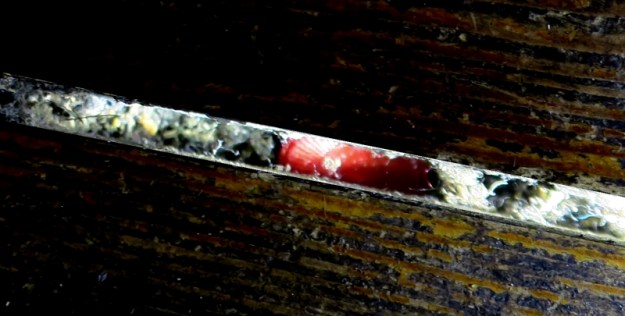
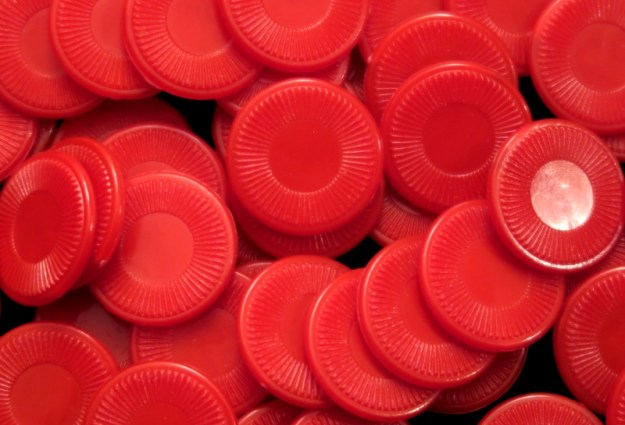
For example, just over a year ago, one of the boardGOATS dropped a counter for No Thanks!.  After an extended session of “Hunt the Game Piece”, we eventually found it nestling in a cushion of dust, just out of reach, exactly where it fell, having cleanly dropped through the gap between the pub floorboards.  The game is inexpensive and readily available, but our copy is much played and much loved, and replacing it for the sake of one token seemed wasteful.  Of course the missing token could be substituted with something else, a penny say, but that would have made us sad every time we played it.  So, a quick email to AMIGO Spiele offering to purchase a couple of spares, and one week later a small handful of red counters arrived in the post—exceptional Customer Service from a superb company.

No Thanks!
– Image by boardGOATS

The remarkable thing is that this is not the only example:  similar service has been received from Zoch Verlag (Auf Teufel komm raus), NSKN Games (Snowdonia: Deluxe Master Set), Queen Games (Kingdom Builder), Ferti Games (PitchCar), Tactic (Nollkoll), Z-man (Le Havre), Rio Grande Games (Torres) & Splotter (The Great Zimbabwe), to name but a few, sometimes their fixing a problem of their making, sometimes just helping out.  This superb service (sometimes with a fee, but often without charge) builds a good relationship with the customer and encourages more sales—so not so much “No Thanks”, as “Yes Please”!

Orléans
– Image by boardGOATS

Last week, however, Asmodee USA closed its Customer Services Department to the public, and announced that all games with missing pieces should be returned to the vendor (as yet there is no comment on who should pay for returns of online purchases, or what happens with gifts that arrive with a piece missing).  Worse, the FAQ adds that when buying a second-hand copy, they “encourage you to make sure that all components of a game are present and intact before purchasing” as they “cannot offer replacements for products that were not purchased directly from our USA retail partners or webstores”.  Their justification for this is:

“With the number of quality titles in Asmodee USA’s growing library, maintaining an independent stock of elements of each game becomes more difficult. We believe offering the customer service through the store they have purchased the game from will be a better experience.”

It was initially thought that this would only affect USA customers, however, it seems that is not the case.  Asmodee UK have passed the buck:  according to their website, for replacement pieces for Asmodee, Fantasy Flight Games, Days of Wonder, Catan, Plaid Hat Games or Z-Man Games, “please visit http://parts.asmodeena.com/”, which in turn simply says:

“As of February 18, 2020, if a game is purchased in the US that has damaged or missing components, please return to where you originally bought the game for assistance.”

This change in policy may or may not make business sense in the short term, but for the gamer it is a very sad loss of what always felt like friendly support, and something that made boardgaming special.

UKGE 2018
– Image by boardGOATS

Next Meeting – 18th February 2020

Our next meeting will be on Tuesday 18th February, at the Horse and Jockey pub in Stanford-in-the-Vale. As usual, we will be playing shorter games from 7.30pm as people arrive, until 8pm when we will start something a little longer.

This week, the “Feature Game” will be The Isle of Cats, a tile-laying game where players are rescuing cats and packing them onto their ship.

Isle of Cats
– Image by BGG contributor kalchio

And speaking of Cats…

Jeff was at the cinema watching the new release of Jane Austin’s “Emma”, when he noticed what looked like a cat sitting next to him.

“Are you a cat?” asked Jeff, surprised.

“Yes,” the cat replied.

“What are you doing at the cinema?” asked Jeff.

“Well,” replied the cat, “I liked the book…”


4th February 2020

Blue and Pink were first to arrive and, while they waited for others and their pizzas to arrive, they tried to squeeze in a quick game of Ganz Schön Clever (a.k.a. That’s Pretty Clever).  This is a “Roll and Write” game, that is to say, players roll dice and use the values they roll to fill in spaces on their score sheet.  So, it is an abstract game where the active player, rolls all six coloured dice and chooses one to keep and use, discarding all dice with lower pip values.  They then roll any remaining dice, again keeping and using one and discarding the rest before rolling the rest one last time keeping and using one final die.  The other players can then use one of the discards, before play passes to the left.

Ganz Schön Clever
– Image by boardGOATS

Filling in some of the boxes gives a bonus action, enabling players to fill in other boxes or gain the opportunity to re-roll their dice or even use an extra die.  The player who wins is therefore the player who makes the best use of the dice they roll and usually, the player who manages to build the most combinations to take advantage of the bonuses available. This time both Blue and Pink started off slowly, but as they were coming to the last couple of rounds, both food and people arrived and their focus drifted a bit.  Pink managed to keep it together better though and as a result finished with a nice round hundred and fifty, some twenty more than Blue.

Ganz Schön Clever
– Image by boardGOATS

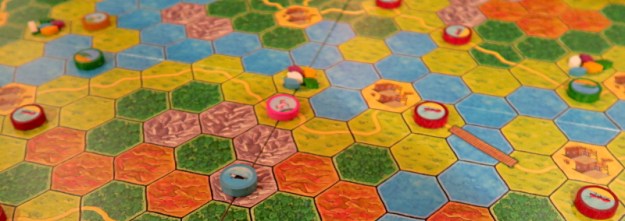
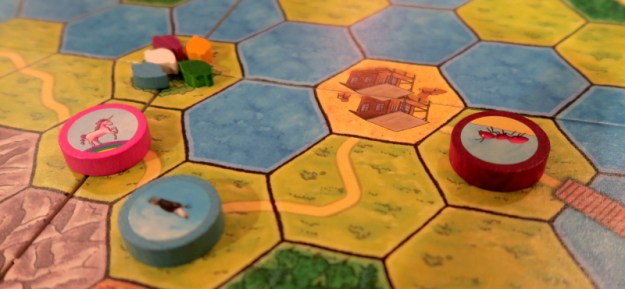
As they finished eating, Green, tried to organise players in an effort get a group together to play Terraforming Mars.  It was quickly clear that it was not going to happen, as Burgundy, Black, Pink, Pine and Mulberry expressed an interest in playing the “Feature Game”, Fast Sloths.   This is a race game where players are sloths travelling around a holiday resort on the backs of other animals.  The rules are quite straight forward:  on their turn the active player takes cards from the face up piles that make the market; optionally play cards, and then discard down to conform to the hand-limit (which varies depending on how players are progressing).  When taking cards, they must all be different animals, and the number they can take depends on their position in the race.

Fast Sloths
– Image by boardGOATS

The game is a pick-up-and-deliver type of game, but unusually the sloths are the cargo being delivered.  Movement on the central board is the heart of the game and each player must try to optimize their movement to win.  When playing cards, they must all be of the same animal – the player then moves the animal corresponding to the cards played towards their sloth, so they can pick it up and drop it somewhere else on the map.  Each animal has their own characteristics, the type of terrain they can cross and how they move etc..  The aim of the game is to collect leaves and the first sloth that can gather eight leaves wins.

Fast Sloths
– Image by boardGOATS

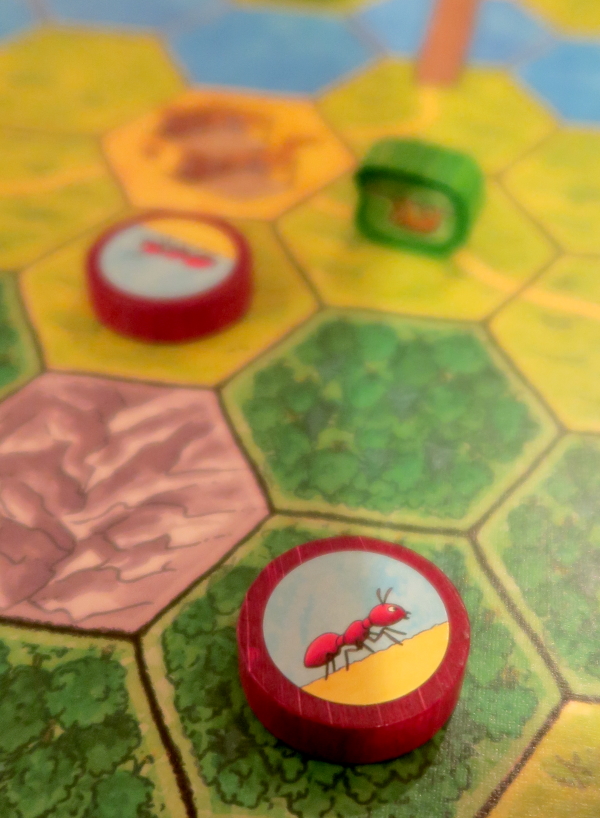
Burgundy got off to a flying start – by both playing first and (even though he was last to pick) securing a good corner tree as his starting location, with a ready-made parade of ants he could bounce over on his way to the next tree.  It was a very tight game, which, after the first few turns while people built up their hand of cards, progressed rapidly with players aiming for a new leaf every turn, or at worst every two turns.

Fast Sloths
– Image by boardGOATS

There was much discussion about the accuracy of the terrains allocated to each transport animal. Donkeys, for example – in Fast Sloths they can’t travel in the mountains or through water, but surely the reasons why donkeys make such good pack animals is that they are great at climbing mountains and wading rivers?  Pink suggested that as this was a “game” perhaps such comparisons weren’t relevant?  However, this suggestion was not received well and went down like a donkey in a river…  Attention then turned to “how true to life” was the representation of unicorn transport.

Fast Sloths
– Image by boardGOATS

The game carried on, with only an occasional call of “Summon the Eagles!” from Mulberry (just imagine Brian Blessed in the film Flash Gordon).  Despite being the first time most people had played the game, all players had clearly got to grips with the mechanism and made speedy progress through the forest – a compliment to the designer it was felt.  In the end, with everyone so closely matched, it came down to marginal differences and Burgundy, after his initial flying start, stayed out in front to win after collecting eight leaves. Hot on his heals were Mulberry, Black and Pine with seven.

Fast Sloths
– Image by boardGOATS

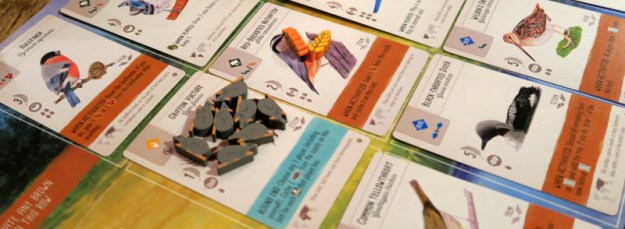
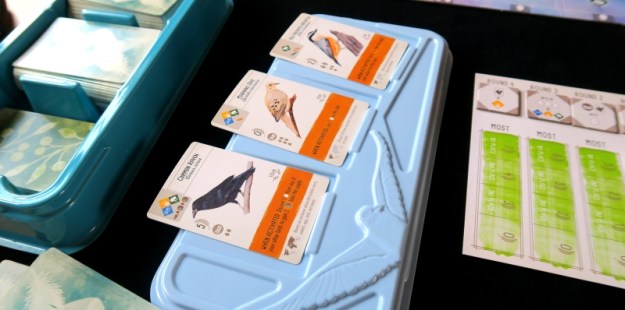
Meanwhile, on the next table, Green and Ivory had settled on Wingspan, and were eventually joined by Purple and Blue.  Since it won the Kennerspiel des Jahres award last year, this has proved a very popular game within the group.  The copy belonged to Burgundy, and he had integrated the European Expansion and Swift-Start Cards, as well as “pimped his bits”; the artwork on the cards is beautiful and the additional pieces just add to the aesthetics.  The game is  functionally very simple, though playing well requires planning and just a little bit of luck.

Wingspan
– Image by boardGOATS

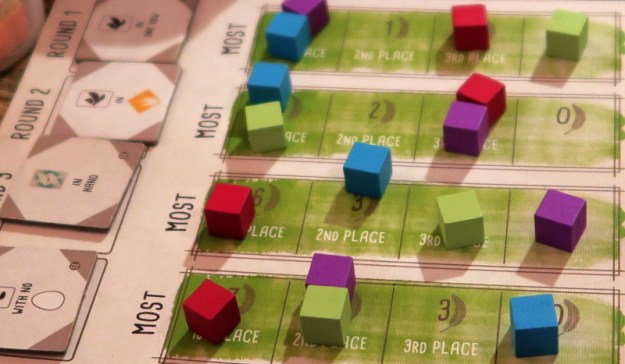
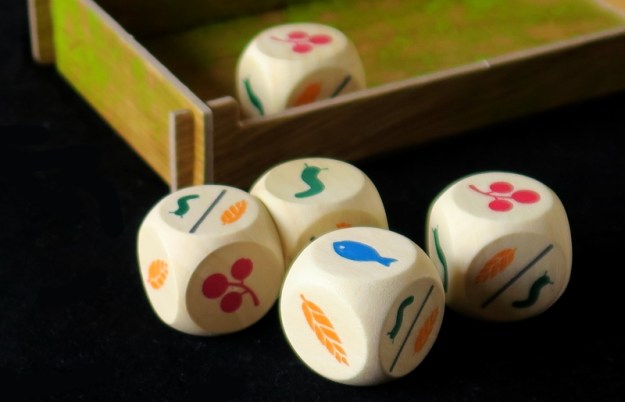
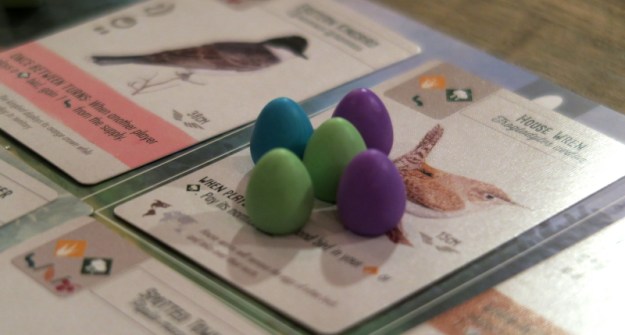
On their turn, the active player can place an action cube to do one of two things:  pay food to play a bird card from their hand, or activate one of their three habitats and all the birds in it.  The three habitats, allow players to collect food, lay eggs or add more bird cards to their hand.  At the end of each round there are bonus points available for players who are most successful with the targets set out; at the end of the game players score points for each bird card they’ve played (value dependent on the bird), food and eggs on their cards, and flocking birds.   The difficult part is to efficiently build combinations of birds with synergistic special powers that will ultimately yield the best score.

Wingspan
– Image by boardGOATS

This time, Blue started by playing a White Wagtail in her Wetland, which gave the opportunity to place a bird card at the end of the round so long as she had activated all three habitats and placed a card during the round.  She still had to pay the food needed, so she concentrated on making sure she had all the bits required to make it work for her every round.  Ivory focused on first playing his Savi’s Warbler and then using it to acquire a lot of cards, many from the face-down draw pile, hoping to draw something good.  Green struggled a bit from the start, partly because he was arguably the player with the least experience, but the fact he was distracted by a bird of a different sort tweeting by phone certainly didn’t help.  Purple on the other hand, quietly concentrated solely on her game, and made excellent use of her Double-Crested Cormorant which allowed her to tuck two cards in exchange for one fish.

Wingspan
– Image by boardGOATS

As the game progressed, Green increasingly needed prompting to take his turn, and explained that he was getting side-tracked because Blue, playing immediately before him, was taking so long on her turn.  While it was true that Blue’s turns were getting longer, this was almost entirely because the number of birds in her reserve was increasing faster than anyone else’s, largely thanks to her White Wagtail which she was busy putting to good use.  The contrast was quite stark Green’s rather meager reserve and Blue’s, although by this time, both Ivory and Purple, also had a good sized reserves.  As the game entered the final round, Fast Sloths was coming to an end and those players wondered over, so the last few turns were played with an audience.

Wingspan
– Image by boardGOATS

At this point, the Wingspan players were putting the finishing touches to reserves.  Green kept commenting how he knew he was coming last and it was clear who had won, but Ivory was not so sure.  In the final accounting every bird in Purple’s reserve had a good point value adding to her points from the tucked birds and Ivory did best in the end of round goals.  Blue had the most birds giving her the same amount of points as Purple (though the individual cards were not as good) and she scored slightly fewer points that Ivory in the end of round goals.  In every other area, however, Blue led the pack giving her the lead overall with ninety-eight points.   Ivory was twenty points behind, and just pipped to second place by Purple.

Wingspan
– Image by boardGOATS

Mulberry, Pine and Ivory Ieft to get an early night, leaving everyone else to play something short;  the game that fitted the bill and was on the top of the pile was For Sale.  This is a very clever property auction game that we played for the first time in years at New Year. The game comes in two parts:  buying properties and then selling them.  So, each player starts the game with $14,000 to spend on property cards.  There are thirty properties, numbered to reflect their relative value and these are auctioned in groups equal in size to the number of players.  The clever part of the auction is that when a player passes and withdraws, they pay half the value of their final bid and take the property with the lowest value; the winner takes the most valuable property, but pays their final bid in full.

For Sale
– Image by boardGOATS

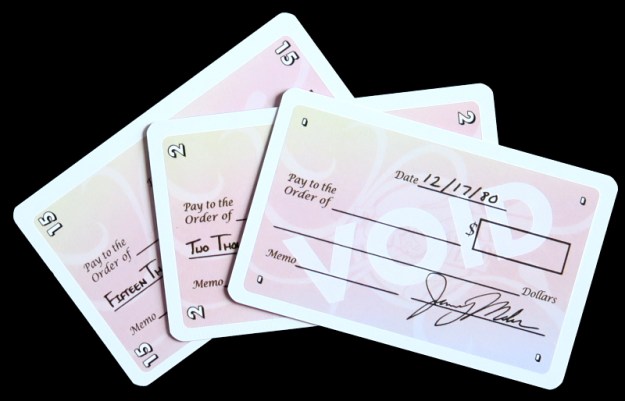
In the second part of the game, cheque cards equal in number to the number of players are laid out, with values from zero to $15,000.  Each player then chooses one property card from their supply and everyone reveals them simultaneously: the highest value property earns the highest value cheque with the second most valuable property earning its owner the second largest cheque and so on.  The winner is the player with the highest total from the sum of their cheques and any left-over cash.  This time, Black took the most valuable property, the space station and with it, on of the $15,000 cheques while Burgundy took the other.

For Sale
– Image by boardGOATS

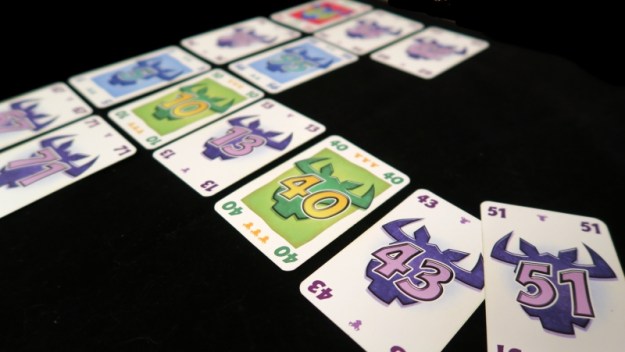
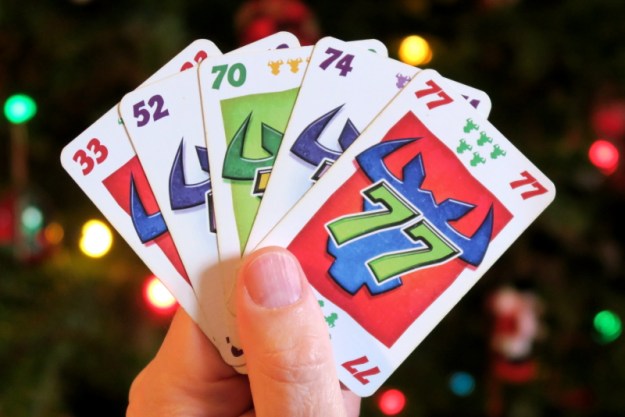
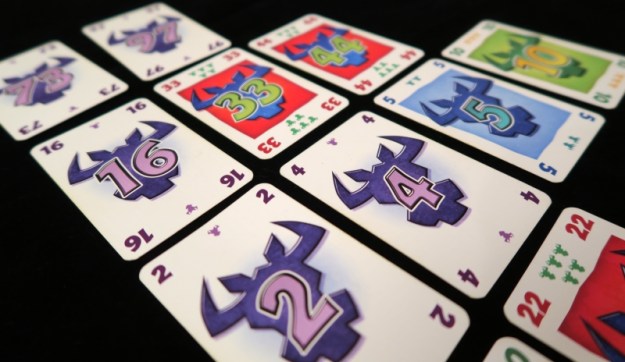
At the other end of the scale, Pink took both the void cheques, but despite this still managed $33,000 for the rest of his properties.  This was nothing compared to the winner, Green, who finished with $53,000, $2,000 more than Burgundy in second.  The night was still young, however, and there was still time for one of our favourite games, 6 Nimmt!.  Although this is often derided as a game of chance, it is clear that it is not pure luck.  The idea is that everyone has a hand of cards from a deck numbered one to a hundred and four.  Simultaneously, everyone chooses a card from their hand, and, starting with the lowest value card, these are then added to one of the four rows of cards.

6 Nimmt!
– Image by boardGOATS

Each card is added to the row with the highest end card that is lower than the card they have played.  If the card is the sixth card, they take the five cards in the row and their card becomes the first card in the new row.  Each card has a number of bull’s heads on it—this is the number of points they score.  The player with the fewest points at the end of the game wins.  We play with a variant that half the cards are dealt out for the first hand and the rest for the second, which gives us a score at half-time.

6 Nimmt!
– Image by boardGOATS

This time Burgundy and Black were in the lead at the half-time with a single nimmt, with Blue a couple of points behind.  Pink set the competitive high score of thirty-one.  Black picked up a handful of cards in the second half, indeed, only Purple, Blue and Burgundy managed to keep their second half scores to single figures.  In the end, it was Blue who just had the edge, beating Burgundy by three nimmts.  At the other end, however, Pink had no competition finishing with a very respectable high score of forty-five, not a record, but a substantial total nonetheless, and a good end to a fun evening.

6 Nimmt!
– Image by boardGOATS

Learning Outcome:  Donkeys are not as versatile as you might think.

Next Meeting – 4th February 2020

Our next meeting will be on Tuesday 4th February, at the Horse and Jockey pub in Stanford-in-the-Vale. As usual, we will be playing shorter games from 7.30pm as people arrive, until 8pm when we will start something a little longer.

This week, the “Feature Game” will be Fast Sloths, a race game where players are sloths. The game is a pick-up-and-deliver type of game, but unusually the sloths are the cargo being delivered.

Fast Sloths
– Image used with permission of boardgamephotos

And speaking of Sloths…

A sloth named Jeff was walking through the forest one day when a gang of snails approached him and beat him up. Jeff was left at the bottom of a tree with many cuts and bruises and was feeling very sorry for himself. Several hours later he gathered up enough strength to go to the local police station. It was immediately obvious to the desk-officer that the sloth was in some distress, so the officer invited him into a quiet room straight away.

“What happened to you?” the officer asked.

“A gang of snails beat me up,” Jeff replied.

The officer took out his notebook and pencil, “Can you describe what they looked like please?”

“I don’t know,” the sloth said, “It all happened so fast…”

21st January 2020

Over the last three years we’ve spent a lot of Tuesday evenings discussing Brexit and following events in the House of Commons as they occured.  Since this was going to be the last games night with the UK in the EU, and as a predominantly pro-EU group, we wanted to mark the occasion and show our support for our European friends and all those who have campaigned against Brexit so valiantly.  For this reason, we decided to make the “Feature Game” “European Ticket to Ride“, in other words, European editions of one of our favourite games, i.e. the Italy, France, Germany, Poland, Netherlands and of course, Europe games/expansions.  Unfortunately, Blue (and therefore most of the maps) was late arriving, and then, nobody could decide what they wanted to play; the only one who expressed any strong opinion was Lime who wanted to play the France map.
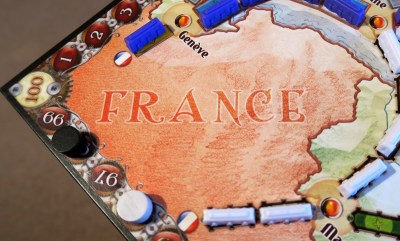
Ticket to Ride Map Collection: Volume 6 – France & Old West
– Image by boardGOATS

With nine players, three groups of three looked good, but the debate as to who would play what rivaled the Brexit negotiations, not helped by the number of people who were enticed by the Japan map on the reverse of the Italy map.  In the end, Ivory and Green took themselves off to play the new Poland map, and, after a lot of discussion, Lime, the only one who had a strong opinion ended up forgoing his choice of France and joined the Poles to even up the numbers.  With Black, Purple and Pine starting on France, that just left Blue, Burgundy and Mulberry to decide, and eventually they decided to play the Italy map using the Germany base game components.

Ticket to Ride: Germany
– Image by boardGOATS

Ticket to Ride is a very well-known, well-loved game that has now become something of a “gateway game”, that is, a game that starts people unfamiliar with modern boardgames along the slippery slope.  The game is popular with casual gamers because it is simple to play, with few options and a little bit of luck, but not too much.  The game is played on a map with cities connected by train routes each made up of anything from one to nine spaces (depending on the map).  On their turn, the active player can do one of a small handful of things:  firstly, they can take train cards from the market or use the train cards to place plastic trains on the map and score points.  To place trains on the map, players spend coloured cards to match the route they are claiming.  As well as coloured train cards, there are also multi-coloured locomotive cards which are wild; a face up Locomotive can only be drawn as the first card and ends the turn, making them more expensive as well as useful.
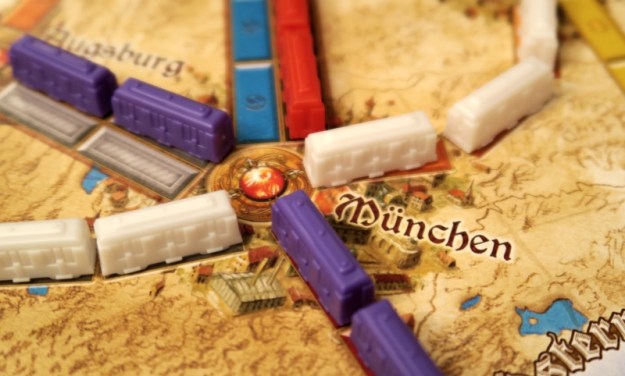
Ticket to Ride: Germany
– Image by boardGOATS

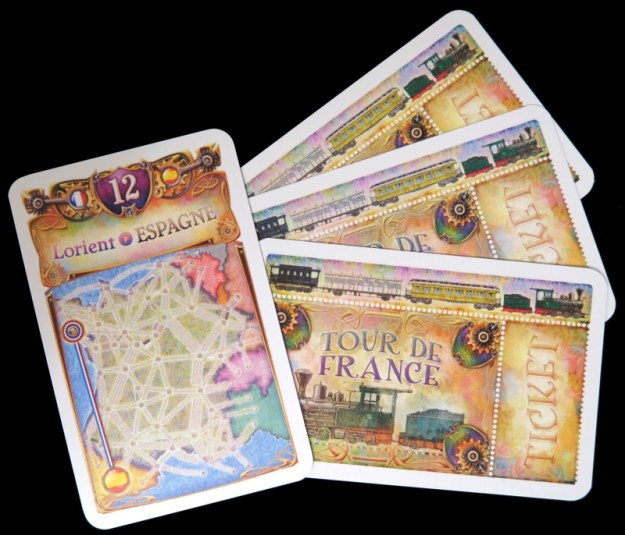
Most cities have only a single route between them, but some are double or even triple, though these can only be used with higher player counts.  Instead of taking train cards or placing trains on the map, players can also draw tickets.  These are a sort of personal objective that give players points for connecting two cities—the further apart, the more points the ticket is worth, but the larger the risk, as failure gives negative points.  Players start the game with a handful of these and can choose which ones to keep.  They can also draw more during the game, keeping some and discarding others, but the specific conditions depend on the map used.
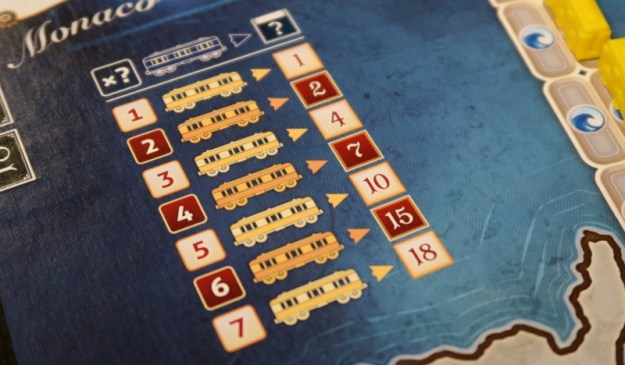
Ticket to Ride Map Collection: Volume 7 – Japan & Italy
– Image by boardGOATS

This is the basics of the original 2004, Spiel des Jahres winning game, with a USA map, Ticket to Ride, but each variant provides a different map and some slight modifications to the rules.  For example, Ticket to Ride: Europe adds Ferry routes which require a certain number of locomotive cards to be played in addition to the coloured train cards. It also adds Stations, which can used to help players complete tickets where a route has been blocked.  For some different maps players get different numbers of trains, Poland is one of the smaller maps, with only thirty-five trains, compared with the forty-five in the Europe and US versions or the three German editions (Germany, Deutschland and Märklin).

Wsiąść do Pociągu: Polska
– Image by boardGOATS

The other thing that makes the Poland expansion map stand out (aside from the fact that it is Map Collection Volume “6½” and goes by the name of “Wsiąść do Pociągu: Polska”) is that routes that connect to the countries bordering Poland give points directly.  Unusually, the routes that cross the border include some triple routes and even a quadruple route, all of which can be used regardless of the number of players.  Each country then also has a small deck of three or four cards, each card giving a different number of points.  The first player to connect to two countries through Poland takes the cards with the highest value, the next takes the next most lucrative and so on.  Adding more countries to a player’s network adds more cards and more points for that player.

Wsiąść do Pociągu: Polska
– Image by boardGOATS

Green was particularly keen to play the Polish expansion because of the “Czech connection”, and Ivory also wanted to try it as it was a new map for him; Lime went along to make up the numbers.  They were quick to get going and started off laying out routes without interfering with each other very much at all.  Ivory was first to link two countries (Czechia and Slovakia), which was annoying to Green as he joined the the same countries on the very next turn.  However, Green got his own back by getting in Ivory’s way and linking Germany into his network first.  Lime was late to join the country network party, but concentrated on the Poland’s eastern borders. Ivory and Lime started taking new tickets about midway through the game, but Green instead continued to concentrate on linking more countries into his network.

Wsiąść do Pociągu: Polska
– Image by boardGOATS

It was only in the last couple of turns that Green finally turned to tickets when it looked difficult to add any more countries to his already substantial, four country network.  While Ivory and Green had been fighting over routes, Lime had quietly travelled the entire width of Poland and also linked several countries into his network, rivalling Green.  In the final scoring it was Lime who had charged ahead, scoring well with tickets and country cards, finishing with ninety-six points—deserved since he gave up his preferred choice of the France map.  It was very close for second though, with Green just three points ahead of Ivory with seventy-nine.  Meanwhile, on the next table, Black, Purple and Pine were setting up the game Lime had missed; a much longer game, that had barely started as the Poles were finishing.
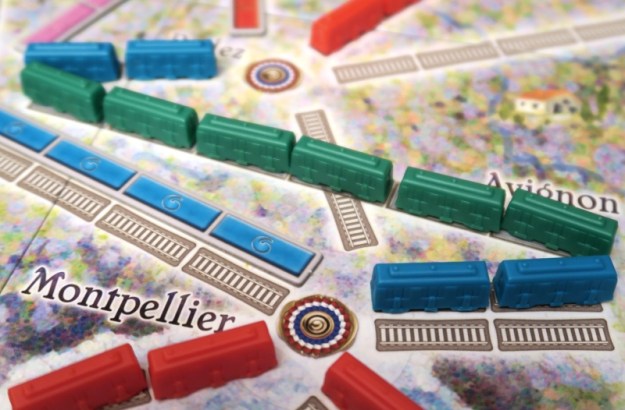
Ticket to Ride Map Collection: Volume 6 – France & Old West
– Image by boardGOATS

France is one of the more complex expansions as the map mostly only depicts the track-bed, and players choose what colour a line will be.  So, every time a player takes carriage cards, they also take a coloured tile of their choice and place it somewhere on the board.  Thereafter, any player can claim that route by spending the appropriately coloured cards and placing the correct number of train pieces.  Some of these track-beds overlap, but once a tile has placed any track-beds under it are no-longer available.

Ticket to Ride Map Collection: Volume 6 – France & Old West
– Image by boardGOATS

At the start, nobody really knew how to play with the track-bed tiles: placing them somewhere near one’s own route telegraphed probable plans, potentially giving others an opportunity to obstruct.  On the other hand, progress could not be made at all until tiles had been placed.  The map is very, very large so to begin with everyone could get on with their own thing.  Purple monopolised the Loire, Auvergne and Burgundy regions while Pine occupied the north coast and eastern borders.  Pine had competition from Black in the Normandy, Picardy and Champagne regions, but other than that, Black took himself off to the west and south and everyone got on with their own thing.

Ticket to Ride Map Collection: Volume 6 – France & Old West
– Image by boardGOATS

Ultimately, the game was very lopsided.  Pine kept drawing tickets and kept getting lucky; he repeatedly got tickets along similar routes so needed minimal addition to his already substantial network.  As a result, he not only took the longest route bonus, but also the Globetrotter points for the player with the most successful tickets, with eight.  Had Black been successful with all his, things would have been closer, but failing two meant it was a tie for second place with both Black and Purple finishing with eighty, exactly half Pine’s massive victory.
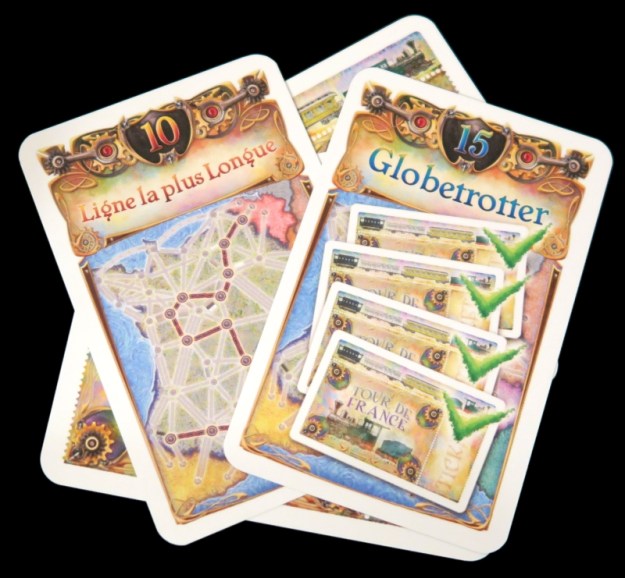
Ticket to Ride Map Collection: Volume 6 – France & Old West
– Image by boardGOATS

Meanwhile, further down the table Burgundy eschewed Netherlands, so the group went instead for Italy, played with the Germany base game, in which the pieces have an unusual colour set.  This gave Blue a slight quandary as to which she should play with, as blue wasn’t available.  Instead Blue opted for purple, only for Purple on the next table to offer to swap pieces as she had chosen blue because purple wasn’t available.  Sadly there was already enough confusion of pieces with Pine, Black and Purple playing with Burgundy’s base game and Blue’s France expansion so swapping pieces just seemed likely to make the chances of all the bits going back into the right boxes that bit smaller.  So in the end, both suffered with the “wrong colour”.
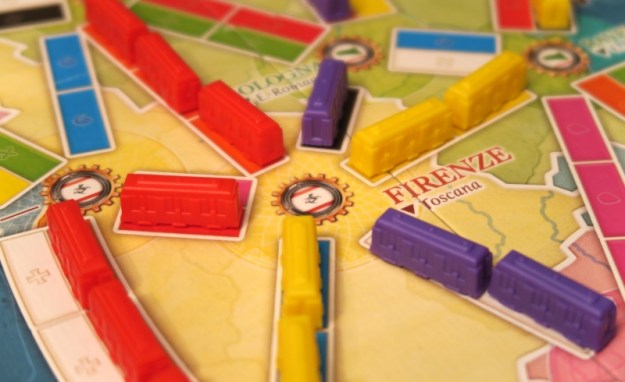
Ticket to Ride Map Collection: Volume 7 – Japan & Italy
– Image by boardGOATS

The Italy map is a more conventional expansion than France, with the only significant differences being a tweak to the Ferry rules and a new bonus scoring opportunity.  Instead of needing Locomotive cards, these Ferry routes include some carriages with a round wave-icon on them.  These can be satisfied either using special Ferry cards, or Locomotive cards.  The special Ferry cards are in a separate deck and one of these can be taken instead of drawing train cards, up to a limit of two at any one time.  Each of these special Ferry cards then count as two “wave” cards.  This makes them better value than Locomotive cards drawn face up from the market, but less versatile.

Ticket to Ride Map Collection: Volume 7 – Japan & Italy
– Image by boardGOATS

The bonus is potentially extremely lucrative, giving points for having a network that connects different regions of Italy.  This starts with one point for five connected regions and increments according to the “Lazy Caterer’s Sequence” to give a massive fifty-six points for a network connecting fifteen or more regions.  The layout of the map itself has a lot in common with the Nordic map in that it is quite long and thin with what feel like a lot of north/south routes running the length of the country, in the middle of the board and a lot of short, east/west routes available in the north and the south.
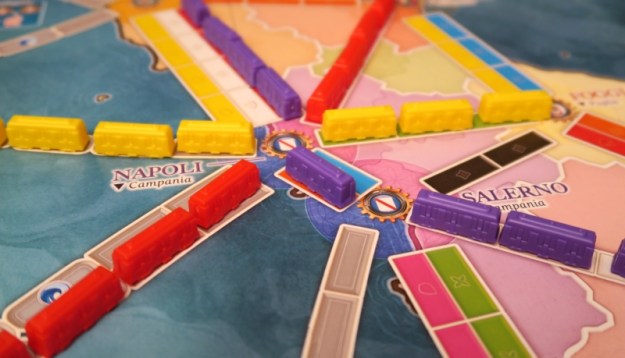
Ticket to Ride Map Collection: Volume 7 – Japan & Italy
– Image by boardGOATS

Blue kept all her starting tickets and Burgundy jettisoned just the one, but in contrast, Mulberry kept the minimum she could.  As a result, it wasn’t long before Mulberry was picking up more tickets, and then more and then even more, much to Burgundy’s and Blue’s horror.  When questioned, Mulberry said, “Just Nickels and Dimes, Nickels and Dimes…”  This didn’t calm Burgundy and Blue in the slightest, as they were still struggling to complete their starting tickets.  Eventually though, they also took more tickets, with Burgundy keeping a lot of his, while Blue was less fortunate.  Burgundy supplemented his tickets with a couple of very long Ferry routes netting him eighteen points each.
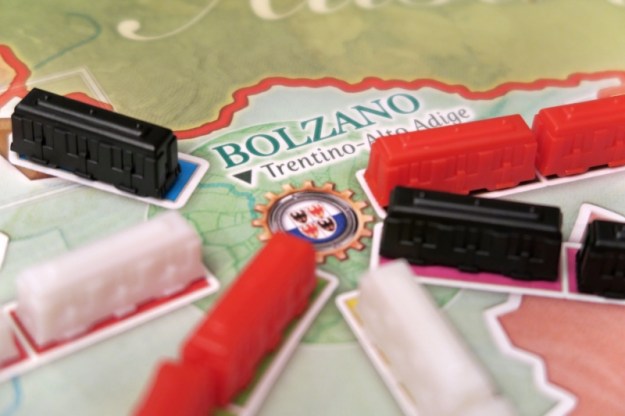
Ticket to Ride Map Collection: Volume 7 – Japan & Italy
– Image by boardGOATS

As the game came to an end, Blue was still struggling to get the yellow carriage cards she needed to complete her final ticket.  So when Burgundy brutally ended the game it cost Blue some forty points, though in truth she was a couple of turns away from getting them even if she had somehow managed to get that one final yellow card.  It was clear that unless Burgundy had a lot of incomplete tickets, he would probably be able to defend his already substantial lead.  Mulberry’s tickets may have been “Nickels and Dimes”, but she had an awful lot of them; as the phrase goes, “Take care of the pennies and the pounds take care of themselves.”  With just regional bonus to add, Burgundy was out of sight and although Blue and Mulberry made a dent in the gap it wasn’t enough.  It was close for second place though, but in the end a couple of extra regions gave it to Blue.

Ticket to Ride Map Collection: Volume 7 – Japan & Italy
– Image by boardGOATS

The Poland game was finished first and with France only just started and Italy only halfway through the Poles toyed with the idea of trying another European Ticket to Ride Map, but instead opted for a quick game of the 2017 Spiel des Jares Winner Kingdomino.  This is a light little game with a very clever market mechanic.  The idea is that players take it in turns to take a tile from the market and add it to their kingdom.  Each tile comprises two “squares” (like a domino), each showing a terrain.  At the end of the game, players score points for each area of terrain in their kingdom gaining points equal to the number of “squares” multiplied by the number of crowns in that region.

Kingdomino
– Image by boardGOATS

The clever part of the game is the market which consists of two columns of tiles, each tile having a rank reflecting their value based on scarcity of the terrain(s) it depicts and the number of crowns.  The tiles in each row are placed, and taken, in descending order.  When a player takes their tile from the current column, they choose which tile they want from the next column, thus a player taking a less valuable tile gets a wider choice on the next round.  Unfortunately, as each column has to have the same number of tiles as players, the game can be a bit unbalanced with three, because some of the tiles are removed at random.

Kingdomino
– Image by boardGOATS

As well as scoring for terrain, players also score bonus points for placing all their tiles in a five-by-five array with their castle in the centre.  This time, Ivory managed a full kingdom with his castle in the centre, and a large wheat field with a healthy number of crowns. His score was also assisted by a not inconsiderable lake (although with only a couple of crowns) and a small but valuable mountain.  Lime, fresh from his stunning Polska victory, realised too late that his castle was not central in his kingdom and his last couple of tiles were unplaceable.  Green managed a complete kingdom with his castle in the middle, though his was made up largely of forest.  Pasture, wheat and sand also featured and gave what was a winning score of sixty-three, some ten points ahead of Ivory in second.
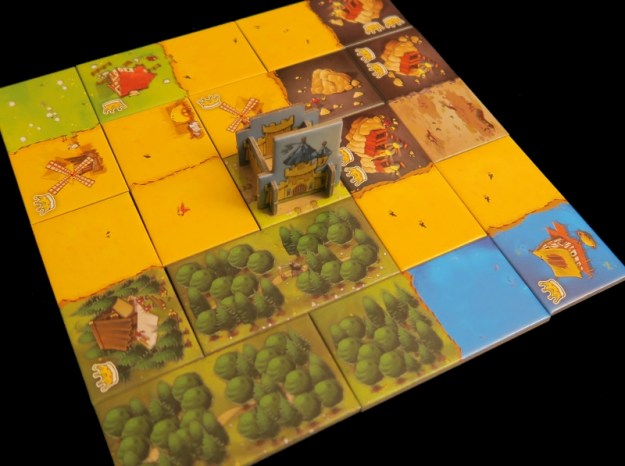
Kingdomino
– Image by boardGOATS

With the Italian map players just finishing, the group decided to join them and see what else was on offer. There were three options: For Sale (best with it’s a maximum of six), Century: Spice Road (plays a maximum of five) and World’s Fair 1893 (maximum of four).  Mulberry decided to get an early night, leaving five players and Century: Spice Road.  This is a resource management game with deck building at it’s core.  Neither Lime nor Green had played it before so there was a quick run down of the rules first.  These are simple enough though.  The central area consists of two markets: one for action cards and one for contracts.
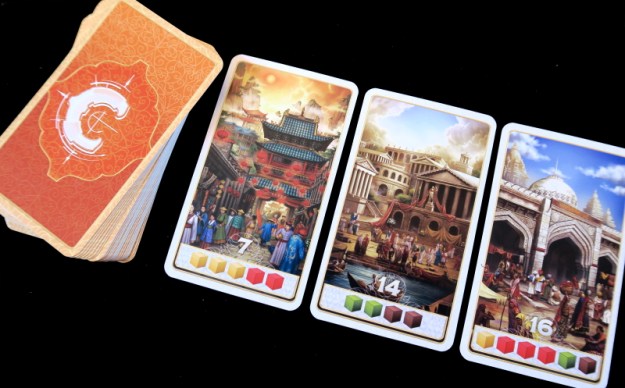
Century: Spice Road
– Image by boardGOATS

On their turn, the active player can take an action card from the market, if they take the card at the end of the row (the one that has been there longest), it is free, otherwise they have to pay resources dependent on the card’s position.  This card goes into the player’s hand where, on a later turn, they can use it to get spices, upgrade spices or convert spices into other spices.  When used, a card is placed on the player’s personal discard pile, and they can also spend a turn picking up all their discarded cards.  The spices, turmeric, saffron, cardamom and cinnamon are then used to fulfill contracts, giving points.

Century: Spice Road
– Image by boardGOATS

The contract cards that have been around for longest get a bonus, in this case a coin is worth one or three points at the end of the game.  The challenge, or at least part of the challenge is storing the spices: each player has a caravan card which will hold a maximum of ten spice cubes, so converting cubes into other cubes and buying contracts has to be done efficiently otherwise spices are wasted.  The game end is triggered when one player has five contract cards.  There are a couple of minor details, like the number of cards in the markets and the values of the coins, but Burgundy clearly knew these without needing to check the rules.

Century: Spice Road
– Image by boardGOATS

The engine-building nature of this game has a lot in common with Splendor and as Burgundy is invincible at that the writing was on the wall before the group even started.  It was no surprise therefore that when Ivory picked up the first contract, Burgundy was immediately behind him.  Green, new to the game, wasn’t far behind either.  Blue had a complete nightmare, but Lime, after a slow start suddenly seemed to get the hang of it and then made rapid progress.  It wasn’t long before Ivory took his final card though.  Taking the maximum number of cards is always key, and when he said he had sixty-seven points it looked like he might have been successful, however, Burgundy, managed to take one last card in that final round as he was the last to play, and ultimately, he managed to take first place by just three points.

Century: Spice Road
– Image by boardGOATS

Learning Outcome:  Europe has a very extensive (and exciting) rail network.

Boardgames in the News: 20 Years of BoardGameGeek

On 22nd January 2000, largely unnoticed, a little website called boardgamegeek.com went live for the first time.  Created by Scott Alden and Derk Solko around the time when everyone else was worrying about The Millennium Bug, boardgamegeek.com has now become the largest “one-stop-shop” for board gamers.

Original BGG Logo
– Image from
boardgamegeek.com

Among other things, it comprises a database with over 100,000 entries; a forum (essential for checking rules etc.), and vast amounts of User-created content, including photos, player aids and rules translations—there is even a marketplace where gamers can buy and sell games.  In 2006, after just six years, the site was generating sufficient funds for Scott Alden to give up the day-job and work on BoardGameGeek full time.  Since then, the site has grown further:  it now includes role-play and video game strands, and they hold their own biannual conventions (BGG.CON and BGG.Spring) with some three thousand attendees.

BGG Ernie
– Image from
boardgamegeek.com

The growth of BoardGameGeek has been commensurate with increasing recognition and participation in board gaming as a whole.  Although there have been many factors that have led to this, it is clear that the provision of extensive information about games and where to get them provided by other gamers, has been massive.  Thus, the creation of BoardGameGeek was undoubtedly timely, but without it, it is arguable that the BoardGameGeek has been essential to the development of the wider board gaming community. So here’s to the next twenty years!

BGG Corner Logo 2019
– Image from
boardgamegeek.com

Next Meeting – 21st January 2020

Our next meeting will be on Tuesday 21st January, at the Horse and Jockey pub in Stanford-in-the-Vale.  As usual, we will be playing shorter games from 7.30pm as people arrive, until 8pm when we will start something a little longer.

This week, the “Feature Game” will be Ticket to Ride, specifically, the European editions.  Over the last year, on games night we’ve spent a lot of time discussing Brexit and following the seemingly endless series of votes in the House of Commons.  As a strongly pro-Europe group, we felt we had to mark the last meeting while we were still part of the EU, and we’ll do it in the only way we know: by playing some of the European versions of Ticket to Ride:  Italy, France, Germany, Poland, Netherlands and of course, Europe.

Ticket to Ride: Switzerland
– Image by boardGOATS

And speaking of Brexit…

Jeff was working in his local pub, when Nigel Farage walked in and asked for a pint.  Jeff went to the pump and drew a pint of Jockey and then threw it into Nigel’s face.

“Why on earth  did you do that?” asked Nigel, wiping beer out of his eyes.

“You asked for a pint, but you didn’t say how you wanted it delivered,” replied Jeff.

Nigel was in a good mood as Brexit day was approaching fast, so he put his large spotted hanky back into his pocket saying, “OK, I get, you’re a Remoaner, I won’t make a fuss, I’ll just have a pint in a pint glass.”

Jeff gave him a firm stare. “No, you can’t ask again,” he said.

“Why not?” Nigel asked.

“Democracy,” Jeff replied.