Author Archives: nannyGOAT

18th March 2025

The evening began with the arrival Ruby and Flint, friends of Teal, who had come along despite the fact he wasn’t able to be there to introduce them to everyone himself.  They introduced themselves as people finished their supper and prepared to play the “Feature Game” which was to be Cartographers Heroes, the standalone sequel to Cartographers.  Cartographers was probably the best of the roll and write games the group played online during the global coronavirus pandemic, so we chose to play it to mark the fifth anniversary of our last meeting in the pub before we moved online.  It was a very difficult time for everyone, though as a group we stuck to it and tried to look after each other, continuing to meet fortnightly, online.
Setting up for online gaming
– Image by boardGOATS

Strictly, Cartographers is a “flip” and write rather than roll and write game as it is card-driven.  Played over four seasons, cards are turned over to reveal choice of “Tetris-like” shapes and/or terrains that players draw on their map.  The game is played over four rounds, each with a different scoring criteria—a total of four during the game, with two active in each round (similar to Isle of Skye).  In addition to the normal terrain cards, there are also Ambush cards, which are nasty as they score negatively with a point lost for each empty space next to an Ambush space at the end of each round.  They can be played in two ways depending on the number of players and the circumstances of the game.
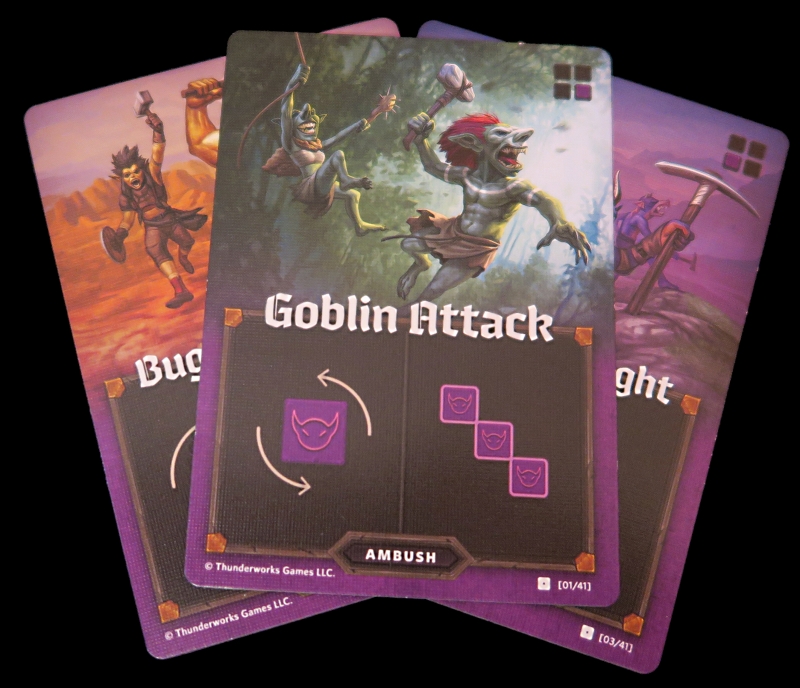
Cartographers: A Roll Player Tale
– Image by boardGOATS

Online, we played these using the Automa rules, where the Ambush “pieces” are placed via a set of rules, whereas in person, players pass their map to a neighbour who places the Ambush piece in as awkward a place as possible.  In addition to Ambush cards, the Heroes game adds Hero cards which can be used to off-set the effect of the monsters from the Ambush cards.  The distribution of cards is also slightly different and the map layout is slightly different too.  This time, although the game can play up to a hundred people simultaneously, because of the difficulty seeing the cards, the group chose to split and play two separate games.
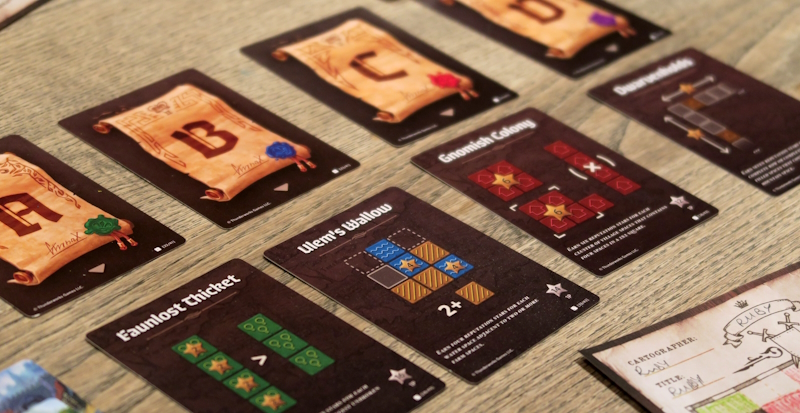
Cartographers Heroes
– Image by boardGOATS

The first of these included Blue, Pink, Flint, Ruby, Purple and Lime, while the other comprised Jade, Sapphire, Pine, Byzantium and Mint.  The first group were using the Collector’s Edition which comes with pencils in colours that match the different terrains.  The second group cast envious eyes on the pretty maps as the games started, but despite offers, refused to take a set and stuck to the slightly more elegant monochrome maps relying on symbols to indicate the different terrain types.  Although the original Cartographers and the Heroes games can be mixed, both groups used the decks and maps from the Heroes game.

Cartographers Heroes
– Image by boardGOATS

The first group began with a sequence of woodland terrain, which fitted with their first objective, but the shapes wrapped nicely round the mines.  The mines give money—when surrounded by terrain, players can tick off a one of the coins marked at the bottom of the map, which gives a point at the end of each round.  Thus collecting them early makes them more valuable each giving up to four points throughout the game.  So, most people started by prioritising them as an easy way forward.  Consequently everyone’s first rounds gave similar scores, but by the second round Lime and Pink had edged a bit of a lead.  Nobody scored particularly well in the third round, so it was all down to the final round to make the real difference.

Cartographers Heroes
– Image by boardGOATS

Most people scored around twice what they’d picked up in earlier rounds, but it was Pink who top scored with a massive fifty-five, giving him a bit of a landslide with a grand total of a hundred and thirteen (after a couple of recounts).  Blue just edged into second, ahead of Lime, but they were some twenty points adrift.  The second game followed a similar pattern with massive scores in the final round, though it was a much closer game, with it possible to cover the top three with a postage stamp.  The scores were generally higher than for the first game, but the victor was Mint who finished with a hundred and twenty-six, three more than Jade in second who pipped Byzantium by a single point.

Cartographers Heroes
– Image by boardGOATS

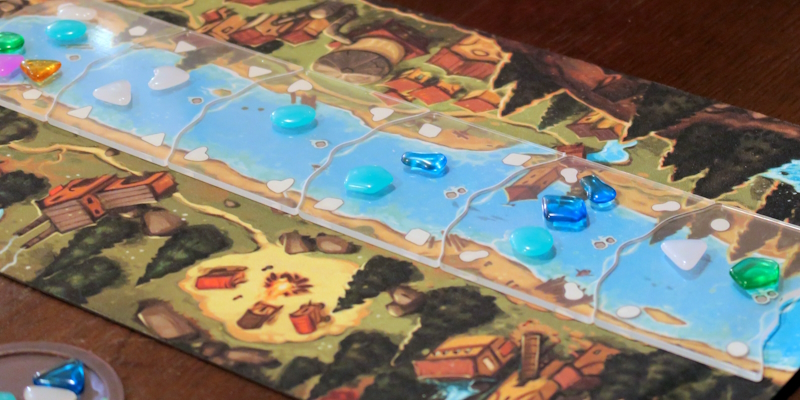
With the second game finishing first, the group moved on to play River Valley Glassworks, a re-implementation of the card game Subastral.  In River Valley Glassworks, players take the role of entrepreneurial of woodland creatures drafting glass from the market of river tiles by playing a piece from their inventory into the river. Each river tile can take only a specific shape, and players have to play into a space adjacent to where they want to draft from. After claiming their glass, the river shifts forward (in a way that is vaguely reminiscent of Niagara), revealing new pieces.
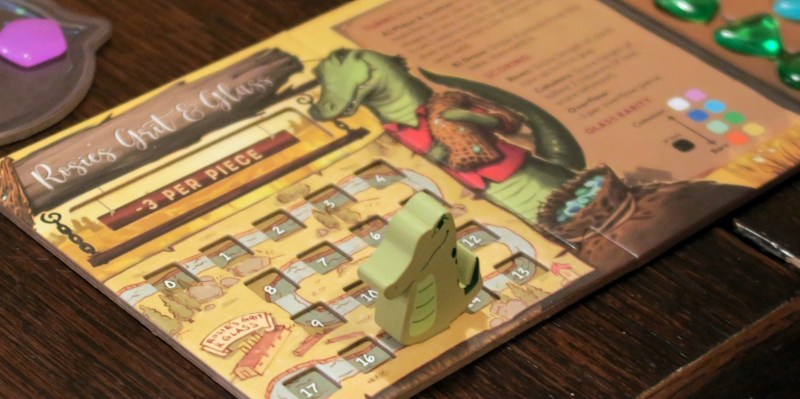
River Valley Glassworks
– Image by boardGOATS

Glass is stored in players’ shops, and the scores depend on where the glass is placed—completed rows and columns gain bonus points, but too many of one type gives negative points.  The game is generally cosy, quick and fun, and this time was no exception.  Jade explained the rules which are simple enough: either place a piece of glass onto a river tile or draw exactly four pieces from the lake with the aim of collecting a rainbow of glass pieces. Getting the balance right can be a little tricky, so it was no surprise that the most experienced players came out best with Jade taking victory with eighty points nearly ten ahead of the other person who had played it before, Sapphire.
River Valley Glassworks
– Image by boardGOATS

When the other game of Cartographers finished, the group continued with the roll and write theme, moving on to another game that went down well online, Second Chance.  This is a similar “Tetris-like” card driven game, but much simpler.  Everyone has a square grid and as cards are turned revealing shapes, they add them to their grid.  Players are eliminated when they can no-longer add the latest shape.  The game gets its name from the fact that when a player gets stuck, they get one card flipped, just for them, and can carry on if they can add that shape to their grid.  The player with the fewest gaps at the end, is the winner.  This time, Purple was eliminated first, but it still got quite close to the wire and the tension was palpable.  The winner was Flint, however, who very nearly managed to fill his whole grid, leaving just two spaces unfilled.

Second Chance
– Image by boardGOATS

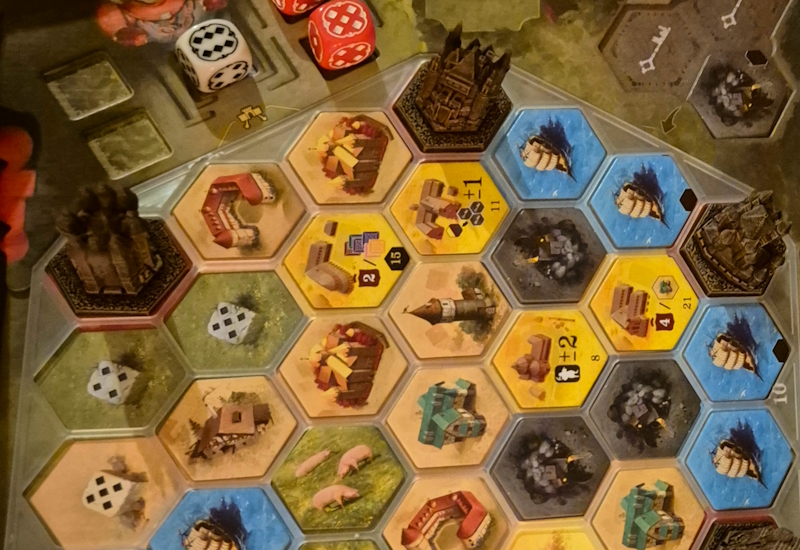
Meanwhile, on the third table, Cobalt was joined by Black, Plum and Ivory in a game of Castles of Burgundy using the new fancy “Special Edition”.  In Castles of Burgundy, players take on the role of an aristocrat controlling a small princedom, building settlements and castles, trading along the river, mining silver, and use knowledge of travelers.  The game is a tile playing game that is played in five phases, each consisting of five rounds. At the start of each round all players roll their two dice, and first player also rolls a goods placement die.  During their turn, players carry out two of the four possible types of action.  These include: take a settlement tile from the numbered location corresponding to one of their dice and place it in storage; take a settlement tile from storage and place it on their player board on a space with a number matching one of their dice;  deliver goods with a number matching one of their dice, or take worker tokens (which allow players to adjust the roll of their dice).

Castles of Burgundy
– Image by boardGOATS

Additionally, players may buy a settlement tile from the central depot and place it in their storage area. The Settlements offer benefits, additional actions, money, advancement on the turn order track, more goods tiles, die roll adjustment or victory points with bonus points awarded for filling a region with tiles.  Cobalt and Black both started on the east side of the map, with Black building to the south with Ships to move up the turn order.  He also got a mine to start generating coins at the end of each of the four rounds. He also managed to completed an area to move up in points (Ships). Cobalt went the other way with yellow and beige buildings and managed to get a second castle (and effectively an extra turn), whilst also completing areas for early points.

Castles of Burgundy
– Image by boardGOATS

Plum started at the bottom and managed to get a Mine, setting up for the future, as well as Ships to move up the turn order, but started accruing points more slowly.  Ivory on the other hand started in the north and went for a different strategy, grabbing animals (specifically goats!) and made a faster start with regards to points, at the expense of turn order.  In the second round, Ivory continued to focus on animals, grabbing more animal tiles and end of game tiles giving points for different animals, to go along with his yellow tile from the first round giving him extra points when scoring animals. He also built his second castle and started to fill the eight beige area, needing one of each beige building in that area for a challenging thirty points.

Castles of Burgundy
– Image by boardGOATS

Plum focused on engine building, getting two more Mines, giving her significant income for the rest of the game, as well as a building which allowed her to build duplicate buildings in an area, making it much easier to achieve thirty points in the eight beige area, as well as a tile allowing her more flexibility in getting tiles (as it allowed her plus/minus one on the die).  Black was also engine building and doing a little bit of everything else, while Cobalt, Like Plum and Ivory was focusing on the beige “Eight” area.  Cobalt also had tiles that allowed him to spend workers to get a tile (as well as change die results) and also get extra workers when he took that action and gain a coin—a very efficient engine! At the end of the round, Cobalt and Ivory had taken the lead, followed by Black and then Plum.

Castles of Burgundy
– Image by boardGOATS

In the third round, Ivory managed to fill all his animal spaces and get the bonus for doing so as well as get more points from his animals, but was generally slowed down by the fact he’d stopped developing his engine.  In contrast, Plum’s engine had kicked in, giving her lots of points and bumping her up the rankings leaving her snapping at Ivory’s heels by the end of the round.  Black was continuing to do a bit of everything, but now had an end game objective for different goods while Cobalt continued to develop his engine.  In the penultimate round, Ivory continued to struggle due to his lack of engine development and his ships paucity of ships meant he had taken his turn last for most of the game, although he was “building beige” where possible for the thirty points.
Castles of Burgundy
– Image by boardGOATS

Plum on the other hand, stormed ahead, filling the “Eight” area and taking thirty-four points as she was able to fill it with the same building.  With other scoring opportunities as well (like animals), it looked like she was a certainty to win being as she had a lead of over thirty points at the end of the round. Cobalt and Black also pushed past Ivory with Cobalt having focused on mines and Black completing all four of his castles, taking bonus points for doing so.  In the final round, Cobalt and Ivory both managed to fill their beige area for thirty-two points and Ivory finally got his first ships, albeit too little too late for anything other than a few points. Plum, having filled in the large beige area, slowed down a little, lacking a focus having done so much in the previous round, but still managed to score significantly.

Castles of Burgundy
– Image by boardGOATS

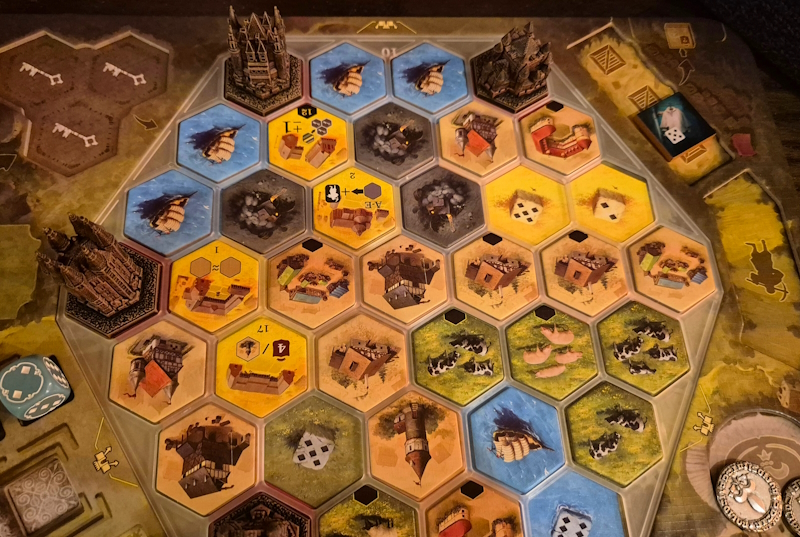
Black was still doing a bit of everything, particularly focusing on goods, but failure to score the large beige area cost him dearly.  By this time, Cobalt, on the other hand, was using his engine to maximum effect, with his ability to grab tiles using workers to give him more actions than everyone else, filling in almost all of his map. This also allowed him to slowly catch up and eventually overtake Plum, taking lots of bonus points for filling in each colour area, giving him the victory with a grand total of two-hundred and forty-four points, some fifteen more than Plum with Ivory some distance behind her.
Castles of Burgundy
– Image by boardGOATS

Learning Outcome:  Some Roll and Write games are much better than our slightly tarnished memories of them.

Next Meeting, 22nd April 2025

Our next meeting will be on Tuesday 22nd April 2025.  As usual, we will start playing shorter games from 7.30pm as people arrive, until 8pm when we will start something a little longer.  The pub is doing food, and the table is booked from 6.30pm for those that would like to eat first.

This week, the “Feature Game” will be the Newleaf expansion to Everdell (base game rules, tutorial video, review; Newleaf rules, tutorial video, review).  This expansion adds new critters, constructions and events, but most significantly the new railway station.

Everdell: Newleaf
– Image from board-game.co.uk

And speaking of trains…

Jeff was on a train to Penzance, but when the guard came round round to check the tickets he noticed Jeff had a ticket for Camborne.

“Sorry sir, this train don’t stop Camborne Wednesdays, you’ll have to get off at Redruth” said the Guard.

“But I simply MUST get off at Camborne—I have an important meeting to attend and if I get off at Redruth, I’ll miss my appointment,” pleaded Jeff.

“I’m very sorry sir, this train don’t stop Camborne Wednesdays,” said the Guard again.

“Isn’t there anything you can do?” Jeff begged.

“Hold on sir, I’ll go ask the driver if he can make an unscheduled stop,” said the Guard and toddled off.

On his return he explained, “The train is already late, all the driver can do is slow down through Camborne. So what I’ll do is get you to come up to the front carriage and I’ll hang you out the door.  You start running in the air and when your legs are going fast enough, I’ll lower you onto the platform.”

Unfortunately the driver forgot to slow down at Camborne and Jeff was pumping his legs furiously as they approached the platform.

“Faster, you need to go much faster,” said the guard.  Jeff’s little legs were a-blur and finally the Guard thought he was air-running fast enough, so as the platform approached he lowered Jeff onto the start of the platform. Off he shot along Camborne platform, desperately trying to slow down as the end of the short platform approached.  He was just slowing to jogging pace as the rear of the train passed him, when a door opened in the last carriage and a pair of hands grabbed him and hauled him onboard.

“You’re lucky to catch this train mate, it don’t stop Camborne Wednesdays…”

Next Meeting, 8th April 2025

Our next meeting will be on Tuesday 8th April 2025.  As usual, we will start playing shorter games from 7.30pm as people arrive, until 8pm when we will start something a little longer.  The pub is doing food, and the table is booked from 6.30pm for those that would like to eat first.

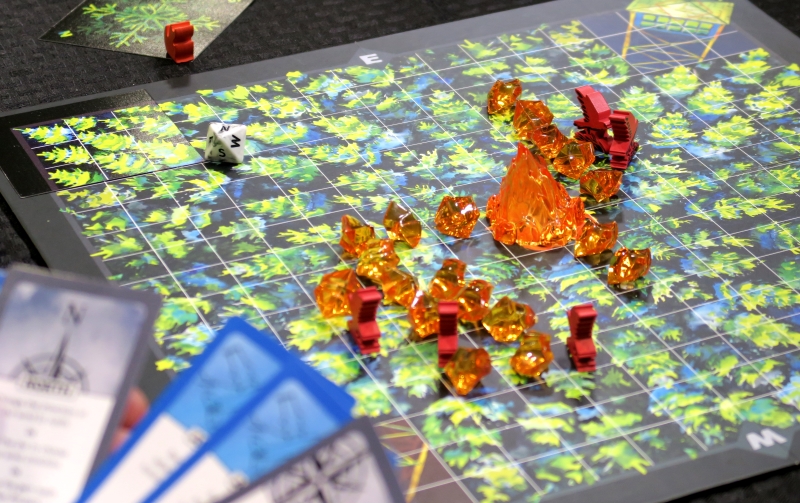
This week, the “Feature Game” will be Fire Tower (rules, review, How to Play video), a competitive game where players order air drops of water, and plan the building of firebreaks in order to combat the blaze.  Although the base game only plays four, we have the Rising Flames expansion which adds a fifth player.

Fire Tower
– Image by boardGOATS

And speaking of fire…

The recent lovely weather mean Jeff had been cooking outside in the garden—he was blazing a trail in the barbecue world, where the steaks are always high.

Next Meeting, 25th March 2025

Our next meeting will be on Tuesday 25th March 2025.  As usual, we will start playing shorter games from 7.30pm as people arrive, until 8pm when we will start something a little longer.  The pub is doing food, and the table is booked from 6.30pm for those that would like to eat first.

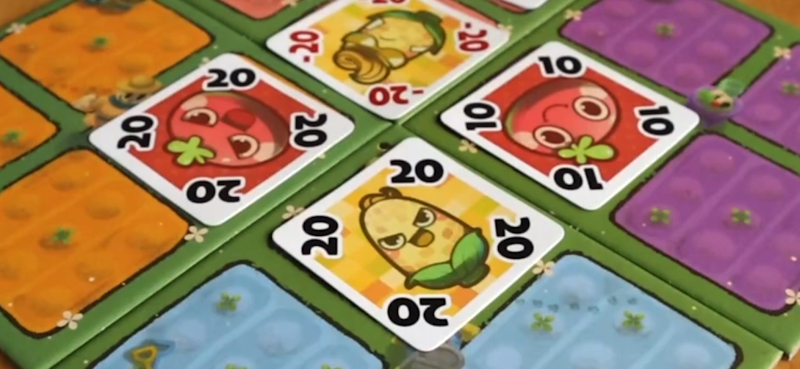
This week, the “Feature Game” will be Habesuto (aka ハーベスト or Harvest; rules, review, video review with demonstration), a game from Japan about building a farm, growing vegetables and distributing produce.  We have picked this game partly because this week was the official start of the Japanese Cherry Blossom Season.

Habesuto (aka ハーベスト or Harvest)
– Image from youtube.com

And speaking of harvests…

The harvest had been a good one for Farmer Jeff so he decided to buy a barrel of beer to celebrate with his friend Joe. When it arrived, he set it up outside his cottage where he and Joe could sit in the sun and relax.

The next day, Jeff woke to find the barrel was only half full although they’d only had a couple of pints each. Furious about the thievery, Jeff put up a sign saying, “This wine belongs to Farmer Jeff. Thieves will be shot.”

Satisfied, Jeff and Joe continued their celebration that evening, but the next morning, the barrel was down to a quarter full and Jeff was incensed.

Joe said, “You’re going about this all wrong,” and made a new sign that said, “Piss barrel. Do not drink!” Jeff grinned at the cleverness, confident no one in their right mind would steal from the barrel.

The next morning, Jeff went to check the contents and found the barrel full again…

Next Meeting, 18th March 2025

Our next meeting will be on Tuesday 18th March 2025.  As usual, we will start playing shorter games from 7.30pm as people arrive, until 8pm when we will start something a little longer.  The pub is doing food, and the table is booked from 6.30pm for those that would like to eat first.

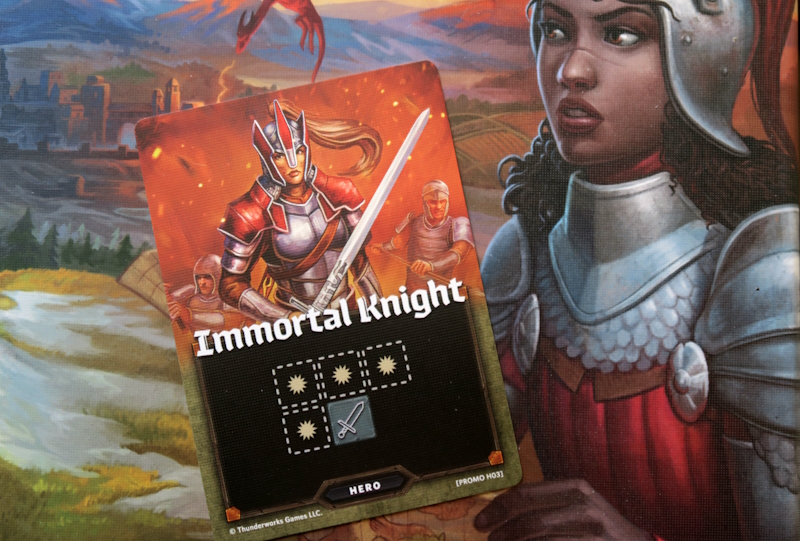
This week, the “Feature Game” will be Cartographers Heroes (rules, review, how to play video), the standalone sequel to Cartographers.  We’ve chosen this game, in part, to mark the fifth anniversary of the start of the global coronavirus pandemic in the UK.  While stuck at home, the group kept going and played a lot of roll and write games online—Cartographers was perhaps the best of these.

Cartographers Heroes
– Image by boardGOATS

And speaking of the global pandemic…

In March 202, Jeff heard terrible things were happening and was very worried, so he went to the chemist and asked the lady behind the counter, “What kills the Corona Virus?”

She replied, “Ammonia Cleaner.”

“Oh, I am sorry,” answered Jeff, “I thought you were the pharmacist.”

4th March 2025

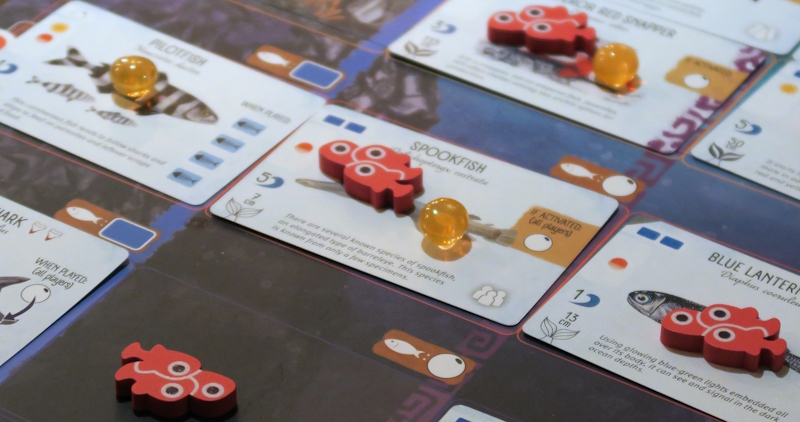
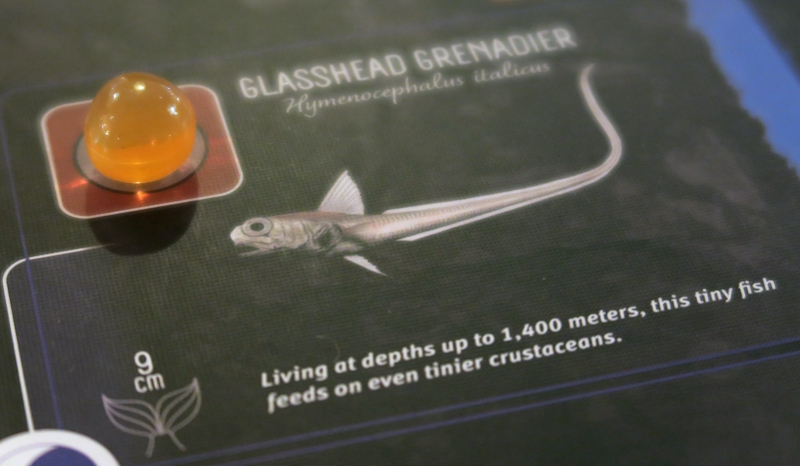
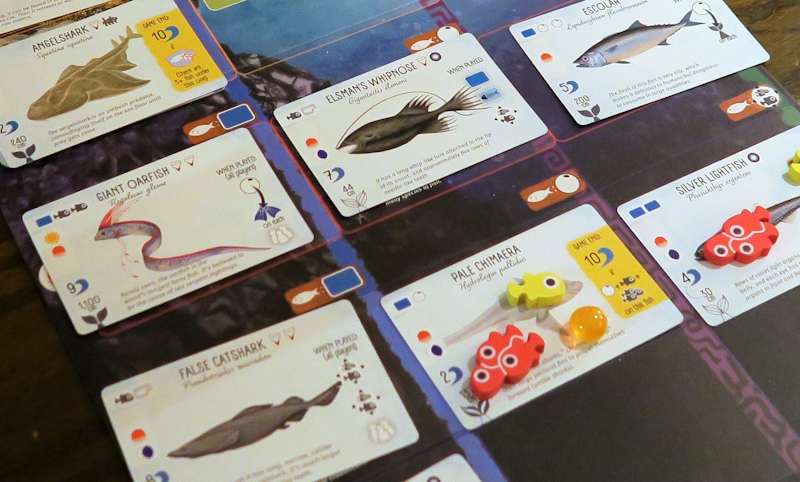
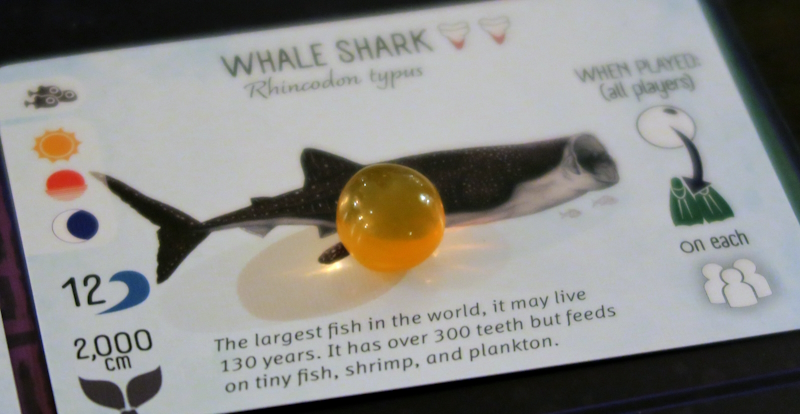
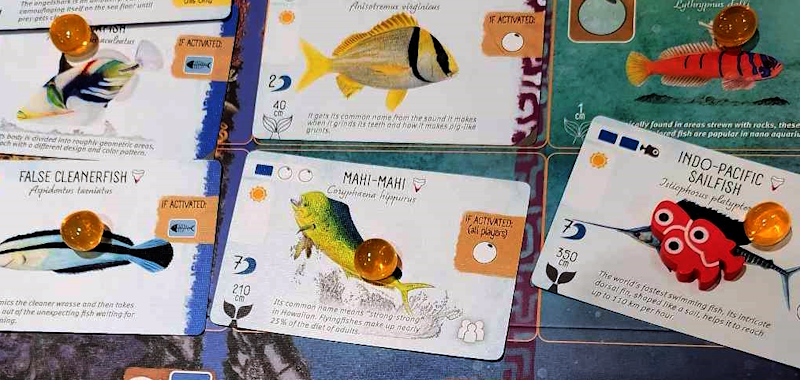
Once people had finished eating, the group settled down to play. There was quite lot interest in the “Feature Game” which was Finspan, a fish-themed version of one of the group’s favourite games, Wingspan.  It is advertised as shorter and lighter than the original, but in the event it was only slightly shorter and not much lighter though it was generally agreed to be a bit smoother and therefore perhaps easier to teach.  Like Wingspan. Finspan is card-based, though the cards are fish instead of birds, albeit just a beautifully illustrated.  As in Wingspan, players have a hand of cards (in this case open) and on their turn can choose to play one from their hand or activate one area or Dive-site of their player board (blue, purple or green), in this case representing the ocean.

Finspan
– Image by boardGOATS

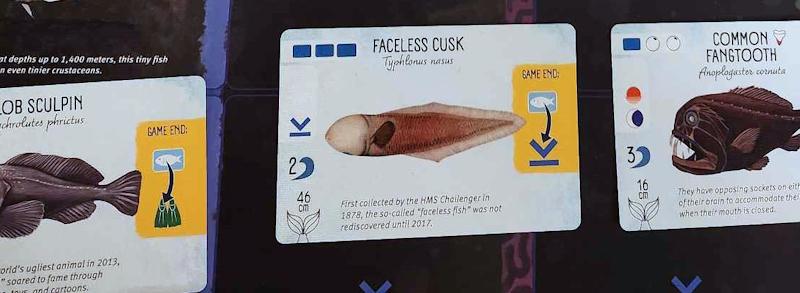
In the case of Finspan, the Dive-sites are arranged vertically (instead of horizontally), but rather than placing cards in order (from left to right in the original), the Fish cards have to be placed at the correct depth for the Fish—some live in the shallows, others in the deep sea, while a small number live in the “twilight” region, between the two.  As in the original, there is a cost for playing cards—fish eggs, Young,Schools and/or other cards. Unlike the original, however, cards spent in this way are placed into players’ own personal discard pile and there are mechanisms for getting them back later in the game.

Finspan
– Image by boardGOATS

Another way that Finspan is different to the original, is the way the Dive-sites are activated. As in Wingspan, cards are activated in order, in this case, from the shallow “sunlit” zone to the “midnight” deeps. The Fish cards have “when played”, “when activated” and “end of the game” powers, but there are fewer cards that have a power on activation and many of these affect all players too. In addition to the difference in the balance of the cards, when a Dive-site is activated, the three zones each give a benefit as long as they have at least one Fish card in them.  These benefits are capped though, as multiple Fish doesn’t increase the income. The first time each player activates a Dive-site in a round, they also get a bonus benefit.

Finspan
– Image by boardGOATS

There are a small number of Fish pre-printed on players’ boards, which mean than some areas give benefits from the very start of the game.  The effect of all this is to give the game a more friendly feel than Wingspan, without reducing the challenge of the game.  There is another major change which significantly adds to the complexity. In Wingspan, a key part of the game is Egg production with Eggs worth a point each at the end of the game.  In Finspan, players also produce Eggs which are worth a point at the end of the game, but each Fish card can only be used to store one single Egg. Eggs can be hatched to give young (also worth a point) and three young on the same fish form a “School”.

Finspan
– Image by boardGOATS

Schools of fish are worth six points at the end of the game.  And this is where the game gets a little “head-hurty” as Young and Schools can be moved around, but while Young can share a Fish space, once they have formed a School, they can’t share a space with another School—one School can’t even pass through a space containing another School.  The game is played over four rounds (or Weeks) with points for achieving objectives at the end of each one.  These are added points gained for each Fish card, Eggs, Young, Schools and any end game actions to give a final total—the player with the most points is the winner.

Finspan
– Image by boardGOATS

As there was a lot of interest in the game, the group set up two tables. Jade, Sapphire, Plum and Byzantium had played it at a convention over the weekend, so Jade led one game with Blue, Ivory and Sapphire, while Plum led the second with Byzantium, Black and Pine. Jade’s group was the first to complete the rules explanation and got going. Ivory was quite excited by the idea of collecting sharks, and while Blue found Nemo, Sapphire found Dorry.  The points from the end of the Week objectives were pretty even for the first three weeks, though only Ivory got much at the end of the final week taking twenty points for his end game bonuses, largely due to having a lot of sharks.

Finspan
– Image by boardGOATS

Blue top-scored for her fish while Jade scored the most for his Schools. In the end, Blue’s hundred and fifty-five took victory with Ivory in second eleven points behind, three points ahead of Jade. Over the other side of the room, Plum’s game was slower to start, but finished at much the same time.  This game was lower scoring and closer too; almost everyone picked up some end game bonuses, but not as many as Ivory, and there were fewer Schools.  The winner was Byzantium, with one hundred and thirty-one, just two points ahead of Plum who was just a nose in front of Black.  All in all, everyone had enjoyed the game as a nice variant on the well known original.

Finspan
– Image by boardGOATS

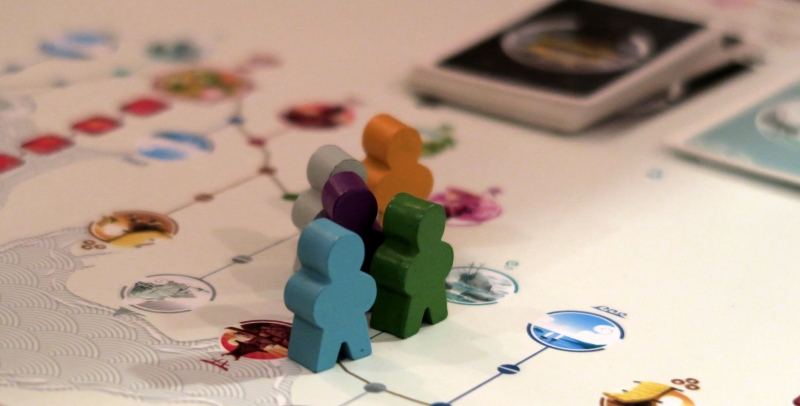
Meanwhile, on the next table, Pink, Cobalt, Lime and Purple had begun by playing Tokaido.  This is a sort of time-track game where the player at the back takes their turn moveing forward to an empty space of their choice taking turns until they are no-longer the one at the back at which point the new “Lantern Rouge” takes their turn.  Each space allows players to collect panoramas, chance it with a random draw for points, buy souvenirs, donate at a temple or work on a farm to gain cash.  At intervals, players have to stop for food which costs money, but the last player to arrive at the restaurant last gets the least choice which can be a catastrophe as these meals are usually more expensive with the risk that they are the same as those eaten on previous stops, which means they can’t eat and therefore don’t score.

Tokaido
– Image by boardGOATS

Although it is quite popular within the group, Cobalt was new to the game and commented that it was quite mean when he realised that once a space had been taken it was gone.  The group played with the choice of two character cards at the start—Pink felt that his Traveler, Hiroshige, was a poor choice as, although he got a free panorama card at each food stop, it didn’t give him much money at the start.  On reflection, he felt Purple had made a better decision in choosing Yoshiyasu, who gave her nine Yen.  Lime was the runaway winner with ninety-one, some fifteen more than Purple who just sneaked into second ahead of Pink.

Tokaido
– Image by boardGOATS

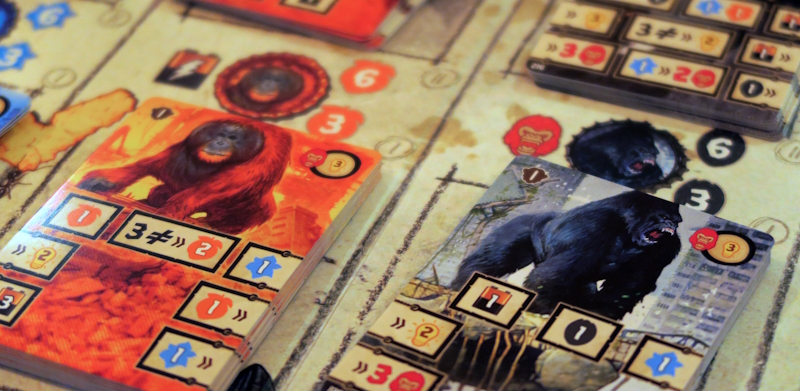
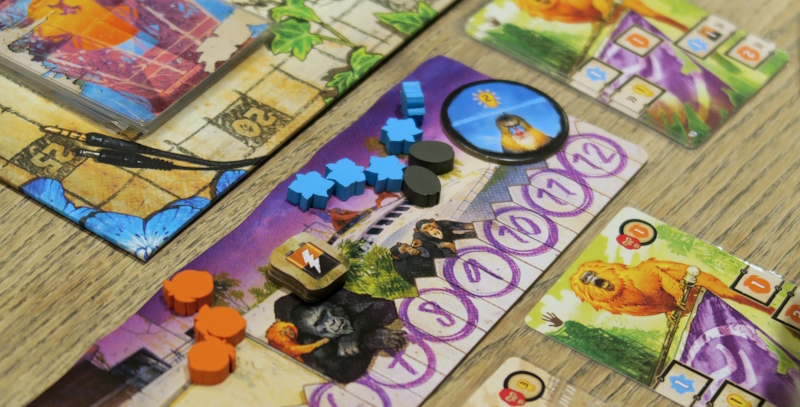
As the games of Finspan were still going, Cobalt introduced the group to After Us, aka “The Monkey Game”.  This had an outing within the group about eighteen months ago, but was new to Pink and Lime. It is a deck-building, resource management, engine building game featuring an original card-combo mechanism. The story is that mankind has died out leaving only apes which have kept evolving. As the leader of a tribe, players add new Primate Cards to their starting deck of tamarins. Primate Cards have three rows of “Effects”—the top row will award resources, the middle row will give points (often at the cost of resources) and the the bottom row will have abilities related to the primate type. At the start of a round, players draw four Primate Cards from their deck to be laid out in a row making “Connections”.

After Us
– Image by boardGOATS

The aim is to get the most out of the Connections by closing the open ended “Frames” along the sides of the cards by butting them up against adjacent cards that also have open ended Frames. Players then resolve the now closed Frames following the order of top left to bottom right, trying to gain as many bonuses as they can. Once everyone has simultaneously collected their Resources they can then use them to buy Primate Cards which are added to the top of the draw deck (and thus they come into use on the very next turn). In this way, they are improving the quality of their deck.

After Us
– Image by boardGOATS

One of the good things about the game is that if a player gets a bit “hosed” by the card draw, the frames mechanism allows them to make the best of a bad job.  The Frames have been resolved, the players simultaneously chose one of their Action Discs denoting which primate type they want to recruit.  The game starts slowly with players building their tribe, but it can end in a sudden rush when one player breaks into a gallop and charges past eighty points triggering the end of the round and this game was no exception.  Lime was again the victor, with sixty-nine points, with Pink second, some nine-points behind.

After Us
– Image by boardGOATS

Learning Outcome:  Jaws was not the only shark.

Next Meeting, 4th March 2025

Our next meeting will be on Tuesday 4th March 2025.  As usual, we will start playing shorter games from 7.30pm as people arrive, until 8pm when we will start something a little longer.  The pub is doing food, and the table is booked from 6.30pm for those that would like to eat first.

This week, the “Feature Game” will be Finspan (rules, review, how to play video), a fish-themed, slightly lighter version of one of the group’s favourite games, Wingspan.

Finspan
– Image from stonemaiergames.com

And speaking of fish…

Two fish, in a tank, one says to the other, “You drive, I’ll man the gun.”

18th February 2025

Blue and Pink began the evening, while they waited for their supper to arrive, messing about with a little card game called Rollecate which is about a historic steam locomotive built in 1967 by a famous Dutch engineer.  The idea of this little game is that players take it in turns to play Track cards to extend Rollecate’s line by placing cards.  They can play as many cards as they want, as long as they all have the same number.  When laying new track, the difference between the numbers on the last card and the first new card placed must not have a difference of two (thus one cannot be followed by three and four cannot be followed by two etc.). Cards must not overlap when played and cannot force impossible play.

Rollecate
– Image by boardGOATS

Once the Track cards have been played, the active player rolls dice equal to the sum of all numbers on the cards they played, and Rollecate moves forward one step for each Wheel rolled on the dice.  Thus, if a player places two threes, they roll six dice. If Rollecate reaches the end of the track, she hits the brakes.  For every step she’s short, the player take one card from behind the train places them on their penalty pile one by one in any order they want. Any time the card placed matches the number of the top card on the pile, both are removed from the deck.  At the end of the game the everyone adds up the face value of their cards and the player with the lowest total wins.

Rollecate
– Image by boardGOATS

By the time Blue had explained the rules to Pink, their food had arrived, and by the time they had finished their supper, Cobalt had joined them.  Blue was just finishing explaining the rules when Pine joined them and eventually they all finally managed to play the game.  There were a few “teething issues”, but before long the delightful little metal miniature was progressing along the track.  Blue and Pink got unlucky and picked up a lot of cards, some high scoring, and weren’t able to remove them.  Cobalt and Pin did rather better with Pine finishing with five penalty points and Cobalt with four.

Rollecate
– Image by boardGOATS

By this time, almost everyone had arrived, and Pink began to set up the “Feature Game” which was to be Viticulture World, the cooperative expansion to the popular wine-producing worker placement game, Viticulture.  This is one of Pink’s and Teal’s favourite games, but also very popular with other members of the group.  No-one had played the cooperative expansion, however, but despite some apprehension that the changes might spoil a favourite, there were a lot of interested parties.  In the end, Pink was joined by Teal, Ivory, Plum and Cobalt, all of whom were very familiar with the base game.

Viticulture
– Image by boardGOATS

There isn’t really anything particularly special about the base game, it is just a worker-placement game where players are growing grapes and making and selling wine.  However, it is just done very, very well.  In general, there are two types of worker spaces—restricted, that only a limited number of workers can use per round, and open spaces which can be used by as many workers as players want.  Each player also has one Grande worker who can be placed anywhere, even on fully occupied spaces.  The cooperative game is essentially much the same as the original Viticulture, with some small rules changes and a different target:  players have six years to goal: each player must reach twenty-five victory points and the shared influence token must reach the end of the influence track.

Viticulture World: Cooperative Expansion
– Image by boardGOATS

There are seven different packs of cards and the group began this time with the easiest, Green Gully, which as advertised, is a very good introduction to Viticulture World.  This is designed to make sure everyone is successful on their first time out (though it may be easier with more players).  Each player has four workers plus one Grande and unlike the original, there is no mechanism to get more.  Two of these workers have yellow hats to indicate they are summer workers and two have blue hats and these can only operate in winter, training however, allows them to remove their hat and play in other seasons.  There was a little concern prior to play that as only certain types of workers are able to claim certain bonuses it might make the game a touch fiddly, but this was not the case.

Viticulture World: Cooperative Expansion
– Image by boardGOATS

As the game progresses, there are Event cards which give special action and also increase the number of workers that can be placed on some locations. There was some confusion at the start of the game as to whether the Grande worker could be used to claim the special actions.  It was felt this would make the game way too easy though, because if everyone was able to take advantage of the bonus with their Grande this would make the game too easy; a quick online check confirmed that this was not allowed.  The group found the game fairly straight-forward, though everyone was quit experienced and therefore knew where the areas of tension were, in particular making wine, harvesting grapes and fulfilling orders, so made a point of upgrading these early.

Viticulture World: Cooperative Expansion
– Image by boardGOATS

The group had a lot of fun, and as is not uncommon with this game, there were lots of “getting my cock out now” comments (especially from Ivory), when it came to claiming the turn-order.  Ivory was the first to achieve his required twenty-five points, but he went on to get thirty in order to claim an extra influence point for the team.  Cobalt was next to make his target and everyone else followed the next round.  Despite the initial reservations, everyone enjoyed the game and would be keen to try some of the more challenging regions on another occasion in the not too distant future.

Viticulture World: Cooperative Expansion
– Image by boardGOATS

While the oenophiles were playing Viticulture, the other four were revisiting Kavango.  This is a medium weight card drafting and tableau building game which has something of the feel of Wingspan.  This was the “Feature Gamelast September, when it went down well with those that played it, one of whom was Pine.  It had a second outing two weeks ago, when Blue promised Pine and others it would come back.  Pine was keen to give it another go, and this time they were joined by Purple and Black.  The game is fairly straightforward to play, though a monumental table-hog, so the group started by moving to a larger table on the other side of the room.  Blue outlined the rules:  Players start with a hand of twelve cards and choose one before putting the rest to one side.

Kavango
– Image by boardGOATS

This card is then either added to the player’s tableau if it is an animal card, or activated if it is an action card.  Once the card has been played, players have the opportunity to invest in protection or claim rewards (money and points) for completing targets.  In the early part of the game, the cards that are dealt are mostly from the bottom of the food chain, what the game refers to as “Producers”, rodents and the like.  As the game progresses, the creatures get bigger and require the presence of other animal types or terrain as food and protection (Habitat, Poaching and Climate).  This time, Blue (who was playing the game for the third time) stole a bit of a march, picking up more points during the game than anyone else.

Kavango
– Image by boardGOATS

Pine who was on his second play, did a god job of collecting valuable animals and finished with a massive one hundred and twenty-six points, but failed to pick up the bonuses for the protection.  Purple didn’t do so well with her animals, but had every type and picked up all the bonus points available for protection too, while Black didn’t take any points for that, but did well on his personal objectives.  The winner, (unsurprisingly given her extra experience) was Blue followed by Pine with Purple in third.  The consensus from Purple and Black was that the game (like Wingspan) felt a too random, though Blue and Pine commented that it felt less so after multiple plays.

Kavango
– Image by boardGOATS

Learning outcome:  Making wine is just as much fun as a team.

Next Meeting, 18th February 2025

Our next meeting will be on Tuesday 18th February 2025.  As usual, we will start playing shorter games from 7.30pm as people arrive, until 8pm when we will start something a little longer.  The pub is doing food, and the table is booked from 6.30pm for those that would like to eat first.

This week, the “Feature Game” will be Viticulture World (rules, review, how to play video), the cooperative expansion to the popular wine-producing worker placement game, Viticulture (rules, review, how to play video).

Viticulture
– Image by boardGOATS

And speaking of wine…

Jeff walked into a wine bar and ordered a bottle of wine. After he had downed most of the bottle he tried to get the barman’s attention.

“I used to be grapes!” he announced loudly.

“What?” the confused bartender asked.

“I’m sorry,” Jeff apologised. “That must have been the wine talking…”

4th February 2025

Blue and Pink were just finishing their supper when not one, but three copies of Ark Nova walked in, escorted by Ivory, Cobalt and Green.  This was because the “Feature Game” was to be its Marine Worlds expansion and, as Ark Nova is a substantial game that doesn’t get as many outings as it deserves, everyone was keen to give their copy a bit of an airing.  The game is much longer than those we usually play on a Tuesday so everyone who was keen to play was early and started setting up promptly.  Given the length, we also erred on the lower end of the player count, with just Ivory, Cobalt and Green playing.  The game is all about planning and designing a modern, scientifically managed zoo, but the game-play is more like Terraforming Mars with animals, than Zoo Break or Zooloretto.

Ark Nova
– Image by boardGOATS

Although it is quite a complex game, functionally it is not difficult to play on a turn by turn basis, though there is quite a lot to manage and keep a track of.  On their turn, players take one of six possible actions:  activating one of the five action cards (Cards, Build, Animals, Association and Sponsor) with a strength equal to the number above the card.  When activating a card players perform the action based on its power level which is dictated by its position in the row.  During the game, players can upgrade and turn over the action cards to a more powerful second side using various Bonuses.  The Marine Worlds expansion introduces several new elements to the game.

Ark Nova: Marine Worlds
– Image by boardGOATS

Firstly, there are sea animals that have to be played in new special enclosures that must be built adjacent to water.  Roughly half the sea animals are reef dwellers, and whenever a player adds a reef dweller to their zoo, they trigger the ability of all reef dwellers in that zoo. To deal with the dilution of the deck (caused by adding more cards), all sea cards feature a wave icon, and whenever it is revealed in the display, you discard the first card in the row, then replace it.  For each of the five Action cards there are four alternate versions with a little twist. Players draft these action cards at the start of play, replacing two of their standard action cards with these new ones, increasing the asymmetry in the game.

Ark Nova: Marine Worlds
– Image by boardGOATS

A new fourth University option is also available on the Association board.  If a player takes it, they claim one of six special Universities from the Reserve that feature one Research icon and one of six animal icons.  When a player takes this, they reveal Cards from the top of the deck and keep the first revealed card with an animal icon that matches their chosen University.  There are also new bonus tiles and other little bits and pieces to smooth out the game play.  Although the Marine Worlds expansion comes is modular, the group chose to play with all the components (Marine animals, asymmetric maps and drafted action cards).

Ark Nova: Marine Worlds
– Image by boardGOATS

Ivory took a Sponsor Card that gave him extra money for breaks and an Association Card that gave him the ability to hire workers.  This coupled with the lake map which gave extra money for building around the lake meant Ivory had access to lots of cash as the game developed.  Both Cobalt and Green took a Sponsor and an Animal Card, with Cobalt taking a map that allowed him to discard cards for money while Green had the map with the park restaurant.  While Cobalt was also able to build up a lot of cash, Green spent most of the game playing the poor relation, just scraping by.  The game started slowly, with initial conservation projects devoted to Australian animals, Birds, and African Animals.

Ark Nova: Marine Worlds
– Image by boardGOATS

Both Green and Ivory wound up spending all their early money, trying to get Animals out, whereas Cobalt focused on the Association board and playing Sponsor cards.  After struggling with money for the first couple of rounds, Ivory managed to get two Australian animals, allowing him to put a token on the conservation card, giving an additional Zoo Dollars at each break/income step and from then on, money wasn’t too much of an issue for him. Green however, struggled for money for most of the game, where Cobalt continued to focus on Sponsor Cards and Association Actions, and as a result, he took an early lead on the Research track which gave him a much greater card choice. Cobalt did build an early aquarium, however, and started filling it up with fish.

Ark Nova: Marine Worlds
– Image by boardGOATS

After a quick start, both on the conservation track and appeal track, Ivory’s game slowed down significantly—he was too focused on animals, compared to Green and Cobalt.  They had both spent time taking Association actions, leading them to Upgrade cards and progress up the Reputation track. Cobalt was able to significantly move up the Conservation track in the middle game using his Sponsor Cards, whereas Green focused on one big move by having lots of birds in his zoo.  Much to Pink’s disgust, although the panda was an option at one point in the game, the “wave” added by expansion pushed it on, so nobody got the Panda.  Instead, by the end of the game, Ivory had quite a collection of monkeys, Green had a few some birds and Cobalt had a lot of fish.

Ark Nova: Marine Worlds
– Image by boardGOATS

Going into the end game, Cobalt some way ahead on the Conservation track, followed by Green, while Green and Ivory were fairly similar in Appeal.  Cobalt then started playing lots of animals in his zoo and managed to completely fill it moving rapidly along the Appeal track.  It was clear he was soon going to bring the game to a close, due in part to both his (and Green’s) ability to make donations by upgrading the Association card. Green was also moving forwards on both tracks while Ivory was lagging behind albeit with three conservation cards in hand. Fortunately, Ivory had lots of “x tokens”, allowing him to play all his conservation cards (and gain the additional worker he needed, shooting up the conservation track, though sadly, it was too little too late.  From there, It wasn’t long before Cobalt’s Tokens to crossed, ending the game.

Ark Nova: Marine Worlds
– Image by boardGOATS

Everyone had made some mistakes reading their cards and/or abilities which cost a little bit, but was probably fairly balanced out.  Everyone managed to get the full four Conservation points on their personal scoring cards, but Green picked up quite a few extra points from the Sponsorship cards leaving him level with Cobalt.  Inevitably, this led to a hunt for tie-breakers—the rules state that the tied player who supported the most Conservation Projects wins the game.  As Green and Cobalt had also supported the same number of Conservation projects the rules dictated they should share the victory.  That said, Green magnanimously said he felt Cobalt had the edge by virtue of having way more coin at the end of the game.

Ark Nova: Marine Worlds
– Image by boardGOATS

On the next table, Blue, Pink and Mint had finally got underway playing Kavango.  This is a conservation, card-drafting game.  A bit like games like Sushi Go! and 7 Wonders, players draft cards to build their Reserve.  Like games like Terraforming Mars, however, cards can only be added to a player’s Reserve if they have its requirements.  These might be the food supply, or enough protection (environmental, poaching or climate).  Climate protection is unique because, as in real life, players have to work on that together.  At the end of the game, after three rounds, players add up the value of their animals, and any bonuses together with any points scored during the game for Research, and the player with the most points is the winner.

Kavango
– Image by boardGOATS

Pine joined them briefly and expressed an interest in playing another time, but decided this week he would take himself home to better acquaint himself with his C-vitamins and avoid unnecessarily sharing his bugs.  Mint was the nominal first player, though mostly the game is played simultaneously.  Blue started hard and fast building up lots of income, however, she was forced to invest heavily in Climate protection—honourable, but not necessarily lucrative.  Pink and Mint were a little slower to start, but made good progress.  Both got caught out by a very minor rules malfunction that had a significant impact:  Cards not used at the end of the round are supposed to go into a discard pile, but instead were returned to their decks.

Kavango
– Image by boardGOATS

Towards the end of the game, this suddenly became significant as some types of card are not available in the final rounds.  So, those that needed, for example, termites (like Mint), were unable to get them.  Pink and Mint were most obviously affected, though everyone got caught in some way or another.  The card draw hindered Blue as she struggled to find any migratory animals at all and had to abandon her personal objective as unachievable.  In contrast, Mint and Pink both did really well with theirs (birds and toxic creatures respectively), making the result much closer than it would otherwise have been with Blue the victor with a hundred and seventy-one, a single point more than Mint.

Kavango
– Image by boardGOATS

Meanwhile, Plum and Byzantium had kindly agreed to take Lime to the other side of the room to play the Golden GOAT Award 2024 Winner, Stamp Swap.  Somehow, despite the flurry of outings it received towards the end of last year, Lime had missed out on playing it.  This is also a drafting-type game, but this time with stamps (mostly).  The game takes place over three rounds, each split into two parts:  Firstly players take it in turns to choose from a central pool, then players divide their pile into two and the first player chooses one pile from another player to take, who keeps their other pile and chooses one from another play—and thus the piles of stamps are swapped.

Stamp Swap
– Image by boardGOATS

On previous outings, Byzantium had managed to annoy Blue by just beating her.  It had been his birthday at the weekend, so the question was whether he would get another, albeit slightly belated, birthday gift in the form of another victory.  Sadly for Byzantium, it was not to be though.  Plum took ten more points than him during the game and another ten more in the end game scoring between them, giving poor Lime quite a trampling on his first game.  Stamp Swap wasn’t the only popular new game to get an outing this evening.  On the next table, Jade and Sapphire were introducing Purple and Black to Fromage, a sort of cheesy worker placement game with simultaneous play and a time component, not completely unlike Tzolk’in.

Fromage
– Image by boardGOATS

The actions are tied up in four “mini-games” which players take it in turns to participate in.  It has proven quite a popular little game because once everyone knows how to play, there is relatively little down time and despite playing different areas at different times, quite a lot of interaction.  Players simultaneously choose where to place their workers, in their quadrant of the board, and once everyone is done, the board is turned and then players retrieve any workers they can and then place workers on their next quadrant.  Players score points for occupying tables in the Bistro quadrant, holding the majority in regions in the Villes quadrant, filling different tables in the Fromagerie quadrant, occupying contiguous areas in the Festival quadrant, and for fulfilling Orders.

Fromage
– Image by boardGOATS

This time, Purple and Jade made a bit of a killing in the bistro taking nearly thirty points each, while Sapphire took twenty-two points in the Villes.  Black’s strategy was somewhat different, picking up points more evenly across the board and focusing particularly on fruit.  In the end, despite the differences in approaches, the scores were very similar, with only three points covering second to fourth.  The winner was Jade, however, some twenty points clear of Sapphire, who just nicked second, but a single point.  The game had been well received, and the group ended up “Doing a Lime” and playing it a second time.

Fromage
– Image by boardGOATS

The second game was also tight, although everyone was much more even in where they scored their points.  Sapphire just edged it though, again by a single point, again from Black, pushing Jade into third.  There was still time after the second game for something else, something new, something quick—Flip 7.  This is a really simple “Push your Luck” game reminiscent of Port Royal, where players simply turn over cards and gamble on not revealing the same number twice.  The catch is that each numbered card appears in the deck that number of times (i.e there is one one, two twos and so on).  Flipping over seven in a row gives fifteen bonus points.

Flip 7
– Image by boardGOATS

There are also some action cards in the deck, “Flip Three”, “Freeze”, “Second Chance” and modifier cards which give extra points.  Players take it in turns to decide whether they want to “flip” or ” stick”.  The game ends when players have reached the pre-agreed total (two hundred, according to the rules, though games can easily be made longer or shorter as desired).  In the first round, three players scored well, but the rest of the game did not go so well.  In fact, the only player who managed to score in every round was Black with a fairly consistent total around thirty.  It was no surprise that he was the first to pass two hundred and was therefore the winner, ahead of Sapphire and Purple, who were joint second with a hundred and seventy-six.

Flip 7
– Image by boardGOATS

Learning Outcome:  Zoos are even more fun with sea creatures.