Category Archives: Games Night

12th May 2020 (Online)

Having spent the last few meetings playing online using Tabletop Simulator shared through Microsoft Teams, this time we decided to do something a little different.  One of the group’s most popular games is 6 Nimmt!, which also plays lots of people.  It has unavoidable hidden information, but is available through the online platform, Board Game Arena.
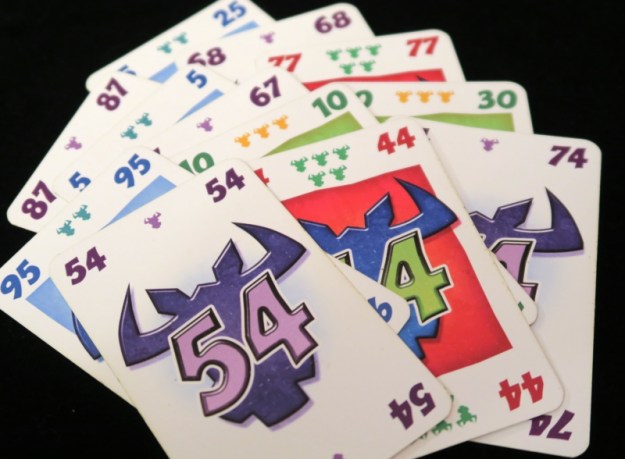
6 Nimmt!
– Image by boardGOATS

On our first online game night, a small group had had a difficult time playing Port Royal on Yucata.  Some of the group had also played rather challenging games of Snowdonia and San Juan, and, as a result, had moved to Board Game Arena for three more recent, epic games of Keyflower.  The graphics and playing environment on Board Game Arena are more up to date than those for Yucata, but like most other platforms, the servers have been struggling at peak  times with the load caused by the recent influx of new online gamers.  The folks at Board Game Arena have done a lot of work on that in the last couple of weeks though, and the performance has improved significantly as a result.  So much so, that we felt reasonably confident it would be stable enough to be the focus of games night.

Board Game Arena Logo
– Image by boardgamearena
on twitter.com

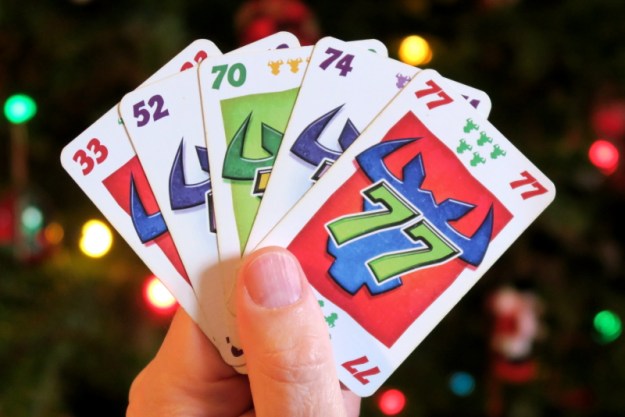
So, this week, the “Feature Game” was to be 6 Nimmt! played on Board Game Arena.  This is a game that everyone knows well, though there are a couple of minor tweaks to the rules.  The idea is that everyone starts with a hand of cards, ten on Board Game Arena (we usually play with the hand size that is dependent on the number of players).  Simultaneously, everyone chooses a card, and then, starting with the lowest numbered card, these are added to the four rows in the display.  Each card is added to the row that ends with the card with the highest number that is lower than the card played.
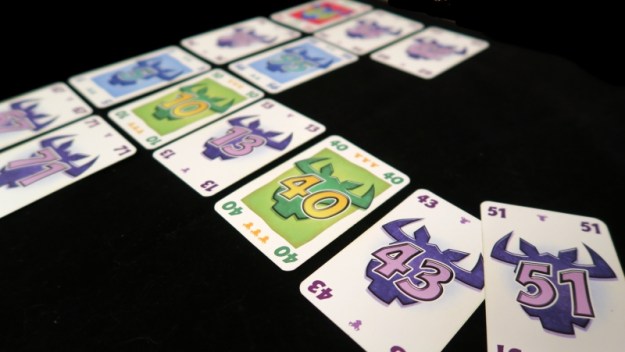
6 Nimmt!
– Image by boardGOATS

Placing the sixth card in the row causes the active player to take all the cards in the row, replacing them with their played card.  The clever part is that the score is the not the face value of the cards, but the number of “bull’s heads” shown on the cards.  The aim of the game is to finish with the lowest score.  When the group usually play, we split the deck into two halves and play just two rounds.  On Board Game Arena, however, everyone starts with sixty-six points and the game end is triggered when someone’s score falls to zero.

6 Nimmt!
– Image by boardGOATS

From 7pm, players began logging onto Board Game Arena and joined the MS Teams meeting.  Lime was one of the first and his chat with Blue and Pink was interrupted by a phone call from one of Blue’s relatives trying to source a set of drain rods.  Blue and Pink were quite convinced they didn’t have any, but that didn’t stop Pink having to spend the next hour hunting for some without success (so Lime kindly offered to lend his if required).  While Pink rummaged in the garage, everyone else joined the meeting and chatted.  Mulberry unfortunately wasn’t able to join us, but she was replaced by Ivory on his first online meeting.  It was great to “see” him again after so long, and good to hear that Mrs. Ivory, Little Ivory and Littler Ivory were all doing well and might be interested in OKIDO.
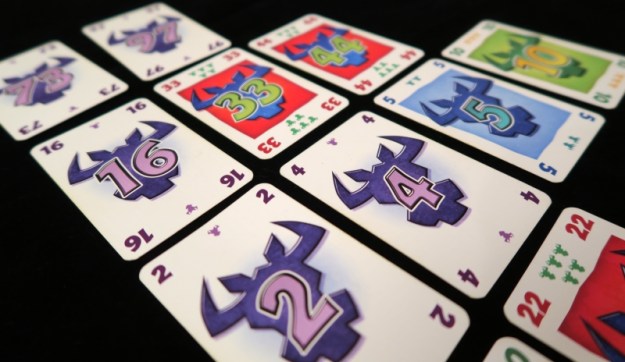
6 Nimmt!
– Image by boardGOATS

Eventually, Pink finished ferreting and returned to the chair kept warm by his panda and everyone settled down to play.  The Board Game Arena implementation worked nicely and everyone was able to chat in the background using MS Teams, but also through the game’s “chat” channel.  There was the usual moaning about the quality of cards and comments about how badly things were going:  it was almost like playing together in the pub, though not quite.
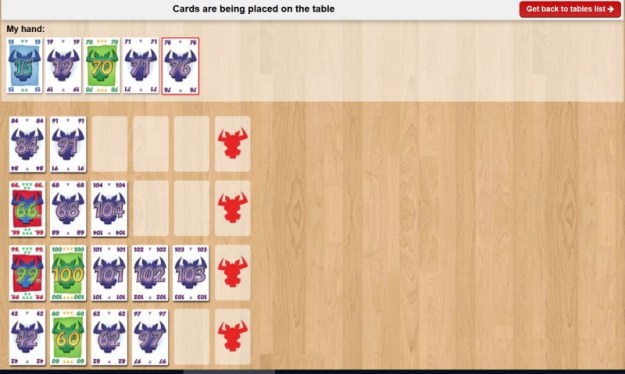
6 Nimmt! on Board Game Arena
– Image by boardGOATS from boardgamearena.com

Green and Purple managed to avoid picking up any cards for the first round or two, but it wasn’t long before their natural collecting mania began.  The disease spread and soon Pine, Ivory and Black were picking up lots of cards too.  It wasn’t long before Lime triggered the end of the game, and Burgundy managed to avoid picking up anything in the final round to win, ten points clear of the rest of the field.

6 Nimmt! on Board Game Arena
– Image by boardGOATS from boardgamearena.com

There is a lot of luck in the game, especially with so many players, but everyone was happy to play again and it is very easy to engage in a re-match, or so we all thought.  It wasn’t until the second game had started that we realised we’d “lost” Lime somewhere along the way.  He seemed to be playing a game, but then it dawned on him, that he’d somehow got himself involved in somebody else’s game by mistake.  He was very embarrassed and was keen to extricate himself, but Blue worked out where he’d gone and shared the link.  So, to the complete mystification of the four French gamers involved, the Brits all joined their game as excitable spectators.

6 Nimmt! on Board Game Arena
– Image by boardGOATS

Everyone boisterously cheered on our British Representative, to the blissful ignorance of the French and huge embarrassment of poor Lime.  Meanwhile, Black worked out how to abandon the incomplete game and Blue started a new one which everyone joined while still following Lime’s progress against the French.  Lime played really well and was in the lead for much of the game, but sadly, one of the French finished strongly and just beat him.  Still, we all felt he’d done an excellent job keeping the British end up, and he finished a very creditable second (especially since he was somehow also playing the group’s game and working!).
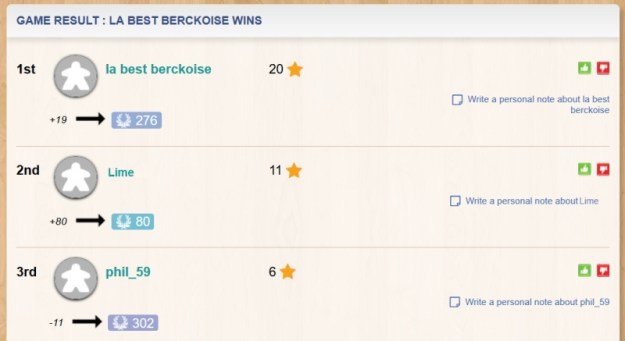
6 Nimmt! on Board Game Arena
– Image by boardGOATS from boardgamearena.com

After all that excitement, our game was something of an anticlimax.  Nobody was really paying much attention for the first part as they were distracted by Lime’s stellar performance.  But when everyone focussed on the game again, Pine, Blue, Ivory and Green were fighting it out to at the top while Pink was doing his best to end the game nice and quickly.  There were the usual smutty comments (Green: “Ivory’s got a big one there…!”) and other banter (Pine: “I had the lead for all of two seconds…!”), but eventually, Pink put everyone out of their misery, somehow leaving Blue just ahead of Pine.
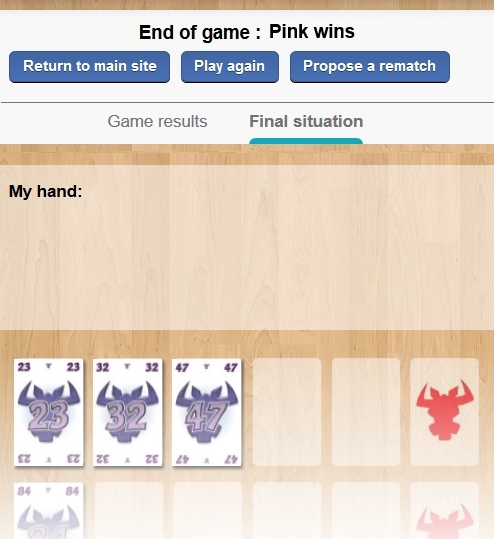
6 Nimmt! on Board Game Arena
– Image by boardGOATS
from boardgamearena.com

Nobody was desperate for an early night, so everyone chose the rematch option again, and this time, everyone ended up in the same game.  It started quite close, but Black soon found the cards irresistible and quickly amassed an unassailable pile of brightly coloured cards.  At the other end, Pink went from “zero” to “hero”, going from last place to first place, with Pine and Lime tying for second place.  Nobody seemed keen to play another round and the evening degenerated into chatter.  Pink shared how to customise backgrounds on MS Teams including a selection he had downloaded from the BBC, with one from Blake’s 7 and another from Multi-coloured Swap Shop.
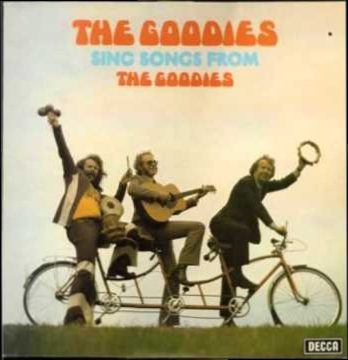
The Goodies Album Cover
– Image from youtube.com

This led to a discussion as to which was better: Swap Shop or ITV‘s offering, TISWAS.  From there, Pine shared some of his album collection with a quick blast of The Goodies’ Funky Gibbon and everyone started sharing weird things on YouTube including sheep playing on roundabouts; a fluffy sheep with no facial features, and the world’s biggest dogs. Pine offered Pink a copy of the soundtrack to The Sound of Music on orange vinyl, a generous offer that was politely declined.

For Sale
– Image by boardGOATS

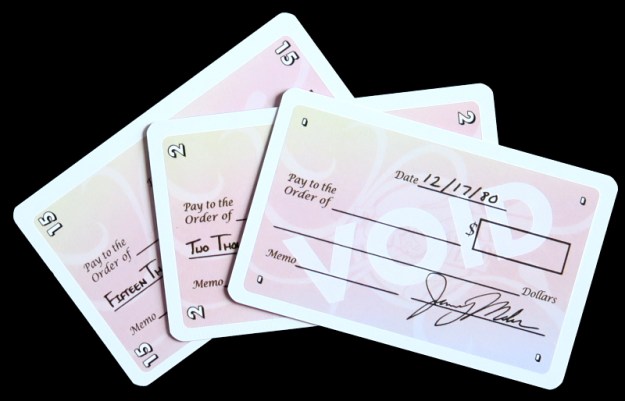
With Lime, Ivory and Green gone, and everyone else clearly not ready for bed yet, but running out of chat, someone suggested another quick game.  Once Blue’s maths had been corrected several times (ruling out all the five-player games), the group started a game of For Sale.  This is a simple auction game of two halves.  First, there is the property sale, where players take it in turn to bid for a building or pass and take the least valuable available.  Then, players choose which properties to sell when the “buyers” reveal their offers (cheques).
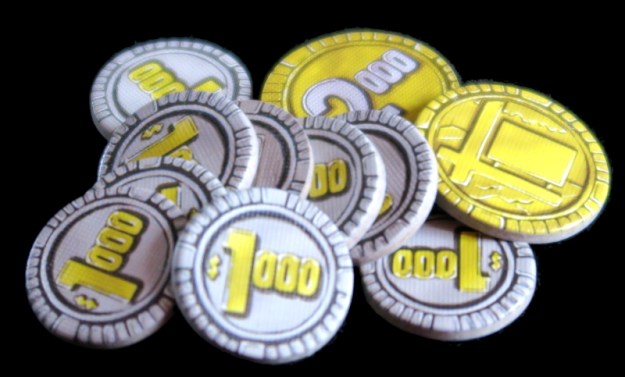
For Sale
– Image by boardGOATS

The clever part of this game is that the property cards are numbered (one to thirty), so they have a relative value with those numbered close to thirty more valuable than those around one.  Everyone starts with $14,000 and bids are in $1,000 increments, but anyone passing takes the lowest value property available, but takes a rebate equal to half the value of the bid (rounded down).  This adds an interesting level of decision making towards the end of each bidding round.  In the second phase, cheques are revealed with values between zero (void) and $15,000.  The player with the highest value of cheques and any left over money once all properties have been bought and sold, is the winner.
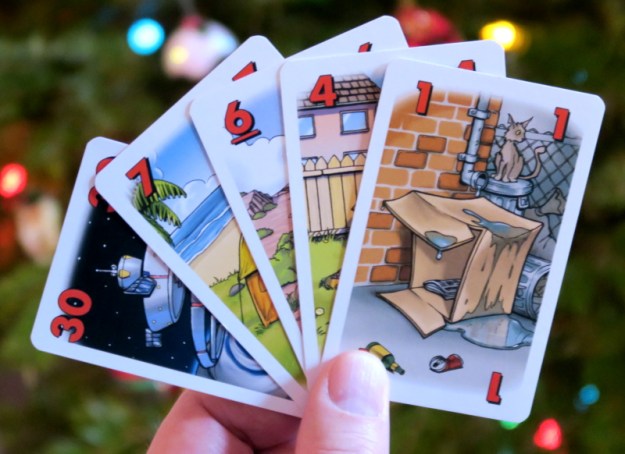
For Sale
– Image by boardGOATS

Board Game Arena have a very nice implementation of For Sale, faithfully reproducing the original, quirky card art.  There were a lot of controversially high bids, not least from Burgundy who paid $9,000 for the space station, the highest value property.  It worked though, as Burgundy just pipped Pine to win by a mere $1,000, in what was a very tight game.  It is a game where valuing property is key, both for buying and selling, and as it plays quickly, the group decided to give it a second try.
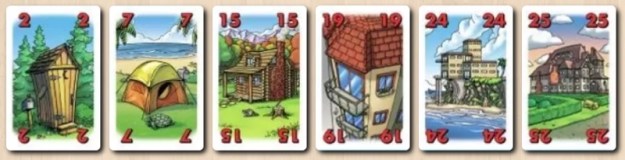
For Sale on Board Game Arena
– Image by boardGOATS from boardgamearena.com

This time, aside from Pink propping up the table again, everyone who had done well, did badly, and everyone who had done badly did well.  So, Blue, Black and Pink were at the top this time, with Blue pushing Black into second place by $5,000.  With that, Pine left the others to decide what long and drawn-out game they were going to play over the next fortnight, and everyone else eventually settled on Tokaido and set up the table to start the next day.
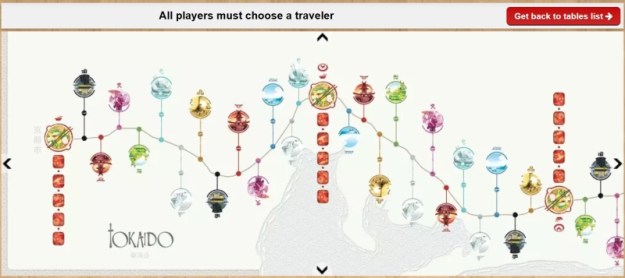
Tokaido on Board Game Arena
– Image by boardGOATS from boardgamearena.com

Learning Outcome:  6 Nimmt! est imprévisible dans toutes les langues.
28th April 2020 (Online)

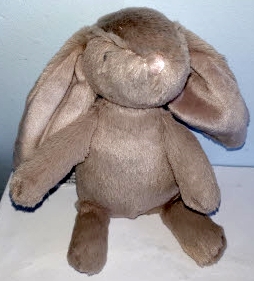
People started to arrive online from about 7pm with Mulberry briefly joining the party to say that she was going to have to work and sadly couldn’t join in the game.  It wasn’t long before everyone was once again sharing their stuffed toys, including Burgundy who’s new friend “Bunny” was watching over him from on high.  While Blue and Burgundy set up the game, Lime proudly showed off his new haircut that Mrs. Lime had done for him, only for someone to comment that it made him look like a bit like Tin Tin

Bunny
– Image by Burgundy

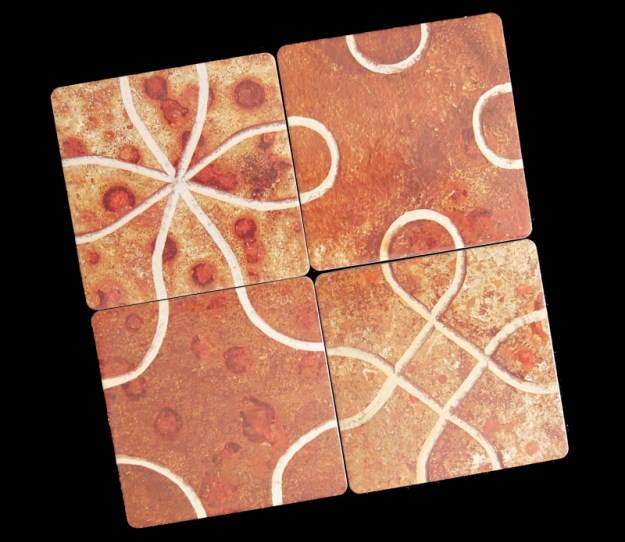
The “Feature Game” was to be Tsuro, a very simple game of tile laying.  The idea is that on their turn, the active player placed a tile in the space next to their stone and moves their stone along the path.  The last player left on the board is the winner.  The game plays lots of people, so was thought to be ideally suited to these online game sessions, but unfortunately, has hidden information in that each player has a secret hand of tiles that they play from.  In order to accommodate this playing online (using Tabletop Simulator to visualise, shared through Microsoft Teams), we simply displayed two tiles and on their turn each player picked one.

Tsuro
– Image by boardGOATS

This reduces the amount of planning possible, making the game less strategic, more tactical and, potentially, more random.  So to compensate a little and make it fairer, when any tiles with four-fold symmetry were drawn, they were put to one side as an extra option, a third tile, available until someone picked it.  As there were a lot of players, we also decided to use the slightly larger board from Tsuro of the Seas, and modify the pieces to suit our purposes.  Aside from this, the rules were the same as the original:  players can rotate the pieces (or ask someone to do it for them), but they must place them in the space next to their piece.

Tsuro
– Image by boardGOATS

Once a tile has been placed on the board, all stones must be moved along any paths extended, and any that collide or go off the board will be eliminated.  Burgundy started in the bottom left corner followed by Black, Purple and Lime, who was joined in the early stages by Little Lime who was keen to help.  Pine with his special friend, Beige assisting, followed by Pink, Blue and Green with Lilac and his “pet” sloth in support.  Everyone was fairly well spaced out around the edge of the board, so the game began quite slowly.  That was OK though as everyone had to get a feel for the graphics and what they were doing.

Tsuro on Tabletop Simulator
– Image by boardGOATS from Tabletop Simulator on Steam

As the game progressed, people started to get entangled with each other.  The first to come a cropper was Black with Pink not too far behind.  Burgundy and Blue got stuck and went off together followed by Green who ran out options and then ran out of road.  When Lime was eventually forced off the board by a lack of space, there were just two left.  As Purple had to move into the space around Pine (playing on behalf of Beige), giving him the opportunity to push her off the board and claim the first victory for his little Gremlin.

Tsuro on Tabletop Simulator
– Image by boardGOATS from Tabletop Simulator on Steam

That had gone quite well and hadn’t taken very long, so as setting up has some overhead, we decided it would be quickest to just play it again.  Blue and Burgundy re-stacked all the tiles and everyone chose their start positions.  For some reason, this time Green ended up surrounded by lots of empty space while everyone else was bunched together.  Green quickly put up a barrier and then went off to play with Lilac to play together alone in the corner, leaving everyone else to fight for space.

Tsuro on Tabletop Simulator
– Image by boardGOATS from Tabletop Simulator on Steam

Pine commented that Blue hadn’t moved far, but when she commented that she’d just been round in a circle, Pine objected inciting Pink to call him a “Boardgame Pedant”.  Pine took this mantle with pride and said he might add it to his CV as it already said he was a “Bird-watching Pedant”.  Blue queried this with “Bird-watching Pheasant?” and Pink upped the ante with “Bird-watching Peasant?”  Pine concurred, “Yeah, that too…”

Tsuro on Tabletop Simulator
– Image by boardGOATS from Tabletop Simulator on Steam

As the game plodded on, Pink was the first to go off, soon followed by Lime and Black.  Then there was a bit of a hiatus though as players got tangled up.  Pine was the first who kindly eschewed the opportunity to expel Blue from the game (or maybe he had no choice); and then Blue returned the favour (also with no other option).  Somehow, the paths kept getting entwined bring everyone to the same place, while Pine played with himself in the top corner, ominously.

Tsuro on Tabletop Simulator
– Image by boardGOATS

It was during this second game that the technology started to struggle a little and Teams kept freezing as the load on the network began to exceed the capacity of the village carrier pigeon.  The game just about kept moving though, with Pink, bored having been the first to leave the game, started intimidating Blue with his large Panda.  Blue and Pine were next off, thanks to Purple, who had to choose who was going to stay in the game with her.  In the end, her choice of Burgundy proved to be unfortunate as he ruthlessly dispatched her on his next turn.  It didn’t make much difference though, and Green with lots of space and no competition was the winner.  Although his second tile had been crucial to his success, it was really the unintentional assistance from Pine when he played a convenient blocking tile in E5 that clinched it.

Tsuro on Tabletop Simulator
– Image by boardGOATS from Tabletop Simulator on Steam

With that over, there was a little bit of chit chat about other game options that would work online:  Finstere Flure was an option on the Simulator, but 6 Nimmt! on Board Game Arena was discussed, as was Take it Easy! with pieces delivered by Blue and Pink.  That didn’t last long though as the evening degenerated into comparing soft toys again (“Is that Kingston Bagpuss?!?!”) accompanied by renditions of songs by The Eagles.  As Green, Lilac and Pine melted away, Blue, Pink, Purple, Black and Burgundy played a few turns to get to the end of Spring in their Keyflower rematch.  But that’s another story…

Keyflower on boardgamearena.com
– Image by boardGOATS from boardgamearena.com

Learning Outcome:  With all this “working from home”, the Stanford Carrier Pigeon needs a good feed.

14th April 2020 (Online)

Social contact is really important for mental health and board games are a great medium for that.  Unfortunately, physical proximity isn’t an option at the moment, so we’ve moved our games nights online.  Despite the limitations experienced last time, the overwhelming response from the group was that we should persist with online meetings.  With this in mind, and the recent special offer for Tabletop Simulator on the Steam platform, we’d had a couple of trial runs to see if that would work for the group.  Tabletop Simulator is a “sandbox” environment, which provides an electronic rendering of the game and tools to move things around.

Tabletop Simulator Splash Screen
– Image from steampowered.com

The strength of Tabletop Simulator, but also its weakness, is that people have to do everything themselves.  Everything.  This is good because it means the game can be played according to any rules people want, however, it also means there is a substantial overhead, which is just that bit too much for players not used to computer gaming.  Additional hurdles included installing software (a problem on some work laptops) and the intricacies of actually getting it running which required an hour or so tutorial to get going.  Unfortunately, these were just too large for us, especially for a group meeting only once a fortnight.

Chess on Tabletop Simulator
– Image by boardGOATS from Tabletop Simulator on Steam

Last time, we had played a simple physical game that we knew well, Las Vegas using cameras.  Seeing the “table” had been difficult though, limited by the resolution of the cameras and lighting.  So to improve things and get others involved, we decided to go with a compromise:  some people would run the game on Tabletop Simulator (providing a better visual experience), but the game would then be “streamed” to the group through Microsoft Teams, using the technology everyone was already familiar with.  This time, we were more ambitious: the “Feature Game“, Camel Up has more moving parts and lots of people hadn’t played it before.  It still fits the two key requirements, however, lots of people can play (especially with the Supercup expansion), and it has minimal “hidden information”, so it would still work with a couple of minor tweaks.

Camel Up
– Image by boardGOATS

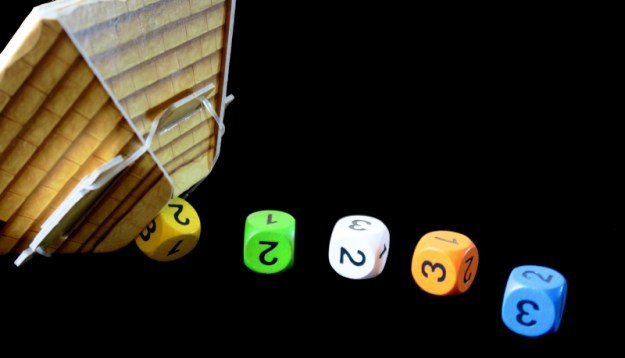
Camel Up is a simple enough family game, so teaching, even online, wasn’t too difficult.  It is a race game, where people are betting on racing camels and the player with the most money at the end of the race is the winner.  On their turn players have four options.  Firstly, they can roll dice to move a camel.  In the physical game, this is done with a special pyramid dice shaker that holds a die for each of the five camels and spits them out one at a time.  We found using the online rendering of this very difficult, and wanted to involve the players more, so we used the real shaker to deliver dictate the number and players rolled their own dice at home to see how far they moved.

Camel Up
– Image by boardGOATS

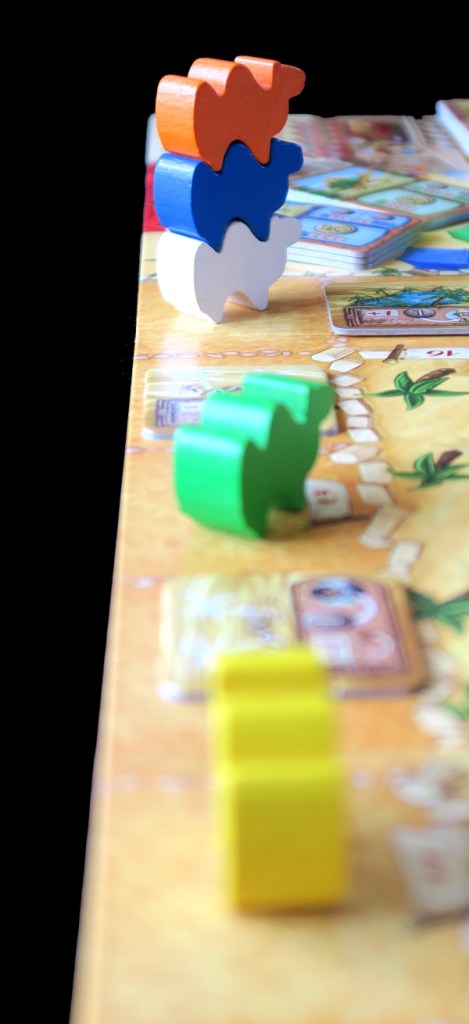
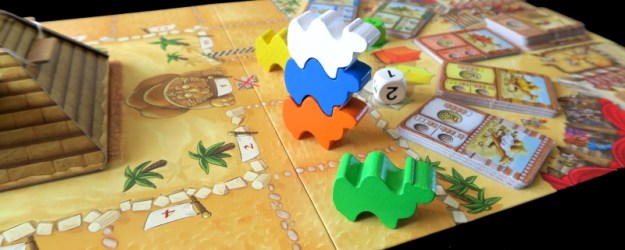
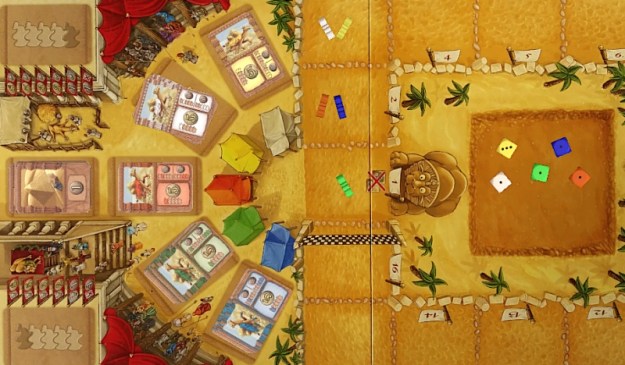
Alternatively, players could place a tile on the track which would earn them money whenever anything landed on it and move those camels forwards or backwards one space (depending which way up the tile had been placed).  The other two options involved betting:  players could bet on the winner of the leg (i.e. after all the dice had been rolled once) or the eventual winner or loser of the overall race.  A simple roll and move would not make betting very interesting, but in Camel Up, when a camel lands on the same space as another camel, it is placed on top of the other piece.  Then, if the lower camel moves before the top one does, it gets a free ride.

Camel Up
– Image by boardGOATS

Betting on the winner of a leg was easy to implement—each player had a space on the simulator and betting tiles (and pyramid tiles showing players had rolled dice) were moved to that area.  Betting on the eventual winner/loser was more difficult.  In the physical game, players have five cards which they play onto the winner or loser pile.  At the end of the game, these are evaluated with the first player to bet correctly getting the most money, continuing on a sliding scale, with those who bet incorrectly losing their stake.  Obviously, this wasn’t going to work for us, so instead, one person made a note of who placed bets and people kept track of their own choices (as well as their money), and we just tallied up at the end.

Camel Up
– Image by boardGOATS

Blue, Pink, and Mulberry started setting up from around 7pm.  We used the expanded board from the expansion to make the race a little longer, but decided that any of the other modules would just make it too complicated this time.  This was a very hard decision, because the game can become very random with lots of players and the expansions do a lot to mitigate that.  We had already increased the complexity considerably compared with last time, and that would have been a step too far this time.

Camel Up
– Image by boardGOATS

As people joined the “meeting”, people chatted, mostly about nothing, largely because not a lot had happened for most people.  Blue commented on the lovely large rainbow image in the window at Lime’s house (drawn by Little Lime), and Pine commented on how nice it was to be home now his caring duties were over.  Green was the last to join the party, and he immediately asked when Pine was going to get back which led to much hilarity as the previous conversation was reprised.  The procession of soft toys reappeared:  Mulberry showed off her Pony, apparently called Macaroni (after Yankee Doodle), and Pine introduced us to his Gremlin, who apparently wants to join us at The Jockey when it re-opens and would like to be known as “Beige”.

Beige
– Image by Beige’s “Wrangler”

Having already set the game up for eight, Green and Lilac decided to play as a team, especially as they were still to eat their supper.  Blue was about half way through the rules explanation, when, much to everyone’s delight, Burgundy arrived.  He didn’t have a microphone, though he could hear everything people said.  This created a weird juxtaposition of speaking and reading replies, which occasionally became typing (especially for Blue) when confusion set in.  Playing would have been quite difficult as well as needing more set up, but it was lovely to have Burgundy back as we’d all missed him last time, and people couldn’t resist chatting on the text channel in the background.  We will definitely sort out a microphone for him for next time though.

Camel Up
– Image by boardGOATS

From there on, it was disorganised chaos mediated by camels.  Pine decided to share his packet of Tangy Cheese Doritos with everyone, and the disembodied crunching and rustling was quite something.  He blamed it on Beige, but no-one was fooled.  This was followed by someone (possibly Black) making a strange bonging noise that to Pink sounded like a bell from a traditional, mechanical signal box.  He does have a bit of a thing about trains though.  Meanwhile, on the chat, there were discussions about shopping and Pine’s burping camel impersonations.  Clearly the Doritos were working their magic.

– From Peter Jordan on youtube.com

The game was something of a side-show to all this “excitement”.  In the first round, aside from a couple of people placing oasis/mirage tiles, everyone just moved camels.  Having seen how the race worked though, the betting really got going on the second round.  The tech, though not perfect, worked well enough, thanks largely to Mulberry’s efficiency.  And although the game wasn’t a “meaty”, “manly” game, being together doing something a little different was the most important thing.

Camel Up on Tabletop Simulator
– Image by boardGOATS from Tabletop Simulator on Steam

The betting on the end game really told the story of the race.  Mulberry was the first to bet on a win, quickly followed by Pine, Black, Purple, Pink and Blue, with everyone gambling on the green or white camel making it over the line first.  Pine was the first to have another shot, but still didn’t get it right.  Betting on the loser, on the other hand, was started early by Lime and quickly followed by Pink, Black, Blue and Mulberry all of whom bet on the yellow camel to stay at the back of the pack.  That camel seemed to have three legs, or maybe a pulling rider, or perhaps it had eaten too many of Green’s sausages.  Whatever, it was definitely not a contender, and everyone agreed with Purple who commented that it should retire to a camel sanctuary.

Camel Up on Tabletop Simulator
– Image by boardGOATS from Tabletop Simulator on Steam

The front of the race was much tighter, and as the probability field gradually whittled down the likely order of finishers as it became clear that the game was coming to an end.  The order of movement was all important and players jumped in with their final bets on who would win the race, but the final leg.  Lime was the first to bet on the eventual winner, giving him eight Egyptian pounds, followed by Blue, and Pine with diminishing returns.  Green realised that betting on the winner of the leg was more lucrative by this point than betting on the end of the race, and Pink followed suit, leaving Mulberry to finish the race.

Camel Up on Tabletop Simulator
– Image by boardGOATS from Tabletop Simulator on Steam

A quick run-down of the final finances showed that Pink was a single pound ahead of Green who who posted an initial, competitive total winnings of twenty Egyptian pounds.  Lime, the first to successfully predict both the overall winner and loser finished some way ahead though, with takings of twenty-eight pounds.  Pine excused his particularly poor showing by saying he thought camel racing was cruel.  From there, the evening mostly descended into verbal and text chatter as people discovered and shared emojis (Pine was the first to find camels, but only in camel colour) and stickers, and then soft toys… again.

Pikachu
– Image by Mulberry

Mulberry suggested that when The Jockey re-opens we should have a “BYOB” party and “Bring Your Own Buddy”.  Burgundy apparently misheard and there was more hilarity when the sad message appeared on the chat, “no bunny”.  Green saw Mulberry’s Pikachu and said Pokemon Go was a problem in the current climate.  That’s not the case for Mulberry apparently, who commented that she has a “Pokey-stop” outside her house.  For those who were not familiar with the game Pokemon Go, that just sounded very smutty.  Mulberry shared a “Let Me Google That For You” link, but it didn’t seem to help, and things only got worse when she tried to explained what she did with her “Pokey-balls”…

Yucata.de
– Image from yucata.de

Time was getting on, and meeting on line is surprisingly tiring so eventually, people sadly departed, leaving Pink, Blue, Black and Purple to continue the seemingly eternal game of Snowdonia they had started two weeks earlier, on Yucata.de.  Snowdonia is a worker placement game that we’ve played quite a bit as a group, where players are building the rack-railway up the famous mountain.  The basic idea is that each player has two workers and they take it in turns to place these on one of the seven options:  gather resources; remove rubble; convert resources; lay track; build part of a station; pick up a contract card, and move their surveyor.

Snowdonia on yucata.de
– Image by boardGOATS from yucata.de

Each of these actions have a different number of available spaces, so for example, only three workers can lay track in any given round.  During the game, the weather changes, increasing and decreasing the work-rate so that players can build that track faster, or slower, or if it is foggy, not at all.  Contract cards give players points for successfully completing certain tasks, but can also be used to give an enhanced action instead.  The game ends when all the track has been built to the summit, Yr Wyddfa.

Snowdonia on yucata.de
– Image by boardGOATS from yucata.de

This game was started after the last games night, so it was only fitting that is should be finished on a games night too.  It had started quite slowly – Yucata is quite different to Tabletop Simulator because it is much less flexible, but does ensure players follow the rules and can play turns for them when they have no decision to make.  This can help speed things along, but can also be confusing at times when the game state changes more than expected between turns.

Snowdonia on yucata.de
– Image by boardGOATS from yucata.de

Playing a strategy game over such a long time period proved difficult for those not used to it.  This is mainly because players lost the thread of the “narrative”, and ended up playing tactically for the short term rather than following a long-term plan.  Unsurprisingly, Black, who plays quite a lot of games asynchronously on Yucata, struggled least with this.  He was also must familiar with the environment and got off to a flying start.  Blue prioritised getting a train, but discovered that it didn’t do quite what she had in mind when she tried to use it a day or two later.

Snowdonia on yucata.de
– Image by boardGOATS from yucata.de

Pink was the first to move his surveyor, but then completely forgot about it.  He only realised it had been passed by everyone else’s about half-way up the mountain in the final round, by which time it was too late to do anything about it and the others were all at the summit.  Blue had been horribly inefficient in places due to losing the thread of the game and additionally couldn’t quite build the track she needed to fulfil her most lucrative contract.  According to Black, Purple was “playing online like she plays in real life”, but she was definitely doing something right as she put a spurt on at the end laying track.

Snowdonia on yucata.de
– Image by boardGOATS from yucata.de

Black started fastest, took the lead and then stayed there, but contracts can be a big game changer in Snowdonia.  This time though, Black completed two contracts adding a total of forty-six points to his twenty-one for getting his surveyor to the top of the mountain and forty-five points collected for building during the game.  The total made him a run-away winner with a total of a hundred and twenty-one, miles ahead of Purple who sneaked into second place a couple of points in front of Blue.  And with that it was time for the long walk to bed.

Snowdonia on yucata.de
– Image by boardGOATS from yucata.de

Learning Outcome:  A simulator can still be used even when most people don’t have access.

31st March 2020 (Online)

It is at times like this that we need social contact more than ever, and board games are a great medium for that, a fact recognised by both the World Health Organisation (WHO) and the British government.  With everyone confined to barracks for the foreseeable, we felt it was important to give online meetings a go.  There are several online gaming alternatives, but they all either cost or are horribly slow thanks to the fact that everyone else is trying to do the same.  For this reason, we decided to try to play a real game using the medium of Microsoft Teams with a camera pointed at the board and everyone else giving instructions.

Setting up for online gaming
– Image by boardGOATS

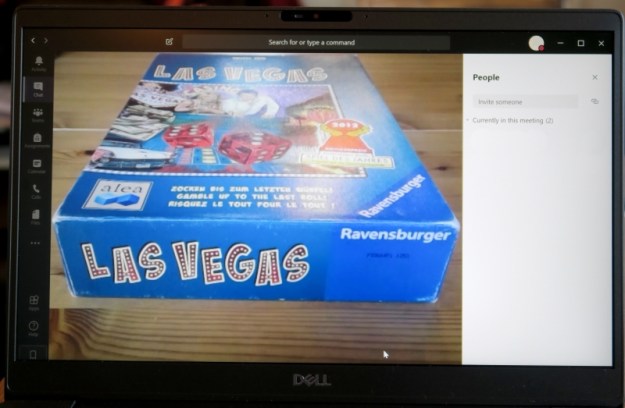
Our game of choice, and therefore our “Feature Game” for the day, was Las  Vegas. This was because everyone knows it (minimising explanations), lots of people can play (this was intended to be a social event, so that meant lots of people could be involved); it has no hidden information (a necessity for this sort of thing).  Blue and Pink began setting up at about 6pm, after the long walk home from work. They used two laptops: one was perched on some place mats and a pile of sturdy game boxes (specifically Tapestry, In the Hall of the Mountain King and Teotihuacan) with the reverse camera pointing at the table and the game, the second laptop was then used to see what everyone else could see.

Las Vegas
– Image by boardGOATS

Black and Purple (in Abingdon), were the first guinea pigs and struggled to get the link to work. Eventually, with some discussion over the phone and the inevitable microphones and speakers on/off issues, they were successful. While Pink popped out to fetch fish and chips from Darren Pryde and his itinerant chip van (which were truly excellent), Mullberry (in Wantage) became the next guinea pig and signed in with little difficulty.  After Blue sent out the link to everyone else at 7.30pm, there was a steady precession of gamers joining the party.  There were a few things we learnt from this first experience:

  • As the sun set, the natural light from the window faded and the camera really struggled—lighting really is critical.
  • MS Teams worked OK with people joining through a link via a web browser, but it is important that the “game camera” has an active microphone. If it does not, Teams decides it is not active and it disappears for anyone viewing on a browser.
  • MS Teams thinks that feeds where the image changes a lot are the most active and therefore the most important focuses on these.  This is a particular problem for those using a browser rather than the application; turning off cameras when inactive can help.
  • During setup, it helps to have something really obvious for people to focus on.
  • Maybe it’s the stress of the current climate, but there are an alarming number of soft toys in close proximity of people’s web cameras, most of which seemed to be pandas.

By about ten minutes to eight, most people had “arrived” and everyone was chatting about their new normal and sharing what they were drinking and stories of shopping—for a moment, it was almost like we were at The Jockey. A couple of minutes before the scheduled start, Green, the last to join, signed in.  As Blue began dealing out the cards, Green’s opening comment was that it didn’t feel like a games night because we hadn’t spent half an hour chatting! That produced much hilarity, and more chit-chat, before we eventually started.

Las Vegas
– Image by boardGOATS

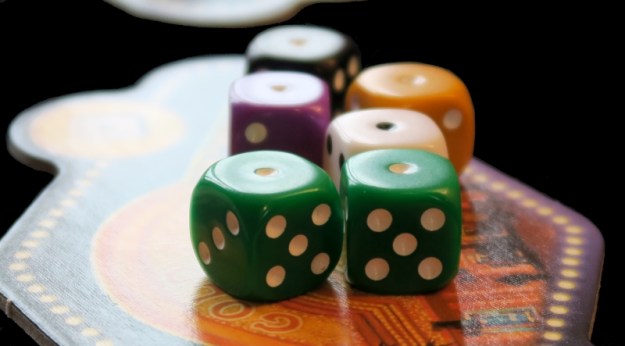
Las Vegas is a very simple game, which is, of course, why we picked it.  Players have a handful of dice and take it in turns to roll them and then place all the dice of one number on the casino of their choice. When nobody has any dice left, the player with the most dice in each cassino wins the jackpot.  There are a couple of clever twists that make this a really great game though. Firstly, the prize fund for each casino is dealt out in money cards.  Some cards are as high as $100,000, while others are only $10,000—the winner takes the largest denomination for that casino, the jackpot, leaving the player in second place to take the second largest, and so on.

Las Vegas
– Image by boardGOATS

Secondly, and perhaps most cleverly, all ties, cancel each other out.  This is absolutely key to the game: the vagaries of dice mean that a well-positioned player could roll one die and end up with nothing, and much hilarity follows. We also add the Slot Machine from the Boulevard expansion, which works in a slightly different way with dice of each number being added a maximum of once.  We also use the “Biggun” from the expansion, so each player has on large die that counts as two.

Las Vegas
– Image by boardGOATS

Mulberry began. One of the reasons we picked this game was that we thought most people might have dice of their own at home and could roll them themselves. Mulberry was the only one who didn’t, so being a true Millennial to the core, she opted for an electronic solution using an online dice roller.  Otherwise, it was very satisfying to hear the rattle of dice as people took their turns.  Although chatting was quite difficult over the network, that didn’t prevent a lot of smutty comments and requests for him to stop bragging when Green announced that he had “got a big one”.  Even more entertaining was when the conversation moved onto Iceland’s entry for Eurovision and links were shared through the chat feature which resulted in Pink pressing play by mistake and drowning out everything else.

– From Eurovision Song Contest on youtube.com

It was not an ideal way to play any game and with our group Las Vegas is not quick at the best of times, but the combination of people reading out their dice roll so that Blue and Pink could display them, dodgy internet connections, people sounding like Miss Othmar (the teacher from the Peanuts cartoons), and trying to keep eight people on-message, definitely slowed things down. At the moment though, these things are unavoidable and we managed. It was nearly 9pm before the first round finished and people were happy enough with the result to play a second, if not our usual third.

– From Corgi Adventures on youtube.com

Black made hay with his singleton on Casino Three, when Mulberry’s and Lime’s piles of dice cancelled each other out. Green just pipped Blue to take $100,000 on the Slot Machine, leaving her with just $20,000 for the round, and poor Lime with nothing at all.  Purple, Black, Pink, Green and Pine all had good totals in the range of $100,000-$150,000, so it was all to play for going into the second round.

Las Vegas: The Slot Machine
– Image by boardGOATS

This time it was Casino Two that was a knife-fight in a phone box.  Pink, Blue and Pine all had four dice in the mix with Green in second place (and therefore winning the jackpot) with two.  The final roll of the game was Green’s “Biggun”, so when he rolled a two, nobody could believe his misfortune.  Just before he placed it though, he realised he had another option—the oft-forgotten Slot Machine. At which point Pink realised the jackpot could have been his if he had done the same on his previous turn.

Las Vegas
– Image by boardGOATS

Nobody really cared about the scores, but Mulberry, Lime and Blue all did better in the second round, though it was too little, too late. The winner was Green with total winnings of $280,000 with Purple in second with $230,000 and Pink and Black just behind.  The real loser of the evening was Covid though: it wasn’t a great game, but for a couple of hours, we’d all had a bit of fun chucking dice about, forgetting reality for a while.  And with that, Green, Lime, and Pine (signing in from Stoke of all places), left the meeting.

Las Vegas
– Image by boardGOATS

Those remaining, decided to give yukata.de a go, and after a bit of discussion, decided to opt for Port Royal. It took a while to get going with Blue and Black trying to remember how to play and explain it to Mulberry. The game itself is simple enough though, and yukata.de, though old-school, keeps everyone honest.

Yucata.de
– Image by boardGOATS from yucata.de

Port Royal is a fairly simple, push-your-luck game.  On their turn the active player turns over cards until they either find one they want (and can afford) or go bust. There are four different types of card: Characters, Ships, Expedition and Taxes.  Ships are free and give money, Characters give victory points and special powers, while Expeditions give opportunities to trade Characters for more points, and Taxes give people behind in the game a little windfall.  Once the active player has taken their card, everyone else gets the chance to take/buy a card in turn order, paying the active player for the privilege.

Port Royal
– Image by boardGOATS

Pink started well, but Blue eventually got her act together and initially made inroads into his lead before taking it from him. When there was a succession of people going bust, her Jester gave Blue lots of cash enabling her to cement her position at the front.  It wasn’t long before her advantage was eroded though, first by Black, adding a Jester to his Admirals, and then by Purple, claiming an expedition.

Port Royal on yucata.de
– Image by boardGOATS from yucata.de

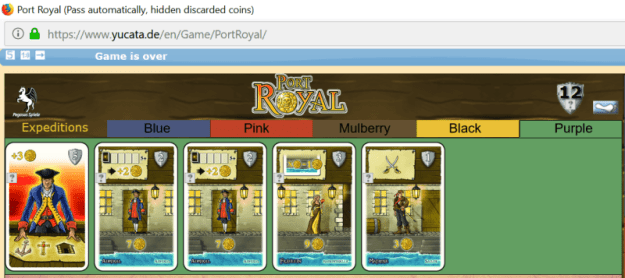
It was all very tight towards the end, but Purple was the first to our chosen end of twelve points, with a score of thirteen points. Unfortunately, due to a rules misunderstanding, everyone was expecting one final round, but sadly, it was not to be.  Purple was the last player in the round, and once everyone had taken cards from her leavings, Yukata decided that was it, Game Over. In truth, it probably wouldn’t have made much difference, and Purple deserved her victory though the other platings might have been different if there had been another round.

Port Royal on yucata.de
– Image by boardGOATS from yucata.de

It had been a slow and trying game, though not quite as bad as attempts to play synchronously at the end of last week when the website had repeatedly failed to record moves.  Mulberry was looking very tired and it was getting very late, so she signed off, leaving Blue, Pink, Black and Purple to start what will probably be a long, asynchronous game of Snowdonia. That’s another story though, especially as it could take a fortnight or longer to play!

Yucata.de
– Image from yucata.de

Learning Outcome: Playing remotely is not as good as playing round a table together, but it is definitely better than nothing at the moment.

17th March 2020 – “Unofficial boardGOATS”

There were people around the bar from 6pm, but we had the back room to ourselves, just the four of us.  The feel was similar to the Sunday after the fire, when people turned out and sat in the garden partly to help drink the smoke and water damaged stock, but largely to show support for a valued amenity, knowing that they would have to do without it for a while.  There was sadness, a sharing of news, some gossip, a certain amount of gallows humour, and for us, lots of desserts and Azul: Summer Pavilion.

Azul: Summer Pavilion
– Image by boardGOATS

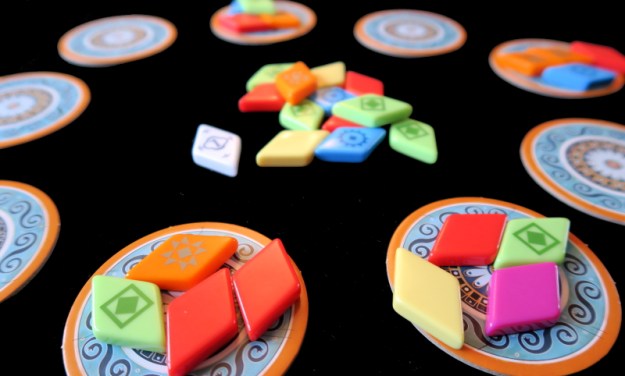
The game uses the same market mechanism used in the original Azul and the re-implementation, Stained Glass of Sintra.  The idea of this is that there are several markets (nine in the four player game) arranged in a circle and each with four coloured tiles.  On their turn, players either take all the tiles of one colour and put the rest in the centre, or take all the tiles of one colour from the centre.  Summer Pavilion differs from the other versions because each round has a special colour:  tiles of this colour are “wild” and can be used to replace any other when placing.  Additionally, only one tile of this colour can be taken from a market or the centre, and then as a bonus with other tiles.

Azul: Summer Pavilion
– Image by boardGOATS

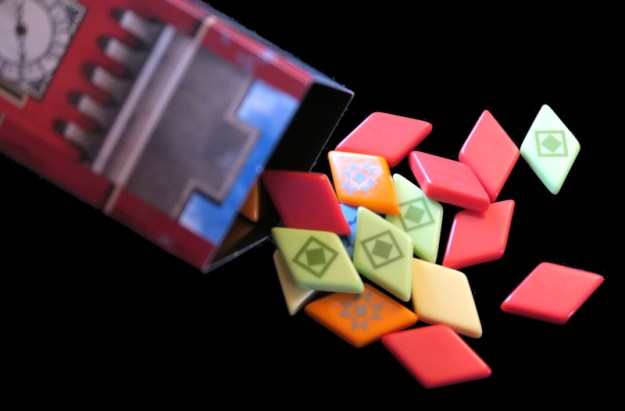
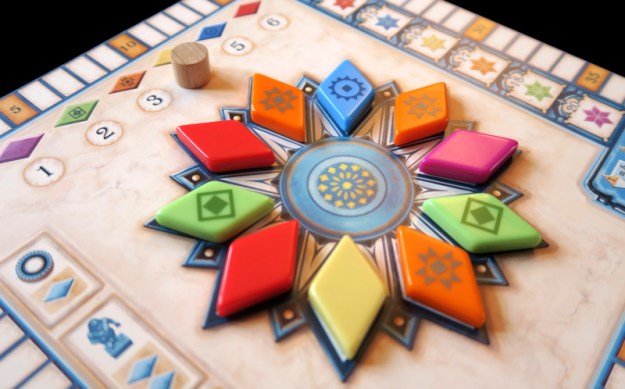
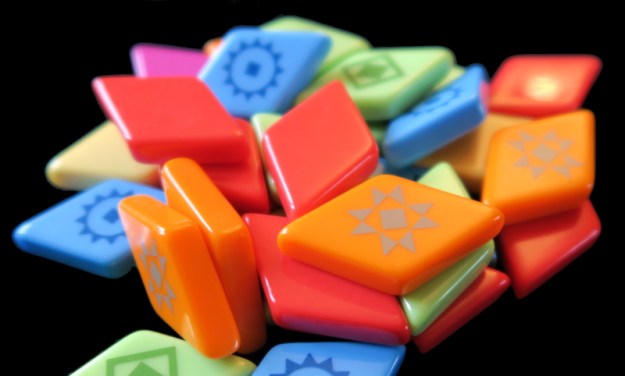
The structure of the game is also different with two phases; players take it in turns to take tiles, then they take it in turns to place tiles (rather than taking and placing straight away).  Perhaps the most obvious difference is the shape of the tiles though—rhombus shaped instead of square and the individual placement mats are built round pretty six-fold symmetric “flowers”.  When placing a tile, players have to match the colour on the mat, and the number on the space throwing the leftovers into a red tower—the build-quality of this is distinctly superior to the one in Stained Glass of Sintra, in fact, the build-quality of pretty much everything is better than in the first re-implementation.

Azul: Summer Pavilion
– Image by boardGOATS

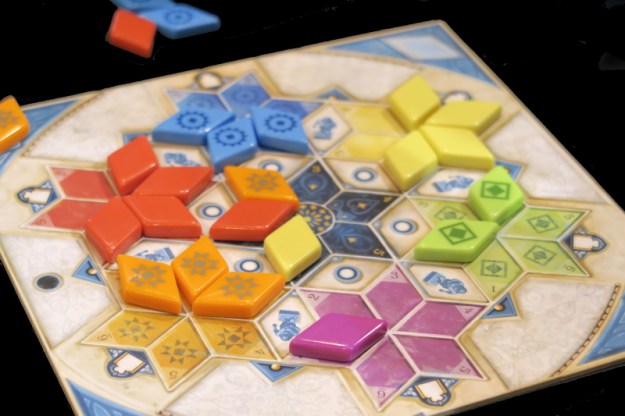
Players score according to the size of the segment after addition, thus adding a piece to connect two other single pieces would score three points.  Enclosing special features on the board gives bonus tiles which are added to the players pile of tiles to be placed.  The game takes six rounds (one for each colour) and players get end-game bonuses for completing flowers and for filling all seven spaces with the same number.  The player with the most points is the winner.

Azul: Summer Pavilion
– Image by boardGOATS

Although Blue was the only person who had played it before, it was quickly clear that everyone liked this version more than the last, but found it more challenging than the original adding a new level of complexity.  Purple went first, and Lime quickly got his nose in front.  Every time someone threatened to catch him, he put on another spurt and increased his speed to maintain his lead at around ten points.  That left it down the bonuss and the question was whether anyone had enough to catch him.

Azul: Summer Pavilion
– Image by boardGOATS

Blue took the most points in the end game scoring, but starting at the back, she also had the most ground to make up; Lime took the least and starting at the front he had the most to lose.  Purple was the closest to catching Lime and looked to be in a good pace taking twenty-four points in bonuses (as many as Blue), but sadly had three tiles she had been unable to place.  That made all the difference as she finished three points behind Lime, with seventy seven points to his eighty.

Azul: Summer Pavilion
– Image by boardGOATS

Lime suggested playing again, something only he ever does—not that this is a bad thing at all, it’s just particularly unusual within the group. Not that anyone minds playing games more than once, but he is the only one to ever suggest it.  This time, most people seemed to think they could do a better job the second time round, so the suggestion was really well received.

Azul: Summer Pavilion
– Image by boardGOATS

The second time round, Black and Blue started out with a different strategy, going for some of the expensive tiles first to maximise the extra tiles they could take early on.  Lime started as he had before taking an early lead and trying to keep it.  This time he found it much more difficult though.  Blue weathered his early spurt and kept with him, eventually overtaking him and sneaking into the lead.  This time everyone did better on the bonuses, as they knew what to look for, indeed everyone did better overall, though Lime said it didn’t feel like it.

Azul: Summer Pavilion
– Image by boardGOATS

Blue had the lead going into the final round and with two completed stars finished twenty point ahead of second place.  It was really tight for that though, with only a handful of points between second and fourth.  Despite a three point penalty at the end, Lime just managed to hold off Black, beating him into second place by a single point.  And that was it, the end of what is likely to be the last game for the group for what could be a very long time.  Everyone sadly said goodbye to the landlord, Charles, and we all wish him and all the staff at The Jockey our very best for what will, no doubt, be an extremely difficult few months for them.

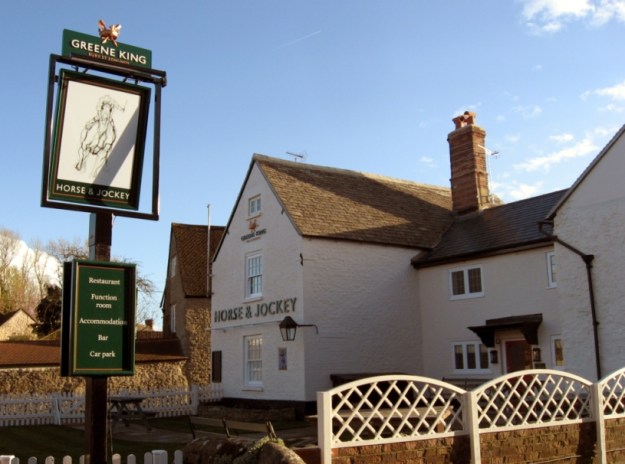
The Horse & Jockey
– Image by boardGOATS

Learning Outcome:  You only fully realise what you’ve got when you are about to lose it.

3rd March 2020

After a short, but sweet battle over who wasn’t going to have the last lamb pie and mash, Burgundy and Blue settled down to eat.  They were soon joined by Pine, Lime, and then Black and Purple bringing news of their new black and purple car.  When Ivory and Green arrived, the key players were in place for the for the “Feature Game”, the Hellas map from the Hellas & Elysium expansion to Terraforming Mars.

Terraforming Mars: Hellas & Elysium
– Image by boardGOATS

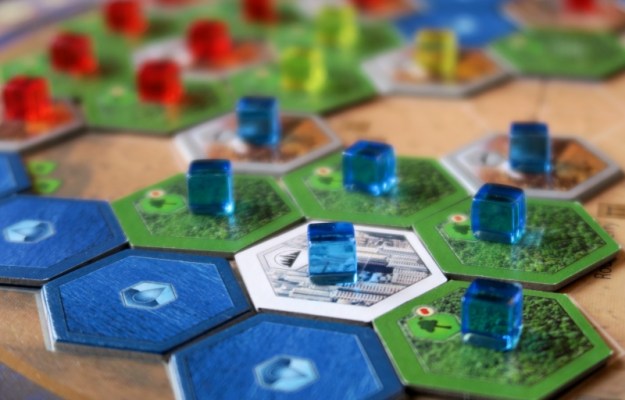
In Terraforming Mars, each person takes the role of a giant corporation, sponsored by the World Government on Earth to initiate projects to make Mars habitable.  This is by raising the temperature, increasing the oxygen level, and expanding the ocean coverage.  The Hellas map presents a new areas of Mars to explore, in particular, the Mars south pole and the enormous seven-hex Hellas crater that just begs to become a giant lake.  Building around the pole gives placement bonuses in the form of heat and possibly even water.

Terraforming Mars
– Image by boardGOATS

At the start of each round, players draw four cards, keeping as many as they like, but paying 3M€ per card.  Since the cards are so critical to the game-play, there is a variant where the cards are drafted, letting players see more of the cards available, but making the decisions more critical.  Players then take it turns to take one or two actions from seven possible actions.  At the end of the round, players simultaneously produce, turning any energy into heat, taking finance according to the combined total of their Terraforming Rating and their M€ production level, and finally receiving all other resources according to their production levels.

Terraforming Mars: Hellas & Elysium
– Image by boardGOATS

The game ends once all three Global Parameters are met:  all of the Ocean Tiles have been placed, the Temperature has reached 8°C, and the Oxygen Level is at 14%. The game is driven by the cards, but the guts of it are the actions.  These include: play a card; use a Standard Project; use an Action Card; convert eight plants into a greenery tile and raise the Oxygen Level; use eight Heat to raise the Temperature; claim a Milestone, and fund an Award.

Terraforming Mars
– Image by boardGOATS

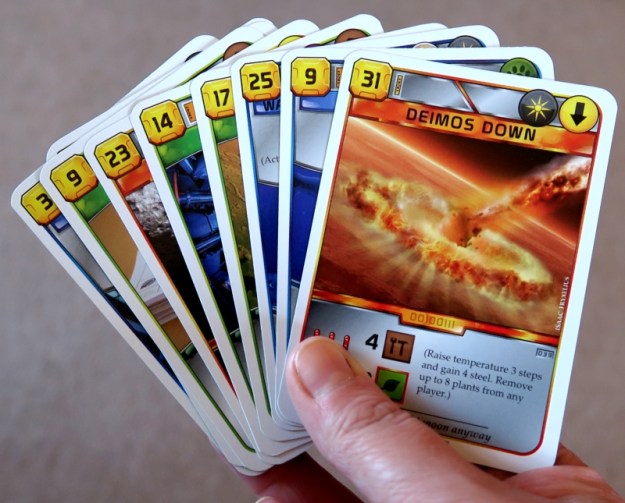
Each card has a set of requirements, for example, Grass cannot grow at very low temperatures, so the Grass Card can only be played when the Temperature is above -16°C.  Other cards may require the player to spend energy, or other resources.  They also have a financial cost, though some can be paid for using Steel and/or Titanium as well.  There are three types of cards: red Event Cards, Green Automatic Cards and Blue Action Cards.  Green and Blue cards have an effect that occurs when they are played.  Red Event Cards have  an action that takes place once and are turned face down once they have been played.  Blue Action Cards also give the player a special ability that can be activated many times during the game, but only once per round.

Terraforming Mars
– Image by boardGOATS

In addition to the actions on the cards, players can also carry out actions associated with Standard Projects.  These can be used several times per round and mostly involve spending money to increase the Temperature, add tiles to the board, or increase the player’s Energy Production.  Players can also sell cards at a rate of 1M€ per card, an expensive option as it’s less than they cost to buy, and it costs an action, but needs must when the Devil drives.  Finally, players can claim milestones (if they have played enough cards with Tags that qualify) or fund an award.  These cost money, but give Points at the end of the game.

Terraforming Mars
– Image by boardGOATS

This is the basic game play, but there are a lot of expansions and variants, so setting up was slow as the group tried to figure out which cards came from which expansion and what bits they actually needed to use.  They got there in the end and chose to add in a few extra corporations to the standard set. Only Ivory received one of them, but still chose an original corporation, Ecoline, which gave him Plant production and reduced the number of plants he needed for a new Forest tile from eight to seven.  Green went for Inventrix, which gave him three extra cards at the start of the game and reduced the restrictions on the environmental requirements.  Burgundy chose Teractor, which allowed him to play cards with Earth Tags more cheaply.

Terraforming Mars
– Image by boardGOATS

Ivory made an early play to plant a city amongst the northern green belt. He knew it was an unusual opening move and a bit of a gamble, but one he hoped would pay dividends later.  Burgundy also planted a city in the first round, nearer to the large potential ocean area in the Hellas crater. Green waited a little longer for his first city, but broke away from the others to plant it near the southern polar region, hoping to expand upon the unique scoring potential for this new board.

Terraforming Mars: Hellas & Elysium
– Image by boardGOATS

Like most games of Terraforming Mars this one progressed gradually and slowly as everyone built their “engines”.  Ivory was clearly working on a Forest growth strategy, and also looking for the bonus end game awards.  Burgundy was trying to build cities next to oceans for bonus money and also keeping the sides of his cities next to Forests for end game scoring.  Green tried to use his relaxed environmental requirements to his advantage by playing cards early, but in the process failed to do anything with his southern city goal.

Terraforming Mars: Hellas & Elysium
– Image by boardGOATS

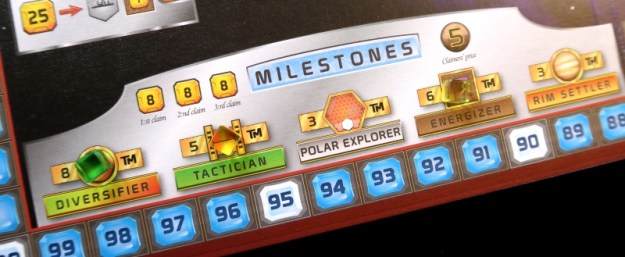
Ivory made the first Milestone claim, taking the Energizer, for increasing his Energy Production to six.  He was about to claim the second too, Diversifier, for having eight different tags played, but then realised that he couldn’t use the Red Event cards and so couldn’t claim it after all.  Very soon after Green took it instead, much to the annoyance of Burgundy who was also on the verge of taking it, and would have done so on his next turn.  Ivory later claimed the third Milestone, Tactician (five environmentally restricted cards), which both he and Burgundy had noticed Green could have claimed earlier and made noises to that effect, but weren’t specific.  Green, however, had forgotten what it was awarded for and hadn’t noticed he qualified.

Terraforming Mars: Hellas & Elysium
– Image by boardGOATS

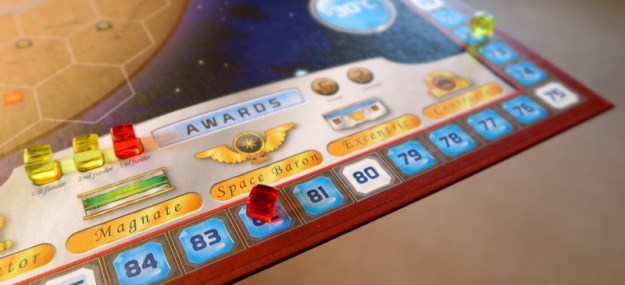
As for the Awards, Ivory again funded the first one to activate the Cultivator, obviously key to his strategy as as it rewarded most Forests.  Ivory also wanted Space Baron in play (for most Jovian tags) and Burgundy paid for the final Magnate Award, which rewards the player with the most green cards.  In the end though, Burgundy won all three awards, with Ivory taking second place in two and Green just pipping Ivory to second by one card for the Magnate Award.  When it came to the scoring, the Terraforming Ratings were quite close with Ivory just ahead of Burgundy as he had been for most of the game.  Burgundy took a lot of points for the awards though and scored heavily for his cities.  The overall winner was therefore Burgundy with eighty-three points, sneaking ahead of Ivory who took second place.

Terraforming Mars
– Image by boardGOATS

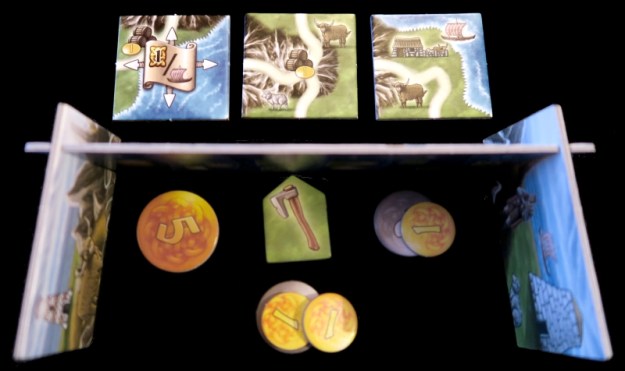
While the Terraforming Mars group began setting up, everyone else took a slightly more relaxed look at the options available, and after some discussion, the group settled on Isle of Skye.  This won the Kennerspiel des Jahres in 2016 and is a game most of the group have played before and really enjoyed.  The best way to describe it is a bit like Carcassonne, but with individual play areas and a very clever auction for the tiles.

Isle of Skye: From Chieftain to King
– Image by boardGOATS

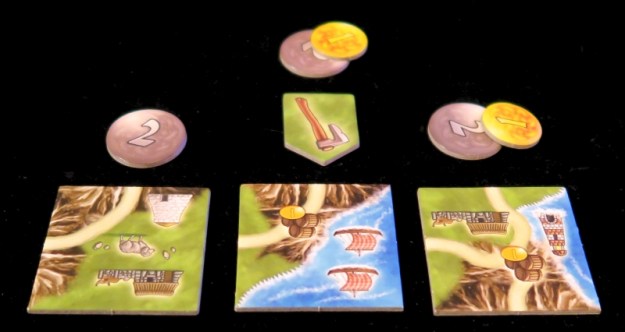
The idea is that players start with three tiles drawn randomly, and place them in front of their screen.  Behind the screen they use their own money decide the price of two of the tiles and choose one to discard.  Once everyone has revealed their prices and discards, the first player chooses a maximum of one tile to purchase from the offering.  They cannot choose one of their own, and they pay the amount shown to the owner of the tile.  Once everyone has made their purchase, players then buy any remaining tiles in front of them, paying with the money the used to indicate the price.

Isle of Skye: From Chieftain to King
– Image by boardGOATS

This auction is very clever for lots of reasons. Firstly, the player with the best tiles, does not necessarily get them.  If they think they have something valuable, then they can give it a high price and will either end up keeping it (paying the money to the bank), or end up getting a lot of money for it.  For this reason, the key thing is getting the value right—over-pricing a tile risks it failing to sell and getting landed with it at a heavy cost.  This was Ivory’s comment from the next table.  There is a more subtle aspect to the auction, however.

Isle of Skye: From Chieftain to King
– Image by boardGOATS

Although they have the widest choice, if the first player prices their tiles too high, they may not have sufficient funds to buy anyone else’s, worse, nobody else will buy their tiles which means they will end up having to pay for them themselves, leaving them short of cash in the next round as well.  On the other hand, because the money paid for tiles and the money used to indicate their cost go straight into the seller’s hand, players later in the turn order, may have less choice, but will likely have more available cash.  In this way, the advantage of turn order is self-correcting and everyone has difficult decisions to make and probabilities to consider, though the decisions are different for each player.

Isle of Skye: From Chieftain to King
– Image by boardGOATS

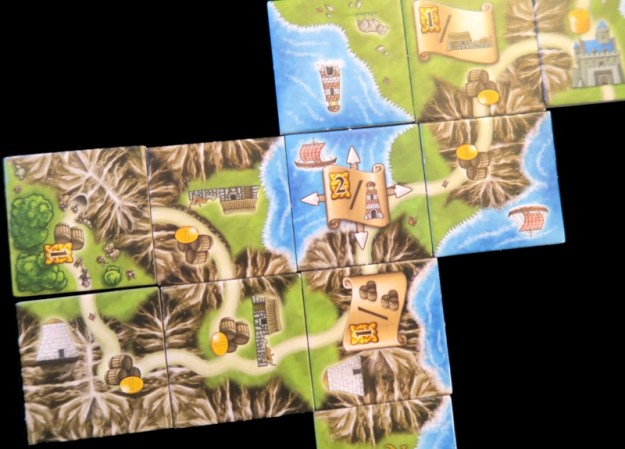
Once the tiles have been bought and paid for, players add them to their kingdom.  Like Carcassonne, the terrain type on the edges of the tiles have to match up (though roads do not), and the tiles have features that are used for scoring.  There are more different features than in Carcassonne, however, and the scoring is very different.  In each game there are four scoring conditions, and each one is used three times during the game (five rounds for the five player game).  Additionally, there are also tiles that feature scrolls which are personal scoring conditions that take effect at the end of the game.

Isle of Skye: From Chieftain to King
– Image by boardGOATS

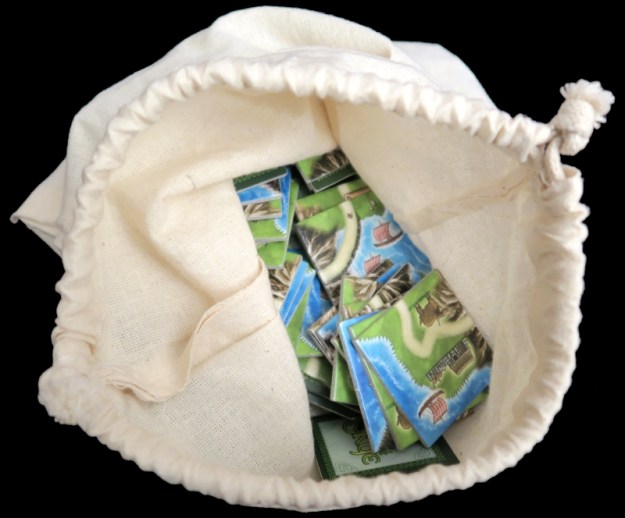
As Lime was new to the game, the group decided not to include the main components of the Journeyman or Druid expansions.  All the tiles went into the bag though, including those from both of the large expansions and the several mini expansions (the Adjacency Scrolls, both Tunnelplättchen, the Themenplättchen and the Kennerspiel des Jahres Promo), and anywhere the main feature required one of the main expansions were just rejected when they were drawn.

Isle of Skye: From Chieftain to King
– Image by boardGOATS

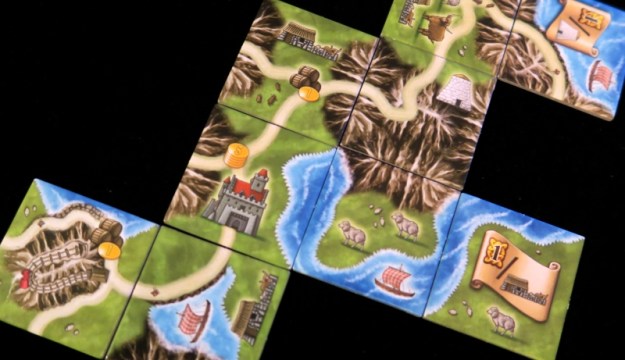
Pine got a flying start in the first round getting five points for his Broch/Lighthouse/Farm combo and a couple of points for a completed mountain range.  As the game progressed, more buildings fell into his lap and the points kept coming.  Black tried to collect Broch/Lighthouse/Farm sets, but couldn’t get any Brochs, so gave up and concentrated on getting diagonals instead.  This is not as easy as it looks because every tile added to a diagonal requires the fixed placement of two tiles.  Each round, players get a maximum of three tiles, so this is very restrictive.

Isle of Skye: From Chieftain to King
– Image by boardGOATS

It was a hard game:  Lime failed to complete and score any mountains and Purple struggled as there were two rounds when she failed to get any points at all.  Blue started off trying to build in a diagonal, but ended up picking up points for Barrels connected to her Castle by road, mostly at Lime’s expense.  She was aided when Pine drew a Barrel tile that Lime really fancied and had lots of money to pay for.  Not wanting to give away his plans, Lime told Pine he didn’t want the tile, so Pine, who believed him, chucked it away, leaving Blue a clear run.

Isle of Skye: From Chieftain to King
– Image by boardGOATS

Pine maintained and grew his lead, though the others did threaten to catch up towards the end.  His Brochs and enclosed scroll giving him two points for each one made all the difference though and he finished with sixty-nine points ten ahead of second place.  The battle for that was much closer with three players within six points of each other.  It was Blue who sneaked in front though, just ahead of Lime who put in a very creditable performance on his first attempt.

Isle of Skye: From Chieftain to King
– Image by boardGOATS

Terraforming Mars was still going on the next table, so although it was getting late the group decided to play something short, and considered Coloretto, but in the end settled on No Thanks!.  This is a really quick and simple “push your luck” reverse auction game.  Everyone starts with eleven chips and on their turn, either takes the card on offer (and any chips on it) or pays a chip to pass the problem on to the next person.  The aim of the game is end up with the lowest card total, subtracting any chips they have left.  The catch is that if a player has a run of cards, only the lowest is counted, however, at the start of the game nine cards are removed from the thirty-three in the deck…

No Thanks!
– Image by boardGOATS

This time, Black won a relatively uneventful first round with twenty, while Purple “top scored” with fifty-three.  It was quick and Terraforming Mars was into another round, so Lime suggested another round and everyone else concurred.  This was more remarkable.  Blue was first to take card.  Since the player who takes a card then has first dibs on the next card, when the next was close the the first, she took that too.  This continued with only a couple of breif interludes for cards she really didn’t want.  In the end, she had a remarkable run of fifteen cards from the twenty-four in play.

No Thanks!
– Image by boardGOATS

Unfortunately for her, as they were mostly low value cards and cards she needed, she had been unable to milk them to get chips from the others.  So she finished with a very reasonable thirteen, but in forth place behind Lime with twelve and, remarkably, Black with minus three and Pine who took the game with minus four, winning by virtue of the fact he played later in the round.  The Terraformers were just finishing, so the cards were shuffled for a third and final time.  This time, Lime tried the collecting cards trick, but he was not as lucky as Blue and ended with a card total of ninety-nine (and twenty-three chips).  Black and Blue both finished with a more normal nine, and tied for the win.  With everyone finished, but time was marching on, so everyone decided to say “No Thanks!” to another game and went home.

No Thanks!
– Image by boardGOATS

Learning Outcome:  Getting a lead is good, but you have to be able to keep it.

18th February 2020

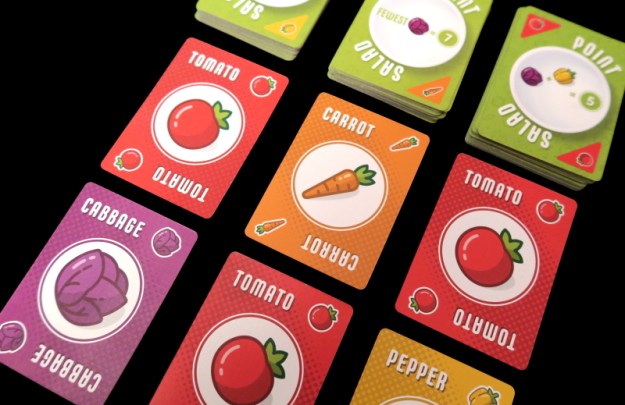
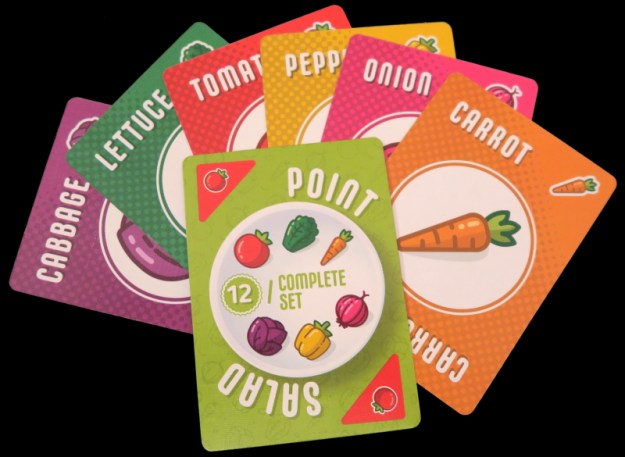
Food was a little delayed, so we decided to start playing something.  Food was clearly on our collective minds though, because we opted for a starter of Point Salad.  This is a very simple set collecting game where players take cards from the market.  The cards are double sided with brightly coloured vegetables on one side and scoring conditions on the other.  The market consists of three piles of cards showing the scoring condition sides, and six cards showing the reverse, the vegetable side.  The number of cards a player can take depends on where they take it from:  one scoring card or two vegetable cards.

Point Salad
– Image by boardGOATS

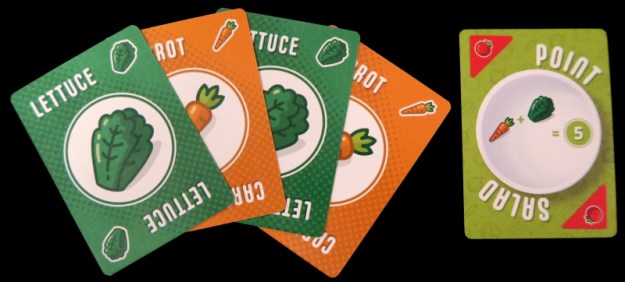
Each pile of cards feeds one pair of vegetables.  So, when a vegetable is taken, a scoring condition card is turned over to reveal its vegetable side, and that scoring condition is no longer available.  Players can also, once per turn, turn over one of their scoring cards so it becomes a vegetable, but they may never turn over a vegetable to make it a scoring card.  The game is over when all the cards have been distributed, and the scores have been totaled.  One of the more unusual things about this game is that both vegetable and scoring cards can be used more than once.  So, a player with a card giving points for sets of onion, cabbage and carrot (i.e. coleslaw), can score it as many times as they have sets.  Furthermore, if they also have a card that scores for pairs of carrots and lettuces (i.e. rabbit food), they can reuse the carrot cards and count them a second time.

Point Salad
– Image by boardGOATS

Pine began collecting lettuces, an obsession with green things that ended up lasting the whole evening.  Burgundy was more obsessed with red things, specifically tomatoes, so Mulberry, Black and Purple took great delight in snaffling them first, even when they didn’t help.  Blue only needed mayonnaise for her coleslaw as she collected onions, cabbages and carrots and generally made a nuisance of herself with Mulberry, sat to her left.  Food arrived before the game finished, and with people getting distracted by pizza and chips (always more appealing than salad) it is possible there were some missed opportunities.  It was tight finish at the front with only six points between the winner and third place.  Sadly, despite everyone else’s best efforts, Burgundy top-scored with fifty-six, ahead of Mulberry and then Blue.

Point Salad
– Image by boardGOATS

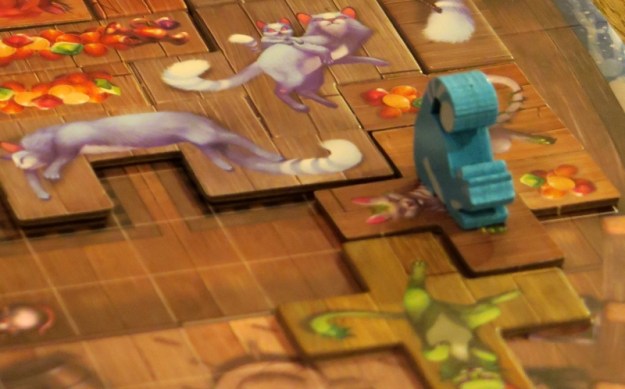
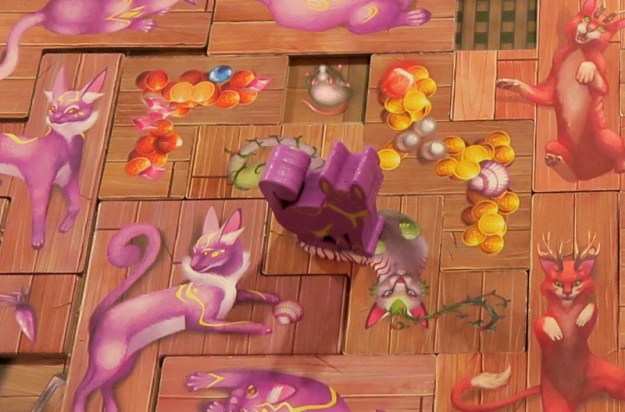
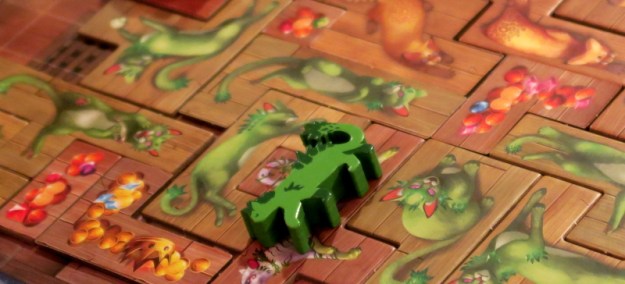
Once everyone had finished eating, it was time to decide who would play what.  The “Feature Game” was The Isle of Cats, a tile-laying game where players are rescuing cats and packing them onto their ship.  There were a lot of takers, none of which were keen to back down (even though Mulberry misunderstood and thought it was called “Pile of Cats” which, on reflection, does sound very exciting).  The game is not terribly complicated though we did make a bit of a meal of it. It is played over five rounds, each of which starts with card drafting.  Players are dealt seven cards and keep two passing the rest to their neighbour; this is repeated until they receive only one single card.

The Isle of Cats
– Image by boardGOATS

The cards come in five different colours: blue, green, yellow, brown and purple.  Blue cards are Lesson cards which are really just Objective cards, but these come in two types, personal and public.  Yellow cards depict some combination of “Boots”, “Cat Baskets” and “Broken Baskets”.  Boots are useful because they dictate where you come in the turn order, while Baskets are needed to used to “pay” to rescue Cats.  Yellow cards are treasure cards, brown cards are special “Oshax” cat cards and purple cards are instant effect cards that can be played at any time.

The Isle of Cats
– Image by boardGOATS

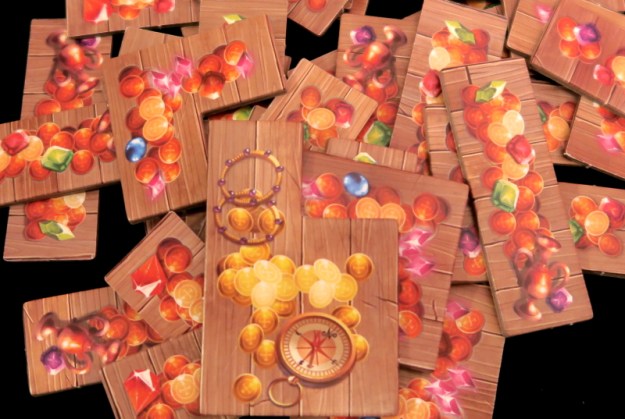
At the start of every round, each player receives twenty Fish which are used to pay for both cards and Cats.  So, once the cards have been drafted, players choose which ones they want to buy. with prices varying from free to five Fish.  The rest are discarded.  It is imprudent to over-spend, as Fish are also needed later in the round to lure cats off the island and onto the players’ ships; some cats are easier to lure than others, with cats on one side of the island costing three Fish and others costing five Fish.

The Isle of Cats
– Image by boardGOATS

Once everyone has paid for their cards, they must play any blue Lesson cards they kept in the round.  Any Public Lessons are revealed while Private Lessons are kept to one side face down.  Players then play their green cards—this is the guts of the game.  Players do not have to play all their green cards straight away, some can be kept for later rounds.  The number of Boots played are counted up, and the turn order is adjusted according to the number of Boots played so that the player with the most goes first and so on.  Player then take it in turns to spend one of their baskets and the appropriate amount of Fish to take one of their Cats and place it on their ship.

The Isle of Cats
– Image by boardGOATS

Each player starts the game with one “Permanent Basket” which they can use once per round, aside from this, the other Baskets usually come from the cards played or other Permanent Baskets acquired later in the game.  The Cats come in five different colours and are depicted on polyomino tiles which are placed on the players’ Ship-player boards.  At the end of the game players score points for grouping Cats of the same colour together in Families:  the larger the Family the more points.  So, a group of three Cats of the same colour will score eight points, while a Family of ten Cats scores a massive forty points.  In addition, players lose one point for each rat they have failed to cover with a cat, and lose five points for each room they fail to fill.

The Isle of Cats
– Image by boardGOATS

Thus, perfectly tessellating Cats is the aim of the game, but additional points are also available from the Lesson-objective cards.  It would be quite a challenge to perfectly tessellate tiles while keeping cats of the same colour together and conforming to the arbitrary objectives given in the Lessons, however, there are a couple of things to help grease the wheels.  Players who cover Scrolls on their Ships with a Cat of the same colour can add a Treasure tile to their ship for free—these are small tiles that are very useful for filling in holes.  There are only five scrolls though, one of each colour.

The Isle of Cats
– Image by boardGOATS

Additionally, however, once everyone has run out of Baskets, they can also play their Rare Treasure, yellow and brown cards.  The yellow cards enable players to place more Treasure tiles while brown cards allow players to place the very rare Oshax Cats (or “Oh, shucks!” Cats as we mostly called them).  These are very friendly Cats and will join any Cat Family of the player’s choice, though they have to pick the colour when they place it.  The cards are quite rare and very expensive, but a couple of these can be a really good way to boost the size of a Family.

The Isle of Cats
– Image by boardGOATS

In addition to Baskets on cards, each player starts with one Permanent Basket which they can use once per round.  Blue started the game quickly, by playing two lesson cards followed by a special card which enabled her to swap them for a second Permanent Basket.  Everyone looked on agog, envious of the advantage that would give, however, it had cost a  lot of Fish, and she spent the rest of the game trying to recover. Mulberry struggled to get some useful cards, but eventually managed to get a Permanent Basket of her own while Burgundy managed to get a couple of his own and he concentrated on trying to make sure there were no gaps round the edge of his boat to fulfill Lesson 113 to give him twelve points.

The Isle of Cats
– Image by boardGOATS

Pine meanwhile, continued his obsession with green and hogged all the green cats.  Since cards are drafted most of the cards are seen by some of the other players, so when he said he wasn’t sure how one of his Lesson cards worked, Blue and Burgundy knew exactly what his problem was.  The Lesson in question was Card 222 which gave ten points for each row of twelve containing at least twelve cats of the same colour.  Green’s queries concerned whether the row had to be continuous or whether they could be broken up by treasure, and whether Oshax cats counted.  We said they didn’t have to be continuous and Oshax cats counted so long as they were the right colour.  As a result, Pine’s green car family continued to grow, now forming long rows, lots of them.

The Isle of Cats
– Image by boardGOATS

It was in the final round that Mulberry turned nasty playing Public Lesson Card 235 which meant anyone  who didn’t have seven treasures would lose five  points, which inconvenienced Blue quite a bit.  When it came to scoring, it turned out that we weren’t quite right with the rule for Card 222—the rows should have been continuous.  That might have cost Pine ten or even twenty points, though of course had he known that, he would likely have been able to offset that a little.  It wouldn’t have mattered anyhow as finished with ninety points and a huge lead.  Over thirty points behind, it was close for second, but Burgundy, who just managed to ensure there were no gaps at the edge of his boat, pipped Blue, by two points.

The Isle of Cats
– Image by boardGOATS

There are a number of really nice things about The Isle of Cats.  Firstly the production quality is stellar and there are some really, really nice touches.  The cat artwork is fantastic and the fancy screen-printed cat-eeples from the deluxe upgraded version are quite special.  Unquestionably, we made a mistake playing with five the first time round—we were slow, with a lot of people spending a lot of time checking whether tiles would fit and that made the game even slower.  Mulberry commented that she disliked variable turn order as a mechanism:  it is common in lots of games, but tends to encourage a lot of pauses followed by queries about whose turn it is.  The are other little things like the fact the purple and brown cards could have been more distinct.  Overall, it definitely deserves another chance, but it might be hard to get some of the players from the first time to give it a second try.

The Isle of Cats
– Image by boardGOATS

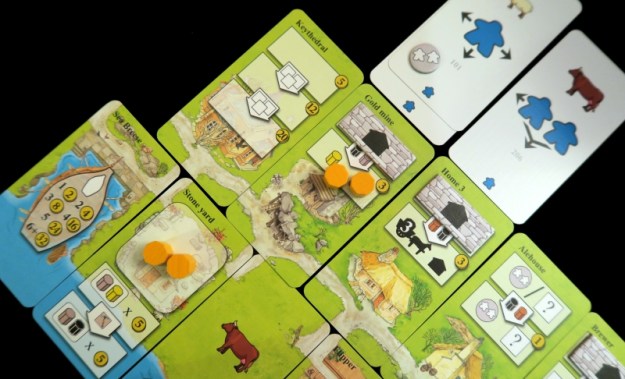
Meanwhile, on the next table, Ivory, Black and Lime, started off with Key Flow.  This was particularly sad for Blue to see, because Key Flow is a sort of card game of Keyflower, one of her favourites.  That said, Key Flow had been played at our sister group, the Didcot Games Club, just a few days previously, so she consoled herself with the memory of that and concentrated on The Isle of Cats.  Although Key Flow has a lot in common with Keyflower, it has a very different feel.  Where Keyflower is really an auction game (using meeples as currency), Key Flow is a card drafting game.  So, in Key Flow, players start with a handful of cards, simultaneously choose one and place it face down, passing the rest on.

Key Flow
– Image by boardGOATS

Players then simultaneously reveal their card and add it to their village before picking up the hand they’ve just been given, selecting another card and so on.  Like Keyflower, the game is played over four seasons, and like Keyflower players receive some of the Winter offerings  at the start of the game which they can then use to drive their strategies.  The iconography is very similar too, so a player who is familiar with Keyflower generally feels at home with Key Flow.  The cards come in three flavours:  village buildings, riverside buildings and meeples.  Village cards are placed in a player’s village, in a row extending either side of their starting home card.  Riverside tiles are placed in a row below, slightly off-set.

Key Flow
– Image by boardGOATS

Meeple cards are used to activate Village cards by placing them above the relevant building.  As in Keyflower, buildings provide resources, skill tiles, transport and upgrades.  They also provide meeple tokens which can be used to increase the power of meeple cards or activate a player’s own buildings at the end of the round.  Arguably the clever part is how the meeple cards work.  At the centre of each card there are a number of meeples which dictate the power of the card.  A single meeple card can be played on any empty building; a double meeple card can be played on an empty building or one where one other card has already been played.

Key Flow
– Image by boardGOATS

If two cards have already been played, a triple meeple card is required to activate it a third and final time.  Alternatively, a lower power meeple card can be played with one of the meeple tokens, which upgrade a single meeple card to a triple meeple card.  Double meeple cards can also be upgraded, but each building can only be activated a maximum of three times per round.  The really clever part is that the meeple cards have arrows on them indicating where they can be played:  in the player’s own village, in the neighbouring village to the right, the village to the left, or some combination.

Key Flow
– Image by boardGOATS

Black began the game by adding the Key Mine to his village which provided him with iron (wooden, black octagonal prisms).  In summer he added the Smelter which added more iron producing capacity (converting skill tiles), but he quickly upgraded this to give gold instead as it is more versatile and can be used instead of any other resource and any left overs are worth a point each at the end of the game.  Ivory also had resource providers in the shape of the Workshop which provided him with a wood, an iron and a stone every time it was activated.  He then added an Apprentice Hall which generated skill tiles.

Key Flow
– Image by boardGOATS

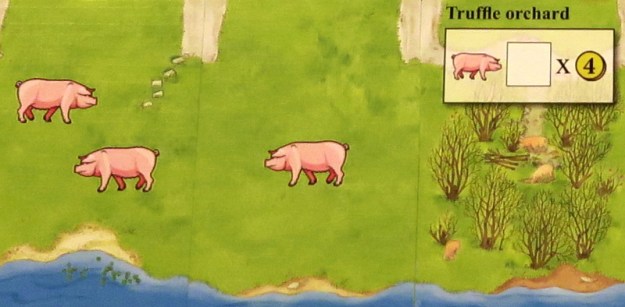
Meanwhile, Lime built a village strong in gold production, with the Gold Mine and Brewer and potentially the Carpenter too if he could upgrade it.  To his village, Black added a flock of sheep on his river bank while Ivory added a heard of pigs; Lime was more of a mixed farmer though with a bit of everything.  As the game progressed into the scoring rounds, Ivory added a Truffle Orchard which gave him four points for each pig and skill tile pair, allowing him to put all his pigs to good use netting twenty-four points.

Key Flow
– Image by boardGOATS

Lime and Black pulled in similar points tallies with their Emporium (four points for each green meeple and gold pair) and Traveller’s Lodge (points for transport and boats) respectively.   With similar points for their upgraded buildings as well, it was close and the smaller contributors became really important.  Ivory’s Trader which scored him fifteen points for stone and axe skill tiles, while both Black and Lime scored ten points for their Autumn stores (Stone and Timber Yards respectively).

Key Flow
– Image by boardGOATS

Perhaps it was the points he got from the meeples (Winter Fair and Craftsmen’s Guild), but there was only two points between first and second in the end. Black finished with a total of seventy-one points, just enough for victory—a couple of points more than Ivory, with Lime not far behind.  It had been a hard fought game, and Ivory was impressed how the Scribe, which in Keyflower he felt was always a winner, had little effect.  For him, this made the game more interesting, though he had really enjoyed the last time the group played Keyflower with the Farmers expansion, as that had also mixed things up.

Key Flow
– Image by boardGOATS

Given the recent game with the Didcot group it was inevitable that a comparison was going to be made.  This time Black won, but he scored fewer points than he had the previous week when he had come second.  Perhaps the most marked difference was how much quicker the three player game of Key Flow had been than the six player game a few days earlier.  Where the six player game had taken all evening, there was still time for something small, and with Lime taking an early bath, Ivory and Black chose to play a head-to-head of Ticket to Ride: London.

Ticket to Ride: London
– Image by boardGOATS

Ticket to Ride is a train game with an inexplicable alure, which everyone in the group loves and we’ve found that the small versions of the game, New York and London make excellent fillers.  The rules and game play are very similar to the full versions, but the take half the time, and with just two players, that makes it a very short game indeed.  On their turn, players take coloured cards or spend them to place their pieces on the map.  Points are awarded for completing tickets, but critically, failing to connect two locations marked on a ticket will score negative points.  The player with the most points at the end of the game wins.

Ticket to Ride: London
– Image by boardGOATS

This time, Ivory built a network connecting Brick Land and the Tower of London in the East with Hyde Park in the West, while Black joined Regent’s Park in the North with Waterloo and Elephant & Castle in the South.  The crunch point came in the area around Covent Garden, but despite this, both players managed to complete all four of their tickets.  This meant it was down to the length of the tickets and the number of pieces placed—Ivory had the edge on both of these.  His revenge for the result in Key Flow was completed by a four point bonus for connecting all four in the St. Paul’s district resulting in a ten point victory.  With that, Ivory headed home, leaving Back to watch the end of The Isle of Cats.

Ticket to Ride: London
– Image by boardGOATS

Learning Outcome:  Games take longer with more players.

4th February 2020

Blue and Pink were first to arrive and, while they waited for others and their pizzas to arrive, they tried to squeeze in a quick game of Ganz Schön Clever (a.k.a. That’s Pretty Clever).  This is a “Roll and Write” game, that is to say, players roll dice and use the values they roll to fill in spaces on their score sheet.  So, it is an abstract game where the active player, rolls all six coloured dice and chooses one to keep and use, discarding all dice with lower pip values.  They then roll any remaining dice, again keeping and using one and discarding the rest before rolling the rest one last time keeping and using one final die.  The other players can then use one of the discards, before play passes to the left.

Ganz Schön Clever
– Image by boardGOATS

Filling in some of the boxes gives a bonus action, enabling players to fill in other boxes or gain the opportunity to re-roll their dice or even use an extra die.  The player who wins is therefore the player who makes the best use of the dice they roll and usually, the player who manages to build the most combinations to take advantage of the bonuses available. This time both Blue and Pink started off slowly, but as they were coming to the last couple of rounds, both food and people arrived and their focus drifted a bit.  Pink managed to keep it together better though and as a result finished with a nice round hundred and fifty, some twenty more than Blue.

Ganz Schön Clever
– Image by boardGOATS

As they finished eating, Green, tried to organise players in an effort get a group together to play Terraforming Mars.  It was quickly clear that it was not going to happen, as Burgundy, Black, Pink, Pine and Mulberry expressed an interest in playing the “Feature Game”, Fast Sloths.   This is a race game where players are sloths travelling around a holiday resort on the backs of other animals.  The rules are quite straight forward:  on their turn the active player takes cards from the face up piles that make the market; optionally play cards, and then discard down to conform to the hand-limit (which varies depending on how players are progressing).  When taking cards, they must all be different animals, and the number they can take depends on their position in the race.

Fast Sloths
– Image by boardGOATS

The game is a pick-up-and-deliver type of game, but unusually the sloths are the cargo being delivered.  Movement on the central board is the heart of the game and each player must try to optimize their movement to win.  When playing cards, they must all be of the same animal – the player then moves the animal corresponding to the cards played towards their sloth, so they can pick it up and drop it somewhere else on the map.  Each animal has their own characteristics, the type of terrain they can cross and how they move etc..  The aim of the game is to collect leaves and the first sloth that can gather eight leaves wins.

Fast Sloths
– Image by boardGOATS

Burgundy got off to a flying start – by both playing first and (even though he was last to pick) securing a good corner tree as his starting location, with a ready-made parade of ants he could bounce over on his way to the next tree.  It was a very tight game, which, after the first few turns while people built up their hand of cards, progressed rapidly with players aiming for a new leaf every turn, or at worst every two turns.

Fast Sloths
– Image by boardGOATS

There was much discussion about the accuracy of the terrains allocated to each transport animal. Donkeys, for example – in Fast Sloths they can’t travel in the mountains or through water, but surely the reasons why donkeys make such good pack animals is that they are great at climbing mountains and wading rivers?  Pink suggested that as this was a “game” perhaps such comparisons weren’t relevant?  However, this suggestion was not received well and went down like a donkey in a river…  Attention then turned to “how true to life” was the representation of unicorn transport.

Fast Sloths
– Image by boardGOATS

The game carried on, with only an occasional call of “Summon the Eagles!” from Mulberry (just imagine Brian Blessed in the film Flash Gordon).  Despite being the first time most people had played the game, all players had clearly got to grips with the mechanism and made speedy progress through the forest – a compliment to the designer it was felt.  In the end, with everyone so closely matched, it came down to marginal differences and Burgundy, after his initial flying start, stayed out in front to win after collecting eight leaves. Hot on his heals were Mulberry, Black and Pine with seven.
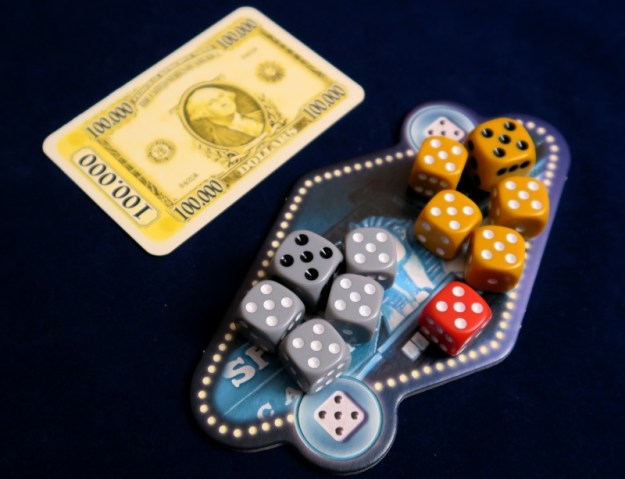
Fast Sloths
– Image by boardGOATS

Meanwhile, on the next table, Green and Ivory had settled on Wingspan, and were eventually joined by Purple and Blue.  Since it won the Kennerspiel des Jahres award last year, this has proved a very popular game within the group.  The copy belonged to Burgundy, and he had integrated the European Expansion and Swift-Start Cards, as well as “pimped his bits”; the artwork on the cards is beautiful and the additional pieces just add to the aesthetics.  The game is  functionally very simple, though playing well requires planning and just a little bit of luck.
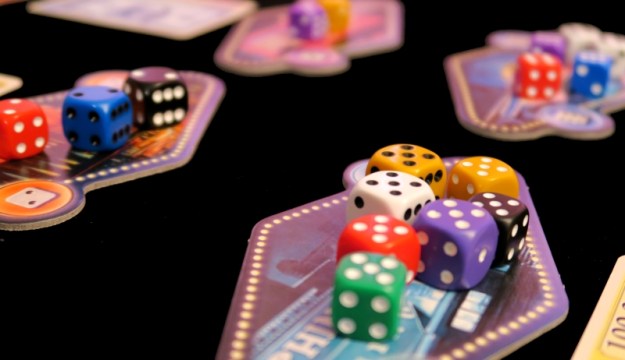
Wingspan
– Image by boardGOATS

On their turn, the active player can place an action cube to do one of two things:  pay food to play a bird card from their hand, or activate one of their three habitats and all the birds in it.  The three habitats, allow players to collect food, lay eggs or add more bird cards to their hand.  At the end of each round there are bonus points available for players who are most successful with the targets set out; at the end of the game players score points for each bird card they’ve played (value dependent on the bird), food and eggs on their cards, and flocking birds.   The difficult part is to efficiently build combinations of birds with synergistic special powers that will ultimately yield the best score.

Wingspan
– Image by boardGOATS

This time, Blue started by playing a White Wagtail in her Wetland, which gave the opportunity to place a bird card at the end of the round so long as she had activated all three habitats and placed a card during the round.  She still had to pay the food needed, so she concentrated on making sure she had all the bits required to make it work for her every round.  Ivory focused on first playing his Savi’s Warbler and then using it to acquire a lot of cards, many from the face-down draw pile, hoping to draw something good.  Green struggled a bit from the start, partly because he was arguably the player with the least experience, but the fact he was distracted by a bird of a different sort tweeting by phone certainly didn’t help.  Purple on the other hand, quietly concentrated solely on her game, and made excellent use of her Double-Crested Cormorant which allowed her to tuck two cards in exchange for one fish.

Wingspan
– Image by boardGOATS

As the game progressed, Green increasingly needed prompting to take his turn, and explained that he was getting side-tracked because Blue, playing immediately before him, was taking so long on her turn.  While it was true that Blue’s turns were getting longer, this was almost entirely because the number of birds in her reserve was increasing faster than anyone else’s, largely thanks to her White Wagtail which she was busy putting to good use.  The contrast was quite stark Green’s rather meager reserve and Blue’s, although by this time, both Ivory and Purple, also had a good sized reserves.  As the game entered the final round, Fast Sloths was coming to an end and those players wondered over, so the last few turns were played with an audience.

Wingspan
– Image by boardGOATS

At this point, the Wingspan players were putting the finishing touches to reserves.  Green kept commenting how he knew he was coming last and it was clear who had won, but Ivory was not so sure.  In the final accounting every bird in Purple’s reserve had a good point value adding to her points from the tucked birds and Ivory did best in the end of round goals.  Blue had the most birds giving her the same amount of points as Purple (though the individual cards were not as good) and she scored slightly fewer points that Ivory in the end of round goals.  In every other area, however, Blue led the pack giving her the lead overall with ninety-eight points.   Ivory was twenty points behind, and just pipped to second place by Purple.

Wingspan
– Image by boardGOATS

Mulberry, Pine and Ivory Ieft to get an early night, leaving everyone else to play something short;  the game that fitted the bill and was on the top of the pile was For Sale.  This is a very clever property auction game that we played for the first time in years at New Year. The game comes in two parts:  buying properties and then selling them.  So, each player starts the game with $14,000 to spend on property cards.  There are thirty properties, numbered to reflect their relative value and these are auctioned in groups equal in size to the number of players.  The clever part of the auction is that when a player passes and withdraws, they pay half the value of their final bid and take the property with the lowest value; the winner takes the most valuable property, but pays their final bid in full.

For Sale
– Image by boardGOATS

In the second part of the game, cheque cards equal in number to the number of players are laid out, with values from zero to $15,000.  Each player then chooses one property card from their supply and everyone reveals them simultaneously: the highest value property earns the highest value cheque with the second most valuable property earning its owner the second largest cheque and so on.  The winner is the player with the highest total from the sum of their cheques and any left-over cash.  This time, Black took the most valuable property, the space station and with it, on of the $15,000 cheques while Burgundy took the other.

For Sale
– Image by boardGOATS

At the other end of the scale, Pink took both the void cheques, but despite this still managed $33,000 for the rest of his properties.  This was nothing compared to the winner, Green, who finished with $53,000, $2,000 more than Burgundy in second.  The night was still young, however, and there was still time for one of our favourite games, 6 Nimmt!.  Although this is often derided as a game of chance, it is clear that it is not pure luck.  The idea is that everyone has a hand of cards from a deck numbered one to a hundred and four.  Simultaneously, everyone chooses a card from their hand, and, starting with the lowest value card, these are then added to one of the four rows of cards.

6 Nimmt!
– Image by boardGOATS

Each card is added to the row with the highest end card that is lower than the card they have played.  If the card is the sixth card, they take the five cards in the row and their card becomes the first card in the new row.  Each card has a number of bull’s heads on it—this is the number of points they score.  The player with the fewest points at the end of the game wins.  We play with a variant that half the cards are dealt out for the first hand and the rest for the second, which gives us a score at half-time.

6 Nimmt!
– Image by boardGOATS

This time Burgundy and Black were in the lead at the half-time with a single nimmt, with Blue a couple of points behind.  Pink set the competitive high score of thirty-one.  Black picked up a handful of cards in the second half, indeed, only Purple, Blue and Burgundy managed to keep their second half scores to single figures.  In the end, it was Blue who just had the edge, beating Burgundy by three nimmts.  At the other end, however, Pink had no competition finishing with a very respectable high score of forty-five, not a record, but a substantial total nonetheless, and a good end to a fun evening.

6 Nimmt!
– Image by boardGOATS

Learning Outcome:  Donkeys are not as versatile as you might think.

21st January 2020

Over the last three years we’ve spent a lot of Tuesday evenings discussing Brexit and following events in the House of Commons as they occured.  Since this was going to be the last games night with the UK in the EU, and as a predominantly pro-EU group, we wanted to mark the occasion and show our support for our European friends and all those who have campaigned against Brexit so valiantly.  For this reason, we decided to make the “Feature Game” “European Ticket to Ride“, in other words, European editions of one of our favourite games, i.e. the Italy, France, Germany, Poland, Netherlands and of course, Europe games/expansions.  Unfortunately, Blue (and therefore most of the maps) was late arriving, and then, nobody could decide what they wanted to play; the only one who expressed any strong opinion was Lime who wanted to play the France map.

Ticket to Ride Map Collection: Volume 6 – France & Old West
– Image by boardGOATS

With nine players, three groups of three looked good, but the debate as to who would play what rivaled the Brexit negotiations, not helped by the number of people who were enticed by the Japan map on the reverse of the Italy map.  In the end, Ivory and Green took themselves off to play the new Poland map, and, after a lot of discussion, Lime, the only one who had a strong opinion ended up forgoing his choice of France and joined the Poles to even up the numbers.  With Black, Purple and Pine starting on France, that just left Blue, Burgundy and Mulberry to decide, and eventually they decided to play the Italy map using the Germany base game components.

Ticket to Ride: Germany
– Image by boardGOATS

Ticket to Ride is a very well-known, well-loved game that has now become something of a “gateway game”, that is, a game that starts people unfamiliar with modern boardgames along the slippery slope.  The game is popular with casual gamers because it is simple to play, with few options and a little bit of luck, but not too much.  The game is played on a map with cities connected by train routes each made up of anything from one to nine spaces (depending on the map).  On their turn, the active player can do one of a small handful of things:  firstly, they can take train cards from the market or use the train cards to place plastic trains on the map and score points.  To place trains on the map, players spend coloured cards to match the route they are claiming.  As well as coloured train cards, there are also multi-coloured locomotive cards which are wild; a face up Locomotive can only be drawn as the first card and ends the turn, making them more expensive as well as useful.

Ticket to Ride: Germany
– Image by boardGOATS

Most cities have only a single route between them, but some are double or even triple, though these can only be used with higher player counts.  Instead of taking train cards or placing trains on the map, players can also draw tickets.  These are a sort of personal objective that give players points for connecting two cities—the further apart, the more points the ticket is worth, but the larger the risk, as failure gives negative points.  Players start the game with a handful of these and can choose which ones to keep.  They can also draw more during the game, keeping some and discarding others, but the specific conditions depend on the map used.

Ticket to Ride Map Collection: Volume 7 – Japan & Italy
– Image by boardGOATS

This is the basics of the original 2004, Spiel des Jahres winning game, with a USA map, Ticket to Ride, but each variant provides a different map and some slight modifications to the rules.  For example, Ticket to Ride: Europe adds Ferry routes which require a certain number of locomotive cards to be played in addition to the coloured train cards. It also adds Stations, which can used to help players complete tickets where a route has been blocked.  For some different maps players get different numbers of trains, Poland is one of the smaller maps, with only thirty-five trains, compared with the forty-five in the Europe and US versions or the three German editions (Germany, Deutschland and Märklin).

Wsiąść do Pociągu: Polska
– Image by boardGOATS

The other thing that makes the Poland expansion map stand out (aside from the fact that it is Map Collection Volume “6½” and goes by the name of “Wsiąść do Pociągu: Polska”) is that routes that connect to the countries bordering Poland give points directly.  Unusually, the routes that cross the border include some triple routes and even a quadruple route, all of which can be used regardless of the number of players.  Each country then also has a small deck of three or four cards, each card giving a different number of points.  The first player to connect to two countries through Poland takes the cards with the highest value, the next takes the next most lucrative and so on.  Adding more countries to a player’s network adds more cards and more points for that player.

Wsiąść do Pociągu: Polska
– Image by boardGOATS

Green was particularly keen to play the Polish expansion because of the “Czech connection”, and Ivory also wanted to try it as it was a new map for him; Lime went along to make up the numbers.  They were quick to get going and started off laying out routes without interfering with each other very much at all.  Ivory was first to link two countries (Czechia and Slovakia), which was annoying to Green as he joined the the same countries on the very next turn.  However, Green got his own back by getting in Ivory’s way and linking Germany into his network first.  Lime was late to join the country network party, but concentrated on the Poland’s eastern borders. Ivory and Lime started taking new tickets about midway through the game, but Green instead continued to concentrate on linking more countries into his network.

Wsiąść do Pociągu: Polska
– Image by boardGOATS

It was only in the last couple of turns that Green finally turned to tickets when it looked difficult to add any more countries to his already substantial, four country network.  While Ivory and Green had been fighting over routes, Lime had quietly travelled the entire width of Poland and also linked several countries into his network, rivalling Green.  In the final scoring it was Lime who had charged ahead, scoring well with tickets and country cards, finishing with ninety-six points—deserved since he gave up his preferred choice of the France map.  It was very close for second though, with Green just three points ahead of Ivory with seventy-nine.  Meanwhile, on the next table, Black, Purple and Pine were setting up the game Lime had missed; a much longer game, that had barely started as the Poles were finishing.

Ticket to Ride Map Collection: Volume 6 – France & Old West
– Image by boardGOATS

France is one of the more complex expansions as the map mostly only depicts the track-bed, and players choose what colour a line will be.  So, every time a player takes carriage cards, they also take a coloured tile of their choice and place it somewhere on the board.  Thereafter, any player can claim that route by spending the appropriately coloured cards and placing the correct number of train pieces.  Some of these track-beds overlap, but once a tile has placed any track-beds under it are no-longer available.

Ticket to Ride Map Collection: Volume 6 – France & Old West
– Image by boardGOATS

At the start, nobody really knew how to play with the track-bed tiles: placing them somewhere near one’s own route telegraphed probable plans, potentially giving others an opportunity to obstruct.  On the other hand, progress could not be made at all until tiles had been placed.  The map is very, very large so to begin with everyone could get on with their own thing.  Purple monopolised the Loire, Auvergne and Burgundy regions while Pine occupied the north coast and eastern borders.  Pine had competition from Black in the Normandy, Picardy and Champagne regions, but other than that, Black took himself off to the west and south and everyone got on with their own thing.

Ticket to Ride Map Collection: Volume 6 – France & Old West
– Image by boardGOATS

Ultimately, the game was very lopsided.  Pine kept drawing tickets and kept getting lucky; he repeatedly got tickets along similar routes so needed minimal addition to his already substantial network.  As a result, he not only took the longest route bonus, but also the Globetrotter points for the player with the most successful tickets, with eight.  Had Black been successful with all his, things would have been closer, but failing two meant it was a tie for second place with both Black and Purple finishing with eighty, exactly half Pine’s massive victory.

Ticket to Ride Map Collection: Volume 6 – France & Old West
– Image by boardGOATS

Meanwhile, further down the table Burgundy eschewed Netherlands, so the group went instead for Italy, played with the Germany base game, in which the pieces have an unusual colour set.  This gave Blue a slight quandary as to which she should play with, as blue wasn’t available.  Instead Blue opted for purple, only for Purple on the next table to offer to swap pieces as she had chosen blue because purple wasn’t available.  Sadly there was already enough confusion of pieces with Pine, Black and Purple playing with Burgundy’s base game and Blue’s France expansion so swapping pieces just seemed likely to make the chances of all the bits going back into the right boxes that bit smaller.  So in the end, both suffered with the “wrong colour”.

Ticket to Ride Map Collection: Volume 7 – Japan & Italy
– Image by boardGOATS

The Italy map is a more conventional expansion than France, with the only significant differences being a tweak to the Ferry rules and a new bonus scoring opportunity.  Instead of needing Locomotive cards, these Ferry routes include some carriages with a round wave-icon on them.  These can be satisfied either using special Ferry cards, or Locomotive cards.  The special Ferry cards are in a separate deck and one of these can be taken instead of drawing train cards, up to a limit of two at any one time.  Each of these special Ferry cards then count as two “wave” cards.  This makes them better value than Locomotive cards drawn face up from the market, but less versatile.

Ticket to Ride Map Collection: Volume 7 – Japan & Italy
– Image by boardGOATS

The bonus is potentially extremely lucrative, giving points for having a network that connects different regions of Italy.  This starts with one point for five connected regions and increments according to the “Lazy Caterer’s Sequence” to give a massive fifty-six points for a network connecting fifteen or more regions.  The layout of the map itself has a lot in common with the Nordic map in that it is quite long and thin with what feel like a lot of north/south routes running the length of the country, in the middle of the board and a lot of short, east/west routes available in the north and the south.

Ticket to Ride Map Collection: Volume 7 – Japan & Italy
– Image by boardGOATS

Blue kept all her starting tickets and Burgundy jettisoned just the one, but in contrast, Mulberry kept the minimum she could.  As a result, it wasn’t long before Mulberry was picking up more tickets, and then more and then even more, much to Burgundy’s and Blue’s horror.  When questioned, Mulberry said, “Just Nickels and Dimes, Nickels and Dimes…”  This didn’t calm Burgundy and Blue in the slightest, as they were still struggling to complete their starting tickets.  Eventually though, they also took more tickets, with Burgundy keeping a lot of his, while Blue was less fortunate.  Burgundy supplemented his tickets with a couple of very long Ferry routes netting him eighteen points each.

Ticket to Ride Map Collection: Volume 7 – Japan & Italy
– Image by boardGOATS

As the game came to an end, Blue was still struggling to get the yellow carriage cards she needed to complete her final ticket.  So when Burgundy brutally ended the game it cost Blue some forty points, though in truth she was a couple of turns away from getting them even if she had somehow managed to get that one final yellow card.  It was clear that unless Burgundy had a lot of incomplete tickets, he would probably be able to defend his already substantial lead.  Mulberry’s tickets may have been “Nickels and Dimes”, but she had an awful lot of them; as the phrase goes, “Take care of the pennies and the pounds take care of themselves.”  With just regional bonus to add, Burgundy was out of sight and although Blue and Mulberry made a dent in the gap it wasn’t enough.  It was close for second place though, but in the end a couple of extra regions gave it to Blue.

Ticket to Ride Map Collection: Volume 7 – Japan & Italy
– Image by boardGOATS

The Poland game was finished first and with France only just started and Italy only halfway through the Poles toyed with the idea of trying another European Ticket to Ride Map, but instead opted for a quick game of the 2017 Spiel des Jares Winner Kingdomino.  This is a light little game with a very clever market mechanic.  The idea is that players take it in turns to take a tile from the market and add it to their kingdom.  Each tile comprises two “squares” (like a domino), each showing a terrain.  At the end of the game, players score points for each area of terrain in their kingdom gaining points equal to the number of “squares” multiplied by the number of crowns in that region.

Kingdomino
– Image by boardGOATS

The clever part of the game is the market which consists of two columns of tiles, each tile having a rank reflecting their value based on scarcity of the terrain(s) it depicts and the number of crowns.  The tiles in each row are placed, and taken, in descending order.  When a player takes their tile from the current column, they choose which tile they want from the next column, thus a player taking a less valuable tile gets a wider choice on the next round.  Unfortunately, as each column has to have the same number of tiles as players, the game can be a bit unbalanced with three, because some of the tiles are removed at random.

Kingdomino
– Image by boardGOATS

As well as scoring for terrain, players also score bonus points for placing all their tiles in a five-by-five array with their castle in the centre.  This time, Ivory managed a full kingdom with his castle in the centre, and a large wheat field with a healthy number of crowns. His score was also assisted by a not inconsiderable lake (although with only a couple of crowns) and a small but valuable mountain.  Lime, fresh from his stunning Polska victory, realised too late that his castle was not central in his kingdom and his last couple of tiles were unplaceable.  Green managed a complete kingdom with his castle in the middle, though his was made up largely of forest.  Pasture, wheat and sand also featured and gave what was a winning score of sixty-three, some ten points ahead of Ivory in second.

Kingdomino
– Image by boardGOATS

With the Italian map players just finishing, the group decided to join them and see what else was on offer. There were three options: For Sale (best with it’s a maximum of six), Century: Spice Road (plays a maximum of five) and World’s Fair 1893 (maximum of four).  Mulberry decided to get an early night, leaving five players and Century: Spice Road.  This is a resource management game with deck building at it’s core.  Neither Lime nor Green had played it before so there was a quick run down of the rules first.  These are simple enough though.  The central area consists of two markets: one for action cards and one for contracts.

Century: Spice Road
– Image by boardGOATS

On their turn, the active player can take an action card from the market, if they take the card at the end of the row (the one that has been there longest), it is free, otherwise they have to pay resources dependent on the card’s position.  This card goes into the player’s hand where, on a later turn, they can use it to get spices, upgrade spices or convert spices into other spices.  When used, a card is placed on the player’s personal discard pile, and they can also spend a turn picking up all their discarded cards.  The spices, turmeric, saffron, cardamom and cinnamon are then used to fulfill contracts, giving points.

Century: Spice Road
– Image by boardGOATS

The contract cards that have been around for longest get a bonus, in this case a coin is worth one or three points at the end of the game.  The challenge, or at least part of the challenge is storing the spices: each player has a caravan card which will hold a maximum of ten spice cubes, so converting cubes into other cubes and buying contracts has to be done efficiently otherwise spices are wasted.  The game end is triggered when one player has five contract cards.  There are a couple of minor details, like the number of cards in the markets and the values of the coins, but Burgundy clearly knew these without needing to check the rules.

Century: Spice Road
– Image by boardGOATS

The engine-building nature of this game has a lot in common with Splendor and as Burgundy is invincible at that the writing was on the wall before the group even started.  It was no surprise therefore that when Ivory picked up the first contract, Burgundy was immediately behind him.  Green, new to the game, wasn’t far behind either.  Blue had a complete nightmare, but Lime, after a slow start suddenly seemed to get the hang of it and then made rapid progress.  It wasn’t long before Ivory took his final card though.  Taking the maximum number of cards is always key, and when he said he had sixty-seven points it looked like he might have been successful, however, Burgundy, managed to take one last card in that final round as he was the last to play, and ultimately, he managed to take first place by just three points.

Century: Spice Road
– Image by boardGOATS

Learning Outcome:  Europe has a very extensive (and exciting) rail network.

7th January 2020

Almost everyone was late arriving and many wanted to eat, so we decided to play something quick to get people going while we waited for food to come.  In the top of the bag was …Aber Bitte mit Sahne (a.k.a Piece o’ Cake), and as there were a lot of hungry people, it seemed appropriate somehow.  “Sahne” is a very simple little “I divide, you choose” game where players are collecting pieces of cake.  On their turn, the active player, or Baker, begins by turning over one of the five piles of cake slices in the order they appear in.  They then divide the cake into segments, each containing one or more slices. The player to their left then chooses one of the segments, either “eating”, or “saving” each of the slices they take.

…Aber Bitte Mit Sahne
– Image by boardGOATS

At the end of the game, if a player has saved the most of a given type of cake, they score the number of points shown on the slices of that type; they also score one point for each blob of cream they have eaten.  The clever part is balancing the possibility of scoring a lots of points later with banking the blobs of cream now.  The cake types that score the most highly are those that have the most slices available, but they also have the most cream.  The player with the most points after the five rounds wins.  Burgundy started the first round, and, as there were four players, he also started the last round, arguably giving Blue a slight advantage since it meant that she was able to choose first twice. Blue began by collecting chocolate cake, because, well, it’s chocolate cake, (obviously), while Green and Pine began a bit of a tussle for “pea pie” (probably gooseberry tart really).

…Aber Bitte Mit Sahne
– Image by boardGOATS

One of the key parts of this game is that ties are friendly, in other words, if there is a tie, everyone gets the points.  This generally has the effect of making players work to get just enough pieces of cake to join the group of players that will score points rather working that bit harder to than get more pieces than everyone else and be the only one to score.  Thus, many people often score points for the same type of cake.  This was instrumental in making it a tight game this time, as there were several ties. In the end, the fact Green wasted none of his slices, winning points for everything he kept and eating the rest, meant he beat Blue by just one point with Pine not far behind in third place.  Towards the end of “Sahne” Ivory arrived and commented on the differences between it and it’s reimplementation, New York Slice, where cream is replaced with pepperoni and anchovies are added to give negative points – one to play another time perhaps.

…Aber Bitte Mit Sahne
– Image by boardGOATS

Once everyone had finished feasting (both in the game and in real life), we started looking at what people might play.  First up was the “Feature Game”, Suburbia in it’s rather epically large, and very fancy new “Collector’s Edition”. This is a tile-laying game, where each player tries to build their own town providing an economic engine and infrastructure that starts off as self-sufficient and hopefully becomes profitable and encourages growth.  Each player has two tracks:  Income and Reputation, the facilities that a player builds affect these, so as the income of their town increases there is more money to spend on purchasing better and more valuable buildings.  These, in turn, can increase the reputation of the town which will increase the population.  The winner is the town with the largest population.  While one might think this means going for the highest possible reputation would be the way to victory, the scoring track contains several expansion checks that immediately reduce a player’s income and reputation.

Suburbia
– Image by boardGOATS

The frequency of these scoring checks increases as scores increase, which could be disastrous for a player who allows rampant population growth to get out of control.  Although only Ivory had played the game before, the group decided to include one of the expansion sets, Nightlife.  Setup did not take as long as it looked, with the box inserts from the new edition making the job much quicker and easier.  The three communal objectives were: Most houses, Highest Income, and Most Municipal Buildings.  Each player also had their own private objectives with Green going for Nightlife, Ivory for Factories and Burgundy for Offices.  In the first round, even though the developments were as yet tiny villages, both Green and Ivory built Helipads.  With the owners of each helipad receiving $5 for every Helipad currently in the game (including the ones just taken), the power of the game became immediately obvious.

Suburbia
– Image by boardGOATS

In most games, players receives bonuses based on the situation when a card or token is taken.  In Suburbia, any benefits act through past, present and future, so tiles can keep on giving throughout the game.  Burgundy used this effect to gain $1 every time anyone built an Office. Green managed to build up a bonus of $3 for every House built in the game. This type of Income really helped, as Green didn’t need to worry too much about his base Income level and could concentrate on building up the Night tiles and Houses that he needed to fulfill his personal goals.  Ivory and Burgundy both decided to chase the Income bonus and ended up fighting for the Income producing tiles pushing each other up to ever higher values.  Obviously that Income helped them buy tiles, but they were largely in competition with each other and thus allowed Green to build a commanding lead in Accommodation and Nightlife.
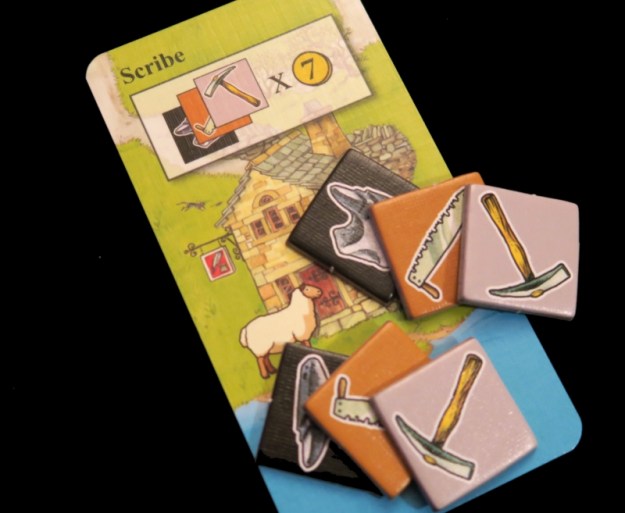
Suburbia
– Image by boardGOATS

Another unique aspect of Suburbia, are the expansion checks that prevent a run-away winner. For every few population points gained, the player’s Income and Reputation markers are pushed back by one point each.  Since Burgundy and Ivory were competing for the income bonuses, there was the highly unusual (and amusing for anyone who was not Burgundy or Ivory) situation in the final couple of rounds where they were trying to avoid scoring too many “points” resulting in reducing their income and potentially losing the fifteen points the end-game objective would.  Ivory in particular was racking his brains over the best way to do this and spent so much thought on it that he failed to spot that he was only one Municipal building ahead of Green who’s turn was next (and had a pile of cash even though his Income was minus three!).

Suburbia
– Image by boardGOATS

Thus, for his final turn Green (knowing he had already won the Houses and Nightlife bonuses) bought the one remaining Municipal building on the track, robbing Ivory (no friendly ties in this game, to get a bonus you have to have most).  In the final scoring, Green’s green and pleasant city, with only Houses, Schools, Nightlife and a large Park (aside from his one starting Factory) was much more popular with the residents than Ivory’s Factory filled city or Burgundy’s green Office city.  Overall the group had enjoyed the game, which had perhaps more than the usual amount of interaction for a personal area building game.  Although there weren’t really any new mechanics, it was well implemented and everyone would be very happy to play it again.

Suburbia
– Image by boardGOATS

Meanwhile, Pine, Lime and Blue opted for the slightly lighter game, Istanbul. This is an old favourite that won the Kennerspiel des Jahres in 2014, but thanks to the new fare hasn’t been played in the group for some time. The game is played on a modular board with players making paths between different locations. The aim of the game is to be the first player to get five red Rubies, but there are a number of ways to get these.  For example, they can be bought from the Gemstone Dealer, but this costs money (and every time someone buys a Ruby, the cost increases too).  Money can be obtained by trading goods obtained from the three warehouses at one of the two markets.

Istanbul
– Image by boardGOATS

Each player starts with a small barrow, with space for four different goods and the Rubies. Three of the goods (Spices, Cloth and Fruit) can be gained from the associated warehouse, with a visit allowing players to fill their barrow to its maximum. A small barrow will only hold a maximum of two of each though, so visiting the wheelwright to buy an extension or two makes these visits more efficient, but barrow extensions also cost money… So planning the order of visits to these different places, and this is the clever part of the game.
Istanbul
– Image by boardGOATS

Each player is in charge of a stack of wooden disks representing a Merchant and his Assistants. The idea is that on their turn, the Merchant visits one of the different locations by travelling orthogonal a maximum of two spaces. At each location, he can negotiate a deal and leaves one of his Assistants to complete it. After several turns, the player runs out of Assistants so they can continue to move their Merchant without making deals returning to the Fountain to call their Assistants so they can start again, possibly using a couple of turns to do so.  Alternatively, the Merchant can move up to two spaces and return to one of the locations where they left an Assistant and carry out another deal at that location, taking the Assistant with them.
Istanbul
– Image by boardGOATS

Thus, the game is similar to Yokohama in that it is all about planning an efficient route, in this case, dropping off Assistants at useful locations and then, ideally, travelling the route again reusing them and picking them up.  There are other factors to consider too however. Encountering another Merchant will cost money, for example.  On the other hand, meeting the Smuggler or the Governor provide opportunities to get resources, including the rare Jewels (valuable, but distinct from Rubies), or bonus cards that can be kept and played to give an advantage later in the game.

Istanbul
– Image by boardGOATS

This time, the group used the big numbers on the location tiles to dictate their layout. Then, after a rules run-down, Blue started, moving her Merchant from the Fountain to the Post Office.  Visits here provide a couple resources and some cash, which she planned to sell, using the profits to extend her barrow.  Lime started out visiting the Tea House (via the Caravansary) to get cash, while Pine went to the Black Market to get money and Jewellery.  Blue was first to get a Ruby, but Pine and Lime weren’t far behind, and it was even closer by the time they were claiming their second Rubies. Lime, every inch the accountant was accruing vast amounts of cash, and somehow seemed to be collecting gems too, without the pile seeming to diminish significantly.

Istanbul
– Image by boardGOATS

As the game approached the end, Lime went on a spending spree, at the end of which Pine scuppered Lime’s plans. He took a Ruby from the Gemstone Dealer, increasing the price for Lime in the process, making things worse by the fact that he was squatting putting the cost just out of Lime’s reach. In the end though, Blue made a mistake leaving the door open for Pine to have another visit, and claim his final Ruby, with it the game.  With that, Pine left for an early night, convinced that Suburbia which was “just finishing” would be at least another half an hour. Blue and Lime, waited and set up For Sale, but it turned out Pine was right, and by the time the other group finished there wasn’t time to play.  So, after a bit of chit-chat, everyone went home.

For Sale
– Image by boardGOATS

Learning Outcome: Green and pleasant towns are nicer places to live.