Category Archives: Games Night

3rd December 2013

Since we knew people were arriving late, we started nice and early to get a quick two-player game in first.  The game we settled on was a cute little game picked up from Essen a couple of months ago, called 1911 Amundsen vs Scott.  This is an asymmetric card game where players are engaged on a polar expedition, and as in 1911, the players take different routes and use different tools (Roald Amundsen famously used dog sleds and beat Robert Falcon Scott’s team who used horses by just a few weeks).  On their turn, players collect cards or play cards.  The cards played can be used to get closer to the pole, or can be special cards to either assist the mission or obstruct the opposition.  Scott had played the game a few times before, whereas Amundsen was new to it.  The Scott’s starting hand included the “equipment loss” card which is quite powerful as it reduces the opponents hand limit from seven to five.  Since Amundsen hadn’t played it before, Scott decided to let Amundsen find his feet before playing it.  This turned out to be a tactical error as the game mirrored 1911 and Amundsen arrived just ahead of Scott who reached the South Pole only to find Amundsen’s Norwegian flag already planted in the frozen ground.

1911 Amundsen vs Scott

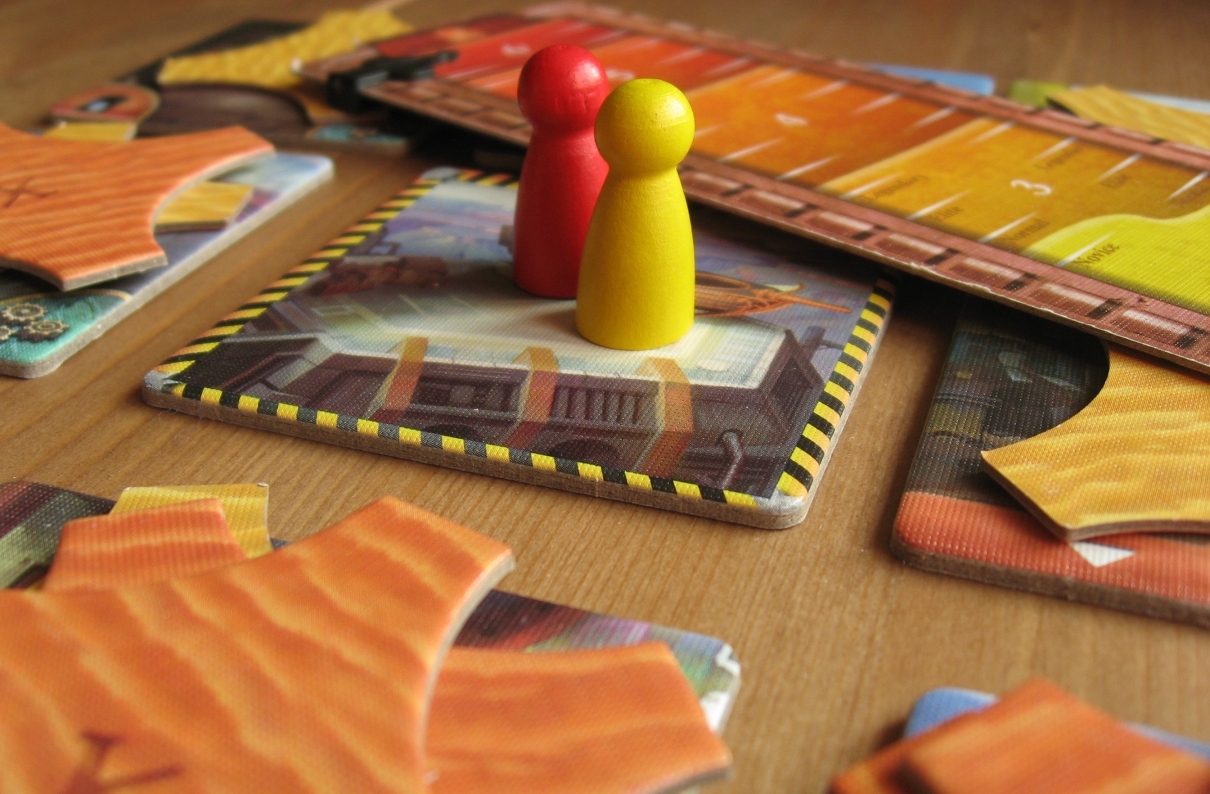
Next up was the “Feature Game”, Tzolk’in:  The Mayan Calendar.  This is a complex, but beautiful worker placement game where players represent different tribes during two Mayan “ages”.  On their turn, players must either place workers or pick up workers. When placing workers, players can place as many workers as they like (as long as they can afford it), and must put them onto the gears in the lowest available spaces on any of the five outer gears.  At the end of the round, the central gear rotates, turning each of the outer wheels moving the workers up the next level.  On the next turn, players may chose to place more workers, or might take some or all of the current workers off the gears – the catch is that a “null move” is not allowed, so timing is everything and it is very easy to get things slightly wrong.  This is made worse by the fact that everyone must have three corn at the start of the round and half way through and at the end of each age, there is a “food day”.  The currency of the game is corn and if you don’t have enough to support your workers you Anger the Gods and the penalties for that can be quite dire.

Tzolk'in:  The Mayan Calendar

Since we had one person who had not played it before and it was a while since the rest of us had played it, we spend a fair amount of time going through the rules.  Then we dealt out the starting tiles for players to chose their starting conditions.  Green chose the crystal skull, Blue decided to start with some technology, Yellow began with some corn and Red started with a small farm providing enough to keep one of her people fed for the rest of the game.  Green started out placing his skull on the Chichen Itza wheel (or chicken pizza as we call it) as he felt it would give him a guaranteed thirteen points.  Blue went first and started out by getting an extra worker and then very slowly began to build her corn harvesting ability, angering the Gods when she didn’t have enough corn at the start of a round.  Meanwhile, Red ensured that her people would be fed by building lots of farms, and Yellow quietly collected resources.

Tzolk'in:  The Mayan Calendar

Green confused everyone by placing only the one crystal skull and then going all out to climb the temple steps.  However, it wasn’t until late in the game that everyone else realised this and although Blue capitalised by catching a lot of the remaining spaces, by this time the damage had already been done.  Yellow made a surge as the only player to successfully build a monument, but it was not enough to catch Blue, or indeed Green who made it two wins out of two for the evening.

Tzolk'in:  The Mayan Calendar

Learning Outcome:  Sometimes its necessary to keep a close eye on the beginner to stop them from winning!

19th November 2013

Since we arrived in “dribs and drabs” and one player had to leave early, we started out playing a couple of quick little games.  First up was Pick Picknic.  This is a cute little game where players simultaneously play coloured chicken cards.  If someone plays the only chicken card of a given colour, they get all the grain at that coloured farm.  If multiple players go for the same coloured farm, then players can either agree to share the corn in any way that is mutually agreeable or roll for all of it.  They must beware the foxes though – foxes don’t eat corn, they only eat chickens; if someone plays a fox card, they will eat any chicken cards of that colour.  The first game was a bit of a white-wash, in contrast, however, the second game was a draw.

Pick Picknic

Next up was a game with a similar box and name, but other wise completely different: Pickomino.  This is a strange little dice rolling game with appealing “worm tiles”.  On a their turn, players roll eight dice.  They must keep all the dice of one “type”, i.e. all those with a one, or all those with a two etc., however, they must not have any of that number or type already.  Then they can, if they choose, re-roll the remaining dice and do the same again.  When they decide to “stick”, they can take any “worm tile” available in the pool with a value equal to or less than the total shown on their dice, and place it on the top of their pile.  When the number rolled exactly matches the topmost tile on someone elses pile, then the player may steal that tile if they choose.  The person with the most worms at the end wins.

Pickomino

Unfortunately, since the rules were in French and the English translation was not entirely clear, we didn’t play this quite right, so we’ll have to give it another go sometime. Since new players had arrived and one had to leave, we moved on to something a little deeper in Montego Bay.  This is an unusual little game about loading barrels into boats.

Montego Bay

To do this, each player has two workers, a large one and a smaller one, and a set of 5 cards for each worker which are used to move them.  Simultaneously, all players secretly choose one of the numbered cards from each of their card sets, then the workers are moved one at a time along the path around the outside of the warehouse, according to a prearranged (otherwise random) order.  Thus, when it is a workers turn to to move, the appropriate card is revealed and the worker moved accordingly.  The clever part is what happens if the space is already occupied, as the original worker is pushed to the opposite side of the warehouse.  In some cases, the position opposite side of the warehouse is also already occupied in which case both spaces are blocked and the active worker simply moves as far as he can.  When all workers have moved, the warehouses are checked if there is a worker next to a chamber. If a worker is next to a chamber with barrels, players receive drums in their colour equal to the number of barrels in the room. These drums are placed in one or more of the ships in the harbour; players may decide freely, but when a ship is full, it sails away immediately and players score points depending on who has the most barrels on the ship.  In contrast, if the chamber has broken barrels in it, drums must be removed from ships.  Thus, players are trying to make sure their workers are optimally placed, but since their pieces can be influenced by other players, everyone is trying to anticipate what each other will do.  Because of all the “double think”, the game is very prone to “analysis paralysis”, however, it wasn’t too bad and only really became noticeable in the last rounds of the game when it was all quite tight and moves were critical to the final score.  Green took the honours in the end, a couple of points clear of Blue, but everyone expressed an interest in playing it again sometime.


Montego Bay

Lastly, was the “Feature Game”, Coup.  This is a very quick little card game of bluffing and back-stabbing.  The idea is that each player starts with two cards representing the people they influence.  On their turn they can take a small amount of money or declare who one of their people is and do a more exciting action associated with that character.  The catch is that since the cards are hidden, players only know who they have influence over themselves – everyone else is secret.  Other players then have a choice, one of them can challenge the active player, or one of them can declare they are a character that can block the action (this declaration can also be challenged), or they can do nothing.  When a player is challenged, they must display one card:  if it demonstrates that they were telling the truth then they draw a replacement card, if it indicates they were lying then they lose a card.  The aim is to be the last player with influence (i.e. a hidden card).  The key to the game is to play as a team against the leader to prevent them from building up enough money to carry out a coup (which there is no real protection from), but to play independently when it is your own turn.  Unfortunately, we didn’t really get the team aspect of the game and, because we didn’t play very many hands, players didn’t really have time to work out that if a player tells the truth, that is a powerful tool to be used against them.  For this reason, it seemed more a game of chance (because if you tell the truth you are safe from challenges), than a game of skill.

Coup

Learning Outcome:  Sometimes short games are best played repeatedly so that they take as long as “big” games which gives time to play the meta-game.

5th November 2013

We were relocated once again, so we had six people for the second week running.  Since we are still meeting in private houses, splitting into two games of three was not really an option due to restricted table space, and this limited what we could play somewhat.  For this reason, we started out with one of our old favourites that we’ve played before, Bohnanza.  This is a fairly simple trading game, where players exchange and plant beans to maximise their harvest.  The game was very tight, ending with joint winners on twelve and third and fourth places on eleven and ten respectively.

Bohnanza

Our youngest player left, leaving us with five players for our Feature Game, Hanabi.  “Hanabi” is the Japanese word for “fireworks” (consisting of the ideograms “Flower” and “Fire”) and given the date we felt it was entirely appropriate.  Last time we played, we used the original card version of the game, however, this time we used the new tile version that was released at Essen a couple of weeks ago.   The idea of the game is very simple:  as a group, players must try to lay a total of twenty-five tiles, in number order within their colour suits, thus the red “one”, must be played before the red “two”, and so on.  The snag is that everyone turns their hand back to front so they can see everyone elses tiles, but not their own.  So, on their turn, players can do one of three things:  play a card, give a clue to another player or discard a tile.  If the wrong tile is played, the team lose one of their three lives and there are only eight clues available; although each discarded tile is also worth an extra clue some tiles don’t have any duplicates…

Hanabi

We enjoyed the first game so much that we ended up playing it twice.  The first time a lot of “ones” came out on the first deal, so we had to decide how to guide people to play the correct tiles.  We finished up with three completed fireworks and a total of twenty points.  Any hope that we could improve on our score quickly evaporated when the second game started with no “ones” at all and it took us ages to get started by which time we had run out of clues.  One player was left with the choice of playing or discarding and chose the wrong option and that really set the tone for the rest of the game.  All things considered, it was a bit of a miracle that we finished two fireworks successfully and the game ended with a total of eighteen – not quite as bad as it had looked earlier.

Hanabi

Learning Outcome:  Sometimes “feelings” can be very misleading and you can be doing much better (or worse) than you thought.

22nd October 2013

We were back to our usual location for our first meeting on the alternate week.  This meant we had an extra person, but in addition, we one of our more distant members coming down on his way to Essen.  He was held up in traffic, so we started out with a quick game of Eight-Minute Empire.  This is a quick little area control game, though in truth, eight minutes is only possible if everyone really knows what they are doing and nobody suffers from “Analysis Paralysis”.

Eight-Minute Empire

Each player has a limited number of coins, three wooden city pieces and a handful of army cubes.  The idea is that players start by picking up a card:  they can choose whether to take the first available card which has no cost, or take another and pay the appropriate number of coins.  Each card is a resource which provide points at the end of the game, the number depending on how many of that resource the player has;  each card also has an action associated with it, which can be place armies on the map, move them about, ship them across the sea, build a city etc.  Players score points for having the majority in a countries and controlling the most countries in each continent, as well as for sets of resources.  The game was a clear victory for Red who finished three points clear of Blue in second place.

Eight-Minute Empire

As we finished, our long distance traveller walked through the door and without missing a beat sat down to join in the Feature GameTsuro.  This is a path laying game that is similar, though strangely opposite to Indigo, which we played a few weeks ago.   Both games are beautiful with a simple mechanism:  players play tiles and any stones that are on paths that are extended by the tile are moved to the end of the path, however, that is where the similarity ends.  In Indigo, you have hexagonal tiles and only draw one at a time, however, in Tsuro, the tiles are square and you have a hand of three for as long as there are enough tiles available.  More importantly though, in Indigo, the object of the game is to navigate stones to your gate and collect them whereas in Tsuro each player has one stone must try to keep it on the board and be the “last man standing”.  We enjoyed the first game so much that we played it again with the winner of the first game coming joint last in the second, and Blue, who came fifth in the first game winning the second, meanwhile one person managed to remain the bridesmaid in both, coming second twice!

Tsuro

The last game was one we have played several times and were mostly very familiar with, Alhambra.  In this game, players can either collect money or buy tiles, however, while they can always overspend, if they pay the exact money, they get an extra turn.  The snag is that there are only so many of each type of tile and the player with the most of each type scores the most points.  The other challenge is placing tiles:  they must form an area unbroken by walls, on the other hand, the longest continuous wall scores lots of points. Playing with so many people really seemed to disrupt some of our plans and the end result was a run-away victory for White who was thirty-six points clear of Blue and Orange who were joint second (with sixty-seven).

Alhambra

Learning Outcome:  Sometimes if you win spectacularly on the first play you can lose the next just as dramatically.

15th October 2013

We had a change of location for the evening which meant that one of our younger members could join us for the first couple of games of the evening.  So, while we were waiting for people to arrive, we had a couple of quick “warm-up” games of Dobble.  Clearly most of us needed quite a lot of warming up as we seemed to spend a huge amount of time staring blankly at cards, leaving the door open for bit of a white-wash.

Dobble

The next game was our Feature Game, Zooloretto. This is a cute little game based on the same set collecting mechanic as the card game, Coloretto (which we’ve played a few times before).  The idea is that on their turn, players draw an animal tile from a bag and place it on a truck.  There are the same number of trucks as there are players, and each truck will hold a maximum of three tiles.  When a player sees a truck they like, instead of drawing a tile, they can take that truck and add the animals on it to their zoo.  The snag is, only one sort of animal can go in each pen (to prevent a massacre apparently) and each zoo only has three pens, but there are a lot of different animal types!  Any animals that don’t have a pen, have to go into storage in the barn.  Instead of drawing tiles and adding them to a truck, you can also pay money to expand your zoo, or to move animals about or even buy one off another player.  Players score points for full, or very nearly full pens, and negative points for each different animal type in they have in the barn at the end of the game.  So, the trick is to set up a nice full truck with animals on it that only you want an hope nobody else pinches it.  Apart from Blue who finished a long way behind the rest, the game was really quite close, second, third and fourth finished within a point and the winner was only a few points clear.

Zooloretto

We were all quite tired so we decided to go for just one more, familiar game and an early night, so we picked Ticket to Ride.  We’d all played this many times before so we only needed a quick clarification of the specific rules for the Europe version (Only one face up loco? – Yes; Locos can be used anywhere? – Yes!  And don’t forget about stations and tunnels…) and then we were off collecting train cards.  Black was the first person to claim a route and went for the six-card line from Palermo to Smyrna.  Unfortunately, since it was a ferry it needed two locomotive cards so Black had to think again and picked up the train card he needed instead.  Out of fairness, since we hadn’t mentioned ferries in the summary, instead of claiming the route, Green gave Black another chance (which he took).  The rest of us were less sympathetic however and over the next couple of turns, the area around Italy, Greece and the Balkans filled up rapidly and Green, struggled valiantly, but ultimately unsuccessfully to make the connections he needed and ended up resorting to using stations.

Ticket to Ride:  Europe

Meanwhile, Red was trying to get from Erzurum to Købenavn and Blue was trying to get from Edinburgh to Athena via Berlin.  Blue was the first to pick up more tickets, quickly followed by Green and eventually red, however, Black kept on claiming routes and before long was well in the lead with only two trains remaining.  Everyone scrabbled to get as many points as they could from the cards they had in their hand before the final recount and scoring of tickets.  Green (who won Zooloretto) came off worst as not only had he been forced to use stations, he also struggled to complete some of his tickets and was left ruing his kindness early in the game.  Black and Blue tied for the European express bonus given for the longest continuous set of trains and the difference between them came down to tickets which gave Blue the win with 122 points (and made up for her terrible game of Zooloretto!).

Ticket to Ride:  Europe

Learning Outcome:  You can lose spectacularly at one game then win at the next, or vice versa.

1st October 2013

As our first birthday is on October 2nd, we decided to make the evening a little bit of a celebration of the year.  The first game we played was our “Feature Game”, which this week was the most popular game that hasn’t been a “Feature Game” and that is Dobble.  So we started out with a couple of quick rounds while we waited for people to arrive.

Dobble

Next up we decided to play another relatively light and quick game, Indigo.  This is a really pretty abstract game, that is extremely easy to teach.  Basically, you have a hand of a single hexagonal tile, and on your turn you play it anywhere on the board that does not already have a tile.  If your tile has a extends the route of one of the coloured glass stones, you move that stone along the path.  The aim of the game is to navigate as many of the stones to your gates.  The clever part is that gates can be owned by one or two people depending on the number of players, so there is a nice interplay between helping yourself and teamwork.  The stones are also worth different numbers of points, so you need to balance the compromise between value and quantity.  The game was quite tight, however, Red managed to extend her unbeaten run with a draw with White.

Indigo

We couldn’t wait any longer and, decided it was time for Cake!  After a quick rendition of “Happy Birthday to Us”, we attacked the really rather excellent chocolate cake and Meeple Biscuits (kindly provided by Tessa Edwards).  Then it was time for the next game…

Cake!

…And that was Stimmt So!  This is a game that we’ve been on the brink of playing many times, but with the same basic mechanism as Alhambra, we’ve always ended up playing that instead.  Basically, on their turn, players can do one of two things:  buy shares, or collect money.  Shares can only be bought in the correct currency, however, and if players pay for them with exactly the right amount of money they get another turn otherwise they don’t get any change.  There are two scoring opportunities during the game, and one at the end, and players score for having the most shares in each market.  Blue was too busy shuffling to pay much attention to the rules, so started out just buying everything she could.  Meanwhile, Red and Green tried to carve out a strong position in the most lucrative companies.  At the first scoring round, Green lost out to Red and Blue (who had by now realised what she was supposed to be doing) held her own with a large number of holdings in the less valuable stocks.  By the second scoring Green was still struggling and the situation only got worse in the final round.  Points are given for the lowest value companies first where Blue had the majority and she romped ahead with Green picking up some of the second place points.  As the more lucrative shares were counted Red galloped round the board, but somehow Blue just maintained her lead.

Stimmt So!

The final game of the evening was an old favourite that we’ve played a few times before:   Die Speicherstadt.  This is a really fun auction game, that somehow doesn’t really feel like an auction game.  A number of cards are placed on the board and players have three meeples to bid with.  They take it in turns to choose which cards they would like to buy, by placing their meeples in rows above the cards they want.  The person who who placed their meeple above a card first gets the first refusal, however, it costs the same number of coins as there are meeples above the card.  Thus, placing first can be a good thing if you have enough money to back it up, but money is very scarce.  The cards could be contracts (that give points at the end if fulfilled), ships containing goods (that enable players to fulfil contracts), firemen (which help score points if there is a fire in the warehouse), merchants (which can sell goods for a better price), or buildings (which give points or occasionally money by some other means).  Blue made a pretty poor fist of it right from the word go paying far too much for the warehouse despite the fact that she had picked up a load of merchant cards in the first round.  White was very late getting contracts, but lost out in a scrap with Purple for firemen cards.  Purple ran out the clear winner with four fulfilled contracts to add to his fire points giving a total of 39 points – almost falling off the end of the scoring track!  White and Blue tied for second, but some way behind.

The Speicherstadt

We ended the evening with a little chat about the Spiel at Essen which some of us are thinking of going to this year, oh, and of course, some more of the really rather tasty cake!

Learning Outcome:  There is only one thing as bad as not going for firemen, and that’s going for firemen and losing.

3rd September 2013

First up this week, while we waited for the others to arrive, was Toc Toc Woodman (aka Clack Clack Lumberjack).  This Is a dexterity game that consists of a segmented plastic tree where the am of the game is to knock bits of bark off with an axe, while not removing the core segments.  As the game progresses, the tree becomes increasingly unstable with the inevitable consequences…  Honours were just about even when we were saved from a tie-breaker by the last of the late arrivals.

– Image by BGG contributor EndersGame

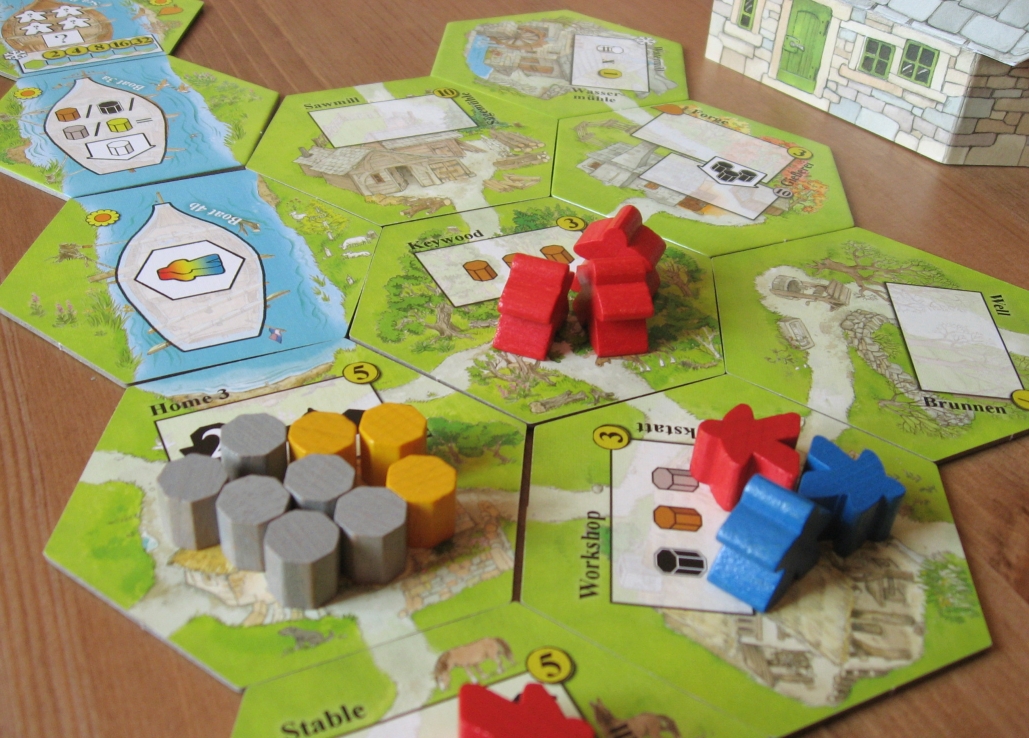
Next we started our “Feature Game”, Keyflower.    Although we have played it before and it is a very popular game with most club members, we had one player who was unfamiliar with it, so we chose to play it without any of the additional tiles.

Keyflower
– Image by boardGOATS

Keyflower is a worker-placement and auction game that is played over four seasons.  Each player begins the game with a home tile and eight worker meeples (or Keyples as they are known in this game).  At the beginning of each round there is a new stack of tiles that players can use and bid for.  The really unusual part of the game is the interplay between workers and bidding:  workers can operate on any tile, in a players own village, in another players village, or one that is still being auctioned.  At the end of the round, the workers go to the owner of the tile, thus, if you have a commodity that other players want, it can be a source of Keyples. On the other hand, if you chose to bid for a tile, presumably you wanted to use it, which means that you have competition for the resource, and so it proved.

Keyflower
– Image by boardGOATS

One player had been present at the drubbing we had received last time we played and tried the same strategy, i.e. to collect skill tiles.  Those of us that were aware of this approach started out with no real strategy except to prevent a second run-away victory by the same means.  Meanwhile the new player quietly got on with collecting gold and marshalling her Keyples.  Mixed based strategies gradually evolved for otherwise indecisive players with resources, the river and transport all featuring and it wasn’t long before we got to the final round, Winter.  Surprisingly, there wasn’t much competition for tiles to begin with as everyone concentrated on getting the resources and skill tiles they wanted to the place they needed them.  By this time, Keyples were in short supply, so there was only a token amount of scrapping for final tiles in what ended as a very, very closely fought game with first and second just one point apart, a tie for third and fourth, and everyone separated by only six points.

Keyflower
– Image by boardGOATS

The third game of the night was, the race game, Salmon Run.    We’ve played this a couple of times before, but still managed to have a couple of new players, so after a quick run through of the rules, off we went with board S1, 5E, 6E, 3M, 2M & F1.  White took an early lead, while Red and Black got in each others’ way and battled with bears.  Red and White both got sore heads bashing the bank, while Black got a bit stuck with mid-stream and trapped everyone else in the current.White made a dash for the finish, but got caught needing a right and straight to get across the last lot of rapids giving Red and Black a chance to catch up.  Red got closest, but White managed to make it across the line first and Red failed to quite make it to the Spawning pool on his last turn.  Even if Red and Black had made it home, Red’s nine fatigue cards and Black’s six dwarfed White’s two (thanks to the enforced wait before the last rapids where she had been able to ditch a lot of hers).

Salmon Run
– Image by BGG contributor kilroy_locke

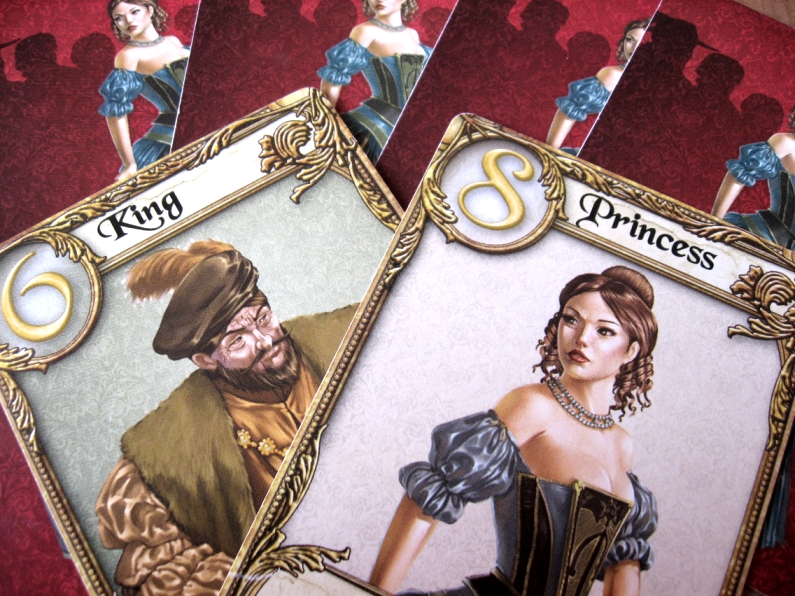
The last game of the night was an old favourite, Love Letter.  This is a really simple little duelling game played with just sixteen cards.  Each round only takes a couple of minutes and each player takes it in turns to draw a card and then play one of the two cards in their hand.  Cards allow players to look at another’s hand, force them to discard, give them the opportunity to try to assassinate other players etc. and the last player in, or (in the unusual case that all sixteen cards are drawn), the player with the highest card, wins the round.  Remarkably, one player managed a run of three rounds undefeated, and despite a desperate rear-guard action, this proved an unassailable lead.

Love Letter
– Image by boardGOATS

Learning Outcome:  A winning strategy doesn’t  always work…

20th August 2013

It being the height of the summer holiday, there was a severe shortage of people about, so we started late with our Feature game, Agricola. This game is about farming in the middle ages and is a one we have played several times now.  However, one of our regulars has somehow missed out and, as it is a game we know she would enjoy we decided that while it was quiet it was a good opportunity to play the “family game” again.

Agricola

So we had a gentle run down of the rules before we started collecting wood and clay, fish and grain.  Before long, Red had renovated her two room hut to brick and started ploughing fields while her farming couple lived on fish.  Meanwhile, Blue was trying (and failing) to expand her wooden hut, plough fields and fence in some pasture so she could keep some sheep, all at the same time.  Blue was the first to engage in a little “family growth” and had no qualms about sending her unfortunate offspring out to work the land at an early age.  Red didn’t have enough clay to build an additional room, so had to wait until she had the option of sharing rooms.  Despite Red picking up vegetables, cattle and pigs, at the end of the day, Blue’s experience (and larger family) meant she had an unassailable lead.

Agricola

There was just time for a quick second game, so we decided to go with something we were familiar with, Forbidden Desert.  This is clever little cooperative game that we’ve played a couple of times before.  The idea is that players are members of a team of adventurers on a mission to excavate an ancient desert city and recover a legendary flying machine that’s rumoured to be powered by the sun.  Moments before arriving at the destination, the helicopter crash lands, stranding the team in the vast desert,exposed to an unrelenting storm and extreme sun.  The only hope for survival is to work together to excavate the city, find the parts of the flying machine and rebuild it to escape.

Forbidden Desert

Players have particular areas of expertise:  this time we had the “Archaeologist” and the “Meteorologist”, which meant we had one player who could clear sand more efficiently (twice as fast as normal) and another who could check what the storm was going to do next.  We started well, making good use of the special abilities and taking advantage of the tunnels to hide from the sun.  Without the “Water Carrier” we were really worried about dying of thirst, but we managed eke out our water supply and stayed on top of the problem by hiding as much as possible.  We also managed to prevent too much sand build-up with occasional judicious use of the Duneblaster, but what we failed to keep an eye on was the sand-storm level and we were at level six with clues still to find.  The storm was on its highest level when we finally managed to pick up the last clue, hop over the dunes with a jet pack, clear the launch pad and escape, but it was a very close-run thing!

Learning Outcome:  There is a reason farming families are usually large.

6th August 2013

We decided to save our “Feature Game” (Guillotine) for an occasion when there’s a more appreciative audience and went straight into a much longer, deeper, and very highly regarded game called Puerto Rico.  Although we had all played it before, for some of us it was a long time ago, so we had a quick recap of the rules before we started.

Puerto Rico

In this game players are plantation owners in seventeenth century Puerto Rico growing up to five different kind of crops: corn, indigo, sugar, tobacco, and coffee.  Each plantation owner must try to run their business more efficiently than their competitors.  First they must grow their crops then they must store them efficiently.  Finally, players must sell their crops at the right time or ship their goods back to Europe for maximum benefit.  In order to do this most effectively, the plantation owners must make optimal use of the arriving colonists and develop the capital city, San Juan, building useful amenities.  In each round, players take it in turns to choose a role, but no role can be selected twice in the same round.  Each player gets the opportunity to carry out each action, however, there is a privilege that goes to the player who chose to do it.  For example, if one player chooses to build, everyone can build if they want, however, it is cheaper for the person who chose to do it.  Ultimately, the player who selects the best roles to advance their position during the game will win.  There are two small expansions, but after some discussion, we decided not to use either in the end as we didn’t feel we needed the variety for this game, but maybe next time.

Puerto Rico

Green decided to start building a couple of quarries and then expanded the indigo plantation that he started the game with, and added sugar (as nobody else seemed to be planting sugarcane).  Meanwhile, Blue started out with some corn, built a quarry, then dabbled briefly in tobacco, before going all out for coffee sales.  Red, on the other hand, started out with one indigo plantation and added a tobacco plantation.  When that didn’t really provide what he wanted, he tried coffee as well for good measure before deciding that what he REALLY wanted was a factory!  Red then went into the coffee market which messed with Blue’s plans, so she started shipping corn and coffee which screwed up Green.  Towards the end of the game, everyone made a mad dash for big buildings, but the damage had already been done by the efficient factory which gave Red the win with fifty-three points.

Puerto Rico

We only had time for one other game, and decided on Hanabi.  This is a really clever and unusual cooperative game which has just been awarded the Spiel des Jahres.  Hanabi is the Japanese word for “fireworks” and the idea is that you are collectively trying make the perfect firework display.  To do this, all you have to do is play cards, in order from one to five, in their colour suits.  The snag is that you hold your hand of cards back to front so that you can’t see the cards you are going to play, although you can see everyone else’s.  Thus, on your turn you can give a hint to someone to tell them something about their cards or you can play or discard a card.  Hints are restricted though and you can only point point out all the cards of a specific, common number or colour.  You also only have eight hints, although you get extras for every card you discard.  You also only have three lives and lose one each time you play a card that has already been played or if you play a card before all the lower numbers of that colour have been played.  One of the reasons Hanabi is so unusual is that although players are working towards a common goal, they can’t really help each other.  In this game, we made a mistake quite early on when someone discarded the second yellow four and it all went downhill from there, ending with a total of eighteen (out of a possible maximum of twenty-five).

Hanabi

Leaning Outcome:  If you teach people too well, sometimes they end up winning!

23rd July 2013

This week we started with our “Feature Game”, Vasco da Gama.  Some of us played this few months ago so we decided to give it another go.  As discussed previously, it is a worker placement game, with an element of risk management.  Players recruit workers, start projects, build ships and sail new commercial routes to eastern Africa and India, to earn money and glory.

Vasco da Gama

The game comes in three phases:  worker placement, then worker actions, and finally ships sailing.  Players take it in turns to choose one of four areas for their workers:  buying ships; captaining and manning ships with sailors; “schmoozing” some influential characters to win valued favours; and finally, launching boats.  The clever part of the game is that when players place their workers, they also choose a counter to go with it.  The counters are numbered from one to twenty and the actions are carried out starting with the lowest working up to the highest – a bit like the deli counter at the supermarket.  However, here, the low numbers cost cost money while the higher ones are free.  The snag is, you don’t know exactly where the free ones start, only the range of possible values, and the further you are below the cut off, the more it is going to cost you to carry out the action.

So, people take it in turns to choose a counter and place one of their four workers in the four areas.  Then, once all the workers have been placed, in number order, players choose whether or to carry out the action (paying if appropraiate) or whether to pass and take money in lieu of an action (just to make things more interesting, the lower numbers get less money).  Once a ship has been bought and has a full crew, the ship can be launched, and this is where it gets tricky.  You get an immediate reward for launching a ship, but you also get rewards for each ship still sailing at the end of the round, and these rewards are increased if the row the ship is in is also full.  The snag is that before the next round starts, each complete row of ships moves on to the next row, however, if there is no space in the next row the ship is lost and with it any future possibility of rewards. Thus, the position of ships is really critical and can make or break your chances of doing well.

Vasco da Gama

Black chose to fight for the attentions of one of the characters, Bartolomeu Dias.  This character is particularly generous as he gives players two victory points when they offer to host him as well as two more victory points at the end of the round AND means you go first at the start of the next round.  Meanwhile, Yellow and Red decided to buy ships and Blue tried to sail the line between bankruptcy and profit.  It is very clear that it is an advantage to have seen the way the ships move as it is a complex process and appears quite chaotic at times with the best laid plans falling apart because someone places a ship unexpectedly or they simply can’t count!  Before long, ships were sinking all over the place and Black had a massive lead, however, before long, Yellow and Blue started making in-roads too.  Yellow ran out the eventual victor, but only a couple of points ahead of Black.

We only had time for one other game and as time was tight, we chose an old favourite that we’d all played lots of times before, Bohnanza.  This is a fun, trading card game, where players are collecting beans to become the most successful bean farmer.  Players have to play cards in the order they are in their hand and are not allowed to rearrange them, so the game is all about controlling the order of the cards trading.  Everyone was feeling very generous and deals were rarely hard bargains.  In contrast to the first game, it was very close and the game was tied with the winners on thirty-three and everyone within four points of each other.

Bohnanza

Learning Outcome:  Bartolomeu Dias is a very powerful guy.