19th December 2023

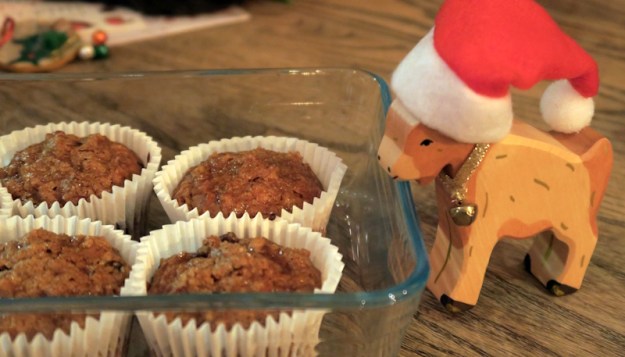
It was party time so everyone was arrived early for the Un-Christmas Dinner—everyone that is, but Blue and Pink who eventually arrived armed with piles of Christmas crackers, party poppers, tree decorations, Christmas cards, raffle prizes, GOAT Award ballot papers, mince pies and festive cake.  Opening the crackers was a necessity before food arrived to avoid the bits landing in people’s supper, so when food arrived, it nestled amongst all sorts of gaming detritus.  As the staff at The Jockey served pizzas, pies, baguettes, cheese with crudités, burgers and chips, gamers called out the awful GOATy jokes from the crackers.

"Un-Christmas Party" 2023
– Image by boardGOATS

During the interval between main courses and dessert, GOAT Award voting forms and Christmas cards were handed out and people began thinking about the games we’ve played over the year.  Ivory collected Christmas Cards and Green collated the ballots before he announced the winners.  The GOAT Poo prize, for the worst game of the year went Dice Hospital when 7 Wonders was relegated as a previous winner.  The Golden GOAT went to Tapestry, while the epic three-way tie in Tapestry won “Moment of the Year”.  With the formalities and food finally complete, there was just the raffle, a copy of Carcassonne: Winter Edition and the Ukraine Map, which were won by Sapphire, then everyone abandoned the carnage (and Purple who helped clean up), to play something festive.

"Un-Christmas Party" 2023
– Image by boardGOATS

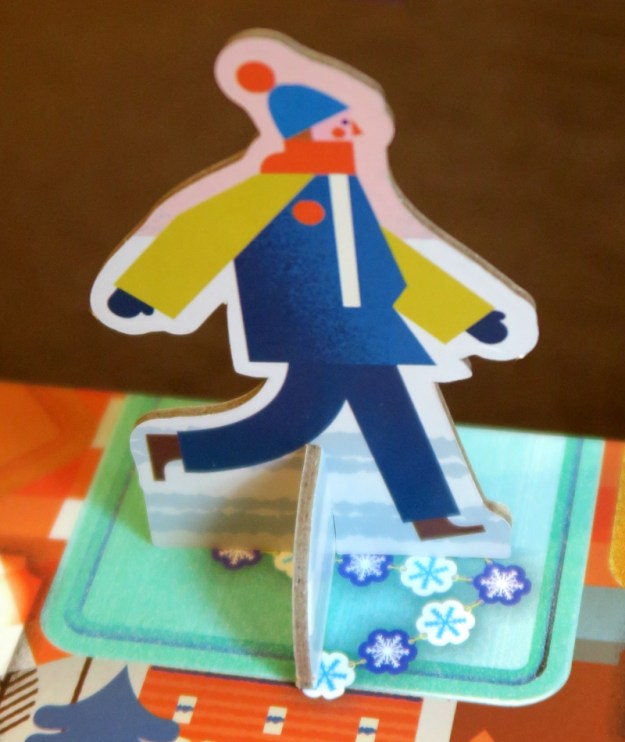
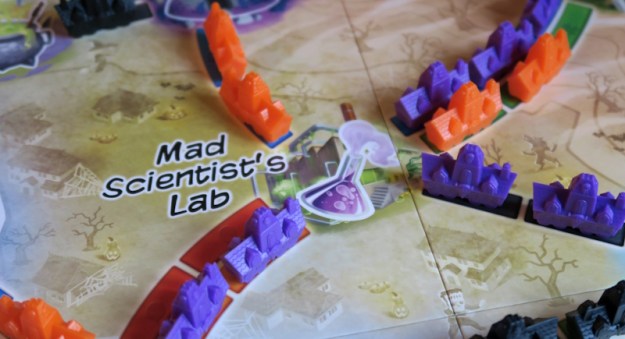
There was a bit of the usual indecisiveness, but eventually Blue, Ivory, Pink, Green and Pine settled down to play the “Feature Game” which was Jokkmokk: The Winter Market while Black, Cobalt, Jade, Sapphire and Lime set up Snow Tails.  Jokkmokk is a very simple game that makes use of the time-track mechanism seen in Tokaido and Namiji (played last time)—that is to say, it is an extended game of leap-frog where the player at the back jumps into an empty space of their choice and then carries out the action associated with it.  Like those games, the compromise is between moving to a preferred space which may be further forward and will ultimately will give fewer turns.  It is much simpler than both Tokaido and Namiji, however.

Jokkmokk: The Winter Market
– Image by boardGOATS

Jokkmokk is a card-driven set collecting game and is made more interesting by a large number of mini-decks, five or six of which are combined for each game.  For the first game, the group chose to use the “First Game” selection of decks (Dalecarlian Horse, Antique, Hot Dog, Patchwork, Present).  Blue went for the Patchwork cards while everyone else fought over kettles (Antiques) and Hot Dogs).  Blue’s strategy nearly paid off giving her ninety-nine points and second place, but Ivory was more efficient than everyone else with his mixture of Horses, Hot Dogs and Kettles, which gave him a hundred and one points and victory.  The game was bright and breezy and, although simple, really didn’t outstay its welcome, so the group decided to “do a Lime” and play it again.

Jokkmokk: The Winter Market
– Image by boardGOATS

This time, this time the group played with the “Gift of Giving” selection of decks (Donation, Bell, Sparkler, Snowflake, Mystery Box, Presents).  Pink went for Sparklers, knowing he would lose half his points if he had the most, but hoping to have so many that it wouldn’t matter.  Green started collecting Bells, as did Blue and Ivory, going for different colours.  Lots of Gifts were given and a good time was had visiting the fair.  Pink’s ninety points were just three more than Ivory’s total, but Blue’s hundred and seven points gave her victory at the second attempt.  Meanwhile, on the next table, the others had finally started playing Snow Tails, spectated by Purple, who had finished helping clear the table after dinner.

Snow Tails
– Image by boardGOATS

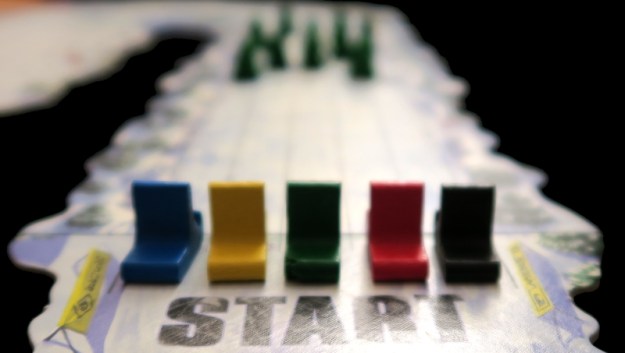
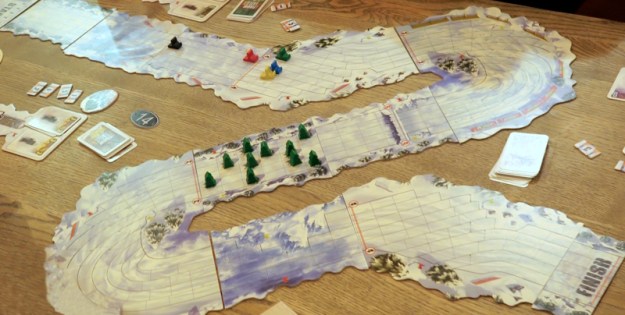
Snow Tails is a very popular game in the group, but somehow, one that is a little tricky to get to grips with.  The games is a card-driven sled-race with the winner the first to navigate the course.  Unfortunately, the course they chose was the one depicted in the main rules, which isn’t really intended to be a course design as it is quite long and features a Chasm right at the start, a couple of hairpins and some Saplings as well.  Each player starts with their own personal deck of cards, with five in hand.  On their turn, players can play up to three cards as they can so long as they are all the same value:  one for each sled dog, and one on the break.

Snow Tails
– Image by boardGOATS

The speed, the number of spaces the sled moves forward, is the total for the dogs minus the value for the Break.  Sleds will additionally drift sideways the difference between the dog speeds, and if the sled is balanced (i.e. the dogs are pulling equally), the player gets a bonus speed equal to the players position in the race.  Each time a sled exceeds the Speed Limit on a corner, hits the side of the track or a Sapling, the player takes a Dent card—a useless card that just blocks the player’s hand making things difficult.  The more Dent cards a player has, the more difficult the game gets, as Black soon demonstrated.  The first game of Jokkmokk had already finished and the sleds were only just off the Start line and through the first Chasm.

Snow Tails
– Image by boardGOATS

Lime claimed the “Big Paws” token for the player with the most “Analysis Paralysis”, though to be fair, everyone suffered a bit.  Jade commented that he’d been planning to play it with his nieces, but was now rethinking the idea.  As a result, the group shortened the track (to give them a chance to finish before midnight), and from there, the game went a bit more smoothly.  Jade was first to cross the Finish line, chased by Cobalt and then Sapphire in what had been a quite epic game.  And with that, the party was over for another year, though people lingered and chatted for quite a while before everyone left the pub staff to lock up.

"Un-Christmas Party" 2023
– Image by boardGOATS

Learning Outcome:  Always plan your Christmas shopping early.

Next Meeting, 19th December 2023

Our next meeting will be Tuesday 19th December 2023 at the Horse and Jockey pub in Stanford-in-the-Vale.

As this is our last meeting before Christmas
we will be meeting early from 7pm for food and Christmas festivities.

This week, the “Feature Game” will be Jokkmokk: The Winter Market (review & play through video, rules), followed by a range of Christmas and winter themed games like Santa’s Workshop, Christmas Tree, Snow Tails, Carcassonne: Winter Edition, Gingerbread House and Ticket to Ride: Nordic Countries.   Jokkmokk is a city in the north of Sweden that holds an annual folk festival and winter market, the latter of which is the subject of the game.

Jokkmokk: The Winter Market
– Image by boardGOATS

Speaking of Christmas shopping…

Before buying Christmas gifts for his niece, Jeff asked her what she would like.

The little girl was really into Disney princesses, but her favourite was Elsa, so she answered that she would love “anything Frozen”.

Jeff was delighted as it was the easiest Christmas shopping he’d ever done and he bought her a bag of peas and some oven chips.

12th December 2023

Blue and Pink were just finishing their supper when Plum and Byzantium arrived, soon followed by Pine, Black and Purple, Teal, Ivory, and finally Lime.  With ten then, the first question was whether to play two games with five each, or three games with fewer.  And then it was who would play the “Feature Game“, Namiji, and who would play something else.  The decision was pretty much made when Ivory said he’d brought Roll for the Galaxy and lots of people looked interested.  Roll for the Galaxy is somehow a game a lot of people struggle with, so who played what almost sorted itself out, with the outstanding question being whether there would be a third game.

Namiji
– Image by boardGOATS

In the end, it was easier to play two games than try to come up with a third, so Ivory took Plum, Teal, and Byzantium to the other side of the room to recap the rules for Roll for the Galaxy, while Blue taught the others Namiji.  Although this was new to everyone, it is extremely to the group favourite, Tokaido.  Both games are based on a time-track, that is to say, players are traveling along a path playing a kind of “leap-frog” where the player at the back jumps forward into an empty space and then carries out the action associated with it.  The player can move forward as far as they like, but the desire to jump into a chosen space is tensioned against the fact that the further forward a player moves, the longer it will likely be until their next turn.

Namiji
– Image by boardGOATS

Both Namiji and Tokaido have with elements of set collecting, indeed the different actions are very, very similar between the two games, and although players are Japanese fishermen, sailing south of the Japanese archipelago in Namiji, the rubric says they are just “a few miles away from the famous Tokaido road” and that games are barely that far apart.  The “Stations” in Namiji are: Angling, Net Casting, the Crustacean Trap, the Whirlpool, the Sacred Rock, the three Panoramas and the Dock.  The last four are roughly analogous to the Temple, the Hot Springs, the Panoramas and the Inn in Tokaido.  The Angling, Net Casting and Crustacean Trap stations are a little bit different.

Namiji
– Image by boardGOATS

Like the Village and the Encounters, these have set-collecting elements, but fish caught when Angling or Casting are laid out in the player’s boat with points scored for rows where the colours or types are the same.  The Crustacean Trap is a push-your-luck draw from a bag where players score a point for each Crustacean drawn (up to a maximum of five), but if two crabs are drawn in the same haul, the whole lot are lost.  The biggest difference between the two games is that there is no money, which has the effect of knocking some of the slightly rougher corners off.  For example, the Inn is much harsher in Tokaido than the Dock in Namiji.

Namiji
– Image by boardGOATS

Because Food cards have to bought at the Inn and these have different costs and duplicates cannot be bought, sometimes players have to go without which costs them six points.  This is enough to effectively put a player out of the running.  In contrast, in Namiji, they are a bit of a non-event.  There are two types of card drawn at the Dock:  Food and Upgrades.  As in Tokaido, Food gives points—fewer than in Tokaido, and variable without the cost or the limit of one type per player.  Upgrades grant players permanent abilities for the rest of the game (triggered when landing on their corresponding Station.  The game ends when everyone returns to port—as in Tokaido, there are bonus points for lots of things, and that includes being early back at port (with decreasing numbers of points as players arrive later).

Namiji
– Image by boardGOATS

Although the rules were simple and the game was mostly known, the debate started when Blue had barely left the table.  The discussion centred on whether the player chosen to be first should go at the front of the track (and thus actually “go” last) or whether they should take the first turn (and therefore actually start at the back).  Black opined that the that the turn order (randomly picked) was the order players should be placed on the track, while Pine felt the person picked should be the one start.  In the end, after studying the rules (which failed to answer the question), the group went with Pine’s view, and finally started sailing.

Namiji
– Image by boardGOATS

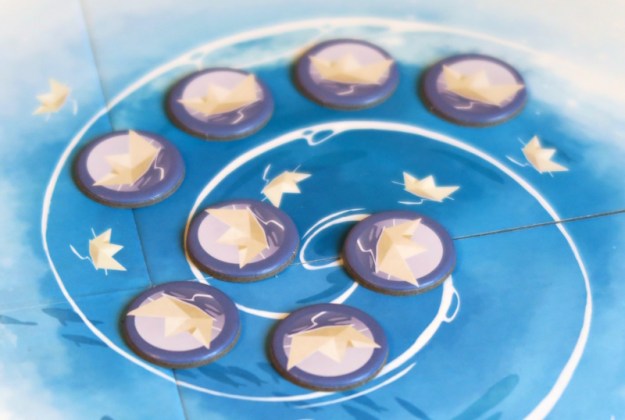
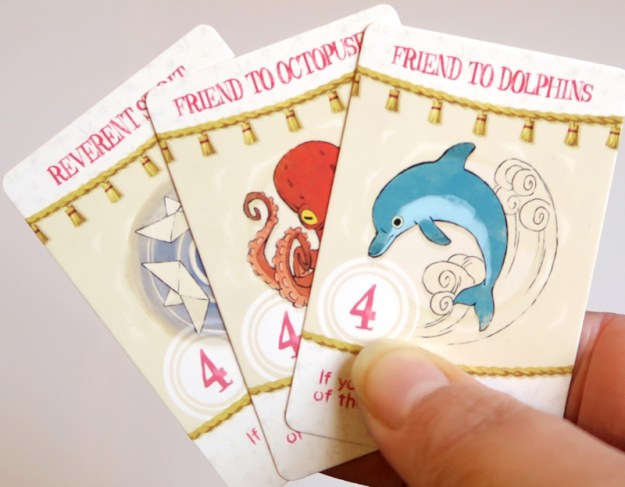
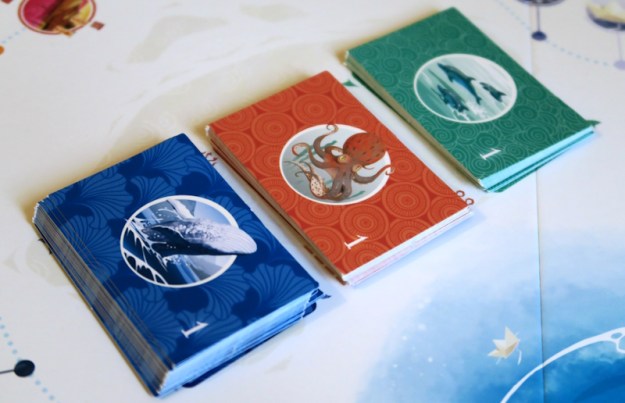
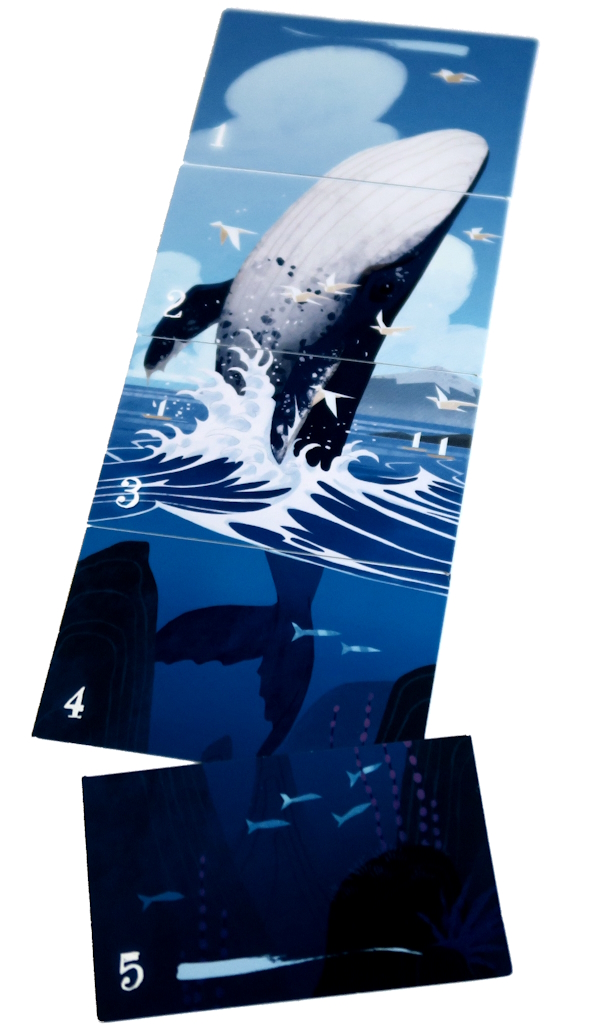
Pink was the first to complete the first Panorama (the Squid), soon followed by Lime who out-competed Purple and Pine to complete the lucrative Whale Panorama taking the bonus points for it too.  Black concentrated on setting his paper hats sailing into the Whirlpool to jettison negative points and top-scored for his catch (though there aren’t any bonus points for that).  Pine concentrated on collecting Cards and then was the first to get back to port.  Ultimately, Namiji is a game that rewards players for concentrating on one thing, and in this case that was Lime, who’s twenty-five points for his Panoramas made all the difference giving him clear victory ahead of Pine in second and Black and Pink jointly in third.

Namiji
– Image by boardGOATS

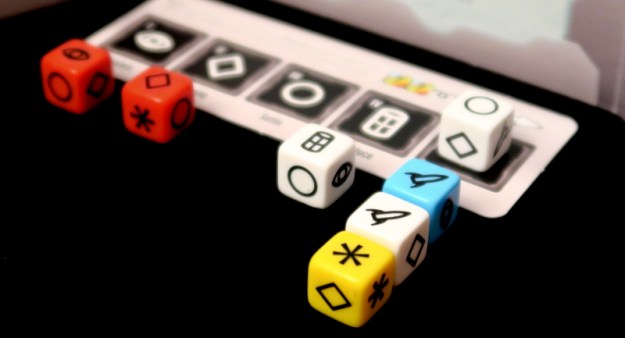
Meanwhile, on the other side of the room, Ivory had just about finished explaining the rules for Roll for the Galaxy when Blue arrived. In principle, the rules are quite simple, but playing the game well is much more difficult.  The game is based on the card game, Race for the Galaxy.  In both games, there are five phases, and players choose one each to activate.  This is important, because with more players more phases are likely to happen.  That is to say, while it is possible that everyone chooses the same phase which is the only one to happen, it is much more likely that two, three or four will be picked giving people more things to do in each round.

Roll for the Galaxy
– Image by boardGOATS

In Roll for the Galaxy, at the start of the round, players simultaneously “shaky-shaky” their dice in their Cup and roll in secret.  Then, behind their screen they secretly assign them to the different phases.  Most are assigned according to the face that was rolled, but any one can be used to decide which phase the player wants to happen.  Additionally, any one die can be used to “Dictate” the behaviour of one other die.  Once everyone has assigned their dice, everyone reveals their choices and the phases for the round are finalised.  Each player then gets to carry-out the actions indicated by their dice, returning unused dice to their Cup.

Roll for the Galaxy
– Image by boardGOATS

There are five phases in each round: Explore, Develop, Settle, Produce and Consume.  Explore allows players to choose tiles that they build in either the Develop or Settle phases, while Produce places goods on Production Worlds that can be turned into points or Credits in the Consume phase.  Used dice (those consumed or used to build) are then placed in a player’s Citizenry and only return to their Cup on payment of one Credit per die.  Thus, the game is very smooth with dice being assigned simultaneously, then moving to either of the player’s stacks of tiles to be used to pay for building, or onto one of their Production Worlds where it stay until it is Consumed.

Roll for the Galaxy
– Image by boardGOATS

Since what players can do depends on the roll of the dice, at first glance, it seems like the decisions are made by chance.  However, that just makes the decisions more key, if nuanced.  Which Worlds to build, which phase to choose, whether to Dictate to reassign a die, whether to consume to give points or cash, and overall, which strategy to choose.  And although the roll of the dice plays a big part, there are lots of dice and plenty of rolls, so the luck averages out, though players have to surf their luck.  The game ends at the end of the round when a player builds their twelfth World, or when the pile of Victory points runs dry, and in this sense, although the game is about rolling dice, it is still a race, a race to build an engine, score points and finish the game.

Roll for the Galaxy
– Image by boardGOATS

The game began with the rattle of the simultaneous “shaky-shaky” as dice rattled in everyone’s Cups.  At the start of the game everyone wanted to Explore and build, but what depended on strategy.  Blue started with a military strategy dictated by her first Development which gave points for red dice at the end.  Ivory also planned his game around his Developments and their bonus points, but built his engine based on reduced costs to build and to Dictate.  Teal and Sapphire chose to follow a conventional “Produce-Consume” victory point strategy, while Plum tried a bit of everything.

Roll for the Galaxy
– Image by boardGOATS

Roll for the Galaxy is a little bit “multi-player solitaire”, with everyone concentrating on their own engine and deciding what they want to do.  However, the winner has to take advantage of the fine margins and that means watching what other players are doing and anticipating and then taking advantage of their choice of phase when they can.   This time, the end was triggered by Ivory, who accelerated quickly out of the traps thanks to his early choice of Development Worlds, and ultimately finished with thirty-six points for his buildings and ten bonus points giving him a runaway victory.  A very creditable second place went to Byzantium, the only player who had never played either Roll or Race for the Galaxy before, with Blue completing the podium.

Roll for the Galaxy
– Image by boardGOATS

Learning Outcome:  Sometimes when you win you have a Whale of a time!

Next Meeting, 12th December 2023

Our next meeting will be Tuesday 12th December 2023.  As usual, we will start playing shorter games from 7.30pm as people arrive, until 8pm when we will start something a little longer.  The pub is doing food, and the table is booked from 6.30pm for those that would like to eat first.

This week, the “Feature Game” will be Namiji (rules, review and How to Play video), which is a Time-track game, with elements of set collecting.  The game is in some way a sequel to the group favourite, Tokaido, although this time, players are Japanese fishermen, sailing south of the Japanese archipelago.

Namiji
– Image by boardGOATS

Speaking of fish…

Jeff and Joe were sitting by the river in a pub beer garden, watching the fishermen on the opposite bank.

Joe mused, “I gather fish is really good brain-food.”

Jeff replied, “It is, I eat it all the time.”

“There goes another theory,” answered Joe.

28th Movember 2023

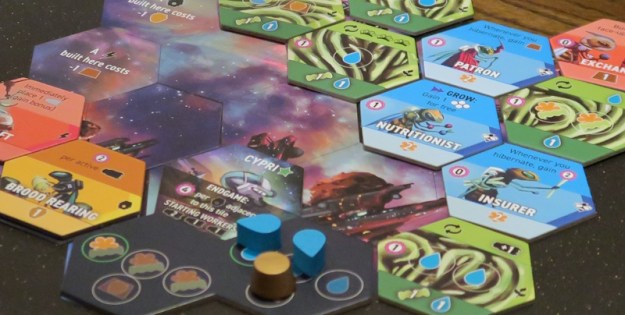
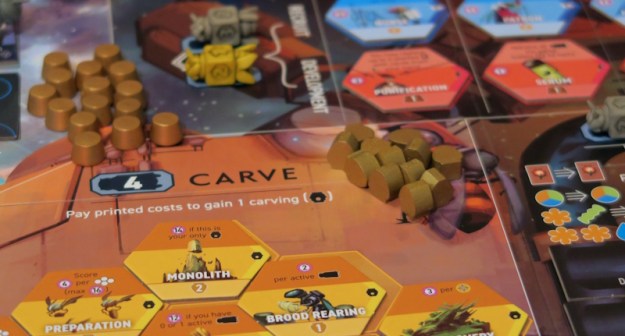
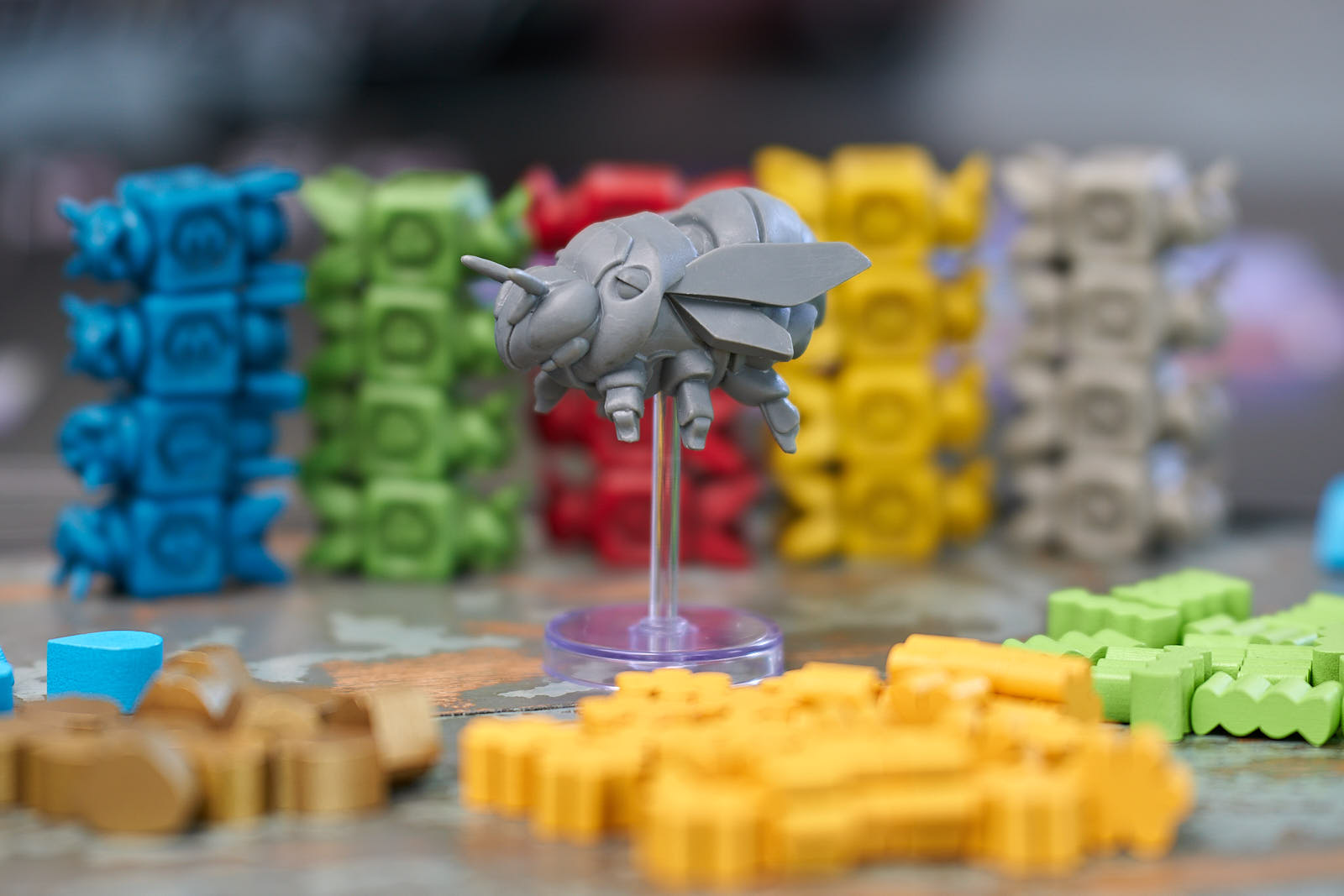
What started out threatening to be a quiet night with the absence of Green, Lilac, Purple and Black, turned out to be quite lively in the end.  As Blue and Pink finished their supper, Pine, then Jade, Sapphire, Plum and Byzantium arrived, soon followed by Teal, Ivory and Lime.  Ivory was armed with his new, shiny copy of Apiary, which was to be the “Feature Game“.  This is a worker-placement, hive-building game where players explore planets, gather resources, develop technologies, and create carvings to demonstrate their faction’s strengths before the end of the year when it is time to hibernate.

Apiary
– Image by boardGOATS

At first glance, Apiary seems to be a fairly simple Worker Placement game, where players have the Tzolk’in choice: place a Worker or retrieve Workers.  Unlike in Tzolk’in where Workers carry out their action when they are retrieved, in Apiary, players take the action and gain the associated benefits when placing a Worker, while retrieving Workers enables players to run any engine they have that relies on those recalled workers.   Unlike many other worker placement games, there is no blocking and players can add workers to any space as long as they have the power and required resources.  If a space is already occupied the existing occupant is “bumped” either to the next space (for certain areas) or sent back to the owner (with a choice to increase strength and make available straight away, or hold on to make use of income abilities).

Apiary
– Image by boardGOATS

Players start with asymmetric factions and basic resources (Pollen, Water, and Fiber) according to their faction.  The Action spaces are mostly about getting or trading Resources and Cards, or adding Tiles to improve their base.  There are five available to players at the start of the game: Explore, Advance, Grow, Research and Convert.  Explore allows players to visit planets, gaining bonuses for being the first to visit a planet, and also resources from the planets they discover while Advance allows players access tiles they can build if they have the resources to do so.  Grow enables players to gain their fourth worker (or gain a worker back from the pool once it hibernates) and allows players to build ship frames while Research gives players access to the Seed Card deck, some of which are incredibly powerful.

Apiary
– Image by boardGOATS

Wax and Honey are more advanced resources that can be created during the game using the Convert Action.  Honey, in particular, is required for the final Action, Carve (which also needs a Level Four worker).   When Workers return to the Active Pool (either by being bumped or because they have been recalled), their value increases by one. Level Four Workers trigger special bonuses when played, but instead of returning to the Active Pool when bumped or retrieved, they hibernate. In this way, the player loses that worker, but gains a bonus.   The game ends when all the hibernate spots are taken or when a player uses all seven of their hibernate tokens.

Apiary
– Image by boardGOATS

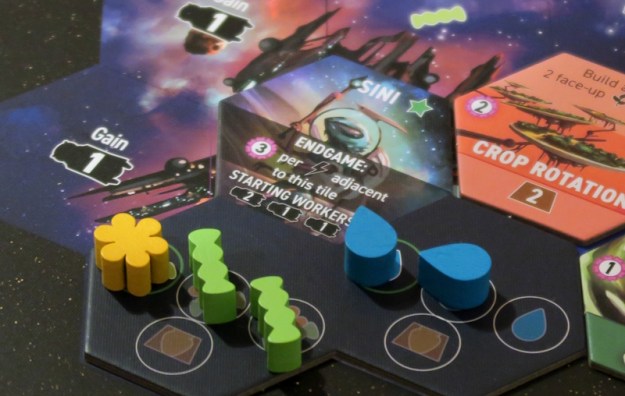
The game is beautifully produced with great art and lovely wooden resource pieces.  The QueenShip is arguably the best, looking a bit like Starbug from Red Dwarf.  With that and the theme (which had those traveling from Swindon crying, “Bees… In… Space!” à la The Muppets “Pigs in Space!” at intervals), the game was off to a good start.  The not-blocked worker space mechanism is similar to that in Euphoria: Build a Better Dystopia, which Plum, Byzantium and Jade had played at HandyCon.  Everyone starts off with a unique player “Hive Mat” and starting Faction Tile. Ivory began with “The Log” and “The Sini” which gave points for filing the Hive Mat and for each Development Tiles surrounding the Faction Tile (respectively), so he prioritised getting Development Tiles.

Apiary
– Image by boardGOATS

Cobalt’s Faction, “The Cypri”, gave him four points for each Carving adjacent to his Faction Tile, but found that hard to achieve needing a lot of Honey, so concentrated elsewhere instead.  Plum’s focus was on her Hive Mat, “The Warre”, which had spaces that progressed her along the Queen’s Favour track when she covered them, so she decided early to try and focus on that. She had some Farm Tiles that also would have helped her gain more Favour when she triggered the income for taking workers back, but she didn’t use that until later as, although her workers were bumped a lot, she kept choosing to increase their strength and have them available straight away instead.

Apiary
– Image by boardGOATS

Byzantium started with “The Lama” for his faction that gave him a point for each tile he added to his Hive which grew quite rapidly.  He also nabbed a Farm Tile from under Plum’s nose which gave him the Edge on the Queen’s Favour Track.  As the game came to a close, everyone scrabbled to try to finish things off—like filling their Hive Mat (Plum’s last space was filled for free when she covered the adjacent hex).  The lead at the end of the game was held by Plum, but that isn’t really where the points are in Apiary.  In contrast to everyone else, Ivory almost completely eschewed the Queen’s Favour, focusing on Planted Cards and Honey Pots, which gave him over thirty points alone, and as a result he charged from the back of the pack to take victory.

Apiary
– Image by boardGOATS

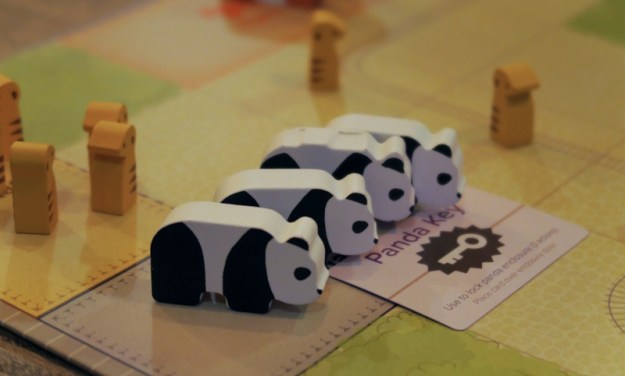
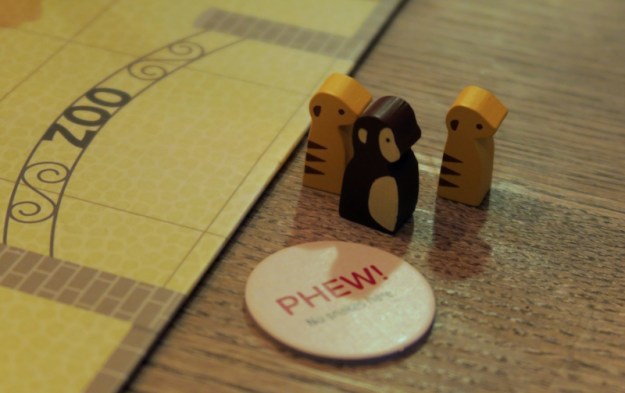
Meanwhile on the other side of the room, Pink, who had been fondly remembering his visit to the see the pandas “Down Under”, sucked Pine and Blue into a game of Zoo Break.  This is a cooperative game where players are zoo keepers trying to prevent the marauding animals escaping the zoo.  This has had a couple of outings this year the first was a disaster ended when a cobra got out, but the second was a hard-fought victory.  This time, with just three keepers, turns would come round more frequently, so to make things a little more interesting, Pink (Lucky Duck), Pine (Gardener) and Blue (Angler) decided to play with the Faulty Lock Variant, personally recommended by the designer.

Zoo Break
– Image by boardGOATS

The idea of the game is that players take it in turns to roll the Action Die to found out how many actions they get, then after carrying out the actions, players first draw an Escape card and then a Move card, to see what animals escape and move.  In the original game, once animals are locked up, however, they can’t escape, which means the game gets progressively easier.  Further, some players potentially end up lurking about with nothing much to do waiting for someone else to deal with the last couple of mischievous meerkats.  In the Faulty Lock Variant, however, when an Escape card is drawn for an enclosure that has already been locked, a die is rolled to see if the lock is faulty and whether the animal escapes or not.

Zoo Break
– Image by boardGOATS

The problem with the Faulty Lock Variant is that it can extend the game quite a bit.  That said, it didn’t look like that was going to be a problem as Pink chucked first Pine and then Blue under the Charging Rhinoceros.  Then Pink got trampled too, before Pine paid a couple more visits thanks to a mad Elephant and a venomous snake.  Eventually, the team got their act together and locked up the Rhino, and then the Capuchins, Pandas, and Elephants.  Every now and then, a lock failed and an Elephant got out, but gradually, the animals were being locked up, and eventually the last of the Meerkats was evicted from the part in the fountain locked up (aside from the two that escaped).

Zoo Break
– Image by boardGOATS

It had been a lot of fun, even though Pink was sad that he’d not been hugged by a lonely Panda, and jealous of Pine who had.  It had taken all evening though, and on the next table, Jade, Sapphire, Lime and Teal had managed two leisurely games and a bit of chit-chat.  The first game was Isle of Cats: Explore & Draw, a role and write version of the much more substantial card-drafting, polyomino cat-tile-placing game, Isle of Cats.  In Explore & Draw, instead of drafting cards before choosing tiles, players choose a set of cards each turn and then draw their “discoveries” on their boats.

Isle of Cats: Explore & Draw
– Image by boardGOATS

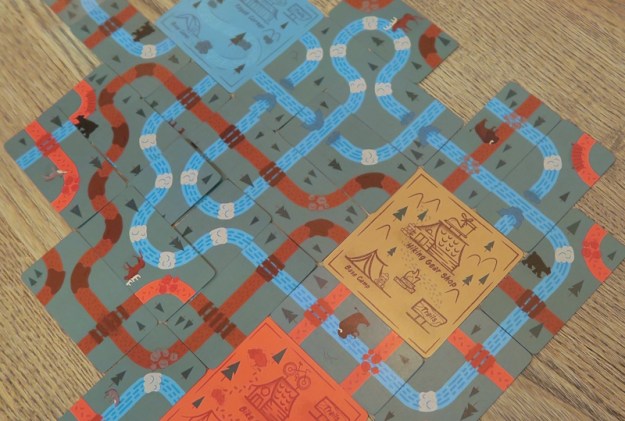
This time it was relatively close for second place, but Sapphire won by something of a landslide, his seventy-nine points was some twenty-five points ahead of Lime who took second with his neatly coloured in boat.  Once the wipe-clean boards had all been cleaned, Teal took an early night before the remaining trio played moved on to the card drafting and path building game, Trailblazers.  In this game, players start with eight Trail cards and draft two cards three times, adding them to their tableau.  The cards must either be placed adjacent to or overlapping other cards as players try to construct long and elaborate trails in three different colours.

Trailblazers
– Image by boardGOATS

Only closed loops in a single colour, that start and end at a matching campsite will score points and players also compete to fulfill “First To” and “End Game” goals.  The game ends after four rounds, when the player with the most points from closed loops and goals achieved is the winner.  This was much closer than the previous game, though the outcome was, ultimately, much the same.  The goal cards in play were “Hikers’ Quartet”, “Trail Hugs”, “Forever Float” and ” Wanderlust”, though the players only scored for the last two (giving points for the longest single blue “Kayak” route and the longest total brown “Hiking” routes.

Trailblazers
– Image by
boardGOATS

Lime and Jade tried to build trails of all three types, Hiking, Kayaking and Biking evenly, making the best of the cards they had.  However, Sapphire focused exclusively on the two that featured in the “Forever Float” and ” Wanderlust” goals, finishing with twenty-eight points for his Kayaking routes alone.  While it was very close when the trail lengths were taken into account, Sapphire took first place for both end game bonuses and Lime came second in both, which also reflected the final placing.  There was some chatter, while “Bees… In… Space!” finished and then it was time for everyone to go home to hibernate until next time.

Trailblazers
– Image by boardGOATS

Learning Outcome: Golden Honey is valuable.

Next Meeting, 28th Movember 2023

Our next meeting will be Tuesday 28th Movember 2023.  As usual, we will start playing shorter games from 7.30pm as people arrive, until 8pm when we will start something a little longer.  The pub is doing food, and the table is booked from 6.30pm for those that would like to eat first.

This week, the “Feature Game” will be Apiary (rules, review and play-through video), which is a worker-placement, hive-building game where players explore planets, gather resources, develop technologies, and create carvings to demonstrate their faction’s strengths before the end of the year when it is time to hibernate.

Apiary
– Image from stonemaiergames.com

Speaking of bees…

One morning, Jeff was chatting to his mate Joe in the village coffee shop, telling him about a recent encounter.

“…she just walked in and I knew we had a future together,” he said.

“So tell me about her then,” Joe asked.

“Well, she was wearing a white jacket covered in bee stings, and smelled sweet, like honey,” explained Jeff.

And then he added, “But somehow, I just knew she was a keeper…”

14th Movember 2023

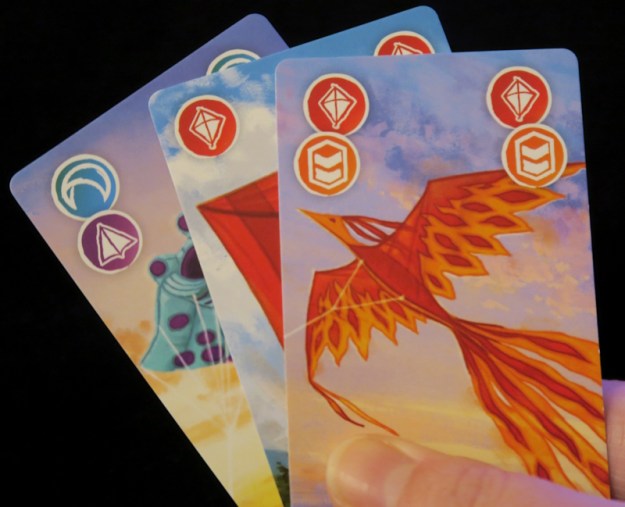
With Black, Teal, Pink, Green and Lime all away, it was looking like it was going to be a very quiet night.  In the event, however, the numbers remained good with the slightly unexpected arrival of Plum, Byzantium, Jade and Sapphire.  When Green dropped off Purple and stayed for a while, it became clear that we’d need something short to play alongside Kites, the “Feature Game“.  Kites is a real-time, cooperative game where players are playing cards and flipping egg-timers to keep the air display going.  A single play-through doesn’t take very long, but it is the sort of game that tends to get played through a couple of times in succession.
Kites
– Image by boardGOATS

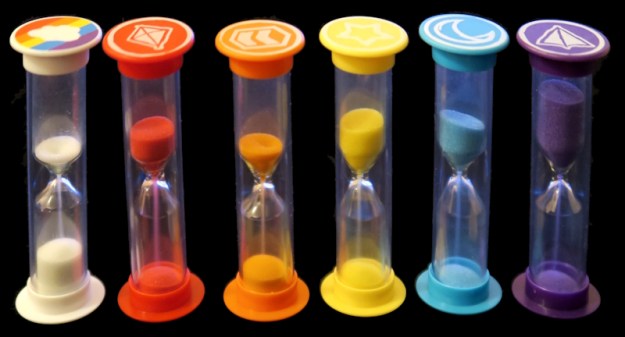
The idea is that that the Team have to launch six Kites, each represented by sand timers, and keep them flying by preventing the timers from running out.  Game play is very simple:  Players start with a hand of cards and must play one on their turn before replenishing their hand from the draw deck.  The cards all show either one or two coloured symbols on the corner, which correspond to the six coloured egg-timers in red, orange, yellow, blue, purple and white/rainbow colours that represent the different Kites.  When a card with two symbols on it is played, both egg-timers in those colours must be turned, however, a card with one just one symbol allows the active player to choose whether to turn the timer in that colour or to flip the white/rainbow coloured timer instead.
Kites
– Image by boardGOATS

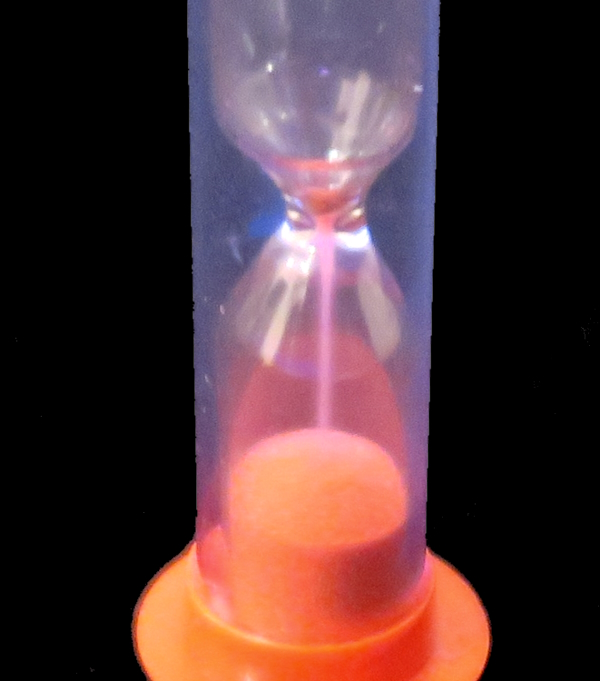
The game ends when either all the cards are played out (the Team win), or when one of the timers runs out of sand (the Team loses).  There are a couple of additional “features”.  Firstly, the different coloured timers each have different amounts of sand in them—the purple lasts the longest at ninety seconds with red running fastest lasting just thirty seconds.  This catches out the unwary, and indeed it caught out the group composed of Jade, Plum, Blue, Purple, Pine and Byzantium on their first try when they succeeded in playing just four out of the fifty-three cards in the deck.  The second attempt wasn’t much better, ending with just six cards played.

Kites
– Image by boardGOATS

The game has an “easy start” mode where players start with just three coloured Kites (plus the white/rainbow one), but nobody was keen to take cards out of the deck.  So, to make things a little easier, instead of starting with three cards in hand as per the rules, the group started with a hand of four cards, giving them a little more in the way of choice on their turn.  With this “House Rule” they were a little more successful, but it was at the fourth attempt, that things clicked, and the group finished with only twelve unplayed cards.  And it was then that the second “feature” caught out the group—when the draw deck has been exhausted, players can no-longer turn the white/rainbow timer.

Kites
– Image by boardGOATS

Having done well with four cards in hand, it was then that the group decided to revert to the rules “as written” and play with three cards in hand.  This made things more difficult during the early part of the game, but had the advantage of leaving players with fewer cards to play once the draw deck had been exhausted.  At that fifth attempt, the players were left with just six cards unplayed, and on the sixth try, they had eight left.  They were so close, they could feel it, and everyone in the group was determined not to stop before they’d won, which turned out to be on the seventh play.
Kites
– Image by boardGOATS

Kites is not the usual sort of fare for many in the group, being both cooperative and featureing real-time play.  It had been interesting and fun, however, with players learning how to work together and what information they needed to share.  Two people took responsibility for turning the timers and everyone else made sure they let people know when they spotted a timer running low.  Perhaps the biggest impact was the realisation that waiting was sometimes more powerful than playing quickly, and certainly more haste often brought less speed.  With the successful game, everyone felt they’d had enough, and while the other table finished their game, the group moved on to another party-style game, the simple little memory game, That’s Not a Hat.

That's Not a Hat
– Image by boardGOATS

Each player starts with a single card and shows it to all the other players before turning it face down.  One player then draws an extra card shows it to all the other players and passes their original card to the left or right (as per the arrow on the back of the card), announcing what they think it is.  The receiving player can either accept the card as it is, or challenge the declaration.  If a challenge is incorrect, the recipient keeps the card as a penalty point, whereas a correct challenge leaves the card/penalty point with the gifter.  It seems very simple, and doesn’t sound promising when described, however, after a couple of turns, when someone realises they can’t remember the card they’ve got in front of them and is forced to guess, the tension mounts and everyone suddenly appreciates the game.

That's Not a Hat
– Image by boardGOATS

Byzantium, Plum and Jade had played the game before and knew what to expect, but it was new to everyone else.  Most people thought they knew what card everyone had, only to discover that wasn’t the case after a couple of swaps.  Blue and Purple picked up just the one penalty, while Plum and Jade picked up a couple each.  After the game, there was some discussion about challenges needed to be accompanied with the correct card identity (which is how Plum had played it it HandyCon).  With this, it actually paid to try to bluff/confuse people who couldn’t identify the correct gift.  Inspired by this, there was some discussion about a possible “House Rule” to introduce a bit more jeopardy:  the challenger could optionally attempt to name the gift with the carrot of forcing another point on their gifter, and an incorrect guess reversing the effect of the challenge.

That's Not a Hat
– Image by boardGOATS

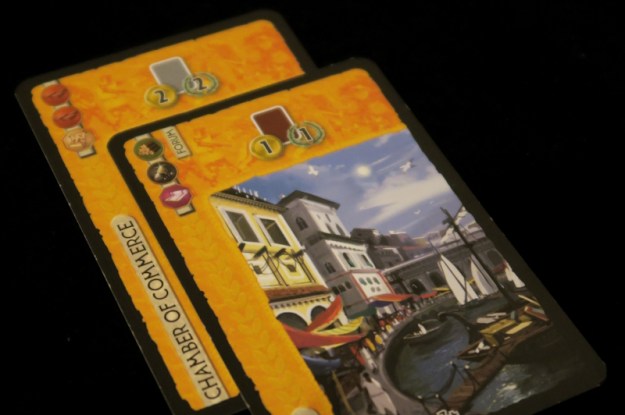
That was for another day.  This time, the winners, were Pine and Byzantium who avoided any penalties, though whether that was by luck or judgement wasn’t entirely clear and indeed, was unimportant.  That was especially true as the game was brought to an abrupt end by the game ending on the next table.  That was 7 Wonders—Green only wanted to play something short that he was familiar with and this fitted the bill.  7 Wonders is a card-drafting game, but has a bit of a “Marmite Factor” and is very unpopular with a significant number in the group, so rarely gets played.  This time though, Cobalt, Ivory and Sapphire were all happy to join Green and give 7 Wonders an outing.
7 Wonders
– Image by boardGOATS

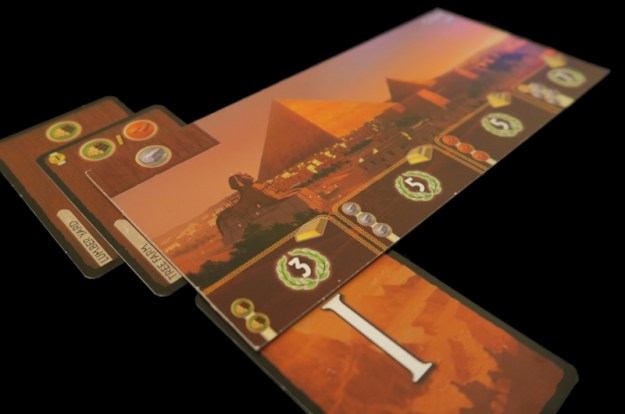
In 7 Wonders, players take the role of leader of one of the seven great cities of the Ancient World (Alexandria, Babylon, Ephesus, Giza, Halicarnassus, Olympia and Rhodes), gathering Resources, developing commercial routes, and developing their Military, build their City and erecting an architectural Wonder.  In each round or age, players receive seven cards and draft them, that is choose one card, then pass the remainder to their neighbour (much like Sushi Go! or Draftosaurus).  Players then reveal their cards simultaneously, paying Resources if required, collecting Resources or interacting with other players according to the cards played ant their player board (which gives special powers).

7 Wonders
– Image by boardGOATS

7 Wonders is essentially a card development game:  Some cards have immediate effects, while others provide bonuses or upgrades later in the game.  Some cards provide discounts on future purchases while others provide Military strength to overpower neighbors and some cards give nothing but victory points. Each card is played immediately after being drafted, so everyone knows which cards their neighbor is receiving and how their choices might affect what they’ve already built.  Players continue to draft cards until everyone has six cards (discarding the seventh).  The game ends after three rounds or ages.
7 Wonders
– Image by boardGOATS

7 Wonders is quite a famous game that Cobalt had heard about it and wanted to try, though he was the only one from the group who was unfamiliar with it.  It is one of those games where it seems like there is a lot to take in, but actually it is really quite simple and easy to pick up (though players do tend to require a round to see how it all plays, and there are only three in the whole game).  Everyone chose their respective Sides of Wonder.  Ivory who had Giza, elected to go for Side B, which has a four-piece Wonder and would give lots of points if he could complete it; Cobalt (Halicarnassus) chose to go for the simpler Side A, which would give him points and a chance to rifle through the discard deck for a card if he managed the second stage.

7 Wonders
– Image by boardGOATS

Sapphire (Ephesus) felt both sides were the same, money & points, just in different ways, while Green (Olympia) went for his Side B where he could have the option of copying a neighbour’s end game purple scoring card and the ability to buy Resources for only one coin each instead of two.  As expected the first round was a little slow as Cobalt felt his way around the cards and options, with help from the rest of the group, particularly from Ivory who was sat next to him and was initially passing his cards to Sapphire (so he could show Ivory the deck for some explanations without giving anything away).

7 Wonders
– Image by boardGOATS

The first round was gentle. Ivory and Sapphire lost out in the fight to Cobalt and Green.  In the second round Cobalt had to use his “Muppet Allowance” and swap a card he had kept when others pointed out he should have taken the other one.  Green was building up his army and building his Wonder with a lot of his own Resource (even though he had the Wonder benefit). Cobalt and Sapphire were beginning to specialise in the green Science cards.  Ivory was not really sure where he was going as he was beginning to lose out by not having access to the vast amount of Resources he needed to build his epic Wonder.

7 Wonders
– Image by boardGOATS

By the third and final round we everyone had the problems associated with trying to choose the best of a good bunch of cards.  Green and Cobalt ended up in an army fight, with six points at stake and already a reasonable army, it wasn’t a battle either of them wanted to give up on. The result was that they both let other good cards pass by.  By the end there were not many purple cards left, as it seemed a few had been used to build the Wonders, so Green’s “Copy” did not score heavily, although he did win the battle with Ivory (and subsequently with Sapphire too). Sapphire managed to get a full set of Science and a couple of single type multipliers, thus learning the power of Science in 7 Wonders (which is often hard to achieve).

7 Wonders
– Image by boardGOATS

By the end scoring, it seemed that Ivory, unusually for him, had indeed been boxed into a corner and ended up some way adrift of the rest of the group.  That aside, it was a very close contest between Cobalt, Green and Sapphire, with only a couple of points between each of them, but it was new player Cobalt who took the Laurels of victory.  Everyone enjoyed the game, so it might get another outing soon for which Green would be particularly grateful as it had always been a firm favourite of his.  With all the early games over at the same time, it was possible to swap the groups about as Green took an early night.  Jade was keen to introduce people to After Us, a game he had picked up at the UK Games Expo and hadn’t yet had the opportunity to introduce the group.

After Us
– Image by boardGOATS

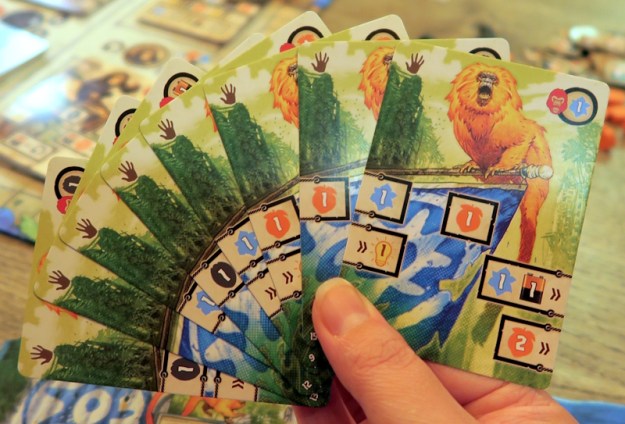
After Us is a deck-building, Resource management, engine building game featuring an original card-combo mechanism.  The story is set in 2083 and mankind has died out leaving only apes which have kept evolving. As the leader of a tribe, players try to guide it towards collective intelligence, by adding new Primate Cards to their starting deck of tamarins. Primate Cards have three rows of “Effects”—the top row will award resources, the middle row will give points (often at the cost of resources) and the the bottom row will have abilities related to the primate type. At the start of a round, players draw four Primate Cards from their deck to be laid out in a row making “Connections”.

After Us
– Image by BGG contributor The Innocent

The aim is to get the most out of the Connections by closing the open ended “Frames” along the sides of the cards by butting them up against adjacent cards that also have open ended Frames. Players then resolve the now closed Frames following the order of top left to bottom right, trying to gain as many bonuses as they can.  Once everyone has simultaneously collected their Resources they can then use them to buy Primate Cards which are added to the top of the draw deck (and thus they come into use on the very next turn). In this way, they are improving the quality of their deck.  The Frames have been resolved, the players simultaneously chose one of their Action Discs denoting which primate type they want to recruit.
After Us
– Image by boardGOATS

The Action Disc chosen will also gives the player a bonus. When recruiting, players have an option to pay three or six Resource (fruit, flowers or grain) to gain a Card. Players can additionally spend two Resource during this phase to copy one of their neighbours’ Action Disc bonus.  Once everyone has resolved their Action Disks and bonuses, players discard their cards and draw four new ones and start again.  The game starts slowly with players building their tribe, but it can end in a sudden rush when one player breaks into a gallop and charges past eighty points triggering the end of the round.  In the shuffle, Cobalt joined Byzantium, Jade, Blue and Purple playing After Us.  Jade and Byzantium led the way (both being familiar with the game), while the others felt their way.

After Us
– Image by boardGOATS

Arranging the cards to make the Connections proved the biggest challenge initially, especially when frustratingly, it wasn’t possible to make use of a really good half Frame.  Blue, Purple and Cobalt just started collecting cards as well as they could, but Jade showed everyone an alternative, shedding all his starting cards until he had no tamarins at all.  It was then that  Byzantium suddenly started surging forward on the points track—having picked up a small number of good quality primate cards and shed a few tamarins he just turned the handle on his engine and it was too late for anyone else to do anything about it.  And he was the first to cross the eighty point finish line, with Blue (who had put on a bit of a spurt) in second.

After Us
– Image by boardGOATS

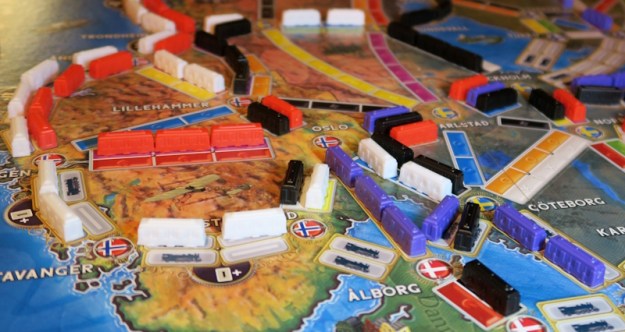
Meanwhile, Ivory, Plum, Pine and Sapphire settled down to to play the new Scandinavian edition of Ticket to Ride, Northern Lights.  Like all the other editions, players take it in turns to either take two coloured cards from the market, pay cards to place trains or take more ticket cards.  Like all the different versions, Norther Lights has a small number of special rules, but unfortunately, the rules in the box are in Danish, Swedish, Finish and Norwegian, and nobody in the group is a speaker, worse, although we played it about three months ago, nobody could remember the rules, so it was out with the phones to get translations.  The biggest difference boiled down to the addition of bonus cards, four of which are drawn at random at the start of the game and give extra points at the end.

Ticket to Ride: Northern Lights
– Image by boardGOATS

Additionally, there are some triple routes (which only take effect with five players) and some routes have a “+X” next to them which give players who build them X train cards from the face down pile.  Finally, for all routes Locomotive cards can replace any other card and for ferry routes Locomotive cards can be replaced with a pair of the same colour (and as a result, unlike most of the other versions, if there are three or more face-up Locomotive cards in the market, the market is not refreshed).  This time, the bonus cards drawn at random gave points for the most stations in Norway, the most stations in the arctic circle, the most successfully completed small Tickets, and the longest continuous connected train route.
Ticket to Ride: Northern Lights
– Image by boardGOATS

While everyone else seemed to be taking more and more tickets, Plum focused on completing her three starting Tickets, two fairly long ones running north-south, and a short one across the top.  It was a tight game for the podium places, though with Ivory, Pine and Plum vying for the lead.  Ticket to ride is often a high-risk, big-reward game though and if Plum had taken Tickets on her final turn instead of placing a single train for one point, she would have gained two more tickets and an additional twenty point which would likely have given her victory.  As it was, she finished in third, behind Ivory in second and Pine the worthy winner with a hundred and twenty-five points.

Ticket to Ride: Northern Lights
– Image by boardGOATS

Learning Outcome: Keeping kites flying takes teamwork.
Next Meeting, 14th Movember 2023

Our next meeting will be Tuesday 14th Movember 2023.  As usual, we will start playing shorter games from 7.30pm as people arrive, until 8pm when we will start something a little longer.  The pub is doing food, and the table is booked from 6.30pm for those that would like to eat first.

This week, the “Feature Game” will be Kites (rules, review and play-through video), which is a cooperative real-time game where players are playing cards and flipping egg-timers to keep the air display going.

Kites
– Image by boardGOATS

Speaking of kites…

One morning, Jeff was in his garden drinking a cup of tea when he spotted something in the sky and wondered what it was.

“Is it a bird?” he asked himself. “No, I think not—it doesn’t have wings.”

Jeff went on, “Neither is a plane, it is too circular, so I’m very sure its not a plane.”

He continued his musings, “It’s not a kite because it doesn’t move around…”

And it was then that Jeff noticed a very important detail—as he watched, it was growing larger and larger.

Then it hit him.

31st October 2023

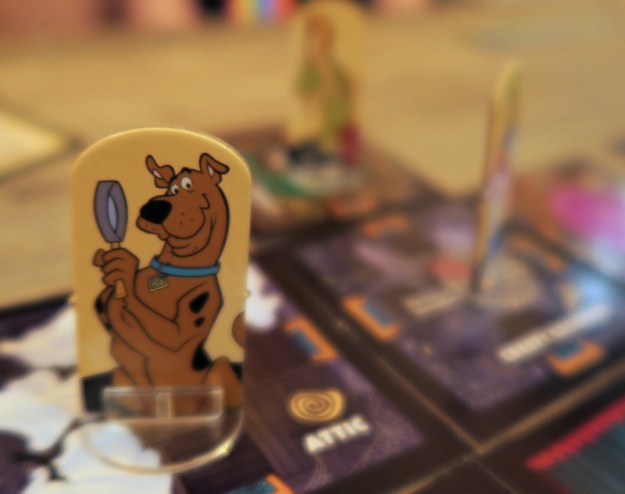
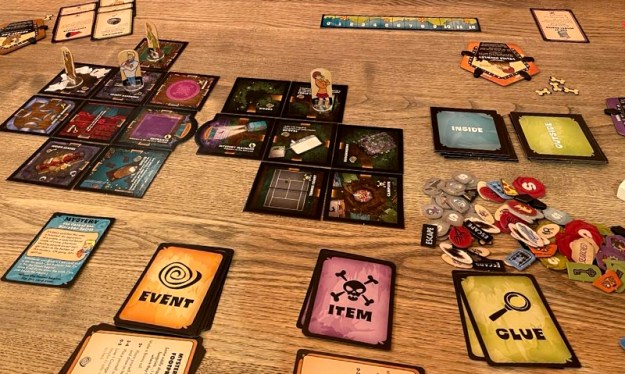
With it being Halloween, there were lots of treats and some very fine spooky-themed attire to go along with the “Feature Game“, Betrayal at Mystery Mansion.  This is a Scooby-Doo themed re-implementation of Betrayal at House on the Hill, a semi-cooperative game, where players work together until there is a haunting and one player takes on the role of the bad guy.  So, the first task for the evening was to decide who was going to take on the roles of Mystery Inc., which precipitated lots of discussion about which was the best character.  Scrappy got short-shift from Pink, though others were less dismissive.  In any case, Scrappy was not an option, and before long, Sapphire, Pink and Pine joined Jade to solve the mystery.

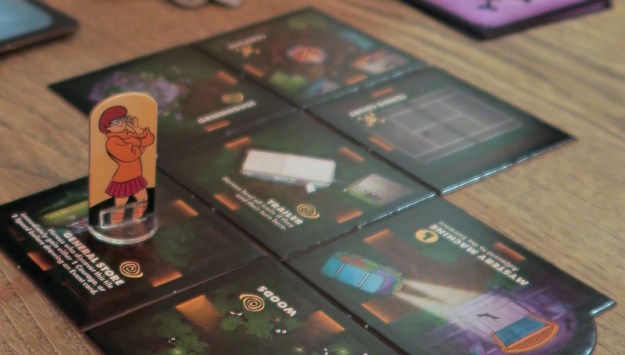
Betrayal at Mystery Mansion
– Image by boardGOATS

Jade, as the group leader, took the role of Fred, while Pink and Pine enthusiastically engaged in the game as Scooby Doo and Shaggy.  That left Sapphire to choose from Velma or Daphne and he went for brains over bimbette.  The group spent quite a bit of time exploring the mansion collecting clues and the like, before the haunt finally started.  As Sapphire was the one to trigger the haunt, Velma was “temporarily lost in the woods” as he took on the roles of the bad guys, a Spectre and a female character called Sharon who was being possessed and controlled by the Spectre.  As the game progressed, it became apparent that the Spectre was her great uncle who was trying to control her to gain access to documents that would enable him to take control of the family fortune.

Betrayal at Mystery Mansion
– Image by boardGOATS

The Scooby Gang (minus Scrappy Doo, Daphne and the now lost Velma) had to track down and battle the Spectre and try break the spell controlling Sharon.  As the villain, Sapphire rolled very well and it was very hard for the Gang to pin him down.  Fred ended up stunned at one point, but thankfully revived after missing a turn.  Shaggy scoffed piles of Scooby Snacks in order to re-roll, but the dice weren’t with him.  Scooby himself, however, did very well and survived his battle with the Spectre then was able to recharge in one of the special rooms of the mansion.  In the end the Mystery Inc. won the day and the great uncle was unmasked and announced that he “would’ve gotten away with it if it weren’t for you pesky kids”!

Betrayal at Mystery Mansion
– Image by boardGOATS

Meanwhile, there were two other games underway on the neighbouring tables.  Blue, Plum and Byzantium eschewed Witch’s Brew (which plays better with more people) and opted for the slightly bigger, beefier, boardgame version of the same game, Broom Service.  Both games rely on the players having a personal deck of Character cards and a lead and follow mechanism.  Each player starts by choosing a set number of Characters from their deck, each with different actions.  The first player then chooses one to lead with and announces that they are either “Brave” or “Cowardly”.  If they choose Cowardly, they can take the action straight away, whereas, if they choose Brave, they must wait until everyone has played to see if they can take the more powerful action.

Broom Service
– Image by boardGOATS

The next player must follow if they have the card in hand, and has the same decision to make—be a Coward and take the weaker action, or be Brave, and risk being gazumped by a later player, as there can only be one Brave player taking the powerful action.  The Brave player (or the most recent Brave player) then leads with another card.  In the card game, Witch’s Brew, players are collecting tokens to give them points, however, in Broom Service, there is an additional “Travelling Salesman” pick-up and deliver type of mechanism.  Players have two Witch-meeples which travel the land collecting potions and delivering them locations to get points.  This time, it was a really, really close game, despite everyone doing different things.

Broom Service
– Image by boardGOATS

Byzantium prioritised collecting Lightening Bolts and Blue concentrated on collecting potions and delivering them.  While they both headed south and contrived to get in each-other’s way, Plum headed north and fell foul of one of the events which left her stuck with no good move in the final round.  Blue kept forgetting about the “Bewitched Roles” which can be used but with a hefty three point penalty and lost six points as a result.  Byzantium assumed he would be the only one to consciously choose to take the hit and thus guarantee he could be Brave, but happened to do that exactly when Blue picked them as well and lost the advantage when he led with those roles.

Broom Service
– Image by boardGOATS

As the game came to a close, it was clear it was going to be close with Blue ahead by a single point with sixty points scored during the game.  She lots of resources left while Byzantium had none but lots of Lightening Bolts, and Plum had some of both.  Initially, Blue and Byzantium tied with seventy-three, just two points ahead of Plum.  That gave Blue victory with the tie break (the most left over resources), but that was only until the miss-count was spotted and Blue lost one point and with it her Winning Witch Medal, instead taking second place by a single point.

Broom Service
– Image by boardGOATS

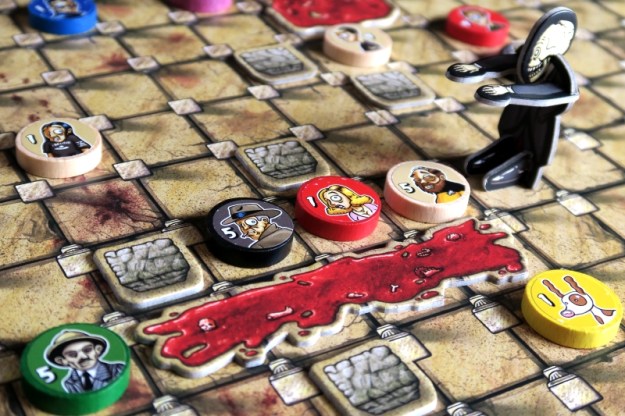
While the first two tables were playing spooky-themed games, Black and Purple led Teal and Cobalt in the monster-mad Finstere Flure (aka Fearsome Floors).  This is a game where players are trying to escape from Fürst Fieso before the castle collapses and without getting eaten.  The idea is very simple: first players move all their pieces the number of spaces shown on their visible side, then the Monster moves.  The Monster moves according to a stack of tiles, either moving a set number or moving until he eats.  The Monster moves one step forwards then looks straight ahead, left and then right. If he sees a player, he turns and moves towards them.

Finstere Flure
– Image by boardGOATS

Thus, the Monster looks, moves, looks, moves until he either runs out of spaces to move, or eats someone.  The game ends after fifteen rounds.  It is simple enough, but there are a few little elements that add to the fun.  Firstly, each player piece moves a total of seven spaces over two turns, but while some alternate three and four space moves, others are more variable, with the most extreme moving six spaces and then one space on the next turn; these different pieces require different tactics.  Players can’t land on another player, if they walk into a rock they push it and if you step in a pool of blood, they slide across it.

Finstere Flure
– Image by boardGOATS

Finally, if the Monster walks into a wall he appears elsewhere on the board adding a further layer of unpredictability.  The game opened with a bang when the first Monster tile revealed was a “Two Kill”, that is to say, the monster keeps moving until he’s eaten twice.  From there, it was carnage.  Everyone had someone eaten, with some multiple times.  There were people who managed to escape from Fürst Fieso, though it wasn’t easy of course.  Everyone managed to get at least one piece out of the castle, with Purple and Cobalt managing to get two pieces out.  The winner, however, was Black who liberated three of his people.

Finstere Flure
– Image by boardGOATS

They were the first to finish, so moved on to play the recent release, Ticket to Ride: Ghost Train.  This is really just a variant of First Journey, a simpler version of the group favourite, Ticket to Ride, aimed at children and non-gamers with super-sized pieces.  Like the original game, players take it in turns to either take “two parade float” cards (in this case blind), or pay cards to place trains on the map.  However, instead of scoring points for placing trains, the game is essentially a race game.  Players start with three Tickets and every time they complete one, they draw a replacement.  The winner is the player who completes the most Tickets.

Ticket to Ride: Ghost Train
– Image by boardGOATS

This time, Teal took an early night, but Black, Purple and Cobalt went at it with spooky enthusiasm.  As a different take on the original, they found this a very enjoyable alternative.  As well as Tickets, players can also win “Trick or Treat” bonuses for connecting the Dark Forest region to the Seashore region.  Black and Purple both took a “Trick or Treat” bonus, but the winner was Cobalt who finished with six Tickets, one more than Purple who would have taken another if she’d had just a little more time.  That wasn’t the only Ticket to Ride game of the night however, as the Scooby Gang played a quick game of Ticket to Ride: Berlin once they had solved their mystery.

Ticket to Ride: Ghost Train
– Image by boardGOATS

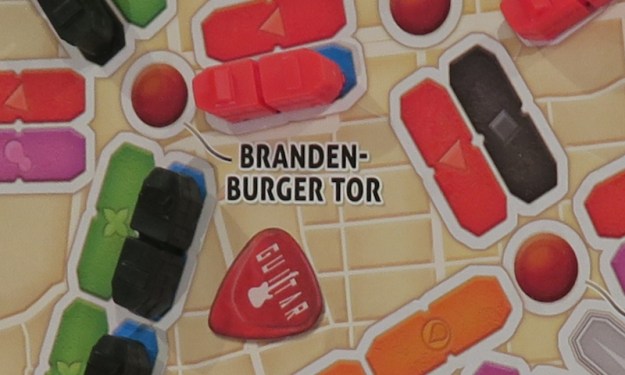
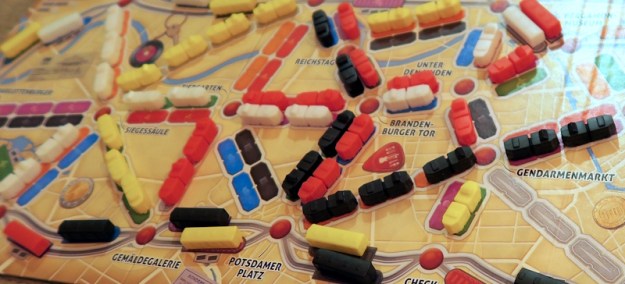
Ticket to Ride: Berlin is one of the mini versions, and there was a little chat about these and which ones people had played.  The first mini version was a “demo” game the publisher used to introduce people to the game at conventions.  Since then, there have been a series of City versions, with New York, London, Amsterdam and San Francisco all featuring and Berlin being the most recent (with Paris to come next year).  These all feature the same basic mechanism as the original game (including the scoring of points for placing trains unlike the First Journey type games), but they have fewer train pieces and a smaller map.  The Berlin map, is long and thin, but the big difference is that players have mixture of Trams and U-Bahn pieces.

Ticket to Ride: Berlin
– Image by boardGOATS

Tram and U-Bahn routes are paid for in similar ways, though only one U-Bahn piece is needed to mark them and they score slightly more points.  Once the differences had been highlighted by Pine and Pink (who played this together a few weeks back), everyone got down to business.  Jade and Sapphire dominated the West while Pink and Pine concentrated on the East, though the geography of the map meant everyone had to include East-West connections in their network.  It was a hard-faught close game with both Jade and Sapphire taking negative points due to incomplete Tickets.  Pine completed five Tickets and Pink finished six.

Ticket to Ride: Berlin
– Image by boardGOATS

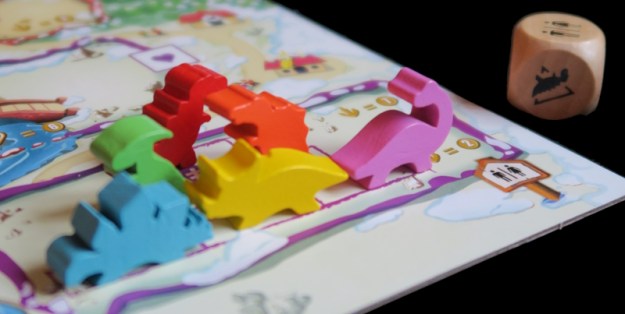
Pine’s Tickets were more lucrative, however, and he took victory with sixty-one points, while Jade with forty-nine just pipped Pink by two points in the struggle for second place.  Everyone had enjoyed the game, and Jade commented that it was one of his favourite renditions of Ticket to Ride so far—indeed, the addition of a second set of transport seems to have been much more successful in this mini version than it was in the full-sized Rail & Sails where it made it longer and more fiddly without making it significantly better.  While everyone else was playing and then discussing the merits of different versions of Ticket to Ride, the Crafty Trio, Plum, Blue and Byzantium had finished Broom Service and squeezed in a quick game of Dinosaur Drafting with Draftosaurus.

Draftosaurus
– Image by boardGOATS

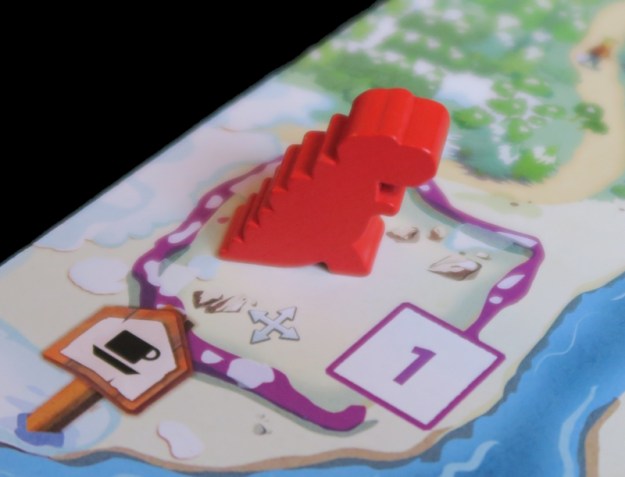
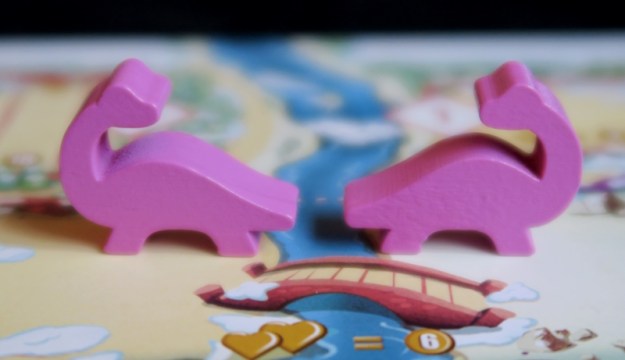
This is a fun little game that we play quite a bit, where players choose one Dinosaur from a handful, add it to their Park and then pass the rest on.  Dino-placement is slightly restricted by the roll of a die, with everyone getting points for how they occupy their pens.  Usually, the group plays with the Summer board, but with the cold weather, the group decided to play with the alternate, Winter board which introduces new and different pens.  These include the Well-Ordered Wood (Dinosaur types must alternate); Lovers’ Bridge (giving six points for each pair of Dinosaurs separated by the bridge); the Lookout (contains one Dinosaur and scores two points for each one of that type in their right neighbour’s pen).

Draftosaurus
– Image by boardGOATS

The most challenging, however is the Pyramid, which holds up to six Dinosaurs in a layered structure, but dinosaurs of the same species may not be placed adjacent to each other (horizontally or vertically).  Blue got into a mess with this, and was stuck with a Dinosaur she could not place at the end as a result.  Plum and Byzantium did slightly better and were able to capitalise more on the Quarantine Zone, which allows players to move the single occupant at the end of the game.  In the end, it was a tight game (though not as tight as Broom Service), in which Plum ran out the victor, three points ahead of Byzantium.

Draftosaurus
– Image by boardGOATS

Learning outcome: They’d have got away with it if it weren’t for those pesky kids!

Next Meeting, 31st October 2023

Our next meeting will be Tuesday 31st October 2023.  As usual, we will start playing shorter games from 7.30pm as people arrive, until 8pm when we will start something a little longer.  The pub is doing food, and the table is booked from 6.30pm for those that would like to eat first.

This week, as it is Halloween, the “Feature Game” will be Betrayal at Mystery Mansion (rules, review and play-through video), which is a Scooby-Doo themed re-implementation of Betrayal at House on the Hill.  Betrayal at Mystery Mansion is a semi-cooperative game, where players work together until there is a haunting and one player takes on the role of the bad guy.  As well as this game other games with a witch, wizard, ghoul or ghost theme will also be available together with the odd trick or treat…

– Image by BGG contributor kalchio

Speaking of Halloween…

Vampire Jeff came in from the night covered in fresh red blood and settled down in his coffin for a rest.

Before long, all the other vampires in the area smelled the sweet scent of blood and began hassling him about where he’d got it.

He told them to go away and let him get some rest, but they persisted until finally he gave in.

“Alright then,” he said, “Follow me,” and left the crypt enthusiastically followed by all the other vampires.

Down through the valley they went, across the river and into the dark forest. Finally, he slowed down and all the other vampires excitedly milled around him.

“Now,” Jeff said, “Do you see that tree over there?”

“Yes, Yes, Yes!” the vampires all screamed together in a frenzy.

“Good,” replied Jeff, “Because I sure as hell didn’t!”