13th December 2022

With this being the annual GOATS UnChristmas Dinner, almost everyone was present for a festival of food and fun, when Blue and Pink arrived with a small car full of party.  There were lots of volunteers to help bring everything in and before long, pizza boxes were being handed round along with crackers stuffed full of bling and GOAT Award voting forms.  The glittery Wingspan eggs from the crackers were especially popular, partly because so many people have a copy, everyone liked the idea of adding them to their game.  As the last of the pizza boxes were being passed around, people started to think about this year’s GOAT awards.

Wingspan
– Image boardGOATS

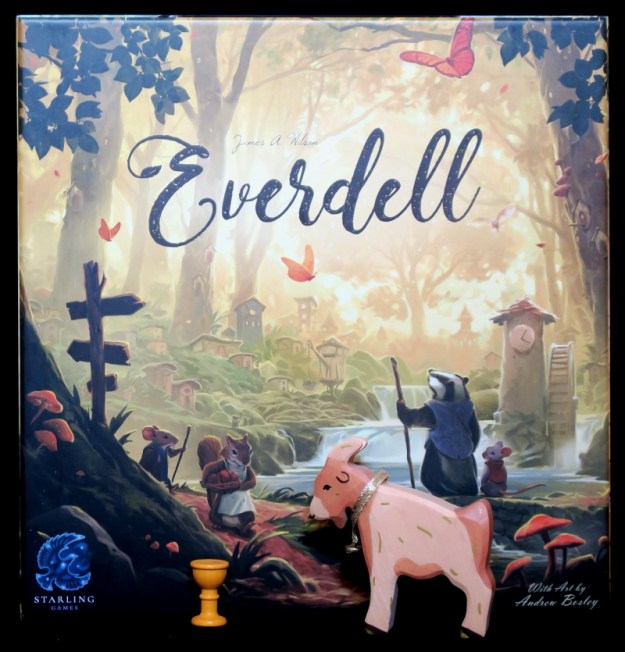
There was lots of umming and ahhhing as people tried to remember which game was which, but eventually the votes were in and people chatted while the returning officers (Pink and Green) did their counting thing.  Then Green announced the winners.  The GOAT Poo prize for the worst game of the year went to Villainous – The Worst takes it All and the Golden GOAT went to Everdell.  Three epic games, one of Viticulture, one of Tapestry and one of Turf Horse Racing were nominated for “Moment of the Year”, but that somewhat poignantly went to the 2021 UnChristmas Dinner which was the last meeting attended by Burgundy, and the last game he played with us, Santa’s Workshop.
Golden GOAT - 2022
– Image boardGOATS

Eventually, we all started thinking about playing games.  Ivory and Indigo were keen to play the “Feature Game“, Merry Madness: The Nightmare Before Christmas, while Jade had specially requested a game of Gingerbread House.  Eventually, largely due to logistics and lethargy (perhaps caused by too much pizza), everyone stayed pretty much where they were and played something with the people they were sat next to.  First underway was Green, Lilac, Pine, Teal and Lime, largely because they were playing a game they were all familiar with, Carcassonne, albeit the Winter Edition.
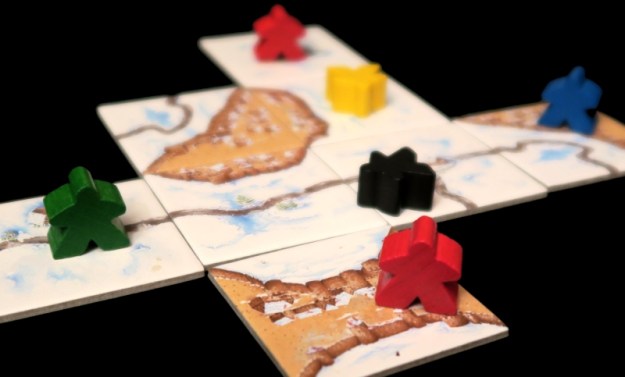
Carcassonne: Winter Edition
– Image boardGOATS

The Winter Edition is essentially the same game as the original “Blue-box” Carcassonne, but with snowy art work.  Thus, players take it in turns to draw and place a tile, add a meeple if desired/possible and then remove any meeples that are ready to score.  As in the original, the features on the tiles include city segments, roads and cloisters. Players score two points for each tile in a city or road they own if it is completed during the game, or one point at the end if incomplete. Similarly, Cloisters score nine points when completely surrounded or one point for the central tile and each surrounding it at the end of the game.
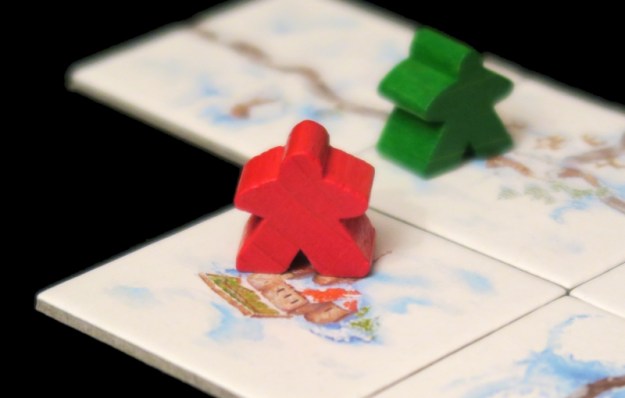
Carcassonne: Winter Edition
– Image boardGOATS

The clever part of the game is that while players cannot add a meeple to a feature that is already owned by another player, features can be joined together and then shared so that both players score.  Green and Lilac had played the same game last year at Christmas, with Der Lebkuchenman (aka Gingerbread Man) mini expansion which consists of additional Gingerbread Man tiles mixed in with the base game; when drawn, the player moves the brown Gingerbread Meeple to an unfinished city of their choice.  Before he is moved, however, the current city containing the Gingerbread Man is scored with each player receiving points for the number of meeples they have in the city multiplied by the number of tiles in the city.

Carcassonne: Winter Edition
– Image boardGOATS

Thus, even players that have only one meeple in the city when their opponents have more score a few points.  This year, in addition to Der Lebkuchenman, the group also added Die Kornkreise (aka Crop Circles) mini expansion. Although they were happy with the Gingerbread Meeple, they were less sure about the crop circles—they looked more like funny shaped snow “angels”.  The expansion consists of six extra tiles which allow each player to place a second follower on a feature that they have already-claimed or return an already-placed follower back to their supply.  Of course, the group did not play the rules quite right, however, initially thinking that each person had a free choice of which action to take and whether to take it or not.

Carcassonne: Winter Edition
– Image boardGOATS

It was only just after the second tile was placed that they realised it was the active player that chose the action (add an extra Meeple to the specific terrain type or pick up a Meeple) and everyone else had to do the same (they decided that if the player had no Meeple in an appropriate area then they just skipped the action).  As a result of the Kornkreise, Lime  ended up with three Farmers on the same tile, which at least it guaranteed him that particular field!  The Crop Circle expansion also led to the biggest coup of the game.  Lilac had started a city with her first tile and Pine positioned himself to muscle in on it a couple of turns later.
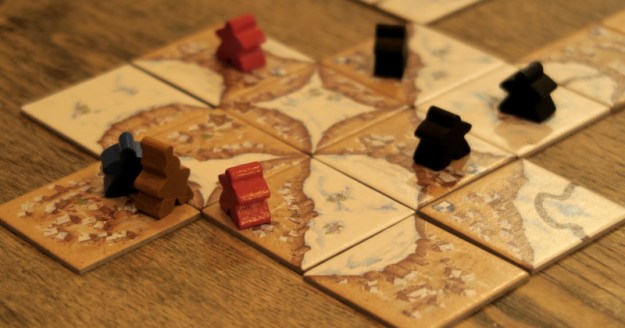
Carcassonne: Winter Edition
– Image boardGOATS

Their cities were joined, but they just could not get the city closed before Teal then joined the fray.  This became a very long city and then in the last quarter of the game, Lime also managed to add himself into the action on this game winning city.  Then the final Crop Circle tile came out for Teal. He decided he wanted everyone to add a Meeple to a city, which he, Pine and Lime were able to do. Unfortunately Lilac (who had started the city right at the beginning of the game) had no Meeples left, so couldn’t and found herself locked out of the scoring  at the end of the game as it was never completed.
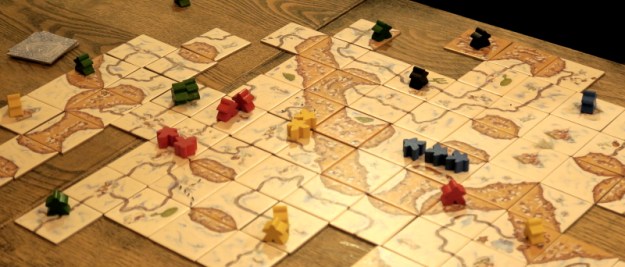
Carcassonne: Winter Edition
– Image boardGOATS

It was a game where no-one seemed to be able to get the tiles they wanted. Green regularly selected from the pile nearest to him, but only ever got roads. When he tried from different piles, he still got roads and when others selected from the “Green” pile, they got cities!  Pine started to choose tiles from within the middle of the stack, raising cries of “cheat” from Green and Lilac. Pine’s argument was that the tile was still random, which was hard to disagree with and Lime started doing the same later on as well.  In the final scoring, Lime surprisingly edged everyone out for the win, with Teal and Pine not too far behind.

Carcassonne: Winter Edition
– Image boardGOATS

It had been fun though and the Winter edition is certainly the prettiest version of Carcassonne, so Green and Lilac are already looking forward playing it again next Christmas.  Meanwhile, on the next table, Blue, Pink, Ivory and Indigo were playing the “Feature Game“, Merry Madness: The Nightmare Before Christmas, a very quick and light dice chucking game where players are trying to gather together all the spooky-themed gifts in Sandy Claws’ Christmas Bag.  It really is very, very light and quick:  simultaneously players roll their three dice and do what they say (in a similar style to Escape: The Curse of the Temple).  The three dice are different: one shows which of the six gift types is moved, another shows how many, one, two or three, and the final die indicates where: to the player on their left, right or of their choice.

Merry Madness: The Nightmare before Christmas
– Image boardGOATS

The group played with the “Making Christmas Toys” variant.  Players started with the same number of each of the different toys.  The idea is to get rid of all the toys that don’t match the one depicted on their “Wish List” (shown on their player mat).  If they roll the toy on their Wish List, they take that toy from the player indicated, whereas for every other type they roll, they gift one of that type to the recipient indicated.  There really wasn’t a lot to it, and basically the game was all about who was most awake (possibly correlated to the person who had eaten the least pizza).  Blue won the first round, and Pink took the second.  Blue finished the game when she took another two rounds and, although it had been silly fun, it was time for something else and Purple joined the foursome from the next table.
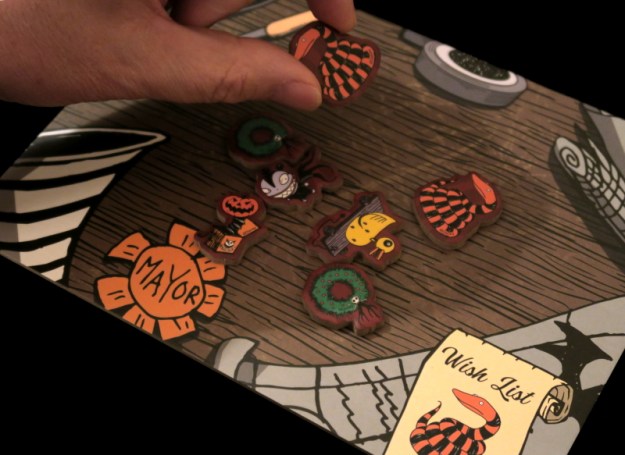
Merry Madness: The Nightmare before Christmas
– Image boardGOATS

Meanwhile, Purple had been explaining Gingerbread House to Plum and Jade and their partners Byzantium and Sapphire, respectively.  In this game players are witches in the Enchanted Forest, building their gingerbread house and attracting hungry fairy tale characters with colorful gingerbread.  Each player has a board with a three-by-three grid of building spaces.  There is a face down stack of rectangular tiles with the top three turned face up (a little like the train cards in Ticket to Ride).  These tiles each feature two squares, similar to Kingdomino tiles.  On their turn, players draw one of the face up tiles and place it on their player board, then carry-out the effect of the symbols they covered up.  The most likely symbol is one of the four different types of gingerbread, which means they collect a token of that type.

Gingerbread House
– Image boardGOATS

Careful placement of pieces is important because if a player is able to cover the same two symbols in one one turn, the player gets the effect three times instead of twice.  Once a tile has been placed, the active player can use some of their gingerbread tokens to capture fairy-tale characters.  If placing tiles completes a level, the active player may also take a bonus card.  The group found the game simple enough once they got going, but it took a while to get there.  The “wilds” caused problems from the first and the group weren’t sure whether covering two at once meant doing three of the same thing.  After re-reading that bit of the rules, it was decided the extra actions didn’t have to be the same, and as a result, Plum was able to make more of her final turn. 

Gingerbread House
– Image boardGOATS

It was close, but despite his super-charged final turn, Byzantium finished two points clear of Plum with Jade coming in third.  Everyone had really enjoyed the game, though, so much so that Jade and Sapphire are now on the lookout for a reasonably priced copy!   Although it took a little while to get going, once Plum, Jade, Byzantium and Sapphire were playing, Purple was at a bit of a lose end.  Nightmare Before Christmas didn’t take long though, so when it was over, Purple joined Blue, Pink, Ivory and Indigo for a game of the husky sled-racing game, Snow Tails.
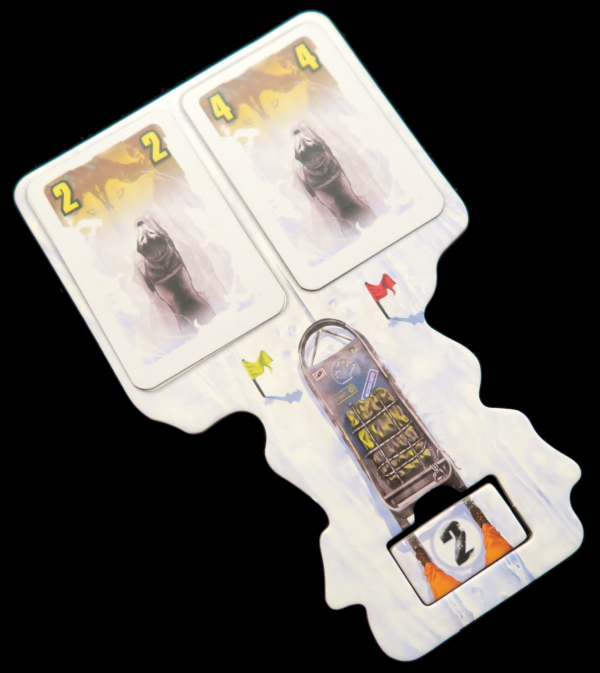
Snow Tails
– Image boardGOATS

The idea is that each player has a sled led by two dogs.  They start with a hand of five cards drawn from their personal deck.  On their turn, they can play up to three cards as long as they all have the same number.  There are three places a card can be played, two drive the dogs, and one activates the brake.  The idea is that a sled’s speed is the sum of the dogs’ speed minus the current value for the brake.  in addition, the difference between the dog values is the sled’s drift, which causes the sled to move left or right. At the end of their turn, players draw back up to five cards.

Snow Tails
– Image boardGOATS

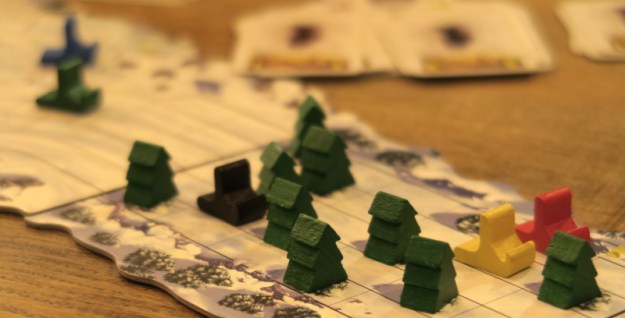
In general, if players hit something, they pick up a dent card which goes into their hand, blocking space and limiting their options.  The game is quite simple, but as always, how and when to apply the “drift” caused some confusion; Pink certainly benefited from the rules malfunction, but others probably did as well.  The group started out with the “Treemendous” track, but it seemed to take an age to get the game going and everyone was concerned that they might not finish before midnight.  So, about half-way through the game, the track was truncated removing the the final bend and finishing with a straight section just before the finish line.
Snow Tails
– Image boardGOATS

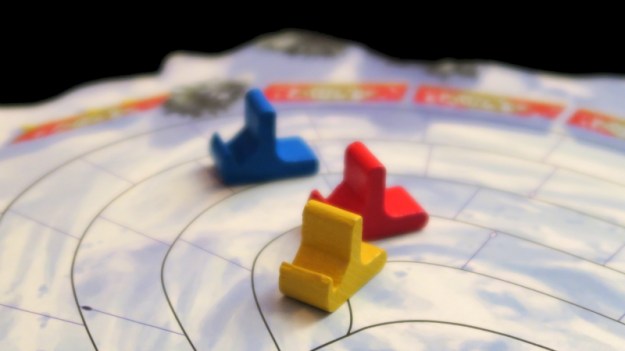
Ivory stole a march in the first couple of turns and looked like he was going to leave everyone miles behind, but when he rammed the first corner it let everyone else catch up.  Ivory was still the first out, but Pink was now not far behind going into the first stand of pines and was taking a different line.  By this time, the damage to Ivory’s sled was starting to take its toll, and Pink was able to take advantage of his balanced sled (his dogs pulling evenly giving him a bonus equivalent to his position in the field) and moved into the lead.
Snow Tails
– Image boardGOATS

It was then that the act of shortening the track played into Pink’s dogs’ paws.  With just the finish line in front, his dogs stretched their legs, he released the brake and shot through the second stand of pines taking out a couple of saplings on his way through.  Everyone could see what was going to happen, but nobody could do anything about it, and Pink crossed the line miles ahead of Ivory who would, no doubt, have taken second had the group played on.  Everyone else was far behind, still working their way through the first plantation.  It had been fun, but it was time for home, so with many “Happy Christmases”, everyone headed off into the cold dark night.
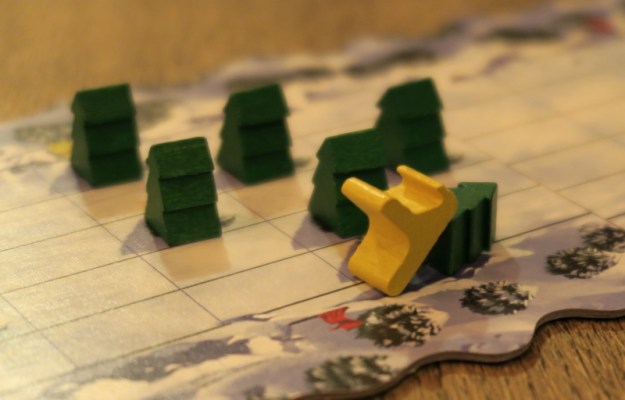
Snow Tails
– Image boardGOATS

Learning Outcome:  Turkey, bacon, sausage, cranberry sauce and stuffing really do make a Pizza taste like Christmas Dinner!
Golden GOAT Award Winners – 2022

As usual, the boardGOATS met just before Christmas for a party and to decide the winners of the GOAT Awards.  After pizza and crackers and the usual mayhem, the group voted for two awards:  the Golden GOAT for our favourite game and the “GOAT Poo” award for our least favourite.  Everyone had the usual three points to hand out for the Golden GOAT Award (plus a bonus if wearing Festive Attire), though a maximum of two points could be given to any individual game.  Everyone could also nominate up to two individual games for the GOAT Poo Prize.

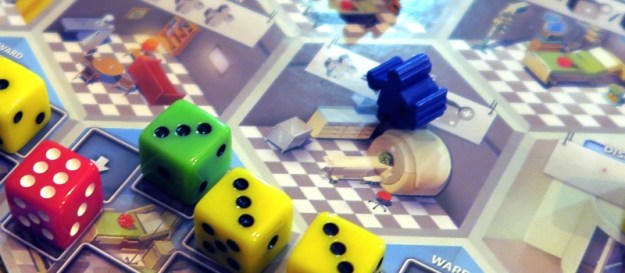
Dice Hospital
– Image by boardGOATS

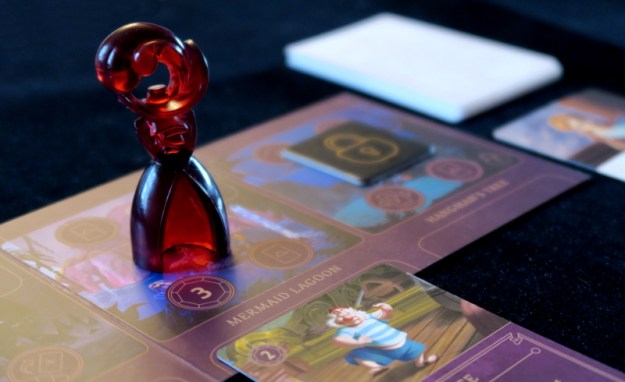
This year, there were a few games that received the unofficial “Marmite Award”, that is to say they received nominations for both the Golden GOAT and the GOAT Poo prizes.  These included Dice Hospital, Azul, Modern Art and Viticulture.  For the GOAT Poo Prize itself, there were several games that received two or three nominations, but the clear winner was Villainous – The Worst takes it All which received six nominations—quite an achievement since only five people played it and one of those wasn’t present for the vote!  Villainous is a beautiful, asymmetric card game, but one that we struggled with for several reasons, not least the fact that players had to work out how to play their own character, and we were playing it with five people which is two or three more than it needs.

Disney Villainous: The Worst Takes it All
– Image by boardGOATS

Nominations for Moment of the Year included two epic games, one of Viticulture and the other of Tapestry.  The latter nomination included the citation:  “I thought I was doing well until Ivory lapped me… twice!”  Pine also recalled Lilac nobbling him in Turf Horse RacingThe most poignant moment however, with hindsight, was last year’s UnChristmas Dinner, which was the last meeting attended by Burgundy, who very sadly, suddenly passed away just a few days later.  We all still miss him, but the fact we were joined by Jade and Plum and their partners this year is his legacy, and one we think he would have been proud of.

Mike Parker
– Image by
Pushpendra Rishi

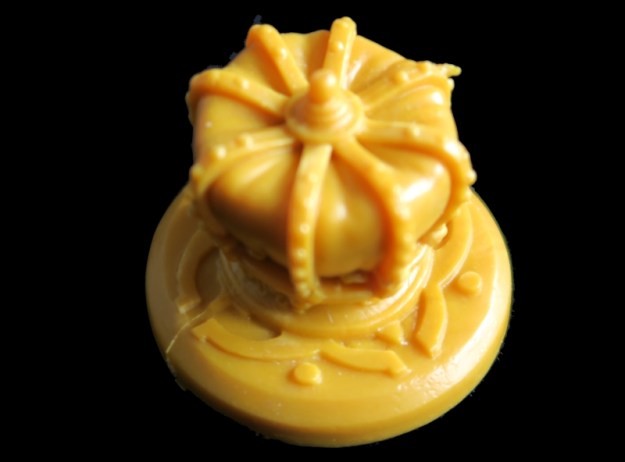
And that just left the Golden GOAT Award for the best game of the year.  Previous winners including Wingspan, Altiplano and 6 Nimmt! were ruled out, but there were plenty of options remaining.  Lots of games received three nominations including Endeavor, Cascadia, Old London Bridge, Splendor, Tapestry and Die Wandelnden Türme  But this year, the clear winner was Everdell. This card-driven game was only played for the first time a few weeks ago, but it is planned to play it again soon with one of the expansions being the “Feature Game” early in the new year.

Golden GOAT - 2022
– Image by boardGOATS

Next Meeting, 13th December 2022

Our next meeting will be Tuesday 13th December 2022 at the Horse and Jockey pub in Stanford-in-the-Vale.

As this is our last meeting before Christmas
we will be meeting early from 7pm for pizzas and Christmas festivities.

This week, the “Feature Game” will be Merry Madness: The Nightmare Before Christmas (review & play through video, rules), followed by a range of Christmas and winter themed games like Santa’s Workshop, Christmas TreeSnow Tails, Carcassonne: Winter Edition, Giftmas at Dungeon Abbey, Gingerbread House and Ticket to Ride: Nordic Countries.   Merry Madness is a real time, dice chucking game where players are trying to gather together all the spooky-themed gifts in Sandy Claws’ Christmas Bag.

Merry Madness: The Nightmare before Christmas
– Image from spelhuis.be

Speaking of nightmares…

It was shortly before Christmas when Jeff had a nightmare and dreamed that he was stuck inside a snow globe.

When he woke, he was really shaken up…

29th November 2022

Although the numbers were severely dented by holidays, work commitments and norovirus, there were still nine of us, and although everyone was late, timings were perfect and the whole group arrived within moments of each other.  There was the usual chatter, as people bought drinks and shared stories of the week, then everyone finally settled down to play some games.  The “Feature Game” was the shiny new Asia expansion to one of our favourite games, the multi-award-winning bird-themed card game, Wingspan.  But first we had to decide who was playing what.

Wingspan
– Image by boardGOATS

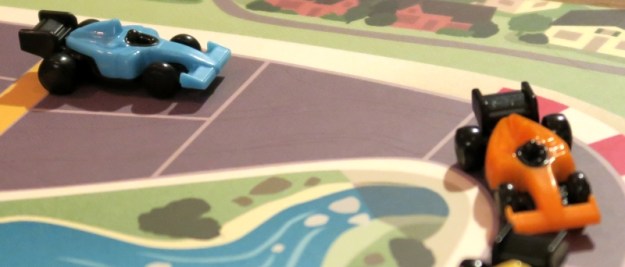
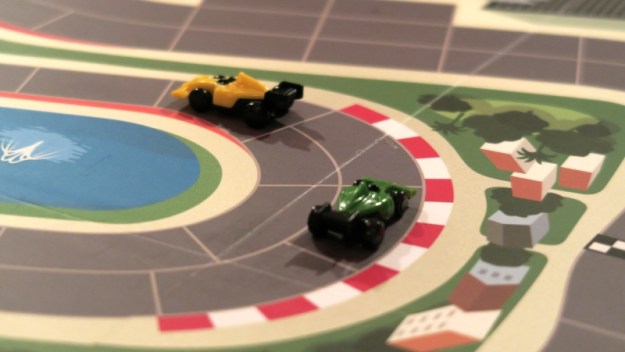
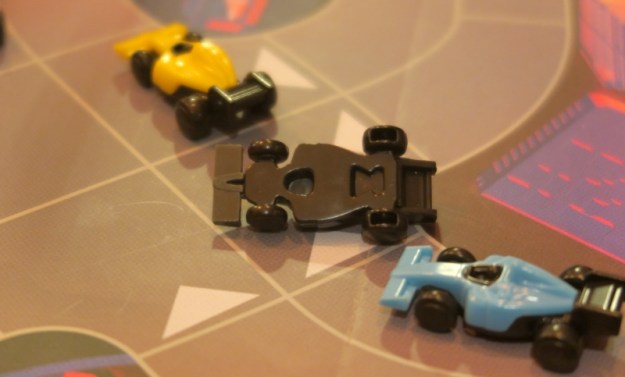
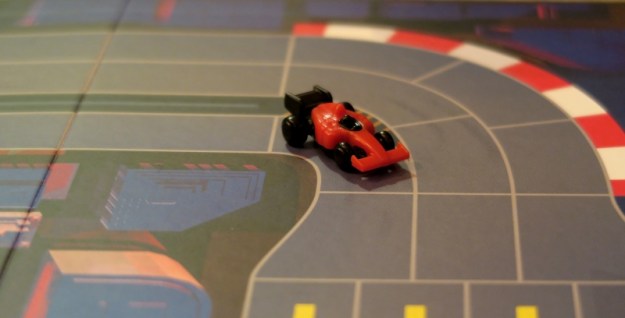
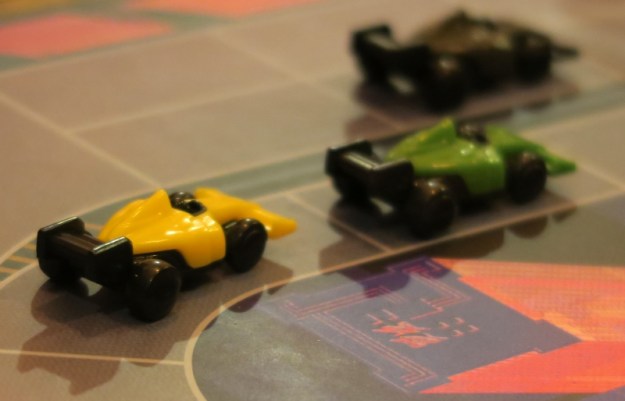
Like last time (when there were also nine people), splitting the group into two or three was quite challenging, but eventually, we decided to go with two tables with Blue, Plum, Black and Ivory playing Wingspan with Pink and Pine leading the rest in a game of Downforce. Downforce has three parts:  a car auction, a race, and betting on the race which occurs during the game.  Downforce has had a couple of outings in the last year, and after last time we played, we concluded that the betting skewed the game a little.  Essentially, when the first car crosses the first betting line which triggers players to place their bets, if several people bet on the same car that tends to lead to a runaway leader.

Downforce
– Image by boardGOATS

After a little research, we found an alternative, “Odds Betting” variant that we thought might be worth a try and Pink was keen to give it a go.  This scheme rewards riskier bets because a player’s winnings depends on the position of the car at the point in the race when the bet is made.  Thus, if a player bets on the leading car at the first betting line and it comes in first, they will win three million dollars ($3,000,000 × 1), however, if they bet on the last car and it defies the odds, they will take eighteen million dollars ($3,000,000 × 6).  Even if that last car comes in third, anyone betting on it will take six million dollars ($1,000,000 × 6)—twice that of betting on the leader if it wins.

Downforce
– Image by boardGOATS

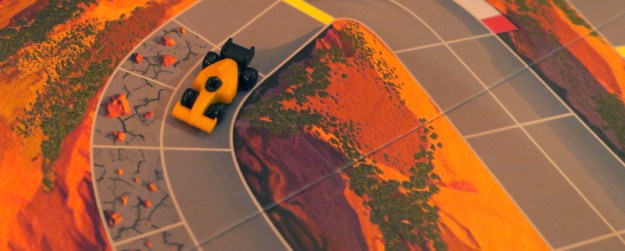
The track chosen was Switchback Pass from the Danger Circuit expansion.  The race began and as the cars weaved around the track, players tried to muscle past each other.  Purple made good use of her power, “Tough” (from the Danger Circuit expansion).  This allowed her to move an extra two spaces every time she finished her move on a space adjacent to a “rumble strip” and she used that a lot, an awful lot.  This was in contrast to Pink who didn’t use his “Determined” power at all.  Despite using her power a lot, sadly, Purple wasn’t able to capitalise on it.  “Ambitious” Lemon was the first to cross the line, shortly followed by “Unpredictable” Orange.  However, the winner is the player with the most cash including income from bets, and in this case, that was Orange who had backed himself from the start.

Downforce: Danger Circuit
– Image by boardGOATS

The consensus was that the “Odds Betting” variant was a definite improvement on the rules as written, though they made things significantly more complicated.  As a result, they weren’t considered a perfect fix.  There are other options still to try though:  the “Simple Odds Betting” variant (where players only bet on the winner with the takings based on position at the time of the bet); the “All Bets are Off” variant (where the betting rules are as written but each player must bet on three different cars, none of which are owned by that player), and the “Three Bets” Variant (which just increases the number of cars everyone has an interest in).

Downforce: Danger Circuit
– Image by boardGOATS

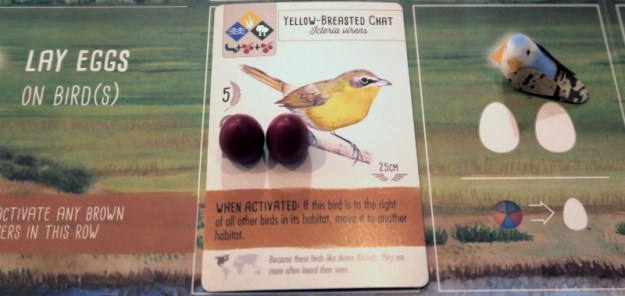
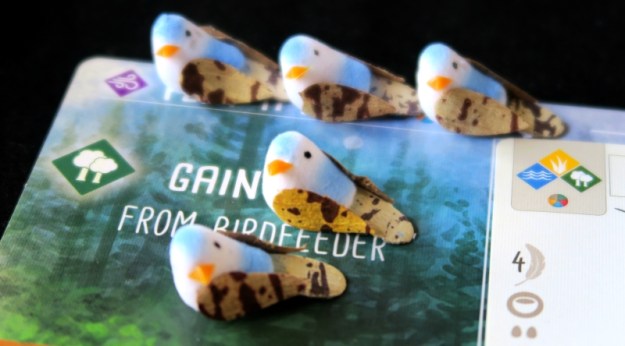
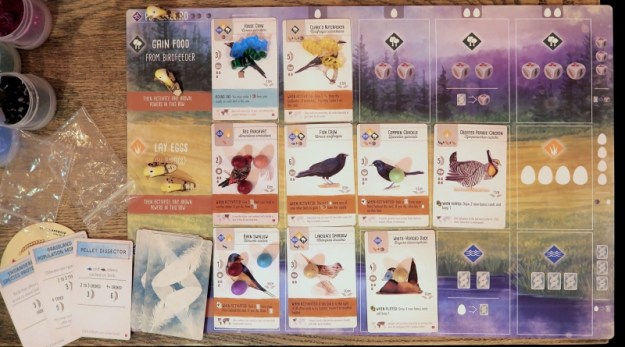
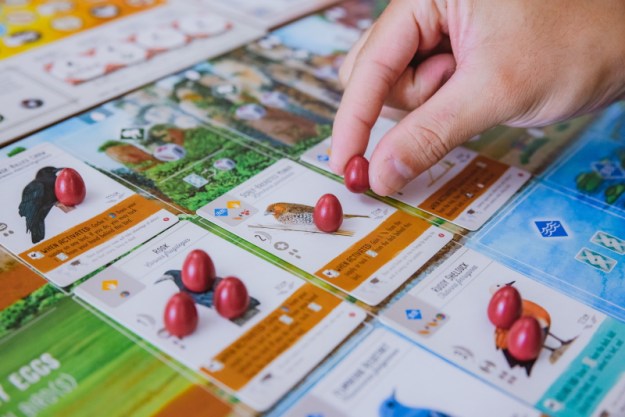
While the race was ongoing, the next table were playing Wingspan.  This is one of the most popular games within the group, so we were keen to give the brand new Asia expansion an outing.  The basic game is simple enough:  on their turn, players either play a bird card in one of the three habitats, or activate one of those habitats and all the birds in it.  The three habitats are Woodland, Grassland and Wetland giving food, eggs and bird cards respectively.  Food and eggs are necessary for playing bird cards, as well as eggs being worth points in their own right at the end of the game.  The European and Oceania expansions both added more cards and the latter also added nectar as a food source.

Wingspan
– Image by boardGOATS

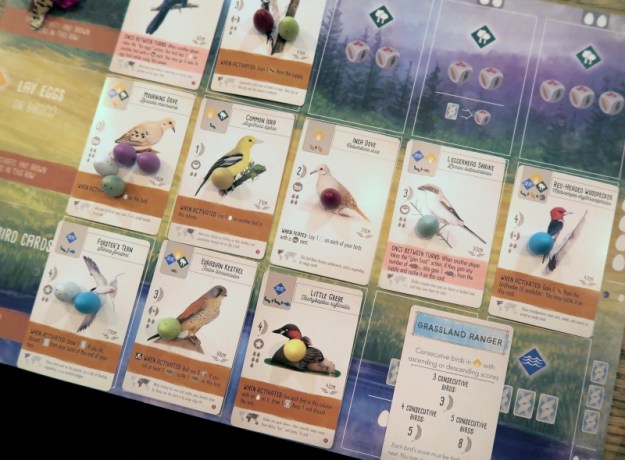
Wingspan: Asia is a standalone two-player game that can also be added to the base game as providing new bird and goal cards.  It also adds a new “flock” mode for playing with six or more players, but with only four players this time, the group decided to make the most of the Asia expansion.  So Ivory, Plum and Black started by removing all the other expansion bird cards from the deck and shuffling in the new ones while Blue sorted out all the other bits needed to play.  That all took longer than expected, but with everyone knowing the game well, there was no need to revise the rules before the game, with just a few edge cases that were checked during play.

Wingspan: Asia
– Image by boardGOATS

Ivory started the fastest, with more birds in his reserve than anyone else by the end of the first round.  The goal at the end of that round was the rather cool “most birds facing right”, and although Ivory won it, everyone else was close behind.  That wasn’t the case in the later rounds though, with somebody struggling to get points in each case, but Ivory taking the top bonus in every round.  Some of the new birds offered a bit more, in particular, those that allowed players to cache food, but gave them a wider choice of options.  Some allowed players to choose which food, and there was another that gave the option of caching food or tucking cards.

Wingspan: Asia
– Image by boardGOATS

Although some of the bonus cards were the same as those in the base game and the other expansions, there were also new ones.  There was one that rewarded having different nest types in the trees. Ivory and Plum both got cards that gave points for playing birds in a given habitat that increased or decreased in value.  Although these were a bit different and added variety, they didn’t fundamentally change the game. As Black pointed out, sometimes the bonuses are a bit too difficult and the other ways of accumulating points much easier.  They are good to give a steer at the start of the game though, when the range of options can be overwhelming.

Wingspan
– Image by boardGOATS

With eggs worth one point each, the final turns involved the usual round of egg-laying.  It felt like it was less of a frenzy than it sometimes is, probably because everyone had other things that they felt they needed to do that were more important.  Towards the end of the game, Plum also picked up a couple of extra goal cards, but had to choose between them.  Both gave points for having birds that increased or decreased in value in a Wetland or Woodland—she went for the Wetland as at least the values were increasing, decreasing values was not ideal at that stage of the game.  Black also picked up a couple of extra goal cards during the game, but from Blue’s perspective, Ivory was where he always was, out in front with a formidable lead.

Wingspan: Asia
– Image by boardGOATS

That was not quite how it turned out in practice, however.  Ivory said he thought Black might have it, and ultimately he was proved right.  The differences in the scores were not quite as anybody expected however.  As the scores came in, it became clear that Ivory had a lot of end of round bonus points (twenty-two in fact) and Black had a lot of points from the bonus cards (fourteen) while Blue had the most from her birds (thirty-eight) and Plum had the most cached food (nine).  Of course it is the total that counts, and in the event, Black was some way ahead of the rest with a total of seventy-seven points.

Wingspan: Asia
– Image by boardGOATS

It was much closer for second than anyone expected as Blue had made an extremely slow start, but Ivory’s total of seventy-two pipped her by a single point.  Everyone had enjoyed the game, but then we always do enjoy Wingspan.  The Asia expansion didn’t change things very much, though it did feel a little different, mainly because of the new goal cards (e.g. the cards that reward placing birds in order of points and for playing birds with different types of nests).  These were the biggest difference, though some of the bird card caching options were a little more flexible and players seemed to like that too.  It is unlikely we’ll play Asia in quite this “Asia strong” way again as it will get mixed in with the other expansions, but it was a good way to introduce it to the group.

Wingspan: Asia
– Image by boardGOATS

Downforce never takes very long to play and the other group were still only half-way through Wingspan, but rather than something longer, the racing group decided to play something lighter and eventually settled on No Thanks!.  This is a very simple game, but always a lot of fun.  Players take it in turns to either take the card on display, or pay a chip to pass the problem on to the next player.  At the end of the game, players sum up the total of their cards and subtract the number of chips they have left and the player with the lowest total is the winner.

No Thanks!
– Image by boardGOATS

The catch is that if a player has a run of cards only the lowest counts, but some of the cards have been removed…  This time, that rule was really critical.  Lemon managed to collect cards thirty-two to thirty-five, but unfortunately, that still gave her lots of points.  Orange did a bit better with his run from twenty-four to twenty-seven finishing with just thirteen points.  Sadly however, Pine did slightly better and finished with an excellent eight.  Points in the second game were much higher—Lemon’s twenty-six points gave her second place, but Pink just nicked it with twenty-three.  And as Wingspan had finally finished, that was it for the night.

No Thanks!
– Image by boardGOATS

Learning Outcome:  Playing an expansion without other expansions makes its features more obvious.

Next Meeting, 29th November 2022

Our next meeting will be Tuesday 29th November 2022.  As usual, we will start playing shorter games from 7.30pm as people arrive, until 8pm when we will start something a little longer.

This week, the “Feature Game” will be the Asia expansion to the multi-award-winning bird-themed card game, Wingspan.  This latest expansion introduces new cards and a “flock” mode for playing with six or more players.

Wingspan: Asia
– Image from stonemaiergames.com

Speaking of birds…

Jeff and Joe were chatting about their favourite songs.  Joe was really into modern stuff, but Jeff said he preferred eighties music.  Then Joe asked Jeff what his favourite song was.

Jeff answered, “Wake me up before you Dodo…”

15th November 2022

With lots of absentees including Pink, Lemon, Orange and Plum, it was a relatively quiet night, but there were still nine and that left a difficult decision as to how to split up the group.  The “Feature Game” was Everdell, and although it only really plays four, Ivory had the new, Complete Collection which includes the Bellfaire expansion which adds two more players.  Three players seemed a little on the small side, so a four and a five it was, and the five were keen to give Everdell a go.

Everdell
– Image by boardGOATS

Although Ivory had played Everdell with Pink and Blue in the summer of 2020, nobody had seen the new, Complete Collection which was a recent acquisition for Ivory, and what a box it was—It was humongous!   Everyone wondered how Ivory stored it.  That developed into a conversation about where people store their games, and it seems pretty much everyone uses a “Kallax” (though some people didn’t know that’s what they are called). However, it turned out the Everdell box is so big, it doesn’t fit onto a Kallax and Ivory stored it under his bed!

Everdell
– Image by boardGOATS

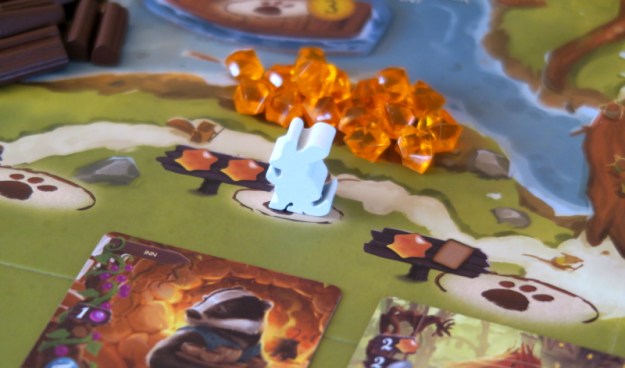
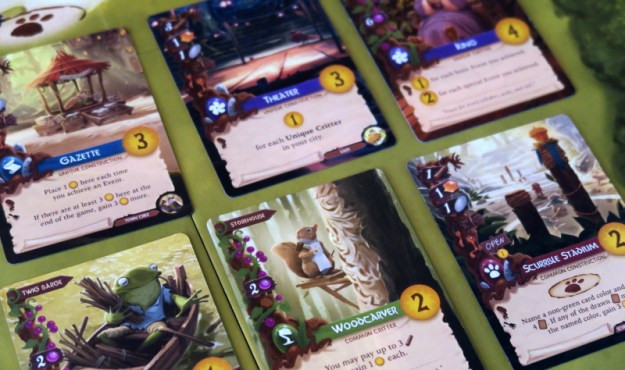
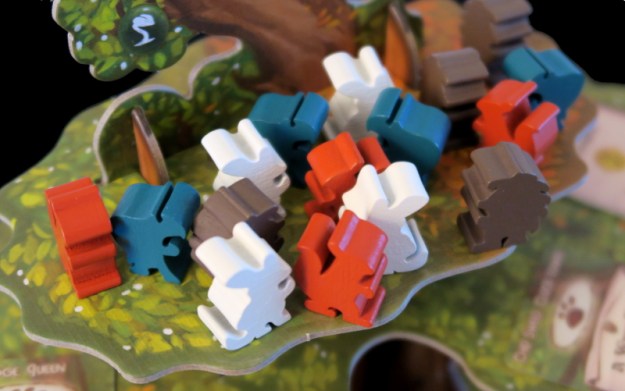
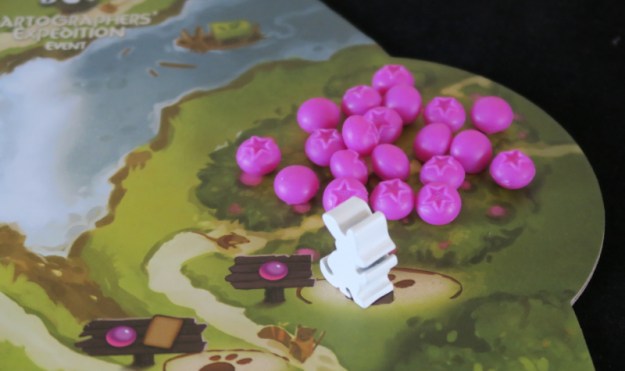
Everdell is a very good looking game, a card-driven, tableau building and worker placement game set in a woodland glade.  Players take the role of leader of a group of critters constructing buildings, meeting characters and hosting events by placing workers to get resources and spending them to play cards.  Everyone enjoyed the opportunity to choose their own wooden meeple animals out of a selection of over twenty different types.  Ivory went for the purple Platypuss, Purple went for a light purple Owl, Lilac went for orange Foxes, Teal chose the grey Hedgehogs , and Green wanted the Brown Bats.  By random selection using a mobile app, Teal was to go first.

Everdell
– Image by boardGOATS

It took a few turns to get the hang of the game, although it is not overly complex on the face of things.  It is one of those games where there are apparently lots of choices, but in practice they are clear and relatively simple:  players either place a meeple to get a selection of resources, or play a card into their tableau.  And then, when all possible choices have been exhausted, players move onto the next “season”.  The trick is working out how to extend the possible number of turns taken each season. Ivory was the only one of the group who had played it before, so had got it worked out.  Everyone else had moved into spring while he merrily carried on taking his turns in his winter!

Everdell
– Image by boardGOATS

Teal was the first to move onto spring, and this order continued through the rest of the game. At one point it looked as though everyone else would have finished completely, while Ivory was still in summer!  It didn’t quite work out like that, but Ivory did have several more turns after everyone else had finished.  The other trick to Everdell is to pair up the Critters cards with the Construction cards. By building a Construction, a player could then build the corresponding critter for free afterwards, thus giving them extra turns and extra bonuses.  Ivory did well in this, and his starting and early meadow cards fell his way.

Everdell
– Image by boardGOATS

Green and Purple also did well getting pairs of cards and playing them during the game. Unfortunately Lilac and Teal just couldn’t seem to get the pairings they needed. So it seems there is still a certain amount of luck in this game.  The other thing which surprised everyone was how quickly the group got through a very big stack of cards from the meadow draw pile.  After last time where we nearly failed finish Endeavor before the pub closed, the group set an alarm to give them a thirty minute warning before closing time as we were worried we may have the same problem this time.

Everdell
– Image by boardGOATS

By the time the alarm went off nearly two hours later, the game was all but finished—not bad for a new five player game.  Playing it again, the same group could probably do it in ninety minutes or less.  Would it get another outing though?  It certainly has cuteness factor in spades; it is interesting, and the game-play is not overly complicated; it has challenge in random variations, and many good looking expansions to enhance and change the experience. So, it will almost certainly get another outing and Ivory had better not put the box too far under the bed, as we’ll be wanting him to bring it along again in the new year.

Everdell
– Image by boardGOATS

After too much “cards with text” with Villainous last month, it was clear that Everdell was not a game ideally suited to Lime and Pine.  Instead, Blue said she had just the game for them: Cascadia.  Cascadia won this year’s Spiel des Jahres award, and had not yet had an outing within the group.  The game is very simple though:  players have a starting three hex terrain tile, and on their turn, they take a terrain hex and a wooden wildlife token and add these to their tableau.  Each terrain tile has one, two or three types of wildlife depicted on it, and the wooden tokens have to be placed on a terrain tile with matching wildlife symbol and that is more or less all there is to it.

Cascadia
– Image by boardGOATS

The interesting part is the scoring.  Players score points for the largest area they have of each of the five different types of terrain with bonus points for the player with the largest area of each.  That is simple enough, but they also score points for each of the different types of wildlife, and their scoring is different for each game.  The scoring depends on the location of each type of wildlife, for example, this time players scored for each set of three (and only three) adjacent bears.  They also scored points for each different type of wildlife between pairs of hawks.  Ribbons of salmon and groups of elk also scored as did foxes for each different type of wildlife surrounding them.

Cascadia
– Image by boardGOATS

The game play behind Cascadia isn’t very new or terribly original, with the tile laying elements giving a feel similar to games like Kingdomino, or even Carcassonne.  The variation in the wildlife scoring (with more wildlife cards available to add more variety), however, and the fact that the wildlife tokens are finite in number and are drawn from a bag, adds just a hint of something reminiscent of bag-builder games like Orléans or Altiplano.  As the group played and Lime and Pine got into it, Blue and Black started to appreciate the subtlety a little more.  The addition of special Keystone tiles that give players nature tokens when wildlife tokens are placed on them, also help players to mitigate the luck elements.

Cascadia
– Image by boardGOATS

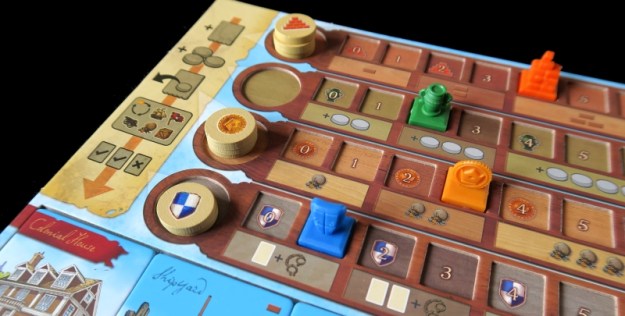
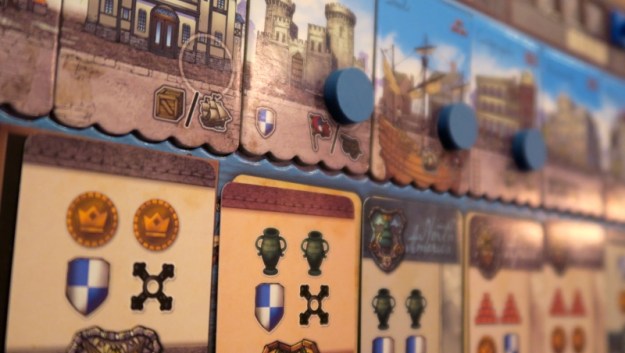
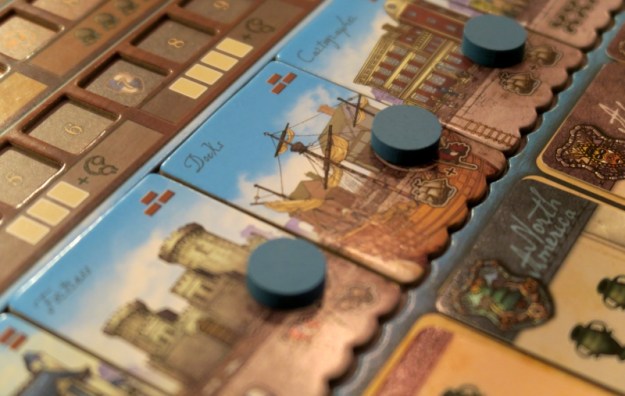
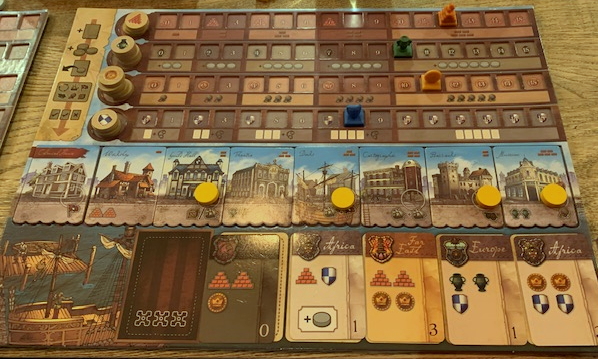
This time, foxes seemed to hide in the corner of the bag when players wanted them, then when they didn’t, they all came out of hiding.  Pine, inevitably put in a good showing and, despite everyone trying to persuade him, Lime succeeded in ignoring the advice to join his two groups of bears together (which would render them pointless).  The scores for the terrain were quite close with a spread of just a handful of points.  However, while Lime, Blue and Black had similar scores for their wildlife as well, Pine was eight points clear of his nearest rival giving him a final score of ninety-eight, ten points clear of Blue who was the best of the rest.  Pine and Lime had clearly enjoyed the game though and it will almost certainly get another outing soon.

Cascadia
– Image by boardGOATS

Lime excused himself, leaving Blue, Black and Pine to play something quick, taking less than an hour.  Although every time we play it, Pine points out that Bohnanza is not quick, this time he was persuaded because there were only three players and he wasn’t given time to think about it too carefully.  Bohnanza is one of the group’s most popular games, yet it hasn’t had an outing for ages.  The game play is very simple, but very interactive with a strong trading element. The active player first plays one or two bean cards from their hand into their fields taking care to keep them in the same order and only play the cards at the front.  They then turn over the top two cards from the deck and plant or trade them.  Finally when everything else has been dealt with, they can trade any cards in their hand with anybody else.

Bohnanza
– Image by boardGOATS

Cards are played into fields—with more players, each person has two fields in front of them and may buy a third, but with three, everyone starts with three fields.  This is important as each bean field can only hold one type of bean at any given time.  Beans can be harvested at any time to give coins and the game ends after three turns through the deck.  There are a few clever things about the game.  Firstly, players cannot harvest a field with a single bean in it unless all their fields have a single bean in them—this prevents players just cycling through beans they don’t want.  The really clever part of the game is that the fact that bean cards turn into coins when fields are harvested.  As the rarer beans are more valuable, this means they get increasingly rare as the game progresses.

Bohnanza
– Image by boardGOATS

This time, Blue planted two lots of Garden Beans early in the game which meant there were none available later.  Pine and Black shared the Black-eyed Beans, Stink Beans and Red Beans between them.  Blue planted lots of Green Beans and took it in turns with Pine to experiment with Soy Beans.  By the end, there were really only Wax Beans, Blue Beans, Coffee Beans and the occasional Green, Soy and Stink Beans.  With three experienced people playing, it was always going to be a tight game.  Pine finished with thirty “Bohnentaler”, a couple of more than Black, and was quite disgusted to find he was pipped by Blue by a single point.

Bohnanza
– Image by boardGOATS

Learning outcome:  Ikea need to sell a bigger Kallax.

Next Meeting, 15th November 2022

Our next meeting will be Tuesday 15th November 2022.  As usual, we will start playing shorter games from 7.30pm as people arrive, until 8pm when we will start something a little longer.

This week, the “Feature Game” will be Everdell (review, play through video, rules), a card-driven worker tableau building and placement game set in a woodland glade.  Players take the role of leader of a group of critters constructing buildings, meeting characters and hosting events by placing workers and playing cards.

Everdell
– Image by BGG contributor guzforster

Speaking of constructing buildings…

Jeff was working as a builder constructing a shed in a customer’s garden.  It was quite a wet day when he approached the backdoor of the house, knocked and asked the lady occupant if she could use the toilet.

The elegant lady looked down at Jeff’s extremely dirty boots and said, “OK, but let me just lay some newspaper down first.”

Jeff looked slightly offended and replied, “It’s OK, I am already trained.”

1st November 2022

Pine was the first to arrive and also the first to leave as he had just popped in to say “Hi!” while his baked potato was in the oven.  There were a few others missing as well, but still more than enough for two tables.  The “Feature Game” was Danger Circuit, an expansion for the card-driven bidding, racing, and betting game Downforce.  Downforce is based on the older game Top Race, which in turn is a reimplementation of several other games including Niki Lauda’s Formel 1. It is widely agreed to be one of the best car racing games, combining strategy and luck, especially when some of the expansion tracks are used.

Downforce
– Image by boardGOATS

Downforce comes in three parts:  a car auction, the race, and betting.  The game starts with the car auction where players bid on the cars using the cards they will use to race later.  The cards show how far the cars shown on it will move.  So when a player plays a card on their turn, they then move all the cars on it in order.  Some cards show only one car while others move more, even all six.  Before the start of the game, players are dealt the hand of cards they will use during the race and therefore know which car or cars over which they will have most control.  Using this information, they then chose a card to bid on each car, getting the card back, but making a note of the amount they “paid” to buy it.

Downforce
– Image by boardGOATS

On three occasions during the game, when the first car crosses a line, everyone makes a note of a secret bet—if the car they pick is placed in the top three, they win money.  This simultaneously makes and breaks the game, because it encourages players to help other players, however, it also means that if a player backs their own car and wins, they are almost guaranteed to finish with the most money.  For this reason, Blue was considering “House Ruling” the betting to use a variant, but as she wasn’t sure of the changes and had not printed the special betting forms, the group stuck with the rules as written.  The car auction is coupled with a Power auction.  The Powers allow players to break the rules of the game slightly to improve their chances.

Downforce
– Image by boardGOATS

The Danger Circuit expansion adds two new tracks with dangerous spaces and crossover loops as well as drivers with new skills.  This time, because most people had not played the game before, players simply drew two cards blind from the deck and picked their favourite.  Lemon won the first auction taking pole position and “Cunning”, which allowed her to control the movement her own car every time (instead of the active player moving it).  Unfortunately, she completely forgot about this in the excitement of the race, so didn’t capitalise on it.  Teal was “Defensive” so could move an extra three spaces if his car wasn’t on the card he played and Lime “Ambitious” which meant it could move an extra couple of spaces when it crossed a betting line.  Lime thought this would guarantee him an extra six spaces, but it didn’t quite play out that way.

Downforce: Danger Circuit
– Image by boardGOATS

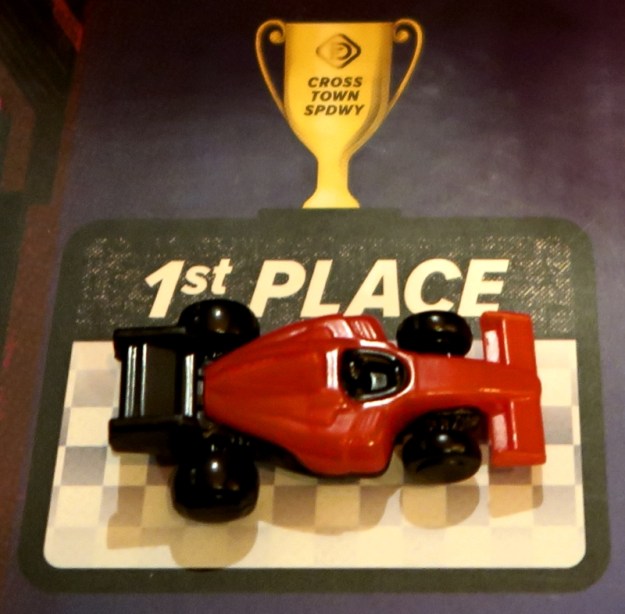
Pink was “Experienced” which meant he was able to take advantage of slip-streaming and move a space forward whenever a car immediately in front of him moved, and Orange was “Tricky” and could move the cars in reverse order on his turn.  Blue was the last to take a car and ended up with “Reckless” as her special power which meant that if she ever squeezed through a tight space she would get to move an extra two spaces.  All of these special abilities except Tricky and Cunning were from the Danger Circuit expansion.  The group chose the Crosstown Speedway track for the race (also from the Danger Circuit expansion), which features two hazardous crossover loops and a couple of split areas of the track, where players must choose between the shorter single-lane section or the longer, more wide open section.

Downforce: Danger Circuit
– Image by boardGOATS

Lemon got a good start from pole and took an early lead and Lime, in an effort to catch up, managed to overturn his car.  Although Lemon was the first to cross it, it was all quite tight at the first betting line.  From there on, everyone was committed and the race began in earnest.  Teal made good use of his special skill a couple of times and Orange used his to great effect as well.  The race was almost all over, however, when Lemon effectively declared her bidding by moving Blue’s red car into the lead and down the first single track shortcut section.  With everyone else either stuck in the bottle-neck of the two track section with a bit of a hairpin corner or stuck behind Blue’s red car, she was able to put a bit of a spurt on.

Downforce: Danger Circuit
– Image by boardGOATS

Keeping her foot on the gas she was able to put clear distance between herself and everyone else along the back straight and make for the line.  She couldn’t do it on her own however, but as a couple of others had backed her to win early in the race, it wasn’t long before she crossed the line and the race was on for second.  That was a lot closer, but eventually Teal trundled home at the front of the pack with Lime coming in third.  The aim of Downforce isn’t to win the race, however; the aim is to finish with the most money when betting, winnings and outlay are all taken into account.

Downforce: Danger Circuit
– Image by boardGOATS

Orange was the only one not to place a bet on Blue’s little red car at any point and with significant costs at the start, despite some excellent in race moves, he suffered as a result.  Everyone else was fairly close though, with just two million dollars between Lime and Pink in second and third place and the others not far behind.  Betting on one’s own car though, is unbeatable however, as long as it comes home first of course.  And in this case, Blue had backed her little red car throughout, so winning the race and betting on her own car gave her a huge payout.  With only one million outlay (it didn’t seem right for anyone to be able to set up a racing team for free), she finished with the maximum of twenty-nine million dollars.

Downforce
– Image by boardGOATS

The game had been a lot of fun, but having played it a few times now it was becoming clear that the betting skews the game a little.  The alternative betting Blue had suggested at the start has the potential to alter that.  The problem is that with players simply getting a straight pay out for betting on the winner, the race can become a bit of a self-fulfilling prophecy:  in this case, because several people bet on the red car to win, they were invested in it and it won.  The variant betting winnings depend on the position the car is in the race at the time when the bet is placed.  In this way it increases both the risk and the reward.  Because this encourages more diversity in the betting, it can mix things up a little and, as such, is definitely something to try before too long.

Downforce: Danger Circuit
– Image by boardGOATS

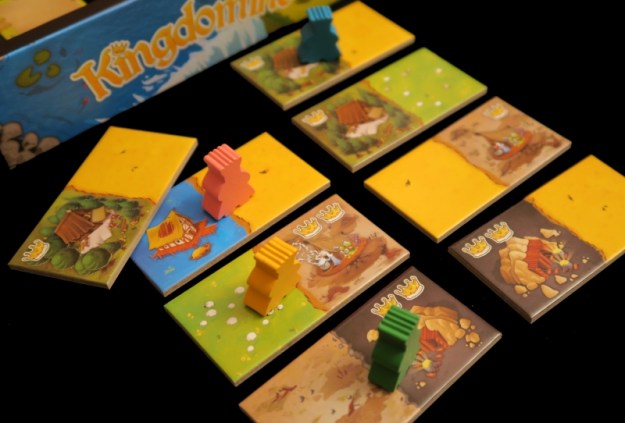
The neighbouring table were still playing, so although Teal and Lime decided to take an early night, the others continued with a game of Kingdomino.  This is a lovely light game that was the deserved winner of the Spiel des Jahres Award a few years ago and has been a staple within the group ever since.  Orange and Lemon were new to the game, however, so Blue and Pink explained the rules:  Players take a tile from “Today’s Market” and place their meeple on a tile of their choice in “Tomorrow’s Market”.  The clever part of the game is that the tiles are numbered with the highest numbers going to the most “valuable” tiles.

Kingdomino
– Image by boardGOATS

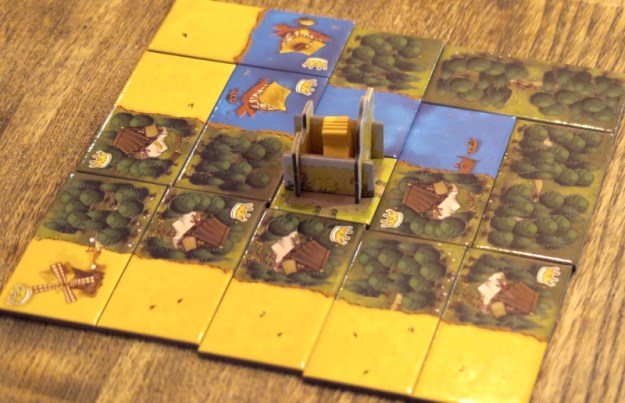
Tiles starting are taken starting with the lowest value ones, which means players have to choose between taking a high value tile (and getting a late turn next time) or positioning themselves early in the turn order for the next round (by taking a low value tile).  When players take their tiles, they add them to their “Kingdom” making areas of different types of terrain.  At the end of the game, players score points for the size of each terrain multiplied by the number of crowns depicted in that terrain, with bonus points for completing a perfectly square Kingdom with their castle in the centre.

Kingdomino
– Image by boardGOATS

This time, Orange went first followed by Lemon.  She started with a small woodland, which rapidly became a large woodland.  As it grew, she took the opportunity early and picked up lots of crowns.  This meant nobody else had any incentive to collect woodland tiles so she was able to pick more and make her woodland ever larger finishing with thirteen woodland spaces and five crowns giving her sixty-five points for that alone.  Nobody was very surprised when Lemon won, finishing with a massive ninety-three points, five more than Pink in second who had focused on pasture and arable.

Kingdomino
– Image by boardGOATS

Although the bar had called last orders and the game on the next table was working through their final round, there was just time for a very quick game of No Thanks!.  This is a superb filler with almost zero setup time—just the kind of game the group loves in such circumstances.  The idea is super simple:  the top card of the deck is turned over and the active player has to choose whether to take the card or pay a chip to pass the problem on to the next person.  Eventually, someone weakens and takes the card and the chips.  At the end of the game, players add up the face value of the cards in front of them and subtract the number of chips they are left with to give their score: the lowest is the winner.

No Thanks!
– Image by boardGOATS

There are two catches:  firstly, for any runs of consecutive cards, only the lowest value card counts.  Secondly, nine cards are removed from the thirty-two card deck at random and in secret before the game begins, making the decision to take or leave a card considerably more difficult.  No Thanks! is a simply great game to teach and so much fun for the time it takes, so is ideal for a game at the end of the evening.  This is another group “staple” and yet Lemon and Orange had somehow missed out.  That was quickly rectified, and like everyone else, the realisation of the simple considerations was apparent as the game developed.

No Thanks!
– Image by boardGOATS

This time, Pink collected a lot of chips, while Orange and Blue collected a lot of cards.  Lemon almost ran out of chips at the end, but had also managed to avoid picking up any high value cards.  Lemon just managed to hold out finishing with thirty-nine points, eleven less than Pink, taking her second victory of the evening.  By this time, the bar was closed and the players on the next table were scrabbling to finish.  They had been playing Endeavor: Age of Sail, a game that was new to Plum, though Black, Purple, Green and Lilac had all played it before.  The game is relatively simple in concept, though one of those games where the interactions make the decisions challenging.

Endeavor: Age of Expansion
– Image by boardGOATS

The game is played over eight rounds, each consisting of four basic phases: Build, Populate, Payment and Action.  The four technology tracks roughly correspond to each phase and dictate what a player can do during that phase.  For example, how far along the building track a player is dictates what they can build: the further along they are, the more buildings they have to choose from.  Similarly, a player who is further along the population (or culture) track, can move more people into their harbour for use in the Action phase.  Payment also increases the number of people available as it moves population markers from the action spaces into the harbour.  More importantly, however, it makes the action spaces available again for use later in the round.

Endeavor: Age of Sail
– Image by boardGOATS

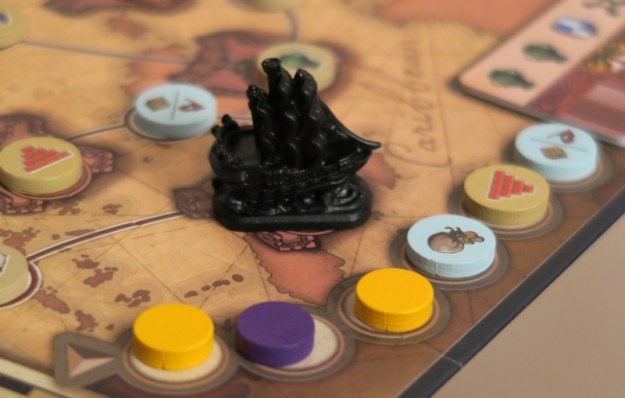
The guts of the game, however, is the Action phase.  when players place population markers on their buildings to activate them and carry out one of the five actions:  Colonise, Ship, Attack, Plunder Assets, and Pay Workers.  These are generally based round the central board which is divided up into seven regions representing the seven continents.  Each continent comprises several cities, a shipping route and a deck of cards. At the start of the game there is a Trade token on each city and each shipping space, but also on many of the connections between cities (these are taken if a player occupies both cities either side).  Players cannot Colonise a city until they have a presence in a region, which they can do by Shipping, using two markers, one to activate their building that provides the shipping action and one to place on the shipping track.

Endeavor: Age of Sail
– Image by boardGOATS

Players also need two population markers to Colonise (one for the action and one to occupy the city) and three if they are going to attack an already occupied city (one is collateral damage).  At the end of the game, after eight rounds, players score for occupied cities, connections and cards as well as points for progress on their technology tracks.  Although Green had been keen to include the last of his unplayed exploits from the Age of Expansion expansion, because Plum was new to the game, the group stuck to the base game. With hindsight that was a doubly good decision given the time constraint at the end and the table wasn’t really big enough for the extra boards anyhow.

Endeavor: Age of Sail
– Image by boardGOATS

Black put out the board while Green pulled out all the bits that were needed, Lilac randomly selected the Level Five buildings (all of them were money action ones by chance) and Plum familiarised herself with the pieces and symbols.  Then everyone helped place all ninety-six tokens onto their spaces on the board.  When finished there were three empty spaces:  one missing token was elsewhere on the board not in a spot and one was found hiding in the corner of the bag, but the last one remained elusive.  The group hunted through the box, on the floor, but nothing. They were in the process of selecting a random cardboard token (the group were playing with the Kickstarter wooden tokens) when someone finally spotted the missing piece lurking in North America.

Endeavor: Age of Sail
– Image by boardGOATS

So finally the game was set up and ready to play, just a quick run through of the rules primarily for the benefit of Plum, but also for everyone else as the game had not had an outing for a while.  The first couple of rounds were fairly quick and by the end of them everyone seemed to know what they were doing.  Throughout the game, Green found himself with more citizens than he could use, largely courtesy of going down a card route and claiming two of the Level One cards to give him extras.  Black seemed to be having the opposite problem as he proved to be the miser of the group and not able to pay his citizens enough.  Lilac was busy occupying Europe, while Plum and Purple were busy shipping and opening up India and Africa respectively.

Endeavor: Age of Sail
– Image by boardGOATS

Later in the game Black and Plum were looking to be doing well and there had been very little attacking going on—a very friendly expansion.  It was then that the group realised that they were playing with the wrong side of the board:  they were using the 2/3/4 Player board when we should have been using the other side for 4/5 Players.  The rules described the side they were one as a “High Conflict Four Player Game”, which presumably made theirs a Very High Conflict Five player game!  So what is the difference? Both boards use the same number of tokens (ie all of them), but there are more shipping routes and fewer cities on the 4/5 Player board. On the 2/3/4 board there were also more tokens in the link spaces, so those occupying had a slight advantage.

Endeavor: Age of Sail
– Image by boardGOATS

At this point the group realised they would all be needing more cannon.  Black was happy with that as he had recently acquired a Fortress Occupy/Attack.  Purple had one as well and had also managed to acquire a couple of blue Attack action tokens.  Green now realised he had boxed himself into a corner as he did not have any Occupy actions, only Shipping.  For one of his last buildings he grabbed a Fortress, as did Plum and Lilac.  The last round or two of the game involved a lot of to-ing and fro-ing as attack’s reigned down, particularly between Black and Purple as they traded blows over the America’s routes.  It was this that did for Black in the end:  looking like the player most likely to win, he became a target and lost a few points as a result.

Endeavor: Age of Sail
– Image by boardGOATS

By now the group had to rush the end, take pictures and throwing everything back in the box to be sorted later. The scores were to be calculated later from the pictures, but leaving, the group thought it would be close between Black, Plum and Lilac, although Lilac was convinced she wouldn’t be in the mix at all.  The later review of the final scoring proved that it was indeed between those three, and quite close too, although Lilac with sixty-three had a significant enough lead over the other two.  Despite the errors made and the quick finish everyone really enjoyed the game and are keen to play it again soon, perhaps with those exploits from Age of Expansion, but it’ll need a bigger table and it would probably be wise to use the correct side of the board too…

Endeavor: Age of Sail
– Image by boardGOATS

Learning outcome:  Backing yourself is sometimes a risk worth taking.

Boardgames in the Nude: A Report in The Independent

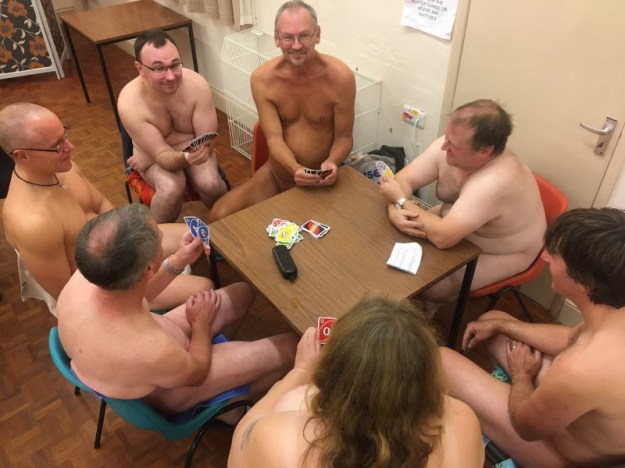
Board games have long been a tradition in Germany, as has naturism, but a recent report in The Independent suggests that in rural Lincolnshire they have taken to combining the two German traditions.  NakedLincolnshire organise “Social Nudity, Naturism and Clothes Optional Events”, and one of their recent events, attended by Colin Drury, was a games night in the Hemswell and Harpswell Village Hall.  The report suggests they played Chess, UNO, Snakes and Ladders, Scrabble and other family-friendly fayre, so perhaps someone might like to go along to their next event introduce them to some more modern games?

Uno
– Image from The Independent

Next Meeting, 1st November 2022

Our next meeting will be Tuesday 1st November 2022.  As usual, we will start playing shorter games from 7.30pm as people arrive, until 8pm when we will start something a little longer.  Please note that the pub will not be serving food on Tuesdays for the foreseeable.

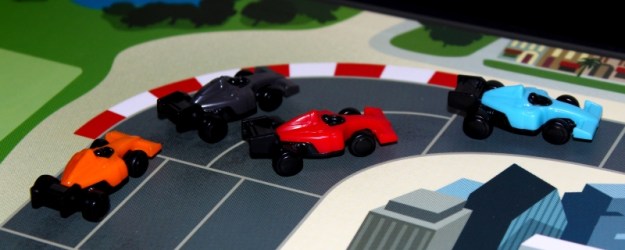
This week, the “Feature Game” will be Downforce: Danger Circuit (rules), an expansion for Downforce (review, play through video, rules).  Downforce is a card-driven bidding, racing, and betting game based on the older game Top Race (which in turn is a reimplementation of several other games including Niki Lauda’s Formel 1).  The Danger Circuit expansion adds two new tracks with dangerous spaces and crossover loops as well as drivers with new skills.

Downforce
– Adapted from Image by BGG contributor kalchio

Speaking of car racing…

Jeff and his mate Joe were chatting about how they had both been enjoying the current Formula One racing season.

“It’s great that I have Sky, because it means I can watch every race, ” said Joe.

Jeff answered sadly, “I keep trying to watch racing on my computer but every time I press the F1 key it just opens a help window.”