Next Meeting, 27th May 2025

Our next meeting will be on Tuesday 27th May 2025.  As usual, we will start playing shorter games from 7.30pm as people arrive, until 8pm when we will start something a little longer.  Due to a recent change of hands, the pub is NOT doing food at the moment.

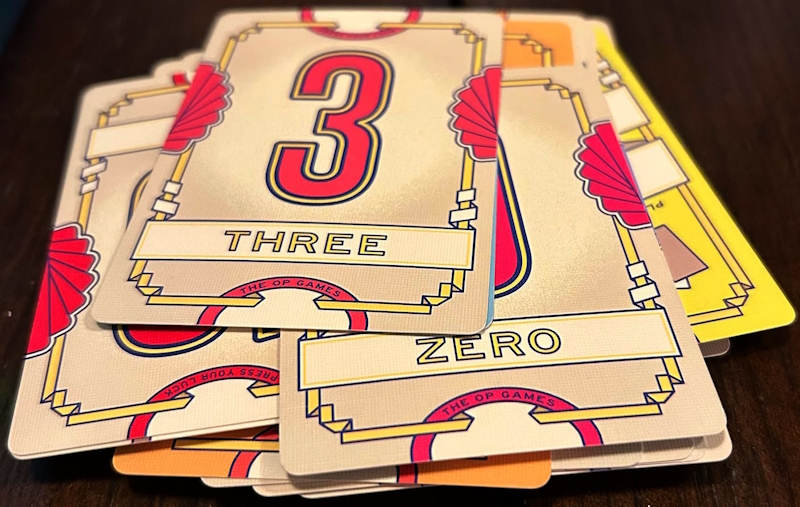
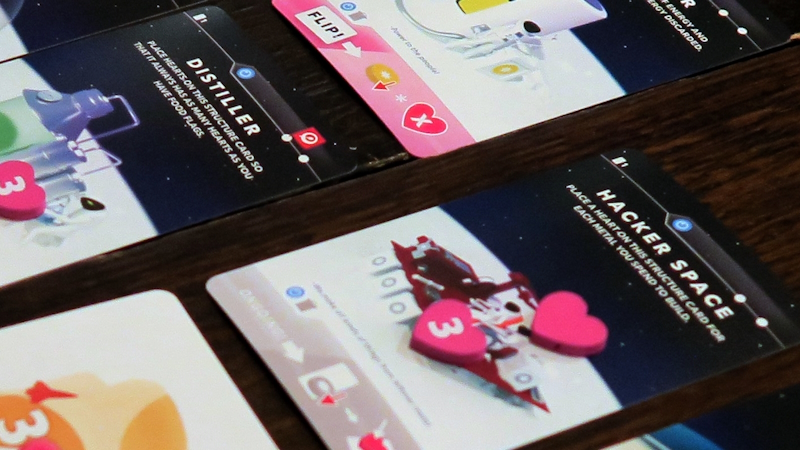
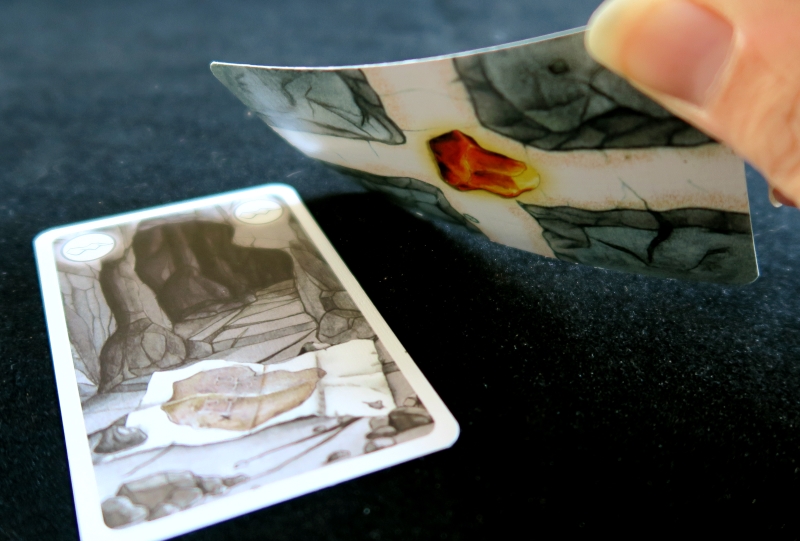
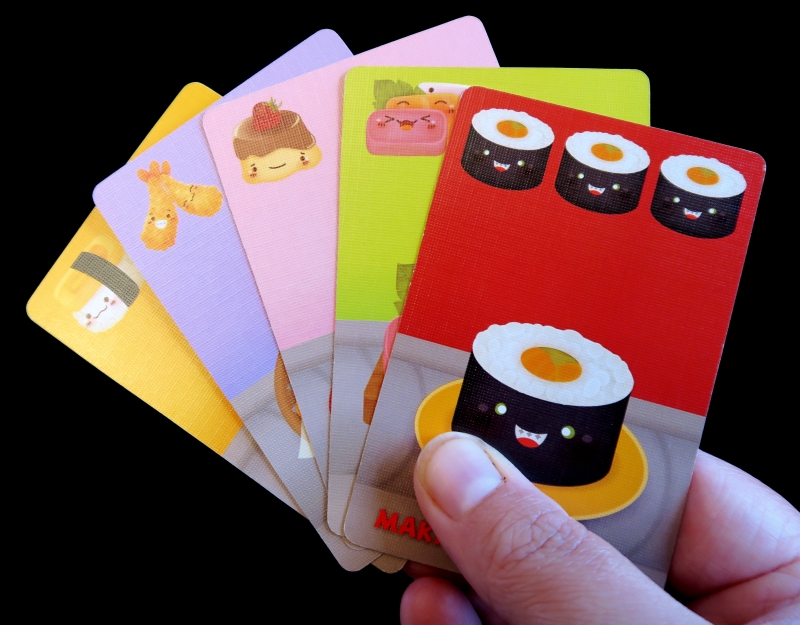
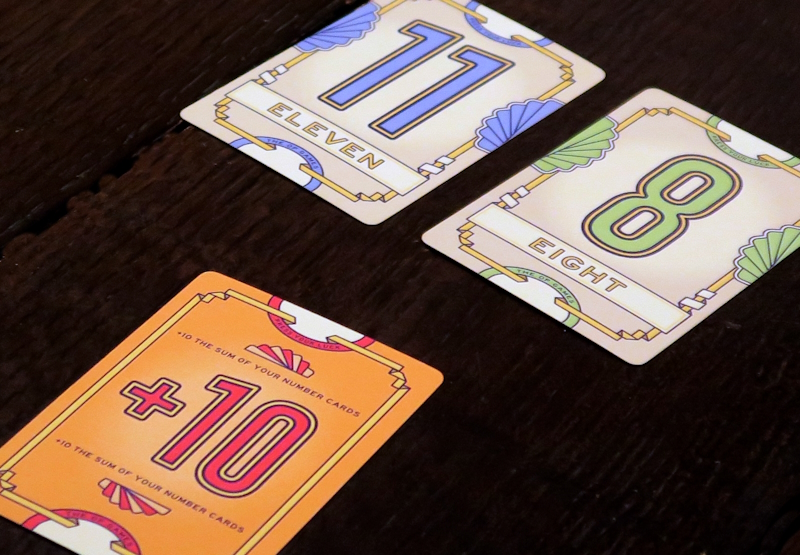
This week, the “Feature Game” will be Flip 7 (rules, tutorial video, review).  This is a quick, push-your-luck card game along the lines of Blackjack that recently won a Golden Geek award and received a nomination for the Spiel des Jahres.

Flip 7
– Image by boardGOATS

And speaking of card games…

Jeff was chatting to Joe over a pint one evening.

“My wife says she’s leaving because of my obsession with Poker,” said Jeff.  “But I think she’s bluffing…”

8th April 2025

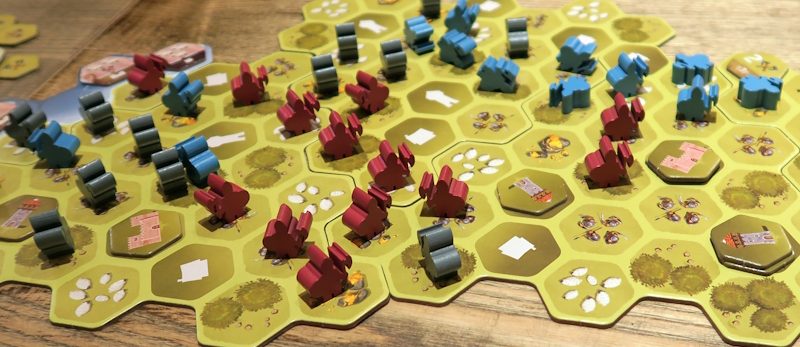
By the time everyone else started to arrive, Cobalt was already most of the way through losing his game of 20 Strong.  This is a solo-player deck-based game where the object is to progress through a shuffled deck of cards, each of which bears a unique challenge. This challenge could be in the form of an enemy, a unique scenario, or some other requirement which are completed by rolling a set of seventeen dice with different odds for a hit.  These dice, along with three adjustable stat dice, make up titular twenty dice.  Cobalt continued rolling his dice while others ordered food, chatted and ate.

20 Strong
– Image by boardGOATS

Before long players began splitting into groups, deciding what to play.  The first group was Blue, Pine, Mint and Pink playing the “Feature Game” which was to be Fire Tower.  This is a competitive game where players order air drops of water, and plan the building of firebreaks in order to combat a woodland blaze.  The rules are very simple:  players begin their turn by spreading the fire in the current wind direction then play one card from their hand (or discard all their cards) and replenish their hand.  There are four different types of cards, Wind, Fire, Water, and Firebreak cards.  Wind cards can be used to change the Direction of the Wind which affects which direction the fire spreads in.

Fire Tower
– Image by boardGOATS

This can either be by playing the card and changing the Wind Direction to that on the card, or by rolling the Wind die and leaving it up to fate.  Alternatively, the player may place a fire gem on one empty space orthogonally adjacent to an existing fire space (or the central Eternal Flame), in the wind direction indicated on the card.  Fire, Water and Firebreak cards give a pattern of spaces that the fire must either spread in, is removed from, or fire break tokens can be placed in.  Firebreaks prevent fire from landing on or jumping over the spaces they occupy and can only be removed using a card that includes the De/Reforest action and cannot be placed in orthogonally adjacent to another Firebreak token.

Fire Tower
– Image by boardGOATS

Each player took the Fire Tower on one corner of the board with Pine sitting opposite Blue and Mint opposite Pink.  Blue went first followed by Mint, then Pine and finally Pink.  The base game is an elimination game, with the winner the being the last player who’s Fire Tower has not be burnt down.  The group decided to play without the events and keep the game as simple as possible to see how things worked.  Pink was the first to get knocked out with Firestorms proving to be disastrous for his Tower.  Pine quickly followed with before there was a long, determined rear-guard action by Blue.

Fire Tower
– Image by boardGOATS

Unfortunately, Mint started in a better position and despite her best efforts, eventually Blue’s Tower was also a moldering ruin.  Since Pink and Pine had spent quite a lot of time as spectators, the group decided to give it a second go, but this time working in pairs.  This time, Blue’s Tower was first to be destroyed with Mint’s next.  Eventually, only Pink’s tower was still standing giving a second victory to Mint, which was shared with Pink.  The game had been quite enjoyable, if very different to the usual fare.  There was still plenty of time left for something else though, so the group had a rummage in the bags and came up with Draftosaurus.

Draftosaurus
– Image by boardGOATS

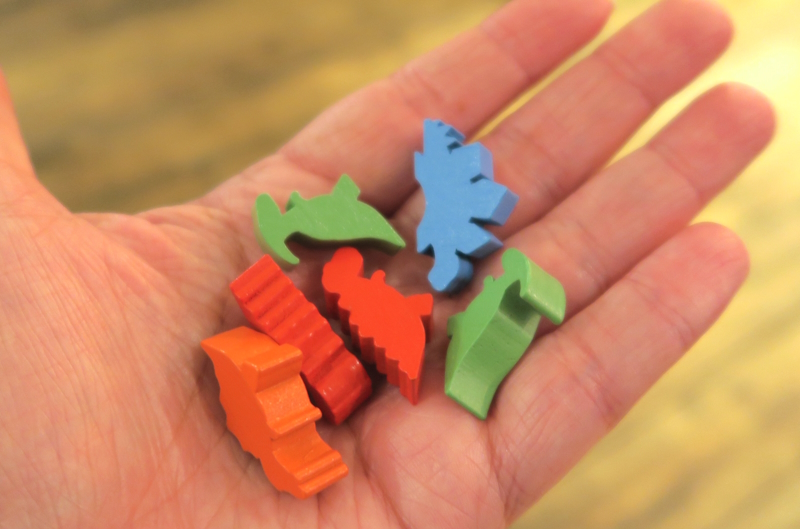
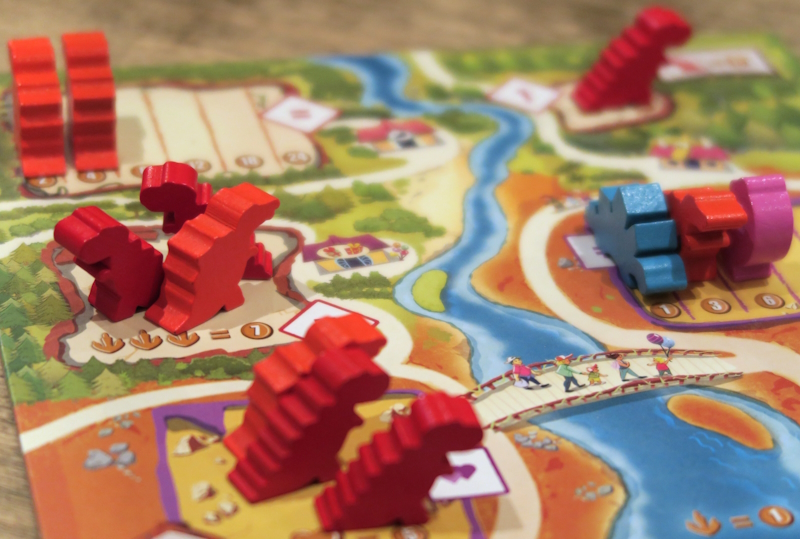
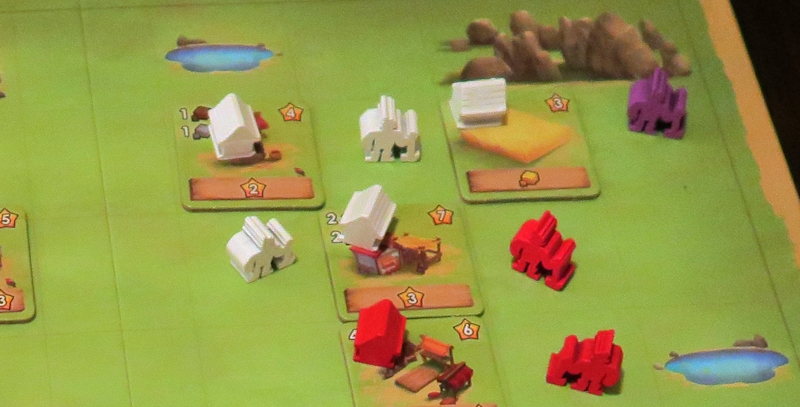
This is a very popular game where players start with a hand of dino-meeples, choose one and pass the rest on before placing them in their dinosaur park.  It frequently gets outings within the group, but on this occasion, for variety, the group decided to play with the winter setting which gives slightly different pens with slightly different placement conditions.  It was very tight, but as is often the case, Pine, who just seems to “get” this game emerged the victor with thirty-six points.  He was only one point ahead of Mint and Pink though, who tied for second place.

Draftosaurus
– Image by boardGOATS

Meanwhile, on the next table, Green putting in a rare, but welcome appearance, was leading Black, Purple and Plum in a game of Discworld: Ankh-Morpork.  In this game, Lord Vetinari has disappeared and players control different factions which are trying to take control of the city.  Game play is quite quick and simple with players playing a card and doing what it says.  Most cards have more than one action on them, and players can choose to do some or all of these actions. Some cards also allow people to play a second card, so they can chain actions together.

Discworld: Ankh-Morpork
– Image by boardGOATS

In this game, Black was the Dragon King of Arms, looking for trouble, Green was Chrysoprase, trying to amass lots of money, Plum was Commander Vimes who was trying to play through the deck and Purple was Lord Rust, with an area control remit.  The game was over quite quickly with Black running out the winner in a game that is much under-rated and sadly very out of print due to IP issues.  This copy was a much cherished one, as it had belonged to Burgundy so it was nice for it to get another outing within the group.  There was time for a second game and this ended up being Faraway, a very clever, much more recent, card-driven game that has had a few outings since its release last year.

Faraway
– Image by boardGOATS

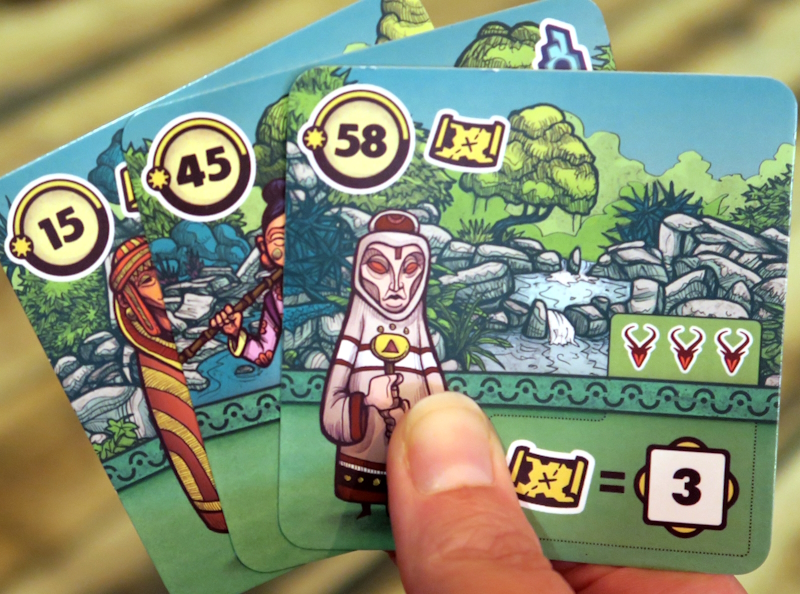
The idea is that players simultaneously chose one of the numbered cards from their hand and starting with the the player that played the lowest card (similar to 6 Nimmt! or Kingdomino), everyone takes it in turns to choose one from the market to add to their hand.  Players then simultaneously choose another card, and again, choose one to add to their hand.  The game ends after everyone has played a total of eight cards, and then everyone scores.  The clever part is that the cards are played left to right, but the scoring is from right to left.
Faraway
– Image by boardGOATS

At first glance, this looks like it makes things easy, because early in the game players find out what they need to get points and can then focus on getting the resources they need as the game progresses, but of course that is not the case.   This time, Purple had a really bad run where she kept getting the highest number cards, which meant she picked last, and then picked up the higher number cards left by others.  Once again, the winner was Black making it two out of two for him, while Plum was second by seven points with Green a little way behind her.

Faraway
– Image by boardGOATS

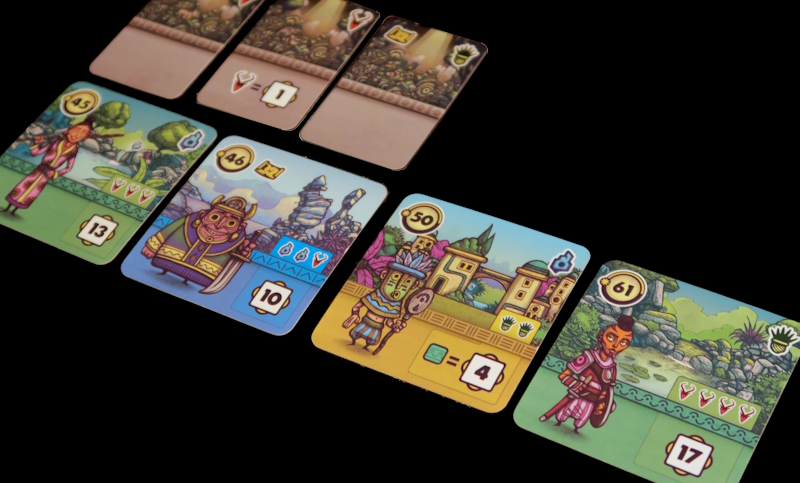
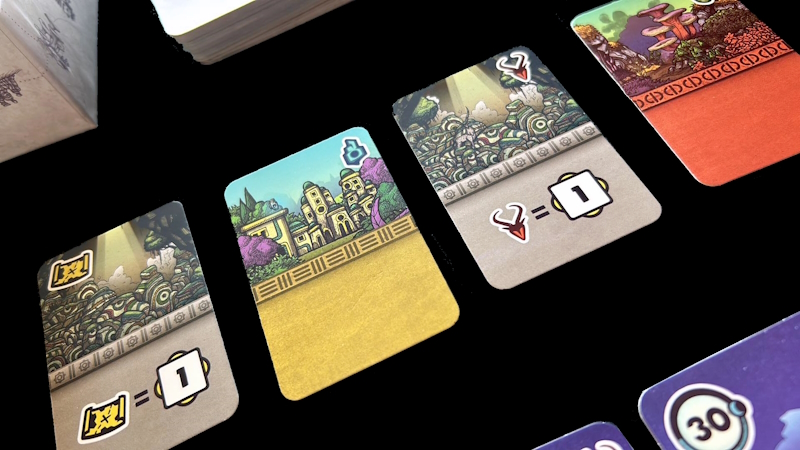
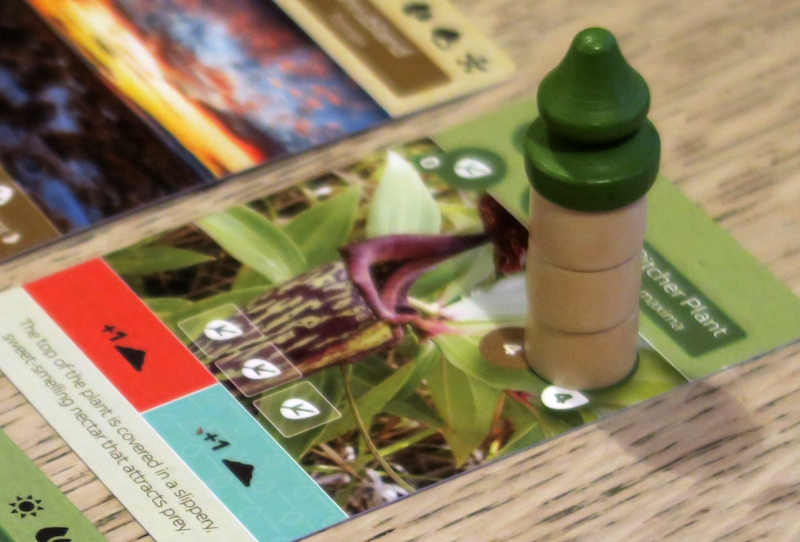
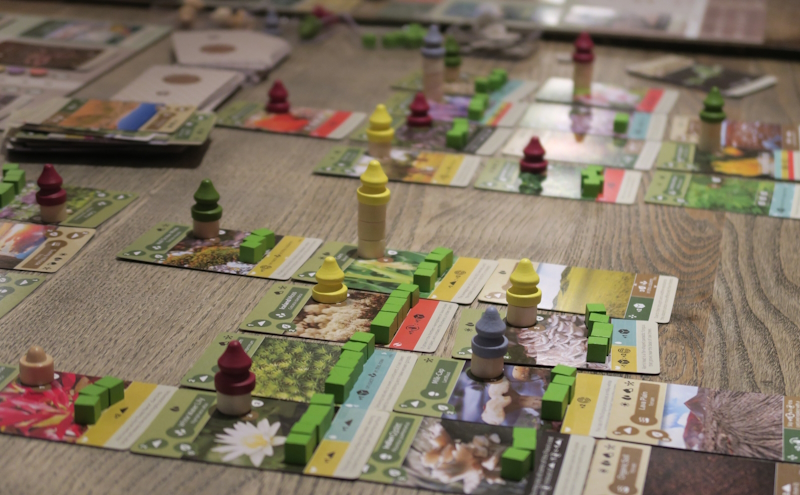
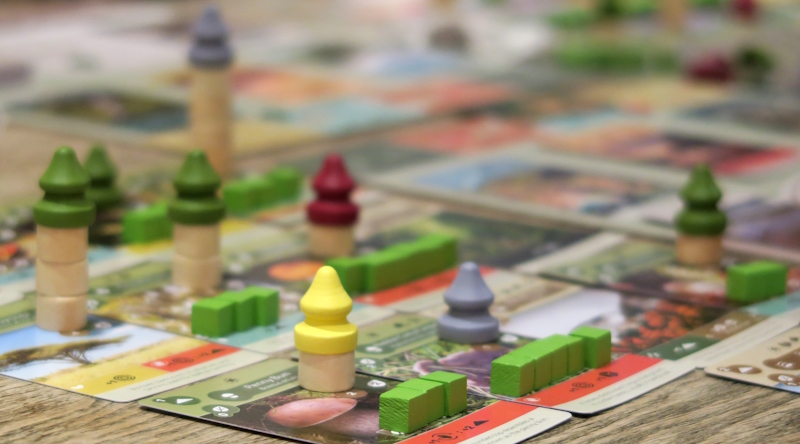
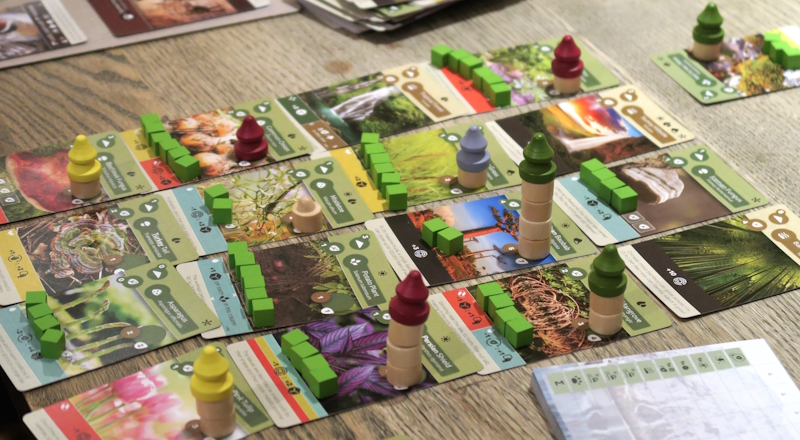
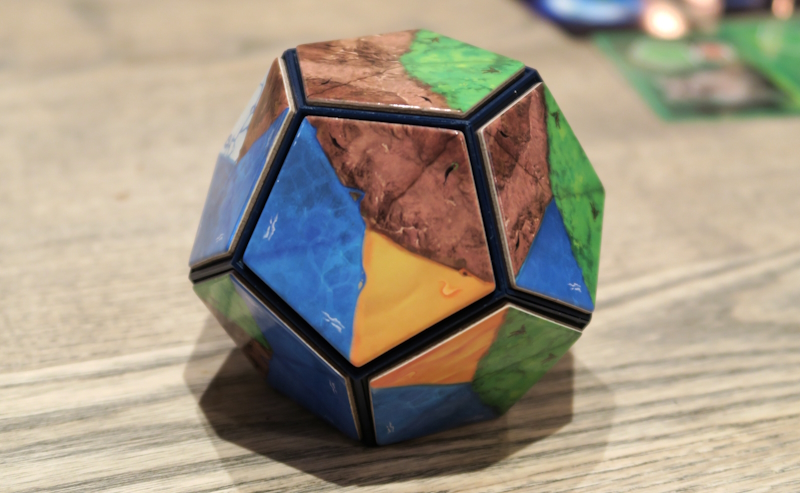
Meanwhile, the third group comprising Jade (fresh from his birthday celebrations), Sapphire, Teal, Byzantium and Cobalt spent the evening playing a five-playergame of Earth.  This is a is a sumptuously illustrated card-driven engine-builder game that is often compared to Wingspan, where players are building themselves an ecosystem.  The game itself is not actually all that complicated. Players are building a four by four grid of Flora and Terrain cards which represents their island and during the game they will plant flora, water it and allow it to grow.  On their turn, players do one of four things: Planting (paying the cost in Soil tokens), Composting (gaining Soil and placing cards from the deck in their discard pile), Watering (place Sprouts and gain Soil) & Growing (draw new cards and place growth tokens).

Earth
– Image by boardGOATS

A bit like Puerto Rico, once the active player has chosen which action they are taking, everyone else gets to do a subsidiary, slightly weaker version of the same action.  Once everyone has completed the action for the turn, everyone activates all the cards in their island that match the colour of the action chosen, starting with the card in the top left and working across each row in turn.  At the end of the game (triggered when one player has completed their island), players score points for each flora card, any Trunks and Canopies they have grown, their Sprouts and their pile of “Composted” or discarded cards.  Players also score points for achieving objectives on the Fauna cards revealed at the start of the game and for completing their island first.

Earth
– Image by boardGOATS

During the game, Cobalt built up the most points; his forty-two were some five ahead of Byzantium.  By far the most points come in the end-game scoring however.  A bit of a point salad there are seven scoring sections:  Teal scored best for Compost; Jade scored most highly for completing his Canopies; Byzantium top-scored for Terrain, and Cobalt out-scored everyone else for his Fauna.  As well as getting the most points for his Sprouts and Ecosystem Objectives, Sapphire also scored well in many of the other categories giving him a clear victory with one hundred and sixty-eight points, thirteen more than Byzantium who pipped Cobalt for second by a single point.

Earth
– Image by boardGOATS

Learning outcome:  Playing with fire may be fun, but you risk getting burnt.

25th March 2025

With a generally Japanesey theme planned for the evening to mark the official start of the Japanese Cherry Blossom Season, Blue and Pink, the early arrivals considered 5×5 Zoo, Songbirds and Honshū which were all abandoned variously because the rules were in Japanese, the game was too complex, or it didn’t natively play two.  In the end, they settled on Sprawlopolis, which although very definitely not Japanese, did at least have a bit of a Japanese feel to it.  The game is a simple quick cooperative micro-game where players take it in turns to at to their city by placing cards.

Sprawlopolis
– Image by boardGOATS

Each card is quartered with each section showing one of the four different zones, green Parks, brown Residential, grey Industry and blue Offices.  The players score a point for each piece in the largest region of each city zone minus the number of roads, plus scores for each objective.  This time the objectives were “Master Planned”, “The Outskirts” and “Sprawlopolis” giving a points target of twenty-five.  It was close and, as Blue and Pink weren’t quite on the same wavelength with their planning (communication is allowed without describing the cards in hand) it was didn’t look like they were going to make it, but in the end, they topped the target by two points.

Sprawlopolis
– Image by boardGOATS

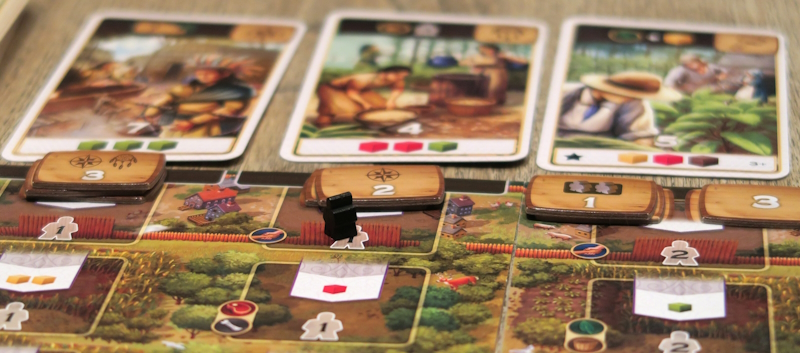
By this time, everyone else had arrived so the group split into three with the first group, a large group of six playing the “Feature Game” which was Habesuto (aka ハーベスト) which translates as “Harvest”.  This is a quick game from Japan about building a farm, growing vegetables and distributing produce. On their turn players play a card onto the central board and then replenish their hand.  Each player owns a field in the central play area; if that field is empty then players must play a card into their own field, thereafter, they can play anywhere.  When a row of three or more cards is created, the cards are scored, with the cards, and therefore points, going to the owner of the field, but points can be positive or negative.

Habesuto (aka ハーベスト or Harvest)
– Image by boardGOATS

There are special cards like the Tornado which removes cards and the wild Harvest card.  There are three vegetable suits of cards (red, yellow and green) each with five denominations, ten, twenty, forty, and minus ten and minus twenty.  At the end of the game, when everyone has run out of cards or is unable to play, players score the value of each card in their score pile.  To this they add fifty points if their field is empty, but subtract fifty points for each special card left in their hand.The game is really quick and nasty.  Initially everyone felt their way through and began playing nicely.  The niceness was reflected in the scores which were very even—Teal was the winner with a hundred points, but it was a three-way tie for second between Sapphire, Ruby and Lime.

Habesuto (aka ハーベスト or Harvest)
– Image by boardGOATS

Everyone had got the feel of the game and wanted to play again, but this time, the gloves were off.  Second time round, Ruby was the victor with Teal increasing his score, but dropping down the rankings into second with a hundred and sixty.  Jade came in third, twenty points behind.  The third round was a bit more evenly balanced, with Lime taking first place with a hundred and thirty and Flint the only other player to make it into three figures.  Teal went from hero to zero and finished the final game with minus ten.  From there, the group decided to move away from Japan and into a world inhabited by cute animals with River Valley Glassworks, which got its first outing just a week ago.

River Valley Glassworks
– Image by boardGOATS

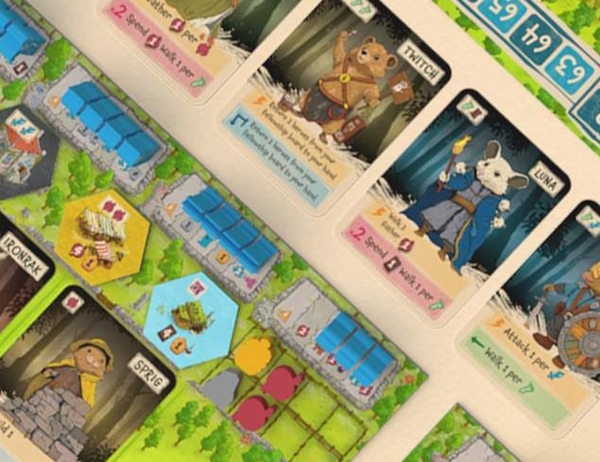
As River Valley Glassworks plays a maximum of five, Jade taught and acted as umpire.  In this game, players take it in turns to play a piece from their inventory into the river. Each river tile can take only a specific shape, and players have to play into a space adjacent to where they want to draft from. After claiming their glass, the river shifts forward revealing new pieces.  Glass is stored in players’ shops, and the scores depend on where the glass is placed with completed rows and columns giving bonus points.  However, too many of one type gives negative points.

River Valley Glassworks
– Image by boardGOATS

The game process is simple enough:  either place a piece of glass onto a river tile or draw exactly four pieces from the lake with the aim of collecting a rainbow of glass pieces but the challenge is getting the balance right.  In the end, the group did a “Lime”, that is, played it once and then decided to give it another go.  First time round, the battle was between Ruby, Sapphire and Teal with Ruby holding off Sapphire by four points who in turn, just pipped Teal by one.  By the second time, Teal had got the hang of things and won by a bit of a land-slide, finishing with sixty-six, eighteen more than Lime in second.

River Valley Glassworks
– Image by boardGOATS

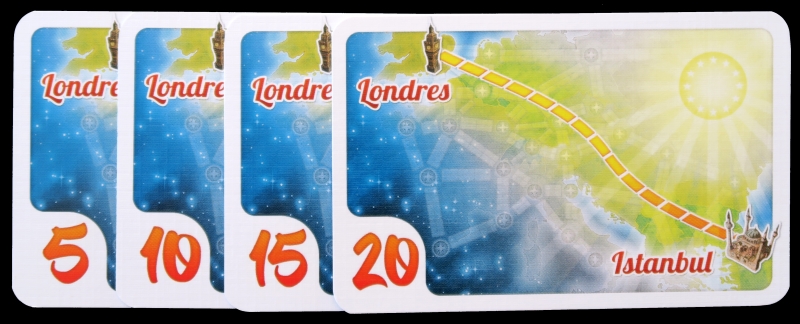
Meanwhile, on the other side of the room, Plum, Ivory, Byzantium and Blue settled down to play another Japanese game, which turned out to be something of a secret favourite amongst them: Yokohama.  This is a sort of path building game, almost like a heavier version of the popular game, Istanbul.  Players operate a Merchant who travels around building their business.  They also have Assistants, Shops and Trading Houses.  On their turn, players deploy one Assistant in three different areas or two Assistants in one area, then they move their Merchant.  Merchants can move as far as they like, but can only travel through locations occupied by their Assistants and cannot finish in an area already occupied by another Merchant.

Yokohama
– Image by boardGOATS

Players then perform the action associated with their destination, with the level depending on the Power of that player at that location.  The Power is the player’s presence in that location, i.e. the sum of the President (equal to one), any Assistants and any Buildings.  The more Power, the better the resultant benefit.  A Power of four or more enables the player to build a Shop or Trading house at the location which will earn additional points or other rewards as well as providing more Power on future visits.  Any Assistants at the location are “used” and returned to the player to be placed on a later turn.

Yokohama
– Image by boardGOATS

As in Istanbul, the different locations provide different benefits.  There are locations that provide resources (Tea, Copper, Silk and Fish), some that provide Order cards (Dock or Port) or Technology cards (Laboratory or Research centre) and others that enable players to get more Assistants, Shops or Trading Houses (Employment Agency), Money (Bank) or points (Church and Customs).  Ivory started quickly, grabbing early points for the game focuses (lots of Tea) and getting some buildings placed, while Blue ended up with a pile of initially unwanted Fish and Plum spent some time tripping over everyone else.  Byzantium, didn’t seem to be doing much but Plum rather ominously said that was the way he played the game, just before winning by a huge margin.

Yokohama
– Image by boardGOATS

Ivory made great headway getting the goods to give him twenty-two points from the Customs House, but just as the game came to a conclusion he ran out of steam having spent lots of turns playing only two Assistants as opposed to three.  It was a close run thing in the end with barely ten points between first and last, indeed, Ivory finished a single coin away from getting the ten point Technology that would have given him the game.  As it was, Plum’s prediction proved right and victory was taken by Byzantium who had quietly got on with his game, mostly unnoticed by everyone else.  It wasn’t the landslide foretold though, as his hundred and six points was only three points ahead of Plum in second.

Yokohama
– Image by boardGOATS

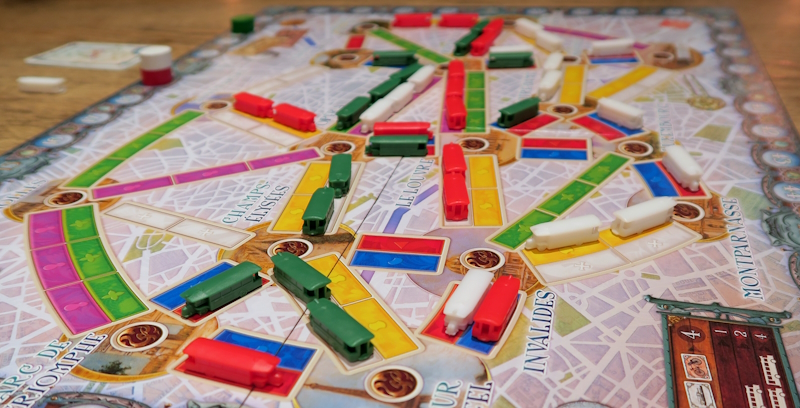
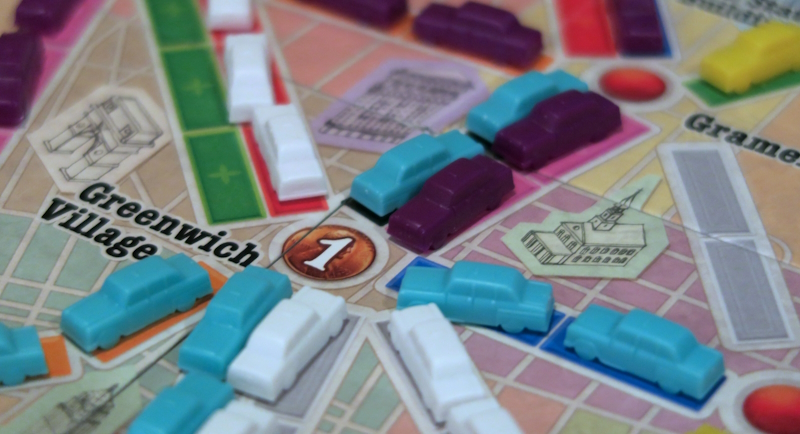
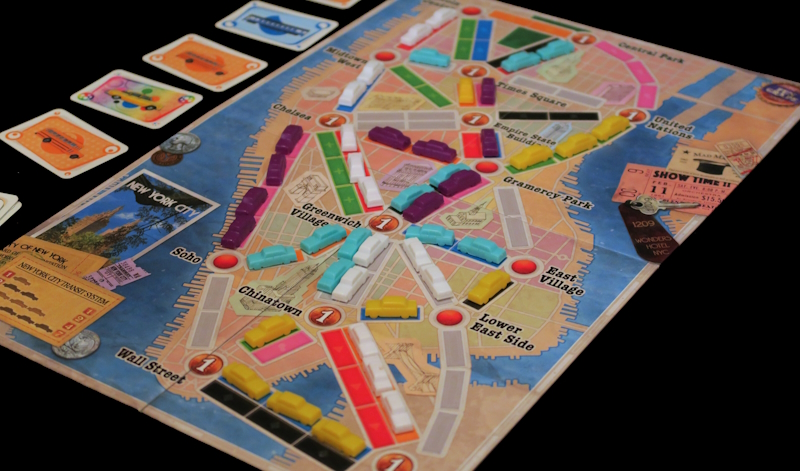
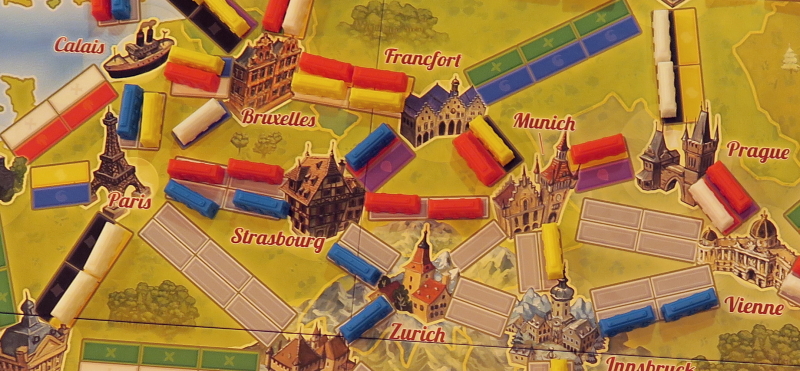
The last group were Blue, Pine, Purple and Black who started off with a game of Ticket to Ride with the Japan expansion.  This is played much like the original base game i.e. players take cards from the market or play cards to place trains; score points for placing trains and completing Tickets.  Like all the expansion maps, the Japan map has its own set of additional features, in this case, these a mostly focused on the Bullet Train which runs through the centre of the long thin board.  Once these routes have been claimed, they can be used by all players to complete destination tickets.  Instead of scoring points for such routes, players progress along the Bullet Train track.  Whoever has contributed most to this shared project at the end of the game receives the largest bonus, with the player who contributes least being penalised.

Ticket to Ride Map Collection: Volume 7 – Japan & Italy
– Image by boardGOATS

Last time we played this game there was a rules malfunction associated with the Bullet Train, but this time, that wasn’t a problem.  Much hilarity ensued when Purple place a single train route from Hiroshima to Okayama and entirely unintentionally prevented Pink from completing his four long Tickets costing him a total of fifty-two points leaving him with a final score of minus twenty-four.  Pine found this so amusing that he went round the room telling everyone else.  Besides this the minor aspect of the winner seemed immaterial, but that was Pine thanks mostly to his completed Tickets, double Black’s total which gave him second place.

Ticket to Ride Map Collection: Volume 7 – Japan & Italy
– Image by boardGOATS

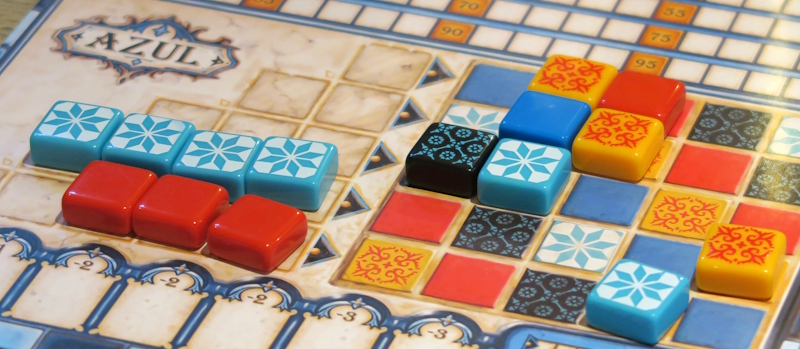
Once the dust had settled, Pine, Pink, Purple and Black rounded off the evening with a game of the Summer Pavilion version of our old favourite, Azul.  This uses the same market mechanism as in the base game, but instead of taking square tiles and placing them straight away, players take lozenge shaped tiles and and put them to one side for the second phase when players place them on their player board.  The pieces a positioned according to colour to form seven coloured “stars”. Each location is numbered according to the cost to play it—thus a space numbered five needs five pieces one of which is placed on the board while the others are discarded.

Azul: Summer Pavilion
– Image by boardGOATS

Placing one gives a single point while placing a second next to the first scores two and so on until the placing the sixth scores six points.  So a priority is placing tiles to expand groups, however, surrounding statues give bonus tiles.  Additionally, played over six rounds, each colour takes its turn as wild, though at least one tile of the required colour has to be played.  At the end of the game, players score a bonus for each of the seven stars that they’ve filled completely and bonuses for completing all seven spaces of value one, two, three or four.

Azul: Summer Pavilion
– Image by boardGOATS

Pink couldn’t remember the rules, so summoned Blue to explain, but her brain wasn’t on the right page so Jade, who, by this time was just adjudicating, explained instead.  The in-game  scoring was quite close with just two points between Pine and Pink, and Purple and Black not far behind.  So it all came down to the bonus points.  Pine picked up points for completing his green star and all the seven spaces with the value one giving him twenty-two additional points.  Pink’s fourteen points for completing his red star together with his twenty-four number bonus points more than off-set Pine’s small advantage, giving a modicum of revenge for the delight everyone got from his earlier misfortune in Ticket to Ride.

Azul: Summer Pavilion
– Image by boardGOATS

Learning outcome: Bad things that happen can make good memories, for some people at least.

Spiel des Jahres Nominations 2025

The nominations for the 2025 Spiel des Jahres Awards have just been announced.  Although there are now other lots of other awards (including the recently announced Golden Geek Awards), this is still the most prestigious award in board gaming and certainly the one that carries the most weight when it comes to casual gamers.  There are three categories, the Kinderspiel (children’s game) , the Kennerspiel (“expert’s” game) and the most desirable of all, the family award, the Spiel des Jahres or “Red Poppel”.  The nominees for this year’s awards have been announced as:

  • Kennerspiel des Jahres
    Kennerspiel des Jahres 2025 - Nominees
    Endeavor: Die Tiefsee (aka Endeavor: Deep Sea) by Carl de Vissser
    & Laurent Escoffier
    Faraway by Johannes Goupy & Corentin Lebrat
    Neuland (aka Looot) by Charles Chevalier & Laurent Escoffier


In recent years, there has been a shift in both the family and expert awards, away from traditional Euro-style board to lighter, more innovative games.  Gone are the days of El Grande, Tikal and The Settlers of Catan (all winners from the 1990s) with recent winners including MicroMacro: Crime City (from 2021) Pictures (from 2020), Challengers! (from 2023).  It may be that there has been a concerted effort to “freshen” the brand and subvert the conventional idea of what a board game is.  Last year’s winners, were Sky Team and Daybreak which were unusual in that both are cooperative games with Sky Team also being a two-player game (unusual for a “family game”).

– Image by BGG Contributor JuiceNeutron

In addition to the nominees, there are always a number of recommendations, which in this year include Castle Combo and Cities.  The Spiel des Jahres Awards are still the industry’s headline award and therefore are of great significance; it will be interesting to see which direction the awards go in this year when they are announced on Sunday 13th July in Berlin.

The Spiel des Jahres Awards
– Image from spiel-des-jahres.de

Golden Geek Awards – 2025

The winners of BoardGameGeek‘s Golden Geek Awards have been announced this month.  There are many Game awards, with the foremost being the Spiel des Jahres Awards and Deutscher Spiele Preis, Both of these are German in origin, with the Spiel des Jahres awards chosen by a panel of experts and the Deutscher Spiele Preis resulting from an open vote by games clubs, gamers and people in the industry.  In contrast, the Golden Geek Awards are voted on by the users of the BoardGameGeek websiteflavour which gives them a slightly different .  There are over a dozen categories, but winners include Arcs, Castle Combo, Harmonies, SETI and Flip 7 with Fromage, Let’s Go! To Japan, Captain Flip, Heat: Heavy Rain, and Forest Shuffle: Alpine featuring among the runners up.

– from youtube.com

Next Meeting, 13th May 2025

Our next meeting will be on Tuesday 13th May 2025.  As usual, we will start playing shorter games from 7.30pm as people arrive, until 8pm when we will start something a little longer.  Due to a recent change of hands, the pub is NOT doing food at the moment.

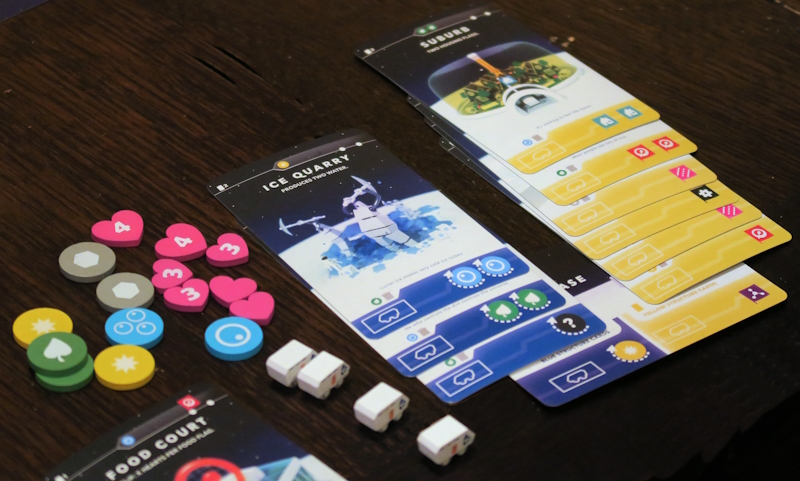
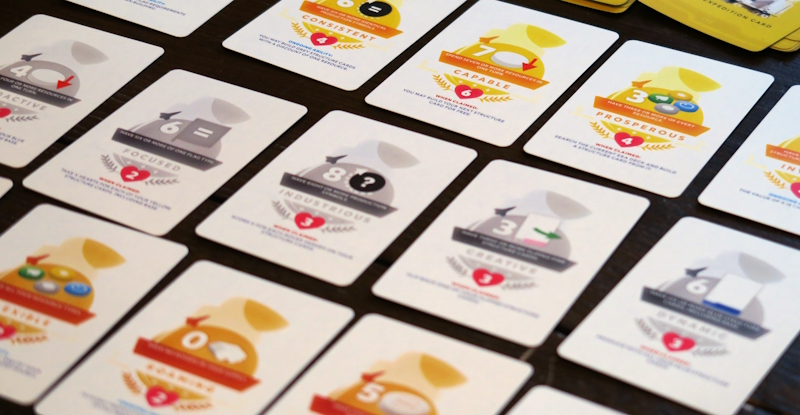
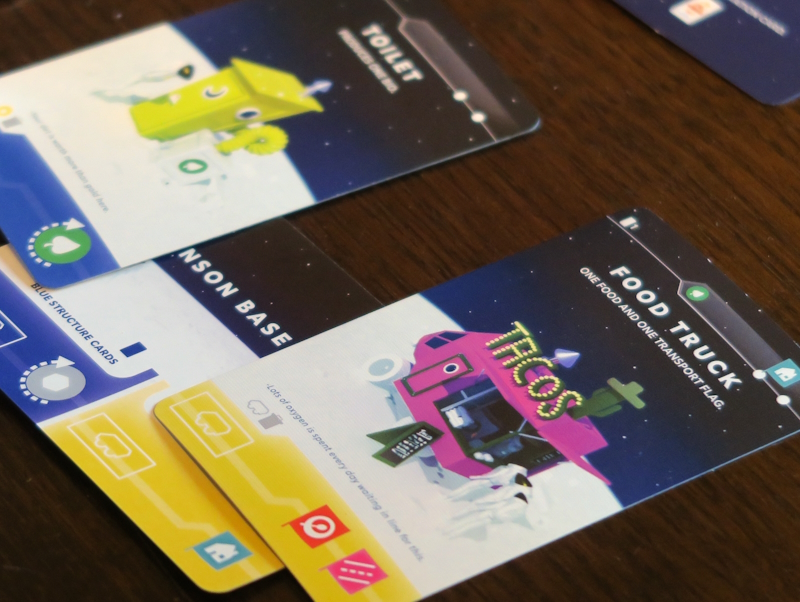
This week, the “Feature Game” will be Moon (rules, tutorial video, review).  This is a card drafting game where players construct bases, vying to build the new lunar capital.

Moon
– Image by boardGOATS

And speaking of the moon…

Jeff was chatting to Joe over a pint. “I’d really love to travel to the moon,” sighed Joe.

“Me too, but it is too expensive.” replied Jeff. “The costs are simply out of this world…”

Boardgames in the News: The Thief who Risked Gaol in the Trivial Pursuit of a Monopoly of Family Games

Theft of games has made it into the news a couple of times recently—back in January £700-800 of games from the HandyCon library were taken from Paul Frohnsdorff-Harris’ car.  This week, Paul Mangal (58), of Haringey, London who admitted twenty-three counts of theft of board games worth a total of £3,000 over a two year period has been sentenced to twelve months imprisonment (suspended for two years).  Investigating officer, Sergeant James Elliott, said Mangal’s offending “appeared to ramp up before, during and immediately after Christmas, then almost daily up until his arrest”.  The offenses concerned multiple copies of family games including Monopoly, Risk and Trivial Pursuit mostly from Waterstones in Crouch End.  On one occasion he was caught on CCTV making off with several games in a suitcase which led to him being additionally banned from being in possession of a suitcase in both Crouch End and Hornsey.

– from youtube.com


Next Meeting, 29th April 2025

Our next meeting will be on Tuesday 29th April 2025.  As usual, we will start playing shorter games from 7.30pm as people arrive, until 8pm when we will start something a little longer.  Due to a recent change of hands, the pub is NOT doing food at the moment.

This week, the “Feature Game” will be Creature Comforts (rules, tutorial video, review).  In this game, players spend Spring, Summer, and Autumn gathering different resources from the forest and spending them to collect items that will home a more inviting place while the world outside is covered in a layer of snow in the Winter.

Creature Comforts
– Image by BGG contributor hipopotam

And speaking of snow…

Last year, Jeff and his wife had bought themselves a tandem for Christmas, but the first chance they got to try it out was January when there was snow on the ground. Reluctant to put off the excitement any longer they decided to take it out anyhow.

It was freezing cold out, and riding a tandem can be a little tricky especially when it is icy, but after a couple of tries and a few near misses, they were going.

“Hey, l-l-look at us!” cried Jeff. “We’re riding a b-icicle built for two!”

18th March 2025

The evening began with the arrival Ruby and Flint, friends of Teal, who had come along despite the fact he wasn’t able to be there to introduce them to everyone himself.  They introduced themselves as people finished their supper and prepared to play the “Feature Game” which was to be Cartographers Heroes, the standalone sequel to Cartographers.  Cartographers was probably the best of the roll and write games the group played online during the global coronavirus pandemic, so we chose to play it to mark the fifth anniversary of our last meeting in the pub before we moved online.  It was a very difficult time for everyone, though as a group we stuck to it and tried to look after each other, continuing to meet fortnightly, online.

Setting up for online gaming
– Image by boardGOATS

Strictly, Cartographers is a “flip” and write rather than roll and write game as it is card-driven.  Played over four seasons, cards are turned over to reveal choice of “Tetris-like” shapes and/or terrains that players draw on their map.  The game is played over four rounds, each with a different scoring criteria—a total of four during the game, with two active in each round (similar to Isle of Skye).  In addition to the normal terrain cards, there are also Ambush cards, which are nasty as they score negatively with a point lost for each empty space next to an Ambush space at the end of each round.  They can be played in two ways depending on the number of players and the circumstances of the game.
Cartographers: A Roll Player Tale
– Image by boardGOATS

Online, we played these using the Automa rules, where the Ambush “pieces” are placed via a set of rules, whereas in person, players pass their map to a neighbour who places the Ambush piece in as awkward a place as possible.  In addition to Ambush cards, the Heroes game adds Hero cards which can be used to off-set the effect of the monsters from the Ambush cards.  The distribution of cards is also slightly different and the map layout is slightly different too.  This time, although the game can play up to a hundred people simultaneously, because of the difficulty seeing the cards, the group chose to split and play two separate games.

Cartographers Heroes
– Image by boardGOATS

The first of these included Blue, Pink, Flint, Ruby, Purple and Lime, while the other comprised Jade, Sapphire, Pine, Byzantium and Mint.  The first group were using the Collector’s Edition which comes with pencils in colours that match the different terrains.  The second group cast envious eyes on the pretty maps as the games started, but despite offers, refused to take a set and stuck to the slightly more elegant monochrome maps relying on symbols to indicate the different terrain types.  Although the original Cartographers and the Heroes games can be mixed, both groups used the decks and maps from the Heroes game.

Cartographers Heroes
– Image by boardGOATS

The first group began with a sequence of woodland terrain, which fitted with their first objective, but the shapes wrapped nicely round the mines.  The mines give money—when surrounded by terrain, players can tick off a one of the coins marked at the bottom of the map, which gives a point at the end of each round.  Thus collecting them early makes them more valuable each giving up to four points throughout the game.  So, most people started by prioritising them as an easy way forward.  Consequently everyone’s first rounds gave similar scores, but by the second round Lime and Pink had edged a bit of a lead.  Nobody scored particularly well in the third round, so it was all down to the final round to make the real difference.
Cartographers Heroes
– Image by boardGOATS

Most people scored around twice what they’d picked up in earlier rounds, but it was Pink who top scored with a massive fifty-five, giving him a bit of a landslide with a grand total of a hundred and thirteen (after a couple of recounts).  Blue just edged into second, ahead of Lime, but they were some twenty points adrift.  The second game followed a similar pattern with massive scores in the final round, though it was a much closer game, with it possible to cover the top three with a postage stamp.  The scores were generally higher than for the first game, but the victor was Mint who finished with a hundred and twenty-six, three more than Jade in second who pipped Byzantium by a single point.

Cartographers Heroes
– Image by boardGOATS

With the second game finishing first, the group moved on to play River Valley Glassworks, a re-implementation of the card game Subastral.  In River Valley Glassworks, players take the role of entrepreneurial of woodland creatures drafting glass from the market of river tiles by playing a piece from their inventory into the river. Each river tile can take only a specific shape, and players have to play into a space adjacent to where they want to draft from. After claiming their glass, the river shifts forward (in a way that is vaguely reminiscent of Niagara), revealing new pieces.

River Valley Glassworks
– Image by boardGOATS

Glass is stored in players’ shops, and the scores depend on where the glass is placed—completed rows and columns gain bonus points, but too many of one type gives negative points.  The game is generally cosy, quick and fun, and this time was no exception.  Jade explained the rules which are simple enough: either place a piece of glass onto a river tile or draw exactly four pieces from the lake with the aim of collecting a rainbow of glass pieces. Getting the balance right can be a little tricky, so it was no surprise that the most experienced players came out best with Jade taking victory with eighty points nearly ten ahead of the other person who had played it before, Sapphire.

River Valley Glassworks
– Image by boardGOATS

When the other game of Cartographers finished, the group continued with the roll and write theme, moving on to another game that went down well online, Second Chance.  This is a similar “Tetris-like” card driven game, but much simpler.  Everyone has a square grid and as cards are turned revealing shapes, they add them to their grid.  Players are eliminated when they can no-longer add the latest shape.  The game gets its name from the fact that when a player gets stuck, they get one card flipped, just for them, and can carry on if they can add that shape to their grid.  The player with the fewest gaps at the end, is the winner.  This time, Purple was eliminated first, but it still got quite close to the wire and the tension was palpable.  The winner was Flint, however, who very nearly managed to fill his whole grid, leaving just two spaces unfilled.

Second Chance
– Image by boardGOATS

Meanwhile, on the third table, Cobalt was joined by Black, Plum and Ivory in a game of Castles of Burgundy using the new fancy “Special Edition”.  In Castles of Burgundy, players take on the role of an aristocrat controlling a small princedom, building settlements and castles, trading along the river, mining silver, and use knowledge of travelers.  The game is a tile playing game that is played in five phases, each consisting of five rounds. At the start of each round all players roll their two dice, and first player also rolls a goods placement die.  During their turn, players carry out two of the four possible types of action.  These include: take a settlement tile from the numbered location corresponding to one of their dice and place it in storage; take a settlement tile from storage and place it on their player board on a space with a number matching one of their dice;  deliver goods with a number matching one of their dice, or take worker tokens (which allow players to adjust the roll of their dice).

Castles of Burgundy
– Image by boardGOATS

Additionally, players may buy a settlement tile from the central depot and place it in their storage area. The Settlements offer benefits, additional actions, money, advancement on the turn order track, more goods tiles, die roll adjustment or victory points with bonus points awarded for filling a region with tiles.  Cobalt and Black both started on the east side of the map, with Black building to the south with Ships to move up the turn order.  He also got a mine to start generating coins at the end of each of the four rounds. He also managed to completed an area to move up in points (Ships). Cobalt went the other way with yellow and beige buildings and managed to get a second castle (and effectively an extra turn), whilst also completing areas for early points.

Castles of Burgundy
– Image by boardGOATS

Plum started at the bottom and managed to get a Mine, setting up for the future, as well as Ships to move up the turn order, but started accruing points more slowly.  Ivory on the other hand started in the north and went for a different strategy, grabbing animals (specifically goats!) and made a faster start with regards to points, at the expense of turn order.  In the second round, Ivory continued to focus on animals, grabbing more animal tiles and end of game tiles giving points for different animals, to go along with his yellow tile from the first round giving him extra points when scoring animals. He also built his second castle and started to fill the eight beige area, needing one of each beige building in that area for a challenging thirty points.

Castles of Burgundy
– Image by boardGOATS

Plum focused on engine building, getting two more Mines, giving her significant income for the rest of the game, as well as a building which allowed her to build duplicate buildings in an area, making it much easier to achieve thirty points in the eight beige area, as well as a tile allowing her more flexibility in getting tiles (as it allowed her plus/minus one on the die).  Black was also engine building and doing a little bit of everything else, while Cobalt, Like Plum and Ivory was focusing on the beige “Eight” area.  Cobalt also had tiles that allowed him to spend workers to get a tile (as well as change die results) and also get extra workers when he took that action and gain a coin—a very efficient engine! At the end of the round, Cobalt and Ivory had taken the lead, followed by Black and then Plum.

Castles of Burgundy
– Image by boardGOATS

In the third round, Ivory managed to fill all his animal spaces and get the bonus for doing so as well as get more points from his animals, but was generally slowed down by the fact he’d stopped developing his engine.  In contrast, Plum’s engine had kicked in, giving her lots of points and bumping her up the rankings leaving her snapping at Ivory’s heels by the end of the round.  Black was continuing to do a bit of everything, but now had an end game objective for different goods while Cobalt continued to develop his engine.  In the penultimate round, Ivory continued to struggle due to his lack of engine development and his ships paucity of ships meant he had taken his turn last for most of the game, although he was “building beige” where possible for the thirty points.

Castles of Burgundy
– Image by boardGOATS

Plum on the other hand, stormed ahead, filling the “Eight” area and taking thirty-four points as she was able to fill it with the same building.  With other scoring opportunities as well (like animals), it looked like she was a certainty to win being as she had a lead of over thirty points at the end of the round. Cobalt and Black also pushed past Ivory with Cobalt having focused on mines and Black completing all four of his castles, taking bonus points for doing so.  In the final round, Cobalt and Ivory both managed to fill their beige area for thirty-two points and Ivory finally got his first ships, albeit too little too late for anything other than a few points. Plum, having filled in the large beige area, slowed down a little, lacking a focus having done so much in the previous round, but still managed to score significantly.

Castles of Burgundy
– Image by boardGOATS

Black was still doing a bit of everything, particularly focusing on goods, but failure to score the large beige area cost him dearly.  By this time, Cobalt, on the other hand, was using his engine to maximum effect, with his ability to grab tiles using workers to give him more actions than everyone else, filling in almost all of his map. This also allowed him to slowly catch up and eventually overtake Plum, taking lots of bonus points for filling in each colour area, giving him the victory with a grand total of two-hundred and forty-four points, some fifteen more than Plum with Ivory some distance behind her.

Castles of Burgundy
– Image by boardGOATS

Learning Outcome:  Some Roll and Write games are much better than our slightly tarnished memories of them.

Next Meeting, 22nd April 2025

Our next meeting will be on Tuesday 22nd April 2025.  As usual, we will start playing shorter games from 7.30pm as people arrive, until 8pm when we will start something a little longer.  The pub is doing food, and the table is booked from 6.30pm for those that would like to eat first.

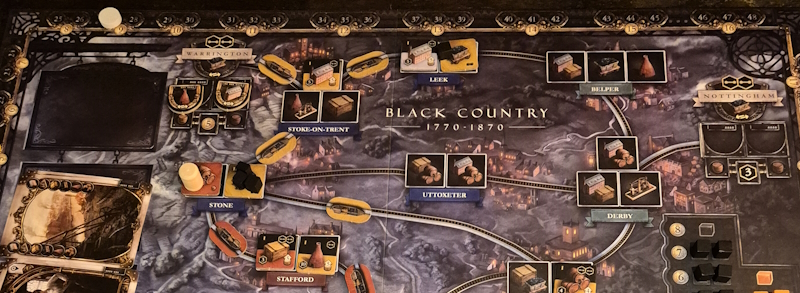
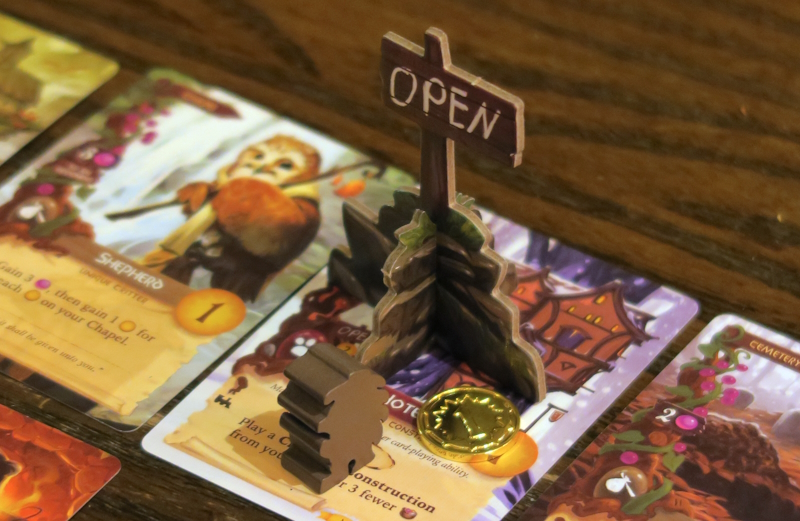
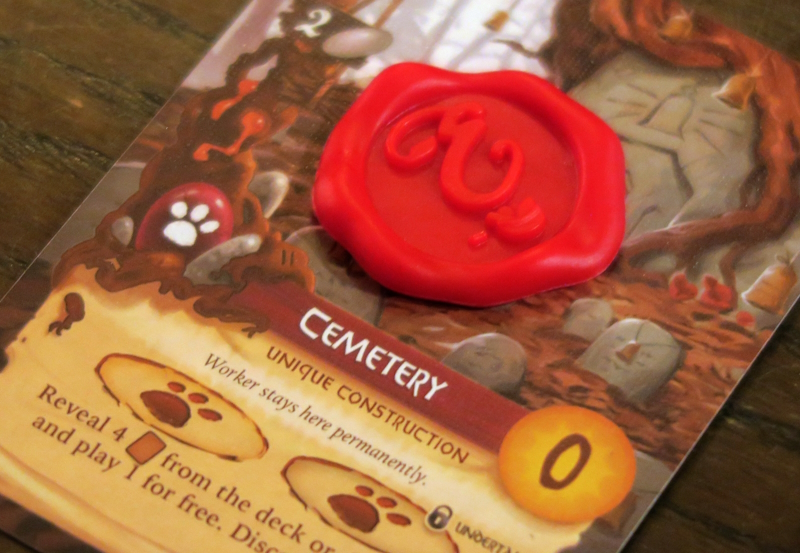
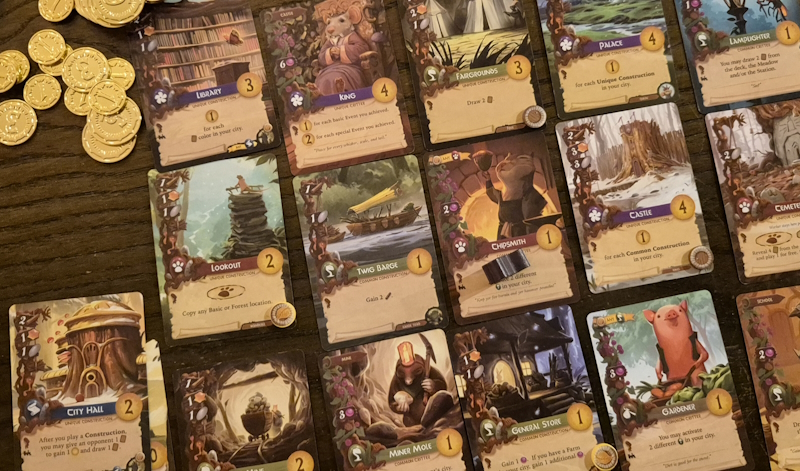
This week, the “Feature Game” will be the Newleaf expansion to Everdell (base game rules, tutorial video, review; Newleaf rules, tutorial video, review).  This expansion adds new critters, constructions and events, but most significantly the new railway station.

Everdell: Newleaf
– Image from board-game.co.uk

And speaking of trains…

Jeff was on a train to Penzance, but when the guard came round round to check the tickets he noticed Jeff had a ticket for Camborne.

“Sorry sir, this train don’t stop Camborne Wednesdays, you’ll have to get off at Redruth” said the Guard.

“But I simply MUST get off at Camborne—I have an important meeting to attend and if I get off at Redruth, I’ll miss my appointment,” pleaded Jeff.

“I’m very sorry sir, this train don’t stop Camborne Wednesdays,” said the Guard again.

“Isn’t there anything you can do?” Jeff begged.

“Hold on sir, I’ll go ask the driver if he can make an unscheduled stop,” said the Guard and toddled off.

On his return he explained, “The train is already late, all the driver can do is slow down through Camborne. So what I’ll do is get you to come up to the front carriage and I’ll hang you out the door.  You start running in the air and when your legs are going fast enough, I’ll lower you onto the platform.”

Unfortunately the driver forgot to slow down at Camborne and Jeff was pumping his legs furiously as they approached the platform.

“Faster, you need to go much faster,” said the guard.  Jeff’s little legs were a-blur and finally the Guard thought he was air-running fast enough, so as the platform approached he lowered Jeff onto the start of the platform. Off he shot along Camborne platform, desperately trying to slow down as the end of the short platform approached.  He was just slowing to jogging pace as the rear of the train passed him, when a door opened in the last carriage and a pair of hands grabbed him and hauled him onboard.

“You’re lucky to catch this train mate, it don’t stop Camborne Wednesdays…”