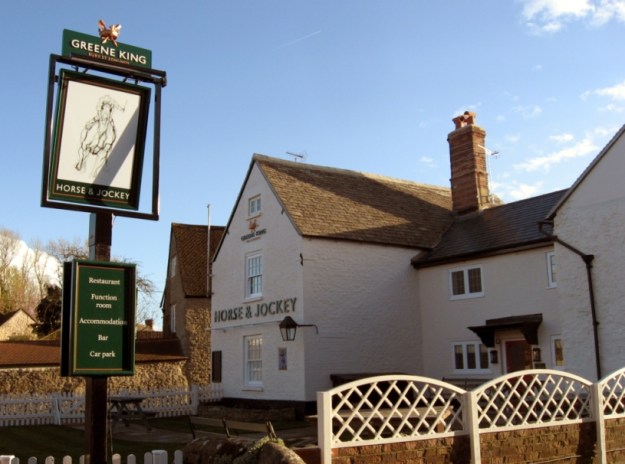
14th April 2020 (Online)

Social contact is really important for mental health and board games are a great medium for that.  Unfortunately, physical proximity isn’t an option at the moment, so we’ve moved our games nights online.  Despite the limitations experienced last time, the overwhelming response from the group was that we should persist with online meetings.  With this in mind, and the recent special offer for Tabletop Simulator on the Steam platform, we’d had a couple of trial runs to see if that would work for the group.  Tabletop Simulator is a “sandbox” environment, which provides an electronic rendering of the game and tools to move things around.

Tabletop Simulator Splash Screen
– Image from steampowered.com

The strength of Tabletop Simulator, but also its weakness, is that people have to do everything themselves.  Everything.  This is good because it means the game can be played according to any rules people want, however, it also means there is a substantial overhead, which is just that bit too much for players not used to computer gaming.  Additional hurdles included installing software (a problem on some work laptops) and the intricacies of actually getting it running which required an hour or so tutorial to get going.  Unfortunately, these were just too large for us, especially for a group meeting only once a fortnight.

Chess on Tabletop Simulator
– Image by boardGOATS from Tabletop Simulator on Steam

Last time, we had played a simple physical game that we knew well, Las Vegas using cameras.  Seeing the “table” had been difficult though, limited by the resolution of the cameras and lighting.  So to improve things and get others involved, we decided to go with a compromise:  some people would run the game on Tabletop Simulator (providing a better visual experience), but the game would then be “streamed” to the group through Microsoft Teams, using the technology everyone was already familiar with.  This time, we were more ambitious: the “Feature Game“, Camel Up has more moving parts and lots of people hadn’t played it before.  It still fits the two key requirements, however, lots of people can play (especially with the Supercup expansion), and it has minimal “hidden information”, so it would still work with a couple of minor tweaks.

Camel Up
– Image by boardGOATS

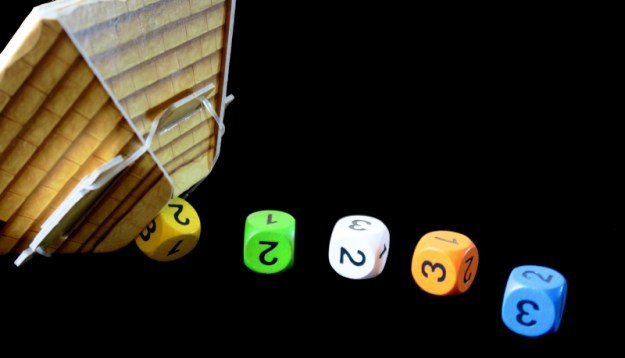
Camel Up is a simple enough family game, so teaching, even online, wasn’t too difficult.  It is a race game, where people are betting on racing camels and the player with the most money at the end of the race is the winner.  On their turn players have four options.  Firstly, they can roll dice to move a camel.  In the physical game, this is done with a special pyramid dice shaker that holds a die for each of the five camels and spits them out one at a time.  We found using the online rendering of this very difficult, and wanted to involve the players more, so we used the real shaker to deliver dictate the number and players rolled their own dice at home to see how far they moved.
Camel Up
– Image by boardGOATS

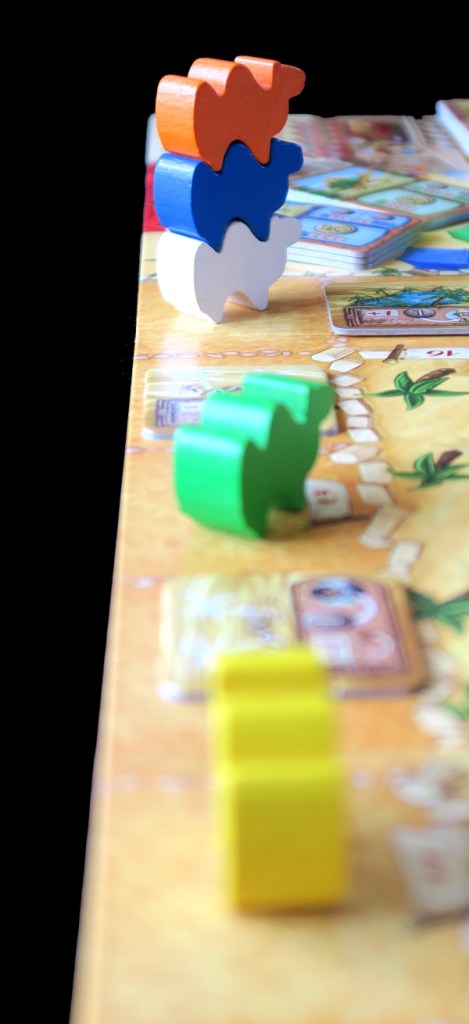
Alternatively, players could place a tile on the track which would earn them money whenever anything landed on it and move those camels forwards or backwards one space (depending which way up the tile had been placed).  The other two options involved betting:  players could bet on the winner of the leg (i.e. after all the dice had been rolled once) or the eventual winner or loser of the overall race.  A simple roll and move would not make betting very interesting, but in Camel Up, when a camel lands on the same space as another camel, it is placed on top of the other piece.  Then, if the lower camel moves before the top one does, it gets a free ride.

Camel Up
– Image by boardGOATS

Betting on the winner of a leg was easy to implement—each player had a space on the simulator and betting tiles (and pyramid tiles showing players had rolled dice) were moved to that area.  Betting on the eventual winner/loser was more difficult.  In the physical game, players have five cards which they play onto the winner or loser pile.  At the end of the game, these are evaluated with the first player to bet correctly getting the most money, continuing on a sliding scale, with those who bet incorrectly losing their stake.  Obviously, this wasn’t going to work for us, so instead, one person made a note of who placed bets and people kept track of their own choices (as well as their money), and we just tallied up at the end.

Camel Up
– Image by boardGOATS

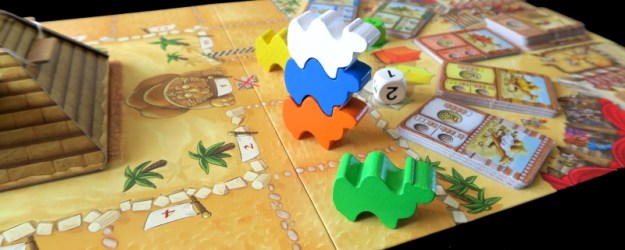
Blue, Pink, and Mulberry started setting up from around 7pm.  We used the expanded board from the expansion to make the race a little longer, but decided that any of the other modules would just make it too complicated this time.  This was a very hard decision, because the game can become very random with lots of players and the expansions do a lot to mitigate that.  We had already increased the complexity considerably compared with last time, and that would have been a step too far this time.
Camel Up
– Image by boardGOATS

As people joined the “meeting”, people chatted, mostly about nothing, largely because not a lot had happened for most people.  Blue commented on the lovely large rainbow image in the window at Lime’s house (drawn by Little Lime), and Pine commented on how nice it was to be home now his caring duties were over.  Green was the last to join the party, and he immediately asked when Pine was going to get back which led to much hilarity as the previous conversation was reprised.  The procession of soft toys reappeared:  Mulberry showed off her Pony, apparently called Macaroni (after Yankee Doodle), and Pine introduced us to his Gremlin, who apparently wants to join us at The Jockey when it re-opens and would like to be known as “Beige”.

Beige
– Image by Beige’s “Wrangler”

Having already set the game up for eight, Green and Lilac decided to play as a team, especially as they were still to eat their supper.  Blue was about half way through the rules explanation, when, much to everyone’s delight, Burgundy arrived.  He didn’t have a microphone, though he could hear everything people said.  This created a weird juxtaposition of speaking and reading replies, which occasionally became typing (especially for Blue) when confusion set in.  Playing would have been quite difficult as well as needing more set up, but it was lovely to have Burgundy back as we’d all missed him last time, and people couldn’t resist chatting on the text channel in the background.  We will definitely sort out a microphone for him for next time though.
Camel Up
– Image by boardGOATS

From there on, it was disorganised chaos mediated by camels.  Pine decided to share his packet of Tangy Cheese Doritos with everyone, and the disembodied crunching and rustling was quite something.  He blamed it on Beige, but no-one was fooled.  This was followed by someone (possibly Black) making a strange bonging noise that to Pink sounded like a bell from a traditional, mechanical signal box.  He does have a bit of a thing about trains though.  Meanwhile, on the chat, there were discussions about shopping and Pine’s burping camel impersonations.  Clearly the Doritos were working their magic.

– From Peter Jordan on youtube.com

The game was something of a side-show to all this “excitement”.  In the first round, aside from a couple of people placing oasis/mirage tiles, everyone just moved camels.  Having seen how the race worked though, the betting really got going on the second round.  The tech, though not perfect, worked well enough, thanks largely to Mulberry’s efficiency.  And although the game wasn’t a “meaty”, “manly” game, being together doing something a little different was the most important thing.
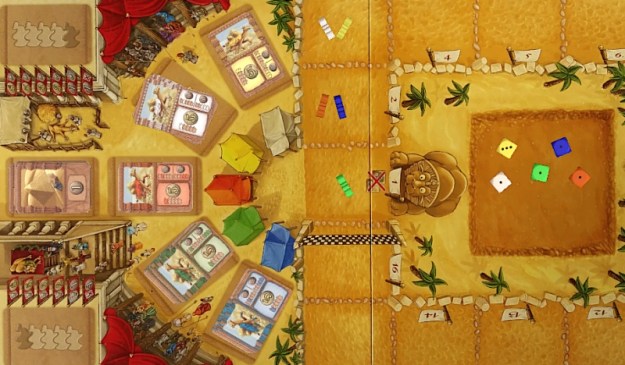
Camel Up on Tabletop Simulator
– Image by boardGOATS from Tabletop Simulator on Steam

The betting on the end game really told the story of the race.  Mulberry was the first to bet on a win, quickly followed by Pine, Black, Purple, Pink and Blue, with everyone gambling on the green or white camel making it over the line first.  Pine was the first to have another shot, but still didn’t get it right.  Betting on the loser, on the other hand, was started early by Lime and quickly followed by Pink, Black, Blue and Mulberry all of whom bet on the yellow camel to stay at the back of the pack.  That camel seemed to have three legs, or maybe a pulling rider, or perhaps it had eaten too many of Green’s sausages.  Whatever, it was definitely not a contender, and everyone agreed with Purple who commented that it should retire to a camel sanctuary.

Camel Up on Tabletop Simulator
– Image by boardGOATS from Tabletop Simulator on Steam

The front of the race was much tighter, and as the probability field gradually whittled down the likely order of finishers as it became clear that the game was coming to an end.  The order of movement was all important and players jumped in with their final bets on who would win the race, but the final leg.  Lime was the first to bet on the eventual winner, giving him eight Egyptian pounds, followed by Blue, and Pine with diminishing returns.  Green realised that betting on the winner of the leg was more lucrative by this point than betting on the end of the race, and Pink followed suit, leaving Mulberry to finish the race.
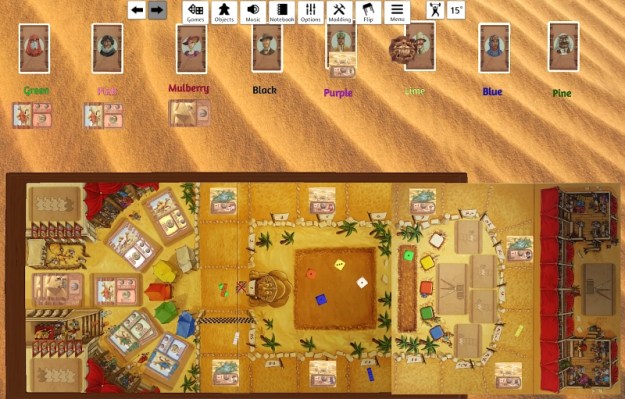
Camel Up on Tabletop Simulator
– Image by boardGOATS from Tabletop Simulator on Steam

A quick run-down of the final finances showed that Pink was a single pound ahead of Green who who posted an initial, competitive total winnings of twenty Egyptian pounds.  Lime, the first to successfully predict both the overall winner and loser finished some way ahead though, with takings of twenty-eight pounds.  Pine excused his particularly poor showing by saying he thought camel racing was cruel.  From there, the evening mostly descended into verbal and text chatter as people discovered and shared emojis (Pine was the first to find camels, but only in camel colour) and stickers, and then soft toys… again.

Pikachu
– Image by Mulberry

Mulberry suggested that when The Jockey re-opens we should have a “BYOB” party and “Bring Your Own Buddy”.  Burgundy apparently misheard and there was more hilarity when the sad message appeared on the chat, “no bunny”.  Green saw Mulberry’s Pikachu and said Pokemon Go was a problem in the current climate.  That’s not the case for Mulberry apparently, who commented that she has a “Pokey-stop” outside her house.  For those who were not familiar with the game Pokemon Go, that just sounded very smutty.  Mulberry shared a “Let Me Google That For You” link, but it didn’t seem to help, and things only got worse when she tried to explained what she did with her “Pokey-balls”…

Yucata.de
– Image from yucata.de

Time was getting on, and meeting on line is surprisingly tiring so eventually, people sadly departed, leaving Pink, Blue, Black and Purple to continue the seemingly eternal game of Snowdonia they had started two weeks earlier, on Yucata.de.  Snowdonia is a worker placement game that we’ve played quite a bit as a group, where players are building the rack-railway up the famous mountain.  The basic idea is that each player has two workers and they take it in turns to place these on one of the seven options:  gather resources; remove rubble; convert resources; lay track; build part of a station; pick up a contract card, and move their surveyor.

Snowdonia on yucata.de
– Image by boardGOATS from yucata.de

Each of these actions have a different number of available spaces, so for example, only three workers can lay track in any given round.  During the game, the weather changes, increasing and decreasing the work-rate so that players can build that track faster, or slower, or if it is foggy, not at all.  Contract cards give players points for successfully completing certain tasks, but can also be used to give an enhanced action instead.  The game ends when all the track has been built to the summit, Yr Wyddfa.
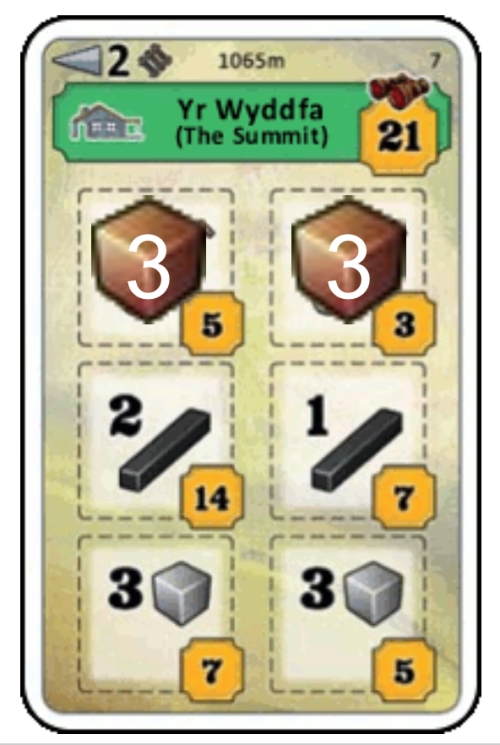
Snowdonia on yucata.de
– Image by boardGOATS from yucata.de

This game was started after the last games night, so it was only fitting that is should be finished on a games night too.  It had started quite slowly – Yucata is quite different to Tabletop Simulator because it is much less flexible, but does ensure players follow the rules and can play turns for them when they have no decision to make.  This can help speed things along, but can also be confusing at times when the game state changes more than expected between turns.

Snowdonia on yucata.de
– Image by boardGOATS from yucata.de

Playing a strategy game over such a long time period proved difficult for those not used to it.  This is mainly because players lost the thread of the “narrative”, and ended up playing tactically for the short term rather than following a long-term plan.  Unsurprisingly, Black, who plays quite a lot of games asynchronously on Yucata, struggled least with this.  He was also must familiar with the environment and got off to a flying start.  Blue prioritised getting a train, but discovered that it didn’t do quite what she had in mind when she tried to use it a day or two later.
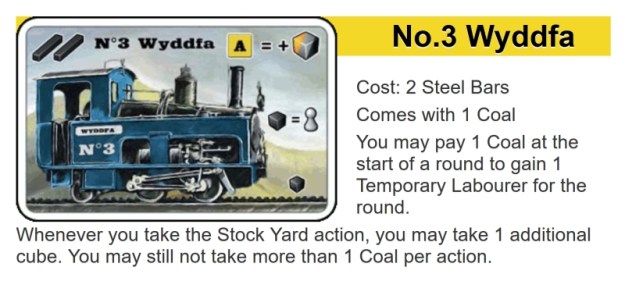
Snowdonia on yucata.de
– Image by boardGOATS from yucata.de

Pink was the first to move his surveyor, but then completely forgot about it.  He only realised it had been passed by everyone else’s about half-way up the mountain in the final round, by which time it was too late to do anything about it and the others were all at the summit.  Blue had been horribly inefficient in places due to losing the thread of the game and additionally couldn’t quite build the track she needed to fulfil her most lucrative contract.  According to Black, Purple was “playing online like she plays in real life”, but she was definitely doing something right as she put a spurt on at the end laying track.

Snowdonia on yucata.de
– Image by boardGOATS from yucata.de

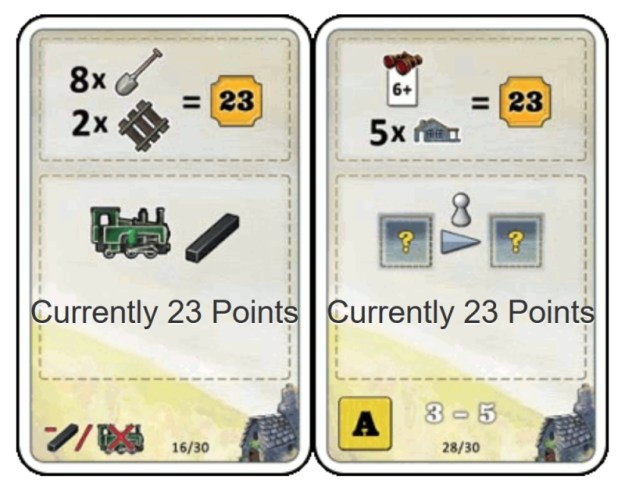
Black started fastest, took the lead and then stayed there, but contracts can be a big game changer in Snowdonia.  This time though, Black completed two contracts adding a total of forty-six points to his twenty-one for getting his surveyor to the top of the mountain and forty-five points collected for building during the game.  The total made him a run-away winner with a total of a hundred and twenty-one, miles ahead of Purple who sneaked into second place a couple of points in front of Blue.  And with that it was time for the long walk to bed.
Snowdonia on yucata.de
– Image by boardGOATS from yucata.de

Learning Outcome:  A simulator can still be used even when most people don’t have access.

Next Meeting, 14th April 2020 – Online!

It is at times like this that we need social contact more than ever, and board games are a great medium for that.  Despite the limitations experienced last time, the overwhelming impression is that we should persist with online meetings.  So, our next meeting will be on Tuesday 14th April 2020; we will gather from around 7.30pm, and start playing at 8pm.

This week, the “Feature Game” will be Camel Up.  We have chosen this game because lots of people can play (especially with the Supercup expansion), and this is intended to be a social event so lots of people can be involved.  The game has some hidden information, but with a couple of minor tweaks it should still work.

Camel Up
– Image by boardGOATS

And speaking of Camels…

Two camels, a father and son are grazing peacefully.  The younger camel looks up to his father and says, “Dad!  Why do we have these giant humps on our backs?”  The father camel looks down at his young son and says, “Why, they are so we can travel for miles in the desert without stopping for water.”  The young camel looks astonished and says “Wow, I didn’t know that!”

A minute or so later, the younger camel pipes up again, “Dad! Why do we have really thick eyelashes?”  His father, slightly irritated at being disturbed from his grazing by his son’s curiosity, answers quickly, “So that our eyes are not scratched by sand storms.”

“Wow!” the young camel replies and then a moment later, daddy camel hears his son again, “Dad!”

“What now!” his father asks clearly biting his tongue. His son asks, “Why do we have such huge feet, Dad?”

“Well son,” his father said in strained patience, “We need to tread through the sand and our feet are big so we can travel more easily.”

This time a few minutes pass before the father hears his son again.  Daddy camel, clearly agitated snaps, “What!?!?”

“Dad… What are we doing in a zoo then?”

31st March 2020 (Online)

It is at times like this that we need social contact more than ever, and board games are a great medium for that, a fact recognised by both the World Health Organisation (WHO) and the British government.  With everyone confined to barracks for the foreseeable, we felt it was important to give online meetings a go.  There are several online gaming alternatives, but they all either cost or are horribly slow thanks to the fact that everyone else is trying to do the same.  For this reason, we decided to try to play a real game using the medium of Microsoft Teams with a camera pointed at the board and everyone else giving instructions.

Setting up for online gaming
– Image by boardGOATS

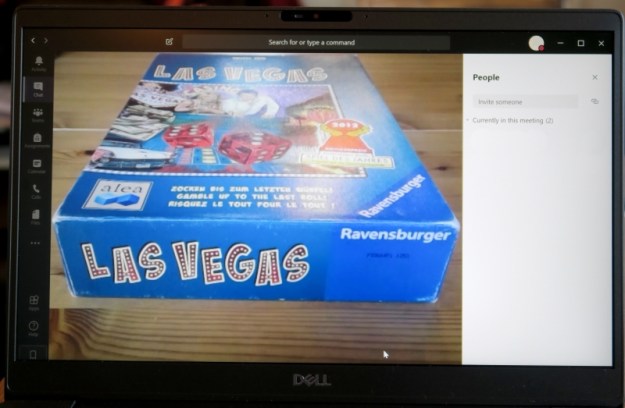
Our game of choice, and therefore our “Feature Game” for the day, was Las  Vegas. This was because everyone knows it (minimising explanations), lots of people can play (this was intended to be a social event, so that meant lots of people could be involved); it has no hidden information (a necessity for this sort of thing).  Blue and Pink began setting up at about 6pm, after the long walk home from work. They used two laptops: one was perched on some place mats and a pile of sturdy game boxes (specifically Tapestry, In the Hall of the Mountain King and Teotihuacan) with the reverse camera pointing at the table and the game, the second laptop was then used to see what everyone else could see.

Las Vegas
– Image by boardGOATS

Black and Purple (in Abingdon), were the first guinea pigs and struggled to get the link to work. Eventually, with some discussion over the phone and the inevitable microphones and speakers on/off issues, they were successful. While Pink popped out to fetch fish and chips from Darren Pryde and his itinerant chip van (which were truly excellent), Mullberry (in Wantage) became the next guinea pig and signed in with little difficulty.  After Blue sent out the link to everyone else at 7.30pm, there was a steady precession of gamers joining the party.  There were a few things we learnt from this first experience:

  • As the sun set, the natural light from the window faded and the camera really struggled—lighting really is critical.
  • MS Teams worked OK with people joining through a link via a web browser, but it is important that the “game camera” has an active microphone. If it does not, Teams decides it is not active and it disappears for anyone viewing on a browser.
  • MS Teams thinks that feeds where the image changes a lot are the most active and therefore the most important focuses on these.  This is a particular problem for those using a browser rather than the application; turning off cameras when inactive can help.
  • During setup, it helps to have something really obvious for people to focus on.
  • Maybe it’s the stress of the current climate, but there are an alarming number of soft toys in close proximity of people’s web cameras, most of which seemed to be pandas.

By about ten minutes to eight, most people had “arrived” and everyone was chatting about their new normal and sharing what they were drinking and stories of shopping—for a moment, it was almost like we were at The Jockey. A couple of minutes before the scheduled start, Green, the last to join, signed in.  As Blue began dealing out the cards, Green’s opening comment was that it didn’t feel like a games night because we hadn’t spent half an hour chatting! That produced much hilarity, and more chit-chat, before we eventually started.

Las Vegas
– Image by boardGOATS

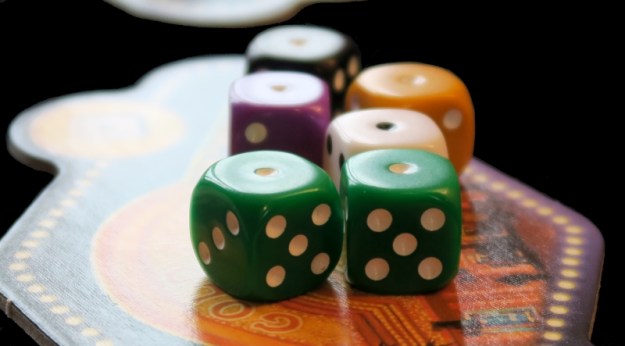
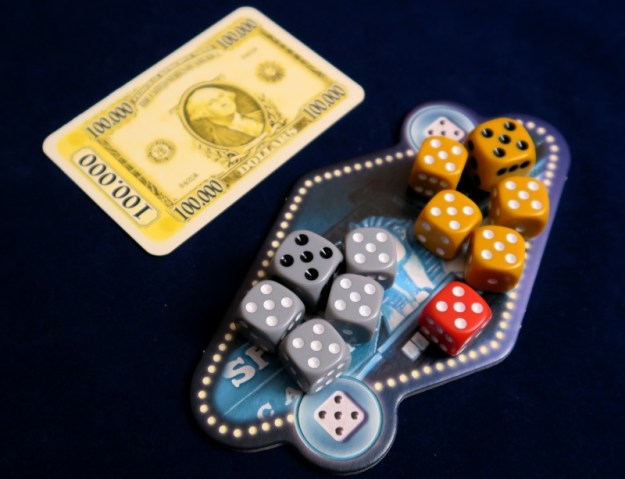
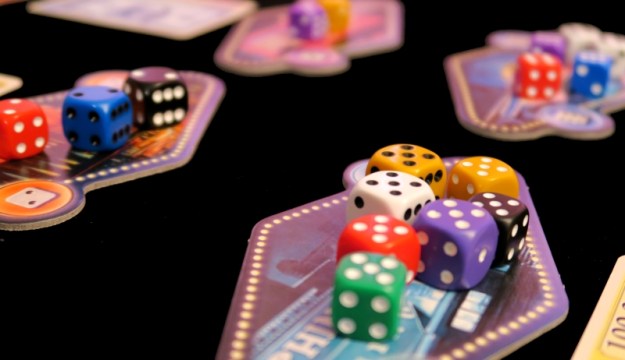
Las Vegas is a very simple game, which is, of course, why we picked it.  Players have a handful of dice and take it in turns to roll them and then place all the dice of one number on the casino of their choice. When nobody has any dice left, the player with the most dice in each cassino wins the jackpot.  There are a couple of clever twists that make this a really great game though. Firstly, the prize fund for each casino is dealt out in money cards.  Some cards are as high as $100,000, while others are only $10,000—the winner takes the largest denomination for that casino, the jackpot, leaving the player in second place to take the second largest, and so on.

Las Vegas
– Image by boardGOATS

Secondly, and perhaps most cleverly, all ties, cancel each other out.  This is absolutely key to the game: the vagaries of dice mean that a well-positioned player could roll one die and end up with nothing, and much hilarity follows. We also add the Slot Machine from the Boulevard expansion, which works in a slightly different way with dice of each number being added a maximum of once.  We also use the “Biggun” from the expansion, so each player has on large die that counts as two.

Las Vegas
– Image by boardGOATS

Mulberry began. One of the reasons we picked this game was that we thought most people might have dice of their own at home and could roll them themselves. Mulberry was the only one who didn’t, so being a true Millennial to the core, she opted for an electronic solution using an online dice roller.  Otherwise, it was very satisfying to hear the rattle of dice as people took their turns.  Although chatting was quite difficult over the network, that didn’t prevent a lot of smutty comments and requests for him to stop bragging when Green announced that he had “got a big one”.  Even more entertaining was when the conversation moved onto Iceland’s entry for Eurovision and links were shared through the chat feature which resulted in Pink pressing play by mistake and drowning out everything else.

– From Eurovision Song Contest on youtube.com

It was not an ideal way to play any game and with our group Las Vegas is not quick at the best of times, but the combination of people reading out their dice roll so that Blue and Pink could display them, dodgy internet connections, people sounding like Miss Othmar (the teacher from the Peanuts cartoons), and trying to keep eight people on-message, definitely slowed things down. At the moment though, these things are unavoidable and we managed. It was nearly 9pm before the first round finished and people were happy enough with the result to play a second, if not our usual third.

– From Corgi Adventures on youtube.com

Black made hay with his singleton on Casino Three, when Mulberry’s and Lime’s piles of dice cancelled each other out. Green just pipped Blue to take $100,000 on the Slot Machine, leaving her with just $20,000 for the round, and poor Lime with nothing at all.  Purple, Black, Pink, Green and Pine all had good totals in the range of $100,000-$150,000, so it was all to play for going into the second round.

Las Vegas: The Slot Machine
– Image by boardGOATS

This time it was Casino Two that was a knife-fight in a phone box.  Pink, Blue and Pine all had four dice in the mix with Green in second place (and therefore winning the jackpot) with two.  The final roll of the game was Green’s “Biggun”, so when he rolled a two, nobody could believe his misfortune.  Just before he placed it though, he realised he had another option—the oft-forgotten Slot Machine. At which point Pink realised the jackpot could have been his if he had done the same on his previous turn.

Las Vegas
– Image by boardGOATS

Nobody really cared about the scores, but Mulberry, Lime and Blue all did better in the second round, though it was too little, too late. The winner was Green with total winnings of $280,000 with Purple in second with $230,000 and Pink and Black just behind.  The real loser of the evening was Covid though: it wasn’t a great game, but for a couple of hours, we’d all had a bit of fun chucking dice about, forgetting reality for a while.  And with that, Green, Lime, and Pine (signing in from Stoke of all places), left the meeting.

Las Vegas
– Image by boardGOATS

Those remaining, decided to give yukata.de a go, and after a bit of discussion, decided to opt for Port Royal. It took a while to get going with Blue and Black trying to remember how to play and explain it to Mulberry. The game itself is simple enough though, and yukata.de, though old-school, keeps everyone honest.

Yucata.de
– Image by boardGOATS from yucata.de

Port Royal is a fairly simple, push-your-luck game.  On their turn the active player turns over cards until they either find one they want (and can afford) or go bust. There are four different types of card: Characters, Ships, Expedition and Taxes.  Ships are free and give money, Characters give victory points and special powers, while Expeditions give opportunities to trade Characters for more points, and Taxes give people behind in the game a little windfall.  Once the active player has taken their card, everyone else gets the chance to take/buy a card in turn order, paying the active player for the privilege.

Port Royal
– Image by boardGOATS

Pink started well, but Blue eventually got her act together and initially made inroads into his lead before taking it from him. When there was a succession of people going bust, her Jester gave Blue lots of cash enabling her to cement her position at the front.  It wasn’t long before her advantage was eroded though, first by Black, adding a Jester to his Admirals, and then by Purple, claiming an expedition.

Port Royal on yucata.de
– Image by boardGOATS from yucata.de

It was all very tight towards the end, but Purple was the first to our chosen end of twelve points, with a score of thirteen points. Unfortunately, due to a rules misunderstanding, everyone was expecting one final round, but sadly, it was not to be.  Purple was the last player in the round, and once everyone had taken cards from her leavings, Yukata decided that was it, Game Over. In truth, it probably wouldn’t have made much difference, and Purple deserved her victory though the other platings might have been different if there had been another round.

Port Royal on yucata.de
– Image by boardGOATS from yucata.de

It had been a slow and trying game, though not quite as bad as attempts to play synchronously at the end of last week when the website had repeatedly failed to record moves.  Mulberry was looking very tired and it was getting very late, so she signed off, leaving Blue, Pink, Black and Purple to start what will probably be a long, asynchronous game of Snowdonia. That’s another story though, especially as it could take a fortnight or longer to play!

Yucata.de
– Image from yucata.de

Learning Outcome: Playing remotely is not as good as playing round a table together, but it is definitely better than nothing at the moment.

Boardgames in the News: Covid-19 Impacts the Industry

Last week, we speculated on some of the changes that the Coronavirus Pandemic may have on board gaming and the community that surrounds it.  Initially, games groups and conventions were postponed and retailers were limiting sales to online orders only, but now the distribution network is also suffering major disruption with knock-on consequences.  A week ago, arguably the largest distributor in the USA, Alliance Games, announced:

“Product distributed by Alliance has been shipping from our Fort Wayne, IN and Austin, TX warehouses. Both are closing at the end of the day on Tuesday, March 24thin the interest of employee safety and to comply with direction from local governments. Any orders not shipped by that time will not be processed until further notice.”

Yesterday, it was further reported that the parent company, Geppi Family Enterprises (GFE), released the following:

“As the world responds to the outbreak of COVID-19, our focus is on protecting employees, understanding the risks to our business, evaluating the risks to our industry and examining the Federal Government resources available”

“While the full impact of this epidemic is still unknown, one thing is certain: supply chain disruptions have cash flow implications across the extended industry that can’t be underestimated. While we work to understand the current industry landscape, the unfortunate truth is that we are no longer receiving consistent payments from our customers. This requires that at this time, we hold payments to vendors previously scheduled to release this week.”

Some small games producers, rely on the income obtained from distributors.  For Twogether Games, for example, this means three months of revenue will be delayed.  For some small companies, such a large loss, even if it is only short term, could be the difference between remaining solvent and bankruptcy.  Although board games may not be seen as an essential at the moment, playing games is good for our mental health and has been recommended by the World Health Organisation (WHO).  Additionally, any purchases made now, could help keep a small company from going under and their staff from losing their jobs.

– From twitter.com


Boardgames in the News: WHO advise “Play a Game”

The current confinement will be very difficult for many people, so national governments have been offering advice on how to pass the time.  For some people, working from home is an option, but for others work has dried up and they are stuck at home with other frustrated family members.  One of the many things to pass the time that as been suggested by both the World Health Organisation (WHO) and the British government, is playing board games.

Candy Land
– Image by BGG contributor binraix

This is perhaps no surprise to most board gamers, but it is not the first time a game has been used during a health crisis.  The well-known US children’s game, Candy Land, originated during the Polio epidemic in the first half of the twentieth century.  The game was invented by a retired schoolteacher named Eleanor Abbott while she was recuperating in a polio ward in San Diego.1  The game was such a success with children on the ward that Ms. Abbott submitted it for consideration by Milton Bradley (who later became part of Hasbro), where the simple race game grew to become one of the company’s most successful products.

Candy Land
– Image by flickr contributor Tiffany Weisberg

By the 1950s, rise in the number of polio cases was impacting the idealised American family, and a culture that viewed children through the lens of “wondrous childhood” became deeply preoccupied with managing and containing risk and danger.2  For mothers who were responsible for keeping their children safe from this unseen menace playing this sweet, light game was a safe alternative, and, as a result, Candy Land is still popular today.

1 Walsh, T. (2005), Timeless Toys: Classic Toys and the Playmakers who Created them, p80-83.
2 Kawash, S., Amer. J. Play (2010), 3, 186.

Goats in the News: More Welsh Goat Entertainment

What is it about Welsh goats causing havoc?!?!  First, it was a couple of mischievous Welsh goats playing on roofs, and now it is a whole flock stopping traffic and eating garden shrubs.  The herd of Kashmiri goats, were originally a gift from Queen Victoria to local landowner Lord Mostyn but are now regarded as wild and life in the hills around Llandudno.

Llandudno Kashmiri Goats
– Image by George Good, from dailypost.co.uk

They often venture down from the hills when the weather is bad, but Storm Gareth has driven them much further into town than usual.

– From twitter.com

Next Meeting, 31st March 2020 – Online!

It is at times like this that we need social contact more than ever, and board games are a great medium for that.  As everyone is now confined to barracks and working from home, tonight’s meeting will be online, starting at 8pm.  There are several online gaming alternatives, but they all either cost or are horribly slow thanks to the fact that everyone else is trying to do the same… For this reason, we are going to try a real game using webcams.

So, this week, the “Feature Game” will be Las Vegas.  We have chosen this game because everyone knows it, so we can get started with minimal explanation; lots of people can play (eight) so as this is intended to be a social thing lots of people can be involved; it has no hidden information, so it should “work”.

Las Vegas
– Image by boardGOATS

And speaking of working from home…

It was a freezing cold morning in late March, and Jeff was up early as he had been having difficulties sleeping.   First thing he did after getting out of the shower was send a text to his girlfriend saying, “Windows frozen, won’t open.”

Jeff’s long-suffering girlfriend, Julie, responded, “Carefully pour lukewarm water over it and gently tap edges with hammer.”

Five minutes later, Jeff replied , “Computer really messed up now.”

Boardgames in the News: Gaming at a Distance

With so many people tucked up at home there has been some debate as to whether this will encourage people to play games more.  Among gamers, there has been a lot of discussion about solo games where players compete against the game, but this loses the social aspect.  Online gaming is also an option; this can enable playing with real people, but loses the tactile element of gaming that so many people love.  In most cases though, people are not “home alone”, they are with family, so perhaps this is an opportunity to play games with them?

Cities of Splendor
– Image by boardGOATS

The occasional board game column in The Guardian has published a list of twenty family games including some modern family classics like, Ticket to Ride: London, Splendor, Kingdomino, Dobble and (inevitably) Pandemic.  It also includes a few, more recent games, like Wingspan, and Just One, as well as some less well known games like Patchwork Express, Legacy of Dragonholt and Blue Lagoon.

Wingspan
– Image by boardGOATS

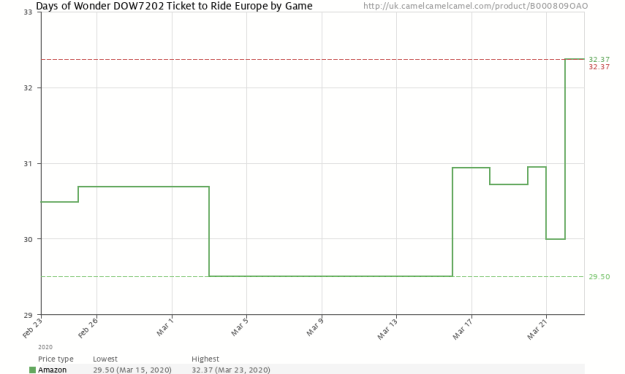
There has some suggestion that there has been a flurry of buying games to play with their families, but is there any real evidence of this?  Anecdotally, there have been comments that prices of games have increased on Amazon.co.uk which could indicate an increase in sales.  The website camelcamelcamel.co.uk tracks prices on Amazon, and it seems to indicate that prices for many popular light games have increased in the last week.

Ticket to Ride: Europe on camelcamelcamel.co.uk (23/03/20)
– Image by boardGOATS from camelcamelcamel.co.uk

There is another possible reason though: Amazon has suspended warehouse services (storage and shipping) of non-medical supplies and “high-demand” products for third party sellers.  This would have the effect of pushing prices up.  A lot of Friendly Local Games Shops sell online though, and many of these have sales on at the moment, so why not support one of the small businesses that are struggling at the moment, and leave Amazon to deal with toilet rolls and hand sanitiser?

Goats in the News: Goats Climbing the Walls?

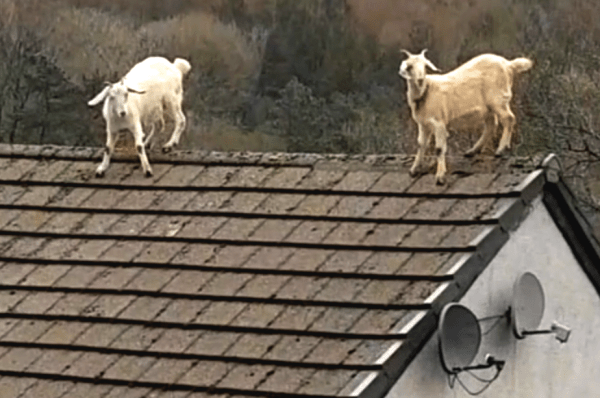
At times of stress, we all need a little light relief, and what better to provide it than a pair of  naughty goats.  Goats are well known for their climbing ability, and are often seen in argan trees in some areas of Morocco.  It is quite unusual to see them climbing roofs in Wales though.

Goats on Roof
– Image taken from msn.com video

Mable and the well-named Trouble, escaped from their garden in Blaencwm, Rhondda, and climbed twenty feet onto a neighbour’s roof. Fay Wilson-Yeates, filmed her efforts to get them down to show her husband, and the video is now being shared by everyone else too.  She is reported to have said, “I think it’s just what the world needs right now – my goats can bring a smile to people’s faces.”

– Video from youtube.com

17th March 2020 – “Unofficial boardGOATS”

There were people around the bar from 6pm, but we had the back room to ourselves, just the four of us.  The feel was similar to the Sunday after the fire, when people turned out and sat in the garden partly to help drink the smoke and water damaged stock, but largely to show support for a valued amenity, knowing that they would have to do without it for a while.  There was sadness, a sharing of news, some gossip, a certain amount of gallows humour, and for us, lots of desserts and Azul: Summer Pavilion.

Azul: Summer Pavilion
– Image by boardGOATS

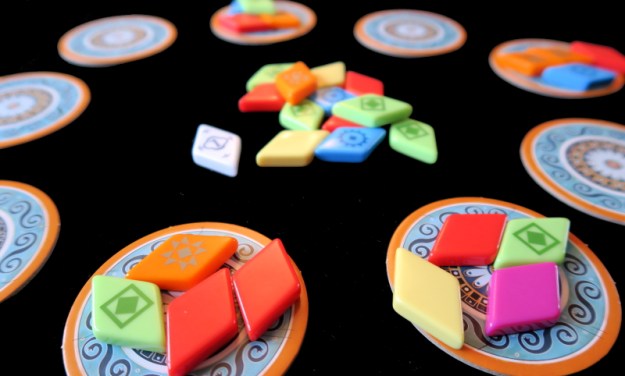
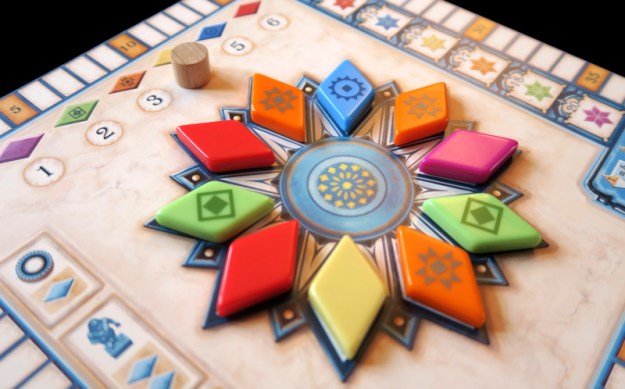
The game uses the same market mechanism used in the original Azul and the re-implementation, Stained Glass of Sintra.  The idea of this is that there are several markets (nine in the four player game) arranged in a circle and each with four coloured tiles.  On their turn, players either take all the tiles of one colour and put the rest in the centre, or take all the tiles of one colour from the centre.  Summer Pavilion differs from the other versions because each round has a special colour:  tiles of this colour are “wild” and can be used to replace any other when placing.  Additionally, only one tile of this colour can be taken from a market or the centre, and then as a bonus with other tiles.

Azul: Summer Pavilion
– Image by boardGOATS

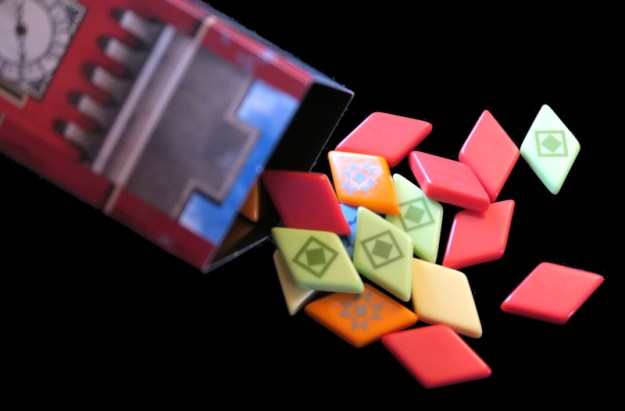
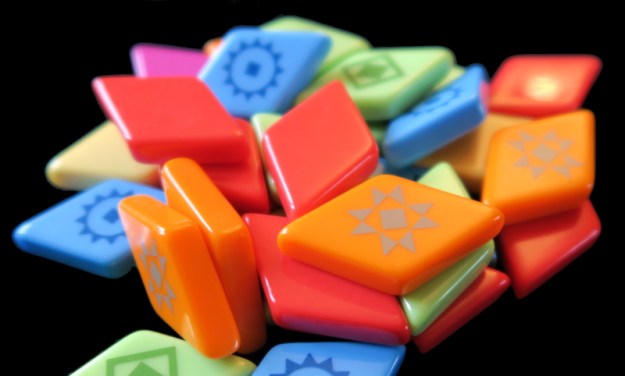
The structure of the game is also different with two phases; players take it in turns to take tiles, then they take it in turns to place tiles (rather than taking and placing straight away).  Perhaps the most obvious difference is the shape of the tiles though—rhombus shaped instead of square and the individual placement mats are built round pretty six-fold symmetric “flowers”.  When placing a tile, players have to match the colour on the mat, and the number on the space throwing the leftovers into a red tower—the build-quality of this is distinctly superior to the one in Stained Glass of Sintra, in fact, the build-quality of pretty much everything is better than in the first re-implementation.

Azul: Summer Pavilion
– Image by boardGOATS

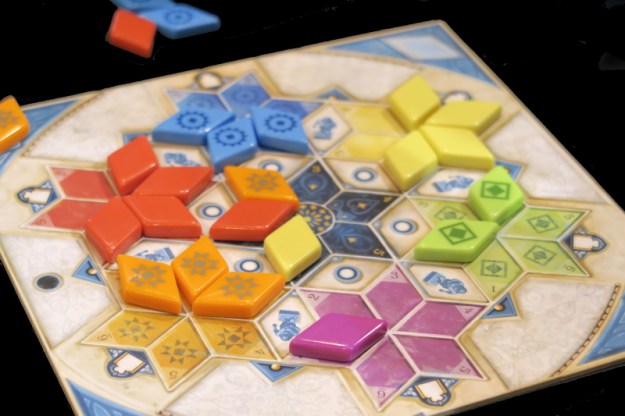
Players score according to the size of the segment after addition, thus adding a piece to connect two other single pieces would score three points.  Enclosing special features on the board gives bonus tiles which are added to the players pile of tiles to be placed.  The game takes six rounds (one for each colour) and players get end-game bonuses for completing flowers and for filling all seven spaces with the same number.  The player with the most points is the winner.

Azul: Summer Pavilion
– Image by boardGOATS

Although Blue was the only person who had played it before, it was quickly clear that everyone liked this version more than the last, but found it more challenging than the original adding a new level of complexity.  Purple went first, and Lime quickly got his nose in front.  Every time someone threatened to catch him, he put on another spurt and increased his speed to maintain his lead at around ten points.  That left it down the bonuss and the question was whether anyone had enough to catch him.

Azul: Summer Pavilion
– Image by boardGOATS

Blue took the most points in the end game scoring, but starting at the back, she also had the most ground to make up; Lime took the least and starting at the front he had the most to lose.  Purple was the closest to catching Lime and looked to be in a good pace taking twenty-four points in bonuses (as many as Blue), but sadly had three tiles she had been unable to place.  That made all the difference as she finished three points behind Lime, with seventy seven points to his eighty.

Azul: Summer Pavilion
– Image by boardGOATS

Lime suggested playing again, something only he ever does—not that this is a bad thing at all, it’s just particularly unusual within the group. Not that anyone minds playing games more than once, but he is the only one to ever suggest it.  This time, most people seemed to think they could do a better job the second time round, so the suggestion was really well received.

Azul: Summer Pavilion
– Image by boardGOATS

The second time round, Black and Blue started out with a different strategy, going for some of the expensive tiles first to maximise the extra tiles they could take early on.  Lime started as he had before taking an early lead and trying to keep it.  This time he found it much more difficult though.  Blue weathered his early spurt and kept with him, eventually overtaking him and sneaking into the lead.  This time everyone did better on the bonuses, as they knew what to look for, indeed everyone did better overall, though Lime said it didn’t feel like it.

Azul: Summer Pavilion
– Image by boardGOATS

Blue had the lead going into the final round and with two completed stars finished twenty point ahead of second place.  It was really tight for that though, with only a handful of points between second and fourth.  Despite a three point penalty at the end, Lime just managed to hold off Black, beating him into second place by a single point.  And that was it, the end of what is likely to be the last game for the group for what could be a very long time.  Everyone sadly said goodbye to the landlord, Charles, and we all wish him and all the staff at The Jockey our very best for what will, no doubt, be an extremely difficult few months for them.

The Horse & Jockey
– Image by boardGOATS

Learning Outcome:  You only fully realise what you’ve got when you are about to lose it.