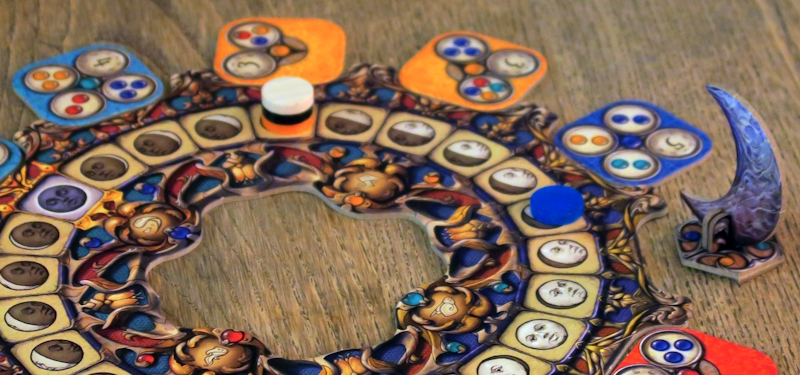
15th October 2024

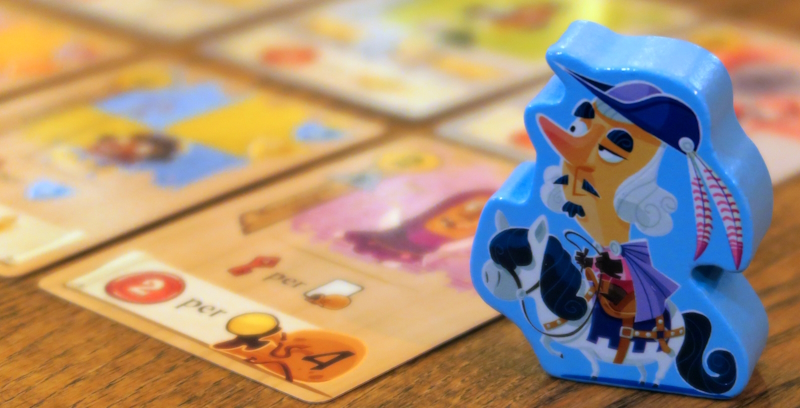
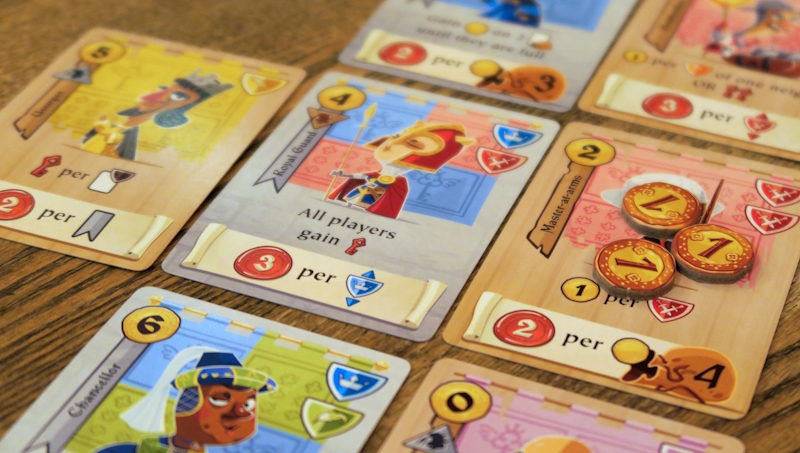
There were quite a few people eating this week, but the earliest arrivals were finished when Green turned up for the first time in months toting his copy of Lost Ruins of Arnak.  Jade was already preparing to lead the “Feature Game” which was to be Castle Combo, and he was joined by Sapphire, Pine and Lime.  This is a game that was released to coincide with Essen, but like many of the most popular games was sold out within a couple of hours.  The essence of the game is tableau-building where players draft cards from two markets creating a three-by-three square of people interacting with each other triggering instant effects and end-of-game bonuses.
Castle Combo
– Image by boardGOATS

The two markets consist of Castle Cards and Village Cards.  At the start of their turn, players can pay a Key to to carry out a special action, before they buy a Card from whichever market the Messenger token is currently located in and place it in their Tableau. Some card abilities grant a permanent discount when purchasing cards of a specific location (Castle, Village, or both).  If a player can’t afford any of the cards (or choose not to pay for them), they can always take a card without paying its cost, and place it face down in their tableau. In doing so, they ignore its ability, its end game points and any other information printed on it, but immediately gain six Gold and two Keys in compensation.

Castle Combo
– Image by boardGOATS

Each card after the first must be placed orthogonally adjacent to at least one other card in a player’s Tableau and at the end of the game, their Tableau must be a three-by-three grid of Cards. In this way, the final position of the cards in the array is fixed as the game progresses. Once it has been placed, the ability of the Card is applied. Some abilities affect opponents (all other players), while others affect a player’s neighbour (they choose which one). Finally, if the Messenger icon is depicted on the card played, the active player moves the Messenger Token, either to the Castle or to the Village, as appropriate, before refilling the market and ending their turn.
Castle Combo
– Image by boardGOATS

The game ends when everyone has nine Cards in their Tableau and everyone adds up their scores.  This time, Sapphire went first as he’d played before.  The game plays very quickly and smoothly as everyone began building up their displays.  It turned out that playing before wasn’t a great deal of help, however,, as Pine gave everyone else a bit of a trouncing as his final Tableau was worth ninety-six points, seventeen more than Jade who took second place a handful of points ahead of Sapphire in third.  Meanwhile, on the next table, Blue and Byzantium were leading a game of Stamp Swap at the request of Pink who had missed out last time.

Stamp Swap
– Image by boardGOATS

This is another fairly straight forward game, albeit one that takes a bit longer than Castle Combo, though it plays just as smoothly.   There is a lot of simultaneous play, which is nice because it minimises down time.  First, players take it in turns to choose items from the central Pool, then simultaneously divide them into two piles of offerings.  The player with the first player token, chooses and takes one of the piles offered by their opponents.  The opponent keeps their other pile and then chooses a pile from one of their opponents and so on.  Once everyone has two piles, players arrange the Stamps in their Album and then choose which of the four available end of round cards to score this time.
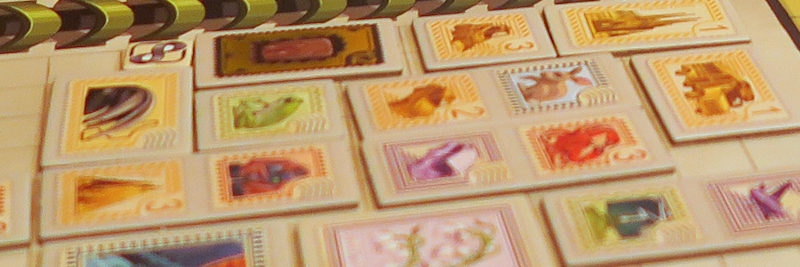
Stamp Swap
– Image by boardGOATS

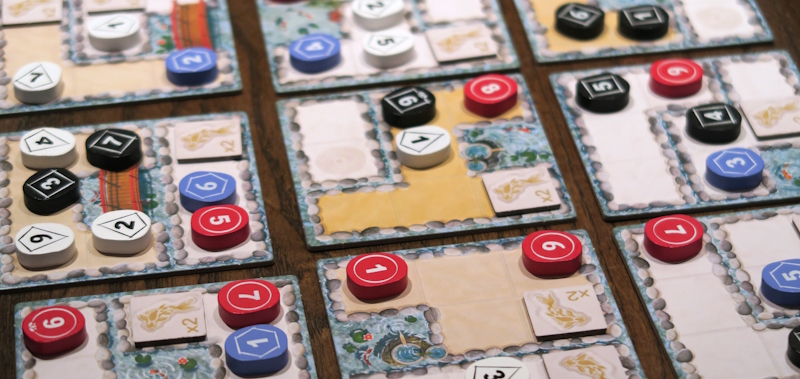
After three rounds, players score the end of game objective card and the player with the most points is the winner.  One of the clever parts about this game is how much difference the objective cards make to the way players arrange their Stamps.  This was very obvious last time when there were two parallel games and one scored Finale Contest gave for points for Stamps completely surrounded by other Stamps, while the other gave points for each empty region.  The former gave lots of Albums where the Stamps were clumped together, while the latter gave spread out Stamps in a lattice-type pattern.  This time, the Finale Contest gave ten points for each completed edge, so players began the game working along the borders of their Album page leaving a hole in the middle that they only filed in later in the game.
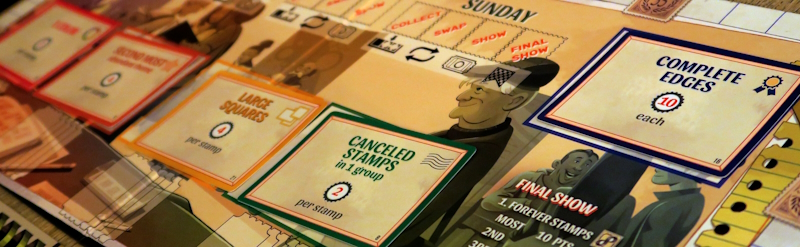
Stamp Swap
– Image by boardGOATS

The end of round scores allowed players to score points for the number of stamps they had in one colour, the number of large square Stamps they had, the number of cancelled Stamps and the number of Stamps in their second most abundant theme.  This artificially increased the value of large square Stamps, which was something that Pink failed to take into account early on.  It led to Blue taking what Pink felt was his obviously less valuable pile and giving her a surprise Special Stamp with a sad face from him.  Still, that was replaced with a big grin when he stole one of Blue’s hidden Stamps later in the game and it turned out to be the one with the Giant Panda on it.
Stamp Swap
– Image by boardGOATS

The first event card was Generous Gifts where players choose one of their Stamps to score and then pass on—always a difficult decision, but more-so at the start of the game.  Slim Pickings was the second event giving players fewer items from the Pool at the start of the round, while Hands to Shake was the final event which made more Attendee Cards available, although by this time, it was too late to really take advantage of them.  That said, Byzantium had made collected quite a few Attendee Cards, using them to great effect to gain extra points and Stamps and took one in the final round as well.

Stamp Swap
– Image by boardGOATS

Aside from the Panda, Purple seemed to collect nearly all the Animal Stamps, while Pink did a good job of collecting Flowers.  The game is a bit of a “Point Salad” though, with points coming in little aliquots from lots of different places, and it perhaps pays not concentrate too much on one aspect.  Byzantium got a fast start and took an early lead, which he just managed to maintain to the end, beating Blue into second place by ten points, for the second time, which Pink taking third.  While packing up, everyone agreed that they really enjoyed the game for its smoothness, and the only part that “jarred” was setting out the starting Pool which was a little laborious.  Discussion online later, however, suggested a away to improve this, so that’s something to try next time.
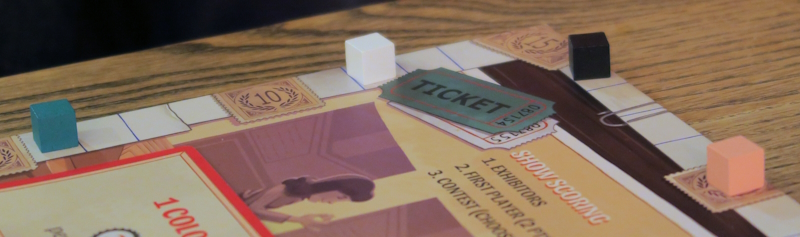
Stamp Swap
– Image by boardGOATS

By the time Stamp Swap finished, Castle Combo had already come to an end and Jade, Sapphire, Pine and Lime had moved on to play Courtisans.  We first played this a few weeks ago, shortly after UK Games Expo.  This is a clever little card game from the same stable as Castle Combo and Faraway, where players are manipulating card values by where they play them.  On their turn, each player receives and plays three coloured Family cards.  One card is played at the Queen’s table to sway a Family’s influence in a positive or negative way depending on whether it is placed above the table or below.  At the end of the game, those Families with more cards below than above will have “Fallen from Grace”.
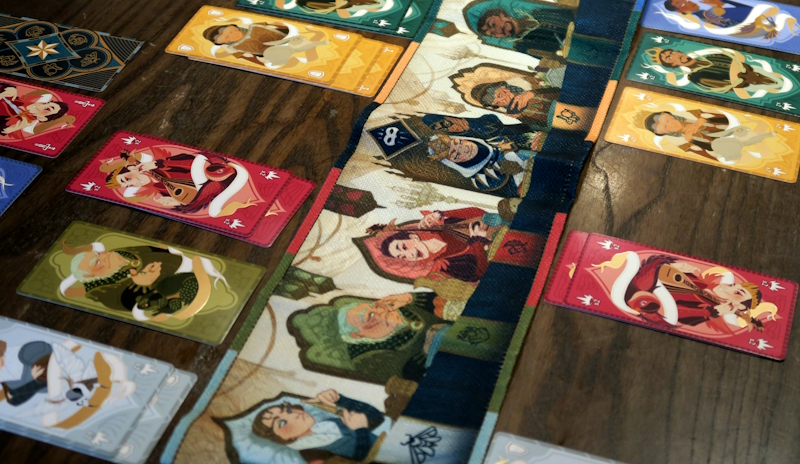
Courtisans
– Image by boardGOATS

One of the other two cards is played in the player’s own Domain and the other in an opponent’s Domain. At the end of the game, each card a player has from an “Esteemed” Family is worth a point, while each card from an Family that has “Fallen from Grace” loses them a point.  Thus, players are trying to increase the value of the cards they have, while decreasing the value of the cards their opponents have. The first game was a game of two parts, Jade and Pine tied for victory with nine points, while Sapphire and Lime also tied with four points.

Courtisans
– Image by boardGOATS

As is often the case with this sort of game, after the first play, once he’d seen how the game works, Lime requested a second game.  This second game was higher scoring with players getting more “Esteem” and fewer Families that had Fallen from Grace.  Both Jade and Lime completed both their objectives as well.  Lime’s massive Esteem scoring of twelve, gave him clear victory with a total of sixteen points, while Jade, who finished with eleven points, just pipped Pine to second by a single point.  There was a bit of chatter with everyone discussing the games, but nobody really had the inclination to play anything else before going home.

Courtisans
– Image by boardGOATS

On the next table, while Blue took a little time out, Pink, Purple and Byzantium played a quick game of the sixteen card filler, Love Letter. This is a sort of multiplayer dueling game where players have a hand of one card, draw a second from the face down deck and then choose one to play, with the aim of being the last player standing, or the player with the highest value card if in the event that the deck runs out first. The trio only played two rounds, but Byzantium managed to get knocked out first turn both times. It was a tie between the other two though, with Purple taking the first round and Pink the second when he knocked out Princess Purple.

Love Letter
– Image by boardGOATS

After two rounds, the trio got bored and moved on to playing Sushi Go!Sushi Go Party! had had a mention earlier in the evening, but as none of them were familiar with the rules changes, they stuck with the smaller, original version.  This is a simple, and one of the purest card drafting games where players start with a hand of cards, keep one and pass the rest on.  The cards are Sushi and players are trying to get sets, or pairs, or as many as possible depending on the Sushi on the card.  The group played the full three rounds, with very mixed outcomes.  At the end of the game, the player with the most Pudding cards gets extra points, but as all three tied so nobody got any.  The winner was Byzantium, with a massive fifty-eight points, seven more than Pink in second in what was a high scoring game.
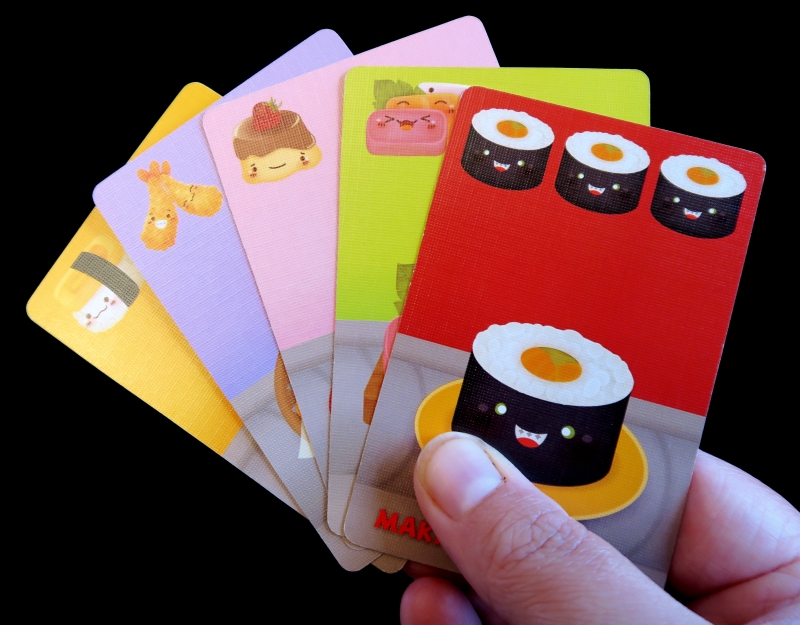
Sushi Go!
– Image by boardGOATS

Byzantium was waiting for Plum to finish on the other side of the room, so Blue rejoined the group for a quick game of something silly—an old game that Blue and Pink acquired at Essen, called Why First?.  The premise of this game is, what’s so important about being first, maybe the winner should be the person who is second.  So in this game, players start with a hand of five number cards and simultaneously, chooses a card to play before, on the count of three giving it to someone.  This player’s piece is then moved that number along the race track.  The round ends after five cards, the last of which must be used to move the payers’ own piece.

Why First?
– Image by boardGOATS

At the end of the round, only the player who is second scores, and that depends on their location on the track.  In the first round, Blue came second (and therefore won the points) and Pink won the second.  Byzantium won the third, but as he finished on the start line, he scored no points, much to his chagrin.  Blue and Purple tied for second in the fourth round so both took a single point, before Purple took the final round.  The winner of the game is, obviously, the player who comes second overall.  Despite a lot of effort by Blue who ultimately finished first and therefore lost, this was Pink who was therefore the winner.

Why First?
– Image by boardGOATS

By this time, the table on the other side of the room had finally finished and were packing up.  Green had clearly arrived wanting to Lost Ruins of Arnak, and Ivory and Plum had kindly joined him.  This had an outing about six months ago, when Green and Plum were also involved.  By this time, however, Green had acquired The Missing Expedition expansion and, having played the game quite a lot solo, wanted to include it to add interest.  The basic game combines deck-building and worker placement with resource management. Players start with six cards in their deck, two Money, two Compasses and two Fear cards (which just clog up players’ hands), and draw five of these to play.
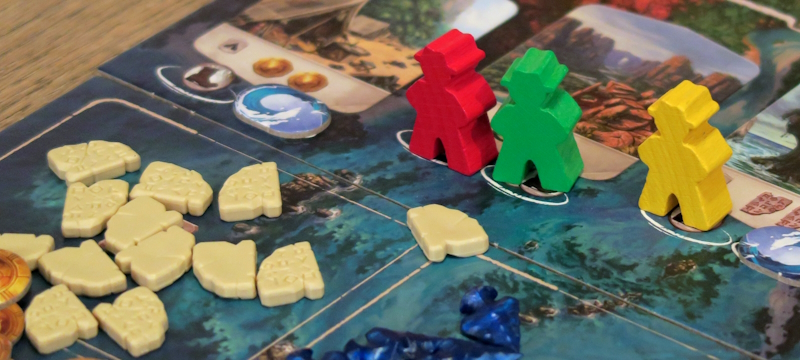
Lost Ruins of Arnak
– Image by boardGOATS

Players then have two meeples each that can be sent to locations on the map, to either discover or use an action Location which generally give Resources plus some extras. Each new site has a Creature guarding it, which, if beaten, will give points and a small one-time bonus.  Players can use resources to move up the Research Track giving different rewards.  Players get one action each per turn, until everyone has passed signalling the end of the round, and the game finishes after five rounds.  The Missing Expedition expansion is modular, but this time the group added the Waterfall Temple and the extra encounter cards. The Waterfall Temple has a couple of steps whose cost changes each time someone Researches past them which can make it a bit unpredictable, though there is a sneaky shortcut to the top of the temple for players prepared to pay the steep cost.
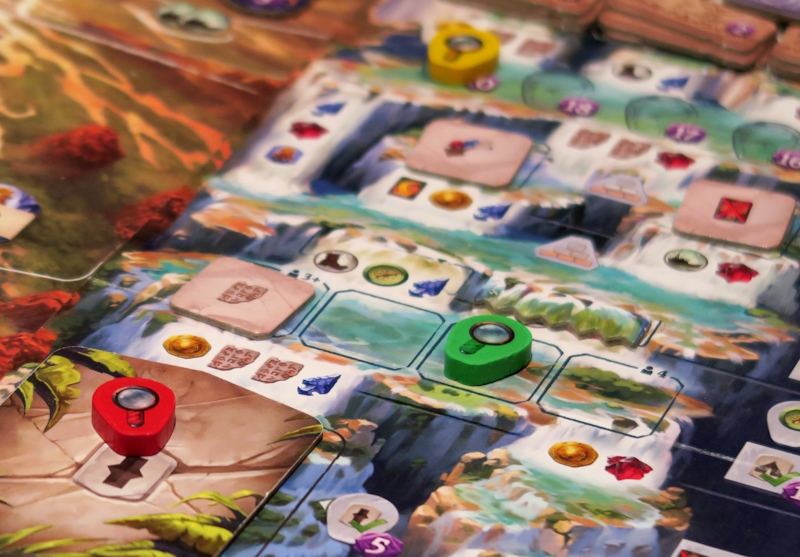
Lost Ruins of Arnak: The Missing Expedition
– Image by boardGOATS

The first round went very quickly with everyone having limited options. Green and Plum began moving up the Research track, looking to gain an Assistant as soon as possible, where Ivory focused on gaining coins and an additional card. Ivory grabbed the Recovered Plane card (from the expansion) that allowed him to recall his explorers and using them again, which felt quite powerful. In the second round, Plum and Green both got their Assistants. They also started getting additional cards with Plum getting the Unreliable Compass card that gave her the benefits from the bottom tile of the exploration track and Green got the Army Knife which gave him flexibility when gaining Resources. Ivory began Exploring, uncovering the first new worked spot, slowly followed by Plum. Ivory managed to use his Plane card to avoid the Guardian, whereas Plum didn’t have that option and gained a Fear card at the end of the round.

Lost Ruins of Arnak: The Missing Expedition
– Image by boardGOATS

In the following rounds, Ivory begin focusing on the research track, catching up with Green and Plum and eventually overtaking them. He reached the part of the track where he could gain the Resources on a set aside exploration tile and got one that gave me an Explore card from the expansion which gave him the choice of something now or something latter. As the third and fourth rounds progressed, the Research track became a core focus Ivory managed to reach the top the first. Everyone continued exploring, and Ivory was also the first to explore a level two tile, gaining additional idols and resources and then subsequently able to recall his explorer to avoid the Guardian and Fear card.
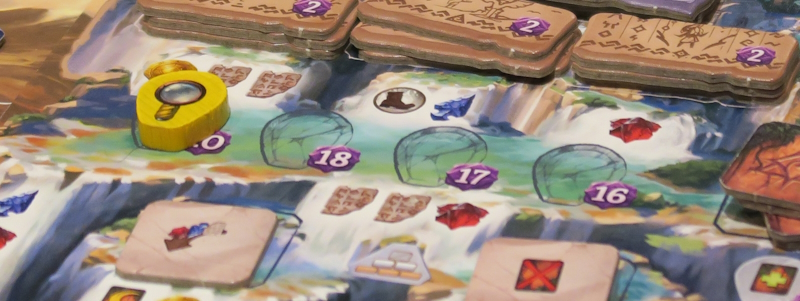
Lost Ruins of Arnak: The Missing Expedition
– Image by boardGOATS

Plum was also Exploring, though at the lower level, but unfortunately the Guardians that she was drawing meant they were very difficult to defeat and she picked up more Fear cards. Green was Exploring less, but was using the engine that he assembled with his Assistants and cards to explore and defeat quite a few Guardians, adding to his engine whilst also gaining points. Towards the end of the game, the question for everyone was how to be most efficient and make the most moves up the Research track. Green joined Ivory at the top, and additionally gained enough Resources to grab an eleven point temple tile. Ivory was looking for an additional Resource to move my notebook up one more step and then remembered he hadn’t gained the bonus tile for reach the top of the Research track, gaining him that valuable Resource.

Lost Ruins of Arnak: The Missing Expedition
– Image by boardGOATS

Plum was also pushing up the Research track, looking to squeeze as much value as possible. Ivory also had accumulated quite a few coins, which allowed him to buy lots of cards during the final round just for their points. With everyone passing in the final round there was just the small matter of the scores. Points for Exploring, Research and Idols were pretty much level. Green’s engine which allowed him to gain the eleven point temple tile and defeat four Guardians (as opposed to Ivory’s and Plum’s one) ultimately gave him victory with seventy-seven points. Ivory’s Artifacts and Item cards gave him second ahead of Plum who had struggled with her Fear (bordering on Terror!) throughout the game.
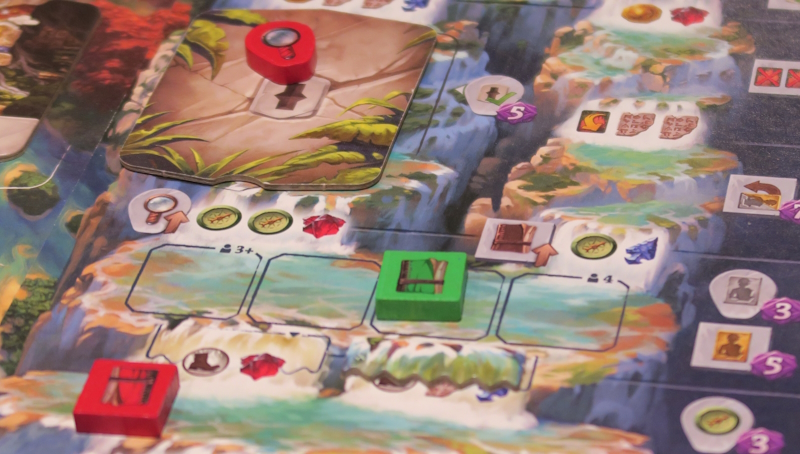
Lost Ruins of Arnak: The Missing Expedition
– Image by boardGOATS

Learning Outcome: Princesses don’t want to live in Ruined Castles.

Jogo do Ana Winner 2024

The winner of the Jogo do Ano, the Portuguese Game of the Year Award, has been announced as Nucleum.  The Jogo do Ano is perhaps more relevant to experienced gamers than some of the other awards (like the Spiel des Jahres and Deutscher Spiele Preise), as it recognises heavier games, or “gamers’ games”.  Nucleum, by Simone Luciani and Dávid Turczi, is a heavy euro-style game in which players take the role of industrialists in nineteenth century Saxony.  Players are trying to use the development of the nuclear reactor (or nucleum) to build and power urban buildings, develop networks, secure contracts, and meet milestones to become the leader of the industrial revolution in an alternate timeline.  Unlike many games of this type, game play is continuous and players take turns without breaks for different game phases.

Congratulations to all involved for the award and for creating a great game.

Nucleum
– Adapted by boardGOATS from an
image by BGG contributor zgabor

Next Meeting, 15th October 2024

Our next meeting will be on Tuesday 15th October 2024.  As usual, we will start playing shorter games from 7.30pm as people arrive, until 8pm when we will start something a little longer.  The pub is doing food, and the table is booked from 6.30pm for those that would like to eat first.

This week, the “Feature Game” will be Castle Combo (rules, review, how to play video), which is a tableau-building game where players draft cards from two markets creating a three-by-three square of people interacting with each other to trigger instant effects and end-of-game bonuses.  The game was released to coincide with Essen, but like many of the most popular games was sold out within a couple of hours.

Castle Combo
– Image from facebook.com

And speaking of castles…

The knight, Sir Jeff and his men returned to the castle after a long hard day of fighting. Sir Jeff went to see his Liege Lord to report on their progress.

“So, how are we faring?” asked the King.

“Sire,” replied the knight, bowing low. “I have been robbing and pillaging on your behalf all day, burning the towns of your enemies in the west.”

“What?!?!” shrieked the King, “I don’t have any enemies to the west!”

Sir Jeff looked slightly crest-fallen as he replied, “Well, you do now your Majesty…”

8th October 2024

As it was our twelfth birthday party, lots of people arrived early for pizza (or an amazing Mixed Grill in the case of Lime and some lovely veggie curry and fiery chilli for Pine), followed by GOAT cupcakes.  While everyone waited for food, arrivals from Essen were handed out, including Nucleum, Faraway and Flamme Rouge expansions; Let’s Go! To Japan and Cascadia mini expansions, and Die Wandelnden Türme (aka Wandering Towers), Keyflower and Dixit promotional items.   There was a lot of chatter too, about flooding, pot holes, the 34 road closure, full car parks and water leaks, as well as Essen.  Indigo and Navy weren’t eating, so had a play with Villagers while the others entertained themselves.  This is a card game where players “Draft” Villager cards from a market (called the Road) and then add them to their Village.

Villagers
– Image by boardGOATS

Some Villagers have prerequisites before they can be “Built”.  These are cards that must exist in the player’s Village before the Villager can be added on top to make a chain, cards that must be unlocked by paying money to other Villagers in their own Village, someone else’s Village or the Bank.  Some cards allow players to draft extra cards, while others enable players to Build extra Villagers and Special Villagers give powerful special actions.  Twice during the game there “Market” Phases when players get income from their cards, and the player with the most money at the end of the game is the winner. Somewhere along the lines, Indigo and Navy had a bit of a rules malfunction, and as everyone else had already started the now traditional birthday “Feature Game“, Crappy Birthday, they abandoned Villagers.

Crappy Birthday
– Image by boardGOATS

Crappy Birthday is a party game where players give each other comedy birthday presents and the recipient has to decide who gave the best and worst gifts.  We play a slight variant of rules as written, where we play a single year of birthdays with each gamer getting one turn to receive gift cards from everyone else from their hand of five cards.  With lots of players the pile of gifts can get quite substantial and this time everyone was getting thirteen gifts to decide which was the best and which was the worst.  The players who gave these then received a point for knowing the recipient so well and the player with the most points at the end of the year is the winner.

Crappy Birthday
– Image by boardGOATS

One of the reasons this game is so fun is that we learn a bit about each other.  Pink went first as his real birthday was next.  He liked the idea of an Easter Island Mo’ai for the garden (not that Blue was so impressed with the idea), but disliked the idea of cave scuba diving.  Plum chose a haunted castle as her favourite (because she loves castles), but pulled a face at the idea of earlobe stretching rings.  Purple had the matching neck rings, but these weren’t her least favourite gift, that was a giant swing ride, while she loved the idea of a penguin collection.  Byzantium showed his environmental credentials by picking a Global Warming Study as his favourite, while eschewing Jade’s wing suit dive gift.

Crappy Birthday
– Image by boardGOATS

Teal felt that trees were quite beautiful enough without being carved, but really liked the idea of a ride-on bike mower.  Jade wasn’t a fan of Cobalt’s offering of Polka lessons, but loved the idea of trip to Mars from Sapphire, while Sapphire felt “perkiness training” wasn’t something he really needed, but the thrill-seeker loved the reciprocal gift from Jade, a roller-coaster ride.  Lime fancied a three day festival trip, but wasn’t keen on a week eating nothing but Spam.  Blue didn’t fancy the creepy baby sculpture to go with the Mo’ai, but fancied Pink’s gift of a Safari (provided she had time to train for the walking element).  Ivory didn’t feel his life would be improved by a free satellite TV dish, but always one to send his meeples into space in Tapestry, grasped the opportunity to join them with a space walk.

Crappy Birthday
– Image by boardGOATS

It turned out that Navy has a problem with bees, so Teal’s gift of a bee keeping which he personally would have loved, didn’t go down well, but much to Pink’s surprise, his gymnastics camp was received really well.  Indigo was quite abrupt in her negative response to the idea of paparazzi following her about, but liked the idea of exploring a volcano while Cobalt didn’t feel he needed his soul to be searched, but fancied flying lessons.  The final birthday of the year was Pine, who didn’t get his usual pile of horses and meat, instead getting the opportunity to run with the bulls, which having known someone who had done it and been gored, wasn’t something he fancied.  Pine’s favourite was Larry the Lobster (not that he has space in his garden for him), one of the Big Things of Australia, that Pink and Blue happened to see on their visit there last year.

Crappy Birthday
– Image by boardGOATS

Lime was the last to break his duck and was very pleased not to end the game without scoring any points, indeed, nobody finished with the dreaded bagel, which was nice.  The runniest of run-away winners was Teal though, with five successful (or unsuccessful) gifts, with Pink and Cobalt joint runners up with three.  It was interesting though, this time there were quite a lot of gifts that people gave “in error” where as Teal commented, he “Gave pressies he thought people would like, but they all hated them!”  With the birthday formalities dealt with, there was time for something relatively short.  First up was Jade who was very keen to give his new Faraway expansion, Le Peuple du Dessous (aka The People Below).

Faraway
– Image by boardGOATS

Faraway is a fairly simple little game, but one that really messes with your head:  players play cards from their hand of three, adding them to a row of cards, left to right, but at the end of they score the eight cards from right to left.  The Peuple du Dessous expansion adds just seventeen cards, but these include the Guides and the Three-Eyed Ones, two new Peoples with more opportunities to score, as well as giving enough cards to play with seven people.  This time there were only five though, with Sapphire, Byzantium, Indigo and Navy joining Jade.  Navy and Indigo were new to the game and, as usual, it took a little bit of getting used to.  That said, the both did really well with Indigo ending up with seventy-seven points, four more than Sapphire in second with Navy taking third, just one point behind.

Faraway
– Image by boardGOATS

Navy and Indigo headed off and took an early night, but the other three had to wait for Plum who’s game on the other side of the room was ongoing.  Faraway is a fun little game though and the expansion adds a little more, so the trio decided to give it another go.  This time, Byzantium was the victor with seventy-three with Sapphire the runner up again.  Meanwhile, Blue, Pink, Pine and Teal, got out Bohnanza.  This is a game that is generally popular with the group, though Teal had somehow only managed to play it the once almost six months ago.  This is a very simple card game, albeit slightly convoluted and very unpromising when explained, but the key is that players must not rearrange the cards in their hand.

Bohnanza
– Image by boardGOATS

On their turn, players must plant the first card in their hand in one of their two been fields and may plant the second if they choose.  They then turn over two cards from the deck, which must be planted before the player can move on.  Fields can only contain one bean type, but beans can be traded, or even gifted, and it is the trading and negotiation that makes the game such fun.  Once the two cards on the table have been planted, players can trade from their hand, but again all traded cards must be planted.  Players can harvest Fields at any time with some of the bean cards dug up becoming money and larger Fields giving more money and at a better rate.

Bohnanza
– Image by boardGOATS

Blue took some high valued Garden Beans and then sold them off to buy a third Bean Field, causing a lot of confusion for Pink who couldn’t believe it when they kept appearing even though there were only six in the deck.  Teal scored well from his Chilli and Wax and Soy beans, while Pine and Blue ended up in competition for Green Beans.  This time with just four, the scores were a little more varied, but Blue was the clear victor with twenty-five Bohn Thaler, five more than Pine who came second.  The final game of the evening was Villagers, which was getting another outing on the other side of the room with Cobalt leading Ivory, Purple and Plum.

Villagers
– Image by boardGOATS

After a reminder of the rules, Purple started and grabbed the Carpenter then Cobalt went next taking the Blacksmith.  Both of these guaranteed their owners an income of coins (and hence points) at the expense of other players paying to use them. However, this did mean that they fell behind on building an engine to Draft and Build more cards (which Plum and Ivory focused on).  From there, the first half of the game went quite quickly with everyone focusing on building their engine. Ivory managed to get a Wine Trader using a Monk as a Graper, as well as playing a Scavenger, enabling him to take slender lead after the first scoring, although the scores were all very close.

Villagers
– Image by boardGOATS

In the second half of the game, Purple and Cobalt were beginning to have to make tough choices, being unable to play as many cards as they would like and not having the building cards they needed, which were also hard to come by. However, they continue gaining coins from all players. Purple had to discard quite a few cards to get starter cards which slowed her down a little, though Plum and Ivory were able to quickly get to the position to Draft and Build the max number of cards allowed; Plum in particular seemed to always have a fist full of cards.  As the game progressed, more people began taking cards that others might want, with Cobalt taking Wool cards that might have been of use to Purple or Ivory.  Ivory, however, was actually more focused on getting a second Vintner, already having a second Wine Trader in hand.

Villagers
– Image by boardGOATS

Towards the end of the game, there was face down Grape card which Ivory debated taking a gamble with, but decided not to take the risk.  Inevitably, when it was flipped over it turned out to be Vintner and Plum grabbed it. Ivory got very lucky during his next draft though, taking a face down Special card that was Monk, which he could then play as Vintner. Elsewhere, Purple played some Wool cards, getting two Weavers, Plum picked up some good end-game scoring cards in the Locksmith and Freemason. Cobalt focused on Solitary cards and Silver end game scoring, doing well from his Priests, Agent and Blacksmith combo. Ivory ended up focusing on the Hay cards, which scored well and that plus the two Wine Traders (and a second Scavenger), gave him a hundred and twenty-six and a two point victory over Cobalt.

2024 Birthday Cupcakes
– Image by boardGOATS

Learning Outcome:  Getting old is not necessarily a bad thing.

Next Meeting, 8th October 2024

Happy Birthday to Us!

Our next meeting will be Tuesday 8th October 2024, when we will be celebrating our twelfth birthday.  We will be eating together to celebrate at 6.30pm with cake and games afterwards.

As is now traditional on our birthday, the “Feature Game” will be Crappy Birthday.  This is a party game where players give each other comedy birthday presents and the recipient has to decide who gave the best and worst gifts.

Crappy Birthday
– Image by boardGOATS

And speaking of birthdays…

Jeff and Joe were chatting over a beer. It had been Jeff’s girlfriend’s birthday and he was explaining how had been stuck as to what to get her.

“In the end,” Jeff said, “I had a brainwave. I just thought about what I would really like and got her that.”

“Oh?” responded Joe.

Jeff replied, “A new fridge.”

“That’s a great gift, did she like it?” pondered Joe.

“Oh yes,” answered Jeff. “You should have seen her face light up when she opened it…!”

17th September 2024

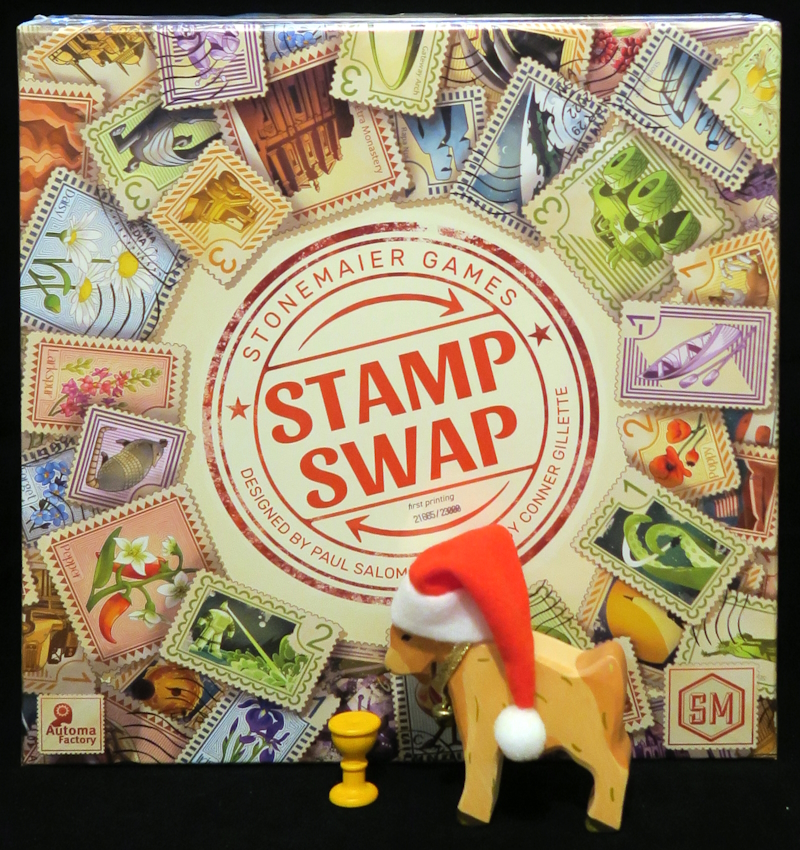
After the usual chatter and some food, the interested parties staked their claim to play the “Feature Game“, Stamp Swap.  This is a game where players take on the role of stamp collectors at a convention collecting, trading and then scoring their stamp album.  All the reviews claim it is a light game, but while it is not hugely complex, there is more to the game than appears at first glance.  At its core is the “I cut, You Choose” mechanism that is used in games like Isle of Skye and …aber bitte mit Sahne, but Stamp Swap is nothing like either of these.

Stamp Swap
– Image by boardGOATS

The game takes place over three rounds each with three phases:  Collect, Swap and Show.  In the collect phase, an Event card is revealed and then players take turns to take an item from the central pool.  Once everyone has six items, everyone puts one item aside to Reserve and then splits the rest into two piles for the Swap phase.  Some “I cut, You Choose” games struggle work across a range of player counts, for example, San Marco, really only plays well with three players where one splits the cards into three sets and the others choose.  While the game might work with two, the decisions would be too trivial (though there are variants with a dummy player).

Stamp Swap
– Image by boardGOATS

In contrast, dividing a pile into four would require too many cards and make the decision complex as well as make the game potentially quite “swingy”.  Thus, although the game officially plays three to four players, the mechanism really only works with three.  Stamp Swap avoids this problem with a snake-like mechanism that also negates the need for valuing the hands or the use of money as an intermediate (as in Isle of Skye).  The first player chooses one set and the owner of that set keeps their other set and chooses one from another player.  That player keeps their second set and chooses a set from another player and so on.

Stamp Swap
– Image by boardGOATS

Players then place the stamps in their album and score in the Show Phase.  There are four Goals in each game and each player can score one of these per round, but can only score each only once.  These Goals are different in each game giving a lot of variability, especially as thy combine together in different ways.  At the end of the game, players additionally earn points for the face value of each Stamp, for any Specialist cards they may have, for Stamps that match their personal Theme, and for their achievement in the Finale Contest, while receiving bonus points their place in the Forever Stamp competition.

Stamp Swap
– Image by boardGOATS

The unexpected complexity arises from the stamps themselves.  They come in five different colours, themes and size/shapes.  Some of these stamps are “Cancelled” (and have no face value) and some are “Faded” (and have a negative face value, but may be useful for claiming the Goals).  There is are special gilded Stamps with their own Chocolate theme and a high face value, but cannot be reserved at the end of the Collect phase.  Finally, there are the “Forever” Stamps.  These are Square and are the only Stamps available in the smallest size and have no face value, but are useful for filling tiny holes (should that be required for the Goals) and give bonus points at the end of the game (in much the same way as Pudding do in Sushi Go!).

Stamp Swap
– Image by boardGOATS

It turns out that the game takes quite a lot longer with more players, which was a bit of a surprise given that much of the game is played simultaneously.  This time Ivory led a group of five with Plum, Sapphire, Jade and Teal, while Blue led a group of four comprising Byzantium, Purple and Black.  Ivory’s group were quick off the mark and first to get going after the rules explanation.  Their Goals gave points for:  Stamps of one Colour in one Group; sets of all five Theme Stamps; Large square Stamps, and Cancelled Stamps not on the edge, while their Finale Contest gave points for the number of Stamps completely surrounded by other Stamps.  Ivory’s personal scoring objective was Space Themed Stamps, Plum’s were Animals, Sapphire’s were Vehicles, Jade’s were Monuments and Teal’s were Flowers.

Stamp Swap
– Image by boardGOATS

Everyone began by feeling their way a bit, especially as the first round added additional Specialists—cards that give extra powers for the rest of the game.  Plum made a “bee line” for these, while Jade and Teal focused on the Large Square Stamps, scoring the related bonus, and giving them an early lead.  Jade also managed to “hide a gold stamp (face down)” and ended up with it in his collect as no one took it.  Plum scored for the Cancelled Stamps first, as she had picked up a lot of them.  As nobody chose his set, Ivory ended up with all his own Stamps, which he thought was great at first, but then had second thoughts as he ended the first round at the back of the pack.

Stamp Swap
– Image by boardGOATS

In the second round, the event was “Rewarding finds” giving two points immediately for taking a face down Stamp, which everyone was keen to do, especially Plum, who quickly caught up with Jade and Teal as a result.  Plum made good use of her “Swap one for three face down Stamps before splitting your collection” to grab extra Stamps.  Teal managed to hang on to the First Player token for most of the game and also took a lead on the Forever Stamps. Sapphire grabbed an exhibitor for Yellow Stamps and proceeded to take Stamps to match wherever possible (both from the pool and from other peoples piles). Ivory made a point of collecting a full set of five different Theme Stamps, scoring nine points, as well as managing to keep a valuable face-down Gold stamp.

Stamp Swap
– Image by boardGOATS

Going into the final round, Ivory was still trailing significantly behind everyone else who were bunched tightly together.  This time the Event gave bonus points for taking Stamps that matched the Theme of their neighbours, which made the game slightly meaner as everyone was taking Stamps others wanted.  Plum was again using the additional Stamps she was getting from her Specialist to shape what she was going to end up with, managing to get three complete sets for twenty-seven points. Jade also managed to score well for this in the final round, as well as for the coloured Stamp cards he collected. Sapphire was similar with his vehicles and Yellow stamps, as well as scoring scoring for Large Square Stamps.

Stamp Swap
– Image by boardGOATS

Teal fell a little behind, taking fewer points for the Cancelled Stamps on the edge and he also failed to collect any of the Flower Stamps he needed as everyone kept taking them during the swap phase (in order to get complete sets). Ivory meanwhile focused on getting as many Large Square Stamps adding to the three he already had, giving him a massive fourty-two points taking him from behind and giving him a significantly lead.  In the final scoring, Teal took the bonus for the most Forever Stamps giving him ten points while and everyone but Plum tied for second with a single Forever Stamp, giving six points.

Stamp Swap
– Image by boardGOATS

Everyone managed to get at least one gold stamp, but Ivory had the most valuable total face value.  Plum scored most for specialists, although most people had at least one, so this made little difference to the scores. Everyone scored well for the Finale Contest, especially Jade, and Plum, but it was not enough to overhaul Ivory’s lead.  He finished with a total of a hundred and forty-eight, ten more than Plum who took second place, who was a handful of points ahead of Sapphire in third.  On the next table, Blue took longer to explain the rules, but once they got going, they soon caught up with the first group and ended up finishing just before.

Stamp Swap
– Image by boardGOATS

Their first Event card was “Generous Gifts” so after the Collect phase, players choose one collected items to score and then pass on to their neighbour.  Everyone quickly chose their highest scoring Stamp, then realised that meant they would lose it, so had a bit of a re-think.  It was then that the group began to really appreciate the quandary at the centre of the game:  it was all very well taking nice tiles, but they were no use if someone else took them.  This tension was particularly obvious in the final round of the first game where the “Mine not Yours” Event gave points for taking Stamps that matched a neighbour’s theme—while players lost the opportunity to pick up Stamps they wanted in the Collect Phase, they had the chance to take them in the Swap phase.

Stamp Swap
– Image by boardGOATS

The Events in the second and third rounds were “More to See” and “Stamps Forever”.  These had a much smaller impact on the game play, or at least it felt like that, though the Forever Stamps were all collected in the final round.  The Finale Contest was “Empty Regions” which gave three points for each empty region.  Black showed everyone how to to maximise this and from the end of the first round, everyone’s collections began to look like every-expanding checker boards.  Comparing the final album boards between the two games, the layouts were completely different with compact groups for the first game and gappy sprawling displays for the second game.

Stamp Swap
– Image by boardGOATS

Black picked up the bonus for having the most the Forever Stamps, and Byzantium, who by his own admission had been “pants during the game” picked up loads of points in the dying stages.  Purple had done the best with her personal Goal—Flowers, while Blue had a plethora of rare, valuable Stamps.  During the game it had been unclear who was really in the lead as the scores seesawed a bit, but Byzantium’s lunge for the line gave him the lead when it mattered and he finished with a hundred and forty-six points, seven more than the runner up, Blue.  All in all, everyone had enjoyed the game, though the overwhelming feel was that there was much more to the game than the reviews claimed, but that’s a good thing.

Stamp Swap
– Image by boardGOATS

Cobalt was the only person with a strong aversion to playing Stamp Swap, but Pine, Lime and Pink were all keep to play one of their favourite games, Zoo Break, another game that wasn’t really his type.  In he end, Cobalt graciously joined in the keepers of Bedlam Zoo, trying to keep the animals under control.  The game is a cooperative game, where players take it in turns to roll a die to determine how many actions they get, take the actions like acquiring
supplies, capturing animals, locking enclosures etc., before cards are drawn to see what animals escape and then move towards the exit.  The aim is to get all the animals back into their cages and lock them before five animals  or anything dangerous gets out.

Zoo Break
– Image by boardGOATS

The group chose to use the standard difficulty (two “Phew” cards), but with the “Faulty Lock” variant.  This is where players roll to see if the lock holds when one of the locked up animals tries to escape; it adds a but of interest to the end of the game, however, unfortunately this time, the group didn’t get that far.  They managed to lock up the Elephants, Tigers and the Rhino, but the mischievous Pandas remained rogue until the end of the game.  They weren’t the problem, however, that was the Snakes.  Three harmless Garter Snakes got out, but they were followed by a Viper, and as it left, so did the group’s zoo license…

Zoo Break
– Image by boardGOATS

With Bedlam Zoo sadly closed prematurely, the group moved on to a couple of quick fillers.  The first of these was No Thanks!, a really clever little “cards with numbers” game.  The idea is that players either take the face up card or pay a chip to pass the problem on to the next player with the aim being to be the player with the lowest total at the end.  The clever part is that if a player has a run, only the lowest value card counts, but the deck also has some cards removed at random.  This makes it a proper gambling and “push your luck” game.  This time, Cobalt was the top scorer, but the winner with eighteen was Pink.

No Thanks!
– Image by boardGOATS

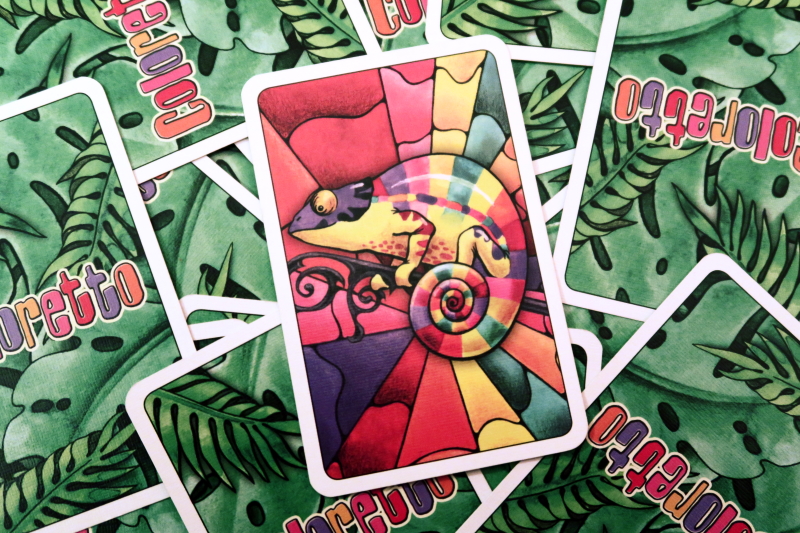
There was just time for one more game, Coloretto.  This is another simple and clever card game, this time the essence of the core mechanism in the bigger game, Zooloretto.  The idea is that players either draw a card and add it to a truck, or take a truck and add its contents to their collection.  At the end of the game players score their three largest sets positively, with negative points for any other sets.  The clever part is the use of the Triangular number sequence which means the first card in a set is worth one point, while the sixth is worth six.  There were the usual questions about Joker cards which resulted in questions being called across the room, but in spite of taking all three Jokers in the deck, Pink was just second by three points behind Lime’s total of forty.

Coloretto
– Image by boardGOATS

Learning Outcome:  A game about Philately can be more than just Stamp Collecting.

Essen 2024

Today was the first day of the largest annual games fair in Europe and arguably the world.  The Internationale Spieltage is known to gamers worldwide simply as “SPIEL” or “Essen”.  This is a “fair” rather than a “convention” and is of particular significance as a lot of new releases are scheduled to coincide with the event, just in time for Christmas sales.  This year, for the first time, tickets were sold out for Thursday and Friday before the fair even started—partly  caused by the ever-growing numbers of attendees, but also as a result of the numbers being capped, apparently due to changes in German legislation.

Monkey Palace
– Image by boardGOATS

It has been additionally observed that whereas Thursday and Friday used to be the quieter days, in more recent years there has been a tendency for Gamers attend on these days to avoid missing the new and hottest games.  As a result, there have been a large number of games selling out early.  For example, this year, Castle Combo had sold out English language copies by 11.30am, and while more will arrive over the next few days, these will be in smaller numbers and are expected to run out even earlier.  Saltfjord, Panda Spin, The Yellow House, and Endangered Rescue! #1: Galápagos Penguins were also sold out before the end of the first day.

Meeps @ Essen 2024
– Image by boardGOATS

The Deutscher Spielepreis winner was announced at the fair as Forest Shuffle (so it was unsuprising that the the day’s quota of copies of its second expansion, Woodland Edge were also gone before the doors closed on Thursday).  It was also revealed that Stonemaier Games has acquired the Tokaido line of games from Funforge, and there will probably be other industry announcements along the same lines before the end of the fair.  One thing is for sure, and that is that there will be the usual deluge of new games and exciting expansions to known and loved games arriving in the shops over the coming weeks.  It will be fun to see what people enjoy playing over the next year.

Essen 2023
– Image from spiel-essen.de

Deutscher Spiele Preis – 2024

The 2024 Deutscher Spiele Preis awards have been announced at the International Spieltage in Essen.  These are the results of an open vote by games clubs, gamers and people in the industry and recognise the “Best Children’s Game” and a top ten list of the “Best Family and Adult Games”.  The games named in the Deutscher Spiele Pris lists often intersect with the winners and nominees of the annual Spiel des Jahres Award, but the Spiel des Jahres winners are chosen by a committee with a list of strict criteria, whereas the Deutscher Spiele Preis is more a list of the most popular games of the preceding year.

Deutscher Spielepries 2024 Logo
– Image from
spiel-essen.com

As is often the case, the top ten list includes the both the winners and some of the nominees of the Spiel and Kennerspiel des Jahres awards, but the top spot went to a game from the Recommended List, Forest Shuffle (aka Mischwald).  Second place went to Sky Team (winner of the Spiel de Jahres) with The White Castle (aka Die weiße Burg) taking third, and Harmonies, also from the Recommended List featuring as well.  Unusually, the winner of the Kennerspiel des Jahres,  Daybreak (aka e-Mission), did not make the top ten. The winner of the best children’s games was Magic Keys (aka Die magischen Schlüssel), which also won the Kinderspiel des Jahres earlier this year. Congratulations to all the award winners.

Forest Shuffle
– Image by boardGOATS

Now we are Twelve – Happy Birthday to Us!

Twelve Today

BoardGOATS is Twelve Years Old Today!

Although it doesn’t feel that long, it is twelve years since our first boardGOATS meeting at the Horse and Jockey in Stanford-in-the-Vale. We now typically have around ten, lovely people every time with lots of people who make a special effort to travel to join us—without you, boardGOATS wouldn’t be the success it is, so we really appreciate it.  Here’s to another year of games!

Next Meeting, 17th September 2024

Our next meeting will be on Tuesday 17th September 2024.  As usual, we will start playing shorter games from 7.30pm as people arrive, until 8pm when we will start something a little longer.  The pub is doing food, and the table is booked from 6.30pm for those that would like to eat first.

This week, the “Feature Game” will be Stamp Swap (rules, review, how to play video), which is a game where players take on the role of stamp collectors at a convention collecting, trading and then scoring their stamp album.  It is a fairly light game that features the “I cut, You Choose” mechanism used in games like Isle of Skye and …aber bitte mit Sahne.

Stamp Swap
– Image from stonemaiergames.com

And speaking of stamps…

Jeff was visiting his crazy Uncle Josiah at his cabin in the woods of Montana. After After dinner Jeff noticed eggshells stuck to his plate, which had a peculiar dull shine.

“Are these plates clean?” asked Jeff.

“We ain’t got no fancy plumbing out here and them plates is as clean as Cold Water can get’ em,” replied Jeff’s Uncle.

The following morning, Jeff woke up rested and hungry (as usual). Rubbing the sleep out of his eyes, he asked, “What’s for breakfast Uncle Joe?”

“Oh, I thought we’d go to town for breakfast,” answered the old man. “I need to go to the post office. Cold Water’s coming too.”

Jeff was confused, “I don’t understand, Uncle, we’re taking water to town? Don’t they have water there?”

Uncle Josiah laughed. “No, no, Cold Water’s my dog, he likes to lick the postage stamps when I send a letter…”