10th December 2024

Everyone had already arrived and was waiting in anticipation when Blue and Pink arrived with piles of gamers crackers, Christmas tree decorations, party poppers, paper parcels, mince pies, festive cakes (with carrot meeples on top) and GOAT Award voting forms.  Food quickly followed along with a volley of noise as people tried to pull their crackers and party poppers first so the contents didn’t land in their supper.  As people munched, there was some discussion about the games played and voting forms were filled in.  In the absence of Green, Pine kindly offered to act as returning officer and collate the statistics.

"Un-Christmas Party" 2024
– Image by boardGOATS

While cake and mince meat parcels were shared round, toasts were offered by Lime to the organisers, and in the memory of Burgundy.  He is much missed and will never be forgotten, but we always make a special point of remembering at this time of year, especially as the Un-Christmas Dinner was his last games night with us.  The GOAT Awards were then announced.  Moment of the Year was when Pine got the end game rule wrong for Tonga Bonga, so that Pink thought he’d won, but then didn’t.  The GOAT Poo Prize for the least popular game of the year went to Ca$h ‘n Guns—not a game the group plays often and its only outing over the last year was at the New Year Party.

"Un-Christmas Party" 2024
– Image by boardGOATS

Then it was time for the Golden GOAT.  Previous winners were ruled out, but other contenders included Akropolis, Kavango, Flamme Rouge and Ticket to Ride: Rails & Sails.  The clear winner of the 2024 Golden GOAT Award, however, was Stamp Swap.  There was much discussion about how this was the third winner from Stonemaier Games (after Tapestry last year and Wingspan in 2019) and how we should invite Jamey Stegmaier, to collect the award in person.  Email correspondence over the following few days suggested that while it was unlikely he would be able to come to GOATS, he will be in the UK next year and just might make it as far as Oxford.  In the meantime, he has highlighted the award on his website.

Golden GOAT - 2024
– Image by boardGOATS

With the festive business over, the group broke into three to play some games.  Pink, Blue, Black and Jade began with the “Feature Game“, Courses De Rennes (aka Reindeer Races), a fun little game where players control a team of four reindeer, racing along four different tracks to try to get the highest-scoring tiles.  On their turn, each player can either draw two cards (with a hand limit of seven) or play as many cards of the same type as they can to move one reindeer along one of the tracks.  The cards are numbered and have suit that corresponds to one of the tracks (or are Elfy, and “wild”).  If two and a three of Gifts is played, the player may move one of its reindeer along the Gift track.

Course des Rennes
– Image by boardGOATS

If a reindeer lands on the same space as another reindeer, it slides forward a space.  If that is occupied too, it continues to slide.  If, however, the owner cries “Thump!” as it lands, the reindeer slithers an extra space forward.  The first reindeer to arrive at the end of a track claims the highest value token.  The game ends when two of the tracks have run out of tokens.  Pink too the first points, and with it a strong early lead.  A few rounds later, Jade took the last token from one of the tracks and with it ended the game.  He got very unimpressed looks from Black and Blue as he gifted victory to Pink, so once this was pointed out, Jade revised his move and play carried on.

Course des Rennes
– Image by boardGOATS

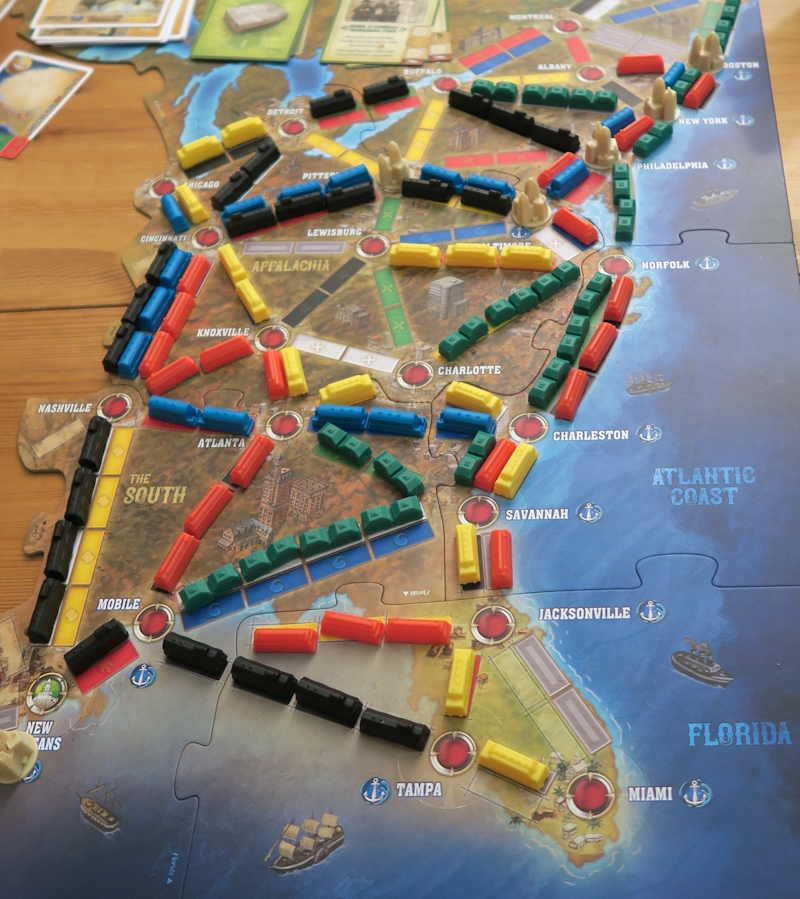
Ultimately, however, it didn’t really change things as Pink still took victory with twenty-two points.  He was long way clear of Jade who won the tight fight for second with fifteen just one point ahead of Black who, in turn, took third by a single point.  Everyone else was still playing, so the group looked for something else to play.  Black had won a copy of Ticket to Ride: Paris in the raffle and, although it wasn’t very festive, it seemed appropriate to give it an outing.  Some of the GOATS had played this mini-city variant of the popular train game earlier in the year when we marked the Olympics with sport and France themed games.  However, none of the current quartet had been part of that group.

Ticket To Ride: Paris
– Image by boardGOATS

The rules are much the same as all the others (take two cards from the market; play cards to place pieces on the map; collect Ticket cards to score points at the end), but like all the variants, Paris has a special rule.  When players claim a red, white, or blue track, they get a card, when they get all three colours they get four “Tricolore” bonus points.  When the game first came out, there had been comments about how this felt very bolted on, but in practice, it was much more interesting than it sounded.  This time, the in game scoring was quite tight, though Blue, with her trains across the city centre got her nose in front and led by six points.  Tickets can make a huge difference to scores though, as they can give a lot of points, both positive and negative.

Ticket To Ride: Paris
– Image by boardGOATS

Black, Pink and Jade all picked up similar points for their completed Tickets (ten, eleven and eight respectively), though Jade was unlucky and unable to complete his last one.  Blue, however, made good use of concurrent routes and scored a massive twenty-four points for hers giving her something of a landslide victory with a total of forty-six.  It was much closer for second which went to Pink who finished with twenty-nine, two points ahead of Black.  Meanwhile, on the other side of the room, Purple was leading Ivory, Plum and Byzantium in one of her favourite Christmas themed games, Christmas Tree.

Christmas Tree
– Image by boardGOATS

This is a fairly simple little card-drafting game played over thee rounds, where players are “decorating their Christmas Tree” with diamond-shaped cards, where players score points for the Objective cards everyone contributed to a central pool at the start of the round.  This time, the group played from the advanced set of Objective cards (including all three levels) although the first round, the cards were all levels one and two.  These gave one point for each blue or “nobbly” ornament, four points for each pair of ornaments of the same colour and shape arranged in a vertical pair and six points for three specific shapes in a given arrangement.

Christmas Tree
– Image by boardGOATS

The first round started off slowly with everyone looking to fulfill some of the Objectives—everyone was successful, but Plum and Byzantium got off to a better start.  Plum placed her first Gingerbread man and then concentrated on placing vertical pairs although she only managed that once.  In the second round the Objectives were from the more complicated sets, including six points for three specific colours in a given arrangement, six points for the same three shapes or colours in a set pattern, or eight points for four ornaments with the same point value arranged in two set formations.  This time, Byzantium significantly out scored everyone with multiple objectives scored multiple times and, as a result, built a big lead.

Christmas Tree
– Image by boardGOATS

Plum used one of her Biscuits to move baubles around to make a row of four contain the three colours of glass bauble.and thus scored well, whereas Ivory was focusing on picking up high value Sweets and surrounding his Gingerbread men.  The final set of Objectives included six points for a set arrangement of certain point values, eight points for four ornaments with the same point value arranged in a particular arrangement and five points for each row in which the total points of the glass were above the given amount. Finally, there were two points for each Gingerbread man, with bonuses of six and three points for the player with the most/second most Gingerbread men.

Christmas Tree
– Image by boardGOATS

In the third and final round, Byzantium again out scored everyone, scoring multiple times for the set arrangement of certain point values.  At this point, Ivory was full committed to Sweets and Gingerbread men, especially knowing he was putting in the Gingerbread man Objective, which he scored well for.  Plum and Purple also scored well in the final round, with Plum following a strategy similar to Byzantium, whereas was Purple was collecting sweets like Ivory.  It looked like Byzantium was going to win by a large amount, as he was fifty points ahead of everyone else and was scoring more than anyone else for Lights and Baubles too.

Christmas Tree
– Image by boardGOATS

Ivory’s focus on surrounding his Gingerbread men gave him over fifty points and with more than thirty for his sweets he finished with one hundred and seventy one points, pipping Byzantium to victory by just two, with Plume in third some twenty points adrift.  The puzzly nature of the the game had gone down well and with the Christmas theme everyone had enjoyed playing Christmas Tree.  On the next table, the festive link was much more tenuous, however.  Teal, Pine, Sapphire and Indigo had chosen 6 Nimmt!, because there was a twelve in it, representing the Twelve Days of Christmas (or perhaps they had just wanted to play the game and if you can’t play a daft party game at Christmas, when can you?).

6 Nimmt!
– Image by boardGOATS

6 Nimmt! is a popular game with the group at any time of year, though it is usually played with more than four people.  Either way, the game is very simple to play, though tough to play well.  Some say this is because there is a lot of chance in the game, but they are usually the people who do badly…  The idea is that players simultaneously choose a card to play and these are then added, in order, to the rows of cards on the table.  The player adding the sixth card, instead, takes the first five cards into their scoring pile.  Usually, we deal out half the cards for the first round and the rest for the second and the winner is the player with the fewest “nimmts” (or points), at the end of the two rounds.

6 Nimmt!
– Image by boardGOATS

This time, however, the group decided to play the multiple-hand variant where each hand has ten cards, and the game ends when someone’s score passes sixty-six.  And that was Sapphire, who finished with an exceptional total of ninety-five.  The winner was Teal with forty-four, however, who was just two points better off than Pine.  The other games were still ongoing, but there was still time for one last game for this group (who were joined by Navy) before everyone went home warmed by the Christmas Gaming Spirit—and their choice of game was Coloretto (apparently this is a  festive game because it includes red, green and gold Chameleons).

Coloretto
– Image by boardGOATS

This is another simple filler game, where players either take a card and add it to a truck, or take a truck.  Each truck can take a maximum of three Chameleons, with players collecting coloured sets.  The largest three sets score positive points (according to the Triangular Number Series), while all the others score negative points.  In this way, the bigger the series the more additional cards will score, so the aim is to collect three large sets and ensure the others are as small as possible.  This game was really tight, with Sapphire claiming victory with twenty-seven and Teal and Indigo tying for second on twenty-four.  And with that, people began to drift off, many not to be seen until 2025.

Coloretto
– Image by boardGOATS

Learning outcome:  GOATS love a Cracker!

Boardgames in the News: A Monopoly on Monopoly?

The Christmas holidays are the time of year when many people who rarely play games get out something to play as a family.  For for some, the tradition is Scrabble, Pictionary or Cluedo, but for many, the game of choice is Monopoly.  This is one of the world’s best known games, and there are many thousands of different editions to choose from, including copies themed round different places, companies, events and even other games.  Last year, Neil Scallan from Hayes (west London) had a visit from the folks at Guinness World Records who counted his four thousand three-hundred and seventy-nine copies and confirmed he holds the record for the Largest Collection of Monopoly Boards.

– from youtube.com

Although Monopoly is very well-known, it is a game that has a reputation for being overly long, often leading to family rows.  This is largely because most families don’t play by the “Rules as Written”, instead playing by the family’s “House Rules“, which are usually passed from generation to generation by word of mouth. There is generally nothing wrong with “House Rules”, however, in the case of Monopoly, they are often responsible for all the perceived problems as discussed by games designer and curator of the Museum of Board Games in Newent, Tony Boydell.  The interview with Kate Clarke for BBC Radio Gloucestershire, was broadcast on Boxing Day and can be found 2hrs 46mins in.

Kate Clarke on BBC Radio Gloucestershire
– Image from bbc.co.uk

Next Meeting – 31st December 2024

Once again be holding a party for New Year’s Eve.  As usual, we will be meeting at a private house in Stanford with people arriving from 7pm with food served sometime around 8pm.  Please get in touch if you would like to come along so we know how much food will be needed.

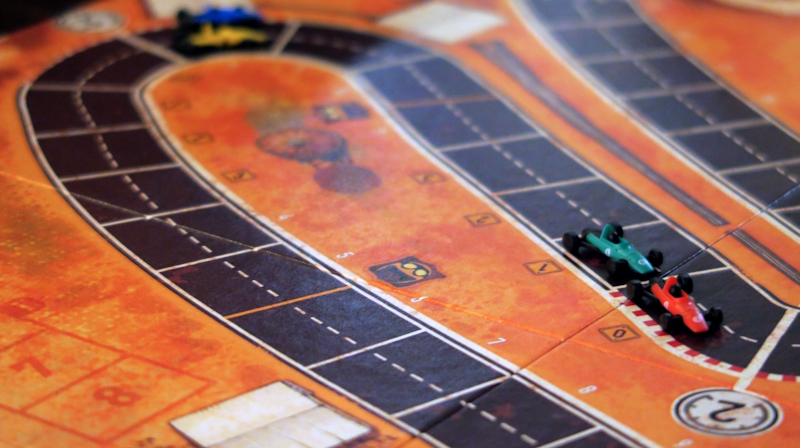
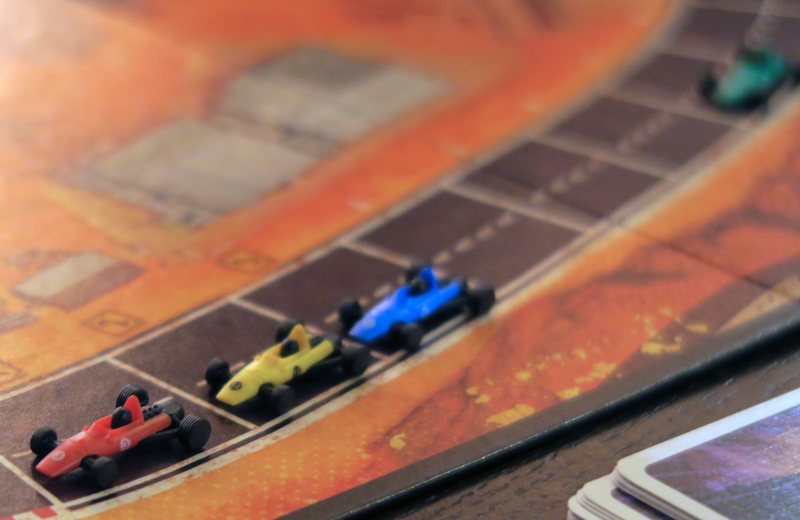
The plan is to start off with the “Feature Game”, which, as has become traditional at these events, will be the gorgeous, dexterity car-racing game, PitchCar.  As there are relatively few people planning available this year we hope to follow it with the first outing of Ticket to Ride Legacy with a break to admire the village’s fireworks at midnight and toast the end of the old year and the start of 2025.

PitchCar
– Image by boardGOATS

And talking of cars…

A policeman sees an elderly woman driving incredibly slowly on the motorway, so he pulls along side and notices her knitting in the driver’s seat.  She remains focused on the road and keeps knitting and driving.

He beeps his horn to get her attention, but she is oblivious and carries on.

Getting more frustrated, the policeman turns his siren on and, as she finally notices him, he signals for her to wind the window down.

After a time she finds the button and down goes the window.

Incensed, the cop yells, “PULL OVER!”

“Oh, no sweetie,” she replies.  “It’s a scarf, see?”

Next Meeting, 23rd December 2024

Our next meeting will be on MONDAY 23rd December 2024.  As usual, we will start playing shorter games from 7.30pm as people arrive, until 8pm when we will start something a little longer.  The pub is doing food, and the table is booked from 6.30pm for those that would like to eat first.

This week, as it is so close to Christmas and a lot of people have gone away already, there isn’t a “Feature Game“, but that gives us plenty of opportunity to play some of our old favourites and maybe some festive games if people want to.

Santa's Workshop
– Image by boardGOATS

And speaking of the festive…

Jeff and Joe were at the bar a couple of days before Christmas chatting about the gifts they’d bought for people.

Jeff, said, “I bought my wife a fridge for Christmas.”

“That’s nice,” answered Joe.

“Yeah,” pondered Jeff. “I can’t wait to see her face light up when she opens it…”

Golden GOAT Award Winners – 2024

This week was the annual boardGOATS Un-Christmas Dinner including the voting to decide the winners of the GOAT Awards.  There are two main awards:  the Golden GOAT for our favourite game played during the year and the GOAT Poo Prize for our least favourite.  Everyone had the usual three points to hand out for the Golden GOAT Award (plus a bonus if wearing Festive Attire), though a maximum of two points could be given to any individual game.  Everyone could also nominate up to two individual games for the GOAT Poo Prize.

Tonga Bonga
– Image by boardGOATS

This year, the unofficial “Marmite Award” went to Viticulture—something many people seemed to find quite a surprise as it is generally not a divisive game and one that few would usually take offense at.  There had been a lot of fun throughout the year, but one of the more memorable moments was Pine getting the end game rule wrong for Tonga Bonga, so that Pink thought he’d won, but then didn’t.  There were several nominations for the GOAT Poo Prize, including King of Tokyo, Rolling Realms and Ark Nova, but the winner was another surprise: Ca$h ‘n Guns—not a game the group plays often, indeed it doesn’t get played at all at the pub (for obvious reasons), so its only outing over the last year was at the New Year Party.  It can be a lot of fun, but it is also easy to see how some might not like the game.

Ca$h 'n Guns
– Image by boardGOATS

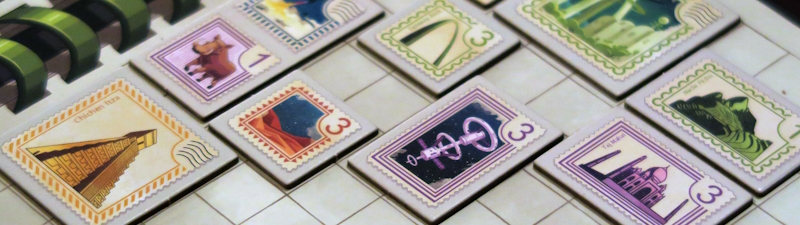
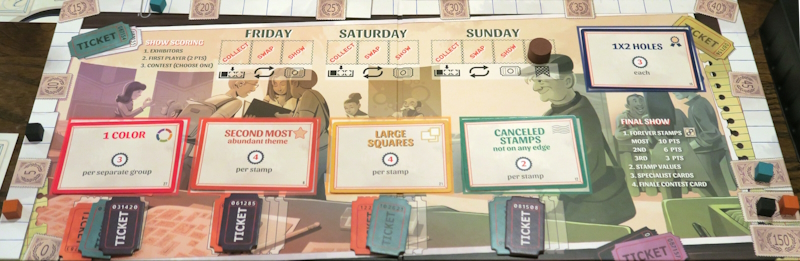
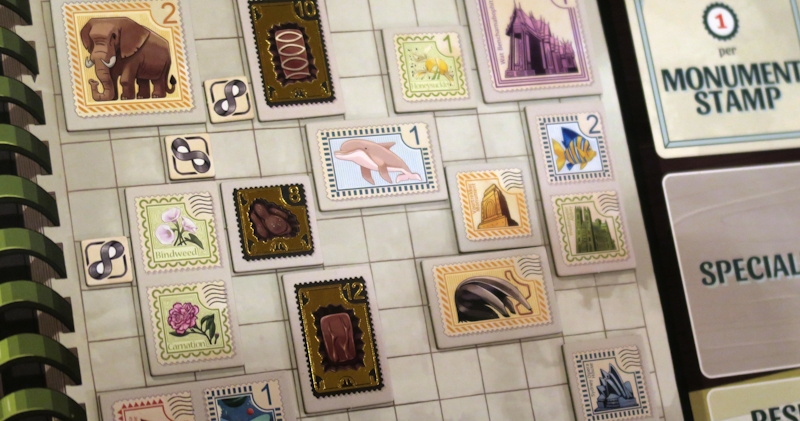
Then finally, there was the Golden GOAT Award for the best game played in the year.  Previous winners were ruled out, but there were plenty of other great games to choose from.  The most popular of these were Akropolis, Kavango, Flamme Rouge and Ticket to Ride: Rails & Sails.  However, the clear winner was Stamp Swap.  This is a new game, only released in September, but was an immediate hit, largely thanks to its silky-smooth game play.  As one person commented, “I wouldn’t have thought a game about stamp collecting would be up my street, and yet…”

Stamp Swap
– Image by boardGOATS

Perhaps more remarkably, this is the third winner from Stonemaier Games after Tapestry last year and Wingspan in 2019—three very different games.  This led to the perhaps slightly tongue-in-cheek suggestion that the group should invite Jamey Stegmaier to visit so we could present him with the actual Golden GOAT in the manner of the Jules Rimet Trophy

Golden GOAT - 2024
– Image by boardGOATS

Next Meeting, 10th December 2024

Our next meeting will be Tuesday 10th December 2024 at the Horse and Jockey pub in Stanford-in-the-Vale.

As this is our Christmas party we will be meeting early from 6.30pm
with food at around 7pm followed by Christmas festivities.

This week, the “Feature Game” will be Courses De Rennes (aka Reindeer Races; review, “How to Play” video & rules), followed by a range of Christmas and winter themed games like Jokkmokk: The Winter Market, Santa’s Workshop, Christmas TreeSnow Tails, Carcassonne: Winter Edition, Gingerbread House and Ticket to Ride: Nordic Countries.   In Course des Rennes, players control a team of four reindeer, racing to try to get the highest-scoring tiles.

Course des Rennes
– Image by BGG contributor chansen2794

Speaking of reindeer…

Joe and Jeff were admiring the reindeer at Appleton Barn.  He was particularly impressed with the decorations on their antlers.

Jeff asked, “Do you think we could just buy some hornament like that?”

“No,” replied Joe, “I think they’d be too deer…”

26th Movember 2024

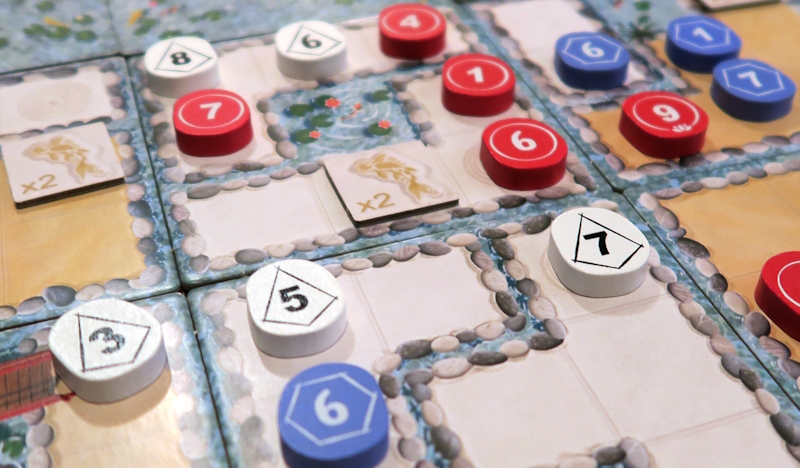
Plum, Jade, Sapphire and Mint were first arrive, and while they were waiting for food, settled down to a game of Hiroba, a sort of board game “Sudoku” where players place their numbered pebbles to take control of the most gardens.  As in Sudoku, players must never have two pebbles of identical value in the same garden, row or column.  After a couple of false starts the group eventually figured out the rules.  This time, Sapphire got in early with the lowest stone number between two Koi carp ponds, ensuring he got both. Plum only got two ponds, so although she got a reasonable number of areas, others overtook her by using the Koi pond multipliers.

Hiroba
– Image by boardGOATS

Food arrived during the game, and some were still eating when the final count (and recounts) took place.  Despite Sapphire’s great start, Mint’s total of thirty-five gave her victory by a single point pushing Sapphire into second and leaving Plum in third.  Meanwhile, since Hiroba was underway when Cobalt arrived, he settled down to a solo game of Explore & Draw, the Roll & Write version of Isle of Cats.  The game play is similar with players now drawing polyomino shapes on their ship board, but choosing a set of cards each round instead of drafting them.  In the solo game, the player is competing against his “sister” and this time won by forty points to her thirty-six.

Isle of Cats: Explore & Draw
– Image by boardGOATS

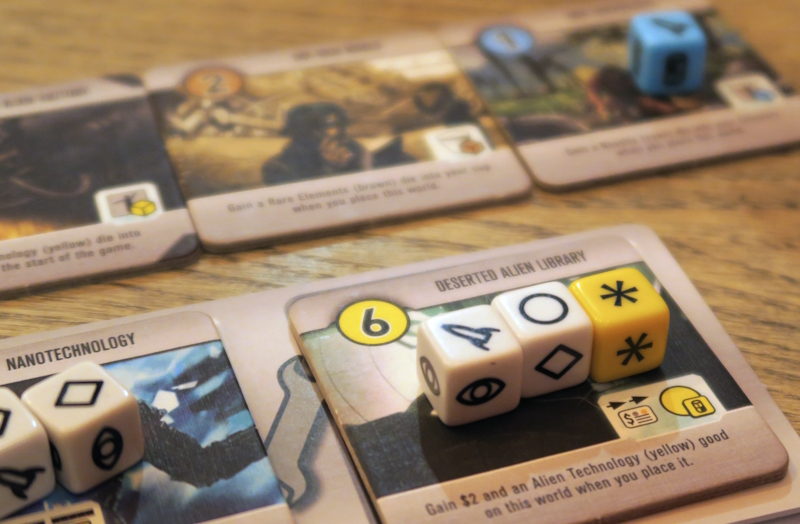
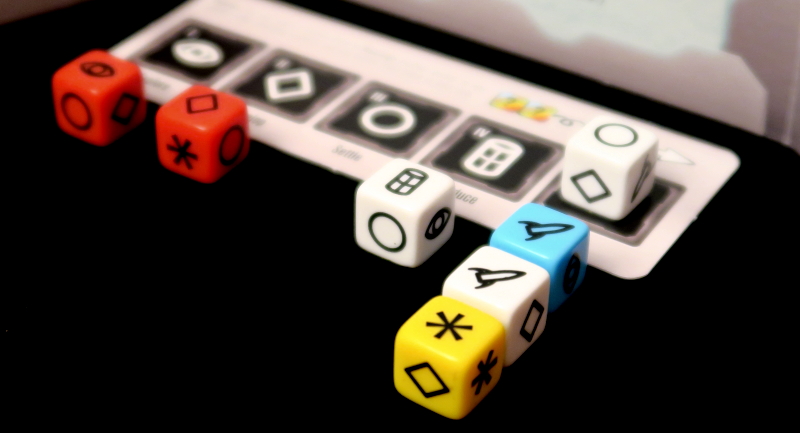
Once everyone had arrived (except Teal who had given up battling the crazy flood-water and gone home) and had finished eating, it was time for the “Feature Game” which was to be Rolling Realms/Rolling Realms Redux. This was advertised as a light roll and write game, but turned out to be rather more involved than everyone expected.  It was developed during the global pandemic as a print-and-play game, but has since been released as two professionally produced games.  Each game consisting of a number of small games based loosely on other games, with more are available to be purchased separately.

Rolling Realms
– Image by boardGOATS

The idea is that players choose three “mini-games”, or “Realms” for each of three rounds.  Then, two dice are rolled and allocated separately to two of the three games.  After nine rolls, players add up the number of starts they’ve achieved in the round.  The winner is the player with the most points after three rounds.  With three copies of the game and several people familiar with it, it should have been a relatively straight-forward game, but with so many different mini-games, players effectively had to learn the rules each round.  As the games play six and there were three copies, the group decided to play one large game. and started with the same three mini-games, based on three of our favourite games, Tapestry, Meadow and Flamecraft.

Rolling Realms
– Image by boardGOATS

And this was where the first problem arose.  The Tapestry mini-game was quite straight-forward, with players trying to fill their grid using polyomino shapes.  However, Meadow and especially Flamecraft, both from the Redux version of the game were more difficult to understand.  The Meadow mini-game was based on the card market with players choosing “cards” and using them to score points and collect resources.  The Flamecraft mini-game caused a lot of confusion with different “Enchant” and “Gather” actions, which are loosely based on the actual game, but it took a while to work out what they did and how to use them.

Rolling Realms
– Image by boardGOATS

All three games involved players doing things to collect Stars, but the real aim of the game is to collect resources (Pumpkins, Hearts and Coins).  These allow players to modify dice, use them both on the same Realm, and most importantly, gain extra dice to give extra actions—these are essential as without them, players don’t get enough turns to get the more challenging Stars.  With so many people playing and the difficulties in getting heads round rules, the group ended up splitting into three tables.  Plum, Jade, Sapphire and Mint were first to get going and were first to finish the first round.  Plum was the victor, and the group went on to play Dinosaur Island, Stamp Swap and Ark Nova for their second round.

Rolling Realms
– Image by boardGOATS

The second group consisting of Blue, Pink, Ivory, Lime and Pine, were a bit slower as they struggled a bit more with the rules, particularly Pine.  As a result, they were a bit slower to get to the end of the first round, with Blue and Ivory leading the way.  This group decided to reduce the rules overhead by keeping one of the Realms from the first round, the easiest to understand, Tapestry.  To this, they added Between Two Castles and My Little Scythe, both from the original Rolling Realms game, as they thought these might be easier to grok, which they generally were.  In their second round, Ivory and Blue were still fighting it out, but this time they were joined by Pink, with Pine not far behind.

Rolling Realms
– Image by boardGOATS

The comparative success of the second round and keeping one Realm and choosing two from the original game, meant they repeated the strategy for the last round.  This time they kept the Between Two Castles Realm and added Between Two Cities and Scythe.  By the final round, everyone seemed to have got the hang of things as the scores were much closer.  In terms of totals though, Blue just had the edge over Ivory, with Pink in third.  The other table had finished first though, with Tidal Blades, Between Two Cities and Euphoria as the Realms in their final round.  Plum had continued her success in the first round winning both the second and third rounds and therefore, taking overall victory.

Rolling Realms
– Image by boardGOATS

Second place was less clear, however, with Sapphire just beating Mint for second place.  The third table consisted of Cobalt, Black and Purple.  Cobalt had played before, but online while Purple and Black were new to it.  They also struggled a bit and took a more leisurely approach to the game, playing just two rounds.  Their second round Realms consisted of Scythe, Potion Explosion and A Feast for Odin, the last two both add-on packs, and therefore possibly more challenging than those from the base game.  Cobalt won the first round by a bit of a land-slide, but the second round was very close between all three players, with Purple just beating Cobalt (who took overall victory).

Rolling Realms
– Image by boardGOATS

Learning Outcome:  Sometimes, one person’s simple game can be another’s nemesis.

Next Meeting, 26th Movember 2024

Our next meeting will be on Tuesday 26th Movember 2024.  As usual, we will start playing shorter games from 7.30pm as people arrive, until 8pm when we will start something a little longer.  The pub is doing food, and the table is booked from 6.30pm for those that would like to eat first.

This week, the “Feature Game” will be Rolling Realms/Rolling Realms Redux (rules, review, how to play video), which is a light roll and write game that was developed during the global pandemic as a print-and-play game and has since been released as a professionally produced game.

– Image from stonemaiergames.com

And speaking of the pandemic…

During 2020, like many people, Jeff ran out of toilet paper.  Unlike most people, he started using lettuce leaves. As he explained to his mate, Joe, that was just the tip of the iceberg, what happens tomorrow romaines to be seen…

12th Movember 2024

The evening began with Plum explaining the “Feature Game” to Indigo and Navy, despite the fact they had already decided they were unlikely to play it.  Still, there was time to fill as people finished eating and the stragglers, and that was as good a way as any.  The game in question was Underwater Cities, which is a sort of worker-placement and network-building game.  Although the game is quite complex, the underlying mechanism is quite simple:  players start their turn with a hand of three Cards and, on their turn choose an Action space and pay a Card to use it.  The Action spaces and the Cards come in three different colours, green, red and orange.

Underwater Cities
– Image by boardGOATS

If the colour of the Card played matches the colour of the Action space chosen, then the player gets to activate the Card, most of which have an instant effect (though for some, the effect is delayed).  In general, the orange Action spaces are quite powerful and the green Action spaces are weak, whereas the green Cards have powerful effects and the orange cards are weaker, thus the Cards and Actions together are balanced.  Each Action space can only be activated by one person per round and the game takes place over ten rounds (though the group used the Quick Start variant from the New Discoveries expansion which replaces the first round) with each player taking three actions per round and production phases after the fourth, seventh and final rounds.

Underwater Cities
– Image by boardGOATS

The aim of the game is to build a network on players’ personal player board, connecting Cities together with Tunnels and adding and Upgrading Buildings to provide production capabilities.  There are four Resources, Kelp, Steelplast, Science and Biomatter together with money, or Credits; these are produced by Farms (Kelp), Desalination plants (money) and Laboratories (Steelplast and Science).  Biomatter is essential for building symbiotic cities and can also be a universal building material (can be used instead of Kelp or Steelplast), but is a rare Resource that can only be acquired through Cards, Actions and by connecting some Metropolises to a player’s network.

Underwater Cities
– Image by boardGOATS

Players score points during the game and in the production phases after the fourth and seventh rounds, but most of the points are scored at the end of the game after the final production phase.  At this point, players score for the number of different Buildings next to each connected city in their network, for any end-game scoring cards, for their final scoring Metropolis and for any Resources they have left.  Indigo and Navy showed some appreciation as Plum explained, but ultimately decided it wasn’t for them, and were replaced by Cobalt and Ivory, both of whom had an idea of how the game played from watching run-through videos.

Underwater Cities
– Image by boardGOATS

The Quick Start gave everyone an Enhanced Assistant so Plum started with the ability to get Biomatter on production, so she was able to build purple Symbiotic Cities (which score more points) right from the beginning.  Cobalt’s also helped him when building Cities, giving him one Credit or Steelplast discount, although he didn’t really take advantage of this until the final Era. In contrast, Ivory focused on the end-game scoring from his Metropolis which required him to build seven Cities to get the maximum number of points.  By the first production phase, he had already built three and connected them to his network with Tunnels, but all those people needed a lot of feeding which was costly and slowed him down a lot.

Underwater Cities
– Image by boardGOATS

Plum focused on building a robust food engine with two upgraded green Buildings attached to one City (her end-game Metropolis also gave points for sets of upgraded structures) while Cobalt focused on getting his engine online and started on his objective to connect all his Metropolises and Cities with Tunnels in the second and third Eras.  He was aided by an ongoing ability that triggered whenever he used an Assistant (draw a Card and gain a Point), which he used heavily, getting four Assistants early in the game and activating them all in every Era. The extra Card draw ensured he was always able to play a matching coloured card with every Action which also helped.

Underwater Cities
– Image by boardGOATS

Plum pointed out that a friend who she plays with and often wins says, “Don’t always let me get the Special Cards—they are powerful!”  So after the first production phase, there was a focus on the special cards in middle, all of us grabbing some quite powerful abilities.  Ivory got an additional tile that gave him points every production phase and Plum got a heavily discounted City.  Cobalt’s engine was working very effectively by this time giving him lots of Resources and discounted Actions.  Despite her Special Cards, Plum was struggling as the main upgrade slot which she needed for her end-game Metropolis was denied to me when she had the Resources to use it.  Instead she ended up focusing on Symbiotic Cities and ended up with only the one regular City.

Underwater Cities
– Image by boardGOATS

After the second production phase, there was a big focus on how to maximize points. Ivory took a risk, taking the end game scoring card that gave twelve points for the player with the most upgraded Tunnels.  When he took it, he had the most upgraded Tunnels, but it was clear that Cobalt could challenge this.  Cobalt on the other hand had grabbed a couple of Special Cards giving three points per upgraded Tunnel plus one point per Card in his tableau.  For Ivory to score his Card it was critical that he denied Cobalt the ability to upgrade in the last turn and Ivory was able to make sure he took his first in the final round—this was fairly ironic as the majority of the rounds he had been the last player!

Underwater Cities
– Image by boardGOATS

This scuppered Cobalt’s plans and gave a twenty-four point swing in Ivory’s favour, but since he had increased his hand limit to four and was drawing multiple cards, he was able to pivot and build a City sharing two upgraded Farms and us Cards that provided points when played. This also produced quite a few resources in the final production phase.  Plum was struggling towards the end of the game as she couldn’t get the final Resources she needed to build the last two Tunnels to connect her end-game scoring Metropolis.  Despite it failing to score, it had still been a good focus for her game as the upgraded structures had given her extra production during the game and those Metropolis points would only be critical if the game was close.

Underwater Cities
– Image by boardGOATS

And close it was.  Plum had a slight lead going into the end game scoring and and-game scoring cards gave points fairly evenly too.  Cobalt and Ivory had the same number of Cities with three different Buildings, slightly more than Plum, but she more than made up for it with her Cities with her Cities with two different Buildings.  The Metropolis she failed to connect proved critical in her scoring though and although she just edged Ivory by two points, Cobalt ultimately took victory, also by just two points as he finished with ninety-seven.  It had been a very thinky game, and with three players was reasonably tight with people taking Actions others wanted.  It was very enjoyable when players were so evenly matched which was reflected in the scores despite very different strategies.

Underwater Cities
– Image by boardGOATS

Black and Blue had been interested in joining the game of Underwater Cities, however, as it was, it was the last game to finish by some mile and would have taken a lot longer with a fourth player.  There wasn’t a sixth player interested in making a second game, so in the end, Black joined Pink who was very keen to give Teal’s new acquisition that he’d been toting about since Pink and Blue had brought it back from Essen for him.  This was the Grand Tour expansion to Flamme Rouge. This is a cycle racing game where players move their two riders forward by drawing and playing cards from that riders specific deck, depleting it as they go.

Flamme Rouge: Grand Tour
– Image by boardGOATS

As in real cycle races, players use slipstreaming to avoid exhaustion, in the game, these are cards that block up players’ hands making dealing with obstacles and moving through the peloton more challenging.  A large part of the new expansion is a campaign mode and there was only time for one game, however, there are some additional features, including some new hilly track and a double right-angle hairpin bend.  These added more interesting features to the parcours.  Like all race games, players usually do best if they can start fast and stay at the front of the pack.  In Flamme Rouge, this is mitigated by the fact that once a card is played it is discarded so players have to make their good cards last the duration of the race while avoiding too much exhaustion.

Flamme Rouge: Grand Tour
– Image by boardGOATS

Teal managed to crash both his bikes, while Black and Purple crashed one each.  Indigo and Navy led for most of the game while Pink tried to maintain a position in the front four or five.  Navy faded as the sprinters wound up for a lunge for the line, with Indigo as Marcel Kittel and Pink as Mark Cavendish.  This time, victory went to the German and the Manx Missile with just piped into second with Navy rolling home in third.  The game had been a lot of fun and the general consensus was that the Grand Tour expansion added some nice new features even when multiple games for a campaign weren’t appropriate.  It hadn’t out-stayed its welcome either, and although Teal headed home, there was time for everyone else to play one more quick game.

Flamme Rouge: Grand Tour
– Image by boardGOATS

The game of choice was Coloretto—something of an old favourite.  This is a really quick game to teach and start playing, with players taking it in turns to either draw a card and add it to one of the trucks, or taking a truck and adding the Chameleons on it to their collection.  The clever part is that largest three sets score positive points following the Triangular series, while any other sets score negative points.  Purple drew the Golden Joker which was picked up by Pink, while Black took the other Joker.  The game was really tight, well, amongst the top three anyhow.  Navy managed to only score positive points, but his thirty-four points was one less than Indigo who took second and who, in turn, scored one point less than the victor, Black.

Coloretto
– Image by boardGOATS

The final table consisted of Pine, Blue, Jade and Sapphire.  After a bit of chit-chat, this group settled on playing Akropolis.  This is a fairly light abstract tile laying game in a similar vein to Taluva or NMBR 9, where tiles placed on higher levels score more points.  In this game, players take a tile from the Market and place it in their City.  The first tile in the market display is always free, the one after costs one stone (the only resource in the game) the next one two stone and so on.  The tiles comprise three conjoined hexes each either a Quarry (which provide Stone when built over), a Plaza, or a District tile.  Tiles can be placed on top of others, but must cover more than one other tile and cannot leave gaps.

Akropolis
– Image by boardGOATS

At the end of the game, tiles that meet the scoring requirements for that colour are multiplied by their height.  As in Kingdomino where the area is multiplied by the number of crowns in it, this District score in Akropolis is multiplied by the number of Plazas in that colour; these totals are added together to give a final total.  This time, Blue scored heavily for her Houses and although Jade almost matched her with his Barracks, he didn’t score much for anything else and Blue had picked up a lot of points for her Markets too.  Together these gave her a bit of a landslide with a total of one hundred and nineteen.  Sapphire and Pine that by the end they had got the hang of things, and fancied giving it another go.

Akropolis
– Image by boardGOATS

The game was punctuated by a discussion about orange juice and lemonade, which is apparently called a “Henry” in these parts though nobody but Jade was aware of it.  Pine commented that where he came from it was more likely to be used to order cocaine.  This time, Blue tried a totally different strategy this time focusing entirely on Houses.  Sapphire’s Markets gave him forty points and Pine’s gave him thirty-four.  These were dwarfed by Jade’s Gardens that gave him sixty points, but they all paled into insignificance compared to Blue’s Houses which gave her one hundred and eight.  Sadly though, with nothing else but a pile of rocks, this left her with exactly the same score as last time—and a tie with Jade, while Sapphire, the most improved player finished in third, just four points behind.

Akropolis
– Image by boardGOATS

Learning Outcome:  The underwater world has a lot of potential.

Next Meeting, 12th Movember 2024

Our next meeting will be on Tuesday 12th Movember 2024.  As usual, we will start playing shorter games from 7.30pm as people arrive, until 8pm when we will start something a little longer.  The pub is doing food, and the table is booked from 6.30pm for those that would like to eat first.

This week, the “Feature Game” will be Underwater Cities (rules, review, how to play video, solo playthrough), which is a card driven, route and engine building game.

– Image by BGG contributor cirdan

And speaking of underwater…

Jeff had taken up scuba diving with his friend Joe. As they were getting ready to go over the side for the first time, Jeff tucked some paper inside his wet suit and tied a pencil to his right wrist. Joe was puzzled and asked him what he was doing.

Jeff replied, “I’m just trying to be prepared in case I want to do some eelustrations…!”