Tag Archives: 6 Nimmt!

16th June 2015

Burgundy and Blue were just finishing their supper when they were joined by Cerise, Grey and Red and decided to play a short game until everyone else had arrived.  They chose Sushi Go! which is a card drafting game similar to 7 Wonders, though without the complexity, so, all the players start with a hand of cards, simultaneously play one and pass the rest of the cards to the player on their left.

Sushi Go!
– Image used with permission of BGG contributor henk.rolleman

Since every player is doing the same thing, each player also receives a hand of cards from the player on their right, but each time the cards are passed the hand gets smaller.  In this game players are collecting sets of cards with rewards varying depending on the card and the target.  This time, we played with the Soy Sauce mini expansion which consists of four cards that reward players for getting more different colours encouraging more speculative play.  The game is played over three rounds, with the middle one going in the opposite direction and the winner is the player with the most points.

Sushi Go!
– Image used with permission of BGG contributor kladan

Grey went for the unusual combination of dessert with soy sauce, but Blue topped the round by the judicious application of wasabi to a valuable squid nigiri.  Burgundy won the second hand and Red close behind with a large pile of maki rolls, so, it was all to play for in the final round.  It was a low scoring finale, with Grey the only really successful player, pulling off his best round when it counted.  Unfortunately it wasn’t quite enough:  although Blue’s scores had been steadily diminishing round on round, she just managed to hang on to win, just one point ahead of Grey.  With Black and Purple having arrived, the group split into two, one playing the Feature Game and the other playing another new game, Om Nom Nom.

Om Nom Nom
– Image by BGG contributor jancis

Om Nom Nom was a UK Games Expo special that Purple had been looking for since Essen last year.  The game is quite quick and fairly simple with a lot of “double think”.  The game simulates the hunter and prey relationship.  There are three game boards each depicting a food chain:  cat, mouse & cheese; wolf, rabbit & carrot; hedgehog, frog & fly.  Each player has six cards representing the top two rungs of each ladder; at the start of a round a handful of dice are rolled that represent the lowest two rungs and are then placed on the appropriate section of the board.

Om Nom Nom
– Image used with permission of BGG contributor msaari

Game play is very simple:  simultaneously, all players choose a card to play a predator.  If their is enough prey to feed each hunter, then the player gets their card back with the prey and they score one point for each.  If there is insufficient food available, the animal starves and they lose their card.  Once the first card has been resolved they must play one of the remaining five cards.  So, the clever bit is the middle rung of the food chain where there are both cards and dice, so a card played in the middle will get eaten by any played above.  There are three rounds with everyone playing all six cards in each round, so trying to out-think everyone else is the name of the game.  Purple had played Om Nom Nom before and used her extra experience to win the first round by a sizable margin.  Grey made up for it in the second round as everyone began to get the hang of it, and Red took the final round, making it a close game.  Her consistency made the difference though and Purple finished just two points ahead of Grey.

Om Nom Nom
– Image by BGG contributor Jean_Leviathan

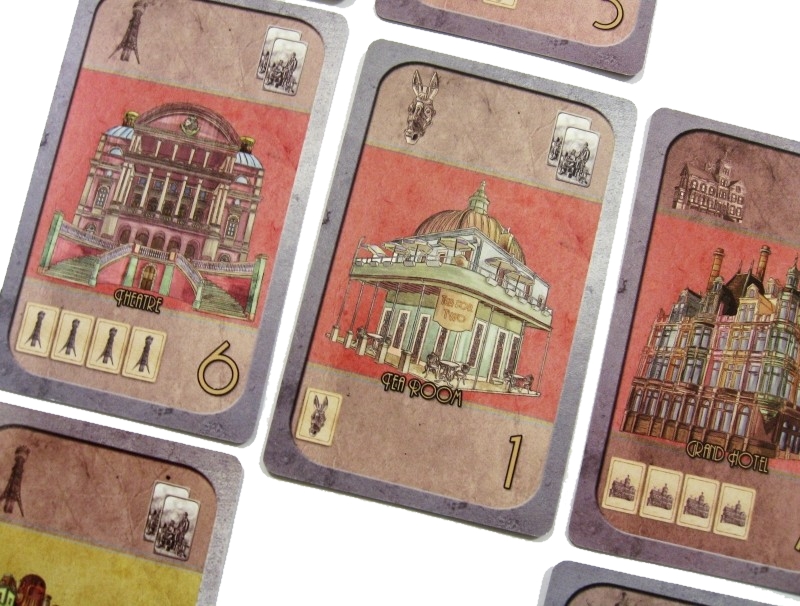
Next the group had a rummage through the bag and opted for another Essen/UK Games Expo acquisition, Steam Donkey; with such a cool name, we wanted to see if the game play matched.  The game is set in 1897, a time when rival seaside resorts are competing to attract a visit from the Queen.  So, players are trying to build a four by three grid of cards representing their seaside resort.  The three rows represent the different parts of the resort:  beach (yellow), town (pink) and park (green).  Similarly, the four columns correspond to the different types of building: amusements, lodgings, monuments and transport.  In order to place a feature, it must go in the correct location and must be paid for using cards of the same type, as such it has similarities with games like Race for the Galaxy and San Juan.
Steam Donkey
– Image by boardGOATS

As players build their resort, visitors arrive at the station and come to see the attractions.   Each attraction can take a certain number of visitors, which are actually a row of face down cards that are used to replenish the cards in players’ hands.  Thus, on their turn players first choose a colour and build as many attractions in that colour as they can/want paying with other cards from their hand.  Next they choose a colour and start taking cards in that colour from the “station”, a row of face down cards.  The colour of the visitor side of cards does not reflect the colour of the attraction on the other side, however, the type of attraction is indicated. Once there are no more visitors of the chosen colour, or there are no more spaces for the visitors to go, the active player adds the visitor cards to their hand and the station platform is refilled with four new visitors.  There is a hand limit of twelve and this can actually be quite a serious impediment for players collecting cards to build the more valuable attractions.

Steam Donkey
– Image by boardGOATS

At the end of the game, points are scored for each unique attraction built as well as for fulfilling individual goals and bonuses depicted on players’ resort posters.  Since this was the first time anyone in the group had played it and there are a couple of unclear points in the rule-book it might not have been played quite correctly, however, everyone seemed to enjoy it what was a very tight game and finished with Purple one point ahead of Red who was just one point ahead of Grey.  Since Purple declared, “It’s a good ‘un!” it almost certainly won’t be long before it gets another outing.

Steam Donkey
– Image by boardGOATS

Meanwhile, the other group were playing the Feature Game, Evolution, yet another game about food and eating!  This is another Essen Special, and is a reimplementation of an earlier game, Evolution: The Origin of Species: the idea is that the game(s) simulate evolution and the “survival of the fittest” concept.  Players start with a herbivore with no special characteristics, and a hand of cards.  Like many games, the cards serve multiple purposes, in this case, they carry a “food supply” number, details of a trait and can also act as a sort of currency,  At the start of the round, players simultaneously choose a card to place face down in the watering-hole, which will dictate how much food will be available later in the round.

Evolution
– Image used with permission of BGG contributor henk.rolleman

Once this is done, players can begin to modify their species.  This can be done in turn, but as it is slow and quite boring if you are relatively unfamiliar with the game, we played this part of the game simultaneously.  There are three things players can do:  they can add a trait to their species; spend a card to increase the body size or population of a species, or spend a card to start a new species.  Cards are a valuable resource and players only get three cards at the start of each round, plus an extra one for each species they have.  This means that traits must be played with care, but also that there is a strong argument for adding new species as early as possible.  However, if there is insufficient food available, animals will starve and if they starve their population will fall, potentially to extinction.

Evolution
– Image used with permission of BGG contributor henk.rolleman

There are a wide range of traits that can be added to a species.  For example if a species is “Fertile”, its population will automatically increase every round saving cards.  Alternatively, if an animal has a “Long Neck” it will feed twice before everything else, allowing it to jump the queue.  It is also possible, however, to make a species a carnivore, which means that instead of feeding from the communal watering-hole, they will only eat meat, feeding off other, smaller species round the table.  Since there are carnivores, there are also traits that can be used to help protect species from being eaten, like the ability to climb, burrow or camouflage.

Evolution
– Image used with permission of BGG contributor henk.rolleman

Traits are most powerful in combination, however. For example, a species which has the ability to cooperate will feed every time the animal to its right feeds.  This means it will jump the queue if that species has a long neck.  Similarly, an animal that can climb and camouflage can only be attacked by a climbing carnivore with good eye-sight.  Since each species has a maximum of three traits, this carnivore would go hungry if the only animals smaller than itself give warning calls as it has no ability to ambush them.  Trait cards are all played face down and revealed in turn order once everyone has finished playing cards and modifying their animals, so players have to try to work out what others might be doing and plan accordingly.

Evolution
– Image used with permission of BGG contributor henk.rolleman

Once everyone has finished playing cards and the traits have been revealed, the amount of food available is revealed and the food numbers on the cards played at the start of the round added up.  Players then each feed one of their hungry species in strict rotation (varied only where traits allow), starting with the start player.  Each player can choose whether to feed one of their herbivores from the watering-hole or use a carnivore to attack another species.  Tactics are important here because each species will need sufficient food for its population.  Once nothing else can feed, any hungry animals will suffer population loss and anything that was completely unfed loses all it population and will become extinct.  On the rare occasion that there is any food left in the watering-hole, it remains there until the next round.  The round ends with each player putting all the food into their food bag which makes the bulk of the points at the end of the game, with extras for each surviving member of the population and any trait they may have.

Evolution
– Image used with permission of BGG contributor henk.rolleman

Unusually there was plenty of food in the first few rounds and everyone quickly built up a pack of animals to try to ensure they got plenty of cards at the start of later rounds.  Unfortunately, food shortages soon set in and one of Black’s animals went carnivorous.  Burgundy suffered badly from the early loss of his alpha species and never really recovered.  Cerise started off well, but was the first to lose a species to Black’s hungry hunter.  Blue was the only player who had tried the game before and was able to use a combination of climbing, cooperation and a long neck to keep her animals fed, but still fell prey to Black and his savage carnivore.  One by one, the animals developed traits to try to out-smart Black, as he added features in a race to avoid starvation.  It was quite tight in the final count, but Blue finished five points clear of Black in second place.

Evolution
– Image used with permission of BGG contributor punkin312

Since the other group were still building their seaside resorts, so the group decided to try Om Nom Nom, and see what all the noise on the other table had been about.  By the end of the first round, it was obvious and there were howls of laughter as everyone tried to second-guess everyone else and everyone’s best laid plans crumbled into dust.  Blue and Burgundy managed to systematically stamp on each-others toes leaving Black and Cerise to fight it out for first place.  Her superb first round turned out to be the deciding factor though and Cerise finished four points ahead of Black.

Om Nom Nom
– Image by BGG contributor jancis

With time creeping on and Cerise and Grey leaving, we looked for a quick game to finish and decided to try another new game, called Skull which is based on an older bluffing game called Skull & Roses.  The idea is that each player has four cards:  three featuring flowers and one with a skull.  Players take it in turns to play a card and declare what the card is.  Alternatively, instead of playing a card, they can start bidding by declaring how many roses they can find around the table.  Once every player has passed the winning challenger must attempt to locate the required number of roses, starting by turning over all the tiles in their own pile.  If they find a skull before they complete their challenge, the lose a card; the winner is the first player to successfully complete two challenges.

Skull
– Image used with permission of BGG contributor nad24

Blue started off showing everyone else how to lose a challenge, by unsuccessfully bluffing to lure others into over bidding.  Black lost two challenges in quick succession, but Burgundy made an end of it by winning two out of two.  Since Skull had finished so quickly, we all felt there was still time for that last game and with barely a mention of 6 Nimmt!, Purple was getting the cards out to play what is rapidly becoming one of our most popular games.  It’s not obvious why we like it, but part of it is probably the fact that nobody really understands it.  This time it was a three way competition for the most points as everyone dived to the bottom, leaving Blue to finish with just eleven, some thirty points better than the person in second place.

6 Nimmt
– Image by boardGOATS

Learning Outcome:  Food is important, both in life and in games, but especially on Alternate Tuesdays

19th May 2015

With more new people, most of the regulars and a few less regulars, it was always going to be a busy evening.  So, as it was, we started out with three games.  The first group began with Eight-Minute Empire, a game that we’ve played before on a Tuesday, however, not with this group – only one person playing this time was familiar with it.  It is a quick little area control and set collecting game, though in truth, it only plays in eight minutes if everyone really knows what they are doing and nobody suffers from “Analysis Paralysis”.  On their turn, the active player starts by picking up a card:  they can choose whether to take the first available card which has no cost, or take another and pay the appropriate number of coins from their limited supply.  Each card is a resource which provides points at the end of the game, the number depending on how many of that resource the player has;  each card also has an action associated with it, which can be place armies on the map, move them about, ship them across the sea, build a city etc.  Players score points for having the majority in a countries and controlling the most countries in each continent, as well as for sets of resources.

Eight-Minute Empire
– Image used with permission of BGG contributor henk.rolleman

Cyan started heading over the seas, Yellow went in the other direction and Green ominously began amassing armies in the start region. Orange and White started with a mixture of expansion and growth.  As the game progressed, Cyan was spreading himself thinly over two continents while Orange headed north leaving the main continent behind and Yellow, White and Green fought over the regions in the middle.  White was also doing a fine trade in rubies while Cyan was collecting anvils.  This gave Cyan a dilemma when a double anvil turned up:  although he had the money to pay the two it would cost, he was playing a miserly game and decided to let it pass.  As it happened, it stayed on the table for nearly the full round until White swiped it from under Cyan’s nose.  Everyone saw the mass of Green in the middle, and, thinking he was an experienced player, decided to gang up on him.  With three players going after Green in the last round they did a good job of removing his dominance in the centre, leaving White the winner with eleven points, though the rubies really helped Yellow in second place just two points behind.

Eight-Minute Empire
– Image by BGG contributor lhapka

After a brief drinks break, the group then went on to play Salmon Run.  This was another game that we had played before, but was new to the majority of the players this time so it took a while to remember how it worked.  In essence, it is a race game that uses a hand-drafting mechanism, so players have their own personal draw piles a bit like Dominion.  The game is modular with a range of possible river sections.  This time the group opted for a short game with only four boards, which was enough to give everyone a flavour of the game, ready to give it a proper run through next time.  After a couple of rounds, everyone started to get the hang of it and salmon were zig-zagging their way up stream dodging bears, eagles and rapids, jumping waterfalls and trying to be the first to get to the spawning pool without being too tired.  Throughout the game the group remained uncertain of the the rules though, and at one point Green got himself blocked with no cards in his hand to help him.  After checking, he realised he could in fact play a card and do nothing (the fish banging its head against the wall). Unfortunately this meant he ended up way behind the others.  Before long, Cyan leapt the last waterfall and landed in the spawning pool with a splash.  It was a tight game with three other players teetering on the brink and ready to make the final jump, but in the end no-one else managed to get across leaving Cyan the clear winner.

Salmon Run
– Image used with permission of BGG contributor kilroy_locke

The second group started out with a repeat of a quick game we played last time, called Yardmaster.  This little train themed card game is turning out to be surprisingly popular with our group, partly at least because it packs a surprising amount of punch for such a simple filler game that plays so quickly.  This time, it was just Burgundy turned the tables on Blue who failed to get the luck of the cards.  Then Purple and and Black turned up to join them for the the “Feature Game”, Machi Koro, which has just been nominated for the Spiel des Jahres.  This card game is a sort of cross between The Settlers of Catan and Dominion, where players take the role of mayor and roll dice and choose cards in order to make it the most successful town.  On their turn, the active player rolls the die (or dice if appropriate) and anyone who owns a card gets money in a similar way to the resource allocation in The Settlers of Catan.  Then, the active player can use their money to buy cards, building up their portfolio in a similar way to Dominion.  The winner is the first player to build all four of their land-mark buildings.

Machi Koro
– Image used with permission of BGG reviewer EndersGame

There are two ways of setting up:  all the cards can be available in separate stacks at the start of the game, alternatively, the cards can be shuffled together and dealt out until there are ten different buildings available (others become available when a pile is exhausted).  The latter makes for a more strategic and interesting game, but when learning it is easier to see how the card combinations work by dealing out all the cards.  With so many people new to the game, all the cards were laid out at the start so everyone could see what their options were.  Blue was the only one who had played it before, so to off-set some of that advantage, she decided to try buying a building she had not bought before.  In her previous games, the Café (which rewards the owner with $2 from the active player when they roll a three) had been fairly ineffective, so she bought one.  Purple promptly rolled a three, and had to hand over some cash.  When this happened a second time, suddenly everyone started building Cafés and the gloves were off.

Machi Koro
– Image used with permission of BGG reviewer EndersGame

Blue built her Station first which allowed her to roll both dice and go for the higher number and value buildings and Purple and Burgundy were quick to follow.  Black was obviously not enjoying himself as much as the rest, and didn’t seem to be building much.  Eventually, he build a handful of Restaurants and Cafés, but otherwise just sat and accrued cash.  Blue and Purple had built their third landmark before Black had built one and it was looking like he wasn’t really focussing on the game at all.  Eventually, Blue built her Radio Tower winning the game.  Since there is nothing in the rules about what happens next, the rest of the group played on.  Burgundy managed to build his third and fourth landmarks in quick succession to take second place leaving Black and Purple to fight it out.  When Black suddenly completed his set (much to Purple’s disgust) his strategy became clear:  by building his most expensive landmarks first, he got a larger benefit from them, which enabled him to quickly complete the smaller ones.  Without two dice, his income was reduced, but since he had the majority of the red cards, he picked up money on when others rolled nines.  Although it hadn’t paid off this time, it looked like an interesting approach, though it was clear that Black was not terribly keen to play it again since, as he commented later, he is not keen on dice as a randomising factor, though he is quite happy to use cards.  Perhaps we’ll try a “dice deck” of cards next time and see if he likes it more…

Coloretto
– Image by BGG contributor SergioMR

Meanwhile, the third group had played an assortment of quicker games beginning with Coloretto.  This cute little set collecting game has been getting played a lot recently on Tuesdays, and, as Teal and Violet were new to the group, Red thought it would be a nice gentle game to start with.  Teal began by collecting a few choice colours, but quickly amassed a positive rainbow of chameleons.  Violet was much more selective and her favouritism for yellow chameleons proved to be particularly sensible in such a close fought game, and gave her clear victory over Red and Teal.  After briefly licking his wounds, Teal then regrouped and proceeded to thrash Red and Violet in a quick game of Dobble.

Dobble
– Image used with permission of BGG contributor msaari

Red had been enviously watching Blue and Burgundy playing Yardmaster across the room (which might explain her poor showing in Dobble).  So, as soon as they had finished, she decided to introduce Teal and Violet to it.  As the most experienced player, Red was in a good position to get revenge for getting beaten in Coloretto and her complete drubbing in Dobble.  The game was quite close, but a crucial coup of a green number one at the very last minute swept her sorting yard into play, making Red the clear winner.

Yardmaster
– Image used with permission of BGG contributor moonblogger

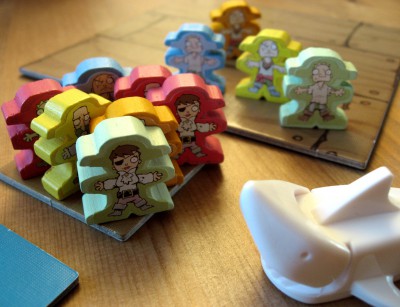
With one victory each, Red got out another of her favourite games, Walk the Plank!.  This is a very simple if silly game, with a lot of opportunity to attack the others playing.  One of the big successes in the group, it has really earned it’s keep as one of the few genuinely popular KickStarter games.  This time was no different to previous games and everyone engaged whole-heartedly in trying to force their opponents off the plank and into the murky depths of the ocean.  Since it had been one game all, this could be seen as the groups tie-breaker and it was Teal who’s pirates managed to resist the temptation to jump into the shark-infested water the longest giving him two wins to Red and Violet’s one.

Walk the Plank!
– Image by boardGOATS

With the second group still playing Machi Koro, Red Teal and Violet joined Cyan, Green and White for a quick game of Pick Picknic.  Like Walk the Plank!, Pick Picknic uses simultaneous card selection, but adds negotiation and a dash of chance and “double think”.  The idea is that there are six yards of different colours, if someone plays the only chicken card of a given colour, they get all the grain at that coloured farm.  If multiple players go for the same coloured yard, then players can either agree to share the corn in any way that is mutually acceptable or roll the die for all of it.  Foxes don’t eat corn, however, they only eat chickens, so if someone plays a fox card, they will eat any chicken cards of that colour.  The game was really close and much hilarity ensued when when Cyan and Green, fighting over a yard managed to roll a tie five times in a row.  In the final count, White finished the winner, just four corn ahead of Green and six clear of Violet.

Pick Picknic
– Image used with permission of BGG contributor kilroy_locke

With people beginning to head off and everyone else reluctant to make it a late night, the remaining players began to look for something short-ish and fun.  Purple suggested Plague & Pestilence again, but when that wasn’t greeted enthusiastically, she proposed 6 Nimmt! instead.  Having had an outing last time, as well as at the Didcot group a few days ago, it is starting to become a bit of a regular.  In this case however, it was clear that everyone had fond memories of Burgundy collecting handfuls of cards and wanted to see if he was going to do it again.  Sadly, that was clearly not his intent and he finished the first round with just eight, only one behind the leader, Green.  Green didn’t keep the lead for long though as he was repeatedly forced to pick up high scoring cards finishing with a nice round forty.  Purple improved on her relatively poor first round, but still had quite a few more than Burgundy, Black and Blue.  It was fitting perhaps then, that it was Burgundy who, despite having a terrible hand played a blinder to finish just one point ahead of Black and two ahead of Blue.

6 Nimmt
– Image by boardGOATS

Learning Outcome:  A long game can be very satisfying, but lots of little games can be lots of fun.

5th May 2015

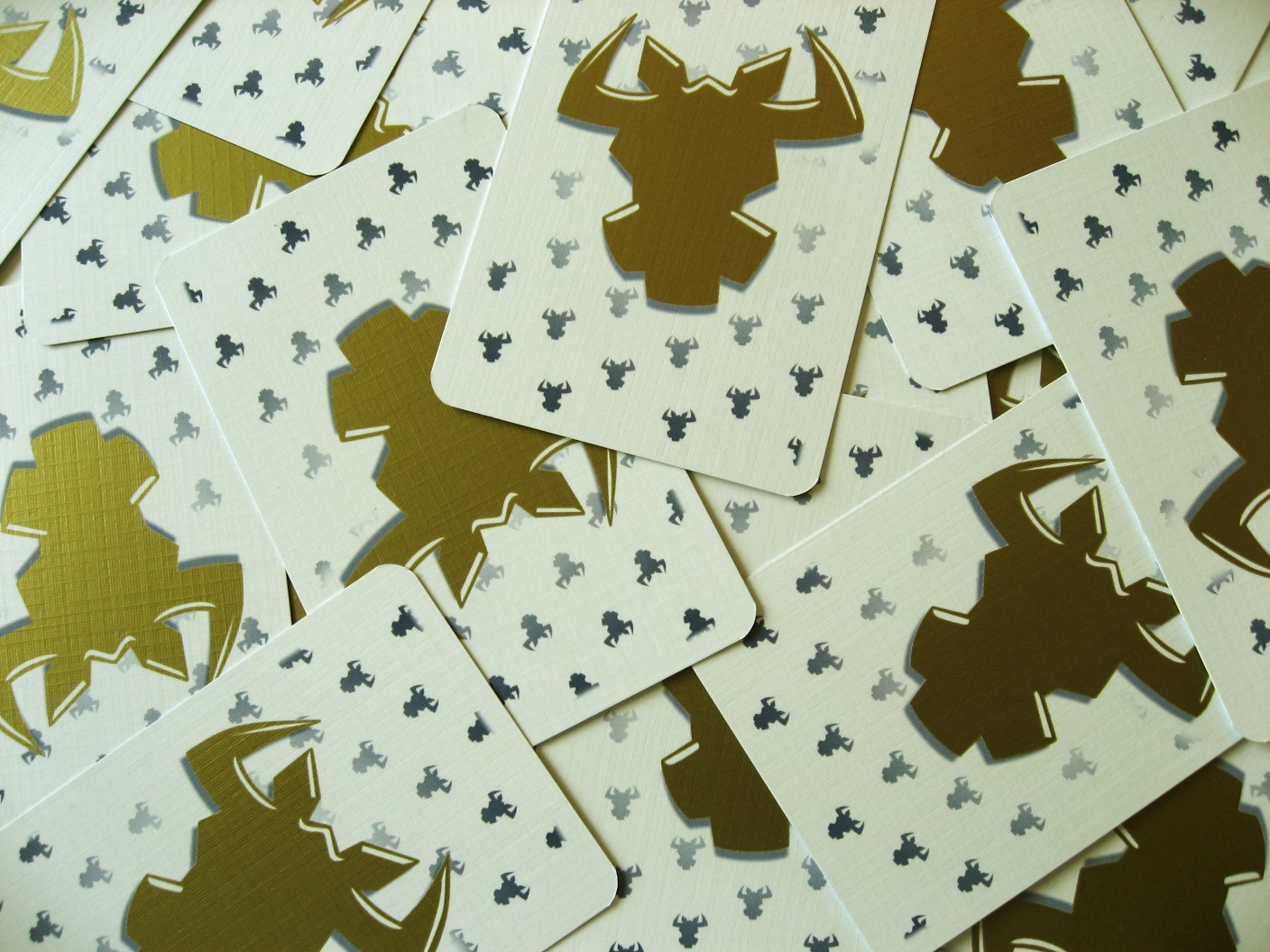
We weren’t sure whether Yellow and Orange (who recently moved to Swindon) were coming, so we started out with a quick game of 6 Nimmt!.  This is an older game, and though very simple it is one that everyone in our group somehow struggles to remember the rules for.  The game is played with a deck of cards numbered from two to one hundred and four and features a number of “Bulls Heads” (mostly just one, but some have as many as seven).  Four cards, chosen at random are turned face up on the table to make the start of four rows.  The idea is that everyone then simultaneously chooses and reveals a card from their hand.  Then, starting with the player who played the lowest card, players add their cards to the rows on the table.

6 Nimmt
– Image used with permission of BGG
contributor punkin312

Cards are added to the row that ends with the highest number that is below their card.  Thus, if the cards on the table are four, ten, fifty, and seventy-two, a player with fifteen would add it to the row containing ten.   If the card played is the sixth card in the row, then the player must take the cards and place their card in the empty space.  If the card played is lower than the last card in all the rows, the player must take all the cards in a row of their choosing.  The aim of the game is to be the player with the lowest number of Bulls’ Heads or “Nimmts”.  As play continues, the number of cards in the rows increase (making it harder to play safely) and the number of cards in hand decrease on each turn (players don’t pick up after each turn), so the decisions get increasingly agonising, especially when the rows contain cards with a lot of Bulls’ Heads.

6 Nimmt
– Image by BGG contributor Niko the Shadow

Burgundy started the first round badly and finished worse, ending with thirty-five Nimmts, compared with Black and Purple who both finished the first round with none.  The idea is that a game consists of two rounds, each played with a random half of the deck.  Unfortunately, we miss-counted and used to many in the first round, so the second round included some repeated cards.  Not that it helped Burgundy much as he finished the second round with twenty-one giving him a combined total of over fifty.  Black and Purple did better, but it was Green who had the best over-all, with just two Nimmts in the first round and none in the second, he was the clear winner.

6 Nimmt
– Image used with permission of BGG contributor punkin312

We then moved on to our Feature Game which was another older game, The Settlers of Catan, which is celebrating its 20th anniversary this year.  As it is an old classic, we had three different editions available and countless expansions.  Since everyone was keen to play it, we set up two parallel games.  Although we’ve only played it once before in the group, everyone knew the game, so we just had a quick reminder of the rules as we were setting up.  At its basic level, the game is one of resource management and civilisation building.  Players start with two roads and two settlements.  These are placed along the edges and on the corners of the hexagons of the modular board.  Each hexagon has a number on it, and on each player’s turn, first they roll both dice and resources are awarded to players with settlements on the corners of the hexagon that  corresponds to the total rolled.  Once the resources have been handed out, the active player can trade resources with other players and use them to build more roads and settlements, develop their settlements into cities or buy development cards.  Victory points are awarded for settlements, cities and the longest continuous road as well as via development cards (both as straight victory points and for the player with the most soldier cards, i.e. the largest army).

The Settlers of Catan
– Image by BGG server robot BoardGameGeek

Burgundy, Blue and Red played with a ten year old, third Mayfair edition, while Green, Black and Purple eschewed an older Mayfair edition and opted for the slightly easier setup provided by the fourth Mayfair edition.  Green, Black and Purple were nearly ready to go, while Burgundy, Blue and Red were still separating the base game from expansion tiles.  No sooner had this been noted by the first group when, calamity, quarter a pint of beer was spilled over their cards, narrowly missing their board!  A hasty drying session ensued and the third copy of Catan came in handy after all, as it was temporarily cannibalised for cards.

The Settlers of Catan
– Image used with permission of BGG contributor ronster0

Meanwhile, Blue, Burgundy and Red had finished setting out their randomised board and had started to critique it.  There was only one good source of brick and nothing for ore, in fact, the only abundant supply of anything seemed to be wood and sheep of which there were plenty.  This was exacerbated by the fact that nine was by far the most frequently rolled number in the first half of the game, which delivered both wood and sheep.  Blue had gone first and had grabbed the best brick space, however, although Red and Burgundy apparently had two better starting positions, it was a bit claustrophobic as they were both camped in close proximity on one side of the board.  Red really suffered as she ended up with two awkwardly placed positions and that made her game really tough.  Everywhere she went she was blocked by Burgundy and Blue and although she challenged for the longest road, she just couldn’t get out of the trap.  Although Blue had much more space to work with, good settlement positions were further apart which meant she had to build a lot of road before she could build.  Consequently, she quickly picked up the Longest Road card.  While Blue was road building, Burgundy got his nose in front and was first to build his third settlement.  With the extra resources this provided, Burgundy was able to keep his nose in front, settling more and building cities first.  He also had enough resources to buy a handful of Development Cards, which first of all netted him the Largest Army, and then enabled him to masterfully take the Longest Road card by building three sections in one turn.  This, together with a single victory point card brought him to ten points bringing the game to a close.

The Settlers of Catan
– Image by boardGOATS

Eventually after a lot of mopping, the second game of The Settlers of Catan had got underway.  As is often the case in this game, it was the statistically unlikely numbers which came up all the time and the more probable ones hardly ever!  This time, five appeared time and again, until Purple was awash with sheep  Wood, ore and wheat appeared often enough, but brick was not available at all, probably because they were both elevens and the twelve!  So, the sheep were exchanged for brick and everyone quickly built their third settlement.  Black obstinately refused to join up his two bits of road to claim the Longest Road card which left Green free to take it having extended his road slightly to try to get some ore into his production.

The Settlers of Catan
– Image by BGG contributor shannona

Everyone built a another settlement or two and Black started turning his into cities, but still didn’t join his roads.  Green struggled to get sufficient wheat and ore, so started buying development cards instead of building cities (as they only need one of each rather than a total of five). In the process, Green also ended up with a number of soldiers which resulted in the Largest Army card.  It was then that we discovered that Black had been inadvertently cheating. He had been using his port to swap two wood for his missing resources (he had two settlements on the wood hexagon that happened to be a six).  Of course there would have been nothing wrong with that, except that in this case his port was for the ore port not the wood port!  Green and Purple ribbed him mercilessly for the rest of the game (and indeed the rest of the evening, as he deserved.

The Settlers of Catan
– Image used with permission of BGG contributor thephantomhennes

Fairly quickly Green had taken a commanding lead with five points to the others two and three, which then became six and eventually eight when he took the Largest Army card.  Green kept plugging away at the development cards, trying to get victory points, but a clear lead meant he was also attracting the attention of the robber and his brick port was great considering he had three settlements giving brick, but the dice just weren’t playing the high numbers game.  Eventually Green found a victory point card and he needed just one more to win.  A settlement at the end of the road or a victory point development card (or perhaps a city) would do it, but by now Black had three cities and a settlement, plus that little gap in his roads.  With people finally rolling sixes and Black gaining four wood every time, the inevitable happened. He built another settlement and the missing piece of road meant his was now one longer than Green. So Black went to ten points, and Green tied with Purple two points behind.  Still, Black had cheated…!

The Settlers of Catan
– Image by BGG contributor olaha

The second game was still in full flow when Blue, Burgundy and Red finished, and decided to give a quick game, Yardmaster an outing.  This is a cute little set collecting game with a train theme and some parallels with the Ticket to Ride games.  In Yardmaster, however, players are building a locomotive rather than routes.  On their turn players can do two actions.  The actions are: draw a cargo card (either blind or from the face up discard pile); buy a railcar card from the four face up cards in the middle, or swap their “Exchange Token” with any other one around the table.  To buy a railcar, players pay using sets of cargo cards, so a yellow number three railcar will cost three yellow “oil” cards.  However, the exchange tokens allow players to use other cargo cards at a rate of two-to-one, so in the above example, if the player only had two yellow oil cards but also had two blue “coal” cards and the blue exchange token, they would still be able to buy the yellow number three railcar.

Yardmaster
– Image used with permission of BGG contributor joeincolorado

When buying a railcar, if the number or colour match the previous car, then it must be added to the end of their locomotive.  If not, then players can park it in their personal sorting yard and add it later, when another railcar is being bought and added to the locomotive.  This is the clever part of the game as it allows players to “stack” points in their personal train yard enabling them both to take some risks and strategically remove railcars from the grasping hands of their opponents.  Players score is the total of the numbers of the on the railcars making up their locomotive (waggons in the sorting yard do not score).  Burgundy started with a succession of ones and gradually built a very long, if not very high scoring loco.  Meanwhile, Blue and Red grabbed a couple of higher scoring waggons each.

Yardmaster
– Image used with permission of BGG contributor moonblogger

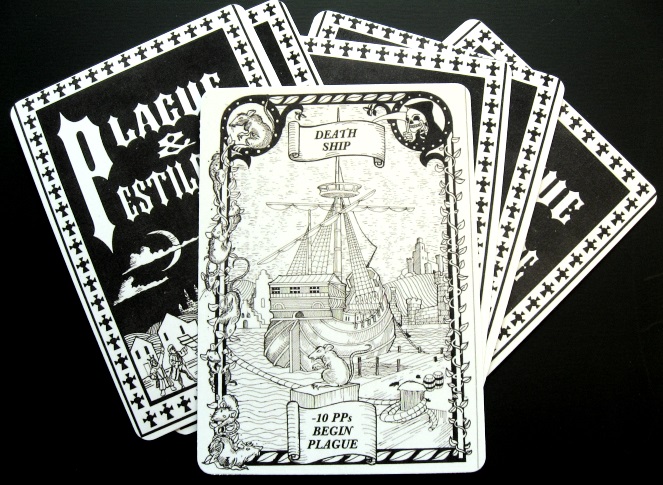
Although quick, Yardmaster was still going when the second game of Settlers finally finished and Green, Black and Purple were looking around something to play and opted for Plague & Pestilence.  This is another old game, dating back to the early 1990s and has been out of print for a long time, however, Green had brought along a self-printed version.  The game is played in two “phases”.  The first is the Prosperity Phase. During their turn, the active player rolls a pair of purple six-sided dice which indicates how much their population increases by.  Then the active player draws Prosperity cards to refill their hand and plays one.  A special Death Ship card is shuffled into the Prosperity deck and drawing it indicates the start of the second phase, the Plague Phase.  This is played exactly the same as the first phase, but the dice rolls now indicate how much the active player’s population decreases by.  As the game progresses, the plague ravages the populations and players are eliminated; the last player is the winner.

Plague & Pestilence
– Image by boardGOATS

Green, Purple and Black had played Plague & Pestilence recently (though not on a Tuesday) and Purple had won decisively with a whole handful of population cards, so was looking forward to a repeat performance.  With it being a game where being nasty was not just possible, but obligatory, Purple and Green quickly ganged up on Black to punish him for cheating in The Settlers of Catan.  Water off a ducks back, he responded with “Pied Piper” cards and “Mass Migrations”!  However his attempts at getting Green and Purple to fight came to naught thanks to Purple’s apparently endless supply of “Negotiated Settlement” cards.  Populations rose and fell, city improvements were built and destroyed. Some surreptitious changing of population cards from small denominations into large ones to reduce the size of the their pile and hide the true value of the hand went on.  Then the death ship arrived and the game was really afoot.

Plague & Pestilence
– Image by boardGOATS

Meanwhile, Red, Burgundy and Blue were bringing Yardmaster to a close, having ridden out a spell of poor railcar cards.  Burgundy was just a handful of points away from winning, and with a cards in his sorting yard needed to buy the red one in the middle, but it was Blue’s turn.  Red urged Blue to take the card or Burgundy would end the game on his next go, but Blue had other plans and using her Exchange Token bought a yellow three and took the opportunity to move all the cards from her sorting yard onto the end of her locomotive, giving her a score of twenty, seven more than Burgundy.

Yardmaster Express
– Image by boardGOATS

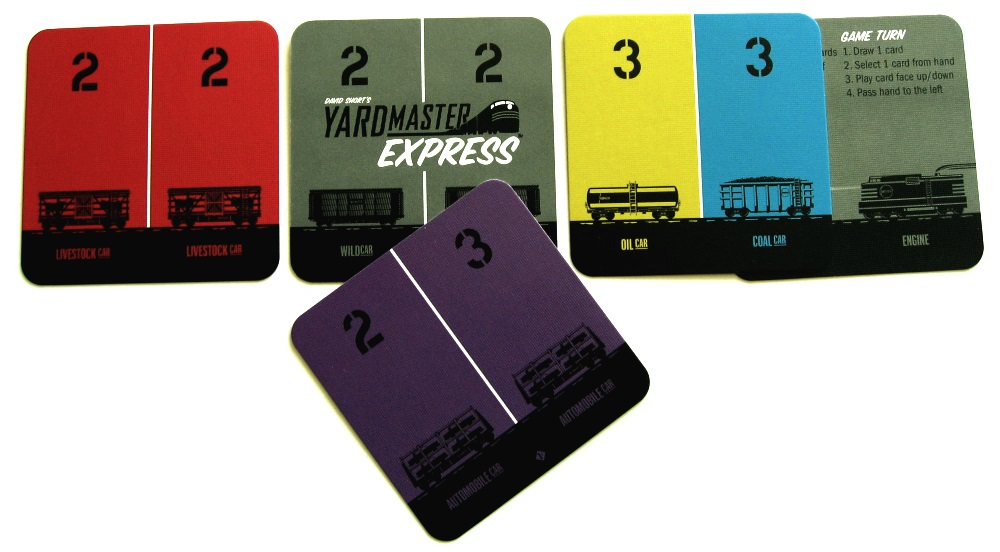
Plague & Pestilence was still ongoing, so, after a quick chat about Yardmaster, Blue, Red and Burgundy decided to give its little brother, Yardmaster Express a go.  This shares the locomotive building feature, but is even quicker and simpler than Yardmaster, though much more luck-driven.  The game is based on card drafting, so the start player begins with a hand of railcar cards, draws one from the draw deck and then chooses one to add to their loco.  As before, the waggons must match in colour or number, but this time, the cards are “split” so they contain two waggons and the front waggon may not be the same as the rear one.  Scores are the sum of the numbers on the waggons, as before, but bonus points are awarded to the player (or players) with the longest continuous set of waggons of the same colour.  This can be significant as the bonus is equal to the number of waggons.  If a player cannot match the colour or number they can play the card face down as wild, but these score less and break any otherwise continuous string of waggons.  Once a card has been chosen, the had is passed to the next player who draws a card and chooses one.   There is a little bit of opportunity to screw over the next player by taking the cards they want, but otherwise, the game is highly luck dependent, and this time, Blue was the lucky one.

Plague & Pestilence
– Image by boardGOATS

Over in Plague & Pestilence, survival was the order of the day.  Purple unfortunately had several very high roles and no improvement cards to reduce them, so quickly found her deck dwindling.  Green and Black, however, were getting better luck on the roles, and combining them with City Improvements, managed to hold on to more of their population.  Purple, with a population reduced to just ten, had one last go at Green with a “Pied Piper” card, but ultimately it wasn’t enough as she rolled 9s and 10s and within a couple more turns was dead. The gloves were now off between Green and Black.  Well not so much gloves off as desperately trying to shore-up our own populations against the relentless tide of plague and death.  Green eventually managed to win the war of attrition, thanks in no small part to four consecutive trade centre cards (which increased his population by ten each time)!

Plague & Pestilence
– Image by boardGOATS

With both games finally finishing more or less together, we had a quick chat and then decided to finish as we had started, with another game of 6 Nimmt!.  This time we started with the correct number of cards and, as before, Burgundy managed to start collecting Nimmts like they were going out of fashion.  Once again, Black managed to avoid picking up any Nimmts in the first round, but this time it was Blue that joined tied with zero at the halfway point.  Much to everyone’s surprise it was Burgundy however, who won the second round with just three Bulls’ Heads.  Unfortunately, with eighteen in the first round he was always going to find it hard to compete for the lead, which left Blue and Black with fourteen overall, having finished both rounds with exactly the same number and the evening finished with a draw.

6 Nimmt
– Image by boardGOATS

Learning Outcome:  New games can be good, but classics remain popular for a reason.

29th July 2014

After a bite to eat, we started late with our first game, Indigo and immediately in walked a two more gamers.  It is a quick game though, and Yellow in particular was quite fascinated watching.  It is a really beautiful and simple yet clever game, based on tile laying and path building.  The idea is players have to direct glass pebbles and catch them in their “gates”; different coloured stones are worth different numbers of points.  Each player has a single tile and on their turn, they place that tile anywhere on the board in almost any orientation.  If the tile extends the path of one of the stones or connects it to another bit of path, the stone is moved along the path to the new end.  If a stone arrives in a gate, the owners of the gate get to keep the stone; each stone have a value and the player with this highest total at the end wins.

Indigo

In the four player game, players have three gates each, sharing one with each player, so there is a certain degree of team-work.  This was White’s first visit, and it became clear early on that this was not the best game for her as, without her glasses, working out where the blue ribbons go was challenging!  Nevertheless, she did remarkably well, especially in helping us make sure Green didn’t win!   Red and Blue led the charge and, when Red brought home the blue stone (which is worth a valuable three points), the writing was on the wall – a draw!

Indigo

With a few more arrivals, we decided to play our “Feature Game” next, which was 6 Nimmt! (aka Category 5 amongst other things).  This is a much older game (celebrating its 20th anniversary this year), though is also quite simple to play.  There are four cards on the table forming the start of four rows and players start with ten cards in their hands.  Each card has a face value between one and one hundred and four and features a number of “Bulls Heads” (mostly just one, but some have as many as seven).  Basically, players secretly choose a card to play, and then simultaneously show them.  The lowest card is then placed after the highest card on the table that has a face value lower than the card they are playing.  In this way, four rows are formed.  The rows are full when they contain five cards and when the sixth card should be added, the active player instead takes all the cards in the row and places their card down to start a new row.  A player scores the number of Bulls Heads on the cards and winner is the one with the fewest at the end.  Since the number of cards in the rows increase (making it harder to play safely) and the number of cards in hand decrease on each turn (players don’t pick up after each turn), the decisions get increasingly agonising, especially when the number of Bulls Heads in the rows starts to increase.

6 Nimmt

We checked that Red understood that she wasn’t supposed to be collecting cards and she assured us that she understood this aspect of the rules, however, it wasn’t a surprise when she finished with nearly twice as many Bulls Heads as anyone else!  So we decided to play a second round and work our way through the second half of the deck to give her a chance to improve things.  Green decided that it was time to “nobble” Blue as she had finished the first round with one Bulls Head, however, he had no idea how to go about doing it, nevertheless, everyone was delighted when Blue was the first to pick up.  Red seemed to have got the hang of it this time and managed to get through the whole round without picking up a single card which meant she finished in joint second with Green.

6 Nimmt

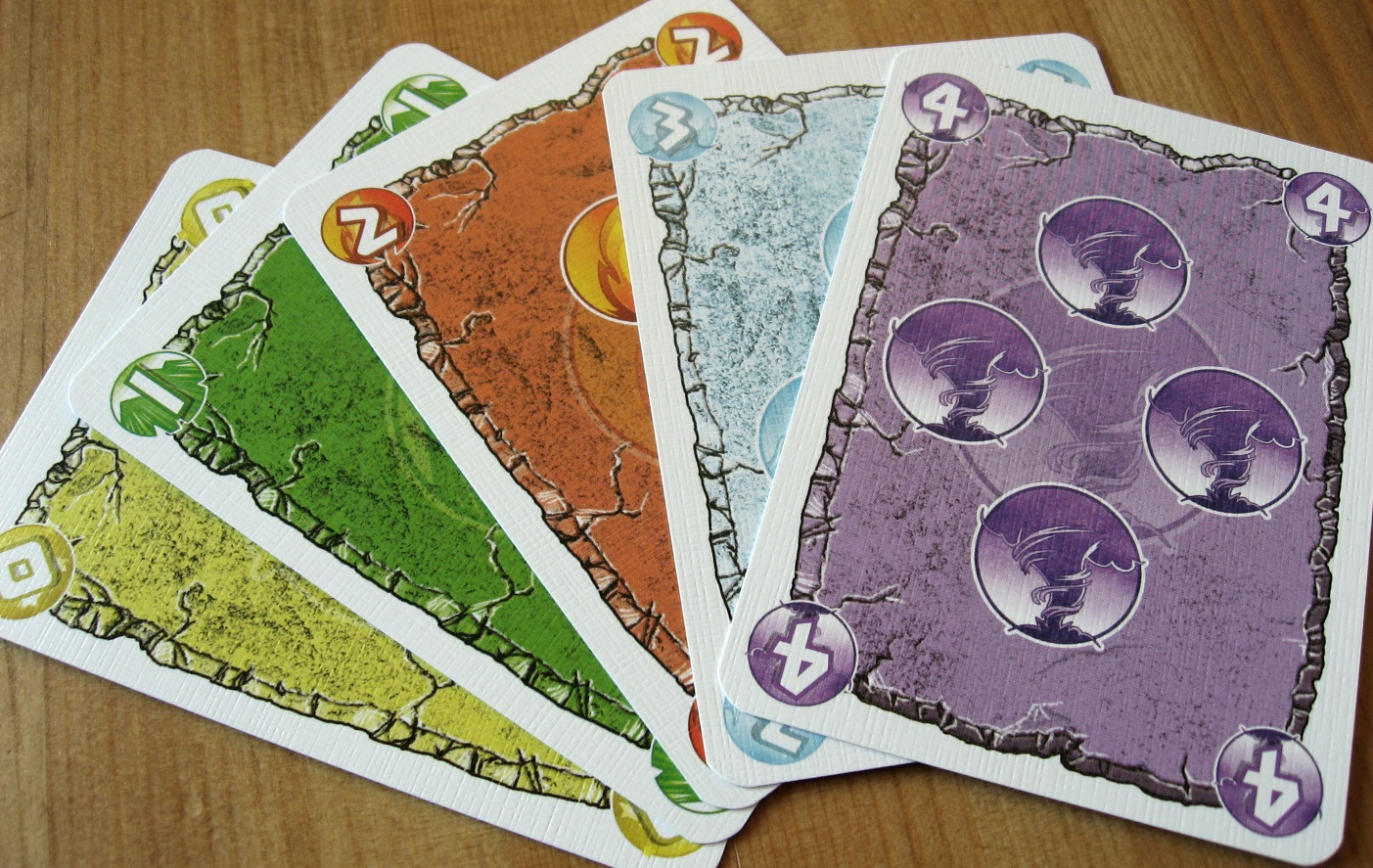
We didn’t have long before people had to leave,  so we played a game of one of our new favourite fillers, Dodekka, which has a lot in common with another game we like, Parade.  This is a simple little push-your-luck card game, with five different suits, Fire, Earth, Air, Water or Ether each with cards numbered 0-4. The game starts with three random cards placed in a line from the draw deck.  On a player’s turn they can either take a card from the deck and add it to the end of the row of cards, or take the card nearest the deck.  If the total of the face values of the cards in the row exceeds twelve, then the player has to take the whole row.  At the end of the game, players choose a scoring suit and add up the face value for that colour, then they subtract the penalty points – one for every card not in their scoring suit.

Dodekka

Yellow was the first to pick up a handful of cards, but it quickly became clear that he had a strategy and, as a substantial number of the cards were blue he was hoping to collect enough to offset any penalties.  Red, Green and Blue, meanwhile tried to delay picking up cards and then minimise the number they got so they could leave the decision until they were forced to choose.  Purple was forced to choose quite early on, but ran out the winner with a grand total of five, just one ahead of Green and three ahead of Yellow.  Remarkably, nearly everyone finished with a positive score, which we felt was much better than last time!

Dodekka

Next up was another recent favourite in Ivor the Engine.  We played this only a few weeks ago, but Yellow has won every game he’s played, so we all felt we couldn’t let this record stand…  Yellow started out well early on, with a lucrative job in Llangubbin, but it stayed close.  Purple carried out a lot of jobs at Mrs. Porty’s House and then picked up the matching event card to add more points.  Green collected a lot of sheep in the Grumbly Town area and then played a handful of cards to do several jobs one after another.  When an event card came up that moved everyone to Tewyn, we all payed a sheep except Yellow who followed the move with an ominous number of jobs in Tewyn Beach.  Meanwhile, Blue had picked up a lot of cards for Dinwiddy’s Gold mine, but without help was unable to clear the sheep efficiently.  So when the matching event card came and went, she changed her strategy and collected a couple of tasty looking jobs in Grumbly Town.  When it looked like Yellow was about to finish the game, Blue gave him a lost sheep card, immediately followed by Purple who forced him to lose a couple more sheep.  Blue turned her Goldmine cards into gold, then into coal enabling her to move and carryout a couple of jobs bringing her sheep flock to twenty-five, and as the last player in the round, brought the game to an abrupt end.  With her extra sheep event card, she finished with thirty, just ahead of Green who pushed Yellow into third, for the first time.

Ivor the Engine

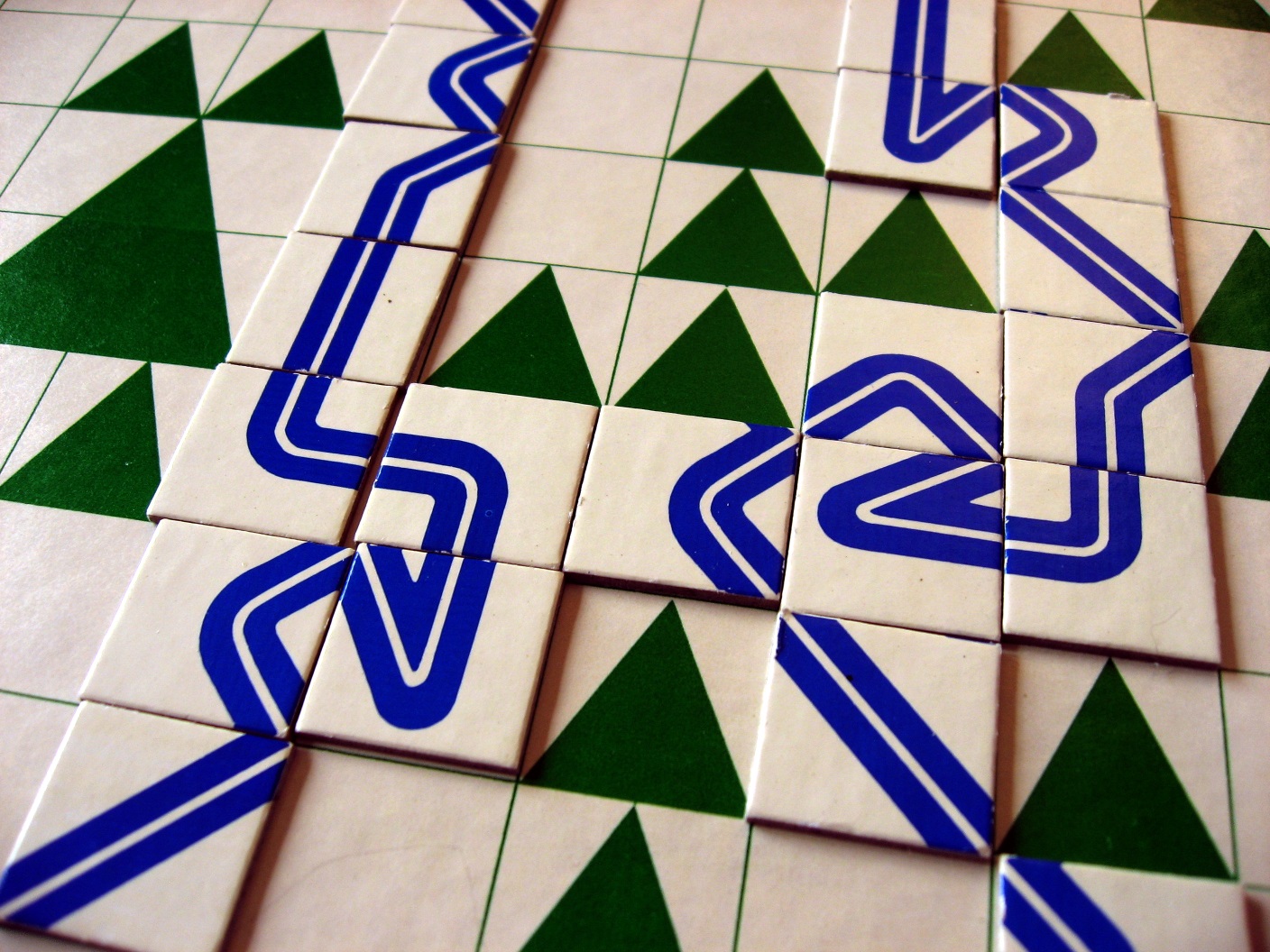
With only half an hour left, we decided to play what looked like a quick game in The Great Downhill Ski Game.  This is is an old game dating back to over forty years, but was ahead of its time.  Basically, players have a hand of ten tiles and on their turn they lay as many of them as they can to create a continuous path avoiding all the trees.  At the end of their turn they draw tiles from a face down pool to bring their hand back up to ten.  The game ends when one player makes it to the bottom of the run and players get points for finishing the course, but also for the tiles they lay, with points for corners and more points for sharper corners or crossing a track.

The Great Downhill Ski Game

Yellow started followed by Blue and Purple, so by Green’s turn he was squeezed into a corner and had to wriggle between the edge and Yellow’s track, as well as avoid the trees.  Purple was lucky with the space she had as Blue had left her with a lot, but didn’t get the tiles she needed.  Meanwhile, Blue started well and made a run for the line, but trying to weave in as many of her higher scoring tiles as she could.  It looked like Blue was miles ahead, but Yellow crossed the line first, leaving everyone one turn to finish.  Purple was the only one who couldn’t quite make it, though she managed to use nearly all her tiles.  Blue was hampered by drawing a high scoring, but high penalty tile in the penultimate round that she couldn’t get rid of, and came joint second with Green who did remarkably well considering his difficult start.  The gold medal went to Yellow though, who was not only first down the course, but was also left with the fewest penalties at the end.

The Great Downhill Ski Game

Learning Outcome:  Old games are sometimes still good games.