Tag Archives: Blackjack

27th May 2025 (Report)

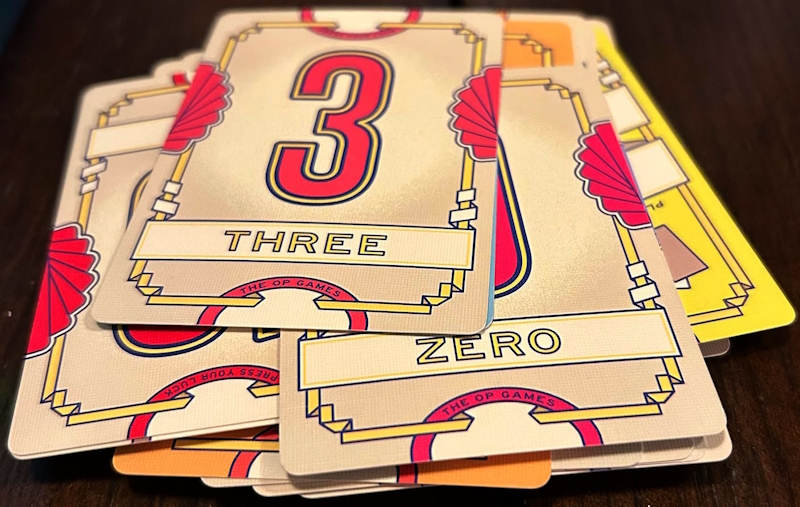
This week, Jade was proactive and quickly got a group together to play the “Feature Game“, which was to be Flip 7.  This is a quick, push-your-luck card game along the lines of Blackjack and recently won a Golden Geek award and received a nomination for the Spiel des Jahres.  The group have already played it a couple of times on a Tuesday, but we wanted to raise its profile and share it more widely amongst our people by making it the Feature Game.  The idea is really simple:  players turn over cards and gamble on not revealing the same number twice.  Unlike Blackjack, the game is played turn-wise, so the the dealer starts by dealing one card to each player.  Then players take it in turns to decide whether they want to “flip” or ” stick”.

Flip 7
– Image by boardGOATS

This mode of play is critical to the game’s popularity because it keeps everyone involved and the turns short. If players stick, they score the total of the face value of their cards.  There are a couple of other things that make the game tick, in particular the fact that each numbered card appears in the deck that number of times (i.e there is one one, two twos and so on).  Thus, the highest scoring cards are also the most risky.  Further driving push to gample, flipping over seven cards in a row gives fifteen bonus points.  There are also some action cards in the deck, “Flip Three”, “Freeze”, “Second Chance” and modifier cards which give extra points, all of which break the rhythm and add interest without adding significantly to the downtime.
Flip 7
– Image by boardGOATS

The game ends when players have reached the pre-agreed total (two hundred, according to the rules, though games can easily be made longer or shorter as desired).  This time, the group played the game as written, to a total of two hundred, which took seven rounds.  Sapphire  and Flint managed to go bust five and six and seven rounds respectively, though Flint did manage to push his luck to get seventy—the most in a single round.   Jade achieved a new low, however, failing to score at all.  The front runner was Teal, but going bust in the sixth round left the door open to Ruby who had been matching him step for step, scoring in every round and triggering the end of the game with her unsurpassed two-hundred and thirteen.

Flip 7
– Image by boardGOATS

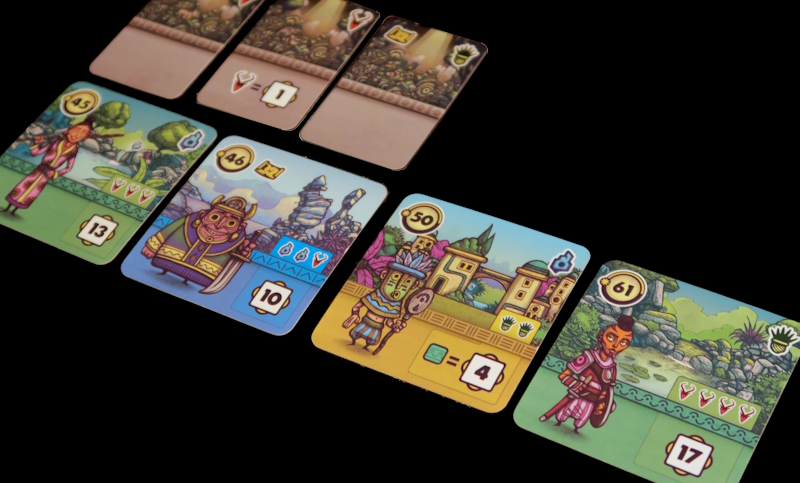
Everyone else was playing a longer game, so with six, that left the choice of another six player game or splitting into two groups of three.  The party feel of Flip 7 had got everyone in the mood for playing in a larger group, leaving a fairly limited choice, though there are a couple of really good options.  Bohnanza is one, but instead, the group chose Faraway—another game that received a Spiel des Jahres nomination this year, that we first played in the group over a year ago and has proved very popular since.  This is another relatively simple game, this time  with a market and a trick-taking type element, but with a really clever twist, and one that really messes with the head.
Faraway
– Image by boardGOATS

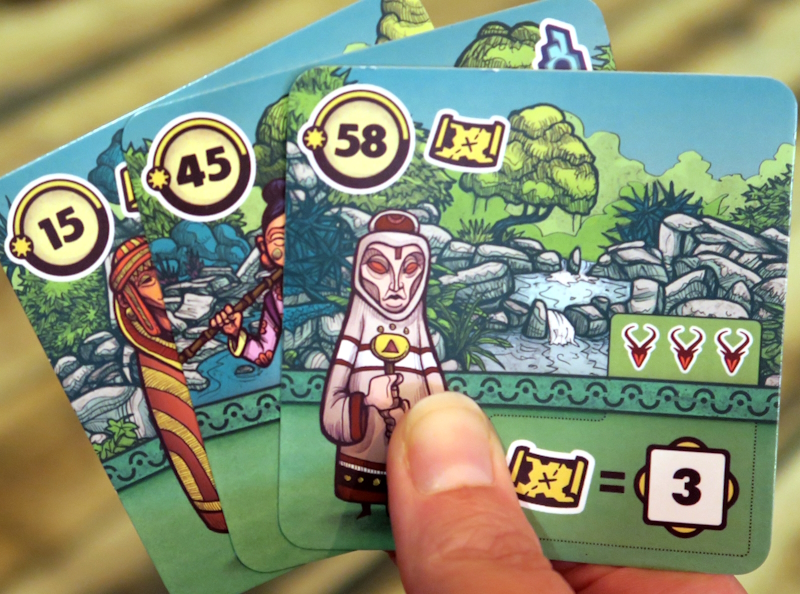
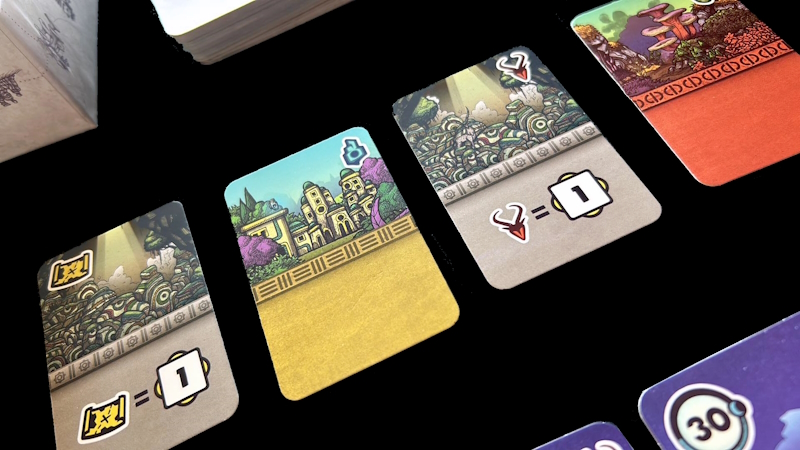
The story is that players are exploring the mysterious land of Alula in search of its secrets, meeting its inhabitants and listing its wonders in order to gain more fame than everyone else.  Players simultaneously chose one of the numbered cards from their hand to add to their tableau then, starting with the the player that played the lowest card (similar to 6 Nimmt! or Kingdomino), everyone takes it in turns to choose one from the market to add to their hand.  Players then simultaneously choose another card to play, and again, choose one to add to their hand.  The game ends after everyone has played a total of eight cards, and then everyone scores.
Faraway
– Image by boardGOATS

The scoring is the really clever part, because although the cards are played into tableaux from left to right, the scoring is from right to left.  At first glance, this looks like it makes things easy, because early in the game players find out what they need to get points and can then focus on getting the resources they need as the game progresses.  However, the desire to play scoring cards early is tensioned against card choice (the player who placed the lowest numbered card goes first) and the ability to get Sanctuary bonus cards.  Scoring cards are generally higher number and Sanctuary cards are gained when the card played has a higher value than the previous one in their tableau.
Faraway
– Image by boardGOATS

It is always hard to see how players are doing with this game, because if a player has played a high value scoring card early it can be worth a lot, but if the player fails to gain the necessary resources it can be worthless.  In the event, it was quite close with four of the six players scoring over sixty.  The winner, however, was Pink who got lucky early when he played card number fifty-nine first to start a map strategy and finished with five of them.  Sapphire was only two points behind in second though, and Teal two points behind that.

Faraway
– Image by boardGOATS

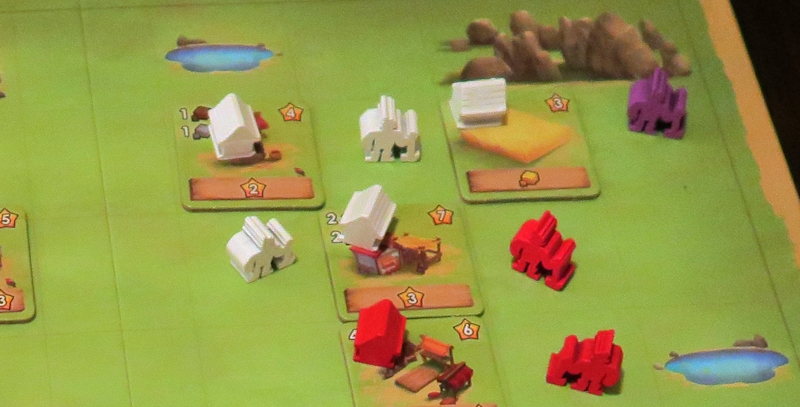
Meanwhile, on the other side of the room, Black and Purple were introducing Pine to Looot, another game that received a nomination, this time for Kennerspiel des Jahres, the “Expert” or “Connoisseur’s” game.  This is a game where players gather resources and capture buildings to develop their fjord, fill their Long Ships and complete buildings to rack up victory points. The player with the most riches is crowned Jarl of the Vikings.  The game is played over several rounds until each player has played all their Vikings, giving a maximum of thirteen turns.  In each, a player first places their Viking on a Resource tile on the central board adjacent to another Viking of any colour and takes the Resource and place it on their personal board.

Looot
– Image by boardGOATS

If possible, they then capture a Building and place that on their board, take a Long Ship and also place it on their board, use a Shield, complete a Construction Site and finally grab a Trophy.  At the end of the game, scoring is a bit of a point salad with points awarded for Castles, Watchtowers, Houses, Gold, Sheep, Trees, Construction Sites, any Trophies the player may have claimed and a five-point penalty for any unfilled Long Ships.  Purple raked in points for her Houses, Construction Sites and Trophies, while Black did better for his Watchtowers and Gold, and Pine top-scored for Trees.  The winner, however, was Purple whose total of ninety-one was five ahead of Black in second.
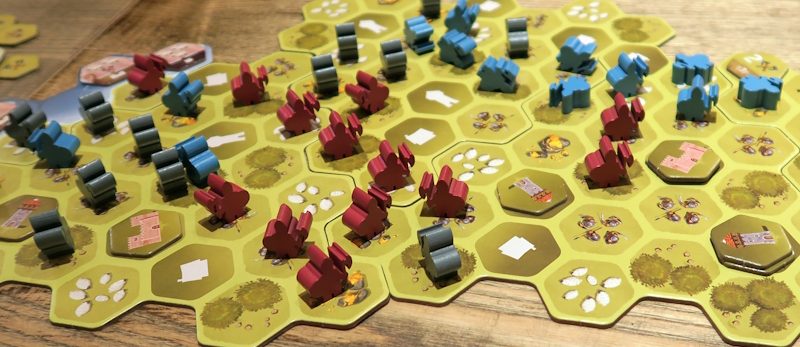
Looot
– Image by boardGOATS

The trio followed this with a shorter game, the Paris version of the 2004 Spiel des Jahres winner, Ticket to Ride (aka Zug um Zug).  Like the original, game-play is very quick and simple:  players take it in turns to take Cards from the market, or spend them to place Trains on the map with the aim of completing Tickets.  Players score points for placing Trains and completing Tickets with penalties for any incomplete Tickets.  Each game variant has its own special rules.  In the case of Paris, when players score bonus points each time they complete a Tricolor: a set of blue, white, and red routes.  This time it was a very close game.  Pine had the most points collected during play (including Tricolors), but Black picked up more for his Tickets and edged it by a single point.
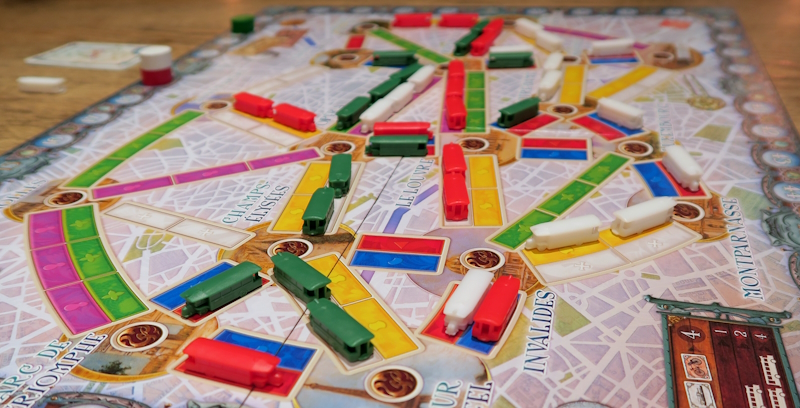
Ticket To Ride: Paris
– Image by boardGOATS

The final game of the night took all evening and was the only one that that has not had a nomination for the Spiel des Jahres, Century: A New World.  This is the final game in the Century Trilogy (preceded by Spice Road, Eastern Wonders), but as they all use some of the same components, Plum and Byzantium had managed to squeeze all three games into one box (with an extra set of cubes so two could be played at once).  In A New World, players are exploring the Americas at the dawn of the 16th century trading with local inhabitants, recording their findings, and hunting and gathering to survive.

Century: A New World
– Image by boardGOATS

The game uses the resource trading mechanisms (Collect, Upgrade and Exchange) found in the rest of the Century series, but instead of using cards as in Spice Road, this is combined with with a worker placement mechanism.  On their turn, players can either Work (place Workers) or Rest (retrieve Workers).  Workers can work at Locations that have neither an Exploration tile nor Workers of their own colour.  If a Location is vacant, they can activate it by placing the number or workers depicted on the space; if it is occupied, the current occupants must be evicted and returned home by placing one extra Worker.
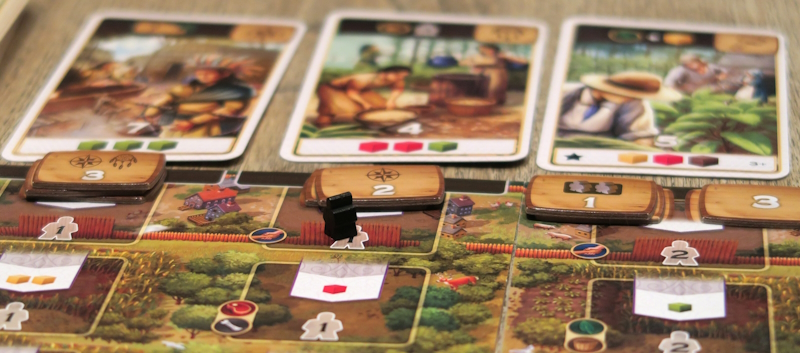
Century: A New World
– Image by boardGOATS

There are four locations types, thee allow players to Collect, Upgrade and Exchange Resource cubes, while the fourth (Forts) allows them to use Resources to claim Points Cards and Bonus Tiles.  Players can only have a limited total number of Bonus Tiles, and can only claim the Points Card associated with the particular Fort.  These Cards are supposed to slide along a conveyor belt so that they move from one Location to another, but thanks to a rules malfunction, this time the didn’t until more than halfway through the game.  The game finishes when one player has their eighth Points Card, so it can end quite suddenly, as players can pick up cards quit quickly due to special powers.

Century: A New World
– Image by boardGOATS

These games are basically race games, and it felt like Byzantium had a good start with points from his Exploration tiles, the only one to have any.  However, as Plum built her engine, she galloped up on the rail, ultimately taking the most points from her Cards. She also took the most points from Bonus Tiles.  In such a tight game, left over resources were critical and they enabled Cobalt to leap-frog Byzantium into second.  Plum was the winner, though by just two points.  It had been fun, though Plum’s comment that she actually preferred the second of the trilogy meant Blue who had not played it would take the opportunity to grab a copy at the UK Games Expo Bring and Buy a couple of days later.

Century: A New World
– Image by boardGOATS

Learning Outcome:  The Spiel des Jahres Jury can spot a good game.

29th April 2025

The evening began with a quick game of the popular Blackjack based game, Flip 7.  This is a quick, push-your-luck card game along the lines of Port Royal where players turn over cards and gamble on not revealing the same number twice taking it in turns to decide whether they want to “flip” or ” stick”. The catch is that each numbered card appears in the deck that number of times (i.e there is one one, two twos and so on). Flipping over seven different cards in a succession gives fifteen bonus points.  There are also some action cards in the deck, “Flip Three”, “Freeze”, “Second Chance” and modifier cards which give extra points. The game ends when players have reached the pre-agreed total.

Flip 7
– Image by boardGOATS

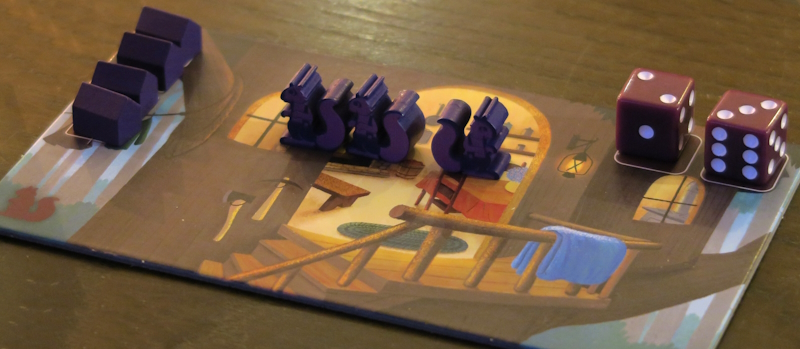
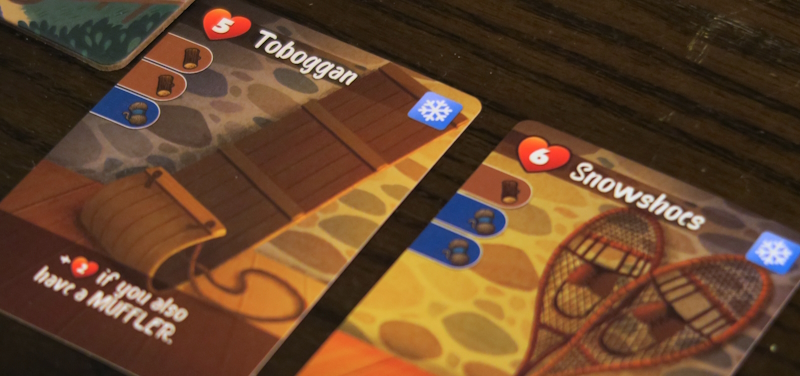
Ivory was keen to get in a little practice as “Little-Ivory” was getting it for his birthday in the next few days.  Although the game plays up to eight (with one box), there were just the four as Ivory was joined by Jade, Sapphire and Mint.  Mint went bust early and Sapphire started fast, but the victor was Ivory who didn’t go bust at all during the game.  With that over quite quickly Jade and Sapphire were joined by Pine, Plum and Byzantium to play the “Feature Game“, Creature Comforts.  In this game, players spend Spring, Summer, and Autumn gathering different resources from the forest and spending them to collect items that will home a more inviting place while the world outside is covered in a layer of snow in the Winter.
Creature Comforts
– Image by boardGOATS

Creature Comforts is a worker placement game with a twist:  the workers can be placed at various locations, but dice of specific values (or sum-totals) are required to activate the locations. Thus, the players need access to dice of specific values when it comes to triggering those workers.  Jade explained the rules to Pine, Plum, Byzantium and Sapphire, some of whom were new to the game.  Played over twelve months, at the start of each month or round, a Traveler “event” card is revealed which either applies an instant effect or one that lasts the duration of the month.  Simultaneously, players then roll their two Family dice and place them on their Home Boards.
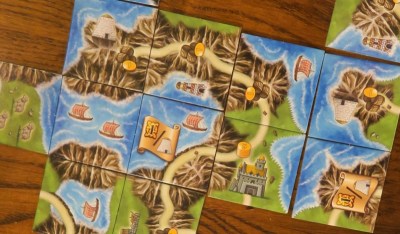
Creature Comforts
– Image by boardGOATS

Then, players simultaneously place their Workers at their choice of the twelve locations.  Although the locations can hold any number of Workers, players can only place a single worker at each one.  Each location will either require a dice of a specific value or multiple dice that add to a given sum (or have a particular requirement e.g. feature all odds or evens).  The catch is that at this point, players only know the values of the two dice that they have access to, their Family dice.  So, placing Workers requires some astute planning mixed with some luck when the four communal Village dice are rolled next, by the start player for the month.  Players then take it in turns to allocate the six dice at their disposal to activate as many of the locations their Workers are at as possible.

Creature Comforts
– Image by boardGOATS

Each Worker that a player cannot activate gets them a Lesson token, which can be used to modify dice values in later turns (for only that player).  Finally, players finish their turn by crafting any creature comfort cards they can, keeping in mind that only three can be carried over to the next round.  After eight months (six if playing a shorter version of the game), players can craft any left-over cards they might have in their hand if they can afford to and then score for their Comfort Cards, Improvement Cards, for empty Cottage spaces and left-over resources.  The first problem was that there were a lot of locations to get to grips with.  Pine, who was new to the game, struggled initially, but by the end was wanting to play again soon!

Creature Comforts
– Image by boardGOATS

Sadly, although the game was a lot of fun and enjoyed by all, it was marred by the fact that “Last Orders” was called sooner than expected.  This meant the last couple of rounds were played at something of a rush and points were missed and some of the scores might not have been correctly counted.  There are a lots of odd points to be counted, but the bulk come from the eponymous Creature Comfort cards.  Byzantium top-scored for these with forty-three points, some ten more than anyone else, so it was no surprise that he ran out the winner by a sizeable margin, with everyone else left fighting for second.  That battle was won by Sapphire with Pine taking third.

Creature Comforts
– Image by BGG contributor hipopotam

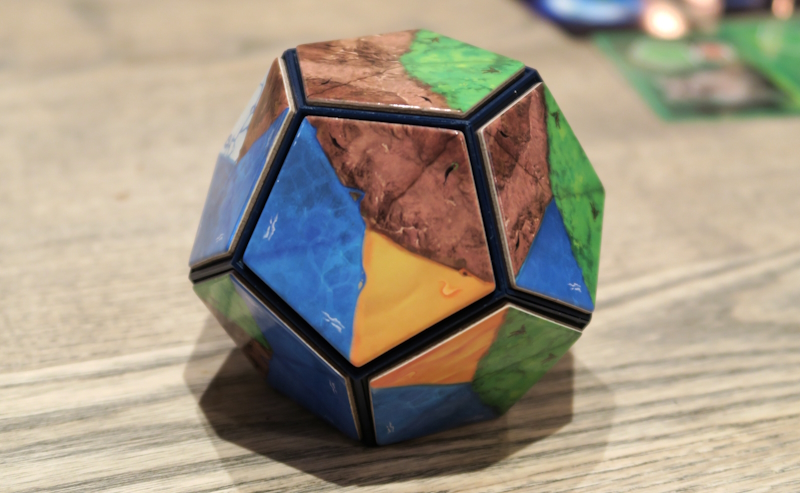
Meanwhile, Mint introduced Blue and Ivory to the really cool, three-dimensional game, Planet.  This is quite a simple game, but really clever:  each player receives a dodecahedral planet core with twelve pentagonal spaces and a magnet in the centre of each one.  On their turn, players choose a pentagonal tile with different terrains (Mountain, Ice, Forest and/or Desert) on them and stick it to their planet. The player who fulfills the most conditions for the appearance of certain animals gains its card.  There are public, animal objectives and each player has a private objective, their “Natural Habitat”.

Planet
– Image by boardGOATS

Players score points for the size of their Natural Habitat, and also for each animal card they claim.  Animals that live in an area that is not the player’s Natural Habitat score extra points which creates sort of opposing incentives to cover the planet with Natural Habitat tiles while also creating the right conditions to score animal cards.  And as the Planet fills up, this gets more and more complex.  Although everyone loved it, the game didn’t quite click for Blue, but it was close between Ivory and Mint.  There were only two points between them in the final totals, with Ivory taking his second victory of the night with twenty points.

Planet
– Image by boardGOATS

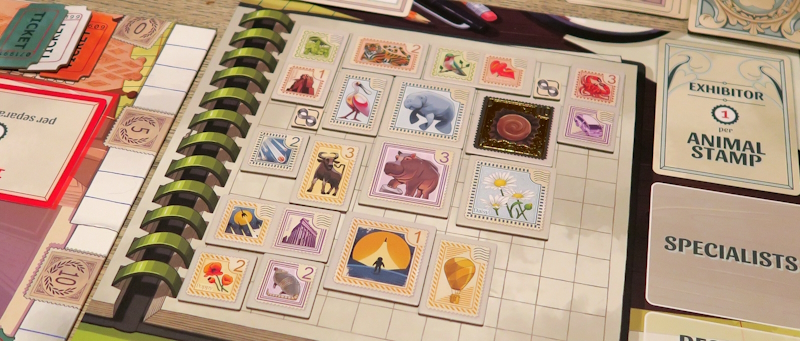
From there, the trio went on to play the Golden GOAT Award winning game, Stamp Swap.  In spite of the theme (which didn’t really set anybody’s imagination on fire), this has proved to be a really popular game within the group—it is just very smooth and doesn’t outstay its welcome.  Everyone had played it before, so there was only the barest minimum of a rules run-down.  The game takes place over three rounds, each split into two parts:  Firstly players take it in turns to choose from a central pool, then players divide their pile into two and the first player chooses one pile from another player to take, who keeps their other pile and chooses one from another play—and thus the piles of stamps are swapped.

Stamp Swap
– Image by boardGOATS

Players score points at the end of each round for their achievements and at the end of the game, for the face-value of the stamps and for end game objectives.  Despite everyone having played it before, there was a rules malfunction that might happened before and could have made a significant difference, to Mint and Blue especially.  Each player has an “Exhibitor” which gives players a point for each stamp they have of a given theme.  The group scored this at the end of the game, however, it is supposed to give points at the end of each round.  Everyone played by the same rules, so Ivory was the deserved winner with a hundred and eighteen points, but the scores would have been closer if the Exhibitors had been played correctly.

Stamp Swap
– Image by boardGOATS

On a night when there were four tables, the third consisted of Pink, Black, Pine and Purple, started with a game of Little Town.  This is a really cute little game of Worker placement, resource collection and management, and building tile placement.  The game lasts for four rounds, during which players collect resources (wood, stones, fish, and wheat) from the eight surrounding squares by placing Workers on central map.  Players can then build buildings using these resources, players can then gain the effect of the building by placing a Worker next to it.  Placing a Worker next to a building owned by another has a cost though, and the player must pay a coin before you can collect resources.

Little Town
– Image by boardGOATS

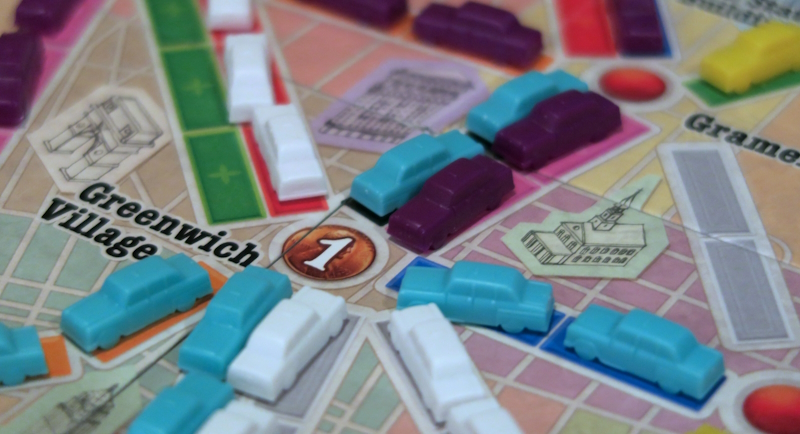
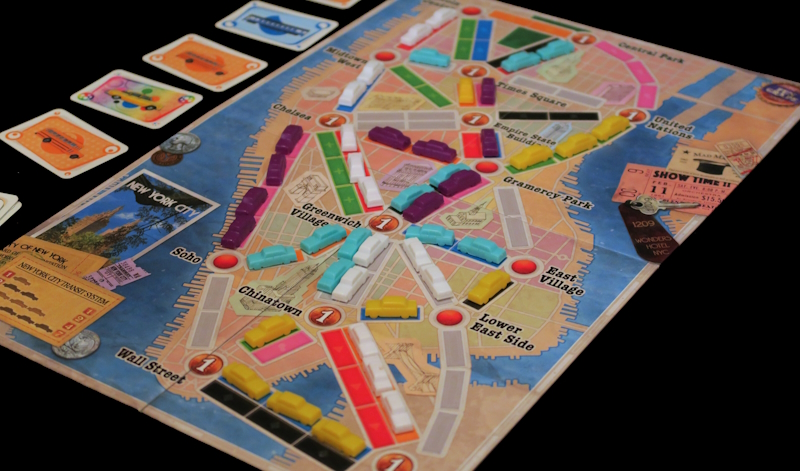
Players collect victory points using the powers of buildings, by constructing buildings, and by achieving objectives dealt at the beginning of the game. This time, Pink played a really pragmatic game essentially simply repeatedly activating the Well and the Bar (giving him two and three points each respectively).  As a result, the game was a bit of a land-slide with Pink taking victory with thirty-nine points, eleven ahead of Black in second with Pine a few points behind that.  With everyone else otherwise engaged, the group went on to play a quick game of Ticket to Ride: New York.  This is one of the first of the very small editions of Ticket to Ride, in fact, the first of the “Cities“, as it was preceded only by the Demo version.
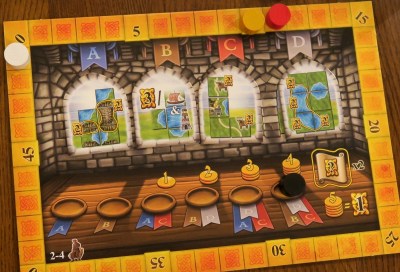
Ticket to Ride: New York
– Image by boardGOATS

The game is played much the same as the full version of Ticket to Ride, with players taking coloured cards from the market and spending them to place pieces (in this case taxis) with the aim of completing tickets.  Black took the most points for the Tourist Attractions he made connections with, but had a bit of a ‘mare elsewhere, failing to complete a large pile of tickets which left him losing fifteen points.  This almost entirely wiped out the rest of his points, but it was relatively close between the others.  Pink was once again the victor though, taking the most points for placing taxis and for his tickets giving him a total of thirty-four points, with Pine taking second place just ahead of Purple.

Ticket to Ride: New York
– Image by boardGOATS

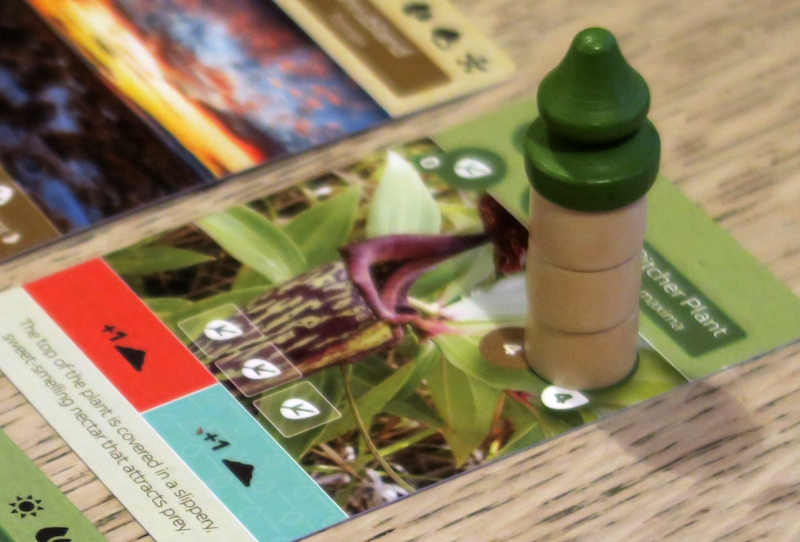
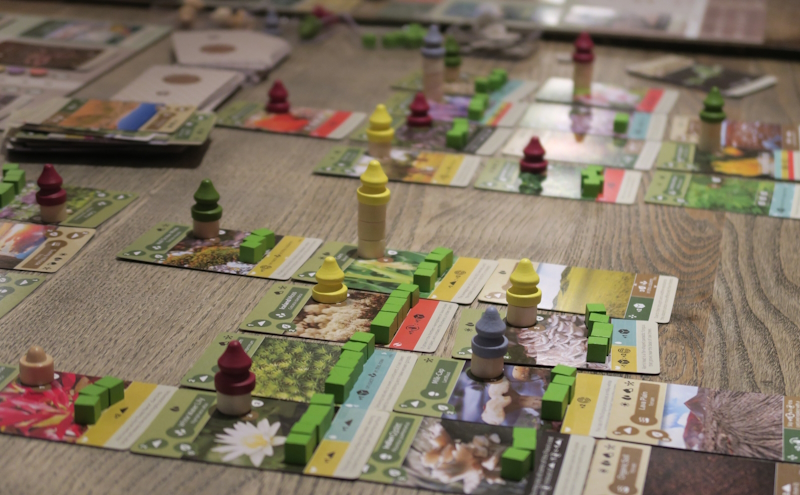
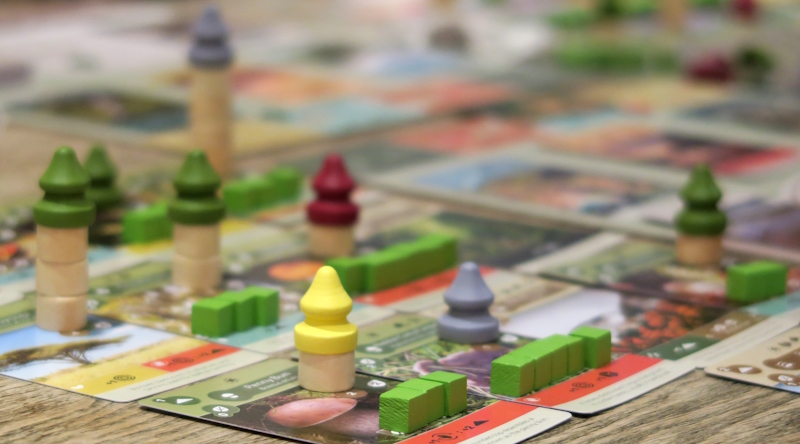
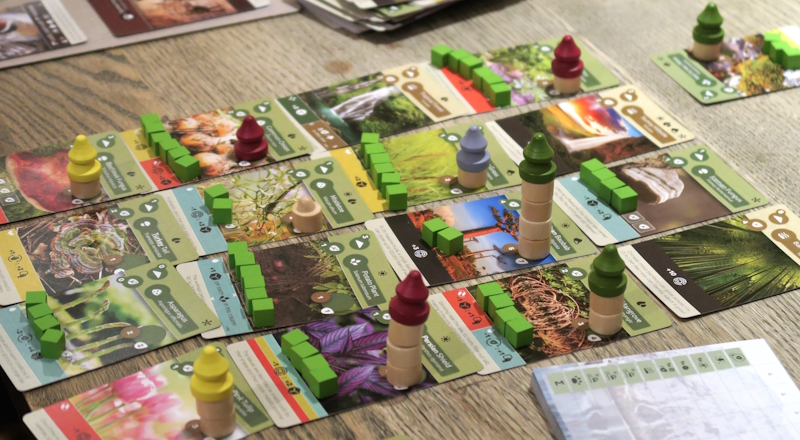
The fourth table consisting of Green, Teal, Salmon and Flint, only played the one game, but it was one of the most beautiful of recent times:  Earth.  This is a card-driven engine-builder where players are building themselves an ecosystem.  Often compared to Wingspan, although there is a lot to understand, the game itself is not actually all that complicated. Players are building a four by four grid of Flora and Terrain cards which represents their island; during the game they will plant flora, water it and allow it to grow.

Earth
– Image by boardGOATS

On their turn, players do one of four things: Planting (paying the cost in Soil tokens), Composting (gaining Soil and placing cards from the deck in their discard pile), Watering (place Sprouts and gain Soil) & Growing (draw new cards and place growth tokens).  A bit like Puerto Rico, once the active player has chosen which action they are taking, everyone else gets to do a subsidiary, slightly weaker version of the same action.  For example, when Planting, the active player plants two cards, draws four and keeps one, while the other players plant one and draw one.

Earth
– Image by boardGOATS

Once everyone has completed the action for the turn, everyone activates all the cards in their island that match the colour of the action chosen, starting with the card in the top left and working across each row in turn.  So, not only is it important which cards are played, but also where they are located in the player’s island.  At the end of the game (which is triggered when one player has completed their island), players score points for each Flora card, any Trunks and Canopies they have grown, their Sprouts and their pile of “Composted” or discarded cards.  Players also score points for achieving objectives on the Fauna cards revealed at the start of the game and for completing their island first.

Earth
– Image by boardGOATS

This was another game that turned out to be a bit of a land-slide.  The base scores for the islands was pretty consistent, but as with many games, it’s about what you do with the cards you get that makes the difference.  Green “Composted” fewer cards, but scored more for his Sprouts.  Players had ups and down, but otherwise it was fairly even.  The biggest difference, however, was the number of Leaf Tokens on the Fauna board—Green had more than twice as many as anyone else with sixty.  As a result, his total of two-hundred and forty-four was nearly fifty more than that of Teal who took second ahead of Flint in third.

Earth
– Image by boardGOATS

Learning outcome:  Rushing the end of a game can take the shine off it.

Next Meeting, 27th May 2025

Our next meeting will be on Tuesday 27th May 2025.  As usual, we will start playing shorter games from 7.30pm as people arrive, until 8pm when we will start something a little longer.  Due to a recent change of hands, the pub is NOT doing food at the moment.

This week, the “Feature Game” will be Flip 7 (rules, tutorial video, review).  This is a quick, push-your-luck card game along the lines of Blackjack that recently won a Golden Geek award and received a nomination for the Spiel des Jahres.

Flip 7
– Image by boardGOATS

And speaking of card games…

Jeff was chatting to Joe over a pint one evening.

“My wife says she’s leaving because of my obsession with Poker,” said Jeff.  “But I think she’s bluffing…”

19th September 2017

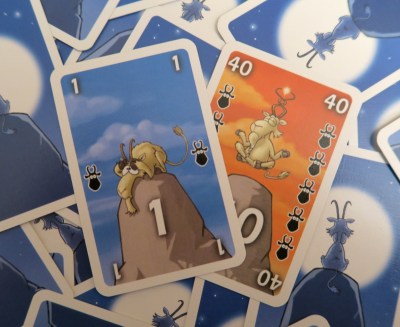
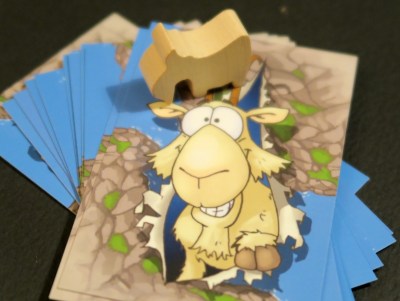
After more discussion that it really warranted, we started the evening with a quick game of Bokken Schieten (aka Ziegen Kriegen).  Given the choice of this, No Thanks! or 6 Nimmt!, Red chose “the Goat Game”, but was disappointed to find it wasn’t what she was expecting.  Bokken Schieten is a very simple trick-taking game based on Blackjack.  Players choose a card from their hand and play it face up in front of them – the person who plays the highest card takes the trick and with it all the cards played in the round.  The player who plays the lowest card draws a Goat Island card and places the goat-meeple on one end, choosing which end will start Goat Island and the value of the number to contribute to the limit.  The game continues with players playing cards and winning tricks, and the player who plays the lowest numbered card adding to Goat Island, choosing whether to add a large or small amount to the total.  At the end of the game players count the number of goat heads on their cards and the winner is the player with the highest total that does not exceed the limit given by the sum of the numbers on Goat Island.

Bokken Schieten
– Image by boardGOATS

Pine was the player who had most recently seen a goat, so he went first.  It quickly became apparent that several players were struggling:  Burgundy had all the low cards, while Magenta had only one card below twenty-four and consequently went bust quite quickly.  Blue also had few low cards, but was so paranoid about going bust she ended up winning no tricks at all.  Goat Island finished with a value of fifteen which immediately put two players out of the running and with Blue taking no tricks it was between Burgundy and Pine.  It turned out that having so many low value cards gave Burgundy the edge as he finished with eleven goat heads, four more than Pine.  It was about this point that Red pointed out that Green, Black and Purple were pariahs because they were the only ones who weren’t wearing blue.  Everyone looked a bit mystified until Red explained that she was celebrating Dublin beating Mayo in the final of the All Ireland Gaelic Football Chamionship, and Dublin played in blue.  Green and Purple quickly demonstrated they did have something blue on (socks and scarf respectively), which just left Black.  He looked shifty and commented that he was also wearing blue, but didn’t think anyone really wanted him to prove it…

Bokken Schieten
– Image by boardGOATS

The silliness continued as Pine commented that he’d received an email with the subject line, “Show us your knickers”.  Apparently this was something to do with recycling and they wanted new undies or “slightly used bras”.  Pine’s well-endowed colleague had commented that none of her bras were “slightly used” and Pine looked to the girls round the gaming table for opinions precipitating a discussion as to what constituted a “slightly used bra”.  With the nonsense continuing into the discussion of games, there were only two games people were keen to play.  Some of the group had played Roll for the Galaxy a few weeks earlier and felt it needed to be played more so everyone could get to grips with it better.  Green was particularly keen to give it another go, and Black and Purple were happy to join him, leaving place for one more.  Burgundy actively rejected it and Red was keen to play the “Feature Game”, Battle Kittens which left three people to sort themselves out.  In the end, we went with seating positions and Pine, although he was a little skeptical and hadn’t played it before, joined the Roll for the Galaxy group leaving Blue and Magenta play Battle Kittens with Red and Burgundy.

Battle Kittens
– Image by boardGOATS

Battle Kittens is a quick-playing card drafting game with a ninja-cat theme.  The idea is that each player is one of the Cat King’s Royal Cat Herders, who starts with seven cat cards, taking one passing the rest on.  As each player receives a new hand, they take another card and keep passing the ever-diminishing hands on until there are no cards left to circulate.  Once this drafting phase has been completed, players divide up their packs of kittens into three groups which will contest the three different battle arenas.  Each arena will be contested on the basis of one of the four traits:  cuteness, strength, wisdom, and agility.  The squads with the three highest point totals in a battlefield are awarded a number of fish tokens in accordance with that particular battlefield’s allotment for first, second and third place.  The key thing is that some kittens have special powers allowing players to pick up “King” cards or add points to other cat cards.  King cards are mostly good, but the King can be fickle sometimes takes out his ill-temper on an unsuspecting squad of kittens.  The game is played over three rounds and the winner is the player with the most fish at the end of the game.
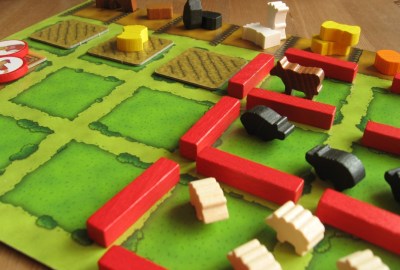
Battle Kittens
– Image by boardGOATS

It took everyone a round to really appreciate what they were trying to do, but by the second round, the gloves were off and the ninja kittens were attacking with everything they had.  It was a hard fought close series of battles as the piles of fish gradually grew and grew.  With the game quickly all done bar the counting, which was very close, but Blue’s Brave Moggies took first place, two fish ahead of Burgundy in second place.  The other table were still underway, so with time for something else, there was another decision to be made.  With time now a factor, there were fewer options and it wasn’t long before a decision was made and players were getting out Sheep & Thief.

Bokken Schieten
– Image by boardGOATS

Sheep & Thief is a strange little “point salad” of a game.  Each player has a board divided into a four by four grid, and starts with their home card and two sheep in the top left hand corner.  Each round is played in two halves: first players draft cards then they play them, taking it turns to place one card per turn.  There are lots of different elements to the game: players are trying to connect their home card to the other three corners while trying to keep their sheep safe and trying to catch other players sheep with their fox, meanwhile, they are also attempting to navigate their black sheep to the bottom right corner of their board.  With points for sheep captured, sheep retained, long rivers, connecting the home card to the other corners of the board as well as for moving their black sheep as far from home as possible, it is hard to see who has the most points and get an idea of who is in the lead.  Blue and Burgundy had both played the game before and both said it was very hard to do everything.

Sheep & Thief
– Image by boardGOATS

Blue didn’t have many sheep and most of them got stolen by Burgundy and particularly Red who really engaged with the thief aspect of the game.  Meanwhile, Magenta didn’t quite follow the rules surrounding the rivers so we had to re-write things a bit to work round it.  Although Blue had almost no sheep and her black sheep got itself sent back to the start right at the end so scored nothing, Blue did manage to pick up lots of points for a long river and and connecting her home to the other corners, giving her a quite respectable score of twenty-eight.  In contrast, Burgundy hadn’t managed to build a route to any of the corners and only had a short river.  With all the sheep he had stolen and his travelling black sheep (who nearly made it all the way to the far corner), he also scored twenty-eight.  It was quite a surprise when Magenta, who had lots of sheep, but was a little low in the other areas, also scored exactly twenty-eight points.  With a three-way tie, it was with bated breath that everyone waited while Blue added up the scores, but sadly, Red had only managed twenty-three.  This seemed a little low to Red, however, and on the recount, it turned out she had, not twenty-eight, but thirty-three, making her the winner and the best sheep thief!

Sheep & Thief
– Image by boardGOATS

With Red and Magenta heading off and the other game still going on, there was just time for Blue and Burgundy to play something short.  It was hard to decide what, as Splendor was the obvious choice, but last time Blue and Burgundy had played, Blue had finally won after two years of trying and was reluctant to start another losing streak.  The game is a simple one of chip collecting and engine-building with a very loose gemstone theme. Basically, on their turn, players can take gemstone poker chips, or use chips to buy a card. Some cards have points on them and all can be used like the poker chips to buy cards (but without having to return them). The cards also give players access to “Noble tiles” which also give points. The winner is the player with the most points after someone reaches fifteen points.  This time, although Blue started well, Burgundy soon wore her down eventually finishing with seventeen points to Blue’s eleven by take two points and a Noble to end the game.

Splendor
– Image used with permission of boardgamephotos

Meanwhile, on the next table a tight fought battle was underway in Roll for the Galaxy.  Black, Purple and Green had all played it before several times and relatively recently too, so it was only Pine who needed a detailed rules explanation.  In summary, players roll the dice in their cup in secret, behind their player screen. They then distribute the dice according to their symbols, matching them up to each of the five phases, Explore, Develop, Settle, Produce and Ship. Players then, still in secret, re-position one of their dice to use it to choose one action they would like to activate. Players can also put a die to one side for a turn to “Dictate” the symbol on another die, i.e. reassign it to a different phase. Once everyone has positioned all their dice, the player screens are removed and players simultaneously carry out the phases that have been chosen in order.  In general, if a phase is chosen by anyone, it will happen for everyone.  Thus, players can look at what others are doing and try to decide whether someone else will activate a particular phase and then they can activate another.

Roll for the Galaxy
– Image used with permission of BGG contributor punkin312

Each die is used to carry out an action once, so if a player has multiple dice assigned to the same phase, the action may be carried out several times. Any dice that were not used because the phase did not happen or because the player chose not to use them are returned to the players’ cups.  Dice that have been “spent” to carry out an action must be placed in the player’s “Citizenry” and must be transferred back into the player’s dice cup at a cost of $1, before they can be used again.  The aim of the game is to get points which come through Trading goods and Settling and Developing Worlds.  These actions have corresponding phases which players must choose during the game.  Worlds broadly come in two different types:  Production and Development.  Production Worlds come with extra dice in different colours and as the different colours have different distributions of symbols, they have different advantages and disadvantages.  The dice can be “spent” in exchange for victory points or money; all dice have the same value when used to get victory points, but different values when acquiring money.  Development Worlds do not provide dice, but instead give special powers and/or extra points at the end of the game.

Roll for the Galaxy
– Image used with permission of BGG contributor punkin312

Players draw World tiles from a bag during the Explore phase and one of the key parts of the game is controlling these piles and manipulating the worlds built in order to steer a particular strategy.  Another important part of the game is controlling which dice that go into the player’s cup.  In this sense, the game could be compared with deck building games like Dominion or bag-building games like Orléans, where players build the contents of their deck/bag in an effort to control luck.  Perhaps the most important part of the game is choosing which Worlds to build and trying to get a synergy between them.  This is quite hard to get to grips with on the first try as it’s not always easy to identify which Worlds are god ones to keep.  That said, players essentially draw one tile from the bag at a time, so the only decision to be made is which side to use.  On the other hand, one of the options is throwing tiles out, in which case, several tiles may be drawn from the bag simultaneously which is more powerful, but makes the decision much harder.  The game end is triggered when one player has built twelve worlds or the pile of victory point chips is consumed.  It is a game that takes a bit of getting used to and everyone usually struggles a bit at the start, which is what Black and Green were so keen to try it again quickly after they last played.  This time everyone seemed to build their strategies round slightly different approaches.

Roll for the Galaxy
– Image by BGG contributor haslo

Green started with a green “Genes” World which is valuable when Trading, however, he was able to he was able to pair it with a Development world that gave him a Production bonus making it very lucrative.  With this and a couple of other Production Worlds he was able to engage in a lot of Shipping.  Black began with a red, Military die which has a distribution that encourages Settling and Developing.  It wasn’t until right at the end of the game though that he was able to Develop some of his most valuable Worlds.  Pine began quite tentatively as it was his first time, but quickly got the hang of Producing and Settling and managed to Develop Worlds that gave him bonuses which eased things along.  Purple, on the other hand,  struggled to get to grips with the game, largely thanks to the worlds she picked up at the start.  In the end, she just built as much as she could and triggered the end of the game when she built her twelfth world.  The others weren’t far behind her though and their better combination of Worlds gave them more points.  It was the victory points from Shipping that really made the difference however, but it was very close at the top with just two points in it.  Had Green ended the game a round earlier (as he’d had the chance to do) he might just have kept his nose in front.  As it was, allowing Black to Develop in the final round was a crucial error and gave him the victory by just two points.

Roll for the Galaxy
– Image used with permission of BGG contributor punkin312

The evening was nearly over, but after a quick update on Richard Branson and Hurricane Irma, there was just time for a little bit more “Trash Talk” – quite literally as it happens, as the conversation moved onto the subject of “drive-through litter-bins” on motorways.  This is now apparently a thing, which led to a discussion with everyone expressing their disgust at the laziness of people who seem incapable of taking their littler home with them and recycling it.  It was in response to one such comment on this subject from Blue that Pine, much to everyone’s astonishment pronounced, “That is because you’re intelligent…”  And on that note, it was definitely time for home!

Roll for the Galaxy
– Image used with permission of BGG contributor punkin312

Learning Outcome:  Black wears blue underwear and Pine thinks Blue is “intelligent” (well, sometimes).

21st February 2017

We started the evening setting up the card games, The Golden Sails and 3 Sind Eine Zu Viel!, but as more players arrived and time was getting on, we abandoned them in favour of the “Feature Game”, Bokken Schieten (aka Ziegen Kriegen or Cliff Hanger).  This is a game that that arguably should be come the group’s signature game as it is very simple little trick taking card game all about goats.  As the rules were explained, Grey (on one of his rare, but much valued appearances), commented that it was like Blackjack (aka Pontoon or Vingt-et-Un) – i.e. play to a limit, but exceed that limit and you are bust.  The idea is that players choose a card from their hand and play it face up in front of them – the person who plays the highest card takes the trick and with it all the cards played in the round.  The player who plays the lowest card plays draws a Goat Island card.  These have two ends with different numbers on them, so the first “loser” takes a card and places the goat-meeple on one end, choosing which end will become part of Goat Island.

Bokken Schieten
– Image by boardGOATS

The game continues with players playing cards and winning tricks, and the player who plays the lowest numbered card adding to Goat Island, choosing whether to add a large or small amount to the total.  At the end of the game, the total of the four cards that make up the island define the limit and players who exceed that value are out.  The catch is that players are not summing the face value of the cards (which go from one to fifty), instead, a little like 6 Nimmt!, they are counting goats head symbols which have little relation to the face value of the cards.  We played the game twice through, since we made a bit of a mess of it the first time.  After a long discussion about whether completed tricks should be placed face down or not, Red who led first misunderstood and thought the cards were played face down, so that screwed up her first turn and lumbered her with a pile of cards she didn’t want.

Bokken Schieten
– Image by boardGOATS

This led to Grey’s comment that the game was poorly designed as once a player is bust their game is over.  In fact though, the game is so short that effective player elimination doesn’t matter that much and in any case, players who are out can still try to take as many others with them as possible.  After the first hand (taken by Grey), we gave it another try.  By this time, Blue had managed to find out who leads after the first trick so instead of passing the honour round the table, we played correctly and the winner led.  The second game went to Red, and was definitely more fun as we began to see what the aim of the game was and how to screw up other people.  We were just beginning to get the hang of it, but felt we should move on to something else now everyone had arrived.  It was genuinely very quick though, so we’ll probably play it again and it might be worth trying some of the variants too.

Bokken Schieten
– Image by boardGOATS

With such a short “Feature Game” and everyone being far too polite, we spent a lot of time deciding what to play next.  Orleans, Terraforming Mars, Viticulture and Agricola were all on the table, but nobody wanted to commit in case something better came along, or perhaps because they genuinely didn’t really mind and were happy to fill in once those who did mind had made a choice. Eventually, Magenta said she would like to play Isle of Skye and several said they’d be happy to play that if others wanted to play something else.  Ivory on the other hand said he was quite happy to play Agricola (which had been brought with him in mind, then Green walked in, making things slightly more complicated as with nine players one game would have to be a five-player which might make it long.  In the end Red got fed up with people being indecisive and started to direct people:  first she made a three player game of Agricola, then she found two to join Magenta playing Isle of Skye which left Blue, Burgundy and Red to find something else to play, which ended up being Imhotep.

Imhotep
– Image by boardGOATS

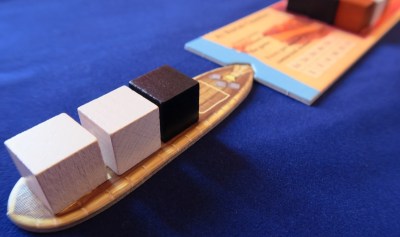
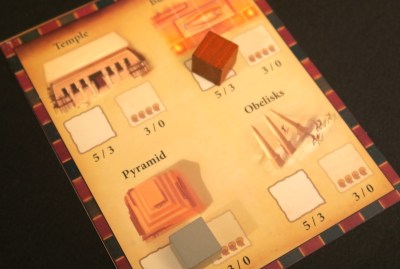
Imhotep is a very simple game that we’ve played a few times since is was nominated for the Spiel des Jahres last year.  On their turn, the active player chooses one of four actions:  procure new stones; load stones on a boat; sail a boat to a monument; or play an action card.  Players can only store a maximum of five stones and when they procure stones they can collect a maximum of three.  Stones are loaded onto ships one at a time, but which of the five possible destinations the boats end up at and the order they are unloaded in is vital, so timing and planning is everything.  What makes it particularly tricky is that the best plans in the world can be crushed by opponents with one small action: when they take a boat to the “wrong place” or “at the wrong time”.  There are four ships and five building locations, so one doesn’t get visited and the round ends when all four boats have sailed.

Imhotep
– Image by boardGOATS

The building locations are double sided so the game can be played with the less complex Side A, the slightly more confusing Side B, or a mixture of the two.  Red had struggled last time she had tried Imhotep since she ended up playing with two people who had tried it before and wanted to play with Side B without fully appreciating how much more complexity it adds.  This time, therefore, we stuck to the simpler Side A, but instead added the Stonemason’s Wager Mini Expansion to give it just a little extra interest.  This little promotional item allows players a one-off, extra option:  the chance to bet on which monument will have the most stones in it at the end of the game.  Otherwise the game is unchanged and there are six rounds in total, as usual, with points scored in different ways for the different buildings; the player with the most points at the end is declared the best builder in Egypt.

Imhotep: The Stonemason's Wager Mini Expansion
– Image by boardGOATS

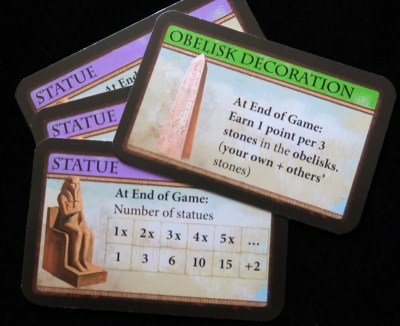
This time, Blue and Burgundy started out visiting the Market picking up statues, but with both in the same market it was always going to be a struggle.  Meanwhile, Red stole an essentially insurmountable lead in the Obelisks.  Blue took a green card that would yield a point for every three stones in the Burial Chamber at the end of the game, so she tried to encourage boats to go there.  Unfortunately, because she also nearly picked up a significant score on the Burial Chamber, but Burgundy was first forced to obstruct her plans and then Red and Burgundy started sending boats to the Temple instead.  In general, it was quite a cagey game with everyone concentrating on not letting anyone take too many points rather than trying to make a killing themselves.  Going into the final scoring, it was all quite close.  Red took the points for the Stonemason’s Wager, and Burgundy took points for statues, but Blue had a lot of bonus points from a range of sources, giving her first place, ten points ahead of Burgundy in second.

– Image by boardGOATS

Imhotep finished, but next game was not far behind, so Blue, Red and Burgundy played a couple of quick hands of Love Letter while they waited.  With its quick play, this micro-game is one of our go to fillers.  The idea is that each player has a single card in hand, and on their turn they draw a second and choose one of the two to play.  Each card has an action and a number, one to eight.  Players use the actions to try to deduce information about which cards others are holding and, in turn use that to eliminate them.  The winner is either the last player standing or the player with the highest ranking card at the end of the game.  In the first round, Blue was caught holding the Princess leaving Burgundy to take the round.  The second played out to the final card.  With just two possible cards left and the Princess still hiding, Red took a chance and played the Prince, forcing Blue to discard her hand.  This meant she had to pick up the set-aside card, which was, of course, the Princess, making it a two-way tie.

LoveLetter
– Image by boardGOATS

On the next table, Magenta, Purple and Grey had been playing a game of Isle of Skye: From Chieftain to King.  This won the Kennerspiel des Jahres last year, and has proven to be quite popular with our group.  The game is a sort of upgraded tile laying game with a lot in common with Carcassonne, but with the added feature of an auction at the start of each round and scoring at the end of each round.  The scoring is one of the interesting parts of this game as the four scoring criteria change from game to game and, and each one scores three times during the course of the game.  Choosing how to prioritise these to drive a strategy is one of the keys to playing well.  This time, with points available throughout for completed areas (lakes and mountains), this was a clear target, however, identifying a strategy and making it work are two different things.

Isle of Skye: From Chieftain to King
– Image by boardGOATS

For example, Purple was unlucky that she was unable to get any tiles with cows on roads until the final round, which meant she struggled to build a score early in the game.  Although this meant she picked up the bonus money for being at the back, she still struggled to get the tiles she wanted.  Similarly, Grey was unlucky in that he placed a tile that later became an real obstacle making it difficult for him to place tiles later and get points.  It was Magenta though who had been able to build an early lead, and kept it throughout picking up points every round.  A couple of lucky tile draws gave her good tiles that both Grey and Purple wanted making it a sellers market, and leaving Magenta with lots of cash to spend towards the end of the game.  Going into the final scoring, Magenta had a sizeable lead, but Grey had a large pile of cash which yielded a tidy eight points and very nearly gave him the game.  Magenta managed to fend him off though with the one point she took for her remaining seven coins, making the difference between first place and second.

Isle of Skye: From Chieftain to King
– Image by boardGOATS

With the games on the first two tables complete, Red, Magenta and Grey went home leaving Purple, Blue and Burgundy to play yet another in the long running campaign to beat Burgundy at Splendor.  This simple set collecting, engine builder has proved to be quite intractable.  Blue and Pine in particular have had several attempts to get the better of Burgundy, but so far he has just had the edge.  Sadly this this game was no exception, though the game was very, very tight. There was a shortage of Opals cards available, despite the presence of lots of cards needing them.  Emeralds were also quite scarce at the start, but Burgundy managed to build a substantial collection of Diamonds to keep the threat alive.  Blue thought she had finally got Burgundy trapped but in the final round Purple took a card and the replacement was a sapphire that Burgundy could take and gave him eighteen points, one more than Blue (who was last in the turn order).  Yet another very, very close game – we’ll get him in the end…

Splendor
– Image used with permission of boardgamephotos

Meanwhile, all evening, Ivory, Black and Green had been engaged in an game of Agricola.  This had started out with an extensive effort to disentangle the cards for the base game from the myriad of expansions Blue had somehow crammed into the box.  Once this was sorted though, and the game was set up, a rules explanation was necessary as Ivory hadn’t played it before.  The archetypal worker placement game, players star out with a farming couple and a shack and during the game try to build up their farmstead, livestock and family, the winner being the player with the most successful farm. Actions available include things like upgrading the farmhouse, ploughing and sowing fields, enclosing areas, taking livestock, and, of course, procreating.  One of the clever parts of the game is that each round, an additional action become available, but the order of these is not known in advance.  The stress is provided by harvests that occur at intervals during the game and require players to have enough food to feed their family, or resort to begging (which yields negative points at the end of the game).

Agricola
– Image by boardGOATS

This time, instead of playing the family game, we played the full version which includes occupation and improvement cards.  The challenge with this game is to use the cards effectively, but not to get carried away and try to force the strategy to use cards to its detriment.  Green started with occupations and used them to quickly fenced a large padock for sheep (building one gave him three extras).  He then ploughed and got three fields up and running before going back to enclosing pasture for cattle. Despite only having two family members, he struggled to have enough food until he eventually managed to nab a cartload of clay and used it to build a an oven, which proved invaluable at keeping hunger at bay.  Towards the end, he finally managed to develop his family and added a pig for a total of twenty-nine.

Agricola
– Image by boardGOATS

Black played a quiet game, also didn’t grow his family and farm developed only slowly too.  As he often does, Black instead concentrated on home-making and upgraded his house to clay and then stone in quick succession.  Somehow he didn’t struggle at harvest time as much as Green, probably because he went into building ovens which provided his food.  This was at the expense of his farm, which remained stubbornly small, right until the end.  The unused spaces cost him though, as did his lack of pigs, and he finished with a fine house, but only one child and a score of twenty-three points.

Agricola
– Image by boardGOATS

Ivory went for a different strategy, starting by going for lots of food, and support for getting food later.  In particular he made good use of his Mushroom Picker.  Building his food engine so early enabled him to grow his family early in the game giving him extra actions.  These he used to quietly collect lots of resources, which enabled him to build a large field for sheep.  He then enclosed second pasture and just swiped a field full for boar before Green got them. He only ploughed late (perhaps it was the snowy landscape that delayed him), but his early food strategy really paid off.  All his extra cards were valuable too and added ten points to his score, giving him a total of forty-one points and victory by a sizeable margin, despite Green’s inadvertent cheating!

Agricola
– Image by boardGOATS

Just as Agricola came to an end, Splendor finished too.  So, after helping to shoe-horn the miriad of little pieces back into the boxes, Ivory and Green headed off leaving Black to join the others.  The ever dwindling numbers were boosted with the arrival of Pine, who had been two-timing us with the WI – he said they had the lowest average age of any WI he’d ever come across, so maybe that was the appeal.  The remaining five gamers felt there was time for one more game, as long as we could keep it to about forty-five minutes.  We are not the quickest at playing, or choosing and time was beginning to get tight, so we opted for Bohnanza as it played quicker than other suggestions and it wouldn’t need any rules reminders (like 11 Nimmt! and Port Royal).  The game is one of our old staples, is quick to learn and keeps everyone involved throughout.  The key to the game is that players cannot rearrange the cards in their hand and must play them in the order they arrive.  Thus, on their turn, the active player first plays the first card in their hand with the option of playing the second if they desire.  Once they’ve been planted, two cards are drawn which can be traded, but must be planted by someone.  This can lead to free gifts, but also players being nasty and refusing to take even the apparently most lucrative trades.

– Image by boardGOATS

This time, Pine was making up for lost time, and the well-known good nature of the WI hadn’t rubbed off.  He accused Burgundy of just about everything he could think of, in an effort to persuade everyone else not to trade with him. Black had one of his worst games for a long time with all the wrong cards coming up at the wrong time giving him nothing to work with.  Otherwise it was a very tight game. In the dying turns, despite Black’s protestations, Purple and Pine both gave Blue exceptionally favourable trades (possibly in an effort to square things from earlier, but more likely to ensure that Burgundy didn’t win – again).  Much to Pine’s surprise, that left him in joint first place with Blue, one coin ahead of Burgundy (possibly the most important factor to him).  Feeling she had been gifted a joint win by Pine’s generosity at the end, Blue offered to concede to Pine, but on checking the rules he won anyhow on the tie-breaker, as the player with the most cards in hand at the end.

Bohnanza
– Image used with permission of BGG contributor spearjr

Learning Outcome:  Cheating doesn’t pay.