Tag Archives: Boomtown

4th April 2023

While Blue was off getting fish and chips for people, Pink chatted with Pine and Green and his family as they arrived.  Green had just got out Incan Gold and was explaining the rules, when food arrived, so it was hastily put away while food was consumed, only to be got out again as soon as the chips had disapparated.  Incan Gold is a very simple “push your luck” type game where players are exploring a mine and trying to get out with treasure before disaster strikes.  Each round a card is revealed and players simultaneously choose whether to stay or leave and share what spoils they already have.  There are three types of card:  Treasure, Artifact, and Disaster.
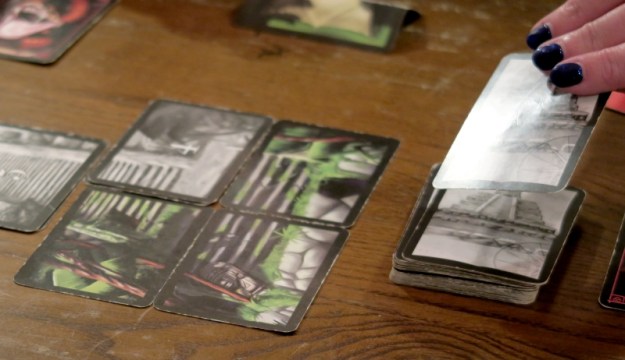
Incan Gold
– Image by boardGOATS

The contents of the Treasure cards are simply divided equally between players when they leave the mine, or as equally as possible leaving behind any left-overs.  Artifacts can only be taken if there is only one player leaving the mine, all alone.  Disaster cards are the problem—Spiders, Snakes, Zombies, Lava and Rock Falls.  Each one is present in the deck three times, and when the third is drawn, the mine collapses leaving everyone in it without any treasure.  This time, though, the group didn’t get off to a very auspicious start.  The first card out was a Rock Fall, the second was Fire and the third was another Fire!
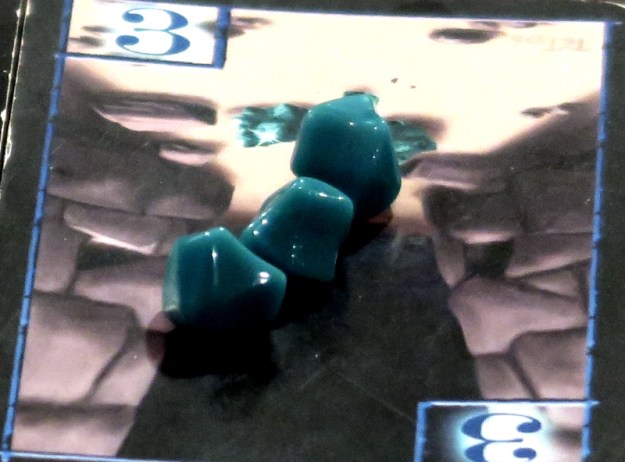
Incan Gold
– Image by boardGOATS

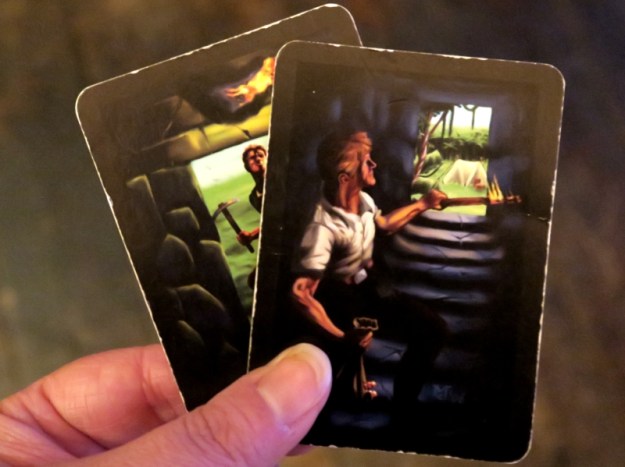
So the group decided it was such a bad start that they would shuffle and try again.  On the second attempt, the first two cards out were again Disasters, but the third delivered some Treasure. It wasn’t very much and nobody felt it was worth leaving for. That was a good choice as there was a little more treasure to come.  Still not very much, but more littered the floor of the tunnel, and it eventually proved too enticing for Emerald and Violet who managed to net about five gems each for their tents.  For the rest of the group, they pushed it a little too far and promptly lost everything as they got caught in a devastating fire.

Incan Gold
– Image by boardGOATS

The second tunnel explored also lured in too many explorers before collapsing the ceiling on everyone.  The third tunnel brought the first glint of Gold—an Artifact.  Eying each other up everyone elected to stay, which was fine, but on the next turn, Lilac decided she would chance it and run. Luckily for her she was the only one and managed to net the Golden treasure on her way out, and left everyone else to die at the hands of a rather midget-like Zombie.  Lilac managed to repeat the feat on the fourth tunnel, collecting the Gold treasure as she made a run for it, although everyone else managed to collect more treasure and eventually decided to save what they had found instead of dying a horrible death.
Incan Gold
– Image by boardGOATS

The final tunnel brought some nice treasure, and another Artifact, but with too many people leaving, they had to leave it where it lay.  Pine was the one who held his nerve and safely collected the Golden treasure this time, before a Disaster as those remaining were overrun by Spiders.  In the final reckoning it was neck & neck between Pine and Lilac on thirty-six points, but Lilac just edged it by dint of having two gold artifacts to Pine’s one.  It was close for third, though Lime was the best of the rest with twenty-four, just ahead of Emerald and Violet.  The least effective was Greedy Green, who’d stayed just too long just too often, eager for more treasure only to be bashed and burned and brutally murdered time after time.
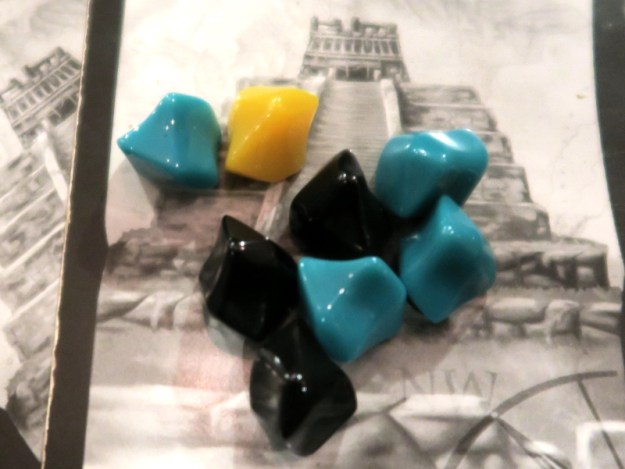
Incan Gold
– Image by boardGOATS

Meanwhile, everyone else played the “Feature Game“, the filler Om Nom Nom.  This is a fun and light little game of think and double-think where players are trying to eat without getting eaten.  The game is set up by seeding the board with cute dice, rolled to give cheese, carrots and flies for the bottom of the food chain, and mice, rabbits and frogs for the middle of the food chain.  Players then receive a deck of six cards representing the animals for the middle of the food chain and the top of the food chain, cats, wolves and hedgehogs.  With game play reminiscent of 6 Nimmt!, players simultaneously choose a card to play which are then evaluated.
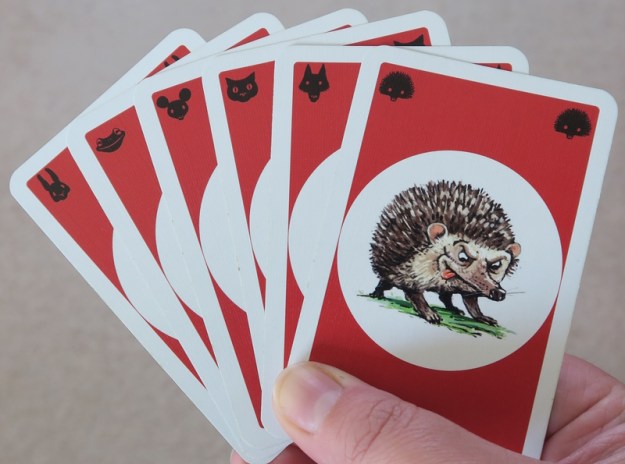
Om Nom Nom
– Image by boardGOATS

Players who played cards at the top of the food chain eat anything below, so long as there is enough for everyone who played the same card.  Thus, if there are four mice (including any cards played) and two cats, the owner of the cats take two cards each and get to keep their cat cards too with them all going on their scoring pile.  If however, there was only one mouse, both cats go hungry and neither player scores anything.  Cards played for the middle of the food chain eat the dice at the bottom of the food chain as long as there are enough dice for everyone who played the same card, but also as long as they don’t get eaten by anyone playing a card at the top of the food chain.

Om Nom Nom
– Image by boardGOATS

Thus, playing a card in the middle of a food chain is all about timing:  there is a higher risk, but also a higher reward as the dice showing red faces are worth two points instead of the usual one for a card or a die showing a black middle of the food chain critter.  Although we’ve played Om Nom Nom several times before, it was new to both Teal and Lime.  Teal started off well though taking a massive fifteen points in his first round.  Unfortunately for him, that turned out to be beginner’s luck and he didn’t do so well in the next round.  Purple’s game, on the other hand, went the other way, starting with nothing in the first round and taking sixteen points in the second.

Om Nom Nom
– Image by boardGOATS

With others being more consistent, in particular Blue who scored a seven and an eight in each of her first two rounds, it was all down performances in the final round.  In the event, Black and Pink both did well in the final round, and Teal improved on his score in the second round too.  It was Purple that won the final, albeit low-scoring round, taking ten points, giving her a winning total of twenty-six, three more than Teal in second with Black and Blue tying for third place some six points behind him.  It had been a quick fun game, one that is always good value and definitely deserves another outing soon.
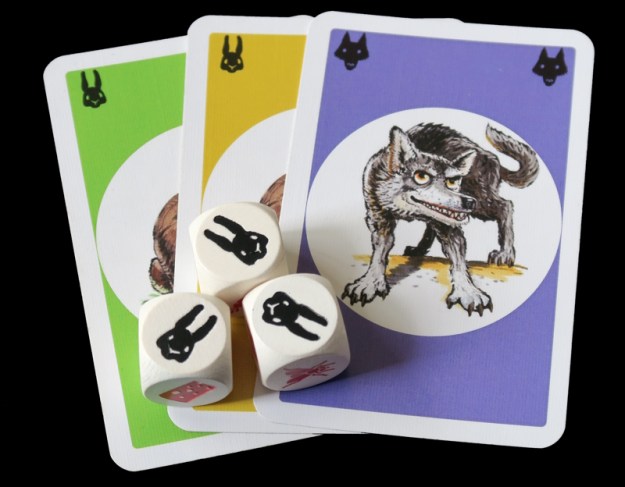
Om Nom Nom
– Image by boardGOATS

Both games, Incan Gold and Om Nom Nom, finished at much the same time, so everyone decided what to play next.  Teal had brought Nidvelilir at Green’s request, but this wasn’t the night for that.  Eventually, Purple traded places with Pine and Lime leaving five players, in one group which picked out a lot of possible five-player games.  Since Violet was here only for the a brief visit they let her choose.  Her selection was Zooloretto or King of Tokyo, however Purple made a face at both choices and suggested Carcassonne instead. Violet was less keen as she felt she had played that a lot recently, so Green made an executive decision to play Boomtown—a fun little bidding game that hasn’t had an outing for a long time and doesn’t take too long.
Boomtown
– Image by boardGOATS

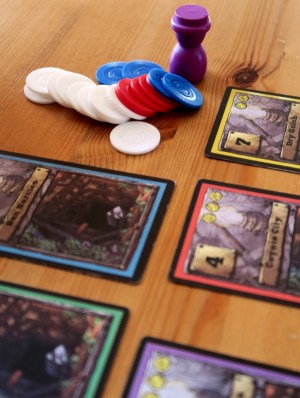
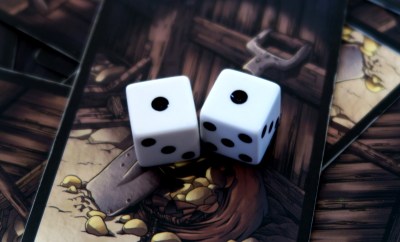
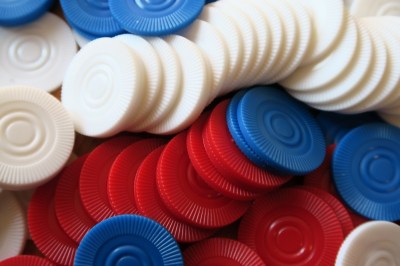
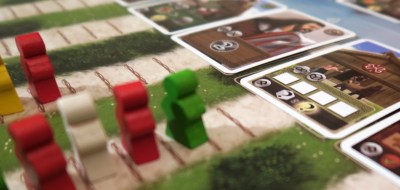
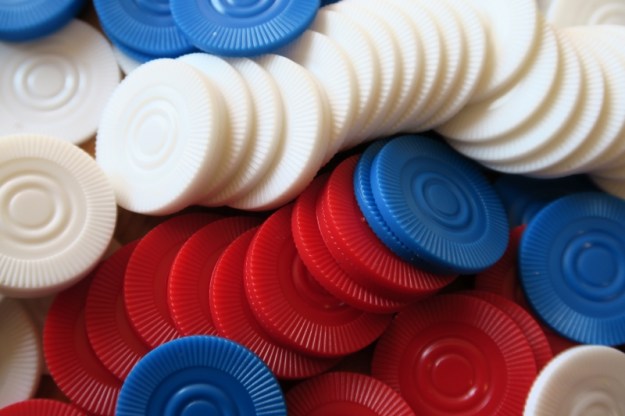
Unfortunately, at this point Emerald was really beginning to feel the heat of the pub and felt he couldn’t participate.  He went off for a wander to get some fresh air, ironically just before the back door was opened to cool everyone down a little.  As he had decided to sit this one out, the rest of the group revised the rules which were simple enough on the face of things.  A deck of sixty cards is shuffled and placed face-down in the middle of the table, along with two dice, a pile of Mayor pawns (one in each of five different colors) and Town tokens (two each of the same colours).  One card per person is turned face up and each player begins the game with $10 starting funds to bid for the card they want.
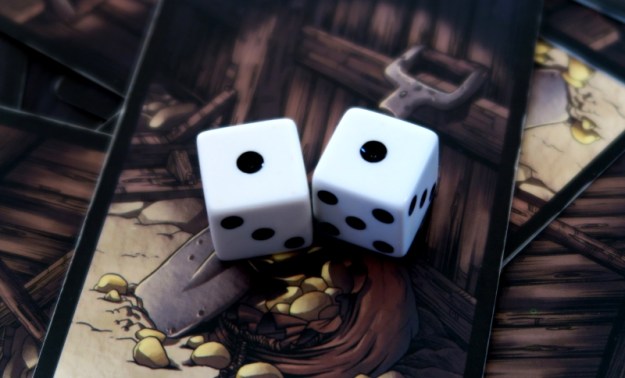
Boomtown
– Image by boardGOATS

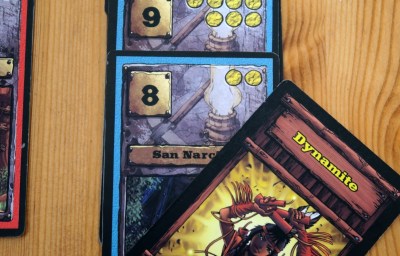
Each player has to increase the bid or pass, until there is one winner.  And this is the clever bit of the game—the winner, pays the player to their right, who passes on half of the money to the player on their right and so on until either there is nothing left to give or the winner is reached (they don’t get any of their own money back).  Everyone then gets a card in clockwise order.  There are Mine, Dynamite, Saloon, Hold-up, Governor and Special cards, each of which has an effect.  Mines and Saloons give players gold and the player with the most Mines in any Town/colour takes the matching Mayor token which forces others to give them money.

Boomtown
– Image by boardGOATS

Dynamite cards allow players to destroy other players’ mines, while Hold-up cards allow players to steal from other and the Governor allows players to upgrade a Mayor so their mines are worth double. Once the cards have been allocated, the dice are rolled and players receive income for their mines.  The game ends when the deck is depleted and all the cards have been sold.  The player with the largest total from their their points, money, the production value of all the mines they control, and five bonus points for each Mayor, is the winner.
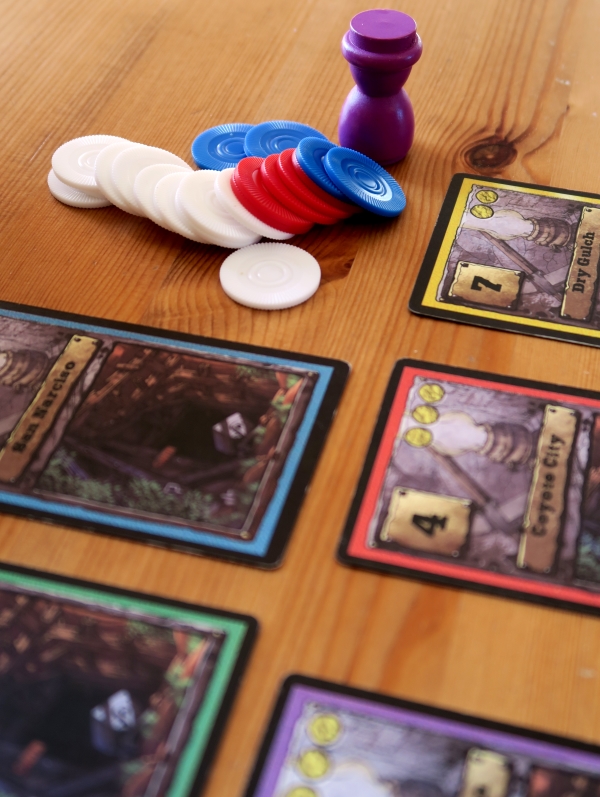
Boomtown
– Image by boardGOATS

Maybe it was the heat, but aside from Green, no-one was quite sure how Boomtown would play out, and it took a few rounds for everyone to get the hang of things.  The group didn’t get off to a great start, even when they adjusted the draw deck to make sure there was enough mines for everyone by replacing the action cards that came out.  The second round brought out two sets of Dynamite though, and both Green and Purple ended up destroying each others mine.  The bidding never got very high in the first half of the game, mostly because nobody knew what they were doing, and did not necessarily want to choose first.
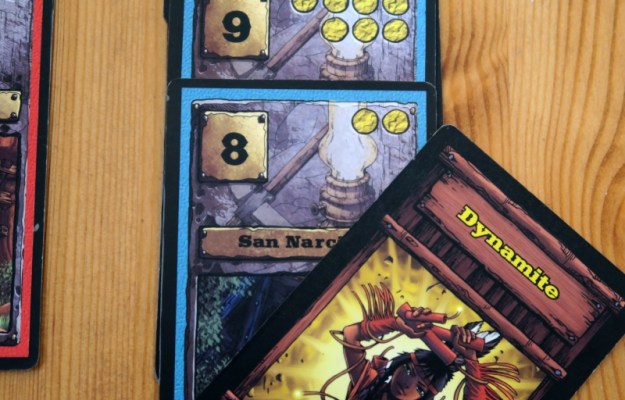
Boomtown
– Image by boardGOATS

However, by about half way and when the Mayor pieces had all been claimed and the Saloons were built everything started to hot up.  Although Lilac had a lot of red Mines, which netted her a little money from players forced to take the last few remaining, every time they found gold, she had to pass most of her claim to Purple who had a red saloon along with Saloon girls!  Violet managed to claim a couple of Mayors along the way, and although she lost one of them, she managed to avoid the attraction of the Saloon, so kept everything she collected. With some judicial rolling on the Card Shark Dice, she managed to rob some of the others blind.

Boomtown
– Image by boardGOATS

By the time the last cards had been claimed and the final Mines had given up their gold, it was Purple who had become the master Miner, by something of a landslide.  Violet was a respectable second with Lilac, having passed on so much of her wealth to Purple, just managing to stay whisker ahead of Green for third.  Meanwhile, on the next table, with so many players Survive: Escape from Atlantis had seemed a good choice as it plays six with the expansion.  This was released to mark the thirtieth anniversary of two very similar, much older games, Survive! and Escape from Atlantis, and is an agglomeration of them both.
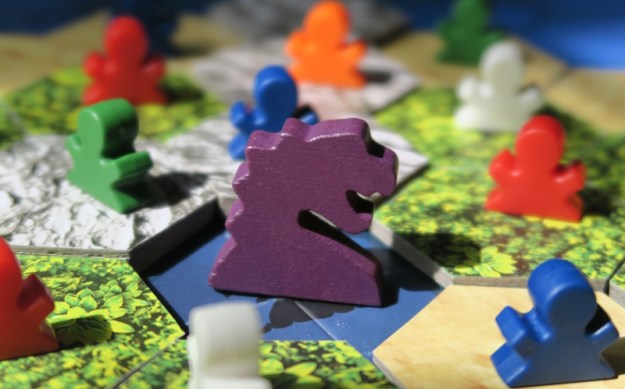
Survive: Escape from Atlantis!
– Image by boardGOATS

The idea is that players rescue their meeples from the central Island of Atlantis before it sinks beneath the waves.  The original Escape from Atlantis had a fabulous sculpted plastic central Island, with lots of Sea Monster miniatures, however, although the thirtieth anniversary edition is arguably a nicer production, the Island is made up of thick card hex-tiles, and the Sea Monsters are made of wood.  This version has safe land shown on the corners of the board each initially guarded by a Sea Monster, with randomly placed hexes forming the Island and a fifth Sea Monster in a central lagoon.
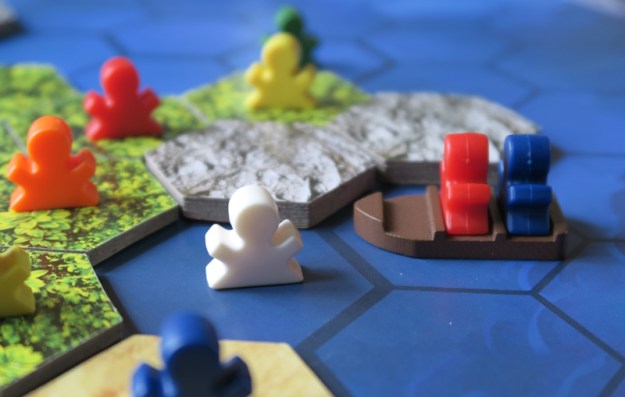
Survive: Escape from Atlantis!
– Image by boardGOATS

The new edition varies from its predecessors only a very little in game play.  On their turn, the active player has three movement points, and then they remove one tile from the Island of Atlantis before rolling the Attack Die which dictates which of the Sharks, Whales or Sea Monsters the player moves.  Sharks and Whales are introduced as the Island sinks: when players remove a hex from the Island, the underside has either an immediate effect (bordered with green) or a delayed effect with the tile stored, usually to be played before a later turn, though a small number can be used reactively.
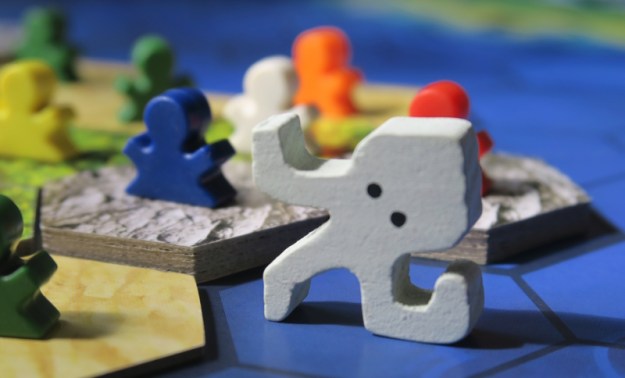
Survive: Escape from Atlantis!
– Image by boardGOATS

There was a lot of discussion about whether to include the Giant Squid and Dolphin mini expansions and what they did, but in the end, the group decided against it this time.  In addition to placing their meeples on Atlantis, during the set up, players also place boats.  These can hold a maximum of three meeples and are moved by whoever has the majority in the boat.  It costs one movement point to climb into or out of a boat, either to or from a neighbouring land space or the water next to the boat.  Meeples in the water can only swim one space per turn because it is tiring.  Once in a boat, however, movement is easier and they can move as far as they want and are able.

Survive: Escape from Atlantis!
– Image by boardGOATS

Thus, the priority is to get meeples into boats, but the decision players have is whether to try to put all their meeples in one boat or whether to hedge their bets.  Pine and Pink tried the former.  Pine managed to get two of his meeples in one boat and then, before he could get any passengers, set sail.  Being early in the game there weren’t many Whales or Sharks about, and with only a short distance to safety, Pine’s pair made it there safely.  From there, the game got quite savage with players preferentially taking land tiles with meeples on them, turning them into Swimmers with a long way to safety—one was unlucky enough to end up in the drink when a Shark dropped into the space next to him and swallowed him whole.

Survive: Escape from Atlantis!
– Image by boardGOATS

Pink tried to emulate Pine’s success, but was a mite more greedy putting three of his meeples with a total value of eight in one boat.  Although he had a plan to get the boat to shore, he reckoned without the appearance of a Whale which was promptly moved to the same space and proceeded to turn his boat into matchwood and transform his sailors into Swimmers.  Whales aren’t interested in Swimmers though, so once his meeples were in the water, it left them alone.  Pink then had ample opportunity to separate them out a little, and indeed was advised to by everyone else, but he choose not to.  So, although everyone felt slightly sorry for him, it wasn’t long before the little clutch of Swimmers proved far too tempting a target and a Shark rocked up and ate them all.
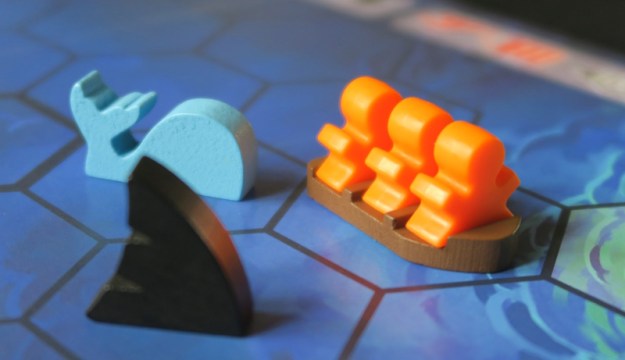
Survive: Escape from Atlantis!
– Image by boardGOATS

From there, there was a steady trickle of boats making landfall, with players trying to work together without doing the lion’s share of the work themselves.  For every boat that made it to safety, however, there was at least one Swimmer that was eaten by a Shark or boat that was attacked by a Whale or a Sea Monster making it a bit of a war of attrition.  But with six players, the game moves quite quickly and players don’t get many turns so collaboration is essential if players are to get anyone to dry land.  Blue and Black cooperated effectively to get a couple of Sailors each home, as did Teal and Pine.  Although for a long time, Lime was the only one not to have any of his meeples eaten, he was also the last to get one safe.

Survive: Escape from Atlantis!
– Image by boardGOATS

With six players, the end of the game came round quite quickly.  The game ends immediately when the Volcano is revealed under one of the last eight Mountain tiles and with so many players once the Woodland tiles have been exhausted the game can end any time, so one extra turn can make all the difference.  And so it proved for many.  It was Lime who turned over the Volcano tile, much to his disgust as he had a boat with two meeples ready to disembark on his next turn.  Pink also had two in a boat near shore (total value nine) and Blue was equally unimpressed as it was her turn next and she needed just one move for her most valuable meeple to crawl up the beach.

Survive: Escape from Atlantis!
– Image by boardGOATS

With Atlantis gone beneath a combination of waves and lava and every meeple that had not made dry land perished in the boiling sea, it was time to score.  Each meeple has a value printed on the bottom, and although players knew what these were when they were placed, they were not allowed to look at them again.  Teal had attempted to codify which meeple was which in their location on the spaces they were placed on, however, Blue quickly called him on this and like everyone else, over the course of the game he had mostly lost track of which was where. Pink and Lime had only got one meeple ashore a piece, but although they were relatively high scoring ones, everyone else had a similar value one home and at least one additional one too.

Survive: Escape from Atlantis!
– Image by boardGOATS

Blue, Black and Teal managed to get three meeples ashore each, with Black totalling six points and Blue totalling seven.  The winner was Teal, however, with a total of eight, though even one more turn or a slightly different turn of events earlier in the game would have made a huge difference to the final placings.  It had been a lot of chaotic fun, but unquestionably, with so many players, there wasn’t much chance to plan and the game  changed hugely between a player’s turns.  With fewer players it is definitely a more strategic game, but with more, the onus is on players to work together more—indeed the players that did this this time, were the most successful.
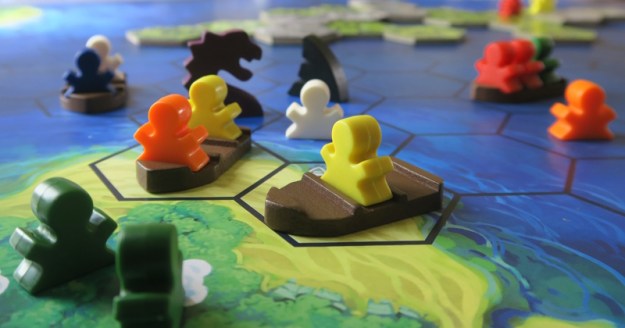
Survive: Escape from Atlantis!
– Image by boardGOATS

Learning outcome:  Just when you thought it was safe to fall into the water…

20th March 2018

Unfortunately, ordering dinner was delayed due to a birthday party on the other side of the room, so Blue, Pine and Burgundy decided to get in a quick game of NMBR 9 while they waited.  Despite the fact that it isn’t a top game for anyone and takes up a lot of room in the bag, it is is rapidly becoming a very popular filler.  This is because it is nice and short, has a enough bite to keep everyone interested for the duration and, as it has almost no set-up time, the activation energy barrier is particularly low (find and open the box, take out the deck of cards and turn over the top one…). The game is a bingo-type tile-laying game where each person plays a total of twenty tiles, numbered zero to nine, with each one appearing twice. The deck of cards dictates the order they appear in and tiles must be placed such that at least one edge touches a previous tile. Tiles can be placed on top of other tiles as long as there are no overhanging parts, and the tile sits squarely on more than one other tile. At the end of the game the number of the tiles are multiplied by the level they sit on minus one. So, a five on the third tier scores ten points (5 x (3-1)).

NMBR 9
– Image used with permission of BGG contributor punkin312

This time, everyone started off with the same placements albeit in a different orientation.  It wasn’t long before first Burgundy and then the other two diverged though, with slightly different strategies.  There is a bit of knack to the game with two basic competing requirements: getting strong continuous layers without gaps, and placing numbers, ideally high numbers, on the highest tiers possible so they score more.  Blue and Burgundy concentrated on getting a really solid zero level with Burgundy even sacrificing his first “nine” to the cause.  Pine on the other hand, succeeded in placing both his “eights” on his third tier scoring a thirty-two points for those tiles alone.  It was a very close game, but the difference was when, towards the end of the game, Burgundy managed to squeeze a “three” onto the fourth layer.  This gave him nine points and victory with a total of sixty-three points, just five points ahead of Blue and Pine, who tied for second place.

NMBR 9
– Image used with permission of BGG contributor punkin312

By the time NMBR 9 was finishing, everyone else was arriving and the group split into two, with one group playing the “Feature Game”, Boomtown and the other playing Yokohama, a game which Ivory had been hankering after playing since he first saw it long before Christmas.  With food due for Blue and Burgundy at anytime, Ivory had to wait another twenty minutes or so, and to try to keep his mind off the delay, the trio decided to squeeze in another filler, Coloretto.  This is a light set-collecting card game that everyone in the group is familiar with: on their turn, players can either pick up a chameleon card from the face down deck and add it to a truck, or take a truck (passing for the rest of the round).  The innovative part of the game is the scoring which uses the triangular number sequence (one point for the first card, three points for two cards, six points for three cards etc.), with positive points for three sets and negative for the rest.

Coloretto
– Image by BGG contributor SergioMR

We’d  just started when food arrived and it quickly became apparent that Blue was concentrating more on her pizza than the game as she just stared collecting almost anything that came her way.  Everyone started collecting light blue/white cards and this was a mistake because it meant that everyone was going to struggle to get lots of them.  In the end, three things made the difference: the jokers that Blue picked up;  the bonus point cards that Blue and Ivory collected, and the negative points that Burgundy ended up with.  As a result, despite her lack of concentration, Blue finished with forty-four points and a sizeable lead, with Ivory in second place.  Meanwhile, the next table had started the “Feature Game”, Boomtown, which is a fairly light card game where players are mining moguls and each round is divided into three parts, auction, selection, and production.

Boomtown
– Image by boardGOATS

At the start of the round one card is drawn per person and placed face for bidding. Players then, in clockwise order, take turns bidding for who gets to choose a card first. Bidding continues round the table; when a player passes then they are out of the bidding and the auction continues until there is one person left.  While the auctions are fun, the real twist in the game is what happens as a result of the auction.  Winning the bidding has two consequences:  first pick from the cards available, but also payment of the bid to the other players.  So, the winner of the auction pays his winning bid to the player on his right who then gives half of that sum to the player on his right who, in turn, gives half of that amount to the player on his right, and so on in anticlockwise order, stopping just before the player who won the bidding.  The winning bidder chooses first and selection then passes to the player on his left and continues in clockwise order (i.e. opposite to the order of the money route).

Boomtown
– Image by boardGOATS

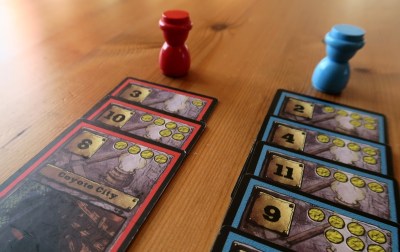
There are two types of cards in Boomtown, mine cards and special cards.  The special cards typically provide a one off action that must be used straight away while others can be saved for later in the game.  Some help the owner, but most target one, several or all of the other players destroying or stealing mines, changing dice rolls or the order of a result of an auction.  Mine cards provide victory points and can also be a source of income throughout the game (especially valuable as  money enables players to take control during the auctions).  Each mine card has a number of gold coin symbols on it as well as a number between two and twelve. The gold coin symbols correspond to the number of victory points the card is worth at the end of the game and the number of chips a player will receive should the card’s number be rolled during the production phase (like in The Settlers of Catan).

Boomtown
– Image by boardGOATS

Each mine card also has a colour and these can be critical as the player with the most cards takes the mayor who is worth five points at the end of the game.  Perhaps more importantly, the player who owns the mayor receives payment from the other players when they take (build) a mine of that colour.  Mayors can also be a deciding factor in how one bids for first choice in a round and some of the special cards can provide an edge in the contest for mayors, as well.  This means that fights over mayors can get very, very nasty indeed.  The game ends when the deck is exhausted and everyone then adds their number of chips to the value of their mines and any mayor bonuses, the player with the highest total wins.

Boomtown
– Image by boardGOATS

It was a slow start with no-one really bidding very high. Most people were not sure quite how the game would work so did not want to commit too much at this early stage. In the very first round, the “aggressive” nature of the game quickly reared its ugly head when four of the five cards in the auction were mines and one was Dynamite.  Green won the bid and since Red was sitting on his right, she was left with the final card, the Dynamite.  There was really only ever one choice as to who’s mine would go…the person who had played it many times before, Green.  A couple more rounds on and the players were still only tentatively feeling their way. Red had chosen to diverge from the other player’s tactics slightly by going for a Saloon rather than mines and before long she was able to add the Saloon Girls to double its effect.

Boomtown
– Image by boardGOATS

When Pine won a bid and started the next round of bidding, he did not know what to choose, not really wanting to win the bid at all. So he bet one, When nearly everyone had passed and he looked like he would win the bid on one, he commented that it seemed unfair that he would be forced to pay some money, thinking that if everyone passed he would be the winner anyway.  A quick check of the rules confirmed that indeed the player starting didn’t have to bid and could pass, and in the unlikely event that everyone passed, they would win.  So everyone agreed to start the round again. Pine passed, Red Passed, Green, with an eye to the main chance then bid one—Oh the shouts of disgust that followed—he had passed last time so why bid this time?  Well, it wasn’t worth two, but it might be worth one, and with that he won the auction.

Boomtown
– Image by boardGOATS

About a third of the way through the game, there were a couple of Mayors out and Red’s yellow Saloon was bringing in some income from Pine’s growing number of yellow mines.  It was about this time when Pine decided he’d had enough and took the next dynamite card and, much to her disgust, blew up Red’s Saloon, taking the girls with it!  In the meantime, Purple was trying to corner the green and red mines, while Black was settling himself strongly into purple mines.  At this point Red decided that she was so far behind in the mining stakes there was little point in switching to that route so decided to stick to the “money by other means” strategy. She managed to get a second saloon and this time chose Black’s purple mines to be the target for her custom.  This seemed to regularly provide income, but without the girls it was only two gold at a time, barely enough to cover costs.

Boomtown
– Image by boardGOATS

As the game drew to a close, it was looking like a two horse race between Green’s extensive pile of cash and Black’s almost as large pile and growing number of mines.  Pine decided he wanted a piece of the action and chose to hold up Black opting for a 50/50 and said he’d try to roll a seven or higher.  He failed, as did Red when she tried the same thing, with Black again the target.  As everyone tallied up the scores, it became apparent that the failed hold-ups had had a significant impact on the outcome. Red’s strategy had totally failed and Purple had been unlucky with the mine production rolls, but it was quite close between the other three.  In the end, Black finished just five points ahead of Pine who pipped Green to second by two points—if Black had lost those hold-ups the game could have gone to Pine…

Boomtown
– Image by boardGOATS

On the next table, Yokohama had barely started, so the group found something a little longer to play in Jórvík.  This is a viking re-themed version of The Speicherstadt, which was a very popular game with the the group a few years ago.  Last time we played the expanded version (corresponding to the original game with the Kaispeicher Expansion), but this time we did not want it to go on too long, so played the base game rather than the fully expanded one.  Pine remembered it as the game where Vikings queue up, and called it “The Queuing Game”, and that sums it up pretty well.  Players take it in turns to place their meeples in queues next to the laid out cards.  Once everyone has placed their cards, each card is “sold” and the first player who placed their meeple next to the card has first dibs.

Jórvík
– Image by boardGOATS

The snag is that the cost depends on the number of players who joined after them.  So, if the queue consists of three people, the first player can pay two for it, but if they turn it down, the next player can pay one.  This makes the game evil.  It is an auction game in which players can increase the value and, once the other person drops out, can drop out as well, no strings attached. A kind of, “Well, I didn’t want it, but I just didn’t want you to have it…”  This lack of control didn’t go down well with Ivory, who saw the game and commented, “If we were playing “Snog, Marry, Avoid”, that would definitely be “Avoid”!”  Curious, Blue asked him whether Yokohama would be “Snog” or “Marry”, to which Ivory emphatically responded, “Snog” and added, “”Marry” would require investment…”

Jórvík
– Image by boardGOATS

The cards come in varying types, starting with contracts and goods – contract cards give victory points, but only if they have been fulfilled by collecting the correct goods.  On the other hand, Market Cards allow players to sell goods and get a better return than usual, enabling the owner to build a supply of cash giving them power in the “auctions”.  One of the most important cards are the viking fighter cards.  When the “Attack of the Picts” come up at the end of each season, the player with the most viking fighters gets a bonus, but woe betide the player that has the fewest viking fighter cards as they will lose points in a “Devil take the hindmost” mechanism.  The game ends when all the cards have been auctioned and the player with the most points is the winner.  It only took one round for everyone to take up their differing strategies.  Red, having not played the game before, had gone for a couple of market cards, enabling her to sell goods for one coin each rather than the usual two goods for one coin. Green had started a collection of Viking fighters to ward off the Pict raiders, Black collected the only artisan card, Purple went for the feast and Pine wasn’t really sure where he was going so had taken another market card.

Jórvík
– Image by boardGOATS

By the end of the second round Red had acquired three of the market cards, Green another fighter, Black and purple both had artisans, and Pine had taken the valuable warehouse.  Black was dubious of Red’s strategy for so many market cards, as experience had shown that these cards were generally not that valuable as you did not often have the required resource to sell. Green was reserving judgement thinking that with three she could almost guarantee being able to sell something.  Then  the goods started to arrive.  Everyone seemed frustrated at what they could actually get and money soon ran very low, except for Red however, who always seemed to have more than anyone else; those markets were beginning to prove useful.  Pine’s warehouse seemed pretty empty however and although Green’s defense of the Picts was mighty, there wasn’t a lot he was defending in the early stages.

Jórvík
– Image by boardGOATS

As the game wore on, Green inched up the score track as Pine, Purple and Red slipped back, due to Pict raids.  By the last round, almost everyone was spent up with no more than one or two coins each, except Red who seemed to have a stash of seven or eight. This meant that she was able to hoover up both the end game scoring bonus cards (the ships and the coins) and this left an odd position that didn’t seem to be covered in the rules.  The very last card in the Winter deck was the attack of the Picts card, which meant that all the other cards had been out and selected, and only two cards remained, both attack of the Picts cards.  Normally, the Attack of the Picts card would have been enacted as soon as it was revealed and then discarded, which is why the cards fit the slots perfectly.  Pine felt the game should end there without activating them, but since we did need to have the final attack card everyone else felt that the game probably meant both attacks should happen, one after the other.  Considering that there is a one in fifteen chance of this happening, it really should have been mentioned in the rules.

Jórvík
– Image by boardGOATS

It quickly became clear why Pine wasn’t keen on activating the Pict cards:  he had seven points to lose and Green had seven to gain!  It didn’t matter though, because in the final scoring Red trounced everyone, proving that some cards are more powerful than we could ever imagine. Black and Green were tied in second place, much to their chagrin, as both had thought it would be one of them in first place; checking the tie breaker, it was Green took a somewhat Pyrrhic victory.  While all this was going on, after some four or five months, Ivory was finally getting personal with Yokohama, and it seamed he was finding that it had been worth the wait.  It had taken quite a while to set up and was quite a “table-hog”, but it looked much more complex than it appeared to the players on the neighbouring table.

Yokohama
– Image used with permission of BGG contributor punkin312

Yokohama has a lot in common with Istanbul—although it is unquestionably a deeper game, the principle is very similar.  In Istanbul, players take it in turn to move their Merchant around the bazaar to locations where he can carry out specific actions.  Merchants can only carry out actions at locations where there is one of their Assistants or where they can drop off one of their Assistants.  Yokohama has a similar travelling Merchant mechanism, but before he moves, the active player places Assistants, three in different locations or two together at the same location.  The difference is that in Istanbul the distance the Merchants can travel is limited, whereas in Yokohama, they can travel as far as they like, but can only travel through locations that are occupied by one or more of their Assistants.

Yokohama
– Image by BGG contributor cmarie

One of the most significant differences between the two games is that the action a player can take depends on the “Power” they have at their Merchant’s location.  The Power is the sum of the number of number of Assistants, Stores and Trading Houses present, plus one for the Merchant.  The nature of the locations are more complex too, some just provide resources or money, but others provide opportunities to get Contract cards, victory points or even technology cards that can be used during the game.   Another key difference is that each player is provided with a small number of Assistants at the start of the game.  Although any Assistants are returned when their Power is used to carry-out out an action, players inevitably need more, which they must obtain by visiting the Employment agency (where players can also buy Stores and Trading Houses).

Yokohama
– Image used with permission of BGG contributor punkin312

Despite the similarities, the games have a very different feel about them, though they are both very smooth to play with very little down-time.  Yokohama has a number of end conditions, including drawing the last contract card, filling a given number of spaces in the Church, or Customs locations, or if one or more players has built all their Trading houses or Stores.  In this way, it is up to the players how long the game goes on, which was definitely something that affected the way Blue, Burgundy and Ivory played.  The game began with Blue picking off the highest scoring Contracts while Ivory decided to build some technology, in particular the ability to place a fourth Assistant, something that proved it’s worth as he used it extensively throughout the game.  Burgundy followed Blue with the Contracts, but was generally beaten to the most valuable cards.

Yokohama
– Image used with permission of BGG contributor HedgeWizzard

As the game developed, all three players began to get into their stride a bit more, and when pine looked on in horror at all the pieces and commented that it definitely looked like an “Ivory sort of game”, all three agreed that it was no where near as complex as it looked.  And that was just as well, because Yokohama has a lot of fiddly pieces and does look especially complicated.  Up to this point though, everyone had been hitting the Contract cards quite hard, when Burgundy suddenly pointed out that there weren’t many left and if we continued that way, the game would be over quite soon. Clearly nobody wanted that, because everyone switched their attention to other sources of points.  It quickly became clear that all three players had spotted the value the Customs house could provide, and since everyone was beginning to build up a small stack of valuable “Import” crates, it became a race to get there first.

Yokohama
– Image by BGG contributor Roger_Jay

Inevitably, Ivory got to the Customs house first, followed by Blue and Burgundy.  Blue had more Import crates though and was able visit several times and hold the majority.  Ivory spotted that there were points to be had by visiting the Church, which the others had completely neglected and Burgundy took one of the achievement bonuses for having built in three commercial and two production areas.  This was something that everyone had tried to go for, but had been sidetracked from.  Ivory snaffled the bonus for being the first to achieve six bundles of silk with an extremely clever move, while Blue who had always had more money than anyone else picked up the bonus for being the first to have ten Yen.  It was clear that the game wasn’t going to go on much longer, but everyone was concentrating on trying to eke out those last few points in what felt like a close game.

Yokohama
– Image used with permission of BGG contributor HedgeWizzard

It was about this point that Red asked to borrow Blues car keys, only to return a few minutes later, much to everyone’s amusement, asking how to use them as she had been pushing the car boot open button without success.  Obviously that wasn’t the right button, so with new instructions she tried again, only to return after another couple of minutes still defeated.  In the end, Green went to her rescue, though even he took several tries to get it to work.  On their return Yokohama was coming to a close and the players were working out the final scores.  It was close, but despite Blue’s obstructive tactics at the end, Ivory still finished five points clear with one-hundred and twenty-two.  It was clear that everyone had enjoyed the game:  Burgundy’s comment was that he’d struggled from start to finish, but loved every minute.  Ivory had clearly enjoyed it too, and was making appreciative comments about variable setups as he helped pack away, though it remains to be seen whether he will invest in an engagement ring…

Yokohama
– Image used with permission of
BGG contributor punkin312

Learning Outcome: Some games are worth the wait.

Next Meeting – 3rd June 2014

Our next meeting will be on Tuesday 3rd June, at the Horse and Jockey pub in Stanford-in-the-Vale.  As usual, we will be playing shorter games from 7.30pm as people arrive, until 8pm when we will start something a little longer.

This week the “Feature Game” will be Boomtown.  This game is one we’ve played before and is set in the Wild West, where players are prospectors bidding for mining concessions.  We’ve chosen this because we were going to play it last week, but ran out of time.  It is a fairly quick game, which should give us plenty of time decide what longer games we would like to play once everyone has arrived.

Boomtown

And talking of the Wild West…

The swing doors of the Wild West saloon crashed open and in came Jeff, black with fury.  “All right!” he raged, “All right! Who did it? What darned varmint painted my horse bright blue?”

The huge figure of Black Jake, a notorious gunfighter and town baddie rose from a chair by the door. “It was me, shrimp,” he drawled, bunching his gigantic fists, “What about it?”

“Oh, well, er,” stammered Jeff wretchedly, “All I wanted to say was… er… when are you going to give it another coat please?”

he swing doors of the Wild West saloon crashed open and in came Little Pete, black with fury. “All right!” he raged, “all right! Who did it? What goldarned varmint painted my horse blue?” The huge figure of Black Jake, notorious gunfighter and town baddie rose from a chair by the door. “It was me, shrimp,” he drawled, bunching his gigantic fists, “what about it?” “Oh, well, er,” stammered little Pete wretchedly, “all I wanted to say was. . .when are you going to give it another coat?” – See more at: http://www.funnymail.com/jokes/swing-doors-wild-west-saloon#sthash.TruYgllK.dpuf

30th October 2012

This week we had two new people, who arrived early, so we started the evening off with a quick four-player game of No Thanks!  This is a very, very simple push-your-luck game with just a hint of strategy and probably one of the best games going for its size.  The idea is that you turn over the first card in the stack and either take it or pay a chip.  If you take it, you turn over the next card, if you pay, the decision passes to the next player; the person with the lowest number of points when the cards run out wins.  The strategy comes because for runs of two or more cards, only the lowest counts, but unfortunately, someone removed nine cards from the deck at random…  Just as we were finishing the first round, another player arrived, so as it is such a quick game we gave it another go.

No Thanks!

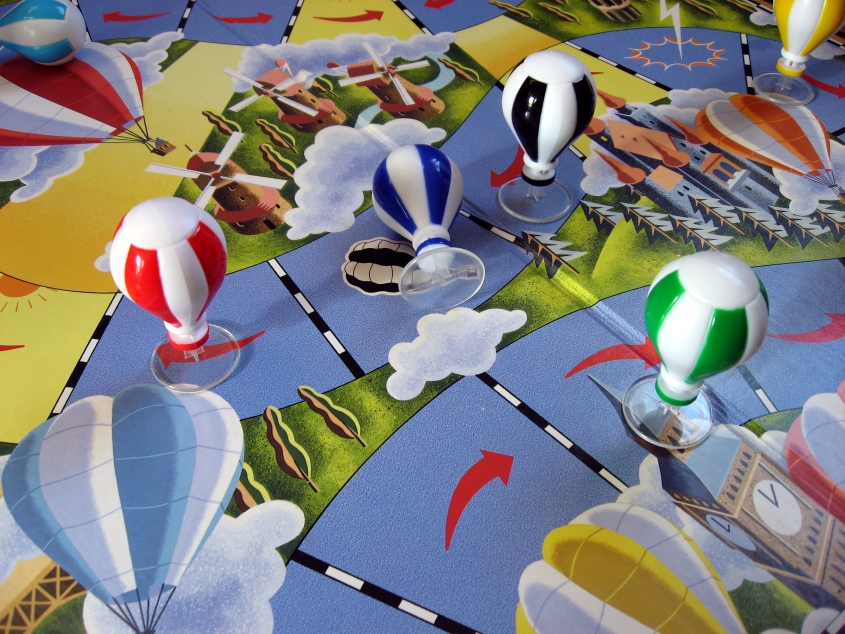
Since it was gone 8pm, we decided to play the  “Feature Game” which was The Great Balloon Race. This is a light hearted, relatively quick race game with quite a lot of luck, and (as it turns out) a lot of vendettas against certain colours with orange and blue being the most victimised.  One of the really nice things about this game was the way that people at the back who felt they had no chance, were able to catch up and indeed win.

The Great Balloon Race

Next, there was some debate about what to play next and in the end we decided to play a fairly light card game, Boomtown.  In this game, players are mining moguls who bid to win the first choice of the cards on offer.  Winning the bidding has two consequences:  you get first pick from the cards available, but you have to pay the other players what you bid.  The game was won by an landslide and it turns out that winning the bid is not always best as it can be expensive as well as favouring the player to your left.  Or was it right?  Actually, it was probably both…

Boomtown

With five games something of a record, we managed to squeeze in a game of Snow Tails.  This is a very pretty game of dog-sled racing, but the choice of game was possibly a mistake given the time, compounded by the fact that we used a more complex track than was wise, and we were playing with the full five players (three of whom were new to it).  Basic numeracy proved to be something of a challenge and the “Big Paws” token changed hands several times as the dents in the sleds increased and the saplings took a beating.  However, most people were in the lead at some point and in the final run for the line, everyone was within one turn or so of finishing the race.

Snow Tails

Learning Outcome: Basic skills such as being able to add up and tell your left from your right can be really useful when mining, flying balloons, and especially driving dog-sleds!