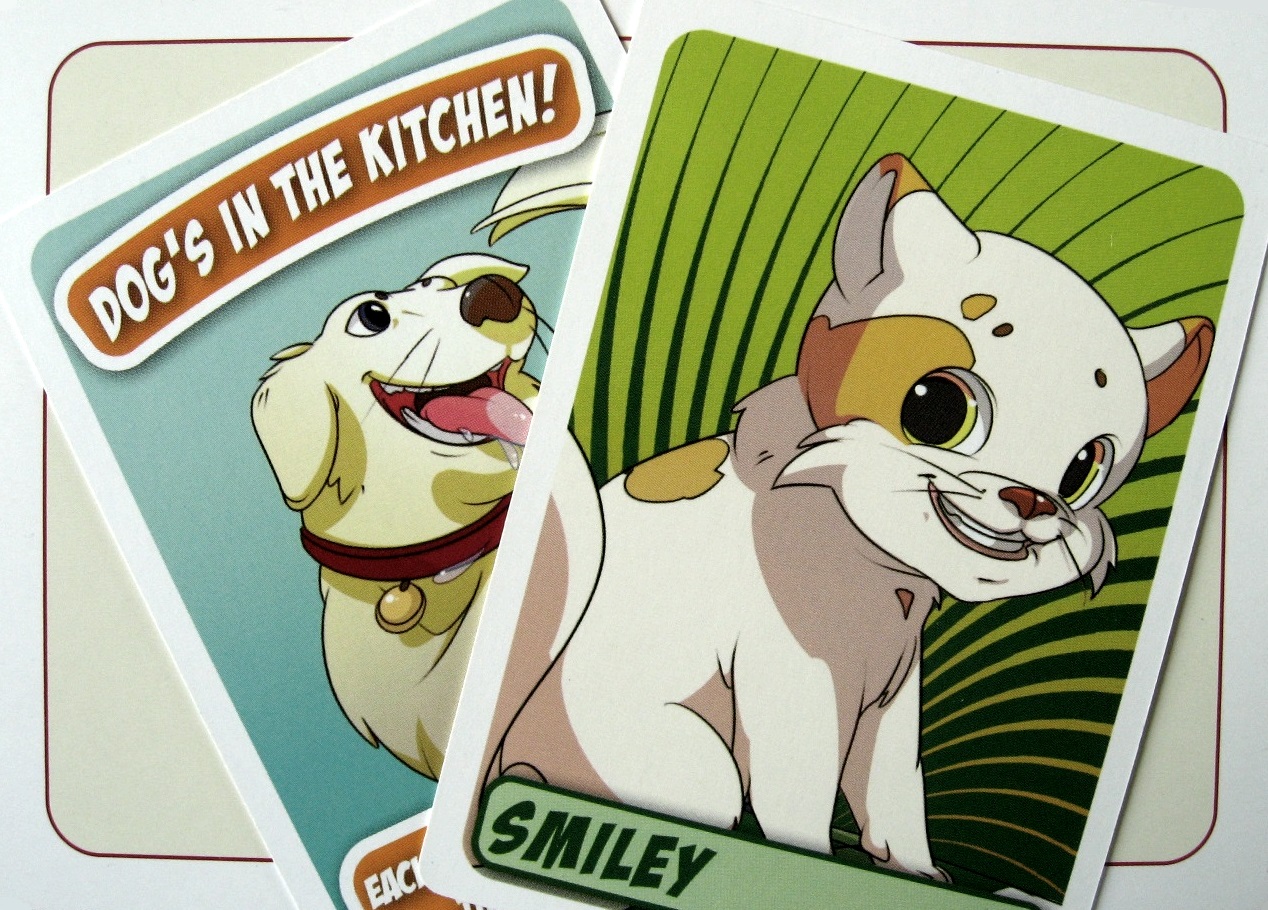
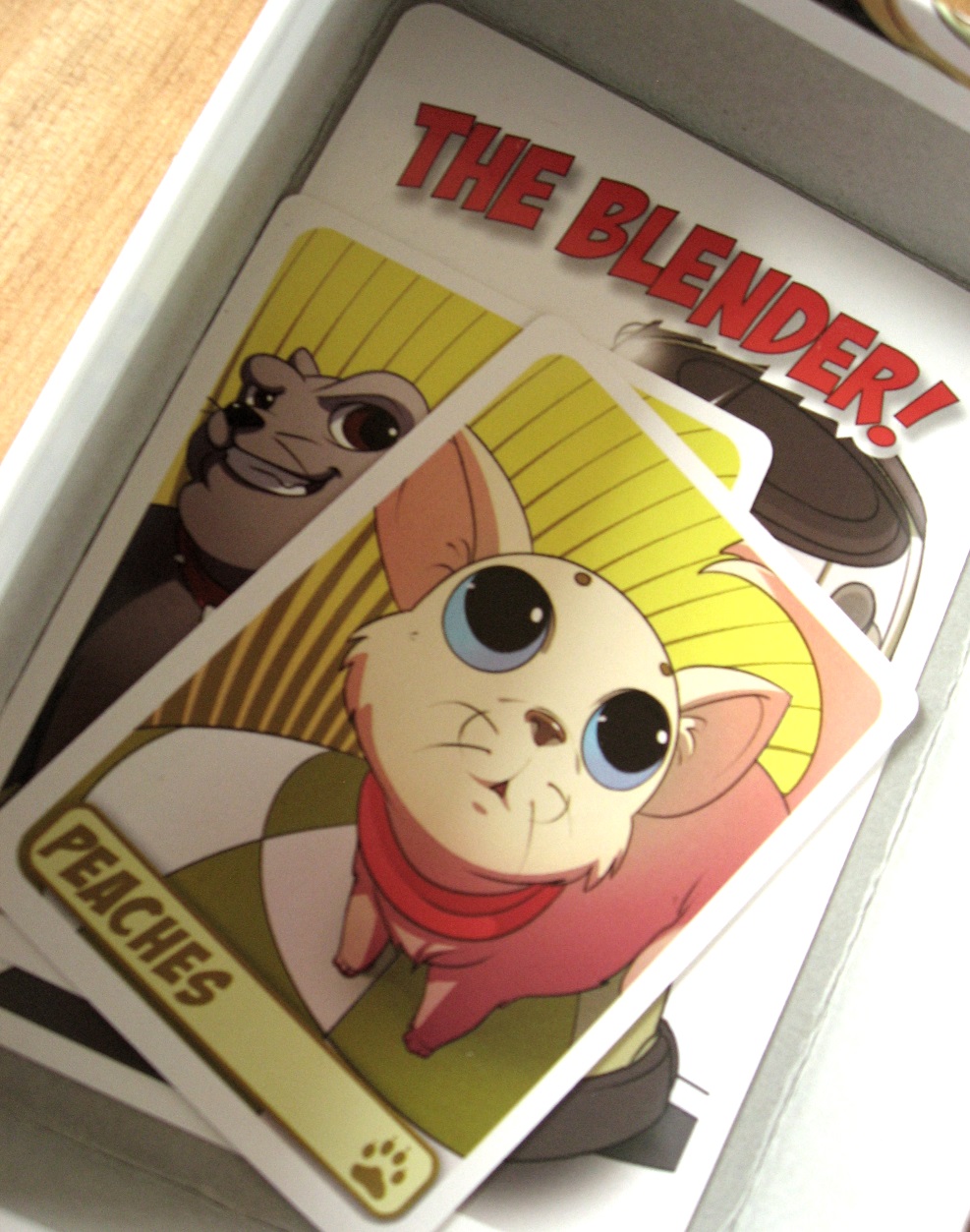
This week we started with a quick game of Kittens in a Blender. This is a light card game, if one with a slightly ghoulish theme. The idea is that on their turn, players must play two cards from their hand of six cards. If they choose to play a kitten card it can go onto the counter in the middle of the table; into the relative safety of the box, or straight into the blender to await its fate. Other cards allow Kittens to be moved one space from the box to the counter or the counter to the blender vice versa. And then there are the blend cards, which cause any kittens in the blender to be blitzed, the kittens in the box to be permanently rescued and the kittens on the counter to move to the blender to become the next in line for “kitten smoothy” (if they aren’t rescued in time). Players score points for every kitten of their own colour that they rescue, and lose points for those that meet a less pleasant end.
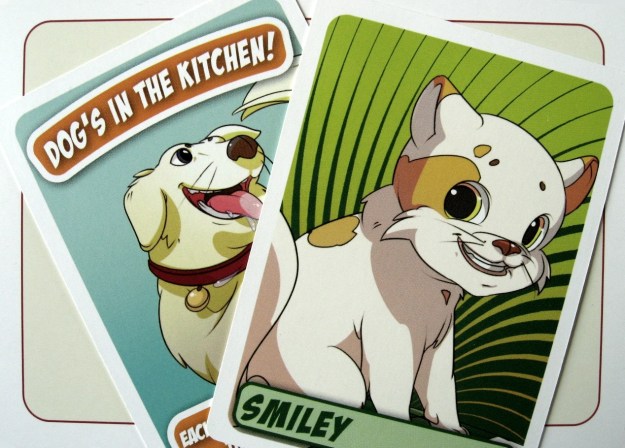
Yellow started out picking on Blue and Orange kittens and, well, Red ones too. So before long, everyone retaliated and the fur began to fly as it all got ugly quite quickly. Orange managed to do the least to offend everyone else and finished miles ahead of everyone else with fourteen points while everyone else struggled (or failed) to finish in paw-sitive figures.

Everyone else was here by now, so next up was our “Feature Game”, the new Spiel des Jahres winner, Camel (C)Up. There has been much debate about the correct name as the box is ambiguous. It was originally released as “Camel Cup”, presumably to reflect the Australian camel race, however, the Spiel des Jahres citation clearly calls it “Camel Up”, which at first sight seemed strange, however, once we started playing it became clear why this name was appropriate. The game consists of a race of five camels and players effectively bet on the leader and eventual outcome of the race. Thus, on their turn players can do one of four things: use the cool pyramid dice shaker to move a camel; bet on which camel will be in the lead at the end of the round; bet on the final outcome of the race (i.e. which camel will cross the line first triggering the game end, or which will be in last place when that happens), or place their oasis tile which can earn the owner money as well as help or hinder a winning/losing camel.

There are a couple of clever things about the game. Firstly, the dice shaker: this is a pyramid-shaped device, made out of card and held together with an elastic band. The idea is that players shake it, turn it upside down and push the slider to let out just one die. Although it malfunctioned a couple of times, in general, it works well. As there are five dice (one per camel) and when a die is “rolled” it is removed from the shaker for the rest of the round, this is used to determine the length of the round (or “leg”). Next, when a camel moves onto another camel’s space it is stacked on top of it, then if the bottom camel moves, the top camel takes a ride. This means that a riding camel can get an extra move, and stacks can contain any number of camels, so if a camel is lucky it can pick up a lot of extra moves. Finally, the way the betting is handled means that players don’t have to worry about stakes and odds. To bet on the outcome of a leg, players simply take a tile of the appropriate colour. Since these are stacked with the highest value first, if that camel comes home first, that player gets more at the end of the round. Similarly, the betting on the end of the race is done by players choosing a card from their hand of five (one per camel) and placing them in the “to win” stack or the “to lose” stack. The earlier they are placed, the more the player wins (if they get it right of course!).

The game began with the the Blue and White camels getting a slight head start. White made a surge forward and everyone made a dash for the White betting tiles, until one player put a mirage in front of it… For some reason, although all the other camels had no difficulty jumping the mirage, the White one really struggled and quickly went from the front to the back, a problem exasperated as every other space now had a mirage tile on it. The Yellow Camel managed to catch a couple of rides, and before anyone could do much about it, it was across the line, with it handing the win to the only two players who had played it before.
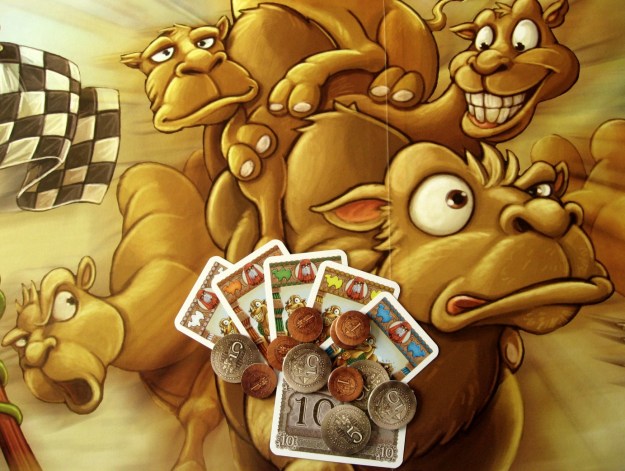
Time was getting on and we only had time for a short game before some of us had to leave, so we played Incan Gold. This is a game we played quite a bit a year or so ago, but hasn’t made it to the table in a while. Basically it is a push your luck game, where players are mining for gold and gems. Each player enters the mine and a card is drawn and placed to make a path; the value of the gems on the card is split equally amongst the players in the mine with any left overs placed on the card. Players then get the option to leave the mine (sharing all the left-overs as they go), or stay in the hope of getting more treasure. The snag is that in addition to gem cards of varying values, there are also “nasty cards”. You can draw lots of different nasty cards, but if s second of the same time type is drawn, the mine collapses and anyone left in loses whatever they had collected in that round. In this game, it was a tale of “nasty cards” as the first three rounds had at least two nasty cards in the first five every time. So it was all a bit scrappy with everyone nervously leaving early. Then, somehow, Orange managed to pull off a bit of a coup and got out of the mine with lots of booty, just before it collapsed. It turned out the lead was unassailable and Orange pulled off her second victory of the night.

Now much depleted in numbers, we decided to continue with the Spiel de Jahres theme and finished with a game of Splendor (one of the runners up). We played this a few weeks ago and like Camel Up, it is quite a simple game, but is much more strategic. The idea is that players are gemstone dealers and can use gem-chips they have collected to purchase cards. In turn, these cards allow players to buy more cards of a higher value, some of which come with extra prestige points. The end of the game is triggered when the first player reaches fifteen points. Black ran off with an early lead, however, while Purple struggled a little, Blue managed to catch up with a couple of high scoring cards. By this time Green had got his engine working properly and started to catch Black. It finished a very close game, but Black just managed to hold on, beating Green and Blue by one and two points respectively. Inevitably we finished with a discussion as to whether we Camel Up or Splendor was the better game. We concluded that while Camel Up was fun, with seven it was too chaotic so that the “sweet-spot” was probably four or five and it would probably be great fun with a family under those conditions. For us, however, we enjoyed Splendor much more and it will no-doubt make a return.

Learning Outcome: Camel racing is fun, but trading gems is Splendid!
:strip_icc()/pic1216485.jpg)
:strip_icc()/pic178001.jpg)
:strip_icc()/pic2540111.jpg)



 boardGOATS