After Blue and Pink had sampled the new pizza menu at The Jockey, people started to roll up and join them for the usual chatter. There were a total of nine, which was one more than required for the “Feature Game“, the recently announced Kennerspiel des Jahres winner, Challengers!. This is a deck-building, dueling “capture the flag” game where players battle head-to-head to find the winner. It is a very light game, with a largely random element, at least on the face of it, so it was always going to be a bit of a “Marmite” game. Green commented that he wasn’t very interested in it, but as everyone else was quite keen to give something novel a go, he sportingly joined in.
 |
| – Image by boardGOATS |
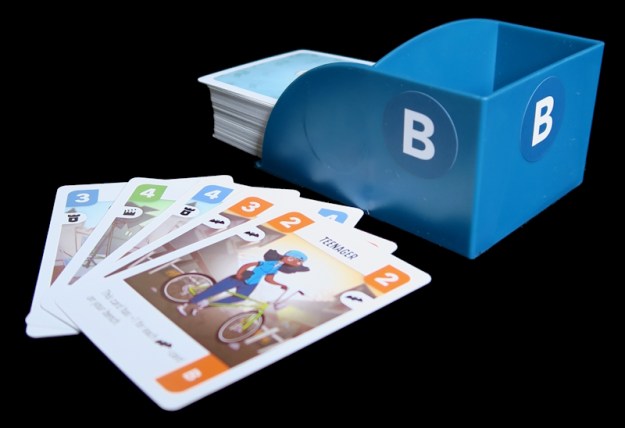
The game is very simple, and seems, at first glance to be quite random. Players start with a hand of cards, and then draw five more and choose a set number to add to their hand. The clever part is that (with eight players) the game is played over seven rounds, and each round the decks players draw from and/or the number of cards they can keep changes. There are three decks, A, B and C, and the cards become increasingly powerful as the game progresses. Once players have fettled their deck, they duel against their designated opponent by drawing the cards from their deck. In this, one player starts by playing a card and taking the Flag, then the other plays cards until their total equals or exceeds that of their opponent.
 |
| – Image by boardGOATS |
This initially seems quite random in that players have no agency in this element of the game. There is a suggested variant that can change this by allowing players to draw two cards and choose one to play—this was an option for later in the game, but in the end, the group stuck to the rules as written. The game focuses on this duel aspect, but really it is more about building card combinations during the first part of the game and deciding what cards to shed and how many. Shedding cards is just as important as acquiring cards as, as the winner of a duel is the last player with the flag, so running out of cards can lose a match.
 |
| – Image by boardGOATS |
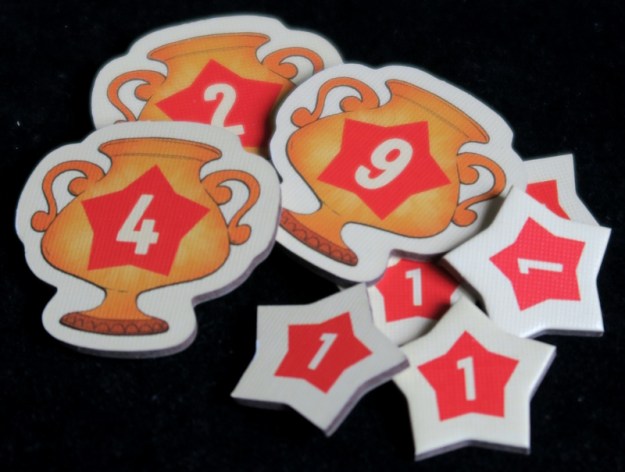
Having too many cards can be a problem as well though—when they take the Flag, players move all their cards except the last played to the “Bench”. The Bench has six seats, and when a card needs a seat and there isn’t one, that player loses. The winner of the match, the last player with the Flag, then takes a winner’s token which is worth points at the end of the game. The game is all about the cards which make it less random than it seems at first; some cards have special powers, while others give points. Additionally, identical cards can share a seat on the Bench, so effectively allow players to have more cards, however, those tend to be weaker cards from the A deck.
 |
| – Image by boardGOATS |
As such, Challengers! should perhaps be thought of more as a programming game, more in the mold of games like Colt Express, rather than a dueling “capture the flag” game. After each match, players play musical chairs and after seven rounds (with eight players), the players with the most points duel for overall honours. Although the idea is very simple, it took a little while for people to get to grips with the procedure. Blue, who was suffering with the after-effects of a bad cold, acted as much needed umpire and guide, explained the rules and demonstrated how the duel worked using Pink’s hand of cards.
 |
| – Image by boardGOATS |
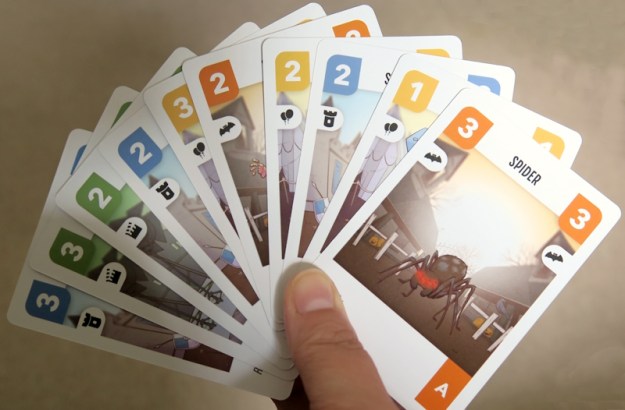
Possibly thanks to her fuzzy head, but Pink despite the fact that he was sat in front of her, was onto the second round before Blue realised that something wasn’t right. Instead of taking his starting hand back after the demo, he had just drawn five blind cards from the A deck, making his hand immensely over-powered. There were the usual tongue-in-cheek cries of “Cheat!”, but it was a genuine error, albeit one that wasn’t easy to fix by this time. As a result, the quickest and easiest solution was for him to forfeit the first round and fix his hand before re-starting the second round.
 |
| – Image by boardGOATS |
One of the nicest aspects of the game was the way everyone played against everyone else. The GOATS are a nice, friendly group, and although some people end up playing together more often, the group always makes a point of trying to avoid cliques caused by the same people playing together all the time. The Musical Chairs element of the game meant everyone played against everyone else which gave it a fun, party feel that we usually only experience in October (when we play Crappy Birthday). It was clear that some people enjoyed it more than others though. Ivory, Teal and Black, really got to grips with the deck-building element and found the game exceeded their expectations, Ivory in particular really enjoyed it.
 |
| – Image by boardGOATS |
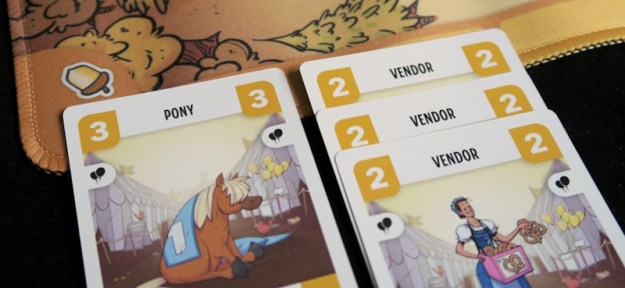
Lime, Pink, Pine and Purple were a little less enthusiastic, while Green felt it was a clever little game enjoyable for a short while, but that it out-stayed it’s welcome—too long for the game-play within it, he couldn’t wait for it to finish. It wasn’t much of a surprise, therefore, that Ivory, Teal and Black were the winners of the “Round Robin” tournament phase, finishing with thirty-five, thirty-three and thirty-one points respectively (some way ahead of Lime in fourth with twenty-three). The play off between Ivory and Teal, therefore, was quite close and tense, but Ivory ran out the eventual winner, largely thanks to his handful of yellow Vendor cards.
 |
| – Image by boardGOATS |
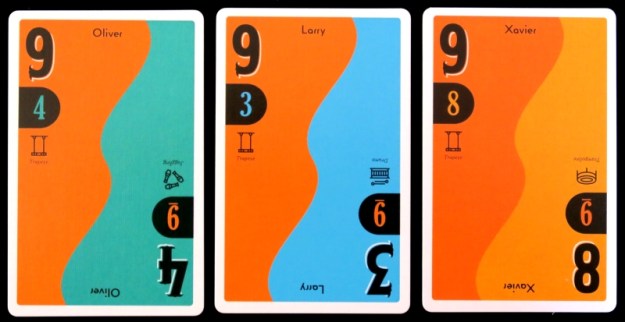
From there, everyone was keen to play something they were familiar with, but it had to be something quite quick. Teal suggested SCOUT, which Blue was keen to give another try (having played appallingly last time) and Ivory and Purple were very happy to join them. This is a very simple, but clever hand management game that was nominated for the Spiel des Jahres award last year. The theme is almost non-existant (something to do with circus performers), and isn’t even reflected in the card art, which is not unpleasant, but very functional (and therefore useful). The idea is that players have a hand of cards which, like in Bohnanza, they cannot rearrange.
 |
| – Image by boardGOATS |
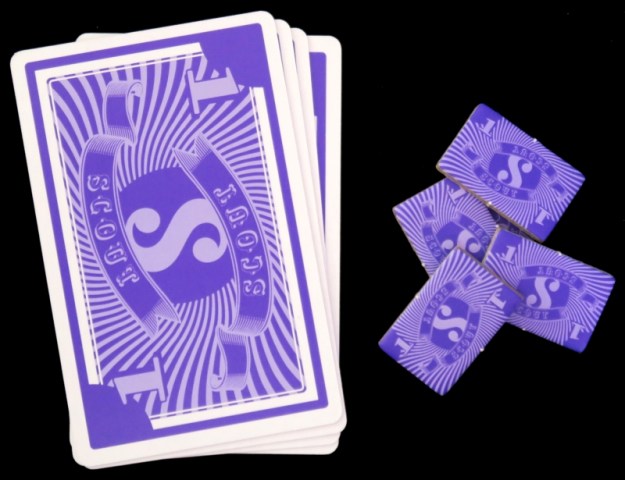
Unlike Bohnanza, on their turn players may play any set of adjacent cards from their hand as long as they beat the current winning set, taking any cards they beat into their scoring pile. Cards can be a a run of cards with consecutive numbers, or a meld of the same number. Sets are ranked by size and value and a meld always beats a run of the same size. Players take it in turns to play, and if they can’t or choose not to “Show” a set of cards that beats the current winning set, they instead “Scout”, taking one of the two cards from either end of the set on the table, adding it to their hand (paying the former owner a point from the supply).
 |
| – Image by boardGOATS |
And this is where the game gets clever: all the cards have two values, one for each end, so players can add any cards to their hand anywhere they like and either way up (i.e. making either value active). In this way, players can manipulate their hand making larger melds or longer runs. The round ends when either every body “Scouted” in succession, or where one player has run out of cards. Players then score points for each card in their scoring pile and for each chip for cards taken by “Scouting” with negative points for any cards left in hand. The first time we played this with the group, it had all been a bit of a voyage of discovery, and last time, Ivory gave everyone a bit of a spanking, so Teal and Blue were keen to prevent that from happening again.
 |
| – Image by boardGOATS |
Things started off well, with Blue beating Ivory in the first round, though Teal and Purple did less well ending up with a hand of cards. The second and third rounds went better with everyone taking positive points and it was very close going into the final round leaving it all to play for. Sadly for everyone else, Ivory brought his A-game to the last round ending the round swiftly leaving Purple and Teal with a hand that more or less off-set their takings and Blue with a positive score, though one with fewer points than Ivory. The end result wasn’t really very close, though it felt less of a stomping than last time: Ivory finished with fifty-five points and Blue took second with forty-one, ahead of Purple and Teal who tied for third.
 |
| – Image by boardGOATS |
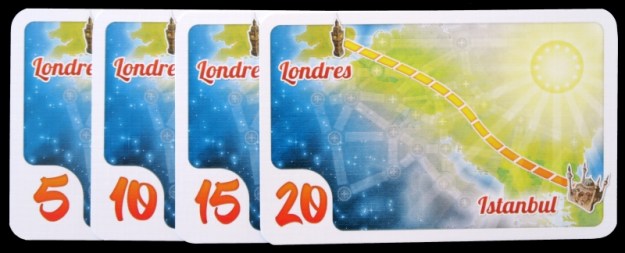
On the next table, Green, Pink, Pine and Black played a close fought enjoyable game of Les Aventuriers du Rail Express, a variant of the Spiel des Jahres winning Ticket to Ride series, but one that is a sort of half-way house between the original full versions of the game and the mini “city” games (like Ticket to Ride: London). The game only plays four and takes less time, but is quite a nice variant and has a couple of differences to the original, being shorter without losing too much of the main game’s challenge. As in the original, players can either take two cards from the market (face up cards, or the draw deck), or pay cards to place trains on the board. Unusually, however, the Locomotive “wild” cards are kept in a single pile and therefore are always available. This is quite a nice variation, as it means that players never feel forced to take blind cards because what they need isn’t available.
 |
| – Image by boardGOATS |
This effectively means players are guaranteed to get at least one train card they want. The other major difference is the presence of the long route ticket. This is one route that everyone can claim, however the highest scores go to the first to claim it. It additionally means that failing to complete it does not lead to negative points, so players can ignore it and concentrate on normal short route tickets if they prefer. There was a moment when the group had three identical coloured cards in the face up market which made them whether they should be scrubbed (as with three Locomotive cards in the base game). It couldn’t be found in the rules and it was pointed out that in the original games it is possible to have five cards of the same colour, so they stayed and someone eventually found a use for them.
 |
| – Image by boardGOATS |
Pine took an early point lead which he maintained for quite a while until Green and Pink caught up, and not long after, Black too. However, as the game neared its conclusion Pine pulled ahead again. Pink had completed the long route already and, at the cost of not being able lay his last two trains, Green decided to get the game finished before anyone else managed it. That long route helped Pink finish in front with sixty-four points, while Black’s slow start demonstrated that getting trains down early is no guarantee of success. That said, he managed to pull into the station in second place with sixty-one points. Green and Pine fought to not be last and ended up tied just a couple points behind with fifty-nine points.
 |
| – Image by boardGOATS |
Learning Outcome: Winning the Spiel des Jahres award means a game is good, but doesn’t mean it will suit everyone.
 Cascadia Junior by Fertessa Allyse & Randy Flynn
 Endeavor: Die Tiefsee (aka Endeavor: Deep Sea) by Carl de Vissser
 Bomb Busters by Hisashi Hayashi
:strip_icc()/pic7815854.jpg)








:strip_icc()/pic7519544.jpg)
 boardGOATS