Tag Archives: Euphoria: Build a Better Dystopia

26th Movember 2024

Plum, Jade, Sapphire and Mint were first arrive, and while they were waiting for food, settled down to a game of Hiroba, a sort of board game “Sudoku” where players place their numbered pebbles to take control of the most gardens.  As in Sudoku, players must never have two pebbles of identical value in the same garden, row or column.  After a couple of false starts the group eventually figured out the rules.  This time, Sapphire got in early with the lowest stone number between two Koi carp ponds, ensuring he got both. Plum only got two ponds, so although she got a reasonable number of areas, others overtook her by using the Koi pond multipliers.
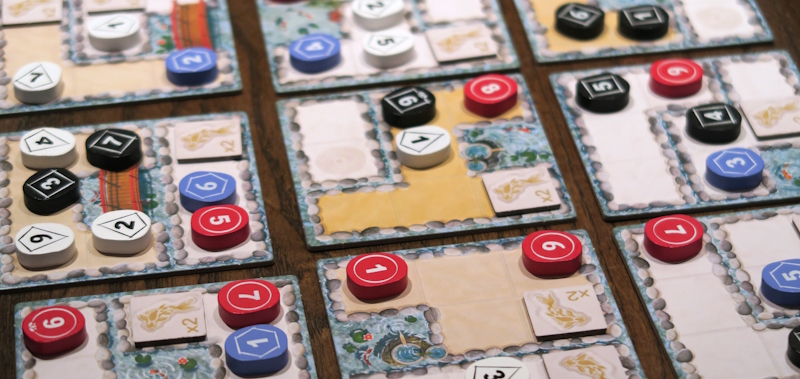
Hiroba
– Image by boardGOATS

Food arrived during the game, and some were still eating when the final count (and recounts) took place.  Despite Sapphire’s great start, Mint’s total of thirty-five gave her victory by a single point pushing Sapphire into second and leaving Plum in third.  Meanwhile, since Hiroba was underway when Cobalt arrived, he settled down to a solo game of Explore & Draw, the Roll & Write version of Isle of Cats.  The game play is similar with players now drawing polyomino shapes on their ship board, but choosing a set of cards each round instead of drafting them.  In the solo game, the player is competing against his “sister” and this time won by forty points to her thirty-six.

Isle of Cats: Explore & Draw
– Image by boardGOATS

Once everyone had arrived (except Teal who had given up battling the crazy flood-water and gone home) and had finished eating, it was time for the “Feature Game” which was to be Rolling Realms/Rolling Realms Redux. This was advertised as a light roll and write game, but turned out to be rather more involved than everyone expected.  It was developed during the global pandemic as a print-and-play game, but has since been released as two professionally produced games.  Each game consisting of a number of small games based loosely on other games, with more are available to be purchased separately.

Rolling Realms
– Image by boardGOATS

The idea is that players choose three “mini-games”, or “Realms” for each of three rounds.  Then, two dice are rolled and allocated separately to two of the three games.  After nine rolls, players add up the number of starts they’ve achieved in the round.  The winner is the player with the most points after three rounds.  With three copies of the game and several people familiar with it, it should have been a relatively straight-forward game, but with so many different mini-games, players effectively had to learn the rules each round.  As the games play six and there were three copies, the group decided to play one large game. and started with the same three mini-games, based on three of our favourite games, Tapestry, Meadow and Flamecraft.

Rolling Realms
– Image by boardGOATS

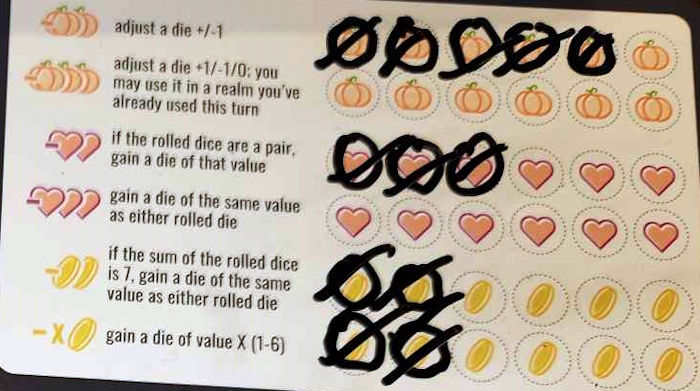
And this was where the first problem arose.  The Tapestry mini-game was quite straight-forward, with players trying to fill their grid using polyomino shapes.  However, Meadow and especially Flamecraft, both from the Redux version of the game were more difficult to understand.  The Meadow mini-game was based on the card market with players choosing “cards” and using them to score points and collect resources.  The Flamecraft mini-game caused a lot of confusion with different “Enchant” and “Gather” actions, which are loosely based on the actual game, but it took a while to work out what they did and how to use them.
Rolling Realms
– Image by boardGOATS

All three games involved players doing things to collect Stars, but the real aim of the game is to collect resources (Pumpkins, Hearts and Coins).  These allow players to modify dice, use them both on the same Realm, and most importantly, gain extra dice to give extra actions—these are essential as without them, players don’t get enough turns to get the more challenging Stars.  With so many people playing and the difficulties in getting heads round rules, the group ended up splitting into three tables.  Plum, Jade, Sapphire and Mint were first to get going and were first to finish the first round.  Plum was the victor, and the group went on to play Dinosaur Island, Stamp Swap and Ark Nova for their second round.

Rolling Realms
– Image by boardGOATS

The second group consisting of Blue, Pink, Ivory, Lime and Pine, were a bit slower as they struggled a bit more with the rules, particularly Pine.  As a result, they were a bit slower to get to the end of the first round, with Blue and Ivory leading the way.  This group decided to reduce the rules overhead by keeping one of the Realms from the first round, the easiest to understand, Tapestry.  To this, they added Between Two Castles and My Little Scythe, both from the original Rolling Realms game, as they thought these might be easier to grok, which they generally were.  In their second round, Ivory and Blue were still fighting it out, but this time they were joined by Pink, with Pine not far behind.

Rolling Realms
– Image by boardGOATS

The comparative success of the second round and keeping one Realm and choosing two from the original game, meant they repeated the strategy for the last round.  This time they kept the Between Two Castles Realm and added Between Two Cities and Scythe.  By the final round, everyone seemed to have got the hang of things as the scores were much closer.  In terms of totals though, Blue just had the edge over Ivory, with Pink in third.  The other table had finished first though, with Tidal Blades, Between Two Cities and Euphoria as the Realms in their final round.  Plum had continued her success in the first round winning both the second and third rounds and therefore, taking overall victory.

Rolling Realms
– Image by boardGOATS

Second place was less clear, however, with Sapphire just beating Mint for second place.  The third table consisted of Cobalt, Black and Purple.  Cobalt had played before, but online while Purple and Black were new to it.  They also struggled a bit and took a more leisurely approach to the game, playing just two rounds.  Their second round Realms consisted of Scythe, Potion Explosion and A Feast for Odin, the last two both add-on packs, and therefore possibly more challenging than those from the base game.  Cobalt won the first round by a bit of a land-slide, but the second round was very close between all three players, with Purple just beating Cobalt (who took overall victory).

Rolling Realms
– Image by boardGOATS

Learning Outcome:  Sometimes, one person’s simple game can be another’s nemesis.
28th Movember 2023

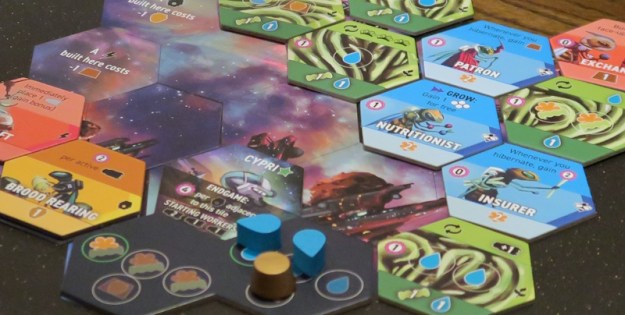
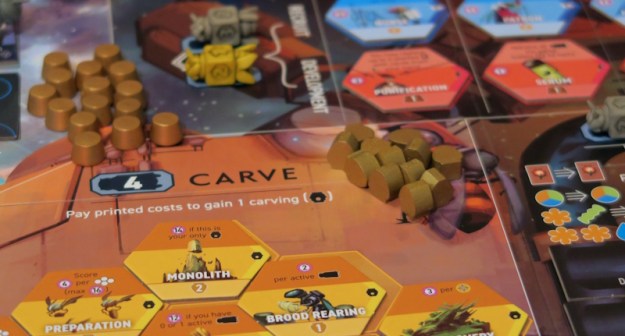
What started out threatening to be a quiet night with the absence of Green, Lilac, Purple and Black, turned out to be quite lively in the end.  As Blue and Pink finished their supper, Pine, then Jade, Sapphire, Plum and Byzantium arrived, soon followed by Teal, Ivory and Lime.  Ivory was armed with his new, shiny copy of Apiary, which was to be the “Feature Game“.  This is a worker-placement, hive-building game where players explore planets, gather resources, develop technologies, and create carvings to demonstrate their faction’s strengths before the end of the year when it is time to hibernate.

Apiary
– Image by boardGOATS

At first glance, Apiary seems to be a fairly simple Worker Placement game, where players have the Tzolk’in choice: place a Worker or retrieve Workers.  Unlike in Tzolk’in where Workers carry out their action when they are retrieved, in Apiary, players take the action and gain the associated benefits when placing a Worker, while retrieving Workers enables players to run any engine they have that relies on those recalled workers.   Unlike many other worker placement games, there is no blocking and players can add workers to any space as long as they have the power and required resources.  If a space is already occupied the existing occupant is “bumped” either to the next space (for certain areas) or sent back to the owner (with a choice to increase strength and make available straight away, or hold on to make use of income abilities).

Apiary
– Image by boardGOATS

Players start with asymmetric factions and basic resources (Pollen, Water, and Fiber) according to their faction.  The Action spaces are mostly about getting or trading Resources and Cards, or adding Tiles to improve their base.  There are five available to players at the start of the game: Explore, Advance, Grow, Research and Convert.  Explore allows players to visit planets, gaining bonuses for being the first to visit a planet, and also resources from the planets they discover while Advance allows players access tiles they can build if they have the resources to do so.  Grow enables players to gain their fourth worker (or gain a worker back from the pool once it hibernates) and allows players to build ship frames while Research gives players access to the Seed Card deck, some of which are incredibly powerful.

Apiary
– Image by boardGOATS

Wax and Honey are more advanced resources that can be created during the game using the Convert Action.  Honey, in particular, is required for the final Action, Carve (which also needs a Level Four worker).   When Workers return to the Active Pool (either by being bumped or because they have been recalled), their value increases by one. Level Four Workers trigger special bonuses when played, but instead of returning to the Active Pool when bumped or retrieved, they hibernate. In this way, the player loses that worker, but gains a bonus.   The game ends when all the hibernate spots are taken or when a player uses all seven of their hibernate tokens.

Apiary
– Image by boardGOATS

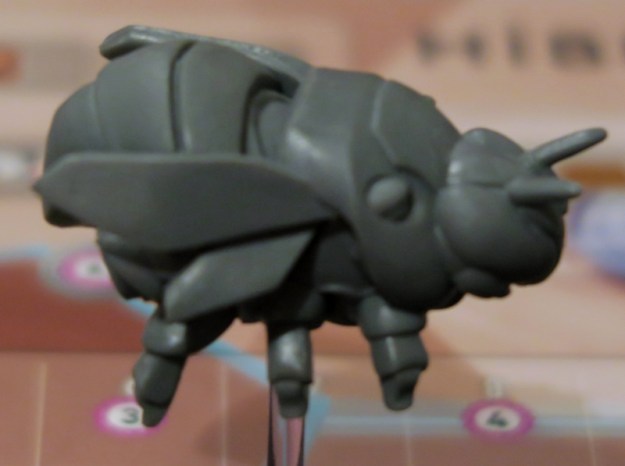
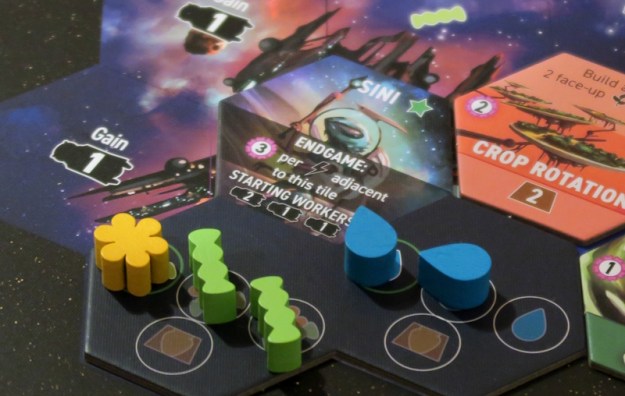
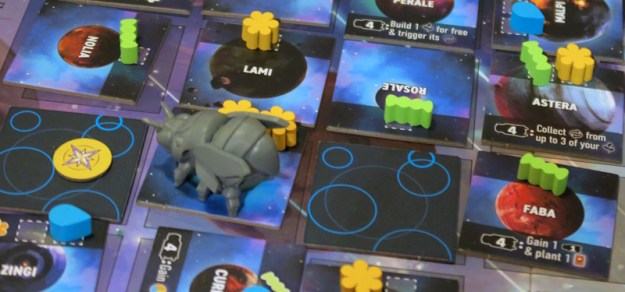
The game is beautifully produced with great art and lovely wooden resource pieces.  The QueenShip is arguably the best, looking a bit like Starbug from Red Dwarf.  With that and the theme (which had those traveling from Swindon crying, “Bees… In… Space!” à la The Muppets “Pigs in Space!” at intervals), the game was off to a good start.  The not-blocked worker space mechanism is similar to that in Euphoria: Build a Better Dystopia, which Plum, Byzantium and Jade had played at HandyCon.  Everyone starts off with a unique player “Hive Mat” and starting Faction Tile. Ivory began with “The Log” and “The Sini” which gave points for filing the Hive Mat and for each Development Tiles surrounding the Faction Tile (respectively), so he prioritised getting Development Tiles.

Apiary
– Image by boardGOATS

Cobalt’s Faction, “The Cypri”, gave him four points for each Carving adjacent to his Faction Tile, but found that hard to achieve needing a lot of Honey, so concentrated elsewhere instead.  Plum’s focus was on her Hive Mat, “The Warre”, which had spaces that progressed her along the Queen’s Favour track when she covered them, so she decided early to try and focus on that. She had some Farm Tiles that also would have helped her gain more Favour when she triggered the income for taking workers back, but she didn’t use that until later as, although her workers were bumped a lot, she kept choosing to increase their strength and have them available straight away instead.

Apiary
– Image by boardGOATS

Byzantium started with “The Lama” for his faction that gave him a point for each tile he added to his Hive which grew quite rapidly.  He also nabbed a Farm Tile from under Plum’s nose which gave him the Edge on the Queen’s Favour Track.  As the game came to a close, everyone scrabbled to try to finish things off—like filling their Hive Mat (Plum’s last space was filled for free when she covered the adjacent hex).  The lead at the end of the game was held by Plum, but that isn’t really where the points are in Apiary.  In contrast to everyone else, Ivory almost completely eschewed the Queen’s Favour, focusing on Planted Cards and Honey Pots, which gave him over thirty points alone, and as a result he charged from the back of the pack to take victory.

Apiary
– Image by boardGOATS

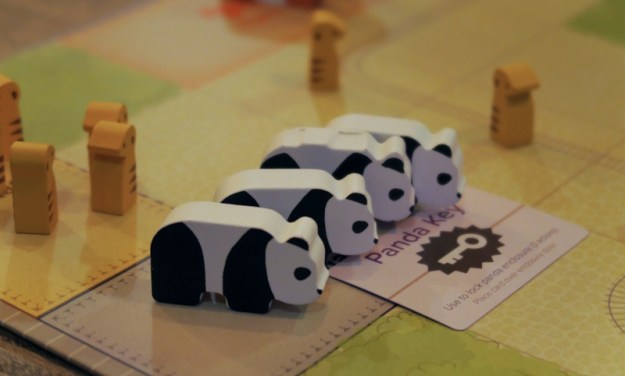
Meanwhile on the other side of the room, Pink, who had been fondly remembering his visit to the see the pandas “Down Under”, sucked Pine and Blue into a game of Zoo Break.  This is a cooperative game where players are zoo keepers trying to prevent the marauding animals escaping the zoo.  This has had a couple of outings this year the first was a disaster ended when a cobra got out, but the second was a hard-fought victory.  This time, with just three keepers, turns would come round more frequently, so to make things a little more interesting, Pink (Lucky Duck), Pine (Gardener) and Blue (Angler) decided to play with the Faulty Lock Variant, personally recommended by the designer.

Zoo Break
– Image by boardGOATS

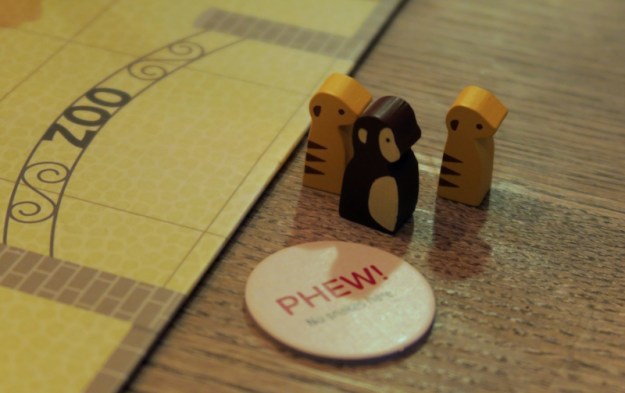
The idea of the game is that players take it in turns to roll the Action Die to found out how many actions they get, then after carrying out the actions, players first draw an Escape card and then a Move card, to see what animals escape and move.  In the original game, once animals are locked up, however, they can’t escape, which means the game gets progressively easier.  Further, some players potentially end up lurking about with nothing much to do waiting for someone else to deal with the last couple of mischievous meerkats.  In the Faulty Lock Variant, however, when an Escape card is drawn for an enclosure that has already been locked, a die is rolled to see if the lock is faulty and whether the animal escapes or not.

Zoo Break
– Image by boardGOATS

The problem with the Faulty Lock Variant is that it can extend the game quite a bit.  That said, it didn’t look like that was going to be a problem as Pink chucked first Pine and then Blue under the Charging Rhinoceros.  Then Pink got trampled too, before Pine paid a couple more visits thanks to a mad Elephant and a venomous snake.  Eventually, the team got their act together and locked up the Rhino, and then the Capuchins, Pandas, and Elephants.  Every now and then, a lock failed and an Elephant got out, but gradually, the animals were being locked up, and eventually the last of the Meerkats was evicted from the part in the fountain locked up (aside from the two that escaped).

Zoo Break
– Image by boardGOATS

It had been a lot of fun, even though Pink was sad that he’d not been hugged by a lonely Panda, and jealous of Pine who had.  It had taken all evening though, and on the next table, Jade, Sapphire, Lime and Teal had managed two leisurely games and a bit of chit-chat.  The first game was Isle of Cats: Explore & Draw, a role and write version of the much more substantial card-drafting, polyomino cat-tile-placing game, Isle of Cats.  In Explore & Draw, instead of drafting cards before choosing tiles, players choose a set of cards each turn and then draw their “discoveries” on their boats.

Isle of Cats: Explore & Draw
– Image by boardGOATS

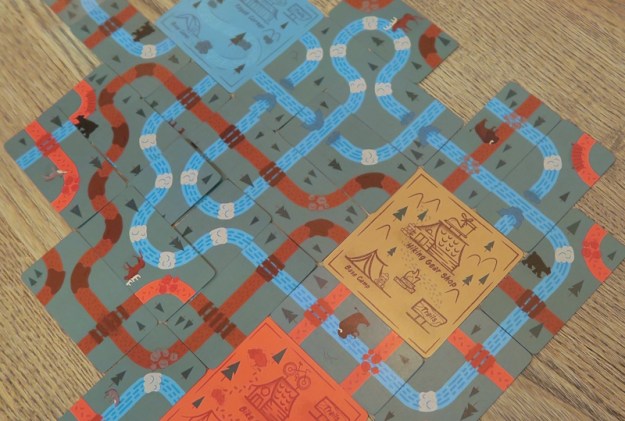
This time it was relatively close for second place, but Sapphire won by something of a landslide, his seventy-nine points was some twenty-five points ahead of Lime who took second with his neatly coloured in boat.  Once the wipe-clean boards had all been cleaned, Teal took an early night before the remaining trio played moved on to the card drafting and path building game, Trailblazers.  In this game, players start with eight Trail cards and draft two cards three times, adding them to their tableau.  The cards must either be placed adjacent to or overlapping other cards as players try to construct long and elaborate trails in three different colours.

Trailblazers
– Image by boardGOATS

Only closed loops in a single colour, that start and end at a matching campsite will score points and players also compete to fulfill “First To” and “End Game” goals.  The game ends after four rounds, when the player with the most points from closed loops and goals achieved is the winner.  This was much closer than the previous game, though the outcome was, ultimately, much the same.  The goal cards in play were “Hikers’ Quartet”, “Trail Hugs”, “Forever Float” and ” Wanderlust”, though the players only scored for the last two (giving points for the longest single blue “Kayak” route and the longest total brown “Hiking” routes.

Trailblazers
– Image by
boardGOATS

Lime and Jade tried to build trails of all three types, Hiking, Kayaking and Biking evenly, making the best of the cards they had.  However, Sapphire focused exclusively on the two that featured in the “Forever Float” and ” Wanderlust” goals, finishing with twenty-eight points for his Kayaking routes alone.  While it was very close when the trail lengths were taken into account, Sapphire took first place for both end game bonuses and Lime came second in both, which also reflected the final placing.  There was some chatter, while “Bees… In… Space!” finished and then it was time for everyone to go home to hibernate until next time.

Trailblazers
– Image by boardGOATS

Learning Outcome: Golden Honey is valuable.

Boardgames in the News: Twenty Awesome Games according to The Guardian

The Guardian boardgame section has produced a number of interesting articles over the last few months, including one about a French Scrabble champion who doesn’t speak French; an article discussing the impact of political boardgames, and a review of the cooperative war game, 7 Days of Westerplatte, where players take on roles of Polish defenders trying to save their city from attack in September 1939.

7 Days of Westerplatte
– Image used with permission of BGG contributor henk.rolleman

Their latest article is entitled, “20 Awesome Board Games You May Never Have Heard Of” and as well as the inevitable usual suspects, there are indeed a number of even less widely known games.  Popular franchise games are included like spin-offs from A Game of Thrones and Firefly to catch the eye of the general public, but these have a good reputation amongst gamers too.  Twilight Struggle also makes its second newsworthy appearance in a month, as well as the slightly less well known gateway games, Dominion and 7 Wonders.

Twilight Struggle
– Image used with permission of BGG contributor killy9999

More interesting are some of the other inclusions.  For example, Survive: Escape from Atlantis! is an excellent game that is very easy to teach, but has a nasty edge, with players trying to save their meeples while encouraging monsters to attack everyone else’s.  Although it is a great game to play with teenagers and students, for some reason it very rarely makes this sort of list.  Similarly, newer games like the 2014 Pandemic spin-off, Pandemic: Contagion and this years’s Spiel des Jahres winner, Colt Express also get a mention.

Colt Express
– Image used with permission of BGG contributor punkin312

It’s not all light family fare either and games like the well regarded semi-cooperative game, Dead of Winter, make an appearance as well as older “Geek Fayre” like Netrunner and Civilisation.  Perhaps the biggest surprises though are Antiquity and Euphoria: Build a Better Dystopia.  These are both much more obscure games:  Antiquity is produced in very small numbers by Splotter (and is currently out of print), and Euphoria is the product of a very successful KickStarter campaign by Stonemaier Games.  The inclusion of games off the beaten track, shows that the Guardian boardgames coverage is from people who know their subject matter much better than those at the Telegraph!  As such, these Guardian articles are always well worth a look and it will be interesting to see what comes of their quest to find the worst games people have played.

Dead of Winter: A Crossroads Game
– Image used with permission of BGG contributor mikehulsebus