Blue, Jade, Plum and Byzantium were first to arrive and started by ordering food and then settled down for a chat. Pine soon joined them, followed by Teal, Green, Black, Purple and Ivory. With Lime tucked up in bed fending off his lurgy, and Lilac away for work, it was just Pink who was trapped on the motorway system somewhere between The Jockey and the Frozen North. So, while food was being finished the others wanted a short game for the other end of the table. Teal had brought along The Lost Expedition and Cottage Garden. Both were apparently at least thirty minutes which probably meant nearly an hour, so we settled on a short one everyone knew, NMBR 9.
 |
| – Image by boardGOATS |
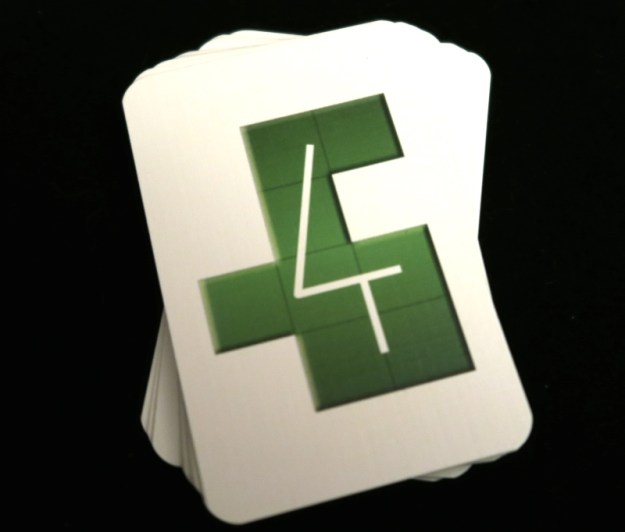
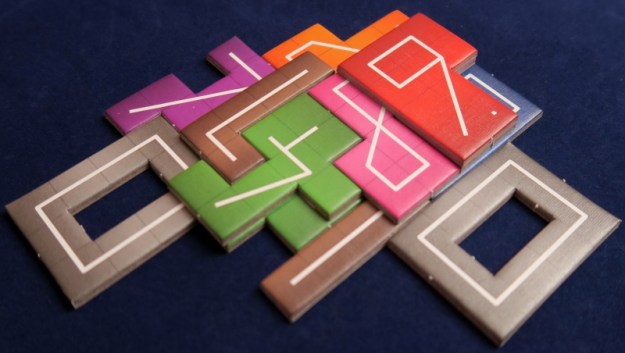
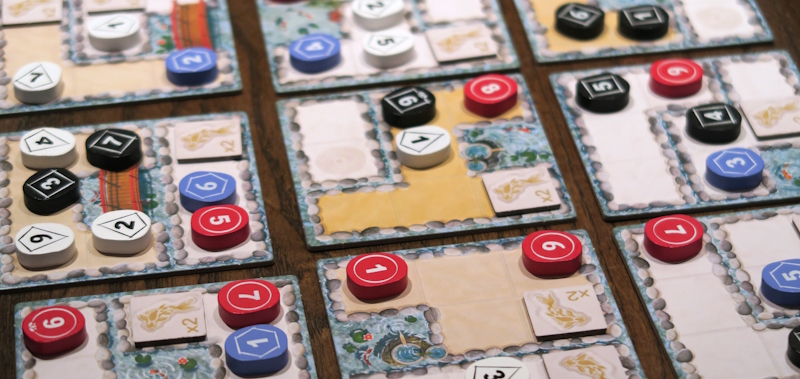
This is a super-quick little game, but what really makes it special is that it has almost zero set-up time. The idea is that one player turns over cards, and these indicate which of ten tiles should be played on that turn. Players take the tiles straight from the box and add them to their tableau with players making sure edges touch and when placing tiles on higher layers, there must be no overhangs and tiles must cover at least two other tiles. Players score for the number on each tile multiplied by the “story” or “floor” (thus a nine placed on the third layer (second floor) scores eighteen points). The player with the largest total is the winner.
 |
| – Image by boardGOATS |
Everything started reasonably well with some low numbers to start, including the zero, to help players build a base. The first nine came out in time for most people to have built a base to place it on, but it was after this that it all started to go wrong. Everyone seemed to struggle to fit the numbers coming out anywhere higher than the bottom layer, and even then players discovered they had blocked themselves from the best base places. Players were were struggling to get much on their second layer, let alone the third, so by the time the last two numbers were drawn (six and one), most people had barely managed a third layer.
 |
| – Image by boardGOATS |
The one came out and was generally placed on top for a whopping three points for most and then the six could only go on the second layer. Everyone felt they just hadn’t managed things very that well this time—all except Black that is. He had been quietly getting on with things in the corner, building his third layer and a final fourth layer for his last number. The end result was that Black ended up with a score that was one of the group’s highest ever for this game and nearly twice that of second place Teal with Green not too far behind in third. With that done, it was time to decide who would play what.
 |
| – Image by boardGOATS |
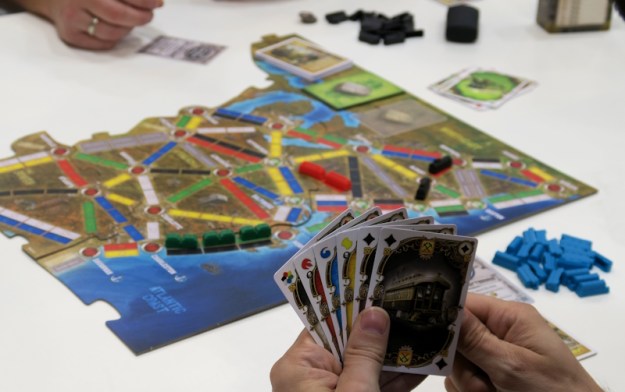
Most people seemed to want to give the “Feature Game“, Flamecraft a go. That was OK, as we had two copies of that available, but the question was what the third game might be. Green failed to find any takers for Terraforming Mars, so in the end Pine and Teal joined him giving the Pennsylvania map for Ticket to Ride a go. The Pennsylvania map is part of Map Collection Volume 5 and is the reverse side to the United Kingdom board. All the Ticket to Ride games are built round the same basic idea: on their turn, players either take carriage cards from the market or use carriage cards to pay to place trains on the map connecting cities together. Players score points for placing pieces on the map and for completing tickets (connecting two places on the board).
 |
| – Image by boardGOATS |
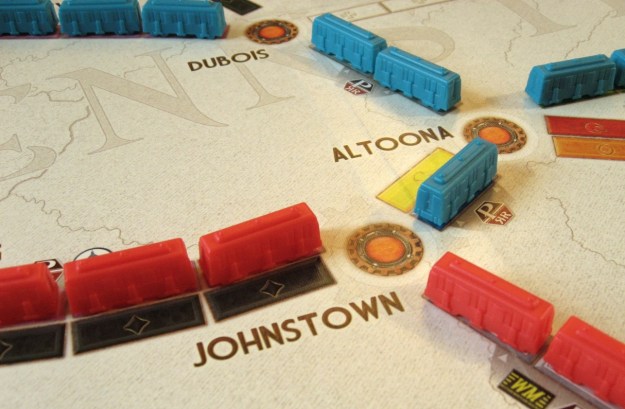
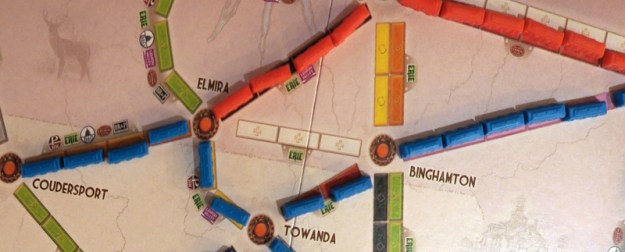
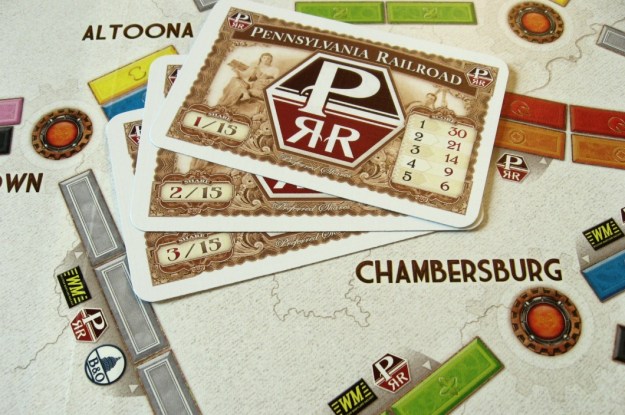
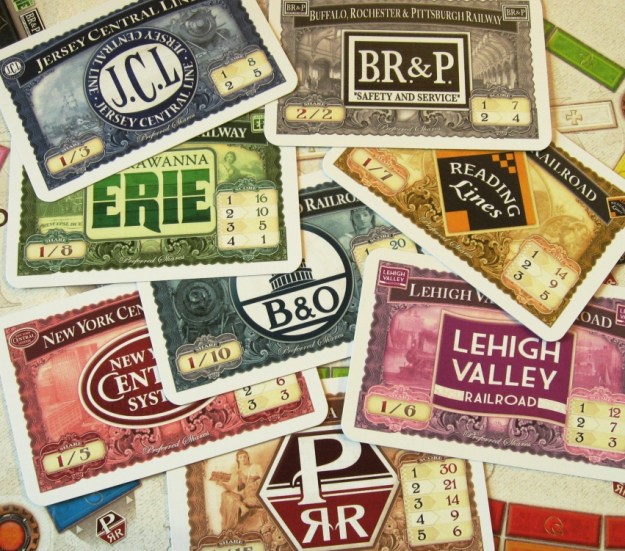
Each map has special rules and or mechanisms that are unique to it. In the case of the Pennsylvania map, this is the ability to acquire Shares. Each time a player completes a route, they claim a Share token for one of the companies depicted next to that route. At the end of the game, whoever holds the most Shares in each company receives points. The trio entered into the game without much thought of how it might be best played, so started out doing their best to complete tickets, with the Shares just an added bonus. Pine was the first to place a train, from Johnstown to Altoona, while Green and Teal continued to collect cards. Teal was second to place trains, a long route on the eastern side from New York to Philadelphia and Green was a little later in the north west.
 |
| – Image by boardGOATS |
There wasn’t much else going on except card collecting, and there didn’t seem to be any Locomotive cards in the deck. When Pine extended his single train westwards to Pittsburg, there was a groan from Green—he had just been unable to get the colours he needed for the same track and now had to go the long way round. Adding to Green’s woes, Teal then took the three train route in from Towanda to Scranton, that he’d wanted for his two point ticket. Annoyingly, it didn’t have a specified colour, so he could have placed something there almost any time, but had been concentrating on getting the colours for the routes into Johnstown for his bigger value ticket.
 |
| – Image by boardGOATS |
When Pine then claimed the final entry into Johnstown to completely block Green out, he was convinced his game was over, with two failed tickets before it was even half way. With a handful of train cards and no-where else to go, Green was the first to take new tickets, keeping just one. After placing trains along the northern edge of the state and into Canada, Green had another go at taking tickets, this time keeping two. With there being a big fifteen point bonus for the most completed tickets and no bonus for longest continuous string of train pieces, this version of Ticket to Ride encouraged everyone to place trains on almost any route.
 |
| – Image by boardGOATS |
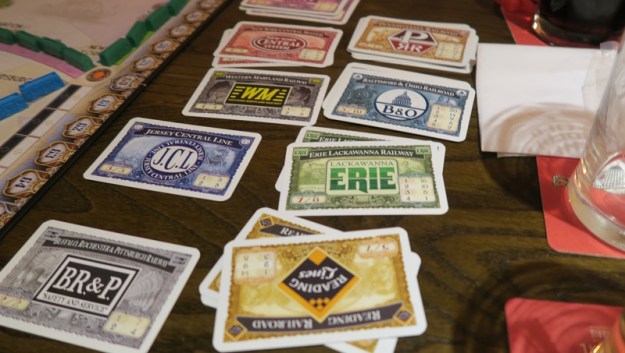
And this was without the Shares—everyone had been been quietly collecting them. Pine seemed to be going for a lot of the highest value, the Pennsylvania Railroad Company, although that was mostly because he kept forgetting he had them. Teal was collecting a variety, but was the first to take Shares in a lot of the lower value companies (which had fewer Shares available). In fact he was so entranced with the share collecting, he was placing his trains on routes to collect shares and forgetting about his ticket completion, which was to be his downfall.
 |
| – Image by boardGOATS |
Pine brought the game to a close with just two trains left leaving Green and Teal to place one more two train route each, though Pine was unable to place any more trains for one last Share. Not terribly surprisingly, Pine eschewed Teal’s suggestion of taking tickets. He’d taken some earlier and although in this game players get four tickets and only need to keep one, he still felt they looked awfully difficult to do. Plus with trains all over the board, it seemed very unlikely that a route may have already been completed, much more so than in some of the other versions of the game where it sometimes feels like it is worth a shot.
 |
| – Image by boardGOATS |
The final scoring was to prove interesting: scores for just placing train pieces on the board were all relatively close. Everyone had to get their fingers and toes out to score the Shares, but in the end found the scores were all very close on these as well, even though everyone had had different approaches towards them. It was the tickets that were to be the deciding factor. As mentioned, Teal had largely forgotten about his routes, and although he had managed two of them, the last was incomplete and counted against him, giving him a ticket score in single digits. Pine had completed four tickets with most of them being good scorers. Green had also managed to complete four tickets, but this score was off-set by his two failures from the early part of the game.
 |
| – Image by boardGOATS |
The tie for the most ticket bonus was “friendly” so they both scored it, but those failed tickets cost Green a total of around forty points, roughly Pine’s winning margin. As the group packed away, they discussed the Pennsylvania map and agreed it was quite good. Although the Shares score was fairly even, the fact that the bonus was for tickets and not the longest continuous set of trains, meant everyone tended to build all over the board rather than focusing on a connected set. The feeling was that playing again people might well go for even more of the short routes to gain more Shares, rather than the long high scoring routes—food for thought from a very worthy Ticket to Ride expansion.
 |
| – Image by boardGOATS |
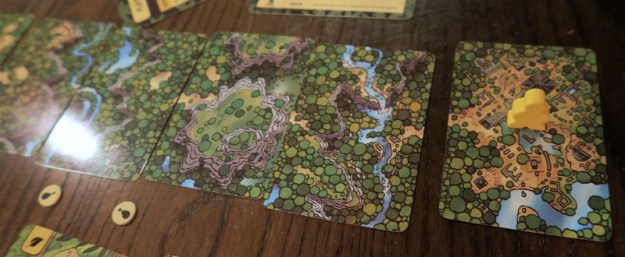
By this time it was nearly 10pm, but Teal wanted to try out the cooperative game, The Lost Expedition. The box suggested thirty to fifty minutes, but Teal assured the group that it was unlikely to take that long and everyone would probably die fairly quickly. He had played it solo a few times and always died, so was keen to try it with a team. The idea of the game is that they take the role of a team of three in search of the lost legendary explorer, Percy Fawcett. The game has really nice artwork a little reminiscent of Tin Tin style and large, easy to read cards. Teal explained the rules, but it wasn’t until play started that Green and Pine really understood how it worked and it wasn’t really that difficult.
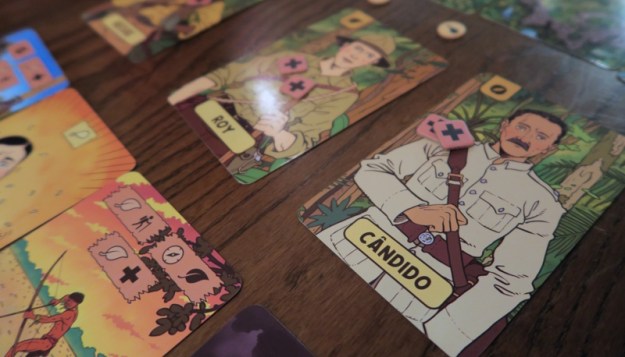 |
| – Image by boardGOATS |
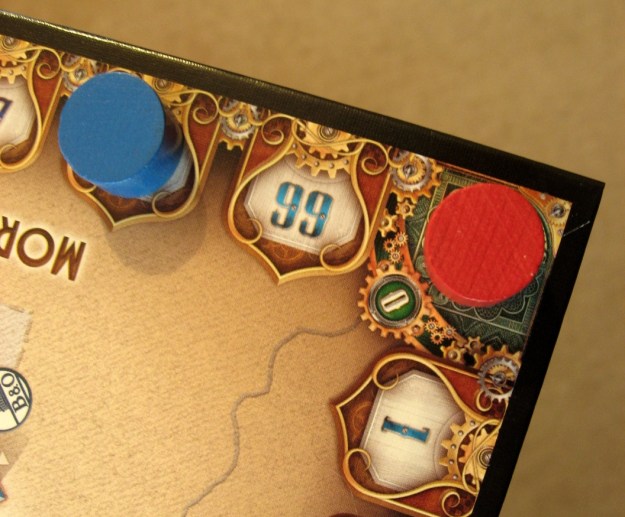
Each player started with a hand of four cards and took it in turns to lay one forming a route, with the numbered cards increasing in value. This was creating a path for the explorers to travel, with some loses and some benefits, and several cards which also allowed them to skip or swap other cards on the track. This meant that if there was a particularly bad card the players could try and place it after one that allowed following cards to be skipped, and therefore not have to deal with it at all. In the first “Morning” round, the group each played two cards from their hand. Once that was done, they then started down the path, deciding what to do with each one.
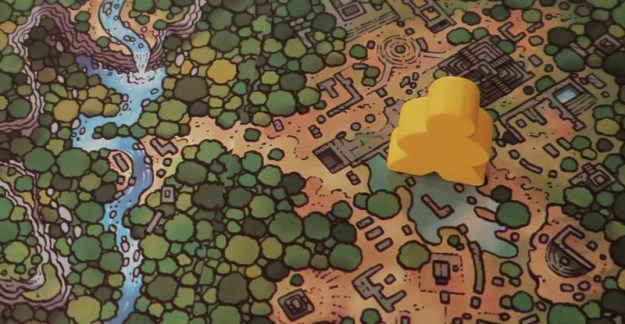 |
| – Image by boardGOATS |
There were usually several choices: some had compulsory things to do, others were optional. For example, for the Panther card the group had to decide on whether to use one of the three bullets the team start the expedition with (leading Pine to comment on how stupid it was to enter a several day jungle adventure with only three bullets!) in order to gain three food, or to lose a health token to skip over the card. Once the first path was completed, the group progressed onto the next part, the “evening”, building a path from the remaining cards in the order of placement (the face value on the card was irrelevant now).
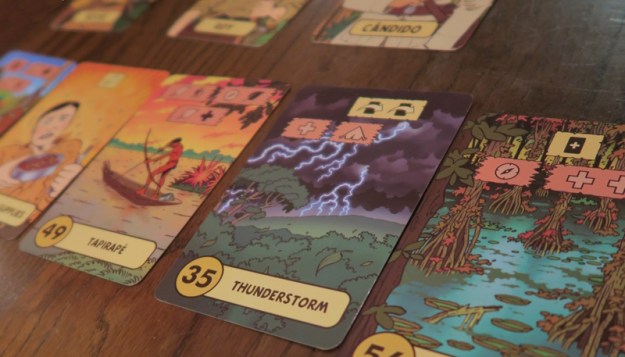 |
| – Image by boardGOATS |
Fortunately, the group had a couple of skips and swaps (allowing them to switch the position of two cards on the path), and by the end they had taken several steps on the main route through the jungle towards their goal. The group had taken a few health hits along with the way, but their three characters still seemed to have at least two or three of their initial four health points remaining. The next day everyone again started with four cards and by the end of the morning phase the team were only two steps from the goal, but their health was beginning to look a little poor. With the evening placements the group somehow managed to make those final two steps with the first two cards of the path before anything bad happened.
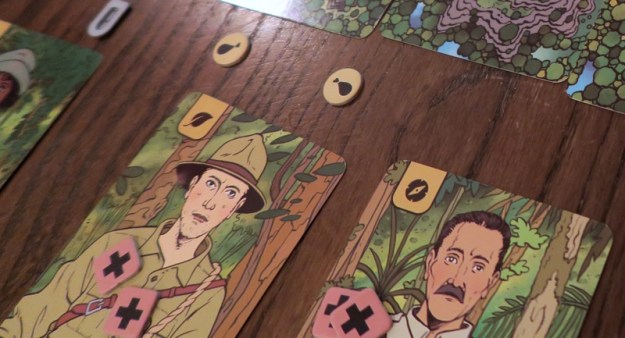 |
| – Image by boardGOATS |
The team had beaten the game, however, it was with the easy setting which has only seven spaces on the main route through the jungle—the standard game has nine! Nevertheless, Teal was pleased to have finally beaten the game and Green and Pine had enjoyed it too. It is a clever little co-operative game that really encourages discussion and doesn’t let one player dominate. With the hand of cards it also provided an element of individual game play and decision making, further preventing the “alpha gamer” problem that often blights cooperative games. As a result, this game might well appeal to those who do not normally enjoy them and this one could well get another outing.
 |
| – Image by boardGOATS |
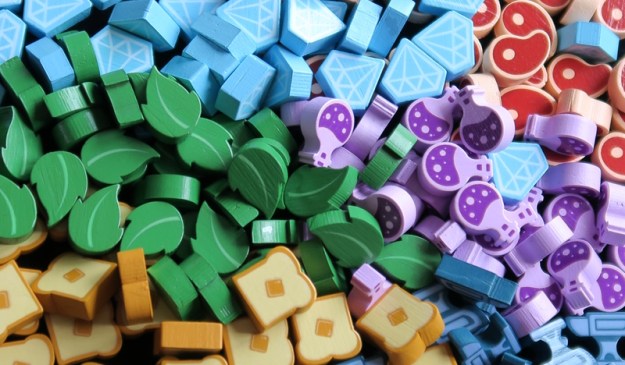
Meanwhile, the other two tables were playing the “Feature Game“, Flamecraft. This is a game where players take the role of Flamekeepers, gathering items, placing dragons and casting enchantments to enhance the Shops of the town with the aim of finishing the game with the most Reputation points. A sort of worker-placement game, players take it in turns to firstly move their dragon to one of the Shops and then either Gather resources from it and optionally play a dragon into the Shop, or spend resources to Enchant or upgrade it so it provides more resources. This sounds very simple and not terribly exciting, but the interplay between the actions on the dragon cards and the large pile of available Shops is what makes the game interesting.
 |
| – Image by boardGOATS |
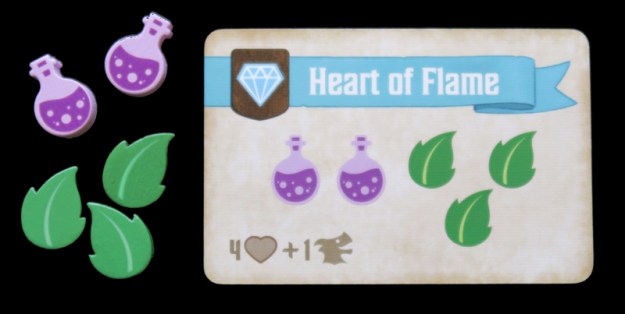
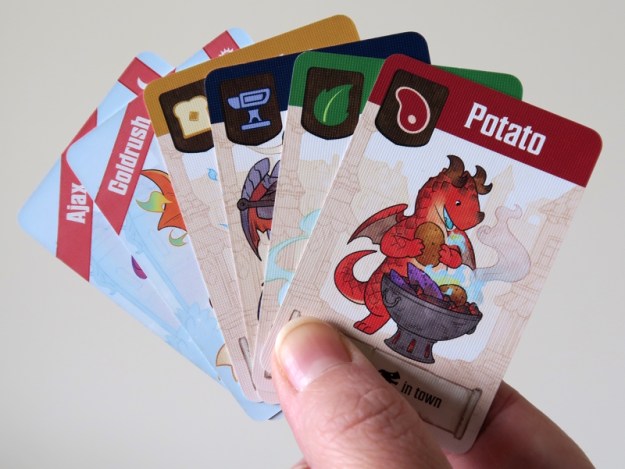
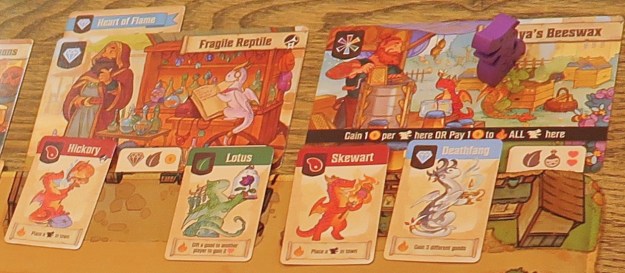
When a player Gathers resources they can also activate or “Flame” one dragon and the special ability for the Shop (if it has one). In contrast, a player that Enchants a Shop, they can activate all the dragons in the Shop, but cannot activate any special ability associate with the store. There are six different types of Artisan Dragon and, although every card has a unique name and artwork, the actions are the same for any one type. For example, all Diamond Dragons allow the active player to take three gems from the supply, and all Bread Dragons allow them to take another Artisan Dragon card from the market or face down deck.
 |
| – Image by boardGOATS |
Players get Reputation points for Enchanting Shops: they pay resources to buy one of the face up cards from the Enchantment market and add it to the Shop they are at which must match the Resource type. There are other ways of getting Reputation though. For example activating a Plant dragon allows a player to gift another person any resource and in return get two Reputation points. Some of the Shops also give Reputation points, but perhaps one of the best source is through Fancy Dragons. These are special dragons which are effectively Goal cards.
 |
| – Image by boardGOATS |
Players start the game with two Fancy dragons and choose one to keep and add to their hand. These come in two types—day and night. Daytime Fancy dragons (marked with a sun) can be completed at any point during the player’s turn and give points in exchange for Resources or manipulating the game so certain conditions are met. In contrast, nighttime Fancy dragons are evaluated at the end of the game giving points, for example, for being the player with the most of one Resource or for each Resource of which you have an odd number.
 |
| – Image by boardGOATS |
Both groups began with the slightly simpler, purple enchantment deck and without the special helper cards (which are an optional addition to the game that provide a one-time special ability to each player). Just as Byzantium, Ivory and Blue were about to start, Pink rocked up and joined the game so after the set up had been adjusted and the rules were explained they got going. Blue started by collecting Resources. On the first play, Flamecraft has a tendency to feel a little bit aimless, but as soon as the special (non-start) Shops started to come out, things get a little more interesting. Although there are only six different types of Artisan dragons, the interplay between them and the Shop powers is much more interesting than it seems at first glance.
 |
| – Image by boardGOATS |
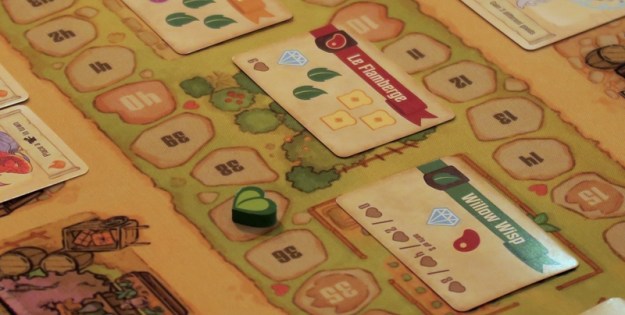
Ivory was quick to get a feel for things and soon scored some points, as was Byzantium, who was the only one around the first table that had played it before. Pink and Blue were a little slower to get off the ground, but soon started to improve their Reputation as well. There was a bit of a rules glitch towards the end when they realised they had forgotten to put out at least one new Shop, but otherwise play proceeded very smoothly to the end of the game. None of the Shops with the wild icon came out, but there was an awful lot of iron available from early in the game.
 |
| – Image by boardGOATS |
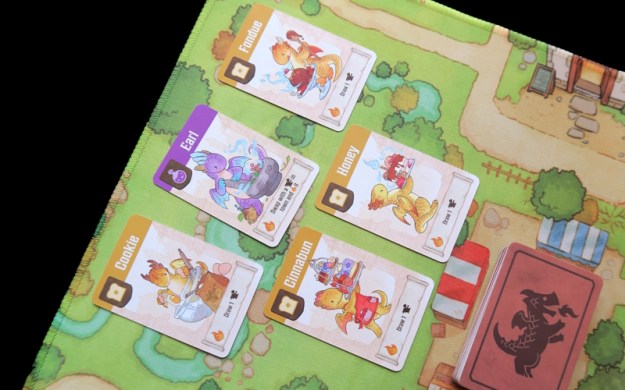
There was also a bit of a general shortage of Bread dragons, which is significant as activating them allows players to take another Artisan dragon card, and the few that were played were moved all over the board by people playing Potion dragons. It was a close game though with lots of to-ing and fro-ing, but when Blue had the chance, she triggered the end of the game by taking the last of the Artisan dragons, giving everyone one last turn which they tried to use to their best advantage. Blue just got her nose in front with Ivory a point behind, but there were still nighttime Fancy dragons to add on and points from dragongeld too.
 |
| – Image by boardGOATS |
Unfortunately for Ivory, his extras exactly matched Blue’s so her single point lead remained, with Byzantium taking third. The second Flamecraft group were slightly slower to get started and were still very much underway with both the Ticket to Ride/Lost Expedition and first Flamecraft groups finished. Pine, Teal and Ivory headed home, so while the second Flamecraft group finished and Byzantium watched, Pink, Green and Blue played a quick game of the filler, No Thanks!. This is one of our old favourites and is very simple with players either taking the face up card on their turn or paying a chip to pass the problem on to the next player.
 |
| – Image by boardGOATS |
The player with the lowest face up total wins, so eyebrows were raised when Green started collecting cards in the thirties. If players get a run, only the lowest of the set count to their final score, but since nine of the thirty-four cards have been removed from the deck it is dangerous to bank on building long runs. Pink picked up the four as almost the first card of the game, and managed to build quite a long run over the course of the game. All was going well until he ran out of chips and was forced to take cards he didn’t want. This also screwed up Green’s plans as he wasn’t able to make the most of his high value cards and force Pink and Blue to give him chips.
 |
| – Image by boardGOATS |
Worse, Pink took a couple of cards Green really wanted. Blue, who started collecting cards in the high teens extended her run into the low twenties. The final card she needed, the seventeen was the final card in the deck and she snaffled it at her first chance to end the game and give her a run from fifteen to twenty-one. After a couple of recounts, Pink and Green finished in a tie with a massive sixty-nine points, more than twice Blue’s winning score.
 |
| – Image by boardGOATS |
The second game of Flamecraft was just coming to an end, but unfortunately, they had a slight rules malfunction and were playing that emptying either the Fancy dragon or Enchantment deck triggered the endgame, when it is the Artisan dragon or Enchantment deck according to the rules as written. Usually, it is Blue that makes these sort of rules errors, so despite having read the rules at least three times in the last few hours, she panicked and checked them yet again, just in case. The second group had a shortage of Bread dragons as well, though for a slightly different reason.
 |
| – Image by boardGOATS |
The selection of Artisan dragons in the face up market was almost entirely “Toast” for most of the game—Black shuffled so they blamed him. This meant players spent most of the game taking Artisan dragons blind from the top of the face down draw deck. As a result, players didn’t have Bread dragons in hand, so only a couple of Bread dragons were placed in Shops and they just got pulled from pillar to post for the whole game. The Shop shuffling was slightly better though and there were some that came out that were new Plum and Jade (who had both played before), which was nice. The game was also close, with Jade taking victory by a single point from Plum with Purple taking third a few points behind.
 |
| – Image by boardGOATS |
Learning outcome: Even dragons like a nice sandwich.







:strip_icc()/pic6895245.jpg)

 boardGOATS