Blue and Pink were first to arrive, and, as they finished their pizza, others began to turn up too. It was a slow start on a relatively quiet night, but eventually Blue Ivory, Black and Jade were settling down to play the “Feature Game“, Ginkopolis. This is a medium weight tile-laying game with an area control element. Blue explained that it was one of those games that had been through a phase of being very out of print and therefore inevitably in high demand, though now was much more available. The game is set in 2212 where players are urban planners trying to building the eco-city, Ginkgopolis, though the theme is quite loose and in reality, it is much more more abstract that that.
 |
| – Image by boardGOATS |
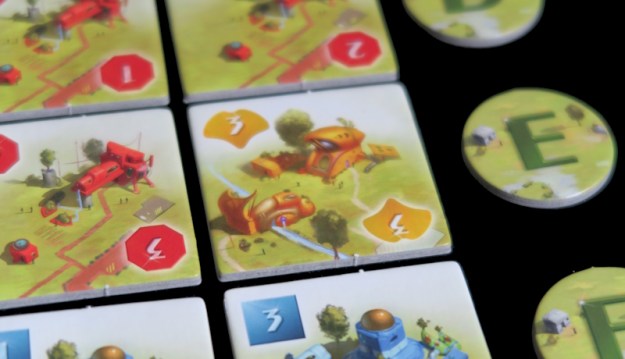
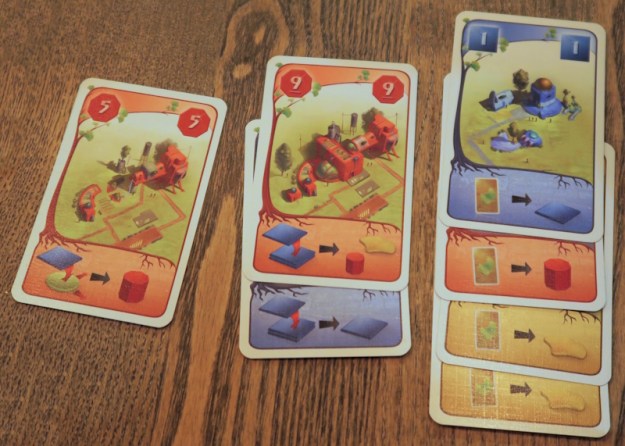
The game is card-driven, with players simultaneously choosing a card and any tiles they are going to play with it, and then, starting with the first player, taking it in turns to carry out one of three possible actions: Urbanise, Construct or Exploit. There are two different sorts of cards in the game, Urbanisation cards which feature a letter, and Construction cards which come in three different colour suits, red, blue and orange, and are numbered one to twenty. When choosing either an Urbanise action or a Construct action, players additionally choose a Tile to play from their personal stash. Urbanising involves placing a tile in the space matching the letter on their Urbanise card, adding a wooden Resource block in their colour to claim it.
 |
| – Image by boardGOATS |
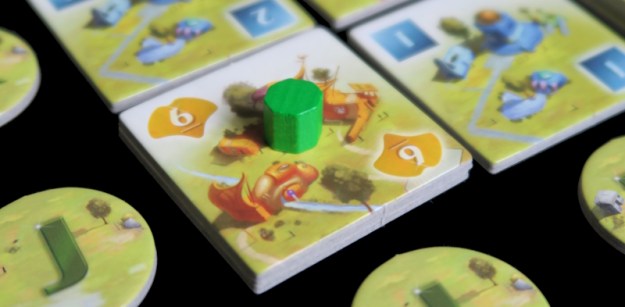
There is a little upkeep, in that they move the Urbanisation letter marker to a space orthogonally adjacent to the Tile they placed and mark it with a grey cylinder. As a reward for urbanising, players get to Activate all orthogonally adjacent buildings. This is claiming a number of Tiles, Resources or Ginkgo Points (a sort of currency used in the game), with the item dependent on the colour and the number received equal to the height of the Building activated. Constructing is similar, except the Tile chosen is placed on top of another Tile, returning any Resources on the tile to their owner and claiming Ginkgo Points from the bank for each one.
 |
| – Image by boardGOATS |
In addition to this immediate reward, there are also costs: if the Constructed Tile has a lower number than the tile it is built on, they must pay the difference in Ginkgo Points and if the colour is different, they must also pay one Resource to the general supply. In addition to these potential costs, the active player must also place Resources from their stash on top of the newly expanded building to claim it (with the number equal to the height). This can make Constructing expensive, though as the game progresses, they get Resources back as other players build on buildings they have Urbanised or Constructed. Still, particularly early in the game, players can find themselves running out of supplies, in which case, they can Exploit.
 |
| – Image by boardGOATS |
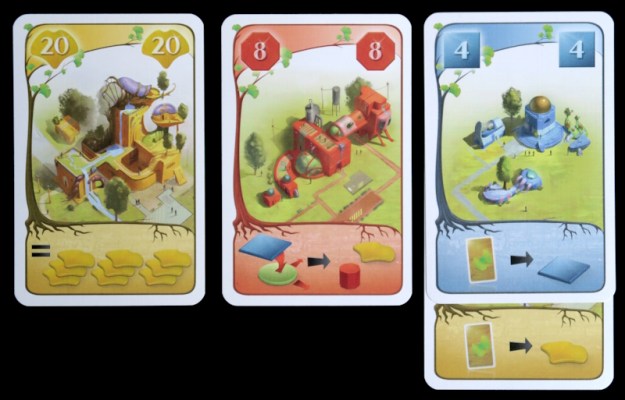
Exploiting involves playing cards (without a tile) to gain Tiles, Resources, or Ginkgo Points. How they Exploit depends on whether the card they are Exploiting is an Urbanisation card or a Construction card. For Urbanisation cards, players just take either a Resource or a Tile from the supply, whereas for Construction cards, players Activate the building on the card to receive Tiles, Resources or Ginkgo Points equal to the height of the building. This is not the only way to get resources, however. Once a player has carried out their chosen action, they either recycle the card (if they Urbanised or Exploited) or, if they Constructed, they keep it in front of them. Each Construction card has an action as well as a number and a colour, and these are activated during the game, most after carrying out actions, with some providing end-game Points.
 |
| – Image by boardGOATS |
And scoring is where the game gets tricky. The winner is the player with the most Ginkgo Points at the end of the game, but in addition to chips acquired during the game and end-game points from Construction cards, the majority of the points come from the area control element of the game. The city is divided into districts with districts defined as areas containing at least two buildings of the same colour. The player with the most Resources in the district wins control and takes Ginkgo Points equal to the total number of Resources in the district. The player to take second gets Ginkgo Points equal to the number of their Resources in the district. Ties are broken in favour of the player with the highest building.
 |
| – Image by boardGOATS |
There is quite a lot of critical upkeep in the game, but the most important it to remember to put a grey construction cylinder on buildings during Urbanisation and Construction. This is because at the end of each turn, players top their hand back up to four cards drawn at random—when the draw deck is empty, however, the discard deck is recycled and topped up with cards that correspond to the newly constructed buildings. Since cards that correspond to buildings are kept when the building is over-built, and everything else is recycled, the draw deck (and the cards in hand) comprise all the buildings currently visible, together with all the Urbanisation cards, and nothing else.
 |
| – Image by boardGOATS |
Getting this wrong, breaks the game spectacularly, as Blue and Ivory had found out on the one other occasion they played it (with Pink, during one of the sporadic meetings in the pub late in the Summer of 2020). This time, they were aware of the importance of placing the grey markers and mostly managed to stay on top of that so everything went a bit smoother, allowing players to concentrate on the nuances of the game. And there are lots of nuances. For example, over-building can help a player to take control of a district, or, if they change its colour, break one up, but it also gives Resources to the previous owner. Similarly, Urbanising expands the city, but provides a cheap way for other players to expand districts and perhaps muscle in.
 |
| – Image by boardGOATS |
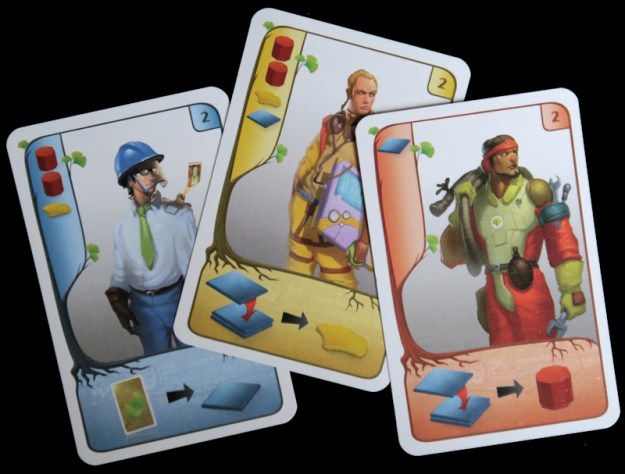
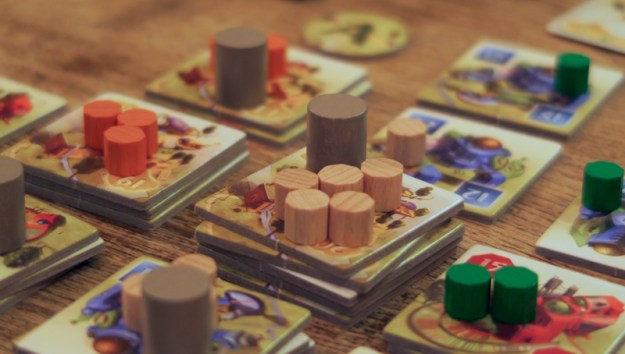
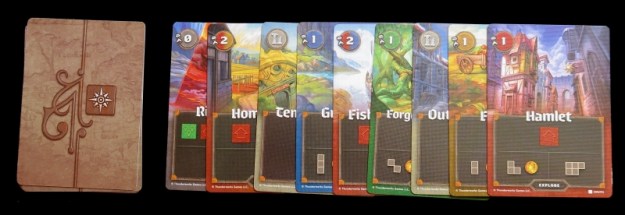
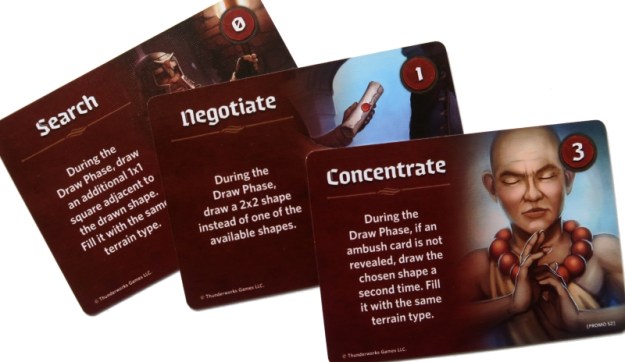
The game started with everyone feeling their way, trying to make the most of the Character cards they were dealt at the start of the game. These give bonuses to players to get them going in the early stages of the game. It is possible to draft these character cards, but the group began with the preconstructed sets: Ivory got set one, Black got set six, Jade got set two and Blue got set five. These give players a strategy steer in the early part of the game, for example, Blue and Black’s cards gave them two bonuses for Exploiting while Jade and Ivory both benefited twice for Constructing. Quite early in the game, it became clear that there was one building towards the middle that was going to be quite critical in the area control battle and Blue, Black and then Ivory all over-built and tried to claim it for their own.
 |
| – Image by boardGOATS |
The game has the ability to feel very swingy, and lacking in control, and yet it is actually an extremely smart, tactical game—one clever tile placement can completely change the game by breaking up a district or joining two districts together and totally change the balance of power. This game was no different in that regard, though it took a little time for everyone to really start to see its potential. There were other elements of the game that players gradually came to appreciate. For example, Black ran into the unexpected difficulty of running out of Resource markers, because he had a lot in the city. This gave the others a problem—building over his buildings relieved that pressure, but because he had so many on the board, it was hard to avoid doing it.
 |
| – Image by boardGOATS |
Jade also had difficulties getting the tiles he wanted to match his cards, while Ivory had difficulties getting the cards he wanted (and was the only one to spend one of his refresh hand tokens, which cost him two points in the end-game scoring). The game ebbed and flowed, and although it vastly exceeded its advertised forty-five minutes, it wasn’t long before the stack of tiles dwindled and triggered the end of the game. At this point, players could choose whether to add tiles from their hand back into the game. Jade was aghast at the idea having struggled to get tiles throughout, but Ivory had an enormous stack and put a few back into the supply to keep things going for another couple of rounds.
 |
| – Image by boardGOATS |
As the game drew to a close, the question was whether anyone would be able to make a move on the largest districts. The highest building that had been long fought over now belonged to Ivory, but had been cut off, leaving it pointless, which left two large red and one large blue district as well as some smaller efforts. Key was the number of Ginkgo points picked up during the game—everyone thought Ivory had a lot, but it turned out Black was the king of the Ginkgo tokens with a massive thirty-six. Blue was a little way behind him, but made up for this with her city scoring, which ultimately gave her victory with sixty-six points, nine more than Black in second who was well clear of Jade and Ivory who tied for third.
 |
| – Image by boardGOATS |
Meanwhile, on the next table, Purple, Green and Pink were deciding what to play while they waited for Pine who was running late. Green commented that he didn’t want to play something new, so in the end the group settled on Splendor. This is an old favourite, though one with poignant memories for most in the group as it was a favourite of Burgundy who sadly passed away eighteen months ago—it would have been his sixty-fifth birthday at the end of the month. As always, with Burgundy in mind, the trio set the game up. It is a very simple, tactical engine builder, where players take it in turns to either take chips from the supply, use chips to buy a face up card from the market or, occasionally, reserve a card.
 |
| – Image by boardGOATS |
Players win points for the higher value cards, or for collecting enough cards of specified colours to claim a Noble. This time, Pink tried a strategy that concentrated on going for cheap cards with the primary aim of scoring for Nobles. This had the benefit of giving him lots of cards which builds the engine quickly making other cards cheaper. The strategy worked well, but not as well as Pink needed it to for him to beat Green who ended the game, with a lead of three points. As Splendor came to a close, Pine rocked up, so the newly expanded, now quartet looked for something fairly light to play, and Pink suggested one of his favourites, For Sale.
 |
| – Image by boardGOATS |
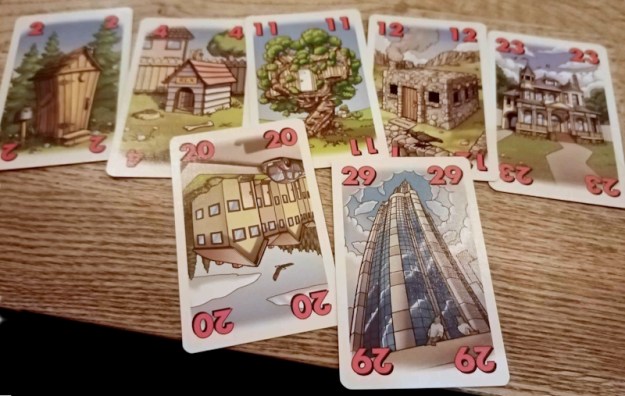
As Pink described it, like football, For Sale is a game of two halves. In the first half, players bid for properties which they then sell in the second half of the game. This time, Purple became a bit of a tent specialist (with tents of various quality), which turned out not to work so well for her. Pine ended up with the outside netty (one of the lowest value cards), but one that you are almost guaranteed not to loose money on. Once again, however, the winner was Green with Pink taking his second second place. So the question was, could anything upset that pattern?
 |
| – Image by boardGOATS |
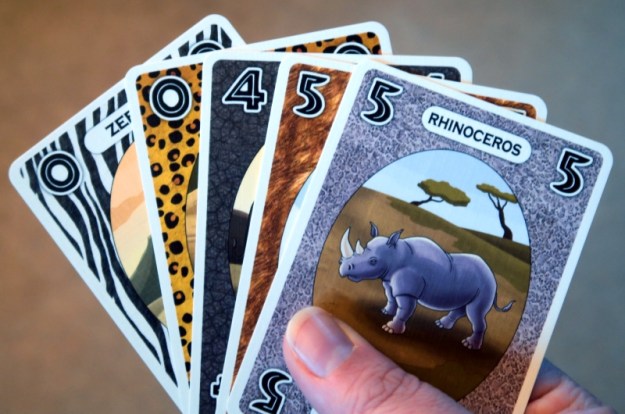
The group moved on to Botswana, a sort of set collection stock-holding card game that it is really hard to get your head round despite actually being very simple. The five animal suites each have six cards, which are shuffled together and dealt out. Players then play a card from their hand, and take any one of the animals on the table. The round is over when any one of the five animals has the sixth card played, at which point players score points for each animal they have, equal to the final card played. After three rounds, the player with the most points is the winner.
 |
| – Image by boardGOATS |
This time, all three rounds were remarkably even. Purple was just one point behind green going into the final round, though Pink had some ground to make up if he was going to continue his run of second places. In the end, Green made it three from three, and relatively poor final rounds from both Pink and Purple left Pine to take second with Purple just behind. Green decided three was enough, and didn’t fancy tarnishing his winning streak, so headed off while Purple and Pink waited for their other halves to finish Ginkopolis, and looked round for a suitable filler.
 |
| – Image by boardGOATS |
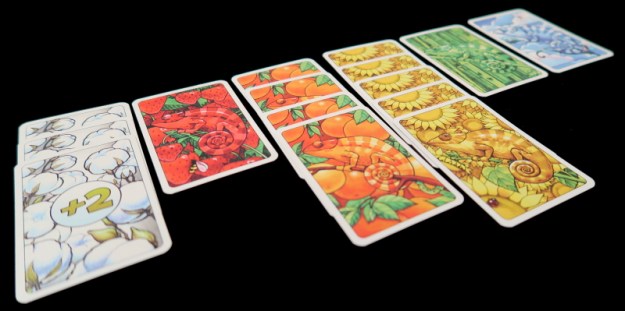
Coloretto is another old favourite, and one that plays really well with three. A really simple set collecting game, on their turn, players either turn over a coloured chameleon card and place it on a truck, or take a truck. At the end of the game (when the draw deck has been mostly depleted), players score points for each coloured set of cards. In general, the larger sets score more, but only the largest three score positively, everything else gives negative scores. For a bit of variety, the group used the scoring card from the Limit Cards/Extra Cards mini expansion (but without any of the other rules and cards). This gives low scores for the small groups, but very high scores for the large sets.
 |
| – Image by boardGOATS |
Aside from a query about the Golden Joker (which like the normal multi-coloured Joker can be added to any set at the end of the game, but additionally gives an extra card drawn at random from the deck), there was no real need to revise the rules. It was a good game, though Pink blotted his copy book with quite a lot of negative points and wasn’t able to improve on his two second places as a result. The run-away winner was Purple though, who finished with forty-eight points, eight more than Pine in second place. And with Ginkopolis coming to an end too, that was it for another week.
 |
| – Image by boardGOATS |
Learning Outcome: In some games, you have to start building right from the gink-go…






 boardGOATS