Tag Archives: Honshū

25th March 2025

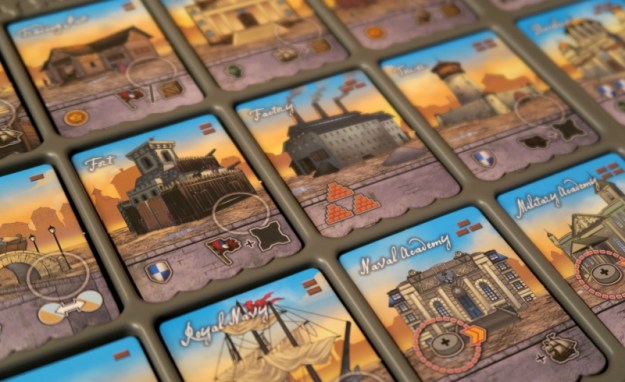
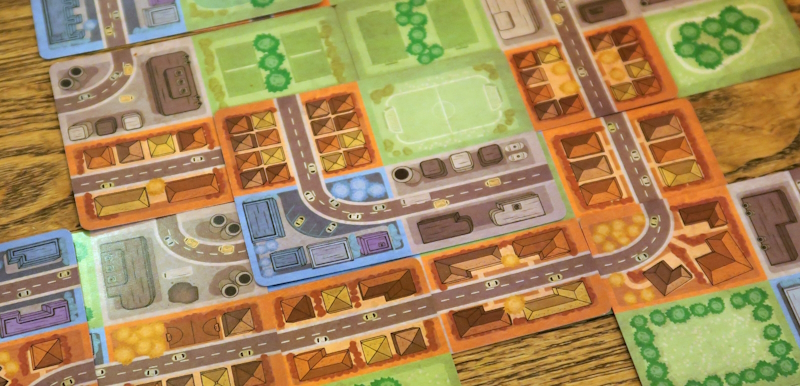
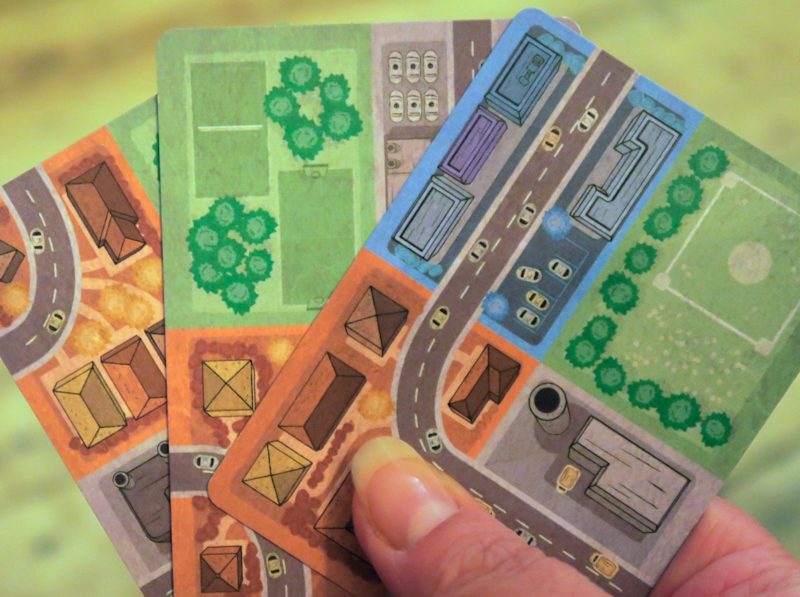
With a generally Japanesey theme planned for the evening to mark the official start of the Japanese Cherry Blossom Season, Blue and Pink, the early arrivals considered 5×5 Zoo, Songbirds and Honshū which were all abandoned variously because the rules were in Japanese, the game was too complex, or it didn’t natively play two.  In the end, they settled on Sprawlopolis, which although very definitely not Japanese, did at least have a bit of a Japanese feel to it.  The game is a simple quick cooperative micro-game where players take it in turns to at to their city by placing cards.
Sprawlopolis
– Image by boardGOATS

Each card is quartered with each section showing one of the four different zones, green Parks, brown Residential, grey Industry and blue Offices.  The players score a point for each piece in the largest region of each city zone minus the number of roads, plus scores for each objective.  This time the objectives were “Master Planned”, “The Outskirts” and “Sprawlopolis” giving a points target of twenty-five.  It was close and, as Blue and Pink weren’t quite on the same wavelength with their planning (communication is allowed without describing the cards in hand) it was didn’t look like they were going to make it, but in the end, they topped the target by two points.
Sprawlopolis
– Image by boardGOATS

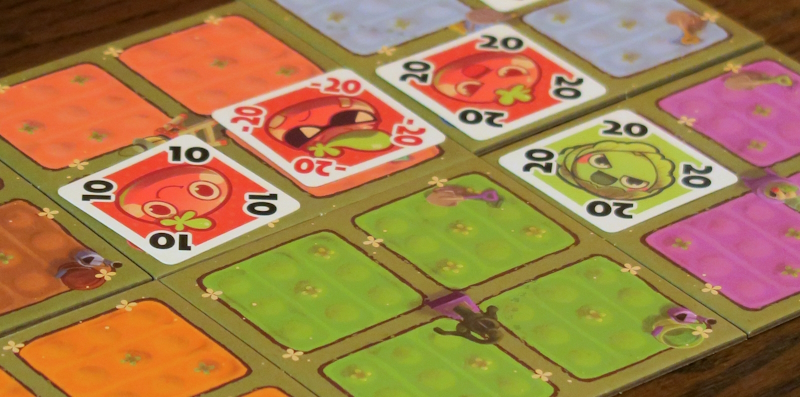
By this time, everyone else had arrived so the group split into three with the first group, a large group of six playing the “Feature Game” which was Habesuto (aka ハーベスト) which translates as “Harvest”.  This is a quick game from Japan about building a farm, growing vegetables and distributing produce. On their turn players play a card onto the central board and then replenish their hand.  Each player owns a field in the central play area; if that field is empty then players must play a card into their own field, thereafter, they can play anywhere.  When a row of three or more cards is created, the cards are scored, with the cards, and therefore points, going to the owner of the field, but points can be positive or negative.
Habesuto (aka ハーベスト or Harvest)
– Image by boardGOATS

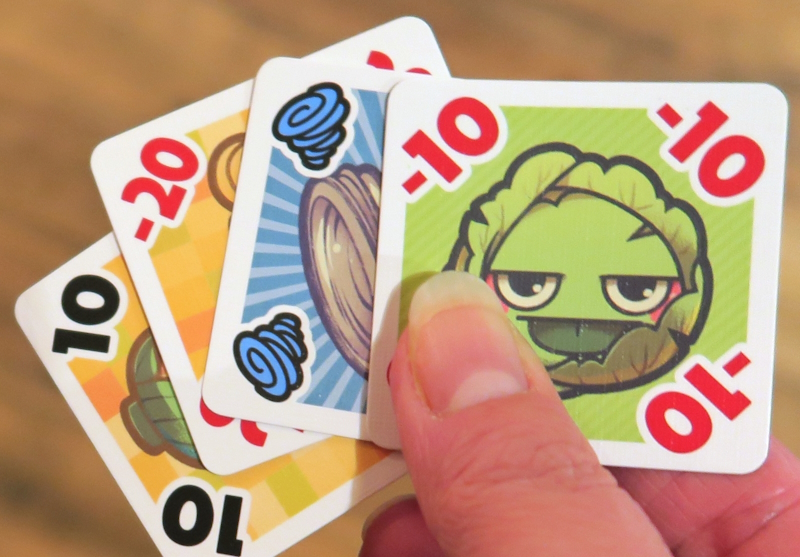
There are special cards like the Tornado which removes cards and the wild Harvest card.  There are three vegetable suits of cards (red, yellow and green) each with five denominations, ten, twenty, forty, and minus ten and minus twenty.  At the end of the game, when everyone has run out of cards or is unable to play, players score the value of each card in their score pile.  To this they add fifty points if their field is empty, but subtract fifty points for each special card left in their hand.The game is really quick and nasty.  Initially everyone felt their way through and began playing nicely.  The niceness was reflected in the scores which were very even—Teal was the winner with a hundred points, but it was a three-way tie for second between Sapphire, Ruby and Lime.
Habesuto (aka ハーベスト or Harvest)
– Image by boardGOATS

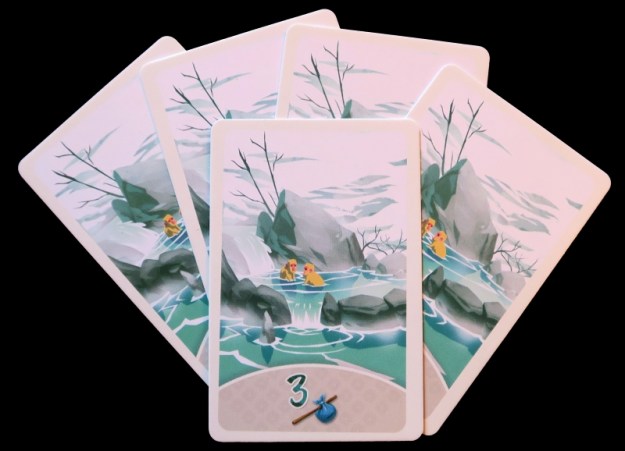
Everyone had got the feel of the game and wanted to play again, but this time, the gloves were off.  Second time round, Ruby was the victor with Teal increasing his score, but dropping down the rankings into second with a hundred and sixty.  Jade came in third, twenty points behind.  The third round was a bit more evenly balanced, with Lime taking first place with a hundred and thirty and Flint the only other player to make it into three figures.  Teal went from hero to zero and finished the final game with minus ten.  From there, the group decided to move away from Japan and into a world inhabited by cute animals with River Valley Glassworks, which got its first outing just a week ago.
River Valley Glassworks
– Image by boardGOATS

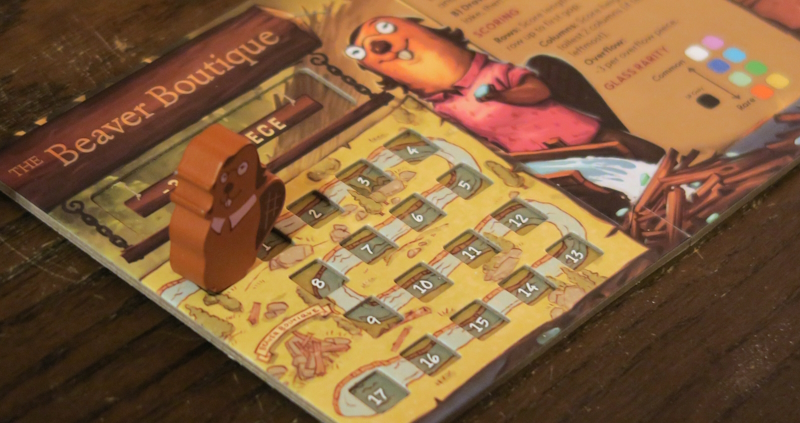
As River Valley Glassworks plays a maximum of five, Jade taught and acted as umpire.  In this game, players take it in turns to play a piece from their inventory into the river. Each river tile can take only a specific shape, and players have to play into a space adjacent to where they want to draft from. After claiming their glass, the river shifts forward revealing new pieces.  Glass is stored in players’ shops, and the scores depend on where the glass is placed with completed rows and columns giving bonus points.  However, too many of one type gives negative points.

River Valley Glassworks
– Image by boardGOATS

The game process is simple enough:  either place a piece of glass onto a river tile or draw exactly four pieces from the lake with the aim of collecting a rainbow of glass pieces but the challenge is getting the balance right.  In the end, the group did a “Lime”, that is, played it once and then decided to give it another go.  First time round, the battle was between Ruby, Sapphire and Teal with Ruby holding off Sapphire by four points who in turn, just pipped Teal by one.  By the second time, Teal had got the hang of things and won by a bit of a land-slide, finishing with sixty-six, eighteen more than Lime in second.

River Valley Glassworks
– Image by boardGOATS

Meanwhile, on the other side of the room, Plum, Ivory, Byzantium and Blue settled down to play another Japanese game, which turned out to be something of a secret favourite amongst them: Yokohama.  This is a sort of path building game, almost like a heavier version of the popular game, Istanbul.  Players operate a Merchant who travels around building their business.  They also have Assistants, Shops and Trading Houses.  On their turn, players deploy one Assistant in three different areas or two Assistants in one area, then they move their Merchant.  Merchants can move as far as they like, but can only travel through locations occupied by their Assistants and cannot finish in an area already occupied by another Merchant.
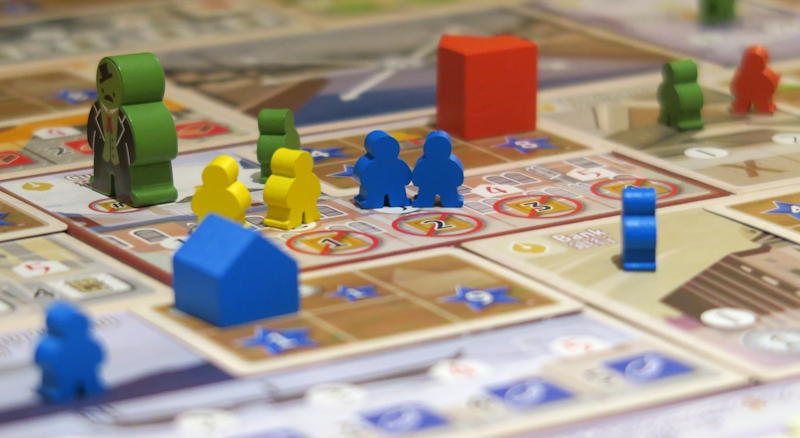
Yokohama
– Image by boardGOATS

Players then perform the action associated with their destination, with the level depending on the Power of that player at that location.  The Power is the player’s presence in that location, i.e. the sum of the President (equal to one), any Assistants and any Buildings.  The more Power, the better the resultant benefit.  A Power of four or more enables the player to build a Shop or Trading house at the location which will earn additional points or other rewards as well as providing more Power on future visits.  Any Assistants at the location are “used” and returned to the player to be placed on a later turn.

Yokohama
– Image by boardGOATS

As in Istanbul, the different locations provide different benefits.  There are locations that provide resources (Tea, Copper, Silk and Fish), some that provide Order cards (Dock or Port) or Technology cards (Laboratory or Research centre) and others that enable players to get more Assistants, Shops or Trading Houses (Employment Agency), Money (Bank) or points (Church and Customs).  Ivory started quickly, grabbing early points for the game focuses (lots of Tea) and getting some buildings placed, while Blue ended up with a pile of initially unwanted Fish and Plum spent some time tripping over everyone else.  Byzantium, didn’t seem to be doing much but Plum rather ominously said that was the way he played the game, just before winning by a huge margin.

Yokohama
– Image by boardGOATS

Ivory made great headway getting the goods to give him twenty-two points from the Customs House, but just as the game came to a conclusion he ran out of steam having spent lots of turns playing only two Assistants as opposed to three.  It was a close run thing in the end with barely ten points between first and last, indeed, Ivory finished a single coin away from getting the ten point Technology that would have given him the game.  As it was, Plum’s prediction proved right and victory was taken by Byzantium who had quietly got on with his game, mostly unnoticed by everyone else.  It wasn’t the landslide foretold though, as his hundred and six points was only three points ahead of Plum in second.

Yokohama
– Image by boardGOATS

The last group were Blue, Pine, Purple and Black who started off with a game of Ticket to Ride with the Japan expansion.  This is played much like the original base game i.e. players take cards from the market or play cards to place trains; score points for placing trains and completing Tickets.  Like all the expansion maps, the Japan map has its own set of additional features, in this case, these a mostly focused on the Bullet Train which runs through the centre of the long thin board.  Once these routes have been claimed, they can be used by all players to complete destination tickets.  Instead of scoring points for such routes, players progress along the Bullet Train track.  Whoever has contributed most to this shared project at the end of the game receives the largest bonus, with the player who contributes least being penalised.
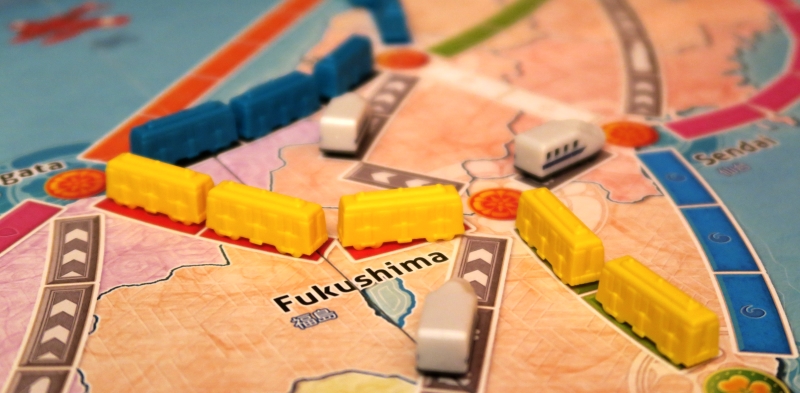
Ticket to Ride Map Collection: Volume 7 – Japan & Italy
– Image by boardGOATS

Last time we played this game there was a rules malfunction associated with the Bullet Train, but this time, that wasn’t a problem.  Much hilarity ensued when Purple place a single train route from Hiroshima to Okayama and entirely unintentionally prevented Pink from completing his four long Tickets costing him a total of fifty-two points leaving him with a final score of minus twenty-four.  Pine found this so amusing that he went round the room telling everyone else.  Besides this the minor aspect of the winner seemed immaterial, but that was Pine thanks mostly to his completed Tickets, double Black’s total which gave him second place.

Ticket to Ride Map Collection: Volume 7 – Japan & Italy
– Image by boardGOATS

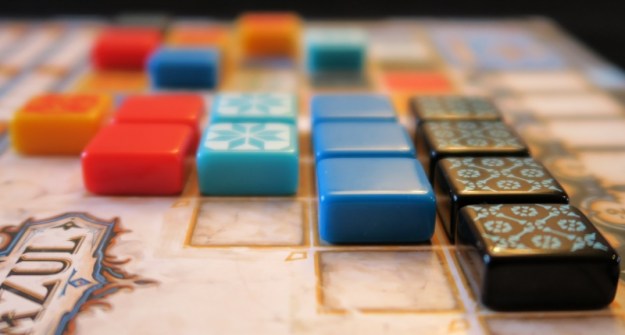
Once the dust had settled, Pine, Pink, Purple and Black rounded off the evening with a game of the Summer Pavilion version of our old favourite, Azul.  This uses the same market mechanism as in the base game, but instead of taking square tiles and placing them straight away, players take lozenge shaped tiles and and put them to one side for the second phase when players place them on their player board.  The pieces a positioned according to colour to form seven coloured “stars”. Each location is numbered according to the cost to play it—thus a space numbered five needs five pieces one of which is placed on the board while the others are discarded.
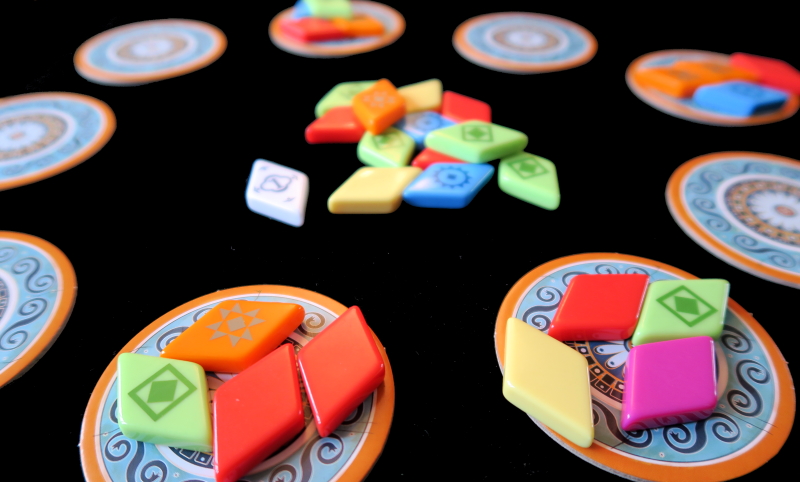
Azul: Summer Pavilion
– Image by boardGOATS

Placing one gives a single point while placing a second next to the first scores two and so on until the placing the sixth scores six points.  So a priority is placing tiles to expand groups, however, surrounding statues give bonus tiles.  Additionally, played over six rounds, each colour takes its turn as wild, though at least one tile of the required colour has to be played.  At the end of the game, players score a bonus for each of the seven stars that they’ve filled completely and bonuses for completing all seven spaces of value one, two, three or four.

Azul: Summer Pavilion
– Image by boardGOATS

Pink couldn’t remember the rules, so summoned Blue to explain, but her brain wasn’t on the right page so Jade, who, by this time was just adjudicating, explained instead.  The in-game  scoring was quite close with just two points between Pine and Pink, and Purple and Black not far behind.  So it all came down to the bonus points.  Pine picked up points for completing his green star and all the seven spaces with the value one giving him twenty-two additional points.  Pink’s fourteen points for completing his red star together with his twenty-four number bonus points more than off-set Pine’s small advantage, giving a modicum of revenge for the delight everyone got from his earlier misfortune in Ticket to Ride.

Azul: Summer Pavilion
– Image by boardGOATS

Learning outcome: Bad things that happen can make good memories, for some people at least.

5th September 2023

The evening began with Green and Purple arriving to find Plum and Cobalt sitting outside the pub chatting.  This was partly because the weather was warm, but also because someone else was sitting at our usual table and we had been relegated to another long table on the other side of the room.  Pine arrived soon after and once introductions between Cobalt and those who had not been about last time were concluded, the group decided to play a short intro game while they waited for everyone else to arrive.  The game settled on was Coloretto, which had only just begun when Ivory arrived, but he was happy to watch.

Coloretto
– Image by boardGOATS

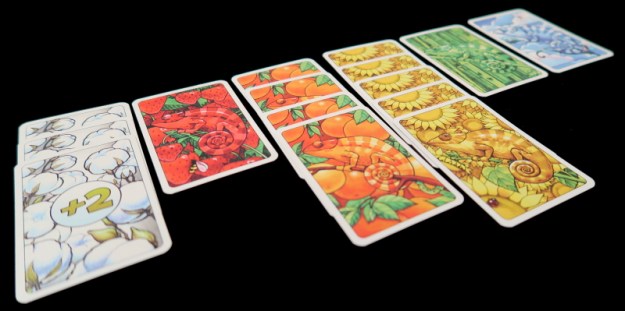
Coloretto is a quick and simple game that is very popular with the group.  Players either turn over the top card and add it to a “Truck”, or take a Truck and add it’s contents to their collection, sitting out until everyone else has taken a Truck.  Players are collecting coloured sets of Chameleon cards, but the key is that only three sets score positive points, with the others scoring negatively.  Thus players are trying to get as many cards in three colour suits, and as few as possible in each of the rest.  This time, everyone started with a different colour, so there were no obvious clashes.  As is usual for this game, it took a few turns for each players position to become clearer.
Coloretto
– Image by boardGOATS

By this time Plum was keeping the number of colour sets she had low with only two, but also had a couple of +2 bonus point cards and a Rainbow Chameleon (a wild) . Purple’s set was similar but with three colours.  Green was making steady progress and Cobalt was low on any particular colour, but only had four sets and a Rainbow Chameleon, so was poised for a good score if the cards fell in his favour. Pine meanwhile seemed to be in the process of collecting at least one of each colour!  By the end of the game, Plum had managed to collect Chameleons in just three colours and so scored no negatives, while Pine just seemed to have sets of everything. Purple had three extra colours, but with only one of each; her Rainbow Chameleon and +2 cards helped to give her a good score.

Coloretto
– Image by boardGOATS

Green managed only one negative point, but had no bonuses, while Cobalt had his cards fall right and ended with a couple of good colour sets and with it, victory.  By the conclusion of Coloretto, Jade and Sapphire had arrived bringing with them the feature game, Vaalbara.  In this game, each player is a clan leader trying to take over some territories with game-play which is vaguely reminiscent of Libertalia/Winds of Galecrest.  Players all have the same deck of twelve cards representing the members of their tribe.  Each turn, players choose secretly one card, then in the order of initiative of the revealed Characters, players activate their powers and take over one of the available Territories. Each type of Territory has its own way of scoring points (Collection, Pair, Diversity, Risk etc.).
Vaalbara
– Image by boardGOATS

Thus the game is about timing and playing the best powers and the high initiatives at the most opportune moments. After nine rounds, the player with the most points wins.  Jade and Sapphire had played Vaalbara about a dozen times together, and Green had played a similar number of games on Board Game Arena with reasonable success. Pine was entirely new to it the game and joined the other three.  Jade and Pine took the Mountains in the first round, and then Jade managed to snatch the only one on offer in the second round.  Green ended up with the final card in the first round—the All Rounder, so scored poorly with it.

Vaalbara
– Image by boardGOATS

By the middle of the game Sapphire was going all out for Fields, Jade was on to his third Mountain and Pine was beginning to get the hang of things.  Green was struggling with his all rounder strategy:  all he could get was a River and several Forests and even after he’d swapped one of those for something else (he’d mixed up the cards and instead of swapping a card between first and second row, it was any card with the top card of the deck) it didn’t work out.  Pine managed to complete his second Mountain, but Jade amazingly managed all four which catapulted his score. It was only then that Pine and Green realised that the fourth Mountain was twenty points on top of the ten for the first three (i.e. a very thirty in total from four cards).

Vaalbara
– Image by boardGOATS

By the end of the game the Poppy Fields were coming out in profusion and started to really score a lot of points.  Unfortunately for Green, Jade managed to nab the Field card ahead of him for a five type bonus and Green was still only on four terrain types.  Once the dust had settled and the final scores were compiled, it was quite close with Jade and Pine were tied for first on seventy points, and Green only three points behind and just ahead of Sapphire. Pine joked that maybe the tie-break would be the player position on the last card back, thinking that would about as arbitrary as some of the other tie breaks had been recently. A quick check of the rules confirmed it and ultimately gave victory to Jade.

Vaalbara
– Image by boardGOATS

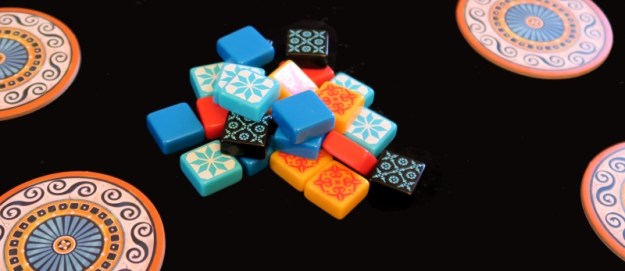
From there, the quartet moved on to play an old favorite, Azul.  In this game, players are tile-laying artists challenged to embellish the walls of the Royal Palace of Evora.  On their turn, players draft colored tiles from the marketplace onto their player board.  At the end of the round, players score points based on how they’ve placed their tiles to decorate the palace with wasted tiles scoring negative points.  Bonuses are awarded at the end of the game for completing rows and columns and sets of the same colour, and then player with the most points is the winner.  A pretty game, the group started with a short discussion about what colour one of the tiles really was.

Azul
– Image by boardGOATS

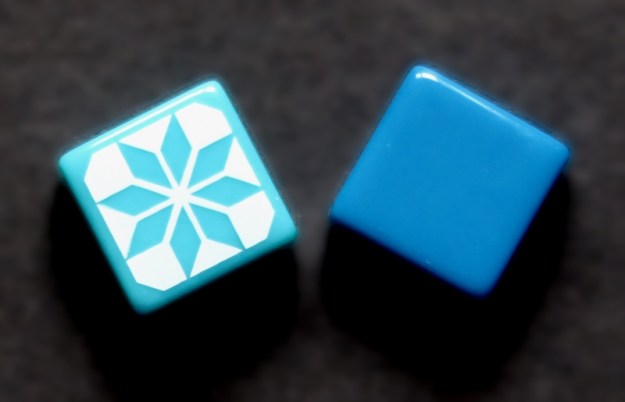
People wanted to call it blue, but there is already a fully blue tile, and this one was a little more turquoise with a white pattern—they did not come up with answer to the problem.  The game played much as it always does with complaints about the tiles that were not coming out of the bag when needed and at one point there was one Marketplace with four tiles all the same colour (that colour that we could not quite pin a name on).  Mid-way through the game no-one seemed to want the orange tiles, and it ended up with about eight of them in the middle of the table. It finally fell to Pine to take them, but he could not place any of them and they all had to go on his negative score line!

Azul
– Image by boardGOATS

The game was reluctantly brought to a conclusion by Sapphire, at the urging of everyone else.  He did not want to complete his row, wanting to hold out and complete a different colour later, but if he hadn’t taken the tile he would have ended up with a larger negative score and it had already not been possible to fully populate market. After final scoring, Jade and Sapphire shared the lead with ninety-five points with Green, who’d had a much better game than he usually has in third.  Tie break time again, but this time Sapphire won it because he was the only player to have completed a full row (the tile he hadn’t wanted to take).

Azul
– Image by boardGOATS

There was still time for something else, and the group settled on Nimalia, a new, interesting card-laying game where players are designing the best Animal Sanctuary.  Each card has four “Biome” squares on it of potentially different terrain, and different animals.  Players start each round with three cards and draft them, placing the chosen card partly (or wholly) on top the already laid cards in a simlar way to Sprawlopolis or Honshū.  The Sanctuary must remain within a six by six grid made of the squares (not the cards).  The game is played over a series of five rounds, where two or three different conditions are scored at the end of each drafting round.  This time, the first round would score for the largest area of Savannah and for connected Polar Bears and in the second round the scoring switched to Polar Bears and Gorillas next to Water.

Nimalia
– Image by boardGOATS

In the third round it returned to the largest Savannah, but with the complication of scoring maximum for no Giraffes down to scoring nothing with three or more giraffes—of course giraffes live in the Savannah!  Rounds four and five used both the Giraffes and the Gorillas to score while adding in the Savannahs in the fourth round and polar bears in the fifth.  The nature of the scoring meant that any cards with Giraffes were quickly passed on leaving some players with a double giraffe card to lay as the last card on a giraffe scoring round.  Since it wasn’t possible to lay a new card underneath an old one, those giraffes caused scores to tumble!

Nimalia
– Image by boardGOATS

In the first round Pine roared into the lead while everyone else stayed within a point or two of each other.  After the second round, Sapphire was the one who lost out, with Pine retaining his significant advantage. During the third and fourth rounds Jade and Green managed to catch Pine, with Jade pulling into the lead.  Sapphire managed a good score in the fourth round, but he had a lot of ground to make up and he’d left his charge to the finish a little too late.  In the final scoring, Jade and Green pulled ahead in a tight battle, which Jade won by just two points with his total of eighty. Pine was third after flailing around in the final round and having been left with a double giraffe.

Nimalia
– Image by boardGOATS

While all that was on-going, the rest of the group, Plum, Ivory, Purple and Cobalt, opted for a club favourite, Wingspan, enhanced by the European Expansion.  This is a card-driven engine-building game where players choose one of four possible actions (activating their Woodland, Grassland or Wetland areas or placing a bird card in one of those locations).  Points come from each individual card end of round goals, and eggs left at the end.  The game is all about building combinations of cards that work together efficiently, so the it took all night as everyone wanted to do their absolute best.

Wingspan
– Image by boardGOATS

Ivory as always was very good at this, but was also quite generous giving everyone food each time he activated his Woodland area.  Cobalt was the first to get three bird cards in his Reserve, though Ivory  ended up with the most valuable birds on his board, with Plum’s next highest.  One of Plums birds moved at the end of each round though, which was very useful for saving costs and improving yields.  It was Ivory and Cobalt who tended to come out best with the end of round goals.  As is often the case Ivory continued to score well with a good haul of bonus card points too.

Wingspan: European Expansion
– Image by boardGOATS

Purple failed to complete any of her bonus cards, but did make sure all her birds laid purple eggs.  Cobalt finished the game with the most eggs, however, inevitably followed by Ivory.  As for cached food and cards, Plum got the most food, but Purple had the most Tucked cards.  With all the scores added up, Ivory was the almost inevitable winner on ninety-three with Cobalt not far behind with eighty-three and Plum taking the battle for third by just three points in what was a hard-fought game.

Wingspan
– Image by boardGOATS

Learning outcome:  Goats love playing with colours.

21st October 2021

The evening began with a little play-testing while people waited for their food to arrive.  The two-player game currently goes by the name of Brain Grabbers and, though simpler, has a mechanistic similarity to Sprawlopolis or Honshū.  The game was designed by one of Pink’s work colleagues, so Pink explained the rules, and then proceeded to lose, first to Blue, then to Pine, failing to take a single point to their combined total of fourteen.  The consensus was that it could be successful as a family-level game, but we weren’t fans of Cthulhu, so spent the next ten minutes coming up with exciting ways to re-theme it.

Sprawlopolis
– Image by boardGOATS

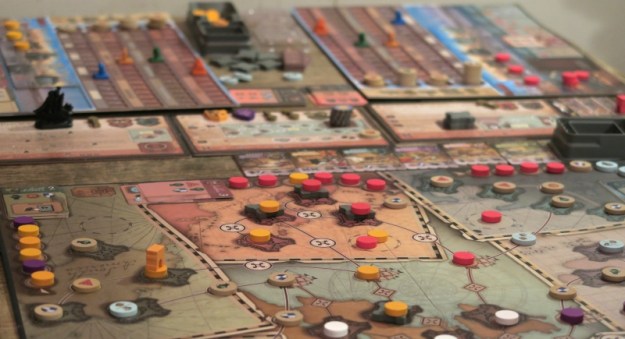
As people finished eating others began to arrive, though there was some question about whether Purple and Black would make it thanks to a serious accident on the A420.  We were discussing the treacherous nature of the A420 and its accident black spots when Purple and Black rocked up, and Purple surprised everyone by joining Green, Ivory and Burgundy to play  the “Feature Game“, Endeavor: Age of Sail with the extras from the new Age of Expansion.  Endeavor is a game we have played quite a bit over the years, initially in it’s original form and, more recently, in the new edition.  The expansion came out last year and, sadly, got lost in the mists of the endless “Roll and Write” games we were playing online.

Endeavor: Age of Expansion
– Image by boardGOATS

The original game is actually not terribly complicated and during play is almost completely luck-free—all the variation is in the set up.  The game is played over eight rounds, each consisting of four basic phases: Build, Populate, Payment and Action.  There are four technology tracks roughly corresponding to each phase, which dictate what a player can do during that phase.  For example, how far along the building track a player is dictates what they can build: the further along they are, the more buildings they have to choose from.

Endeavor: Age of Sail
– Image by boardGOATS

Similarly, a player who is further along the population (or culture) track, can move more people into their harbour for use in the Action phase.  Payment also increases the number of people available as it moves population markers from the action spaces into the harbour.  More importantly, however, it makes the action spaces available again for use later in the round.  The first phase consists of passing round the tray of buildings rather like a box of chocolates although in truth, at this point of the game players have very little choice.  Despite that, the decision is crucial to how players do.

Endeavor: Age of Sail
– Image by boardGOATS

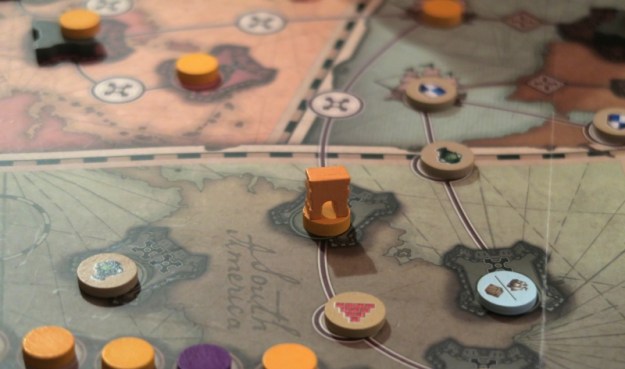
After the Building phase, the second and third phases (Population and Payment) are more or less carried out simultaneously.  The guts of the game, however, is the Action phase, when players can place population markers on their buildings to activate them and carry out one of the five actions:  Colonise, Ship, Attack, Plunder Assets, and Pay Workers.  The actions are generally based round the central board which is divided up into seven regions representing the seven continents.  Each continent comprises several cities, a shipping route and a deck of cards.

Endeavor: Age of Sail
– Image by boardGOATS

At the start of the game there is a Trade token on each city and each shipping space, but also on many of the connections between cities (these are taken if a player occupies both cities either side).  Players cannot Colonise a city until they have a presence in a region, which they can do by Shipping.  In this case, they activate their building that provides the shipping action by placing one population marker on it, then place a second population marker on the shipping track.  Thus, players need to have two markers available to be able to Ship.

Endeavor: Age of Sail
– Image by boardGOATS

The second population marker is placed in the furthest unoccupied space from the deck of Asset cards in the region of their choice, and the player takes the Trade token on that space.  Most trade tokens add to one of the four technology tracks, though a small number provide one off actions instead.  Players also need two population markers to Colonise (one for the action and one to occupy the city) and three if they are going to attack an already occupied city (one is collateral damage).  Once a player has a presence in a region they can take an Asset card, so long as the number of the top card is not higher than the number of population markers that player has in the region.

Endeavor: Age of Sail
– Image by boardGOATS

After eight rounds, players add up scores for each track and for the cities they control and the player with the most points is the winner. The new Age of Expansion adds several new components that completely mix up the game.  First there is a completely new set of buildings, many of which have actions as well as boosting the players’ economies while others have more choice.  Similarly, the first, second and fifth cards in the region decks now have more powerful and unique cards.  These are now more desirable creating more competition for them.

Endeavor: Age of Expansion
– Image by boardGOATS

The new buildings also introduce three new concepts:  Trade, Fortify, and Conscription & Mobilisation.  Trade allows players to swap one Trade token from their play area with one on the central board, while Fortify allows players to increase the protection in a city they occupy causing others to lose an extra casualty should they decide to attack.  Conscription enables players to acquire extra population which can then only be Mobilised as part of an action that has been activated in the usual way (e.g. used as a casualty during an attack, or to Settle).

Endeavor: Age of Expansion
– Image by boardGOATS

Additionally, a single Prominence tile drawn at random can be added to the game.  These provide players with new ways to gain presence in a more-competitive Europe and each one provides difference benefits and ways to score.  This time the Prominence tile was “Changing Alliances” which allows players to set up an alliance, where players cannot attack each other within Europe, in exchange for points at the end of the game.

Endeavor: Age of Sail
– Image by boardGOATS

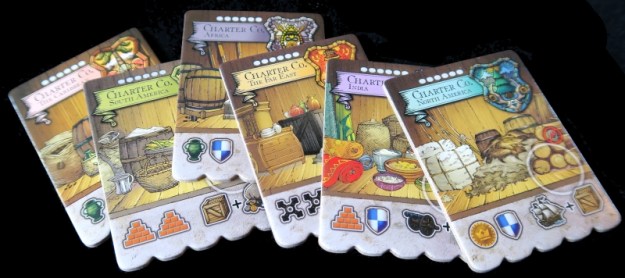
The game took a little while to set up, and although everyone had played it before, we needed a refresher of the rules and run down of the new expansions.  In addition to the new Age of Expansion updates, the group also included the Exploits from the original Age of Sail, the mini Charter Company buildings and two additional micro-expansions from Age of Expansion (Seize your Fate & Level 6 region cards), making it a mega-game.  Overall, it took about an hour for set-up and rules explanations.

Endeavor: Age of Sail - Charter Companies
– Image by boardGOATS

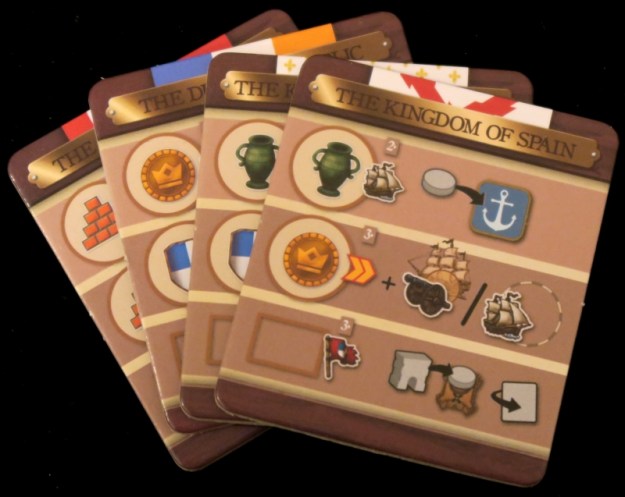
The Seize your Fate Expansion provides each player with a unique starting set-up.  Ivory was The Kingdom of France so started with a city in Europe; Purple was The Ottoman Empire, so started in the open sea of India; Green was The Kingdom of Spain so started with a city in South America; Burgundy was Great Britain and started in the open seas of North America and the Caribbean.  Coincidentally, each player was sat near the part of the board where their starting places were, so that set the stage for players’ strategies.

Endeavor: Age of Expansion
– Image by boardGOATS

Ivory quickly started taking cities in Europe and was open to a Prominence Alliance. Green was taking Fleets in Europe so joined him. No-one else wanted to form any alliances leaving Ivory to dominate Europe with and Green (to a lesser extent).  However, due to a rules malfunction, this was under the false impression that as part of the winning alliance they would score four points for each disc in the region when it was actually four points for each disc in the Alliance.  Since he was concentrating on becoming the power house in Europe Ivory left his Seize the Fate actions for much later in the game, and only expanded out of Europe to the Far East and later on Africa.

Endeavor: Age of Expansion
– Image by boardGOATS

He did however make good use of the Dutch East India Company exploit (once it was open) to upgrade his seaside buildings.  Meanwhile, Purple concentrated mostly on India and Africa, but suffered early on with not having enough population in her harbour or enough bricks to build better buildings.  The game was long though, and she managed to Seize her Fate (Round the Cape).  She also made use of the Dutch East India company in the latter rounds, and although scores weren’t calculated until the end of the game, she probably made up good ground with these latter stages.

Endeavor: Age of Expansion
– Image by boardGOATS

Elsewhere, Green was concentrating on the Caribbean, and making connections with his Fleets in Europe. He managed to amass a large population early on, but let it slip so that by the end of the game, Ivory and Burgundy had much more population to spare for attacks, even on fortified cities. Green kept an eye on Burgundy’s progress to keep a presence in South and North America. He was the first to Seize his Fate (Form the Great Armada) and used The Transit of Venus exploit, shipping up to Tahiti and using his money to increase his population.

Endeavor: Age of Expansion
– Image by boardGOATS

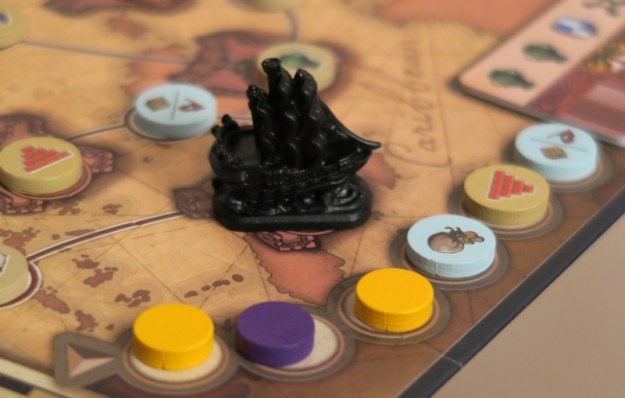
Burgundy concentrated on the America’s, and although he opened the Republic of the Pirates exploit, he never used it (and neither did Green who could also have done so). This was because he said he did not really understand it and it didn’t seem that useful. Which was a shame, as it meant the beautifully crafted big black plastic pirate ship didn’t make it onto the board. What Burgundy did do, however, was to make heavy use of Conscription buildings, which really helped him ship to almost everywhere.  Unfortunately for him, in the final round of the game there was no shipping left and he discovered that he didn’t have enough other actions to make use of the population he had.

Endeavor: Age of Expansion
– Image by boardGOATS

In the end, after a re-evaluation of the scores due to the Alliance misunderstanding, Ivory  was declared the winner with eighty-one.  Burgundy was the runner-up with seventy-three, three points ahead of Green in what turned out reasonably close game.  But what of all the expansions?  The exploits can always be relied on to add an interesting dynamic (with a couple of duds) and it is likely these will continue to feature.  The Charter companies seem to help in four and five-player games when Level five buildings have the potential to disappear quickly (especially with the Exploit we used this time), and apart from space around the board don’t intrude too much anyway.

Endeavor: Age of Expansion
– Image by boardGOATS

The Level six cards seem to be intended to be played with the Age of Expansion every time, as Slavery is Abolished on the Europe Level 6 card, whereas in the Age of Sail base game it is abolished on the Europe Level five card.  This time, none of the Level six cards actually got played.  Again, they don’t intrude, but give additional options, so are also worth playing with.  The benefits of the “Seize your Fate” was perhaps less clear. Having different starting positions certainly helped the start and gave players a steer as to strategy.  Remembering the actions were available was a problem and the extra scores were quite small (about four points for those who used them). Including this module would probably depend on the group.

Endeavor: Age of Expansion
– Image by boardGOATS

The new Conscription action seemed to open up more of the board, which counters a common complaint about the game, that in order to get a region open, players have to neglect a couple of other areas and can lose out if they made a start in them early in the game.  However, the danger seems to be in overusing Conscription.  In this game there was a lot of Fortification, and in many ways it seemed a little too much. The bonuses on the new cards were interesting and add variety to the main game, but the expansion certainly doesn’t make the Age of Sail options obsolete as they could be very valuable if a less competitive game was wanted.

Endeavor: Age of Expansion
– Image by boardGOATS

While Purple was exploring India and Africa, Black, Pine, Lime, Blue and Pink were exploring Japan with Tokaido. This is a highly tactical game, that straightens out the market mechanism at the heart of Glen More and makes it the centre of a set collecting game.  During the game, players are travelling from the ancient capital Kyoto, to Edo (now Tokyo) via the Tōkaidō road.  This was one of the five centrally administered routes, the Gokaidō, that connected the capital of Japan with the outer provinces during the Edo period (1603–1868).

Tokaido
– Image by boardGOATS

As players travel, they experience the wonders of Japan sampling food and scenery, talking to the colourful characters en route, buying souvenirs and giving thanks at the temples they pass.  The game board consists of a long track with locations marked—each location can only be visited by one player.  Players line up along the path and the player at the back goes first (in this case Pink).  They move their piece to an empty space and carry out the associated action, before the next player at the rear takes their turn.

Tokaido
– Image by boardGOATS

In each case, the primary decision is simple:  move to the space with the most interesting action to maximise points, or move to the first available space to get the most turns. In most cases, once that decision has been made, players simply take money or a card from the appropriate pile, the three panoramas, the hot springs, or Characters.  Panoramas and Hot Springs simply give points while Characters give other bonuses.  Stopping at a temple allows players to genuflect and pay tribute, while visiting a Village gives player the opportunity to buy souvenirs.  Both of these cost money, however.

Tokaido
– Image by boardGOATS

Money is really tight and there are few chances to get more, and an important source of points is sampling the varied food, but food can be expensive.  There are four stops to eat and players have to stop and wait at these.  The first person to arrive gets to choose their meal from a handful of cards—they do not have to buy food, if they choose not to or cannot afford it, but each meal is worth six points at the end of the game.  Food comes at different prices though, so arriving early means players get to choose a cheaper meal. Each meal a player takes must be different, however, so waiting to the end can end up being costly, either financially, or in points lost.

Tokaido
– Image by boardGOATS

At the end of the game, there are bonus points for almost everything:  the player who donated most to the temples, the player who spent the most on food, the player who completed each of the panoramas first, and the players who visited the most Hot Springs, met the most visitors and bought the most souvenirs.  The player with the most points at the end is deemed to have had the best journey and wins.

Tokaido
– Image by boardGOATS

Players start by choosing their character from a pair drawn at random.  Blue was Kinto, Lime was Hirotata, Pink was Zen-emon, Pine was Mitsukuni and Black was Umegae.  Each of these gave a special power, for example, picking Kinto meant Blue paid one Ryō less for food each time she stopped to eat.  Similarly, every time Lime stopped to pay tribute at a temple, he was able to donate an extra Ryō, taking it from the main supply scoring an extra point straight way, and putting him in pole position for picking up the ten point bonus for being the most devout.

Tokaido
– Image by boardGOATS

The special powers aren’t all financial though—Mitsukuni gives an extra point at the end of the game for every end-game bonus the player wins.  Most of them do involve money on some level though even if it is not directly.  Zen-emon’s special power, for example, activated when Pink visited a Village to buy souvenirs.  When buying souvenirs, the active player draws three souvenir cards and can choose to buy one, two or all three.  Whenever Pink bought one souvenir, Zen-emon enabled him to buy one souvenir for one Ryō (regardless of its marked price) and as many others as he wished at full price.

Tokaido
– Image by boardGOATS

Souvenirs are a great way to get points.  They come in different types and players are collecting mixed sets with the first card in a set being worth one point, but later being worth more—a full set gives sixteen points.  The special powers give players a steer as to which strategies might be beneficial.  To take advantage of Zen-emon’s special power, Pink needed to visit the Village as often as possible, however, there were two problems:  firstly, souvenirs are expensive, and secondly Pine kept getting there first.

Tokaido
– Image by boardGOATS

Pine got extremely lucky on his card draws when he visited the Villages too, picking up lots of cheap souvenirs and getting lots of points in return.  As if that wasn’t enough, Pine seemed to be able to harness his “inner Burgundy” and every time he visited the Hot Springs, he found monkeys and with them an extra point.  To rub salt in Pink’s wounds, he ran out of cash and found he couldn’t afford to eat, and thus he haemorrhaged points.

Tokaido
– Image by boardGOATS

Meanwhile, Black as Umegae, kept meeting people and every time he did so he gained an extra point and a Ryō.  This occasional top-up of cash meant he wasn’t as strapped as everyone else, but further, the New Encounter mini-expansion Cards were also included in the deck, and some of these are quite powerful.  Pine picked up Itamae, the especially powerful itinerant cook (who cooked him an extra meal for just one Ryō), but Black took Takuhatsuso, for example, the old priest who gave him four points in exchange for just one Ryō.

Tokaido
– Image by boardGOATS

As the players approached Edo, Pine was way out in front, though Black and Blue (thanks to spending a lot of time admiring the views) were not far behind.  There were a lot of points available from the bonuses though and it wasn’t a forgone conclusion by any means.  Lime took the ten point temple bonus, but it wasn’t really enough.  Black finished one point behind Blue, until the recount when Black finished one point ahead.  That was just enough to give Black second place, but Pine picked up enough bonuses and with the extras provided by Mitsukuni he finished seven points clear.

Tokaido
– Image by boardGOATS

Pine and Lime went for an early night, but Endeavor was still going so Black had to wait for Purple which meant a game of Azul with Blue and Pink.  We’ve played this a lot within the group, but having effectively had over a year off has rejuvenated many of our old favourites.  The series of games use a very simple, but very clever market mechanic where players take all the tiles of one colour from a market and put the rest into a the centre, or take all the tiles of one colour from the centre.  The three different games, Azul, Stained Glass of Sintra, and Summer Pavilion, all differ in what players do with the tiles once they’ve taken them.

Azul
– Image by boardGOATS

In the original Azul, as soon as they have taken the tiles, players add them to one of the rows on their player board.  At the end of the round, one tile in each full row is moved into their mosaic.  The game ends when one player completes one full row of their mosaic.  Players score points when they add tiles to their mosaic (one point for each tile in the row and column it forms), and receive bonuses for completed rows, columns and any completed sets in their mosaic.  The catch is that each feeder row can only contain one colour and and if there are left-overs when they add to it, these score negative points.  Further, each row in a player’s mosaic can only have one tile of each colour.

Azul
– Image by boardGOATS

And that was where Pink got caught, first with seven negative points taking him to zero and then a massive eleven negative points.  Black and Blue managed to avoid that pitfall though and the game was progressing well when suddenly, Blue brought it to an abrupt end by completing two rows.  Black failed to spot it was on the cards because Blue’s finished rows, were the second and third, rather than the easier first row.  Inevitably, having his game cut short stymied him somewhat, and Blue’s final score of a nice round hundred put her some way ahead of the others.

Azul
– Image by boardGOATS

Endeavor was coming to a close, but there was just time for one final quick game while they finished up.  The game the trio settled on was Coloretto, the cute chameleon collecting game that provides the core mechanism that underpins the better known game, Zooloretto.  This is really a really simple game:  on their turn, players either draw the top chameleon card from the deck and add it to a truck, or take a truck.  The aim of the game is to collect sets of one colour, but only the largest three sets give positive scores, while the others score negatively.  The clever part is the set scoring, which uses the Triangular Number Series.

Coloretto
– Image by boardGOATS

Each additional card in a set is worth one more than the last card added with the first worth a single point, but the card that completes the set is worth six points.  As usual, there was stiff competition for the multicoloured chameleon cards, but also for the bonus point cards.  Blue went from “Azul Hero” to “Coloretto Zero” picking up too many cards of in too many different colours early on.  It was closer between Pink and Black, though Pink’s large collection of orange cards made the difference giving him victory by eight points.  And with Endeavor finally packed away, the evening came to a close.

Coloretto
– Image by boardGOATS

Learning Outcome:  Don’t spend all your money in the souvenir shop – food is important too.

7th August 2018

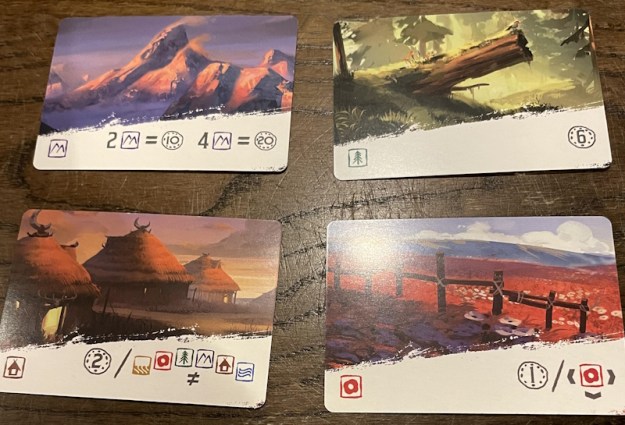
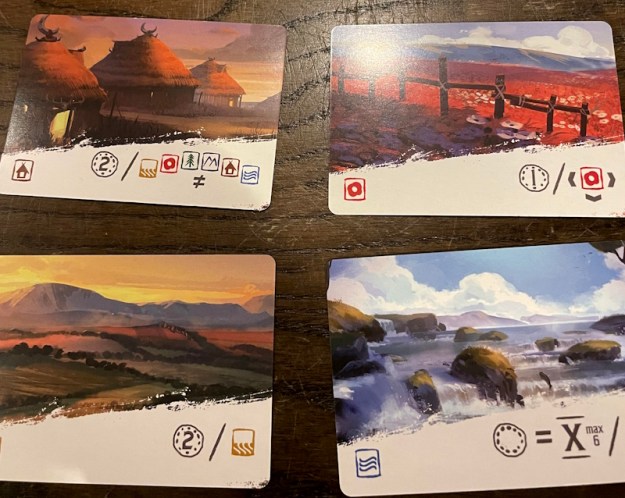
Largely due to holidays and work, for the first time in months, we only had enough players for one game.  Blue and Pink were first to arrive and, while they were waiting for their pizzas, they played a quick game of Honshū.  This is a game that Blue had played with Black and Purple about a year ago when Black and Blue agreed it was a very, very clever game.  Somehow though, it hadn’t got another outing until last week at the Didcot Games Club, when Blue introduced Pink to it.  He really enjoyed it and was keen to give it another go.  It is a trick taking game, so it plays a bit differently with two.  The idea is that players start with a hand of six cards; two cards are drawn at random from the deck to make one pool, and the players play a card each to make the second pool.  Each card features six districts and a number – the player who wins the trick by playing the highest number chooses one pool and then chooses a card from that pool.  The other player does the same with the second pool.

Honshū
– Image used with permission of
BGG contributor  HedgeWizzard

The players then add the cards to their city. Each card is divided into six districts, each of which scores in a different way at the end of the game. For example, every district in their largest city, players score a point. Similarly, all forest districts score two points. More interestingly, a single water district is worth nothing, but water districts connected to it after that are worth three points each. Perhaps the most interesting are the factories which only score if they are supplied with the appropriate resources, wooden cubes that are placed on resource producing districts.  These resources can also be used increase the value of cards when they are played, in the two-player game this is only by the losing player who can guarantee a win by paying a resource.  One of the biggest challenges is choosing the cards though. When the cards are placed, players must take care to make sure that they either partially cover (or are covered by) at least one other card. This, together with the fact that players are trying to expand their largest city and any lakes makes choosing and placing a card really difficult as there are many options to explore.

Honshū
– Image used with permission of BGG contributor msaari

Despite playing it a couple of times, neither Blue nor Pink have really understood how the game plays which is probably what makes it interesting.  After the first three rounds, in the two-player game, players swap their remaining three cards and are supposed to add another three (repeating this after the sixth and ninth rounds).  Unfortunately, Blue misunderstood the rules for some reason, so instead, they swapped hands after three tricks, refreshed their hands to six cards at half-way and swapped hands again after nine.  This simplifies the game a lot, as the obvious strategy is to play high cards early and then hand all the dross over to the other player who is forced to play them.  It also introduces a lot of luck, and while we like luck in the right place, the game would definitely be more interesting with the rules as written.  Blue won, but it is definitely one to play again, and correctly this time.

Honshū
– Image used with permission of BGG contributor bkunes

With Burgundy’s arrival and then Green’s, and food out of the way, we moved onto the “Feature Game”, Altiplano.  This is a bag building game that re-implements some of the mechanisms found in one of our more popular games, Orléans.  Like Orléans, Altiplano has two phases: planning and carrying out.  The idea is that players start off with a handful of resource tokens and, on their turn can draw a number of these out of their bag, placing them on their personal worker board.  Simultaneously, players then place them on the action spaces on their board.  This usually takes a little time as everyone is trying to maximise their return.  And this is where it differs significantly from Orléans where everyone can more or less do whatever they want, whenever they want.  In Altiplano, there is a central circle of locations, and actions can only be carried out when player’s meeple is in the appropriate area.  There are seven locations and players get one movement of a maximum of three spaces for free on each turn.  This means it is possible to get to any location, but only one of them, unless they pay a food token which will allow them another move, but only a single space.  Thus getting the planning right is essential.

Altiplano
– Image used with permission of boardgamephotos

In the action phase, players must take an action, or pass.  Once they’ve passed, they cannot have another turn.  Before or after they take an action, players may move if they are able to.  This effectively means that players can carry out actions in two locations per turn, unless they pay for more.  Once a token has been spent, it it goes into a little cardboard crate where it stays until the player’s bag is empty.  This means that unlike Orléans, every token must come out of the bag and be placed; there is no element of chance except in the timing.  Thus, instead of playing with probability, the game is now all about controlling what’s in the bag and knowing what can come out and when.  Anyone who’s played Orléans and felt that their Monks have entered a closed order in the corner of their bag will really appreciate this.  However, it also means rubbish can be even more costly as it WILL come out and must be used.  Worse, any rubbish will will eventually go back in the bag and have to be dealt with again, and again and again…

Altiplano
– Image used with permission of boardgamephotos

It is possible to get rid of resources:  they can be placed into the player’s personal warehouse. Once they are in the warehouse though, they can’t be taken out again and as all resources are limited, it may not be possible to obtain a replacement.  Placing resources in the warehouse is done by visiting the Village and is a useful thing to do as it is one of the ways to score points.  Most resources are worth points at the end of the game, but in addition to this, full shelves in the warehouse score bonus points.  Each shelf can only hold one type of resource, and the higher shelves score more points.  Getting resources is therefore important, but they have to be the right resources as the warehouse isn’t the only strategy available.  At the Village location, players can also buy Hut cards which depict one resource and give players extra points for that resource at the end of the game (as well as a little bonus).  In the Market, it is possible to “sell” goods (they still go back into circulation though), and buy Contract cards which give points when completed.  Players can only work on one Contract at a time, but once they are finished, they can be worth a lot of points.

Altiplano
– Image used with permission of boardgamephotos

The Market will probably be one of the most visited locations as players can also buy “Extensions” to their player board.  These are really key to playing the game well, as without them there are lots of resources that are difficult to get.  In addition to the Village and Market, there are five other locations to visit:  the Farm, the Forest, the Mines, the Harbour and the Road.  The first four of these are mostly about using one sort of resource to get another (e.g. using an alpaca and some food to get wool, or using two fish to get stone).  All resources acquired in this way go into the recycling crate to be used on a later turn.  The Road is slightly different as it features a track similar to the Knights track in Orléans, and players’ position on the road dictates how many resource tokens they are allowed to place in the planning phase.  Like Orléans, players don’t have to place their full quota of tokens on action spaces, but these will block spaces for their next turn if they don’t (which can be doubly damaging as it prevents more useful things coming out of the bag).  The Road has to be built though, and it costs a wood and a stone to travel along the path.  Some steps give Corn instead, and this has to be placed in the warehouse, but it can be very useful as it is “wild”, so can help fill those difficult rows where resources are scarce.

Altiplano
– Image used with permission of BGG contributor JackyTheRipper

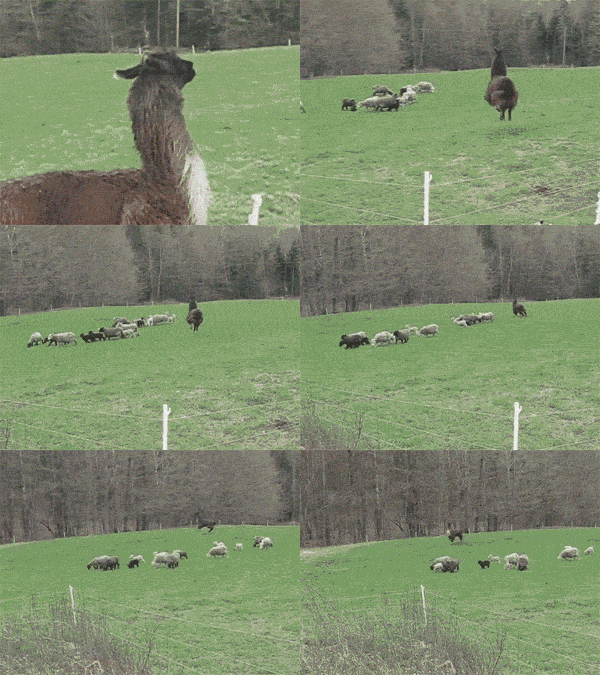
The game is not terribly complicated in itself, but there is a surprising amount of thinking to be done and, like all great games, players always want to do many more things than they are able.  Blue had played Altiplano with Pink a couple of times, and Burgundy had read the rules and watched a video, so the rules explanation was really for the benefit of Green.  Unfortunately, he was too interested in playing with his phone to pay attention, which might explain why he made such a mess of things later on.  To be fair, everyone was interested in the difference between an alpaca and a llama (apparently llamas have long banana-shaped ears and are roughly twice the size of an alpaca, but alpacas have softer fleece and are a bit more skittish).  We all had a good laugh at the jumping alpaca footage too, but even after all that and everyone else focussed on the game, it was clear Green’s attention was elsewhere.

Altiplano
– Image used with permission of BGG contributor Mouseketeer

At the start of the game, everyone gets a character card which dictates their starting resources and gives them a special action.  Green was the Woodcutter, Blue was the Shepherd, Pink was the Miner and Burgundy was the Farmer, giving them access to Wood, Wool, Ore and Alpacas respectively.  Blue and Green started with only three resources (and an extra coin), which didn’t seem to bother Green much.  Blue felt it was a big disadvantage though, especially as it wasn’t clear to her what strategy the Shepherd encouraged.  In the absence of anything better, she started off going to the Market and buying an Extension, and using her Alpaca to make some Wool in the hope that things would become clearer in time.  Green on the other hand, began with the obvious tactic and used his Woodcutter to get some wood.  For Burgundy, the priority was to increase the number of resources he was able to place in each round, so he began by trying to get the stone he needed to start building his road.

Altiplano
– Image used with permission of boardgamephotos

Pink had a two-pronged strategy, planning to go for the three point resources  (especially Silver as he had the Miner which meant he could get plenty of Ore).  This was because they were less difficult to get than Glass, but were still worth a lot, especially if augmented with a Hut bonus.  So that was the second part of his plan: get lots of Hut cards from the Village as they give a small bonus anyhow, and by taking them he was depriving everyone else.  As Burgundy started to build his road, Blue and then Pink decided to join him.  Eventually Green followed suit, but it wasn’t until he was several steps along the road that it became clear that he hadn’t actually been visiting the road to build it.  He explained that he didn’t think it was necessary as the road was different and it had been positioned very slightly out of the line of the circle due to the slightly cramped space.  Everyone else had been visiting properly though, so if he’d been concentrating on the game and watching what others were doing (instead of playing with his phone), it probably wouldn’t have happened.

Altiplano
– Image used with permission of boardgamephotos

Meanwhile, Pink was continuing to collect Huts and Silver, and Blue had another Extension, was buying lots of Cocao and using it to get Glass (or occasionally Food or Cloth).  It was around this time that Green began to join Pink collecting Huts.  Burgundy was just beginning to get his game off the ground when he got into a bit of a tangle.  He had positioned himself to move onto his third step along the Road, but that gives Corn and he really didn’t want to take it yet as it would have to go into his Warehouse.  Since he didn’t have any resources in his Warehouse yet, it would mean he would have to start a shelf with Corn.  The problem with this is that any corn he got later would have to go on that shelf too, rather than padding out any other, scarce resource.  Eventually, Burgundy managed to sort out his problem, but it took a couple of turns and set him back just long enough for Blue to buy the Extension he had his eye on (again).

Altiplano
– Image used with permission of BGG contributor JackyTheRipper

The game was entering its final stages and Blue began filling her Warehouse, trying to keep the size of her bag down.  She was helped by the Extension she’d grabbed from under Burgundy’s nose which allowed her to place an extra item in the Warehouse on each visit.  Everyone else followed, and began worrying about what they needed to maximise their bonus points.  Everyone that is except Green, who was still fiddling with his phone despite the fact that his friend had apparently gone to bed.  The game end is triggered when either there aren’t enough Extensions left to fill the Extension Strip, or one of the locations is completely exhausted.  When Green took the last Glass token, everyone had just one more round to maximise their bonus points.  Blue and Burgundy fought to try to get the last Extension that allows players to draw an extra ten tokens out of their bag and put them straight in the Warehouse at the end of the game.  This time Burgundy won, as Blue discovered that she didn’t need it anyhow because she could use Corn to do the job, and as she didn’t have the right resources in her bag it wouldn’t have helped her in any case.

Altiplano
– Image used with permission of boardgamephotos

Eventually, the game petered out as there was nothing more people could do and players began adding up their scores.  Burgundy had struggled throughout and Pink’s experience and Hut strategy had worked well.  It was very, very close at the front though with just three points in it, and much to everyone’s surprise given how much attention he wasn’t paying, Green finished just ahead of Blue with a hundred and six to her hundred and three.  He was obviously pleased and professed to have liked the game despite not really focusing on it.  It was when Burgundy commented on all the Wood and the Glass that he had, that someone asked where Green had got all the Glass from.  As Green explained that he’d got one from a Hut, it all came out.  Every time he’d taken a Hut card, he’d taken a resource (perhaps confusing them with Boat cards).  He said it wouldn’t really have made much difference, although he wouldn’t have won as he’d have had fewer resources and therefore maybe ten points less, leaving him in second place.  Burgundy pointed out that the advantage he got from all those resources during the game was incalculable, added to which, taking the last Glass ended the game early preventing others from scoring more.  Normally nobody would have minded as everyone makes mistakes from time to time, but as Green had been playing with his phone all evening and not concentrating, we decided there was no cause for a llama, and just disqualified him.

Altiplano
– Image used with permission of boardgamephotos

Learning Outcome:  Playing with your mobile phone means you make mistakes which upset the balance of the game.

8th August 2017

With Burgundy and Blue still finishing their supper, Black, Red Purple and Pine decided to play a quick game of Coloretto.  Pine and Red needed reminding of the rules, and by the time that was done Blue was ready to join them, but Burgundy was still wading through his pizza.  When he commented that he was struggling because it was “really very cheesy”, Pine responded that, “You can’t order a four cheese pizza and then complain that its too cheesy!”  Most people agreed it was a fair point, but it didn’t speed him up.  In the end Blue and Burgundy joined forces and played together, not because it is a complicated game, quite the opposite – the game is very simple.  On their turn the active player either draws a chameleon card and places it on a “truck” or takes a truck (which means they’re out for the rest of the round). The idea is that players are collecting sets of cards, but only three will yield positive points, with the rest scoring negatively. The really clever part of the game is the scoring which uses the triangular number sequence (one point for the first card, three points for two cards, six points for three cards etc.), which rewards one large set more than two or even three small ones.

Coloretto
– Image by BGG contributor SergioMR

Blue & Burgundy started out collecting blue, and Black orange.  Purple on the other hand ended up with nearly every possible colour, which really isn’t the point!  In contrast, Red managed to restrict herself to just three colours, but didn’t really manage to get enough cards in each to compete with the big hitters, Black and Pine.  Black collected a full set of orange cards, but Pine had four purple cards and a joker to score highly.  In the end, Black took the game, just three points ahead of Pine.  With the first game over and Burgundy finally having finished his very cheesy pizza, it was time for the “Feature Game”.  This necessitated splitting into two groups, and that couldn’t be done until a second game had been chosen.  There was much debate, but Pine and Burgundy were keen to play Kerala.  Purple was reluctant, she said because everyone had been nasty to her last time.  Eventually, she was persuaded to play when Pine promised to be nice, and for the most part, everyone was very nice.

Kerala
– Image by boardGOATS

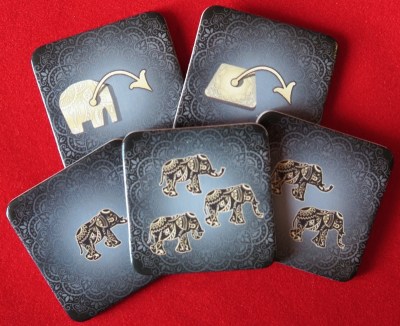
Kerala is one of the games Blue and Pink picked up at Essen last year. It is a fairly simple tile-laying game where each player starts with a single tile in their own colour with two wooden elephants perched precariously on it.  On their turn, the active player draws the same number of tiles from the bag as there are players and then chooses one before everyone else takes it in turns pick one.  Players then simultaneously place their tiles next to a tile with an elephant on it and move the elephant onto the new tile.  The tile can be placed in an empty space, or on top of a tile previously laid.  Thus, over the course of the game the elephants ponderously move over their play-area while players messing with the opponent to their left by leaving them with tiles they don’t want.  There are three types of tiles, Elephant tiles, Edge tiles and Action tiles.  Elephant tiles score points at the end of the game with players receiving one point for each elephant visible.”Edge” tiles have one side with a different colour; if these are adjacent to the correct colour the player scores an additional five points otherwise they can be ignored.  There are also two sorts of action tiles, which score no points but allows the player to move either a tile or an Elephant.

Kerala
– Image by boardGOATS

Everyone was very nice and offered everyone else advice on where to place tiles.  It wasn’t always helpful advice, but no-one was obviously hostile.  It was only as the game came to a close that everyone realised that they had forgotten some of the most important aspects of the scoring.  At the end of the game players require precisely one contiguous region of each colour (with two allowed for their own colour).  Somehow in the rules recap the bit about losing five points for each missing a colour had been missed.  It didn’t matter though, because everyone had all the colours so nobody was in danger of losing points even though some players picked up their last colour in the final round.  In the end it was a close game, but it was burgundy’s very stripey layout that had the edge and he finished four points ahead of Purple who took second.

Kerala
– Image by boardGOATS

Meanwhile, Black, Purple and Blue played the “Feature Game”, Honshū.  This is a light trick-taking, map-building card game loosely set in feudal Japan – almost like an oriental mixture of Pi mal Pflaumen and something like Carcassonne or Kingdomino.  The idea is very simple:  from a hand of six numbered map cards, players take it in turns to choose one and play it.  The player who plays the highest numbered card then chooses one, then the next player and so on until every card has been taken.  The players then add the cards to their city.  Each card is divided into six districts, each of which scores in a different way at the end of the game.  For example, the for every district in their largest city, players score a point.  Similarly, any forest districts also score one point.  More interestingly, the water district is worth nothing, but water district connected to it after that is worth three points.  Perhaps the most interesting are the factories which only score if they are supplied with the appropriate resources, wooden cubes that are placed on resource producing districts.

Honshū
– Image used with permission of BGG contributor msaari

Resources can also be used increase the value of cards when they are played allowing players to manipulate their position in the turn order.  Like Pi mal Pflaumen, this is a key part of the game as it enables players to ensure they get the card they want.  One of the biggest challenges is choosing the cards though.  When the cards are placed, players must take care to make sure that they either partially cover (or are covered by) at least one other card.  This, together with the fact that players are trying to expand their largest city and any lakes makes choosing and placing a card really difficult as there are many options to explore.  Nobody really had much of a clue as to what strategy they were trying to employ, and for the first three rounds, everyone ended up picking up the cards they’d played as these were the ones they’d thought about.  After the first three rounds, players pass their remaining three cards left and add another three; his is repeated after nine rounds when the cards are passed right.  So when at the start, when Black commented that he had lots of good cards and Red and Blue answered that they had lots of poor ones, in actual fact nobody really had much idea what good and bad cards were.  That quickly changed when Blue passed her left over cards on and Black discovered what a bad hand really looked like.

Honshū
– Image used with permission of BGG contributor William Hunt

Everyone found the game very strange, and a real brain-burner, dressed up in such an innocent sounding game.  There were more spells of players choosing the cards they had just played, so Red was really mifffed when Blue broke the tradition and took the one she had played and wanted for herself.  Towards the end, Black pointed out that while he had built a very compact island Red and Blue both had long thin islands.  This was the first time either of them had looked at anyone else’s island – a demonstration of how absorbed they had been in choosing cards.  After lots of turning cards round trying to decide where best to place them, it was time to add up the scores.  It didn’t really matter who won as everyone felt they were fighting to get to grips with the game, though it was Blue who’s island scored the most points, and Black and Red tied for second place.  Both games finished simultaneously and the Honshū crowd were in need of some light relief so we resorted to 6 Nimmt!.  This is a game that we have played a lot on Tuesday evenings, but seems to have been neglected of late.

Honshū
– Image used with permission of BGG contributor msaari

We reminded ourselves of the rules:  players simultaneously choose a card, then simultaneously reveal them before playing them in ascending order placing each on on the highest card that is lower than the card being played.  When the sixth card is added to a row, the first five are taken and the number of heads contributes to the player’s score, lowest score wins.  We tend to play a variant over two rounds with half the deck in each round and not resetting the table in between which tends to result in a cascade of points in the second round, and this time was no exception.  Purple and Blue started out well, but quickly made up for that in the second round.  Red and Mike started badly in the first half and Mike got worse in the second – they tied for highest scorers. Black started out low and although Pine did better than him in the second round, Black’s aggregate score of nine was seven points lower.  Black was the only one to stay in single figures and was therefore a worthy winner.  6 Nimmt! finished quite quickly and we were all feeling quite sociable, so despite having played it last time, we gave in to Red, the “Bean Queen”, who fluttered her eye-lashes and we agreed to play Bohnanza.  While people sorted out refreshments, we compared Bean rhymes, Pine came out with the best, borrowed from Bart Simpson,  “Beans, beans, the unusual fruit, the more you eat, the more you toot!”

Bohnanza
– Image used with permission of BGG contributor spearjr

Bohnanza is a card game where the key element is the fact that players have a hand of cards that they must play in strict order.  On their turn, the active player must play (plant) the first bean card in their hand (the one that has been there the longest) and may plant the second if they wish.  Then they draw two cards and place them face up in the middle of the table so everyone can see, at which point the bidding starts with players offering trades for cards they like.  Once both cards have been planted (either in the active player’s fields or somewhere else), then the active player can trade cards from their hand too.  All traded cards must be planted before the active player finished their turn by drawing three cards and putting them into their hand in strict order.  And it is the strict order that is the key to the game, however difficult it is for players to refrain from rearranging their cards.

Bohnanza
– Image used with permission of BGG contributor spearjr

This time, the game proceeded with lots of trading and everyone warning everyone else who dangerous it was give Red any favourable trades.  Nevertheless, everyone seemed to be forced to give her free-bees as she was the only person who could take them. In the dying stages of the game Pine was desperate to get his paws on some of Blue’s Wax Beans and was offering all sorts of lucrative trades, but they all evolved round Blue’s now complete field of Green Beans.  When she pointed this out he grumped that it was her own fault for building up the field to capacity, ” adding “That’s hardly sustainable farming now, is it?!?!”  With the last trade done, everyone began counting their takings. During the game everyone had given Red loads and loads of cards, mostly because they were forced to.  When the Bean Queen was inevitably victorious, Black commented that it was fine as we had all contributed so much that everyone could rejoice and share in the joy of her win.

Bohnanza
– Image by boardGOATS

Learning Outcome:  Beanz meanz fun.