Tag Archives: Keyflower

23rd December 2024

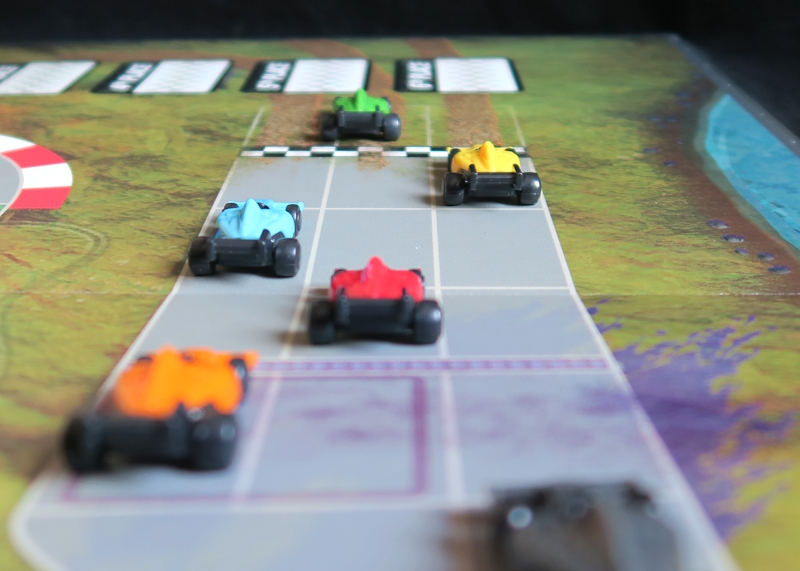
Being an extraordinary Monday meeting and only two days before Christmas, we didn’t really know who or what to expect, so didn’t have a “Feature Game” planned.  In the event, almost everyone expected turned up and we played some of our all-time favourite games.  Pink was first out of the traps, and persuaded Black, Lime and Pine to join him in a game of his favourite race game, Downforce.  This is a fun car racing game where players bet on cars as well as try to win the race.  What makes it special is that players play cards, but, whereas in other race games players can only influence their own car, in Downforce, the cards can be used to play anything from only the player’s own card, to every car on the track (depending on the card).

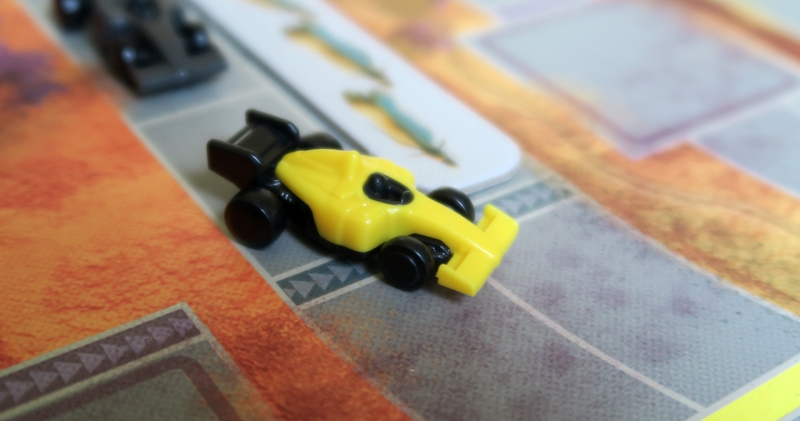
Downforce: Wild Ride
– Image by boardGOATS

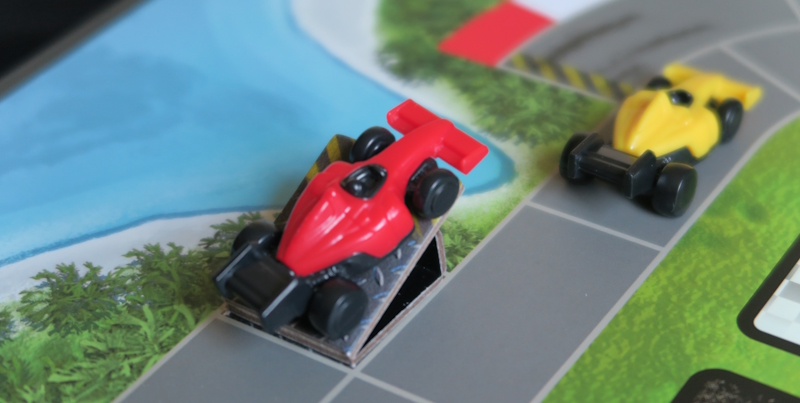
This time, the group played with the Aloha Sands track from the Wild Ride expansion which features water jumps. Cars can use these ramps if they are moving fast enough which lets players pass other cars and move more efficiently. Thus, hand management to take full advantage of the different speed cards is crucial.  The game begins with an auction of cars.  This is after players have been dealt their hand of cards, and this time, the blue car was popular and went to “determined” Lime, who outbid “cunning” Pink.  With six cars on the grid, and four players, there is the possibility of some getting more than one vehicle—although one car (green) went unclaimed, Lime ended up with orange as a second.

Downforce: Wild Ride
– Image by boardGOATS

The Aloha Sands only has two betting lines, and the group chose to use the first two featuring on the betting variant score sheet.  In this “odds” variant, players get better “odds” for a car that is at placed less well than one that is currently winning.  The red car, owned by Pine took an early lead, but by the time the cars made it to the second (and final) betting line, it had dropped to third.  Pink had a fist full of cards that favoured to the blue car, and although he had been outbid for it, he had decided to push it along anyhow and bet on it.  As a result, with both Lime and Pink favouring it, the blue car moved through the field (aided by some double jumps) and crossed the finishing line first.

Downforce: Wild Ride
– Image by boardGOATS

Second place went to Black’s little black car with Pine’s red roadster completing the podium.  Betting and car costs have a huge impact on the final scores though, as can the initial outlay for the vehicle.  In this case, despite paying for two cars at the start, the fact that Lime owned the winning car and had also bet on it, meant he had an unassailable twenty-one million dollars, eight million more than Pink in second place.  With the race over, the quartet chose to move onto a more festive game, Jokkmokk—a cute little set collecting game that went down really well when it got its first outing last year.

Jokkmokk: The Winter Market
– Image by boardGOATS

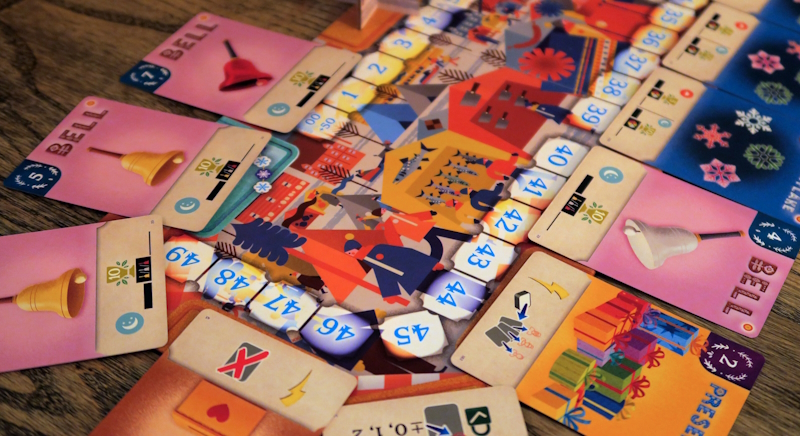
In this game, players move one of their two family members, the one furthest back, to an empty space and claim the associated card before resoling its effect and refilling the empty space.  Some cards score points in the middle, others only at the end, so the sets of cards used can really change the game.  As this was the second game, the group chose to use the “Second Game” set, featuring the Fika (a Swedish custom of enjoying a coffee and a treat with friends), Aurora Borealis, Snowflake, Patchwork, Mystery Box decks.  Of these, the Snowflake cards scored during the game giving Black and early lead with fifteen points, five more than Pine in second.

Jokkmokk: The Winter Market
– Image by boardGOATS

The mid-game points were chicken-feed compared to the end game scoring, however, with lots of points available for Fika and Patchwork scoring and for the face value of the cards themselves.  The winner was Pine with a total of one hundred and twenty-eight, eight more than Pink in second and eighteen more than Black in third.  Everyone had enjoyed the game so much, that when Lime inevitably suggested playing again, everyone else agreed.  This time the group used the “Gift of Giving” set of cards, including the Donation, Bell, Sparkler, Snowflake, Mystery Box and Presents decks.

Jokkmokk: The Winter Market
– Image by boardGOATS

The game followed a similar pattern to the first, with Black and leading at the midpoint with Pine in second and Pine taking overall victory.  This time, Lime was the runner-up, however, with Black taking third again.  Meanwhile, on the next table, Blue, Plum, Byzantium and Purple were playing Blue’s favourite game, Keyflower.  This is it’s second outing of the year, but Plum and Byzantium had missed out last time.  They had played it before, but had felt that it didn’t shine with two players and were keen to see how it played with more.

Keyflower
– Image by boardGOATS

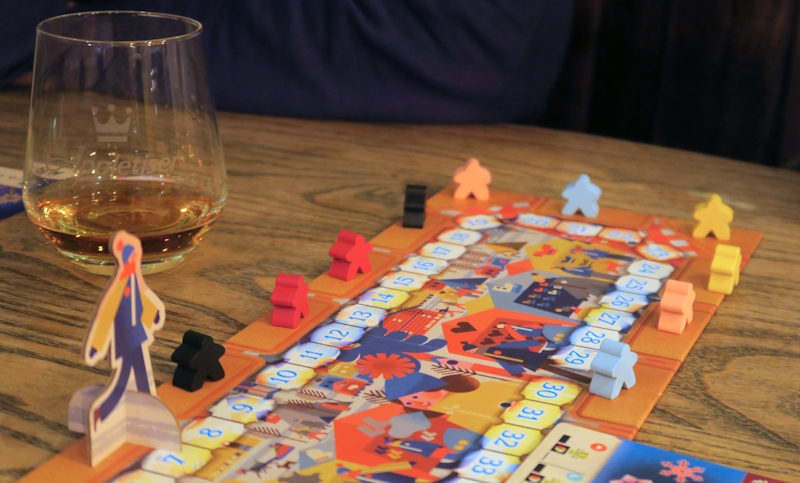
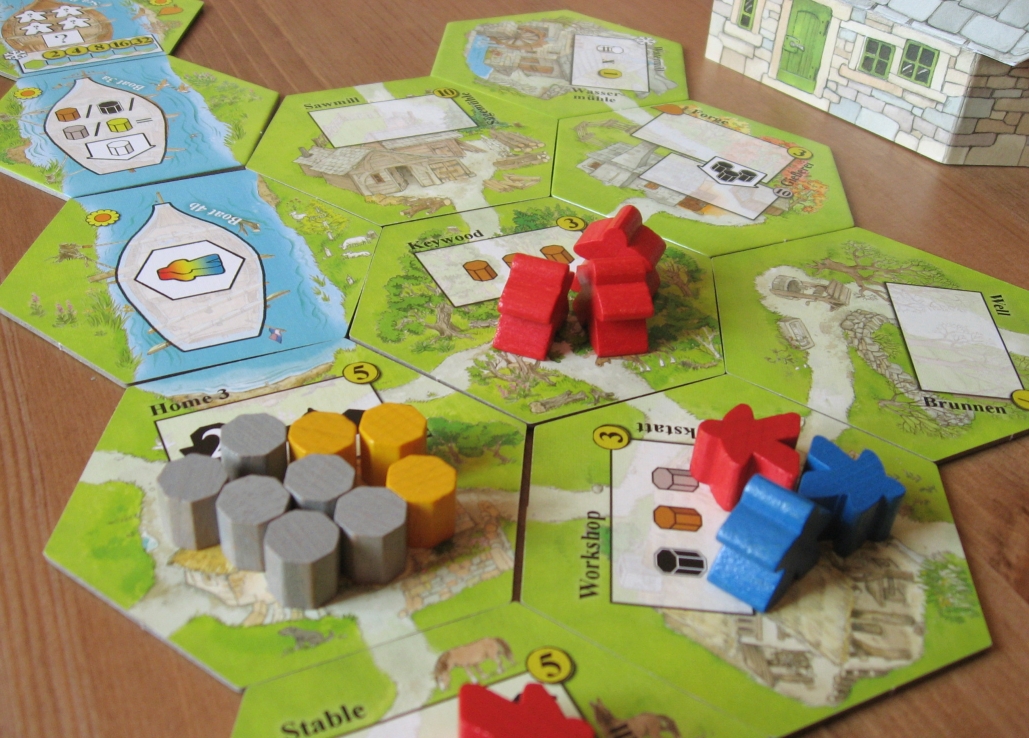
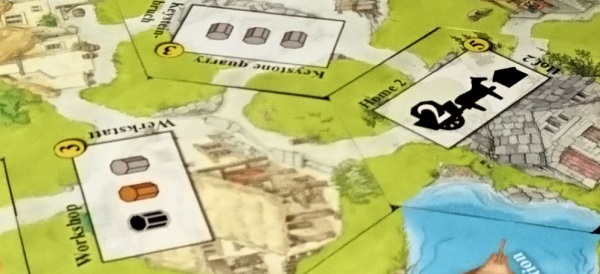
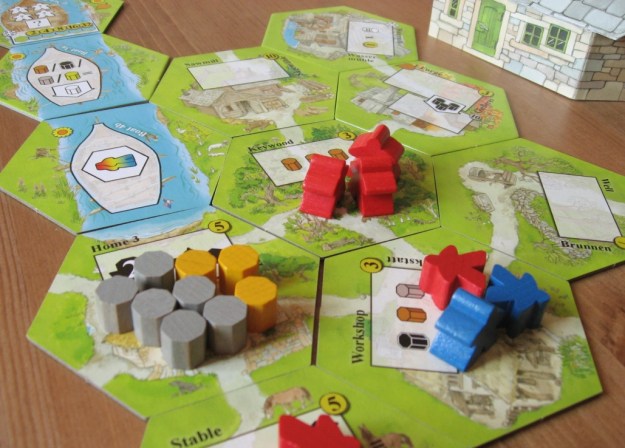
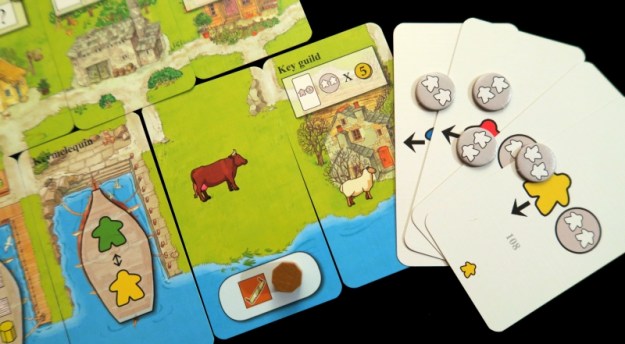
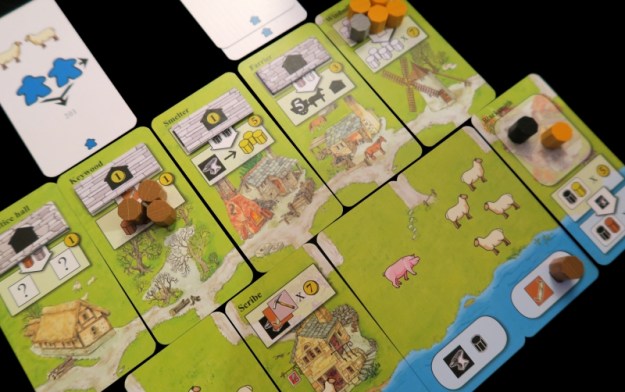
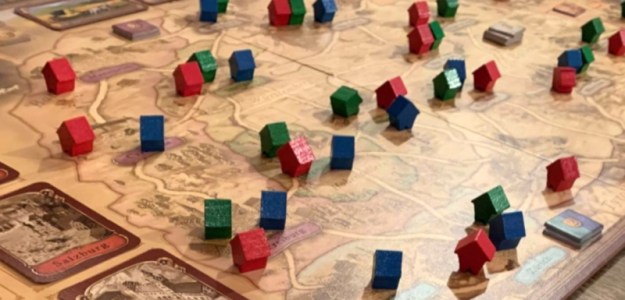
Keyflower is an auction and worker placement, with elements of set collection and even network building.  Although everyone had played it before, Blue went through the rules.  The idea is that players use meeples to bid on tiles, but can also use them to activate tiles to gain their benefit (usually Resources, Skill tiles or the ability to move resources around their Village).  At the end of each of the four rounds players add the tiles they have won to their Village and get any meeples back that were used to activate tiles in their own village.

Keyflower
– Image by boardGOATS

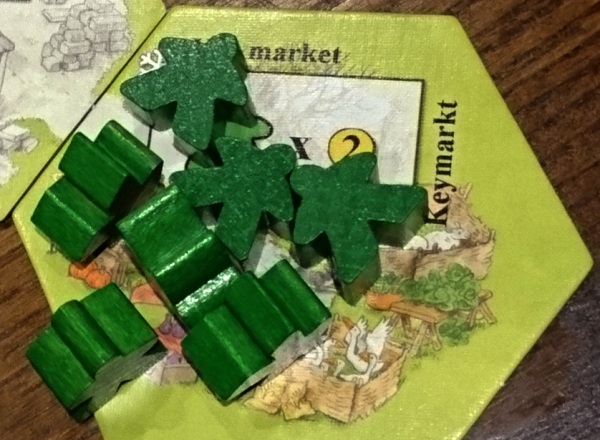
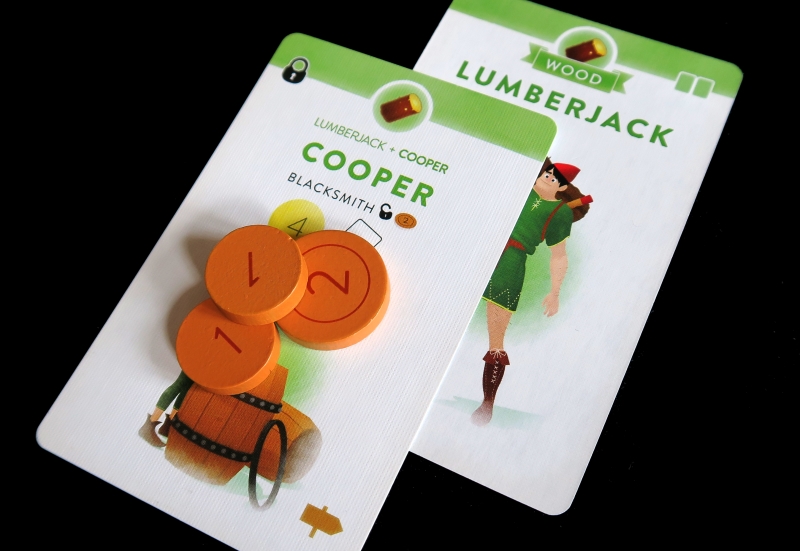
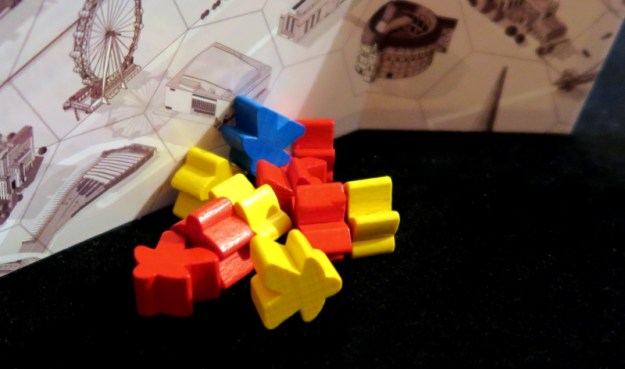
One of the key aspects of the game is the colour of the meeples, as players have to “follow” when bidding or activating a tile. As a result controlling the number of blue, red and yellow meeples they have is a key part of the game.  More, green meeples, which are special and can only be acquired by activating specific tiles, can be really valuable.  Blue had a Winter tile that gave points for having green meeples at the end of the game, so started bidding on the Peddlar which came out in Spring.  Byzantium had other ideas, however, and outbid Blue.  In fact, that was just the start of a tight game where there was a lot of competition for many tiles.


Keyflower
– Image by boardGOATS

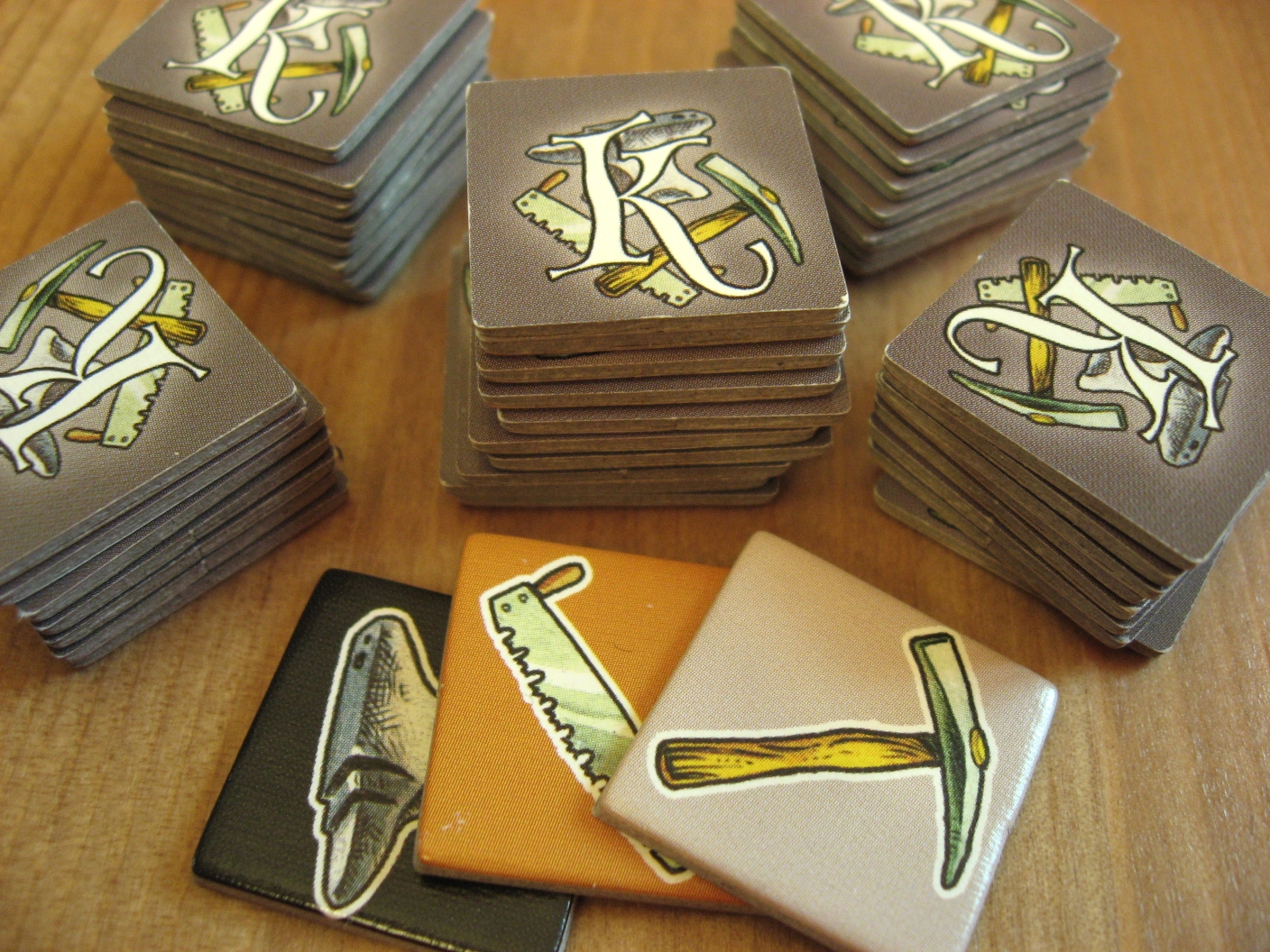
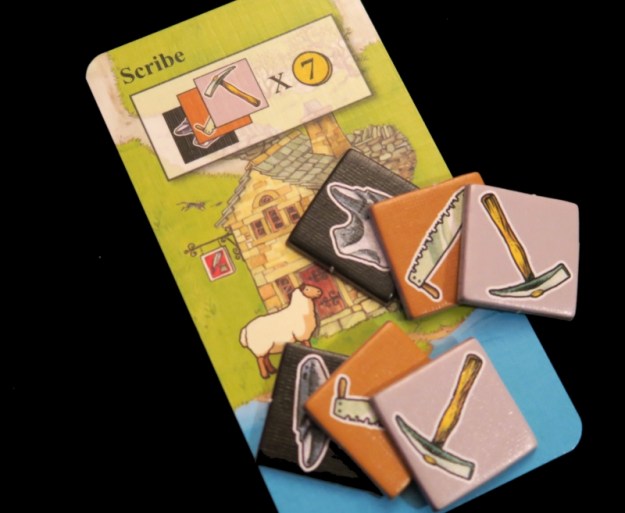
Keyflower is a game that typically rewards players who keep their options open, but this time, Blue found her options quickly narrowed and ended up going for sets of three Skills tiles.  This can be lucrative, but can also be difficult to make work, so like many things in Keyflower is a bit of a gamble and with all her eggs in the one basket, she had no choice but to ensure she won the Scribes tile by ensuring she went first in the final round and had a large pile of red meeples to back it up.  Tension mounted as players fought for the tiles they needed.  The Keythedral changed hands several times, and the Jeweller, the Village Hall and the Watermill were all strongly contested.

Keyflower
– Image by boardGOATS

In the final scoring, it was clear that the Scribes tiles made all the difference, with Blue finishing with eighty-six points, fifteen more than Byzantium in second with Plum taking third.  As the tiles were packed away, there was some discussion about the game, with Plum and Byzantium commenting that the balance of tiles is less swingy in four-player Keyflower than with two  While they were packing up, the second of two games on the next table was coming to an end.  In the first of these, Jade led Sapphire and Cobalt in the hot-off-the-press game, Fromage, a worker placement game about cheese-making in France.

Fromage
– Image by boardGOATS

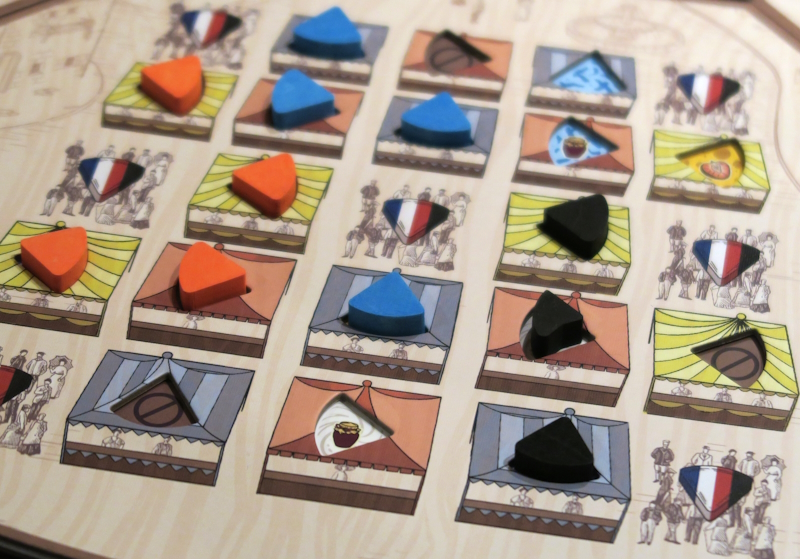
This is a clever game with a “time” element, similar in feel to Tzolk’in.  In both these games, workers left on the board for longer give more valuable actions, however, in Tzolk’in, players place their workers and the options become better the longer they stay on the board with players making the decision as to what they get when they remove workers from the board.  Players can also only place workers or remove them, not both.  In Fromage, there is more flexibility, and the action is carried out when the workers are placed and then remain on the board for longer for the more valuable actions.

Fromage
– Image by boardGOATS

Game play is simultaneous, with all players placing their workers at the same time working on their quarter of the board.  Once everyone has finished, the board is rotated, and any workers who have finished their spell on the board are returned to their owner to be placed again in the next round.  Workers can stay on the board for one, two or three turns, so a key part of the game is planning and with only three workers, making sure that players don’t end up with all of them stuck on the board.  This was another tight game with players scoring fairly evenly in the four areas of the board, the Bistro, Festival, Fromagerie and Ville.

Fromage
– Image by boardGOATS

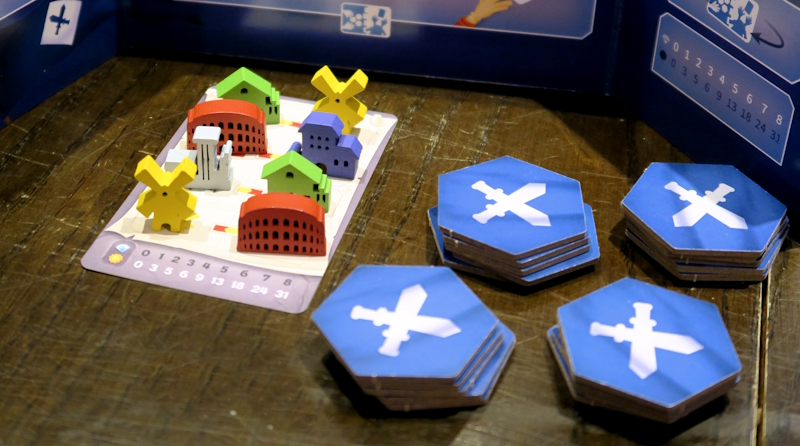
Cobalt just edged it on Fruit and Orders, however, giving him a four-point victory over Jade in second with Sapphire not far behind.  There was just time for one last game and the choice was another recent popular game, Looot.  This is a clever management game, using a double placement mechanism where Vikings conquer territory on the central player board, allowing players to gain resources, buildings and objective tiles while they build their village on their personal board using tiles from the common board to gain victory points.  This was another tight game, especially between first and second place.

Looot
– Image by boardGOATS

It was backwards and forwards between Cobalt and Jade and finished with just two points between them.  Once again though, Cobalt just had the edge, his hundred and six points just pushing Jade into second again.  It had been a good night though and a fitting end to the evening, and the last meeting of the year at the pub.  As the last Christmas cards were handed out and final Season’s Greetings shared, people headed off into the darkness and with just two sleeps till the big day.

Santa's Workshop
– Image by boardGOATS

Learning outcome:  You don’t have to play Festive games at Christmas to have fun.

8th October 2024

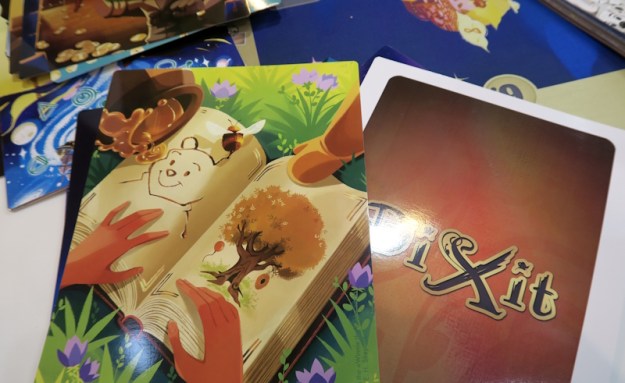
As it was our twelfth birthday party, lots of people arrived early for pizza (or an amazing Mixed Grill in the case of Lime and some lovely veggie curry and fiery chilli for Pine), followed by GOAT cupcakes.  While everyone waited for food, arrivals from Essen were handed out, including Nucleum, Faraway and Flamme Rouge expansions; Let’s Go! To Japan and Cascadia mini expansions, and Die Wandelnden Türme (aka Wandering Towers), Keyflower and Dixit promotional items.   There was a lot of chatter too, about flooding, pot holes, the 34 road closure, full car parks and water leaks, as well as Essen.  Indigo and Navy weren’t eating, so had a play with Villagers while the others entertained themselves.  This is a card game where players “Draft” Villager cards from a market (called the Road) and then add them to their Village.

Villagers
– Image by boardGOATS

Some Villagers have prerequisites before they can be “Built”.  These are cards that must exist in the player’s Village before the Villager can be added on top to make a chain, cards that must be unlocked by paying money to other Villagers in their own Village, someone else’s Village or the Bank.  Some cards allow players to draft extra cards, while others enable players to Build extra Villagers and Special Villagers give powerful special actions.  Twice during the game there “Market” Phases when players get income from their cards, and the player with the most money at the end of the game is the winner. Somewhere along the lines, Indigo and Navy had a bit of a rules malfunction, and as everyone else had already started the now traditional birthday “Feature Game“, Crappy Birthday, they abandoned Villagers.

Crappy Birthday
– Image by boardGOATS

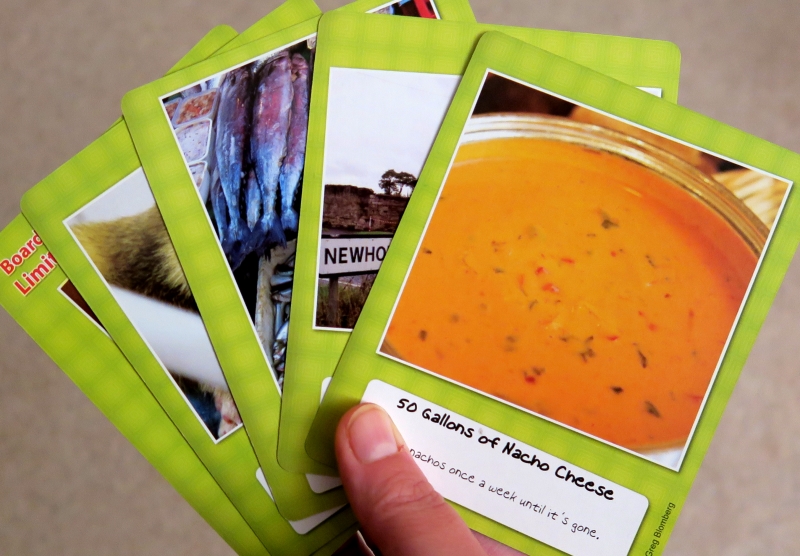
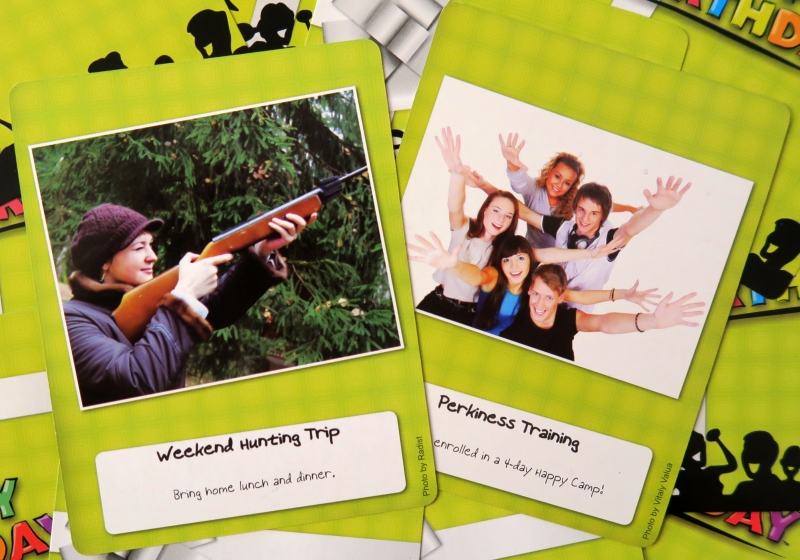
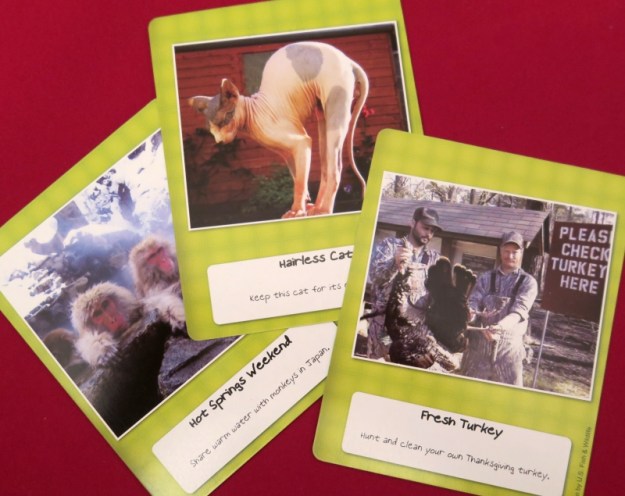
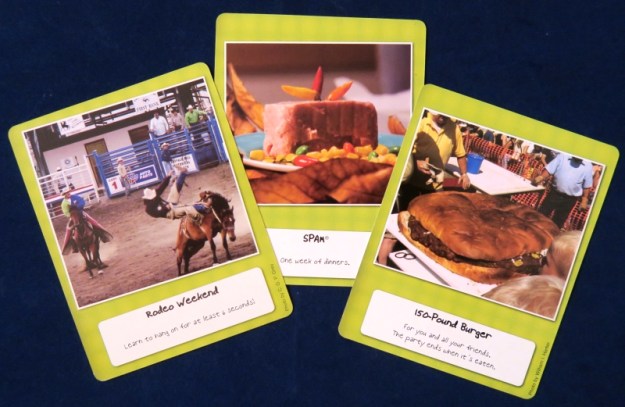
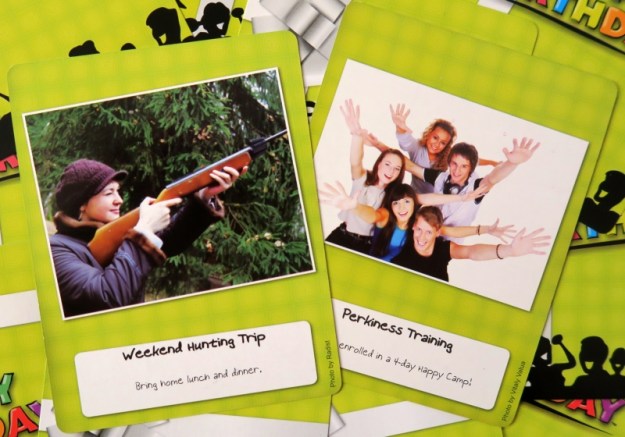
Crappy Birthday is a party game where players give each other comedy birthday presents and the recipient has to decide who gave the best and worst gifts.  We play a slight variant of rules as written, where we play a single year of birthdays with each gamer getting one turn to receive gift cards from everyone else from their hand of five cards.  With lots of players the pile of gifts can get quite substantial and this time everyone was getting thirteen gifts to decide which was the best and which was the worst.  The players who gave these then received a point for knowing the recipient so well and the player with the most points at the end of the year is the winner.

Crappy Birthday
– Image by boardGOATS

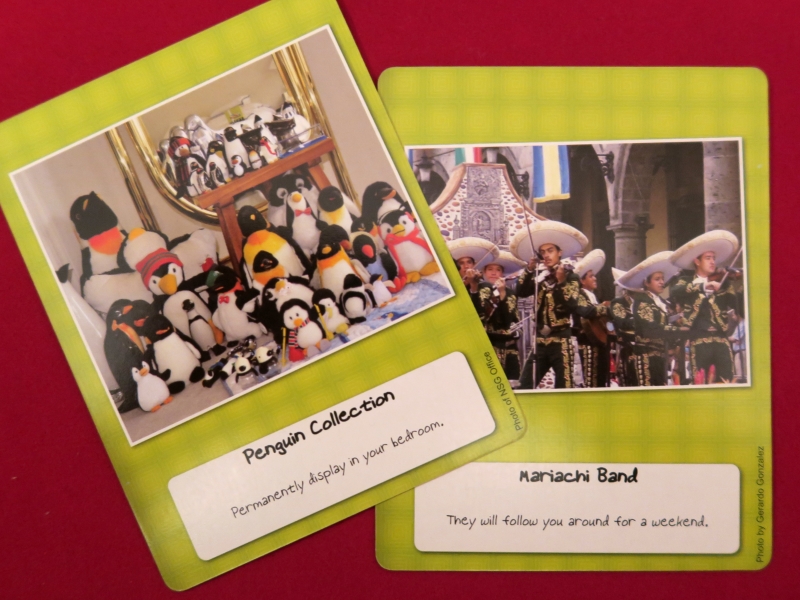
One of the reasons this game is so fun is that we learn a bit about each other.  Pink went first as his real birthday was next.  He liked the idea of an Easter Island Mo’ai for the garden (not that Blue was so impressed with the idea), but disliked the idea of cave scuba diving.  Plum chose a haunted castle as her favourite (because she loves castles), but pulled a face at the idea of earlobe stretching rings.  Purple had the matching neck rings, but these weren’t her least favourite gift, that was a giant swing ride, while she loved the idea of a penguin collection.  Byzantium showed his environmental credentials by picking a Global Warming Study as his favourite, while eschewing Jade’s wing suit dive gift.

Crappy Birthday
– Image by boardGOATS

Teal felt that trees were quite beautiful enough without being carved, but really liked the idea of a ride-on bike mower.  Jade wasn’t a fan of Cobalt’s offering of Polka lessons, but loved the idea of trip to Mars from Sapphire, while Sapphire felt “perkiness training” wasn’t something he really needed, but the thrill-seeker loved the reciprocal gift from Jade, a roller-coaster ride.  Lime fancied a three day festival trip, but wasn’t keen on a week eating nothing but Spam.  Blue didn’t fancy the creepy baby sculpture to go with the Mo’ai, but fancied Pink’s gift of a Safari (provided she had time to train for the walking element).  Ivory didn’t feel his life would be improved by a free satellite TV dish, but always one to send his meeples into space in Tapestry, grasped the opportunity to join them with a space walk.

Crappy Birthday
– Image by boardGOATS

It turned out that Navy has a problem with bees, so Teal’s gift of a bee keeping which he personally would have loved, didn’t go down well, but much to Pink’s surprise, his gymnastics camp was received really well.  Indigo was quite abrupt in her negative response to the idea of paparazzi following her about, but liked the idea of exploring a volcano while Cobalt didn’t feel he needed his soul to be searched, but fancied flying lessons.  The final birthday of the year was Pine, who didn’t get his usual pile of horses and meat, instead getting the opportunity to run with the bulls, which having known someone who had done it and been gored, wasn’t something he fancied.  Pine’s favourite was Larry the Lobster (not that he has space in his garden for him), one of the Big Things of Australia, that Pink and Blue happened to see on their visit there last year.

Crappy Birthday
– Image by boardGOATS

Lime was the last to break his duck and was very pleased not to end the game without scoring any points, indeed, nobody finished with the dreaded bagel, which was nice.  The runniest of run-away winners was Teal though, with five successful (or unsuccessful) gifts, with Pink and Cobalt joint runners up with three.  It was interesting though, this time there were quite a lot of gifts that people gave “in error” where as Teal commented, he “Gave pressies he thought people would like, but they all hated them!”  With the birthday formalities dealt with, there was time for something relatively short.  First up was Jade who was very keen to give his new Faraway expansion, Le Peuple du Dessous (aka The People Below).

Faraway
– Image by boardGOATS

Faraway is a fairly simple little game, but one that really messes with your head:  players play cards from their hand of three, adding them to a row of cards, left to right, but at the end of they score the eight cards from right to left.  The Peuple du Dessous expansion adds just seventeen cards, but these include the Guides and the Three-Eyed Ones, two new Peoples with more opportunities to score, as well as giving enough cards to play with seven people.  This time there were only five though, with Sapphire, Byzantium, Indigo and Navy joining Jade.  Navy and Indigo were new to the game and, as usual, it took a little bit of getting used to.  That said, the both did really well with Indigo ending up with seventy-seven points, four more than Sapphire in second with Navy taking third, just one point behind.

Faraway
– Image by boardGOATS

Navy and Indigo headed off and took an early night, but the other three had to wait for Plum who’s game on the other side of the room was ongoing.  Faraway is a fun little game though and the expansion adds a little more, so the trio decided to give it another go.  This time, Byzantium was the victor with seventy-three with Sapphire the runner up again.  Meanwhile, Blue, Pink, Pine and Teal, got out Bohnanza.  This is a game that is generally popular with the group, though Teal had somehow only managed to play it the once almost six months ago.  This is a very simple card game, albeit slightly convoluted and very unpromising when explained, but the key is that players must not rearrange the cards in their hand.

Bohnanza
– Image by boardGOATS

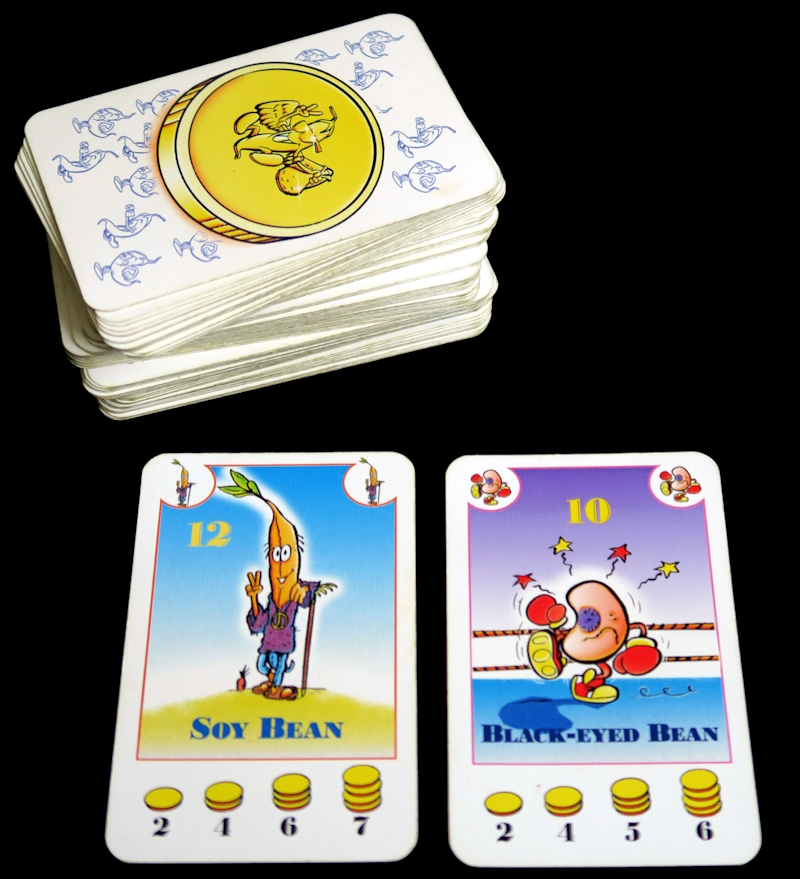
On their turn, players must plant the first card in their hand in one of their two been fields and may plant the second if they choose.  They then turn over two cards from the deck, which must be planted before the player can move on.  Fields can only contain one bean type, but beans can be traded, or even gifted, and it is the trading and negotiation that makes the game such fun.  Once the two cards on the table have been planted, players can trade from their hand, but again all traded cards must be planted.  Players can harvest Fields at any time with some of the bean cards dug up becoming money and larger Fields giving more money and at a better rate.

Bohnanza
– Image by boardGOATS

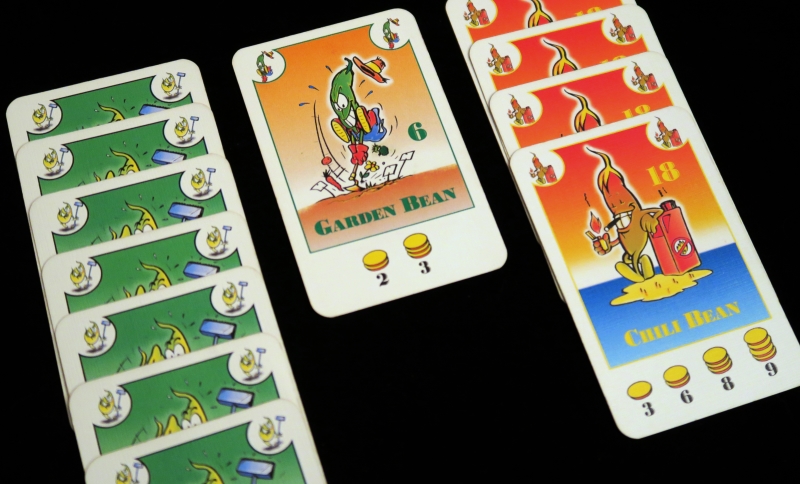
Blue took some high valued Garden Beans and then sold them off to buy a third Bean Field, causing a lot of confusion for Pink who couldn’t believe it when they kept appearing even though there were only six in the deck.  Teal scored well from his Chilli and Wax and Soy beans, while Pine and Blue ended up in competition for Green Beans.  This time with just four, the scores were a little more varied, but Blue was the clear victor with twenty-five Bohn Thaler, five more than Pine who came second.  The final game of the evening was Villagers, which was getting another outing on the other side of the room with Cobalt leading Ivory, Purple and Plum.

Villagers
– Image by boardGOATS

After a reminder of the rules, Purple started and grabbed the Carpenter then Cobalt went next taking the Blacksmith.  Both of these guaranteed their owners an income of coins (and hence points) at the expense of other players paying to use them. However, this did mean that they fell behind on building an engine to Draft and Build more cards (which Plum and Ivory focused on).  From there, the first half of the game went quite quickly with everyone focusing on building their engine. Ivory managed to get a Wine Trader using a Monk as a Graper, as well as playing a Scavenger, enabling him to take slender lead after the first scoring, although the scores were all very close.

Villagers
– Image by boardGOATS

In the second half of the game, Purple and Cobalt were beginning to have to make tough choices, being unable to play as many cards as they would like and not having the building cards they needed, which were also hard to come by. However, they continue gaining coins from all players. Purple had to discard quite a few cards to get starter cards which slowed her down a little, though Plum and Ivory were able to quickly get to the position to Draft and Build the max number of cards allowed; Plum in particular seemed to always have a fist full of cards.  As the game progressed, more people began taking cards that others might want, with Cobalt taking Wool cards that might have been of use to Purple or Ivory.  Ivory, however, was actually more focused on getting a second Vintner, already having a second Wine Trader in hand.

Villagers
– Image by boardGOATS

Towards the end of the game, there was face down Grape card which Ivory debated taking a gamble with, but decided not to take the risk.  Inevitably, when it was flipped over it turned out to be Vintner and Plum grabbed it. Ivory got very lucky during his next draft though, taking a face down Special card that was Monk, which he could then play as Vintner. Elsewhere, Purple played some Wool cards, getting two Weavers, Plum picked up some good end-game scoring cards in the Locksmith and Freemason. Cobalt focused on Solitary cards and Silver end game scoring, doing well from his Priests, Agent and Blacksmith combo. Ivory ended up focusing on the Hay cards, which scored well and that plus the two Wine Traders (and a second Scavenger), gave him a hundred and twenty-six and a two point victory over Cobalt.

2024 Birthday Cupcakes
– Image by boardGOATS

Learning Outcome:  Getting old is not necessarily a bad thing.

9th July 2024

When Blue and Pink arrived, Crimson and Cyan were already there on their first visit, finishing their supper and playing a game of Molehill Meadows.  This is a new game by the designer of Zuuli, that they had picked up at the UK Games Expo (meeting the designer Chris Priscott and his delightful family in the process).  In Molehill Meadows, players take on the personality of Mika the Mole, who has an affinity for shiny things, a hunger for juicy worms and an innate desire to dig  A flip-and-write game, players dig tunnels using polyomino shapes to carefully expand their molehill home.

Molehill Meadow
– Image by boardGOATS

Their game was somewhat interrupted as people arrived and were introduced and they were surrounded by the general chatter of arrival and Blue and Pink munching their pizzas.  Crimson and Cyan carried on playing, flipping polyomino cards and then drawing the shapes on their map.  Extending their tunnel to find Worms gave both players four “Worm Powers”, and fining treasure gave them points.  Cyan collected twice as much treasure and picked up more than twice the number of bonus points than Crimson (for collecting all of the two sets of flowers on the Objective Cards) and thus was the eventual victor by something of a landslide (or should it have been a tunnel collapse?).

Molehill Meadow
– Image by boardGOATS

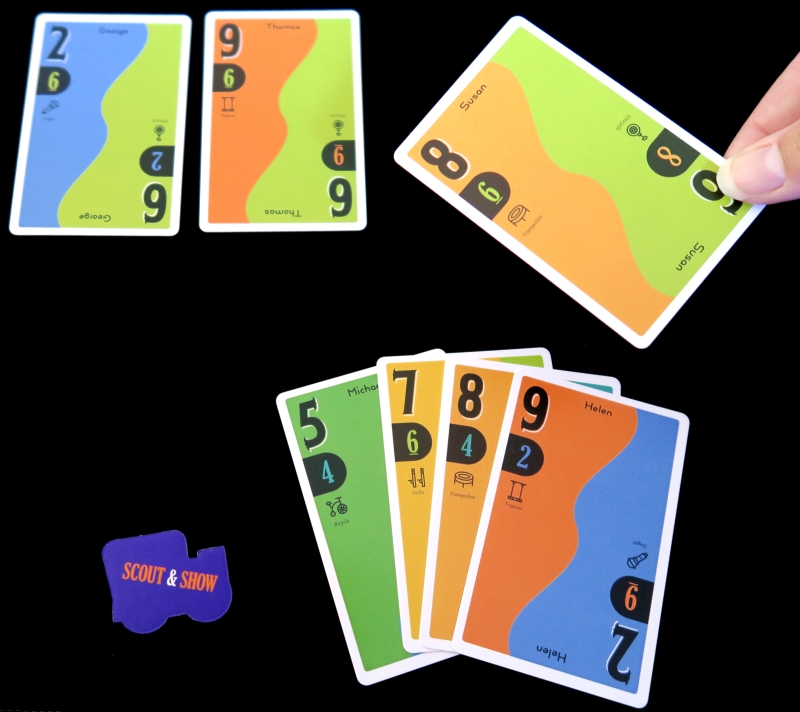
Then, while everyone else generally gossiped and caught up with the events of the last week or so, Jade and Sapphire joined Crimson and Cyan for a quick couple of rounds of the trick-taking, climbing game, SCOUT.  We’ve played this a few times on a Tuesday and everyone has always enjoyed it.  The game is simple in that on their turn, the active player either plays a set of cards to beat and replace the set on the table (a run or a meld), or take one card from either end of the set on the table and add it to their hand.  The round ends if a player plays the last card in their hand, or if it is a player’s turn and they played the current active set of cards on the table.
SCOUT
– Image by boardGOATS

At this point, player score for cards in their scoring pile (cards they have beaten during the round), for “chocolate bars” (rewards given when another player takes a card from their active set), and deducts a point for every card left in hand.  The clever part of the game is that, like Bohnanza, cards cannot be rearranged in hand, this with the fact that cards have different values depending which way up they are make this little card game really clever.  In the interests of time, the group only played two rounds, and although the scores can be very disparate, this time it was really tight with only five points between first and last and Sapphire taking the honours one point ahead of Crimson.

SCOUT
– Image by boardGOATS

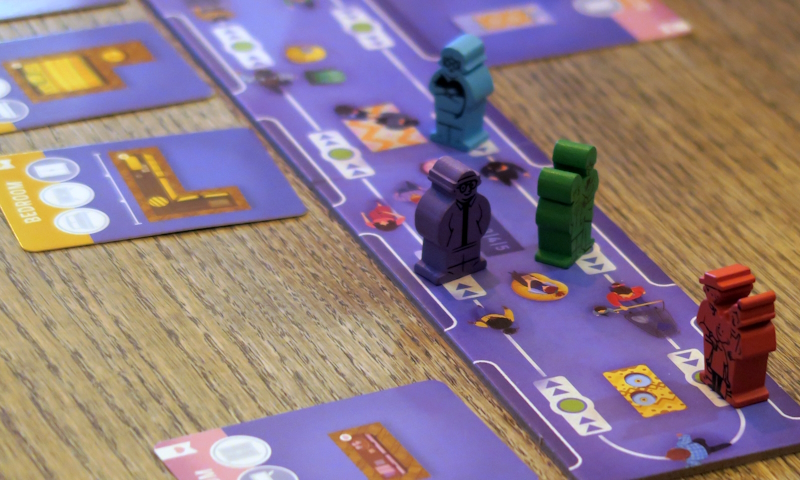
By this time, Blue and Pink had just about finished eating and everyone else had mostly finished chatting, so with twelve, the group split into three groups of four, starting with Pine, Sapphire and Cyan who joined Jade in the “Feature Game“, Happy Home.  This is another polyomino game, with similarities to games like New York Zoo and Bärenpark, but with a theme of home decorating rather than building an animal park.  Like New York Zoo (or indeed Jokkmokk), the game has a central market, in this case representing a Store, which players move their Meeple round.
Happy Home
– Image by boardGOATS

On their turn, the active player moves their Meeple (or should that be Muman?) to an available space, takes the card and matching tile and then adds it to their home.  When all the cards are used up, players instead place a “Welcome Mat” on their doorstep to show they are ready to welcome visitors.  When everyone has finished , the game is over and players score their Home for Furniture, Colours, Pot Plants, their Welcome Mat and Design Objectives, losing points for any scratches still visible and not covered up by Furniture.
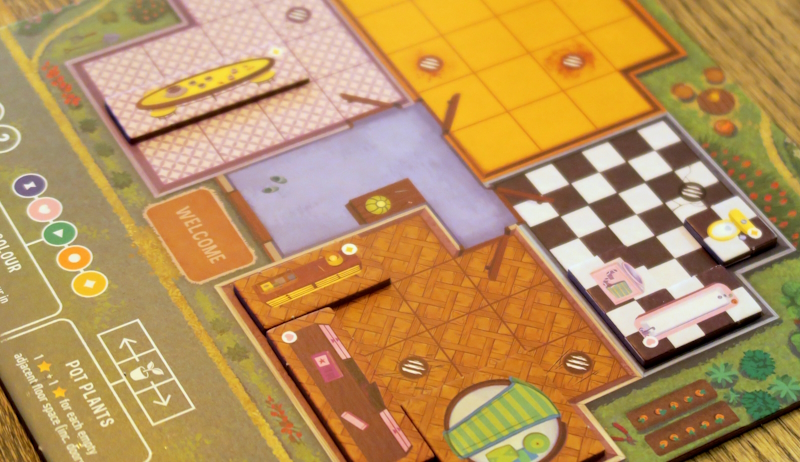
Happy Home
– Image by boardGOATS

There was a wee bit of misunderstanding on how the scoring worked even though Jade had done his best to explain it at the beginning.   Each Room scores one, three or six points if it has one, two or all three different core pieces of Furniture in it, and each Pot Plant is worth a point plus a bonus point for each empty space orthogonal to it.  That wasn’t where the problem was however, that was with the Colour scoring. Essentially players need to have the same Colour across at three different rooms to get two points and across four rooms to get five points, but somehow, this caused more confusion than it should have done.
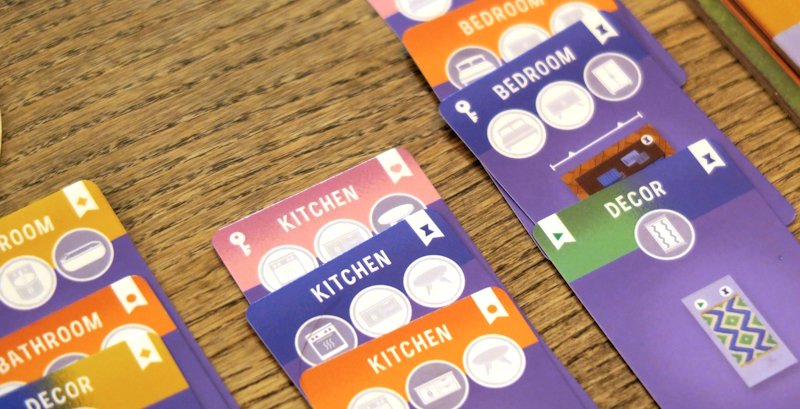
Happy Home
– Image by boardGOATS

The group also made life more difficult for themselves by shuffling the cards and removing twenty-four cards as per the rules for the four-player game, but somehow the bulk of those removed seemed to be Furniture for just one of the rooms, the Bathroom.  It was a good learning game as the value of Rugs, for example, became evident later on—players were a bit confused as they don’t score in their own right, but they add Colour to a Room and thus can score at the end of the game.
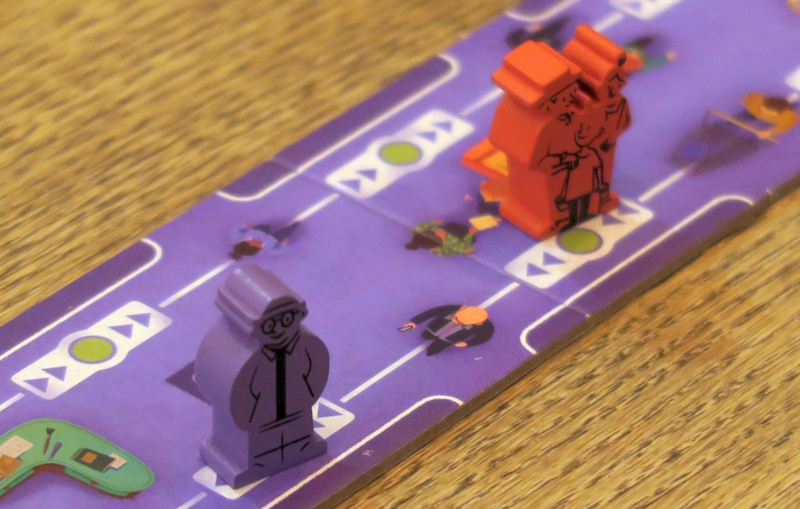
Happy Home
– Image by boardGOATS

This time the Design Objective was “Bigger is Better”, so players lost a point for each empty floor space in their Room with the most empty spaces.  The lack of Bathroom fittings, meant Pine didn’t have a loo in his house and had to resort to “wafflestomping“, but he did have what looked like two pink ironing boards furnishing his Lounge.  Next door, Sapphire filled his Living Room with a pink sofa and an enormous matching pink widescreen TV (that was the same size as the sofa!).  In the end, the victor was a bit of a runaway winner.
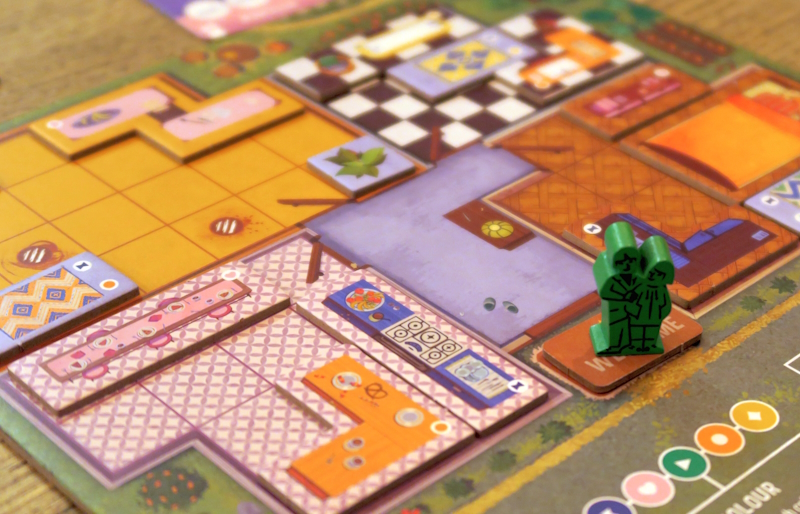
Happy Home
– Image by boardGOATS

In spite of his lack of toilet facilities, Pine finished with twenty-four points, some seven ahead of Sapphire in second, with Jade taking the last place on the podium.  Before the game, Pine had said he wasn’t sure about it from the description, but in the event he really enjoyed it, as indeed did everyone else.  Meanwhile, there were two other games underway.  The first of these was Keyflower—a very popular game with certain members of the group, but one that hasn’t had an outing for a long time, in fact the last time the group played it was online in 2020, and the much-missed Burgundy was involved.
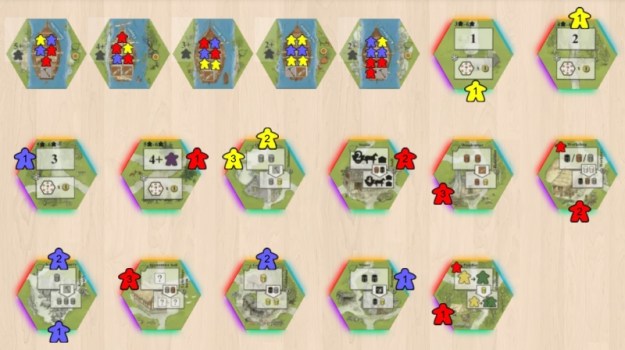
Keyflower on boardgamearena.com
– Image by boardGOATS from boardgamearena.com

This time, the four players were Blue, Pink, Black and Ivory, all of whom had played Keyflower before (albeit a while ago).  The game is fairly simple in terms of concepts, but like many good games, challenging to play well.  Each round, players take it in turns to bid on a tile, or activate a tile.  The clever part of the game is that both bidding and activating is done with red, blue, yellow or occasionally green Keyples (Meeple-shaped workers).  In each of the four rounds (or Seasons), a set number of tiles are put out for players to bid on.  Players take it in turns to bid or activate and when everyone passes in succession, any tiles won are added to the winner’s village, any losing bids and any Keyples used for activating return to their owner.

Keyflower: The Farmers
– Image by boardGOATS

At the end of each round, a boatload of new Keyples arrive in each village (players can bid to get the one of their choice), before the tiles for the next Season are set out.  In general, tiles are drawn at random, and in the first season, Spring, mostly provide Resources with Summer and Autumn tiles providing special powers and Autumn and Winter tiles providing scoring opportunities.  The Winter tiles are different to those for the other Seasons in that instead of being drawn at random at the start of the Season, they are dealt our to each player at the start of the game.  Then, at the start of Winter, players choose from their pile which ones they want to make available—in this way, the Winter tiles act as sort of objective tiles.
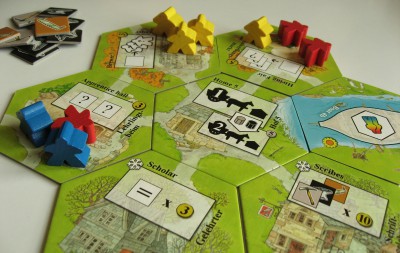
Keyflower
– Image by boardGOATS

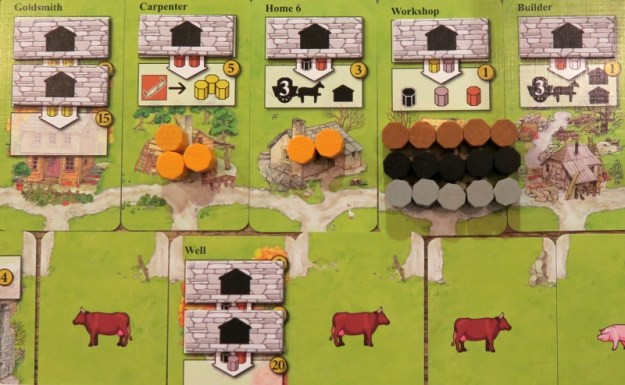
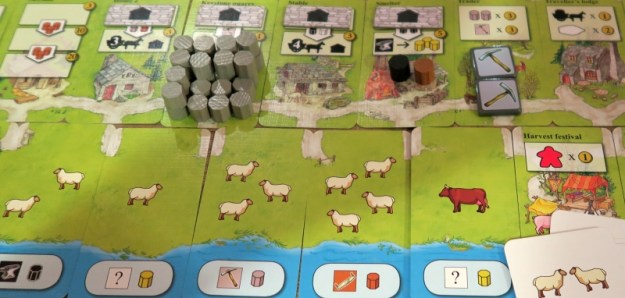
The Keyflower box also contained The Farmers expansion and the question arose whether to include it or not.  Blue, Pink and Ivory were on the fence until Black said he’d never played with the Farmers, so of course that was a problem they had to urgently fix.  In the base game, the different tiles are connected by roads which are used for transporting goods to places where they can be used to upgrade tiles or score points.  In The Farmers expansion, these roads now define fields where animals can be left to graze and with each occupied field scoring points at the end of the game.
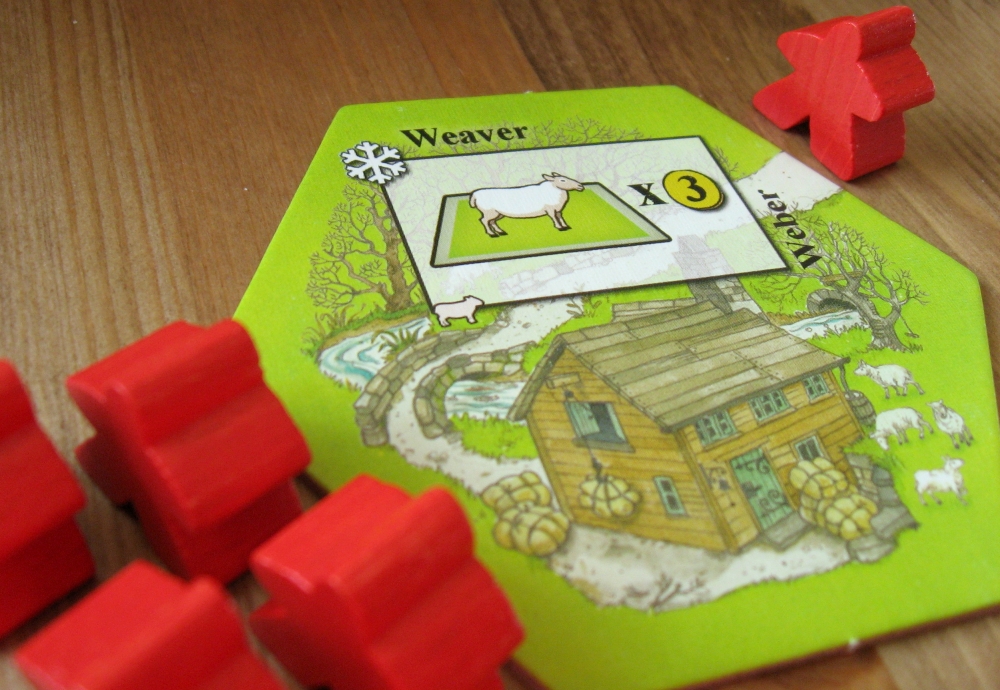
Keyflower: The Farmers
– Image by boardGOATS

Additionally, The Farmers expansion introduces wheat as a new resource, which can be used to add distance/quantity to the movement action, enabling players to move more animals and resources further.  There are several ways to set up the game with The Farmers expansion, but this time the group used The Farmers Variant, where all the tiles from the expansion are used and the number made up with tiles from the base game.  After setting up and explaining the additional rules to Black, Ivory went first, taking the waving purple start-player Keyple, and began the bidding.

Keyflower: The Farmers
– Image by boardGOATS

In Spring, Blue failed to get anything useful at the start of the game (or so she thought) taking just the Key Mine tile which gives Coal and didn’t match any of her Winter tiles.  Pink started off taking the Sheep Fold which gave him a source of sheep and the Paddock which gave him more Movement and upgrade ability together with some Wheat.  Then, he took the Workshop which gave him one resource of his choice from Wood, Coal or Stone, upgradeable to three resources, one of each, which matched his Winter tile, the Mercer’s Guild.  Ivory won the Quarryman, which gave him some very useful gold, and in Summer took the Shepherd’s Hut which gave him Wheat and Sheep and then embarked on a concerted breeding and movement programme.

Keyflower
– Image by boardGOATS

Black picked up a few tiles early in the game, which ultimately led to a lightly sprawling Village by the end of the game.  These included the Wheatfield in Spring and the Tavern, the Smelter and Boat 3a in the Summer.  By this time, Pink had decided that the sheep weren’t doing it for him so moved on to pigs, with the Pigsty.  Blue, having missed out on the Tavern which converts one Keyple into two, instead took the only tile that generated green Keyples, the Store which went well with one of her Winter tiles, the Key Market, but gave the added power of preventing other players from following if she was the first to Bid with Green, as they were highly unlikely to have any.

Keyflower: The Farmers
– Image by boardGOATS

In Autumn, Blue discovered the value of the Key Mine tile she had picked up in the first round, when the Blacksmith tile appeared which gave points for each Coal on the tile at the end of the game.  She added the Ranch to this which gave Cows and Wheat, and then began mining Coal in earnest and hoarding large numbers of sheaves for a super-movement move later in the game to get everything where it was needed as efficiently as possible.  Black got the Goldsmith which went well with his Smelter which gave him the Gold he needed to upgrade it and get ten points, while Ivory and Pink continued their procreation programmes.
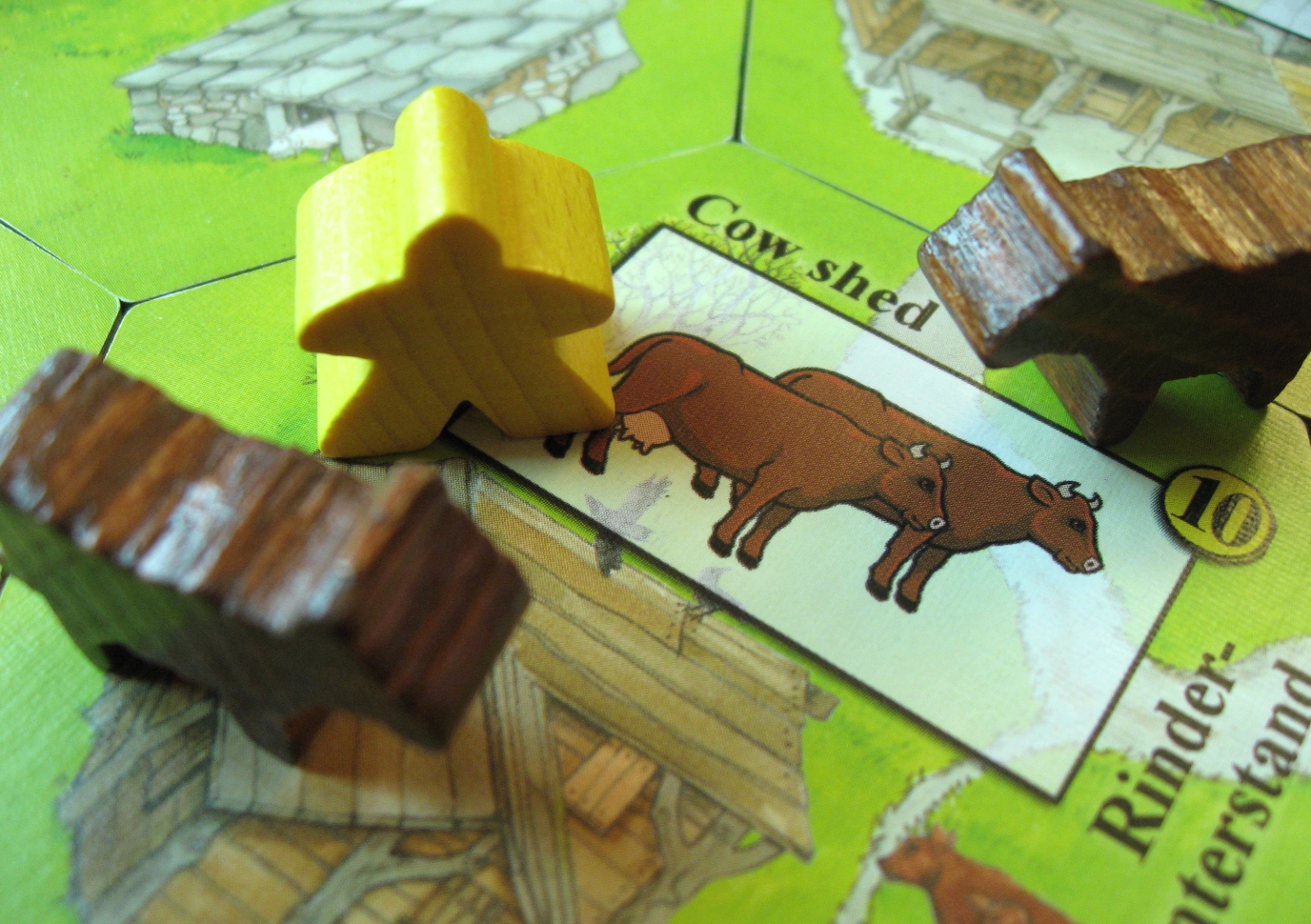
Keyflower: The Farmers
– Image by boardGOATS

As the game progressed there were several visits from the other gamers in the room, many of whom, much to the people who were playing it’s surprise, had not played Keyflower. It is, of course, Blue’s favourite game and was a favourite of Burgundy’s, as well as being generally very popular with almost all of the regulars pre-2020.  So as the game continued into Winter, it was clear it would have to get another outing or two reasonably soon to rectify the situation. There is also The Merchants expansion which has not been played with the group, so that might be the “Feature Game” in the coming months.

Keyflower: The Farmers
– Image by boardGOATS

Only eight out of a possible sixteen Winter tiles were introduced by the players and the Scribes, which Ivory commented usually ensured victory was not there (it turned out nobody had started with it).  Black took the Granary which gave him points for his Wheat and Pink got his Mercer’s Guild that he’d been working towards.  Ivory won the Cathedral giving him a straight twelve points; the Weaver giving two extra points per sheep field, and the Bakery giving four points for each set of a Resource, a Skills tile and a Wheat Sheaf.  Blue had lots of options, so concentrated on building her piles of resources before bidding for her end of game scoring.
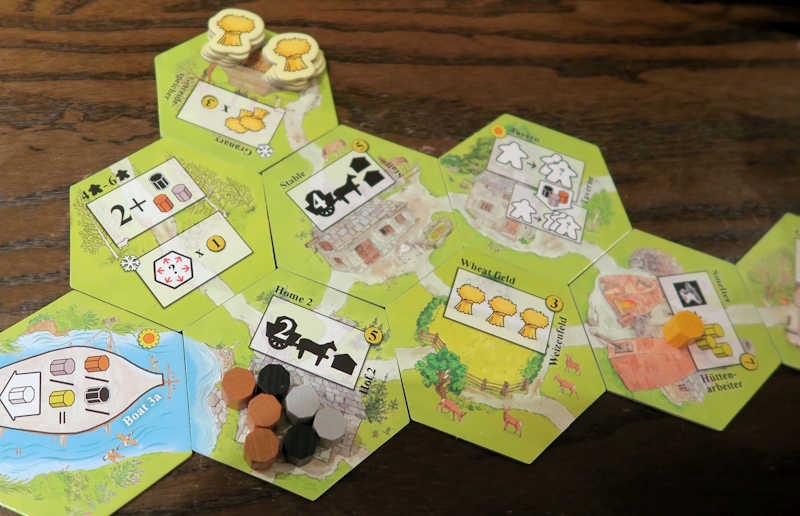
Keyflower: The Farmers
– Image by boardGOATS

This required a lot of nerve as Ivory had there wherewithal to take some of the tiles she obviously wanted.  Ivory hummed and hawed over it and as Black and Pink passed, twice he had the chance to begin a war, but decided not to as “that’s not very nice” and it can also backfire spectacularly.  Instead he generated the odd Gold for a point (“in case it was close”) and waited and watched.  In the end he passed and then Blue passed and that was that bar the counting.  And as it turned out, it was close, very close, but Blue just took victory, by a mere three points, with a total of ninety-five.
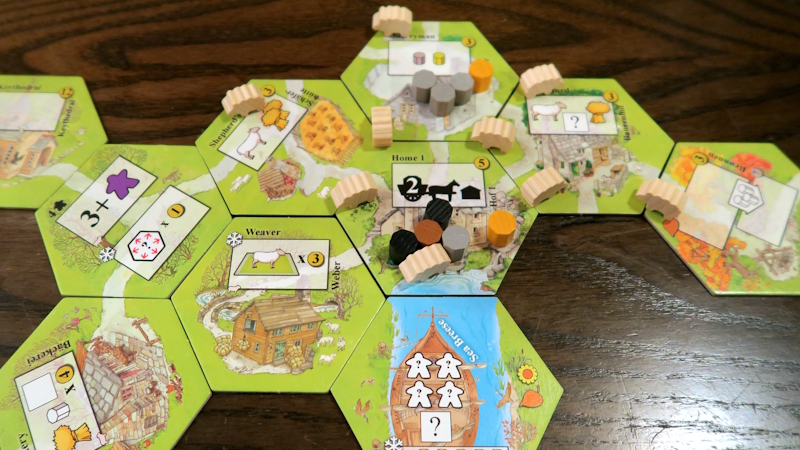
Keyflower: The Farmers
– Image by boardGOATS

The jury is out as to whether it was Ivory’s kindness that cost him the game because Blue did, of course, have contingency plans if someone had tried to take some of the tiles she wanted, and she could have cost him a lot of points.  However, by the end, Blue had no Keyples left and Ivory had a couple that he could have used, so depending on how things had panned out, he might have just nicked it or still lost.  Instead, his kindness and generous good nature won him a lot more respect from his fellow gamers, especially given that everyone knew how fond Blue is of Keyflower successfully destroying her plans might have made her just a little bit sad.
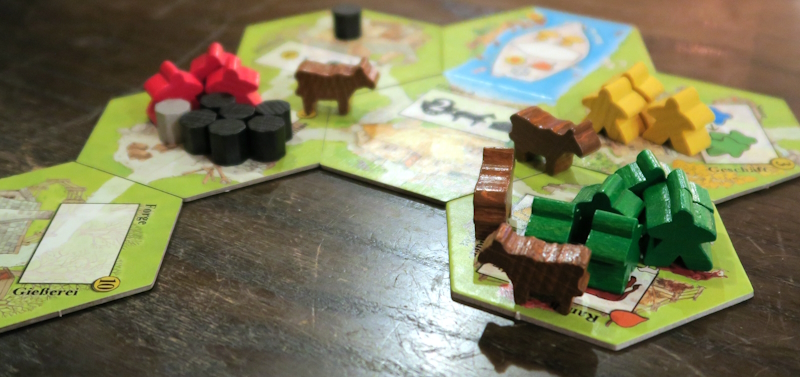
Keyflower: The Farmers
– Image by boardGOATS

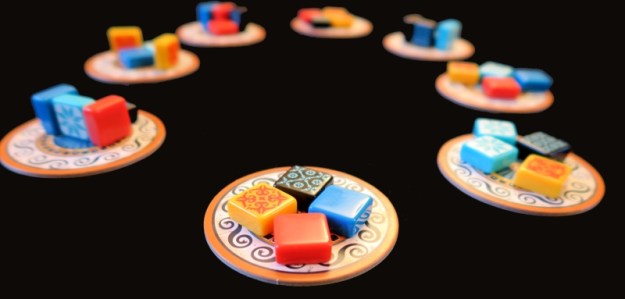
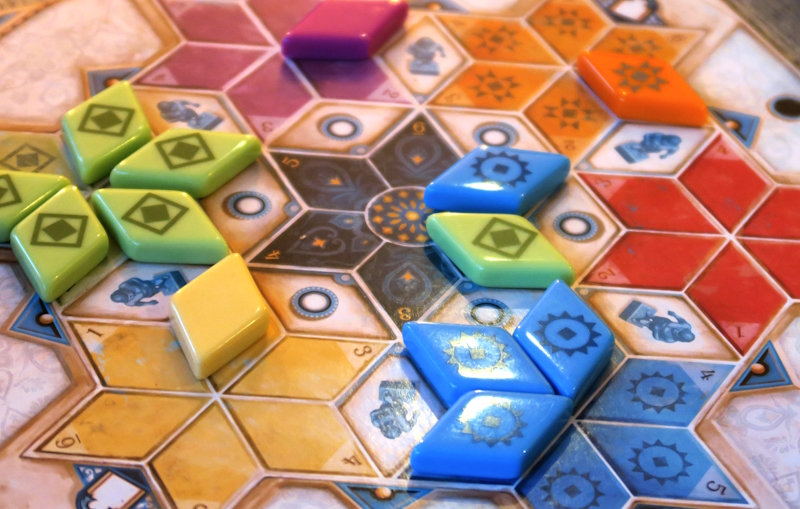
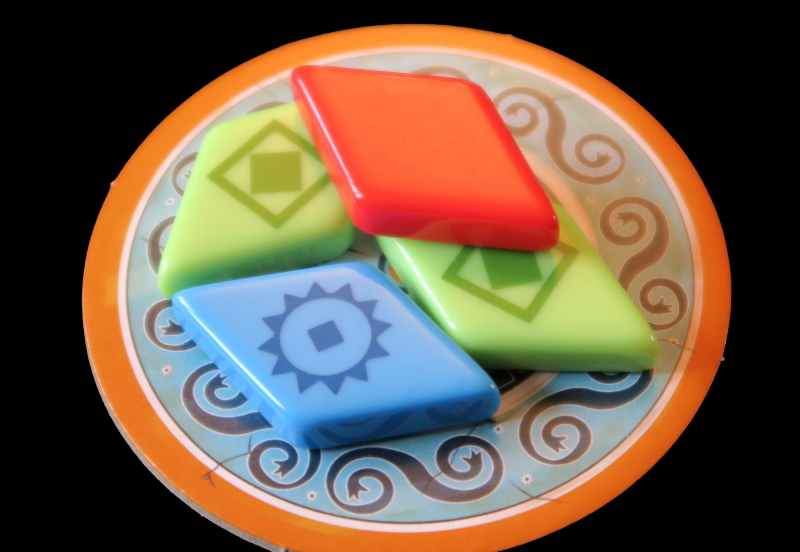
Finally, the third table began their evening with Azul: Summer Pavillion, the third in the series based on the essentially abstract game of tile collecting, Azul.  Crimson kindly obliged in offering to lead the game with Lime, Teal and Purple, none of whom had played this variant before.  This is more similar to the original than the second in the series (Stained Glass of Sintra), but is built on lozenge-shaped pieces that make up hexagons.  Like the original, players take tiles from a central market and add them to their player-boards claiming points as they do so.  In contrast to the original, players store the tiles and add them all to their board at the end of the round (taking it in turns to do so).
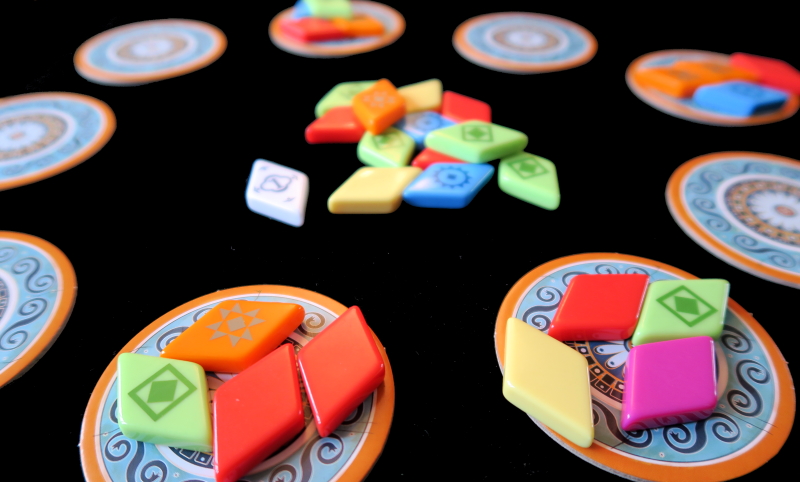
Azul: Summer Pavilion
– Image by boardGOATS

After some initial confusion caused by the additional bag and player boards from the Objective Tiles and Glazed Pavillion expansions, the game got underway.  Unfortunately, there was a bit of a rules malfunction:  initially it was thought that every time a tile was placed it scored one point for itself, two for one next to it and three for a third one in sequence (totalling six).  The group soon realised this wasn’t right though.  So they then thought you scored at the end of the round after playing all the tokens, however, they soon realised there was no way anyone could remember when a new tile that round had been placed.
Azul: Summer Pavilion
– Image by boardGOATS

At this point, they then read the rules and from that decided players score one point for the tile and one for each tile it was adjacent to, thus scoring from one to three points per tile as they were placed and this is how they continued to play.  Cyan immediately identified they had come a cropper when he looked at the low end-game scores. He explained that they should have scored one point for the tile placed and one point for each tile connected to that group, so potentially up to six points could be scored for some tiles!
Azul: Summer Pavilion
– Image by boardGOATS

Although it wasn’t played by “the rules as written”, everyone had the same disadvantage, and the group resolved to give it another go again soon, but with the right rules next time.  As it was, it was a very close game with Crimson, beating Lime by a single point and Teal finishing some half a dozen points behind.  It is a very pretty game, and despite the issues, players had enjoyed making patterns and pushing the tactile bright tiles around, which was very therapeutic after a hard day at work.

Azul: Summer Pavilion
– Image by boardGOATS

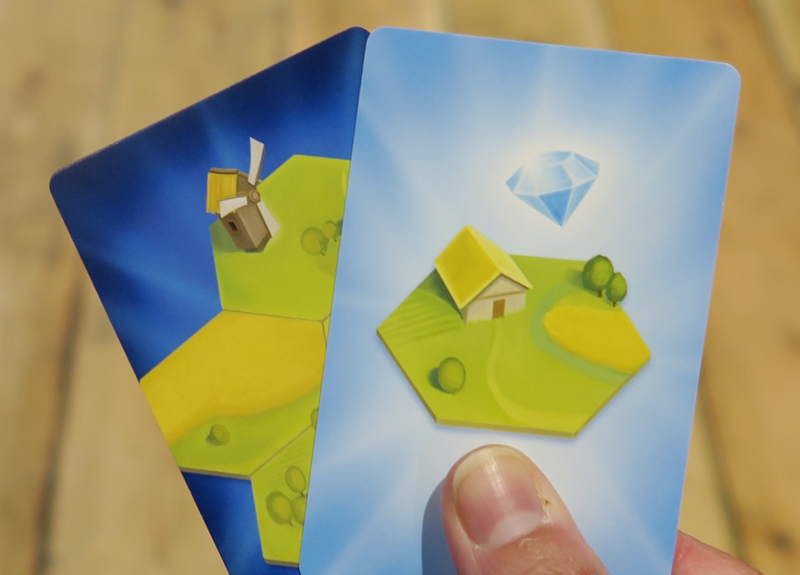
Keyflower was ongoing (and would be for the rest of the evening), but Happy Home had finished so there was a quick game of musical chairs and Purple began by leading Lime, Cyan and Pine in a game of the group’s currently popular filler, Rome in a Day.  This is a little tile laying game built round the “I divide, you choose” mechanism.  The idea is that players draw five land tiles at random and place two buildings on tiles one and two. They then divide the five tiles into two groups—a bigger and a smaller one (in any ratio), and add a Crystal Gem to the smaller land set before offering the choice to their neighbour.
Rome in a Day
– Image by boardGOATS

During the four rounds that the game is played over this neighbour alternates, right, left, right, left. So, each round, players choose a set from their neighbour and these and the tiles they were left with are added to their domain.  At the end of the game, any building that stands on or adjacent to land of its own colour will score for each tile in the group and then players score for the diamonds they have collected—the player with the most points is the winner.  The game has had a couple of outings recently after Black and Purple picked it up at UK Games Expo a few weeks back.  Pine, Lime and Cyan had not been part of those games, so Purple explained the rules.
Rome in a Day
– Image by boardGOATS

The game was a bit of a struggle, probably not helped by the fact that on both the previous occasions the rules have not been strictly adhered to.  This is partly because the rules are not the best written and partly because when the game was explained to Black and Purple at UK Games Expo they were different to those published online.  Although it wasn’t entirely clear to everyone during the game, it was actually very close.  In fact, Lime and Cyan finished tied for first place with forty-four points each despite quite different tactics with Cyan prioritising collecting Gems and Lime making hay in his Wheat fields and wine in his Vineyards.
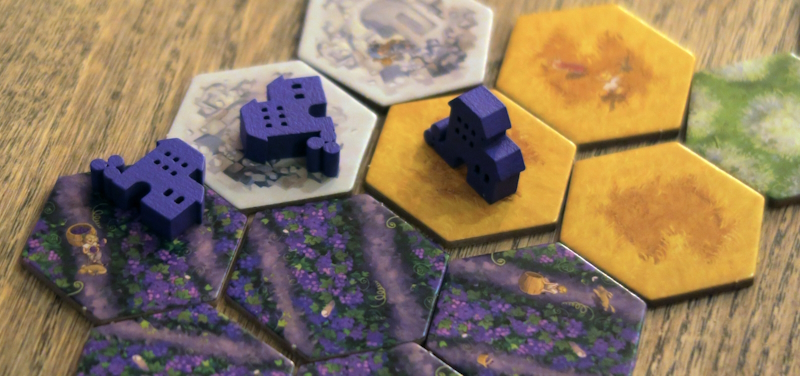
Rome in a Day
– Image by boardGOATS

While the group were fighting their way through Rome in a Day and Keyflower was coming to an end, Jade led Sapphire and Crimson in the 2024 Spiel des Jahres recommended game, Harmonies.  This was described by Jade as a sort of cross between Splendor and Cascadia, with an Azul-type market.  On their turn, the active player takes three wooden Tokens from one of the spaces on the central player board and places them on their player board. These Tokens represent Mountains, Trees, Buildings, Water and Fields.  Some tokens can stack, others cannot: the reasons why are thematic (e.g. tall Mountains and Forests, no tall Rivers etc.), but otherwise Tokens can be placed on any empty space.

Harmonies
– Image by boardGOATS

Players may then take an Animal card from the central display—they can have a maximum of four at any one time and each has a number of Animal cubes on them.  Each time the pattern on an Animal card is fulfilled, one of these Animal cubes is removed and placed on the token indicated on the card.  At the end of the game, players score for the highest achieved Animal on each card and for each Mountain, Tree, Building, Field and River (or Island, depending on  which side of the board players are using).  Mountains are made of stacks of up to three Rock Tokens, while Trees are a green Leaf Token on zero, one or two Wood Tokens.
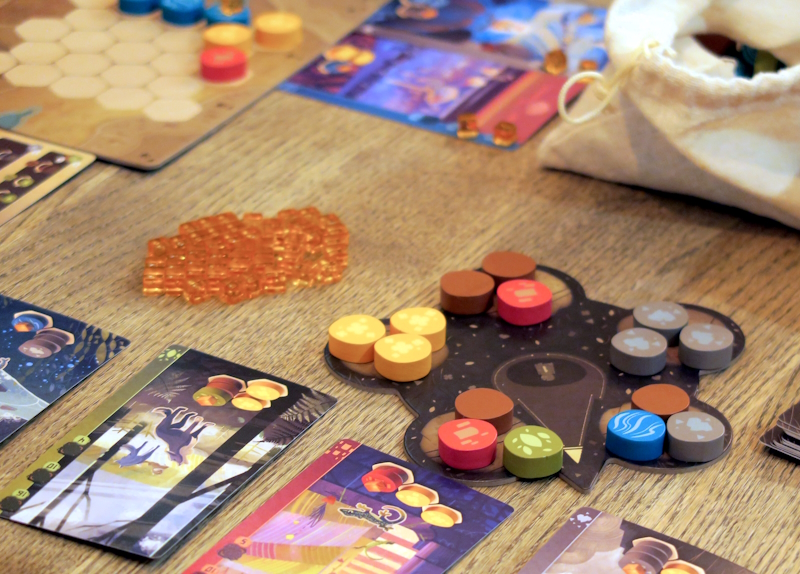
Harmonies
– Image by boardGOATS

Taller Mountains and Trees give more points (one, three or seven points), while Buildings (made of two Tokens, at least one Brick and a Wood, Rock or another Brick), and Fields (two adjacent Wheat Tokens) score five points each.  Finally, depending which side of the board is used, players score points for the length of their River, or five points for each Island they make.  This time, the group played with “Side A” which scores for Rivers.  It was a learning game for Crimson, but was quite close quite between Jade and Sapphire, but Sapphire’s one hundred and eight gave him victory in what is an interesting point-salad tile-placement game that deserves another outing soon.

Harmonies
– Image by boardGOATS

Learning Outcome:  You don’t need a toilet to have a Happy Home.
Jogo do Ana Nominations 2024

Although the Jogo do Ano, the Portuguese Game of the Year Award is less well known than its German counterpart, the Spiel des Jahres, it is perhaps more relevant to experienced gamers as it recognises heavier games, or “gamers’ games”.  Starting in 2006, it is chosen by members of Spiel Portugal with each choosing ten games of their choice. The five nominees of the year are then played again and are evaluated according to defined parameters, namely: production (15%); theme (10%); mechanics (10%); replayability (10%); interaction (5%); time/fun (50%).

Spiel Portugal Logo
– Image from spielportugal.org

Previous winners include Barrage, Root, Lisboa, Great Western Trail, Mombasa, La Granja, Keyflower, Agricola and Brass.  Last year the winner was Carnegie, a game inspired by the life of  nineteenth century Scottish-American benefactor and philanthropist Andrew Carnegie.  This year, the nominees are:

The winner will be announced in October.

Jogo do Ano Logo
– Image from spielportugal.org

Essen 2023

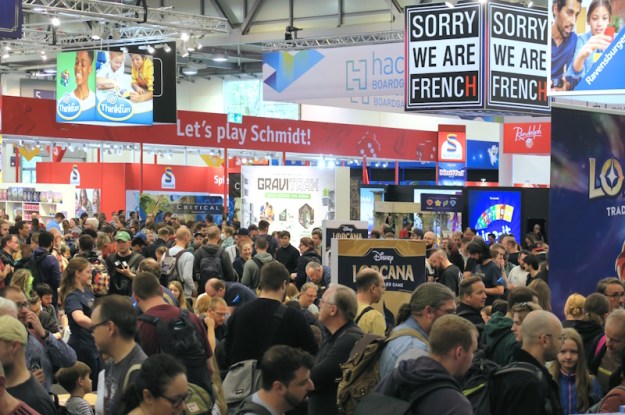
Today is the final day of this edition of the largest games fair in Europe and arguably the world, the Internationale Spieltage.  Known to gamers worldwide simply as “SPIEL” or “Essen”, the annual fair is of particular significance as many new releases are scheduled to coincide with the event just in time for Christmas sales.  Following the recent change in management, this year there were quite a few changes.  Aside from the logo, the most noticeable was the layout in the halls—according to one game designer, every stand except his was in a new location in an effort to theme the halls.  For the most part, this seemed to work, though inevitably some people will feel they lost out in the great shuffle.

Essen 2023
– Image from spiel-essen.com

One thing that hasn’t changed, is the lack of general gaming space, especially when compared with the likes of the UK Games Expo and Gen ConSPIEL is a games fair, not a convention—it’s purpose is to showcase new and up-coming games and sell them to the general public, but also small and medium-sized resellers.  Additionally, there is a lot of business going on behind the scenes, including designers demoing games to publishers, and publishers meeting with producers and other publishers to discuss contracts.  It is arguable that large amounts of playing space are counter to SPIEL’s priorities, but they could definitely do with providing more chairs—not everyone has the stamina of a twenty year old, and the number of people just sitting on the ground suggests more seating is an essential.

Essen 2023
– Image by boardGOATS

Following the cancellation of SPIEL in 2020, there were restrictions on numbers for 2021 and Covid mandates in 2022 leading to reduced numbers (93,600 and 147,000  respectively), so 2023 was the first year when things were back to normal.  One question therefore, has been whether numbers would return to the levels, or even exceed those of 2019, when there were 209,000 entries.  It will be a few days before the statistics for 2023 are reported, but anecdotally, the answer is yes, with some exhibitors commenting that Friday was the busiest it had ever been, and the annual no-ship Maths Trade and Auction was as mad as ever.

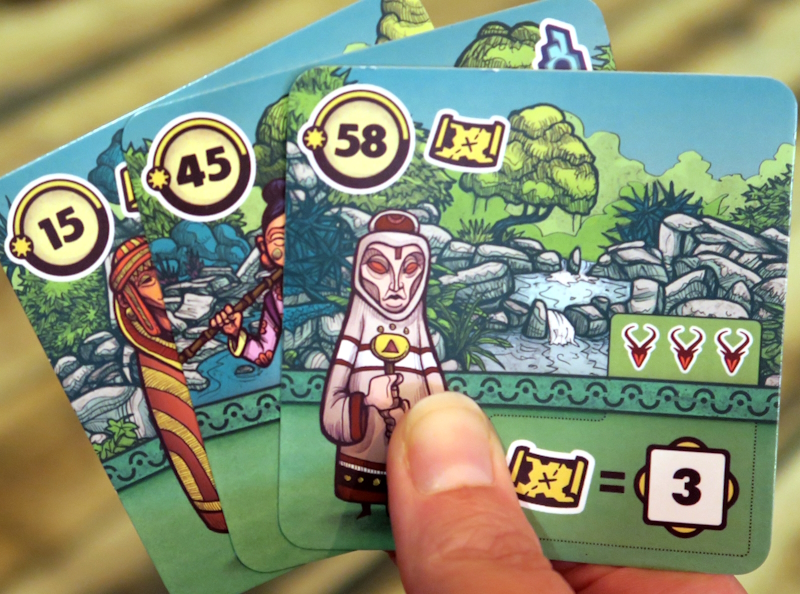
My Gold Mine
– Image by boardGOATS

This year there is the usual selection of the latest releases including, The White Castle, Nucleum, Kutná Hora: The City of Silver, Evacuation, The Glade, My Gold Mine, Amygdala, Forest Shuffle and Footprints.  There are also expansions for previous games like Cascadia (Landmarks), Ark Nova (Marine Worlds), Lost Ruins of Arnak (The Missing Expedition) as well as this year’s winners of the Deutscher Spiele Preis, Planet Unknown (Supermoon).

Ticket to Ride Legacy: Legends of the West
– Image by boardGOATS

A common theme are the re-releases and reimplementations of old favourites and there are a lot of these this year, like Ticket to Ride (Legacy: Legends of the West) Elfenland, Zooloretto, Dixit (Disney Edition), Shipyard (Second Edition) and NMBR 9.  As usual, there are also loads of mini promotional expansions available for games like Flamecraft, Die Wandelnden Türme, Keyflower, Underwater Cities, Dorfromantik and 2022 Golden GOAT, Praga Caput Regni, amongst others.  There truly is something there for everyone.

Dixit: Disney Edition
– Image by boardGOATS

20th September 2022

Blue and Pink were the first to arrive to the news that The Jockey was under new management.  Pine soon followed and after a bit of chatter, the three of them settled down to the first “Royal Themed” game, Love Letter.  This is a very quick little game played with a deck of just sixteen cards.  The idea is that players have a hand of one card and, on their turn draw a second and choose which one to play.  The cards each have a special action and a number—the actions allow players to eliminate each other and the player with the highest number at the end is the winner.

Love Letter
– Image by boardGOATS

Powerful cards can lead to early gains, but are risky as they make players targets, however, relying on weaker cards for too long will give a guaranteed loss.  This time, Pink was taken out twice in consecutive rounds by Guard cards with Pine and Blue sharing the spoils.  In the third round, it was down to Blue and Pine again and Pine ran out the winner.  Although with three players the winner is usually the first to win five rounds, as Green and Lilac arrived with Orange and Lemon, the trio called it a halt there.

Love Letter
– Image by boardGOATS

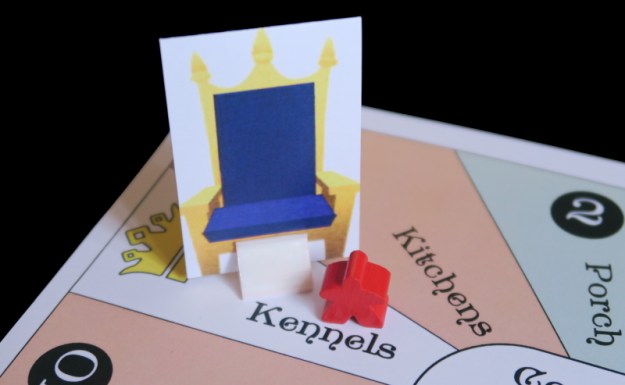
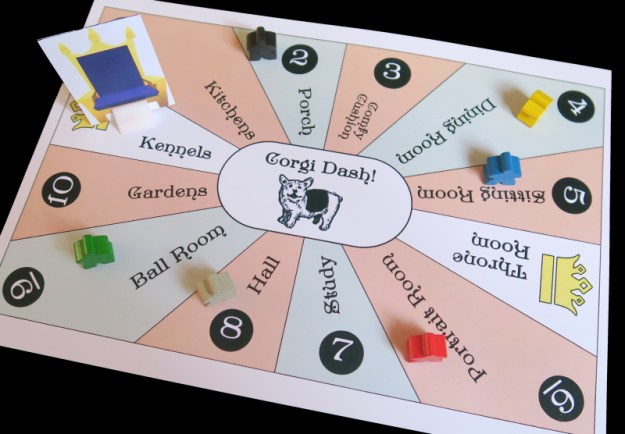
Ivory, Black and Purple turned up as well and as they arrived, everyone remarked on the new smart table decor.  We were only waiting for Lime, but when Pine suggested he might not be coming, his text enquiry was met with the response, “OMG, it’s Tuesday not Monday, will be there in twenty minutes!”  So, while the group were waiting, they decided to start with the “Feature Game“.  To mark the passing of Her Majesty Queen Elizabeth II, this was Corgi Dash, a re-theme of the 1986 Spiel des Jahres winner Heimlich & Co..  Corgi Dash was published as a “Jubilee Souvenir” earlier this year, by Tony Boydell; although we had a copy picked up at the UK Games Expo, as it was a special occasion we had enlarged the board to make it easier to play in a large group.

Corgi Dash
– Image by boardGOATS

The game is very simple:  on their turn, players roll a die and distribute the pips amongst the “corgis” to move them round the board.  When one of the corgis reaches the throne (either in the Throne Room or the Kennels), each dog scores with the one that triggered the scoring getting nothing.  The Throne then moves to the next location, and the corgis continue to dash towards the Throne.  Each player secretly “owns” one of the dogs and after one dog reaches a score of thirty, everyone secretly guesses which dog belongs to which player.  The game ends when one dog reaches forty points.  Players then score for their dog and receive five additional points for each identity they guessed correctly.

Corgi Dash
– Image by boardGOATS

Blue, Pink, Ivory, Purple and Pine got going first.  In their game, the blue dog (well, meeple actually) got picked on early which marked it out as the dog with no owner.  Unfortunately, the blue dog turned out to belong to Pine and it was the grey dog who had no owner, which became more apparent towards the end when everyone concentrated on their own hounds.  The black dog was the first to get to thirty and then the only one to get to forty too.  Ivory was the only one to guess more than one owner correctly, but it didn’t make any difference as the black dog’s score was twenty more than any other, making it’s owner, Pink, the clear winner.

Corgi Dash
– Image by boardGOATS

On the neighbouring table, Green (who had played Heimlich & Co. a very long time ago, explained the rules to Lilac, Orange, Lemon and Purple. They finished their game early, guessing after two scoring rounds and scoring after the third.  Green’s dog did by far the best picking up thirty-two points, twelve more than any other hound.  Orange did exceptionally well at guessing who had each dog, getting three right, but it wasn’t quite enough to take the lead and he finished two points behind Green, both some way clear of the field with Lemon a distant third.

Corgi Dash
– Image by boardGOATS

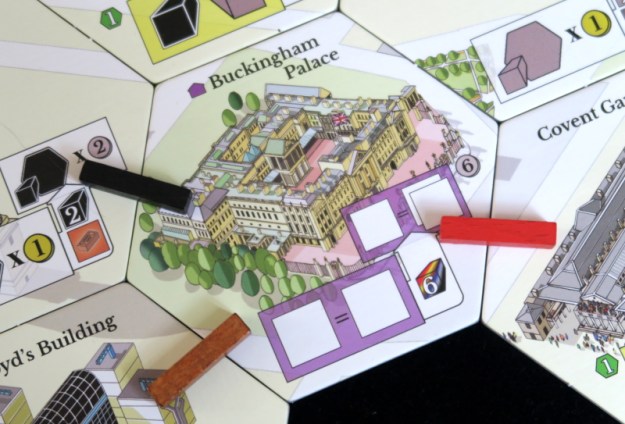
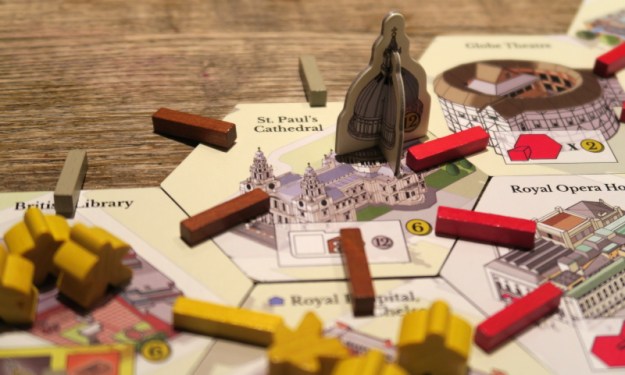
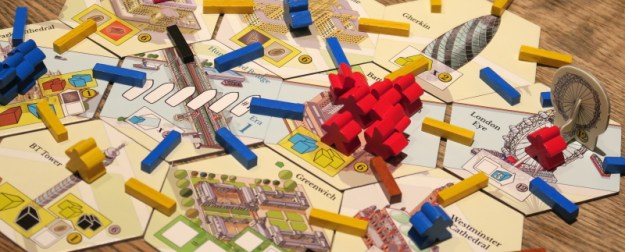
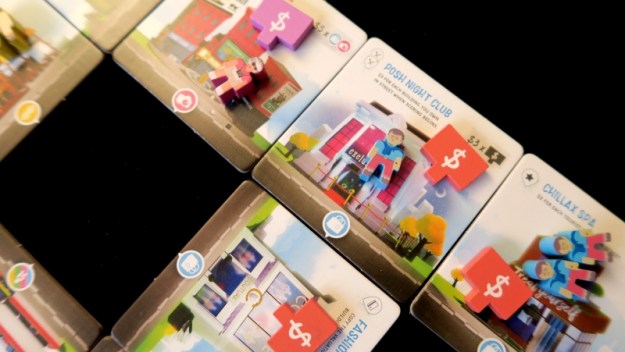
Corgi Dash was very quick to play leaving plenty of time for other games.  With all the happenings around Buckingham Palace and Westminster over the last week, “London themed” games seemed appropriate, so while everyone else played Ticket to Ride: London, Ivory, Blue and Lime took themselves off to the other side of the room to squeeze in a game of Key to the City: London.  This is a reimplementation of one of Blue’s favourite games, Keyflower.  Lime, however, had not played either game, so Blue and Ivory had to explain the rules first.

Key to the City - London
– Image by boardGOATS

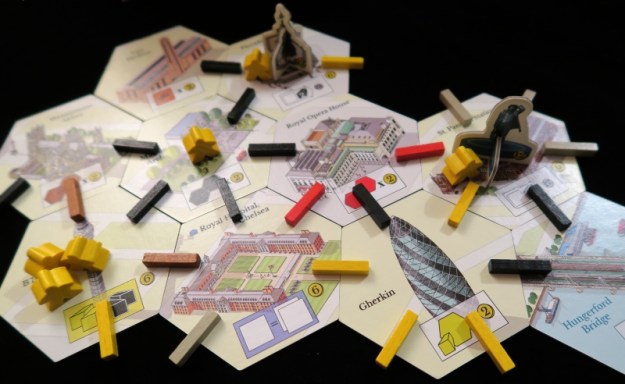
Like Keyflower, Key to the City: London is based on an a series of tile auctions where players bid with meeples.  The rules for bidding are simple:  players can bid on any tile, but if there is already a bid, they must follow with the same colour and increase the value.  In addition to bidding for tiles, players can also activate a tile in their Borough, a tile in someone else’s Borough or even a tile that is currently up for auction.  Again though, players must follow colour if the tile has already been activated or has an active bid, further, every time it is activated it costs one additional meeple.

Key to the City - London
– Image by boardGOATS

At the end of each round, all meeples in winning bids return to the bank and players take any tiles they’ve won and add them to their Borough.  All meeples on tiles in a player’s Borough go back to that player, and any meeples used to activate tiles up for auction go to the winner of the tile.  Tiles are worth points at the end of the game.  Some are just worth points out-right while others are dependent on tiles they are connected to and all are worth more if they are upgraded.  Connections are acquired by activating specific tiles; tiles are also upgraded by activating them and paying any associated cost.
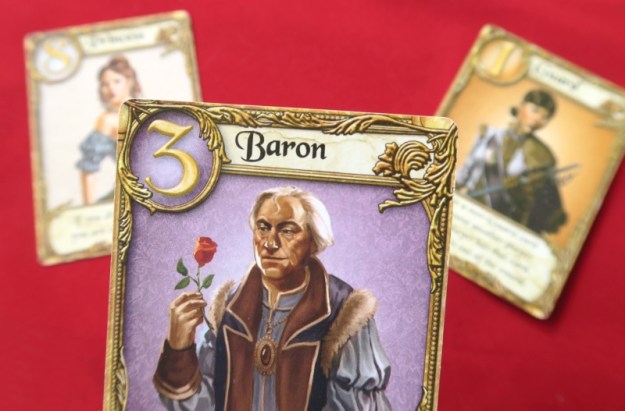
Key to the City - London
– Image by boardGOATS

The winner is the player with the most points at the end of the game.  While the mechanics of the game are fairly straight forward, like Keyflower the art of the game is combining them to score well.  The Connections are the main difference between Key to the City and Keyflower, but there are several other smaller differences like the round endings, for example.  In Keyflower, players bid for boat tiles which dictate how many meeples they get at the end of each round, but in Key to the City, when players choose to end their round place their boat in a position on the river.  The earlier a player “checks out”, the earlier they can place their boat and the more meeples they can get—and meeples are scarce, very scarce, in both games.
Key to the City - London
– Image by boardGOATS

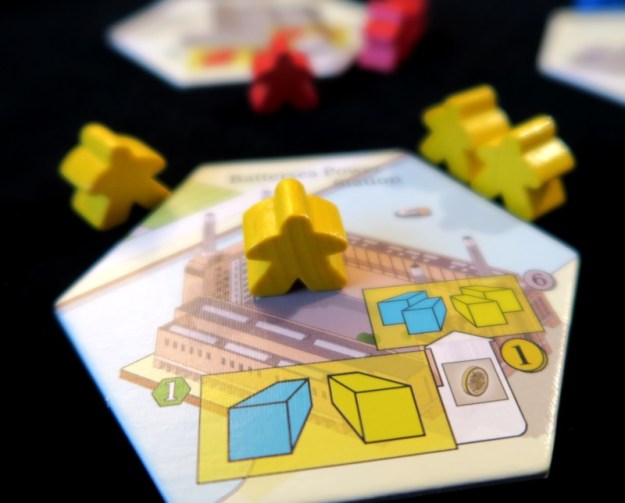
This time, Ivory with the Buckingham Palace player screen and start tile, went first.  He began by winning Paddington Station which gave him telecoms (black) and electricity (grey) cable connections.  He went on to couple this with St. Pancras, Kings Cross and the Royal Academy which gave points when connected with electricity cables and Marble Arch and Monument which gave points for telecoms cable connections.  Lime understood the fundamentals, but was struggling with how to fit them into the game, so when he picked up Battersea Power Station which provided water (blue) and gas (yellow) pipe connections, he was encouraged to pick up the London Eye and Canary Wharf to go with it which ultimately proved good choices.

Key to the City - London
– Image by boardGOATS

Blue lost out in a couple of early bidding wars, so ended up with the Barbican instead, giving her underground tunnels (red) and waste pipe (brown) connectors and later Charing Cross (more underground tunnels and grey electricity cables).  Maybe she’s spent too long with Pink, but she mostly chose to eschew sewage pipes and electricity pylons, instead focusing on trains, using them to make connections with the Royal Opera and the Globe Theatre.  Unfortunately, there was a little “rules malfunction” in the early part of the game with a misunderstanding of one of the scoring icons.  Instead of players scoring for connectors of the colour indicated connected directly or indirectly to a tile, players should only score for each tile connected to the scoring tile.

Key to the City - London
– Image by boardGOATS

The “rules malfunction” was spotted quite early, so although it added a little to Lime’s confusion, everyone had enough time to correct things before scoring took effect.  In the final round, Ivory bid for the Natural History Museum which gave him points for monuments, and London Zoo giving him two points for each blue meeple he was left with at the end of the game.  He then activated a few last tiles and set sail.  Lime engaged in making lots of utilities connections, and bid for the British Museum and the Royal Festival Hall (giving two points for each tile won in the final round and three points for each tile connected by all six utilities respectively).
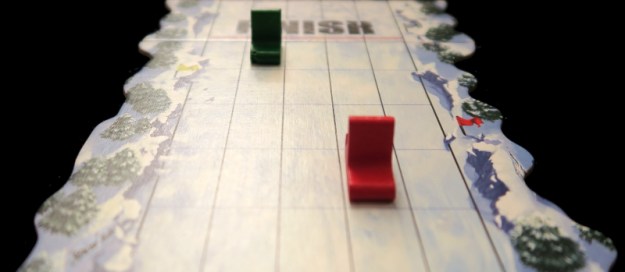
Key to the City - London
– Image by boardGOATS

Blue took the V & A Museum (giving points for sets of skills tiles) and the Science Museum (giving points for tiles with six connections).  Then she made a mistake:  with Ivory out and Lime running low on meeples, she had the opportunity to either out bid Ivory for London Zoo, or compete with Lime for the British Museum and in a fit of stupidity went for the latter.  Blue’s error might have proved critical though as winning the zoo would not only have given her twelve points, but also taken twelve from Ivory.  As it was, in the final count, Ivory took victory with a hundred and seventeen to Blue’s ninety-six and Lime’s seventy-eight.

Key to the City - London
– Image by boardGOATS

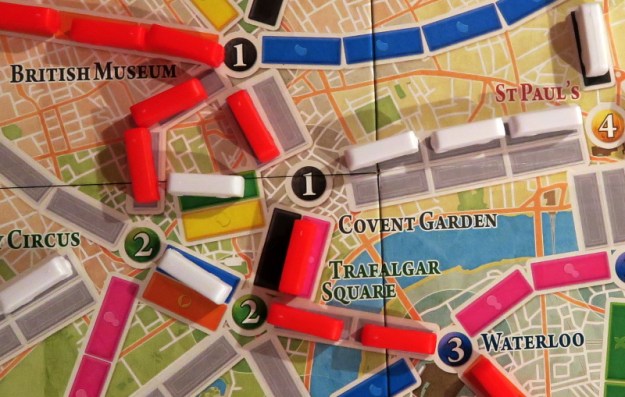
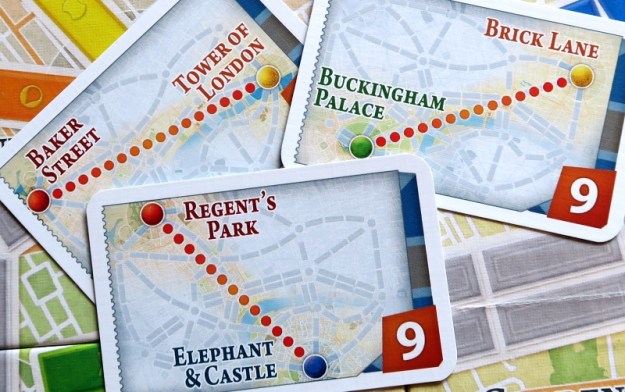
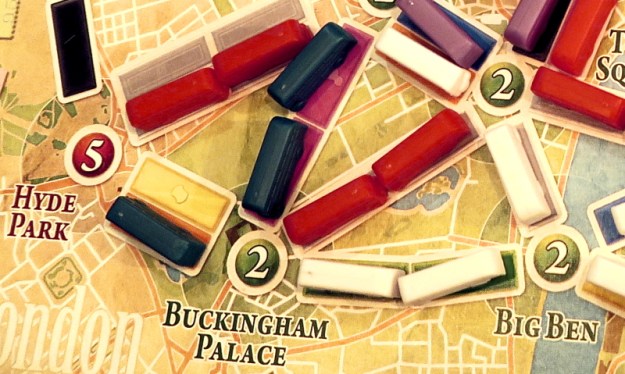
Meanwhile, on the other side of the room two games of Ticket to Ride: London were underway.  Ticket to Ride is one of our current favourite games and the London variant, being one of our “local” editions is particularly popular.  The game plays in the usual way with players taking cards from the market, using them to pay to place trains on the map and claim routes, or taking Tickets which give points at the end of the game if the two destinations are connected.  Each map has an extra rules “tweak” and in case of the London edition players get bonus points if they visit all the places in a borough.

Ticket to Ride: London
– Image by boardGOATS

When Pink asked Pine who the people were on the box there was a general aura of shock when he claimed not to recognise Emma Peel (though he did correctly identify Her Majesty Queen Elizabeth II).  Their game with Purple and Black started off very confrontationally in the centre of the board and carried on in much the same vein as the game developed from there.  Pink took Pine’s dubious advice to take more tickets, but failed to score them.  Pine got his comeuppance though when Black just pipped him to the line beating him into second place by a single point, while Purple took third.

Ticket to Ride: London
– Image by boardGOATS

The other group managed to rattle through the game really quickly too as everyone knew what they were doing.  Orange completed all his Tickets and triggered the end of the game.  For everyone else it was a more frustrating game. Lilac was convinced she was going to lose as she had failed to complete one of her tickets finding herself blocked, but in the end finished second, significantly ahead of Green and Lemon.  Green had tried the “gamers tactic” (espoused by Black on previous occasions) said all the best Ticket to Ride players do, namely  collecting more tickets at the start of the game.

Ticket to Ride: London
– Image by boardGOATS

This went OK until about half way through when he got blocked on his best route, then while trying to re-route got blocked again, forcing him to try a third option. This was blocked too and he was locked out of his key station, finishing with three incomplete Tickets.  Lemon had tried the same strategy (collecting tickets first), but also ended up with a couple not completed.  As a result, Orange wiped the floor with everyone else finishing with a score nearly three times that of his nearest competitor: a convincing victory.

Ticket to Ride: London
– Image by boardGOATS

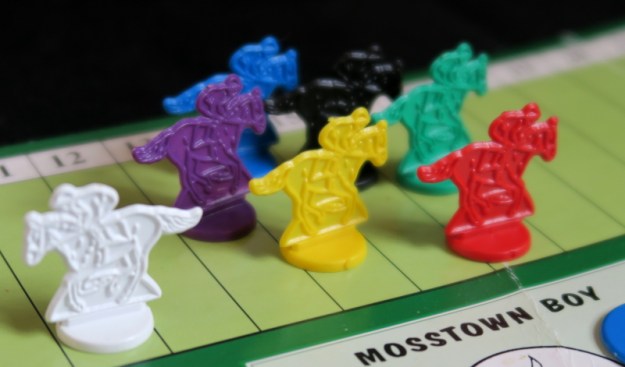
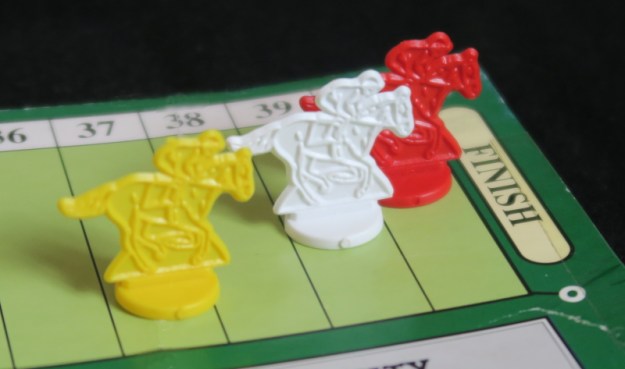
Key to the City: London was still underway, so, given Her late Majesty’s well known love of the gee-gees, the two groups got together to play Turf Horse Racing.  It was a while since anyone in the group played it, so Green reminded everyone of the rules.  The idea is very simple, players have three counters to use for betting, two small and one large, double weight one.  In the first stage, players take it in turns to use these counters to bet on horses.  In the second stage, players take it in turns to roll the die and move a horse to determine the outcome of the race.

Turf Horse Racing
– Image by boardGOATS

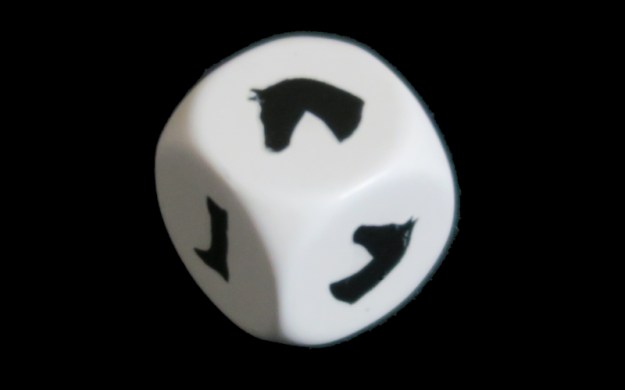
The game works because the die has three horses heads with one of each of the other icons, and each horse moves a different amount depending on what is rolled.  Since each horse has to move before a horse can be moved again, players can choose to make a positive move for one of their own horses, or nobble someone else’s.  Although the rules as written give the maximum number of players for Turf Horse Racing as six, the group thought it would stretch to more due to the way it is played.  And given the hilarity that ensued, that seemed a really good decision.

Turf Horse Racing
– Image by boardGOATS

It was decided that due to there being so many players, perhaps three bets per player would create too many horses with multiple bets, so it was house-ruled to two bets only each: one big and one small.  The extra bet tokens needed were taken from Ticket to Ride: a scoring disc and a bus.  Pine was the sole “investor” in Roamin’ Emperor’s fortunes.  Pink, trying to get his revenge for being misled in Ticket to Ride, cajoled everyone to choose this purple horse to move only one space, much to Pine’s annoyance.  Pink got his way, but then got his comeuppance when someone made his chosen horse, Lagoon Lady, also move only one.

Turf Horse Racing
– Image by boardGOATS

After the first round it was Silver Blaze blazing a trail up front, closely followed by Mostown Boy and Raven Beauty.  This theme kept repeating with Lagoon Lady and Roamin’ Emperor moving only one space a turn, until finally Pine struck gold and was able to shoot his horse forward by a massive fifteen spaces and get it into the leading group.  It was a close race, and eventually Silver Blaze was overhauled and brought back into the pack.  As the race entered it’s final furlongs Lagoon Lady was still languishing behind.  Although it had made up some ground, Roamin’ Emperor was making better progress but also starting to fall back.  One more “mega surge” would have been enough to put it within spitting distance of a win, however, that was not to be.

Turf Horse Racing
– Image by boardGOATS

In the end it was The Red Baron who crossed the line first, with Silver Blaze second and Desert Prince third. Adding up the betting totals, Lemon took home the biggest winnings with eight, with Lilac just one behind in second and Black a comparatively distant third.  The conclusion was that Turf Horse Racing can definitely be played with eight, but maybe a little more tinkering is needed. Perhaps keeping the three bets, but with seven horses, the start player moved around the table very slowly—something to think on and investigate further perhaps.

Turf Horse Racing
– Image by boardGOATS

Learning Outcome:  Her Majesty had a point—dogs and horses can be a lot of fun.

Boardgames in the News: What are “Filler” Games?

To most people, games come in two types, board games and card games.  Modern board gamer, however, have many other classifications.  For example, board gamers make the distinction between Strategy Games and Family Games.  Strategy Games typically are more complex than Family Games, which is not to say that Family Games don’t involve strategy, simply that the strategies are more involved.  Typically, a “Light Family Game” will be relatively simple in concept and take around forty-five minutes to an hour to play, where “Heavy Strategy Games” tend to take at least a couple of hours and sometimes several or more.

Niagara
– Image by boardGOATS

Examples of Family Games include Niagara, Downforce and Escape: The Curse of the Temple, while Altiplano, Keyflower and Concordia might be described as Strategy Games.  There is a third category which, can be harder to describe, Filler Games.  These are typically shorter games that often also fit the Family Game criteria, but have sufficient challenge that players of heavier Strategy Games enjoy playing them between other games.  “Shorter” is obviously in the eye of the beholder—to people who often play games that last several hours, any game that lasts less than an hour and a half might be a “Filler game”.

– Image by boardGOATS

However, if a games night lasts around three hours, a Filler Game might be one that lasts no more than around thirty minutes or so.  More importantly, and in order to save time, they have minimal setup time and are usually well known amongst gamers or at least are very quick to teach.  Popular Filler Games include card games like No Thanks! and Love Letter, but also tile laying games like NMBR9 and board games like Tsuro and Draftosaurus.  All these fit the basic criteria, but additionally are good fun and are great for warming up or down at the start or end of an evening, as well as for playing between games and while waiting for other games to finish.

No Thanks!
– Image by boardGOATS

13th January 2022

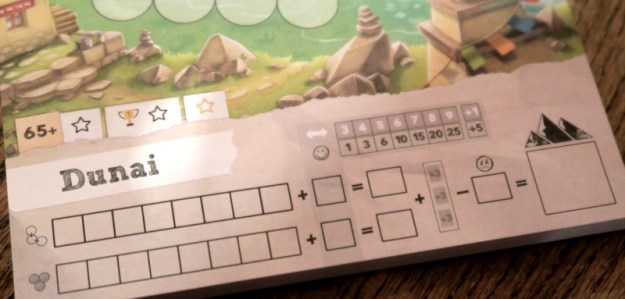
Blue and Pink were the first to arrive, soon joined by Black and Purple.  Others quickly rolled up and before long, everyone was discussing what they’d been doing over the holiday.  Teal produced a new “Roll and Write” game that everyone could play together, called Trek 12: Himalaya, a game where players are climbing a mountain.  He gave a quick summary and demonstrated how he’d raided the stationary cupboard so everyone quickly agreed to give it a go.

Trek 12: Himalaya
– Image by boardGOATS

The game has some prima facie similarities to On Tour which we played remotely a couple of times, in that two dice are rolled and their results combined.  In On Tour, the results are simply combined to make a two digit number, so a two and a three can make a twenty-three or a thirty-two.  In Trex 12, the numbers are combined by addition, subtraction or multiplication and additionally players can pick either the larger or the smaller individually, with each option available a total of four times during the game.

Trek 12: Himalaya
– Image by boardGOATS

Players are trying to make chains of consecutive numbers and groups of the same number—runs and melds, which represent ropes and camps respectively.  At the end of the game, players score for the highest number in the rope (or camp), plus one additional point for every other connected point (which must be connected when they are played).  Additionally, players score bonus points for the longest rope they make, and the largest camp, and penalties for any isolated numbers that are not part of a rope or a camp.

Trek 12: Himalaya
– Image by boardGOATS

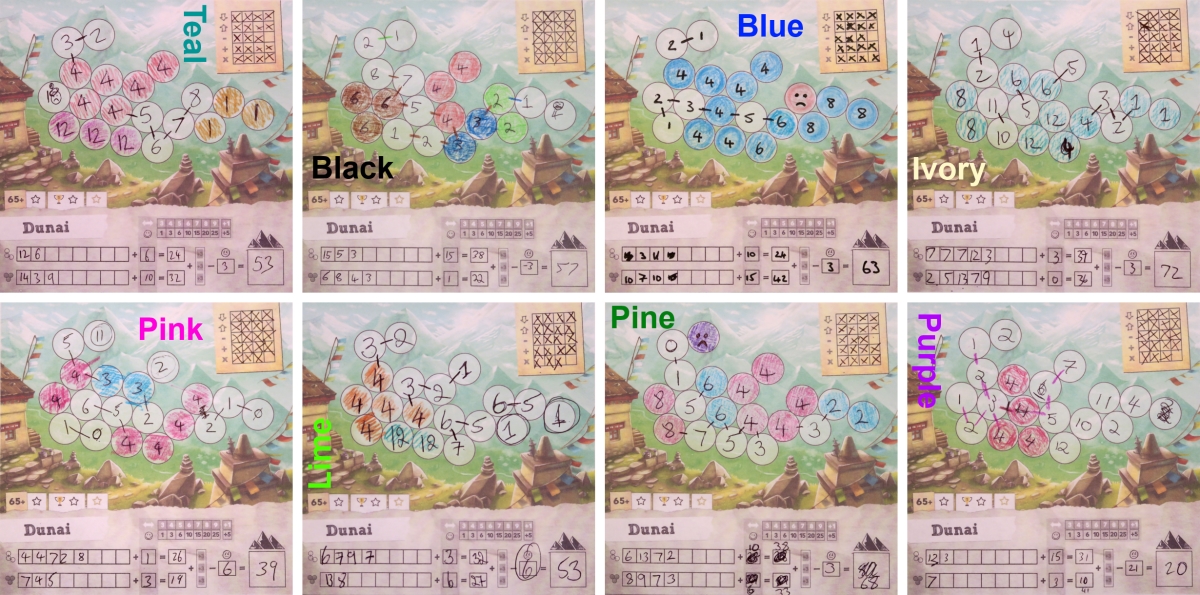
It took a couple of turns to get going, but thereafter it was quite quick.  The game has a sort of legacy element with alternative maps and envelopes that can be opened once certain challenges have been met, but we played the Dunai map and without any complications.  Teal pointed out that although the first number can go anywhere, thereafter numbers must be written next to other numbers so it was wise to keep options open.  Pink therefore started at one end, immediately demonstrating how to make the game more challenging.

Trek 12: Himalaya
– Image by boardGOATS

Pine and Blue seemed to be working to very similar strategies with a long rope and a large “Four” camp in the middle, though Pine made a better fist of it and finished in second place with sixty-eight.  Ivory was the overall winner though, with lots and lots of short bits of rope of high value and a final score of seventy-two, well clear of the total needed to beat the game.  Trex 12 had been both quick and enjoyable, so after that aperitif everyone was ready to move on to something a little more filling, and the group split into two, the first playing the “Feature Game“, Streets.

Streets
– Image by boardGOATS

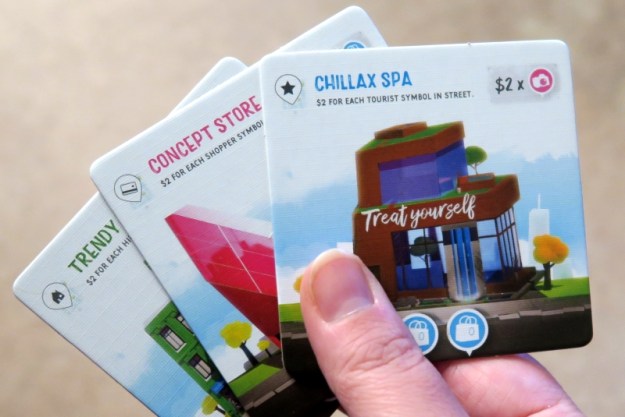
Streets is a tile laying game by the same people as the very enjoyable Villagers.  It is, perhaps, a little lighter and, rather than developing the occupants of a village, players are building a city, transforming it street by street, from a small town into a centre of culture and commerce.  The turn structure is similar to more familiar games like Carcassonne: On their turn, the active player chooses a building tile, adds it to the town, places an ownership marker on it and then scores any completed features, in this case, Streets.

Streets
– Image by boardGOATS

Although there are similarities, there are a lot of differences: players have a hand of three tiles all of which represent buildings; as well as ownership tokens, the active player also places people on the building, then there are the tile placement and scoring rules.  The building tiles have a road at the bottom and sky at the top and can be placed such that a Street, a row of houses, is extended by adding the tile to it in the same orientation, or terminated so that the road is perpendicular forming a junction.  When both ends of a Street finish in a junction, the Street is closed and scored.

Streets
– Image by boardGOATS

Different buildings score in different ways, for example some tiles give points for people in the Street and others for the number of building symbols in the Street.  There are a few little niggly little rules.  For example, when scoring a Street players include the symbols on the street itself, but also any on a tile that terminates the Street and points towards it.  There are other ways of scoring buildings as well, for the number of adjacent tiles or copying another building of choice in the Street for example.  In addition to the money won for the building itself, players also score for the number of people on the tile scored.

Streets
– Image by boardGOATS

When a building is scored, the active player moves the people on to different building in another, open Street.  This encourages players to terminate Streets even though they might not score themselves, because they can move people onto their own buildings elsewhere which means they will score more later in the game.  There are a few other things that contribute to the decision making dilemmas.  For example, players only have five ownership tokens, and if they run out, they have to take them from another building without scoring it.

Streets
– Image by boardGOATS

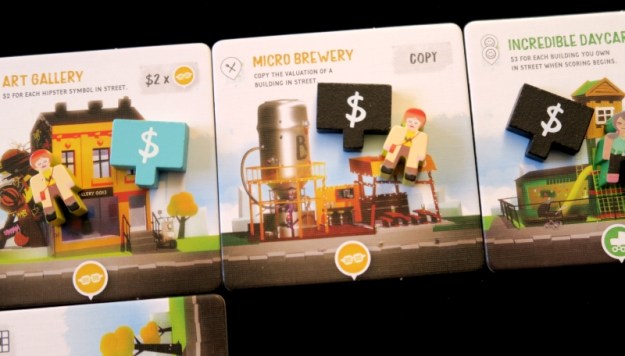
The game ends when all the tiles have been played and any remaining Streets are scored, but for half points (similar to Carcassonne).  The basic game is quite straight forward, but although most people got to grips with it, the combination of small text, symbols, a little confusion of terminology and general tiredness meant others struggled with planning effective moves.  Black took what was obviously an early march when he played his micro-brewery tile to “copy” another high-scoring tile in the same street, but Purple, Blue and Pine had their moments too.

Streets
– Image by boardGOATS

In the end, Black won with a cricket score of a hundred and twenty (well, a score that would have beaten England in the recent Ashes series anyhow).  Blue, Purple and Black quite enjoyed the game and could see the its potential for adding expansions too.  Definitely one to be played again, though Pine might need some persuading.  Meanwhile, on the next table, Ivory, Pink and Teal were getting to grips with a game of Key Flow (Lime having taken an early night after another very early morning).

Key Flow
– Image by boardGOATS

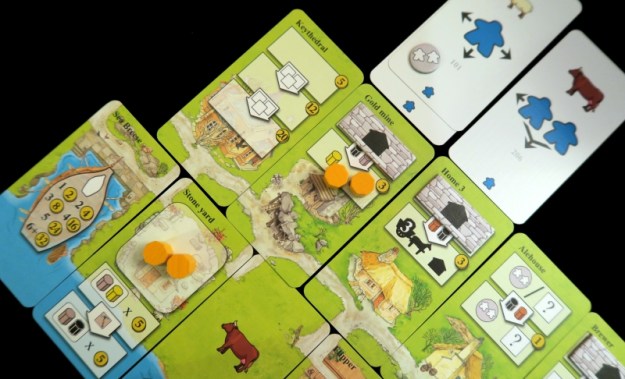
Ivory and Pink have played Key Flow and its big brother, Keyflower, many times before (including relatively recently in October), but Teal was new to the game though he’d heard good things.  In both games, players are building villages and activating the buildings in their villages by playing meeples (or rather Keyples) to generate resources and score points.  The games have a lot in common including the artwork, the iconography and the fact both take place over four rounds or seasons, but the underlying game mechanism is different.  In Keyflower, players acquire tiles by auction where in Key flow players gain cards by drafting.

Key Flow
– Image by boardGOATS

Key Flow is surprisingly straightforward to play, though doing well is a completely different matter.  Players who start with a hand of cards, choose one and pass the rest on, adding their chosen card to their village before they get their next, slightly smaller hand.  There are three types of card:  Village cards, Riverside cards and “Keyple” cards.  Village cards are buildings that can be activated by playing Keyples above them, while Riverside cards provide instant resources and skill tiles.

Key Flow
– Image by boardGOATS

The cards have to be “connected” together and location can be important. Buildings for example are more productive if they have been upgraded, but upgrading needs resources and the resources need to be moved to the building being upgraded. Similarly, in autumn there are some buildings which score points for resources they are holding. Therefore, it is helpful if the building producing the resources is near to the one being upgraded or used for scoring as moving resources can be expensive and sometimes difficult.

Key Flow
– Image by boardGOATS

Simlar to the Keyples in Keyflower, the Keyple cards are used to activate buildings and produce resources.  Some can be played either in a neighbour’s village or the player’s own village.  Other cards can only be played in the village one side or cannot be played in one’s own village.  This is why three players is arguably the sweet-spot for Key Flow—with more players there is at least one village players cannot use, adding a level of randomness that it is difficult to deal with.  With three however, everything in play is accessible, though perhaps at a cost.

Key Flow
– Image by boardGOATS

At the start of the game players get some winter cards which can act as objectives to guide players’ strategies; at the start of the final round players get to keep one of these with the rest going into the draft.  At the end of the game, players score for any autumn cards, any buildings with upgrades as appropriate, any winter cards and finally one point for any otherwise unused gold.

Key Flow
– Image by boardGOATS

This time, Pink went for a “Scholar Strategy”, but changed his mind at the last minute to go for the Ranch instead.  Teal went for a gold strategy with the Jeweller to double his score, and picking up both the Gold Mine and the Smelter, the latter of which he upgraded so he could exchange one skill tile for three gold.  Unfortunately, Pink found that useful too and therefore got in his way somewhat.  Ivory didn’t appear to have a strategy early on, but made sure he had plenty of resources he hoped would be useful later in the game.

Key Flow
– Image by boardGOATS

In the final round, Pink got his Scholar anyhow then lucked out and got the Trader too, while Teal’s flotilla of boats gave him a lot of options, but somehow he struggled to convert them into points.  Ivory who had been keeping all his options open with a scatter-gun approach, managed to finish with a smorgasbord of points from pigs, Keyples, travel, and of course resources.

Key Flow
– Image by boardGOATS

It was not a surprise Ivory won as he always does well in this game, but Pink was very pleased to have run him close finishing just five points behind.  With that, people started to drift off, a few people hung about for a while, just chatting, amongst other things, discussing what “Cotton Clouds and White Cashmere” smells like and whether the new soap in the Ladies really did smell of it…

Key Flow
– Image by boardGOATS

Learning Outcome:  “Roll and Write” games aren’t only the preserve of “Remote Gaming”.

3rd Movember 2021

Blue and Pink were, unexpectedly, joined by Green and Lilac thanks to a clock-reading malfunction.  So while Blue and Pink were dealing with their dinner, Green introduced Lilac to Tsuro.  This is a very accessible game that we actually managed to play a little over a year ago from home, but is much better played in person.  Each player starts with a stone lined up on the edge of the board and a hand of three tiles.  On their turn, they place one of their tiles on the board next to their stone, and move their stone along the path on the tile, then replenish their hand.

Tsuro
– Image by boardGOATS

The aim of the game is to stay on the board the longest, with the last player remaining, the winner.  It wasn’t long before Lilac had Green on the ropes and Blue and Pink urged her to take her chance and finish him off.  It’s not in Lilac’s nature to go for the jugular, however, and despite the encouragement, she didn’t make the most of her opportunity.  Inevitably, Green wriggled free and it wasn’t long before he was edging Lilac off the board himself.  With the first game over, and Blue and Pink finishing their dinner, there was a little chatter before others arrived and players were deciding what to play.

Tsuro
– Image by boardGOATS

The “Feature Game” was to be Modern Art, which is an auction game where players are buying and selling art trying to make a profit with paintings valued by the number of artworks of that type that were sold.  It is an older game, nearly thirty years old, and several people had played it before, albeit some years ago.  When Green admitted that he hadn’t really enjoyed it, Pink was shocked and suggested that not liking Modern Art was akin to not liking puppies, at which point Green, much to Pink’s horror, admitted he wasn’t that keen on them either…

Modern Art
– Image by boardGOATS

Needless to say, when settling on games, Green took himself away from the slightly offended Pink and his copy of Modern Art leaving him (with his brick and sack comments), to play the “Feature Game” with Ivory, Blue and Teal.  The game is a simple, yet clever auction game, and therein lies the problem—the group has had mixed responses to auction games.  For example, the highly regarded Ra (like Modern Art designed by Reiner Knizia) received mixed responses when that was played, however, one of the all-time favourites, Keyflower, is an auction game at its heart (though to be fair it doesn’t really feel like one).

Modern Art
– Image by boardGOATS

The group (aside from Pink) was therefore slightly reticent, but went for it positively, and in the event, really enjoyed it.  Each round consists of several auctions, each of which is conducted by a player.  The auctioneer chooses one card from their hand which is auctioned according to the indicator on the card.  There are five possible auction types:  Open, Fixed Price, Sealed Bid, Once Round the Table, and Double (where two pieces by the same artist are offered at the same time).

Modern Art
– Image by boardGOATS

We were playing with the new Oink Games version, which features real modernist artwork from the likes of Mondrian, Kaminski and Ivory (who obviously has talent we were hitherto unaware of).  When the fifth work by an artist is offered for sale, the round ends (without the final auction), and the works valued.  The value depends on how many paintings were sold by that artist in the round, with the value increasing by $30,000 for the most popular.  Players then sell their art to the bank, but here there is a catch.  Players only get a return on art by the three most popular artists in that round—everything else is worthless.  The value of the art that is sold, however, is the cumulative total including increases over all the previous rounds.

Modern Art
– Image by boardGOATS

Thus, players sell their art giving them money to buy more, and more expensive art in the next round. Although the mechanics are clever, what makes the game fun is the auctioneer’s pitch as they try to describe the work they are selling and draw the other players’ attention to its clear and obvious assets and up-sell it.  One notable lot by Kaminski was initially described as “a cat’s pencil sharpener” and then to much hilarity as “a charming number depicting someone bending over picking up a fiver.”  The game ends after four rounds and the player with the most money at the end wins.

Modern Art
– Image by boardGOATS

This time, players clearly had a bit of a fixation with Kaminski with his works being the most popular in the first round, with Hick and Mondrian making a distant second and third.  The initial popularity of Kaminski inflated the perceived value of his work in the second round and, although fewer works were offered for sale, it still scored, though the Mondrian age was upon us.  The third round was dominated by the works of Okamoto, putting in a brief, but valuable appearance for those that made purchases, as it provided funds for the all-important final round.  This led to a resurgence of Hick as the most popular together with poor Ivory, who’s work had hitherto only had a brief period in the limelight in the second round.

Modern Art
– Image by boardGOATS

The eternal popularity of Kaminski continued until Blue brought the game to an end with a double auction ensuring Kaminski’s works gave a return again, and having scored in every round, they were very lucrative.  Despite the game feeling like there was a lot of ebb and flow, the final scores were remarkably close with a mere twenty grand between first and third—fine margins indeed in a game where the scores were measured in hundreds of thousands and players reserves fluctuated wildly during rounds.  It was Blue though, who made the most, finishing with $392,000, just ahead of Ivory (the gamer rather than the artist).

Modern Art
– Image by boardGOATS

Meanwhile, at the other table, Green, Lilac, Purple and Black (who also expressed a dislike of Modern Art, though not of puppies), were playing the puppy related game, Snow Tails.  This is a fun race game where players are racing dog sleds along a winding track of varying complexity.  The idea is that players have a hand of cards, which they play to adjust the dogs’ speed or apply the brake.  When they play cards, they can play up to three (one for each dog and one for the brake), but they must all have the same value.  The sled speed (how many spaces it moves) is then the sum of the dogs’ speed minus the value on the brake.

Snow Tails
– Image by boardGOATS

Additionally, the sled will drift left or right by the amount by which the two dogs’ speeds differ.  Players have to use this to negotiate corners and slalom round pine trees to get to the finish line.  The cards come from their own personal decks, and this is where the game gets clever because players have to manage the cards they play to make best use of them.  If a player crashes or goes into a corner with too much speed and exceeds the limit, they pick up a dent card.  These occupy space in the player’s hand which means they have less choice.

Snow Tails
– Image by boardGOATS

The first player to cross the line (or, in the case of a tie cross it and travel the furthest), is the winner.  The group spent far too long debating which track to use. Lilac had not played Snow Tails before so the group did not want to make it too extreme, but also not too trivial for everyone else.  In the end the group decided on a variation of “Treemendous” (chosen as it would fit on the “narrower than we would like” pub table) and swapping the first set of trees for a narrow canyon.  Through random selection, Lilac was chosen as start player, but as she wasn’t sure how the game would play she took a gentle start so Purple, Green and Black shot past her at speed.

Snow Tails
– Image by boardGOATS

Through the first corner and approaching the Canyon, Purple hit the side of the track and slowed up, while Green and Black raced forward. Lilac took her foot off the break and caught Purple, who was struggling to get her head around which side of the sled needed the higher number to move to the right to get around the corner.  With the bend successfully negotiated Black slowed for the canyon, but Green decided to let rip through it. He made it in one go without hitting anything, but was on the outside for the next corner.  Black took a steadier run through the canyon and came out on the inside of the corner behind Green.

Snow Tails
– Image by boardGOATS

Lilac also maintained a steady pace taking a couple of turns for the Canyon, while Purple continued to dally at the back, hampered somewhat by her reduced hand size from her earlier crash. Black and Green raced to the forest, with Black reaching it just before Green. He “dropped an anchor” and came to an almost complete stop at the entrance right in front of Green, causing him to slow up sharply and swerve to the left instead of taking the route ahead he had planned.

Snow Tails
– Image by boardGOATS

Black managed to clear the forest first but found himself drifting towards the outside of the long hairpin bend. Green was close behind, but his direction of travel sent him to the inside.  Lilac continued her steady progress, avoiding the hazards and came through the forest unscathed in the middle of the track.  Black and Green were racing hard:  Black had the speed, but was forced to the outside of the track and wasn’t able to make progress while Green going more slowly on the inside, manage to squeeze past to get just ahead.  Then it was a straight fight to the line.

Snow Tails
– Image by boardGOATS

Black was able to lift his break to a one, but could only manage a double four, so he positioned himself less advantageously to try and block Green. It didn’t work as Green came off the corner on another track, but he was a little heavier on his break, so still on a two, and also a double four, Black managed to just slide past for the win finishing just ahead.  Lilac continued her steady progress and finished the following round while Purple took a more leisurely ride through the forest, came out on the outside of the bend.  Struggling to stay on the track on the way round the corner, she finally found her speed down the final straight and came flying off the end of the track, unfortunately a couple of rounds too late to win.

Snow Tails
– Image by boardGOATS

Snow Tails was still going when Modern Art finished, but only just, so Tsuro got a second outing of the evening.  This time, Blue was out first by killing herself and taking her piece off the board, quickly followed by Pink who committed harakiri in a similar fashion.  That left them to cheer on Teal and Ivory.  It was close and they were down to the last few tiles, but in the end, Teal took victory when he pushed Ivory off the board.  As the huskies settled down for a well-earned nap, Pine arrived just in time for one last game of Bohnanza, replacing Green and Lilac who went home as they had an early start the next day.

Bohnanza
– Image by boardGOATS

Bohnanza is one of our old favourites, and barely even needs a reminder beyond the rules that are specific for the particular player count.  With six, players start with different numbers of cards, they plant one or two beans turn over two bean cards from the deck, plant and trade, then draw four cards to replenish their hand.  Buying a third bean field is cheaper as well with six, costing two Bohnentaler instead of three.  This is important because the game is shorter with more players and some players barely get a turn in the final round.

Bohnanza
– Image by boardGOATS

As a result, buying a third field is always a bit risky, and the general consensus is that it is rarely worth it. This time was the exception that proves the rule however, with lots of people deciding to buy a third field.  This had the unintended effect of shortening the game as more beans were left in fields at the ends of the rounds.  This didn’t stop the usual hilarity when people made the occasional silly trades and players got unfeasibly lucky with the draw of the cards.  This time the winner was Ivory, two Bohnentaler ahead of Pine, but in truth, we are all winners with a game that is so much fun.

Bohnanza
– Image by boardGOATS

Learning Outcome: It is amazing how much money people will spend on tat.

6th October 2021

For the first time, the group were meeting on a Wednesday to avoid clashing with the Quiz on Thursday.  As Blue and Pink waited for food they decided to squeeze in a quick game of NMBR9 to celebrate our ninth birthday.  This is a quick little tile-laying game that has almost zero setup time, so is very appealing as a filler in this sort of situation.  The tiles are poly-ominos roughly shaped like the numbers zero to nine and there is a deck of cards featuring each number, zero to nine, twice.  Players take the appropriate number from the box following a flip of a card, and add it to their personal play-space.

NMBR 9
– Image by boardGOATS

Tiles have to be placed in layers with tiles on higher layers being more valuable as the number on the tile is multiplied by the “storey” it is on.  Tiles must be placed adjacent to another tile on the same layer and, when placing tiles on higher layers they must not be wholly over one other tile and must be completely supported (no bridging gaps or overhangs).  This time, Pink managed to make it to four layers putting a seven on the top layer, his third “storey” to give twenty-one points.  As a result he was sure he was going to win.

NMBR 9
– Image by boardGOATS

Pink had fewer tiles on the second and, particularly third levels, though, where Blue had concentrated her efforts.  The effect was very similar, so much so that there was only one point in it, but much to his disappointment, even several recounts couldn’t put the deficit in Pink’s favour.  He was cheered up by the imminent arrival of his pizza though and they were still eating when Green, Lilac, and then Teal turned up.  Since Green and Lilac had missed last time, they introduced themselves to Teal and there was some general chit-chat as everyone else turned up.

NMBR 9
– Image by boardGOATS

Appropriately, as we were celebrating our ninth birthday, there were nine of us to play the traditional birthday “Feature Game“, Crappy Birthday, as we ate meeple decorated chocolate cupcakes.  Crappy Birthday is a silly little party game but is a surprising amount of fun.  As we explained the rules to Teal, we reminisced about last year, when we played it over two sessions (one wrapping our parcels and one giving them) in order to be able to play it online.  Lime expressed his astonishment that it was a year ago, and everyone concurred that it didn’t feel like a year.

2021 Birthday Cupcakes
– Image by boardGOATS

Crappy Birthday doesn’t sound like much: the game is played over one “year” and each player takes it in turns to have their birthday, with everyone else choosing a card from their hand as a “gift”.  The birthday boy or girl then chooses their favourite and least favourite gifts and the givers of these each get a point.  As such, those gifting are trying to avoid the mediocre , in a similar way to Dixit, but “not as good” as Purple opined.  While most people around the table would agree that Dixit is the better game, this group tend to get more fun out of Crappy Birthday because of the really silly gifts on the cards.

Crappy Birthday
– Image by boardGOATS

The silliness of the gifts would get stale if we played the game more frequently, but we only play Crappy Birthday once a year and we usually only use around half the cards, so most cards only come out once every two years.  It is a great way to find out about people though, so being new to the group, everyone thought Teal would be at quite a disadvantage.  This year we found out that Pink was unimpressed by 100lb of raw fish, Lilac quite fancied a trying out a wingsuit and Blue would overcome the creepiness of 3am in the Paris catacombs as apparently they were hard to get to visit.  Ivory, was torn between the opportunity to sing the National Anthem before a Major League Baseball game and getting his earlobes stretched, but went for the latter as his least favourite as it was more permanent.

Crappy Birthday
– Image by boardGOATS

We discovered that Teal likes to keep his feet on the ground, so he eschewed a flight in a fighter jet, but really liked the idea of a Viking helmet.  It was about this point that we were joined by one of the former bar staff who stuck about to help Pink with his gift selection.  It seemed she didn’t really help a lot though as he completely failed to get any of his gifts picked as best or worst.

Crappy Birthday
– Image by boardGOATS

From there, Purple nearly ended up instigating divorce proceedings when she received a set of camera scales from Black (a gift nobody else would have been prepared to give to anyone).  Instead of fully justified revenge, however, Purple gave Black’s his favourite gift a campervan.  Lime having just moved house eschewed recycled newspaper wallpaper, instead opting to decorate his new home with some modern art after some classes.  DIY seemed to be in the air, as Green chose a house that needed renovation, though he volunteered Lilac to fix the roof.

Crappy Birthday
– Image by boardGOATS

As usual, Lime’s amazing gift-giving skills meant he did well, but this time he was beaten into third place by Purple and, remarkably, Teal who tied for first place, with four—it seems Teal knows us all surprisingly well after just a couple of weeks!  As people counted their scores and decided what to play next, the group put together a special selection of gifts for Pine who was running late thanks to a group of over-enthusiastic cubs whom he had been showing round his work.  This special selection was tailor-made for a vegan who doesn’t like horses.

Crappy Birthday
– Image by boardGOATS

From there, the group split into three, one led by Lilac who wanted to play Thurn und Taxis, one led by Ivory who wanted to play Key Flow and one led by Green to play with something short that Pine could join in with when he arrived.  Thurn und Taxis is a slightly older, Spiel des Jahres winning game where players build postal routes connecting cities across Bavaria and surrounding regions.  Routes are built city to city to city, so that each city is adjacent to the next city on the route and there is a road connecting these two cities.

Thurn und Taxis
– Image by boardGOATS

Players are building routes by collecting cards and playing them in front of them.  Every turn, the active player takes a city card from the face-up display (or blind from the top of the deck) and then plays a card for a city connected to either end of their existing route.  The card played, must connect to their route, otherwise they have to discard their route and start again.  Then they can score their route if they choose, but each route must consist of at least three cities and players may build only one route at a time.

Thurn und Taxis
– Image by boardGOATS

If after adding to the route, the length of the route is at least three cities, the player may declare it finished and score it.  Players start with a supply of twenty post offices in their colour, each of which is worth minus one at the end of the game. When they score a route, players place post offices in cities on the board, but they have a choice.  Each city is in a region and each region has a colour, when a route is scored, the active player can either place one post office in one city in each of the region their route visits, or in all the cities on one of the regions their route goes to.

Thurn und Taxis
– Image by boardGOATS

When a route is scored, the active player can take a cart card.  These give points, however, in the general case, the cart card must be one more than the previous one and the route must be longer than the cart number.  Thus, if someone is scoring a six leg route, they can only take a level six card if their previous cart was a level five card.  If they enlist the help of the Wainwright, however, if they have a level five card, they would be able to take a level six card with a route of only four legs.  Once a route is scored, the city cards of that route are discarded, and the player begins a new route on their next turn.

Thurn und Taxis
– Image by boardGOATS

The Wainwright is not the only special character in the game: the Postman, Bailiff and Coachman are all there to offer help, allowing players to take a second card, refresh the card market and play a second card respectively.  Players can only enlist aid once per turn though, so they must choose who they call on carefully. When a player exhausts their supply of post offices or acquires a value seven carriage, the end of the game is triggered with players continuing the round—the player with the most points wins.

Thurn und Taxis
– Image by boardGOATS

In addition to points for cart cards, there are also bonus points available for players to connect all the cities in a region or to have a post office in every outer region, as well as for players completing longer routes and for the player who triggers the end of the game.  In general, bonuses score most for the first player to make the achievement with diminishing returns thereafter.  This is therefore a consideration players must take into account, but the fact that players must add at least one city to their route each turn or lose the whole route is probably the most important aspect of planning in the game.

Thurn und Taxis
– Image by boardGOATS

Although Thurn und Taxis is an older game, Purple had not played it before, and it took her a while to get her head round it.  She got to grips with it eventually, however, it was later in the game and Black and Lilac had already got a head start.  It was very close between them though with the scores neck-a-neck until the last.  Lilac triggered the end of the game by taking a level seven cart card and with it took what turned out to be the decisive bonus point, pipping Black with twenty-seven points to his twenty-six.

Thurn und Taxis
– Image by Lilac

On the next table, Teal had looked in the game bags and decided Azul was one he’d like to play.  Green, Lime and Teal had just started without Pine when he inevitably arrived a couple of turns in.  He politely eschewed their kind offers to start again, instead concentrating on his healthy supper of crisps and cake and choosing his gift.  In Pine-like fashion, he chose to redefine the rules and decided his favourite gift was a hunting expedition as long as the subjects of the hunt were the people delivering the perkiness training in his other “choice” gift.

Crappy Birthday
– Image by boardGOATS

We have played a lot of Azul and its derivatives (Stained Glass of Sintra and Summer Pavilion) over the last three years, but the original is probably still the favourite across the group.  It is really very simple, and despite being an abstract game, the pieces are really nice.  On their turn, the active player either takes all the tiles of one colour from one of the “markets” putting the rest in the centre, or they take all the tiles of one colour from the central pool.  They then add the tiles to one of the rows on their player board.  The catch is that all the tiles placed in any row must be the same colour and if they over-flow, they score negatively.  Additionally, each colour can only score in each row once.

Azul
– Image by boardGOATS

Only complete rows are removed and scored, and then only at the end of the round (when all the tiles in the market and central pool have been taken).  Thus if a player has a nearly complete row at the end of a round, they carry that through to the next round leaving them with less free space to work with.  When a row is scored, one tile is moved to the player’s mosaic and scores for the number of tiles it forms a continuous row/column with.  The game ends when one or more players complete two rows.  This time it was a game of two halves, or rather two games.  It had been a while since we played the original version (or any version for that matter), but it wasn’t long before Teal, Lime and Green were happily playing, filling their boards.

Azul
– Image by boardGOATS

Lime and Teal took an early lead and were soon well ahead of Green as he had concentrated on filling his grid from the bottom up, whereas they had been working from the top down. As the game progressed Green began to catch up.  It was then that he realised that he’d forgotten what the game end trigger was.  He’d thought it was when the markets could no-longer be refilled, but checked the rules to be sure.  Only to find that two full completed rows had happened two turns earlier!  The group decided to finish the round and make it the last.  It was very close between Lime and Teal, with Lime just taking victory by three points.  The other games were still going and it was not yet late, so the group decided to give it another go, and this time finish the game correctly.

Azul
– Image by boardGOATS

In the second game, Green built his grid from the top down and the scores remained fairly similar, until around half way through when Teal began to pull away.  It was at about this point that Green noticed that one row had tiles of a colour he’d already scored for that row.  No-one was quite sure how it had happened, but the mutual decision was that he’d move these tiles down to the next row.  That turn didn’t go quite as expected, but at least it wasn’t a complete disaster.  The following round, he discovered he’d done the same thing again.  This time he worked out what he’d done:  he’d had failed to clear the remaining tiles when he moved one across to the pattern board.  So, on the previous turn, instead of moving tiles, he should have removed them.  It didn’t really matter though as Teal won by a landslide.

Azul
– Image by boardGOATS

Meanwhile, Ivory, Blue and Pink had revised the rules, completed card set up for Key Flow, and had started playing.  Key Flow is the card game of one of the group’s favourite games, Keyflower.  In both games, players are building villages and activating the buildings in their villages by playing meeples (or rather Keyples) to generate resources and score points.  The games have a lot in common including the artwork, the iconography and the fact both take place over four rounds or seasons.  Fundamentally, the underlying game mechanism is different, however, with players acquiring tiles by auction in Keyflower and by card drafting in Key Flow.

Keyflower
– Image by boardGOATS

Once the card decks have been sorted out, Key Flow is quite straightforward to play, though doing well is a different matter.  Players who start with a hand of cards, choose one and pass the rest on.  They then add their chosen card to their village.  There are three types of card:  Village cards, Riverside cards and “Keyple” cards.  Village cards are buildings that can be activated by playing Keyples above them, while Riverside cards provide instant resources and skill tiles.

Key Flow
– Image by boardGOATS

The cards have to be “connected” together and location can be important.  Buildings for example are more productive if they have been upgraded, but upgrading needs resources and the resources need to be located on the building being upgraded.  Similarly, in autumn there are some buildings which score points for resources they are holding.  Therefore, it is helpful if the building producing the resources is near to the one being upgraded or used for scoring as moving resources can be expensive and sometimes difficult.

Key Flow
– Image by boardGOATS

At the start of both Keyflower and Key Flow players get some winter tiles/cards which can act as objectives to guide players’ strategies.  Whereas in Keyflower these are just added to the tile draw, in Key Flow, players get to keep one of their winter cards with the rest going into the draft.  At the end of the game, at the end of winter, players score for any autumn cards, any buildings with upgrades as appropriate, any winter cards and finally one point for any otherwise unused gold.

Key Flow
– Image by boardGOATS

One of the biggest differences between Key Flow and Keyflower is the way Keyples work.  In Key Flow, they are cards and come in singletons and pairs.  Each card has a small Keyple at the bottom of the card, and the number of Keyples needed to activate a building is one more than the number of small Keyples already there.  So if there is one small Keeple already there, a pair would be needed to activate that building.  Further, only one card is can be played each round, so if two small Keyples are already present, the Keyple card must be augmented with a Keyple token (obtained as a bonus with some cards or from some buildings).

Key Flow
– Image by boardGOATS

Further, the Keyple cards also feature arrows which indicate where they can be played.  Some can be played either in a neighbour’s village or the player’s own village.  Other cards can only be played on one side or cannot be played in their own village.  This is why three players is arguably the sweet-spot for Key Flow—with more players there is at least one village players cannot use, adding a level of randomness that it is difficult to deal with.  With three however, everything in play is accessible, though perhaps at a cost.

Key Flow
– Image by boardGOATS

It had been a while since Key Flow had been given an outing, so although game play is functionally straightforward, it took Blue, Ivory and Pink a while to remember the little features and how to make the game work for themselves.  Pink started off early with an obvious strategy of generating stone, stone and even more stone from his Keystone Quarry.  It was very clear, even to Pine who joined in to spectate about halfway through, that Pink had a winter card that would score for stone.  And so it proved when he produced the Trader in the final round.

Key Flow
– Image by boardGOATS

Things were less clear-cut for Blue and Ivory, however.  Blue started by just playing the cards in her hand, which meant she ended up with a lot of cows (just because).  In summer, Ivory picked up a boat that allowed him to convert sheep into pigs and pigs into sheep, which went nicely with his animal scoring winter cards.  Blue, on the other hand, very out of practice with this sort of game, just played tactically, and played for points.  Her Workshop went well with the Mercer’s Guild she had in her winter cards, but the Well and Goldsmith, both fully upgraded gave her thirty-five points alone.

Key Flow
– Image by boardGOATS

Ivory had a bit of a nightmare and was unable to make the game work for him this time.  This was made worse by a rule we only spotted towards the end which meant each Keyple card could only be used towards one goal and the fact he made a mess of things when he put a Riverside card in the middle of his village and had to make it work retrospectively.  As he said sadly, although he had remembered how to play, he’d forgotten how to win.  Pink, with his massive pile of stone thought he was in with a good chance, but they were actually only worth one and a half points each, so although he had a huge pile, it only gave him thirty-nine points and had taken a lot of work to get them.

Key Flow
– Image by boardGOATS

Pink was a little bit stymied by the fact he was banking on also getting a a sheep scoring card in winter, but Ivory took it before it got round to him.  Blue on the other hand had lucked out when she picked up a lot of Keyple scoring cards that nobody else seemed interested in giving her over a hundred points and a comfortable victory.  With that, Ivory left, as did Lime and Teal, leaving Green, Pink, Blue and Pine waiting for the conclusion of Thurn und Taxis, and time to play a couple of rounds of Love Letter.  In the end, it really was just a couple of rounds and ended with a round a piece for Green and Pink, as the pub was closing and it was time to leave.

Love Letter
– Image by boardGOATS

Learning Outcome:  While camera scales may seem like a good gift idea, in reality the giver will probably end up sleeping on the couch.